


Abstract
Generative Artificial Intelligence (GenAI) is reshaping technology-mediated learning environments in higher education, yet the structural heterogeneity of student adoption patterns—particularly across multimodal dimensions beyond text—remains empirically under-characterized. This study develops an empirically derived, data-driven taxonomy of GenAI adoption among university students, identifying distinct user profiles and their disciplinary and ethical risk implications. A quantitative, cross-sectional design was employed with a disciplinarily quota-balanced sample of 3415 students from eight Ecuadorian public universities, stratified across seven areas of knowledge according to the UNESCO classification. K-means cluster analysis on five continuous multimodal variables (text generation, mathematical problem-solving, programming, image generation, and music generation) yielded four distinct profiles: Passive (44.3%), Artist (24.4%), Technical (18.3%), and Comprehensive (13%). Profile membership showed a significant structural association with academic discipline (χ2 = 517.85; Cramér’s V = 0.225). Profiles differed substantially in their self-reported propensity for intellectual delegation to AI systems, with the Comprehensive profile reporting the highest levels (η2 = 0.114, 95% CI [0.092, 0.139]). These findings suggest that ethical risk in AI-mediated academic environments is not uniformly distributed but structurally associated with whether outputs are verifiable or directly presentable, with implications for differentiated AI literacy programs and institutional governance frameworks in higher education.
1. Introduction
The emergence of Generative Artificial Intelligence (GenAI) constitutes one of the fastest technological shifts in the recent history of higher education. Since the mass release of tools such as ChatGPT at the end of 2022, the capacity of large language models (LLMs) and multimodal architectures to generate text, code, images, audio, and video has transformed the processes of teaching, learning, and academic knowledge production, configuring a new technological ecosystem in which students interact with AI systems as cognitive assistants for problem-solving, content generation, and academic task completion (Dwivedi et al., 2023; Chiu, 2024). Within a few years, student adoption has reached unprecedented levels: global surveys indicate that between 86% and 92% of university students use GenAI tools in their studies, with a significant increase in their use for assessed tasks, rising from 53% in 2024 to 88% in 2025 in contexts such as the United Kingdom (Freeman, 2025). According to a large-scale industry survey conducted across more than 4200 students and educators (Coursera, 2026), over 80% of students report perceived improvements in academic performance attributable to these technologies, although only a minority of institutions have established clear academic integrity policies adapted to this context (UNESCO, 2025).
This phenomenon is not limited to the automation of repetitive tasks; rather, it represents a paradigm shift in which GenAI intervenes directly in the generation of original content, challenging traditional notions of authorship, critical thinking, and authentic learning (O’Dea, 2024; Eaton, 2023). Within this context, the concept of “post-plagiarism” has emerged, wherein the boundary between legitimate collaboration and the delegation of academic work becomes increasingly blurred, and traditional similarity-detection systems lose their efficacy against novel synthetic content (Foltynek et al., 2023). In the Global South, and particularly in Latin America, these challenges are intensified by persistent second- and third-generation digital divides, relating to unequal access to high-quality connectivity, unlimited data plans, and critical AI competencies (van Dijk, 2020; Valdivieso & González, 2025; UNESCO, 2025). In this context, Torres and Duart (2025) describe contemporary students as members of the “WiFi Generation”: a hyperconnected collective that not only uses technology but “inhabits it,” integrating GenAI as a daily cognitive prosthesis within hybrid face-to-face and virtual ecosystems.
Despite the rapid growth of the literature on GenAI in higher education, empirical studies on adoption patterns present significant limitations. The majority focus on text-based conversational tools (primarily ChatGPT or Gemini), with small samples (N < 500 in many cases), concentrated in Anglophone contexts, and with limited attention to multimodality (images, music, programming, mathematics) (Beckman et al., 2025; Saihi & Ahmed, 2026; Torres, 2025). Existing taxonomies, whether conceptual (D’Addario, 2025; Olmanson et al., 2025) or derived from clustering analyses (Beckman et al., 2025; Torres, 2025), typically identify between three and six profiles but rarely incorporate, in quantitative terms, the disciplinary mediation or the relationship with academic integrity indicators such as self-reported plagiarism or excessive delegation—an omission particularly consequential in multidisciplinary Global South contexts, where cognitive demands vary considerably between technical and interpretive fields (Contractor & Reyes, 2025; Qu & Wang, 2025; Saihi & Ahmed, 2026). Without empirical evidence on which profiles concentrate greater risk and in which disciplines, institutional academic integrity policies tend to be uniform and ineffective: excessively permissive for some profiles, unnecessarily restrictive for others.
The present study addresses these gaps through the development and empirical characterization of a taxonomy of GenAI adoption profiles among Ecuadorian university students. It draws on a large, disciplinarily quota-balanced sample (N = 3415) drawn from eight Ecuadorian public universities, stratified across the seven areas of knowledge according to the UNESCO classification, incorporating continuous multimodal variables and analyzing their relationship with the perception of academic plagiarism and other digital behaviors.
General objective
We aim to develop and empirically derive a multimodal taxonomy of GenAI adoption among university students, incorporating disciplinary mediation and analyzing its implications for academic integrity and digital inequalities in higher education.
Specific objectives
- To identify differentiated profiles of GenAI tool usage through non-hierarchical cluster analysis (K-means) applied to multimodal variables.
- To examine the structural association between the area of knowledge and profile membership through association analysis (Chi-square and Cramér’s V).
- To examine the association of the taxonomy with self-reported copying/delegation tendency and mobile device addiction, comparing effect sizes (η2) across both dimensions.
Beyond fulfilling the objectives stated above, this study makes four contributions to the literature on generative artificial intelligence in higher education. First, whereas existing taxonomies remain largely conceptual or text-centric (see Section 2.2), this study offers one of the few empirically derived, multimodal taxonomies of GenAI adoption in a Latin American setting. Second, its sample (N = 3415) is substantially larger than those reported in comparable clustering-based studies (N = 192–379; see Table 1), improving the statistical power and stability of the resulting profiles. Third, unlike prior work, which treats discipline as a background descriptor, this study formally tests and quantifies its association with profile membership, providing an evidentiary basis absent from the studies reviewed in Section 2.2. Finally, by directly linking adoption profiles to self-reported copying/delegation tendency, the study translates a methodological exercise in classification into actionable evidence for the design of differentiated, risk-informed institutional integrity policies—a link that conceptual taxonomies alone cannot provide.
Table 1.
Comparative overview of studies classifying students according to their use of GenAI tools.
2. Theoretical Framework
2.1. Contemporary Conceptualization of GenAI in Higher Education
Artificial Intelligence (AI) is defined as the set of technologies that enable machines to perform tasks typically requiring human intelligence, such as learning, reasoning, and decision-making (Saihi & Ahmed, 2026). Traditionally, AI systems have been grounded in predictive or discriminative approaches oriented toward classifying data, identifying patterns, and optimizing processes through machine learning, operating on existing information without generating new content (Dwivedi et al., 2023).
By contrast, Generative Artificial Intelligence (GenAI) represents a paradigmatic shift by producing original content: text, code, images, or video, from user prompts, through deep learning, large language models (LLMs), and multimodal architectures (Dwivedi et al., 2023; Hashmi & Bal, 2024). These capabilities are underpinned by training on large volumes of data and by architectures such as transformers and diffusion models (Vaswani et al., 2017; Ramesh et al., 2021), enabling the generation of synthetic outputs that replicate patterns of human language and creativity.
In the domain of higher education, a growing body of scholarship characterizes GenAI as a paradigm shift in the processes of learning and academic production (O’Dea, 2024). These tools not only automate repetitive tasks but intervene directly in complex cognitive activities such as academic writing, problem-solving, and the creation of personalized educational materials (Kasneci et al., 2023; Chiu, 2024). Platforms such as ChatGPT, Gemini, and DALL·E enable the generation of texts, code, and images within seconds, opening pedagogical opportunities while simultaneously posing challenges related to authorship, assessment, and academic integrity (Dai et al., 2026; Chiu, 2024).
In the Latin American context, Torres and Duart (2025) conceptualizes this transformation through the notion of the “WiFi Generation,” characterized by three defining features: permanent hyperconnectivity, the everyday integration of technology as a cognitive extension, and a hybrid educational ecosystem in which face-to-face and virtual dimensions are intertwined. Within this context, GenAI functions as a cognitive prosthesis that is naturally integrated into daily academic practices.
2.2. Taxonomies and Profiles of GenAI Adoption
Research on technology adoption in educational contexts has been predominantly shaped by attitudinal models such as the Technology Acceptance Model (TAM; Davis, 1989) and the Unified Theory of Acceptance and Use of Technology (UTAUT; Venkatesh et al., 2003), which explain adoption through perceived usefulness, ease of use, and social influence as antecedents of behavioral intention. While these frameworks have proven valuable for predicting whether students intend to use a given technology, they are fundamentally unidimensional in their treatment of adoption: they capture the likelihood of use but not the nature, functional orientation, or multimodal diversity of actual usage patterns. In the context of GenAI, a technology whose adoption manifests across qualitatively distinct domains (text, code, images, music) and is conditioned by disciplinary epistemology, this limitation becomes particularly consequential. Recent studies applying UTAUT to GenAI adoption in science, technology, engineering, and mathematics (STEM) contexts (BinJwair, 2025) confirm the model’s predictive validity for intention to use, but leave the structural heterogeneity of usage patterns unaddressed. It is precisely this gap that has driven a growing body of research toward classificatory approaches. These approaches move beyond frequency-of-use measurements and seek to empirically map how students adopt GenAI, rather than merely why. Cluster analysis, user segmentation, and conceptual taxonomies have emerged as the primary methodological responses to this need, recognizing that GenAI usage varies according to factors such as AI literacy, the type of academic tasks, motivational orientations, and ethical perceptions. In this vein, Beckman et al. (2025) identified three student profiles, Novice, Cautious, and Enthusiastic, through cluster analysis applied to a sample of Australian university students, revealing differences associated with AI literacy and frequency of use, though the study remained primarily focused on conversational tools. Similarly, Torres (2025) applied a two-stage cluster analysis to segment students according to awareness of generative tools, frequency of use, and attitudes toward their academic integration, identifying clusters such as Enthusiasts, Practitioners, and Cautious Experts; that study likewise remained centered on conversational platforms and did not incorporate continuous multimodal variables.
Saihi and Ahmed (2026) applied clustering-based segmentation to identify four GenAI “adoption personas” in higher education—Cautious Achievers, Skeptical Utilitarians, Disengaged Doubters, and Engaged Enthusiasts—associated with distinct patterns of interaction and motivational orientations, although the authors acknowledge the exploratory nature of the study given the limited sample size.
Beyond empirical approaches, conceptual taxonomies have also been proposed. D’Addario (2025) put forward five categories of GenAI use in academic writing, ranging from exploration to indiscriminate use, emphasizing the ethical gradient between collaboration and the substitution of intellectual labor. Similarly, Olmanson et al. (2025) proposed a six-level taxonomy of use in autonomous learning, distinguishing varying degrees of student agency vis-à-vis technology, from deliberate abstention to the creative amplification of learning.
A closer comparison reveals a shared methodological pattern beyond sample size: none of the empirical studies cited above cluster on continuous, modality-specific usage intensities. Beckman et al. (2025) and Saihi and Ahmed (2026) classify students using composite attitudinal scores (literacy, trust, efficiency), while Torres (2025) reports predictor importance values as low as 0.1–0.4 for demographic evaluation fields, attributing this explicitly to sample imbalance across disciplines. Consequently, none formally tests the association between profile membership and disciplinary area, nor links profiles to a behavioral integrity outcome rather than a self-reported attitude. The present study addresses both gaps through quota-stratified UNESCO-area sampling and a direct statistical test (Cramér’s V) of profile-discipline association.
Table 1 synthesizes these proposals and highlights recurrent limitations in the literature: small and poorly representative samples, a predominant focus on text-based conversational tools, and limited incorporation of the multimodal dimensions of GenAI (images, music, programming, or mathematics). Furthermore, few studies quantitatively examine the relationship between adoption profiles and variables relevant to academic integrity, such as self-reported plagiarism or excessive task delegation.
GenAI adoption profiles are not uniformly distributed across disciplines, as differences in cognitive demands, epistemological objectives, and professional practices generate differentiated usage patterns across academic fields (Contractor & Reyes, 2025; Köhler & Hartig, 2024; Qu & Wang, 2025; BinJwair, 2025). The evidence suggests that technical and quantitative disciplines tend toward more intensive and pragmatic use, whereas interpretive or caring fields exhibit greater caution or ethical concern in their adoption (Saihi & Ahmed, 2026; Qu & Wang, 2025; Köhler & Hartig, 2024; Torres & Duart, 2025). Accordingly, adoption taxonomies must explicitly incorporate the disciplinary dimension as a structural conditioning factor so as to avoid generalizations that obscure the diversity of academic practices in higher education.
2.3. Academic Integrity in the Age of GenAI: From Traditional Plagiarism to Post-Plagiarism
The concept of academic integrity has undergone significant transformation with the advent of GenAI, necessitating a redefinition of the boundaries between legitimate authorship, assisted collaboration, and improper delegation. Traditionally, plagiarism was understood as the verbatim or paraphrased appropriation of others’ texts without attribution. With GenAI, this concept evolves toward what Foltynek et al. (2023) term “unauthorized content generation” (UCG): the student presents as their own a text produced by a model that does not exist in similarity databases, thereby circumventing traditional detection systems. In this context, improper delegation is understood as the act by which a student transfers to GenAI the substantive intellectual responsibility required for an assessed task, presenting the result as their own without any meaningful cognitive process of elaboration, verification, or critical appropriation of the generated content (Eaton, 2023; Olmanson et al., 2025). Unlike traditional plagiarism, which involves the appropriation of pre-existing text, improper delegation does not require verbatim copying: it suffices that GenAI substitutes the student’s own thinking as the primary agent of the task. This concept is distinguished from the legitimate and assisted use of GenAI, in which the tool functions as an editorial support mechanism, idea generator, or results validator without displacing the student’s autonomous reasoning (D’Addario, 2025; Olmanson et al., 2025).
In parallel, the phenomenon of contract cheating has mutated with the advent of GenAI: rather than outsourcing academic work to human agents, students can now delegate it entirely to a language model, eliminating personal effort and circumventing traditional detection systems (Foltynek et al., 2023). This compromises the validity of assessment as a measure of student learning (Rundle et al., 2023). Within this context, Eaton (2023) introduces the paradigm of “post-plagiarism,” wherein human–AI collaboration becomes inevitable and the focus of academic integrity shifts from textual surveillance to transparency in the process of creation. The challenge lies in distinguishing the legitimate use of GenAI as editorial support (rewriting, stylistic improvement, idea generation) from its use as a substitute for critical thinking and personal authorship.
This transition demands a fundamental rethinking of academic integrity policies: moving away from prohibitive approaches toward models that promote the explicit declaration of GenAI use, the design of assessments that prioritize authentic processes, and the cultivation of critical competencies that cannot be outsourced. GenAI does not eliminate the need for academic integrity; rather, it redefines it as a matter of procedural transparency and ethical responsibility within an increasingly pervasive context of human–AI collaboration.
2.4. Digital Divides from the Perspective of Taxonomies
Digital divides constitute a critical factor in the adoption of Generative Artificial Intelligence (GenAI) in higher education, having evolved from disparities in basic access (first generation) toward inequalities in meaningful use and competencies (second and third generation) (van Dijk, 2020). From the perspective of profile taxonomies, these divides not only constrain access but also shape the configuration and diversity of the profiles themselves, influencing the intensity, functional orientation, and equity of technological integration.
The second-generation divide focuses on meaningful use: the quality of infrastructure (permanent data plans versus limited connectivity) determines whether GenAI use is ubiquitous or sporadic (van Dijk, 2020). In adoption taxonomies, this implies that profiles oriented toward intensive, multimodal use require high-productivity environments, whereas passive or reactive profiles may depend on basic mobile access, thereby limiting their creative or pragmatic exploration (Valdivieso & González, 2025).
The third-generation divide emphasizes outcomes: who capitalizes on GenAI to enhance learning versus who is excluded due to a lack of competencies or resources (Molina & Medina, 2025). Within taxonomies, emergent profiles (enthusiast or comprehensive) tend to be associated with greater digital capital, while cautious or peripheral profiles reflect compounded disadvantages and inequalities in access quality, thereby amplifying disparities across the Global South (Beckman et al., 2025; UNESCO, 2025).
The literature demonstrates that digital divides operate as structural conditioning factors in the formation of GenAI usage profiles (van Dijk, 2020; Beckman et al., 2025). It is therefore imperative that taxonomies transcend traditional metrics and explicitly incorporate the dimension of digital equity and socioeconomic barriers (Valdivieso & González, 2025; Saihi & Ahmed, 2026). Only this multidimensional approach will achieve an inclusive representation of technological adoption, enabling institutions to design strategies that mitigate structural disparities (Molina & Medina, 2025; UNESCO, 2025).
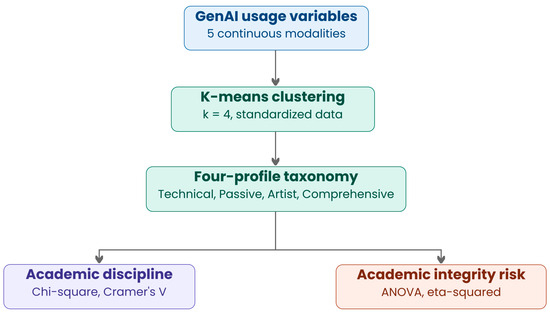
Figure 1 synthesizes the theoretical relationships developed throughout this section into a single analytical framework. The five continuous usage variables reviewed above serve as the empirical basis for the multimodal taxonomy; the resulting profiles are then examined for their association with academic discipline, consistent with the digital-divide and disciplinary-mediation literature discussed in Section 2.4, and for their association with academic integrity risk, consistent with the post-plagiarism framework discussed in Section 2.3. This framework directly informs the specific objectives and hypotheses outlined in Section 1.
Figure 1.
Conceptual framework linking multimodal GenAI usage variables, the resulting taxonomy, and its disciplinary and academic integrity correlates.
Having established the theoretical foundations and conceptual framework guiding this research, the following section details the methodological approach used to operationalize these constructs.
3. Materials and Methods
3.1. Research Design and Study Population
This study adopts a quantitative approach with a correlational, cross-sectional scope. The study population comprised students legally enrolled in eight public universities in Ecuador, selected through a convenience procedure based on institutional access. Within each institution, participants were selected through random cluster sampling, with classroom sections randomly assigned for survey administration; attendance figures were not recorded, so a response rate is not available. Data were collected between November and December 2025, yielding an initial sample that was subsequently screened to reach the final sample size of 3415 university students, as detailed in Section 3.2.
3.2. Balancing Procedure and Bias Control
To mitigate biases induced by disciplinary background, the sample was stratified using fixed disciplinary quotas, adopted to ensure adequate statistical power for between-area comparisons. This procedure ensured that six of the seven areas of knowledge each represented approximately 14.6% of the sample (approximately 500 participants per area), while the areas of Natural Sciences, Mathematics, and Statistics accounted for 12.2%. This distribution ensures that the profiles identified in the taxonomy are not conditioned by the technical or humanistic nature of any single academic discipline.
A total of 3617 questionnaires were administered. Of these, 72 were excluded during data entry for having any missing response on the five GenAI usage items used for clustering, leaving 3545 valid questionnaires. Of these, 130 were then randomly eliminated within UNESCO areas exceeding the 500-participant quota, in order to achieve balanced disciplinary quotas; areas with fewer than 500 valid cases were retained in full. This process yielded the final analytic sample of 3415 questionnaires.
3.3. Data Collection Instrument and Psychometric Properties
Data were collected using a structured questionnaire from an ongoing research program on technology use in Ecuadorian universities, whose content validity and cultural pertinence have been established in prior publications by the research team (Torres-Díaz et al., 2021; Torres-Díaz et al., 2025), administered in person at each participating institution through paper-based administration and subsequently transcribed into a digital dataset.
The instrument comprises three blocks. The first block includes five items measuring GenAI use intensity across distinct modalities—text writing, mathematical problem-solving, programming, image generation, and music generation—on a continuous scale from 0 to 9, where 0 denotes no use and 9 the maximum possible use in each activity. Internal consistency was evaluated using Cronbach’s alpha coefficient, yielding α = 0.773, indicating acceptable reliability for capturing the intensity and diversity of technological adoption.
Corrected item-total correlations ranged from 0.369 (text generation) to 0.626 (image generation), all exceeding the conventional 0.30 threshold for item retention (Nunnally & Bernstein, 1994). Removing any single item would not have meaningfully improved reliability (α if item deleted ranged from 0.707 to 0.788), supporting retention of the full five-item block.
The second block records self-reported copying/delegation tendency through a single item on the same scale, where 0 represents the complete absence of the behavior described and 9 its maximum extent. The third block measures self-perceived mobile device addiction using an identical format, where 0 equates to no perceived dependency and 9 the maximum level of self-reported addiction; this variable was included as an indicator of general digital behavior to contrast its predictive capacity against the taxonomy and evaluate the discriminant validity of the identified profiles.
Single-item measures for plagiarism and addiction reflect a deliberate methodological decision: Bergkvist and Rossiter (2007) demonstrated their convergent and predictive validity equivalence to multi-item scales when constructs are concrete, singular, and conceptually unambiguous to the respondent—a criterion met in both cases and replicated in educational and digital behavior contexts (Fuchs & Diamantopoulos, 2009; Sarstedt & Wilczynski, 2009). Single items also reduce cognitive load and fatigue bias in large samples (N = 3415), though this approach precludes independent estimation of internal reliability for each construct; results should therefore be interpreted as indicators of self-perceived tendency rather than psychometrically precise clinical measurements. Furthermore, self-reported copying/delegation tendency values must be interpreted with caution given social desirability bias, as actual levels of improper delegation are likely to exceed those reported.
Given its centrality to the study’s academic integrity focus, the plagiarism item receives additional validation detail below. The exact wording of the plagiarism item was “Do you present work copied from the internet or generated with AI as if it were your own?”, rated on a 0–9 scale, where 0 indicates the complete absence of the behavior described and 9 indicates its maximum extent. This item is double-barreled, combining two potentially distinct behaviors—copying material from the internet and presenting AI-generated content as one’s own—within a single measure; consequently, it captures a general tendency toward improper attribution rather than a unidimensional measure of either plagiarism or AI-specific delegation. As supplementary evidence of convergent validity, this self-reported copying/delegation tendency correlated significantly with use of ChatGPT for coursework (r = 0.265, p < 0.001) and trust in ChatGPT-generated information (r = 0.368, p < 0.001); these associations should be interpreted as complementary support rather than sufficient evidence of convergent validity, given the item’s double-barreled nature.
3.4. Data Analysis
The data analysis was conducted in IBM SPSS v.29, with two exceptions handled in Python 3.12 (scikit-learn 1.8.0, SciPy 1.17.1, NumPy 2.4.4) where SPSS does not natively provide the required output: the cluster-selection diagnostics reported in Table 2 (BIC and Silhouette coefficient are not generated by SPSS’s K-means procedure) and the bootstrap confidence intervals for the effect sizes reported in Section 4 (percentile bootstrap, 2000 resamples, case-level resampling with replacement).
Table 2.
Cluster selection diagnostics across candidate solutions.
Prior to cluster analysis, the five multimodal usage variables were checked for missing data; none were identified across the 3415 cases. For the purpose of selecting the number of clusters, these variables were standardized (z-scores) and evaluated across candidate solutions from k = 2 to k = 6 using the Bayesian Information Criterion (BIC; following Pelleg & Moore, 2000, with pooled variance and p = kd + 1 free parameters), the Silhouette coefficient (Rousseeuw, 1987), and intra-cluster inertia (Table 2). None of the statistical criteria indicated an unambiguous optimum: the BIC decreases continuously without presenting a defined inflection point within the evaluated range, the Silhouette favors the most parsimonious solution (k = 2), and the inertia shows diminishing reductions without a pronounced elbow. Given this absence of statistical convergence, a situation documented as common in multidimensional behavioral data (Arbelaitz et al., 2013), Hair et al. (2019) establish that the definitive criterion for selecting a cluster solution must be the theoretical and practical interpretability of the resulting groups. Under this principle, the k = 4 solution was selected as a theoretically motivated exploratory solution, generating profiles with theoretical coherence directly linkable to the literature on GenAI adoption and digital divides, capturing the functional differentiation between pragmatic–logical and exploratory–aesthetic use that constitutes the conceptual core of the taxonomy. Solutions of lower complexity would collapse this functionally relevant heterogeneity into categories too broad to guide differentiated institutional interventions.
The final clustering used to derive the reported taxonomy (Table 3) was conducted in SPSS using the Quick Cluster procedure on the original 0–9 usage scale (unstandardized), with the following explicit settings: maximum iterations = 100, convergence criterion = 0, and center updating via running means. Initial cluster centers were selected by SPSS’s default deterministic procedure, which identifies well-separated cases based on their order in the data file; Quick Cluster does not support a user-specified random seed. The solution converged genuinely at iteration 10 (maximum absolute coordinate change < 10−9), with no empty clusters.
Table 3.
Final cluster centroids and sizes.
Multivariate outliers were assessed using Mahalanobis distance (D2); 16 cases (0.47% of the sample) exceeded the critical χ2 value at p < 0.001 (df = 5). A sensitivity analysis comparing cluster centroids and sizes with and without these cases showed negligible differences (centroid shifts ≤ 0.05 scale points; cluster proportion shifts ≤ 0.3 percentage points), indicating that the four-profile solution is not driven by extreme responses; consequently, all cases were retained in the final analysis.
Because Quick Cluster’s initial-center selection depends on case order and does not support random-seed control or multiple random restarts, stability was assessed by re-running the clustering on three independently randomized case orderings. The resulting partitions differed both from one another and from the originally reported solution, a pattern consistent with the well-documented sensitivity of the classic K-means algorithm to initialization when run without multiple restarts. This finding reflects a limitation of the clustering procedure that should be considered when attempting to replicate the study; it does not constitute evidence against the existence of the underlying profiles. This limitation is discussed further in Section 5.2.
Group differences in self-reported copying/delegation tendency and mobile device addiction across profiles were examined using one-way ANOVA. Given a significant Levene’s test result for plagiarism and unequal group sizes, Games–Howell post-hoc comparisons, which do not assume equal variances, were used in place of Tukey HSD for both outcomes, with adjusted p-values and 95% confidence intervals reported for all pairwise comparisons in Section 4.4. As a sensitivity check given the ordinal nature of the single-item outcomes, Kruskal–Wallis tests were also conducted for both variables. Effect sizes were calculated using η2 (interpreted according to Cohen’s (1988), criteria) for the ANOVA models, and Cramér’s V for the association between profile and disciplinary area; 95% confidence intervals for these effect sizes were estimated via percentile bootstrap (2000 case-level resamples with replacement). Assumption checks for the ANOVA models—homogeneity of variance (Levene’s test) and residual normality (skewness and kurtosis)—are reported alongside each result in Section 4.4.
3.5. Ethics Statement
This study was conducted in accordance with institutional and international ethical standards, including the principles of the Declaration of Helsinki. Given that data were collected anonymously via a structured questionnaire, reported exclusively in aggregate form, and involved no personally identifiable information, formal ethics committee review was not required under applicable institutional regulations. All participants were informed of the voluntary and anonymous nature of their participation prior to completing the survey, and completion was taken as implicit consent.
With the methodological and ethical foundations established, the following section presents the empirical findings derived from this analytical approach.
4. Results
4.1. Sample Description and Technological Profile
The study was conducted on a balanced sample of 3415 university students. Table 4 details the disciplinary composition of the study population.
Table 4.
Sample composition by area of knowledge according to UNESCO.
Participants were enrolled across 52 distinct academic programs, reflecting substantial disciplinary diversity within each UNESCO area. On average, students had 5.6 subjects enrolled (SD = 1.8) in the current term.
This sample is characterized by gender parity (51.5% female, 48.5% male) and a marked concentration within the young adult segment, with 90% of participants falling between 16 and 25 years of age. From a socioeconomic standpoint, low to lower-middle income strata predominate, with 68.3% of the sample reporting monthly household income below USD 700.
With regard to the technological profile, participants demonstrate the characteristics of digital natives with a consolidated connectivity trajectory (M = 9.97 years of experience). While access to mobile devices and residential internet is virtually universal (>97%), a relevant gap is identified in access to high-productivity tools, such as laptop computers (15.8% lacking) and permanent mobile connectivity through data plans (57.9% lacking). Additionally, students report a moderately high self-perceived level of technological dependency, with a mean of 5.82 on the mobile device addiction scale, a finding that contextualizes this sample’s predisposition toward the integration of AI-based tools.
4.2. Taxonomy of GenAI Tool Usage
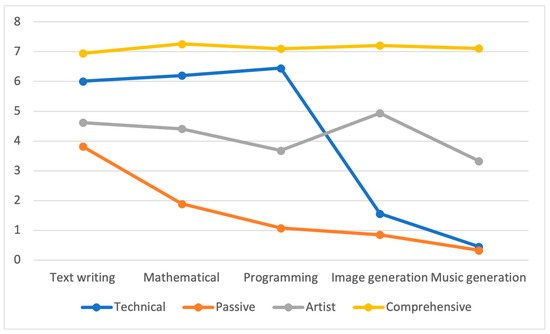
The resulting taxonomy identifies four distinct user profiles of AI tools across university activities, defined not only by intensity of use but also by the nature of the tasks involved (logical, linguistic, or creative). Cluster analysis shows that AI adoption is not uniform, but is associated with academic discipline and a tension between the pursuit of pragmatic efficiency and creative exploration. This classification enables an understanding of AI not as a generic tool but as an ecosystem of applications adopted by students in accordance with the demands of their professional profile. Five variables were used as the basis for classifying students. Four fully differentiated groups were obtained, as illustrated in Figure 2:
Figure 2.
Cluster representation based on centroids of AI tool usage. Note. Values represent mean usage intensity on a 0–9 scale across five GenAI application modalities (text, mathematics, programming, image, and music generation) by cluster.
Profile 1—Technical: Defined by a pragmatic and functional orientation, this profile centers its activity on the optimization of academic processes and the resolution of technical problems, exhibiting the highest scores in programming (6.45) and mathematics (6.20). This profile shows a significant male majority (61.8% male, 38.2% female; χ2 = 101.70, df = 3, p < 0.001, Cramér’s V = 0.173) and constitutes 18.3% of the sample. Unlike other groups, members show an almost complete disinterest in aesthetic or creative applications.
Profile 2—Artist: This profile is distinguished by shifting the focus of AI from logical productivity toward aesthetic experimentation, leading in the use of image generation (4.94) and music generation (3.33) tools outside the Comprehensive group. Comprising 24.4% of the sample, this is a heterogeneous group not confined to the arts, drawing participants relatively evenly across all seven UNESCO areas, including Business (18.2%), Health (17.4%), and Education/Arts/Social Sciences (15.7%).
Profile 3—Passive: Representing the largest segment of the university population, this cluster groups 44.3% of students who maintain a distant and cautious relationship with AI, limiting their interaction to basic linguistic tasks such as text writing (3.82). This profile shows a significant female majority (60.5% female, 39.5% male). Technology use within this profile is reactive and sporadic, with a low self-perceived level of mobile addiction.
Profile 4—Comprehensive: This group is characterized by the highest overall intensity of AI usage within the university, with expert and uniform usage spanning from the resolution of logical problems to advanced multimedia creation. With mean usage scores exceeding 7/10 across all dimensions, particularly in mathematics and image and music generation, it comprises 13% of students who have integrated AI as a permanent cognitive assistant. Their behavior is defined by high digital dependency; they report delegating a significant proportion of their intellectual production to GenAI, reflecting the highest levels of self-reported copying/delegation tendency.
4.3. Analysis of the Association Between Discipline and Usage Profiles
To assess whether membership in a specific cluster is associated with students’ academic background, a Pearson Chi-square test (χ2) was applied to the cross-tabulation of UNESCO areas and the four-group taxonomy. A statistically significant association of moderate magnitude was found between area of knowledge and AI usage profile (χ2 = 517.85, df = 18, p < 0.001). Cramér’s V reached a value of 0.225, 95% CI [0.205, 0.249].
Analysis of the adjusted standardized residuals reveals patterns of functional specialization by faculty. The most salient findings are as follows:
Technical Profile: Exhibits an extreme and exclusive association with the ICT area (Residual = 20.72), where 41.1% of students belong to this cluster. Conversely, this profile is significantly underrepresented in Health, Education, and Agriculture areas.
Passive Profile: This is the dominant group in faculties with traditional academic trajectories. It shows a significant positive association with Agriculture (Residual = 5.80), Health and Welfare (Residual = 3.75), and Education and Social Sciences (Residual = 2.97).
Artist Profile: Significantly concentrated in the Business and Law (Residual = 3.37) and Health (Residual = 2.58) areas, suggesting an AI usage pattern focused on the aesthetic and visual exploration of complex concepts.
Comprehensive Profile: The highest-intensity usage cluster is positively associated with Business (Residual = 4.20) and Engineering (Residual = 3.05) areas, reflecting a transversal and pragmatic adoption of the technology.
4.4. Analysis of Relational Characteristics of Taxonomy Groups
With the aim of providing a deeper characterization of the taxonomy, the analysis first examined whether membership in a specific AI adoption profile is associated with students’ self-reported copying/delegation tendency in their academic activities.
To determine the existence of significant differences between groups, a one-way analysis of variance (ANOVA) was applied, using self-reported copying/delegation tendency as the dependent variable and the four identified clusters as the independent variable. The results, summarized in Table 5, reveal a highly significant association between user profile and self-reported copying/delegation tendency (p < 0.001).
Table 5.
ANOVA results for Self-Reported Copying/Delegation Tendency by User Cluster.
The magnitude of this association was evaluated using the eta-squared coefficient (η2), yielding a value of 0.114, 95% CI [0.092, 0.139]. In accordance with Cohen’s (1988) conventions for the social sciences, this result indicates that the AI usage taxonomy accounts for 11.4% of the total variance in plagiarism perception, constituting a medium-to-large effect size. Levene’s test indicated a violation of the homogeneity-of-variance assumption, F = 91.25, p < 0.001. Given the large sample size, residual skewness (0.774) and kurtosis (0.093) remained within an acceptable range for ANOVA robustness. As a sensitivity check, a Welch’s ANOVA (Welch, 1951)—which does not assume equal variances—was conducted and confirmed the same conclusion, F(3, 1258.1) = 120.58, p < 0.001, indicating that the result is robust to this violation.
As a complement, the Games–Howell post-hoc test was applied to identify specific disparities between profiles, given the significant Levene’s test result and unequal group sizes. The Comprehensive profile reported significantly higher self-reported copying/delegation tendency than all other profiles (vs. Passive: diff = 2.632, 95% CI [2.22, 3.04], p < 0.001; vs. Technical: diff = 1.642, 95% CI [1.17, 2.12], p < 0.001; vs. Artist: diff = 1.509, 95% CI [1.07, 1.95], p < 0.001). The Artist profile also differed significantly from Passive (diff = 1.123, 95% CI [0.87, 1.37], p < 0.001), and Technical differed significantly from Passive (diff = −0.990, 95% CI [−1.30, −0.68], p < 0.001); the Artist–Technical comparison was not significant (diff = 0.133, 95% CI [−0.21, 0.48], p = 0.751).
Having established that the taxonomy is associated with Self-reported copying/delegation tendency, the analysis proceeded to evaluate whether this pattern of association extended to other dimensions of digital behavior, specifically self-perceived mobile device addiction.
The ANOVA results for this variable, shown in Table 6, although statistically significant given the sample volume (N = 3415), revealed a notably weaker association than that observed for plagiarism. For mobile phone addiction, F(3, 3411) = 29.24, p < 0.001 was obtained. The eta-squared coefficient (η2) was 0.025, 95% CI [0.016, 0.037], indicating that cluster membership explains only 2.5% of the variance in technological dependency, a small effect size according to Cohen’s (1988) criteria.
Table 6.
ANOVA results for Mobile Phone Addiction Level.
Levene’s test supported the homogeneity-of-variance assumption for this model, F = 0.13, p = 0.941. Residual skewness (−0.252) and kurtosis (−0.171) were within acceptable limits.
As a complement, the Games–Howell post-hoc test was applied to identify specific disparities between profiles for mobile device addiction. The Technical profile reported significantly higher addiction than Passive (diff = 0.598, 95% CI [0.37, 0.83], p < 0.001) and Artist (diff = 0.629, 95% CI [0.37, 0.89], p < 0.001); the Technical–Comprehensive comparison was not significant (diff = −0.121, 95% CI [−0.43, 0.18], p = 0.735). The Comprehensive profile differed significantly from Passive (diff = −0.719, 95% CI [−0.99, −0.45], p < 0.001) and Artist (diff = −0.751, 95% CI [−1.04, −0.46], p < 0.001); the Passive–Artist comparison was not significant (diff = 0.031, 95% CI [−0.19, 0.25], p = 0.983).
Analysis of digital infrastructure indicates that the Comprehensive cluster leads in data plan usage (49.4%), while the Technical profile presents the lowest rate of permanent mobile connectivity (33.3%).
4.5. Associations of the Taxonomy with Self-Reported Copying/Delegation Tendency and Contrast Behaviors
To evaluate the taxonomy, an analysis of variance (ANOVA) was conducted comparing profiles according to self-reported plagiarism and a behavioral control variable: mobile device addiction.
As shown in Table 7, the taxonomy shows an explanatory power approximately five times greater for academic plagiarism than for the behavioral control variable of mobile device addiction.
Table 7.
Comparative means and effect sizes by AI Profile.
5. Discussion
The identification of four functionally differentiated profiles of GenAI adoption carries a theoretical implication that transcends mere classification: it suggests that the use of generative tools does not respond to a continuum of intensity but to qualitatively distinct logics of use associated with the epistemic nature of the discipline. This challenges the unidimensional models dominant in the literature (Beckman et al., 2025; Torres, 2025) and supports a reconceptualization of GenAI use as an ecosystem of differentiated practices, rather than as a continuous frequency variable. The multimodal dimension appears critical: without it, profiles such as the Technical and the Artist, which present globally similar levels of overall use but radically opposed orientations, would be collapsed into a single category, forfeiting precisely the information most relevant to the design of targeted interventions. This finding also illustrates a fundamental limitation of attitudinal frameworks such as TAM and UTAUT when applied to GenAI: by modeling adoption as a single behavioral intention, they would have assigned the Technical and Artist profiles to the same high-intention category, obscuring the functional divergence that this study identifies as the key correlate of academic integrity risk. The clustering approach adopted here does not replace attitudinal models. It complements them by mapping the structure of adoption once intention has already been acted upon.
The most counterintuitive finding is not that the Comprehensive profile reports higher plagiarism, but that the Technical profile, with the highest usage levels in programming and mathematics, presents plagiarism levels statistically equivalent to those of the Artist (p = 0.751) and significantly lower than those of the Comprehensive profile. This partially contradicts the prevailing narrative associating greater intensity of use with greater ethical risk (Foltynek et al., 2023): intensity per se is not associated with improper delegation; rather, one possible interpretation is that functional orientation may contribute to the observed association. The Technical profile employs GenAI as a problem-solving tool in domains with verifiable outputs (code generation), where total externalization is functionally counterproductive because the result must be executable and correct. The Comprehensive profile, by contrast, operates in domains where GenAI output is directly presentable without independent verification, which may reduce the cognitive friction that acts as a natural barrier against excessive delegation. This distinction between verifiable domains and presentable domains has not been theorized in the prior literature and is proposed here as a post-hoc conceptual hypothesis warranting prospective testing, rather than an established mechanism.
These interpretations should be considered alongside plausible alternative explanations. First, given the cross-sectional design, the observed association between discipline and profile membership (Cramér’s V = 0.225) is equally consistent with a self-selection pathway—students with an existing pragmatic, tool-oriented disposition toward technology may preferentially enroll in technical programs—as with a disciplinary-socialization pathway in which the field of study shapes adoption patterns after enrollment. Second, the comparatively lower self-reported copying/delegation tendency in the Technical profile may partly reflect differential social desirability bias rather than differential behavior: professional norms in engineering and computing disciplines, which often emphasize code correctness and peer review, could suppress admission of improper delegation independently of its actual prevalence. The present data cannot adjudicate between these explanations, and we flag this as a priority for future longitudinal or multi-method research.
Particularly noteworthy is the dissociation found between GenAI use and mobile device addiction (η2 = 0.025, small effect). Whereas the Technical and Comprehensive profiles present similarly elevated levels of mobile dependency, only the Comprehensive profile exhibits significant intellectual delegation. This indicates that ethical risk does not derive from a generic “technological addiction” but from a pragmatic functional specialization that, in the absence of clear ethical frameworks, facilitates the externalization of critical thinking. The medium-to-large effect size on the plagiarism variable (η2 = 0.114) indicates that the proposed taxonomy is a considerably stronger correlate than general behavioral variables, offering institutions a valuable diagnostic instrument for targeted interventions.
The structural association of discipline (Cramér’s V = 0.225) reinforces the theoretical arguments advanced by Saihi and Ahmed (2026), Contractor and Reyes (2025), and Torres and Duart (2025): GenAI adoption patterns are associated with the epistemological and professional demands of each field. The Technical and Comprehensive profiles concentrate in technical and business disciplines, while the Passive and Artist profiles predominate in caring and creative fields. This disciplinary association, hitherto scarcely quantified, must be incorporated as a structural variable in future taxonomies.
From the perspective of digital divides (van Dijk, 2020), the findings are consistent with the third-generation divide (outcomes) already being operative in the Ecuadorian context: the Comprehensive profile, with greater access to unlimited data plans, capitalizes on GenAI to enhance perceived academic performance, while the Passive profile is relegated to reactive and sporadic use. Institutions in the Global South must therefore design strategies that mitigate these inequalities rather than assuming universal adoption.
This connectivity pattern also reveals a within-taxonomy distinction in how digital infrastructure is leveraged. As noted in Section 4.4, the Comprehensive cluster shows markedly higher data-plan access than the Technical profile (49.4% vs. 33.3%), despite the latter’s higher competency in programming and mathematics. This pattern suggests that technical users prefer stable, high-productivity working environments (desktop/laptop) for the execution of complex logical tasks, in contrast to the Comprehensive profile, which integrates the tool more transversally across mobile devices, facilitating ubiquitous interaction with AI.
5.1. Practical and Policy Implications
The results carry direct implications for the design of institutional academic integrity policies. The central finding, that the risk of improper delegation is concentrated in the Comprehensive profile and is structurally associated by discipline, indicates that uniform policies are insufficient. We propose three concrete, differentiated measures, informed by the exploratory verifiable/presentable-output distinction discussed above. First, in disciplines with more verifiable outputs (e.g., engineering, computing), instructors can require submission of process artifacts—version-controlled code commits, intermediate drafts, or problem-solving logs—that are difficult to fabricate after the fact; in disciplines with more presentable outputs (e.g., education, social sciences), a short mandatory reflective statement describing how and where GenAI was used can serve the same verification function. Second, institutions should adopt a competency-based assessment design that validates deliverables demonstrating actual skill attainment through process evidence—such as the artifacts described above—applied uniformly across all coursework, regardless of discipline or profile. Third, training should be tiered by profile: a brief onboarding module on responsible GenAI use for the Passive profile; a mandatory ethics and disclosure workshop addressing the limits of intellectual delegation for the Comprehensive profile; and guidance on authorship attribution for AI-assisted creative work for the Artist profile. Finally, given that 57.9% of the sample lacks an unlimited mobile data plan, institutions should pair any GenAI-integration policy with concrete connectivity support—such as subsidized data plans or expanded free campus Wi-Fi access—to avoid penalizing students whose lower engagement reflects infrastructure access rather than choice.
5.2. Limitations and Future Directions
The study presents five principal limitations. First, the plagiarism and addiction data are self-reported, which may lead to an underestimation of actual behaviors due to social desirability bias. Second, the cross-sectional design precludes the establishment of causal relationships or the analysis of temporal trajectories; as discussed above, this leaves open alternative directional and confounding explanations for the discipline-profile association. Third, although the sample is large and disciplinarily stratified, institutions were selected by convenience and classroom sections by random cluster sampling rather than through a fully probabilistic national design, which may limit strict generalizability to the broader Ecuadorian student population. Fourth, the use of single-item measures for plagiarism and mobile addiction, while methodologically justified (see Section 3.3) and supported by convergent-validity evidence, precludes the estimation of construct-specific internal reliability and may not capture the full multidimensionality of these constructs. Fifth, the results require replication in other national contexts to assess their generalizability beyond Ecuador. Future research should incorporate objective measures of academic performance, multi-item validated scales for integrity-related constructs, as well as longitudinal and experimental designs capable of evaluating profile-based interventions and disentangling self-selection from socialization effects.
6. Conclusions
This study advances the empirical understanding of GenAI adoption in higher education by proposing and empirically characterizing a multimodal taxonomy that moves beyond the frequency of use metrics and text-centric focus prevalent in prior research. The four profiles identified—Passive, Artist, Technical, and Comprehensive—are not points on a continuum of technological sophistication but qualitatively distinct modes of engagement, each associated with the epistemological demands of the discipline and the quality of digital infrastructure available to students. This finding has a consequential implication: GenAI adoption cannot be governed by uniform institutional policy, because the risk it poses to academic integrity is not uniformly distributed.
The conceptual distinction proposed here between verifiable domains and presentable domains, offered as a candidate explanatory factor for improper delegation, opens a line of theoretical inquiry that attitudinal frameworks such as TAM and UTAUT are not equipped to address. Future research should examine whether this distinction holds across different institutional contexts, assessment formats, and disciplinary cultures and whether interventions designed around domain type, rather than profile type alone, prove more effective in reducing undue intellectual externalization.
From a methodological standpoint, the taxonomy’s substantially stronger association with self-reported plagiarism (η2 = 0.114) than with mobile device addiction (η2 = 0.025) suggests that data-driven profile approaches offer diagnostic precision that generic behavioral measures cannot replicate. Institutions in the Global South, where digital inequality compounds the heterogeneity of adoption patterns, stand to benefit most from this kind of targeted, evidence-based framework provided that connectivity gaps are addressed as a structural precondition, not an afterthought, of any GenAI governance strategy.
Author Contributions
Conceptualization, J.C.T.-D.; methodology, J.C.T.-D.; software, J.C.T.-D.; validation, J.C.T.-D., D.E.R.-R. and A.M.B.F.; formal analysis, J.C.T.-D.; investigation, J.C.T.-D., D.E.R.-R. and A.M.B.F.; resources, J.C.T.-D.; data curation, J.C.T.-D.; writing—original draft preparation, J.C.T.-D.; writing—review and editing, J.C.T.-D., D.E.R.-R. and A.M.B.F.; visualization, J.C.T.-D.; supervision, J.C.T.-D.; project administration, J.C.T.-D. All authors have read and agreed to the published version of the manuscript.
Funding
This research received institutional support from Universidad Técnica Particular de Loja (UTPL), Ecuador.
Institutional Review Board Statement
This study did not require formal ethics committee approval. In accordance with the regulatory framework of the Ministry of Public Health of Ecuador (Ministerial Agreement No. 004889, Official Registry No. 279, July 2014, and its Substitutive Regulation, Ministerial Agreement No. 0005-2022), which governs the Committee for Ethics in Research on Human Beings (CEISH) of the Universidad Técnica Particular de Loja (UTPL), studies based exclusively on anonymous, voluntary survey data on non-sensitive topics, with no personally identifiable information, no biological samples, and no clinical intervention are not subject to mandatory ethics committee review. This is consistent with CIOMS International Ethical Guidelines (Guideline 23).
Informed Consent Statement
Participants were informed of the research objectives, the voluntary nature of their participation, and the anonymous and confidential treatment of their responses prior to completing the survey. Given the anonymous, non-identifiable, and minimal-risk nature of the questionnaire, completion of the survey was taken as implied consent, consistent with the ethics exemption described above. A total of 52 participants (1.5% of the final sample) self-reported ages of 16–17 years; the same implied-consent procedure was applied uniformly to this subgroup, and no separate parental consent process was implemented.
Data Availability Statement
No personally identifiable information was collected at any stage, and response data were stored on password-protected institutional servers accessible only to the research team. The data presented in this study, along with a complete codebook, SPSS syntax, and Python code for full analytical reproducibility, are openly available in Figshare at https://doi.org/10.6084/m9.figshare.33116396.
Acknowledgments
During the preparation of this manuscript, the author(s) used Claude (Anthropic, claude.ai) for the purposes of refining the written expression and improving the clarity and fluency of the text. The authors have reviewed and edited the output and take full responsibility for the content of this publication.
Conflicts of Interest
The authors declare no conflicts of interest.
Abbreviations
The following abbreviations are used in this manuscript:
| GenAI/AI | Generative Artificial Intelligence |
| UNESCO | United Nations Educational, Scientific and Cultural Organization |
| LLMs | Large Language Models |
| UCG | Unauthorized Content Generation |
| TAM | Technology Acceptance Model |
| UTAUT | Unified Theory of Acceptance and Use of Technology |
| STEM | Science, Technology, Engineering and Mathematics |
| ICT | Information and Communication Technologies |
| BIC | Bayesian Information Criterion |
| ANOVA | Analysis of Variance |
| HSD | Honestly Significant Difference |
| USD | United States Dollar |
| df | Degrees of freedom |
| F | F-statistic |
| Sig. | Significance |
| N/n | Sample size |
| M | Mean |
References
- Arbelaitz, O., Gurrutxaga, I., Muguerza, J., Pérez, J. M., & Perona, I. (2013). An extensive comparative study of cluster validity indices. Pattern Recognition, 46(1), 243–256. [Google Scholar] [CrossRef] [Scilit]
- Beckman, K., Apps, T., Howard, S. K., Rogerson, C., Rogerson, A., & Tondeur, J. (2025). The GenAI divide among university students: A call for action. The Internet and Higher Education, 67, 101036. [Google Scholar] [CrossRef] [Scilit]
- Bergkvist, L., & Rossiter, J. R. (2007). The predictive validity of multiple-item versus single-item measures of the same constructs. Journal of Marketing Research, 44(2), 175–184. [Google Scholar] [CrossRef] [Scilit]
- BinJwair, A. (2025). Predicting STEM students’ adoption of generative AI in academic contexts: An application of the UTAUT model. Frontiers in Education, 10, 1669750. [Google Scholar] [CrossRef] [Scilit]
- Chiu, T. K. F. (2024). The impact of generative AI (GenAI) on practices, policies and research direction in education: A case of ChatGPT and Midjourney. Interactive Learning Environments, 32(10), 6187–6203. [Google Scholar] [CrossRef] [Scilit]
- Cohen, J. (1988). Statistical power analysis for the behavioral sciences (2nd ed.). Lawrence Erlbaum Associates. [Google Scholar]
- Contractor, Z., & Reyes, G. (2025). Generative AI in higher education: Evidence from an elite college (IZA Discussion Paper No. 18055). Institute of Labor Economics. Available online: https://docs.iza.org/dp18055.pdf (accessed on 9 May 2026).
- Coursera. (2026). AI in higher education: Insights on attitudes, adoption, and risks from over 4200 students and educators. Available online: https://blog.coursera.org/ai-in-higher-education-2026 (accessed on 9 May 2026).
- D’Addario, M. (2025). A taxonomy of standardized terms for generative AI use in the composition classroom. Discover Education, 4, 655. [Google Scholar] [CrossRef] [Scilit]
- Dai, K., Liu, Y., & Zhang, X. (2026). Generative AI in higher education: A bibliometric review of emerging trends, power dynamics, and global research landscapes. Computers and Education: Artificial Intelligence, 10, 100544. [Google Scholar] [CrossRef] [Scilit]
- Davis, F. D. (1989). Perceived usefulness, perceived ease of use, and user acceptance of information technology. MIS Quarterly, 13(3), 319–340. [Google Scholar] [CrossRef] [Scilit] [PubMed]
- Dwivedi, Y. K., Kshetri, N., Hughes, L., Slade, E. L., Jeyaraj, A., Kar, A. K., Baabdullah, A. M., Koohang, A., Raghavan, V., Ahuja, M., Albanna, H., Albashrawi, M. A., Al-Busaidi, A. S., Balakrishnan, J., Barlette, Y., Basu, S., Bose, I., Brooks, L., Buhalis, D., … Wright, R. (2023). Opinion paper: “So what if ChatGPT wrote it?” Multidisciplinary perspectives on opportunities, challenges and implications of generative conversational AI for research, practice and policy. International Journal of Information Management, 71, 102642. [Google Scholar] [CrossRef] [Scilit]
- Eaton, S. E. (2023). Postplagiarism: Transdisciplinary ethics and integrity in the age of artificial intelligence and neurotechnology. International Journal for Educational Integrity, 19, 23. [Google Scholar] [CrossRef] [Scilit]
- Foltynek, T., Bjelobaba, S., Glendinning, I., Khan, Z. R., Santos, R., Pavletic, P., & Kravjar, J. (2023). ENAI recommendations on the ethical use of artificial intelligence in education. International Journal for Educational Integrity, 19(1), 12. [Google Scholar] [CrossRef] [Scilit]
- Freeman, J. (2025). Student generative AI survey 2025 (HEPI Policy Note 61). Higher Education Policy Institute. Available online: https://www.hepi.ac.uk/reports/student-generative-ai-survey-2025/ (accessed on 9 May 2026).
- Fuchs, C., & Diamantopoulos, A. (2009). Using single-item measures for construct measurement in management research. Die Betriebswirtschaft, 69(2), 195–210. [Google Scholar]
- Hair, J. F., Black, W. C., Babin, B. J., & Anderson, R. E. (2019). Multivariate data analysis (8th ed.). Cengage Learning. [Google Scholar]
- Hashmi, N., & Bal, A. S. (2024). Generative AI in higher education and beyond. Business Horizons, 67(5), 607–614. [Google Scholar] [CrossRef] [Scilit]
- Kasneci, E., Sessler, K., Küchemann, S., Bannert, M., Dementieva, D., Fischer, F., Gasser, U., Groh, G., Günnemann, S., Hüllermeier, E., Krusche, S., Kutyniok, G., Michaeli, T., Nerdel, C., Pfeffer, J., Poquet, O., Sailer, M., Schmidt, A., Seidel, T., … Kasneci, G. (2023). ChatGPT for good? On opportunities and challenges of large language models for education. Learning and Individual Differences, 103, 102274. [Google Scholar] [CrossRef] [Scilit]
- Köhler, C., & Hartig, J. (2024). ChatGPT in higher education: Measurement instruments to assess student knowledge, usage, and attitude. Contemporary Educational Technology, 16(4), ep528. [Google Scholar] [CrossRef] [Scilit] [PubMed]
- Molina, E., & Medina, E. (2025). AI revolution in higher education: What you need to know. In Digital Innovations in Education (Brief No. 4). World Bank. Available online: https://openknowledge.worldbank.org/server/api/core/bitstreams/55df3fae-5720-46e9-83cc-d67b1090fe1a/content (accessed on 11 May 2026).
- Nunnally, J. C., & Bernstein, I. H. (1994). Psychometric theory (3rd ed.). McGraw-Hill. [Google Scholar]
- O’Dea, X. (2024). Generative AI: Is it a paradigm shift for higher education? Studies in Higher Education, 49(5), 811–816. [Google Scholar] [CrossRef] [Scilit]
- Olmanson, J., Hassani, A., & Jeon, M. (2025). A taxonomy of AI use for learning in higher education [Preprint]. OSF Preprints. Available online: https://osf.io/preprints/edarxiv/8ajbg_v2 (accessed on 11 May 2026).
- Pelleg, D., & Moore, A. W. (2000). X-means: Extending K-means with efficient estimation of the number of clusters. In Proceedings of the 17th international conference on machine learning (pp. 727–734). Morgan Kaufmann. [Google Scholar]
- Qu, Y., & Wang, J. (2025). The impact of AI guilt on students’ use of ChatGPT for academic tasks: Examining disciplinary differences. Journal of Academic Ethics, 23(4), 2087–2110. [Google Scholar] [CrossRef] [Scilit]
- Ramesh, A., Pavlov, M., Goh, G., Gray, S., Voss, C., Radford, A., Chen, M., & Sutskever, I. (2021). Zero-shot text-to-image generation. In M. Meila, & T. Zhang (Eds.), Proceedings of the 38th international conference on machine learning (Vol. 139, pp. 8821–8831). PMLR. Available online: https://proceedings.mlr.press/v139/ramesh21a.html (accessed on 9 May 2026).
- Rousseeuw, P. J. (1987). Silhouettes: A graphical aid to the interpretation and validation of cluster analysis. Journal of Computational and Applied Mathematics, 20, 53–65. [Google Scholar] [CrossRef] [Scilit]
- Rundle, K., Curtis, G. J., & Clare, J. (2023). Why students do not engage in contract cheating: A closer look. International Journal for Educational Integrity, 19, 11. [Google Scholar] [CrossRef] [Scilit]
- Saihi, A., & Ahmed, V. (2026). Uncovering adoption personas for generative AI in higher education: A clustering-based segmentation approach. International Journal of Educational Technology in Higher Education, 23, 7. [Google Scholar] [CrossRef] [Scilit]
- Sarstedt, M., & Wilczynski, P. (2009). More for less? A comparison of single-item and multi-item measures. Die Betriebswirtschaft, 69(2), 211–227. [Google Scholar]
- Torres, J. C., & Duart, J. M. (2025). Inteligencia artificial en la universidad: Radiografía de la “Generación WiFi”. United Academic Journals. [Google Scholar] [CrossRef] [Scilit]
- Torres, R. C. (2025). College students’ use of generative AI in academic tasks: Integrating two-stage cluster analysis. International Journal of Information and Education Technology, 15(9), 2391–2400. [Google Scholar] [CrossRef] [Scilit]
- Torres-Díaz, J. C., Duart, J., Rivera, D., & Beltrán Flandoli, A. (2025). Artificial intelligence and academic integrity: Exploring plagiarism in Ecuadorian universities. International Journal for Educational Integrity, 21, 35. [Google Scholar] [CrossRef] [Scilit]
- Torres-Díaz, J. C., Duart, J. M., Torres Carrión, P. V., & Marín Gutiérrez, I. (2021). Plagiarism and use of technology by high school students. Campus Virtuales, 10(2), 175–184. Available online: https://www.uajournals.com/ojs/index.php/campusvirtuales/article/view/875 (accessed on 28 July 2026).
- UNESCO. (2025). AI and the future of education: Disruptions, dilemmas, and directions. UNESCO Digital Library. Available online: https://unesdoc.unesco.org/ark:/48223/pf0000395236 (accessed on 9 May 2026).
- Valdivieso, T., & González, O. (2025). Generative AI tools in Salvadoran higher education: Balancing equity, ethics, and knowledge management in the Global South. Education Sciences, 15(2), 214. [Google Scholar] [CrossRef] [Scilit]
- van Dijk, J. (2020). The digital divide. Polity Press. [Google Scholar]
- Vaswani, A., Shazeer, N., Parmar, N., Uszkoreit, J., Jones, L., Gomez, A. N., Kaiser, L., & Polosukhin, I. (2017). Attention is all you need. Advances in Neural Information Processing Systems, 30, 03762. [Google Scholar]
- Venkatesh, V., Morris, M. G., Davis, G. B., & Davis, F. D. (2003). User acceptance of information technology: Toward a unified view. MIS Quarterly, 27(3), 425–478. [Google Scholar] [CrossRef] [Scilit]
- Welch, B. L. (1951). On the comparison of several mean values: An alternative approach. Biometrika, 38(3/4), 330–336. [Google Scholar] [CrossRef] [Scilit]

Disclaimer/Publisher’s Note: The statements, opinions and data contained in all publications are solely those of the individual author(s) and contributor(s) and not of MDPI and/or the editor(s). MDPI and/or the editor(s) disclaim responsibility for any injury to people or property resulting from any ideas, methods, instructions or products referred to in the content. |
© 2026 by the authors. Licensee MDPI, Basel, Switzerland. This article is an open access article distributed under the terms and conditions of the Creative Commons Attribution (CC BY) license.