


Abstract
This study examines how students aged 10–20 conceptualize Education for Sustainable Development (ESD), focusing on their ability to think multiperspectively and justify decisions multidimensionally. In a classroom-based teaching experiment, 131 high school students from Lower Saxony completed a drawing task visualizing sustainable village transformations, followed by interviews with twelve participants. Their negotiation processes, verbal responses, and drawings were analyzed using qualitative content analysis. The visualization of village transformations functions as a biology-didactic ESD activity, where students apply decision-making and problem-solving strategies to address biological system levels (e.g., individuals, populations, ecosystems) and their interconnections (trophic levels, food webs, biodiversity). Results indicate age-related differences: students in grades 5–7 primarily emphasized social and ecological aspects, designing idealized living spaces for themselves. Upper-secondary students (grades 11–13) incorporated societal, political, and economic considerations, prioritizing economic development. However, no consistent relationship between multiperspectivity and multidimensional reasoning was identified. Based on these findings and related research, the study advocates integrating systems thinking with a comprehension-oriented approach, combining the Conceptual Metaphor Theory (CMT) and the Model of Educational Reconstruction (MER). This aims to address the complexity of ESD more effectively, avoiding oversimplified, monocausal narratives that undermine the multidimensional nature of sustainable development.
1. Introduction
Sustainable development presents education policy with the core challenge of fostering systems thinking and transformative learning to integrate complex global challenges—such as climate change, social inequality, and resource scarcity—as fundamental components of knowledge transmission and competence development.
The endeavor entails reconceptualizing education not merely as a means of knowledge dissemination, but as a tool for societal transformation. UNESCO’s Education for Sustainable Development: A Roadmap reaffirms the centrality of the SDGs as a core objective of the ESD for 2030 framework (UNESCO, 2020). The 17 Sustainable Development Goals (SDGs), as outlined in UNESCO’s Education for Sustainable Development Goals: Learning Objectives (UNESCO, 2017), encompass distinct thematic areas that can initially seem overwhelming for school settings and learners. Both the school as a whole (e.g., its educational mandate) and biology instruction in particular bear the responsibility of providing learners with competencies that enable them to navigate this complexity.
Sustainable development is defined by complex cause-and-effect relationships in a highly dynamic network of functional interactions (Rieß et al., 2015). This complexity is reflected in the body of knowledge required to evaluate a given issue. Moreover, multiple, sometimes only partially compatible, dimensions confront one another. Even within a single dimension, an ostensibly positive intention may be interpreted as a detrimental decision: for example, the expansion of renewable energy (green energy) can conflict with the preservation of biodiversity (green environment), giving rise to a “green-green dilemma”.
To cope with the complexity of ESD, the Conference of the German Ministers of Education and Cultural Affairs (for further explanations, see “Abbreviations”) (KMK, 2024) has formulated the following guideline: “Recognizing, classifying, evaluating, and considering possible consequences for ecological, economic, and social systems is necessary for responsible societal participation and demands science-based competencies” (KMK, 2024).
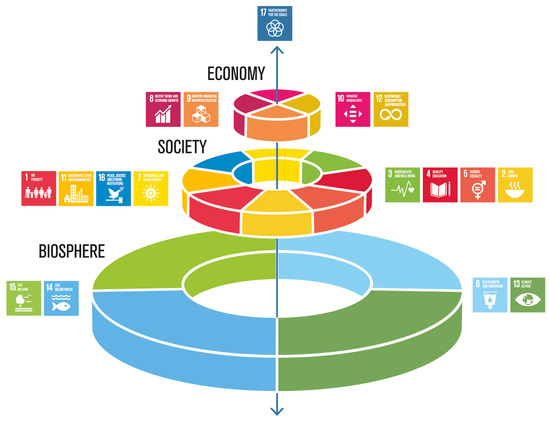
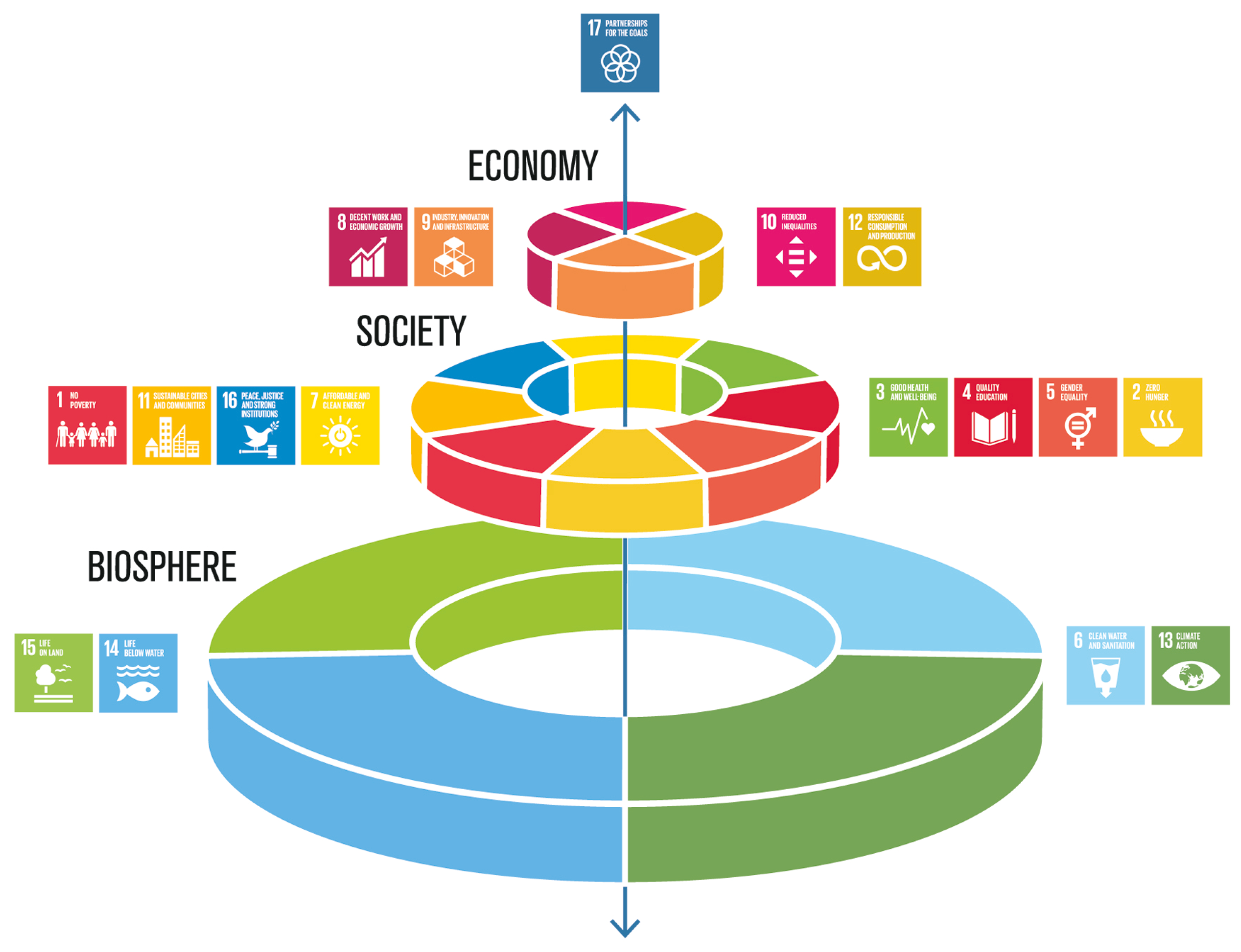
Figure 1, which illustrates the SDG wedding cake model (Stockholm Resilience Centre, 2016), serves as a central conceptual framework for this study by visually representing the interconnectedness and hierarchical prioritization of sustainability dimensions. Its relevance lies in transcending traditional additive sustainability frameworks by positioning ecological integrity as the foundational layer (the “base of the cake”), upon which social and economic dimensions are built. This structure highlights the systemic dependencies emphasized in systems thinking (Rieß & Mischo, 2010) and aligns with the study’s triadic framework integrating CMT, MER, and systems thinking to foster a nuanced understanding of sustainability.
Figure 1.
SDG “wedding cake” (Stockholm Resilience Centre, 2016).
Crucially, the model underscores the trade-offs and synergies between the SDGs, directly supporting the study’s focus on diagnosing genuine trade-off processes in ESD. The study follows the premise that employing this model enables learners to perceive sustainability not as isolated goals but as a dynamic, interconnected system—a core objective of the Model of Educational Reconstruction (MER) in aligning subject-specific content with pedagogical effectiveness.
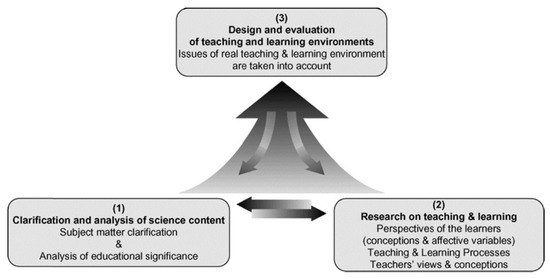
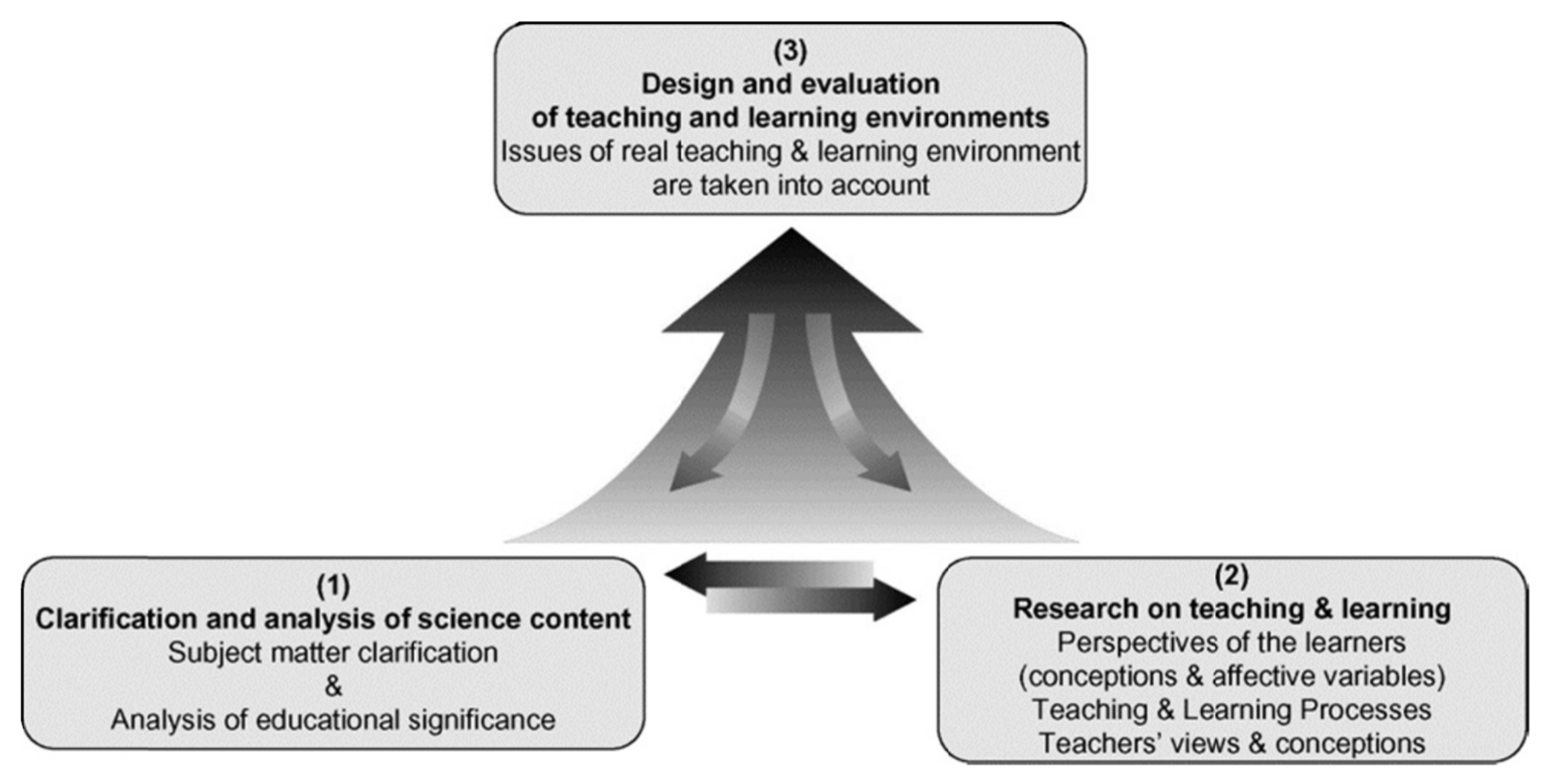
Teaching such complex interdependencies effectively calls for more than cognitivist learning theories; constructivist perspectives are equally pertinent. The Model of Educational Reconstruction (MER) (Kattmann et al., 1996) has proven to be a useful heuristic for the constructivist design of learning environments in biology education. The MER proposes to compare the disciplinary description of science content (intended for instruction) with students’ pre-existing conceptions. From the discrepancy between these two perspectives, instructional strategies are derived (Figure 2).
Figure 2.
The Model of Educational Reconstruction (Kattmann et al., 1996).
The following sections therefore begin with a clarification of the core concepts of the science content.
1.1. State of Research and Theoretical Background
The sustainability paradigm, characterized by the holistic and simultaneous consideration of economic, ecological, and social issues (multiperspectivity) (Enquête-Kommission “Schutz des Menschen und der Umwelt—Ziele und Rahmenbedingungen einer nachhaltig zukunftsverträglichen Entwicklung”, 1998), can be understood as an overarching complex system (Vester, 2002). Consequently, ESD in schools should enable students to manage this complexity.
1.1.1. The Complexity Challenge: Multiperspectivity, Multidimensionality, and Systems Thinking
Both teachers and students are confronted with the requirement to comprehend ecological, economic, and social interrelationships as dynamic interdependencies and recursive processes. Several hurdles arise when attempting to understand connections within and between dimensions:
- Dimension-specific focus: Learners often concentrate on the dimension for which they possess greater prior knowledge or a stronger inclination. For instance, biology students tend to describe sustainability with an ecological focus (Groß et al., 2009), whereas economics students adopt an economic perspective (Redman et al., 2021).
- Issue-specific framing: The very object of the challenge can shape the dominant interpretation. Sustainable nutrition, for example, is frequently discussed primarily in terms of health (Dornhoff et al., 2020).
Beyond this dimension-specific expertise, systems thinking demands an additional aspect: the recognition of interdependence and recursion. Historically, the interactions among system elements have been described in similar yet subtly different ways. Wiener (1964) introduced cybernetics—the science of control and regulation—as a mechanistic view of element interaction, whereas Ludwig von Bertalanffy placed the interactions themselves at the center of analysis, thereby also accommodating social systems (Drack & Pouvreau, 2015). Within interdisciplinary systems theory, cybernetics is distinguished into first-order and second-order forms (Heylighen & Joslyn, 2003).
First-order cybernetics is characterized by an apparent objectivity: learners identify the known elements of a sustainability problem and describe the dynamics of the interactions among them, positioning themselves as the controlling agent.
Second-order cybernetics entails learners recognizing themselves as part of the system; their subjectivity becomes explicit, and the underlying experiences that construct their reality can be reflected upon.
Thus, effective systems thinking requires at least (1) disciplinary knowledge for assessing elements and their interactions, and (2) an understanding of system control and regulation. Ideally, learners also become aware of—and critically reflect on—their own position within the system.
1.1.2. Students’ Conceptions of Multiperspectivity and Systems Thinking
Several alternative theoretical frameworks address students’ conceptions. The present work adopts the Conceptual Metaphor Theory (CMT) (Lakoff & Johnson, 2003; Gropengießer, 2007) for biology education. The CMT offers multiple advantages for investigating students’ conceptions in educational contexts:
Its neuro-biological grounding enables the description of how conceptions emerge (e.g., Gallese & Lakoff, 2005; Rohrer, 2005). It is already established as a diagnostic framework in sciences education (e.g., Riemeier & Gropengießer, 2008; Johann et al., 2022; Michelsen et al., 2022). As a theory of understanding, it supports the derivation of interventions and learning environments aimed at deliberately transforming conceptions (e.g., Gropengießer & Groß, 2019).
As a constructivist theory of understanding, the CMT assumes that meaning arises in learners when they interpret sensory perceptions through pre-existing mental representations. These prior representations themselves have been shaped by neuronal activation of earlier sensory experiences (“embodiment”). The theory further posits that abstract topics can only be comprehended by combining various sensorily derived representations.
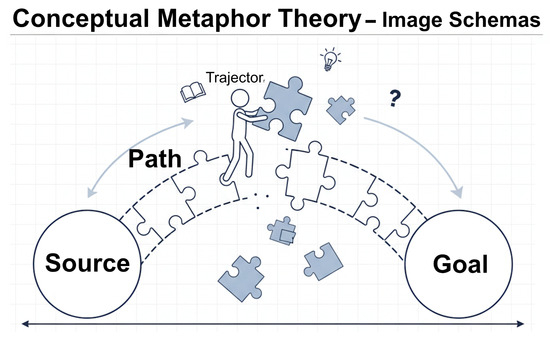
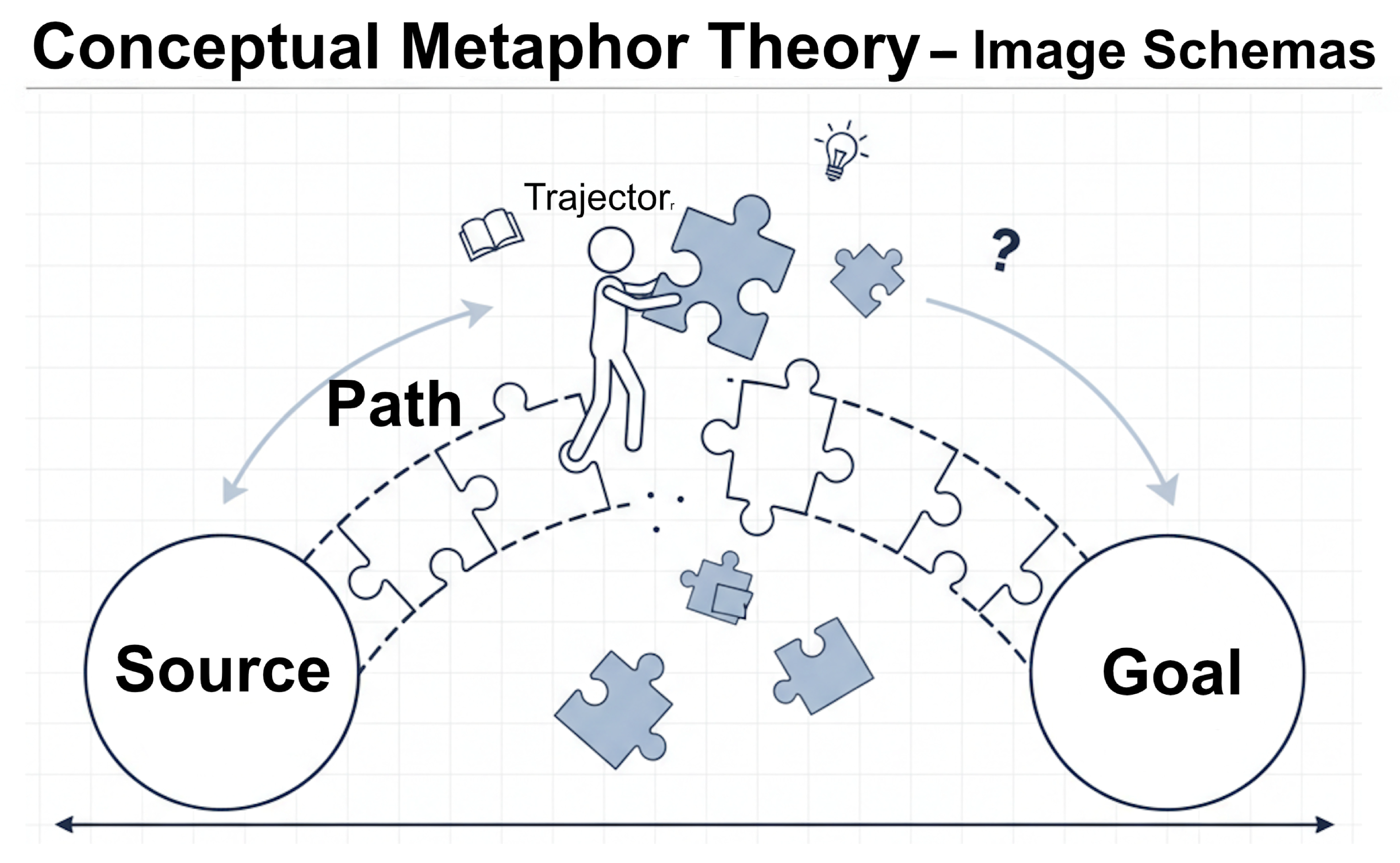
For education, the following implication is central: repeated, fundamental experiences (e.g., giving and receiving, eating, sharing, assembling) structure our understanding and constitute the building blocks of our reality. These building blocks are termed image schemas (Rohrer, 2005). In a specific context, image schemas generate notions; for example, the environment may be conceptualized as a container when “waste is poured into the environment.” The CMT by Lakoff and Johnson (2003) provides a central tool for understanding how learners structure and internalize abstract concepts such as sustainability. A particularly relevant cognitive schema for analyzing sustainability conceptions is the Source–Path–Goal schema (Figure 3). This schema is a fundamental embodied cognition model that structures not only spatial movement but also metaphorical processes of comprehension and action (Lakoff & Johnson, 2003). It is therefore particularly well-suited to explain how students perceive sustainability as a dynamic, goal-directed process—such as a “journey” or “path” (e.g., “Sustainability is a journey in which we learn step by step to make responsible decisions”). Analogously, the source–path–goal schema can be applied in contexts like: “Combating climate change (source) begins with setting emission reduction targets, implementing measures like renewable energy and reforestation (path), and ultimately achieving a sustainable, low-carbon future (goal).”
Figure 3.
Conceptual Metaphor Theory (based on Lakoff & Johnson, 2003; Rohrer, 2005; Gropengießer & Groß, 2019) using the source–path–goal schema as an example.
Mark Johnson redefines image schemas in Embodied Mind, Meaning, and Reason as recurring patterns of sensory–motor–affective experience that enable humans to interpret their environment, structure abstract concepts, and facilitate reasoning. Building on embodied cognition, he argues that these schemas—emerging from bodily interactions—serve as a bridge between body and mind, resolving the philosophical challenge of dualism by demonstrating how physical experience grounds abstract thought. Image schemas are not merely linguistic constructs but fundamental structures that shape meaning, imagination, and inference, particularly through cognitive metaphors. By analyzing their logical organization—such as the Source–Path–Goal schema—Johnson illustrates how embodied experiences provide the foundation for abstract reasoning, thereby integrating perception, action, and cognition into a unified framework. To overcome the body–mind divide, he emphasizes the need to recognize how image schemas arise from bodily engagement with the world, structuring both experience and abstract conceptualization (Johnson, 2017).
In the present study, the term student’s conception is understood as a classification system comprising four levels of complexity, as adapted and further developed for biology by Gropengießer (2007) based on the CMT. This framework has been described and applied in subsequent studies (e.g., Gropengießer & Groß, 2019; Michelsen & Groß, 2024). Conceptions are categorized into the following levels of complexity—term, concept, notion, and theory—arranged from lower to higher complexity. A symbol refers to an element such as a drawing or a word to which no meaning is initially assigned. Meaning is constructed only through individual associations and experiences, at which point it is referred to as a term. For example, the word “cell” remains a mere symbol until the learner associates it with specific content, thereby transforming it into a term. A concept is defined as a connection between two or more terms that are linked by relationships. Analyzing conceptions at this level provides detailed insights into learning processes. An individually shaped cluster of concepts, used to explain phenomena, is termed a notion. These notions are often influenced by concrete experiences (embodied conceptions; cf. Gallese & Lakoff, 2005; Rohrer, 2005). Notions can also be described as concepts that share a common image schema or originate from the same conceptual domain (e.g., nutrition understood as substance absorption, derived from human eating habits). For the present study, examining this level and the level of concepts is particularly valuable, as it enables an analysis of how learners explain phenomena holistically—a complexity level that aligns with the intervention task (map drawings). The level of terms, however, is unsuitable for the analysis in this study, as terms do not convey context. Understanding a learner’s underlying notions is essential to determine which sensory experiences must be fostered within a learning arrangement to achieve the intended learning objective. The classification of conceptions into four levels of complexity is completed by the theory level, defined as the entirety of notions a learner employs to explain a phenomenon.
1.1.3. Implications for Systems Thinking
The properties of system elements are interpreted according to students’ discipline-specific conceptions. Because sustainability questions span many domains, a wide variety of such conceptions is expected. Nevertheless, many of these conceptions can be traced back to cross-disciplinary, experience-based foundations. Some foundational experiences are culture-specific, leading to culturally contingent conceptions. For instance, regionally varying reading directions (Monahan & Romero, 2020) may explain why a process is described as starting “upward or leftward” and proceeding “downward or rightward.”
Understanding control and regulation dynamics is already a cross-disciplinary issue. Empirical studies (Gropengießer & Groß, 2019) demonstrate that learners can grasp abstract system interdependencies (e.g., ecological interdependence) through mental models grounded in concrete experiences. From the CMT perspective, typical comprehension hurdles can be identified:
- Multiplicity of actors: Real-world systems usually involve many actors, yet learners’ everyday experience often centers on individual agents.
- Contradictory mechanisms: Systems may contain counter-acting mechanisms, whereas everyday actions are typically directional and intentional.
- First- vs. second-order cybernetics: In daily life, we are always part of a system, and our empathy opposes a neutral observer stance. Because we construct new knowledge from prior knowledge, it is natural to assume that other actors behave like ourselves.
To teach ESD successfully, the Conference of the German Ministers of Education and Cultural Affairs (KMK) emphasizes the following goal:
Understanding biological systems requires mentally shifting among different systems and adopting diverse perspectives concerning the preservation of life-supporting conditions. In biology, this enables the simultaneous development of multiperspectival and systemic thinking.(KMK, 2024)
Consequently, students must be enabled to recognize interconnections and reciprocal relationships within complex systems, make predictions despite dynamic processes, and devise possible actions. Students therefore need to acquire systems thinking (Rieß & Mischo, 2010; Frischknecht-Tobler et al., 2008; R. Mehren et al., 2014; M. Mehren et al., 2015; Rieß et al., 2015).
From the disciplinary perspective on systems thinking and the CMT viewpoint, merely switching between systems and perspectives is insufficient for learning systems thinking. The dimensions of dynamics, control and regulation, and reflection on one’s own position within the system are not captured by the KMK statement.
Despite strong curricular trends to embed ESD firmly in schools (e.g., National Action Plan (NAP) for ESD, Nationale Plattform BNE, 2017), recent studies reveal that young people do not feel empowered by their educational institutions to contribute effectively to solving sustainability problems (Grund & Brock, 2022).
Fundamentally, only a limited number of studies have examined whether ESD objectives are actually achieved in school contexts (Redman et al., 2021).
This study proposes an integrated approach that synergistically combines systems thinking, CMT, and the MER to enhance ESD. This triadic framework offers a robust and innovative contribution to current discourse:
Systems thinking conceptualizes sustainability as an interconnected system comprising ecological, social, and economic dimensions. It facilitates the structuring of complex interdependencies (e.g., climate change, consumer behavior), the delineation of system boundaries, and the analysis of trade-offs. Example: A project on sustainable consumption illustrates how individual purchasing decisions influence global supply chains. CMT renders abstract sustainability concepts tangible through vivid metaphors (e.g., “Sustainability is a journey”). Such metaphors shape understanding and motivate action while enabling the identification and correction of unproductive conceptions.
The MER integrates subject matter clarification, learner perspectives, and didactic structuring. It ensures that ESD content is scientifically rigorous, pedagogically effective, and practically applicable.
A practical implementation of this framework could unfold as follows:
- Systems thinking: Analyze the topic (e.g., sustainable consumption) as a system with dynamic interactions.
- CMT: Employ metaphors and embodied learning formats (e.g., experiments, role-playing) to convey abstract concepts.
- MER: Develop teaching materials that align subject-specific content with learner needs and evaluate their efficacy.
By conducting a study with 131 students from all grade levels of a secondary school and employing in-depth qualitative analyses, this research advances the current state of knowledge by:
- Mapping cohort-specific competencies in systems thinking across different educational stages, thereby addressing the scarcity of longitudinal evidence in ESD research through a cross-sectional design. This approach enables inferences regarding the achievement or non-achievement of intended competence gains, while acknowledging the inherent limitations of cross-sectional designs in comparison to longitudinal studies.
- Identifying the limitations of an additive sustainability understanding, wherein sustainability dimensions are addressed independently and undercomplex rather than as interconnected components of a complex and dynamic system.
- Investigating the interplay between cognitive frameworks, comprehension-oriented approach, and pedagogical approaches—combining the CMT and the Model of Educational Reconstruction (MER)—to enhance ESD in biology.
- Emphasizing the significance of task complexity in ESD for the diagnosis and fostering of genuine trade-off processes.
By addressing these research gaps, the study contributes to a more nuanced understanding of how ESD can be effectively implemented in schools. It examines the actual competencies that students develop for responsible societal participation in sustainable development.
1.2. Goal and Research Questions
Against this background the following guiding question arises:
- Which competencies have students developed at specific points in their school career for responsible societal participation in sustainable development?
The guiding question is subdivided into the following research questions (RQs):
- What learning progression toward the ESD paradigm can be identified through the conceptions relevant to systems thinking by capturing cross-sectional patterns?
- What conclusions can be drawn for the successful teaching of ESD in biology based on the interpretive engagement with the results?
Throughout this study, key terms are defined to ensure precision in understanding for all readers and to enhance reliability:
“Learning progression” refers to the sequential development of competencies among students within a specific cohort, assessed up to a given grade level. It evaluates whether students have acquired the intended skills and knowledge by the end of that grade, providing insight into their cognitive and practical growth in sustainability-related topics.
“Sustainability education paradigm” describes the holistic and systemic approach to sustainability education, emphasizing the interconnectedness of ecological, social, and economic dimensions. This paradigm moves beyond isolated topics, fostering a comprehensive understanding of sustainability as a dynamic and complex system, in line with systems thinking (Rieß & Mischo, 2010) and MER.
“Conceptions relevant to systems thinking” encompass students’ mental models and understanding of interdependencies, feedback loops, and trade-offs within sustainability contexts. These conceptions are shaped by embodied cognition and CMT, where metaphors (e.g., “sustainability is a journey”) help structure abstract concepts into tangible, actionable knowledge.
2. Materials and Methods
The subsequent sections describe both the intervention and the research methodology.
2.1. Intervention Design
To address multiperspectivity, multidimensionality, and systems thinking, the elicitation of students’ conceptions is appropriate. A combination of concept-eliciting drawings (Ehrlén, 2009; Ingebrethsen, 2013; Michelsen & Groß, 2024) and retrospective interviews (Côté et al., 2005) has proven effective. The intervention must (a) prompt students to express themselves on the topic, (b) generate data that allow the identification of underlying conceptions, and (c) afford a highly individual expressive modality.
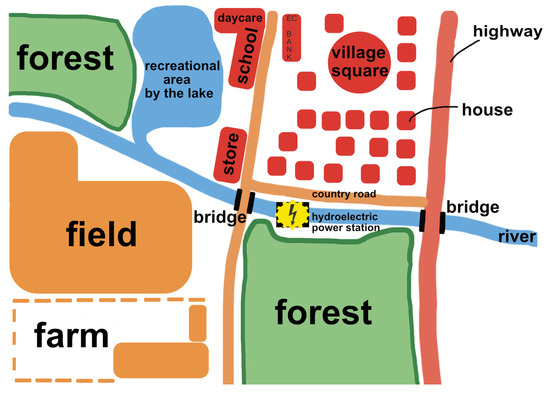
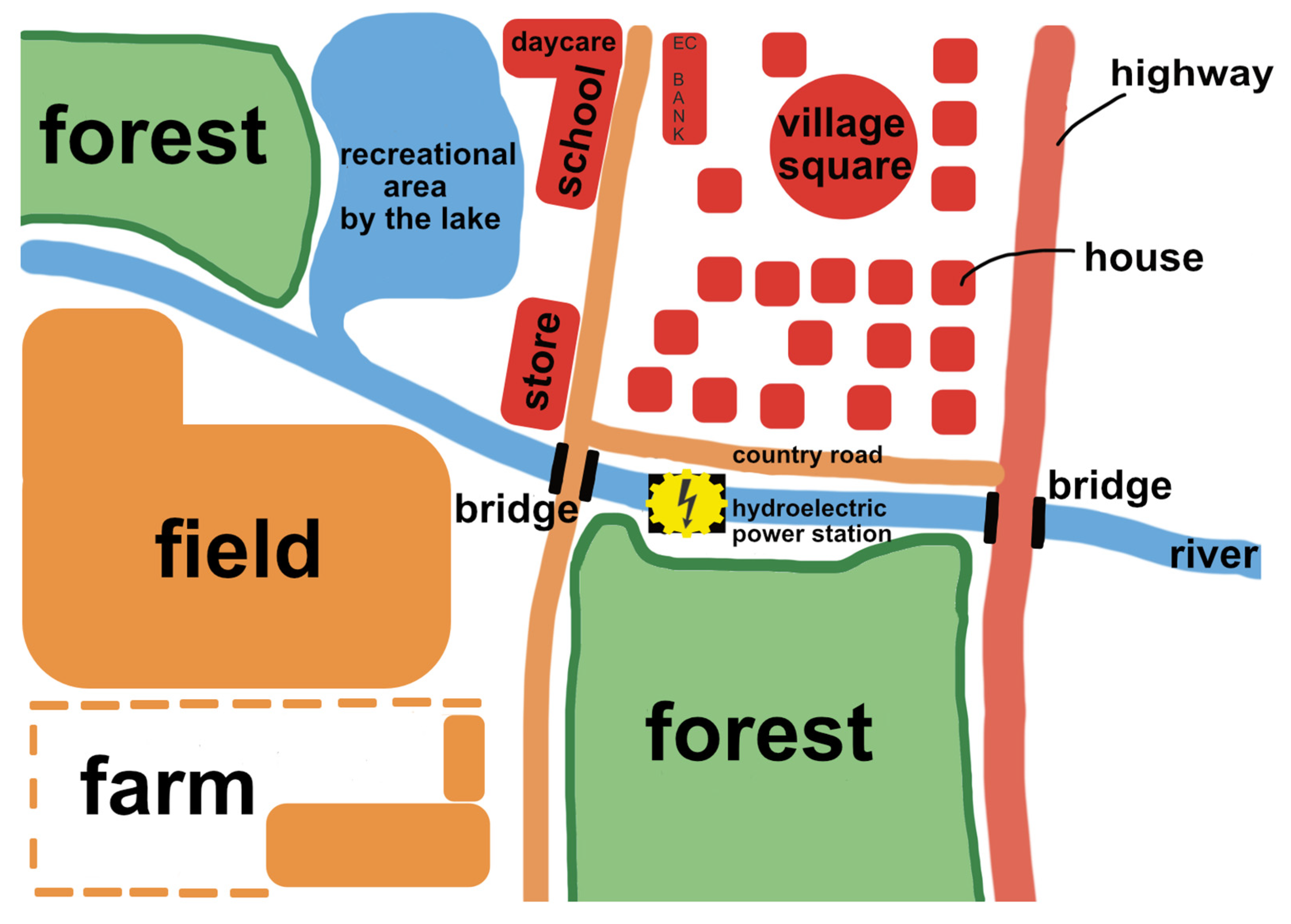
The present study employs a drawing task that was developed in a pilot study (Kaufmann et al., 2026) and subsequently refined (Figure 4).
Figure 4.
Drawing task “10 years ago”.
In the pilot, participants (n = 12)—recruited from a university student cohort—were assigned a comparable symbol-based task derived from a precursor map, incorporating an intervention design based on the peer-interaction-method. However, students did not recognize the task situation as a complex system characterized by indeterminate goals. Participants produced teleological arguments—attributing intentions to systems—that impeded genuine prognostic ability and thus hampered systems thinking (Kaufmann et al., 2026). The main reason was a preconception about the specific development of the map described in the assignment. Consequently, the current design requires open-ended decision making: no overarching development was suggested, and all decisions of the fictional actors remained at the discretion of the students. The new assignment was developed as follows:
Assignment: A farmer implemented changes on his farm. Based on the map “10 years ago” (Figure 4), create a new map that depicts the village and its surroundings as they appear today. You may alter anything, keep everything as it is, add new structures, or remove existing ones.
The participants shape the external influences themselves. This method enables a wide spectrum of graphic expressions, which are later deepened through interview sessions, plenary discussions, and additional prompts. The task underscores that ESD is inherently interdisciplinary in nature: it not only addresses biological aspects but also incorporates additional academic disciplines.
The elements shown on the map were selected to serve as starting points for potential illustrations while incorporating key features of a typical map. The elements balance the three dimensions of sustainability—ecological, social, and economic—without overrepresenting any single dimension. In addition to fostering multidimensional reasoning through these elements, the inclusion of multiple actors (e.g., farmers, residents, employees, teachers, children) and their potential networks and interactions provides a suitable basis for perspective-taking and systems thinking.
Unlike the original map in the pilot study, the map used in this study (Figure 4) has been simplified in its element details. It is a significantly more schematic illustration, enabling students of all grade levels to create their own drawings based on this template.
2.2. Research Method: Students Confront a Sustainability Challenge
A total of 131 students (n = 131) from a Lower Saxony high school (which in Germany covers grade levels 5–13 for students choosing this school track), age distribution 10–20, participated. The classes of the respective grades from which the students were drawn were randomly selected. Participation was voluntary, with no refusals, ensuring that the entire class was included in the survey. Data collection took place during regular class hours. The sample spans grades 5–13, covering the entire secondary curriculum up to the Abitur (the German university entrance qualification), thereby allowing the identification of possible learning progressions toward the ESD paradigm across the school trajectory (RQ 1). While this is not a longitudinal study—since the learning progression of individual students could not be tracked over the full nine-year span—the cross-sectional study at the same school enables conclusions about progressions. This is because all students from grades 5 to 13 follow or have followed an approximately identical educational pathway at the same institution. Thus, it allows for both statements regarding the current learning status up to a given grade level and comparative analyses between consecutive grades, each representing the learning status of the subsequent cohort. From the pool of drawings, 12 students were invited to a retrospective individual interview (Côté et al., 2005). They were randomly selected across grades, ensuring that the lower secondary level (Grades 5–7), middle secondary level (Grades 8–10), and upper secondary level (Grades 11–13) were approximately equally represented. The same applies to boys and girls. Their verbal statements were audio-recorded. The retrospective individual interviews and students’ self-descriptions of their drawings in the plenary session were conducted prior to the intervention phase, ensuring that these statements remained unbiased. The drawings were collected before the intervention, preventing any modifications during the intervention or plenary discussions. These interviews, together with the corresponding drawings, were analyzed using a mixed coding Qualitative Content Analysis (Mayring, 2004) and interpreted through the CMT (Gropengießer, 2007) in relation to systems thinking (Rieß & Mischo, 2010). Additionally, a Teaching Experiment (Komorek & Duit, 2004) was conducted: plenary discussions with stimulus questions were held during classroom sessions. The entire intervention process, following the individual drawings, was structured as follows: Students first presented all their drawings (which structures they added, altered, or removed) and justified their decisions, followed by a phase in which the interviewer asked follow-up questions to clarify understanding and the reasoning behind decisions of all aspects depicted (accompanied group interviews). In the next step, the open classroom discussion in plenary (hereinafter referred to as the “plenary discussion”) was conducted. Subsequently, the study leads initiated negotiation processes through an intervention designed to provoke conflicts in decision-making by modifying the initial conditions—such as prohibiting the logging of certain forests due to protected species.
Transcripts of verbal expressions were created for all grades (accompanied group interviews). These transcripts were also subjected to Qualitative Content Analysis.
For the diagnosis of conceptions (RQ 1) in the drawings (cf. Ehrlén, 2009; Ingebrethsen, 2013), the graphic elements were triangulated with the interview transcripts. A coding scheme was developed to classify student statements from the 12 interviews and the 10 plenary phases into 15 categories. These categories were derived from a preceding study (Kaufmann et al., 2026), which revealed that learners particularly rely on image schemas, teleological reasoning, and intentionalism when justifying their decisions. In the context of land-use map planning, the selected image schemas proved most suitable:
- Categories 1–3: The three sustainability dimensions (ecological, social, economic).
- Category 4: a primary overarching design goal.
- Categories 5–7: use of image schemas (Source–Path–Goal schema, action schema, center–periphery schema).
- Category 8: Employment of two dimensions for justification (multidimensionality).
- Category 9: Employment of three dimensions.
- Category 10: Interdependence and recursion concerning the used dimensions and perspectives (multiperspectivity).
- Category 11: Intentionalism.
- Category 12: Teleological arguments.
- Category 13: Anticipated external expectations.
- Category 14: Anthropomorphizations and value judgments.
- Category 15: Pessimistic statements and underestimation of personal influence.
A particular research interest lies in examining interdependence and recursion from a systems-thinking perspective across the sustainability dimensions. Table 1 presents an excerpt from the coding guide.
Table 1.
Coding Guide—Drawing ESD (excerpt).
The design’s aim is to collect comparable data across multiple grade levels within a cross-sectional design at approximately the same point in time using an identical task and analytical framework, thereby attributing age-related (cohort-specific) differences to genuine variations in interpretive and decision-making logic rather than to methodological artifacts.
The following description illustrates our use of qualitative content analysis.
- (1)
- Data Preparation: Audio recordings of group interviews are transcribed verbatim. During this stage, the text is systematically refined to enhance clarity and focus. Meaningful statements are extracted, while redundancies, filler words (e.g., “um,” “like”), and unrelated remarks are removed. Participant expressions are rephrased into concise, independent statements to preserve their core meaning while improving readability.
- (2)
- Contextual Interpretation: Each statement is analyzed in its original context to ensure accurate interpretation. This step involves cross-referencing the transcript to clarify ambiguous phrasing or implicit meanings, ensuring that the essence of the participants’ responses is preserved.
- (3)
- Categorization and Structuring: The refined statements are systematically organized into thematic categories based on their relevance to the research question. This process includes:
- -
- Grouping by Meaning: Statements conveying similar ideas are consolidated to avoid duplication.
- -
- Resolving Inconsistencies: Contradictions or unclear statements are reviewed to determine whether they reflect genuine divergence or require further clarification.
- -
- Ordering for Coherence: The categorized statements are arranged in a logical sequence to facilitate analysis and interpretation.
This structured approach ensures that the data is both rigorous and interpretable, enabling meaningful insights to be drawn from the material.
Triangulation was achieved by cross-checking verbal statements from individual interviews with those from the two plenary phases and with the graphic outputs from the solitary drawing task.
A reliability check was conducted on 20 drawings and the corresponding two transcripts per drawing (representing > 15% of the data) by two independent researchers using the coding scheme, resulting in Cohen’s κ = 0.85. Inter-rater reliability was calculated following Posner et al. (1990).
The drawing task, combined with semi-structured interviews, is designed as a visual-conceptual elicitation method grounded in embodied cognition and the CMT. By analyzing the process of drawing (e.g., elements, connections, annotations) alongside verbal explanations, the study captures not only final representations but also dynamic cognitive operations such as identifying interdependencies, trade-offs, and hierarchical relationships—core competencies of systems thinking (Rieß & Mischo, 2010). The accompanying interviews further probe metaphorical reasoning (e.g., spatial or journey-based depictions of sustainability), ensuring that the drawings reveal conceptual structures rather than mere design preferences. This dual-method approach strengthens construct validity by aligning procedural and declarative data with the study’s triadic framework (CMT, MER, systems thinking).
3. Results: Patterns in Students’ Sustainability-Related Drawings and Verbalizations
A total of 1066 statements referring to structures within the three sustainability dimensions (ecological, social, and economic) were identified by triangulating the 131 land-use drawings, the ten plenary discussions, and the twelve retrospective individual interviews.
The Results section reports (a) the coded conceptual patterns identified in students’ drawings and verbalizations, (b) descriptive differences across grade cohorts, and (c) the frequency with which individual or multiple sustainability dimensions and reciprocal relationships were referenced. The theoretical interpretation of these patterns and their educational implications are addressed in the Discussion.
3.1. Coded Conceptual Patterns in Drawings and Verbalizations
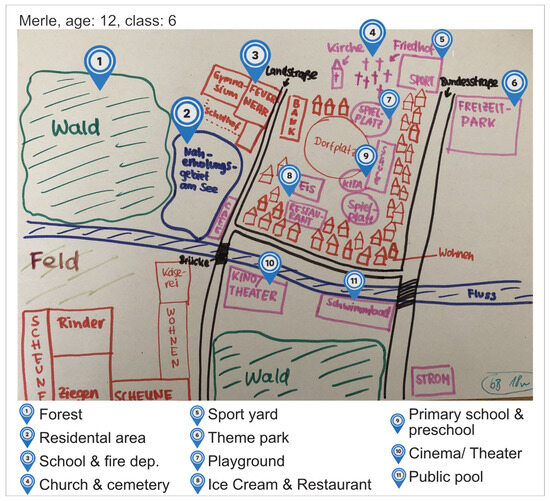
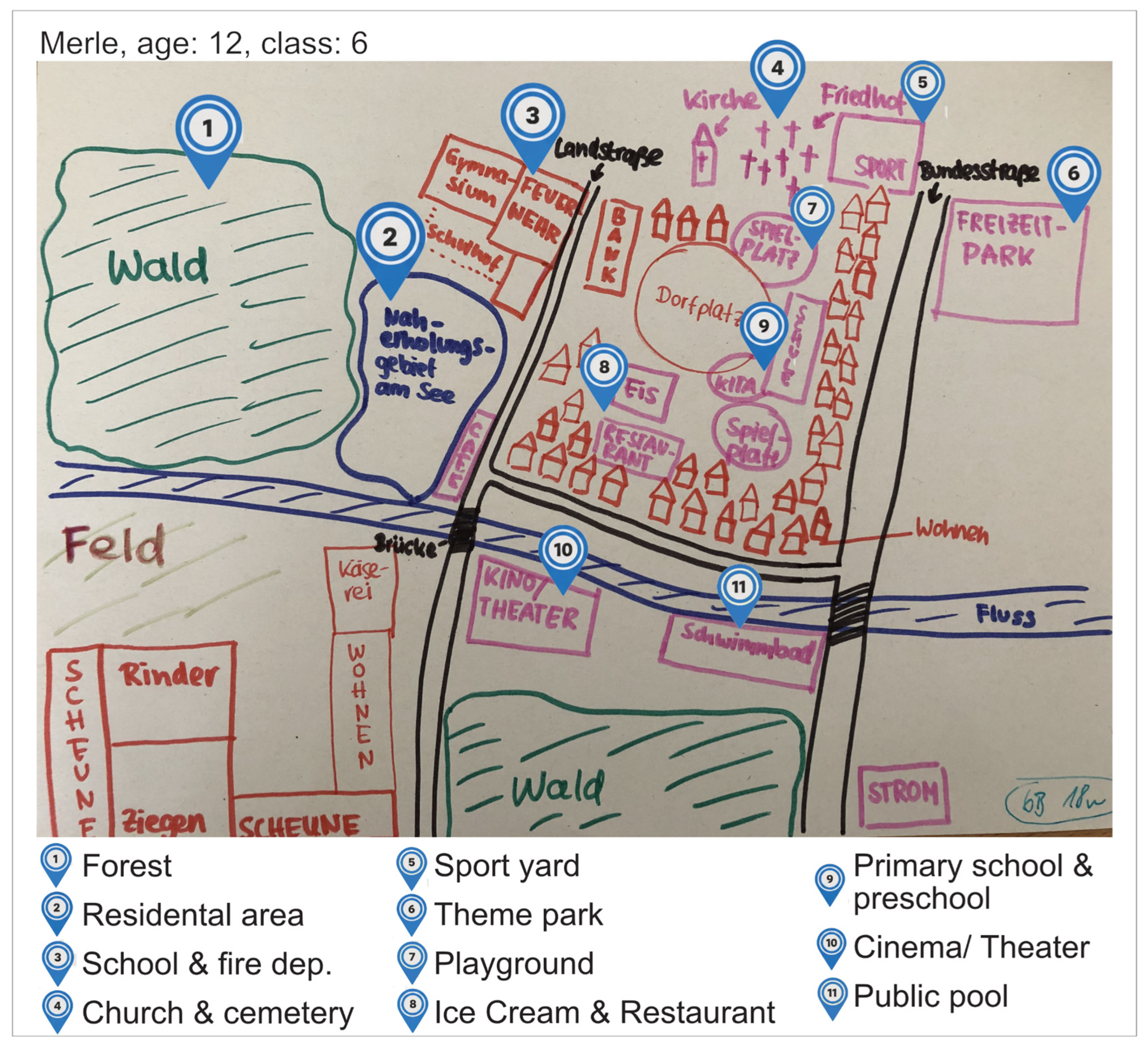
For better comprehension, our results are illustrated using an example. Figure 5 shows the map drawn by Merle (age 12, grade 6).
Figure 5.
Example map drawing of lower grade levels.
In addition to the use of certain elements typical for younger students—which will be discussed in more detail later—Merle’s map exemplifies a common approach to task implementation:
The task-derived map serves as a template, which students expand, modify, or reduce. They maintain the schematic style, rarely adding detailed depictions, and typically label elements directly or, less frequently, include a legend. This allows students to make substantial graphical changes within a manageable timeframe. Furthermore, the evaluation of the map elements requires no interpretative effort, as the intended representations are clearly defined.
Compared to the map “10 years ago” (Figure 4), her drawing clearly shows that she added a fire department (3), a church (4), several recreational areas (5, 6, 7, 10, 11), and eating options (8).
Verbally, she expressed: “I drew a swimming pool. So people don’t get bored in the village. And a theatre. That’s for entertainment” (Merle, 12, plenum).
According to the CMT, her expression refers to the so-called agent-action schema: things are processed/crafted/modified to serve a purpose.
In total, we identified several conceptions on the level of notions through the triangulation of verbal expressions and drawings. For the purpose of clarity, we have formulated them below as antipodes. These antipodal (opposing) or triangulated concepts at the level of notions serve to systematically categorize the polar or gradual tensions in learners’ conceptualizations and highlight their analytical significance for understanding learning processes within the context of ESD. By contrasting these concepts—such as between individual agency (Change through Choice) and external constraints (Change through External Control), or between anthropocentric (Right to Economic Success) and ecocentric rights (Intrinsic Right of Nature)—it becomes possible not only to reconstruct learners’ cognitive structures but also to identify learning obstacles, contradictions in reasoning, and developmental potential for a holistic systems perspective. The analysis of these antipodes further allows for the systematic examination of embodied conceptions (embodied understandings) and their influence on the interpretation of sustainability dimensions (ecological, social, economic)—for instance, through drawings or verbal expressions—and to derive targeted didactic interventions from these insights.
| CHANGE THROUGH CHOICE | CHANGE THROUGH EXTERNAL CONTROL |
While the first notion is characterized by shaping the world according to one’s values and beliefs, the latter focusses on general trends and social boundaries.
| QUALITY OF LIFE THROUGH LEISURE | QUALITY OF LIFE THROUGH ECONOMIC SECURITY |
Statements categorized as QUALITY OF LIFE THROUGH LEISURE referred to recreation, entertainment, and personal well-being. Statements categorized as QUALITY OF LIFE THROUGH ECONOMIC SECURITY referred primarily to employment, income, productivity, and material stability.
| RIGHT TO ECONOMIC SUCCESS | RIGHT TO UTILIZE NATURE | INTRINSIC RIGHT OF NATURE |
Statements categorized as Right to Economic Success prioritized economic outcomes; RIGHT TO UTILIZE NATURE framed natural structures primarily as resources for human purposes; and INTRINSIC RIGHT OF NATURE attributed value to nature independently of direct human use.
| ECONOMY AND ECOLOGY ARE CORRELATING DIMENSIONS | ECONOMY AND ECOLOGY ARE DIMENSIONAL ANTIPODES |
Both notions encompass a dependency between the two dimensions. On the one hand the influence is gradual and necessitates a trade-off—on the other hand it has opposing effects and constitutes a zero-sum game.
Although, when looking at the results as a whole, some conceptions appear more prominent than others, a year-group-specific analysis reveals the following findings.
3.2. Cross-Sectional Differences Across Grade Cohorts
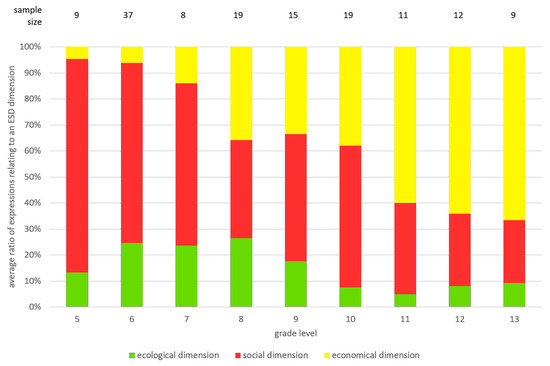
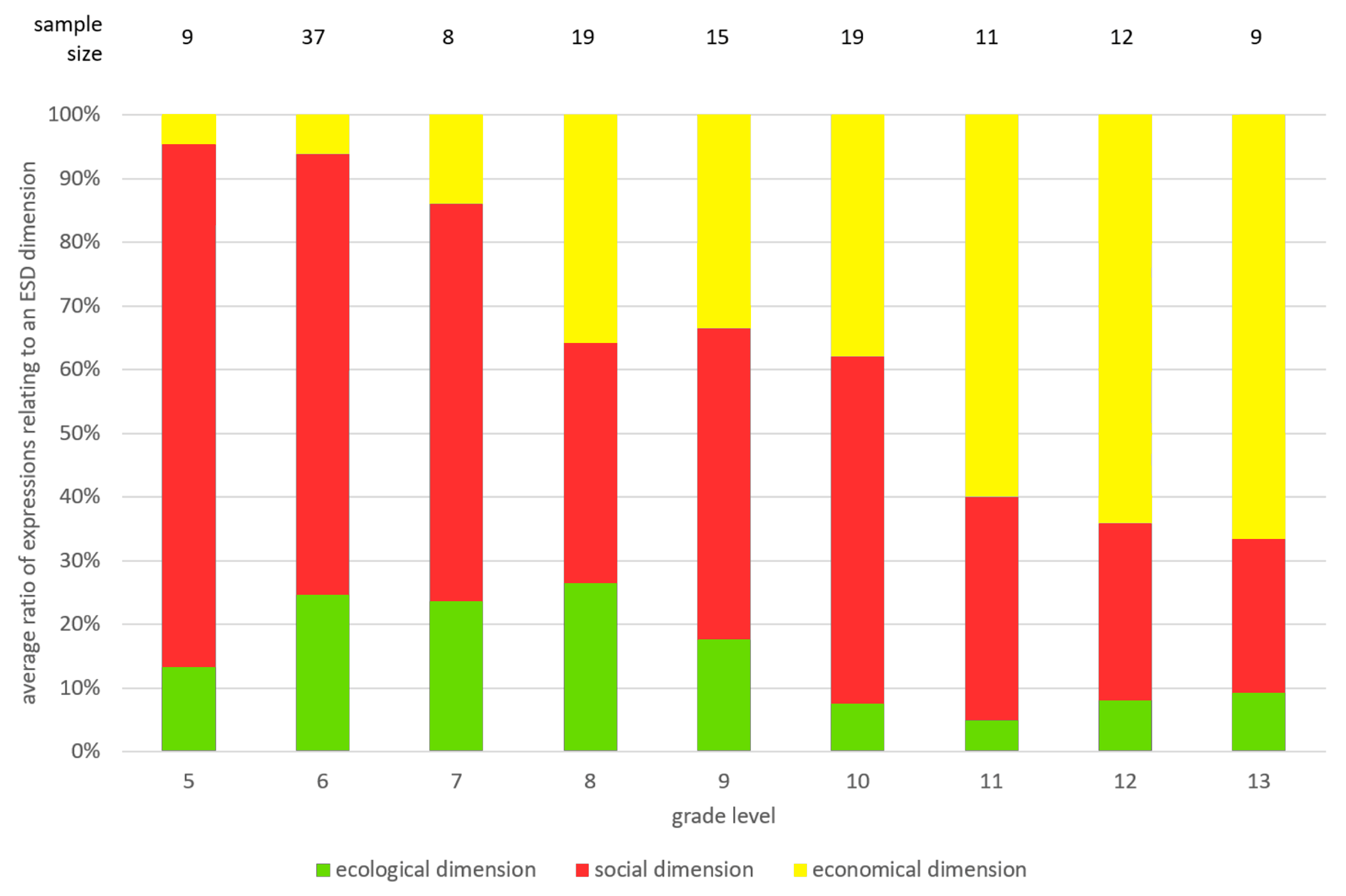
Figure 6 presents the relative frequency of ecological, social, and economic references across the grade cohorts. Ecological references remained comparatively stable, whereas the relative frequency of social references decreased and that of economic references increased between Grades 5 and 13. In Grade 5, 81.6% of the coded statements referred to the social dimension and 4.6% to the economic dimension. In Grade 13, 24.2% referred to the social dimension and 66.6% to the economic dimension.
Figure 6.
Average ratio of expressions relating to an ESD dimension depending on grade level.
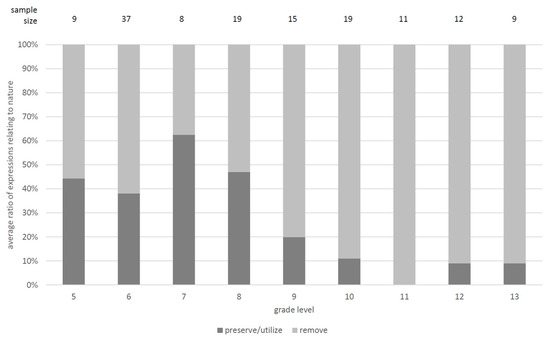
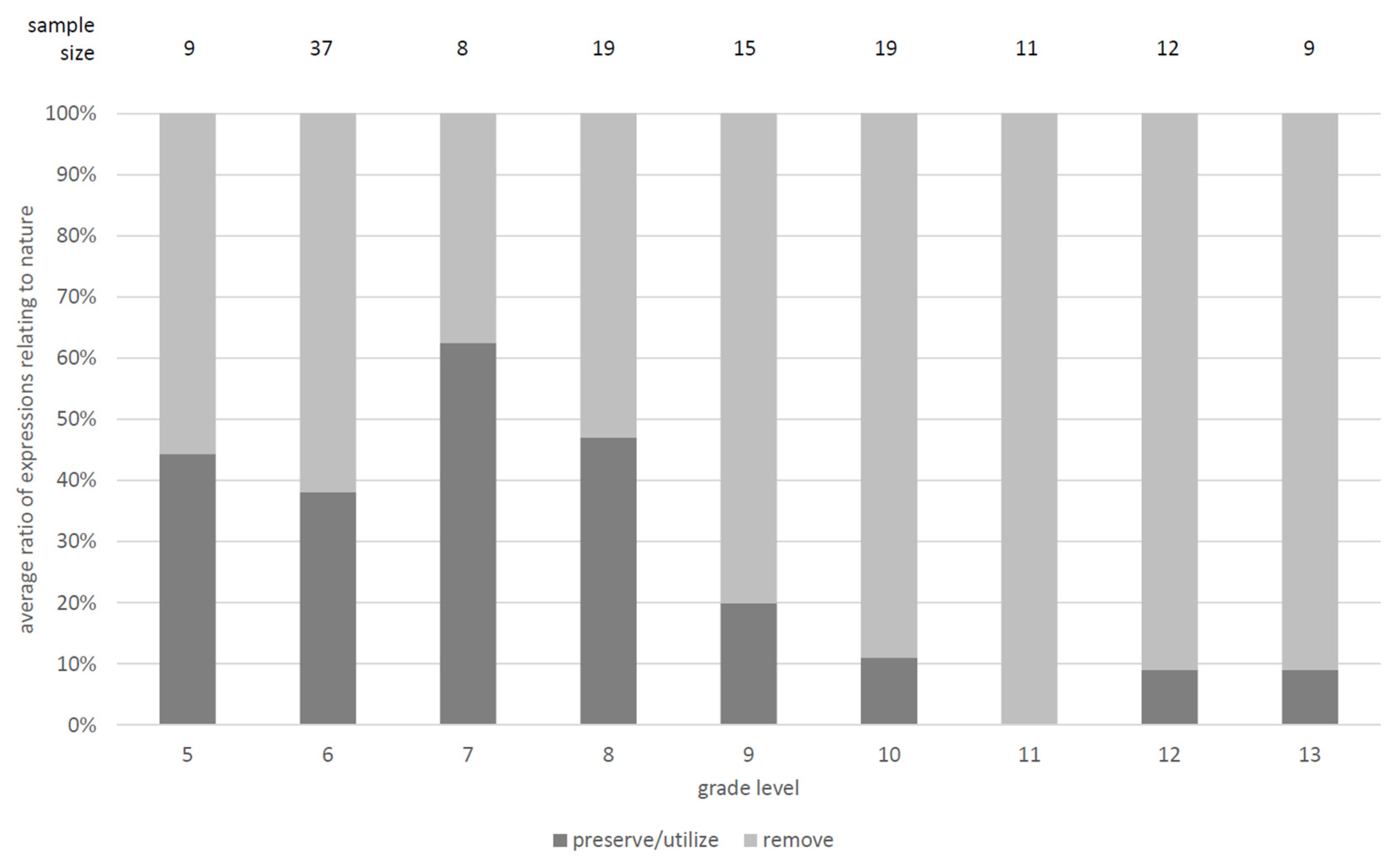
A striking observation in the drawings was the treatment of the natural structures already present on the map, such as forests, lakes, and rivers. Relevant research distinguishes between utilization and preservation of nature (Bogner & Wiseman, 1999). While the underlying and widely used 2-MEV (2 major environmental values) scale consists of questions concerning the general attitude towards nature (Bogner, 2018), the map in our study asks for a trade off with elements of other dimensions. Because of that and the anthropocentric idea of sustainability, we have decided to contrast the utilization (e.g., nature for farmland or recreation) and preservation (nature has value on its own) of nature with its complete removal in favor of other elements (Figure 7). The utilization and preservation are combined and contrasted with the complete removal of natural structures across grade levels. This approach is justified because both utilization and preservation retain natural structures, allowing for a clear contrast with their removal.
Figure 7.
Ratio of tendencies to preserve/utilize or remove nature depending on grade level.
The counts reveal that, already in lower-grade cohorts (grades 5–7), more than half of the students (55.6%) remove elements of nature, yet a substantial proportion (44.4%) utilizes or preserves elements of nature. In contrast, all students in higher grades (grades 11–13) remove natural structures. Only 4.2% of these students plan to reintegrate natural structures elsewhere.
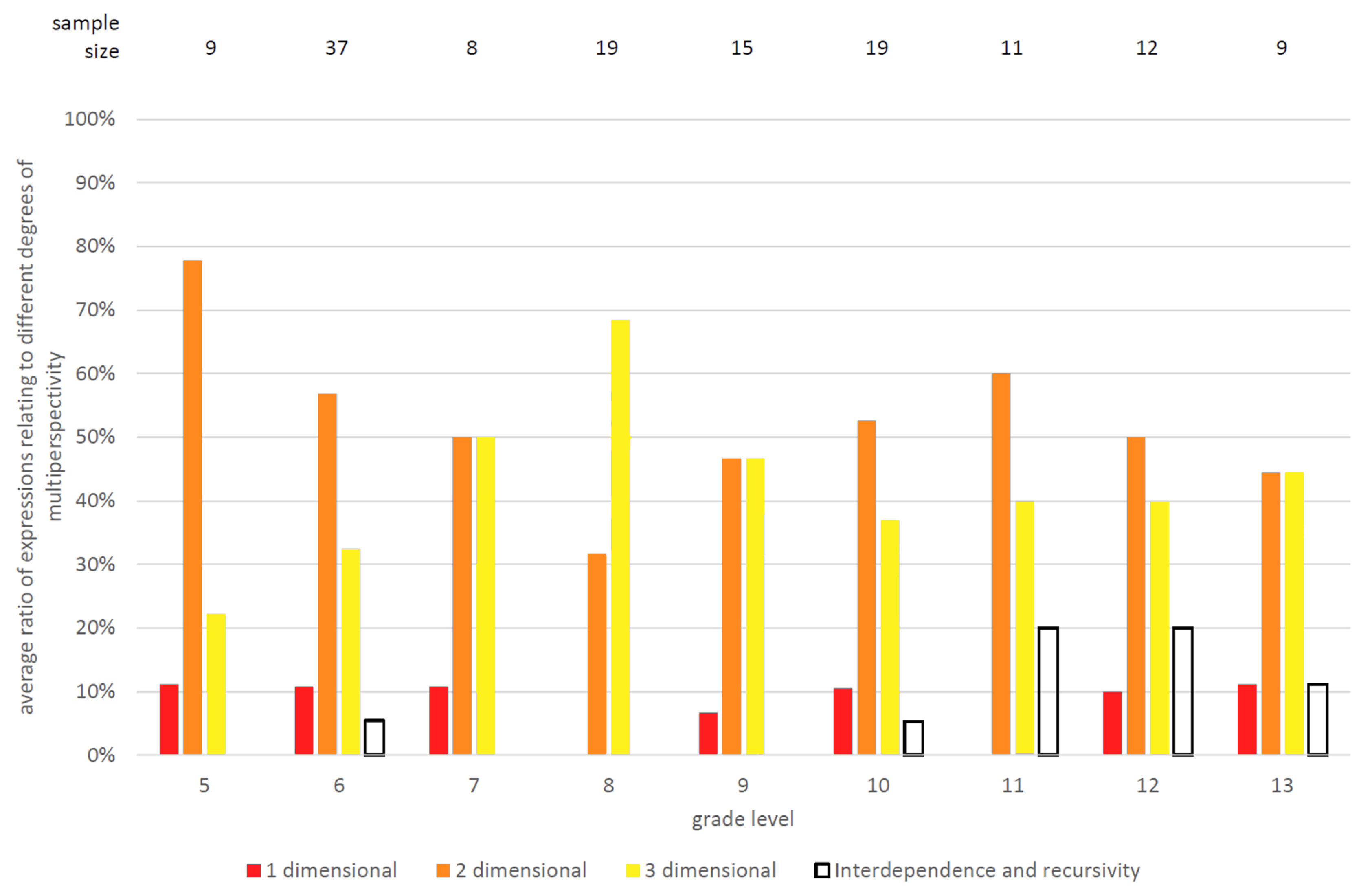
Regarding another aspect of the learners’ dimension-specific expressions, a closer analysis also reveals a new insight: multidimensionality and interdependence.
Multidimensionality refers to the integration of key sustainability dimensions—ecological, economic, and social—and examines their interdependencies. Multiperspectivity, in contrast, emphasizes the inclusion of diverse viewpoints, disciplines, or stakeholders to highlight the range of interpretations and interests at play. Together, these principles enable a comprehensive and critical engagement with complex sustainability issues.
Figure 8 reports two levels of analysis: the number of sustainability dimensions represented in each complete drawing and the number of dimensions used to justify individual decisions. Across the complete drawings, 7.6% represented one sustainability dimension, 50.4% represented two dimensions, and 42.0% represented all three dimensions. At the level of individual decision justifications, 94.7% referred to only one sustainability dimension. No coded justification linked all three dimensions through reciprocal relationships.
Figure 8.
Expressions triangulated through drawings and speech regarding mono- or multidimension, their interdependence and recursivity; shown as the average ratio of expressions from all students of each grade level in relation to the respective category.
4. Discussion
In the following, we identify possible causes for these circumstances, discussing them in light of the CMT. These considerations yield implications for systems thinking.
The present study investigated students’ grade-level differences toward systems thinking in ESD. Based on 1066 coded expressions from drawings, discussions, and interviews, the results reveal a central contradiction: students increasingly recognize different sustainability dimensions but rarely connect them in a systemic way. Although most students created multidimensional land-use maps (50.4% integrating two dimensions; 42% integrating all three dimensions), individual decisions remained almost exclusively monodimensional (94.7%). This can be interpreted to mean that students see dimensions but miss systems thinking. Interdependence and recursion, which represent core elements of systems thinking (Rieß & Mischo, 2010; M. Mehren et al., 2015), were almost absent (5.3%, n = 131). The data indicates that interdependence and recursivity are observed almost exclusively in the upper secondary grades (grades 11–13), where they account for 16.7% of the students.
From the perspective of CMT (Lakoff & Johnson, 2003), this discrepancy can be explained by fundamental experience-based reasoning patterns. These patterns help learners reduce complexity but may simultaneously limit their ability to understand dynamic systems. The following sections discuss implications for (1) multidimensionality and multiperspectivity as prerequisites for understanding systems and (2) systems thinking as a problem-solving strategy.
4.1. From Recognizing Dimensions to Understanding Interdependencies: Implications for Multidimensionality and Multiperspectivity
Systems thinking requires learners not only to identify system elements but also to understand their relationships and reciprocal effects. The results demonstrate that students successfully identify ecological, social, and economic elements but usually interpret them independently rather than as interconnected components. This indicates an additive understanding of sustainability: different dimensions coexist but are rarely negotiated within one decision. Similar findings have shown that learners often focus on dimensions that correspond to their prior knowledge or experiences (Groß et al., 2009; Redman et al., 2021). However, the present study reveals that the dominant perspective changes throughout students’ educational development without necessarily becoming more systemic.
4.1.1. Self-Oriented Reasoning: Sustainability Is Interpreted Through Personal Goals
A first limitation arises from students’ tendency to understand complex systems from their own perspective. Younger students primarily interpret sustainability through personally meaningful experiences. In grade 5, 81.6% of expressions refer to the social dimension, whereas economic aspects are rarely considered (4.6%).
For example, Kilian (11) explains: “I designed the village so that I would also like to live there myself.”
Such statements represent the conception QUALITY OF LIFE THROUGH LEISURE. Students create environments according to their own ideas of a desirable life.
From a CMT perspective, these explanations are based on the agent-action schema: an actor intentionally changes the world to achieve a goal. This intentionalism helps students make sustainability issues meaningful but can restrict systemic understanding when complex interactions are reduced to purposeful actions. Older students do not overcome this structure but replace the dominant goal. By grade 13, 66.6% of statements refer to the economic dimension. Economic functionality becomes the central organizing principle: “I tried to plan the village so that it works economically” (Piet, 19).
Thus, the learning progression does not represent a shift from simple to systemic thinking. Instead, the guiding goal changes from personal well-being to economic efficiency. Decisions continue to follow a source–path–goal schema: a desired outcome is defined, and actions are selected to achieve it. Instead of using the conception QUALITY OF LIFE THROUGH LEISURE, like younger students, they use the conception QUALITY OF LIFE THROUGH ECONOMIC SECURITY.
4.1.2. Monoperspectivism: Perspective-Taking Does Not Equal Perspective Integration
A second barrier concerns the difference between adopting perspectives and integrating them. Students frequently consider different actors, such as residents, farmers, companies, or animals. However, decisions are usually justified from one dominant viewpoint. This reflects a center–periphery schema: one actor or one goal becomes central, while other perspectives remain peripheral. Among younger students, this often leads to anthropomorphic reasoning. Needs and experiences are transferred to non-human actors: “The forest should stay because the animals live there.” (Leon, 11).
Such reasoning supports empathy toward nature but does not necessarily lead to an ecological understanding of complex relationships. Older students increasingly adopt anticipated external expectations. Their reasoning is shaped by what they perceive as unavoidable societal or economic developments: “What brings the most money wins.” (Piet, 19).
From this, it can be inferred that economic development is regarded not as a negotiable perspective, but as a necessity. This is reflected in the finding that all students in grades 11–13 removed natural structures, whereas only 4.2% compensated for this removal elsewhere. Therefore, the educational challenge is not only to foster perspective-taking but perspective coordination: students need to negotiate conflicts and dependencies between ecological, economic, and social dimensions.
4.1.3. Perceived Powerlessness: Awareness Without Agency Limits Systems Thinking
A third limitation concerns students’ perception of their own influence within complex systems. Older students frequently recognize ecological problems but perceive current developments as difficult to change. Lesslie (17) states: “Some people demonstrate and so on. But you see that it mostly doesn’t achieve anything.” These statements thus indicate that there are experiences related to a perceived powerlessness.
This finding may be interpreted in light of current discussions on climate anxiety. For instance, Gunasiri et al. (2022) report that increased awareness of environmental problems does not automatically lead to sustainable action but may produce helplessness if students do not experience agency. Those statements align with Grund and Brock (2022), who argue that many young people do not feel sufficiently empowered by educational institutions to contribute to sustainability transformations. Consequently, ESD must not only increase awareness of problems but enable students to experience themselves as actors within changeable systems.
4.1.4. Implications for Learning Environments
The results suggest that learning environments should move beyond simply adding ecological, economic, and social dimensions. Students already recognize dimensions—the challenge is connecting them. Contrasting perspectives are not examined in depth, and innovative problem-solving strategies are not required due to the lack of competing interests among different actors. In this respect, the data and its interpretations are highly compatible with R. Mehren et al.’s (2014) considerations on instructional settings within Education for Sustainable Development, which note that topics are often addressed under-complexly, with mono-causal solution approaches being suggested. It is therefore proposed to promote students’ intrinsic tolerance for complexity by expanding the number of cause-and-effect chains they mentally simulate, thereby fostering abstract transferability to unforeseen life and action situations (R. Mehren et al., 2014). Accordingly, an enhancement of ambiguity tolerance is also required.
Following the MER, students’ conceptions should be understood as starting points for learning. Intentional reasoning, anthropomorphism, and goal-oriented thinking are not misconceptions but experience-based strategies.
In this regard, the following educational implications for instructional design are proposed:
- Make conflicts between sustainability dimensions explicit;
- Require students to justify one decision from several perspectives;
- Visualize feedback loops and unintended consequences;
- Promote reflection on students’ own position within systems (second order cybernetics).
4.2. From Finding Solutions to Managing Complexity: Implications for Systems Thinking as a Problem-Solving Strategy
Systems thinking is not only required to understand complex systems but also to act within them. Sustainable development problems cannot be solved through simple cause–effect reasoning because they involve uncertainty, conflicting goals, and unintended consequences.
However, the results indicate that students frequently approach sustainability challenges as optimization problems. They define a desirable goal and search for the most efficient pathway toward achieving it. Notably, a prior study (Kaufmann et al., 2026) suggested that scenarios and tasks should avoid prescribing overarching design goals to prevent hindering genuine trade-off processes in systems thinking. In this study, the task was deliberately designed to be open-ended, granting students full autonomy over initial decisions. However, the results reveal that students did not engage in deliberative trade-off discussions as expected. Instead, they prioritized predefined design goals, which subsequently shaped their subsequent decisions.
4.2.1. Self-Oriented Reasoning: Solutions Follow Predefined Goals
Students’ reasoning is often structured by the source–path–goal schema. They define a future state and interpret decisions as necessary steps toward this goal. For younger students, this goal is often social well-being. For older students, it shifts toward economic success: “A maximally efficient increase in economic growth.” (Michael, 19).
Such reasoning enables purposeful action but reduces complex systems to linear action sequences. As M. Mehren et al. (2015) argue, dealing with complexity requires understanding interactions rather than searching for isolated solutions.
4.2.2. Monoperspectivism: Sustainability Requires Negotiation Rather than Optimization
The findings show that students rarely evaluate competing perspectives simultaneously. Instead, they optimize solutions within one dominant frame. This becomes visible in the conception ECONOMY AND ECOLOGY ARE DIMENSIONAL ANTIPODES.
These monofocal optimizations can be theoretically framed as cognitive framing effects (Entman, 1993) and paradigmatic cognitive frameworks (Kuhn, 1962). Framing effects (Entman, 1993) demonstrate how the framing or perception of information—such as through metaphors like “sustainability is a journey”—guides cognitive processing, leading to a selective focus on particular aspects. Within the context of this study, such effects may elucidate why students often remain confined to a single frame, disregarding alternative perspectives. Paradigmatic cognitive frameworks (Kuhn, 1962) refer to deeply ingrained, often unconscious cognitive schemas that shape thinking. These frameworks can impede systems thinking when learners remain trapped in additive or linear thought patterns, thereby hindering the development of interconnected solutions.
Students often perceive sustainability conflicts as zero-sum decisions: economic development occurs at the expense of ecological preservation. When resources are limited—as in the constrained space of the map—older students increasingly adopt the utilitarian conception of RIGHT TO UTILIZE NATURE. This is reflected in their willingness to manipulate natural structures arbitrarily in favor of economic objectives. This aligns with prior findings on shifting environmental attitudes during adolescence (Liefländer & Bogner, 2014) and the established distinction between utilization and preservation of nature (Bogner & Wiseman, 1999). While traditional 2-MEV scales assess general environmental attitudes (Bogner, 2018), our task explicitly introduces a trade-off between nature and other dimensions, revealing how utilitarian reasoning dominates under constraints. We argue that a trade-off situation is more comparable to the experience of making everyday decisions in the context of sustainability. This could explain part of the discrepancy with studies on general utilization or preservation attitudes.
However, systems thinking requires understanding sustainability problems as negotiation processes. In this context, it seems reasonable for students to learn that different solutions can lead to varying consequences for different actors. Therefore, it might be beneficial if ESD shifts its focus from asking: “What is the correct sustainable solution?” to instead exploring: “How do different solutions alter systems?”.
4.2.3. Perceived Powerlessness: Problem Solving Requires Possible Futures
Older students’ stronger orientation toward external expectations may indicate that sustainability problems may be perceived as predetermined. This suggests that it may limit transformative competence because students recognize problems but do not imagine alternatives. Consequently, learning environments should support future-oriented thinking. Students should experience that systems are dynamic and that interventions can create new possibilities. Rather than predicting a probable future, ESD should enable students to design possible futures.
5. Limitations
Several limitations should be considered when interpreting the findings: First, the participants were recruited from a single secondary school in Lower Saxony, making the results context-dependent and limiting their direct transferability to other school types, regions, or educational systems. Second, the cross-sectional comparison provides cohort-specific snapshots rather than evidence of individual learning progression over time. Grade-level differences should therefore be interpreted as indications of possible developmental patterns rather than as longitudinal effects. Finally, the analysis of drawings, interviews, and plenary discussions is inherently interpretive. Although data triangulation and independent coding of more than 15% of the material indicated high intercoder agreement (Cohen’s κ = 0.85), subjective influences on categorization cannot be fully excluded. Future longitudinal and multi-site studies are needed to examine the robustness and transferability of the findings.
6. Conclusions
This study suggests that students show increasing familiarity with sustainability dimensions as they progress through grade levels. However, these patterns do not necessarily indicate a shift toward systems thinking—rather, instances of recursivity and interdependence, as understood within systems thinking, were scarcely observed.
Rieß’s framework (Rieß, 2003; Rieß & Mischo, 2010; Rieß et al., 2015) illustrates that the knowledge–behavior gap cannot be understood solely as a cognitive problem. Sustainable behavior is embedded in a complex network of structural, social, and psychological influences. Consequently, educational interventions must consider not only content delivery but also structural conditions and motivational factors.
The central challenge is not that students lack ecological, social, or economic knowledge. Instead, they struggle to connect these dimensions and negotiate their interactions.
The identified learning progression (measured against the competency level of the respective cohort) therefore represents a shift in dominant perspectives rather than a progression toward systemic reasoning: younger students focus on social well-being and personal experience, whereas older students increasingly adopt economic and societal expectations.
From the perspective of CMT, these patterns can be understood as experience-based reasoning strategies. They help learners make sense of sustainability problems but may hinder recognition of complexity, feedback, and interdependence.
For biology education, the findings emphasize that ESD must move beyond teaching sustainability dimensions as separate categories. Learning environments should focus on relationships, conflicts, and transformation processes.
Educationally, the data may encourage the idea that students should not only learn to analyze sustainable development but experience themselves as active participants within dynamic systems.
Pedagogically, this suggests that only when learners move from recognizing dimensions to understanding connections can systems thinking become a foundation for sustainable action.
For future research directions, a longitudinal study design could serve as a meaningful complement to the current approach, offering the potential for deeper insights into individual learning progressions over time.
One possible implication of this study is to shift the study design from an individual drawing task that strongly emphasizes individual agency toward collaborative problem-solving. Recent scholarship in Education for Sustainable Development, such as that by Ardoin et al. (2022), argues that ESD benefits from approaches that prioritize cooperation and collective action, particularly when addressing complex challenges. A potential extension of this design could involve introducing a subsequent collaborative phase, in which students discuss their individual proposals from the perspectives of various stakeholders (e.g., through role-playing) before co-constructing a shared solution. Initial approaches to this were tested in a pilot study (see Kaufmann et al., 2026) using a collaborative teaching method based on the peer interaction method (PIM). Such an approach could foster the interconnectedness that currently appears less evident and align more closely with social constructivist perspectives like the model of Vygotsky’s zone of proximal development defined as “the distance between the actual developmental level as determined by independent problem solving and the level of potential development as determined through problem-solving under adult guidance or in collaboration with more capable peers” (Vygotsky, 1978). It illustrates how targeted interventions, such as collaborative tasks, can foster systems thinking by challenging learners to operate beyond their current cognitive level. Social-constructivist approaches thus complement cognition-based theories by adding an action-theoretical perspective, emphasizing that sustainability conceptions emerge not in isolation but through interaction with peers, educators, and cultural narratives, a process that would further enrich the CMT by incorporating a social dimension (Vygotsky, 1978).
The central demand for biology education is clear: ESD must move beyond presenting sustainability as an additive catalogue of ecological, social, and economic dimensions. Instead, learning environments should explicitly address young people’s economic anxieties and make complexity itself an object of instruction—through conflicting perspectives, interdependencies, unintended consequences, and alternative future scenarios. Otherwise, ESD risks merely raising awareness without strengthening systems understanding or the capacity to act. The guiding principle should therefore be: relationships instead of addition, negotiation instead of perceived constraints, and opportunities for action instead of powerlessness. The task is not simply to teach additional dimensions, but to enable learners to understand how these dimensions interact, come into conflict, and transform one another—and how they themselves can thereby contribute to changing the system.
Author Contributions
Conceptualization, K.K., M.M. and J.G.; methodology, K.K. and J.G.; software, K.K.; validation, K.K. and M.M.; formal analysis, K.K. and M.M.; investigation, K.K.; resources, K.K.; data curation, K.K.; writing—original draft preparation, K.K.; writing—review and editing, K.K., M.M. and J.G.; visualization, K.K. and M.M.; supervision, J.G.; project administration, K.K. All authors have read and agreed to the published version of the manuscript.
Funding
This research received no external funding.
Institutional Review Board Statement
The study was conducted in accordance with the principles of the Declaration of Helsinki and complied with all applicable data protection requirements, including the General Data Protection Regulation (GDPR). The study involved voluntary participation, anonymized data collection, no intervention beyond normal educational activities, and no foreseeable risk to participants. Written permission to conduct the study was obtained from the participating school’s principal.
Informed Consent Statement
Informed consent was obtained from all subjects involved in the study.
Data Availability Statement
The raw data supporting the conclusions of this article will be made available by the authors on request.
Conflicts of Interest
The authors declare no conflicts of interest.
Abbreviations
The following abbreviations are used in this manuscript:
| CMT | Conceptual Metaphor Theory |
| ESD | Education for Sustainable Development |
| KMK | Kultusminister Konferenz (The Conference of the German Ministers of Education and Cultural Affairs is Germany’s central body coordinating educational policies across federal states, and its framework—particularly in areas like digitalization, competency-based learning, and vocational education—serves as a benchmark for educational reforms internationally due to its structured, consensus-driven approach and alignment with European educational standards.) |
| MER | Model of Educational Reconstruction |
| MEV | Major Environmental Values |
| NAP | National Action Plan |
| RQ | Research Question |
| SDG | Sustainable Development Goals |
References
- Ardoin, N., Bowers, A., & Wheaton, M. (2022). Leveraging collective action and environmental literacy to address complex sustainability challenges. Ambio, 52, 30–44. [Google Scholar] [CrossRef] [Scilit] [PubMed]
- Bogner, F. X. (2018). Environmental values (2-MEV) and appreciation of nature. Sustainability, 10(2), 350. [Google Scholar] [CrossRef] [Scilit]
- Bogner, F. X., & Wiseman, M. (1999). Toward measuring adolescent environmental perception. European Psychologist, 4(3), 139–151. [Google Scholar] [CrossRef] [Scilit]
- Côté, J., Ericsson, K. A., & Law, M. P. (2005). Tracing the development of athletes using retrospective interview methods: A proposed interview and validation procedure for reported information. Journal of Applied Sport Psychology, 17(1), 1–19. [Google Scholar] [CrossRef] [Scilit]
- Dornhoff, M., Hörnschemeyer, A., & Fiebelkorn, F. (2020). Students’ conceptions of sustainable nutrition. Sustainability, 12(13), 5242. [Google Scholar] [CrossRef] [Scilit]
- Drack, M., & Pouvreau, D. (2015). On the history of Ludwig von Bertalanffy’s “general systemology”, and on its relationship to cybernetics—Part III: Convergences and divergences. International Journal of General Systems, 44(5), 523–571. [Google Scholar] [CrossRef] [Scilit] [PubMed]
- Ehrlén, K. (2009). Drawings as representations of children’s conceptions. International Journal of Science Education, 31(1), 41–57. [Google Scholar] [CrossRef] [Scilit]
- Enquête-Kommission “Schutz des Menschen und der Umwelt—Ziele und Rahmenbedingungen einer nachhaltig zukunftsverträglichen Entwicklung”. (1998). Konzept nachhaltigkeit: Vom leitbild zur umsetzung (Drucksache 13/11200, p. 218). Deutscher Bundestag. [Google Scholar]
- Entman, R. M. (1993). Framing: Toward clarification of a fractured paradigm. Journal of Communication, 43(4), 51–58. [Google Scholar] [CrossRef] [Scilit]
- Frischknecht-Tobler, U., Kunz, P., & Nagel, U. (2008). Systemdenken—Begriffe, konzepte, definitionen. In U. Frischknecht-Tobler, U. Nagel, & H. J. Seybold (Eds.), Systemdenken—Wie kinder und jugendliche komplexe systeme verstehen lernen (pp. 11–31). Pestalozzianum. [Google Scholar]
- Gallese, V., & Lakoff, G. (2005). The brain’s concepts: The role of the sensory-motor system in conceptual knowledge. Cognitive Neuropsychology, 22(3–4), 455–479. [Google Scholar] [CrossRef] [Scilit] [PubMed]
- Gropengießer, H. (2007). Theorie des erfahrungsbasierten verstehens. In D. Krüger, & H. Vogt (Eds.), Theorien in der biologiedidaktischen forschung (pp. 105–116). Springer. [Google Scholar] [CrossRef] [Scilit]
- Gropengießer, H., & Groß, J. (2019). Lernstrategien für das verstehen biologischer phänomene: Die rolle der verkörperten schemata und metaphern in der vermittlung. In J. Groß, M. Hammann, P. Schiemann, & J. Zabel (Eds.), Biologiedidaktische forschung: Erträge für die praxis (pp. 59–76). Springer. [Google Scholar] [CrossRef] [Scilit]
- Groß, J., Lude, A., & Menzel, S. (2009). BNE und biologische vielfalt im schulischen und außerschulischen Kontext—Curriculare vorgaben und verständnis. Natur und Landschaft, 84(3), 108–112. [Google Scholar]
- Grund, J., & Brock, A. (2022). Nachhaltigkeitsinteressiert und zukunftspessimistisch—Replikation einer quantitativen studie zu nachhaltigkeit im bildungssystem. Freie Universität Berlin. [Google Scholar]
- Gunasiri, H., Wang, Y., Watkins, E.-M., Capetola, T., Henderson-Wilson, C., & Patrick, R. (2022). Hope, coping and eco-anxiety: Young people’s mental health in a climate-impacted Australia. International Journal of Environmental Research and Public Health, 19(9), 5528. [Google Scholar] [CrossRef] [Scilit] [PubMed]
- Heylighen, F., & Joslyn, C. (2003). Cybernetics and second-order cybernetics. In Encyclopedia of physical science and technology (pp. 155–169). Elsevier. [Google Scholar] [CrossRef] [Scilit]
- Ingebrethsen, B. (2013). Drawing with metaphors: Mediating ideational content in drawing through metaphors. FormAkademisk—Forskningstidsskrift for Design og Designdidaktikk, 6(3), 1–18. [Google Scholar] [CrossRef] [Scilit][Green Version]
- Johann, L., Rusk, F. K. H., Reiss, M. J., & Groß, J. (2022). Upper secondary students’ thinking pathways in cell membrane biology—An evidence-based development and evaluation of learning activities using the model of educational reconstruction. Journal of Biological Education, 58(1), 144–165. [Google Scholar] [CrossRef] [Scilit]
- Johnson, M. (2017). Embodied mind, meaning, and reason: How our bodies give rise to understanding. University of Chicago Press. [Google Scholar]
- Kattmann, U., Duit, R., Gropengießer, H., & Komorek, M. (1996, March 31–April 3). Educational reconstruction—Bringing together issues of scientific clarification and students’ conceptions. Annual Meeting of the National Association for Research in Science Teaching (NARST) (pp. 1–19), St. Louis, MO, USA. [Google Scholar]
- Kaufmann, K., Michelsen, M., Hermann, M., & Groß, J. (2026). Systems thinking aus verständnisorientierter perspektive: Entwicklung von vorstellungen und problemlösestrategien beim erstellen von landnutzungskarten zur BNE [In Print: Lehr- und Lernforschung in der Biologiedidaktik. (Band 12)]. Studienverlag. [Google Scholar]
- Komorek, M., & Duit, R. (2004). The teaching experiment as a powerful method to develop and evaluate teaching and learning sequences in the domain of non-linear systems. International Journal of Science Education, 26(5), 619–633. [Google Scholar] [CrossRef] [Scilit]
- Kuhn, T. S. (1962). The structure of scientific revolutions (1st ed.). University of Chicago Press. [Google Scholar]
- Kultusministerkonferenz (KMK). (2024). Qualitätssicherung in schulen: Weiterentwickelte bildungsstandards in den naturwissenschaften für das fach biologie (MSA). Beschluss der kultusministerkonferenz vom 16. Dezember 2004 in der fassung vom 13. Juni 2024 (p. 5). Kultusministerkonferenz. [Google Scholar]
- Lakoff, G., & Johnson, M. (2003). Metaphors we live by. University of Chicago Press. [Google Scholar]
- Liefländer, A. K., & Bogner, F. X. (2014). The effects of outdoor ecology education on environmental attitudes: Educating children vs. adolescents. The Journal of Environmental Education, 45(2), 105–117. [Google Scholar]
- Mayring, P. (2004). Qualitative content analysis. In U. Flick, E. von Kardorff, & I. Steinke (Eds.), A companion to qualitative research (pp. 266–269). SAGE Publications Inc. [Google Scholar]
- Mehren, M., Mehren, R., Ohl, U., & Resenberge, C. (2015). Die doppelte komplexität geographischer themen: Eine herausforderung für schüler und lehrer. Geographie aktuell und Schule, 37(216), 4–11. [Google Scholar]
- Mehren, R., Rempfler, A., & Ulrich-Riedhammer, E.-M. (2014). Denken in komplexen zusammenhängen: Systemkompetenz als schlüssel zur steigerung der eigenkomplexität von schülern. Praxis Geographie, 44(4), 4–8. [Google Scholar]
- Michelsen, M., & Groß, J. (2024). Peer-interaction—Collaborative learning to foster and observe conceptual transformation in science education. Journal of Biological Education, 59(4), 621–641. [Google Scholar] [CrossRef] [Scilit]
- Michelsen, M., Groß, J., Paul, J., & Messig, D. (2022). Elaboration of practical diagnostic competence in context of students’ conceptions on plant nutrition. Science Education International, 33(2), 213–223. [Google Scholar] [CrossRef] [Scilit]
- Monahan, L., & Romero, M. (2020). Heading the right way? The influence of motion direction in advertising on brand trust. Journal of Advertising, 49(3), 250–269. [Google Scholar] [CrossRef] [Scilit]
- Nationale Plattform Bildung für nachhaltige Entwicklung. (2017). Nationaler aktionsplan bildung für nachhaltige entwicklung: Der deutsche beitrag zum UNESCO-weltaktionsprogramm. Bundesministerium für Bildung und Forschung (BMBF). Available online: https://www.bne-portal.de/bne/en/german-national-action-plan/the-esd-process-in-germany/the-esd-process-in-germany.html (accessed on 23 August 2026).
- Posner, K. L., Sampson, P. D., Caplan, R. A., Ward, R. J., & Cheney, F. W. (1990). Measuring interrater reliability among multiple raters. Statistics in Medicine, 9, 1103–1115. [Google Scholar] [CrossRef] [Scilit] [PubMed]
- Redman, A., Wiek, A., & Barth, M. (2021). Current practice of assessing students’ sustainability competencies: A review of tools. Sustainability Science, 16, 117–135. [Google Scholar] [CrossRef] [Scilit]
- Riemeier, T., & Gropengießer, H. (2008). On the roots of difficulties in learning about cell division: Process-based analysis of students’ conceptual development in teaching experiments. International Journal of Science Education, 30(7), 923–939. [Google Scholar] [CrossRef] [Scilit]
- Rieß, W. (2003). Die Kluft zwischen umweltwissen und umwelthandeln als pädagogische herausforderung—Entwicklung und erprobung eines prozessmodells zum “umwelthandeln in alltäglichen anforderungssituationen”. Zeitschrift für Didaktik der Naturwissenschaften (ZfDN), 9, 147–159. [Google Scholar] [CrossRef] [PubMed]
- Rieß, W., & Mischo, C. (2010). Promoting systems thinking through biology lessons. International Journal of Science Education, 32(6), 705–725. [Google Scholar] [CrossRef] [Scilit]
- Rieß, W., Schuler, S., & Hörsch, C. (2015). Wie lässt sich systemisches denken vermitteln und fördern? Geographie aktuell und Schule, 37(215), 16–29. [Google Scholar]
- Rohrer, T. (2005). Image schemata in the brain. In From perception to meaning: Image schemata in cognitive linguistics (pp. 165–198). De Gruyter Brill. [Google Scholar] [CrossRef] [Scilit]
- Stockholm Resilience Centre. (2016). The SDG “wedding cake”-model. Available online: https://www.stockholmresilience.org/research/research-news/2016-06-14-the-sdgs-wedding-cake.html (accessed on 23 August 2026).
- UNESCO. (2017). Education for sustainable development goals: Learning objectives. UNESCO. [Google Scholar] [CrossRef] [Scilit]
- UNESCO. (2020). Education for sustainable development: A roadmap. UNESCO. [Google Scholar] [CrossRef] [Scilit]
- Vester, F. (2002). Die Kunst vernetzt zu denken: Ideen und werkzeuge für einen neuen umgang mit komplexität. dtv Verlagsgesellschaft mbH & Co. KG. [Google Scholar]
- Vygotsky, L. S. (1978). Mind in society: The development of higher psychological processes. Harvard University Press. [Google Scholar]
- Wiener, N. (1964). Mensch und maschine: Kybernetik und gesellschaft. Athenäum. [Google Scholar]

Disclaimer/Publisher’s Note: The statements, opinions and data contained in all publications are solely those of the individual author(s) and contributor(s) and not of MDPI and/or the editor(s). MDPI and/or the editor(s) disclaim responsibility for any injury to people or property resulting from any ideas, methods, instructions or products referred to in the content. |
© 2026 by the authors. Licensee MDPI, Basel, Switzerland. This article is an open access article distributed under the terms and conditions of the Creative Commons Attribution (CC BY) license.