


Abstract
This paper judges Eurocentric mathematics and its role in sustaining colonial inequalities. Drawing on Fanon’s work and a redefined concept of capital, we highlight the taken-away power (and knowledge) within margins, such as Indigenous communities, which influences the maintenance or diminution of the capital of taken-for-granted social structures. We present two examples. The first highlights an initiative that is reclaiming Indigenous mathematical knowledge by actively resisting colonization. The second illustrates the dangers of seemingly well-intentioned initiatives that inadvertently reinforce knowledge colonization, despite translating workbooks into Indigenous languages. We conclude by emphasizing the need to move beyond simply including knowledge from the margins in the existing Eurocentric framework, and to instead recognize and build on the transformative power of those margins to reshape and redefine the very nature of capital, power and knowledge.
1. Pre-Context: In the Mind of the Authors as They Wrote This Text
Yasmine: I was born into a literature- and knowledge-rich culture 2000 years old. Over the millennia, repeatedly, some knowledge receptacles were burnt, banned, and destroyed, and others were equally cherished, revitalized and safeguarded. A not-so-distant example of a war against this indigenous knowledge happened just 45 years ago. I learnt from Dorothy Kenyon who told Ruth Bader Ginsburg: “You should look to [your daughter’s] generation. They’re taking to the streets, demanding change, like we did when we fought for the vote. Our mistake was thinking we’d won. We started asking, ‘please’, as if civil rights were sweets to be handed out by judges”.
My past and this quote taught me that we are never done. Connecting the horrors of history to those of the present, our collective will always fight for and with one another, in a spirit of humanity.
Karli: My positionality in the world as a European settler is a dangerous one, especially as a teacher of mathematics. In Canada, mathematics education sustains a legacy of colonialism by forcing Indigenous knowledges to the margins. I didn’t become a mathematics teacher because of expertise in mathematics or a profound understanding of it. I became a teacher of mathematics because I noticed how powerful it was in the eyes of students and society. I noticed the lies being told about needing to know long division to solve the worlds’ problems and the inability of mainstream schooling to address a crisis of inequality.
Pania: I come to this work as one-generation-lost. My father was brought up with his heritage language, ontological and epistemological ancestral understandings and knowledge systems, along with learnings from colonial forces. Colonial forces violently persuaded him to keep his ancestral language and knowledge from his children, lest they be beaten. Because of him, I understand that epistemic racism (Swan, 2018) is deeply embedded within the global, hegemonic mathematics education system. I judge and reject the colonizing myth of mathematics-education-as-salvation-and-progress-creating-the-enlightened-citizen-who-contributes-to-the-global-knowledge-society (Popkewitz, 2002). Math saviour myths drive kind people to help the natives, whom we are made to think need mathematics in the way education does it for their very survival and right to be viewed as human. Efforts to be gentle and kind within an education system driven by ‘busnocratic rationality” (Marshall, 1992, p. 20) only serve to perpetuate colonization, but it is done with a smile.
2. Context
To address what the authors set out to do in this paper, we decided not to use verbs such as to explore, to examine or to investigate. Instead, we use the verb to judge. Like many others, we have heard the phrase ‘do not judge’. We have probably said it many times ourselves. Building on Hannah Arendt, we have concluded: Yes, judge. But immediately assume responsibility for the judgment and act. This means that if we judge mathematics (education) as hegemonic knowledge, we must also clarify our responsibility in response to this judgment and suggest actions to move forward. We use the word judgment with great care, because we have seen instances of harmful ‘judgment’ (such as the judgment that books about the LGBTQ+ community or about race are bad influences on white Americans) and the assumption of responsibility to take action (for example, by banning the books). To distance ourselves from harmful judgment, at every step, moment by moment, we ask ourselves: does this judgment disregard or diminish the humanity and dignity of any person or persons? Would our judgment benefit only the social group we belong to (for example, white straight American)? Does this judgment harm groups of people who are already in the margin? In short, we follow James Baldwin’s view that we can disagree, judge and still love each other, unless the judgment is rooted in someone else’s oppression and the denial of their humanity and right to exist. As such, in understanding the nuances of our judgements, we exercise reflexivity in our interactions with the communities we are part of (Olmos-Vega et al., 2023); we embrace our subjectivity, and own our paradigmatic stance about the historic ravages of a capitalist and colonial, Eurocentric global mathematics education system.
3. Setting a Base for Our Responsibilities
In her book Responsibility and Judgement, Arendt (1993) uses events in history (such as interactions in the Second World War) to relate judgment to human rights and dignity. Arendt argues that history is not the ultimate arbiter of judgment. This means that just because something has historically been ‘there’, it doesn’t mean that it should be.
We have known for decades that the reproduction of Eurocentric mathematics (in education) has perpetuated social inequalities, by constructing particular types of knowledge as legitimate (Bernstein, 1975, 1996). But what becomes possible when Eurocentric mathematics gets out of the way so that other knowledge systems have space to exist and be part of how we relate to the world? With many other researchers, we also judge that just because Eurocentric mathematics has historically been in a place to hegemonically monopolize the field of mathematics education as the legitimate form of knowledge, it should not actually be ‘there’. Our judgment needs to be followed by our position of responsibility. This responsibility is to look back at, reflect upon, and begin to make sense of affairs related to our communities, and then, more importantly, to form individual standpoints. The more individual standpoints are present and have space to redeem themselves, the better one can imagine how the other would feel and think if one were in their place, and hence “the stronger will be our capacity for representative thinking” (Arendt, 1993, p. 241). Here we add that individuals with power hold a greater responsibility for self-reflection about their role in making sense with others—good intentions are not enough.
In this paper, we judge the hegemonic nature of mathematics (education). To articulate responsibility, we use the concept of capital and Fanon’s perspective of decolonization to better understand the human capacity for collective thinking. Collective thinking is a basis for critique of hegemonic power structures that authorize discourses about the constitution of Eurocentric mathematics education as a necessity for a full and good life, for all.
In short, our responsibility will become to critically reflect on inherited systems of knowledge and question their continued dominance, rather than accepting them simply because they are historically established. Secondly, our responsibility also involves forming individual standpoints that remain attentive to the perspectives, experiences and well-being of others. And finally, those in positions of power (such as mathematics educator) carry a heightened responsibility to engage in self-reflection and to actively contribute to a collective of different ways of thinking and knowing. Now we make our “judgemental position” clearer.
4. Inequality Perpetuated by Eurocentric Mathematics
Eurocentric mathematics education perpetuates inequalities in many shapes and forms. Valero (2018, p. 103) prompts us to think: “what are the potentials of mathematics education to produce or challenge inequalities in society and among students?” Gutiérrez (2013) further argues that a sociopolitical turn in mathematics education has enabled us to ask and answer harder, more complex questions that include issues of identity, agency, power, and sociocultural and political contexts of (Eurocentric) mathematics learning and teaching. This turn has allowed us to see the historical legacy of mathematics used by education as a tool of oppression as well as a product of our humanity.
Decades of research in mathematics education have conceptualized and challenged inequalities in the field in various ways: considering social and political issues such as race (Martin, 2019), gender and sexuality (Yeh & Rubel, 2020), languages (Setati & Planas, 2012), abilities (Padilla & Tan, 2019), and worldviews (Allen & Trinick, 2021), or in terms of criticizing and challenging the ontology of Eurocentric mathematics itself as a universal language with consistent principles, concepts, and rules across time and space (Ernest, 2002). Even the premise of reliably measuring children’s success in mathematics by age, stage, and level according to curriculum content, is linked to a notion of human progress toward worthiness dictated by the Eurocentric colonizer’s frameworks (Popkewitz, 2011). Yet, in mathematics education, there is a powerful force that influences how social, political and ontological inequalities are addressed. This powerful force is the perception of Eurocentric mathematics as a gatekeeper to prosperity and prestige, reinforcing existing economic structures worldwide (Stinson, 2004).
Here resides a tension, namely that while Eurocentric mathematics and its teaching and learning contribute to inequalities in society and among students, they are also touted as a pathway to economic prosperity. This tension makes mathematics a powerful double-edged sword. On the one hand, Eurocentric mathematics is a pathway to economic prosperity (as if this is the only way to prosper). On the other hand, Eurocentric mathematics education perpetuates inequalities in multiple dimensions, such as race, gender, sexuality, abilities, and worldviews. In this paper we revisit this tension, with Fanon’s perspective on the power of the margin.
Eurocentric mathematics has been positioned as one of the most important school subjects in many parts of the world. Students’ performance in Eurocentric mathematics can shape a country’s educational discourse. For example, reports on German learners’ PISA results had a ‘tsunami-like impact’ (Gruber, 2006, p. 195) in Germany, influencing educational policy-making discourse (Waldow, 2009). The weight attributed to mathematics, along with states’ reactions to its teaching and learning, grants this subject undeniable power. This power, and its consequences, are problematic on at least two levels. Firstly, this power is shaped by, and has shaped, Eurocentricmathematics to be a catalyst for economic and technological progress. Atweh (2009) critiques mathematics education that prioritizes economic and technological progress as its primary goal. He explains that with such a goal, mathematics education emerges from a system implemented by economists and bankers. Such a system is built on the neoliberal premise that market gain is what is best for all human life. Such a view of mathematics education, which assumes monetary capital as the ultimate goal for everyone, is problematic for several reasons. One reason is that not every community sees their prosperity in terms of monetary capital. Another reason is that, with monetary wealth concentrated in the hands of a few, a sole focus on the money-based economy manifests itself as artificial resource scarcity. For instance, if a community views their prosperity through their wholeness connection to the land (such as some Indigenous communities), or through their life work of eliminating greed, hatred and ignorance (such as some Buddhist communities), then this economy-centric approach does not offer them any prosperity, nor does it make the resources available to them less scarce, if they do not have access to great monetary capital. Eurocentric mathematics, then, becomes less of a pathway to prosperity when different kinds of mathematics could become more useful. It becomes more of a sorting alley into the haves and have-nots of the economic machine.
Secondly, the power attributed to Eurocentric mathematics drives the pursuit of ensuring that every child has access to it, reinforced, for example, by the slogan ‘mathematics for all’. Pais (2012) believes that the efforts of mathematics education to combat injustice through better teaching and learning of mathematics for all only reinforces the market value of mathematical qualifications given that, in a capitalist system, the failure of the many is a precondition for the success of the few. One drawback of the “mathematics for all” perspective is that it normalizes hidden assumptions about mathematics, making them appear natural. Stoer and Magalhães (2001) highlight some of this rhetoric and assumptions; for example, that school is necessary, that mathematics is one of the most important achievements of mankind, and that it is one of the most important school subjects. Pais (2009) expands the critique of “mathematics for all” to the compulsion of “schooling for all” as a form of calibration. He argues that mandating attendance at an institution called school serves as an “apparatus to govern a population by fabricating the dissemination of norms that function as calibration devices” (p. 56). This calibration is problematic because in many places the calibration of tamariki (a Māori word meaning “children”) is rooted in universalism and modernity, where a dominant, colonizing form of intellect, reason, and logic asserts superiority over all others. Popkewitz (2011) points to the curriculum as one of the prime instruments of present education systems, whose intent is the deliberate and planned calibration of children to conform to this so-called superior civilization. The system of dominance may accept multiple languages, but only insofar as they share the same message. Politically, without objecting and actively resisting universalism and hierarchy in mathematics education, the structures stay the same and powerful knowledges remain in the margins.
In this paper, we judge how Eurocentric mathematics reinforces hegemonic structures by privileging some communities while marginalizing others, including Indigenous communities. Gramsci (1971) explains hegemony as a process that sustains the privileged status of dominant groups. Sharing this view of hegemony, we understand the hegemonic nature of mathematics education (and the content of its curricula) as ways through which mathematics, and its teaching and learning, is sustained to privilege only a certain group of people. Considering our responsibilities for our judgment, we focus on the notion of hope by using the framework of social capital and Fanon’s perspective on colonization and the power of the margins. Following Fanon’s argument, we ask two guiding questions:
How is the taken-away power of the margin, such as Indigenous perspectives, recognised?
In what ways is the active and collective participation of different Indigenous perspectives within mathematics curricula essential to breaking free from the legacy of colonialism?
5. Theoretical Framework: Reclaiming Power by Redefining Capital
To navigate our guiding questions, we need a conceptualization of power as well as an understanding of what it means to collectively participate. To do so, we build our arguments on an understanding of capital, as well as on Fanon’s view of decolonization. First, we argue that capital could be things other than money. Then we highlight how Fanon’s perspective of the power of the margin helps us to reimagine collective participation.
5.1. Capital Is Not Always Monetary
The notion of capital can be traced to Marx (1895). In his conceptualization, capital is part of the surplus value captured by the bourgeoisie, who control the means of production through the circulation of commodities and monies between the production and consumption processes. Being a surplus value, capital represents an investment with expected returns in terms of being able to have a more comfortable life; to which, of course, the sky is the limit (also known as greed)! As mentioned above, the economy-driven view of Eurocentric mathematics contributes to this sense of capital. This view reinforces the idea that owning (knowing, learning) Eurocentric mathematics is an investment for a greater return. The return, of course, is more money: with this investment, one can land in the segment of society with better jobs and access to better resources (houses, schools, roads, healthcare and so on).
Williams and Choudry (2016) critique this view of capital. They utilize Bourdieu’s theory of capital to highlight the dominant power structures in the educational field. From this perspective, school mathematics provides capital that is finely tuned to generationally reproduce the social structures that serve to keep the powerful in power, while ensuring that less powerful groups are led to accept their own failure in mathematics. They interpreted mathematical capital as a reproductive force and highlighted the importance of its cultural arbitrariness. The superiority of the academy that echoes back to the Renaissance movement involves judgement that continues to have powerful influence. This results in considering ‘valueless’ anything which does not conform to the dominant culture’s means of production, even when the results are the same or more appropriate to the context (p. 503).
As argued by others, capital can also be things other than money surplus. Capital can be rooted in social networks and social-ecological relationships. As noted by Lin (1999), capital can be defined as “resources embedded in a social structure which are accessed and/or mobilized in purposive actions” (p. 35). By this definition, the notion of capital contains three ingredients: “resources embedded in a social structure; accessibility to such social resources by individuals; and use or mobilization of such social resources by individuals in purposive actions” (p. 35). These resources, of course, include relational social knowledge—knowledge that is embedded in social structures, is accessible, and is useful for collective actions. Eurocentric mathematics, which views capital solely in terms of economic and technological surplus, strips away the relational knowledge embedded in people’s everyday lives. With Fanon, we argue for inherent (mathematical) knowledge and the power in the collective relationships of the community. Our argument here is not to prove the power of the mathematics of the margin or the values of the (mathematical) knowledge of communities. Such an argument does not need proof, because time (thousands and thousands of years of being) and space (long-lasting communities around the world) are witnesses to the survival of the knowledge that is useful for the survival of the community. We want to break away from the monopoly and greed of one form of knowledge: Eurocentric mathematics.
5.2. Collective Power of the Margin
Breaking away from mainstream Eurocentric mathematics allows us to recognize the suppressed power of marginalized perspectives, where diverse mathematical ways of knowing and being offer vital contributions to humanity. It is in these margins that powerful knowledges have been protected from the forces that seek to eliminate them. This includes Indigenous knowledges, land-based knowledges, and any knowledges that emerge from a perspective of the interconnectedness of humans with the Earth, the environment, and the more-than-human world. Mathematics exists in these margins but the violent separation of people from places, languages and history has made it hard to believe. The first step that Fanon explain is for the supporters and the reproducers of Eurocentric mathematics the knowledge holders in the margin to stand up in solidarity. Hespeaking of colonization, said:
“This huge task [of decolonization] which consists of reintroducing [human]kind into the world will be carried out with the indispensable help of the European peoples who must realize that in the past they have joined the ranks of our common masters where colonial questions were concerned. To achieve this, the Europeans must first decide to wake up and shake themselves, use their brains, and stop playing the stupid game of Sleeping Beauty”. (Fanon, 1966, p. 106)
Fanon lived in the context of independency from colonialization. He has evaluated the extent to which formerly colonial countries are truly independent even after formal decolonization. He extrapolated how colonial dominance persisted even after political independence and explained that marginalised groups of people, such as the working class, are ‘necessary and irreplaceable if the colonial machine is to run smoothly’ (p. 86). In fact, he argues that even after formal decolonization the dependency of the colonial system on the oppressed margins continues, leading to one form of exploitation being supplanted by another. In decolonization Fanon asks us to realise the potential power of not only the political elite but also the oppressed margins. This means that true liberation requires the active being of those historically subjugated. For example, in relation to the teaching and learning of Eurocentric mathematics, Mason (2006) points to the fact that mathematics education in the Canadian Arctic has failed to meet the needs of Inuit students to the extent that it becomes a barrier to attending school altogether (p. 133). In order to address the complex nature of schooling, where decolonization is a goal, Mason “invites the [majority European] teachers of Nunavut to see themselves as entitled, even compelled, to critically question their schools’ tacit acceptance of a mathematics program that developed in a society (southern Canada) that is geographically, socially, and morally different from theirs” (ibid.). Mason’s invitation is an example of liberation.
Reclaiming the power stripped from the margins is an act of resistance and struggle for everyone, both at the margins and the center. For true liberty, no one is to play the game of Sleeping Beauty. Fanon tells us that decolonization is a program of complete disorder, a historical process that we can only understand by understanding the conditions that allowed it to come into being. For example, in Canada, the history of colonization in the Arctic is relatively short and extremely violent. It is characterized by genocidal policies such as forced relocation and schooling, as well as adherence to principles of capitalism and colonial institutions of governance. Unlike Marx’s focus on the working class, Fanon refers to the oppressed margins as the source of revolutionary power in a colonial society. The working class too easily becomes absorbed by the hegemonic center as it adopts colonial ways of being by people seeking prosperity. Mathematics teachers, as working-class members of society, if not conscious of the hegemonic power of Eurocentric mathematics and willing to challenge it, maintain this dominance, requiring the oppressed margins to remain resilient. Reclaiming human dignity is at the heart of this resistance.
Now we summarize. In the discussion above, we demonstrated how Eurocentric mathematics is deeply intertwined with capitalist systems, prioritizing economic progress as its primary goal and reinforcing market-driven values. We further showed that because of this characteristic, Eurocentric mathematics has gained power to become a gatekeeper to money-centric prosperity. The obvious problematic nature of this characteristic of Eurocentric mathematics is the concentration of resources and consolidation of power within privileged groups (many Eurocentric). Here, we intertwine the concept of capital with the power of the margin, to theoretically conceptualize the deep tensions between the Eurocentric mathematics of economic dominance and the power of the margin. With our frameworks we argue that one way to reclaim power is by redefining capital through alternative frameworks, negotiating which resources are embedded in social structures and accessible to their members for effective mobilization. The power of mathematics, when rooted in the margins, can grow if it is based on resources embedded within social structures, provides individuals with access to these resources, and is used to mobilize them for purposeful action. Within our theoretical framework, we define as “in the margin” any group whose resources —whether physical, mental, emotional, or spiritual, that are embedded in their social structure, are accessible to all members, and are used to mobilize individuals for collective action—have been dispossessed for the direct benefit of another, dominant group.
6. Re-Claiming the Power of the Margin: Critique of the Hegemonic Power Structure of Mathematics
The hegemonic Eurocentric perspective in mathematics often dismisses, and hence marginalizes, the mathematical traditions of non-Eurocentric communities, including Indigenous knowledge systems that have long-standing traditions of mathematical reasoning and problem-solving. Many Indigenous peoples around the world have fought for their knowledge to be cherished, safeguarded and revitalized, with a focus on mathematics knowledge, in recent years. Re-conceptualizing the monopoly of the power of Eurocentric mathematics through Fanon’s perspective on the power of the margin, we see that Fanon is not inviting us to create a path for the marginalized to be included in the center, standing alongside the colonizers (the bourgeois, the capitalist, the powerful). That is, he is not asking the working class to become middle or upper class. Instead, he is urging for two distinct dimensions: (a) for the margins to reclaim the power [of the knowledge] that is rightfully theirs but has been denied to them; and (b) for the colonial class to shut up and get out of the way—to step aside so that space becomes available for others to be and to become. One possible way to reclaim power is to redefine what constitutes capital, by considering a different range of resources embedded in the social structure of the community. In what follows, we illustrate some of the struggles observed in the field of mathematics education research. We then highlight elements that are embedded within mathematics and its teaching and learning that limit or hinder the redefinition of capital, thereby sustaining the power of Eurocentric mathematics. These elements include the social and political positioning of mathematics and its teaching and learning, as well as the epistemological and ontological assumptions of mathematics itself.
Considering the social and political positioning of mathematical knowledge, one element that hinders the reclamation of Indigenous power is the lack of utilization of Indigenous mathematical knowledge. Meaney and Evans (2013) argue that the teaching and learning of mathematics “must take seriously its responsibility to support Indigenous students to gain school mathematics and also to help maintain the use of traditional mathematical ideas. If this does not occur, mathematics educators will contribute, intentionally or unintentionally, to the loss of Indigenous knowledge that present and future generations of Indigenous people will hold them responsible for” (p. 481). Barnhardt and Kawagley (2005) further advocate for foregrounding Indigenous knowledges and drawing on their mathematics knowledge to complement and benefit Indigenous communities, rather than merely consuming and zombifying Indigenous knowledges for the sake of Eurocentric mathematics learning. They argue for equitably privileging the teaching of Indigenous knowledge alongside Eurocentric mathematics knowledge. These are not invitations to Indigenous peoples to learn the mathematics and join the center. These are invitations to consider the Indigenous knowledges as capital—resources embedded in social structures and accessible to their members—and by redefining the capital, the power of non-Eurocentric mathematical ideas can be reclaimed.
Even when Eurocentric mathematics education appears to acknowledge the resources embedded in social structures, it fails to redefine capital. Regardless of how local communities define their own prosperity, the concept of capital remains tied to a Eurocentric notion of economy-driven prosperity. As such, to transfer rules and concepts perceived to be neutral, this form of mathematics education uses Indigenous culture, language and artefacts to sustain its power. Te Maro (2019) argues that mathematising Indigenous knowledges and artefacts repeats the mistake of relegating them to an inferior status in which they are only useful if you can extract mathematics out of them, continuing to position mathematics as a knowledge system superior to Indigenous knowledge systems. Such positioning places mathematics as a priority, subsuming Indigenous knowledge systems (Civil & Hunter, 2019; Nicol et al., 2020). Using Fanon’s view, the use of Indigenous culture and artefacts in teaching Eurocentric mathematics (with its economy-driven prosperity) can be seen as an invitation to center the knowledge of the margins, while paradoxically denying the margin the reclamation of their power. Similarly, Parra and Trinick (2018) examine the imposition of Eurocentric mathematics on Indigenous languages by focusing on Indigenous peoples’ experiences of mathematics education in Colombia and Aotearoa New Zealand. They argue that using an Indigenous language for teaching mathematics is not merely a technical task of creating a lexicon. Rather, it must account for the broader “politics of knowledge” (p. 3) at play. The use of Indigenous language in mathematics education arises from deeper social and cultural tensions about knowledge, and its use alone does not address the epistemological issues associated with unequal power relationships (Parra & Trinick, 2018). Here again, the power of the margin’s knowledge is undermined when Indigenous languages are used without addressing the deeper epistemological challenges of knowledge systems and meaning-making through language. In both these cases, Eurocentric mathematics is blind to how capital is defined in these communities. Although resources embedded in their social structure (such as artefacts and languages) are utilized, the sense of capital and prosperity is not redefined.
Lastly, given our attention to the power of the margin, assumptions about school and the status of mathematics as normal and natural requires far greater critique. Indigenous peoples were flourishing in highly civilized, knowledge-based societies well before colonization and the arrival of this saviour named mathematics. As Popkewitz (2002) points out, mathematics education became one of the high priests of modernity. Mathematics education still carries the salvation narrative of progress. The narratives are of the enlightened citizen who contributes to the global knowledge society, but only through a distinct economic system. Through mathematics education colonization persists by re-formatting Indigenous children’s identities. Children and their families are led to believe that ontologically, Eurocentric mathematics is the ultimate source of knowledge, and Indigenous knowledge is only useful for the sake of Eurocentric mathematics.
In her work with pre-service Inuit teachers from Nunatsiavut, Bergquist (2020) highlighted another ontological and epistemological issue. In working with mathematics through local, land-based learning, the pre-service Inuit teachers refer to ways of becoming to know as natural, self-taught, trial and error. In their perspective, the “drill and kill” experience of their own schooling was not an appropriate path to become to know mathematics. Ontologically, for them, mathematics was not seen as “concepts and skills” but as common sense that develops by living connected to the land, sea and community.
The common thread in these studies is the hegemony of Eurocentric mathematics education as a pathway to the concentration of power. They highlight that even when non-Western mathematical contributions are included, they are often presented as supplementary. This approach perpetuates the notion that Eurocentric mathematics is the standard, while other mathematical traditions are ancillary. With our added lens of Fanon, we focused on the notion of reclaiming the power of the margin to critique the dominance of Eurocentric mathematics education and the mechanisms through which this power is maintained. With this examination, we are not looking for something that looks like plurality has been restored; we are looking for evidence of decolonization in the center as well. Change on the margins requires not only reclaiming power through the means of knowledge production; it means eliminating from the inside the structures of dominance that amplify its values and practices so we cannot hear anything else.
In the following sections we provide two examples. In the first, we report on a research initiative in Aotearoa New Zealand that reclaims the power of local mathematical and Indigenous knowledges together. In the second example, we demonstrate how, despite appearances, mathematics is undermining the power of knowledge that currently resides on the margins. While we acknowledge and appreciate the initiative presented in the first example, we offer a more critical analysis of the second.
Example One. To reclaim the power of their mathematical knowledge, a current Aotearoa New Zealand research project is based on active resistance to colonization, which manifests as proactively prioritising Māori knowledge in all mathematics learning experiences. The research project was awarded three years of funding through the New Zealand Council of Educational Research. Data after two years of study have been collected from diverse school types across the North Island of Aotearoa, where the primary investigator has formed enduring relationships as a facilitator and advisor. These are as follows:
- A tribally based 100% Māori language immersion kura (school) in a rural/suburban town in the south of the North Island, where the language, principles and philosophies of teaching and learning are determined by a local hapū (family group)—studying the Wharekura (secondary) age group.
- A suburban bilingual unit in an English intermediate school midway along the east coast of the North Island which is 51–80% immersed in Māori language and where the principles of teaching and learning are determined by Māori principles, values and ways of doing and being.
- An inner-city school in the largest Aotearoa New Zealand city in the north of the North Island, with a Māori bilingual and immersion unit with principles and philosophies similar to those of the other schools. The researchers are mainly studying years 5 to 8.
Data is also being gathered from a 100% immersion English secondary school at the southern end of the North Island.
NB. Information about school types in Aotearoa New Zealand can be found in these two web sites: Education Counts list of schools and Types of primary and secondary education.
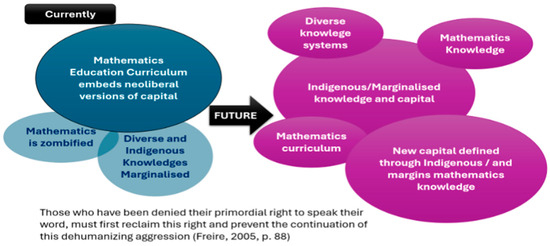
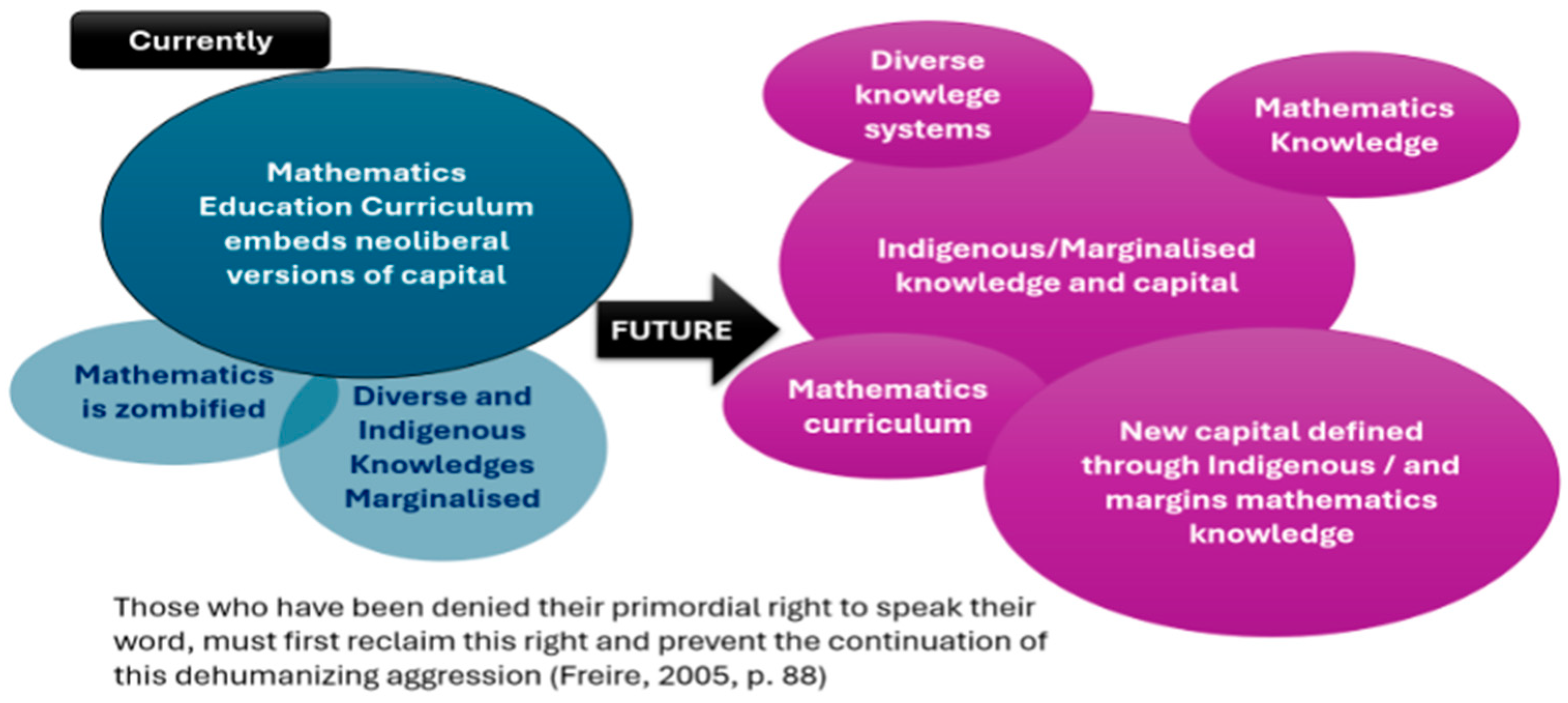
In deliberate acts of decolonization, this research forefronts and centralizes Māori knowledge systems as powerful and necessary. By introducing mathematics knowledge during Māori knowledge activities, mathematics knowledge systems take up space only where they benefit, sustain and maintain Indigenous systems of knowing, being and doing in the battle to live in Indigenous prosperity sustained by Indigenous capital. Interestingly, when mathematics knowledge-building is used in this way, it clarifies mathematical culture and how and why it works on and in the world, therefore making conceptual understanding of mathematics easier for teachers and children to learn and critique. Key components that have been identified to date that support resistance to the hegemonic-power positioning of mathematics education highlight the need for the teachers to have robust (a) Māori knowledge; (b) knowledge of their students, their extended families and communities; and (c) knowledge of mathematics processes, content and language that can be used in service to Māori aspirations. The researchers have found that through prioritization of Māori knowledge, when the students learn mathematics to support them as Māori, they are better able to precisely identify 1. the specific mathematical concepts and content they have learned; 2. the specific Māori knowledge that they are using mathematics to support; and 3. how, when they use both systems in mutually beneficial ways, they are enacting what is called pāngarau, which is not just a translation of mathematics but embodies the mutually beneficial relationship of mathematics and Māori knowledges. Figure 1 illustrates Freire’s position of what is possible and what is mutually beneficial.
Figure 1.
What is possible, what is mutually beneficial (Freire, 2005, p. 88).
Example Two. The second example explores the possibility of damaging the power of Inuit knowledge in the Canadian Arctic. In 2025, the Territory of Nunavut will begin implementation of a new curriculum (CBC News, 2025) that has been embedded with principles of Inuit Qaujimajatuqangit, or Inuit ways of knowing (Karetak et al., 2017). Inuit pedagogy is inherently holistic, “characterized by an emphasis on experiential learning and hands-on activities, as well as a deep respect for the natural world and the interconnectedness of all living things” (Inutiq et al., 2024). Despite this articulation, Nunavut is also adopting JUMP Math to be taught in their schools. We see it as our responsibility to provide an alternative perspective on what JUMP Math is and has claimed to provide. We ground our position solely in research in other Indigenous communities and on the information that JUMP Math has provided on its webpage.
First we situate JUMP Math within its broader context. JUMP Math is a highly prescriptive program focused on developing procedural fluency through repetition and algorithmic practice, originating in Canada. Studies conducted in the United States, Europe, and Canada draw on cognitive and behavioral science, as well as standardized testing frameworks, to evaluate its effectiveness in controlled environments (https://jumpmath.org/ca/research/, accessed on 18 August 2026). However, this approach is arguably problematic, as it risks institutionalizing the notion that mathematics is a fixed and singular body of knowledge, and that one instructor can provide all necessary understanding. We question the rigidity of this model for learners both at the center and at the margins. These concerns are further heightened when JUMP Math positions itself as an ally to Canada’s commitments to Truth and Reconciliation, raising important questions about how such a standardized approach aligns with diverse ways of knowing and learning.
As part of its marketing strategy, JUMP Math has translated its workbooks into a standardized Inuktitut dialect. A webpage outlining “JUMP Math’s Commitment to Truth and Reconciliation” includes promotional language such as “licence-free access to our resources, which they translate from English” and claims that educators can “adapt exercises to include references to students’ lived experiences and cultural traditions.”
However, within the same section, the terms Indigenous and First Nations are used interchangeably, signaling a significant concern regarding the organization’s understanding of the distinct identities, cultures, and histories of Inuit, Métis, and First Nations peoples. For example, the statement, “Reclaiming their culture and heritage, many Indigenous learning communities conduct lessons in their First Nations languages,” conflates diverse groups and reinforces a conceptual ambiguity that raises important questions about the depth of JUMP Math’s engagement with Indigenous realities.
This ignorance is not unique to JUMP Math, Lunney Borden (2021) explains that historically, settler-educators perpetuate the myth of a singular mathematics when they do not recognize and value making space to consider the diversity of mathematical ways of knowing. Trinick and Allen (2024) also highlight that mathematics is not culturally neutral: when concepts, structures, and terminology are imported directly from English, they can impose foreign meanings and linguistic patterns onto te reo Māori. This risks distorting the te reo Māori language and limiting the development of mathematics in ways that reflect Māori ways of knowing. Instead, Trinick advocates for approaches that build mathematical meaning through Māori language and cultural contexts, rather than relying on direct translation.
Synthesizing the findings of these research studies, we believe that JUMP Math can be assumed to be yet another example of the colonizer-selected nature and status of mathematics education that children and teachers unwittingly and involuntarily have their “souls submitted passively” (Fendler, 1998) to those who have developed the mathematics education system. Battiste (2008) put this critique beyond mathematics and explains how:
Despite their contradictory natures, both examples mentioned above are designed to support students in learning mathematics. However, Example One is built on the idea of reclaiming the power of the margins, whereas this premise is not present in Example Two. In what follows we heavily critique the second example. Our specific critique for the JUMP Math example is the pretense that children’s success and achievement can, and should be, reliably and authentically measured by age, stage and level, according to math curriculum content items. Such measurement is seen as human progress toward worthiness, and therefore happiness. Young (2011) claims that it is an issue of equity to ensure that all students have access to the powerful knowledge of mathematics, and yet at the same time acknowledges that the inclusion of mathematics as a subject does little to guarantee equity. This means that completing a JUMP Math program does not guarantee equity for students in Nunavut. Young does not address why achievement in mathematics or any other so-called powerful knowledge system in education does not create equity. Popkewitz (2011), however, provides critique. He discusses how school subjects were historically assembled not to teach music, or science, or mathematics, but as “…converting ordinances in relation to modes of life. Pedagogy linked collective narratives with principles generated about who the child is, who it should be, and who does not “fit” the envisioned future.” (p. 15)Education has been used a sword of cultural imperialism to assimilate Native North America into a hegemonic system, not so that they might take their rightful place in the market economy after their economies were destroyed, but to be held hostage to systems of economy created outside of the Aboriginal context.(p. 162)
Mason (2006) describes a “dissonance between the goals of the people of Nunavut and the mathematics they have innocently adopted for their schools” (p. 133). The colonizer-selected nature and status of mathematics education means that children and teachers unwittingly and involuntarily have their “souls submitted passively” (Fendler, 1998) to those who have developed the mathematics education system. Even their “feelings, desires, and anxieties” are involuntarily shaped by educational ideologies in order to produce a version of some other culture’s “desired” citizen (Fendler, 1998, p. 28). Decolonization requires a far more rigorous process that involves Europeans challenging themselves to stop being colonizers. Adopting a mathematics program from the South continues the process of preparing students for roles in an inequitable society, rather than imagining a society where “all students as unique individuals can succeed in personally meaningful ways in Nunavut’s schools” (Mason, 2006, p. 143).
Indigenous school communities must oversee what the desired characteristics of Indigenous citizens are, and this cannot happen without fully informed, conscientised opportunities to accept, reject, and/or adapt, governing and disciplining assumptions about what is necessary to be fully human, and what part math education plays in that. In accordance with Young (2011), it is the right of children to access all forms of powerful knowledge in ways that preserve and maintain their own powerful knowledge systems. It is also the right of mathematics to be taught in ways that children have access to, can find challenge in, and enjoy. Decolonization, then, is not just about decolonizing for the sake of Indigenous people; it is also decolonizing mathematics education itself.
Rather than resigning ourselves to this reality, we turn to the margins as a site of resistance and possibility. Drawing on the work of Fanon, we explore how the periphery—often dismissed or excluded by dominant structures—possesses transformative potential. Fanon’s insights on colonization and decolonization provide a lens through which we can reimagine mathematics as a more inclusive and liberatory practice. By engaging with mathematical knowledge from historically marginalized communities, we highlight the possibility of a more just and equitable approach to mathematical thought—one that acknowledges multiple ways of knowing and values diverse intellectual traditions. Through this perspective, we offer a message of hope: that the power of the margin is not only in the resistance to hegemonic forces, but also in the ability to reshape and redefine the very nature of knowledge itself.
7. Discussion
In this paper we judged Eurocentric mathematics as a hegemonic force that pays no (or merely superficial) respect to margins such as Indigenous knowledge systems. Drawing on Fanon’s perspective on colonialism and the power of the margin, we argue that the dominance of Eurocentric mathematics education perpetuates inequalities and undermines Indigenous ways of knowing. We further argue that this approach, focused on procedural fluency and calibrated to Western values, undermines the powerful knowledge inherent in Indigenous languages and pedagogies. This is true even in jurisdictions like Nunavut, where Inuit have significant political power.
The path forward is to reclaim Indigenous knowledge, along with what is identifiable as Indigenous mathematical knowledge, and resist the imposition of Eurocentric mathematical frameworks. Fanon calls on us to recognize the revolutionary power of not only political elites, but also the margins in the process of decolonization. Drawing on Fanon, we emphasize that the goal is not to include the margins in the “center” of Eurocentric mathematics, but for the margins to reclaim the power [of the knowledge] that is rightfully theirs but has been denied to them. To reclaim power, what counts as capital should be defined. Capital, defined by any communities, includes resources inherent in their social structure, individuals’ access to these resources, and the purposeful utilization or activation of these resources in local actions. This means that to reclaim their power, Indigenous school communities have the absolute right to make emancipated decisions about how their children receive mathematics education and how the identities of their children are formatted. Emancipated decision making means ensuring that communities are critically informed regarding hegemonic discourses that perpetuate mathematics education myths and reinforce all kinds of inequality. One of the greatest myths is that math is neutral, culture free, and an absolute necessity for life. Mathematics cannot be neutral: it is steeped in culture, with its own distinctive symbols to communicate ideas, its own rules, its own ways of organizing objects and ideas in the world, and its own language.
To address these challenges, Indigenous communities must have not only autonomy, but also critical perspectives on mathematics education, in order to make informed decisions about how mathematics education is taught in ways that respect, and are mutually beneficial to, their cultural knowledge systems. Mason (2006) challenges us to “imagine a curriculum where content is secondary, because ‘people come first’” (p. 144). This involves challenging hegemonic narratives that position mathematics as a superior, culture-free discipline while acknowledging its cultural foundations and potential for coexistence with Indigenous epistemologies.
We finish this paper with messages to the systems that ensure the reproduction of Eurocentric mathematics:
- Your capital is not my capital. What you consider wealth, I may consider extraction. What you call success, I may recognise as defeat. My capital is built on my own terms, rooted in my community, my knowledge, and my ways of knowing.
- Prosperity is not a singular path, nor is it defined by those who have long controlled the systems of power. I define my own prosperity, on my terms. And with that, I know exactly what resources I need to get there. Not the systems built for someone else’s success.
- Stop the deception. Claiming that Indigenous children will “finally” learn math in their own language through a colonial system (such as JUMP Math) only forces them into the very framework that denies their right to define and experience mathematics as Indigenous peoples.
- Finally, if success means to know Eurocentric mathematics, I refuse to measure my worth by the very systems designed to erase my knowledge and my capital.
This paper is not rejecting Eurocentric mathematics. The authors of this paper have high regards for all forms of knowledges. Rather, we reject its monopoly and its money-centric approach to prosperity.
Author Contributions
All three authors contributed to the drafting, writing and editing of the text. Theoretical conceptualizations are shared between the three authors. They contributed equally to compiling the text. All authors have read and agreed to the published version of the manuscript.
Funding
This paper is supported by Research Council of Norway (Forskingsrådet) project number: 343263. The support is for the working hours of Author 1.
Institutional Review Board Statement
Not applicable.
Informed Consent Statement
Not applicable.
Data Availability Statement
No new data were created or analyzed in this study. Data sharing is not applicable to this article.
Conflicts of Interest
The authors declare no conflicts of interest.
References
- Allen, P., & Trinick, T. (2021). Agency-structure dynamics in an indigenous mathematics education community in times of an existential crisis in education. Educational Studies in Mathematics, 108(1), 351–368. [Google Scholar] [CrossRef] [Scilit]
- Arendt, H. (1993). Responsibility and judgment. Schocken. [Google Scholar]
- Atweh, B. (2009). Ethical responsibility and the “what” and “why” of mathematics education in a global context. In P. Ernest, B. Greer, & B. Sriraman (Eds.), Critical issues in mathematics education (pp. 7–19). Information Age Publishing. [Google Scholar]
- Barnhardt, R., & Kawagley, O. (2005). Indigenous knowledge systems and alaska native ways of knowing. Anthropology and Education Quarterly, 36(1), 8–23. [Google Scholar] [CrossRef] [Scilit]
- Battiste, M. (2008). The decolonization of Aboriginal education: Dialogue, reflection, and action in Canada. In P. R. Dasen, & A. Akkari (Eds.), Educational theories and practices from the majority world (pp. 168–195). SAGE Publications. [Google Scholar] [CrossRef] [Scilit]
- Bergquist, K. (2020). Local mathematics in Nunatsiavut: A funds of knowledge approach [Master’s thesis, University of Ottawa]. uOttawa Research. Available online: http://hdl.handle.net/10393/40752 (accessed on 18 August 2026).
- Bernstein, B. (1975). Class, codes and control: Vol. 3. Towards a theory of educational transmissions. Routledge & Kegan Paul. [Google Scholar]
- Bernstein, B. (1996). Pedagogy, symbolic control and identity: Theory, research, critique. Taylor & Francis. [Google Scholar]
- CBC News. (2025, March 22). Teachers learning new curriculum to be rolled out in Nunavut starting next year. Available online: https://www.cbc.ca/news/canada/north/new-inuktut-curriculum-nunavut-1.7490070 (accessed on 18 August 2026).
- Civil, M., & Hunter, R. (2019). Promoting equitable teaching in mathematics teaching education. In C. Xenofontos (Ed.), Equity in mathematics education: Addressing a changing world (pp. 179–200). Information Age Publishing. [Google Scholar]
- Ernest, P. (2002). Empowerment in mathematics education. Philosophy of Mathematics Education Journal, 15(1), 1–16. [Google Scholar]
- Fanon, F. (1966). The wretched of the earth (C. Farrington, Trans.). Grove Press. [Google Scholar]
- Fendler, L. (1998). What is it impossible to think? A genealogy of the educated subject. In T. S. Popkewitz, & M. Brennan (Eds.), Foucault’s challenge: Discourse, knowledge, and power in education (pp. 39–63). Teachers College Press. [Google Scholar]
- Freire, P. (2005). Education for critical consciousness. Continuum. [Google Scholar]
- Gramsci, A. (1971). The intellectuals. In Selections from the prison notebooks (p. 5). New York International Publishers. [Google Scholar]
- Gruber, K.-H. (2006). The German ‘PISA-shock’: Some aspects of the extraordinary impact of the oecd’s PISA study on the German education system. In H. Ertl (Ed.), Cross-national attraction in education: Accounts from England and Germany. Symposium Books. [Google Scholar]
- Gutiérrez, R. (2013). The sociopolitical turn in mathematics education. Journal for Research in Mathematics Education, 44(1), 37–68. [Google Scholar] [CrossRef] [Scilit]
- Inutiq, M., Mearns, C., & Healey Akearok, G. (2024). Inuit holistic pedagogical practice: Balancing narratives within inuit nunangat. International Journal of Indigenous Health, 20(1), 1–13. [Google Scholar]
- Karetak, J., Tester, F. J., & Tagalik, S. (Eds.). (2017). Inuit qaujimajatuqangit: What Inuit have always known to be true. Fernwood Publishing. [Google Scholar]
- Lin, N. (1999). Building a network theory of social capital. Connections, 22(1), 28–51. [Google Scholar]
- Lunney Borden, L. (2021). Decolonizing mathematics education in a time of reconciliation. In A. Andersson, & R. Barwell (Eds.), Applying critical mathematics education (pp. 47–70). Brill. [Google Scholar] [CrossRef] [Scilit]
- Marshall, J. (1992, June 18–19). Principles and the national curriculum: Centralised “Development” [Paper presentation]. Teacher Education: An Investment for New Zealand’s Future Conference, Auckland, New Zealand. [Google Scholar]
- Martin, D. B. (2019). Equity, inclusion, and antiblackness in mathematics education. Race Ethnicity and Education, 22(4), 459–478. [Google Scholar] [CrossRef] [Scilit]
- Marx, K. (1895). Capital: A critique of political economy (Vol. 1). Penguin Books Ltd. [Google Scholar]
- Mason, R. (2006). A kinder mathematics for nunavut. In Y. Kanu (Ed.), Curriculum as cultural practice: Postcolonial imaginations (pp. 131–148). University of Toronto Press. [Google Scholar]
- Meaney, T., & Evans, D. (2013). What is the responsibility of mathematics education to the indigenous students that it serves? Educational Studies in Mathematics, 82, 481–496. [Google Scholar] [CrossRef] [Scilit]
- Nicol, C., Gerofsky, S., Nolan, K., Francis, K., & Fritzlan, A. (2020). Teacher educator professional learning with/in place: Storying the work of decolonizing mathematics education within a colonial structure. Canadian Journal of Science, Mathematics and Technology Education, 20(2), 190–204. [Google Scholar] [CrossRef] [Scilit]
- Olmos-Vega, F. M., Stalmeijer, R. E., Varpio, L., & Kahlke, R. (2023). A practical guide to reflexivity in qualitative research: AMEE Guide No. 149. Medical Teacher, 45(3), 241–251. [Google Scholar] [CrossRef] [Scilit]
- Padilla, A., & Tan, P. (2019). Toward inclusive mathematics education: A metatheoretical reflection about countering ableism in mathematics standards and curriculum. International Journal of Qualitative Studies in Education, 32(3), 299–322. [Google Scholar] [CrossRef] [Scilit]
- Pais, A. (2009). The tension between what mathematics education should be for and what it is actually for. In P. Ernest, B. Greer, & B. Sriraman (Eds.), Critical issues in mathematics education (pp. 53–61). Information Age Publishing. [Google Scholar]
- Pais, A. (2012). A critical approach to equity. In O. Skovsmose, & B. Greer (Eds.), Opening the cagecage: Critique and politics of education mathematics education (pp. 49–93). Sense Publishers. [Google Scholar]
- Parra, A., & Trinick, T. (2018). Multilingualism in indigenous mathematics education: An epistemic matter. Mathematics Education Research Journal, 30(3), 233–253. [Google Scholar] [CrossRef] [Scilit]
- Popkewitz, T. S. (2002). Whose heaven and whose redemption? The alchemy of the mathematics curriculum to save (please check one or all of the following: (a) the economy, (b) democracy, (c) the nation, (d) human rights, (d) the welfare state, (e) the individual). In P. Valero, & O. Skovsmose (Eds.), Proceedings of the third international MES conference, addendum (pp. 1–26). Centre for Research in Learning Mathematics. [Google Scholar]
- Popkewitz, T. S. (2011). PISA: Numbers, standardizing conduct, and the alchemy of school subjects. In PISA under examination: Changing knowledge, changing tests, and changing schools (pp. 31–46). Sense Publishers. [Google Scholar]
- Setati, M., & Planas, N. (2012). Mathematics education across two language contexts: A political perspective. In O. Skovsmose, & B. Greer (Eds.), Opening the cage: Critique and politics of mathematics education (pp. 167–187). Sense Publishers. [Google Scholar]
- Stinson, D. W. (2004). Mathematics as “gate-keeper” (?): Three theoretical perspectives that aim toward empowering all children with a key to the gate. The Mathematics Educator, 14(1), 8–18. [Google Scholar] [CrossRef] [Scilit]
- Stoer, S. R., & Magalhães, A. M. (2001). A incomensurabilidade da diferença e o Anti-anti-etnocentrismo (D. Rodrigues, Ed.). Educação e Diferença. Porto Editora. [Google Scholar]
- Swan, C. (2018). Challenging epistemic racism: Incorporating Māori knowledge into the Aotearoa New Zealand education system. Journal of Initial Teacher Inquiry, 4, 8–10. [Google Scholar]
- Te Maro, P. (2019). Mai i ngā rā o mua. Dialectical and knowledge-power relations in the interactions of kura and maths education [Doctoral thesis, Te Whare Wānanga o Awanuiārangi]. [Google Scholar]
- Trinick, T., & Allen, P. (2024). Wayfinding in an indigenous initial teacher education mathematics programme. ZDM–Mathematics Education, 56(3), 485–495. [Google Scholar] [CrossRef] [Scilit]
- Valero, P. (2018). Political perspectives in mathematics education. In S. Lerman (Ed.), Encyclopedia of mathematics education (pp. 1–5). Springer. [Google Scholar] [CrossRef] [Scilit]
- Waldow, F. (2009). Review essay. What PISA did and did not do: Germany after the ‘PISA-shock’. European Educational Research Journal, 8(3), 476–483. [Google Scholar]
- Williams, J., & Choudry, S. (2016). Mathematics capital in the educational field: Bourdieu and beyond. Research in Mathematics Education, 18(1), 3–21. [Google Scholar] [CrossRef] [Scilit]
- Yeh, C., & Rubel, L. (2020). Queering mathematics: Disrupting binary oppositions in mathematics pre-service teacher education. In Borders in mathematics pre-service teacher education (pp. 227–243). Springer. [Google Scholar]
- Young, M. (2011). The return to subjects: A sociological perspective on the UK coalition government’s approach to the 14–19 curriculum. The Curriculum Journal, 22(2), 265–278. [Google Scholar] [CrossRef] [Scilit]
Disclaimer/Publisher’s Note: The statements, opinions and data contained in all publications are solely those of the individual author(s) and contributor(s) and not of MDPI and/or the editor(s). MDPI and/or the editor(s) disclaim responsibility for any injury to people or property resulting from any ideas, methods, instructions or products referred to in the content. |
© 2026 by the authors. Licensee MDPI, Basel, Switzerland. This article is an open access article distributed under the terms and conditions of the Creative Commons Attribution (CC BY) license.