


Abstract
Science, Technology, Engineering, Arts, and Mathematics (STEAM) education has been increasingly recognized for its potential to promote early childhood development, while inclusion has become a fundamental principle of early childhood education. However, research and practice on STEAM in reverse inclusive activities remain limited. This study aimed to explore whether STEAM in reverse inclusive activities in preschools works and how it works. Participants included 6 children with special education needs and 22 typically developing children aged 4–6 years from a public preschool in China. The Assessment, Evaluation, and Programming System Chinese version was used to assess children’s early childhood development in daily routines and during STEAM in reverse inclusive activities. The findings indicated that STEAM in reverse inclusive activities in preschool was effective, with both typically developing children and children with special educational needs demonstrating developmental gains. Children’s early development within the activities was facilitated by the integration of art, embodied learning, effective peer interaction, and flexible teacher support responsive to children’s inquiry problems. Overall, this study provided initial evidence regarding the implementation and effectiveness of STEAM in reverse inclusive activities and offered practical implications for promoting early childhood development.
1. Introduction
In 2016, the National Institute of Education Sciences of China released the White Paper on STEM Education in China, incorporating Science, Technology, Engineering, and Mathematics (STEM) education into the national strategy for cultivating innovative talents (Lu, 2024). STEM education promotes interdisciplinary learning. Building upon this foundation, Science, Technology, Engineering, Arts, and Mathematics (STEAM) education incorporates the arts into the STEM framework, broadening its interdisciplinary scope to foster creativity, esthetic appreciation, and holistic development through the integration of artistic and humanistic perspectives (Y. Li & Peng, 2019). STEAM education typically centers on challenging problem-based scenarios, emphasizing the integration of knowledge and skills across disciplines (Qi & Li, 2023), and it has characteristics such as contextuality (Chen, 2017; Qi & Li, 2023), problem orientation, interpersonal interaction, openness, and hands-on engagement. STEAM education encourages children to engage in inquiry through “learning by doing” within authentic learning activities and to collaborate through sustained interpersonal interaction.
Preschool children are in a sensitive period characterized by rapid development of creativity and other domains of early childhood development. Science, Technology, Engineering, and Mathematics are key elements for children’s learning and future success (Tippett & Milford, 2017). Therefore, STEAM learning opportunities integrated into preschool education have received considerable attention. Previous research has demonstrated that STEAM education significantly enhances children’s overall problem-solving abilities and innovative thinking (Lai & Qin, 2026). Furthermore, STEAM education supports the development of diverse learning abilities and dispositions in children, including reading, writing, mathematics, and literacy skills (Claessens & Engel, 2013; Clements et al., 2020; Paprzycki et al., 2017), as well as core executive functions—namely, sustained attention, working memory (Di Lieto et al., 2020a; Robertson et al., 2020; Robledo-Castro et al., 2025), planning (Di Lieto et al., 2020b), inhibitory control (Robertson et al., 2020; Robledo-Castro et al., 2023), and cognitive flexibility (Zhang et al., 2025). These competencies are essential for navigating everyday life (Ding et al., 2024; Zhan et al., 2023).
However, STEAM research in preschools has predominantly focused on typically developing (TD) children (Pollak et al., 2023). In fact, children from all backgrounds can benefit from engaging in STEAM learning (McClure et al., 2017; Sari et al., 2024). Children with special education needs (SEN), including those with reading difficulties, speech and language disorders, learning disabilities, visual or hearing impairments, and autism spectrum disorder (ASD), can also benefit from participation in STEAM education (Butera et al., 2016; Hwang & Taylor, 2016; Maslyk, 2016). These benefits include the associating various concepts with concrete experiences and materials; various skills (language, social, communication, fine motor skills, etc.); real-world problem solving through connecting with the arts and generalizing the link between arts and science content; motivation; increasing self-esteem and confidence; creativity; development of peer interaction and cooperation, etc. (Hwang & Taylor, 2016; Maslyk, 2016; Zayyad, 2019). Therefore, it is critically important to ensure that all children have access to high-quality, inclusive STEAM learning opportunities from the earliest years, regardless of ability, background, or circumstance (Amsbary et al., 2024). To realize this goal, it is necessary to explore how STEAM education can be effectively implemented within inclusive early childhood education.
1.1. STEAM in Inclusive Early Childhood Education
The concept of inclusive education advocates that general schools provide all children with education suited to their diverse learning needs (R. Yang & Deng, 2016). It safeguards the fundamental right of children with SEN to access education. STEAM (Nhil, 2021; Utaminingsih et al., 2023) and inclusive education (Kefallinou et al., 2020; Yazcolu & Aktepe, 2022) both offer distinct advantages in supporting the multidimensional development of all children.
Firstly, the transdisciplinary nature of STEAM learning enables children to autonomously engage with diverse activity themes and learning areas based on their individual strengths, interests, and needs, thereby ensuring accessibility and sustained engagement of all children (Bloomquist & Georges, 2022). It also lays a foundation for equitable and meaningful participation in inclusive early childhood education. Secondly, the creation of problem-based contexts in STEAM education includes both open learning environments and open-ended problems. This is particularly important in inclusive early childhood education. On the one hand, an open learning environment fosters children’s agency and motivation by enabling autonomous choices and decisions. On the other hand, open-ended questions support real-life connections and sustained inquiry through continuous questioning and re-questioning (Lu, 2024) within children’s zone of proximal development.
In conclusion, STEAM education provides an interactive and developmentally responsive learning pathway for diverse children within inclusive early childhood education, supporting the social adaptation and holistic development of children with SEN while simultaneously enhancing the learning quality and meaningful engagement of TD children in inclusive education settings (Dang, 2021).
1.2. Challenges in Inclusive Early Childhood Education and the Emergence of Reverse Inclusion in China
In 1987, the concept of learning in regular classes (LRC) (Chinese called: Sui Ban Jiu Du) (National Education Commission, 1987) was first introduced; LRC represents the localized implementation of the traditional direction of inclusion in China and has gradually become one of the primary educational models for advancing inclusive education in the country (Qin, 2000; Shen, 2011). In this traditional direction of inclusion, children with SEN are the primary participants who enter general education settings and receive necessary support alongside their TD peers, with the aim of providing them with a non-segregated educational environment and promoting shared learning experiences between children with SEN and their TD peers (N. Yu, 2022). Specifically, LRC refers to an educational approach in which a small number of children with SEN—typically one to three—are enrolled in general education classrooms and learn alongside their TD peers (Xu & Wang, 1997). To date, inclusive education in China has achieved a transformation from quantitative expansion to quality enhancement (X. Yu et al., 2022). The Preschool Education Law of the People’s Republic of China (The Standing Committee of the National People’s Congress, 2024) further provides a clear legal foundation for the development of inclusive early education and reflects China’s institutional commitment and firm stance in ensuring equal access to education for all preschool children.
However, inclusive early education in China remains in an exploratory phase and faces multiple developmental challenges. Children with SEN often encounter difficulties in social integration in regular classrooms and may experience marginalization (J. Wang et al., 2020), limiting their opportunities for meaningful participation and access to individualized, high-quality education. Specifically, several challenges may contribute to these difficulties: in terms of environmental support, inclusive classroom environments are often inadequate, characterized by limited spatial flexibility, insufficiently inclusive classroom arrangements, and a lack of environments that facilitate meaningful peer interaction (Bai, 2023). In terms of resource support, educational provisions remain seriously insufficient. Only 17.9% of kindergartens had established special education resource rooms, and merely 17.7% were equipped with the necessary rehabilitation facilities and instruments for children with SEN (Hong et al., 2024). In terms of teacher support, existing studies indicated relatively low levels of teacher support, including insufficient instructional guidance, limited use of adaptive teaching strategies, and weak coordination among teachers, parents, and therapists (Cao, 2024; Y. Liu, 2019). In terms of teaching staff, experience-rich special education teachers are particularly scarce in inclusive settings (Gu & Zhu, 2023), and only 0.2% of kindergarten principals and teachers had a special education background, further indicating a structural imbalance in the teaching workforce (Hong et al., 2024). In addition, general early childhood teachers face considerable challenges in implementing inclusive education. Empirical evidence showed that 74% of teachers reported a lack of knowledge of more specialized instructional strategies, and 86% reported insufficient professional skills, particularly in addressing children’s emotional, behavioral, daily routine, and learning difficulties (Gu & Zhu, 2023). Consequently, when adequate support is lacking, the implementation of LRC, as a localized form of the traditional direction of inclusion, may be reduced to “merely sitting in inclusive classrooms” or “physically present classrooms” (Fu & Xiao, 2016; Song & Sun, 2022; H. Zhu, 2019), reflecting challenges such as “co-location without inclusion” (Huang, 2024) and insufficient implementation of individualized, high-quality support. These challenges may limit the effectiveness of inclusion for children with SEN and constrain their access to appropriate developmental opportunities within general education classrooms.
Against this backdrop, special education classes have served as another important placement option within China’s inclusive education service continuum. Special education classes are recognized as a key placement option within the special education service continuum. They are typically established in general schools or special education institutions, featuring an independent teaching environment (McNamara, 1989) and a low student–teacher ratio (Barnes et al., 2021). They contribute to fostering a fair and equitable educational environment, meet the educational needs of children with SEN, and advance inclusive education (X. Yang, 2022).
As one of the earliest regions in China to implement inclusive education, Shanghai has developed a comprehensive policy framework and diversified placement system for inclusive early childhood education, centered on LRC and supported by special education classes and home-based services (Basic Education Division of the Shanghai Municipal Education Commission, 2023). In terms of placement, policies stipulate that each street or town designate a kindergarten as a special education resource point to provide special education classes or targeted support services (Shanghai Municipal Education Commission et al., 2018). At the implementation level, inclusive education has been extended to children with SEN, including those with visual impairments (best corrected visual acuity of 0.05–0.3), hearing impairments (41–70 dB hearing loss or >70 dB with language ability after training), intellectual disabilities (IQ 50–69 based on standardized scales), physical disabilities (Grade III–IV mobility impairment), speech, behavioral, and health-related disorders, as well as mental disabilities, multiple disabilities, and developmental delays (DD) (Shanghai Xuhui District Changqiao No. 2 Primary School, 2009). Placement is further differentiated into LRC for children with mild disabilities and special education classes for those with moderate to severe disabilities (Jinshan District Education Bureau, 2023).
It should be noted that special education classes in kindergartens are not completely separated from mainstream children or regular classrooms. Instead, they adopt a reverse inclusive approach to support the joint development of both TD children and children with SEN in China. Reverse inclusion is an inclusive education model first proposed in the United States during the 1960s. It reverses the traditional direction of inclusion by supporting TD children to enter special education classrooms and learn alongside children with SEN, thereby fostering adaptive competence and promoting positive, reciprocal interactions among all children (Baker, 2015; Dang, 2021; L. Liu, 2015; Yan, 2014). Previous studies have shown that, in reverse inclusion, mutual recognition between children with TD and children with SEN has increased from 60% to over 85% (Z. Li & Wang, 2016). Consequently, reverse inclusion not only promotes equitable and high-quality education for all children but also addresses persistent challenges in inclusive education (Dang, 2021). However, limited empirical evidence exists regarding the implementation and developmental outcomes of reverse inclusion in preschool settings, particularly when embedded in STEAM education. In the present study, reverse inclusive activities (RIAs) refer to activities conducted in special education classrooms in which one or two TD children joined children with SEN on a daily basis to participate in activities centered on the themes of Science, Technology, Engineering, Arts, and Mathematics. During these activities, children with diverse developmental characteristics engaged in a shared learning environment, using the same types of activity materials to participate in collaborative exploration, social interaction, and play. Teachers provided developmentally appropriate scaffolding tailored to children’s individual needs, fostered positive peer relationships, facilitated peer interaction and collaborative problem-solving, and supported children in constructing new experiences through shared participation, thereby promoting their cognitive, social, and emotional development.
Against this backdrop, given the developmental benefits associated with both STEAM education and reverse inclusion, an important question arises: can STEAM in RIAs support the development of diverse children, and how does it work in practice? Based on this, the present study investigated the role of STEAM in RIAs in promoting early childhood development. Specifically, the study explored how STEAM education was designed and implemented in preschool reverse inclusion and examined whether and how these activities supported early childhood development. By integrating quantitative and qualitative evidence, this study sought to advance understanding of how STEAM in RIAs supports children’s learning, participation, and development.
2. Research Questions
Investigating the current implementation and effectiveness of STEAM in RIAs in preschools is valuable, as it establishes a foundation for supporting the development of children with diverse abilities, informs the design of STEAM in RIAs, and helps identify critical developmental domains requiring targeted support within such activities. The research questions were:
- How were STEAM in RIAs designed in preschool reverse inclusion?
- How were STEAM in RIAs implemented in preschool reverse inclusion?
- Is STEAM in RIAs in preschools effective in promoting early childhood development?
- How does STEAM in RIAs in preschools work to support children’s early childhood development?
3. Materials and Methods
3.1. Ethics
Prior to the study, approval was obtained from the Institutional Review Board of East China Normal University (IRB number HR2-0272-2025). Before conducting the survey, children and parents participating in the study were recruited through preschools’ parentteacher conferences, parent-child activities, bulletin boards, and online platforms, and participants’ consent was obtained.
3.2. Participants
After written informed parental consent was obtained, 6 children with SEN (age: M = 67.7, SD = 8.9), 22 children with TD (age: M = 71.1, SD = 3.7) participated in the study, as shown in Table 1 and Table 2. In addition, this study selected five teachers from the special education classes serving the participating children as research participants. All were women. Before implementing STEAM in RIAs, these teachers participated in preschool-based professional development activities to develop an understanding of the rationale and procedures of this approach. During these activities, teachers discussed the objectives and implementation process of STEAM in RIAs with university experts and clarified the expected roles of teachers and children during the activities. Drawing on their professional experience in special education and their knowledge of children’s developmental characteristics and individual needs, teachers selected appropriate materials, arranged activity spaces, and designed activity procedures. After each activity, teachers further discussed the implementation process with teachers from TD children’s classes to reflect on children’s participation, peer interactions, and possible adjustments for subsequent activities.
Table 1.
Basic information of children with special education needs (SEN) (n = 6).
Table 2.
Basic information of Typically developing (TD) children (n = 22).
3.3. Method and Instrument of Observation
3.3.1. Method
From an epistemological perspective, this study was grounded in an interpretivist paradigm to understand children’s developmental processes during participation in STEAM in RIAs. The interpretivist paradigm views the subject matter of social sciences as the social world constituted by human beings. As Weber argued, social science seeks to achieve an empathic understanding (Verstehen) of human actions by interpreting the meanings that individuals attribute to their behaviors and experiences (Weber, 1992). Rather than assuming that social reality exists independently from individuals, this perspective considers social reality as continuously constructed through individuals’ experiences, perceptions, and interpretations. At the same time, meanings are not viewed as pre-existing entities; instead, they are constructed and reconstructed through social interactions. STEAM in RIAs is essentially a social activity. Through participation in STEAM activities, interactions with peers and teachers, and engagement with materials and the learning environment, children gradually identify problems, engage in inquiry processes, develop understanding, enrich their existing experiences, and construct meaning. Therefore, the implementation of STEAM in RIAs and its effectiveness in promoting children’s development cannot be understood as processes possessing the same characteristics as natural science phenomena, such as stability, predictability, objectivity, and measurability. Instead, they are shaped by children’s individual experiences, social interactions, and contextual conditions (Y. Lei & Wen, 2025). If STEAM in RIAs is examined solely through an empirical approach that focuses on “what is,” namely whether the activity produces developmental outcomes, it may provide limited explanations of how children participate, interact with others, and experience developmental changes within authentic contexts. Therefore, an interpretive understanding of how STEAM in RIAs operates is necessary, with particular attention to children’s meaning-making processes and social exchanges during activities (Qu, 2011).
Based on this epistemological position, this study adopted a mixed-methods design to integrate quantitative and qualitative evidence. By combining developmental assessment and qualitative analysis, this study aimed to examine the effectiveness of STEAM in RIAs for children’s development, specifically whether it works, to what extent it works, and how it works. The effectiveness of STEAM in RIAs was examined from both outcome and process perspectives. At the outcome level, effectiveness was reflected in improvements in the total early childhood development score and across the eight developmental domains, including gross motor, fine motor, social-emotional, social-communication, cognitive, adaptive, literacy, and mathematics skills, as assessed by the Chinese version of the Assessment, Evaluation, and Programming System (AEPS-3). At the process level, qualitative evidence was used to explore how developmental changes occurred during participation in STEAM in RIAs, including children’s engagement in peer interaction, social initiative, sustained participation, exploration of materials, and involvement in shared activities.
Specifically, the quantitative component was designed to address Research Question 3: Does STEAM in RIAs in preschools work? Children’s early developmental outcomes before and after participation in STEAM in RIAs were assessed using the Chinese version of the AEPS-3. AEPS-3 provides a comprehensive assessment of children’s developmental skills across multiple domains and is suitable for evaluating children with diverse developmental characteristics. The total developmental scores and scores across eight developmental domains were compared between pre- and post-intervention assessments. Given the characteristics of the sample and data distribution, the Wilcoxon signed-rank test was conducted to compare pre- and post-test scores and determine whether children demonstrated developmental improvements following participation in STEAM in RIAs. However, quantitative assessment alone cannot fully explain the processes through which developmental changes emerge. Therefore, qualitative methods, including naturalistic observation and case analysis, were employed to investigate children’s experiences, interactions, and meaning construction during STEAM in RIAs. Such qualitative approaches enable researchers to examine educational phenomena within their authentic contexts and provide contextualized interpretations that complement quantitative findings (C. Lei & Li, 2026). Specifically, naturalistic observations were conducted to document the design principles, implementation processes, activity materials, and children’s participation during STEAM in RIAs, addressing Research Question 1 and Question 2: How were STEAM activities designed and implemented in preschool reverse inclusion? Furthermore, by analyzing children’s learning behaviors and peer interactions across the before-, during-, and after-activity stages, this study illustrated how children gradually engaged in STEAM in RIAs and achieved developmental progress. These qualitative findings complemented the quantitative evidence by moving beyond identifying whether developmental changes occurred to explaining why and how these changes emerged. Representative STEAM in RIAs cases were further selected for case analysis to explore the developmental processes underlying children’s participation, addressing Research Question 4: How does STEAM in RIAs in preschools work?
By integrating quantitative assessment with qualitative interpretation, this study examined not only whether STEAM in RIAs contributed to children’s early development but also how developmental changes were generated through children’s participation, peer interactions, and experience construction. In other words, quantitative evidence addressed the effectiveness of STEAM in RIAs, whereas qualitative evidence provided insights into its underlying processes and mechanisms. Therefore, the mixed-methods approach provided an appropriate methodological foundation for comprehensively understanding how STEAM in RIAs supports children’s development.
3.3.2. Instrument of Observation
In this study, the AEPS-3 (Bricker et al., 2022) was administered to assess early childhood development before and after participation in STEAM in RIAs across eight domains: gross motor, fine motor, social-emotional, social-communication, cognitive, adaptive, literacy, and math skills.
The AEPS-3 is a widely recognized curriculum-based assessment tool developed in the USA for young children, particularly those with DD or disabilities. It can assess the current overall developmental level of children aged 0–6 across multiple domains (Y. Li, 2020). This study adopted the latest edition of the AEPS-3 and revised and adapted it for the Chinese cultural context through rigorous localization procedures, yielding a culturally appropriate, psychometrically robust, and developmentally valid Chinese version for assessing early childhood development in China.
The resulting scale comprised 8 primary domains, 34 secondary indicators, 115 third-level indicators, and 288 fourth-level indicators. Each fourth-level indicator was scored on a three-point ordinal scale reflecting behavioral mastery: “2 = fully mastered”, “1 = skill emerging”, and “0 = skill not yet evident”. The total possible score is 576. Table 3 presents the primary domains, secondary indicators, and Cronbach’s alpha coefficients for each subfactor, confirming satisfactory internal consistency.
Table 3.
Indicators of “Assessment, Evaluation, and Programming System (AEPS-3)” and reliability for each subfactor.
The Kaiser–Meyer–Olkin (KMO) value (0.910) and Bartlett’s test of sphericity (χ2 = 9393.633, p < 0.001) indicated that the data were suitable for factor analysis. Factor analysis identified eight extracted factors with eigenvalues greater than 1, accounting for a cumulative variance of 81.761% after rotation. Cronbach’s alpha for the scale was 0.960, and Cronbach’s alpha for every dimension was higher than 0.95, indicating high internal consistency.
3.4. Research Procedure
This study lasted 3 months, from March 2025 to June 2025, totaling 12 weeks. The research process consisted of four distinct stages, as illustrated in Figure 1.
Figure 1.
Research process.
3.5. Data Analysis
IBM SPSS Statistics 27.0 (IBM Corp., Armonk, NY, USA) was used to analyze the assessment results of early childhood development among 28 children. First, descriptive statistics were used to analyze the current status of early childhood development among children with SEN and TD. Second, the Wilcoxon signed-rank test for two related samples was used to verify significant differences in early childhood development before and after participation in STEAM in RIAs, with separate analyses conducted for children with SEN and children with TD. Third, the Shapiro–Wilk normality test was conducted to determine whether the results followed a normal distribution, providing a reference for deciding how to perform variance analysis. Finally, the Kruskal–Wallis H test was conducted to examine differences in early childhood development across different types of peer interaction during STEAM in RIAs.
4. Results
4.1. How Were STEAM in RIAs Designed and Implemented in Preschool Reverse Inclusion?
4.1.1. Kindergarten Profile
Q Preschool, located in Jing’an District, Shanghai, is a public kindergarten that jointly delivers general and special education. Established in September 2014, it was upgraded to a Shanghai Municipal First-Class Kindergarten in 2018. The entire first floor was dedicated to the early childhood special education resource center and special education classes. General education classes for TD children were situated on the second and third floors.
From March 2025 to June 2025, Q Preschool had two special education classes with 8 children with SEN (7 boys and 1 girl, aged 3–7 years old; 5 with DD, 2 with ASD, and 1 with cerebral palsy), whose disabilities ranged from moderate to severe. Children with SEN participated in STEAM in RIAs from 10:00 to 10:30 a.m. daily. There were 90 children with TD in the preschool, and 24 TD children (aged 5–6 years old) participated in the RIAs, with 30 min sessions every day. Children with TD would participate in rotation according to their school number, and 2 children would be selected each time, and the rotation would be completed every two weeks.
4.1.2. Design Principles for STEAM in RIAs
When designing STEAM in RIAs, Q Preschool adhered to the following design principles.
(1) Child-Centered Principle.
STEAM in RIAs should be designed around children’s interests, prior experiences, developmental levels, and diverse learning needs. The child-centered approach requires teachers to view children as active participants in learning and to carefully consider their individual characteristics when planning activities, selecting materials, and providing support.
First, activity design should build on children’s interests and everyday experiences. Engaging materials and familiar objects can capture children’s attention, increase motivation, and facilitate meaningful participation. Teachers should carefully observe children’s preferences for specific materials, tools, and topics, and use these observations to inform decisions about activity content and format. For example, the Colored Clay Workshop incorporated clay, a material that children consistently enjoyed and were familiar with, thereby encouraging active exploration and sustained engagement.
Second, STEAM in RIAs should be differentiated according to children’s developmental levels and disability characteristics. Activity goals, materials, participation formats, and support strategies should be adapted to accommodate individual strengths, needs, communication styles, motor abilities, and learning preferences. For example, TD children and children with mild DD may participate in open-ended collaborative activities such as Colored Clay Workshop and Colorful World. Children with ASD may initially engage in more structured tasks, such as Cave Exploration or Treasure Sand Tray, before gradually transitioning to small-group activities with visual and instructional supports. For children with cerebral palsy, accessible and adaptive activities such as Sticky Fun and Music Mat can promote participation, autonomy, and successful engagement.
Therefore, child-centered STEAM in RIAs emphasizes responsiveness to children’s individual differences while ensuring that all children can participate meaningfully in shared learning experiences. Children’s progress should be evaluated based on individualized goals, engagement, and participation.
(2) Content Organization Principle.
The content of STEAM in RIAs is systematically organized through three interrelated dimensions: seasonal rotation, thematic integration, and developmental progressivity, ensuring coherence between activity design and children’s developmental needs.
Firstly, seasonal rotation requires that activity content be adjusted in a timely manner according to seasonal changes, so that STEAM experiences in RIAs remain closely aligned with natural environmental rhythms. For example, during the hot summer, a Save the Little Ball activity was designed, in which children retrieve balls by tapping ice blocks with child-safe hammers, thereby experiencing a refreshing and engaging sensory experience. In contrast, in the cold winter, a Dreamy Tree activity was implemented, where children use homemade paddles to gently tap colorful balls hanging on a tree, promoting both physical engagement and thermal comfort. This seasonal alignment embeds learning within natural temporal contexts and enhances embodied experience.
Secondly, thematicity emphasizes the integration of educational themes into STEAM in RIAs to strengthen children’s problem-solving abilities and creativity. Activities such as Colorful World and Cave Exploration demonstrate this principle, as their activity materials can be flexibly adapted and replaced according to different thematic focuses. Through such thematic embedding, the same activity structure can support diverse learning objectives, thereby enriching the depth and breadth of children’s exploratory experiences.
Finally, progressivity ensures that activity difficulty is gradually increased in accordance with each child’s developmental trajectory. The complexity of tasks, as well as physical and cognitive demands, is progressively scaffolded according to children’s developmental levels. Activities begin with simple foundational actions that help children develop routines and understand expectations. As competence increases, new steps are introduced, task duration is extended, and cognitive or motor challenges are enhanced. For instance, in the Colored Clay Workshop and Treasure Sand Tray activities, children progress from basic grasping and kneading of materials, to the purposeful use of tools, and eventually to completing multi-step artistic creations guided by visual task cards, thereby supporting holistic development through scaffolded learning.
(3) Environmental and Material Design Principle.
The design of environments and materials in STEAM in RIAs is guided by three interrelated dimensions: safety assurance, material suitability, and environmental adaptability.
Firstly, safety constitutes a fundamental prerequisite for activity implementation. Ensuring that the environment and materials are safe and non-toxic is essential for protecting children’s well-being. Prior to activities, the venue should be thoroughly inspected to remove sharp objects and level uneven surfaces, thereby preventing potential injuries such as falls or cuts. In terms of materials, painting tools should include short, thick, non-toxic wax crayons that are resistant to breakage. Hands-on materials should consist of soft fabrics, foam sheets, and other age-appropriate resources that are free from sharp edges, corners, and high fragmentation risks. For children with mobility impairments, additional individualized safety supports should be provided, such as installing soft protective padding around activity areas to ensure physical security during participation.
Secondly, material suitability emphasizes that learning materials should be developmentally appropriate and accessible to children with diverse abilities. For children with SEN, particularly those with motor difficulties, familiar and easily manipulable materials should be prioritized to support engagement and success. In contrast, materials designed for TD children may incorporate higher levels of challenge to stimulate exploration. Within each category of materials, variation in features such as size, brightness, opacity, and texture can be intentionally designed to promote observation, comparison, and inquiry-based learning. For example, in Light and Shadow Explorations, children use flashlights with different luminance levels and animal puppets of varying sizes to investigate how these variables influence shadow formation, thereby fostering scientific reasoning through material variation.
Finally, environmental suitability highlights the need to balance predictability and exploratory opportunities within the learning environment. For children with SEN, consistent visual cues, fixed material placement, and structured routines provide essential support for self-regulation, independence, and smooth transitions between activities. At the same time, the environment should also be designed to encourage exploration and peer interaction, enabling TD children to engage in inquiry-based and collaborative learning within an inclusive setting. This dual structure ensures that the environment functions both as a stable support system and as a dynamic space for interaction, exploration, and shared learning.
These principles ensured that activities were aligned with children’s developmental levels and disability profiles, enabling all children to participate meaningfully and progress within appropriately scaffolded challenges.
Detailed descriptions of the activity examples are provided in Appendix A.
4.1.3. Activity Schedule for STEAM in RIAs
STEAM in RIAs was mainly implemented outdoors. Before activities began, children with TD were escorted to the special education classroom by general education teachers, where materials were prepared by assistant teachers and activity centers were introduced by the lead teacher. Children were then guided to select centers autonomously based on their interests. Each STEAM session was organized into multiple thematic activity zones, each with a predefined capacity and supervised by at least one trained teacher. Children with ESN were given priority in selecting activity zones, after which TD peers selected from the remaining options, resulting in mixed-ability groupings. Prior to the activities, teachers facilitated brief peer introductions and provided communication support as needed. During the sessions, special education teachers collaborated across zones to provide responsive support and monitor participation. At the end of each session, teachers facilitated children’s transition back to their classrooms and prepared materials for subsequent activities.
4.1.4. Materials for STEAM in RIAs
The activities were characterized by highly hands-on, low-structured materials that supported cross-domain integration within the STEAM framework. Science materials (e.g., grinding tools, light-and-shadow boxes, spray bottles) supported sensory exploration and understanding of natural phenomena; Technology materials (e.g., modular pipes, cardboard structures, sand tools) enabled functional manipulation; Engineering materials (e.g., sand, cooking tools, connectors) promoted construction and spatial reasoning; Arts materials (e.g., clay, color-changing canvases) supported creative expression; and Mathematics materials (e.g., building blocks, plastic cards of different shapes) facilitated intuitive understanding of quantity, shape, and spatial relations. Together, these materials provided an open, flexible, and highly manipulable learning environment that supported inquiry, creativity, and inclusive participation.
4.2. Is STEAM in RIAs in Preschools Effective in Promoting Early Childhood Development?
To evaluate the effectiveness of STEAM in RIAs within preschool settings, this study adopted a dual focus on developmental outcomes and children’s participation processes. Changes between pre- and post-intervention assessments captured overall developmental gains, while children’s deep learning observed during activities reflected the dynamics of meaningful engagement and learning in practice. Together, these two complementary dimensions offered a more holistic understanding of program effectiveness.
4.2.1. Have Children Demonstrated Developmental Gains Following Participation in STEAM in RIAs?—Evidence from Pre- and Post-AEPS Assessments
The descriptive statistical analyses presented in Table 4 describe changes in early childhood development among scores among children with SEN and children with TD separately before and after participation in the STEAM in RIAs.
Table 4.
Assessment of the early childhood development before and after their participation in the Science, Technology, Engineering, Arts, and Mathematics (STEAM) in reverse inclusive activities (RIAs).
The results showed that, apart from fine motor skills and social-communication skills, there were significant differences in the average early childhood development scores among children with TD before and after participating in the STEAM in RIAs. All test statistics were positive ranks and were higher than negative ranks, indicating that the values of the post-test data were greater than those of the pre-test data. Except for literacy and math skills, children with SEN showed significantly higher post-test early childhood development scores than pre-test scores after participating in STEAM in RIAs.
In conclusion, participation in the STEAM in RIAs was associated with significant improvements in early childhood development scores among both TD children and children with SEN. The findings indicated that STEAM in RIAs was effective in preschools.
4.2.2. How Do Children’s Participation in STEAM in RIAs Evolve?—Evidence from Observed Manifestations of Deep Learning Processes
Deep learning is closely aligned with the objectives of STEAM education (Meng et al., 2023). Deep learning emphasizes children’s active engagement in learning processes, including hands-on activities and social interaction (H. Guo, 2016; X. Wang, 2021; Wu, 2019; L. Zhu et al., 2023). Whether children enter such a meaningful learning state can therefore serve as an indicator of the effectiveness of STEAM education.
This study showed that, during the implementation of STEAM in RIAs, the children experienced three developmental phases. These phases were inductively identified through systematic analysis of observational records collected throughout the implementation process. Specifically, the researchers reviewed observation records across activities and examined changes in children’s behaviors, peer interactions, and participation patterns to identify developmental trajectories. The preliminary phases were then discussed with participating teachers, whose professional experiences and contextual understanding of children’s development were used to refine and validate the interpretation of each phase.
- Phase 1: Initial Implementation Phase
At the initial phase of STEAM in RIAs implementation, TD children and children with SEN were generally unfamiliar with one another. As a result, solitary play occurred frequently, and social interactions between the two groups were limited. Teachers primarily interacted with children with SEN and provided individualized guidance.
- Case 1
During the Treasure Sand Tray activity. Yangyang (DD) and one TD child (female) participated in the activity. The TD child used molds to create animal shapes.
Yangyang repeatedly filled a mold with sand and then turned to the teacher and said, “Help me.” The TD child continued her own activity.
The teacher asked, “What’s wrong?”
Yangyang pointed to the mold and said, “Fish.”
The teacher demonstrated the process of filling and pressing the sand into the mold step by step. Yangyang followed the guidance and completed the task.
After completion, the teacher prompted Yangyang to name the product (“crocodile”), but Yangyang responded only with “fish.” The teacher then confirmed the outcome and provided positive feedback.
- Case 2
During the Colored Clay Workshop activity, Tianci (DD) repeatedly took pieces of clay from his TD peer and threw them onto the floor.
The TD child attempted to communicate with him but received no response, disrupting the activity.
The teacher intervened by returning the clay to the TD child and prompting Tianci to apologize (“Please say sorry to your brother”). She then explained that the clay belonged to his peer, provided Tianci with his own piece of clay, and encouraged him to make a rabbit while remaining nearby to support his participation.
Overall, during the early stage, children with SEN tended to seek support primarily from teachers rather than peers. TD children engaged primarily in independent play. Peer interaction difficulties were occasionally observed due to limited mutual understanding of behavioral and communicative differences. Teachers functioned primarily as immediate regulators of classroom behavior, particularly in response to disruptions in peer interaction.
- Phase 2: Intermediate Implementation Phase
With increased exposure to STEAM in RIAs, TD children gradually became more familiar with peers with SEN and began to develop adaptive interaction strategies. TD children increasingly initiated social interactions and attempted to construct shared play contexts. When initial attempts were not successful, they adjusted their communicative strategies and play structures.
- Case 3
During the Treasure Sand Tray activity, a TD child (female) was making hamburgers with molds and invited Feifei into her play scenario by saying, “Another new order has arrived, Feifei.”
Feifei did not respond and continued scooping sand out of a mold with a spoon.
After noticing Feifei’s spoon, the TD child asked the teacher for one as well and attempted to join Feifei’s play, saying, “I’ll help Feifei. There are too many orders.” Holding a pan filled with sand, she pretended to cook and explained, “These are for the animals to eat. Another customer wants a fish-shaped ice cream.”
Meanwhile, the teacher supported the interaction by drawing DD’s attention to the TD child’s actions (e.g., “Look, she is cooking”). While, throughout the interaction, Feifei remained focused on manipulating the sand and did not verbally respond to either the TD child or the teacher.
During the middle stage, TD children demonstrated increased initiative in social interaction and showed emerging adaptive strategies for engaging peers with SEN. However, peer interaction in STEAM in RIAs still faced multiple challenges. In particular, children with SEN appeared to remain on the margins of participation, which further constrained the depth of their learning.
- Phase 3: Advanced Implementation Phase
At the later stage, children became more familiar with peers, materials, and activity structures. Interaction between TD and SEN children increased in frequency. Children with SEN increasingly engaged in observation-based learning and imitation of TD peers’ behaviors.
- Case 4
In the Grinding Little Expert activity, Zaizai (ASD) and a child with TD (female) explored dried orange peels using a grinding mill and related tools.
At the beginning of the activity, Zaizai pointed to a mortar and said, “This one,” indicating that he wanted the teacher to pass it to him. Meanwhile, the TD child pointed to the orange peels and asked, “Should we put them in here?” Zaizai did not respond verbally and used chopsticks to transfer large pieces of orange peel into a bowl.
The TD child attempted to crush the orange peels with a pestle, commenting, “It’s too hard. I can’t crush it.” The teacher responded, “They’re dried out. You can tear them into smaller pieces first.” While watching the TD child’s actions, Zaizai took the pestle and also began crushing the orange peels. Later, he used chopsticks to remove larger pieces from the mixture. Observing this, the TD child likewise attempted to separate the larger pieces. When she found it difficult, he remarked, “I can’t get them out with the stick,” and started picking them up by hand. Zaizai then adopted the same strategy.
After the orange peels had been crushed, Zaizai inserted the pieces into the opening of the grinding mill. The TD child poured the remaining material into the mill and began turning the handle. Zaizai then stood up and grasped the handle as well.
At the later stage, children with SEN demonstrated increased engagement in peer observation and imitation. Collaborative activity became more goal-oriented, with both groups participating in shared inquiry problem-solving. Interaction shifted from parallel play toward coordinated task completion.
Overall, across the three phases, children’s engagement in STEAM in RIAs evolved from predominantly independent and parallel play, to increasing peer initiation and interaction attempts by children with TD, and ultimately to coordinated participation in shared inquiry activities, with children with SEN becoming more actively involved through observation, imitation, and collaborative problem-solving. Thus, the findings suggested that STEAM in RIAs progressively supported deeper learning among children with diverse developmental profiles, as evidenced by their increasing social initiative, sustained engagement, material exploration, and participation in shared activities, while its impact remained contingent on sustained and coherent implementation over time.
It should be noted that children’s participation outcomes varied depending on the severity and nature of their developmental needs. Children with relatively stronger social communication skills (e.g., some children with DD) tended to establish peer connections more rapidly and engage more readily in shared inquiry-based activities. In contrast, some children with ASD demonstrated stronger engagement in solitary or parallel play, particularly when activities allowed for self-directed material selection and manipulation. In these contexts, reduced social demand and increased autonomy may have supported sustained engagement.
4.3. How Does STEAM in RIAs in Preschools Work to Support Children’s Early Childhood Development?
First of all, the stability of the activity environment and the appropriateness of materials served as foundational conditions for children’s engagement in STEAM in RIAs, exerting a basic and enabling influence on their development. As the environment and materials remained consistent throughout the study period, they were not further examined in terms of variation in this study. In addition, teacher support and peer interaction during STEAM in RIAs also played important roles in shaping early childhood development.
4.3.1. The Support Provided by Teachers in the STEAM in RIAs for Children
Teacher support in STEAM in RIAs was characterized by a three-tiered structure comprising foundational, emotional, and cognitive support (Table 5). These forms of support were enacted flexibly in response to children’s varying needs throughout the activities. Foundational support enabled children to access materials, understand tasks, and participate in ongoing activities. Emotional support was provided through encouragement, reassurance, and responsive interactions, whereas cognitive support involved questioning, prompting, and extending children’s thinking. The three forms of support often overlapped and were continuously adjusted as activities unfolded.
Table 5.
A three-tiered structure of teacher support in STEAM in RIAs.
Beyond the three-tiered structure of foundational, emotional, and cognitive support, teacher support in STEAM in RIAs was characterized by responsiveness to children’s inquiry problems, facilitation of problem-solving, flexibility in addressing diverse needs, and support for children’s agency. Together, these characteristics illustrated the child-centered and adaptive nature of teacher support in STEAM in RIAs.
Teacher Support Based on Children’s Inquiry Problems Facilitated Deeper Inquiry
A problem is not an exercise (Kang, 1997). Mayer classified problems based on their nature into conventional and unconventional problems (Mayer, 1998). Conventional problems are generally closed-ended, providing all necessary information and allowing solutions to be extracted from existing knowledge structures. They embody regularity and reproducibility. In contrast, unconventional problems are open-ended, contain incomplete information, lack a single correct answer, and do not provide ready-made solutions. Solving such problems requires learners to generate novel solutions through independent thinking based on prior knowledge, reflecting creativity and exploration. In STEAM inRIAs, children gradually focused on unconventional problems through observation, comparison, and hands-on operation. For example, when children discover in a light box that some shadows are larger and others smaller, prompting the problem “Why do shadows vary in size?”; or when constructing small animals using space sand and building modules, they observe that the structures collapse easily upon light contact, leading to problems such as “Why do the small animals fall apart?” and “How can we build them so they stay intact?” These open-ended problems emerged from children’s direct experiences and became the focus of their subsequent investigations, thereby functioning as inquiry problems. As children continuously generated, tested, and refined explanations, problem solving constituted an open, iterative, and evolving inquiry process. Therefore, in STEAM in RIAs, inquiry problems served as the central thread sustaining children’s investigation, promoting deeper exploration, and supporting meaningful learning.
Teacher support was closely aligned with children’s emerging inquiry problems and continuously adapted to their ongoing exploration. Rather than providing direct solutions, teachers engaged with children’s inquiry processes by using questioning, prompting, and scaffolding to extend their thinking and sustain investigation. Observations indicated that support was often provided through a sequence of progressively deepening questions that responded to children’s immediate actions and discoveries. For example, during the Grinding Little Expert activity in which children used grinding tools to process leaves, the teacher asked, “Why are you using the stick?”, “Do you need other tools?”, “Is there a new problem now?”, “Where did the leaves go?”, and “Why is the color of the juice different from the color of the leaves?”. These questions were closely connected to children’s ongoing inquiry and encouraged them to observe, reflect, and explore emerging problems in greater depth. Rather than directing children toward predetermined answers, teachers maintained and extended the inquiry process by responding to questions as they arose during the activity.
Teacher Support Demonstrated Flexibility, Which Exercised Children’s Agency
Agency is regarded as a fundamental attribute of children as active subjects, reflecting respect for their individuality, autonomy, and capacity for self-directed development (Chen, 2019). In educational contexts, supporting children’s agency has become an important component of contemporary competency-based and child-centered approaches. Agency is particularly important in STEAM education, where children construct understanding of themselves, others, and the surrounding world through firsthand experiences, exploration, experimentation, and inquiry. For this reason, Q Kindergarten consistently adhered to a child-centered philosophy in the design and implementation of STEAM in RIAs. Supporting children’s exercise of agency involved enabling children to make choices, explore materials, and conduct investigations based on their own interests and approaches. In doing so, children actively expressed ideas and shaped the direction of activities. To accommodate children’s emerging interests and needs, teacher support remained flexible, with activities and support strategies continuously adjusted according to children’s immediate responses, developmental characteristics, levels of participation, and situational demands.
During a block-play activity, Feifei (ASD) repeatedly placed blocks into a toy box. Rather than redirecting the child to the planned activity, the teacher joined the child’s ongoing action and placed blocks into the box alongside the child. After noticing that the child consistently selected rectangular blocks, the teacher said, “Please give me the rectangular blocks, and I will help you put them into the box.” The child then continued searching for and handing over rectangular blocks. When all the rectangular blocks had been collected, the teacher continued, “Please give me the round blocks.” As the child appeared uncertain, the teacher turned to a TD peer and asked, “Can you help her?” The peer picked up a spherical block, showed it to the child, and said, “A block like this.” The child then began searching for similar blocks and handing them to the teacher.
This episode illustrates how teacher support was flexibly adjusted in response to the child’s participation and emerging needs, while respecting and supporting the child’s agency during the activity.
4.3.2. The Effects of Peer Interaction During STEAM in RIAs
The Type of Peer Partnerships
When participating in STEAM in RIAs, children with different characteristics developed peer partnerships. Based on the types of children with SEN included in this study, two types of peer partnerships were examined: children with TD paired with children with ASD, and children with TD paired with children with DD.
Mann–Whitney U test results showed no statistically significant differences between TD-ASD partnerships and TD-DD partnerships in early childhood development scores or any other developmental dimensions.
The Type of Peer Interaction and Initiator
This study draws on existing research findings (Koegel & Koegel, 2006) to identify 11 types of children’s peer interaction. Based on whether these behaviors demonstrate prosociality, the types were classified into positive, neutral, and negative peer interactions. Positive interaction refers to interactions in which children exhibit prosocial behaviors such as cooperation, sharing, helping, and comforting; neutral interaction refers to interactions in which children exhibit contextually neutral behaviors such as joining ongoing play, seeking assistance, or peer imitation; and negative interaction refers to interactions in which children exhibit antagonistic or disruptive behaviors such as resource competition, physical or verbal aggression, interrogative or blaming statements, and social exclusion. Interaction initiators were categorized as children with TD or children with SEN.
Among all types of peer interactions in this study, positive interactions accounted for 50.0% (n = 14), neutral interactions for 32.1% (n = 9), and negative interactions for 17.9% (n = 5). Initiations by children with TD and by children with SEN each constituted 50% of all initiations (n = 14 per group). Cross-tabulation of interaction types and initiators (Table 6) revealed that peer interactions initiated by children with TD were significantly more likely to be positive (χ2 = 28.00, p < 0.001), whereas interactions initiated by children with SEN showed a higher likelihood of being negative and neutral.
Table 6.
Cross-tabulation between interaction types and initiators (n = 28).
In terms of interaction types, the Kruskal–Wallis H test results (Table 7) showed that children with TD engaged in neutral interactions had significantly higher mean ranks than those engaged in positive or negative interactions in the social-communication (H = 10.662, df = 2, p = 0.005), cognitive (H = 7.698, df = 2, p = 0.021), and adaptive skills domains (H = 6.044, df = 2, p = 0.049).
Table 7.
Kruskal–Wallis H test results for early childhood development scores among children with TD during peer interactions (n = 22).
5. Discussion
This study provided a preliminary exploration of the implementation and effectiveness of STEAM in RIAs in Chinese preschools. The findings suggested that this innovative educational approach could support the development of both children with SEN and TD children, although the developmental outcomes differed across groups. In general, across early childhood development domains, both groups showed shared developmental gains in gross motor, social-emotional, cognitive, and adaptive skills.
5.1. Children with SEN Were Able to Participate in STEAM Learning and Derive Benefits from STEAM in RIAs
STEAM education requires children to integrate knowledge, skills, attitudes, emotions, and values across multiple domains (Z. Yang et al., 2026). Moreover, STEM education integrates knowledge from disciplines such as physics, chemistry, biology, astronomy, and earth sciences, as well as logical reasoning, critical thinking, and evidence-based inquiry, reflecting an increasing trend toward interdisciplinary integration (Ministry of Education of the People’s Republic of China, 2022). Such characteristics often lead to the assumption that meaningful participation in STEAM learning requires advanced cognitive, linguistic, and reasoning abilities, which may inadvertently limit opportunities for children with SEN, particularly those with moderate to severe disabilities. This is because intellectual, communicative, and physical impairments can create significant barriers to verbal interaction, social engagement, and participation in group-based activities, thereby constraining their access to collaborative and inquiry-based learning experiences (Ikeda et al., 2017).
However, the findings of the present study suggested otherwise. Children with SEN were not only able to participate in STEAM learning but also demonstrated developmental gains across multiple domains. This finding is consistent with previous research (Butera et al., 2016; Hwang & Taylor, 2016; Maslyk, 2016). One possible explanation was that the integration of artistic experiences and embodied learning within STEAM in RIAs provided accessible entry points for participation. Through sensory exploration, material manipulation, movement, observation, and interaction with peers, children were able to engage with inquiry processes in ways that were not solely dependent on verbal communication or abstract reasoning. As a result, STEAM learning became accessible to children with diverse developmental characteristics and support needs.
5.1.1. The Integration of the Arts into STEM in RIAs Provided More Accessible Entry Points for Deep Learning for Children with SEN
Arts have been shown to be effective in both special and inclusive education settings (Malley & Silverstein, 2014), and they are essential in developing fine motor skills, creativity, expressing emotions, and storytelling of children (Masi, 2021; Ring, 2006). Building on these strengths, the integration of the arts within STEAM can support the development of both children with and without SEN (Butera et al., 2016; Liao, 2016; Malley & Silverstein, 2014). Furthermore, it promotes more equitable learning experiences by enabling children to construct and communicate understanding in different ways (Beisly & Moffitt, 2025). Through engagement with diverse materials in authentic contexts, both individually and collaboratively, children make meaning through artistic processes, fostering exploration, inquiry, deeper self-understanding, self-efficacy (Guay, 1994), confidence (Agbeze, 2025) and connection (Hartle et al., 2015).
Art and artworks are fundamentally expressions of inner experience (Zhou et al., 2023); both children with and without SEN can express themselves and engage in learning in ways aligned with their individual characteristics (Kallio-Tavin, 2020). Moreover, art makes scientific ideas visible, allowing children to externalize their thinking and enabling teachers to better understand their development (Beisly & Moffitt, 2025; Magnusson & Bäckman, 2023).
Overall, art functions as a key vehicle for STEAM in RIAs, characterized by low-threshold participation, multisensory engagement, and high accessibility, which simultaneously supported the developmental and therapeutic needs of children with SEN while fostering the strengths and potential of TD peers, thereby contributing to an inclusive educational vision of diversity and mutual growth.
5.1.2. STEAM in RIAs Is Inherently Embodied, Which Provided a Bridge for the Participation of Children with SEN
Within mind-centered traditions, the mind is conceptualized as an autonomous mental entity, separate from the body and responsible for cognition, reasoning, and consciousness. The body is consequently treated as secondary, serving mainly to support, transmit, and enact the operations of the mind (J. Liu et al., 2026). As children with SEN may exhibit characteristics such as limited physical stamina, delayed motor development, repetitive or stereotyped behaviors, and heightened susceptibility to environmental influences on sensory experiences, these bodily characteristics have often been viewed as constraints on the development of higher-order cognitive abilities. Consequently, from the perspective of traditional cognitive theories, children with SEN have often been reduced to developmental deficits in mental functioning and, as a result, excluded from meaningful participation in STEAM learning. In contrast, embodied cognition is grounded in the principles of mind–body unity and the inseparability of cognition and action (Ye, 2015). From this perspective, cognition is understood as a dynamic process emerging through the continuous interaction among the body, the environment, and cognitive activity. Embodied cognition emphasizes the central role of bodily experience, situated engagement, and embodied meaning-making in the construction of knowledge (J. Liu et al., 2026).
First, STEAM in RIAs was continuously deepened through children’s embodied cognition. STEAM education is characterized by inquiry-based learning, which emphasizes children’s active engagement in hands-on exploration and knowledge construction within authentic contexts (Mao et al., 2024). When shared inquiry problems arise, children with SEN were able to participate in both exploratory manipulation and embodied problem-solving grounded in direct sensory experience. So their learning was continuously deepened through embodied cognition. Second, STEAM education enables children to engage in inquiry within authentic real-life contexts (Alghamdi, 2023; Lowrie & Larkin, 2020), thereby promoting a more integrated understanding of knowledge. Third, STEAM in RIAs reflected the generative nature of cognition, in which knowledge was not passively acquired but continuously constructed and transformed through action, interaction, and feedback within evolving activity contexts. As children manipulated materials, responded to task demands, and negotiated with peers and teachers, their understanding was dynamically adjusted and progressively refined. In this process, learning emerges as an ongoing cycle of exploration, trial, reflection, and adaptation, through which children with SEN gradually developed ways of thinking and problem-solving.
In summary, STEAM in RIAs invited a reconsideration of how to support the learning and development of children with SEN and challenged deficit-based assumptions about their learning abilities. The findings showed that children with SEN could participate in and benefit from STEAM activities when appropriate support was provided. In particular, the integration of arts and the embodied, situated, and generative features of STEAM in RIAs lowered participation barriers and expanded opportunities for meaning-making. Peer interaction and teacher scaffolding further supported sustained engagement and the development of problem-solving, social, and autonomous participation skills. Overall, STEAM in RIAs provided both a pedagogical approach and a lens for understanding inclusive learning and development.
5.2. Peer Interactions Contributed to Children’s Early Childhood Development During STEAM in RIAs
Peer interaction was an important factor through which STEAM in RIAs exerted its effects. Peer interaction, including communication and play between children, plays a critical role in social, emotional, and cognitive development (Rubin et al., 1995). The findings indicated that interaction initiation was observed among both children with SEN and children with TD. This finding further corroborates previous research findings (Baker, 2015; Dang, 2021; L. Liu, 2015; Yan, 2014). This suggested that STEAM in RIAs was a co-constructed and jointly initiated interactive process, in which both TD children and children with SEN contributed through different interactional strengths.
During STEAM in RIAs, children with SEN often demonstrated interest in peers and tended to initiate interaction through nonverbal initiatives, such as making gestures, looking at or moving towards another child, or even negative contacts. Their attempts to join in play might also be misunderstood by peers, due to their inadequate peer interaction skills or situationally inappropriate behavior (Laaksonen, 2014). This might limit their effective participation in STEAM in RIAs. In such cases, interactions initiated by children with SEN were more likely to shift toward forms characterized by interpersonal engagement, emotional expression, or seeking responses from peers. This, in turn, provided children with opportunities to build social skills and relationships, thereby supporting the development of social-emotional skills through peer-mediated interaction (Ruiz, 2021). Therefore, STEAM in RIAs enabled diverse forms of interaction among children in an inclusive manner, thereby providing a foundation for their multidimensional development through varied interactional experiences.
5.3. Teacher Support Was Grounded in Children’s Inquiry Problems and Flexibly Adjusted in STEAM in RIAs
As an inquiry-based learning approach, STEAM positions children as active participants in learning, while teachers serve as facilitators and mentors. The importance of teacher support was further highlighted in the present study, which is consistent with previous research (Cheng et al., 2009; W. Guo et al., 2012; Volkmar & Wiesner, 2009; Wood & Bennett, 1998). Providing flexible teacher support requires teachers to leave space for children to address inquiry problems and take responsibility for their own learning, thereby fostering their experience of self-determination in the learning process (Conradty & Bogner, 2019). Previous research has demonstrated that open inquiry-based learning settings characterized by high levels of free choice and individual responsibility are associated with greater long-term knowledge gains, lower tension, and higher perceived competence (Conradty & Bogner, 2011).
Taken together, effective inquiry-based learning requires a balance between teacher support and children’s autonomous participation, rather than either complete teacher control or unrestricted child independence (Franklin et al., 2015; Kim & Park, 2012; Novak & Gowin, 1984). During STEAM in RIAs, the flexible extent to which teachers provide support and teacher support for children’s exercise of agency formed a dynamically interwoven and mutually regulating continuum (Figure 2).
Figure 2.
The relationship between the level of teacher support and children’s exercise of agency. Note: The blue boxes represent teachers’ support for children’s agency and children’s inquiry activities under high agency. The red box represents children’s inquiry problems, which serve as a central link between teachers’ support and children’s inquiry and problem-solving. The green boxes represent the processes in which teachers provide support around children’s inquiry problems and children engage in inquiry and problem-solving around these problems. Solid black arrows indicate the direction of teachers’ support for children’s generation of inquiry problems, while dashed red arrows indicate the direction of teachers’ support and children’s inquiry and problem-solving processes following the generation of inquiry problems.
In STEAM in RIAs, children were able to exercise a certain degree of agency during exploration. When difficulties or problems arose in their inquiry processes, teachers could identify these moments and intervene by providing more help to facilitate problem solving. After the problem was resolved, teachers further supported children in re-engaging in higher levels of higher-level autonomous exploration. Therefore, teacher support was not characterized by continuous assistance, but rather by sensitivity to emerging problems, which served as signals for timely intervention. At the same time, the flexibility of teachers in shifting between intervention and withdrawal was crucial. In practice, maintaining a dynamic balance between supporting children’s agency and providing necessary help required careful and responsive pedagogical judgment.
5.4. Limitations and Future Directions
Firstly, the number of participants in this study was relatively small, particularly the samples of children with SEN and teachers, which limited the amount of data available for early childhood development assessment and reduced the overall analytical power. This may have affected the stability of comparisons of early childhood development outcomes across different support conditions, resulting in some findings not reaching statistical significance. It also weakened the observed significance of certain variables in subsequent simple linear regression analyses, thereby limiting the generalizability of the findings. More importantly, although developmental gains were observed, the absence of a control group and the inability to control for potential confounding variables limited the extent to which these changes could be attributed solely to STEAM in RIAs. In addition, the duration of the study was relatively short, and early childhood development is a complex and dynamic process influenced by multiple interacting factors. Although STEAM in RIAs may support children’s development to some extent, whether its related factors serve as significant predictors remains to be further examined through stricter control of variables and longer-term longitudinal designs.
Therefore, future research should further explore children’s developmental outcomes and teacher support practices within STEAM in RIAs using larger samples and extended timeframes. It should also be noted that, while teacher support and peer interaction are important components in evaluating the effectiveness of STEAM in RIAs, they are not the only factors of interest. Future studies should therefore adopt a broader educational systems perspective to examine its implementation effectiveness. In addition, future research should apply stricter control of variables and conduct pre- and post-intervention assessments to more accurately evaluate the effectiveness of STEAM in RIAs in promoting early childhood development.
6. Conclusions
STEAM in RIAs in preschool, as a novel form of inclusive education, was preliminarily explored for its implementation and effectiveness in this study. The findings suggested that this approach was beneficial for both children with SEN and children with TD, highlighting its potential value for wider implementation to support meaningful learning and children’s development.
This study provided implications for inclusive early childhood education. First, it was important to recognize the capacity and potential of children with SEN to participate in STEAM learning and to benefit from such experiences when appropriate support was provided. Second, the integration of arts and an embodied cognition perspective could help reduce participation barriers and support children’s learning and development. In addition, greater attention should be given to inclusive forms of interaction between children with SEN and their TD peers, with a focus on facilitating meaningful peer engagement. Finally, teachers in STEAM in RIAs should provide flexible, inquiry-responsive forms of support to better address diverse learning needs and promote children’s development.
Author Contributions
Conceptualization, X.S.; methodology, X.S. and Y.Z.; software, X.S.; validation, X.S. and Y.Z.; formal analysis, X.S. and Y.Z.; investigation, Y.Z.; resources, X.S.; data curation, X.S.; writing—original draft preparation, X.S. and Y.Z.; writing—review and editing, X.S. and Y.Z.; visualization, Y.Z.; supervision, X.S.; project administration, X.S. All authors have read and agreed to the published version of the manuscript.
Funding
This research received no external funding.
Institutional Review Board Statement
The study was approved by the Institutional Review Board of East China Normal University (IRB number HR2-0272-2025, date of approval 1 July 2025)
Informed Consent Statement
Informed consent was obtained from all individual participants included in the study.
Data Availability Statement
Data are contained within the article, further inquiries can be directed to the corresponding author https://www.kdocs.cn/l/cpS599R2cSAE, accessed on 1 April 2026.
Acknowledgments
The authors acknowledge would also like to thank all those who participated in the study, especially Q Preschool, for providing support with data collection.
Conflicts of Interest
The authors declare no conflicts of interest.
Abbreviations
The following abbreviations are used in this manuscript:
| STEM | Science, Technology, Engineering, and Mathematics |
| STEAM | Science, Technology, Engineering, Arts, and Mathematics |
| STEAM in RIAs | STEAM in reverse inclusive activities |
| Children with SEN | Children with special education needs |
| TD children | Typically developing children |
| ASD | Autism Spectrum Disorder |
| DD | Developmental Delays |
| AEPS-3 | Assessment, Evaluation, and Programming System |
| LRC | Learning in regular classes |
Appendix A
The following are some activity examples.
- Example 1
| Treasure Sand Tray |
1. Developmental Targets.
(a) Perceptual and Cognitive Development
Visual perception: discriminate basic colors.
Tactile perception: explore the texture and malleability of kinetic sand and identify hidden objects through touch.
Knowledge of living things: recognize common animals such as chickens, ducks, cats, dogs, and pigs.
Thinking and imagination: demonstrate simple imitation and imaginative play.
(b) Health and Motor Development
Fine motor skills: grasp, pick up, and manipulate small objects during sand play.
Bimanual coordination: use both hands in a coordinated manner (e.g., holding a container with one hand while twisting the lid with the other).
Self-care skills: maintain personal hygiene with adult support.
Safety awareness: avoid placing non-food objects in the mouth, nose, or ears.
2. Materials.
Kinetic sand, small treasure objects, task cards, molds of different shapes and colors, and various play utensils, such as spoons, pans, spatulas, toy dump trucks, shovels, and strainers (Figure A1).
Figure A1.
Materials in Treasure Sand Tray.
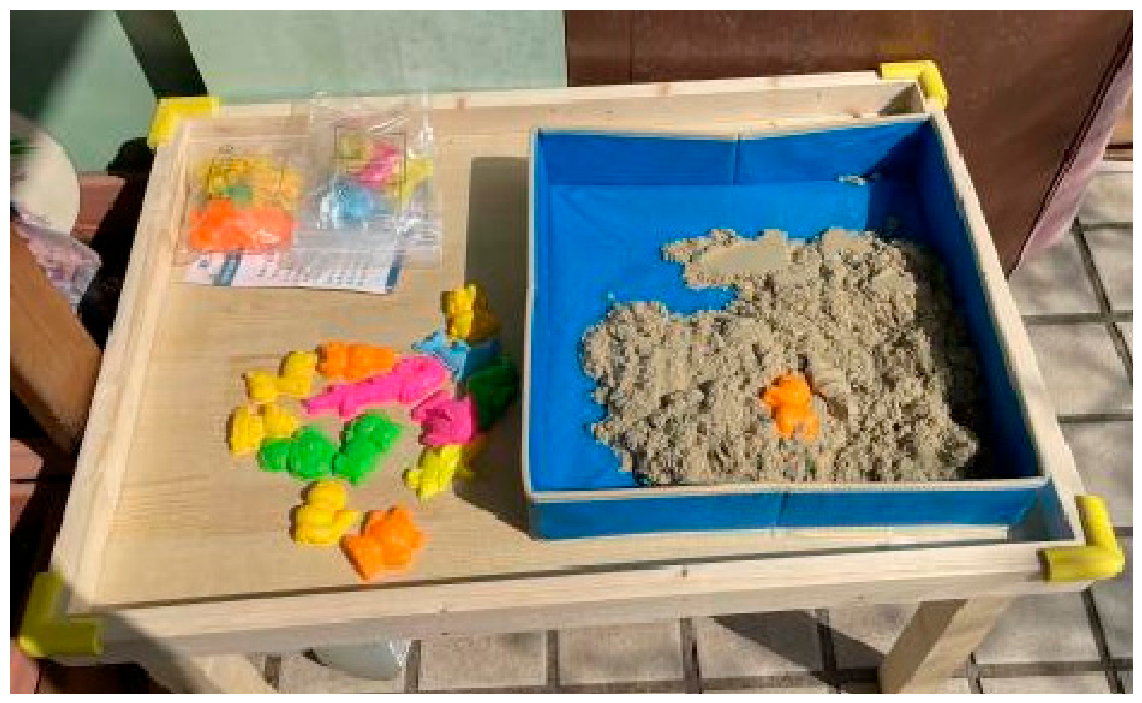
3. Children’s ways of participation in activities.
(a) Children engage in sensory exploration of kinetic sand by directly manipulating it with their hands, including grasping, squeezing, pinching, and molding, thereby experiencing its texture, resistance, and malleability.
(b) Children participate in constructive play by using a variety of tools to dig, transport, and shape kinetic sand with molds, developing early tool-use skills and spatial awareness.
(c) Children create a “snowfall” effect by sifting kinetic sand through a strainer, observing the dynamic flow of particles and experiencing basic cause-and-effect relationships.
(d) Children engage in a treasure-hunting game by hiding small objects in the sand and retrieving them using different search and problem-solving strategies, promoting exploratory behavior and strategy use.
4. Observation Focus.
(a) Ability to imitate demonstrated sand-play actions.
(b) Strategies used to locate and retrieve hidden objects from the sand.
- Example 2
| Light and Shadow Explorations |
1. Developmental Targets.
(a) Perceptual and Cognitive Development
Tactile perception: explore and identify differences in the texture and physical properties of sensory materials through touch.
Visual perception: discriminate common geometric shapes (e.g., circles, squares, and triangles) and basic colors (e.g., red, yellow, and blue).
(b) Health and Motor Development
Hand–eye coordination: operate simple switches and light-producing devices using finger movements.
2. Materials.
Tent, light-and-shadow sensory box, massage oil, food coloring, glitter, colored cellophane, cardboard boxes, flashlights, and PVC sheets (Figure A2).
Figure A2.
Materials in Light and Shadow Explorations.
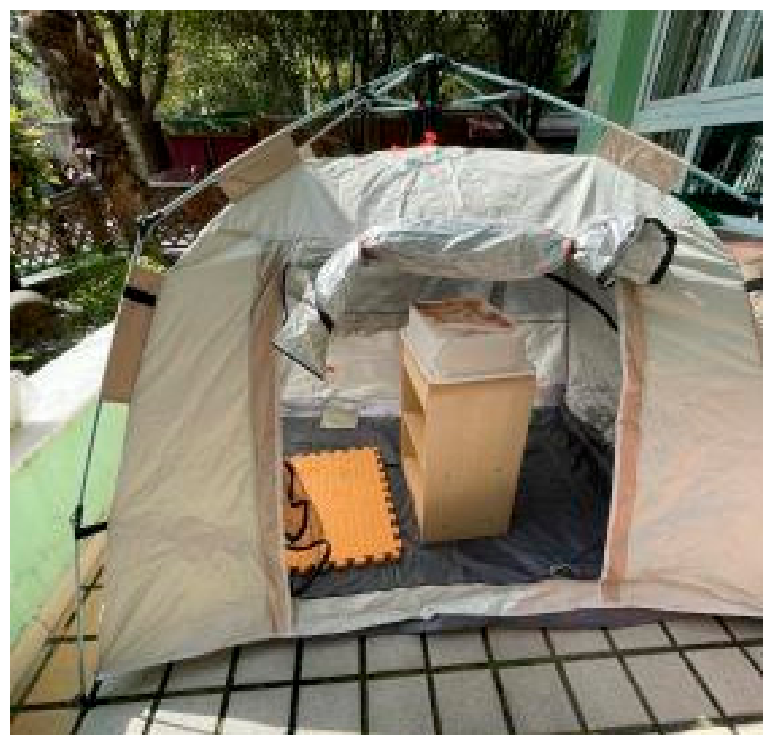
3. Children’s ways of participation in activities.
Children engage in multisensory exploration of sensory bags attached to the light-and-shadow box through touch, observation, and smell, while attending to changes in color, texture, and light effects.
4. Observation Focus.
(a) Willingness to touch and explore the sensory bags.
(b) Emotional responses during sensory exploration.
(c) Sustained attention to different materials and colors within the sensory bags.
(d) Awareness of changes in light and shadow while interacting with the sensory bags.
- Example 3
| Grinding Little Expert |
1. Developmental Targets.
(a) Perceptual and Cognitive Development
Tactile perception: perceive differences in the texture and properties of natural materials through touch.
Olfactory perception: distinguish basic odors (e.g., fragrant, unpleasant, sour).
(b) Health and Motor Development
Fine motor skills: grasp and manipulate grinding tools and natural materials using controlled finger movements (e.g., two- or three-finger grasp).
Bimanual coordination: The child uses one hand to hold the mortar and the other hand to operate the pestle to crush objects.
Self-care skills: develop basic hygiene awareness with adult support.
2. Materials.
Grinding stone plate, mortar and pestle, plates, and natural sensory materials such as orange peels and leafy green vegetables (Figure A3).
Figure A3.
Materials in Grinding Little Expert.
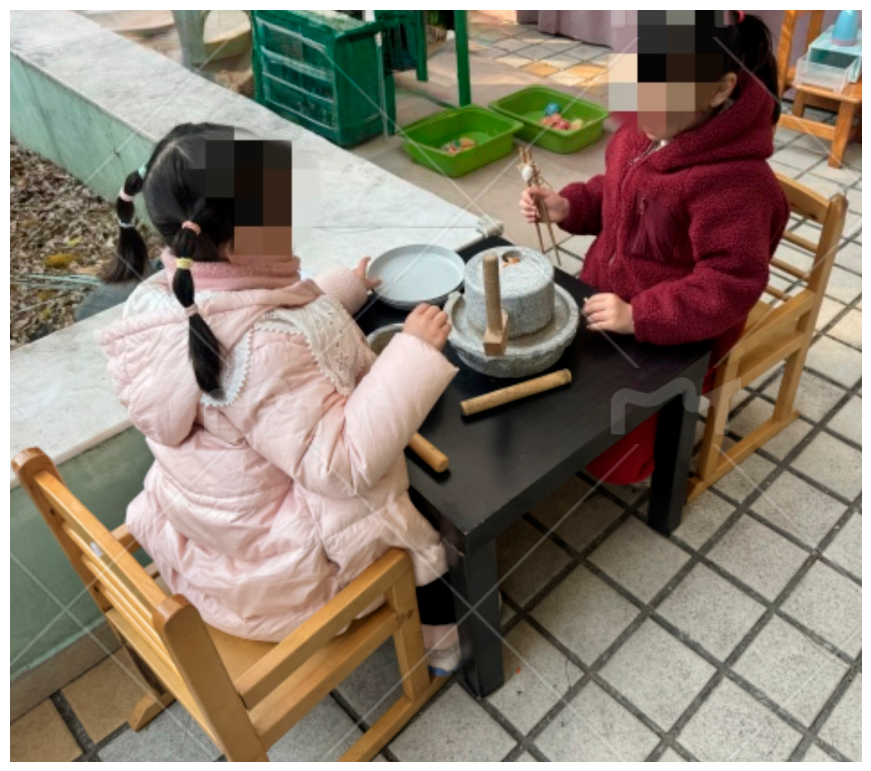
3. Children’s ways of participation in activities.
Children engage in a sequential material transformation process involving crushing, grinding, and transferring orange peels. They begin by using a mortar and pestle to crush the peels, then place the crushed material onto a grinding stone plate. By holding and rotating the grinding plate, children further refine the material, and finally use a brush to transfer the processed orange peel into a plate, completing a full cycle of hands-on transformation.
4. Observation Focus.
(a) Fine motor grasping and releasing behaviors.
(b) Evidence of bimanual coordination during task performance.
(c) Level of knowledge and familiarity with fruits and vegetables.
- Example 4
| Sensory Bomb |
1. Developmental Targets.
(a) Perceptual and Cognitive Development
Mathematical cognition: classify and match objects according to color.
Visual perception: discriminate and match objects by color (e.g., orange, red, blue).
(b) Health and Motor Development
Fine motor skills: grasp, hold, and release objects independently.
Hand–eye coordination: insert sticks into pegboards and manipulate objects with visual guidance.
Bimanual coordination: use both hands to connect chain toys and align components.
2. Materials.
Paper balls, chain toys, structural frame, small balls, colored paper of different types, and ropes of varying lengths (Figure A4).
Figure A4.
Materials in Sensory Bomb.
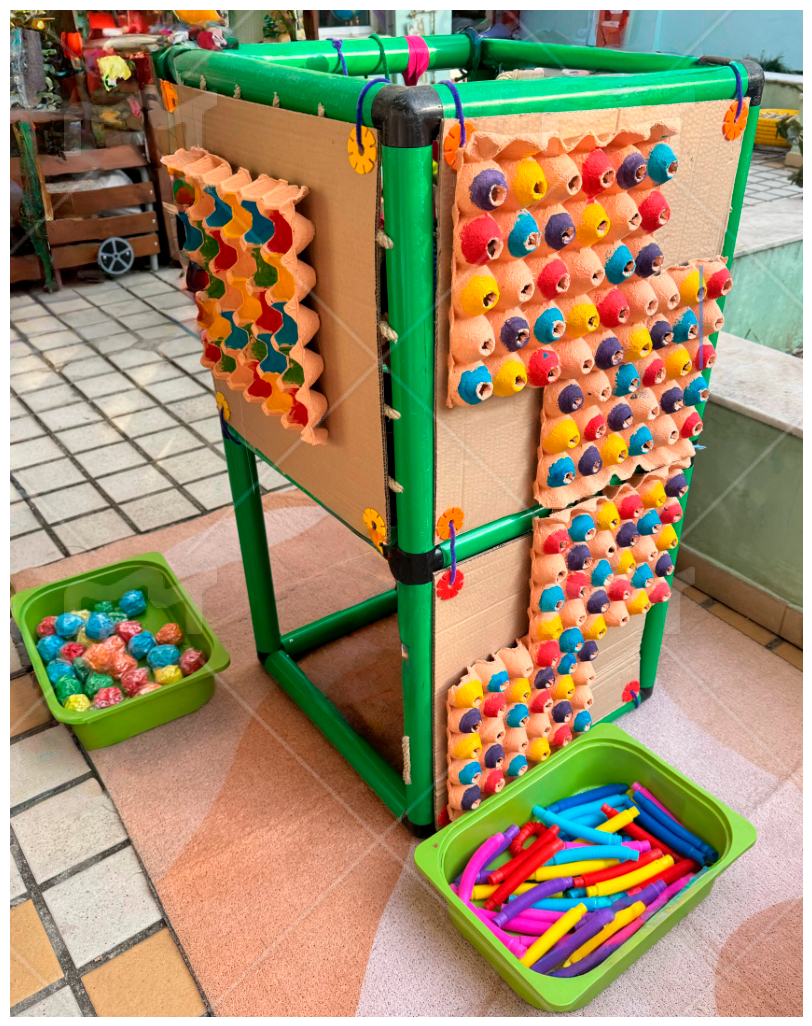
3. Children’s ways of participation in activities.
(a) Children engage in color-matching activities by placing paper balls into corresponding compartments based on color, developing early classification and discrimination abilities.
(b) Children participate in color-connection tasks by observing and selecting matching colors to connect tubes or pathways, supporting visual discrimination and pattern recognition.
(c) Children guide ball movement in a ball-rolling task by directing small balls along designated pathways, developing spatial awareness and action control.
(d) Children explore sensory ropes of different colors and lengths through visual and tactile interaction, comparing their properties and strengthening multisensory perception.
(e) Children construct chains in a chain-building task by extending chain toys according to simple patterns or sequences, fostering early understanding of ordering and regularity.
4. Observation Focus.
(a) Fine motor performance during manipulation tasks.
(b) Ability to match and pair objects based on color.
(c) Spatial perception and orientation skills during play activities.
References
- Agbeze, R. (2025). Becoming agents of change: Deconstructing dis/ability in an inclusive art classroom. International Journal of Education & the Arts, 26(1–19), 7. [Google Scholar] [CrossRef]
- Alghamdi, A. A. (2023). Exploring early childhood teachers’ beliefs about STEAM education in Saudi Arabia. Early Childhood Education Journal, 51(2), 247–256. [Google Scholar] [CrossRef] [Scilit]
- Amsbary, J., Yang, H.-W., Sam, A., Lim, C.-I., & Vinh, M. (2024). Practitioner and director perceptions, beliefs, and practices related to STEM and inclusion in early childhood. Early Childhood Education Journal, 52(4), 705–723. [Google Scholar] [CrossRef] [Scilit] [PubMed]
- Bai, N. (2023). Action research on improving the educational quality of preschool inclusive classes [Master’s thesis, Qingdao University]. Available online: https://kns.cnki.net/kcms2/article/abstract?v=wxNydmF1-_RuzYwL_m8z8mRwS4OALyuE-YFnyI1c2sLJTUiErCxdLJC_8VI4pR5ruJ_MFPcfO-MzyPjO2KCElw0PijnW0HoXmIL-dJNbTrW19QhxGWOjQHBsF8EdtY99T49Fbr4VD382Csc-nfprfbzSy7wm9EAQUlR3kKI5ztMau_83fJiZ9lor6lzxZQP-uQeIXPc__i0&uniplatform=NZKPT&captchaId=771a0291-2e2a-4c08-82e2-b4781e6fdcad (accessed on 16 February 2026).
- Baker, L. (2015). Implications of a reverse inclusion program for students with moderate to severe disabilities [Master’s thesis, California State University, Monterey Bay]. Available online: https://www.semanticscholar.org/paper/Implications-of-a-Reverse-Inclusion-Program-for-to-Baker/8f77a86d090e7a34bc3a5808d390b132455f4e19 (accessed on 22 February 2026).
- Barnes, T. N., Cipriano, C., & Xia, Y. (2021). Cultivating effective teacher–paraprofessional collaboration in the self-contained classroom. Beyond Behavior, 30, 107–115. [Google Scholar] [CrossRef] [Scilit]
- Basic Education Division of the Shanghai Municipal Education Commission. (2023). The implementation opinions of the Shanghai municipal education commission on strengthening the in-class reading program in schools and improving the level of inclusive education in the city. Available online: https://www.shanghai.gov.cn/gwk/search/content/957eac55e793455a9c662d74618f1992 (accessed on 7 March 2026).
- Beisly, A., & Moffitt, A. (2025). Sense-making and STEAM: Using art to make science visible. Early Childhood Education Journal, 53(2), 645–653. [Google Scholar] [CrossRef] [Scilit]
- Bloomquist, C. D., & Georges, L. S. (2022). Interdisciplinary leadership: A Leadership Development Model for Scholar-Practitioners. The Journal of Leadership Education, 21(4), 58–75. [Google Scholar] [CrossRef] [Scilit]
- Bricker, D., Dionne, C., Grisham, J., Johnson, J. J., Macy, M., Slentz, K., & Waddell, M. (2022). Assessment, evaluation, and programming system for infants and children (AEPS-3). Paul H. Brookes Publishing Co. [Google Scholar]
- Butera, G., Horn, E. M., Palmer, S. B., Friesen, A., & Lieber, J. (2016). Understanding science, technology, engineering, arts, and mathematics (STEAM). In B. Reichow, B. A. Boyd, E. E. Barton, & S. L. Odom (Eds.), Handbook of early childhood special education (1st ed., pp. 143–163). Springer. [Google Scholar]
- Cao, W. (2024). Analysis of the current quality of preschool inclusive education in shanghai and its influencing factors [Master’s thesis, East China Normal University]. Available online: https://kns.cnki.net/kcms2/article/abstract?v=wxNydmF1-_TQJ6XaMiOkE_H9ipc3AUNIfj-91MIH9UUocLERjRUa892HvBjoiyJO0zYjC_P1cyv_hnCEViP5jGJ-yZ9mCNE-AW0xw1ZfaYp39iT39iTfKxW-SqehqCd_wkTUnJCAA4mKSg46Q5AA3R4B56LqHu8LNruqidquLifc08Y1xoEEt9yOkHt98pV5xsFPiZynlCQ&uniplatform=NZKPT&captchaId=44dee149-edff-4674-ac20-c992a98f193c (accessed on 8 March 2026).
- Chen, J. (2017). Development of extended science curriculum for primary schools based on STEAM education—Taking “recovery cup experiment” as an example. Experiment Teaching and Apparatus, 34(7), 124–125. Available online: https://xueshu.baidu.com/ndscholar/browse/detail?paperid=4c205fcdc52c4bc46c47dbb42f04873c&site=xueshu_se (accessed on 1 June 2026).
- Chen, J. (2019). Reverting to natural child-centered development and local exploration. Journal of Shanghai Educational Research, (12), 88–91. [Google Scholar] [CrossRef]
- Cheng, X., Wang, L., Li, L. E., & Zhang, X. (2009). A case study on inclusive education intervention to an autism child. Studies in Early Childhood Education, (6), 34–38. [Google Scholar] [CrossRef]
- Claessens, A., & Engel, M. (2013). How important is where you start? Early mathematics knowledge and later school success. Teachers College Record: The Voice of Scholarship in Education, 115, 1–29. [Google Scholar] [CrossRef] [Scilit]
- Clements, D. H., Vinh, M., Lim, C.-I., & Sarama, J. (2020). STEM for inclusive excellence and equity. Early Education and Development, 32(1), 148–171. [Google Scholar] [CrossRef] [Scilit]
- Conradty, C., & Bogner, F. X. (2011). Computer-aided learning: Unguided versus guided instruction. Advanced Science Letters, 4, 3310–3316. [Google Scholar] [CrossRef] [Scilit]
- Conradty, C., & Bogner, F. X. (2019). From STEM to STEAM: Cracking the code? How creativity & motivation interacts with inquiry-based learning. Creativity Research Journal, 31(3), 284–295. [Google Scholar] [CrossRef] [Scilit]
- Dang, Q. (2021). Research on the reverse inclusive education experience of blind students and typically eveloping students: Taking Wsecondary Vocational school for the blindas an example [Master’s thesis, Southwest University]. [Google Scholar] [CrossRef]
- Di Lieto, M. C., Castro, E., Pecini, C., Inguaggiato, E., Cecchi, F., Dario, P., Cioni, G., & Sgandurra, G. (2020a). Improving executive functions at school in children with special needs by educational robotics. Frontiers in Psychology, 10, 2813. [Google Scholar] [CrossRef] [Scilit] [PubMed]
- Di Lieto, M. C., Pecini, C., Castro, E., Inguaggiato, E., Cecchi, F., Dario, P., Cioni, G., & Sgandurra, G. (2020b). Empowering executive functions in 5- and 6-year-old typically developing children through educational robotics: An RCT study. Frontiers in Psychology, 10, 3084. [Google Scholar] [CrossRef] [Scilit] [PubMed]
- Ding, K., Wu, D., Shen, Y., Cao, S., Liu, Q., Wan, Z., & Li, H. (2024). Effect of short-term intensive design-based STEM learning on executive function: An fNIRS study of the left-behind children. Cerebral Cortex, 34(8), bhae311. [Google Scholar] [CrossRef] [Scilit] [PubMed]
- Franklin, B. M., Xiang, L., Collett, J. A., Rhoads, M. K., & Osborn, J. L. (2015). Open inquiry-based learning elicits deeper understanding of complex physiological concepts compared to traditional lecture-style or guided-inquiry learning methods. FASEB Journal, 29, 541.22. [Google Scholar] [CrossRef] [Scilit]
- Fu, W., & Xiao, F. (2016). A qualitative study of the change of the placement of children learning in regular classrooms. Chinese Journal of Special Education (Monthly), (3), 3–9. Available online: https://kns.cnki.net/kcms2/article/abstract?v=InrCKZ6Ohl4w2Ow1ewj1uvwK_UwQeKbqhNbNwnSMsoxi0QNw0t_g8zhOOzcAv_DTo6hQ6OjSx4zrhU9SJGpqXp1kYfr2accKTPYvqIUpaR9VOIHA8D-iN7A0rUEqAvOWvUsz7godFpQgKbnUUlXX49e6nLzxla19fpbH10Tqq6uBy5QTsjn_OQ==&uniplatform=NZKPT&language=CHS (accessed on 19 March 2026).
- Gu, C., & Zhu, L. (2023). Research on the current situation of inclusive education and support services in inclusive kindergartens in Beijing: Taking 13 kindergartens as an example. Chinese Journal of Special Education (Monthly), (4), 26–31. Available online: https://kns.cnki.net/kcms2/article/abstract?v=wxNydmF1-_RLgkeLtfIYiRKWnwSp6XW-9Fy_SwrIu0jKSTAnYZE0TNsI3MPfJeYIRVrRUZFQPzJqYgu4l3efvE_kacvmkGH_LxnGUr8RvMJc3QitwT8iJz2f4uqN8Hs0tQX_IQf1XyPgzV2n_jINxnyPCgaMTOA43UpHmJ7TQPxu_0OiVGS3ag==&uniplatform=NZKPT&language=CHS (accessed on 2 March 2026).
- Guay, D. M. (1994). Art educators integrate: A challenge for teacher preparation. Teacher Education & Special Education, 17(3), 181–191. [Google Scholar] [CrossRef] [Scilit]
- Guo, H. (2016). The deep learning and its significance. Curriculum, Teaching Material and Method, 36(11), 25–32. [Google Scholar] [CrossRef]
- Guo, W., Zhou, N., & Fang, J. (2012). How to improve the interpersonal skills of autistic children: Voices from three special education teachers working in inclusive education school. Education Research Monthly, (5), 72–75. [Google Scholar] [CrossRef]
- Hartle, L. C., Pinciotti, P., & Gorton, R. L. (2015). ArtsIN: Arts integration and infusion framework. Early Childhood Education Journal, 43(4), 289–298. [Google Scholar] [CrossRef] [Scilit]
- Hong, X., Liu, Y., & He, Z. (2024). The current situation and action direction of quality assurance construction in preschool inclusive education. Journal of the Chinese Society of Education, (4), 22–27. Available online: https://kns.cnki.net/kcms2/article/abstract?v=wxNydmF1-_S1JMcQrErUL310fmVo2NZtXpz7C96GYzukOyb8TRfs5EPRJM-0h_65mjP3kzuOqe-tf2YQ5H5BTmU5L5u-CLY5bAIGIdgYArw9RhmlEW8Ziz1BCjFLU4bEP-9GjfC4FpHOz7HdUV_qe9HjS1qbWTRt1BImirkLrm9fojL2G2nHxQ==&uniplatform=NZKPT&language=CHS (accessed on 3 March 2026).
- Huang, J. (2024). From following to suitability: Quality evolution and optimization strategies in the implementation of integrated education for disabled children. Journal of Educational Studies, 20(5), 113–125. [Google Scholar] [CrossRef]
- Hwang, J., & Taylor, J. C. (2016). Stemming on STEM: A STEM education framework for students with disabilities. Journal of Science Education for Students with Disabilities, 19(1), 39–49. [Google Scholar] [CrossRef] [Scilit]
- Ikeda, S., Kodama, M., & Takahashi, T. (2017). National survey on implementation realities of art education at special needs schools. The Journal for Japanese Association of Art Education, 38, 45–59. [Google Scholar] [CrossRef] [PubMed]
- Jinshan District Education Bureau. (2023). Implementation guidelines for the educational placement of children and adolescents with special needs in Jinshan district (trial). Available online: https://www.shanghai.gov.cn/jsqywjy/20230515/95b4269a17c94ffc900e5bf2b9ee77f8.html (accessed on 28 March 2026).
- Kallio-Tavin, M. (2020). Disability studies as a site of knowledge in art education. International Journal of Education Through Art, 16(1), 3–11. [Google Scholar] [CrossRef] [Scilit]
- Kang, W. (1997). A brief overview of foreign research on mathematical problem solving and its implications. Math Teaching, (3), 4. Available online: https://xueshu.baidu.com/ndscholar/browse/detail?paperid=d3d1b2f652fc6f441a6d748537d2e192&site=xueshu_se (accessed on 8 June 2026).
- Kefallinou, A., Symeonidou, S., & Meijer, C. J. W. (2020). Understanding the value of inclusive education and its implementation: A review of the literature. PROSPECTS, 49, 135–152. [Google Scholar] [CrossRef] [Scilit]
- Kim, Y., & Park, N. (2012). The effect of STEAM education on elementary school student’s creativity improvement. In Computer applications for security, control and system engineering. Springer. [Google Scholar]
- Koegel, R. L., & Koegel, L. K. (2006). Pivotal response treatments for autism: Communication, social, and academic development. Brookes Publishing Company. [Google Scholar]
- Laaksonen, V. (2014). Children’s peer interaction skills and bullying in the peer groups of preschool [Ph.D. thesis, University of Jyväskylä]. [Google Scholar]
- Lai, Y., & Qin, Y. (2026). Re-examining the logic of kindergarten science activity curriculum under the STEAM education concept: Realistic gaps, logical reconstruction, and implementation pathways. Journal of Guangxi Normal University (Philosophy and Social Sciences Edition), 62(2), 103–113. [Google Scholar] [CrossRef]
- Lei, C., & Li, T. (2026). Beyond positivism: A reconsideration of the paradigm of educational research. Modern University Education, 42(4), 24–30. Available online: https://kns.cnki.net/kcms2/article/abstract?v=vJPlAO6Aao-s_dK3fF4SFHa46Dmt8fTYmJE1L5iPEqb5rcnX__8KC_gFL2BWoFd5lvXjxNb70vZUNV9H-E3laMpwmEsKrg8pBH5Bd8cg4-ZA1b4APFlVB89IVDBx99Y4__vqAntkPEJG4zIpjuRmUHj-pxxnify-Bc3uIUlET4cJa8zqL7DLzaSKqbFcfc_g&uniplatform=NZKPT&captchaId=76aad4fe-5941-475f-8ada-1f8c1efe8ae6 (accessed on 17 August 2026).
- Lei, Y., & Wen, X. (2025). Getting out of the predicament of empirical research in education: An educational phenomenological perspective for bracketing facts and grasping essences. Modern Distance Education Research, 37(6), 52–60. Available online: https://kns.cnki.net/kcms2/article/abstract?v=GB7hzhCfPWjywV07KXaB4xpdlv3W-SovwM4l589-GXsHATXYnQNnwJMLuVrc-Tqh5BVKRtxFl1OvCjKUylyOhD8vd3_zdK4TL5OiKA7Tf_ORo0mcA415uIROiBUhioRav-MARFTNAnUf7SMjVD49EbrjM6KT7cK6akeKard7-W8dZiq_8Ob3qA==&uniplatform=NZKPT&language=CHS (accessed on 7 May 2026).
- Li, Y. (2020). The revision and application of social-communication area in assessment, evaluation, and programming system 3rd [Master’s thesis, East China Normal University]. [Google Scholar] [CrossRef]
- Li, Y., & Peng, Y. (2019). The development history, value orientation and localization construction of STEAM curriculum. Modern Educational Technology, 29(9), 115–120. Available online: https://kns.cnki.net/kcms2/article/abstract?v=vJPlAO6Aao_KSn0SdoQRm6Rf1aNwyaB5RFF-p1wVrhFIoxScb4whFl8SSILiLFoshgLA4Z0QGTs2cH-w4XYvbHPQay6IvxI8DTnj4fNzR1bbTNf980YqSf0NVgIH3pGVerNNiciMe_ho9zeUng8GaCM_pINw6Fa0xwgx_rx_siY7yPe_D4WrvvBxpHLl_q8ThpFOPN-ZZhE&uniplatform=NZKPT&captchaId=4f4467f6-e8b0-44c6-ab91-7e999cb83058 (accessed on 1 February 2026).
- Li, Z., & Wang, Q. (2016). Reverse integration: Exploring the path of inclusive education for hearing-impaired children and normal children. Modern Special Education, (19), 13–15. Available online: https://kns.cnki.net/kcms2/article/abstract?v=InrCKZ6Ohl6auisJ1BJT_2mLNWya6NAK9N3tDZyksQOjcR67FogFYyGNhVdJCtYAQARzLFzoDLV20fe14Clk4e1L3Z1Av_Im4JNjpY5C8vGMarc3LkG_cImSYRj4rCceqwr4n2CWNGgtRCZissbJy2bvFh8cLRF0igNyFhVOLarvuzTHjD9n5Q==&uniplatform=NZKPT&language=CHS (accessed on 27 February 2026).
- Liao, C. (2016). From interdisciplinary to transdisciplinary: An arts-integrated approach to STEAM education. Art Education, 69(6), 44–49. [Google Scholar] [CrossRef] [Scilit]
- Liu, J., Li, X., & Wang, J. (2026). From disembodiment to embodiment: The contemporary shift in science education from the perspective of embodied cognition theory. Theoryand Practice of Education, 46(14), 10–17. Available online: https://kns.cnki.net/kcms2/article/abstract?v=mX7l0X-lXK2ZcjVQSNITYkVwzjwWJOay9mxCfwxeEntegPBvEe3paB0akmzm8cA8ZLyY-Nm6SNsMojoD8qhMAJDuCy7FK7k5fI_J3GuBXzRlBc8NJmCvVRTAfX14WAgMvb2zWWM3XnByXMkKBRVTmMpaaWleOaN499rxuH-vfW5_ki2--OzRAQ==&uniplatform=NZKPT&language=CHS (accessed on 22 July 2026).
- Liu, L. (2015). Case analysis of reverse integration education for children with down syndrome. Modern Special Education, (Z1), 106–108. Available online: https://kns.cnki.net/kcms2/article/abstract?v=InrCKZ6Ohl5QURR-dYNVi2_Y8sBe_16H6HplK9tVHBGH6h_c3iZIaPjO5TqeJ3kBU3MeDAlOKURw7rU6EuqKOafNHQ4D8agtCGSs_HiXONi0sA6_8vDKnXqu7Q8uR_oCJyY6NVEpuo-WG4JBu67YAc4F_YSPZF62oHhZfZrOLY6lPZOQJfgpqw==&uniplatform=NZKPT&language=CHS (accessed on 12 March 2026).
- Liu, Y. (2019). Study on the current status and promotion strategies of preschool inclusive education [Master’s thesis, Zhejiang Normal University]. [Google Scholar] [CrossRef]
- Lowrie, T., & Larkin, K. (2020). Experience, represent, apply (ERA): A heuristic for digital engagement in the early years. British Journal of Educational Technology, 51(1), 131–147. [Google Scholar] [CrossRef] [Scilit]
- Lu, Y. (2024). Practical exploration of early STEAM project development based on deep learning. Journal of Shanghai Educational Research, (3), 82–88. [Google Scholar] [CrossRef]
- Magnusson, L. O., & Bäckman, K. (2023). What is the capacity of A in the contexts of STEM? Early Years, 43(1), 123–136. [Google Scholar] [CrossRef] [Scilit]
- Malley, S. M., & Silverstein, L. B. (2014). Examining the intersection of arts education and special education. Arts Education Policy Review, 115(2), 39–43. [Google Scholar] [CrossRef] [Scilit]
- Mao, G., Zhang, L., & Gao, W. (2024). Discussion on the improvement strategy of kindergarten science education based on STEAM. Advances in Educational Technology and Psychology, 8(2), 148–155. [Google Scholar] [CrossRef] [Scilit]
- Masi, C. (2021). Drawing for learning: A review of the literature. Drawing: Research, Theory, Practice, 6(1), 199–218. [Google Scholar] [CrossRef] [Scilit]
- Maslyk, J. (2016). STEAM makers: Fostering creativity and innovation in the elementary classroom. Corwin. [Google Scholar]
- Mayer, R. E. (1998). Cognitive, metacognitive, and motivational aspects of problem solving. Instructional Science, 26, 49–63. Available online: https://xueshu.baidu.com/ndscholar/browse/detail?paperid=a4555b0a4a3715e5f5c3222c24c55d58&site=xueshu_se (accessed on 10 March 2026). [CrossRef] [Scilit]
- McClure, E., Guernsey, L., Clements, D. H., Bales, S. N., Nichols, J., Kendall-Taylor, N., & Levine, M. H. (2017). STEM starts early: Grounding science, technology, engineering, and math education in early childhood. Executive summary. The Joan Ganz Cooney Center. [Google Scholar]
- McNamara, B. E. (1989). The resource room: A guide for special educators. State University of New York Press. [Google Scholar]
- Meng, F., Hai, T., Sheng, X., Zheng, M., & Zhang, H. (2023). Deep learning evaluation index system under STEAM education. Chinese Journal of Electron Devices, 46(3), 795–808. Available online: https://kns.cnki.net/kcms2/article/abstract?v=wxNydmF1-_Qpyx2v5cd3ssSP5XwF2wHmHIflTuyZeJMse8O6UV1V_7jGNEEibwHapH5-tutLQbW2w1NjvsfpfA9kulROngWNlpGBGFwyn81kOL5oXvPidVKB1OMpSiyWOx3EmayK8P1xJ4GPFEDbDLR7LV54AEh8aObA0HuYMDxNekMuiT14qA==&uniplatform=NZKPT&language=CHS (accessed on 11 May 2026).
- Ministry of Education of the People’s Republic of China. (2022). Compulsory education science curriculum standards (2022 edition). Beijing Normal University Press. [Google Scholar]
- National Education Commission. (1987). Full-time mentally retarded school (classroom) teaching plan (draft for comment). Available online: https://law.lawtime.cn/d534697539791.html (accessed on 7 March 2026).
- Nhil, K. (2021). STEAM education and its significance. Cambodian Journal of Educational Research, 1(1), 81–86. [Google Scholar] [CrossRef] [Scilit]
- Novak, J. D., & Gowin, D. B. (1984). Learning how to learn. Cambridge University Press. [Google Scholar]
- Paprzycki, P., Tuttl, N., Czerniak, C. M., Molitor, S., Kadervaek, J., & Mendenhall, R. (2017). The impact of a framework-aligned science professional development program on literacy and mathematics achievement of K-3 students. Journal of Research in Science Teaching, 54(9), 1174–1196. [Google Scholar] [CrossRef] [Scilit]
- Pollak, Y., Shoham, R., Scheres, A., & Dekkers, T. J. (2023). ADHD and risk-taking behavior: Associations, mechanisms, and interventions. In J. L. Matson (Ed.), Clinical handbook of ADHD assessment and treatment across the lifespan (pp. 295–332). Springer International Publishing. [Google Scholar] [CrossRef] [Scilit]
- Qi, C., & Li, Y. (2023). STEAM project-based teaching: Connotational meanings, value dimensions and application examples. Journal of Dialectics of Nature, 45(11), 106–113. [Google Scholar] [CrossRef]
- Qin, H. (2000). Problems of learning in regular class. Chinese Journal of Special Education (Quarterly), (3), 29–31. Available online: https://kns.cnki.net/kcms2/article/abstract?v=InrCKZ6Ohl7wyNnFiZy9Ty46K4isLbjkjukXLwdttLpDJcI-JTkAcleX3QTu2AgEHOC0DBh45lkGNXxKarRlgYZhvbdwdrKZQzg-U4UxUT5IT9Aciy86vIlpqZoqAy_LhRgy4BqvScvIdiDVEaozd-XTTnOndRrlagtPxgjKaBNuejABNBadeQ==&uniplatform=NZKPT&language=CHS (accessed on 2 March 2026).
- Qu, B. (2011). Marx’s social theory that transcends the empirical paradigm and the interpretive paradigm. Journal of Northeast Normal University (Philosophy and Social Sciences Edition), (5), 160–162. [Google Scholar] [CrossRef]
- Ring, K. (2006). Supporting young children drawing: Developing a role. International Journal of Education Through Art, 2(3), 195–209. [Google Scholar] [CrossRef] [Scilit] [PubMed]
- Robertson, J., Gray, S. I., Martin, T., & Booth, J. N. (2020). The relationship between executive functions and computational thinking. International Journal of Computer Science Education in Schools, 3, 35–49. [Google Scholar] [CrossRef] [Scilit]
- Robledo-Castro, C., Hederich-Martínez, C., & Castillo-Ossa, L. F. (2023). Cognitive stimulation of executive functions through computational thinking. Journal of Experimental Child Psychology, 235, 105738. [Google Scholar] [CrossRef] [Scilit] [PubMed]
- Robledo-Castro, C., Mejía, C. V., & Chiu, J. (2025). Exploring computational thinking, executive functions, visuospatial skills and experiences with toys in early childhood: Protocol for a controlled trial. MethodsX, 14, 103145. [Google Scholar] [CrossRef] [Scilit] [PubMed]
- Rubin, K. H., Stewart, S. L., & Coplan, R. J. (1995). Social withdrawal in childhood. In T. H. Ollendick, & R. J. Prinz (Eds.), Advances in clinical child psychology (Vol. 17, pp. 157–196). Springer. [Google Scholar] [CrossRef] [Scilit]
- Ruiz, P. (2021). The social skills across the life span: Theory, assessment, and intervention. Douglas W. Nangle, Cynthia A. Erdley, and Rebecca A. Schwartz-Mette, Eds. (2020) Amsterdam, The Netherlands: Elsevier. 368 pp. The Journal of Nervous and Mental Disease, 209(7), 538. [Google Scholar] [CrossRef] [Scilit]
- Sari, H., Çevik, M., & Çevik, Ö. (2024). The impact of STEAM (STEM + arts) activities on learning outcomes in students with specific learning disabilities. Support for Learning, 39(1), 3–21. [Google Scholar] [CrossRef] [Scilit]
- Shanghai Municipal Education Commission, Shanghai Municipal Development and Reform Commission, Shanghai Municipal Civil Affairs Bureau, Shanghai Municipal Finance Bureau, Shanghai Municipal Human Resources and Social Security Bureau, Shanghai Municipal Health and Family Planning Commission, Office of the Shanghai Municipal Commission for Public Sector Reform & Shanghai Disabled Persons’ Federation. (2018). Three-year action plan for special education in Shanghai (2018–2020). Available online: https://www.shanghai.gov.cn/nw43336/20200824/0001-43336_55408.html (accessed on 30 March 2026).
- Shanghai Xuhui District Changqiao No. 2 Primary School. (2009). Requirements for the identification and confirmation of students eligible for learning in regular classrooms during compulsory education in Xuhui district. Available online: https://c2xx.xhedu.sh.cn/cms/app/info/doc/index.php/29095 (accessed on 30 March 2026).
- Shen, R. (2011). From isolation to integration: A historical examination of special education in China. Research on the History of Education, (4), 1–9. Available online: https://xueshu.baidu.com/ndscholar/browse/detail?paperid=7e0da63a3c05703ee241c0ec5d8a42fb (accessed on 17 March 2026).
- Song, S., & Sun, Y. (2022). An analysis and prevention strategy of bullying to students with autism spectrum disorder in the context of inclusive education. Chinese Journal of Special Education (Monthly), (8), 11–20+29. Available online: https://kns.cnki.net/kcms2/article/abstract?v=InrCKZ6Ohl6dw7t3iMApiXe0888XkoK9AlVXt8_Bq0AGJ4RBNHQe_m4JNAlnYb4h_U6w-qXNjA15sjYOQHZJxi8_oH2lKejN-eeEKEW4OzSYJIkt9ndZ7bpl5fqoTv_eEU3_3itdYXXUIJHqvuPGL-Kyp3MMr0HYhVn6orRLY-yjh7ziPhsGdA==&uniplatform=NZKPT&language=CHS (accessed on 19 March 2026).
- The Standing Committee of the National People’s Congress. (2024). Preschool education law of the People’s Republic of China. Available online: http://www.moe.gov.cn/jyb_sjzl/sjzl_zcfg/zcfg_jyfl/202411/t20241108_1161363.html (accessed on 6 March 2026).
- Tippett, C. D., & Milford, T. M. (2017). Findings from a pre-kindergarten classroom: Making the case for STEM in early childhood education. International Journal of Science and Mathematics Education, 15(1), 67–86. [Google Scholar] [CrossRef] [Scilit]
- Utaminingsih, E. S., Ellianawati, E., Sumartiningsih, S., & Puspita, M. A. (2023). STEAM education. Jurnal Ilmiah Profesi Pendidikan, 8(3), 1605–1612. [Google Scholar] [CrossRef] [Scilit]
- Volkmar, F. R., & Wiesner, L. A. (2009). A practical guide to autism: What every parent, family member, and teacher needs to know. John Wiley & Sons, Inc. [Google Scholar]
- Wang, J., Lian, F., & Zhu, N. (2020). A study on peer relationship of students with intellectual disabilities in inclusive primary school. Chinese Journal of Special Education (Monthly), (3), 42–48+61. Available online: https://kns.cnki.net/kcms2/article/abstract?v=InrCKZ6Ohl4OHmaezP7HD6uPSBMLLwLY_wl2qCUX2cfIk0UgQj3Ac-eo6Vuhj8dR9xY38TKqp6sPKvPogTL-xdwsV2nLVEs4zLwe86G_ykJb2QPjoUHLPKvNndD2WO5TZWIYKf-4j6iFjKhVhEfNJE_tzritglPoKtrPjBH-cJxftOdXSA1k6g==&uniplatform=NZKPT&language=CHS (accessed on 6 March 2026).
- Wang, X. (2021). An exploratory study on the theory and practice of deep learning in early childhood—Theory. Tsinghua University Press. [Google Scholar]
- Weber, M. (1992). Methodology of the social sciences (Q. Li, & W. Tian, Trans.). China Renmin University Press. [Google Scholar]
- Wood, E., & Bennett, N. (1998). Teachers’ theories of play: Constructivist or social constructivist? Early Child Development and Care, 140(1), 17–30. [Google Scholar] [CrossRef] [Scilit]
- Wu, Y. (2019). On the renewed understanding of deep learning. Curriculum, Teaching Material and Method, 39(2), 51–58+36. [Google Scholar] [CrossRef]
- Xu, Y., & Wang, G. (1997). A discussion on two special education forms: Special schools and inclusive education in regular classrooms. Education Exploration, (6), 27–45. Available online: https://kns.cnki.net/kcms2/article/abstract?v=InrCKZ6Ohl7K4EzDxCGNNzwdg4SMbg25fo37JfB-jmAMIOpFqbpq4jd6piYAxHe2hqIOBy0Cqo2PFoYEj2Jg1rK-fu8wdzve_L1bNp1J-aK_SP95RHXOPzB596-kt_ENXO-NimBazKWtfdz1v34yFGtzc7kdFC8FSlR8szIs4KrVlkmkXIEfiQ==&uniplatform=NZKPT&language=CHS (accessed on 6 March 2026).
- Yan, H. (2014). The reverse inclusion under the background of special education. Journal of Suihua University, 34(7), 153–156. Available online: https://kns.cnki.net/kcms2/article/abstract?v=InrCKZ6Ohl4d_6VQGjCySiQ8oRV4F7Hvp6Qu36XBURmjPj3rL8gfmyDK9fH2PFoKT3x6fle0iRMOUfGbvWMKTLNrGapgqZBTSM786-Nqvq6lLquttDe5WndrTu6KbzCfHvXypBDgrmcctOOqUPBCM7EbTLbMHr1dt-dTuTRmCIdFy5AmXHsjiQ==&uniplatform=NZKPT&language=CHS (accessed on 27 March 2026).
- Yang, R., & Deng, M. (2016). On models of family: School collaboration for students with disabilities under the context of inclusive education. Journal of Modern Special Education (Academic), (12), 3–9. Available online: https://kns.cnki.net/kcms2/article/abstract?v=InrCKZ6Ohl4ZXF2pMXyN2MZqoHL7H3Gs134DiJsZBGzhb8kpqVv1-xeL1c2S6fZN2uOAgskpmmaw4rJIK9TlHiXP_vqYopXtfggsYSJHTNPa27a2fKLrjbaBdqO5WOV0XyfkXarHZ-yWIYVZQgdfnlwecehZzvp1Qy6C5MAE7ruXCAvmPeQY7MQNwtcXAgHR&uniplatform=NZKPT&language=CHS (accessed on 25 February 2026).
- Yang, X. (2022). Do we need to develop special education classes: Reflection on its significance in regular compulsory education schools. Chinese Journal of Special Education, (1), 10–14+21. Available online: https://kns.cnki.net/kcms2/article/abstract?v=InrCKZ6Ohl5nCyB8B3l_n2akRpxi5lyaM81jHYpK51_UpZEqPve99fa0B1HQ5DMES5kZwCJGKhyf8AyeT3TNRNlcgLE6R9w2ywfBL7OItkBB2fLZRtHC7RJSwkdLREqbXfToj3X3_RRCgWsqjeQb3ZBfn7dszl3IQkPggHr3DXt0XFVJkDkLEQ==&uniplatform=NZKPT&language=CHS (accessed on 2 April 2026).
- Yang, Z., Wang, K., & Jiang, X. (2026). A STEAM-based approach to cultivating master students in science and technology education in Hainan. Journal of Hainan Normal University (Social Sciences), 39(2), 165–172. [Google Scholar] [CrossRef]
- Yazcolu, T., & Aktepe, V. (2022). Identifying the values to be acquired by the students in inclusive classrooms based on the views of the classroom teachers. International Journal of Progressive Education, 18(1), 52–64. [Google Scholar] [CrossRef] [Scilit]
- Ye, H. (2015). The body and learning: Embodied cognition and its impact on traditional view of education. Educational Research, 36(4), 104–114. Available online: https://kns.cnki.net/kcms2/article/abstract?v=mX7l0X-lXK0aSQYgY_Mzp2_Du4JRpfsa1RdybRAtWpULdDzQ3n4Ki22gJJKAZNslKKrhsjQFsXzJVjydx3OkRqccFElDBvd7V7kfTMXZi7pG9Uk1QKnrocZnYYzoScUaAd_B6lsDwVk1S0CVVO7mYTWI19Ml9t80DzDWZ8VpG0szVcJqnvMp7g==&uniplatform=NZKPT&language=CHS (accessed on 11 July 2026).
- Yu, N. (2022). The dilemma and supporting path of teachers’ role practice in inclusive preschool education. Teacher Education Research, 34(3), 56–61. [Google Scholar] [CrossRef]
- Yu, X., Ma, R., & Tang, M. (2022). The development status and promotion strategy of preschool inclusive education in China from the perspective of quality evaluation. Studies in Early Childhood Education, (8), 1–12. [Google Scholar] [CrossRef]
- Zayyad, M. (2019). STEAM education for students with specific learning disorders. In W. Wu, & S. Alan (Eds.), Research highlights in education and science 2019 (pp. 31–42). ISRES Publishing. [Google Scholar]
- Zhan, Z., Yao, X., & Li, T. (2023). Effects of association interventions on students’ creative thinking, aptitude, empathy, and design scheme in a STEAM course: Considering remote and close association. International Journal of Technology and Design Education, 33(5), 1773–1795. [Google Scholar] [CrossRef] [Scilit] [PubMed]
- Zhang, X., Chen, Y., Hu, L., Hwang, G.-J., & Tu, Y.-F. (2025). Developing preschool children’s computational thinking and executive functions: Unplugged vs. robot programming activities. International Journal of STEM Education, 12(1), 10. [Google Scholar] [CrossRef] [Scilit]
- Zhou, W., Zhong, Y., You, H., & Jiang, Y. (2023). Primary and secondary school STEAM education: What is “A”—A mixed analysis based on literature and interviews. Journal of Shanghai Educational Research, (8), 47–53. [Google Scholar] [CrossRef]
- Zhu, H. (2019). Functional generalization and regression of inclusive education for special children. Journal of the Chinese Society of Education, (7), 68–72. Available online: https://navi.cnki.net/knavi/detail?p=d7witHVxxI5x2YOgLiSQDcwduv_arN7_PoAYDu1AZbck7Y4jVhlAE7YUkm6GgED6zRD3PU8U3-YWBlEWtazDKlVVv_6pUDmC49oIpQQhRuc=&uniplatform=NZKPT (accessed on 27 March 2026).
- Zhu, L., Wu, L., Song, N., & Huang, J. (2023). The deep learning meaning, value, and expression under the concept of STEAM education. Educational Science Research, (1), 73–79. Available online: https://kns.cnki.net/kcms2/article/abstract?v=wxNydmF1-_QiBv9msumEA2IK1Y1p-bLo5bMhGPEjeEWsUtfwWtcjnNVIe8AuTmrVgp_8g2svWYLdJ0XLn5bgjnZo2MzPUF227yK8u23726EJ8S6UhajJ09Zbnp_HW-pjxFkC7YAfYoVjQpV4-MnOSb13RNy2D6elU7fzGhj965F3_CzRsOmk0w==&uniplatform=NZKPT&language=CHS (accessed on 27 May 2026).
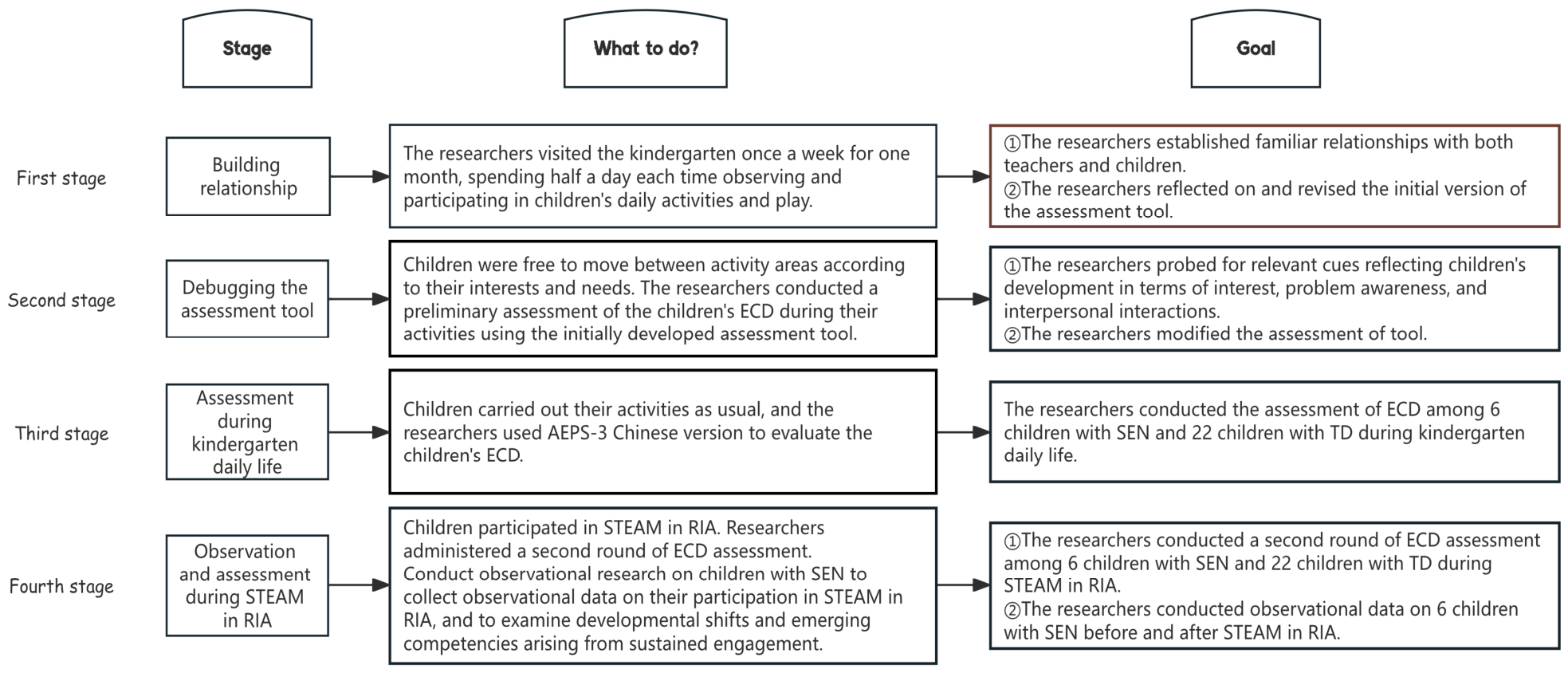
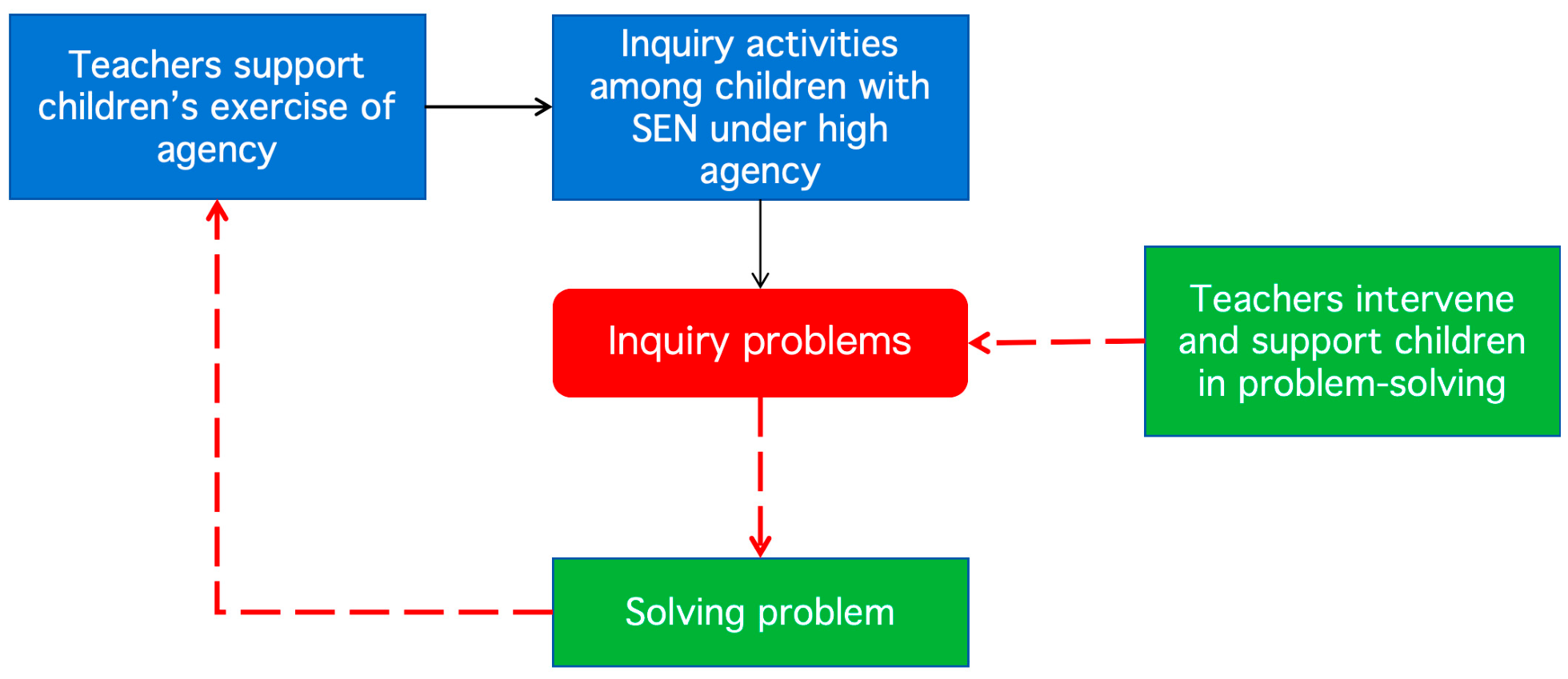

Disclaimer/Publisher’s Note: The statements, opinions and data contained in all publications are solely those of the individual author(s) and contributor(s) and not of MDPI and/or the editor(s). MDPI and/or the editor(s) disclaim responsibility for any injury to people or property resulting from any ideas, methods, instructions or products referred to in the content. |
© 2026 by the authors. Licensee MDPI, Basel, Switzerland. This article is an open access article distributed under the terms and conditions of the Creative Commons Attribution (CC BY) license.