


Abstract
Transnational higher education (TNE) partnerships between Chinese and UK universities continue to expand. However, the structural conditions that shape teaching quality and the governance arrangements through which they are managed remain under-theorised from a faculty-centred perspective. Drawing on a survey-based mixed-methods cross-sectional study of 56 teaching staff (80% response rate) at a Sino-British dual-degree engineering programme in western China, this study provides single-case evidence that teaching workload was the strongest observed negative correlate of perceived institutional support/satisfaction. Total weekly teaching load was moderately and negatively associated with the overall support/satisfaction composite (Spearman’s ρ = −0.49, p < 0.001). Non-parametric paired comparisons showed that teaching facilities were the only support dimension that differed significantly between the two institutional contexts, with a moderate effect; the remaining dimensions showed no significant differences. Internal consistency was acceptable to good. Qualitative thematic analysis identified three faculty adaptation strategies: simplifying and contextualising course materials, using bilingual instructional resources, and scaffolding peer-based discussion. Exploratory teaching-method comparisons involving 13 paired tests, interpreted descriptively, indicated higher reported use of reflection exercises and project-based learning at the joint school campus. An exploratory, perception-based engagement paradox also emerged: faculty reported a higher proportion of students showing >75% active participation at the joint school campus (85.7%) than at the parent institution (70.4% of valid responses), despite rating joint-school infrastructure lower. This finding requires student-level validation. The study contributes an empirically grounded, faculty-centred account of workload governance in transnational partnerships, using the Sino-British case as an illustrative test site.
1. Introduction
The internationalisation of higher education has accelerated substantially over the past two decades, reshaping institutional strategy and education policy worldwide (Rizvi & Lingard, 2010), with transnational higher education (TNE) partnerships representing one of its most complex expressions (Knight & de Wit, 2018). China has emerged as the world’s largest host of TNE programmes: by 2022–2023, over 81,000 students in mainland China were enrolled in UK higher education programmes across more than 260 active joint-degree partnerships (British Council, 2024). These arrangements promise curricular enrichment and mutual institutional benefits, yet they impose substantial demands on the academic staff who deliver them (Dunn & Wallace, 2008; Wilkins & Neri, 2019; Wilkins & Annabi, 2023) and create distinctive governance and management challenges that extend to the faculty level (Stafford & Taylor, 2016; Tran et al., 2023).
Faculty members are the operational core of any TNE programme, navigating dual administrative systems, adapting pedagogy across cultural and linguistic boundaries (Yang, 2016), and managing teaching commitments spanning two institutional contexts simultaneously (Zhang, 2024). Despite this central role, the empirical literature has focused predominantly on student outcomes and institutional governance, leaving faculty experiences understudied (Wilkins & Neri, 2019; Yi et al., 2020). A critical gap concerns the relationship between workload and perceived support/satisfaction: in mainstream higher education, teaching load is consistently associated with burnout and reduced pedagogical quality (Sabagh et al., 2018; Toohey et al., 2017), yet this relationship has not been quantified in the dual-institutional environment of a Sino-British joint programme. Wilkins and Neri (2019) identified faculty role strain as a persistent concern; this study responds directly.
Three research questions guide this study:
RQ1. How do faculty members rate and compare key dimensions of institutional teaching support across the parent institution and joint school campus?
RQ2. What is the relationship between teaching workload and perceived institutional support/satisfaction among faculty members across both contexts?
RQ3. What pedagogical adaptation strategies do faculty members employ in response to cross-cultural teaching demands?
By foregrounding workload as a structural and governable variable, this study reframes the management of TNE faculty as a problem of workload governance, the institutional arrangements through which dual-system teaching obligations are taken into account, distributed, and supported. It contributes an empirically grounded, faculty-centred account of this governance challenge and offers actionable guidance for joint programme leadership amid mounting strategic pressure on Sino-British partnerships (Shi & Ramos, 2023; QAA, 2024). The Sino-British engineering partnership studied here serves as an illustrative case through which these governance dynamics can be examined rather than as the limit of their relevance.
2. Literature Review
2.1. Faculty Experience in Transnational Higher Education
Research on TNE has expanded since the early 2000s, yet it has remained predominantly institutional and student-centred (Altbach & Knight, 2007; Knight, 2008). Dunn and Wallace (2006) identified a structural tension in transnational teaching: faculty members must maintain parent-institution standards while adapting to host-context norms, yet they often receive little systematic preparation. Yi et al. (2020) identified language barriers, mismatched pedagogical expectations, and inadequate peer support as persistent challenges for faculty members in China. W. Xu and Ramirez (2024) developed an intercultural teaching competency training programme, reinforcing the importance of structured professional development for improving cross-cultural faculty effectiveness, while Wilkins and Annabi (2023) documented the working conditions and job satisfaction challenges faced by academic staff at international branch campuses. Dunn and Wallace (2008) showed that transnational teaching imposes preparation, translation, and relational demands outside formal contact hours that significantly expand the effective workload for joint-school faculty. Wilkins and Neri (2019) identified dual accountability structures as a source of role strain, highlighting faculty perceived institutional support/satisfaction as a key governance concern.
2.2. Workload and Perceived Institutional Support/Satisfaction
Sabagh et al. (2018) conducted a systematic review of 23 studies and found consistent negative associations between perceived workload and job satisfaction. Toohey et al. (2017) framed transnational teaching as a job-satisfaction challenge and noted that additional administration can contribute to dissatisfaction among academics involved in TNE. In TNE contexts, these dynamics are amplified by dual administrative obligations, cross-cultural pedagogical effort, and duplicated reporting structures (Dunn & Wallace, 2008; Wilkins & Neri, 2019). Nevertheless, workload has rarely been operationalised as a primary independent variable in TNE faculty studies, a methodological gap this study directly addresses.
2.3. Theoretical Frameworks
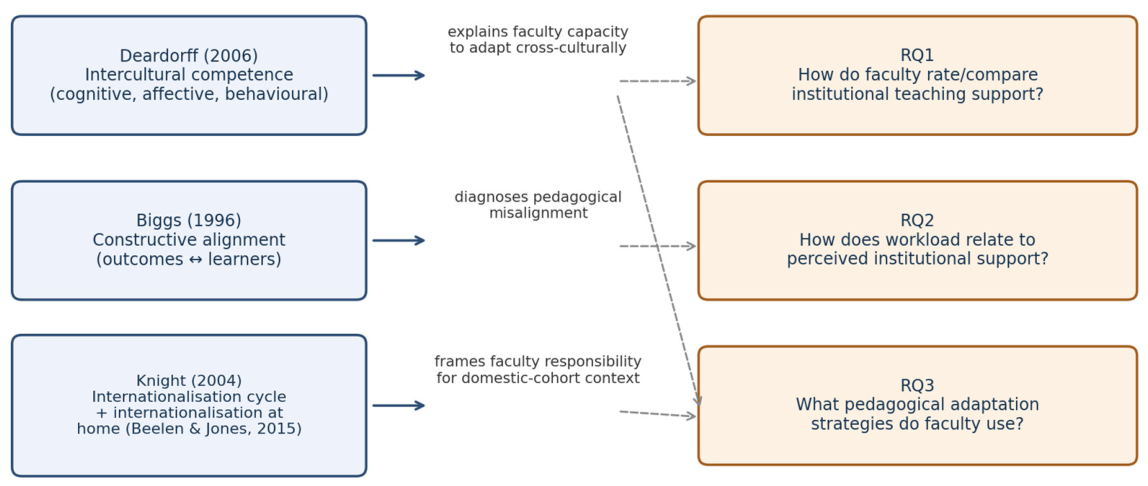
Three frameworks structure this study. Deardorff’s (2006) intercultural competence model conceptualises cross-cultural effectiveness as the integration of cognitive knowledge, affective attitudes, and behavioural skills, thereby explaining why faculty adaptation constitutes a competence that can be accelerated through structured development (W. Xu & Ramirez, 2024). Biggs’ (1996) constructive alignment framework provides diagnostic language for pedagogical adaptation: misalignments between outcomes designed for one educational culture and students socialised in another can be addressed through systematic curriculum redesign. Knight’s (2004) internationalisation cycle and ‘internationalisation at home’ theory (Beelen & Jones, 2015; Soria & Troisi, 2014) highlight that faculty members bear full responsibility for creating intercultural learning conditions for a predominantly domestic student cohort. Figure 1 summarises the relationships between the three theoretical frameworks and the research questions.
Figure 1.
Conceptual relationships between the theoretical frameworks and research questions. Note: Solid arrows show each framework’s primary interpretive contribution; dashed arrows show the research question or questions informed by each framework. Deardorff’s (2006) intercultural competence model and Biggs’ (1996) constructive alignment framework jointly inform RQ3, while Knight’s (2004) internationalisation cycle, together with internationalisation-at-home theory (Beelen & Jones, 2015), informs RQ2 and RQ3.
2.4. Perceived Support/Satisfaction Measurement
Validated instruments, including the Job Satisfaction Survey (Spector, 1985) and Maslach Burnout Inventory (Maslach et al., 1996), consistently find faculty satisfaction/support perceptions to be multidimensional, with teaching resources, administrative support, professional development, and workload loading onto distinct but correlated factors (Oshagbemi, 1997; Castillo & Cano, 2004). In Chinese higher education, internationalisation has reshaped institutional expectations (X. Xu, 2023), while teacher–researcher role conflicts and workload pressure have been linked to burnout among university teachers (L. Xu, 2019). Whether these patterns persist in joint programme contexts is the central empirical question this study examines.
2.5. From TNE Governance to Workload Governance
A growing body of research examines governance arrangements in TNE partnerships, yet the faculty-level labour implications of these arrangements have attracted comparatively little systematic attention. Stafford and Taylor (2016) argue that TNE creates distinctive institutional governance and management challenges that differ fundamentally from those of single-campus delivery, and Tran et al.’s (2023) systematic review of 227 articles identified governance fragmentation, quality-assurance risk, and faculty role ambiguity as recurring challenges for sustainable TNE. Si and Rayner (2025) examined governance dynamics in Chinese Sino-foreign joint institutes through stakeholder interviews, analysing how autonomy, joint committees, and financial structures shape institutional behaviour. Their adaptive governance framework provides essential context for understanding why faculty members experience dual accountability pressures. At the institutional management level, Wilkins and Neri (2019) documented how expatriate faculty members navigate cross-campus role demands, while Bordogna (2018) developed a theoretical approach focused specifically on the experience of operational faculty members in TNE partnerships, emphasising that their labour is structurally distinct from that of faculty at single-campus institutions.
The faculty experience perspective has been developed through several China-specific studies. Duffy (2025) examined expatriate academics on offshore campuses in China, documenting how administrative practices, organisational support, and job satisfaction interact in ways that differ substantially from domestic academic contexts. Ma and Montgomery (2021) demonstrated the importance of interpersonal relationships in sustaining UK–China higher education partnerships, suggesting that peer coordination functions as workload-relieving relational capital. Hu et al. (2019), analysing 122 Chinese host-university self-appraisal reports, identified ground-level quality factors in TNE that institutional self-reports tend to underestimate. Taken together, these studies examine TNE management, faculty experience, expatriate adjustment, and institutional governance, but none operationalise workload as a measurable faculty-level governance variable in the dual-system Sino-British context. Our study addresses this gap by positioning workload governance—the institutional arrangements through which dual-system teaching obligations are taken into account, distributed, and supported—as the faculty-level expression of the broader governance dynamics that Si and Rayner (2025) identified at the institutional tier.
3. Methodology
3.1. Research Design
A survey-based mixed-methods cross-sectional design was employed (Creswell & Plano Clark, 2018), combining Likert-scale items for breadth and inferential power with open-ended prompts for contextual richness. The qualitative data were used to contextualise and explain quantitative patterns rather than to provide a fully independent qualitative strand.
3.2. Research Context and Institutional Terminology
This study pertains to a Sino-British dual-degree engineering partnership at a research-intensive university in western China. Throughout this paper, the Chinese partner university’s main campus is referred to as the parent institution and the joint delivery site as the joint school campus. The UK partner contributes curriculum frameworks and academic oversight remotely. This terminology avoids the ambiguity of ‘home institution’, which, in the TNE literature, may refer to the UK awarding body. The programme spans four year groups and five engineering disciplines.
Two of the research team members are affiliated with the institutions analysed: one serves as a UK-side faculty member, and the other serves as joint school campus staff. Insider positioning facilitated the 80% response rate, which is high for organisational survey research (Baruch & Holtom, 2008), and enabled the design of a contextually informed survey instrument, but it also introduced risks of social desirability and confirmation bias. To mitigate these risks, we used an anonymous survey with no staff identifiers; the analysis was conducted independently of programme management; ethical approval was received (Reference: EPS 2714, 8 March 2025); and all procedures adhered to the Declaration of Helsinki.
3.3. Participants
The target population comprised all 70 teaching staff. Of the 57 completed survey responses received, one was excluded for lack of consent, yielding n = 56 (80.0%). Table 1 summarises the participants’ characteristics.
Table 1.
Faculty demographic characteristics (n = 56).
3.4. Instrument Development
The survey was developed following a review of faculty satisfaction scales (Spector, 1985; Oshagbemi, 1997) and prior TNE faculty research (Yi et al., 2020; W. Xu & Ramirez, 2024). Five-point Likert items (1 = Strongly Disagree; 5 = Strongly Agree) assessed four dimensions—teaching materials, administrative support, professional development, and teaching facilities—and were administered in parallel across both institutional contexts, enabling within-subject paired comparisons. The overall support/satisfaction composite used in the correlation analysis was calculated as the mean of the parent-institution and joint-school four-item composites (each comprising teaching materials, administrative support, professional development, and teaching facilities). No separate global satisfaction item was administered; the composite is therefore interpreted as perceived institutional support/satisfaction rather than comprehensive academic job satisfaction. The joint-school teaching-material item (B8-JC: “I have access to high-quality teaching materials at [joint school campus]”) is additionally examined as a component-level correlate. Because this item contributes to the joint-campus composite, its correlation with the overall composite is interpreted descriptively as a component-level association rather than as an independent predictor, and it is labelled “teaching materials adequacy (Joint)” throughout. All 56 participants taught in both contexts and completed all support-scale items; therefore, n = 56 was used for paired support comparisons. The active-participation categories included two missing parent-institution responses, handled as described in Section 4.5. The four active-participation response bands administered to faculty were <25%, 25–50%, 50–75%, and >75% (item B16, Appendix B). These were the only category boundaries used in data collection and analysis, and this item was not recoded. Open-ended prompts elicited descriptions of challenges and adaptation strategies. A pilot review performed by three faculty colleagues confirmed item clarity. The full survey instrument is reproduced in Appendix B.
3.5. Quantitative Analysis
Given the ordinal nature of Likert data and the substantial ties in the paired response distributions (most respondents provided a rating of 4 for both items in most comparisons), non-parametric procedures were employed throughout. In paired comparisons, we used the Wilcoxon signed-rank test (standard settings; see Appendix A), and W and two-tailed p are the primary inferential results.
Because the Wilcoxon normal-approximation Z can be unstable when paired Likert distributions contain many ties (Conover, 1999), approximate effect sizes were calculated as r = |Zp|/√n, where Zp was derived from the two-tailed p-value using the inverse standard normal distribution, with magnitude thresholds interpreted according to Cohen (1988). Effect sizes are interpreted cautiously because of substantial ties; emphasis is placed on W, p, and mean differences as the primary statistical evidence.
Spearman’s rank correlation with 95% confidence intervals (Fisher’s z-transform) was used to assess associations between continuous and ordinal variables. In inferential analyses, we used non-parametric procedures throughout, including Wilcoxon signed-rank tests and Spearman rank correlations. Cronbach’s α was used to assess internal consistency. The significance level for inferential tests was set at 0.05 (two-tailed). Software and function-level implementation details are reported in Appendix A. Wilcoxon tests are treated as exploratory. For the five institutional support comparisons (Section 4.2), Holm-adjusted p-values are reported as a sensitivity check alongside uncorrected values. Teaching-method comparisons (Section 4.4) are interpreted descriptively because 13 paired tests were conducted; no Holm correction was applied to these tests. Regardless, the marginal professional development result (p = 0.057) should be treated with particular caution. Teaching method frequency responses were collected, rated using a five-point ordinal scale (1 = never, 2 = rarely, 3 = sometimes, 4 = often, and 5 = always), and coded numerically in this order prior to analysis; this coding scheme is applied consistently across all teaching method comparisons reported in Section 4.4. A few missing continuous values were mean-imputed prior to analysis: two joint school campus experience values and two parent-institution weekly teaching load values. Sensitivity checks confirmed that the main workload–support association remained statistically significant across three alternative specifications (excluding imputed cases and the highest-load outlier); full imputation values, re-estimated coefficients, and software/implementation details are reported in Appendix A.
3.6. Qualitative Analysis
Open-ended responses were analysed using Braun and Clarke’s (2006) six-phase reflexive thematic analysis, which was conducted inductively without pre-imposed categories. Line-by-line coding produced descriptive and in vivo codes, which clustered into candidate themes through peer debriefing—this study’s qualitative trustworthiness strategy. Peer debriefing was conducted by the two research team members not responsible for the initial line-by-line coding: one holds a doctorate in education with prior qualitative-methods training, and the other is a UK-side faculty member experienced in TNE programme delivery but external to the joint-school site. These two colleagues independently reviewed the candidate codes and themes after the initial coding stage (Braun and Clarke’s Phase 3, theme development) and again after theme refinement (Phase 5), checking coded extracts against the candidate themes for fit, challenging interpretations they found underdetermined by the data, and proposing alternative groupings where relevant. Disagreements were resolved through discussion until a consensus was reached; whenever a consensus could not be reached, the theme was described more conservatively in the final write-up. Feedback from both debriefing rounds is reflected in the final theme structure and definitions reported in Section 4.7. An audit trail was maintained, and NVivo 14 was used for coding and retrieval.
4. Results
4.1. Scale Reliability
Internal consistency was acceptable for the parent institution four-item scale (α = 0.746) and good for the joint school campus scale (α = 0.840), meeting conventional thresholds (Nunnally, 1978). Item–total correlations ranged from r = 0.51 to 0.68 across both scales.
4.2. Institutional Support Perceptions (RQ1)
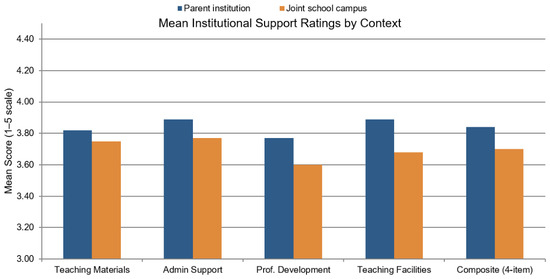
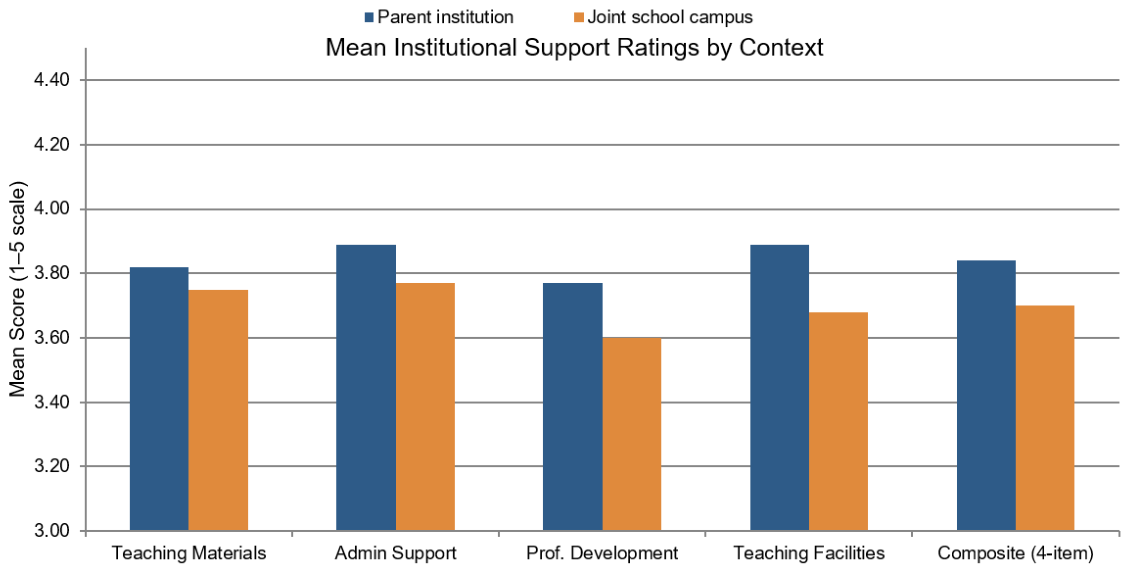
Faculty ratings across all four support dimensions were broadly positive at both the parent institution and the joint school campus (means 3.59–3.89 on a five-point scale). Figure 2 displays mean ratings by context, and Table 2 provides the full inferential results.
Figure 2.
Mean institutional support ratings: parent institution versus joint school campus (n = 56). Note: The bars show mean ratings on a five-point scale. Inferential statistics and approximate effect sizes are reported in Table 2 and Figure A1. Significance markers are not embedded in the figure; Table 2 reports Wilcoxon W, p and Holm-adjusted p values.
Table 2.
Descriptive statistics and Wilcoxon signed-rank tests: parent institution vs. joint school campus (n = 56).
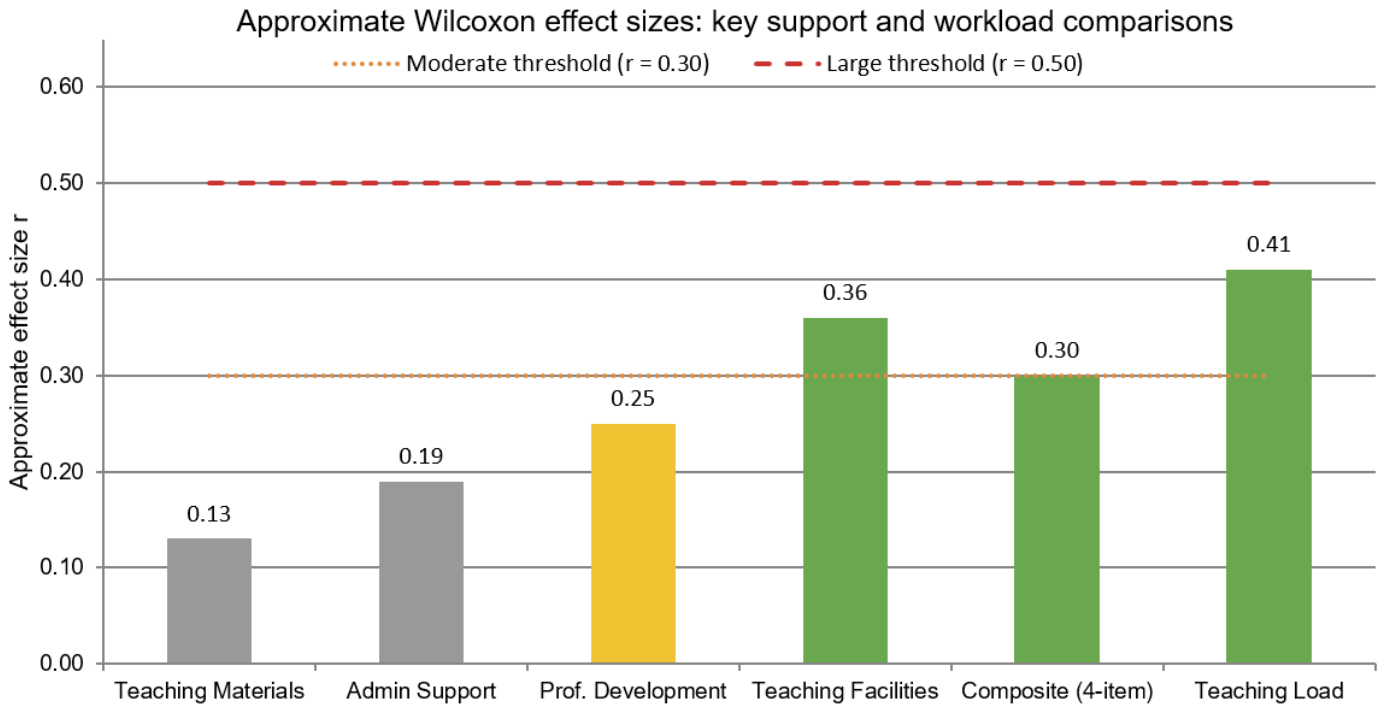
The composite four-item score differed significantly between contexts (W = 57.5, p = 0.024, approximate r = 0.30, moderate). Of individual items, only teaching facilities reached statistical significance (W = 13.0, p = 0.007, approximate r = 0.36, moderate). Administrative support (W = 17.5, p = 0.154), teaching materials (W = 32.5, p = 0.317), and professional development (W = 23.5, p = 0.057, marginal) showed no statistically significant differences. After Holm correction across the five paired comparisons, teaching facilities remained statistically significant (Holm-adjusted p = 0.037), while the composite comparison became non-significant (Holm-adjusted p = 0.096); the composite difference is therefore interpreted cautiously as suggestive rather than confirmatory. These findings indicate that the two institutional environments are broadly comparable in terms of faculty perception, with physical infrastructure representing the principal site of differentiation.
4.3. Workload and Support/Satisfaction (RQ2)
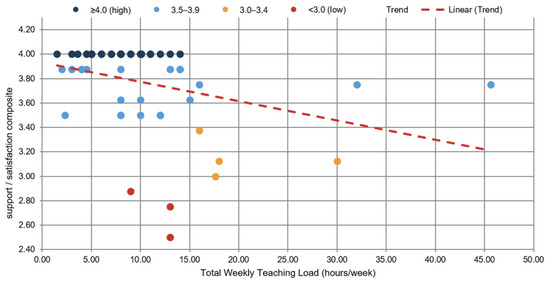
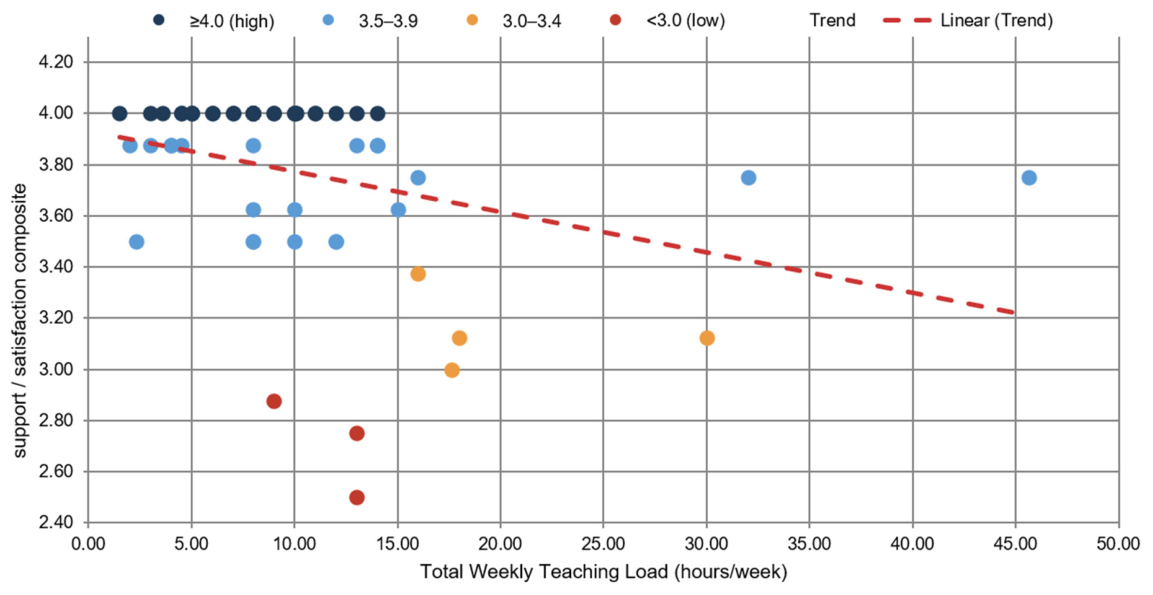
Faculty reported a mean weekly teaching load of 5.63 h (SD = 4.07) at the parent institution and 4.47 h (SD = 5.79) at the joint school campus. The parent institution load was significantly higher (W = 291.5, p = 0.002, approximate r = 0.41, moderate). Figure 3 shows the scatter of total load against the overall support/satisfaction composite.
Figure 3.
Total weekly teaching load versus the overall support/satisfaction composite (n = 56). Note: Each point represents one faculty respondent; colour indicates the support/satisfaction level. The dashed line shows the linear trend. Spearman’s ρ = −0.49, 95% CI [−0.67, −0.26], p < 0.001.
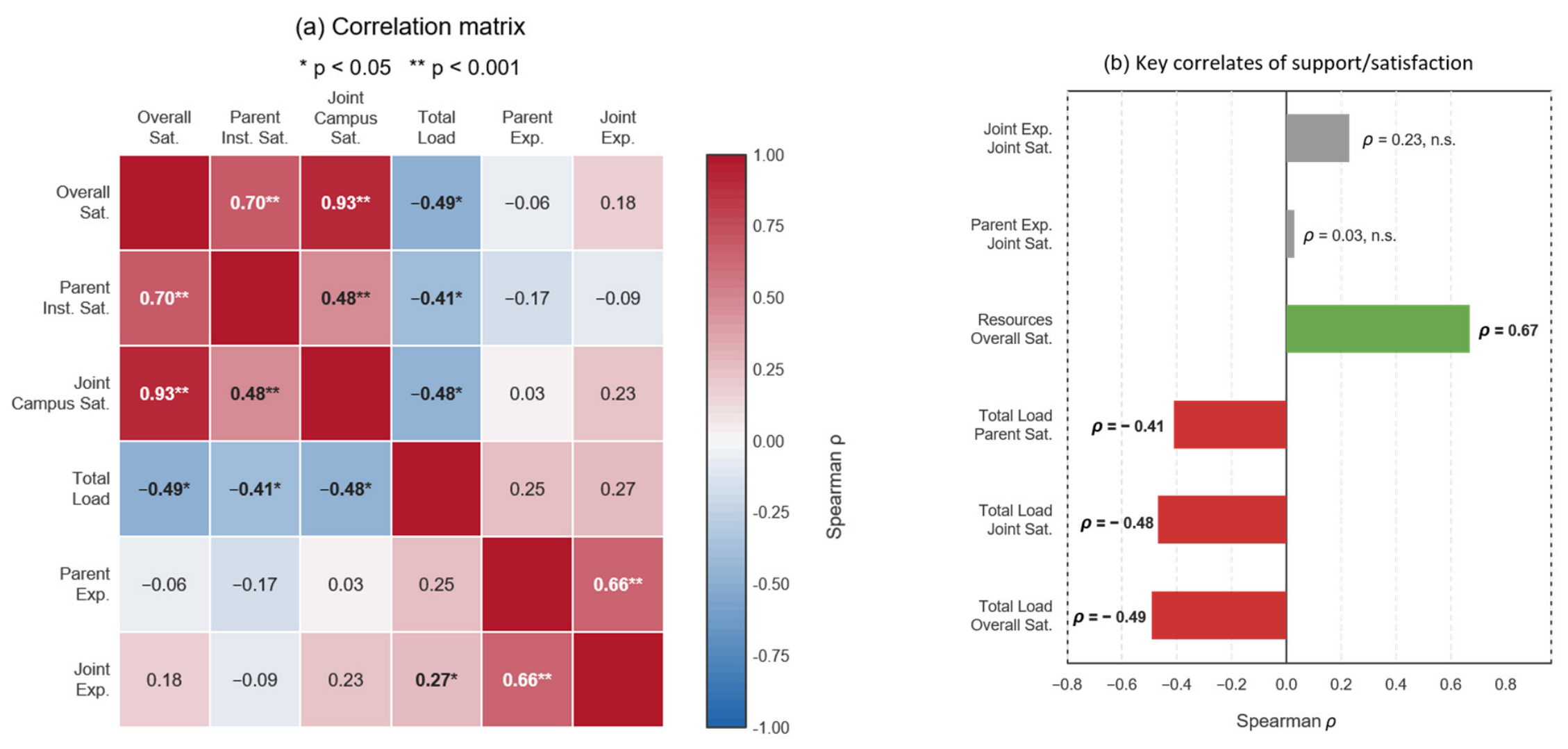
Table 3 presents the selected Spearman correlations central to RQ2. Total load was the strongest observed negative correlate of the overall support/satisfaction composite (ρ = −0.49, 95% CI [−0.67, −0.26], p < 0.001), a relationship that held for both the joint school campus (ρ = −0.48, p < 0.001) and parent institution (ρ = −0.41, p = 0.002) scales. Teaching material adequacy at the joint school campus (B8-JC: “I have access to high-quality teaching materials at [joint school campus]”) was the individual support component most strongly associated with the overall support/satisfaction composite (ρ = 0.67, p < 0.001). Because the individual support items contribute to the composite, associations between components and the composite are interpreted descriptively as indicators of relative importance rather than as independent predictors. Neither parent institution experience (ρ = 0.03, p = 0.811) nor joint school campus experience (ρ = 0.23, p = 0.085) was significantly associated with support/satisfaction.
Table 3.
Selected Spearman rank correlations involving support/satisfaction (n = 56).
4.4. Teaching Method Context (RQ3)
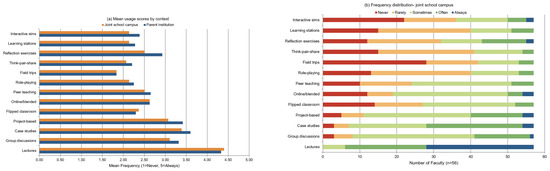
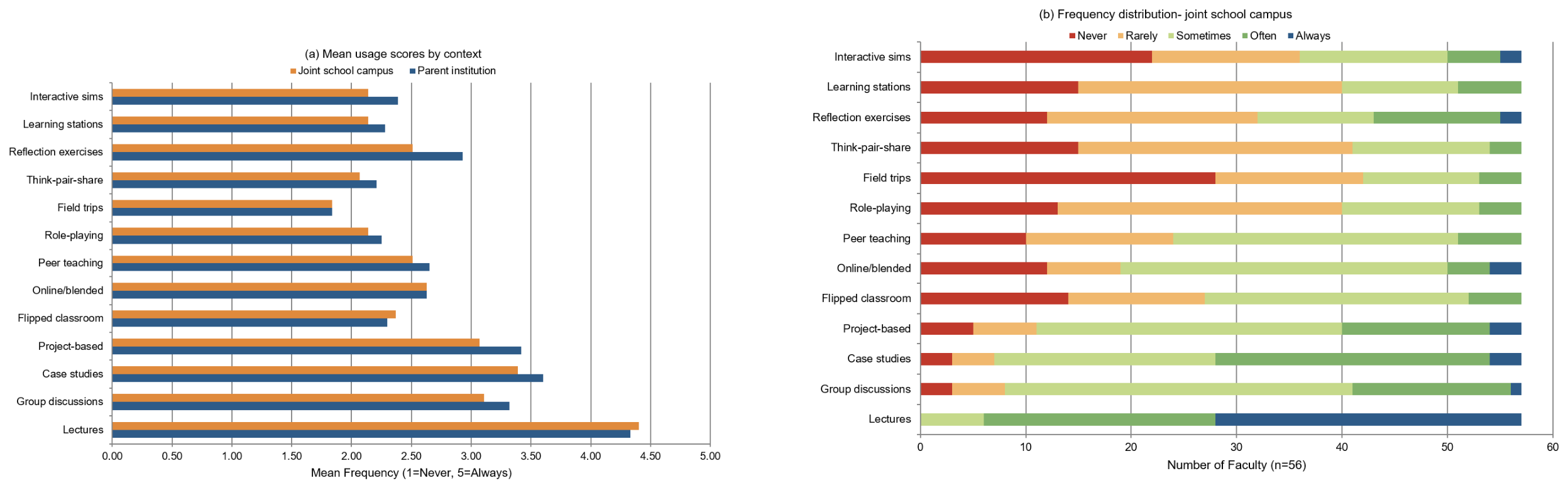
At the joint school campus, lectures were the most frequently reported method in terms of both mean score (M = 4.32) and “often or always” frequency (80.4%). Case studies were also widely reported (M = 3.59; 60.7% often or always), followed by project-based learning (M = 3.41; 50.0% often or always) and group discussions (M = 3.32; 35.7% often or always). Figure 4 presents the full distribution. Because 13 paired comparisons were conducted, all teaching-method tests are treated as exploratory rather than confirmatory. Uncorrected Wilcoxon tests indicated higher reported use of reflection exercises at the joint school campus (W = 90.5, p = 0.004, approximate r = 0.39, moderate effect) and higher reported use of project-based learning (p = 0.025, approximate r = 0.30). All uncorrected method differences are interpreted as descriptive indicators of pedagogical adaptation rather than confirmatory findings; the ordinal coding scheme is described in Section 3.5. These frequency patterns contribute to RQ3 by indicating where pedagogical adaptation is already visible at the observable level of reported method choice: the higher reported use of reflection exercises and project-based learning at the joint school campus is consistent with faculty members adjusting their teaching methods in response to the cross-cultural delivery context, even though these quantitative comparisons are exploratory rather than confirmatory. The richer, strategy-level evidence for RQ3—explaining how and why faculty members adapt—is presented qualitatively in Section 4.7, with the two strands together offering a more comprehensive answer to RQ3 than either could alone.
Figure 4.
Teaching-method usage: mean scores and frequency distributions (n = 56). Note: (a) Mean frequency scores by context (1 = never; 5 = always). Uncorrected Wilcoxon tests indicated higher reported use of reflection exercises (W = 90.5, p = 0.004, approximate r = 0.39) and project-based learning (p = 0.025, approximate r = 0.30) at the joint school campus; all method comparisons are exploratory (see Section 3.5). (b) Stacked frequency distribution for the joint school campus.
4.5. Student Engagement and Challenges
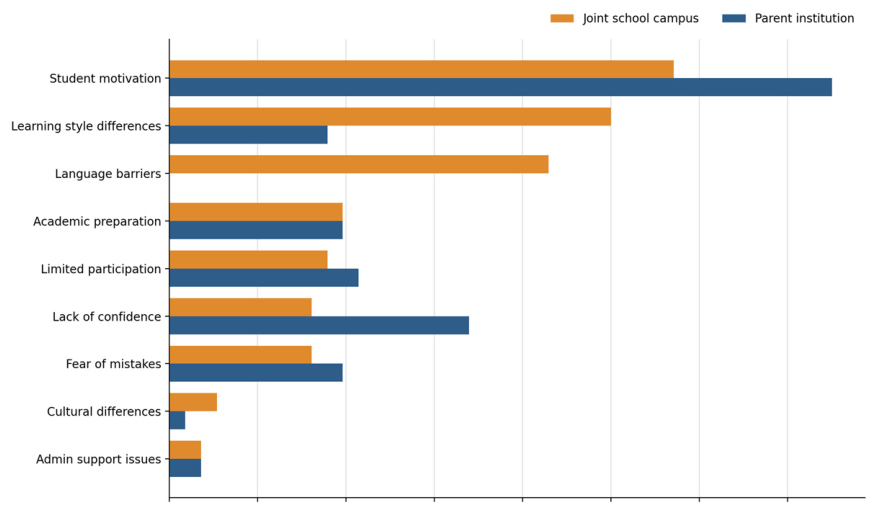
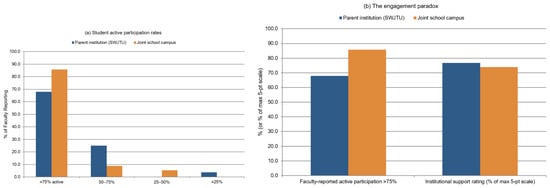
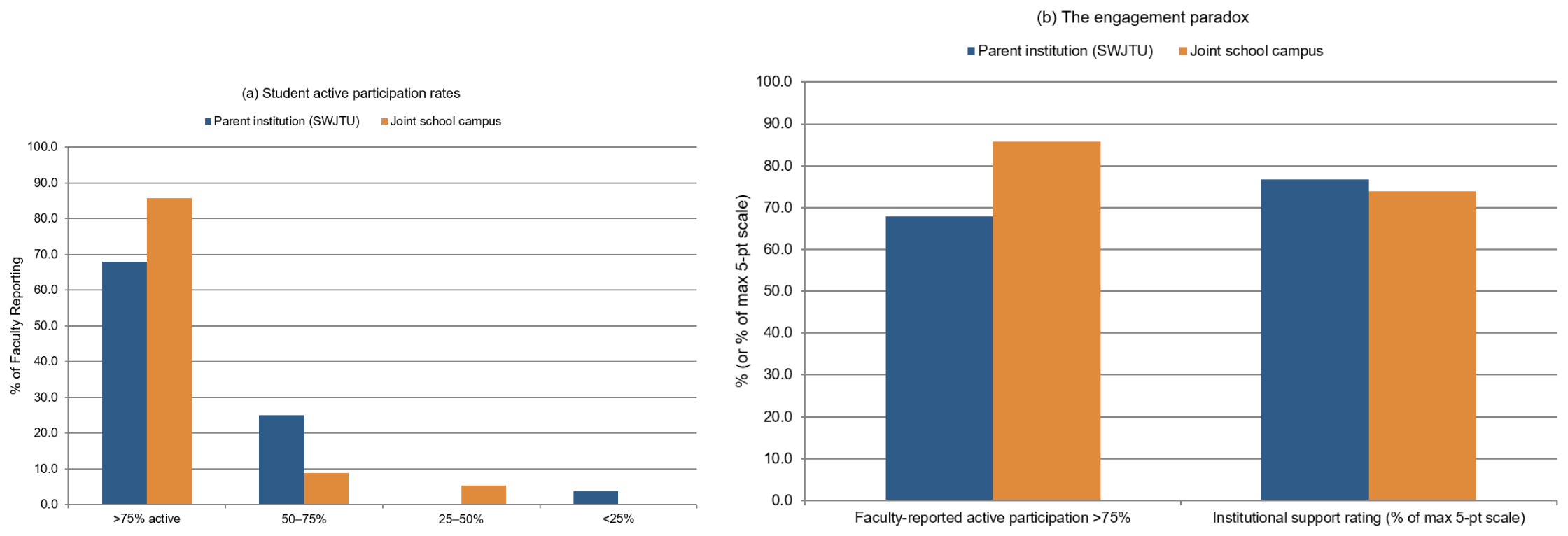
Faculty reported that a higher proportion of students showed >75% active participation at the joint school campus (85.7%; 48/56) than at the parent institution (70.4% of valid responses; 38/54), despite the joint school campus receiving lower institutional support ratings. Two parent-institution responses were missing for this item; the full-sample figure, treating missing responses as the denominator, is 67.9% (38/56), which is reported here for transparency, but the valid-response percentage (70.4%) is treated as the primary estimate throughout this paper. Figure 5 shows that language barriers (42.9% at the joint campus vs. 0% at the parent institution) and learning style differences (50.0% at the joint campus vs. 17.9% at the parent institution) were substantially more prevalent at the joint campus, directly reflecting the cross-cultural delivery context.
Figure 5.
Student engagement challenges stratified by institutional context (% of faculty reporting, n = 56). Note: Language barriers and learning style differences were substantially greater at the joint school campus. Student motivation challenges were more intense at the parent institution. Percentages sum to >100%, as faculty members could select multiple challenges. Figure 6 summarises the faculty-reported active-participation distributions and the resulting engagement paradox.
Figure 6.
Faculty-reported student active participation and the engagement paradox (n = 56). Note: (a) Distribution of faculty-reported student active-participation rates; these are faculty perceptions rather than official attendance records. (b) The joint school campus shows higher active participation (>75%; 85.7%) despite a lower institutional support rating (3.70 versus 3.84 on a five-point scale). Support values were normalised as percentages of the maximum for visual comparison.
4.6. Correlation Structure
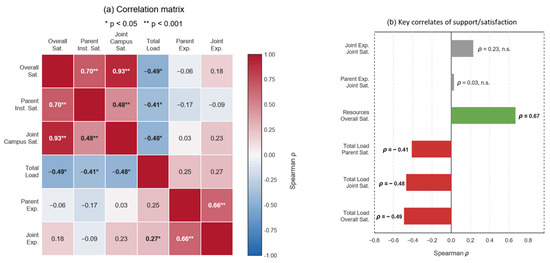
Figure 7 presents the Spearman correlation matrix for the main analytical variables. The largest positive association was between the overall support/satisfaction composite and the joint campus composite (ρ = 0.93), as expected because the joint campus composite contributes to the overall measure. The strongest negative association was between total teaching load and the overall support/satisfaction composite (ρ = −0.49). Teaching experience showed negligible, non-significant correlations with support/satisfaction across both contexts. Figure A1 provides the corresponding approximate Wilcoxon effect sizes.
Figure 7.
Spearman correlation matrix and selected correlates of support/satisfaction (n = 56). Note: (a) Colour-coded correlation matrix (* p < 0.05; ** p < 0.001). (b) Bar chart showing selected Spearman ρ values for correlates of support/satisfaction. Red indicates a statistically significant negative correlate; green indicates a statistically significant positive correlate; grey indicates a non-significant correlate. The total-load/joint-campus support/satisfaction bar represents ρ = −0.48.
4.7. Qualitative Thematic Analysis: Adaptation Strategies (RQ3)
Three overarching themes emerged from the inductive thematic analysis. Table 4 presents a structured summary with response frequencies and illustrative quotations.
Table 4.
Summary of qualitative themes: response frequencies and illustrative quotations.
4.7.1. Theme 1: Navigating Dual Administrative Systems
Duplicated documentation requirements, inconsistent scheduling, and parallel reporting were recurring challenges. Respondents described the practical cost of these systems in concrete terms: “Administrative tasks were time-intensive; clearer protocols could free time for pedagogical innovation”, and “There are too many different systems to manage for teaching and assessment across both institutions.” Several respondents specifically requested structural improvements: “Frequent communication between [the UK partner] and [the parent institution] would help”, and “The collaboration could be done more effectively; we often hear about changes after they have already been decided.” Peer coordination and informal networks were frequently described as partially compensating for these systemic pressures. Faculty accounts suggest that peer relationships and informal coordination functioned as practical coping resources when formal institutional structures were experienced as fragmented, linking this theme to the wider TNE governance literature discussed in Section 5.1.
4.7.2. Theme 2: Evolving Resource Infrastructure
Differential resource access was framed as developmental rather than deficient and not as a fixed structural deficit. Specific material gaps were identified: “High-end computing power for students like a GPU-server” and “We need better access to laboratory equipment that matches what students will use in industry.” The perceived gap in teaching case resources was also prominent: “[The joint school] provides more teaching cases to help me improve my teaching methods.” However, these accounts were consistently paired with forward-looking orientations: “Teaching in the Joint school has offered me much confidence and happiness, but I need more support from the school to help me develop”, and “The joint school is improving year by year; I can see the direction is right even if resources are not yet equal.” Across these responses, resource limitations were commonly described alongside perceptions of continuing improvement at the joint school campus. This developmental, trajectory-based framing of resource gaps is revisited in the Discussion Section (Section 5.1).
4.7.3. Theme 3: Pedagogical Adaptation
Faculty members articulated a rich repertoire of adaptations for the cross-cultural context. Curriculum repositioning was the most frequently described: “In [the parent institution], there is a stronger focus on theoretical understanding, while the Joint School’s international approach encourages me to incorporate more practical elements”, and “I redesign my slides every semester so that examples are relevant to Chinese engineering contexts, not just UK ones.” Bilingual mediation was described as both a burden and a pedagogical choice: “I use bilingual slides not because I am required to, but because I can see students engage more when key concepts appear in both languages” and “Some concepts in mechanics simply do not translate well, so I develop parallel explanations rather than direct translations.” The affective dimension of classroom management was also prominent: “Some students bring educational experiences that value reflective consideration before verbal participation, shaped by diverse educational traditions”, and “I have learned to build longer wait times into discussion activities and to use small-group structures before open plenary; this changed everything for participation rates.” Co-teaching arrangements were consistently valued both pedagogically and relationally: “Collaborating teaching with [UK-partner] teachers builds up a closer relationship between the two universities and provides more insights into the Transnational Education model”, and “The teaching in the Joint school is much more active; working alongside a colleague from the other institution keeps me reflective about my own assumptions.” Across respondents, the most commonly described adaptations involved contextualising materials, bilingual mediation, discussion scaffolding, and co-teaching. Their theoretical interpretation and implications for professional development are discussed in Section 5.3.
4.8. Integration of Quantitative and Qualitative Findings
The quantitative and qualitative findings were broadly convergent. Qualitative accounts of peer coordination as a primary coping resource were consistent with the broader pattern of relatively high support/satisfaction ratings. They helped explain how faculty managed dual-system workload pressures. The workload–support/satisfaction correlation (Figure 3) was reinforced qualitatively by accounts of administrative burdens consuming preparation time. One divergence emerged: although most faculty placed student active participation in the >75% category in both contexts, the open-ended responses also described culturally specific participation patterns as a challenge. This nuance was not fully captured by the categorical engagement item, reinforcing the value of the mixed-methods design (Creswell & Plano Clark, 2018).
5. Discussion
5.1. Workload, the Strongest Observed Structural Correlate
This study provides single-case evidence that total teaching load is strongly associated with the overall support/satisfaction composite, consistently across both institutional contexts (Spearman ρ = −0.49, p < 0.001). This finding is consistent with the broader workload literature (Sabagh et al., 2018; Toohey et al., 2017) and extends Wilkins and Neri’s (2019) concern regarding faculty management and role strain to a Sino-British joint-school context. Because the design of this study is cross-sectional and correlational, causal direction cannot be established; rather than heavier loads causing dissatisfaction, it is possible that dissatisfied faculty perceive their loads to be heavier. Nonetheless, the consistency of the association across both contexts and both context-specific support/satisfaction composites strengthens confidence in its substantive significance. Importantly, the quantitative instrument primarily captures weekly contact hours. At the same time, the qualitative accounts point to a broader range of hidden labour, bilingual preparation, cross-institutional coordination, and administrative duplication that contact hours alone do not capture. This is consistent with Dunn and Wallace’s (2008) discussion of hidden workload in transnational teaching and with Duffy’s (2025) finding that administrative practices and organisational support are central to the job satisfaction of expatriate academics at Chinese offshore campuses. Together, these strands suggest that workload governance should address both invisible and visible academic labour, even though this study can only directly measure the latter. The qualitative accounts of duplicated administrative systems (Section 4.7.1) reinforce this interpretation: the faculty members’ descriptions of time-intensive parallel reporting and scheduling conflicts are consistent with Bordogna’s (2018) argument that operational faculty in TNE partnerships absorb institutional coordination costs that are structurally invisible in formal workload models. The faculty accounts also suggested that peer coordination and informal networks partially offset these pressures, in line with collaborative practice development across transnational teaching teams documented by Keevers et al. (2014) and with Ma and Montgomery’s (2021) observation that interpersonal relationships function as partnership-sustaining capital in UK–China higher education collaborations; this suggests that workload governance interventions should be designed so as not to displace the informal relational capital that currently absorbs some of this burden. Similarly, the developmental, trajectory-based framework that faculty members applied to evolving resource infrastructure (Section 4.7.2), evaluating current gaps against a perceived improving direction rather than as fixed deficits, is consistent with Hu et al.’s (2019) analysis of Chinese host-university self-appraisal reports. Their work identified resource provision as a dynamic rather than static quality factor. This alignment reinforces the case for using longitudinal, rather than only cross-sectional, designs in TNE faculty research. Three sensitivity checks confirmed robustness: excluding the two mean-imputed parent-institution workload cases yielded ρ = −0.454 (p = 0.0006); excluding all four imputed-value rows yielded ρ = −0.402 (p = 0.003); and excluding the 40-h outlier yielded ρ = −0.482 (p < 0.001). None of these sensitivity checks materially changed the conclusion.
5.2. Institutional Differences Are Narrow and Concentrated in Facilities
The institutional maturity narrative received only partial support: teaching facilities differed significantly (p = 0.007, Holm-adjusted p = 0.037; Figure 2). Three of four individual dimensions showed no significant differences, and the composite difference, while significant in the uncorrected comparison, did not survive Holm correction (Holm-adjusted p = 0.096) and should be treated as suggestive rather than confirmatory. The composite difference was substantively modest (Δ = 0.15 points; moderate effect r = 0.30). This is consistent with Wilkins and Juusola’s (2018) finding that maturity-related differences concentrate in physical infrastructure. The implication is that governance intervention in workload may yield faster improvements in perceived support/satisfaction than infrastructure investment.
5.3. Intercultural Competence and Pedagogical Innovation
The adaptation strategies identified qualitatively, bilingual resources, material simplification, and culturally responsive discussion scaffolding are interpretable within Deardorff’s (2006) model as enacted behavioural competence, and they echo Zhang’s (2024) finding that intercultural staffroom dynamics in Sino-foreign partnerships generate pedagogical innovations that formal induction rarely anticipates. That these strategies emerged consistently across respondents and were largely developed by faculty themselves rather than through formal institutional training suggests that they represent transferable institutional knowledge rather than individually held, informally transmitted practices. W. Xu and Ramirez (2024) developed an intercultural teaching competency training programme, reinforcing the importance of structured professional development for faculty working in internationalised teaching contexts. This reinforces the case for institutionalising individually developed strategies through structured professional development, addressing the preparedness gaps long noted in transnational teaching (Dunn & Wallace, 2006; W. Xu & Ramirez, 2024).
5.4. The Engagement Paradox
An exploratory, perception-based paradox emerges from the data: faculty members reported higher proportions of students showing >75% active participation at the joint school campus (85.7%) than at the parent institution (70.4% of valid responses), despite lower infrastructure ratings (Figure 6). This finding should be treated with caution and requires future student-level validation through official attendance records, classroom observation, or learning management system activity data before any causal interpretation is warranted. As a perception-based measure, the difference may partly reflect differing cohort sizes, student characteristics, or faculty assessment tendencies across contexts rather than genuine differences in engagement. With these caveats noted, the pattern is theoretically coherent: internationalisation-at-home theory (Beelen & Jones, 2015; Soria & Troisi, 2014) suggests the joint programme’s international character may elevate student motivation, a factor known to shape the value students place in their learning (Chen & Hoshower, 2003), potentially compensating for infrastructural limitations. Several faculty comments are consistent with this interpretation: “The teaching in the Joint school is much more active”, and “[Joint-school] students are more motivated and active.” This pattern is therefore retained as an exploratory discussion point rather than a theoretical contribution, and future research integrating student self-report data with faculty perceptions would substantially strengthen this argument.
5.5. Theoretical Contributions
This study makes three contributions to the TNE faculty literature and, more specifically, an emerging agenda on TNE workload governance. First, this single-case study provides evidence that measured teaching load is strongly associated with perceived institutional support/satisfaction across both institutional contexts, consistent with the workload-satisfaction literature (Sabagh et al., 2018; Toohey et al., 2017) and extending it to an underexplored Sino-British setting. The qualitative accounts further suggest that hidden dual-system labour, bilingual preparation, cross-institutional administration, and translation work should be treated as workload-governance issues, positioning faculty workload as a governable structural condition rather than an individual burden. This contribution builds on and extends the institutional governance analyses conducted by Stafford and Taylor (2016), Si and Rayner (2025), and Bordogna (2018) by operationalising governance at the faculty level. Second, institutional differences in faculty perceptions are narrow across most support dimensions and, even where significant, remain moderate, thereby empirically constraining the institutional maturity narrative and suggesting that governance intervention in workload may yield faster improvements in perceived support/satisfaction than infrastructure investment alone. Third, the exploratory perception-based engagement paradox, i.e., higher faculty-reported student participation at the institutionally lower-rated campus, generates new theoretical questions about motivation in internationalisation-at-home contexts. However, this finding requires student-level validation before firmer conclusions can be drawn. Taken together, these contributions reframe the central question in TNE sustainability scholarship from whether branch-campus infrastructure has matured to how dual-system workload is recognised, distributed, and supported at the faculty level.
5.6. Policy and Practical Implications
This study provides single-case evidence that measured teaching load is strongly associated with perceived institutional support/satisfaction. At the same time, the qualitative accounts suggest that hidden dual-system labour should be treated as a workload-governance issue, a finding consistent with the governance challenges that Stafford and Taylor (2016) and Tran et al. (2023) identified at the institutional tier and that Si and Rayner (2025) traced through the dynamics of Sino-foreign joint institute governance. The implications extend beyond this single partnership to joint programmes managing dual-system teaching obligations. Three actionable governance recommendations follow. First, joint programme leadership should implement workload-accounting frameworks that capture the full scope of dual-institutional obligations, including invisible academic labour (Dunn & Wallace, 2008; Duffy, 2025), and use them to guide equitable load distribution; this is the faculty-level equivalent of the administrative simplification that QAA (2024) recommends at the programme level. Second, professional development targeting intercultural teaching competence should be formalised in induction, drawing on evidence-based frameworks (W. Xu & Ramirez, 2024) and building on the faculty-developed strategies documented in Theme 3 above. Third, administrative coordination should be treated as a workload-reduction priority: duplicated documentation and scheduling inconsistencies are addressable process inefficiencies, and Ma and Montgomery’s (2021) finding that interpersonal relationships sustain UK–China partnerships suggests that reducing administrative friction may protect the relational capital on which programme quality depends.
5.7. Limitations
Seven limitations bound interpretation of the results. First, the cross-sectional design means the causal direction between workload and perceived support/satisfaction cannot be established. Second, the sample was drawn from a single engineering programme in western China, so caution is required with respect to generalisation. Third, self-report Likert-scale data are subject to social desirability bias; the anonymous survey design reduced, but could not eliminate, this risk. Fourth, the student active participation data are based on faculty perceptions, not official attendance records, and should be interpreted accordingly. Fifth, overall perceived support/satisfaction was measured using context-specific four-item support composites rather than a full validated job-satisfaction scale; the findings should therefore be interpreted as evidence of perceived institutional support/satisfaction rather than as a comprehensive model of academic job satisfaction. Sixth, two categorical items in the survey instrument (age brackets and the active-participation engagement bands) used boundary values shared between adjacent categories (e.g., 30–40 and 40–50, and 25–50% and 50–75%), which could introduce ambiguity and minor measurement error for respondents whose true values sat at a boundary; this is a design limitation of the instrument rather than the analysis, and future revisions of the instrument should use non-overlapping bounds (e.g., 30–39, and 40–49). Seventh, because the parent institution and joint school campus are described throughout and several illustrative quotations and figures directly compare the two contexts, faculty at the partner institutions may be identifiable to readers familiar with the programme despite the anonymous survey design; quotations and contextual details were reviewed to remove or generalise potentially identifying specifics, but full institutional anonymity could not be guaranteed given the comparative, single-case design.
6. Conclusions
We set out to identify the structural conditions shaping faculty perceived institutional support/satisfaction in a Sino-British dual-degree engineering partnership. In this single TNE case, teaching workload emerged as the strongest observed structural correlate of the overall support/satisfaction composite, and this finding was consistent across both institutional contexts. Institutional differences were narrower than the TNE maturity literature predicts, being concentrated in physical facilities. The findings reframe sustainable TNE quality as a matter of workload governance: it is not infrastructure investment alone but transparent workload accounting and the institutionalisation of faculty-developed adaptation practices that convert a functioning partnership into a sustainable one.
Faculty members in this setting are adaptive and constructively oriented, being largely self-reliant in developing the intercultural competencies the programme demands (Table 4). Converting this individual resourcefulness into institutional capital, through formalised professional development, reduced administrative duplication, and transparent workload accounting, is the central governance challenge facing joint programmes of this kind, and this study’s primary contribution is to frame it as such. As Sino-British TNE partnerships face increasing strategic pressure (Shi & Ramos, 2023; QAA, 2024; Tran et al., 2023), retaining and developing faculty effectiveness will be central to programme sustainability. This requires, at minimum, the three governance levers this study identifies—transparent workload accounting, formalised intercultural professional development, and administrative simplification—which are all within reach of existing joint programme leadership structures.
Future research should pursue longitudinal designs tracking workload, perceived support/satisfaction, and intercultural competence co-evolution; comparative studies across multiple Sino-British partnerships (Wilkins & Neri, 2019); intervention studies evaluating structured professional development (W. Xu & Ramirez, 2024); and studies integrating student outcome data, including official attendance records, with faculty perceptions.
Author Contributions
Conceptualization, K.K.; methodology, K.K.; formal analysis, K.K.; investigation, K.K. and X.Z.; writing—original draft preparation, K.K.; writing—review and editing, K.K., X.Z. and Y.L.; visualization, K.K.; project administration, K.K. All authors have read and agreed to the published version of the manuscript.
Funding
This research received no external funding.
Institutional Review Board Statement
The study was conducted in accordance with the Declaration of Helsinki and approved by the University of Leeds Engineering and Physical Sciences Faculty Research Ethics Committee (ethics reference EPS 2714; approval date: 8 March 2025).
Informed Consent Statement
Informed Consent Statement: Informed consent was obtained from all subjects involved in the study.
Data Availability Statement
The data presented in this study are available from the corresponding author upon reasonable request. The data are not publicly available because the qualitative responses and single-case institutional context create a risk of indirect identification and are subject to ethical and institutional restrictions.
Conflicts of Interest
The authors declare no conflict of interest.
Appendix A. Supplementary Statistical Details
Figure A1 presents approximate Wilcoxon effect sizes for the key paired support and workload comparisons. The 13 teaching-method comparisons are treated descriptively and are not included here. Effect sizes should be interpreted as approximate, given the substantial ties in the paired distributions (see Section 3.5). Details of the imputation procedure and sensitivity analyses are provided in Section 3.5. Two missing joint-school-campus experience values were mean-imputed at M = 4.71 years, and two missing parent-institution weekly teaching load values were mean-imputed at M = 5.63 h/week. Three sensitivity re-analyses of the total load–support/satisfaction correlation confirmed robustness: excluding the two mean-imputed parent-institution workload cases yielded ρ = −0.454, with p = 0.0006; excluding all four rows containing any imputed continuous value yielded ρ = −0.402, with p = 0.003; and excluding the single highest-load case (40 h per week at the joint school) yielded ρ = −0.482, with p < 0.001. Analyses were conducted in Python 3.10 with SciPy 1.11 (scipy.stats.spearmanr and wilcoxon, zero_method = ‘wilcox’); Cronbach’s α was computed using the standard variance-based formula. The significance level for inferential tests was set at 0.05 (two-tailed).
Figure A1.
Approximate Wilcoxon effect sizes: key support and workload comparisons (n = 56). Note: Approximate effect size r was derived from the two-tailed Wilcoxon p-value and divided by √56. Small r < 0.30; moderate r = 0.30–0.49; large r ≥ 0.50. Effect sizes are approximate because of substantial ties in the paired Likert distributions. The emphasis throughout the paper is on W, p, and mean differences as the primary statistical evidence.
Appendix B. Survey Instrument
The following items constitute the complete survey administered to the participants. Items marked [PI] were administered with reference to the parent institution; items marked [JC] were administered with reference to the joint school campus. Items without a marker were administered once only.
Appendix B.1. Section 1: Demographic and Contextual Information
B1. Gender: Male/Female/Non-binary/Prefer not to say
B2. Age bracket: Under 30/30–40/40–50/50–60/Above 60
B3. Highest qualification: PhD/Master’s degree/Bachelor’s degree/Other (please specify)
B4. How many years have you taught at the parent institution? (open numeric)
B5. How many years have you taught at the joint school campus? (open numeric)
B6. Approximate weekly teaching contact hours at the parent institution this semester: (open numeric)
B7. Approximate weekly teaching contact hours at the joint school campus this semester: (open numeric)
Appendix B.2. Section 2: Institutional Teaching Support (Five-Point Likert Scale: 1 = Strongly Disagree to 5 = Strongly Agree)
The following four items were administered twice, once with reference to the parent institution [PI] and once with reference to the joint school campus [JC].
B8 [PI/JC]. I have access to high-quality teaching materials at [institution]. (Teaching materials)
B9 [PI/JC]. I receive adequate administrative support for my teaching at [institution]. (Administrative support)
B10 [PI/JC]. I have access to relevant professional development opportunities related to my teaching at [institution]. (Professional development)
B11 [PI/JC]. The teaching facilities at [institution] are adequate for delivering high-quality instruction. (Teaching facilities)
Appendix B.3. Section 3: Support/Satisfaction and Resource Availability
B12. No separate global satisfaction items were administered. The overall support/satisfaction composite used in analyses is the mean of the four support items (B8–B11) across both contexts. The “satisfaction” terminology in the paper refers to this perceived support composite throughout.
B13. Overall support/satisfaction composite: This is the mean of the parent-institution composite (mean of B8-PI, B9-PI, B10-PI, B11-PI) and the joint-school composite (mean of B8-JC, B9-JC, B10-JC, B11-JC). This grand mean captures cross-context perceived support and is the primary outcome variable in Table 3 and Figure 3.
B14. [No separate “resource availability” item exists in the survey. The variable labelled “teaching materials adequacy (Joint)” in Table 3 is item B8-JC: “I have access to high-quality teaching materials at [joint school campus].” This is the joint-school version of the paired materials item and is used as a proxy for perceived resource support in the Spearman correlation analysis.]
Appendix B.4. Section 4: Teaching Methods and Student Engagement
B15 [PI/JC]. How frequently do you use the following teaching methods at [institution]? (1 = Never, 5 = Always): Lectures/Group discussions/Case studies/Project-based learning/Flipped classroom/Online/blended learning/Peer teaching/Role-playing/Field trips/Think-pair-share/Reflection exercises/Learning stations/Interactive simulations/Other (specify)
B16 [PI/JC]. Approximately what proportion of your students show active participation (>75% engagement) during a typical class at [institution]? (<25%/25–50%/50–75%/>75%)
B17 [PI/JC]. Which of the following student engagement challenges do you experience at [institution]? (select all that apply): Student motivation/Learning style differences/Language barriers/Academic preparation/Limited opportunities for participation/Students feel afraid of making mistakes/Students’ lack of confidence/Cultural differences/Lack of administrative support/Other (specify)
Appendix B.5. Section 5: Open-Ended Questions
B18. What are the main challenges you face when teaching across both institutional contexts? Please describe any specific difficulties related to workload, administration, or resources.
B19. What teaching strategies or adaptations have you developed to address the cross-cultural and cross-institutional demands of this programme?
B20. Is there anything else you would like to share about your teaching experience in this joint programme?
References
- Altbach, P. G., & Knight, J. (2007). The internationalisation of higher education: Motivations and realities. Journal of Studies in International Education, 11(3–4), 290–305. [Google Scholar] [CrossRef] [Scilit]
- Baruch, Y., & Holtom, B. C. (2008). Survey response rates and trends in organisational research. Human Relations, 61(8), 1139–1160. [Google Scholar] [CrossRef] [Scilit]
- Beelen, J., & Jones, E. (2015). Redefining internationalization at home. In A. Curaj, L. Matei, R. Pricopie, J. Salmi, & P. Scott (Eds.), The European higher education area (pp. 59–72). Springer. [Google Scholar] [CrossRef] [Scilit]
- Biggs, J. (1996). Enhancing teaching through constructive alignment. Higher Education, 32(3), 347–364. [Google Scholar] [CrossRef] [Scilit]
- Bordogna, C. M. (2018). Transnational higher education partnerships and the role of operational faculty members: Developing an alternative theoretical approach for empirical research. Journal of Studies in International Education, 22(1), 3–19. [Google Scholar] [CrossRef] [Scilit]
- Braun, V., & Clarke, V. (2006). Using thematic analysis in psychology. Qualitative Research in Psychology, 3(2), 77–101. [Google Scholar] [CrossRef] [Scilit]
- British Council. (2024). UK–China transnational education (TNE). Available online: https://www.britishcouncil.cn/en/programmes/education/higher/TNE (accessed on 22 March 2026).
- Castillo, J. X., & Cano, J. (2004). Factors explaining job satisfaction among faculty. Journal of Agricultural Education, 45(3), 65–74. [Google Scholar] [CrossRef] [Scilit]
- Chen, Y., & Hoshower, L. B. (2003). Student evaluation of teaching effectiveness: An assessment of student perception and motivation. Assessment & Evaluation in Higher Education, 28(1), 71–88. [Google Scholar] [CrossRef] [Scilit]
- Cohen, J. (1988). Statistical power analysis for the behavioural sciences (2nd ed.). Lawrence Erlbaum. [Google Scholar]
- Conover, W. J. (1999). Practical nonparametric statistics (3rd ed.). Wiley. [Google Scholar]
- Creswell, J. W., & Plano Clark, V. L. (2018). Designing and conducting mixed methods research (3rd ed.). Sage. [Google Scholar]
- Deardorff, D. K. (2006). Identification and assessment of intercultural competence as a student outcome of internationalisation. Journal of Studies in International Education, 10(3), 241–266. [Google Scholar] [CrossRef] [Scilit]
- Duffy, L. P. (2025). Voices from abroad: Insights of expatriate academics on offshore campuses in China. International Journal of Chinese Education, 14(1), 2212585X251321554. [Google Scholar] [CrossRef] [Scilit]
- Dunn, L., & Wallace, M. (2006). Australian academics and transnational teaching: An exploratory study of their preparedness and experiences. Higher Education Research & Development, 25(4), 357–369. [Google Scholar] [CrossRef] [Scilit]
- Dunn, L., & Wallace, M. (Eds.). (2008). Teaching in transnational higher education: Enhancing learning for offshore international students. Routledge. [Google Scholar]
- Hu, M., Eisenchlas, S. A., & Trevaskes, S. (2019). Factors affecting the quality of transnational higher education in China: A qualitative content analysis on Chinese host universities’ self-appraisal reports. Journal of Higher Education Policy and Management, 41(3), 306–321. [Google Scholar] [CrossRef] [Scilit]
- Keevers, L., Lefoe, G., Leask, B., Sultan, F. K. P. D., Ganesharatnam, S., Loh, V., & Lim, J. S. Y. (2014). ‘I like the people I work with. Maybe I’ll get to meet them in person one day’: Teaching and learning practice development with transnational teaching teams. Journal of Education for Teaching: International Research and Pedagogy, 40(3), 232–250. [Google Scholar] [CrossRef] [Scilit]
- Knight, J. (2004). Internationalisation remodelled: Definition, approaches, and rationales. Journal of Studies in International Education, 8(1), 5–31. [Google Scholar] [CrossRef] [Scilit]
- Knight, J. (2008). Higher education in turmoil: The changing world of internationalisation. Sense Publishers. [Google Scholar]
- Knight, J., & de Wit, H. (2018). Internationalisation of higher education: Past and future. International Higher Education, 95, 2–4. [Google Scholar] [CrossRef]
- Ma, J., & Montgomery, C. (2021). Constructing sustainable international partnerships in higher education: Linking the strategic and contingent through interpersonal relationships in the United Kingdom and China. Journal of Studies in International Education, 25(1), 19–34. [Google Scholar] [CrossRef] [Scilit]
- Maslach, C., Jackson, S. E., & Leiter, M. P. (1996). Maslach burnout inventory manual (3rd ed.). Consulting Psychologists Press. [Google Scholar]
- Nunnally, J. C. (1978). Psychometric theory (2nd ed.). McGraw-Hill. [Google Scholar]
- Oshagbemi, T. (1997). Job satisfaction profiles of university teachers. Journal of Managerial Psychology, 12(1), 27–39. [Google Scholar] [CrossRef] [Scilit]
- Quality Assurance Agency [QAA]. (2024). New country guide: People’s Republic of China. Available online: https://www.qaa.ac.uk/news-events/news/new-country-guide-published-peoples-republic-of-china (accessed on 10 January 2026).
- Rizvi, F., & Lingard, B. (2010). Globalizing education policy. Routledge. [Google Scholar]
- Sabagh, Z., Hall, N. C., & Saroyan, A. (2018). Antecedents, correlates and consequences of faculty burnout. Educational Research, 60(2), 131–156. [Google Scholar] [CrossRef] [Scilit]
- Shi, L., & Ramos, E. (2023, July 19). Changes in UK–China transnational education partnerships: What’s driving the shift? HEPI Blog. Available online: https://hepi.ac.uk/2023/07/19/changes-in-uk-china-transnational-education-partnerships-whats-driving-the-shift/ (accessed on 12 December 2025).
- Si, H., & Rayner, S. (2025). Exploring institutional governance dynamics in China’s transnational higher education (TNHE): A study of Sino-foreign joint institutes. Cogent Education, 12(1), 2450124. [Google Scholar] [CrossRef] [Scilit]
- Soria, K. M., & Troisi, J. (2014). Internationalisation at home alternatives to study abroad: Implications for students’ development of global, international, and intercultural competencies. Journal of Studies in International Education, 18(3), 261–280. [Google Scholar] [CrossRef] [Scilit]
- Spector, P. E. (1985). Measurement of human service staff satisfaction: Development of the job satisfaction survey. American Journal of Community Psychology, 13(6), 693–713. [Google Scholar] [CrossRef] [Scilit] [PubMed]
- Stafford, S., & Taylor, J. (2016). Transnational education as an internationalisation strategy: Meeting the institutional management challenges. Journal of Higher Education Policy and Management, 38(6), 625–636. [Google Scholar] [CrossRef] [Scilit]
- Toohey, D., McGill, T., & Whitsed, C. (2017). Engaging academic staff in transnational teaching: The job satisfaction challenge. Journal of Studies in International Education, 21(4), 333–348. [Google Scholar] [CrossRef] [Scilit]
- Tran, N. H. N., Amado, C. A. F., & Santos, S. P. (2023). Challenges and success factors of transnational higher education: A systematic review. Studies in Higher Education, 48(1), 113–136. [Google Scholar] [CrossRef] [Scilit]
- Wilkins, S., & Annabi, C. A. (2023). Academic careers in transnational higher education: The rewards and challenges of teaching at international branch campuses. Journal of Studies in International Education, 27(2), 219–239. [Google Scholar] [CrossRef] [Scilit]
- Wilkins, S., & Juusola, K. (2018). The benefits and drawbacks of transnational higher education: Myths and realities. Australian Universities’ Review, 60(2), 68–76. [Google Scholar]
- Wilkins, S., & Neri, S. (2019). Managing faculty in transnational higher education: Expatriate academics at international branch campuses. Journal of Studies in International Education, 23(4), 451–472. [Google Scholar] [CrossRef] [Scilit]
- Xu, L. (2019). Teacher–researcher role conflict and burnout among Chinese university teachers: A job demand-resources model perspective. Studies in Higher Education, 44(6), 903–919. [Google Scholar] [CrossRef] [Scilit]
- Xu, W., & Ramirez, M. T. S. (2024). Developing an intercultural teaching competencies training program for educators in application-oriented universities in Anhui Province, China. Contemporary Education and Teaching Research, 5(11), 405–412. [Google Scholar] [CrossRef] [Scilit]
- Xu, X. (2023). Towards a Chinese definition of higher education internationalisation? A systematic review of the Chinese and English literature. Discourse: Studies in the Cultural Politics of Education, 44(3), 364–388. [Google Scholar] [CrossRef] [Scilit]
- Yang, R. (2016). Cultural challenges facing East Asian higher education: A preliminary assessment. In C. S. Collins, M. N. N. Lee, J. N. Hawkins, & D. Neubauer (Eds.), The Palgrave handbook of Asia pacific higher education (pp. 227–245). Palgrave Macmillan. [Google Scholar] [CrossRef] [Scilit] [PubMed]
- Yi, S., Wu, N., Xiang, X., & Liu, L. (2020). Challenges, coping and resources: A thematic analysis of foreign teachers’ experience of cultural adaptation in China. Frontiers in Psychology, 11, 168. [Google Scholar] [CrossRef] [Scilit] [PubMed]
- Zhang, L. (2024). Exploring intercultural communication: Perspectives from internationalized staffrooms at a Sino-French partnership institution. Asia Pacific Journal of Education. Advance online publication. [Google Scholar] [CrossRef] [Scilit]

Disclaimer/Publisher’s Note: The statements, opinions and data contained in all publications are solely those of the individual author(s) and contributor(s) and not of MDPI and/or the editor(s). MDPI and/or the editor(s) disclaim responsibility for any injury to people or property resulting from any ideas, methods, instructions or products referred to in the content. |
© 2026 by the authors. Licensee MDPI, Basel, Switzerland. This article is an open access article distributed under the terms and conditions of the Creative Commons Attribution (CC BY) license.