


Abstract
Cognitive load is a key factor influencing student success. As physics plays a significant role in developing critical thinking, it is important to identify the most effective approach for achieving the highest student performance, specifically the lowest extraneous cognitive load. Although numerous student-centred teaching approaches have been developed in recent decades, their comparative effects on reducing cognitive load remain insufficiently systematised. Therefore, the aim of this research is to systematically review and meta-analytically examine the contribution of different teaching approaches in physics education to reducing perceived cognitive load during learning. Following PRISMA guidelines, studies published in English in the past ten years were identified from the Scopus and WoS databases. After applying inclusion criteria and removing duplicates, 32 studies reported in 28 papers were reviewed. Random-effects meta-analysis, mixed-effects meta-regression, and sensitivity analyses were conducted using R. The results show varying contributions to cognitive load reduction and high heterogeneity. However, three groups of teaching strategies—immersive technologies, simulations, and mobile learning—show a tendency towards greater cognitive load reduction. The main conclusion is that the effectiveness of a teaching approach in reducing cognitive load depends on how the approach is implemented, rather than simply on the use of technology.
1. Introduction
Physics is widely perceived as a difficult and cognitively demanding school subject compared with other subjects (Angell et al., 2004; Radulović, 2021). This perception may be explained by its requirement that students simultaneously process texts, pictures, graphs, and experiments. This complexity can lead to cognitive overload and negatively affect students’ understanding of teaching materials and their motivation to learn physics. However, physics education provides a suitable context for developing critical thinking because it emphasizes reasoning, modeling, and evidence-based explanation (Nixon et al., 2016; Radulović et al., 2016), thereby supporting the development of higher-order thinking skills within the domain. Therefore, critical thinking in physics education can be seen as closely tied to domain-specific knowledge and conceptual understanding.
Given these two contrasting perceptions of physics, numerous student-centered teaching approaches have been developed over the past few decades. As the number of these approaches has increased, teachers have become uncertain about which approach most effectively enhances student performance. Furthermore, as new teaching approaches have emerged, additional factors and variables have been identified that allow more detailed monitoring of their effects. One such relatively recent factor is cognitive load, introduced in the 1980s (Sortwell et al., 2026) and described in Cognitive Load Theory (de Jong, 2010; Van Merrienboer & Sweller, 2005; Kalyuga, 2011; Plass et al., 2010; Sweller et al., 2011). This theory provides an important framework for understanding how instructional design affects the learning process. According to the theory, the effectiveness of learning and teaching depends on the balance between the limitations of working memory (Miller, 1956) and the cognitive demands imposed by the teaching material and activity (Maričić et al., 2025; Mutlu-Bayraktar et al., 2019).
More recent perspectives and findings highlight the need for a holistic view of the integrated interaction among cognitive, emotional, social, and self-regulatory competencies (Sortwell et al., 2026). This newer approach to the theory removes strict divisions into intrinsic, extraneous, and germane cognitive load. Nevertheless, to examine how different teaching approaches contribute to reducing students’ cognitive load, this review draws on the classical framework of Cognitive Load Theory and focuses on the role of instructional design in managing extraneous cognitive load. Extraneous cognitive load refers to the mental effort required to process the way teaching material is presented. As a form of unnecessary load caused by the choice of teaching approach or teachers’ verbal and communication skills (Radulović, 2015), extraneous cognitive load should be minimized.
Currently, there are no systematic literature reviews or meta-analyses providing information on which of the newer teaching approaches most effectively reduces extraneous load in physics teaching. Previous review papers either focus on only one approach (such as multimedia learning) or are more general (addressing the sciences but not specific to physics). Additionally, some findings are contradictory. For example, Albus and Seufert (2023) showed that two different ways of using virtual reality (VR) can have different impacts on extraneous load. In their study, audiovisual presentation caused slightly higher extraneous load than visual-only presentation in VR, whereas Tarng et al. (2022) showed that, in general, VR decreases cognitive load. Thus, teachers, textbook writers, and policymakers are left to determine for themselves which teaching approach is most effective in achieving the highest student performance.
For this reason, the aim of this research is to compare the contributions of different teaching approaches to reducing cognitive load, including all empirical studies in the relevant databases (WoS and Scopus) from the last 10 years. Since Cognitive Load Theory distinguishes three categories of cognitive load, the included studies operationalized cognitive load in different ways. Some studies measured overall cognitive load or mental effort as its measurable component. Therefore, this review focuses primarily on the reduction of perceived cognitive load during learning activities, with particular attention to extraneous load when it is explicitly reported. This will help teachers, textbook writers, and policymakers create and apply learning environments that achieve the highest student performance and guide researchers in the development of physics teaching methodology. Therefore, based on this aim, research questions were formulated:
- What are the bibliographic and methodological characteristics of the included studies (publication year, journal distribution, geographical origin, and teaching approaches)?
- Which teaching approaches and strategies have the greatest effect on reducing cognitive load, based on the values of standardized mean differences?
2. Materials and Methods
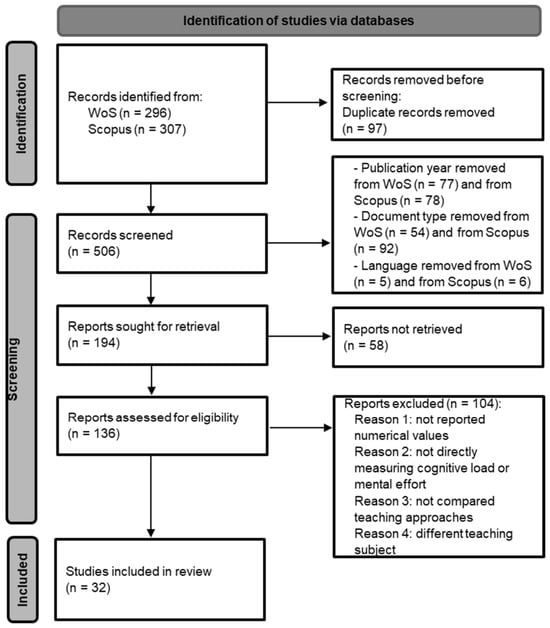
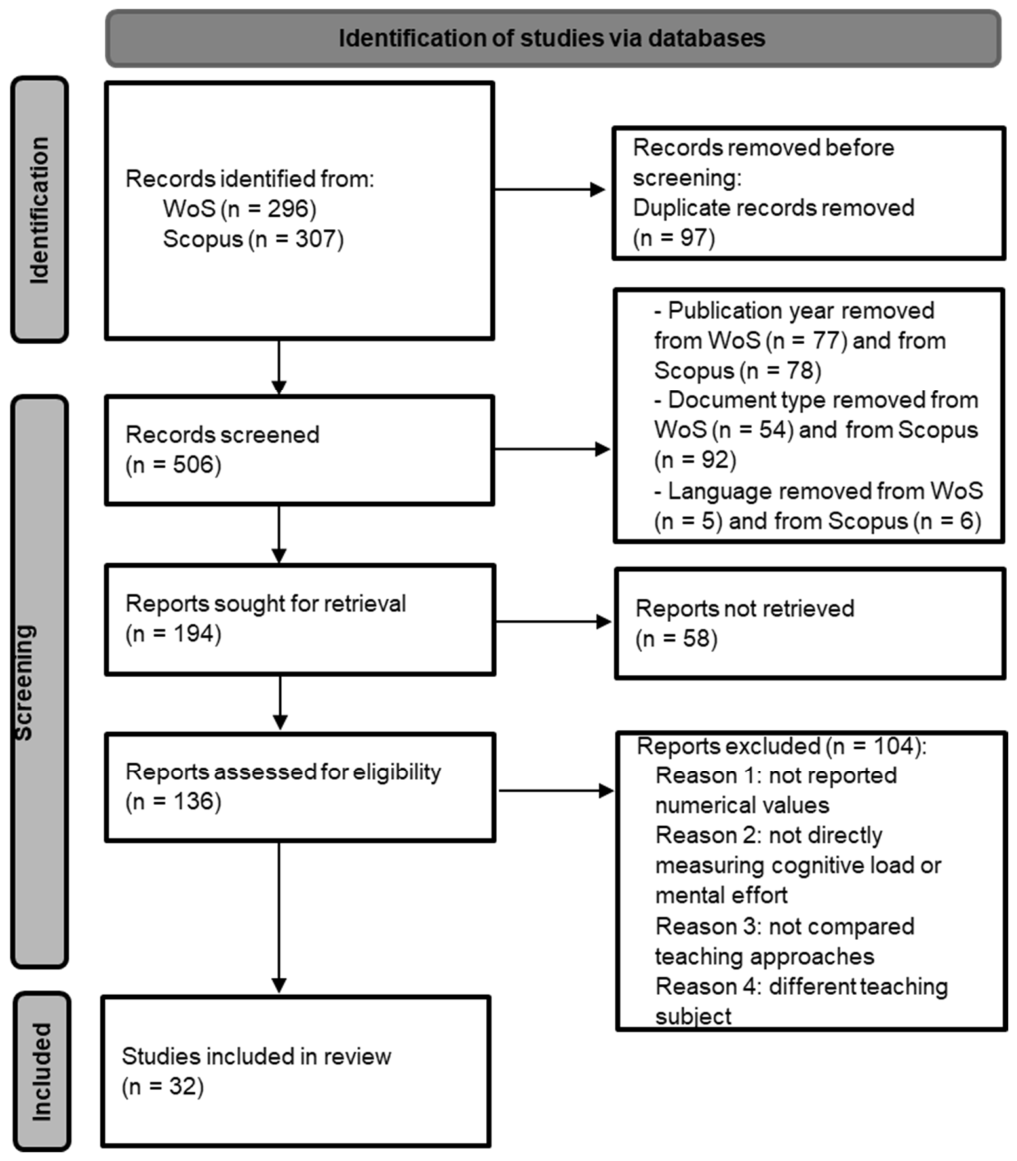
The PRISMA method was used for data collection, as shown in Figure 1. The method included the stages of identification, screening, eligibility, and inclusion.
Figure 1.
PRISMA Flow Diagram.
2.1. Identification
Two databases were used: Scopus and WoS. Data were collected using the keywords cognitive load and physics. In subsequent searches, keywords were combined with the “OR” and “AND” operators. Keywords identified in the titles and abstracts of papers were used. The search operator applied was (“Cognitive Load AND Physics” OR “Mental Effort AND Physics”) to generate papers focused on relevant studies (Appendix A). The search identified 296 documents in WoS and 307 in Scopus. After manually removing duplicates, screening was initiated.
2.2. Screening, Eligibility, and Included
Inclusion and exclusion criteria were applied to retain only relevant studies. Screening was limited to papers published between 2016 and 2026, written in English, and classified as scientific papers. The selection criteria are presented in Table 1.
Table 1.
Screening process.
After the first screening cycle, 194 documents in WoS and Scopus were retained. Following a detailed review, studies were excluded based on the full-text eligibility assessment. Full-text assessment was conducted to exclude studies that
- -
- did not report numerical cognitive load values,
- -
- referred to cognitive load but without directly measuring it,
- -
- compared educational system rather than teaching approaches,
- -
- focus on other subjects than physics education.
The screening and eligibility assessment process was conducted manually by one of the authors. The final number of studies included in the detailed analysis is 32, published in 28 papers (Figure 1). Some papers compare two teaching approaches, meaning there are two experimental groups, each compared in some cases to a different control group and sometimes to a common control group. To better understand the contribution of different teaching approaches, each study is treated as a unit, even when the results of two studies are published in a single paper. Therefore, there are more studies than papers in the database.
2.3. Coding Procedure and Data Analysis
Information extracted from each article was systematically organized using an analytical matrix developed by the author, who collected and analyzed the data. The basic characteristics of each study are presented in a comprehensive spreadsheet ordered by publication year. The following information was extracted from each study: author names, year of the study, applied teaching approach, number of students in the control and experimental groups (separately), perceived cognitive load during learning activities for the control and experimental groups, and standard deviations for the results obtained in the control and experimental groups.
The dependent variable in this meta-analysis was perceived cognitive load, as measured by the instruments reported in the included studies. Before the analysis, the original study results were not transformed, and the data were entered exactly as reported by the authors. Because the included studies used different measurement instruments and scales, direct comparison of the data was not possible; therefore, Hedges’ g was calculated. Hedges’ g was computed from the reported means, standard deviations, and sample sizes. All calculations were performed in R, which automatically derived the standardized mean differences from the extracted data. In this way, all results obtained with different measurement instruments and response scales were synthesized within a common effect size metric. Based on this, a meta-analysis was conducted. Random-effects models were used because of the expected heterogeneity in the actual effect sizes across studies. These variations arise from the heterogeneity of the studies themselves, namely the applied teaching approaches, the age of the population, and the sample material. For this reason, heterogeneity was monitored throughout the data analysis process using Q statistics, tau-squared (τ2), and I-squared (I2). A funnel plot was used to assess study bias, with each effect size plotted against its standard error.
To more clearly and concretely suggest directions for implementing the learning environment to achieve the highest student performance, that is, the lowest cognitive load, teaching approaches are grouped into teaching strategies. Five groups were formed to classify the studies based on their characteristics, particularly their functional role in the learning process: Mobile learning, Simulation, Cognitive structuring, Immersive technology, and Learning support. The Mobile learning group includes studies applying mobile or game-based learning in the experimental group, while the Simulation group comprises approaches that simulate physical phenomena and processes. Cognitive structuring includes approaches that support the organization, processing, and structuring of knowledge, focusing on mental models, representations, and strategies that facilitate understanding and long-term retention of information. The study using a novel as a teaching tool is also included in this category, as writing and understanding a novel requires outlining events that follow cause-and-effect relationships. Immersive technologies are categorized as a separate group because they alter the perception of the environment, as well as the level and manner of immersion in the teaching content. Learning support represents a more metacognitive group, encompassing approaches that support all other categories, with an emphasis on providing specific feedback when necessary.
Meta-analysis, meta-regression, and sensitivity analysis were conducted using the Statistical Package R (version 4.5.3) with the metaphor package (version 4.8-0). Random-effects meta-analysis was performed using the rma() function with a restricted maximum likelihood (REML) estimator. Data were collected in April 2026.
2.4. Study Risk of Bias Assessment
Potential publication bias across studies was examined using funnel plot analysis and leave-one-out sensitivity analyses. Funnel plots were inspected for asymmetry indicating possible publication bias, and sensitivity analyses were conducted to evaluate the robustness of the observed effect sizes. Potential risk of bias in the included studies was assessed using the revised Cochrane risk-of-bias tool for randomized trials (RoB 2) for randomized studies (Higgins et al., 2019) and the Risk Of Bias In Non-randomized Studies–of Interventions, version 2 (ROBINS-I V2), for non-randomized studies (Sterne et al., 2025). The assessment was conducted by the author.
2.5. Data Visualisation
The results are presented using figures and tables. Figures and tables were created in Word, Excel, and R program. All figures and tables are compiled by the author(s).
3. Results
3.1. Study Selection and Excluded Studies
The initial search identified 296 documents in WoS and 307 in Scopus after applying inclusion and exclusion criteria; 32 studies were selected for analysis. Studies were excluded if they lacked numerical cognitive load values, if the database indicated cognitive load but the research did not measure it (for example, Kurbanoglu & Takunyaci, 2017; Hong et al., 2025; Shi et al., 2020; Weber & Wilhelm, 2024), if the study compared two educational systems rather than two teaching approaches, as in Radulović et al. (2022), or if it focused on biology teaching, as in Županec et al. (2022).
3.2. Characteristics of Studies
Table 2 shows the annual distribution of papers that examine cognitive load and different teaching approaches which was used in our paper.
Table 2.
Annual distribution of papers used.
Of the 28 papers used, four were published in Learning and Instruction, followed by three each in the Journal of Science Education and Technology and the Journal of Baltic Science Education. Two papers were published in Physical Review Physics Education Research and Education and Information Technologies. One paper was published in each of the following journals: Computers & Education, Computers in Human Behavior, Smart Learning Environments, Education Sciences, Applied Cognitive Psychology, Human Behavior and Emerging Technologies, Journal of Computing in Higher Education, Science Education, Journal of Eye Movement Research, EPJ Quantum Technology, IEEE Transactions on Learning Technologies, Frontiers in Psychology, Universe, and Zbornik Instituta za Pedagoška Istraživanja.
The authors of the selected studies are entirely from Europe (71.9%), Asia (15.6%), and America (12.5%). The former group focused more on lower and upper secondary school levels, while the latter focused more on higher education. This result aligns with the findings of Mutlu-Bayraktar et al. (2019), which show that papers addressing cognitive load from Africa and Australia are rarely represented in the literature. Therefore, these results highlight the need for future research to encourage greater international or multinational collaboration between European and Asian researchers on one side, and African and Australian researchers on the other.
The continental division of researchers’ interests in examining cognitive load at specific educational levels indicates the need for an exchange of perspectives and approaches. Thus, this result suggests that future European research should focus on higher education and examine the impact of implementing new teaching approaches at universities.
3.3. Risk of Bias Assessment
Table 3 shows the overall risk scores, and Appendix B presents the estimates for all domains. The included papers comprised randomized controlled and nonrandomized studies; therefore, tools for both study types were used.
Table 3.
Risk of bias assessment of the included papers.
Most randomized trials received overall ratings of “some concerns,” and quasi-experimental studies were typically rated as “moderate risk.” The most common reason for risk was related to bias in measurement of the outcome and bias in selection of the reported result, as well as bias due to confounding. More precisely, some studies did not state the reliability of the scale (Cronbach Alpha) or did not use initial measurements in order to more clearly observe the impact of the teaching approach. None of the studies had excessive high overall risk.
3.4. Meta-Analyses
A random-effects meta-analysis was conducted on 32 independent studies to assess the overall impact of various teaching approaches on reducing cognitive load, as shown in Table 4.
Table 4.
Characteristics of the included studies.
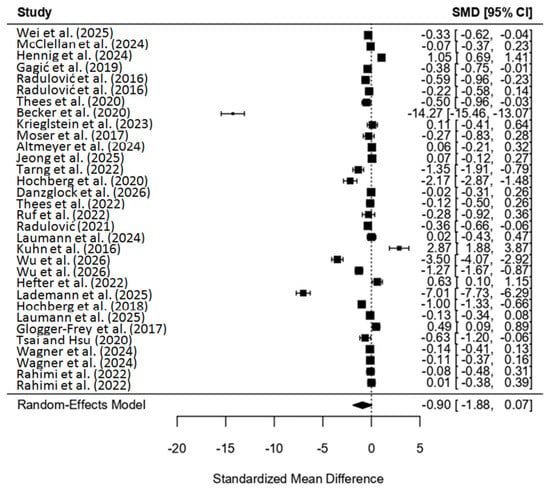
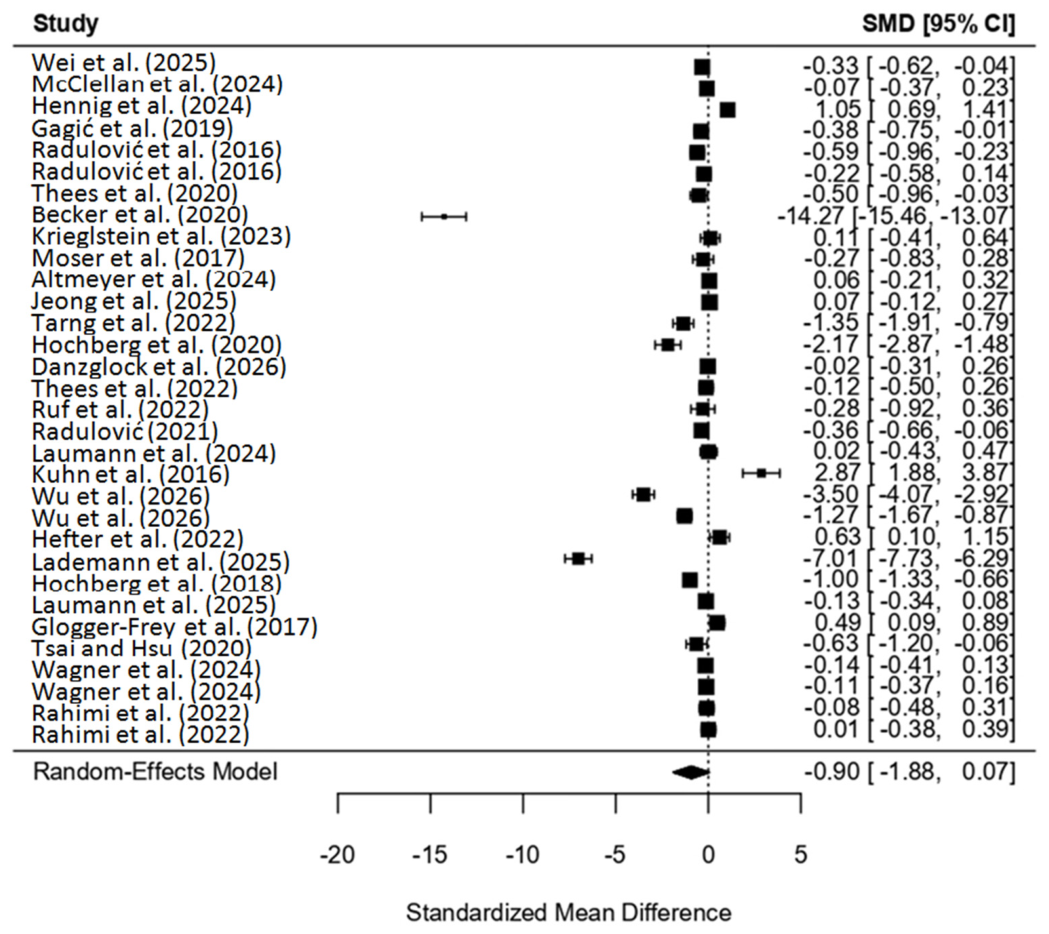
The model fit indicators (AIC = 156.85, BIC = 159.72) suggest stability of the data, and the overall estimated effect is negative and moderate in size (g = −0.90, SE = 0.50). However, the effect is not statistically significant (z = −1.82, p = 0.068, 95% Confidence Interval (CI) [−1.88, 0.07]). The obtained results show a very high heterogeneity between the outcomes of the studies (Q(31) = 1228.08, p < 0.001), which is caused by the differences between the teaching approaches and the studies rather than the normal statistical scattering of the measurements (I2 = 99.56%). The between-study variance estimate (τ2) was 7.81 (SE = 2.00), while τ was 2.80. The results are shown in Figure 2.
Figure 2.
Forest plot.
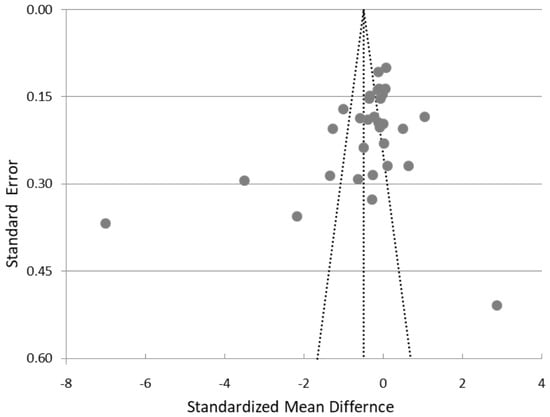
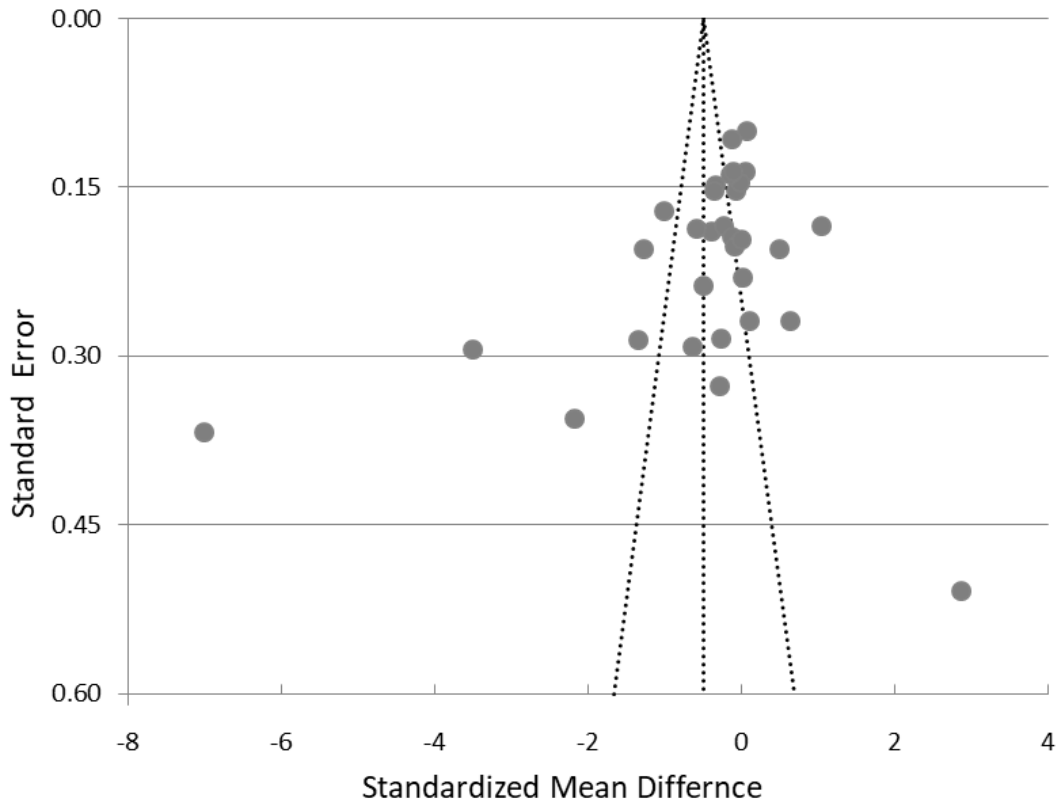
One study is identified as an outlier. The results of the study by Becker et al. (2020) deviate significantly from all other studies, so this study is omitted from here on. After removing that outlier, there was a change in the overall effect size from g = −0.90 to g = −0.49 (SE = 0.27); the model fit indicators (AIC = 108.58, BIC = 116.13) still show stability and also the preservation of the residual heterogeneity (Q(26) = 651.59, p < 0.0001; I2 = 98.44%; τ2 = 2.27, SE = 0.60). Test moderators do not show a statistically significant difference (Q(4) = 4.21, p > 0.05). The obtained result shows that the variability is structural and not only due to individual outliers. Significant funnel plot asymmetry is not statistically significant (z = −1.09, p > 0.05), as shown in Figure 3.
Figure 3.
Funnel plot indicating potential publication bias.
Table 5 shows the distribution of teaching approaches across the defined groups. As the Learning support group underpins all other approaches, it was selected as the reference category in a mixed-effects meta-regression.
Table 5.
Distribution of teaching approaches in groups.
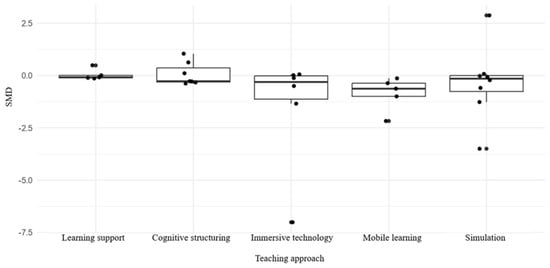
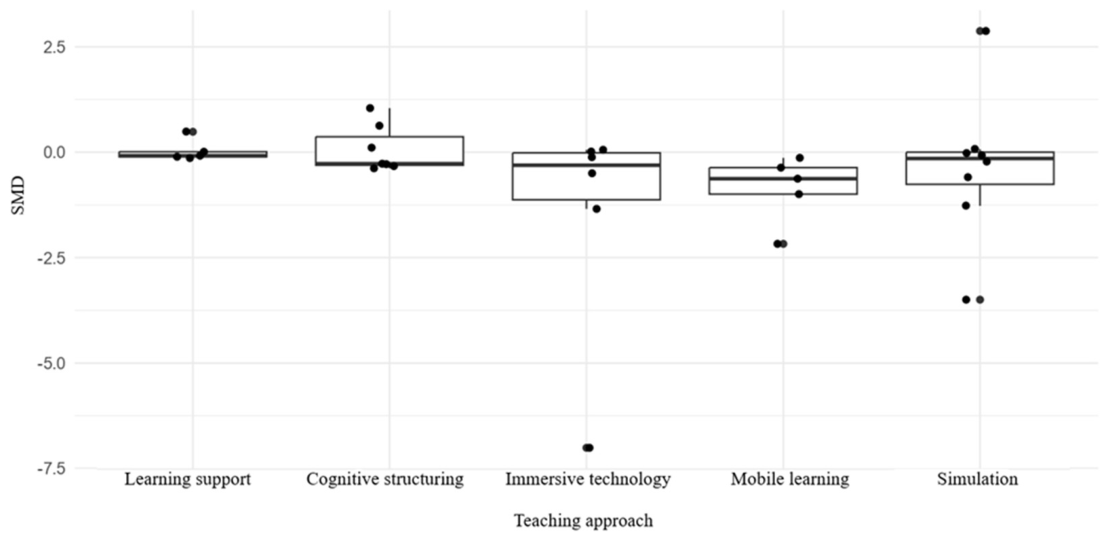
The results indicate that group formation did not significantly moderate effect sizes (QM(4) = 4.21, p > 0.05), as residual heterogeneity remained high (I2 = 98.44%). However, the meta-regression results show substantial differences in effectiveness between the defined groups (Table 6, Figure 4).
Table 6.
Meta-regression results by groups.
Figure 4.
Effect sizes by groups.
Sensitivity analyses (leave-one-out analyses) show that the overall effect size was stable, ranging from −0.28 to −0.59. No single study exerts a disproportionate influence on the results, and heterogeneity consistently remains consistently high across all iterations.
Summarizing the results, it was found that research was most often conducted in Europe, somewhat less often in Asia and America, while Africa and Australia were almost completely omitted. However, the studies showed high heterogeneity, even after removing outliers, which shows that this difference is due to the characteristics of the teaching approaches and research contexts themselves. In order to better understand the contribution of different teaching approaches to reducing cognitive load, the approaches are grouped according to their characteristics into separate units (mobile learning, simulations, cognitive structuring, immersive technologies and learning support). Meta-regression analysis showed that immersive technologies (AR, VR and AI tools) showed the greatest potential for reducing cognitive load, followed by mobile learning, while simulations had a somewhat weaker negative effect. Therefore, these findings suggest that modern teaching approaches can contribute to the reduction of cognitive load in physics teaching but that their effectiveness significantly depends on the way of implementation.
4. Discussion
4.1. Bibliographic and Methodological Characteristics of the Studies (RQ1)
The first research question focused on the bibliographic and methodological characteristics of studies examining cognitive load in physics teaching. The results indicate a growing interest in this topic throughout, especially after 2020, with peaks observed in 2022, 2024, and 2025. This trend indicates increased attention paid to instructional design, and cognitive load as a complex construct is increasingly recognized as an important indicator for assessing the effectiveness of teaching approaches and learning environments.
The geographical distribution of studies showed a greater presence of European research, while research in Asia and America was somewhat less represented and not at all in Africa and Australia. Although other review papers (Mutlu-Bayraktar et al., 2019) obtained a similar result, generalizations cannot be made. Therefore, obtained results should be viewed in the light of limitations; papers in English and journals indexed in WoS and Scopus were reviewed. Although these are the two most important databases, perhaps researchers from these continents favor some other bases or, due to the great differences in educational systems, focus on some other problems in teaching.
The included studies used a wide range of different teaching approaches. This diversity (which is more elaborated in RQ2) represents a good foundation but indicates the need for further research. Thus, in the future, attention should be paid not only to cognitive outcomes but also to contextual and educational factors, i.e., including holistic learning approach and factors that may influence learning processes.
4.2. Effects of Teaching Approaches on Reducing Cognitive Load (RQ2)
Following RQ1, the second research question examined which teaching approaches contribute most to reducing perceived cognitive load during physics learning. Although most studies achieved a reduction in cognitive load, extremely high heterogeneity was obtained, which remained even after removing outlier. In order to better understand the contribution, the approaches are divided into five groups, according to their characteristics. However, high heterogeneity remained present. This finding suggests that the variability within groups in teaching approaches is greater than the variability between groups. In other words, the effectiveness of a teaching approach seems to depend more on how it is applied than on which group it belongs to. This conclusion is important because discussions about educational innovation often focus on identifying the “best” approach to teaching. The current findings indicate that no student-centered group statistically significantly outperforms another in reducing cognitive load across all instructional contexts, but certain trends are noticeable. Immersive technology, mobile learning, and simulation showed a tendency toward greater reductions in perceived cognitive load. A possible explanation is that these approaches provide visual, dynamic, or interactive representations of abstract physical phenomena. Similarly, research on multimedia learning suggests that combining verbal and visual information can facilitate learning when instructional materials are designed according to evidence-based principles (Mayer, 2002). This can be linked to the cognitive load theory, according to which well-designed teaching materials can cause a reduction in primarily extraneous load (Sweller et al., 2011; Kalyuga, 2011). However, in addition to this basic theory, it is necessary to consider the social environment. As the respondents in this research are members of Generation Z and Alpha, who are deeply influenced by technology, it is understandable that researchers and producers of new technologies should create tools, content, and environments relevant to these populations. According to Hochberg et al. (2018), smartphones can be used as experimental tools, offering significant opportunities for science education through built-in sensors. These possibilities, together with students’ willingness to accept the mobile phone as a tool (Fiorella & Mayer, 2022), provide a wide range of opportunities for further development in physics didactics. Game-based learning, included in the same group, showed not only lower cognitive load but also higher educational efficiency, greater student involvement, and a higher level of scientific reasoning (Radulović, 2021). Based on this, a greater contribution to decreasing cognitive load can be inferred. On the other hand, Thees et al. (2020) and Tarng et al. (2022) advanced their pedagogical experiments by incorporating augmented and virtual reality. Thees et al. (2020) used augmented reality systems in a physics laboratory experiment, employing see-through smart glasses to provide real-time data for investigating heat conduction. Students measured the temperature along heated metal rods using a thermal imaging camera. Their results showed that the augmented reality condition did not lead to a learning gain in a conceptual knowledge test, but it significantly reduced extraneous cognitive load compared to the traditional condition. Tarng et al. (2022) used a virtual reality system to represent concepts of special relativity and mass–energy equivalence. In their study, students travelled in a spacecraft moving at nearly the speed of light to conduct space exploration and understand the concepts of special relativity and mass–energy equivalence. Virtual reality offers an effective solution for presenting specific teaching topics such as relativistic mechanics. Their results indicate that the virtual reality system provides an immersive and interactive environment for students, reducing cognitive load, particularly mental load, while simultaneously increasing students’ achievement. Thus, abstract concepts of special relativity and mass–energy equivalence were transformed into an engaging and observable space exploration mission (Tarng et al., 2022).
In the Simulations group, there is greater disparity in the data because it included a wider range of approaches than the other two groups, resulting in a smaller reduction in cognitive load compared to those previously described. While lab inquiry and computer simulations decreased cognitive load, smart glasses increased it.
Findings for Cognitive structuring and Learning support require special attention. These groups showed less tendency to reduce cognitive load, but this should not be interpreted as evidence that metacognitive or organizational approaches are less valuable. Such approaches can promote self-regulation, planning, monitoring, and deeper conceptual understanding, which, according to recent findings, goes beyond the scope of cognitive load theory (Sortwell et al., 2026). Thus, obtained results confirm the need to look not only at cognitive parameters but also at the broader context and include emotional, interpersonal, developmental, and self-regulatory dimensions of learning.
4.3. Limitations
This research has several limitations. Although the two most important databases for pedagogical research were used, only works published in English were considered. This language barrier represented one of the basic limitations because some different results may have been published in other languages. Additionally, the results showed high heterogeneity caused by differences in the studies themselves. Such heterogeneity is expected in educational research, where teaching approaches are implemented across diverse instructional contexts, student populations, and learning environments.
Funnel plots and sensitivity analyses were used to assess potential publication bias and robustness of findings, while for formal risk of bias assessment, RoB2 or ROBINS-I were used. However, the Grading of Recommendations, Assessment, Development, and Evaluations (GRADE) approach was not implemented. This represents a limitation of the present study. Also, in order to perform a meta-analysis, only studies with quantified data were considered, while qualitative studies were excluded from consideration. Therefore, the obtained results should be viewed in accordance with the limitations mentioned.
4.4. Pedagogical Implications and Future Direction
The results indicated several important pedagogical implications. First, the result showing that no statistically significant difference was obtained between teaching approaches (along with high heterogeneity) indicates that the reduction of perceived cognitive load during learning depends more on the teacher’s training to apply a method than on the technology itself. Therefore, training programs for (future) teachers should focus not only on technological competencies but also on the principles of instructional design derived from Cognitive Load Theory, especially with new data from the Neurodevelopmental Informed Holistic Learning and Development Framework (NIHLDF) written by Sortwell et al. (2026). Second, three groups of teaching approaches were distinguished that showed a tendency to a greater reduction of the perceived cognitive load. This indicates the student’s need to visualize physical phenomena and processes, which can be understood as a student’s suggestion to present complex problems and concepts through these approaches. That is, during the training of (future) teachers, the importance of the Cognitive Load Theory and NIHLDF, as well as the factors it encompasses, should be emphasized. Therefore, future research should include as many factors as possible that are related to cognitive load in order to obtain as complete information as possible about the effects of certain teaching approaches. Also, future research should take into account the structure of educational programs and curricula to compare them at the international level in order to give guidelines to policymakers. These would also be directions for the development of physics teaching methodology, which should be directed towards the discovery of new factors, with simultaneously much greater and systematically organized support for teachers and better preparation of future teachers for school work.
5. Conclusions
This study systematically reviewed and meta-analytically examined the contribution of student-centered teaching approaches to reducing perceived cognitive load in physics education. The included studies showed an increasing interest of researchers in cognitive load, especially after 2020. Geographic distribution showed a significant presence of studies from Europe, followed by Asia and America, while Africa and Australia were not represented.
In terms of methodology, the included studies applied different teaching approaches. The meta-analysis showed high heterogeneity and that there are no statistically significant deviations between the teaching approaches, even between the formed groups. Therefore, the most important conclusion of this study is not that one group of teaching approach is superior to another but that the variation within groups is greater than the variation between categories. This finding suggests that the effectiveness of an instructional approach in reducing cognitive load depends largely on the way it is implemented, rather than on the teaching approach itself. Although certain tendencies were obtained in favor of approaches that show a physical phenomenon or process in a more direct way, there is no statistical significance. Simple use of some technical and technological innovations does not necessarily lead to improved student performance.
For this reason, future empirical research should, in addition to cognitive, also include emotional, social, and self-regulatory learning processes, i.e., take a more complex look at student characteristics, as well as teacher training, classroom conditions, and available resources. Such studies can provide a more comprehensive explanation of the variability observed in different teaching approaches and contribute to the development of more effective physics teaching practices.
Author Contributions
Conceptualization, B.R., J.Ž.R., and J.B.; methodology, B.R., J.Ž.R., and J.B.; formal analysis, B.R.; investigation, B.R.; writing—original draft preparation, B.R., J.Ž.R., and J.B.; writing—review and editing, B.R., J.B.; visualization, J.B. All authors have read and agreed to the published version of the manuscript.
Funding
This research was funded by Ministry of Science, Technological Development and Innovation of the Republic of Serbia grant number 451-03-33/2026-03/200125 & 451-03-34/2026-03/200125.
Institutional Review Board Statement
Not applicable.
Informed Consent Statement
Not applicable.
Data Availability Statement
We used WoS and Scopus database.
Conflicts of Interest
The authors declare no conflicts of interest.
Appendix A
| Database | Variant | Search String |
| Web of Science (WoS) | Advanced search | “cognitive load and physics” (Topic) or “mental effort and physics” (Topic) or “cognitive load and teaching physics” (Topic) or “mental effort and teaching physics” (Topic); Refined By: Publication Years: 2016 or 2017 or 2018 or 2019 or 2020 or 2021 or 2022 or 2023 or 2024 or 2025 or 2026; Document Types: Article; Languages: English |
| Scopus | Advanced search | TITLE-ABS-KEY (cognitive load) OR TITLE-ABS-KEY (mental effort) AND TITLE-ABS-KEY (physics) AND (LIMT-TO (DOCTYPE, “ar”)) AND (LIMIT-TO (LANGUAGE, “English”)) AND PUBYEAR > 2015 |
Appendix B
| Author(s) (Year) | Tool | Bias Arising from Randomization Process | Bias Due to Deviations from Intended Interventions | Bias Due to Missing Outcome Data | Bias in Measurement of Outcome | Bias in Selection of Reported Result | Overall Risk of Bias |
| Wei (2025) | RoB 2 | low | low | low | some concerns | some concerns | some concerns |
| Hennig et al. (2024) | RoB 2 | low | low | low | low | some concerns | some concerns |
| Thees et al. (2020) | RoB 2 | low | low | low | low | some concerns | some concerns |
| Becker et al. (2020) | RoB 2 | low | some concerns | some concerns | low | some concerns | some concerns |
| Krieglstein et al. (2023) | RoB 2 | low | some concerns | low | some concerns | some concerns | some concerns |
| Jeong et al. (2025) | RoB 2 | some concerns | no information | low | low | some concerns | some concerns |
| Danzglock et al. (2026) | RoB 2 | low | some concerns | low | low | some concerns | some concerns |
| Thees et al. (2022) | RoB 2 | low | low | low | some concerns | low | some concerns |
| Laumann et al. (2024) | RoB 2 | low | low | low | low | low | low |
| Kuhn et al. (2016) | RoB 2 | low | low | low | low | some concerns | some concerns |
| Wu et al. (2026) | RoB 2 | low | low | low | low | low | low |
| Hefter et al. (2022) | RoB 2 | low | some concerns | low | low | low | some concerns |
| Lademann et al. (2025) | RoB 2 | low | low | low | low | low | low |
| Hochberg et al. (2018) | |||||||
| Laumann et al. (2025) | RoB 2 | some concerns | low | low | low | low | some concerns |
| Glogger-Frey et al. (2017) | |||||||
| Tsai and Hsu (2020) | RoB 2 | low | low | low | low | low | low |
| Wagner et al. (2024) | |||||||
| Rahimi et al. (2022) |
| Year | Tool | Bias Due to Cofounding | Bias in Classification of Interventions | Bias in Selection of Participants into the Study | Bias Due to Deviations from Intended Interventions | Bias Due to Missing Data | Bias in Measurement of the Outcome | Bias in Selection of the Reported Result | Overall Risk of Bias |
| McClellan et al. (2024) | ROBINS-I | ||||||||
| Gagić et al. (2019) | ROBINS-I | ||||||||
| Radulović et al. (2016) | ROBINS-I | moderate | low | low | low | low | moderate | moderate | moderate |
| Moser et al. (2017) | |||||||||
| Altmeyer et al. (2024) | ROBINS-I | moderate | moderate | moderate | moderate | moderate | moderate | moderate | moderate |
| Tarng et al. (2022) | ROBINS-I | moderate | moderate | low | low | low | moderate | moderate | moderate |
| Hochberg et al. (2020) | ROBINS-I | moderate | moderate | moderate | moderate | low | moderate | moderate | moderate |
| Ruf et al. (2022) | ROBINS-I | low | low | low | low | low | low | low | low |
| Radulović (2021) | ROBINS-I | low | low | low | low | low | low | low | low |
| Hochberg et al. (2018) | |||||||||
| Glogger-Frey et al. (2017) | |||||||||
| Wagner et al. (2024) | |||||||||
| Rahimi et al. (2022) |
References
- Albus, P., & Seufert, T. (2023). The modality effect reverses in a virtual reality learning environment and influences cognitive load. Instructional Science, 51(4), 545–570. [Google Scholar] [CrossRef] [Scilit]
- Altmeyer, K., Brünken, R., Kuhn, J., & Malone, S. (2024). The role of cognitive learner prerequisites for cognitive load and learning outcomes in AR-supported lab work. Education Sciences, 14(11), 1161. [Google Scholar] [CrossRef] [Scilit]
- Angell, C., Guttersrud, Ø., Henriksen, E. K., & Isnes, A. (2004). Physics: Frightful, but fun. Pupils’ and teachers’ views of physics and physics teaching. Science Education, 88(5), 683–706. [Google Scholar] [CrossRef] [Scilit]
- Becker, S., Klein, P., Gößling, A., & Kuhn, J. (2020). Using mobile devices to enhance inquiry-based learning processes. Learning and Instruction, 69, 101350. [Google Scholar] [CrossRef] [Scilit]
- Danzglock, M., Berger, R., & Hänze, M. (2026). Interleaved practice in physics benefits from collaboration. Learning and Instruction, 102, 102307. [Google Scholar] [CrossRef] [Scilit]
- de Jong, T. (2010). Cognitive load theory, educational research, and instructional design: Some food for thought. Instructional Science, 38(2), 105–134. [Google Scholar] [CrossRef] [Scilit]
- Fiorella, L., & Mayer, R. E. (2022). The generative activity principle in multimedia learning. In R. E. Mayer, & L. Fiorella (Eds.), The Cambridge handbook of multimedia learning (pp. 339–350). Cambridge University Press. [Google Scholar]
- Gagić, Z. Z., Skuban, S. J., Radulović, B., Stojanović, M. M., & Gajić, O. (2019). The implementation of mind maps in teaching physics: Educational efficiency and students’ involvement. Journal of Baltic Science Education, 18(1), 117–131. [Google Scholar] [CrossRef] [Scilit]
- Glogger-Frey, I., Gaus, K., & Renkl, A. (2017). Learning from direct instruction: Best prepared by several self-regulated or guided invention activities? Learning and Instruction, 51, 26–35. [Google Scholar] [CrossRef] [Scilit]
- Hefter, M. H., Fromme, B., & Berthold, K. (2022). Digital training intervention on strategies for tackling physical misconceptions—Self-explanation matters. Applied Cognitive Psychology, 36(3), 648–658. [Google Scholar] [CrossRef] [Scilit]
- Hennig, F., Tóth, K., Veith, J., & Bitzenbauer, P. (2024). Mathematical sense making of quantum phenomena using Dirac notation: Its effect on secondary school students’ functional thinking about photons. EPJ Quantum Technology, 11(1), 61. [Google Scholar] [CrossRef] [Scilit]
- Higgins, J. P. T., Savović, J., Page, M. J., & Sterne, J. A. C. (2019). Revised Cochrane risk-of-bias tool for randomized trials (RoB 2). Available online: https://sites.google.com/site/riskofbiastool/welcome/rob-2-0-tool (accessed on 8 July 2026).
- Hochberg, K., Becker, S., Louis, M., Klein, P., & Kuhn, J. (2020). Using smartphones as experimental tools—A follow-up: Cognitive effects by video analysis and reduction of cognitive load by multiple representations. Journal of Science Education and Technology, 29, 303–317. [Google Scholar] [CrossRef] [Scilit]
- Hochberg, K., Kuhn, J., & Müller, A. (2018). Using smartphones as experimental tools—Effects on interest, curiosity, and learning in physics education. Journal of Science Education and Technology, 27(5), 385–403. [Google Scholar] [CrossRef] [Scilit]
- Hong, W., Li, T., Wang, L., Dai, R., Bao, L., Yu, K., & Xiao, Y. (2025). Overcoming the more measurements, the better intuitive heuristic in physics data evaluation: The role of inhibitory control. Physical Review Physics Education Research, 21(2), 020159. [Google Scholar] [CrossRef] [Scilit]
- Jeong, S., Rague, J., Litson, K., Feldon, D. F., Lawler, M. J., & Plummer, K. (2025). Effects of decision-based learning on student performance in introductory physics: The mediating roles of cognitive load and self-testing. Education and Information Technologies, 30(4), 4413–4433. [Google Scholar] [CrossRef] [Scilit]
- Kalyuga, S. (2011). Cognitive load theory: How many types of load does it really need? Educational Psychology Review, 23, 1–19. [Google Scholar] [CrossRef] [Scilit]
- Krieglstein, F., Meusel, F., Rothenstein, E., Scheller, N., Wesenberg, L., & Rey, G. D. (2023). How to insert visual information into a whiteboard animation with a human hand? Effects of different insertion styles on learning. Smart Learning Environments, 10(1), 39. [Google Scholar] [CrossRef] [Scilit]
- Kuhn, J., Lukowicz, P., Hirth, M., Poxrucker, A., Weppner, J., & Younas, J. (2016). gPhysics—Using smart glasses for head-centered, context-aware learning in physics experiments. IEEE Transactions on Learning Technologies, 9(4), 304–317. [Google Scholar] [CrossRef] [Scilit]
- Kurbanoglu, N. I., & Takunyaci, M. (2017). Development and evaluation of an instrument measuring anxiety toward physics laboratory classes among university students. Journal of Baltic Science Education, 16(4), 592–598. [Google Scholar] [CrossRef] [Scilit]
- Lademann, J., Henze, J., & Becker-Genschow, S. (2025). Augmenting learning environments using AI custom chatbots: Effects on learning performance, cognitive load, and affective variables. Physical Review Physics Education Research, 21(1), 010147. [Google Scholar] [CrossRef] [Scilit]
- Laumann, D., Krause, M., Kremer, F. E., Leibrock, B., Ubben, M. S., Forthmann, B., Janzik, R., Masemann, D., Reer, F., Denz, C., Greefrath, G., Heinicke, S., Marohn, A., Quandt, T., Souvignier, E., & Heusler, S. (2025). Mobile learning in the classroom—Should students bring mobile devices for learning, or should these be provided by schools? Education and Information Technologies, 30(7), 9463–9496. [Google Scholar] [CrossRef] [Scilit]
- Laumann, D., Schlummer, P., Abazi, A., Borkamp, R., Lauströer, J., Pernice, W., Schuck, C., Schulz-Schaeffer, R., & Heusler, S. (2024). Analyzing the effective use of augmented reality glasses in university physics laboratory courses for the example topic of optical polarization. Journal of Science Education and Technology, 33(5), 668–685. [Google Scholar] [CrossRef] [Scilit]
- Maričić, M., Anđić, B., Soeharto, S., Mumcu, F., Cvjetićanin, S., & Lavicza, Z. (2025). The exploration of continuous teaching intention in emerging-technology environments through perceived cognitive load, usability, and teacher’s attitudes. Education and Information Technologies, 30(7), 9341–9370. [Google Scholar] [CrossRef] [Scilit]
- Mayer, R. E. (2002). Multimedia learning. In Psychology of learning and motivation (Vol. 41, pp. 85–139). Academic Press. [Google Scholar] [CrossRef] [Scilit]
- McClellan, D., Chastain, R. J., & DeCaro, M. S. (2024). Enhancing learning from online video lectures: The impact of embedded learning prompts in an undergraduate physics lesson. Journal of Computing in Higher Education, 36(3), 852–874. [Google Scholar] [CrossRef] [Scilit]
- Miller, G. A. (1956). The magical number seven, plus or minus two: Some limits on our capacity for processing information. Psychological Review, 63(2), 81–97. [Google Scholar] [CrossRef] [Scilit]
- Moser, S., Zumbach, J., & Deibl, I. (2017). The effect of metacognitive training and prompting on learning success in simulation-based physics learning. Science Education, 101(6), 944–967. [Google Scholar] [CrossRef] [Scilit]
- Mutlu-Bayraktar, D., Cosgun, V., & Altan, T. (2019). Cognitive load in multimedia learning environments: A systematic review. Computers & Education, 141, 103618. [Google Scholar] [CrossRef] [Scilit]
- Nixon, R. S., Godfrey, T. J., Mayhew, N. T., & Wiegert, C. C. (2016). Undergraduate student construction and interpretation of graphs in physics lab activities. Physical Review Physics Education Research, 12(1), 010104. [Google Scholar] [CrossRef] [Scilit]
- Plass, J. L., Moreno, R., & Brünken, R. (2010). Cognitive load theory. Cambridge University Press. [Google Scholar]
- Radulović, B. (2015). Cognitive load of the second grade physics students at high school [Ph.D. thesis, Faculty of Sciences, University of Novi Sad]. [Google Scholar]
- Radulović, B. (2021). Educational efficiency and students’ involvement of teaching approach based on game-based student response system. Journal of Baltic Science Education, 20(3), 495–506. [Google Scholar] [CrossRef] [Scilit]
- Radulović, B., Stojanović, M., & Županec, V. (2016). The effects of laboratory inquire-based experiments and computer simulations on high school students ‘performance and cognitive load in physics teaching. Zbornik Instituta za Pedagoska Istrazivanja, 48(2), 264–283. [Google Scholar] [CrossRef] [Scilit]
- Radulović, B., Zajkov, O., Gegovska-Zajkova, S., Stojanović, M., & Sliško, J. (2022). A cross-country comparison of students’ graphs understanding and perceived mental effort. Mathematics, 10(14), 2428. [Google Scholar] [CrossRef] [Scilit]
- Rahimi, S., Shute, V. J., Fulwider, C., Bainbridge, K., Kuba, R., Yang, X., Smith, G., Baker, R., & D’Mello, S. K. (2022). Timing of learning supports in educational games can impact students’ outcomes. Computers & Education, 190, 104600. [Google Scholar] [CrossRef] [Scilit]
- Ruf, V., Küchemann, S., Kuhn, J., & Klein, P. (2022). Comparison of written and spoken instruction to foster coordination between diagram and equation in undergraduate physics education. Human Behavior and Emerging Technologies, 2022(1), 5860936. [Google Scholar] [CrossRef] [Scilit]
- Shi, W. Z., Ma, L., & Wang, J. (2020). Effects of inquiry-based teaching on Chinese university students’ epistemologies about experimental physics and learning performance. Journal of Baltic Science Education, 19(2), 289–297. [Google Scholar] [CrossRef] [Scilit]
- Sortwell, A., Gkintoni, E., Díaz-García, J., Ellerton, P., Ferraz, R., & Hine, G. (2026). Beyond cognitive load theory: Why learning needs more than memory management. Brain Sciences, 16(1), 109. [Google Scholar] [CrossRef] [Scilit] [PubMed]
- Sterne, J., Brandt Mathur, M., Elbers, R., Hróbjartsson, A., McAleenan, A., Reeves, B., Shrier, I., Tilling, K., Armstrong, R., Berkman, N., Boutron, I., Carpenter, J., Chan, A.-W., Deeks, J., Golder, S., Henry, D., Jüni, P., Kirkham, J., Konstantinidis, M., … Higgins, J. (2025). The risk of bias in non-randomized studies—Of interventions, version 2 (ROBINS-I V2) assessment tool. Available online: https://sites.google.com/site/riskofbiastool/welcome/robins-i-v2?authuser=0 (accessed on 8 July 2026).
- Sweller, J., Ayres, P., & Kalyuga, S. (2011). Cognitive load theory. Springer. [Google Scholar]
- Tarng, W., Liao, Y. C., & Ou, K. L. (2022). Application of virtual reality in learning the concepts of special relativity and mass–energy equivalence. Universe, 8(12), 618. [Google Scholar] [CrossRef] [Scilit]
- Thees, M., Altmeyer, K., Kapp, S., Rexigel, E., Beil, F., Klein, P., Malone, A., Brünken, R., & Kuhn, J. (2022). Augmented reality for presenting real-time data during students’ laboratory work: Comparing a head-mounted display with a separate display. Frontiers in Psychology, 13, 804742. [Google Scholar] [CrossRef] [Scilit] [PubMed]
- Thees, M., Kapp, S., Strzys, M. P., Beil, F., Lukowicz, P., & Kuhn, J. (2020). Effects of augmented reality on learning and cognitive load in university physics laboratory courses. Computers in Human Behavior, 108, 106316. [Google Scholar] [CrossRef] [Scilit]
- Tsai, F. H., & Hsu, I. (2020). Exploring the effects of guidance in a computer detective game for science education. Journal of Baltic Science Education, 19(4), 647–658. [Google Scholar] [CrossRef] [Scilit]
- Van Merrienboer, J. J., & Sweller, J. (2005). Cognitive load theory and complex learning: Recent developments and future directions. Educational Psychology Review, 17(2), 147–177. [Google Scholar] [CrossRef] [Scilit]
- Wagner, S., Sibley, L., Weiler, D., Burde, J. P., Scheiter, K., & Lachner, A. (2024). The more, the better? Learning with feedback and instruction. Learning and Instruction, 89, 101844. [Google Scholar] [CrossRef] [Scilit]
- Weber, J., & Wilhelm, T. (2024). Contributing factors to the improvement of conceptual understanding in a computer-based intervention in Newtonian dynamics. Physical Review Physics Education Research, 20(2), 020130. [Google Scholar] [CrossRef] [Scilit]
- Wei, Y. (2025). Written instruction that significantly promotes science learning. Physical Review Physics Education Research, 21(2), 020141. [Google Scholar] [CrossRef] [Scilit]
- Wu, X., Wu, X., Hu, W., & Sun, J. (2026). The impact of 3D interactive prompts on college students’ learning outcomes in desktop virtual learning environments: A study based on eye-tracking experiments. Journal of Eye Movement Research, 19(1), 19. [Google Scholar] [CrossRef] [Scilit] [PubMed]
- Županec, V., Radulović, B., & Lazarević, T. (2022). Instructional efficiency of STEM approach in biology teaching in primary school in Serbia. Sustainability, 14(24), 16416. [Google Scholar] [CrossRef] [Scilit]

Disclaimer/Publisher’s Note: The statements, opinions and data contained in all publications are solely those of the individual author(s) and contributor(s) and not of MDPI and/or the editor(s). MDPI and/or the editor(s) disclaim responsibility for any injury to people or property resulting from any ideas, methods, instructions or products referred to in the content. |
© 2026 by the authors. Licensee MDPI, Basel, Switzerland. This article is an open access article distributed under the terms and conditions of the Creative Commons Attribution (CC BY) license.