


Abstract
Team-based learning (TBL) is increasingly being implemented in health sciences education to promote active learning and higher-order cognitive skills. However, the long-term effects of TBL on student performance and perceptions remain unclear. This study evaluated the impact of TBL on veterinary anatomy practical sessions over four academic years (2022/2023–2025/2026) using a longitudinal, mixed-methods design. Quantitative measures included performance across TBL components such as individual and team readiness tests, application exercises, formative assessments, and final scores. Cognitive level analysis was based on Bloom’s taxonomy. Student perceptions were collected through Likert-scale surveys, and qualitative responses were analyzed thematically. The results showed consistently low individual readiness scores, indicating persistent challenges in pre-class preparation. However, team performance improved over time, highlighting the benefits of collaborative learning. Application exercise scores and overall performance increased over time, with notable improvements in higher-order cognitive skills compared to a traditional cohort. Students’ perceptions evolved from initial resistance and perceived difficulty to more positive evaluations, with significant reductions in negative comparisons and metacognitive miscalibration, as well as increased positive perceptions. Overall, TBL supported progressive improvements in academic performance and cognitive development. Collaboration mitigated limitations in individual preparation, and student adaptation enhanced the effectiveness of this pedagogical approach in veterinary education.
1. Introduction
Anatomy is a fundamental discipline in medical and veterinary education. It provides the basis for understanding the structure and organization of living organisms. Traditionally, anatomy has been taught through lecture-based methods that emphasize knowledge transmission and memorization (Youssef, 2021). However, this approach has been widely criticized for promoting surface-level learning rather than deep conceptual understanding. This approach may leave students insufficiently prepared for the demands of clinical practice (Saverino, 2020). Additionally, relying solely on lectures can hinder the development of essential higher-order cognitive skills, such as critical thinking, problem-solving, and applying knowledge in clinical contexts, which are crucial for clinical competence (Jha et al., 2024; Singh et al., 2019; Martín-Alguacil et al., 2025b). While this model gives students a sense of structure and control, it impedes the development of higher-order cognitive skills (Mishra et al., 2023; Jha et al., 2024). Recently, active learning approaches have become more relevant, particularly Team-Based Learning (TBL). TBL is a well-established instructional strategy that has been validated in medical, nursing, dental, and veterinary anatomy (N. S. Vasan et al., 2011; Martín-Alguacil et al., 2021a; Al-Neklawy & Ismail, 2022; Hashmi, 2014; Sterpu et al., 2024).
TBL is based on four principles: pre-class preparation, individual readiness assessment (IRA), team-based assessment (TBA), and applying knowledge (AK) through problem solving. With this methodology, the initial acquisition of core content occurs outside the classroom. This allows class time to be dedicated to deeper cognitive engagement, collaboration, and the practical application of knowledge. TBL is an active, collaborative instructional methodology in which students acquire knowledge through a combination of individual preparation and structured group work. Developed by Michaelsen in 1979 to address large class sizes, TBL has since been adopted by institutions and disciplines worldwide, demonstrating its effectiveness in enhancing student engagement and learning outcomes (Michaelsen et al., 2007; Sweet & Michaelsen, 2012). This instructional approach is characterized by a systematic, sequenced structure that allows one or more instructors to manage multiple teams simultaneously, fostering individual accountability and collective problem-solving. At its core, TBL promotes deep learning by requiring students not only to understand theoretical concepts but also to apply them to real-world problems. This dual focus encourages learners to think critically, both independently and collaboratively, and to take responsibility for their own learning process. The instructor’s role shifts from being the primary source of information to acting as a facilitator who guides discussion and supports reasoning. This transition is key to moving students from a passive to an active learning mindset and is essential for the success of the methodology (Martín-Alguacil et al., 2021b). According to Michaelsen and Sweet (2008), successful TBL implementation depends on maintaining its fundamental methodological pillars. These include: (1) careful team formation and management to ensure balanced, stable groups, (2) strong student accountability for pre-class preparation, (3) using class time to apply concepts to solve meaningful problems, and (4) an evaluation system that combines individual and group performance. These elements are widely considered critical because the effectiveness of TBL relies on the integration of all its components rather than isolated activities.
For TBL to be successful, several “musts” must be consistently met. First, students must arrive prepared because the methodology depends on prior individual study to facilitate meaningful group interaction. Teams must be carefully designed and remain stable over time in order to build trust and foster effective collaboration. Instructors must fully understand and commit to the methodology, embracing their facilitative role and designing appropriate materials and activities (Martín-Alguacil et al., 2021b). Additionally, assessments must align with learning objectives and include both individual and team components to reinforce accountability. Finally, activities must be relevant and application-oriented because the true value of TBL lies in engaging students in reasoning, discussion, and problem-solving, rather than passive content reception. When these conditions are met, TBL creates a dynamic learning environment in which students actively construct knowledge, develop critical thinking skills, and learn to collaborate effectively—outcomes that are essential for academic and professional success.
Active learning approaches, including flipped TBL, are being used more frequently in health sciences education to promote a deeper understanding of, engagement with, and application of knowledge. In anatomy education, where spatial reasoning and the integration of complex information are essential, TBL has been associated with improved collaborative learning and enhanced application skills (N. Vasan et al., 2008; N. S. Vasan et al., 2011; Martín-Alguacil et al., 2021a). However, the effectiveness of TBL with early-stage learners is uncertain. First-year students often lack experience with self-directed learning and may not have developed the metacognitive skills necessary for evaluating their own understanding. This limitation is particularly relevant when comparing active learning environments with traditional, lecture-based instruction.
In health sciences education, flipped and active learning can improve performance (Martín-Alguacil et al., 2025a). Metacognition, the ability to think about one’s own thinking, is a key underlying skill that requires explicit support. Metacognition, or thinking about one’s own thinking, is a foundation of self-regulated, lifelong learning and is emphasized more and more in health professions curricula (Medina et al., 2017; Cale et al., 2022). Flipped and other active learning models aim to engage these skills; however, their impact depends on design and learner support (Medina et al., 2017). Metacognition involves planning, monitoring, and evaluating one’s learning. It supports critical thinking and self-directed learning in pharmacy, medical, and nursing education (Medina et al., 2017). Students often exhibit inconsistent metacognitive abilities, relying on superficial cues rather than deep understanding. This suggests the need for explicit metacognitive teaching and assessment (Versteeg et al., 2021). Higher metacognitive awareness is associated with a more adaptive, mastery-oriented motivation to learn among medical students (Siqueira et al., 2020).
Traditional teaching can create an illusion of competence by making explanations clear and fluent (Carpenter et al., 2013, 2020a). Students may perceive that they understand the material without engaging in deep cognitive processing (Carpenter et al., 2020b). In contrast, TBL requires active retrieval, discussion, and reasoning. This approach exposes students to gaps in their understanding and generates metacognitive uncertainty. This shift may lead to a discrepancy between perceived and actual learning, especially among novice learners (De Bruin et al., 2023). Students may feel less confident in active learning environments while simultaneously developing stronger cognitive skills (Deslauriers et al., 2019).
This study evaluated TBL practical sessions in a first-year veterinary anatomy course over the course of four academic years using a longitudinal, mixed-methods approach. Specifically, the study investigated the relationship between perceived learning and demonstrated competence, as well as whether TBL induces a shift from the illusion of competence to productive uncertainty. The study also examined the role of metacognition in discrepancies between perception and actual performance.
2. Materials and Methods
This study used a longitudinal, mixed-methods design to examine the implementation and impact of TBL in anatomy labs over four consecutive academic years (2022–2023 to 2025–2026). Integrating quantitative and qualitative data allowed the study to capture measurable learning outcomes and the evolution of student perceptions, providing a comprehensive analysis of the pedagogical process over time.
The participants were undergraduate veterinary students enrolled in practical anatomy sessions at a single institution. Cohort sizes ranged from 157 to 164 students, depending on the academic year. All participants followed the regular curriculum, which fully integrated TBL, ensuring ecological validity. The intervention was progressively refined across cohorts, incorporating core TBL components, such as pre-class preparation, readiness assurance testing, and application exercises. In later years, additional elements, including formative assessment and flipped classroom resources, were introduced to support continuous learning.
The TBL methodology was implemented through a structured sequence designed to promote active engagement and the progressive construction of knowledge. Prior to each session, students completed preparatory work that was assessed through the Individual Readiness Assurance Test (IRAT). This was followed by the Team Readiness Assurance Test (TRAT), in which students collaborated to develop consensus-based responses. Then, sessions progressed to application exercises focused on clinical reasoning and problem-solving in anatomical contexts. Later cohorts incorporated formative assessment activities and audiovisual materials to reinforce learning within a flipped classroom framework.
Quantitative data were collected to evaluate student performance across the different components of the TBL process, including individual preparation (IRAT), team performance (TRAT), application exercises, formative assessments, and final overall scores. The data were analyzed longitudinally to identify trends across academic years. To better characterize levels of individual preparation, IRAT scores were categorized into predefined intervals (below 3.00, 3.00–4.99, 5.00–6.99, and 7.00 and above). This enabled a more detailed interpretation of student readiness across cohorts. Following the IRAT and TRAT phases, students completed application exercises collaboratively within their teams, discussing and applying concepts to solve anatomy-related problems in accordance with the Team-Based Learning framework.
Learning outcomes were also examined from a cognitive perspective using Bloom’s Taxonomy. Assessment items were classified into four levels ranging from basic knowledge acquisition to higher-order cognitive processes, such as application, analysis, and evaluation (Martín-Alguacil & Avedillo, 2024). For comparison purposes, data from a pre-intervention cohort (2015/2016) that was taught using traditional methods were included. To ensure comparability, the assessment items were identical or equivalent across cohorts.
Student perceptions were collected through structured surveys administered via Wooclap and the virtual campus at the end of each academic year. The surveys used Likert scale items to evaluate motivation, the perceived usefulness of teaching components, experience with group work, confidence in reasoning, and acceptance of TBL and flipped classroom approaches. Responses were analyzed descriptively using percentage distributions. The survey instrument is provided in Appendix A.
Qualitative data were obtained from open-ended survey responses and analyzed using an inductive thematic approach. Recurring themes were identified through coding and grouped into five categories: perceived difficulty; comparison with traditional teaching methods; metacognitive miscalibration; contextual and applied understanding; and positive perception. The prevalence of each category was quantified across cohorts to enable longitudinal comparisons and integration with the quantitative findings. Coding categories and representative examples are provided in Appendix B.
Statistical analysis combined descriptive and inferential approaches. Continuous variables (e.g., IRAT, TRAT, application exercises, and final scores) are reported as means, and categorical variables (e.g., survey responses and qualitative coding frequencies) are presented as frequencies and percentages. Likert-scale responses were grouped into three levels (low: 1–2, moderate: 3, and high: 4–5) to facilitate interpretation.
To estimate variability in categorical proportions derived from qualitative coding, 95% confidence intervals (CIs) were calculated using a binomial approximation (CI = p ± 1.96 × √[p(1 − p)/n]), where p represents the proportion of comments assigned to a given category, and n represents the total number of comments analyzed within each cohort. Because individual comments could be assigned multiple codes, independence assumptions were not strictly met. Therefore, CIs were interpreted as descriptive rather than inferential indicators. Intervals that overlapped were considered indicative of stability, while non-overlapping intervals suggested meaningful differences.
We conducted comparisons between academic years using the chi-square (χ2) test of independence for categorical variables. Pairwise comparisons of proportions were performed using Z-tests with Bonferroni correction to control for multiple testing. Longitudinal trends across cohorts were assessed using the chi-square test for trend (Cochran-Armitage test) to identify directional changes over time. Statistical significance was set at p < 0.05. Analyses were conducted using IBM SPSS Statistics Version 29.0 (IBM Corp., Armonk, NY, USA).
Finally, quantitative and qualitative findings were integrated through triangulation. This approach revealed a longitudinal trajectory characterized by an initial adjustment phase, a subsequent resistance phase, and a final adaptation and consolidation phase of the TBL methodology compared to traditional teaching. This integrative perspective provided a comprehensive understanding of how learning outcomes and student perceptions evolved throughout the implementation process.
3. Results
3.1. Student Preparation and Performance in TBL Components
An analysis of learning outcomes across four academic years revealed a consistent pattern that highlights the interaction between individual preparation, collaborative learning, and knowledge application within the TBL framework.
Table 1 presents mean scores across assessment components. Individual preparation, as measured by the IRAT, remained relatively stable across cohorts (range: 4.69–5.38), indicating moderate pre-class readiness levels. In contrast, TRAT scores were consistently higher, showing a progressive increase over time and reaching their highest value in 2025/2026 (7.33). This pattern underscores the positive effect of collaborative learning on student performance.
Table 1.
Mean scores across TBL components.
Application Exercises (AEs), which assess knowledge application in practical contexts, showed an obvious upward trend, with scores rising from 6.77 in 2022/2023 to 7.78 in 2025/2026. Formative assessment (FA), introduced in later cohorts, yielded high mean values (7.92 and 8.26), suggesting strong engagement with continuous assessment. Similarly, the final score (FS), which reflects overall performance, increased gradually across cohorts, from 6.14 to 6.75, indicating a positive longitudinal effect of TBL on academic achievement.
Despite these improvements, a significant number of students did not pass the IRAT, suggesting that they are still struggling with pre-class preparation (Table 2).
Table 2.
Distribution of IRAT scores by grade intervals in practical sessions across the academic years 2022/2023, 2023/2024, 2024/2025, and 2025/2026.
Consistently high failure rates (46–55%) suggest that many students entered TBL sessions without sufficient preparation. However, this limitation was mitigated through collaborative learning, as evidenced by the difference between IRAT and TRAT scores.
3.2. Learning Outcomes Across Cognitive Levels
Performance improvements were observed across cognitive levels classified according to Bloom’s Taxonomy (Table 3). Compared with the traditional teaching cohort of 2015/2016, all TBL cohorts demonstrated higher total scores, increasing from 3.23 in the traditional model to values above 5.0 in recent years.
Table 3.
Average scores by cognitive level (Bloom’s taxonomy).
The most significant improvements were observed in higher-order cognitive levels (Levels 3 and 4), suggesting that students progressively developed the ability to apply, analyze, and evaluate knowledge. These findings are consistent with the pedagogical objectives of TBL.
3.3. Application of Knowledge and Learning Progression
A clear, stepwise progression emerged across all cohorts. They moved from individual preparation (IRAT) to collaborative performance (TRAT), and ultimately, knowledge application (AEs). While IRAT scores remained comparatively low, TRAT scores improved consistently, demonstrating the effectiveness of peer interaction in supporting learning.
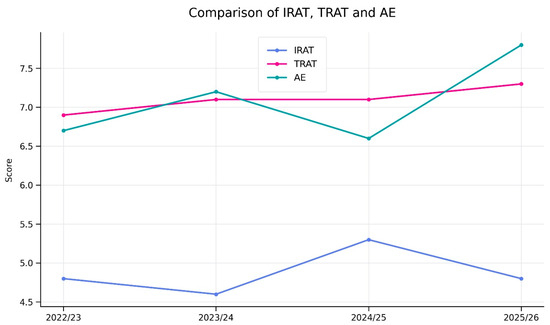
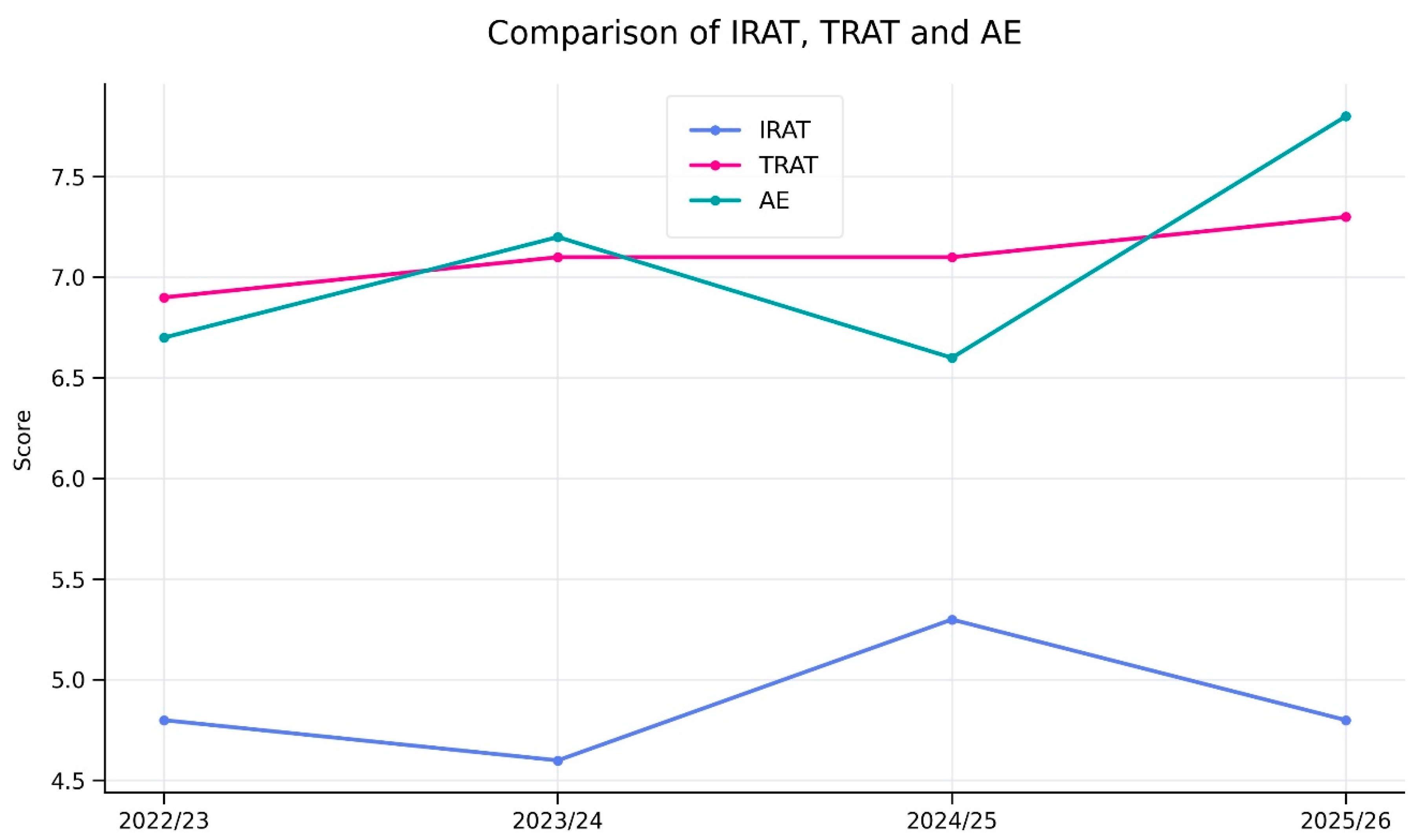
AEs further demonstrate students’ ability to apply knowledge. Figure 1 illustrates this progression from individual performance (IRAT) to team-based performance (TRAT) to knowledge application (AE).
Figure 1.
Comparison of Individual Readiness (IRAT), Team Readiness (TRAT), and Application Exercises (AE) Across Academic Years.
IRAT scores are consistently lower, reflecting limited individual preparation. In contrast, TRAT scores are substantially higher, highlighting the positive impact of collaborative learning. AE scores are also high, generally comparable to or slightly below TRAT scores. This indicates that, despite initial gaps in individual preparation, students can effectively apply knowledge in practical contexts. This pattern suggests that collaborative learning and structured activities facilitate the transition from knowledge acquisition to practical competence.
3.4. Longitudinal Evolution of Student Perceptions
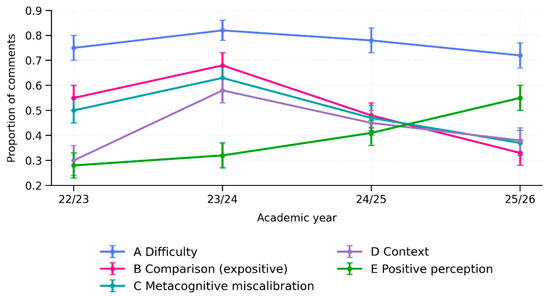
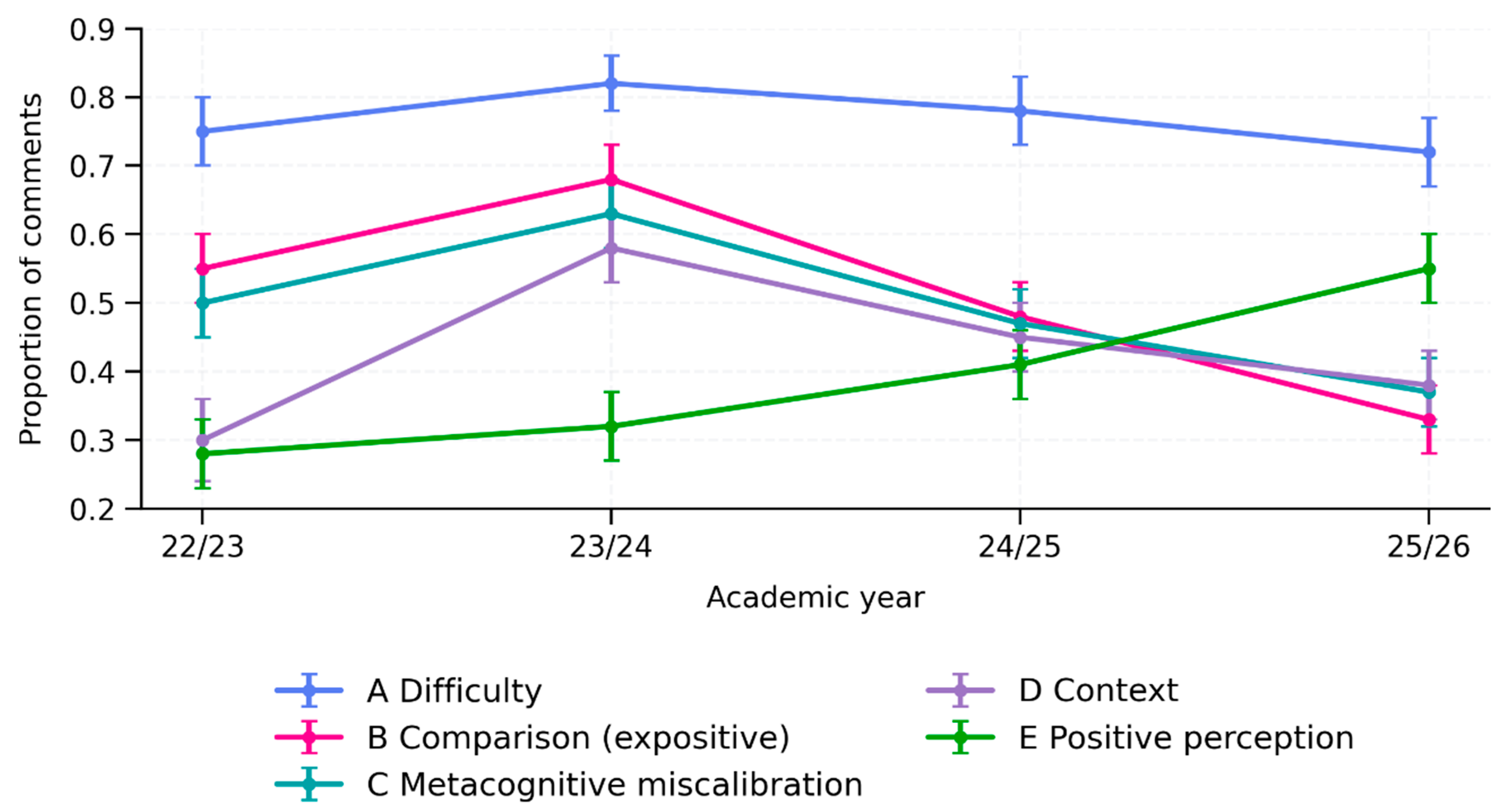
Qualitative responses were grouped into five categories (see Appendix B). Figure 2 illustrates the evolution of student perceptions across cohorts.
Figure 2.
Longitudinal trends in student perceptions of TBL in practical sessions, 2022/23–2025/26, with 95% confidence intervals.
The figure shows the distribution of qualitative categories from student responses. These categories include perceived difficulty (A), comparison with traditional teaching (B), metacognitive miscalibration (C), contextual understanding (D), and positive perception (E).
Perceived difficulty (A) remained consistently high across all academic years, indicating sustained cognitive demands associated with the TBL methodology. In contrast, comparison with traditional teaching (B) and metacognitive miscalibration (C) peaked in the intermediate cohort (2023/2024) and then declined, reaching statistical significance (p = 0.012 and p = 0.018, respectively).
Contextual understanding (D) increased and then stabilized, reflecting improved integration of applied knowledge. Positive perception (E) exhibited a progressive and statistically significant increase across cohorts (p = 0.006), indicating growing acceptance of the methodology.
3.5. Integrated Interpretation of Results
Taken together, the results reveal a coherent, longitudinal trajectory of student learning and perception. While individual preparation remains a challenge, collaborative learning significantly improves performance, as reflected by higher TRAT scores. Furthermore, students demonstrate strong competence in applying knowledge, as evidenced by high AE scores and improved performance in higher-order cognitive levels.
Comparing the results with those of the traditional teaching cohort confirms that TBL improves overall academic performance and promotes the development of higher-order cognitive skills. Furthermore, the evolution of student perceptions supports a progressive adaptation process characterized by an initial phase of difficulty and resistance followed by acceptance and positive evaluation of active learning strategies.
Overall, the convergence of quantitative outcomes and qualitative trends provides robust evidence of the effectiveness of TBL in promoting meaningful, sustained learning.
4. Discussion
This study provides a longitudinal evaluation of the implementation of TBL in anatomy labs, considering performance outcomes, cognitive development, and student perceptions over four years. The findings reveal a consistent trajectory of adaptation, characterized by an initial phase of difficulty and resistance, followed by progressive improvements in learning outcomes and perceptions of the methodology.
A central finding is the persistent discrepancy between individual preparation and performance in collaborative settings. IRAT scores remained low across cohorts, with a significant number of students failing to meet the passing threshold annually. This suggests that pre-class preparation remains challenging, even as the methodology becomes more familiar. These results align with evidence from active learning environments, where students accustomed to traditional instruction often struggle to adopt self-directed learning strategies (Schweder & Raufelder, 2024). However, these limitations did not compromise overall learning outcomes. In contrast, TRAT scores were consistently higher and improved over time, highlighting the compensatory role of collaborative learning. Through peer discussion, argumentation, and consensus-building, students refine their understanding and perform better than they would individually, especially on complex tasks (Slof et al., 2020; Zambrano et al., 2019). These results are consistent with previous studies that have linked TBL to improved teamwork, efficacy, and performance in health education settings (Alberti et al., 2020). However, TRAT scores should be interpreted as indicators of team performance and collaborative problem-solving, rather than as direct evidence of equivalent learning gains among all students. Higher TRAT scores may reflect teams’ collective ability to reach correct answers through discussion, peer instruction, and consensus-building. Therefore, while these findings support the effectiveness of collaborative learning processes, they should not be interpreted as demonstrating the same level of learning improvement for every student. Future studies incorporating additional individual-level measures would help further clarify the relationship between team performance and individual learning outcomes.
These results can be interpreted through the lens of the “illusion of competence” associated with traditional teaching methods. Fluent explanations can create the perception of understanding without deep cognitive processing (Carpenter et al., 2013, 2020a). In contrast, TBL requires active retrieval, reasoning, and discussion, which expose gaps in knowledge and generate a state of productive uncertainty. The discrepancy observed between perceived learning and demonstrated competence reflects this shift. In intermediate cohorts, students reported lower confidence and greater uncertainty, even though they showed measurable improvements in performance, especially in application exercises and higher-order cognitive outcomes. This pattern aligns with the “active learning paradox” described by Deslauriers et al. (2019), wherein students may feel they are learning less while achieving a deeper understanding. This misalignment can be understood as metacognitive miscalibration, a common characteristic of novice learners who are still developing the ability to accurately assess their own knowledge (De Bruin et al., 2023). Rather than indicating poorer learning, this apparent reduction in perceived understanding reflects a transition toward more accurate self-assessment and deeper engagement.
From a broader educational perspective, active learning approaches, including TBL and flipped classroom models, are closely associated with developing metacognitive and self-regulated learning (SRL) skills (Medina et al., 2017; Nichat et al., 2023; Kandra & Vennam, 2025). However, these skills do not develop automatically and require explicit instructional support. Evidence suggests that the effectiveness of such approaches depends on structured guidance, opportunities for reflection, and developing students’ capacity to plan, monitor, and evaluate their learning (Oudbier et al., 2021; Cale et al., 2022). In demanding disciplines such as anatomy, where cognitive load and time pressure are high, students may be reluctant to change their study strategies unless they receive metacognitive support early on and throughout their time in the program (Cale et al., 2022).
Evidence from veterinary education supports this idea. First-year students often demonstrate only moderate use of SRL strategies, with a notable gap between their knowledge of these strategies and their application (Dörrenbächer-Ulrich et al., 2025). Furthermore, a decline in the use of metacognitive strategies over time underscores the difficulty of maintaining effective self-regulation without structured support (Dörrenbächer-Ulrich et al., 2025). Reflective practices, including structured feedback, guided reflection, and portfolio-based learning, have shown potential in addressing these challenges, though empirical evidence remains limited (Jones et al., 2024). Together, these findings suggest that the benefits of TBL are closely linked to its capacity to stimulate metacognitive processes, which must be intentionally supported within the curriculum.
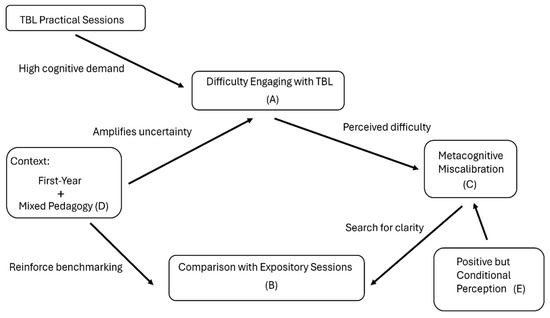
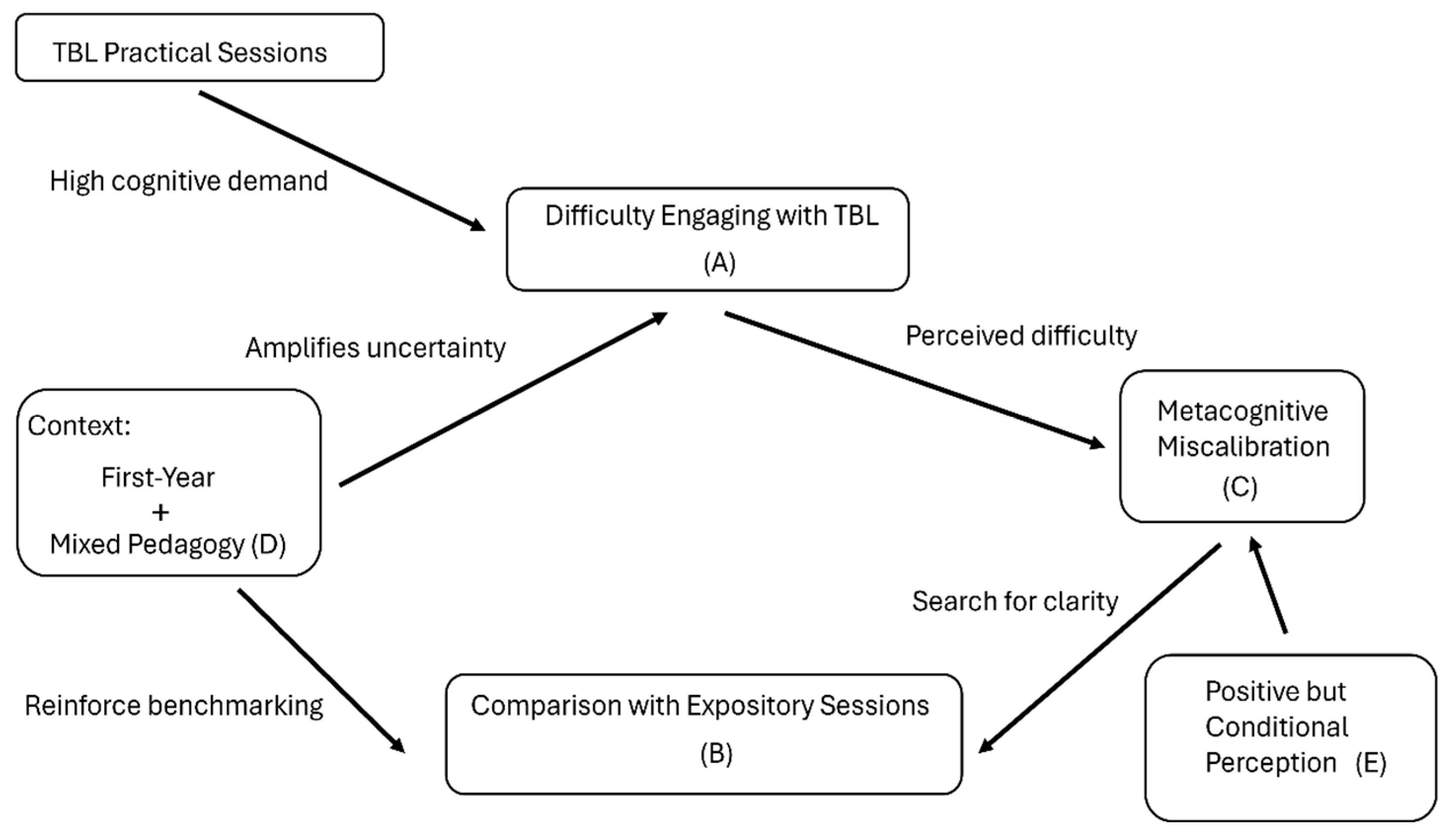
Figure 3 presents a conceptual model that synthesizes these dynamics by illustrating how engagement with TBL increases cognitive demand, leading to perceived difficulty. Initially, students interpret this difficulty through metacognitive miscalibration. They equate effort and uncertainty with reduced learning and compare TBL unfavorably to traditional expository teaching. This process is influenced by contextual factors, such as adapting to university learning as a first-year student and the presence of both traditional and active teaching methods, which perpetuate lecture-based expectations. Concurrently, students express positive, albeit conditional, perceptions of TBL, acknowledging its value when structured and supported appropriately. Therefore, the model demonstrates that critical perceptions do not reflect a rejection of TBL, but rather, they emerge from the interaction between cognitive demand, metacognitive processes, and contextual influences.
Figure 3.
Conceptual Model of Student Perceptions of TBL in Practical Sessions.
An additional contextual factor relates to institutional frameworks for evaluating teaching quality. At the Complutense University of Madrid, for example, the Docentia-UCM program places significant value on student feedback, reflecting a broader trend in higher education. However, student satisfaction does not necessarily correspond to effective learning, especially in cognitively demanding environments (Hajdin & Pažur, 2012; Uttl et al., 2017; Martin-Alguacil et al., 2024). The present findings reinforce this concern, showing that active learning approaches may initially lower perceived learning despite improving objective performance. These results highlight the limitations of perception-based evaluation systems and underscore the need for more comprehensive frameworks that incorporate objective measures of learning.
Consistent with this interpretation, the study demonstrates clear improvements in higher-order learning outcomes. Scores on application exercises increased over time. Analysis based on Bloom’s Taxonomy revealed substantial gains in higher-order cognitive levels compared to those of a traditional teaching cohort (Martín-Alguacil & Avedillo, 2024). These results support the effectiveness of TBL in promoting deep, transferable learning and reinforce the notion that productive uncertainty fosters cognitive development rather than hinders it.
The longitudinal evolution of student perceptions further contextualizes these results. Although perceived difficulty remained consistently high, indicators of resistance, such as negative comparisons with traditional teaching methods and metacognitive misalignment, were most pronounced in the intermediate stages and decreased over time. Conversely, positive perceptions progressively increased, indicating that students gradually recognized and accepted the value of the methodology. This transition reflects a shift from an initial illusion of competence toward a more reflective and cognitively engaged approach to learning.
From a constructivist perspective, these results suggest that TBL fosters knowledge construction through active engagement, interaction, and problem-solving. Repeated exposure to these processes fosters metacognitive awareness and self-regulation, resulting in enhanced performance and boosted confidence in subsequent stages.
Finally, the study highlights improvements in collaborative learning processes. The progressive increase in team performance and positive evaluations of group work suggest that students adapt individually and develop more effective communication and teamwork skills. These skills are essential professional competencies (Qazi et al., 2024; Jansen & Cavdar, 2024). These findings further suggest that the educational benefits of TBL are not limited to content acquisition but also derive from its capacity to promote metacognitive awareness and self-regulated learning processes, highlighting the importance of explicitly supporting these competencies within veterinary curricula.
Despite these strengths, important challenges remain. The persistence of low IRAT scores highlights the need to strengthen strategies that promote pre-class preparation. These strategies should include clearer guidance, formative incentives, and structured accountability mechanisms. Additionally, variability in student responses to flipped learning components indicates that not all self-directed learning elements are equally effective or accepted. This emphasizes the importance of careful instructional design and ongoing refinement. In addition, because team-based assessments such as the TRAT primarily measure collective performance, it is impossible to determine from the present data the extent to which improvements observed at the group level reflect equivalent gains among all individual students.
Overall, the findings provide robust evidence that TBL is an effective pedagogical approach that enhances academic performance, supports higher-order cognitive development, and fosters the gradual adoption of active learning strategies. Importantly, the discomfort and uncertainty students experience in the early stages should not be viewed as barriers, but rather as integral components of the learning process. The transition from an initial sense of competence to productive uncertainty seems to play a key role in promoting metacognitive awareness and enabling meaningful, sustained learning.
5. Conclusions
This study shows that implementing TBL in anatomy labs improves student learning outcomes, especially higher-order cognitive skills like application, analysis, and evaluation. Despite limitations in individual preparation, collaborative learning enhances performance and supports the effective application of knowledge.
The longitudinal design reveals a dynamic adaptation process, wherein initial student resistance and perceived difficulty evolve into greater acceptance and positive evaluation of the methodology. This transition reflects a shift from the initial illusion of competence associated with traditional teaching to a state of productive uncertainty that promotes deeper learning and improved metacognitive awareness.
Overall, TBL emerges as a robust pedagogical approach that improves academic performance and fosters essential competencies, including critical thinking, collaboration, and self-regulation. These findings support integrating TBL into professional education and highlight the importance of sustained exposure to active learning environments to facilitate meaningful, lasting learning. They also underscore the value of explicitly fostering metacognitive and self-regulated learning skills to maximize the educational impact of TBL.
Author Contributions
Conceptualization, N.M.-A.; methodology, L.A. and N.M.-A.; software L.A.; validation, L.A. and N.M.-A.; formal analysis, L.A. and N.M.-A.; investigation, L.A. and N.M.-A.; writing—original draft preparation, N.M.-A.; writing—review and editing, L.A. and N.M.-A.; supervision, N.M.-A. All authors have read and agreed to the published version of the manuscript.
Funding
This research received no external funding.
Institutional Review Board Statement
The Bioethics Committee of Complutense University of Madrid (UCM) confirmed this study did not require formal ethical approval, as the study was part of an educational innovation project and did not involve clinical procedures or sensitive personal data.
Informed Consent Statement
All participating students were informed in advance about the purpose and nature of the study, and their participation was entirely voluntary. Data was collected anonymously to ensure privacy and confidentiality. The study was conducted in accordance with the ethical principles of transparency, respect and academic integrity.
Data Availability Statement
The raw data supporting the conclusions of this article will be made available by the authors on request.
Acknowledgments
The authors thank the first-year veterinary students at Complutense University who participated in the study, as well as those who declined to participate for their valuable contributions. The authors gratefully acknowledge Wooclap SA, Brussels, Belgium for their support. They also acknowledge the institutional support provided by the Educational Innovation Project “Validation of Flipped Classroom and Team-Based Learning (TBL) protocols in Health Sciences through advanced digital tools and integrated AI” (Ref. 31/2026), funded by Complutense University of Madrid.
Conflicts of Interest
The authors declare no conflicts of interest.
Abbreviations
The following abbreviations are used in this manuscript:
| AEs | Application Exercises |
| AK | Applying knowledge |
| CIs | Confidence intervals |
| FA | Formative assessment |
| FS | Final score |
| IRA | Individual Readiness Assessment |
| IRAT | Individual Readiness Assurance Test |
| SRL | Self-regulated learning |
| TBA | Team-based assessment |
| TBL | Team-based Learning |
| TRAT | Team Readiness Assurance Test |
| UCM | Complutense University of Madrid |
Appendix A
Appendix A.1. Student Survey Instrument
The following questionnaires were administered to students at the end of each academic year to assess perceptions of team-based learning (TBL), learning processes, and instructional components. All items were rated using a 5-point Likert scale unless otherwise specified.
Appendix A.1.1. 2022/2023 Cohort Survey
Response scale:
1 = Not at all/Very low
2 = Low
3 = Moderate
4 = High
5 = Very high
How would you rate the effort you invested in preparing for and participating in practical sessions?
To what extent did TBL sessions motivate you and encourage your participation?
How comfortable did you feel working in groups?
To what extent did group work contribute to your learning?
How useful were the mini-lectures provided by the instructor?
How useful were the application-based activities for your learning?
How would you rate the level of difficulty of the application-based activities?
How would you rate the effort made by the teaching staff to organize active learning?
Appendix A.1.2. 2023/2024 Cohort Survey
Likert-scale questions:
How useful was anatomical reasoning for understanding clinical cases?
Multiple-choice item:
Which teaching approach do you prefer?
- (a)
- Teacher-centered instruction (lectures and note-taking)
- (b)
- Guided learning focused on reasoning and active participation
Multiple-response item:
Which of the following statements reflect your experience with active learning? (Select all that apply)
It was a new way of learning that was initially difficult to understand
It was not new and I felt comfortable from the beginning
It helped me think and solve problems as a future professional
It was motivating and useful for my training
I did not learn to reason anatomically and found it ineffective
Likert-scale item:
How would you rate the adequacy of the guidance provided by the teaching team?
Appendix A.1.3. 2024/2025 Cohort Survey
Response scale: 1 = Not at all/Very low, 5 = Very high
How would you rate the audiovisual materials used in the course (videos, images, anatomical material)?
How useful were the audiovisual materials for learning?
To what extent did the flipped classroom model improve your group learning?
How useful was anatomical knowledge for interpreting diagnostic images (e.g., X-ray, CT, MRI)?
To what extent was peer learning beneficial?
How confident do you feel in performing anatomical reasoning?
To what extent did group work improve your communication and collaboration skills?
To what extent did flipped videos allow you to learn at your own pace?
How useful was the ability to repeatedly view videos?
Appendix A.1.4. 2025/2026 Cohort Survey
Response scale: 1 = Not at all/Very low, 5 = Very high
How would you rate the audiovisual materials used in the course?
How useful were flipped videos for your learning?
To what extent did the flipped classroom model improve active group learning?
How useful was anatomical knowledge for interpreting diagnostic images?
To what extent was peer learning beneficial?
How confident do you feel in performing anatomical reasoning?
To what extent did group work improve your communication and collaboration skills?
To what extent did flipped learning allow you to learn at your own pace?
How useful was the ability to repeatedly view videos?
Appendix B
Appendix B.1. Qualitative Coding Scheme
Qualitative data were obtained from open-ended student responses and analyzed using an inductive thematic approach. Codes were iteratively developed and refined, resulting in five main categories that capture the evolution of student perceptions of team-based learning (TBL) across cohorts. These categories were subsequently quantified to allow longitudinal comparison.
Appendix B.2. Perceived Difficulty
Definition: Student perceptions of cognitive effort, workload, or challenges associated with TBL activities, including preparation, reasoning, and engagement in practical sessions.
Interpretation: This category reflects the sustained cognitive demand imposed by TBL, particularly in early stages of exposure. High frequency indicates that students perceive the methodology as demanding but not necessarily ineffective.
Example responses:
“I found the activities difficult because they required much more preparation than expected.”
“Understanding the questions required deeper thinking than in traditional classes.”
“At the beginning, I struggled to follow the reasoning process.”
Appendix B.3. Comparison with Traditional Teaching
Definition: Statements in which students explicitly contrast TBL with traditional lecture-based methods, often expressing preference for more passive instructional approaches.
Interpretation: This category reflects resistance to pedagogical change and reliance on familiar learning models. It is particularly prominent during transition phases.
Example responses:
“I prefer when the teacher explains everything clearly instead of having to figure it out myself.”
“Traditional lectures are easier to follow than this method.”
“I feel I learn better when the professor tells us exactly what to study.”
Appendix B.4. Metacognitive Miscalibration
Definition: Expressions indicating a mismatch between perceived and actual learning, including lack of confidence, uncertainty about understanding, or beliefs that learning is ineffective despite engagement.
Interpretation: This category captures the concept of productive uncertainty and reflects the disruption of the illusion of competence. It is particularly relevant in intermediate stages of adaptation to TBL.
Example responses:
“I don’t feel like I’m learning enough, even though I try to follow the activities.”
“It’s hard to know if I really understand the content.”
“Sometimes I feel lost during the sessions.”
Appendix B.5. Contextual and Applied Understanding
Definition: Statements highlighting the usefulness of TBL for understanding, applying, or integrating knowledge in practical or clinical contexts.
Interpretation: This category reflects the development of applied reasoning skills and the transition from theoretical knowledge to practical competence.
Example responses:
“The activities help me understand how to apply anatomy in real situations.”
“I now see how the concepts are useful beyond memorization.”
“Working with cases improves my ability to think clinically.”
Appendix B.6. Positive Perception and Acceptance
Definition: Expressions of satisfaction, motivation, or recognition of the benefits of TBL, including increased engagement, collaboration, and perceived learning value.
Interpretation: This category reflects the consolidation phase, where students internalize the benefits of active learning and develop a positive attitude toward the methodology.
Example responses:
“I find this method more engaging and dynamic.”
“Working in a team helped me learn more effectively.”
“Now I think this approach is very useful for my training.”
Appendix B.7. Summary of Coding Framework
The five categories collectively capture the longitudinal evolution of student experience with TBL:
- A (Difficulty): Persistent cognitive demand
- B (Comparison): Initial resistance to change
- C (Miscalibration): Metacognitive adjustment phase
- D (Application): Development of practical understanding
- E (Acceptance): Consolidation of positive perceptions
This framework underpins the quantitative trends presented in the main text and supports the interpretation of a transition from initial resistance toward progressive adaptation and effective learning.
Appendix C
Appendix C presents detailed distributions of survey responses across cohorts, complementing the summarized results reported in the main text. Data are presented as frequencies (n) and percentages (%). Likert-scale responses were grouped into three categories (low: 1–2, moderate: 3, high: 4–5) to facilitate interpretation.
Comparisons of proportions between academic cohorts were performed using the Chi-square (χ2) test of independence or the Z-test for two proportions, as appropriate. For longitudinal trends across ordered cohorts, the Chi-square test for trend (Cochran–Armitage test) was applied when evaluating directional changes over time.
Supplementary Quantitative Tables
Appendix C.1. Detailed Distribution of Survey Responses (2022/2023 Cohort, n = 54)
Appendix C.1.1. Table: Effort Invested in Preparation
| Response Level | n (%) |
| Low (1–2) | 1 (1.85%) |
| Moderate (3) | 8 (14.81%) |
| High (4–5) | 45 (83.33%) |
Appendix C.1.2. Table: Motivation and Participation
| Response Level | n (%) |
| Low (1–2) | 10 (18.52%) |
| Moderate (3) | 21 (38.89%) |
| High (4–5) | 23 (42.59%) |
Appendix C.1.3. Table: Comfort in Group Work
| Response Level | n (%) |
| Low (1–2) | 3 (5.56%) |
| Moderate (3) | 6 (11.11%) |
| High (4–5) | 45 (83.34%) |
Appendix C.1.4. Table: Usefulness of Group Work for Learning
| Response Level | n (%) |
| Low (1–2) | 6 (11.11%) |
| Moderate (3) | 10 (18.52%) |
| High (4–5) | 37 (68.51%) |
Detailed distribution of student responses for the 2022/2023 cohort (n = 54). Responses are grouped into low (1–2), moderate (3), and high (4–5) categories based on Likert-scale ratings. Items assess student-reported effort, motivation, comfort in group work, and perceived usefulness of collaborative learning. These data provide a baseline characterization of student engagement and perceptions during the initial implementation of team-based learning (TBL).
Appendix C.1.5. Statistical Note
Responses are presented as frequencies and percentages. Categories were grouped into low (1–2), moderate (3), and high (4–5) for descriptive clarity. No inferential comparisons were performed for individual items in this cohort; results are interpreted as baseline measures during initial TBL implementation. Results are presented descriptively to characterize baseline student responses during initial implementation of TBL. No inferential statistical comparisons were performed for this cohort alone.
Appendix C.2. Detailed Survey Results (2023/2024 Cohort, n = 139)
Appendix C.2.1. Table: Usefulness of Anatomical Reasoning
| Response Level | n (%) |
| Low (1–2) | 62 (45%) |
| Moderate (3) | 53 (38%) |
| High (4–5) | 24 (17%) |
Appendix C.2.2. Table: Preferred Teaching Approach
| Response | n (%) |
| Teacher centered | 77 (56%) |
| Guided/active learning | 60 (44%) |
Appendix C.2.3. Table: Experience with Active Learning (Multiple Responses)
| Statement | n (%) |
| Initially difficult to understand | 91(68%) |
| Comfortable from the start | 5 (4%) |
| Helped develop reasoning skill | 40 (30%) |
| Motivating and useful | 25 (19%) |
| Perceived as ineffective | 40 (30%) |
Detailed survey results for the 2023/2024 cohort (n = 139). These tables present distributions of responses related to perceived usefulness of anatomical reasoning, preferred instructional approaches, and experiences with active learning. Multiple-response items capture students’ perceived difficulties, perceived effectiveness, and motivational aspects, reflecting the transitional phase of adaptation to TBL.
Appendix C.2.4. Statistical Note
Descriptive statistics are presented as frequencies and percentages. Multiple-response items were analyzed independently; therefore, totals may exceed 100%. Comparisons of response distributions between cohorts (reported in the main text and figure) were analyzed using tests for proportions, with statistical significance set at p < 0.05. Frequencies and percentages are reported for each item. Multiple-response questions were analyzed independently, and total percentages may exceed 100%. Between-cohort comparisons of proportions were conducted using the Chi-square test or Z-test for proportions, with significant differences reported in the main Results.
Appendix C.3. Detailed Survey Results (2024/2025 Cohort, n = 127)
Appendix C.3.1. Table: Usefulness of Audiovisual Materials
| Response Level | n (%) |
| Low (1–2) | 26 (20%) |
| Moderate (3) | 59 (45%) |
| High (4–5) | 46 (35%) |
Appendix C.3.2. Benefit of Peer Learning
| Response Level | n (%) |
| Low (1–2) | 2 (2%) |
| Moderate (3) | 33 (25%) |
| High (4–5) | 98 (74%) |
Appendix C.3.3. Confidence in Anatomical Reasoning
| Response Level | n (%) |
| Low (1–2) | 40 (31%) |
| Moderate (3) | 64 (49%) |
| High (4–5) | 26 (20%) |
Detailed survey results for the 2024/2025 cohort (n = 127). Responses are grouped into low, moderate, and high categories. Items evaluate perceptions of audiovisual materials, peer learning benefits, and confidence in anatomical reasoning. These data illustrate the progression toward greater acceptance of collaborative and applied learning strategies.
Appendix C.3.4. Statistical Note
Responses were grouped into low (1–2), moderate (3), and high (4–5) categories. Trends across cohorts were examined longitudinally using descriptive comparisons. Observed increases in high-response categories (e.g., peer learning and applied understanding) are consistent with statistically significant trends reported in the main results section. Responses were grouped into low, moderate, and high categories. Longitudinal changes in response distributions were examined using the Chi-square test for trend (Cochran–Armitage test). Observed increases in high-category responses are consistent with significant trends reported in the main analysis.
Appendix C.4. Detailed Survey Results (2025/2026 Cohort, n = 148)
Appendix C.4.1. Table: Usefulness of Flipped Videos
| Response Level | n (%) |
| Low (1–2) | 28 (20%) |
| Moderate (3) | 48 (36%) |
| High (4–5) | 58 (43%) |
Appendix C.4.2. Table: Benefit of Peer Learning
| Response Level | n (%) |
| Low (1–2) | 5 (4%) |
| Moderate (3) | 27 (20%) |
| High (4–5) | 106 (77%) |
Appendix C.4.3. Table: Confidence in Anatomical Reasoning
| Response Level | n (%) |
| Low (1–2) | 43 (29%) |
| Moderate (3) | 74 (50%) |
| High (4–5) | 32 (21%) |
Detailed survey results for the 2025/2026 cohort (n = 148). These tables summarize student perceptions of flipped learning resources, peer collaboration, and confidence in reasoning. The distribution of responses reflects a consolidated stage of adaptation, with increased positive evaluations of active learning components and improved self-reported competence.
Appendix C.4.4. Statistical Note
Percentages are calculated based on total valid responses. Longitudinal comparisons with previous cohorts were evaluated using proportion tests (p < 0.05), as reported in the Results. The increase in positive responses (high category) and reduction in resistance categories correspond to statistically significant trends identified in the overall analysis. Percentages are based on valid responses. Comparisons with previous cohorts were performed using Chi-square tests and Z-tests for proportions, depending on the number of groups compared. Longitudinal trends were assessed using the Cochran–Armitage trend test, confirming the increase in positive responses and decrease in resistance patterns (p < 0.05).
References
- Alberti, S., Motta, P., Ferri, P., & Bonetti, L. (2020). The effectiveness of team-based learning in nursing education: A systematic review. Nurse Education Today, 97, 104721. [Google Scholar] [CrossRef] [Scilit] [PubMed]
- Al-Neklawy, A. F., & Ismail, A. S. A. (2022). Online anatomy team-based learning using blackboard collaborate platform during COVID-19 pandemic. Clinical Anatomy, 35(1), 87–93. [Google Scholar] [CrossRef] [Scilit] [PubMed]
- Cale, A., Hoffman, L., & McNulty, M. (2022). Promoting metacognition in an allied health anatomy course. Anatomical Sciences Education, 16, 473–485. [Google Scholar] [CrossRef] [Scilit] [PubMed]
- Carpenter, S. K., Northern, P. E., Tauber, S. U., & Toftness, A. R. (2020a). Effects of lecture fluency and instructor experience on students’ judgments of learning, test scores, and evaluations of instructors. Journal of Experimental Psychology: Applied, 26(1), 26–39. [Google Scholar] [CrossRef] [Scilit] [PubMed]
- Carpenter, S. K., Wilford, M., Kornell, N., & Mullaney, K. M. (2013). Appearances can be deceiving: Instructor fluency increases perceptions of learning without increasing actual learning. Psychonomic Bulletin & Review, 20, 1350–1356. [Google Scholar] [CrossRef] [Scilit] [PubMed]
- Carpenter, S. K., Witherby, A., & Tauber, S. K. (2020b). On students’ (mis)judgments of learning and teaching effectiveness. Journal of Applied Research in Memory and Cognition, 9(2), 137–151. [Google Scholar] [CrossRef] [Scilit]
- De Bruin, A. B. H., Biwer, F., Hui, L., Onan, E., David, L., & Wiradhany, W. (2023). Worth the effort: The start and stick to desirable difficulties (S2D2) framework. Educational Psychology Review, 35, 41. [Google Scholar] [CrossRef] [Scilit]
- Deslauriers, L., McCarty, L., Miller, K., Callaghan, K., & Kestin, G. (2019). Measuring actual learning versus feeling of learning in response to being actively engaged in the classroom. Proceedings of the National Academy of Sciences of the United States of America, 116, 19251–19257. [Google Scholar] [CrossRef] [Scilit] [PubMed]
- Dörrenbächer-Ulrich, L., Gerics, B., & Steinberg, E. (2025). Self-regulated learning in early-year veterinary students: Analyzing strategy usage and strategy knowledge in anatomy classes. Journal of Veterinary Medical Education, 12, e20250016. [Google Scholar] [CrossRef] [Scilit] [PubMed]
- Hajdin, G., & Pažur, K. (2012). Differentiating between student evaluation of teacher and teaching effectiveness. Journal of Information and Organizational Sciences, 36, 123–134. [Google Scholar]
- Hashmi, N. R. (2014). Team based learning (TBL) in undergraduate medical education. Journal of the College of Physicians Surgeons Pakistan, 24(8), 553–556. [Google Scholar] [PubMed]
- Jansen, M., & Cavdar, I. K. (2024). Adapting team-based learning for medical education: A case study with scalable and resource-efficient implementation. Medical Science Educator, 35, 883–892. [Google Scholar] [CrossRef] [Scilit] [PubMed]
- Jha, S., Sethi, R., Kumar, M., & Khorwal, G. (2024). Comparative study of the flipped classroom and traditional lecture methods in anatomy teaching. Cureus, 16(7), e64378. [Google Scholar] [CrossRef] [Scilit] [PubMed]
- Jones, A., Cobb, K. A., & England, G. C. W. (2024). A scoping review on the use of reflection and reflective portfolio learning in veterinary education. Veterinary Record Open, 11, e279. [Google Scholar] [CrossRef] [Scilit] [PubMed]
- Kandra, K., & Vennam, P. (2025). The active classroom: A narrative review of active teaching methods and the flipped classroom model in graduate medical education. Cureus, 17(11), e98186. [Google Scholar] [CrossRef] [Scilit] [PubMed]
- Martin-Alguacil, N., Avedillo, L., Mota-Blanco, R., & Gallego-Agundez, M. (2024). Student-centered learning: Some issues and recommendations for its implementation in a traditional curriculum setting in health sciences. Education Sciences, 14(11), 1179. [Google Scholar] [CrossRef] [Scilit]
- Martín-Alguacil, N., & Avedillo, L. (2024). Student-centered active learning improves performance in solving higher-level cognitive questions in health sciences education. International Medical Education, 3, 346–362. [Google Scholar] [CrossRef] [Scilit]
- Martín-Alguacil, N., Avedillo, L., Mota-Blanco, R. A., Marañón-Almendros, M., & Gallego-Agundez, M. (2025a). ChatGPT as a virtual peer: Enhancing critical thinking in flipped veterinary anatomy education. International Medical Education, 4, 34. [Google Scholar] [CrossRef] [Scilit]
- Martín-Alguacil, N., González, M. E., de Gaspar Simón, I., & Avedillo, L. J. (2021a). Aprendizaje basado en el equipo (TBL) en las sesiones prácticas de anatomía y embriología de primer año de grado en veterinaria. Metodología e implementación. In Innovación e investigación docente en educación: Experiencias prácticas (pp. 256–279). Dykinson. [Google Scholar]
- Martín-Alguacil, N., Mota-Blanco, R., Avedillo, L., Marañón-Almendros, M., & Gallego-Agundez, M. (2025b). Timing, tools, and thinking: H5P-Driven engagement in flipped veterinary education. Veterinary Sciences, 12(10), 1013. [Google Scholar] [CrossRef] [Scilit] [PubMed]
- Martín-Alguacil, N., Rojo Salvador, C., Blazquez-Llorca, L., & Mota Blanco, R. (2021b). Aprendizaje basado en el equipo (TBL), en las prácticas de anatomía y embriología de primer año de grado en veterinaria. Nuevo papel de profesores y alumnos. Metodología e implementación. In Innovación e investigación docente en educación: Experiencias prácticas (pp. 280–301). Dykinson. [Google Scholar]
- Medina, M. S., Castleberry, A. N., & Persky, A. (2017). Strategies for improving learner metacognition in health professional education. American Journal of Pharmaceutical Education, 81(4), 78. [Google Scholar] [CrossRef] [Scilit] [PubMed]
- Michaelsen, L. K., Parmelee, D. X., McMahon, K., & Levine, R. E. (2007). Team-based learning for health professions education. In A guide to using small groups for improving learning. Stylus. [Google Scholar]
- Michaelsen, L. K., & Sweet, M. (2008). The essential elements of team based learning. New Directions for Teaching and Learning, 116, 7–27. [Google Scholar] [CrossRef] [Scilit]
- Mishra, D., Singh, S., Khan, A. Z., Kumar, S., & Dwivedi, P. (2023). Comparison of didactic lectures and activity-based learning for teaching first-professional MBBS students in the subject of anatomy. Cureus, 15(12), e51106. [Google Scholar] [CrossRef] [Scilit] [PubMed]
- Nichat, A., Gajbe, U. L., Bankar, N. J., Singh, B. R., & Badge, A. K. (2023). Flipped classrooms in medical education: Improving learning outcomes and engaging students in critical thinking skills. Cureus, 15(11), e48199. [Google Scholar] [CrossRef] [Scilit] [PubMed]
- Oudbier, J., Spaai, G., Timmermans, K., & Boerboom, T. (2021). Enhancing the effectiveness of flipped classroom in health science education: A state-of-the-art review. BMC Medical Education, 22(1), 34. [Google Scholar] [CrossRef] [Scilit] [PubMed]
- Qazi, S., Mazhar, M. A., Shaikh, A. A., Rasool, A., Atif, K., & Obeidat, A. (2024). Fostering TBL success at Alfaisal University: A complex adaptive systems approach. Advances in Medical Education and Practice, 15, 935–944. [Google Scholar] [CrossRef] [Scilit] [PubMed]
- Saverino, D. (2020). Teaching anatomy at the time of COVID-19. Clinical Anatomy, 34, 1128. [Google Scholar] [CrossRef] [Scilit] [PubMed]
- Schweder, S., & Raufelder, D. (2024). Does changing learning environments affect student motivation? Learning and Instruction, 89, 101829. [Google Scholar] [CrossRef] [Scilit]
- Singh, K., Bharatha, A., Sa, B., Adams, O. P., & Majumder, M. (2019). Teaching anatomy using an active and engaging learning strategy. BMC Medical Education, 19(1), 149. [Google Scholar] [CrossRef] [Scilit] [PubMed]
- Siqueira, M. A. M., Gonçalves, J. P., Mendonça, V. S., Kobayasi, R., Arantes-Costa, F. M., Tempski, P. Z., & Martins, M. A. (2020). Relationship between metacognitive awareness and motivation to learn in medical students. BMC Medical Education, 20(1), 393. [Google Scholar] [CrossRef] [Scilit] [PubMed]
- Slof, B., Leeuwen, A. V., Janssen, J., & Kirschner, P. (2020). Mine, ours, and yours: Whose engagement and prior knowledge affects individual achievement from online collaborative learning? Journal of Computed Assisted Learning, 37, 39–50. [Google Scholar] [CrossRef] [Scilit]
- Sterpu, I., Herling, L., Nordquist, J., Rotgans, J., & Acharya, G. (2024). Team-based learning (TBL) in clinical disciplines for undergraduate medical students-a scoping review. BMC Medical Education, 24(1), 18. [Google Scholar] [CrossRef] [Scilit] [PubMed]
- Sweet, M., & Michaelsen, L. K. (2012). Team-based learning in the social sciences and humanities: Group work that works to generate critical thinking and engagement. Stylus. [Google Scholar]
- Uttl, B., White, C. A., & Gonzalez, D. W. (2017). Meta-analysis of faculty’s teaching effectiveness: Student evaluation of teaching ratings and student learning are not related. Studies in Educational Evaluation, 54, 22–42. [Google Scholar] [CrossRef] [Scilit]
- Vasan, N., Defouw, D., & Holland, B. (2008). Modified use of team-based learning for effective delivery of medical gross anatomy and embryology. Anatomical Sciences Education, 1(1), 3–9. [Google Scholar] [CrossRef] [Scilit] [PubMed]
- Vasan, N. S., DeFouw, D. O., & Compton, S. (2011). Team-based learning in anatomy: An efficient, effective, and economical strategy. Anatomical Sciences Education, 4(6), 333–339. [Google Scholar] [CrossRef] [Scilit] [PubMed]
- Versteeg, M., Bressers, G., Wijnen-Meijer, M., Ommering, B., De Beaufort, A. J., & Steendijk, P. (2021). What were you thinking? Medical students’ metacognition and perceptions of self-regulated learning. Teaching and Learning in Medicine, 33, 473–482. [Google Scholar] [CrossRef] [Scilit] [PubMed]
- Youssef, S. (2021). Different approaches for teaching and learning anatomy and future directions. Indian Journal of Clinical Anatomy and Physiology, 8, 1–6. [Google Scholar] [CrossRef] [Scilit]
- Zambrano, R. J., Kirschner, F., Sweller, J., & Kirschner, P. (2019). Effects of prior knowledge on collaborative and individual learning. Learning and Instruction, 63, 101214. [Google Scholar] [CrossRef] [Scilit]

Disclaimer/Publisher’s Note: The statements, opinions and data contained in all publications are solely those of the individual author(s) and contributor(s) and not of MDPI and/or the editor(s). MDPI and/or the editor(s) disclaim responsibility for any injury to people or property resulting from any ideas, methods, instructions or products referred to in the content. |
© 2026 by the authors. Licensee MDPI, Basel, Switzerland. This article is an open access article distributed under the terms and conditions of the Creative Commons Attribution (CC BY) license.