


Abstract
Blended learning has become a structural feature of contemporary higher education, yet little is known about how students experience the digital study practices that shape their everyday learning rhythms. This qualitative study explores how students navigate autonomy, competence, and relatedness within digitally mediated blended environments. Semi-structured interviews were conducted with 20 students enrolled in blended programs at a Belgian university. Using reflexive thematic analysis, four themes were identified: fostering flexibility without losing orientation, cultivating belonging in blended spaces, providing scaffolds to build competence and motivation, and navigating digital strain. Students valued the autonomy afforded by flexible study rhythms, yet this autonomy was fragile when digital structures were unclear or inconsistent. Belonging depended on visible instructor presence and intentional opportunities for interaction, while competence was shaped by clarity, coherence, and timely feedback across platforms. Digital strain accumulated through extended screen time, technical frictions, and blurred boundaries between study and personal life. These findings offer a situated understanding of how students experience technology-mediated learning as both enabling and demanding. The study highlights the importance of predictable digital routines, relational presence, and coherent design in supporting sustainable engagement in blended higher education.
1. Introduction
Blended learning (BL), which combines online and face-to-face instruction, has become a common feature of contemporary higher education (Singh et al., 2021). Students often appreciate the flexibility that blended formats provide, particularly when they combine study with work, caregiving responsibilities, or fluctuating personal circumstances (Kumar et al., 2021). As blended formats have become structurally embedded in many programs, this flexibility increasingly shapes how students organize their study rhythms (Raes, 2022). At the same time, BL is frequently experienced as a learning environment in which clarity and autonomy coexist with moments of fragmentation, uncertainty, and reduced social connection. Students describe how digital structures can feel disjointed when communication is inconsistent or when interaction is primarily asynchronous (Megahed & Hassan, 2022). Research increasingly highlights how inconsistencies in digital routines, limited instructor visibility, and unclear expectations can complicate students’ sense of orientation and belonging within blended environments (Sanabria-Mazo et al., 2026). These dynamics are not limited to students; instructors also report that hybrid delivery can unsettle established routines and create ambiguity around pedagogical roles (Howard, 2021), suggesting that BL is a relational environment shaped by shifting expectations on both sides.
Self-Determination Theory (SDT; Ryan & Deci, 2017) offers a useful lens for understanding how students navigate these conditions. According to SDT, students’ well-being and motivation depend on the extent to which three basic psychological needs, autonomy, competence, and relatedness, are supported. In blended contexts, these needs take on specific forms: flexible scheduling may enhance autonomy yet feel overwhelming when expectations are unclear; multimodal materials may support competence yet create uncertainty when feedback is limited; and online communication may increase accessibility while reducing the spontaneous interactions that sustain belonging (Fan et al., 2024). Digital strain, accumulated through screen fatigue, cognitive overload, and blurred boundaries, adds an additional layer to these experiences (Adedoyin & Soykan, 2023). Together, these structural and digital conditions shape a learning environment that students must navigate on a daily basis, which makes it important to understand how they experience blended learning in relation to their psychological needs. Recent work on BL interventions suggests that students feel most supported when digital and physical components are coherently aligned and when instructor presence remains visible across modalities (Alonso et al., 2025).
Although interest in the relationship between BL and student well-being is growing (Raes, 2022), much of the existing literature focuses on isolated design features or general satisfaction measures. Less is known about how students themselves experience the interplay between the opportunities and constraints of BL, and how these experiences shape their psychological needs in everyday practice. This gap is particularly relevant in programs where BL is not an occasional format but a structural condition of study (Watermeyer et al., 2021). The present study addresses this gap by examining how students experience blended learning in relation to their psychological needs. Through semi-structured interviews with students enrolled in blended programs, we explore how autonomy, competence, and relatedness are supported or challenged within their learning environments, offering a situated account of the conditions under which BL can contribute to, or complicate, emotional sustainability in higher education.
2. Theoretical Background
2.1. Blended Learning as a Digital Learning Environment
Blended learning (BL) refers to the intentional integration of face-to-face instruction with online learning activities (Hrastinski, 2019). Over the past decade, BL has increasingly become a sustained mode of delivery across higher education. Its appeal lies in the possibility of combining the immediacy and social richness of in-person learning with the flexibility and accessibility of digital formats. Students frequently describe this flexibility as essential for balancing academic work with employment or caregiving responsibilities (Ubben et al., 2023).
Yet BL also reshapes expectations for teaching and learning. Instructor-focused research shows that hybrid delivery can prompt shifts in professional identity and create uncertainty around pedagogical roles (Howard, 2021), highlighting that BL affects both sides of the learning relationship. Students likewise encounter challenges: fragmented course structures, inconsistent communication, and reduced opportunities for informal peer interaction can undermine orientation and engagement (Megahed & Hassan, 2022). More recent work highlights how coherence across platforms, predictable digital routines, and visible educator presence remain essential for sustaining engagement in blended environments (Torre et al., 2025). Studies examining BL interventions point to the importance of clear structure, timely feedback, and supportive learning environments for maintaining motivation across modalities (Alonso et al., 2025). Understanding BL therefore requires attention to how students interpret and manage these shifting conditions, and how they sustain orientation, motivation, and connection across modalities.
RQ1.
How do students experience and interpret the opportunities and constraints of blended learning in their daily study practices?
2.2. Student Well-Being in Blended Learning
Student well-being has become an increasingly central concern in higher education, with growing recognition that emotional and motivational experiences are shaped by relational, structural, and technological conditions. In blended learning environments, these conditions can support well-being in some moments and strain it in others. Flexible scheduling and asynchronous access may reduce stress for students balancing multiple responsibilities, while recorded lectures and online materials can support accessibility and self-regulation (Adedoyin & Soykan, 2023). At the same time, reduced physical presence may limit opportunities for spontaneous interaction, increase feelings of isolation, and complicate help-seeking (Raes, 2022).
Digital strain, extended screen time, cognitive overload, and blurred boundaries can further undermine students’ emotional sustainability (Adedoyin & Soykan, 2023). Institutional structures also play a role: unclear communication, slow support services, and inconsistent digital routines can exacerbate stress and uncertainty (Sanabria-Mazo et al., 2026). These dynamics suggest that well-being in BL is shaped by how students navigate the structure, rhythm, and relational qualities of their learning environments. Recent work highlights that students feel most supported when autonomy, competence, and relatedness are actively reinforced through coherent design and visible instructor presence (Alonso et al., 2025). Qualitative approaches can therefore deepen understanding by foregrounding students’ own accounts of how BL shapes their emotional and motivational experience, and how they negotiate the conditions that support or unsettle their psychological needs.
RQ2.
How do blended learning conditions support or unsettle students’ emotional and motivational well-being?
2.3. Self-Determination Theory and Psychological Needs
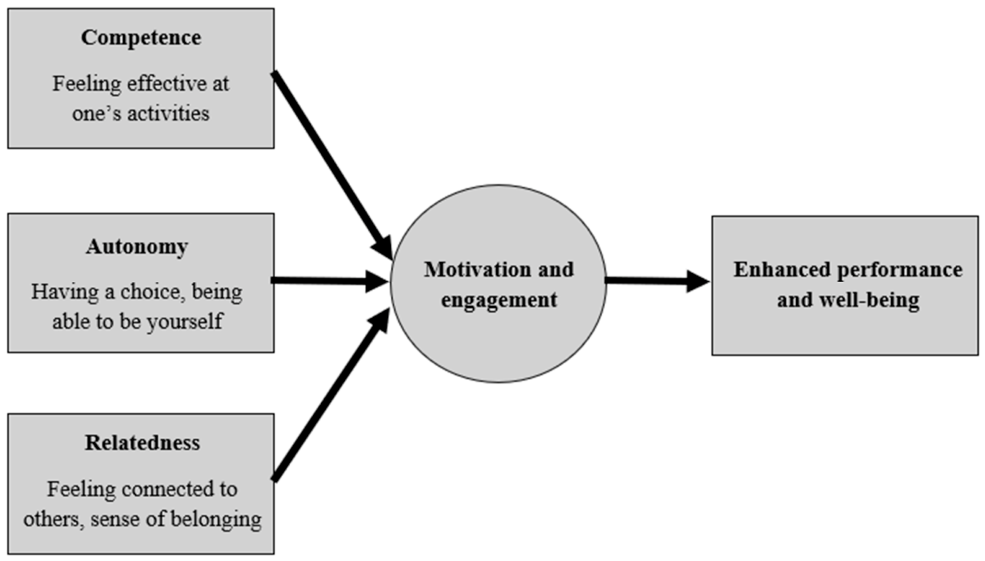
Self-Determination Theory (SDT; Ryan & Deci, 2017, Figure 1) provides a useful framework for examining how learning environments shape students’ motivation and well-being. According to SDT, three basic psychological needs, autonomy, competence, and relatedness, are essential for optimal functioning. When these needs are supported, students are more likely to experience engagement, persistence, and emotional sustainability; when they are frustrated, students may encounter stress, uncertainty, or reduced motivation (Vansteenkiste et al., 2019).
Figure 1.
Basic psychological needs within Self-Determination Theory. The figure illustrates the three basic psychological needs, autonomy, competence, and relatedness, and their role in supporting students’ motivation and well-being in blended learning environments. The layout is adapted conceptually from Ryan and Deci (2017), but represents an original visualization. It also offers a conceptual orientation for the study’s research questions, which consider how students navigate blended learning conditions in ways that relate to these motivational and relational dimensions.
In blended contexts, these needs take on specific forms. Flexible scheduling can support autonomy yet feel overwhelming when expectations or digital routines are unclear. Competence may be strengthened by multimodal materials yet challenged when platforms feel fragmented or feedback is limited (White et al., 2021). Relatedness may be fostered through synchronous interaction or visible instructor presence yet remain difficult to sustain when informal contact is limited (Fan et al., 2024). Recent work suggests that digital strain and institutional structures can indirectly shape need satisfaction by influencing students’ sense of clarity, orientation, and connection (Sanabria-Mazo et al., 2026). Rather than treating SDT as a prescriptive model, this study uses it as a sensitizing lens to explore how students interpret and negotiate their psychological needs within blended environments.
Taken together, these perspectives illustrate how blended learning can shape students’ psychological needs, yet they also suggest that certain aspects of students’ day-to-day experience remain less visible in current research. Existing studies describe structural features, digital routines, and forms of instructor presence, but they offer only a partial view of how students themselves navigate these conditions in practice. Even recent work on coherence across modalities (Alonso et al., 2025) and the emotional qualities of digital study rhythms (Sanabria-Mazo et al., 2026) pays limited attention to how moments of uncertainty, fragmentation, or reduced connection are experienced by students, and how such moments relate to feelings of autonomy, competence, and relatedness within structurally embedded blended programs. This study therefore turns to students’ own accounts to explore how these needs are negotiated within the everyday flow of blended learning.
RQ3.
How do students negotiate autonomy, competence, and relatedness within structurally embedded blended programs?
3. Goal and Context of the Study
Building on the gap identified in the theoretical background, this study aimed to develop a situated understanding of how students experience blended learning (BL) in relation to their psychological well-being. Rather than approaching BL as a set of predefined design choices, we considered it as an environment that students continuously move through and interpret, shaped by programme expectations, institutional structures, and the practical realities of studying across multiple settings. Guided by Self-Determination Theory (SDT; Ryan & Deci, 2017), the study focused on how feelings of autonomy, competence, and relatedness are supported or challenged within these environments, and how students make sense of the conditions that influence these needs. This focus follows directly from the recent literature, which highlights the ecological nature of BL but still offers only a partial view of how students themselves understand and navigate the environments in which they study.
To explore these dynamics, the study concentrated on how students describe their digital study practices and the contextual factors that shape them; how psychological needs are experienced within blended settings; and how institutional and programme arrangements influence the ways students navigate and interpret their study lives. These aims complement the research questions by specifying the aspects of students’ experiences that guided the analysis, and they reflect the need for a more fine-grained account of how blended environments are encountered in practice.
The study was situated within a large Flemish university offering blended bachelor and master programmes in psychology and educational sciences during the 2024–2025 academic year, a period in which digital learning practices were being further consolidated. Students engaged with a mix of synchronous and asynchronous tools, learning management systems, video-based lectures, digital assessment platforms, and collaborative online workspaces, while also navigating diverse home environments and programme-level expectations. These intersecting conditions formed the backdrop against which students’ experiences of BL were explored, and they resonate with a broader European context in which digital study practices have become an established part of everyday learning.
Although grounded in this specific institutional and cultural setting, the study’s attention to digital study practices, contextual navigation, and the role of psychological needs speaks to dynamics that are relevant across many blended learning environments. The perspective developed here is therefore contextually situated yet conceptually transferable, offering insights that may support institutions seeking to understand how students encounter and navigate blended programmes in practice.
4. Materials and Methods
4.1. Study Design
This study used a qualitative design, grounded in reflexive thematic analysis, based on semi-structured interviews to explore how students experience blended learning (BL) in relation to their psychological needs. A qualitative approach was chosen because it allows for rich, situated accounts of how students navigate the opportunities and tensions of blended environments in their everyday study practices. The aim was not representativeness, but depth and nuance in understanding how autonomy, competence, and relatedness are interpreted and negotiated within hybrid learning contexts. The study was conducted at a large Belgian university where BL is structurally embedded across several programs. This setting provided an opportunity to examine how students make sense of blended formats that form part of their routine academic experience rather than temporary or exceptional arrangements. Although qualitative findings are inherently context-bound, the structural integration of BL at this institution offers conditions that are comparable to many European higher-education settings. As such, the results may hold transferability for similar blended programs where students balance digital and on-campus components as part of their everyday learning ecology. Data were collected during April and May 2025, a period in which students were actively engaging with both digital and in-person components of their programmes. The interviews were designed to explore how students interpret and navigate blended learning in relation to autonomy, competence, and relatedness, forming the central purpose of the data collection.
4.2. Participants
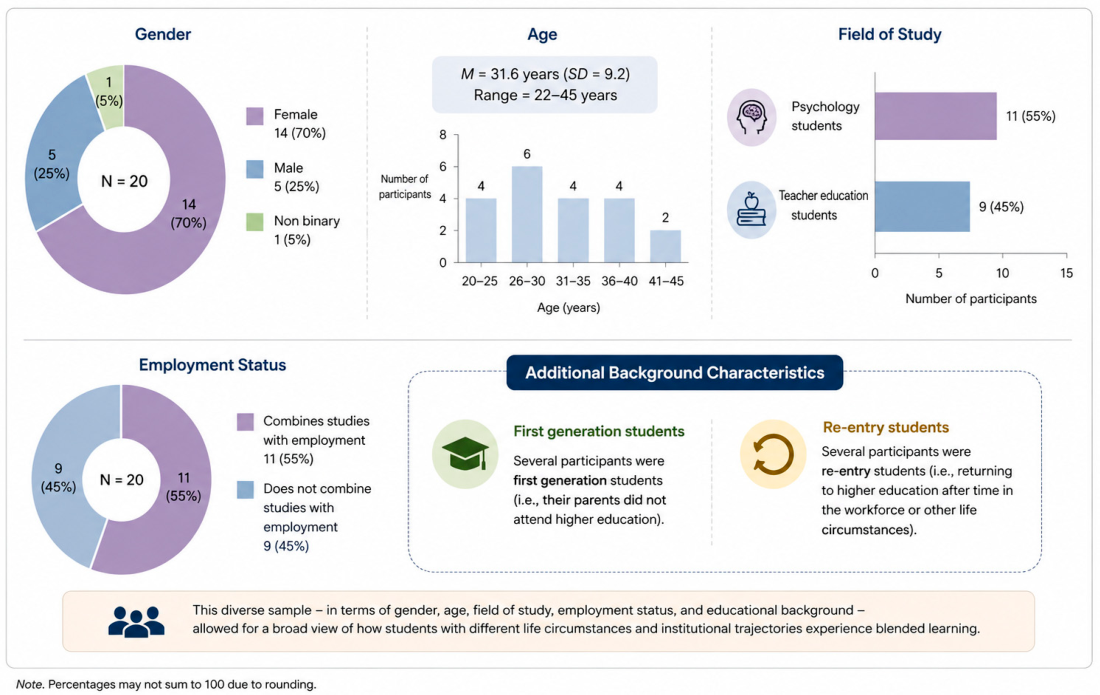
Figure 2 presents the participant demographics. Participants were recruited through announcements on the university’s online learning platform and brief invitations during lectures. Eligible students were currently or previously enrolled in a higher education program and had experience with blended learning. Interested students contacted the research team directly and received additional information about the study. In total, 20 students took part in the interviews. They ranged in age from 22 to 45 years (M = 31.6, SD = 9.2). Fourteen participants (70%) identified as female, five as male (25%), and one as non-binary (5%). The sample included 11 psychology students (55%) and 9 teacher education students (45%). More than half combined their studies with employment (55%), and several were first-generation or re-entry (i.e., individuals returning to higher education after time in the workforce or other life circumstances) students. This diversity allowed for a broad view of how students with different life circumstances and institutional trajectories experience blended learning.
Figure 2.
Participant characteristics (N = 20).
4.3. Recruitment and Procedure
After expressing interest, students received an information sheet outlining the study’s aims, procedures, and ethical safeguards. Those who agreed to participate scheduled an interview at a convenient time. All interviews were conducted remotely via Microsoft Teams by two members of the research team (F.L. and E.V.d.E.). One researcher acted as the primary interviewer, while the other observed and took reflective notes; these roles alternated across interviews. Remote interviewing was chosen for both practical and conceptual reasons: it increased accessibility for participants with work or caregiving responsibilities, and it aligned with the digitally mediated nature of the learning environments under study. Interviews lasted an average of 53 min and followed a semi-structured format that allowed participants to describe their experiences in their own terms while offering gentle prompts to explore relevant themes. Recordings were transcribed verbatim, identifying information was removed, and all data were stored securely on an encrypted server. After each interview, participants received a short debriefing and a resource sheet with contact information for mental health support services.
4.4. Materials
A semi-structured interview guide was developed to explore students’ experiences with blended learning and its relationship to their psychological needs. The guide was informed by Self-Determination Theory (SDT; Ryan & Deci, 2017), but questions were phrased broadly to allow participants to describe their experiences in their own terms. The guide covered four areas: (1) general experiences with BL, (2) emotional and motivational dynamics, (3) perceived links between BL design features and well-being, and (4) strengths and areas for improvement. Example prompts included: “How would you describe the role of blended learning in your program?”, “In what ways do you feel supported or challenged in shaping your learning process?”, and “How do the digital and in-person components influence your sense of connection or motivation?” The guide was piloted with three students to refine clarity and flow; these pilot interviews were not included in the final dataset. The full interview guide is provided in Appendix A.
4.5. Data Analysis
Data were analyzed using reflexive thematic analysis (RTA; Braun & Clarke, 2006), an approach that aligns with our aim to understand how students make sense of blended learning in their everyday study practices. The analytic process unfolded iteratively, with ongoing movement between the data, early insights, and emerging patterns. The researchers began by reading the transcripts several times to become familiar with the material and to note initial impressions. Coding was carried out inductively, while recognising that SDT served as a sensitising lens rather than a predefined structure. Codes were developed to capture moments in which students described feeling supported or challenged in terms of autonomy, competence, and relatedness, as well as broader experiences of navigating blended environments. Illustrative early codes included short phrases such as “reduced commuting time, studying at one’s own pace, and greater flexibility,” “difficulty concentrating during online classes,” “a higher threshold for contacting lecturers online,” “lecture recordings enhance feelings of competence,” and “a reduced sense of connection in online classes.” These codes evolved throughout the process as new nuances became visible.
During clustering, we paid particular attention to recurring concepts related to autonomy, clarity, social presence, and digital strain, as these appeared across interviews in varied forms. Codes that captured similar experiential qualities were grouped and compared, allowing us to trace how students described feeling supported or challenged within blended environments. Through iterative cycles of clustering, re-reading, and interpretative dialogue, these groups gradually developed into broader themes that reflected both shared patterns and meaningful divergences. This process emphasized interpretative meaning-making rather than mechanical categorization, ensuring that themes emerged organically from students’ accounts. The two researchers discussed their interpretations regularly, using these conversations to explore alternative readings, question assumptions, and reflect on how their own perspectives shaped the analytic process. Because both interviewers were familiar with blended learning environments through their roles within the institution, they remained attentive to how this shared context might subtly influence the kinds of follow-up questions they asked and the interpretative tendencies that emerged. Reflexive notes were used to capture these moments, helping to keep track of assumptions, emotional responses, and shifts in understanding as the analysis progressed. These exchanges helped cultivate a shared analytic orientation without aiming for consensus or a fixed codebook. As the analysis progressed, codes were examined for connections, tensions, and recurring patterns. Through cycles of clustering, re-reading, and memo writing, broader themes were constructed that captured how students experienced flexibility, belonging, competence, and digital strain within blended learning. These themes were refined to ensure they were coherent and meaningful while remaining grounded in the diversity of participants’ accounts. This reflexive engagement aligns with recommendations by Pearson et al. (2025), who emphasize the importance of attending to researcher positionings when analyzing inductive qualitative data.
5. Results
Reflexive thematic analysis of the semi-structured interviews resulted in four themes that describe how students navigated blended learning (BL) environments in relation to their psychological needs: (1) fostering flexibility while maintaining orientation, (2) cultivating belonging in blended spaces, (3) scaffolding competence and sustaining motivation, and (4) navigating digital strain. Table 1 presents an overview of the four themes. These themes capture recurring patterns in how students experienced autonomy, social connection, competence, and the emotional demands of digitally mediated study rhythms. Across our data, students described how blended formats opened possibilities for flexibility and accessibility while also introducing uncertainties, frictions, and affective tensions that shaped their engagement. The themes below present these patterned experiences, illustrated with representative quotations (all pseudonyms; discipline indicated as P = psychology or E = education). A reflexive validation process supported the analysis: the two researchers regularly discussed emerging interpretations and revisited transcripts to ensure that the developing themes remained closely connected to participants’ descriptions.
Table 1.
Overview of themes identified through reflexive thematic analysis.
5.1. Fostering Flexibility While Maintaining Orientation
Flexibility was consistently described as one of the most valued aspects of blended learning. Many students emphasized that asynchronous access, recordings, and adaptable study rhythms enabled them to combine academic work with employment, caregiving, or fluctuating health. For several, this flexibility was not simply convenient but essential:
“I simply couldn’t do this master’s without the recordings. I can’t just leave work to attend lectures, but this way I can watch in the evenings and catch up at weekends.”[Marianne, P]
“Being able to decide my own pace really helps. Some weeks I move faster, other weeks I slow down, and blended learning makes that possible.”[Mila, E]
Students often linked this flexibility to reduced stress and a greater sense of control over their learning. Being able to shift study time in response to personal circumstances was experienced as emotionally protective:
“The biggest advantage is the freedom to plan my own schedule. If I’m having a tough day, I can shift my study time without falling behind. That takes away a lot of stress.”[Noor, P]
At the same time, flexibility also introduced challenges. Several first-year students and those with less familiarity with higher education described feeling disoriented when structures were too open or when guidance was limited. Without clear expectations or predictable routines, flexibility could become overwhelming:
“Sometimes there’s so much freedom that you don’t even know where to start. Without a clear framework, the assignments just feel vague and stressful.”[Alex, E]
“The flexibility is great, but sometimes I wish there was a clearer path. Freedom is helpful, but not when it feels like you’re navigating alone.”[Noor, P]
“The freedom is motivating, but it can also be overwhelming. You have to constantly make decisions about how to study.”[Olivia, P]
Several students with ADHD described similar tensions. While they appreciated the ability to learn at their own pace, the absence of structured pacing or consistent deadlines sometimes intensified procrastination and cognitive overload:
“I can hyperfocus and watch a recording for hours, but then it takes me three days to finish one lecture. Without clear deadlines I just spiral.”[Peter, P]
Inconsistencies in uploading materials or last-minute changes to deadlines further undermined students’ sense of orientation:
“When a recording is missing, you just feel behind instantly. You can’t plan and it’s so stressful.”[Ella, E]
“If materials aren’t uploaded consistently, I lose my rhythm. Once I lose momentum, it’s really hard to get back into it.”[Jeremy, E]
Across participants, flexibility was experienced as supportive when embedded within stable digital routines and clear expectations. When these anchors were missing, students’ sense of autonomy became fragile, particularly among those with limited self-regulation or institutional familiarity.
5.2. Cultivating Belonging in Blended Spaces
Students frequently described how blended learning altered the social texture of their studies. Many noted that informal interaction, the spontaneous conversations, quick questions, and shared presence of campus life, was difficult to reproduce online:
“The social side of student life just disappeared. Online, it’s only you and your screen, no spontaneous chats or quick questions to classmates.”[Mila, E]
This sense of disconnection was especially pronounced among first-year and full-time students, who often struggled to build relationships or feel part of the academic community:
“I felt like just a number. In the first year, I hardly knew anyone. Online you don’t bump into people, and it makes it so much harder to ask for help.”[Mieke, P]
“It’s hard to make new friends online. You don’t have those small moments where you naturally start talking to someone.”[Hannah, P]
Working and re-entry students also experienced reduced peer contact, though they often framed it as an expected trade-off. Many relied on peer-led WhatsApp groups or informal networks to maintain connection, describing these as practical and emotionally supportive, yet limited in depth:
“WhatsApp is great for quick answers, but it doesn’t replace actually seeing each other. It’s easy to feel like you’re on your own.”[Jeremy, E]
Instructor presence played a notable role in shaping students’ sense of belonging. Prompt replies, personalized feedback, and small gestures of care helped students feel visible and supported:
“Professors who check in and answer quickly really make a difference. It feels like they see you, even online.”[Eva, E]
“When the lecturer shows up with energy, it pulls everyone in. Without that, the group just feels disconnected.”[Noor, P]
Conversely, inconsistent communication or instructors who were difficult to reach contributed to feelings of detachment. Some institutional attempts to foster community, such as group projects or welcome events, were experienced as superficial when not accompanied by clear purpose or sustained engagement:
“Some group projects just feel like filler. Half the group doesn’t participate, and instead of connection it creates frustration.”[Jana, P]
Across students, belonging did not emerge automatically in blended environments. Students described needing structured opportunities for interaction, consistent communication, and visible instructor engagement to feel connected within digitally mediated learning spaces.
5.3. Scaffolding Competence and Sustaining Motivation
Clear structure and predictable expectations were central to students’ sense of competence in blended learning. Many described how transparent guidelines, sequenced modules, and timely feedback helped them stay oriented and maintain motivation:
“When you know exactly what’s expected and when, it’s much easier to stay motivated. It gives a sense of control.”[Noor, P]
Lecture recordings supported comprehension by allowing students to revisit difficult material, while formative quizzes and scheduled feedback sessions helped them monitor progress. When these elements were consistent, students described feeling more confident and capable. However, inconsistencies across courses, such as varied policies on recordings, different uses of platforms, or unpredictable release of materials, created friction and cognitive load:
“Sometimes you’re just waiting for the recordings to show up and you can’t plan anything. It’s frustrating because you feel behind before you’ve even started.”[Ella, E]
Students with ADHD or limited experience with self-directed learning were particularly affected by these inconsistencies. Several described having to “re-learn” how each course worked, which fragmented their study routines and undermined coherence. Practical, hands-on skills posed additional challenges in online formats. Students in teacher education and psychology programs noted that digital simulations could not fully replace embodied practice:
“We don’t get enough hands-on practice. You can watch videos, but it’s not the same as doing it yourself with a teacher there to guide you.”[Renold, E]
Feedback emerged as a key element in sustaining competence. Even brief affirmations helped students feel reassured and motivated, while delayed or ambiguous feedback contributed to uncertainty:
“Just a quick ‘you’re on the right track’ makes such a difference. Without it you start doubting everything.”[Hannah, P]
“Even a short message like ‘this looks good’ keeps me going. Without feedback, I start doubting every step.”[Eva, E]
Across interviews, competence was supported when autonomy was paired with clear scaffolding, constructive feedback, and cross-course alignment. When these elements were inconsistent, students’ confidence and motivation became more fragile.
5.4. Navigating the Emotional and Cognitive Demands of Digital Study
Alongside the benefits of flexibility, many students described the emotional and cognitive toll of extended screen time and digitally mediated study rhythms. Fatigue, reduced focus, and a sense of being “drained” were common:
“At a certain point, you just feel drained from being behind a screen all the time. It’s harder to focus, and small tasks feel overwhelming.”[Kate, E]
“By the end of the week I feel mentally exhausted. It’s not one big thing, it’s the constant screen time that wears you down.”[Mila, E]
Several students emphasized how this fatigue accumulated across days, especially when online sessions were dense or poorly paced:
“After three online classes in a row, my head just shuts down. It’s like the screen eats your energy.”[Lotte, E]
The home environment often intensified these challenges. Without the spatial cues of a classroom, students found it harder to transition into learning mode:
“At home, I get distracted so quickly. In class, my brain automatically switches into focus mode, but online that just doesn’t happen.”[Olivia, P]
“At home there’s always something pulling my attention; my phone, noise, people walking around. It makes studying feel twice as hard.”[Jana, P]
Technical issues, unstable internet, login problems, and inconsistent platform navigation added further strain, particularly for students with limited digital literacy or inadequate hardware. Many described relying on peers rather than institutional services for support:
“If something’s wrong, it’s easier to just ask a friend than to email ICT and wait days for an answer.”[June, P]
Others noted that even small technical frictions could derail concentration or motivation:
“When the platform freezes, I lose my flow completely. It sounds minor, but it really breaks your rhythm.”[Saar, P]
Students also noted that institutional support services often felt distant or slow to respond, leaving them to manage digital strain largely on their own. Some described developing personal coping strategies, such as scheduled breaks or exercise, while others expressed uncertainty about how to manage the cumulative demands of blended study. Across participants, digital strain was not experienced as a single challenge but as an accumulation of small frictions, technical, cognitive, and emotional, that shaped students’ capacity to engage over time.
5.5. Summary of Findings
Table 2 presents a summary of main findings. Across the four themes, students described blended learning as a space of both possibility and tension. Flexibility supported autonomy but could become overwhelming without clear structure. Social connection required intentional cultivation, as belonging did not emerge organically in digitally mediated environments. Competence was strengthened by predictable scaffolding and responsive feedback, yet easily disrupted by inconsistencies across courses. Digital strain accumulated through extended screen time, technical frictions, and blurred boundaries between study and personal life. Together, these themes illustrate how students’ experiences of autonomy, competence, and relatedness were dynamically negotiated within blended learning environments, shaped by the interplay of digital infrastructures, instructional practices, and personal circumstances.
Table 2.
Summary of main findings across participants.
6. Discussion
The aim of this study was to explore how students experience blended learning (BL) in relation to their psychological needs. Across interviews, students described BL as a learning environment that opens possibilities for autonomy, access, and flexibility, while simultaneously introducing uncertainties, frictions, and affective tensions that shape their engagement. These findings resonate with research suggesting that BL can feel both enabling and demanding, depending on how students navigate its structures and rhythms (Hrastinski, 2019). The four themes illustrate how students negotiated these dynamics in their everyday study practices, and how experiences of autonomy, competence, and relatedness were continually shaped within blended learning contexts.
6.1. Negotiationg Autonomy Within Flexible Structures
Students consistently valued the flexibility that BL afforded, particularly those combining studies with work, caregiving, or fluctuating health. Flexibility enabled them to adapt study rhythms to personal circumstances, which many described as emotionally protective. These patterns align with research showing that flexibility can enhance students’ sense of volition when embedded within clear structures (Broadbent & Fuller-Tyszkiewicz, 2018). At the same time, students’ accounts revealed a more ambivalent experience than often reported in survey-based studies. For those who relied on external structure to maintain orientation, autonomy was not experienced as freedom but as an unanchored openness that could become overwhelming. This nuance echoes Self-Determination Theory, which conceptualizes autonomy not as independence but as a sense of volition and clarity in action (Ryan & Deci, 2017). In this study, autonomy was strengthened when students could make meaningful choices within a stable framework, and weakened when open structures lacked guidance or predictability. A small subgroup pattern emerged: employed students emphasized flexibility as essential for coordinating study with work responsibilities, whereas unemployed students described flexibility more in terms of pacing and personal preference. These differences were modest but consistent, and they nuance how autonomy was experienced across the sample.
6.2. Relatedness as a Fragile Dimension of Blended Participation
The shift to blended formats altered the social texture of students’ learning. Many described a reduction in informal interaction, spontaneous encounters, and embodied presence, elements that typically support the development of belonging. Prior research similarly notes that BL can unintentionally weaken social presence when interaction is not intentionally scaffolded (Kahu & Nelson, 2018; Redmond et al., 2018).
In this study, relatedness emerged as the most fragile of the three psychological needs. Students did not assume connection; they described it as something that needed to be actively cultivated. Instructor visibility played a central role: timely replies, personalized feedback, and small gestures of care helped students feel seen and supported, echoing findings that teacher immediacy is crucial for sustaining connection in digital environments (Martin et al., 2018). Conversely, inconsistent communication or limited visibility contributed to feelings of detachment. These accounts highlight that belonging in BL is not a natural by-product of hybrid formats but a relational practice that requires intentional design and sustained engagement.
6.3. Competence as a Product of Clarity, Coherence and Responsiveness
Students’ sense of competence was closely tied to the clarity and predictability of instructional structures. Transparent expectations, sequenced modules, and timely feedback helped them maintain orientation and monitor progress. These patterns align with research showing that structured learning pathways and consistent feedback enhance perceived competence and reduce cognitive load in BL environments (Jaggars & Xu, 2016). However, students also emphasized how inconsistencies across courses, such as varied policies on recordings, different uses of platforms, or unpredictable release of materials, undermined competence, particularly for those with ADHD or limited experience with self-directed learning. Rather than feeling empowered by autonomy, these students described fragmentation and cognitive overload. Practical, hands-on skills posed additional challenges, echoing findings that embodied learning is difficult to replicate digitally (DeCoito & Richardson, 2018). These accounts suggest that competence in BL is shaped not only by content mastery but by the coherence of instructional design and the responsiveness of feedback processes. Competence was supported when autonomy was paired with clear scaffolding and cross-course alignment, and weakened when these anchors were inconsistent.
6.4. The Cumulative Nature of Digital Strain
Alongside the benefits of flexibility, students described the emotional and cognitive demands of extended screen time and digitally mediated study rhythms. Digital fatigue, reduced focus, and blurred boundaries have been widely documented (Peper et al., 2021; Alonso et al., 2025). In this study, digital strain emerged not as a single challenge but as an accumulation of small frictions, technical issues, environmental distractions, and the absence of spatial cues, that shaped students’ capacity to engage over time. Students often relied on personal coping strategies or informal peer support, while institutional services were perceived as distant or slow to respond. These accounts highlight the importance of attending to the affective dimensions of BL participation, echoing calls for more attention to emotional sustainability in digital learning environments (Kahu & Lodge, 2022). Digital strain indirectly shaped students’ experiences of autonomy, competence, and relatedness by eroding their capacity to focus, participate, and maintain motivation. Taken together, these patterns illustrate how digital strain functions as a dynamic force that shapes students’ psychological needs in blended learning, offering a refinement of existing scholarship that has typically examined these needs in more stable or isolated terms.
6.5. Interpreting Blended Learning as a Dynamic, Situated Experience
Taken together, the findings illustrate that students’ experiences of autonomy, competence, and relatedness in BL are dynamic and context-dependent. Rather than functioning as stable traits, these needs were shaped by the interplay of digital structures, instructional practices, and personal circumstances. Flexibility and fragmentation often coexisted, and students’ well-being depended on how these conditions aligned with their life contexts and learning preferences. While prior work has described blended participation as context-dependent and relational (e.g., Kahu & Nelson, 2018; Hrastinski, 2019), less is known about how these dynamics intersect with students’ psychological needs in everyday digital study rhythms. By foregrounding these situated negotiations, the study contributes a more affective and relational understanding of BL participation. While BL offers meaningful opportunities for autonomy and access, it also introduces new forms of uncertainty and emotional labor. Understanding these dynamics may help educators design learning environments that are responsive to the diverse ways students inhabit blended spaces. By articulating how psychological needs are continually negotiated within digital study rhythms, the study extends blended learning research by foregrounding the affective and situated dimensions of participation that remain underexplored in the current literature.
6.6. Implications of the Study
The findings offer several implications for supporting students’ experiences within blended learning environments. These implications are intentionally practice-proximal, reflecting the concrete patterns described by students. First, flexibility was most supportive when paired with predictable digital routines and clear expectations. Timely release of materials, transparent deadlines, and stable weekly rhythms helped students navigate autonomy without becoming overwhelmed. Second, belonging required intentional cultivation. Instructor visibility, timely responses, and small gestures of care played an important role in helping students feel seen. Structured opportunities for peer interaction, such as small-group discussions or low-threshold collaborative activities, supported connection even when physical presence was limited. Third, competence was strengthened by clarity and responsiveness. Transparent expectations, consistent platform use, and timely feedback helped students maintain orientation. For skills that rely on embodied practice, blended formats may benefit from complementary in-person opportunities or guided practice moments.
Finally, digital strain highlighted the emotional and cognitive demands of sustained online engagement. Shorter, more interactive sessions, guidance on digital self-regulation, and accessible support channels may help students manage these demands. While individual coping strategies were common, students’ accounts suggest that shared norms and responsive support can play an important role in sustaining engagement. Taken together, these implications emphasize the value of small, relational, and rhythm-oriented practices that respond to the lived experiences of students navigating blended learning.
6.7. Limitations and Future Directions
This study offers an in-depth exploration of how students navigate blended learning in relation to their psychological needs, yet several limitations should be acknowledged. First, the findings are based on a relatively small and context-specific sample from a single institution. While this aligns with the aims of reflexive thematic analysis, which prioritizes depth and situated meaning-making over representativeness (Braun & Clarke, 2021), it also means that the patterns described here reflect the particularities of this group and their institutional context. Second, participation was voluntary, which may have attracted students who felt especially strongly about their BL experiences. Students who were less engaged or facing acute challenges may have been underrepresented. Third, although the sample included students with diverse life circumstances, the study did not systematically compare subgroups. Differences between first-year and working students, or between students with and without ADHD, emerged organically but were not the focus of the design.
Finally, the analysis reflects the interpretative work of the researchers, shaped by our theoretical lens and positionalities. Reflexive thematic analysis acknowledges that themes are not discovered but constructed through ongoing engagement with the data (Braun & Clarke, 2019). While reflexive dialogue supported analytic depth, other researchers might have emphasized different nuances. Rather than offering generalizable claims, the study provides a contextualized account of how students in this setting negotiated autonomy, competence, and relatedness within blended learning environments. The findings may be transferable to similar contexts where students navigate comparable structural and relational dynamics.
7. Conclusions
This study examined how students experience blended learning in relation to their psychological needs for autonomy, competence, and relatedness. Students described blended formats as offering meaningful opportunities for flexibility and access, while also introducing uncertainties and affective tensions that shaped their engagement. Autonomy was supported when flexibility was embedded within predictable digital routines; competence was strengthened through clear scaffolding and timely feedback; and relatedness depended on visible instructor presence and intentional opportunities for interaction. At the same time, digital strain accumulated through extended screen time, technical frictions, and blurred boundaries between study and personal life. Rather than proposing general design prescriptions, the findings underscore the importance of coherent digital structures, relational engagement, and accessible support in sustaining students’ emotional and motivational experience. Attending to these conditions may help institutions shape blended environments that align more closely with students’ everyday realities and support their well-being over time.
Author Contributions
Conceptualization, F.L., E.V.d.E. and J.T.; Methodology, F.L., E.V.d.E. and J.T.; Validation, F.L., E.V.d.E. and J.T.; Formal analysis, F.L. and E.V.d.E.; Investigation, F.L. and E.V.d.E.; Resources, J.T.; Data curation, F.L., E.V.d.E. and J.T.; Writing—original draft preparation, F.L. and E.V.d.E.; Writing—review and editing, J.T.; Visualization, F.L. and E.V.d.E.; Supervision, J.T.; Project administration, F.L., E.V.d.E. and J.T. All authors have read and agreed to the published version of the manuscript.
Funding
This research received no external funding.
Institutional Review Board Statement
The study was conducted in accordance with the Declaration of Helsinki, and approved by the Ethics Committee for Human Sciences of the Vrije Universiteit Brussel (protocol code ECHW_592, approved in April 2025).
Informed Consent Statement
Informed consent was obtained from all subjects involved in the study. Written informed consent has been obtained from the patient(s) to publish this paper.
Data Availability Statement
The data that support the findings of this study are available from the corresponding author upon reasonable request.
Acknowledgments
We would like to thank the students who participated in this study for sharing their experiences. During the preparation of this work the author(s) used ChatGPT 4.0 (OpenAI) and CoPilot to assist with language editing and refinement of wording. After using these tools/services, the authors reviewed and edited the content as needed and take full responsibility for the content of the publication.
Conflicts of Interest
The authors declare no conflicts of interest.
Abbreviations
The following abbreviations are used in this manuscript:
| BL | Blended Learning |
| SDT | Self-Determination Theory |
| RTA | Reflexive Thematic Analysis |
| ADHD | Attention-Deficit/Hyperactive Disorder |
| ICT | Information and Communication Technology |
Appendix A
Part 1—Experience with Blended Learning Technology Use
- Which digital tools do you use most frequently in your studies? (Canvas, Teams, interactive exercises, online learning materials, AI, …)
- How easy or difficult do you find it to work with these tools?
- What support is provided for using digital tools? Do you find this sufficient/too little/too much?
- What role do mobile devices (smartphone, tablet) play in your learning process?
Positive Aspects of Blended Learning
- Did you consciously choose this programme because of the blended learning format?
- What do you consider to be the main advantages of blended learning?
- Does blended learning increase your chances of successfully completing the programme? Why or why not?
- Which aspects of blended learning do you find most valuable?
Barriers
- Do you experience any problems with digital tools or blended learning? (Technical issues, time pressure, lack of support, platform navigation.)
- Do you easily find your way around the online learning platform?
- Do you feel that lecturers have sufficient experience with blended learning? (logical structure, variation in learning formats, knowledge of tools)
Part 2—Mental Well-Being & Self-Determination Theory
Autonomy
- Do you feel you have a lot of freedom in how you approach your studies?
- How important is autonomy to you? (score 1–5)
- How does blended learning influence your sense of autonomy?
- What do you consider to be the strengths of autonomy within this programme?
- What do you consider to be the weaknesses of autonomy within this programme?
- Do you have suggestions for improvement?
Competence
- How important is it for you to experience a sense of competence?
- How does blended learning help you develop your competences?
- Have there been moments when tasks were insufficiently structured or unclear?
- Do you think the mode of instruction (F2F/online/blended) affects your preparation as a future teacher?
Relatedness
- How important is relatedness for you within the programme?
- Do you find it important to know your fellow students?
- How do you experience communication between students, and between students and lecturers?
- Do you find it important that the programme emphasises collaboration (projects, master’s thesis)?
- Do you have suggestions for improving relatedness?
Part 3—Relationship Between Blended Learning and Well-Being
- How do the flexibility and possibilities, as well as the challenging aspects of blended learning, influence your well-being?
- Does blended learning affect your stress levels?
- Does blended learning affect your motivation?
- Have there been moments when blended learning had a positive or negative impact on your well-being?
- Does blended learning influence your balance between study and free time?
Part 4—Future Improvements
- Which elements of blended learning should definitely be retained?
- What would you change in the way blended learning is implemented to better support your well-being?
- How should blended learning be adapted in the future to achieve a better balance between learning and well-being?
References
- Adedoyin, O. B., & Soykan, E. (2023). COVID-19 pandemic and online learning: The challenges and opportunities. Interactive Learning Environments, 31(2), 863–875. [Google Scholar] [CrossRef] [Scilit]
- Alonso, R. K., Velez, A., Diego Mantecón, M. Á., & Heredia Oliva, E. (2025). Blended learning in higher education for the development of intrinsic motivation: A systematic review. Cogent Education, 12(1), 2487572. [Google Scholar] [CrossRef] [Scilit]
- Braun, V., & Clarke, V. (2006). Using thematic analysis in psychology. Qualitative Research in Psychology, 3(2), 77–101. [Google Scholar] [CrossRef] [Scilit]
- Braun, V., & Clarke, V. (2019). Reflecting on reflexive thematic analysis. Qualitative Research in Sport, Exercise and Health, 11(4), 589–597. [Google Scholar] [CrossRef] [Scilit]
- Braun, V., & Clarke, V. (2021). Can I use TA? Should I use TA? Should I not use TA? Comparing reflexive thematic analysis and other pattern-based qualitative analytic approaches. Counselling and Psychotherapy Research, 21(1), 37–47. [Google Scholar] [CrossRef] [Scilit]
- Broadbent, J., & Fuller-Tyszkiewicz, M. (2018). Profiles in self-regulated learning and their correlates for online and blended learning students. Educational Technology Research and Development, 66, 1435–1455. [Google Scholar] [CrossRef] [Scilit]
- DeCoito, I., & Richardson, T. (2018). Teachers and technology: Present practice and future directions. Journal of Teaching and Learning, 12(1), 1–19. [Google Scholar] [CrossRef] [Scilit]
- Fan, S., Trimble, A., Kember, D., Muir, T., Douglas, T., Wang, Y., Masters, J., & Mainsbridge, C. (2024). Supporting engagement and retention of online and blended-learning students: A qualitative study from an Australian university. The Australian Educational Researcher, 51(1), 403–421. [Google Scholar] [CrossRef] [Scilit] [PubMed]
- Howard, N. J. (2021). Navigating blended learning, negotiating professional identities. Journal of Further and Higher Education, 45(5), 654–671. [Google Scholar] [CrossRef] [Scilit]
- Hrastinski, S. (2019). What do we mean by blended learning? TechTrends, 63(5), 564–569. [Google Scholar] [CrossRef] [Scilit]
- Jaggars, S. S., & Xu, D. (2016). How do online course design features influence student performance? Computers & Education, 95, 270–284. [Google Scholar] [CrossRef] [Scilit]
- Kahu, E. R., & Lodge, J. M. (2022). Student engagement in the digital university: Sociomaterial perspectives. Higher Education Research & Development, 41(1), 1–15. [Google Scholar] [CrossRef] [Scilit]
- Kahu, E. R., & Nelson, K. (2018). Student engagement in the educational interface: Understanding the mechanisms of student success. Higher Education Research & Development, 37(1), 58–71. [Google Scholar] [CrossRef] [Scilit]
- Kumar, A., Krishnamurthi, R., Bhatia, S., Kaushik, K., Ahuja, N. J., Nayyar, A., & Masud, M. (2021). Blended learning tools and practices: A comprehensive analysis. IEEE Access, 9, 85151–85197. [Google Scholar] [CrossRef] [Scilit]
- Martin, F., Wang, C., & Sadaf, A. (2018). Student perception of helpfulness of facilitation strategies that enhance instructor presence, connectedness, engagement and learning in online courses. The Internet and Higher Education, 37, 52–65. [Google Scholar] [CrossRef] [Scilit]
- Megahed, N., & Hassan, A. (2022). A blended learning strategy: Reimagining the post-COVID-19 architectural education. Archnet-IJAR, 16(1), 184–202. [Google Scholar] [CrossRef] [Scilit]
- Pearson, H., Myall, M., Darlington, A. S., & Gibson, F. (2025). The approach and application of analysing inductive and deductive datasets: A worked example using reflexive thematic analysis. Qualitative Research in Psychology, 22(4), 842–886. [Google Scholar] [CrossRef] [Scilit]
- Peper, E., Wilson, V., Martin, M., Rosegard, E., & Harvey, R. (2021). Avoid Zoom fatigue, be present and learn. NeuroRegulation, 8(1), 3–12. [Google Scholar] [CrossRef] [Scilit]
- Raes, A. (2022). Exploring student and teacher experiences in hybrid learning environments: Does presence matter? Postdigital Science and Education, 4(1), 138–159. [Google Scholar] [CrossRef] [Scilit] [PubMed]
- Redmond, P., Heffernan, A., Abawi, L., Brown, A., & Henderson, R. (2018). An online engagement framework for higher education. Online Learning, 22(1), 183–204. [Google Scholar] [CrossRef] [Scilit]
- Ryan, R. M., & Deci, E. L. (2017). Self-determination theory: Basic psychological needs in motivation, development, and wellness. Guilford Press. [Google Scholar]
- Sanabria-Mazo, J. P., Bentil, H., Bonilla, I., Cladellas, R., Dudenaite, D., Tillmanns, T., Dobler, I., Muro, A., & Riva, E. (2026). Well-being in post-pandemic digital higher education: A scoping review of students and teaching staff. Cogent Education, 13(1), 2652188. [Google Scholar] [CrossRef] [Scilit]
- Singh, J., Steele, K., & Singh, L. (2021). Combining the best of online and face-to-face learning: Hybrid and blended learning approach for COVID-19 and beyond. Journal of Educational Technology Systems, 50(2), 140–171. [Google Scholar] [CrossRef] [Scilit]
- Torre, S., Ulloa Severino, A., & Ligorio, M. (2025). Learning outcomes and training satisfaction: A case study of blended customization in professional training. Technology, Knowledge and Learning, 30, 1663–1702. [Google Scholar] [CrossRef] [Scilit]
- Ubben, M. S., Kremer, F. E., Heinicke, S., Marohn, A., & Heusler, S. (2023). Smartphone usage in science education: A systematic literature review. Education Sciences, 13(4), 345. [Google Scholar] [CrossRef] [Scilit]
- Vansteenkiste, M., Aelterman, N., De Muynck, G.-J., Haerens, L., Patall, E. A., & Reeve, J. (2019). Seeking stability in stormy educational times: A need-based perspective on (de) motivating teaching grounded in self-determination theory. In Motivation in education at a time of global change: Theory, research, and implications for practice. Emerald Publishing Limited. [Google Scholar] [CrossRef] [Scilit]
- Watermeyer, R., Crick, T., Knight, C., & Goodall, J. (2021). COVID-19 and digital disruption in UK universities. Higher Education, 81, 623–641. [Google Scholar] [CrossRef] [Scilit] [PubMed]
- White, R. L., Bennie, A., Vasconcellos, D., Cinelli, R., Hilland, T., Owen, K. B., & Lonsdale, C. (2021). Self-determination theory in physical education: A systematic review of qualitative studies. Teaching and Teacher Education, 99, 103247. [Google Scholar] [CrossRef] [Scilit]

Disclaimer/Publisher’s Note: The statements, opinions and data contained in all publications are solely those of the individual author(s) and contributor(s) and not of MDPI and/or the editor(s). MDPI and/or the editor(s) disclaim responsibility for any injury to people or property resulting from any ideas, methods, instructions or products referred to in the content. |
© 2026 by the authors. Licensee MDPI, Basel, Switzerland. This article is an open access article distributed under the terms and conditions of the Creative Commons Attribution (CC BY) license.