


Abstract
Primary CLIL teacher wellbeing remains underexplored in France and Spain. This exploratory, context-specific qualitative study examined the factors that ten primary teachers, five in France (Montpellier and Lille) and five in Andalusia, associated with their wellbeing. Bronfenbrenner’s ecological framework, enriched with the ontosystem and the flourishing/floundering distinction, was used as an interpretive device. The interviews were analysed through reflexive thematic analysis. Participants’ accounts converged around perceived gaps in CLIL-specific training, time, coordination, and human and material resources, while differing in how they interpreted programme stability and recent policy change. The analysis tentatively developed a compensatory pedagogy of affection and a broader pattern of professional delegitimation and identity-related loss. Explicit bilingual professional shame appeared in one account. It also identified native-speaker-oriented linguistic self-demand and an emerging pattern of AI-assisted material adaptation across six accounts. We offer a provisional, context-specific tensional ecological framework to organise the relationships participants described between conditions perceived as structural pressures and personal, relational, formative, and material resources. The framework is intended as a heuristic and hypothesis-generating contribution rather than a validated causal or longitudinal model. The findings identify areas for institutional review and further research.
1. Introduction
France and Spain have developed bilingual education programmes over more than two decades through institutionally distinct models. Content and Language Integrated Learning (CLIL), known as EMILE (Enseignement d’une Matière par l’Intégration d’une Langue Étrangère) in France and AICLE (Aprendizaje Integrado de Contenidos y Lenguas Extranjeras) in Spain, has become a prominent pedagogical approach across Europe. For consistency, we use the international label CLIL throughout. The quality and sustainability of these programmes depend on interacting institutional, formative, material, pedagogical and relational conditions. Teachers are a central component of this broader ecology, particularly at primary level, yet their wellbeing within CLIL remains insufficiently studied.
Teaching ranks among the professions with the highest levels of stress, exhaustion and burnout (McInerney et al., 2018; Nwoko et al., 2023). Prior research has identified additional demands affecting CLIL teacher wellbeing. These include gaps in linguistic and didactic competence, the burden of producing teaching materials, limited institutional support and low social recognition (Coyle et al., 2010; Gruber et al., 2020; Pérez Cañado, 2012). The literature has also linked teacher wellbeing to pupil wellbeing and learning (Beames et al., 2023; McCallum & Price, 2010).
Although the topic is clearly relevant, empirical research treating primary CLIL teacher wellbeing as a distinct field remains very limited (Talbot et al., 2021). The literature reviewed concentrates mainly on secondary and higher education (Hessel et al., 2020; Hofstadler et al., 2021; Pappa et al., 2017; Ruiz-Cecilia et al., 2025). Among the studies we identified, Gruber et al. (2020) was the only international investigation focused specifically on primary education. To the best of our knowledge, we identified no published empirical study of this issue in the French or Spanish primary CLIL contexts and no comparison between the two settings.
The present study addresses this gap through a comparative qualitative analysis structured around the question: which factors do the primary CLIL teachers interviewed in France and Andalusia associate with their wellbeing, and how are these factors configured in their accounts? Following Aelterman et al. (2007), Dodge et al. (2012) and McCallum and Price (2016), we operationally conceptualise teacher wellbeing as the dynamic balance between the resources at teachers’ disposal (psychological, social, formative and material) and the professional challenges they face. We chose France and Andalusia because each represents the administrative level at which primary CLIL policy is defined. In France, guidelines fall under national authority. In Spain, educational competences are devolved to the autonomous communities. Andalusia therefore constitutes a distinct political and curricular unit with a consolidated CLIL programme in place since 2005 (Coyle et al., 2010; Palacios-Hidalgo et al., 2022). The comparison between national and subnational levels reflects a structural feature of the policy settings and is treated as part of the object of study.
To answer this question, we first identify the factors participants associated with their wellbeing and then analyse convergences and divergences between the two groups within the ecological systems of teacher wellbeing. On this premise, we offer a provisional, context-specific tensional ecological framework for interpreting the relationships participants described between conditions perceived as structural and personal, relational, formative and material resources.
2. Literature Review
2.1. CLIL Teaching in France and Spain
France and Spain have developed bilingual teaching traditions through institutional models that are not directly equivalent. In France, the sections internationales (1981) and the sections européennes (1992) consolidated school bilingualism mainly at the secondary level, while bilingual teaching in primary education, gathered under the EMILE umbrella, has developed more recently and unevenly (Azaoui et al., 2025). In Spain, CLIL-based bilingual education took root following the MEC–British Council agreement (1996) and the pioneering regional programmes in Madrid (2004) and Andalusia (2005) (Coyle et al., 2010; Palacios-Hidalgo et al., 2022).
The regulatory frameworks also differ: French policies are defined centrally, whereas Spanish policies depend largely on the autonomous communities. Azaoui et al. (2025) report that EMILE implementation in French primary education has grown in recent years but remains flexible and heterogeneous. There is no unified national definition, criteria vary between schools, and official texts frame EMILE chiefly as a means of improving foreign-language proficiency. They address the integration of content and language less explicitly. In Spain, by contrast, AICLE is a well-established methodological reference, with implementation across educational stages and a substantial literature on teacher training, assessment, attention to diversity and linguistic scaffolding (Campillo et al., 2019; Custodio Espinar & García Ramos, 2020; Pérez Cañado, 2012; Pladevall-Ballester, 2014). The literature therefore suggests a difference in emphasis, in that Spain has addressed CLIL teacher education more extensively, whereas the French framework remains more institutional than methodological. In France, implementation often depends on individual teacher initiative, and outcomes remain insufficiently documented (Azaoui et al., 2025).
2.2. Teacher Wellbeing from an Ecological Perspective
Wellbeing is a complex construct in educational psychology and lacks a consensus definition (Mercer, 2023). Available conceptualisations generally frame it as a dynamic balance between the resources available to individuals and the challenges they face (Aelterman et al., 2007; Dodge et al., 2012; McCallum & Price, 2016). Ryff’s model of psychological wellbeing (Ryff, 1989; Ryff & Singer, 1998, 2002) is particularly relevant to the identity-related, relational and professional experiences examined here. It comprises six dimensions: self-acceptance, positive relations with others, autonomy, environmental mastery, purpose in life and personal growth.
Öztürk et al. (2024) identify three predominant discourses in research on teacher wellbeing: negativity, flourishing and professional development. These discourses are rarely integrated. TALIS (OECD, 2025), in turn, combines direct indicators such as stress, satisfaction and intention to leave with organisational and systemic determinants.
Drawing on teacher-wellbeing adaptations of Bronfenbrenner’s framework (Hofstadler et al., 2021; Jin et al., 2021; Price & McCallum, 2015), we use the ecological levels as permeable analytical locations, rather than mutually exclusive containers. The macrosystem covers broad policy, regulatory, cultural and professional conditions, whereas the exosystem covers institutional decisions and resource arrangements that affect teachers without their direct participation. The mesosystem concerns connections among immediate CLIL settings and actors, and the microsystem concerns direct classroom and school interactions and practices. The chronosystem captures biographical and policy-related change over time. Following Jin et al. (2021), the ontosystem comprises teachers’ biographical, identity-related, psychological and social resources. When a phenomenon spans levels, we locate it according to its principal mechanism while acknowledging overlap. This is an adapted analytical use of the ecological model, rather than a strict reproduction of Bronfenbrenner’s original classification. We operationally define teacher wellbeing as the balance between resources and challenges (Aelterman et al., 2007; Dodge et al., 2012; McCallum & Price, 2016). Ryff’s (1989) dimensions structured the interview guide, the flourishing/floundering distinction (Gruber et al., 2020) denotes possible outcome configurations, and the Job Demands–Resources model (Bakker & Demerouti, 2017) provides a comparative lens in Section 5. Wellbeing is thus treated as situated, multilevel and dynamic.
2.3. The Wellbeing of Primary CLIL Teachers: An Empirical Gap
Research on primary CLIL teacher wellbeing remains limited (Talbot et al., 2021). Among the studies identified in our review, work on CLIL teacher psychology concentrates on secondary and higher education (Hessel et al., 2020; Hofstadler et al., 2021; Pappa et al., 2017; Ruiz-Cecilia et al., 2025). Gruber et al. (2020) was the only study we identified that focused specifically on primary education. Its interview findings linked threats to wellbeing with material shortages, negative perceptions of the profession, low social status and the linguistic demands of CLIL. Relationships with pupils and belief in the value of the approach acted as protective factors. The authors described this duality as flourishing or floundering. The same context may therefore support fulfilment or create strain, depending on the interaction between available resources and professional demands.
In the literature reviewed, we found no published empirical study specifically addressing primary CLIL teacher wellbeing in France or Spain. The British Council report (Azaoui et al., 2025) likewise characterises research on French primary bilingual classroom practices as still emerging. TALIS data (OECD, 2025) describe French teachers as working under high institutional pressure, with training shortfalls, limited social recognition and a perceived erosion of working conditions, alongside clear signs of attrition. In Spain, related literature has examined programme implementation and teacher preparation, rather than wellbeing as a primary object (Pavón Vázquez et al., 2020; Pérez Cañado, 2016). The Spanish TALIS report (MEFPD, 2025) shows a teaching profile that combines high job satisfaction and a low intention to leave, with rising stress. It identifies teacher collaboration and accessible school leadership as protective factors, whereas bureaucracy, low perceived social status and poorly managed reforms may undermine wellbeing.
3. Materials and Methods
3.1. Research Design
This study adopts a contextual-constructivist qualitative orientation (Braun & Clarke, 2006, 2019). It assumes that meanings are culturally situated and produced through interaction between individuals and their contexts. This position aligns with reflexive thematic analysis (RTA) and with the study’s ecological view of teacher wellbeing as shaped by institutional structures, relational networks and biographical trajectories. We use Braun and Clarke’s (2019) approach to RTA, which treats analysis as an active, recursive and theoretically informed process of constructing patterns of meaning. It allows theoretically informed interpretation while remaining open to meanings not specified in advance.
3.2. Participants and Context
The final sample consists of ten primary teachers working in CLIL programmes: five in France (Montpellier, n = 2, academic year 2023–2024; Lille, n = 3, academic year 2024–2025) and five in Andalusia, Spain (Granada, Jaén, Almería and Cádiz, academic year 2024–2025). The comparison concerns participants situated within two policy frameworks, nationally defined bilingual-education policy in France and regionally defined policy in Andalusia. It does not assume uniform implementation within either setting.
Participants were recruited through purposive and snowball sampling via professional contacts developed through Primary Education practicum networks in both settings. The inclusion criteria were (a) being a practising primary teacher; (b) teaching at least one non-language subject through a foreign language under a CLIL model; (c) having a minimum of three academic years of CLIL experience; and (d) practising in publicly funded schools. Trainee teachers, substitute teachers without continuity, and teachers from grant-aided or private schools were excluded. Recruitment relationships and their reflexive implications are detailed in Section 3.5.
Regarding school context, funding status and urban or peri-urban location were taken from formal school information. All ten schools were publicly funded, most were urban, a few peri-urban, and none rural. The remaining profile was based on participants’ descriptions. They portrayed the schools as serving predominantly locally monolingual populations alongside varying numbers of plurilingual pupils from migrant backgrounds, and as mainly middle-class. The exceptions were the schools of P1F and P2F, which they identified as REP+ and as serving more socio-economically vulnerable communities. Participants also reported seven to twelve years of CLIL/EMILE provision. No systematic school-level data were collected on socioeconomic composition, migration background, vulnerability or programme duration. The research team’s contextual knowledge informed interpretation but was not treated as independent verification. Interview-based claims about pupils and families are attributed as participants’ perceptions in the Results.
The sample size (n = 10) was guided by the principle of information power (Malterud et al., 2016; Sim et al., 2018). The specificity of the research question, participants’ direct CLIL experience, and the length and depth of the interviews (45–90 min) provided sufficient material for the exploratory aims. The corpus enabled preliminary theme construction and contextually situated comparison of how participants related wellbeing to conditions across ecological levels. It was not intended to cover policy system comprehensively, establish pattern prevalence, or exhaust experiences within or between settings.
Complete equivalence between the two subsamples in training profile was not possible. As shown below, the French participants had a predominantly generalist profile combined with a language certificate (B2 or higher). The Andalusian participants were more heterogeneous: three combined generalist training with a foreign-language specialisation, one combined generalist training with a language certificate, and one was a foreign-language specialist. This difference reflects the respective primary-teacher training models and is considered in Section 5. Table 1a,b present participants’ sociodemographic, professional, linguistic and CLIL-related characteristics.
Table 1.
(a) Sociodemographic and professional characteristics of the participating teachers. (b) Linguistic and CLIL-related profile of the participating teachers.
3.3. Data Collection
We used in-depth semi-structured interviews to explore subjective perceptions and meanings while retaining sufficient thematic consistency for comparison. The Spanish interview guide was developed from the literature, with Ryff’s model of psychological wellbeing (Ryff, 1989; Ryff & Keyes, 1995) used to organise broad areas of inquiry, rather than as a coding frame. Its four sections addressed professional trajectory and identity, self-perception and autonomy, interpersonal relations, institutional and curricular conditions, professional goals and development, and CLIL-specific challenges. Three experts, two in qualitative educational research and one in foreign-language didactics, reviewed the Spanish version and refined its organisation and wording. R1, R2 and R3 then adapted it for primary education and the French context. Core questions remained unchanged in Montpellier, Lille and Andalusia. Only linguistic and contextual references varied. Relevant differences between the Spanish and French versions were discussed without formal back-translation. In both versions, “department” referred to the relevant subject-specialist group, such as the foreign languages, English, French or CLIL group. R2 generally followed the planned order but adjusted the order of questions when participants anticipated later topics. Neutral follow-up prompts requested examples, clarification, perceived effects or changes over time. All participants were asked directly when and why they used the L1 during CLIL lessons, although the guide did not systematically introduce the labels code-switching, translanguaging or native-speaker norms. The guide structured the conversation but did not predetermine themes or function as a codebook. File S1 provides the Spanish and French guides, an English translation prepared for publication and two transparency tables: one links the prompts to Ryff’s dimensions, and the other shows how selected analytical topics were addressed in the guide.
Data collection took place in Montpellier (April–June 2024), Lille (May–June 2025) and Andalusia (February–April 2025). Interviews were conducted face-to-face or online in quiet, private settings. R2 conducted all ten interviews in participants’ first language. They lasted 45–90 min and were audio- and video-recorded after oral consent to recording had been obtained and documented at the beginning of each interview. R1–R3 translated the French transcripts into Spanish for comparative analysis, and all four researchers checked them against the originals. Following Temple and Young (2004), translation was meaning-oriented. Culturally or emotionally dense segments were discussed against the French originals, and related codes were also applied to those originals. During analysis, R2 and R3 translated the French quotations directly into English, while R1 and R2 translated the Spanish quotations. R1 and R2 checked the English versions against the source extracts and, for French material, the Spanish analytic translations. When alternatives remained, R1 and R3 returned to the original wording and analytical context to agree on the final wording. All translators participated in the analysis. Fine distinctions among embarrassment, shame, identity-related loss and professional delegitimation were discussed explicitly, and participant wording was distinguished from higher-order constructs. File S2 presents the original wording and published English versions of analytically central quotations. Markers of orality were reduced only when they hindered readability.
3.4. Data Analysis
Analysis followed Braun and Clarke’s (2006, 2019) six recursive phases. We worked by hand to remain close to the material. R2 undertook initial broad coding; the others questioned, extended and revised it in collaborative sessions. These were not independent coding checks for accuracy or agreement, but opportunities to compare readings, challenge assumptions, notice overlooked meanings, examine tensions across cases and refine themes’ central organising concepts. Coding was open, predominantly semantic and data-led, without an a priori codebook or ecological categories. Candidate themes preceded ecological mapping; Ryff’s dimensions, the resource–challenge balance and flourishing/floundering informed later interpretation. Analysis then moved abductively between data and literature. No inter-coder agreement index was calculated because RTA treats coding as interpretive, rather than as discovery of a fixed reality (Braun & Clarke, 2019).
For member reflection, R2 contacted P1F, P2F, P7E and P9E, selected for varied profiles and experiences. Each received by email an individualised thematic summary, full transcript and audio recording, and was invited to identify meanings that resonated or were missing, possible misreadings, alternative interpretations, or material to remove or qualify. Their responses did not prompt changes and were treated as reflections on experiential resonance and plausibility, not validation of a single correct interpretation. Table 2 summarises the eight data-led themes and their ecological placement. Later interpretive formulations constitute subsequent analytical layers.
Table 2.
Thematic structure constructed before ecological mapping.
3.5. Researcher Positionality and Reflexivity
Consistent with RTA, we treated codes, themes and the framework as analytic constructions shaped by the dataset and the research team’s positioning (Braun & Clarke, 2019). All four researchers work in language and literature education and have experience as CLIL teacher educators. R1, R2 and R4 were Spanish-speaking researchers based in the Faculty of Education Sciences at a Spanish public university. R3 was a French-speaking researcher based in the Faculty of Education at a French public university. R1 and R2 had advanced French and English, R3 advanced Spanish and English, and R4 C2 English and intermediate French. The team held mixed views of CLIL, and no member entered the study committed to defending, criticising or expanding it.
Participants were professional contacts reached through Primary Education practicum networks. R1 recruited the five Andalusian participants and R3 the five French participants. R2, known to them through these networks, conducted all interviews in their first language. R1–R3 translated the French transcripts into Spanish, and all four checked them against the originals. R4’s role concentrated on coding, interpretive validation and drafting. As the team shared a disciplinary background, differences arose mainly from national, institutional and linguistic positioning, and were used to question context-bound assumptions.
Reflexivity involved periodic analytical meetings, a shared decision log, and critical dialogue that challenged assumptions and opened alternative readings. The team’s earlier study of Andalusian secondary CLIL teachers created a recognised risk of importing previous categories, so initial coding remained open and data-led, and ecological systems were introduced only after provisional themes had been constructed. In one documented discussion, institutional disenchantment had begun to absorb extracts later interpreted as identity-related loss. The team distinguished cognitive evaluation of programme conditions from perceived symbolic loss tied to professional identity, revised the category boundaries and retained identity-related loss as a higher-order interpretation, rather than an equivalent main theme. The decision was recorded in the analytical log. These practices sought to make the team’s subjectivity visible, rather than remove it.
3.6. Rigour and Quality of the Analysis
Methodological quality was guided by Lincoln and Guba’s (1985) trustworthiness criteria, Tracy (2010), and RTA guidance (Braun & Clarke, 2006, 2019; Nowell et al., 2017). Used reflexively, quotations illustrate and situate interpretations, rather than verify them; contextual and participant description supports transferability; and the analytical record traces the development of codes and themes. Positionality, collaborative dialogue and member reflection exposed interpretive choices, rather than minimising researcher influence or validating a definitive reading. These criteria were flexible principles, not fixed procedural standards.
3.7. Ethical Considerations
The study followed ethical principles for research with human participants in the social sciences and education (World Medical Association, 2025; European Parliament and Council of the European Union, 2016; Jefatura del Estado, 2018; République française, 1978; British Educational Research Association, 2018). Before participation, all participants received information about the study’s aims, the voluntary nature of participation, their right to withdraw, the recording procedures, and the measures used to protect confidentiality, and they signed informed consent forms. The forms covered participation, confidential handling, analysis and interpretation of the data, and dissemination of findings in academic articles and conference presentations. Oral consent to audio and video recording was also obtained and documented at the beginning of each interview. Recordings and transcripts were stored in the University of Granada’s institutional Google Drive environment. Access was restricted to the four researchers through recipient-specific permissions requiring authentication. Cross-institutional access was granted through restricted links sent by institutional email. Participant codes (P1F–P5F in France and P6E–P10E in Spain), together with the removal or generalisation of identifying details, were used to protect confidentiality before quotations were published. The team will retain the recordings and pseudonymised transcripts for five years after publication and will then securely delete them, unless a longer period is required by institutional or funder obligations. The committee’s formal determination is reported in the closing declaration.
4. Results
The data-led analysis generated eight themes: professional identity and legitimacy; self-regulation, affect and professional boundaries; institutional conditions and work demands; collegial relations, coordination and intraprofessional stigma; families and the wider school community; CLIL/EMILE pedagogical practice; pupils and the pedagogical relationship; and professional meaning, commitment and continuity. Table 2 presents their organising concepts, principal subthemes, representative semantic codes, and main variations. Because the themes crossed ecological levels, the findings are presented through the adapted ecological classification defined in Section 2.2. The systems are treated as permeable analytical locations rather than exclusive categories, and cross-level findings are placed according to their principal mechanism. This ecological organisation was applied after provisional theme construction as an interpretive ordering device, not as a prior deductive coding matrix. Figure 1 offers a provisional heuristic for organising the relationships described in participants’ accounts. It does not represent an empirically established causal or temporal sequence. Table 3 specifies the operational boundaries.
Figure 1.
Provisional tensional ecological framework for interpreting CLIL teacher wellbeing. Note. Figure designed by the authors, drawing on Bronfenbrenner (1979, 2005), Gruber et al. (2020), and Jin et al. (2021). The dashed side arrows represent proposed interpretive relationships derived from participants’ accounts: perceived structural conditions may be experienced across the inner ecological systems, while teachers described personal, relational, formative and material resources used to manage them. Flourishing and floundering are represented as possible heuristic configurations, rather than as observed stages, fixed states or demonstrated transitions. The figure does not establish causal direction, sequence or temporal development. The boundaries between systems are analytical and permeable, as defined in Section 2.2.
Table 3.
Operational use and boundaries of the ecological systems in the present study.
4.1. Macrosystem
This section primarily brings together Theme 3 (institutional conditions and work demands) and the policy-related dimensions of Themes 6 and 8. Across participants’ accounts, limited training, recognition, time, and resources were interpreted as structural pressures whose effects were perceived across everyday professional settings.
All participants reported a lack of specific CLIL didactic training, which they identified as a major source of strain. Some emphasised the absence of linguistic and didactic preparation (P2F, P4F, P5F, P9E): “I had no training in language teaching … I never received didactic or pedagogical training for teaching a subject through a foreign language … I learned on the job, with my books and my own determination” (P2F). P8E described an initially improvised approach to CLIL and later training undertaken in personal time: “At first, I did not really know what a bilingual programme involved … I lacked training … most courses are online, at home, in your free time.” Most participants linked this gap to limited preparation for addressing learner diversity. In their accounts, responsibility for professional development therefore shifted from the institution to the individual.
Participants in both groups reported shortages of human and material resources. These included limited teaching and coordination time, insufficient support staff, such as language assistants and, in France, Accompagnants des élèves en situation de handicap (AESH), and a lack of bilingual textbooks adapted to primary education. Some participants interpreted these shortages as evidence of limited institutional commitment to the programme (P2F, P5F, P10E).
Most participants also described unfavourable structural conditions, including administrative neglect, outdated regulations, excessive bureaucracy, limited social and material recognition, and an expansion of responsibilities related to hygiene, values education and emotional support. This view was more pronounced among the five Andalusian participants, all of whom referred to the Instructions of 28 November 2023 (Junta de Andalucía, 2023). The Instructions aligned bilingual provision with the 2023 curriculum. In primary education, Conocimiento del Medio Natural, Social y Cultural is the only compulsory non-language area taught through the L2, while other areas depend on staffing. All five reported reductions of two to three weekly hours in their schools, and associated them with this reorganisation. They portrayed the bilingual programme as being in retreat and as an unfulfilled political promise (P6E–P10E). The five French participants, by contrast, portrayed their provision as under-resourced but historically stable (P1F–P5F).
4.2. Exosystem
At the exosystem level, Themes 3 and 6 concern institutional arrangements for training, staffing, time, materials, and guidance, which affected participants without their direct involvement in allocation decisions. Several participants requested more continuing education and criticised its scarcity and limited practical focus (P1F, P2F, P6E, P8E, P9E–P10E). Some also requested practical classroom-based support (P2F, P6E, P9E). Curricular guidelines were described as flexible, but less experienced participants sometimes experienced this flexibility as insufficient guidance (P2F, P4F, P10E).
4.3. Mesosystem
At the mesosystem level, Themes 4 and 5 concern the connections among colleagues, coordinators, leadership teams, language assistants, families, and other actors through which CLIL was organised.
Several participants described cooperation among specialist peers as effective and as a substitute for formal training. The two participants with coordination roles (P1F and P7E) described more negative experiences. They presented coordination as something that had to be secured, rather than as a routine arrangement, and reported having to pursue colleagues because meetings depended on individual initiative. They also described responsibility for organisation, materials and programme objectives without corresponding recognition or paid time. P7E explained: “I coordinate a team of 18 people … you may well see us arguing because we have not managed to find a single hour to meet on a Monday afternoon … coordination time is missing, and it is the basis of everything … hours are missing, and that translates into money.” The same participant added: “The leadership team trusts me a great deal. Let us leave it at that.” A small number of participants, nevertheless, described reliable peer support, although this was not the dominant pattern across the corpus.
Participants also described coordination with language assistants as important. When coordination was limited, the assistant could become an additional source of work, rather than support (P1F, P8E).
4.4. Microsystem
At the microsystem level, Themes 5–7 bring together the direct interactions and pedagogical practices through which institutional and relational conditions were experienced in everyday work.
Most participants expressed general satisfaction with the rules and day-to-day functioning of their schools, and felt that the professional and psychological support available within them was adequate.
Several Andalusian participants described an individualistic teaching culture (P6E, P8E, P10E), in which “everyone cooks their own dish and eats it alone” (P6E). The French participants more often reported difficulty collaborating with teachers who were not involved in bilingual provision (P1F, P2F, P4F–P5F). Reports of collegial hostility and stigma came only from Andalusian participants. P6E stated that “they treat us with enormous hostility,” while P9E said that colleagues sometimes tried to “undermine” bilingual teachers. P9E also reported that many non-bilingual colleagues opposed the programme, leading her to avoid conversations in which she was repeatedly asked to justify bilingual teaching.
The language assistant was described by most participants as positive in-class support, and greater availability was requested.
Participants in both groups reported that some families held unrealistic expectations about the speed and effectiveness of foreign-language acquisition (P1F, P3F, P6E, P8E, P10E). P2F and P8E also said that some families expressed distress about being unable to support their children in English. Participants described increasing demands and pressure on academic outcomes as sources of strain. Some Andalusian participants additionally perceived a post-pandemic devaluation of the teaching role: “they question everything you do” (P8E); “teaching is something anyone can do” (P6E). A small number described broadly supportive family relationships, indicating variation across cases.
Several participants perceived post-pandemic sociocultural regression among pupils in areas such as gender equality and respect for diversity (P2F, P3F, P4F, P6E, P8E, P9E). They partly associated these changes with unsupervised social-media use. Some Andalusian participants also perceived greater emotional fragility (P6E, P9E) and declining effort (P8E–P9E). These were teachers’ interpretations, not independently measured pupil characteristics. Participants in both groups described care as central to the pedagogical relationship (P2F, P4F, P8E, P10E). Most accounts concerned general pedagogical care, including protection from humiliation, empathetic responses to distress, and contextual interpretations of disruptive behaviour. A more specifically compensatory use of affection appeared in P8E’s account of work in disadvantaged schools: “I have worked in very tough schools … children of drug addicts … let’s give them what they lack, which is affection.” We therefore use compensatory pedagogy of affection tentatively for affection directed towards perceived unmet family or institutional needs, rather than for teacher care in general. P10E’s principle of treating pupils as she would wish her own children to be treated and P4F’s refusal to personalise disruptive behaviour illustrate the broader care pattern in the Andalusian and French accounts, respectively.
Four patterns were evident in participants’ descriptions of pedagogical practice. Andalusian participants reported predominantly instrumental reasons for joining the programme, whereas French participants more often described intrinsic, identity-related motivations. Andalusian participants also reported a sharper tension between language and content teaching, following reductions in instructional time. This tension affected both the organisation of learning and their sense of professional efficacy. Participants in both groups described native-speaker-oriented linguistic self-demand, particularly regarding fluency and accent. P1F noted that, although he considered his accent “passable,” he did not sound like a native English speaker. P3F similarly contrasted a good accent with a native accent. Classroom language practices varied independently. Approximately half of the participants described relatively strict language separation, whereas the remainder reported strategic L1 use or more plurilingual approaches. All participants were asked about L1 use, but the technical labels code-switching and translanguaging were not introduced systematically. The absence of these terms is therefore not treated as evidence that the practices were absent. Participants in both groups also associated attention to diversity with limited training, time and resources. P6E explained that, in a 50 min class with 26 pupils, “you don’t even have 2 min per student … so I go home frustrated.” P2F stated: “I ought to be using pedagogical differentiation, but honestly I don’t know how, I have no idea.” P6E also described a change in her view of inclusion: “I used to believe in inclusion in the mainstream classroom … I don’t any longer … sometimes a specific centre or classroom is what is best for a student.”
Six participants (P1F, P3F, P6E–P9E) referred to AI or AI-assisted digital resources in relation to material preparation. Reported tasks included simplifying or adapting texts, extracting key concepts or vocabulary, adjusting language level, and producing or locating classroom materials. Tool names were not consistently reported. P8E explicitly referred to Canva’s AI functions and described an application in which “you put in the text and it extracts the most basic words … it adapts the text to my pupils’ level … and you have it in 30 s.” The interviews did not establish frequency of use, formal institutional permission, or a shared verification protocol. Nor did every account distinguish generative AI from other automated tools. We therefore treat AI-assisted material adaptation as an emerging compensatory resource, rather than a consolidated practice.
4.5. Ontosystem
At the ontosystem level, Themes 1 and 2 concern the biographical, identity-related and psychological resources through which participants interpreted and regulated their professional experience.
The French participants entered the profession with basic teacher preparation that they generally described as insufficient for bilingual programmes. The Andalusian participants emphasised a lack of preparation for bilingual teaching and described varied career paths before obtaining permanent posts, including geographical mobility, further qualifications, retraining, and changes of specialism. Participants in both groups referred to influential teacher role models with comparable affective importance. None reported prior experience of bilingual or immersion education as a pupil.
Teacher identity also differed across accounts. In four of the five French accounts, participants described identity as gradually shaped by early bilingualism, with language forming an explicit component of the self. The Andalusian participants described the L2 as an acquired professional resource developed through experience, rather than as a foundation of biographical identity. Nevertheless, most participants in both groups regarded bilingual teaching as important to their professional identity. They associated it with cultural connection and positive influence, with approaches to error and self-compassion, and with interdisciplinary work, critical thinking, and professional collaboration.
All five Andalusian participants contributed to a broader pattern of professional delegitimation, but only P9E explicitly reported shame-related feelings: “I am often embarrassed to say that I am a bilingual primary teacher.” The other accounts concerned distinct experiences, rather than a single psychological state. These included perceived hostility and stigma (P6E), repeated professional questioning and self-censorship (P7E), dissatisfaction with programme conditions and policy direction (P8E), and loss of pedagogical legitimacy, expressed as “playing a part and not really teaching” (P10E). P9E also described avoiding conversations about bilingualism and reduced recognition of the role to being “bilingual to celebrate Halloween.” We therefore use professional delegitimation and identity-related loss as the broader interpretation, while reserving bilingual professional shame for P9E’s explicit account. To varying degrees, participants associated these experiences with the November 2023 Instructions and perceived programme retrenchment.
Most French participants described self-demand as a long-standing personal tendency that they had learned to manage. The Andalusian participants more often described their professional aspirations as constrained by external conditions, and referred to the 2023 Instructions when explaining this perception. Across both groups, participants described several ways of protecting their wellbeing: drawing on experience to gain distance, lowering expectations, accepting personal limits, practising self-care, seeking psychological support, reframing help-seeking as a strength, and using sport or meditation. P6E referred to being reminded that “you are not Superwoman” and stated, “I am not embarrassed to say that I go to a psychologist.” These strategies did not remove the reported pressures, but they helped participants continue working under strain. They may also make perceived institutional shortcomings less visible. We interpret some Andalusian accounts as expressing identity-related loss when these resources were described as insufficient in the face of perceived programme retrenchment. Among the French participants, some described a wish to change country (P1F) or to leave the programme when they no longer had sufficient energy (P2F, P5F).
The groups differed more clearly in how participants described their psychological resources than in the relational resources available to them. The French participants generally portrayed self-efficacy, optimism, hope and resilience as relatively stable, whereas the Andalusian participants described them as less stable, and associated this perception with administrative abandonment and the perceived weakening of the programme. Relational resources were expressed through the peer, family and classroom networks discussed at the micro- and mesosystem levels; when internalised as available support, they also formed part of participants’ social capital.
4.6. Chronosystem
At the chronosystem level, Theme 8 and the temporal dimensions of Themes 1 and 2 capture changes in professional identity, self-regulation, commitment and possible exit across participants’ careers. The chronosystem also adds a temporal dimension to the other systems by locating accounts of continuity, inertia and possible departure. Participants in both groups reported improved self-regulation with experience, but gave different reasons for remaining. French participants more often emphasised commitment to the programme and institution despite limited resources. Andalusian participants emphasised pupils’ learning (P8E), classroom relationships (P7E, P9E), and satisfaction with longer-term outcomes (P6E, P10E). Exit intentions were not universal, and several participants described continued commitment without plans to leave the programme, profession or country. Where exit was discussed, French participants considered broader changes, including moving country (P1F) or profession (P2F, P5F). Andalusian participants referred to leaving the bilingual programme (P6E, P8E, P10E); P8E had already applied through a competitive process to do so.
5. Discussion
This study addresses a gap identified in the literature reviewed: limited empirical evidence on primary CLIL teacher wellbeing in France and Spain (Azaoui et al., 2025; Pérez Cañado, 2016; Talbot et al., 2021). The closest international study identified was Gruber et al.’s (2020) research in Austria, which described tensions between autonomy and institutional abandonment. We found no study comparing how such processes were described in the two settings examined here. Our findings support a context-bound ecological interpretation of how the interviewed teachers related institutional conditions to relational, pedagogical and personal resources. Figure 1 organises these reported relationships as a provisional heuristic, not as an empirically established sequence. Because the eight themes in Table 2 cross ecological levels, Section 5 examines their interrelations rather than treating each theme or system separately.
All participants reported limited CLIL-specific didactic training and shortages of human or material resources. These accounts are consistent with earlier research (Coyle et al., 2010; Gruber et al., 2020; López Hernández, 2021; Pons Seguí, 2020; Porcedda & González Martínez, 2020). Participants linked the perceived gaps to everyday self-training and material preparation, rather than describing them only at policy level. We interpret voluntary self-training, often completed online and outside working hours, as a possible compensatory response. It may reduce immediate demands while making institutional gaps less visible, although this relationship requires further investigation. Moate (2011) found that teaching through a foreign language can carry a wellbeing cost even when teachers find it rewarding. This observation is consistent with our data and supports further attention to specific initial and continuing training.
Six participants described AI or AI-assisted tools as reducing material-preparation demands, chiefly through text simplification, linguistic adaptation and resource production. We retain this pattern because it recurred across accounts and connected perceived resource gaps with teachers’ compensatory practices, not merely because it may be novel. The tools, frequency of use, and verification procedures were incompletely specified, and the data do not support treating every resource as generative AI. The evidence therefore concerns immediate workload relief; possible longer-term institutional substitution is an authorial question for future research, rather than a participant-reported outcome.
Participants in both groups reported gaps in training and resources, but interpreted programme trajectories differently. French participants described bilingual provision as under-resourced yet stable. This is broadly consistent with Azaoui et al. (2025) and TALIS data (OECD, 2025), which describe stable employment alongside increasing symbolic and organisational demands in France. Andalusian participants portrayed provision as being in retreat and as an “unfulfilled political promise,” associating this trajectory with the November 2023 Instructions. Within this small sample, the difference suggests that wellbeing may relate not only to perceived institutional support, but also to participants’ interpretations of programme change over time. The accounts further suggest that the job satisfaction reported for Spanish teachers overall (MEFPD, 2025) can coexist with malaise among teachers who perceive local policy changes as detrimental. Because school timetables were not independently compared before and after the Instructions, these associations remain retrospective interpretations, rather than demonstrated effects.
Findings at the micro- and mesosystem levels are consistent with earlier observations that CLIL programmes often depend on individual effort (Pons Seguí, 2020; Porcedda & González Martínez, 2020). The two participants with coordination responsibilities (P1F and P7E) reported greater strain and described coordination as something that had to be secured, rather than as a routine arrangement. This is an exploratory observation based on two cases. It illustrates a gap between institutional support for collaboration and the recognised, remunerated time available for it (Pérez Cañado, 2012). Reports of collegial hostility from Andalusian participants add further context to the relational pressures described by Gruber et al. (2020). In these accounts, delegitimation was attributed not only to public opinion and families but also to colleagues who were not involved in bilingual provision. The material does not support treating stigma, self-censorship, policy disappointment and shame as identical states. Explicit bilingual professional shame was confined to P9E. Across the five Andalusian accounts, the broader convergence concerned professional delegitimation and identity-related loss. This interpretation is consistent with the professional-identity tensions discussed by Smajla (2021).
Participants’ reports of family pressure and expectations were consistent with Gruber et al. (2020), and several participants described perceived post-pandemic changes as an additional source of strain. Perceived emotional fragility among some pupils placed further pressure on the relational dimension, which is especially important in primary education because teachers spend extended time with the same group (Spilt et al., 2011). Participants in both groups described pedagogical care. Explicitly compensatory affection was clearest in P8E’s account of responding to perceived unmet family needs, with related vulnerability-oriented care in P4F and P10E. We therefore use compensatory pedagogy of affection tentatively, and distinguish it from teacher care more generally. This interpretation is consistent with Noddings’s ethics of care (Noddings, 1984, 2003) and Hochschild’s account of emotional labour (Hochschild, 1983/2012). Affection directed towards needs perceived beyond the classroom may provide meaning and relational protection while also increasing emotional labour. Margolis et al.’s (2014) warning that individual resilience can benefit institutions at the teacher’s expense is relevant to this dual role, but the present sample does not support a gender interpretation.
A further contrast concerned professional identity. French participants more often described an identity developed through early bilingual experience, with language forming part of their biographical sense of self. Andalusian participants described the L2 more often as a professional resource acquired through training and experience. This contrast relates to Ryff’s (1989) dimensions of purpose and personal growth. In the French accounts, language was linked to self-acceptance and autonomy. In the Andalusian accounts, it was described more instrumentally and alongside greater emotional vulnerability associated with perceived administrative retrenchment. This interpretation is consistent with the deficit-based view that Smajla (2021) identifies as a possible source of professional-identity tension in CLIL.
Accounts from both groups indicated native-speaker-oriented linguistic self-demand rather than a shared ideology of monolingual purism. Several participants treated native-like fluency or accent as a reference point, while classroom practices ranged from language separation to strategic L1 use and translanguaging. Because the interview guide asked about L1 use but did not systematically name technical practices, non-mention cannot be treated as evidence of non-use. The reported self-demand is compatible with Holliday’s (2006, 2015) account of native-speakerism, which places the idealised native speaker at the top of an implicit linguistic hierarchy. We use this as a cautious interpretive lens, not as evidence of a shared ideology. The accounts also contrast with integrated plurilingual frameworks (Coyle et al., 2010; García & Wei, 2014). Limited CLIL-specific preparation may intensify linguistic insecurity and the identity demands experienced by non-native CLIL teachers (Mercer & Kostoulas, 2018).
Participants described a broadly similar set of self-care strategies, consistent with Hofstadler et al. (2021), Jin et al.’s (2021) ontosystem, Ruiz-Cecilia et al. (2025), and the PERMA model (Seligman, 2011) as adapted by Mercer and Gregersen (2020). This pattern also aligns with research that treats teacher resilience as a dynamic process shaped by interactions among person, context and time, rather than as a stable trait (Beltman et al., 2011; Mansfield et al., 2016). Such a processual account is consistent with the provisional framework. Within this sample, differences in how French and Andalusian participants explained self-demand suggest that interpretations of the policy context may shape the experience of professional effort. Some Andalusian accounts combined perceived limits to these strategies with identity-related loss, including explicit embarrassment in P9E and role banalisation or the sense of “playing a part” in P10E. These accounts suggest strain extending beyond workload, but did not indicate a uniform response across participants.
5.1. A Provisional Tensional Ecological Framework for CLIL Teacher Wellbeing
By integrating the themes with the adapted ecological classification, we offer a provisional, context-specific framework for interpreting the relationships described in the interviews (Figure 1). Tensional refers to the coexistence of pressures perceived as structural and the personal, relational, formative and material resources through which participants sought to manage them. Their accounts suggest that macrosystemic and exosystemic conditions may be experienced in immediate professional settings, while ontosystemic resources and micro- and mesosystemic relationships may buffer or intensify perceived effects. Flourishing and floundering are treated as heuristic configurations, not as observed stages, fixed states or demonstrated transitions. The cross-sectional design cannot establish direction, sequence or temporal development.
The framework was developed through an abductive process between data and theory. Provisional themes were first constructed through open, predominantly semantic coding. Bronfenbrenner’s (1979, 2005) ecological architecture, Jin et al.’s (2021) ontosystem, and Gruber et al.’s (2020) flourishing/floundering distinction were then used to interpret relationships among them. The resulting context-bound hypothesis is that teachers’ accounts can be read as negotiations between conditions perceived as structural and resources located across ecological levels. Within this interpretation, the ontosystem comprises the biographical, identity-related and psychological resources through which professional experience is interpreted.
The framework can also be compared with the Job Demands–Resources model (Bakker & Demerouti, 2017; Demerouti et al., 2001). JD-R focuses primarily on organisational demands and resources, whereas the present framework locates reported demands and resources across a multilevel ecology and includes an identity-narrative dimension relevant to language teachers (Mercer & Kostoulas, 2018). It is intended as a heuristic for future longitudinal and mixed-method research, not as a validated explanatory model. Its value lies in organising questions about how pressures are perceived across levels, which resources may buffer or intensify them, and when accounts of flourishing or floundering may emerge.
5.2. Implications for Educational Policy and Teacher Training
Participants’ accounts identify several areas for institutional review, consistent with Azaoui et al. (2025), Gruber et al. (2020), MEFPD (2025), and OECD (2025). We distinguish between priorities emerging directly from reported needs and possible interventions whose effects require policy evaluation.
Participants consistently identified four areas for institutional review. First, they reported limited access to practical initial and continuing training for primary CLIL, including pedagogical, linguistic, diversity-related and context-sensitive plurilingual support. Second, they described insufficient time and recognition for bilingual coordination. Third, they reported shortages of materials adapted to primary education. Fourth, Andalusian participants called for review of the implementation and perceived consequences of the Instructions of 28 November 2023 (Junta de Andalucía, 2023). Consultation with bilingual teachers could form part of such a review. Future programme evaluations might also examine wellbeing and intentions to leave alongside linguistic outcomes. These priorities arise from participants’ accounts; the present study did not test the effects of specific interventions.
Several possible interventions are consistent with the findings and previous research, although each requires evaluation. Sustained mentoring could include protected time and incentives, following Naghieh et al.’s (2015) principle of intervening for teachers, rather than only in teachers. Institutions could also evaluate guidance for selecting, verifying and using AI-assisted materials pedagogically, given the absence of shared protocols in the interviews. Professional learning communities may support peer exchange and shared material development (Owen, 2016; Soini et al., 2010). In France, policy evaluation could examine the heterogeneity of designations and the absence of unified national guidelines for primary education (Azaoui et al., 2025). Transnational networks could likewise be evaluated as a means of sharing resources and practices. Their effects on teacher wellbeing and programme outcomes remain hypotheses for policy evaluation.
5.3. Limitations and Future Research
The study has several limitations. First, the purposively selected sample supported exploratory theme construction, but cannot represent either policy system comprehensively or establish the prevalence of the patterns identified. The comparative patterns and provisional framework require examination across more diverse participants, schools and sites. Second, the subsamples differed in training profile and gender composition: the French subsample was mixed, whereas the Andalusian subsample was exclusively female. Gender cannot therefore be separated from national or school context, and no gender interpretation is advanced. Third, the geographical scope, confined to Montpellier, Lille and Andalusia, does not capture the territorial heterogeneity of either country. Fourth, the cross-sectional design prevents analysis of changes in wellbeing over time. Fifth, recruitment through professional practicum contacts may have increased social desirability bias, while the team’s familiarity with CLIL may have shaped interpretation. These relationships and the corresponding reflexive safeguards are detailed in Section 3.5.
These limitations suggest several directions for future research. Longitudinal studies could examine whether the relationships proposed in the provisional framework recur and how they develop over time. Mixed-methods designs combining qualitative analysis with validated quantitative instruments, such as the Copenhagen Burnout Inventory, WHO-5 or PERMA measures, would also be valuable. Research could extend to other Spanish autonomous communities, French and Francophone regions, and European systems with contrasting CLIL developments. Further work should also examine the types, frequency, verification and institutional governance of AI-assisted material adaptation.
6. Conclusions
In response to the research question, the ten teachers associated their wellbeing with the balance between perceived institutional and pedagogical demands and personal, relational, formative and material resources. Their accounts converged around gaps in CLIL-specific training, time, coordination and adapted materials, but differed in interpretations of programme stability and policy change. Participants also described personal, relational and pedagogical ways of sustaining their work. The provisional tensional ecological framework organises these reported relationships as a context-specific heuristic, not as a validated explanatory theory or causal pathway. The analysis tentatively develops a compensatory pedagogy of affection and a broader pattern of professional delegitimation and identity-related loss. Explicit bilingual professional shame occurred in one account. Native-speaker-oriented linguistic self-demand and AI-assisted material adaptation across six accounts are differently supported observations, rather than equivalent constructs. These findings identify areas for institutional review and hypotheses for longitudinal and mixed-method research with more diverse participants and settings.
Supplementary Materials
The following supporting information can be downloaded at: https://www.mdpi.com/article/10.3390/educsci16081250/s1, File S1: Interview guides and adaptation across contexts, including Table S1: Indicative relationship between Ryff’s dimensions and the interview prompts, and Table S2: Relationship between interview prompts and selected analytical topics; File S2: Original-language wording and English translations of analytically central quotations, including Table S3: Source-language wording and English translations of selected extracts.
Author Contributions
Conceptualization, J.R.G.-O. and L.M.S.; methodology, J.R.G.-O. and L.M.S.; investigation, J.R.G.-O., L.M.S., B.A. and C.P.V.; formal analysis, J.R.G.-O., L.M.S., B.A. and C.P.V.; data curation, B.A.; validation, C.P.V.; writing—original draft preparation, L.M.S.; writing—review and editing, J.R.G.-O., L.M.S., B.A. and C.P.V.; translation, J.R.G.-O., L.M.S. and B.A.; supervision, J.R.G.-O.; funding acquisition, J.R.G.-O. All authors have read and agreed to the published version of the manuscript.
Funding
This research was conducted within the framework of project PID2021-128341OB-I0O, “An ecological study of the well-being of teachers of CLIL (Primary and Secondary Education) and CLIL/EMI (Universities) programmes in the Andalusian context” (WELL-CLIL), funded by MCIN/AEI/10.13039/501100011033 and by FEDER/UE.
Institutional Review Board Statement
Not applicable. Ethical review and approval were not required for this study in accordance with the institutional policy of the University of Granada Human Research Ethics Committee (reference 6190/CEIH/2026).
Informed Consent Statement
Written informed consent was obtained from all participants. Oral consent to audio and video recording was obtained and documented at the beginning of each interview.
Data Availability Statement
The qualitative data generated and analysed in this study (interview transcripts) are not publicly available in order to protect participants’ confidentiality, in accordance with the informed consent provided. Representative excerpts are reproduced in Section 4. Requests for additional information may be addressed to the corresponding author, subject to the ethical and confidentiality requirements governing the study.
Acknowledgments
We sincerely thank the participating teachers in France and Spain for the generosity with which they shared their professional experience despite demanding working conditions. We also thank the three experts who validated the interview guide for their constructive observations, and the coordinating team of project PID2021-128341OB-I00 for the institutional support provided. During the preparation and revision of this manuscript, the authors used an AI assistant (Anthropic, Claude Opus 4.7) for language editing, formatting and readability. The tool was not used for data collection, analysis or the generation of results. The authors reviewed and edited the output and take full responsibility for the content of this publication.
Conflicts of Interest
The authors declare that they have no conflict of interest in relation to the research, analysis, or publication of this article.
Correction Statement
This article has been republished with a minor correction to the Funding statement. This change does not affect the scientific content of the article.
Abbreviations
The following abbreviations are used in this manuscript:
| AESH | Accompagnant des élèves en situation de handicap |
| AICLE | Aprendizaje Integrado de Contenidos y Lenguas Extranjeras |
| BERA | British Educational Research Association |
| CLIL | Content and Language Integrated Learning |
| EMI | English-Medium Instruction |
| EMILE | Enseignement d’une Matière par l’Intégration d’une Langue Étrangère |
| GDPR | General Data Protection Regulation |
| IRB | Institutional Review Board |
| JD-R | Job Demands–Resources (model) |
| MEFPD | Ministerio de Educación, Formación Profesional y Deportes |
| OECD | Organisation for Economic Co-operation and Development |
| REP+ | Réseau d’éducation prioritaire renforcé |
| RTA | Reflexive Thematic Analysis |
| TALIS | Teaching and Learning International Survey |
References
- Aelterman, A., Engels, N., Van Petegem, K., & Verhaeghe, J. P. (2007). The wellbeing of teachers in Flanders: The importance of a supportive school culture. Educational Studies, 33(3), 285–297. [Google Scholar] [CrossRef] [Scilit]
- Azaoui, B., Skeet, J., Wilson, G., Cross, R., Veitch, A., Wiseman, A., Coyle, D., Payre-Ficout, C., & Rutgers, D. (2025). The current landscape of CLIL in primary education in France: An exploratory study and recommendations for further research into content and language integrated learning (CLIL). British Council. [Google Scholar] [CrossRef]
- Bakker, A. B., & Demerouti, E. (2017). Job demands–resources theory: Taking stock and looking forward. Journal of Occupational Health Psychology, 22(3), 273–285. [Google Scholar] [CrossRef] [Scilit] [PubMed]
- Beames, J. R., Spanos, S., Roberts, A., McGillivray, L., Li, S., Newby, J. M., O’Dea, B., & Werner-Seidler, A. (2023). Intervention programs targeting the mental health, professional burnout, and/or wellbeing of school teachers: Systematic review and meta-analyses. Educational Psychology Review, 35(1), 26. [Google Scholar] [CrossRef] [Scilit] [PubMed]
- Beltman, S., Mansfield, C., & Price, A. (2011). Thriving not just surviving: A review of research on teacher resilience. Educational Research Review, 6(3), 185–207. [Google Scholar] [CrossRef] [Scilit]
- Braun, V., & Clarke, V. (2006). Using thematic analysis in psychology. Qualitative Research in Psychology, 3(2), 77–101. [Google Scholar] [CrossRef] [Scilit]
- Braun, V., & Clarke, V. (2019). Reflecting on reflexive thematic analysis. Qualitative Research in Sport, Exercise and Health, 11(4), 589–597. [Google Scholar] [CrossRef] [Scilit]
- British Educational Research Association. (2018). Ethical guidelines for educational research (4th ed.). BERA. Available online: https://www.bera.ac.uk/publication/ethical-guidelines-for-educational-research-2018 (accessed on 8 February 2023).
- Bronfenbrenner, U. (1979). The ecology of human development: Experiments by nature and design. Harvard University Press. [Google Scholar]
- Bronfenbrenner, U. (Ed.). (2005). Making human beings human: Bioecological perspectives on human development. SAGE Publications. [Google Scholar]
- Campillo, J. M., Sánchez, R., & Miralles, P. (2019). Primary teachers’ perceptions of CLIL implementation in Spain. English Language Teaching, 12(4), 149–156. [Google Scholar] [CrossRef] [Scilit]
- Coyle, D., Hood, P., & Marsh, D. (2010). CLIL: Content and language integrated learning. Cambridge University Press. [Google Scholar]
- Custodio Espinar, M., & García Ramos, J. M. (2020). Medida de la competencia para programar AICLE y diagnóstico de las necesidades de formación docente. Bordón. Revista de Pedagogía, 72(1), 31–48. [Google Scholar] [CrossRef] [Scilit]
- Demerouti, E., Bakker, A. B., Nachreiner, F., & Schaufeli, W. B. (2001). The job demands-resources model of burnout. Journal of Applied Psychology, 86(3), 499–512. [Google Scholar] [CrossRef]
- Dodge, R., Daly, A. P., Huyton, J., & Sanders, L. D. (2012). The challenge of defining wellbeing. International Journal of Wellbeing, 2(3), 222–235. [Google Scholar] [CrossRef] [Scilit]
- European Parliament and Council of the European Union. (2016). Regulation (EU) 2016/679 of 27 April 2016 on the protection of natural persons with regard to the processing of personal data and on the free movement of such data. Official Journal of the European Union, L 119, 1–88. Available online: https://eur-lex.europa.eu/eli/reg/2016/679/oj (accessed on 20 March 2023).
- García, O., & Wei, L. (2014). Translanguaging: Language, bilingualism and education. Palgrave Macmillan. [Google Scholar] [CrossRef] [Scilit]
- Gruber, M. T., Lämmerer, A., Hofstadler, N., & Mercer, S. (2020). Flourishing or floundering: Factors contributing to CLIL primary teachers’ wellbeing in Austria. CLIL Journal of Innovation and Research in Plurilingual and Pluricultural Education, 3(1), 19–34. [Google Scholar] [CrossRef] [Scilit]
- Hessel, G., Talbot, K. R., Gruber, M.-T., & Mercer, S. (2020). The well-being and job satisfaction of secondary CLIL and tertiary EMI teachers in Austria. The Journal for the Psychology of Language Learning, 2(2), 73–91. [Google Scholar] [CrossRef] [Scilit]
- Hochschild, A. R. (2012). The managed heart: Commercialization of human feeling (3rd ed.). University of California Press. (Original work published 1983). [Google Scholar]
- Hofstadler, N., Babic, S., Lämmerer, A., Mercer, S., & Oberdorfer, P. (2021). The ecology of CLIL teachers in Austria—An ecological perspective on CLIL teachers’ wellbeing. Innovation in Language Learning and Teaching, 15(3), 218–232. [Google Scholar] [CrossRef] [Scilit]
- Holliday, A. (2006). Native-speakerism. ELT Journal, 60(4), 385–387. [Google Scholar] [CrossRef] [Scilit]
- Holliday, A. (2015). Native-speakerism: Taking the concept forward and achieving cultural belief. In A. Swan, P. J. Aboshiha, & A. Holliday (Eds.), (En)countering native-speakerism: Global perspectives (pp. 11–25). Palgrave Macmillan. [Google Scholar]
- Jefatura del Estado. (2018). Ley Orgánica 3/2018, de 5 de diciembre, de Protección de Datos Personales y garantía de los derechos digitales. Boletín Oficial del Estado, 294, BOE-A-2018-16673. Available online: https://www.boe.es/eli/es/lo/2018/12/05/3 (accessed on 11 March 2023).
- Jin, J., Mercer, S., Babic, S., & Mairitsch, A. (2021). Understanding the ecology of foreign language teacher wellbeing. In K. Budzińska, & O. Majchrzak (Eds.), Positive psychology in second and foreign language education (pp. 19–38). Springer. [Google Scholar] [CrossRef] [Scilit]
- Junta de Andalucía. (2023, November 28). Instrucciones de 28 de noviembre de 2023, de la Dirección General de Tecnologías Avanzadas y Transformación Educativa, sobre la organización y funcionamiento de la enseñanza bilingüe en los centros andaluces. Available online: https://www.juntadeandalucia.es/educacion/portales/web/inspeccion-educativa/w/instrucciones-de-28-de-noviembre-de-2023-de-la-direccion-general-de-tecnologias-avanzadas-y-transformacion-educativa-sobre-la-organizacion-y-funcionamiento-de-la-ensenanza-bilingue-en-los-centros-andaluces (accessed on 14 December 2023).
- Lincoln, Y. S., & Guba, E. G. (1985). Naturalistic inquiry. SAGE Publications. [Google Scholar]
- López Hernández, A. (2021). Initial teacher education of primary English and CLIL teachers: An analysis of the training curricula in the universities of the Madrid Autonomous Community (Spain). International Journal of Learning, Teaching and Educational Research, 20(3), 132–150. [Google Scholar] [CrossRef] [Scilit]
- Malterud, K., Siersma, V. D., & Guassora, A. D. (2016). Sample size in qualitative interview studies: Guided by information power. Qualitative Health Research, 26(13), 1753–1760. [Google Scholar] [CrossRef] [Scilit] [PubMed]
- Mansfield, C. F., Beltman, S., Broadley, T., & Weatherby-Fell, N. (2016). Building resilience in teacher education: An evidence informed framework. Teaching and Teacher Education, 54, 77–87. [Google Scholar] [CrossRef] [Scilit]
- Margolis, J., Hodge, A., & Alexandrou, A. (2014). The teacher educator’s role in promoting institutional versus individual teacher well-being. Journal of Education for Teaching, 40(4), 391–408. [Google Scholar] [CrossRef] [Scilit]
- McCallum, F., & Price, D. (2010). Well teachers, well students. Journal of Student Wellbeing, 4(1), 19–34. [Google Scholar] [CrossRef] [Scilit]
- McCallum, F., & Price, D. (Eds.). (2016). Nurturing wellbeing development in education: From little things, big things grow. Routledge. [Google Scholar] [CrossRef] [Scilit]
- McInerney, D. M., Korpershoek, H., Wang, H., & Morin, A. J. S. (2018). Teachers’ occupational attributes and their psychological wellbeing, job satisfaction, occupational self-concept and quitting intentions. Teaching and Teacher Education, 71, 145–158. [Google Scholar] [CrossRef] [Scilit]
- Mercer, S. (2023). The wellbeing of language teachers in the private sector: An ecological perspective. Language Teaching Research, 27(5), 1054–1077. [Google Scholar] [CrossRef] [Scilit]
- Mercer, S., & Gregersen, T. (2020). Teacher wellbeing. Oxford University Press. [Google Scholar]
- Mercer, S., & Kostoulas, A. (Eds.). (2018). Language teacher psychology. Multilingual Matters. [Google Scholar]
- Ministerio de Educación, Formación Profesional y Deportes, Instituto Nacional de Evaluación Educativa. (2025). TALIS 2024: Estudio internacional de la enseñanza y el aprendizaje. Informe español. Available online: https://www.educacionfpydeportes.gob.es/inee/evaluaciones-internacionales/talis/talis-2024.html (accessed on 9 April 2025).
- Moate, J. M. (2011). The impact of foreign language mediated teaching on teachers’ sense of professional integrity in the CLIL classroom. European Journal of Teacher Education, 34(3), 333–346. [Google Scholar] [CrossRef] [Scilit]
- Naghieh, A., Montgomery, P., Bonell, C. P., Thompson, M., & Aber, J. L. (2015). Organisational interventions for improving wellbeing and reducing work-related stress in teachers. Cochrane Database of Systematic Reviews, 2015(4), CD010306. [Google Scholar] [CrossRef] [Scilit] [PubMed]
- Noddings, N. (1984). Caring: A feminine approach to ethics and moral education. University of California Press. [Google Scholar]
- Noddings, N. (2003). Happiness and education. Cambridge University Press. [Google Scholar]
- Nowell, L. S., Norris, J. M., White, D. E., & Moules, N. J. (2017). Thematic analysis: Striving to meet the trustworthiness criteria. International Journal of Qualitative Methods, 16(1), 1–13. [Google Scholar] [CrossRef] [Scilit]
- Nwoko, J. C., Emeto, T. I., Malau-Aduli, A. E. O., & Malau-Aduli, B. S. (2023). A systematic review of the factors that influence teachers’ occupational wellbeing. International Journal of Environmental Research and Public Health, 20(12), 6070. [Google Scholar] [CrossRef] [Scilit] [PubMed]
- OECD. (2025). Results from TALIS 2024: The state of teaching. OECD Publishing. [Google Scholar] [CrossRef] [Scilit]
- Owen, S. (2016). Professional learning communities: Building skills, reinvigorating the passion, and nurturing teacher wellbeing and ‘flourishing’ within significantly innovative schooling contexts. Educational Review, 68(4), 403–419. [Google Scholar] [CrossRef] [Scilit]
- Öztürk, M., Wigelsworth, M., & Squires, G. (2024). A systematic review of primary school teachers’ wellbeing: Room for a holistic approach. Frontiers in Psychology, 15, 1358424. [Google Scholar] [CrossRef] [Scilit] [PubMed]
- Palacios-Hidalgo, F. J., Gómez-Parra, M. E., & Huertas-Abril, C. A. (2022). Spanish bilingual and language education: A historical view of language policies from EFL to CLIL. Policy Futures in Education, 20(8), 877–892. [Google Scholar] [CrossRef] [Scilit]
- Pappa, S., Moate, J., Ruohotie-Lyhty, M., & Eteläpelto, A. (2017). Teachers’ pedagogical and relational identity negotiation in the Finnish CLIL context. Teaching and Teacher Education, 65, 61–70. [Google Scholar] [CrossRef] [Scilit]
- Pavón Vázquez, V., Lancaster, N., & Bretones Callejas, C. (2020). Key issues in developing teachers’ competences for CLIL in Andalusia: Training, mobility and coordination. The Language Learning Journal, 48(1), 81–98. [Google Scholar] [CrossRef] [Scilit]
- Pérez Cañado, M. L. (2012). CLIL research in Europe: Past, present, and future. International Journal of Bilingual Education and Bilingualism, 15(3), 315–341. [Google Scholar] [CrossRef] [Scilit]
- Pérez Cañado, M. L. (2016). Are teachers ready for CLIL? Evidence from a European study. European Journal of Teacher Education, 39(2), 202–221. [Google Scholar] [CrossRef] [Scilit]
- Pladevall-Ballester, E. (2014). Exploring primary school CLIL perceptions in Catalonia: Students’, teachers’ and parents’ opinions and expectations. International Journal of Bilingual Education and Bilingualism, 18(1), 45–59. [Google Scholar] [CrossRef] [Scilit]
- Pons Seguí, L. (2020). Are pre-service foreign language teachers ready for CLIL in Catalonia? A needs analysis from stakeholders’ perspective. Porta Linguarum, (33), 279–295. [Google Scholar] [CrossRef] [Scilit]
- Porcedda, M. E., & González Martínez, J. (2020). CLIL teacher training: Lacks and suggestions from a systematic literature review. Enseñanza & Teaching, 38(1), 49–68. [Google Scholar] [CrossRef] [Scilit]
- Price, D., & McCallum, F. (2015). Ecological influences on teachers’ well-being and ‘fitness’. Asia-Pacific Journal of Teacher Education, 43(3), 195–209. [Google Scholar] [CrossRef] [Scilit]
- République française. (1978). Loi n° 78-17 du 6 janvier 1978 relative à l’informatique, aux fichiers et aux libertés. Journal Officiel de la République Française. Available online: https://www.legifrance.gouv.fr/loda/id/JORFTEXT000000886460 (accessed on 21 January 2023).
- Ruiz-Cecilia, R., Medina-Sánchez, L., & López-Rodríguez, S. (2025). Factors that promote teacher well-being: A qualitative study among Andalusian secondary CLIL teachers. Onomázein, NE XVI, 68–87. [Google Scholar] [CrossRef] [Scilit]
- Ryff, C. D. (1989). Happiness is everything, or is it? Explorations on the meaning of psychological well-being. Journal of Personality and Social Psychology, 57(6), 1069–1081. [Google Scholar] [CrossRef]
- Ryff, C. D., & Keyes, C. L. M. (1995). The structure of psychological well-being revisited. Journal of Personality and Social Psychology, 69(4), 719–727. [Google Scholar] [CrossRef] [PubMed]
- Ryff, C. D., & Singer, B. (1998). The contours of positive human health. Psychological Inquiry, 9(1), 1–28. [Google Scholar] [CrossRef] [Scilit] [PubMed]
- Ryff, C. D., & Singer, B. H. (2002). From social structure to biology: Integrative science in pursuit of human health and well-being. In C. R. Snyder, & S. J. Lopez (Eds.), Handbook of positive psychology (pp. 541–555). Oxford University Press. [Google Scholar]
- Seligman, M. E. P. (2011). Flourish: A visionary new understanding of happiness and well-being. Free Press. [Google Scholar]
- Sim, J., Saunders, B., Waterfield, J., & Kingstone, T. (2018). Can sample size in qualitative research be determined a priori? International Journal of Social Research Methodology, 21(5), 619–634. [Google Scholar] [CrossRef] [Scilit]
- Smajla, T. (2021). The suitability of foreign language teaching in childhood according to the CLIL approach: The foreign language teachers’ attitudes. English Language Teaching Educational Journal, 4(1), 1–14. [Google Scholar] [CrossRef] [Scilit]
- Soini, T., Pyhältö, K., & Pietarinen, J. (2010). Pedagogical well-being: Reflecting learning and well-being in teachers’ work. Teachers and Teaching: Theory and Practice, 16(6), 735–751. [Google Scholar] [CrossRef] [Scilit]
- Spilt, J. L., Koomen, H. M. Y., & Thijs, J. T. (2011). Teacher wellbeing: The importance of teacher–student relationships. Educational Psychology Review, 23(4), 457–477. [Google Scholar] [CrossRef] [Scilit]
- Talbot, K. R., Gruber, M. T., Lämmerer, A., Hofstadler, N., & Mercer, S. (2021). Comparatively speaking: CLIL/EMI teacher well-being at the primary, secondary and tertiary levels in Austria. In K. R. Talbot, M. T. Gruber, & R. Nishida (Eds.), The psychological experience of integrating content and language (pp. 153–173). Multilingual Matters. [Google Scholar]
- Temple, B., & Young, A. (2004). Qualitative research and translation dilemmas. Qualitative Research, 4(2), 161–178. [Google Scholar] [CrossRef] [Scilit]
- Tracy, S. J. (2010). Qualitative quality: Eight “big-tent” criteria for excellent qualitative research. Qualitative Inquiry, 16(10), 837–851. [Google Scholar] [CrossRef] [Scilit]
- World Medical Association. (2025). World Medical Association Declaration of Helsinki: Ethical principles for medical research involving human participants. JAMA, 333(1), 71–74. [Google Scholar] [CrossRef] [Scilit] [PubMed]
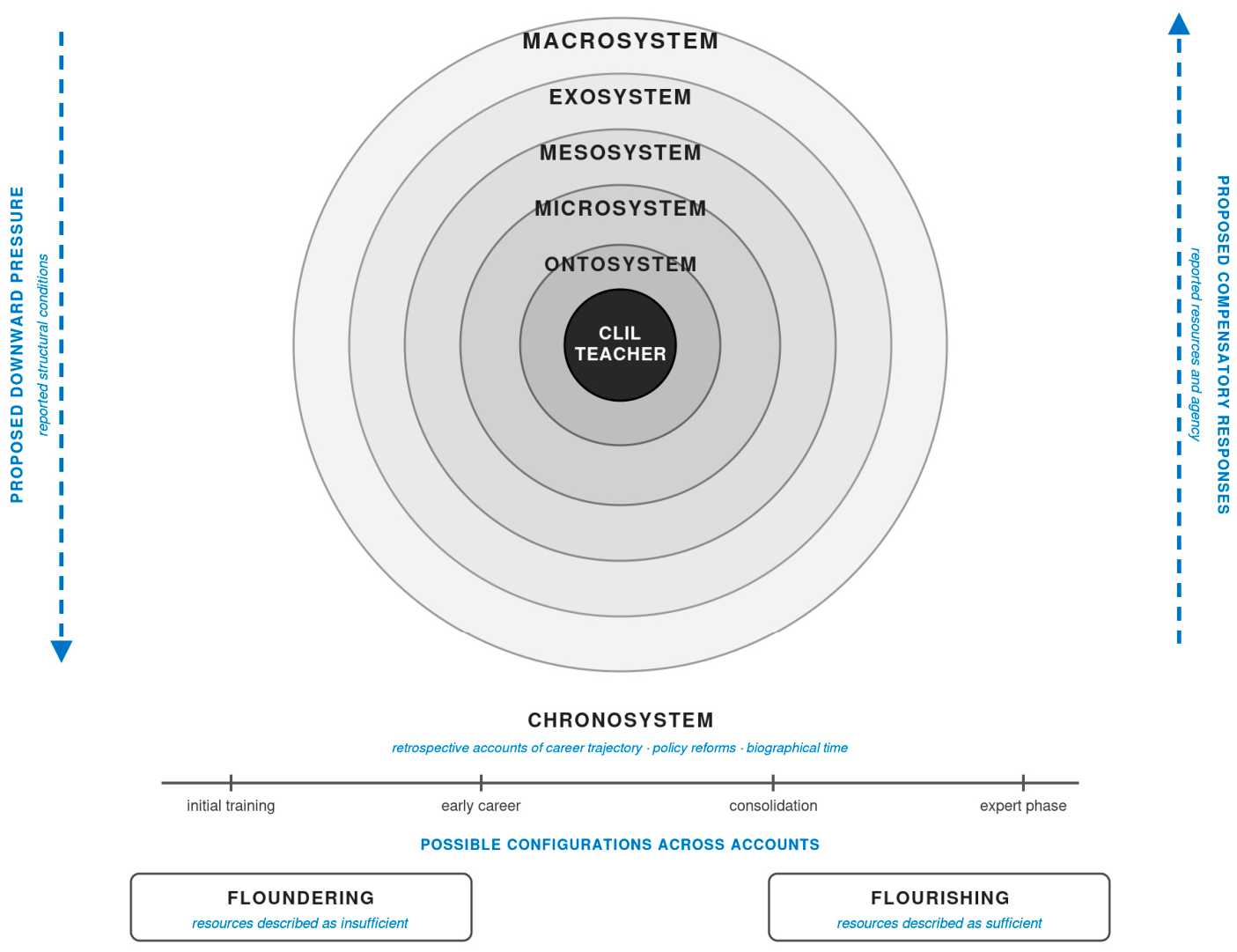

Disclaimer/Publisher’s Note: The statements, opinions and data contained in all publications are solely those of the individual author(s) and contributor(s) and not of MDPI and/or the editor(s). MDPI and/or the editor(s) disclaim responsibility for any injury to people or property resulting from any ideas, methods, instructions or products referred to in the content. |
© 2026 by the authors. Licensee MDPI, Basel, Switzerland. This article is an open access article distributed under the terms and conditions of the Creative Commons Attribution (CC BY) license.