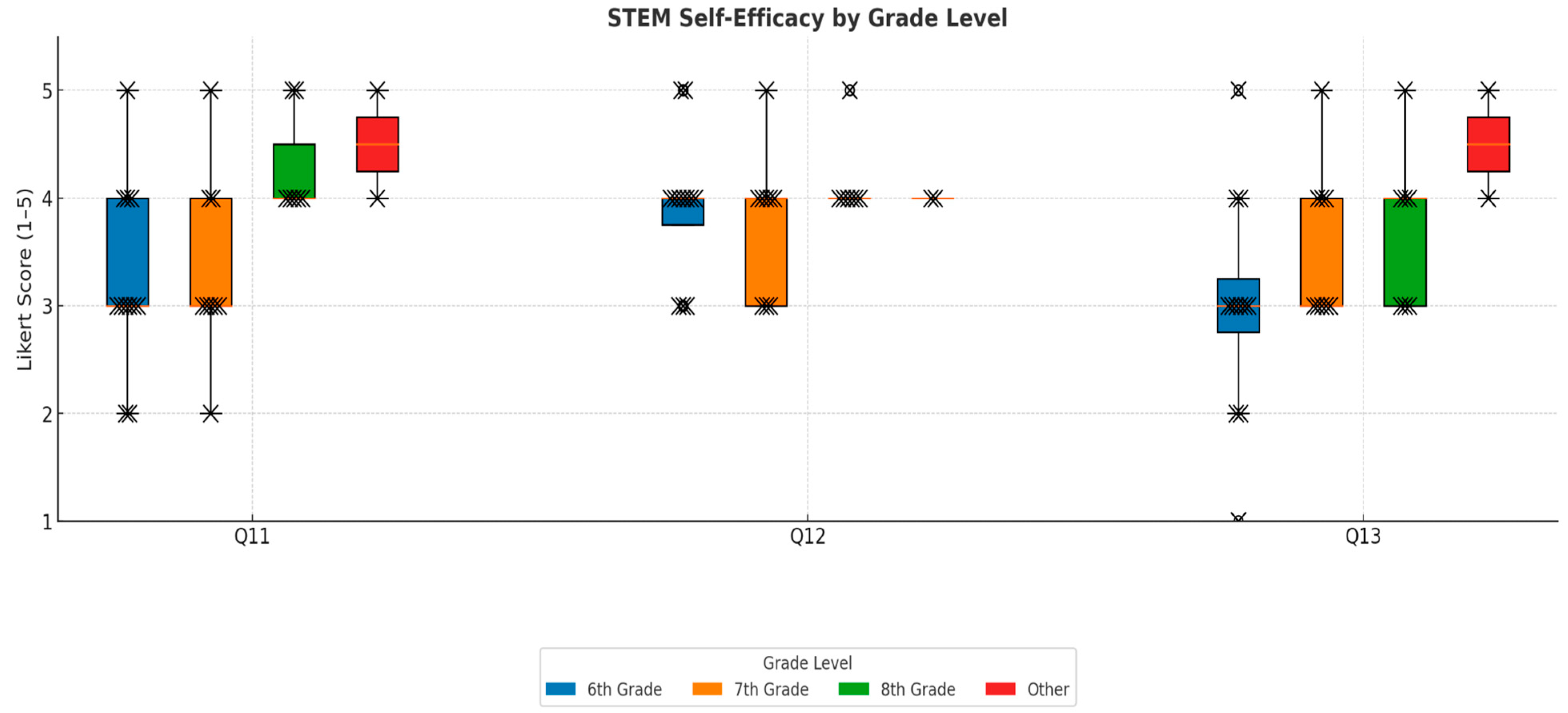
Middle School Students’ Interest and Self-Efficacy in a One-Day Informal STEM Learning Experience


Abstract
1. Introduction
2. Literature Review
2.1. STEM Interest Among Middle School Students
2.2. STEM Self-Efficacy
2.3. Informal STEM Learning Experiences with College Student Mentoring
2.4. Research Gap and Purpose of the Study
2.5. Research Questions
2.6. NSF STEM Day Event
2.6.1. Background
2.6.2. STEM Day at UNLV
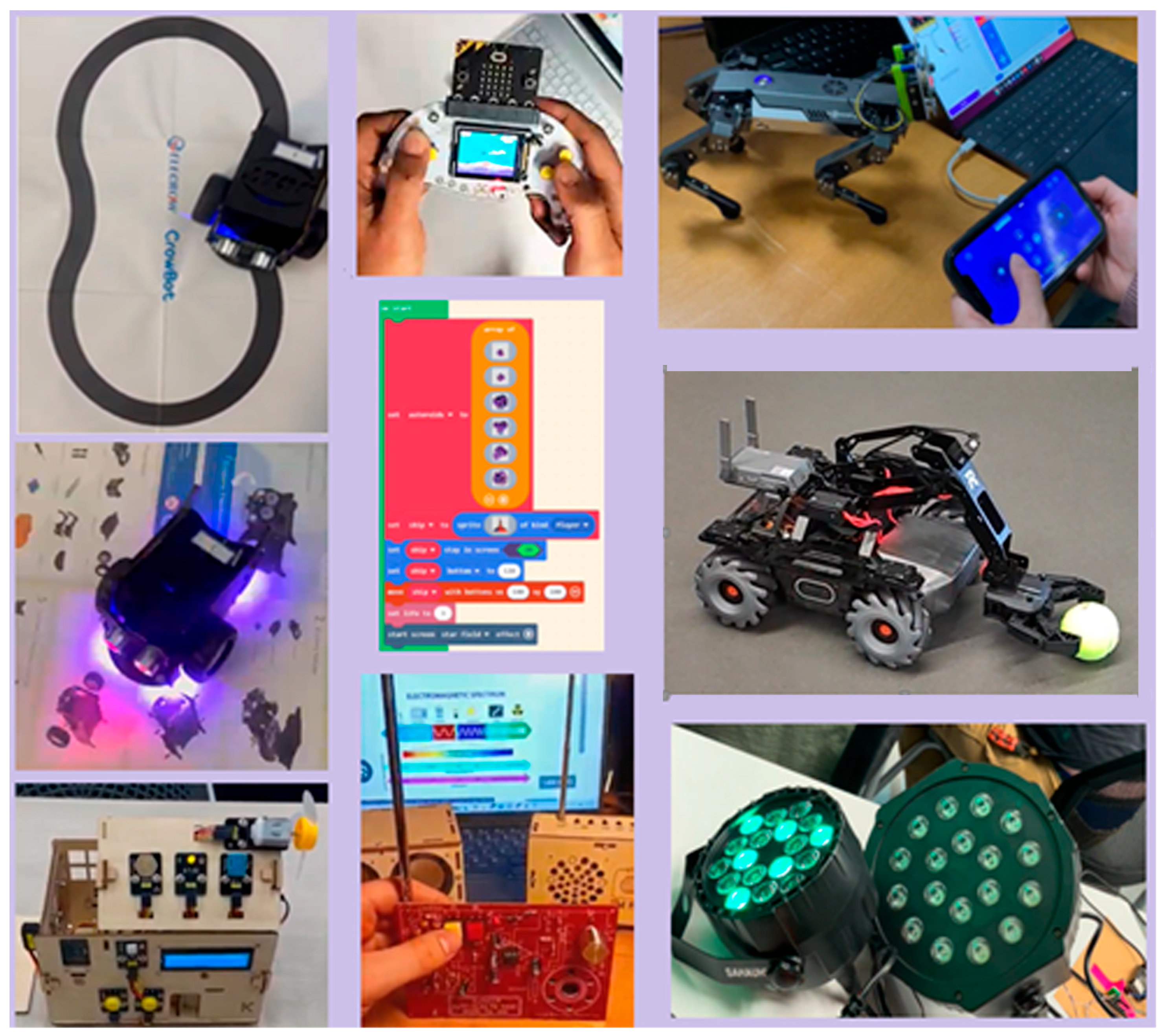
- Sphero Bolt demonstrated block coding for the Sphero Bolt and provided examples of navigating the robot.
- Tello Edu Drone demonstrated gesture control and remote control of the drone.
- The Robotic Dog kit demonstrated various ways to program and control a robot dog, including using both Java and block-based coding on the Micro:bit website. The students used a mobile app to interact with and control the robot.
- Micro:bit demonstrated development of games on the micro:bit utilizing the arcade controller and little bots.
- Robotic Arm/Hydraulic Hand and Arm Ball Caddy demonstrated a robot searching for the nearby tennis balls, picking them up, and dropping them at the desired spot.
- SmartFarm demonstrated the use of a microcontroller and sensors, and showed the functions of the farm.
- DMX Lighting fixtures with the control console demonstrated how DMX lighting fixtures can be controlled through software or a physical control board and explained how it works in the entertainment industry.
- FM Radio kits, Walkie-Talkies, and Bluetooth speakers explained the concepts of wireless communication and the technology that uses it, such as phones, radio, and Wi-Fi.
3. Methods
3.1. Participants of the Study
3.2. Instrument Development
3.3. Data Analysis
3.4. Limitations
3.5. Qualitative Methods
4. Results
4.1. STEM Interest
4.2. Student Self-Efficacy
4.3. College Mentors’ Reflections
5. Discussion
5.1. Students’ STEM Interest (RQ1)
5.2. Students’ STEM Self-Efficacy (RQ2)
5.3. Mentor-Led Hands-On Projects (RQ3)
5.4. Implications for Practices
5.5. Discussion and Conclusions
Author Contributions
Funding
Institutional Review Board Statement
Informed Consent Statement
Data Availability Statement
Acknowledgments
Conflicts of Interest
Appendix A. Survey Questions
References
- Archer, L., DeWitt, J., Osborne, J., Dillon, J., Willis, B., & Wong, B. (2012). Science aspirations, capital, and family habitus: How families shape children’s engagement and identification with science. American Educational Research Journal, 49(5), 881–908. [Google Scholar] [CrossRef]
- Archer, M., DeWitt, J., Davenport, C., Keenan, O., Coghill, L., Christodoulou, A., & Hou, L. (2020). Going beyond the one-off: How can STEM engagement programmes with young people have real lasting impact? arXiv. [CrossRef]
- Bandura, A. (1997). Self-efficacy: The exercise of control (Vol. 11). W. H. Freeman. [Google Scholar]
- Beier, M. E., Kim, M. H., Saterbak, A., Leautaud, V., Bishnoi, S., & Gilberto, J. M. (2019). The effect of authentic project-based learning on attitudes and career aspirations in STEM. Journal of Research in Science Teaching, 56(1), 3–23. [Google Scholar] [CrossRef]
- Brown, P. L., Concannon, J. P., Marx, D., Donaldson, C., & Black, A. (2016). An examination of middle school students’ STEM self-efficacy, interests, and perceptions. Journal of STEM Education: Innovations and Research, 17(3), 27–38. [Google Scholar]
- Chiang, F. K., Zhang, Y., Zhu, D., Shang, X., & Jiang, Z. (2022). The influence of online STEM education camps on students’ self-efficacy, computational thinking, and task value. Journal of Science Education and Technology, 31(4), 461–472. [Google Scholar] [CrossRef] [PubMed]
- Greene, J. P., Kisida, B., & Bowen, D. H. (2014). Value of field trips. Education Next, 14(1), 78–86. [Google Scholar]
- Habig, B., Gupta, P., Levine, B., & Adams, J. (2020). An informal science education program’s impact on STEM major and STEM career outcomes. Research in Science Education, 50(3), 1051–1074. [Google Scholar]
- Hidi, S., & Renninger, K. A. (2006). The four-phase model of interest development. Educational Psychologist, 41(2), 111–127. [Google Scholar] [CrossRef] [PubMed]
- Hussim, H., Rosli, R., Mohd Nor, N. A. Z., Maat, S. M., Mahmud, M. S., Iksan, Z., Rambely, A. S., Mahmud, S. N., Halim, L., Osman, K., & Lay, A. N. (2024). A systematic literature review of informal STEM learning. European Journal of STEM Education, 9(1), 7. [Google Scholar] [CrossRef] [PubMed]
- Kaggwa, R. J., Blevins, A., Wester, E., Arango-Caro, S., Woodford-Thomas, T., & Callis-Duehl, K. (2023). STEM outreach to under-resourced schools: A model for inclusive student engagement. Journal of STEM Outreach, 6(1), n1. [Google Scholar] [CrossRef]
- Luo, T., So, W. W. M., Wan, Z. H., & Li, W. C. (2021). STEM stereotypes predict students’ STEM career interest via self-efficacy and outcome expectations. International Journal of STEM Education, 8(1), 36. [Google Scholar] [CrossRef]
- National Research Council. (2009). Learning science in informal environments: People, places, and pursuits. National Academies Press. [Google Scholar] [CrossRef] [PubMed]
- Newton, K. J., Leonard, J., Buss, A., Wright, C. G., & Barnes-Johnson, J. (2020). Informal STEM: Learning with robotics and game design in an urban context. Journal of Research on Technology in Education, 52(2), 129–147. [Google Scholar] [CrossRef]
- Nugent, G., Barker, B., Welch, G., Grandgenett, N., Wu, C., & Nelson, C. (2015). A model of factors contributing to STEM learning and career orientation. International Journal of Science Education, 37(7), 1067–1088. [Google Scholar] [CrossRef]
- Potvin, P., & Hasni, A. (2014). Interest, motivation, and attitude toward science and technology at K-12 levels: A systematic review of 12 years of educational research. Studies in Science Education, 50(1), 85–129. [Google Scholar] [CrossRef]
- Radcliffe, R., & Bos, B. (2011). Mentoring approaches to create a college-going culture for at-risk middle school level students. American Middle School Education, 39, 86–107. [Google Scholar]
- Rittmayer, A. D., & Beier, M. E. (2008). Overview: Self-efficacy in STEM, SWE-AWE/CASEE ARP Resources. Available online: https://www.researchgate.net/publication/242589949_Overview_Self-Efficacy_in_STEM (accessed on 9 July 2026).
- Roberts, T., Jackson, C., Mohr-Schroeder, M. J., Bush, S. B., Maiorca, C., Cavalcanti, M., & Cremeans, C. (2018). Students’ perceptions of STEM learning after participating in a summer informal learning experience. International Journal of STEM Education, 5(1), 35. [Google Scholar] [CrossRef] [PubMed]
- Samsudin, M. A., Jamali, S. M., Zain, A. N. M., & Ebrahim, N. A. (2020). The effect of STEM project-based learning on self-efficacy among high-school physics students. Journal of Turkish Science Education, 17(1), 94–108. [Google Scholar] [CrossRef]
- Sripaoraya, N., Spronken-Smith, R., & Longnecker, N. (2022). Intensive, short-term presenting with a science outreach program enhances positive science attitudes and interest in lifelong learning about science. Frontiers in Education, 7, 719686. [Google Scholar] [CrossRef]
- Tai, R. H., Liu, C. Q., Maltese, A. V., & Fan, X. (2006). Planning early for careers in science. Science, 312(5777), 1143–1144. [Google Scholar] [CrossRef] [PubMed]
- Wang, M. T., & Degol, J. L. (2017). Gender gap in science, technology, engineering, and mathematics: Current knowledge, implications for practice, policy, and future directions. Educational Psychology Review, 29(1), 119–140. [Google Scholar] [CrossRef] [PubMed]
- Xu, Y., Yang, M., Zhang, S., & Muthukumar, V. (2024). How constructivist learning impacts secondary girls’ STEM career interests. Journal of Education and Training Studies, 12(2), 62–74. [Google Scholar] [CrossRef]
- Xu, Y., Zhang, S., Yang, M., & Muthukumar, V. (2025, April 23–27). Constructivist learning as intervention: A pre-post examination of STEM interest and self-efficacy [Paper presentation]. American Educational Research Association Annual Conference, Denver, CO, USA. [Google Scholar]
- Zhou, Y., Jiang, Z., Chiang, F. K., & Leng, C. (2025). Impact of school-enterprise cooperative informal STEM learning on the STEM career intention of female high school students. Research in Science Education, 55, 231–250. [Google Scholar] [CrossRef]



| Option | Pre-Survey | Post-Survey | ||
|---|---|---|---|---|
| Count | Percentage | Count | Percentage | |
| Hispanic/Latino | 8 | 13.8% | 3 | 8.9% |
| Native American | 0 | 0% | 0 | 0% |
| White | 17 | 29.3% | 6 | 17.6% |
| Asian | 19 | 32.8% | 14 | 41.2% |
| Black/African American | 8 | 13.8% | 5 | 14.7% |
| Pacific Islander | 1 | 1.7% | 0 | 0% |
| Other | 5 | 8.6% | 6 | 17.6% |
| Total | 58 | 100% | 34 | 100% |
| Project and Technologies | Pedagogical Demonstration | Student Experiential Learning | Mentor Reflection |
|---|---|---|---|
| Sphero Bolt | Block coding applications. | Programmed navigational paths and custom LED matrix designs. | Applying gamified, hands-on learning tools into pedagogy. |
| Micro:bit Robotic Dog Kit | Java and block-based programming for robotic kinetics. | Modified code blocks to alter robotic behavior and operated the hardware via a mobile interface. | Acquired foundational Java skills and developed strategies for simplifying complex science communication. |
| Micro:bit/Little Bits | Electronic hardware integration via arcade controllers. | Engaged directly in hardware programming and electronic component manipulation. | Identified that minimizing direct instruction maximizes experiential learning time. |
| Micro:bit, Micro:Bit Retro Arcade, Little Bits, Android Tablet | Console game development, proximity sensors, and digital displays. | Programmed proximity alarms, configured digital nametags, and explored iterative game design. | Translated complex technical concepts into engaging, age-appropriate educational curricula. |
| Robotic Arm/Hydraulic | Sensor-driven object retrieval and hydraulic physics. | Examined sensor utility and applied physical principles of hydraulics. | Gained practical experience in training and deploying machine learning models for object recognition. |
| Robot Dog/Micro:bit | Integration of software and hardware in robotic functionality. | Customized operational code and observed real-time software execution via mobile application. | Understood the granular impact of iterative software development on physical robotic operations. |
| Smart Farm (ESP32) | Microcontroller integration with environmental sensors. | Manipulated environmental sensors and observed real-time data feedback via tablet interfaces. | Gained proficiency in hardware modification and improved presentation strategies for non-expert audiences. |
| DMX Lighting Fixtures | Entertainment industry lighting control via DMX software. | Manipulated color mixing principles using physical control boards. | Recognized the necessity of simplifying complex software interfaces for novice users prior to demonstration. |
| FM Radio, Walkie-Talkies | Principles of wireless communication. | Tested broadcast ranges and engaged in experiential play using communication devices. | Deepened technical understanding of FM radio mechanics and wireless hardware. |
| CrowBot BOLT | Infrared sensor mechanics and motion detection. | Assembled robotic components and controlled sensor-driven motion detection. | Discovered an aptitude for youth-oriented STEM facilitation and classroom management. |
| Tello Edu Drone | Gesture-based control and programmatic drone flight. | Coded gesture controls and gained practical piloting experience via mobile applications. | Applied theoretical computer vision and machine learning concepts to functional, deployable code. |
Disclaimer/Publisher’s Note: The statements, opinions and data contained in all publications are solely those of the individual author(s) and contributor(s) and not of MDPI and/or the editor(s). MDPI and/or the editor(s) disclaim responsibility for any injury to people or property resulting from any ideas, methods, instructions or products referred to in the content. |
© 2026 by the authors. Licensee MDPI, Basel, Switzerland. This article is an open access article distributed under the terms and conditions of the Creative Commons Attribution (CC BY) license.
Share and Cite
Zhang, S.; Regentova, E.E.; Xu, H.; Muthukumar, V.; Kim, S.J. Middle School Students’ Interest and Self-Efficacy in a One-Day Informal STEM Learning Experience. Educ. Sci. 2026, 16, 1249. https://doi.org/10.3390/educsci16081249
Zhang S, Regentova EE, Xu H, Muthukumar V, Kim SJ. Middle School Students’ Interest and Self-Efficacy in a One-Day Informal STEM Learning Experience. Education Sciences. 2026; 16(8):1249. https://doi.org/10.3390/educsci16081249
Chicago/Turabian StyleZhang, Shaoan, Emma E. Regentova, Hongming Xu, Venkatesan Muthukumar, and Si Jung Kim. 2026. "Middle School Students’ Interest and Self-Efficacy in a One-Day Informal STEM Learning Experience" Education Sciences 16, no. 8: 1249. https://doi.org/10.3390/educsci16081249
APA StyleZhang, S., Regentova, E. E., Xu, H., Muthukumar, V., & Kim, S. J. (2026). Middle School Students’ Interest and Self-Efficacy in a One-Day Informal STEM Learning Experience. Education Sciences, 16(8), 1249. https://doi.org/10.3390/educsci16081249