


Abstract
This exploratory mixed-methods study investigated the relationships among students’ engagement with L2 tasks, extramural English, and their self-assessed L2 proficiency. Participants were undergraduate students at a public university in Myanmar. First, qualitative data were elicited from eight students; then, quantitative data were collected from 336 participants. The thematic analysis revealed how students engaged with L2 tasks and extramural English cognitively, behaviourally, emotionally and socially. The quantitative results underpinned with evidence of students’ high to moderate levels of engagement with tasks in their English classes and beyond them. Correlation analysis documented that their engagement with L2 tasks in and beyond their classes were positively and significantly related to their self-reported L2 competency. SEM results evidenced a positive and significant direct pathway of task engagement to participants’ English proficiency (β = 0.367, p < 0.001); whereas, a direct prediction of extramural English engagement on self-reported L2 proficiency was statistically not significant (β = 0.059, p > 0.05). Task engagement significantly mediated the relationship between extramural English and participants’ L2 outcomes (β = 0.161, p < 0.001). These findings highlight the pivotal role of task engagement both in and outside English classes. L2 educators should recommend and integrate extramural English activities to enhance their students’ proficiency in English.
1. Introduction
Learning a second (L2) or foreign language (FL) is an arduous process requiring student engagement in L2 tasks to enhance their achievements in the target language. Engagement has been seen as an important contributor to L2 learning (Mercer & Dörnyei, 2020), where engagement means students’ active participation in the process of learning the target language (Hiver et al., 2024). Engagement has been conceptualized as a multidimensional construct concerning students’ thoughts, actions, moods, and interactions within learning contexts (Henry & Thorsen, 2020). Cognitive engagement concerns students’ cognitive effort during learning, for example, thinking and paying attention (Dao, 2021). Behavioural engagement concerns putting effort into performing tasks (Dörnyei & Kormos, 2000; Philp & Duchesne, 2016). Emotional engagement refers to learners’ attitudes towards their learning context and their emotions as they do tasks (Sang & Hiver, 2021). Social engagement relates to interactions with peers and educators while performing L2 tasks (Svalberg, 2009).
Empirical studies have highlighted the pivotal role of students’ engagement in the L2 learning process. Students with high L2 engagement levels tend to have better L2 outcomes (e.g., Alzahrani, 2025; Li et al., 2022). The concept of students’ engagement goes beyond classroom activities. Sylvén and Sundqvist (2012) documented that learners’ autonomous use of English was positively related to their language achievements. Extramural activities such as listening to English songs, watching English-speaking movies, playing digital games, reading books, blogs or posts in English, texting, chatting, and using social media in English all contribute to students’ development in English in measurable ways (e.g., Busby, 2021; Imsa-ard, 2025; Uztosun & Sundqvist, 2025).
Studies focused on activities in and outside classes separately can limit the pedagogical benefits of fostering student engagement and L2 achievements, as they might bring their learning experiences and knowledge gained from extramural English into their classrooms. Sundqvist (2024) asserted that learners’ engagement in extramural English is an individual difference to be included in studies assessing L2 skill achievements. Hence, focusing on engagement with classroom tasks, extramural English activities, and learning outcomes simultaneously may provide L2 educators with insights into the interplay among these variables and the integration of extramural English tasks. Additionally, realizing the pivotal role of engagement in learning, we investigated students’ extramural English from the perspective of engagement rather than the hours they spent using English beyond their classes. As students’ engagement is a multifaceted construct (Philp & Duchesne, 2016; Hiver et al., 2024), focusing on two or three dimensions is less likely to capture the depth of students’ engagement with English. Thus, we hope to capture a comprehensive understanding of the multifaceted nature of engagement.
This study focuses on the cognitive, behavioural, social, and emotional domains of Myanmar undergraduates’ engagement with English not only in their classes but also in their extramural activities. Myanmar is an agricultural country in Southeast Asia. Myanmar students take English as a mandatory subject from Grade 1 (age 6) following the KG +12 educational system. They choose their specialized subjects depending on the total marks they scored in Grade 12. At the tertiary level, they continue learning English for one to three additional years, depending on the colleges they attend. English proficiency at the undergraduate level enables Myanmar students to have better educational and career opportunities in both local and global contexts. In the Myanmar context, student engagement is shaped through the cultural value of respect. For example, students hardly argue with their teachers in classes. Arguing with or posing counter questions to educators is perceived as disrespectful. Teachers are not only viewed as facilitators of knowledge but also placed at the same level of spiritual reverence like God and parents. This cultural norm makes Myanmar students manifest their engagement in learning through obedience, being well-disciplined and respectful. Furthermore, advanced information technology (e.g., internet access and smartphone applications) enables Myanmar students to engage with autonomous extramural English activities such as watching YouTube, using social media, listening to songs, reading e-books and playing digital games. Beyond their English classes, they have extramural English experiences. These educational, cultural and technological factors make it meaningful to investigate how this under-researched context contributes to the existing literature. Addressing two research questions and testing three hypotheses, this mixed-methods study investigates the interplay among tertiary students’ cognitive, behavioural, social, and emotional engagement with classroom tasks, extramural activities, and their English achievements.
- How do participants engage with learning tasks in their English classes?
- What extramural activities do they engage in and how?
2. Literature Review
2.1. Task Engagement
Engagement encompasses students’ participation in interactions and connections with learning contexts. Motivation and engagement are different in that the former is an individual’s unobservable internal motive; whereas, the latter is observable through their actual action while performing learning tasks (Reeve, 2012). Engagement occurs in specific contexts and requires an object to engage with. For example, in a class, students engage with roleplay activities. Finn and Zimmer (2012) mentioned that engagement is context-dependent and does not appear in a vacuum. Students’ engagement in learning fluctuates over time, depending on the tasks they engage with (Wang et al., 2019).
The concept of engagement is multifaceted (Hiver et al., 2024), and it consists of different aspects: students’ thinking, actions, emotional states, and communication within L2 learning contexts (Henry & Thorsen, 2020). Cognitive engagement concerns students’ mental involvement in learning, and it includes concentration, deep thinking, asking clarification questions, revising and preparing lessons, studying various sources of information, and using cognitive and regulatory strategies such as memorizing, critical thinking, comprehending, and planning (Dao, 2021; Fredricks et al., 2004). Fredricks and McColskey (2012) added facial expressions, eye movements and postures as nonverbal reflections of students’ cognitive engagement.
Predictors of behavioural engagement include students’ efforts and attempts to accomplish the assigned tasks by following instructions, and their involvement in learning activities (Finn & Zimmer, 2012; Fredricks et al., 2004). Behavioural engagement concerns students’ physical effort put into performing learning tasks, for example, in terms of voluntary participation, attendance, and doing tasks as instructed (Dörnyei & Kormos, 2000; Philp & Duchesne, 2016).
Students’ emotional state and attitudes towards their learning contexts reflect emotional engagement (Fredricks et al., 2004). This dimension includes predictors such as fun, enjoyment, and satisfaction while performing tasks and interacting with peers and teachers (Svalberg, 2009). Henry and Thorsen (2020) pointed out that students’ moods and emotional states impact other dimensions of their engagement.
Social engagement concerns initiating and maintaining positive and appropriate interactions with peers and teachers, listening to one another, and taking turns in activities (Storch, 2008; Svalberg, 2009). Socially engaged students willingly cooperate and avoid antisocial behaviour and withdrawing from classroom tasks. Lambert et al. (2017) suggested that this dimension of engagement occurs when students interact with one another during their cooperative learning tasks.
Multiple dimensions of task engagement contribute to the L2 learning process (Oga-Baldwin, 2019). Cognitive, behavioural, social, and emotional dimensions of engagement occur while L2 learners perform L2 tasks. As Henry and Thorsen (2020) stated, engagement is an interconnected phenomenon that concerns active participation, cognitive, social and emotional involvement in learning. The present study includes four dimensions of engagement to achieve a holistic understanding of its association with extramural English and L2 achievements.
2.2. Extramural English
Extramural English is not related to formal classroom activities (Sundqvist, 2021); it concerns activities using English outside formal classes; students choose them based on their interests in their spare time. Extramural English is in the exosystem, the third level of Bronfenbrenner’s (1974) interrelated ecological systems. The microsystem at the first level includes teachers and peers directly affecting students’ L2 outcomes in their classes. In the mesosystem, students interact with two or more factors of the microsystem. The exosystem offers access to digital and non-digital English language resources, which indirectly impact learners’ English language skills. The macrosystem relates to norms and beliefs about the target language; whereas, the chronosystem concerns time-related changes in the target language learning process, including previous experiences.
Perceptions of extramural English vary from one scholar to another. Benson (2001) stated that students learn language skills from outside-class activities without their teachers’ guidance, or deliberate effort, in a naturalistic manner. Forsman (2004) pointed out that unintentional learning occurs when students learn accidentally without aiming to remember things. Sundqvist (2009) introduced the term extramural English to distinguish it from naturalistic learning (Benson, 2001). Extramural activities in English are voluntary, autonomous, and authentic, as students are intrinsically motivated to do them to play, to entertain themselves or to learn new content, but not the English language directly (Sundqvist, 2009).
Task engagement occurs in L2 classes and courses; whereas, engagement in extramural English is driven by students’ autonomous interest. Nevertheless, both domains share the same engagement perspectives; cognitive (e.g., translating English subtitles into L1), behavioural (e.g., finding and reading new e-books), social (e.g., joining online fan groups) and emotional dimensions (excitement, joy, and happiness while doing extramural activities). Extramural English encompasses varieties of digital and non-digital activities. For example, interaction with other users of English, listening to English songs, watching English-speaking movies, playing digital games, reading books, blogs or posts in English, texting, chatting, and using social media in English. Students’ autonomous activities in English beyond their English classes can contribute to shaping their English development due to easy exposure to varieties of extramural English with the help of information technology (Modiano, 2005).
Extramural English has been seen as a key construct contributing to students’ L2 skills achievement (e.g., Sundqvist & Uztosun, 2024; Uztosun & Sundqvist, 2025). The present study explored how cognitive, behavioural, social and emotional engagement in extramural English connects to students’ task engagement in their English classes and their self-perceived English proficiency.
2.3. The Relationships Among Task Engagement, Extramural English, and L2 Achievements
Researchers have documented that different dimensions of engagement interact with students’ L2 attainments. For example, X. Zhang et al.’s (2020) study in a Chinese context evidenced a significant mediating impact of undergraduate students’ behavioural and emotional engagement on their achievements in English listening and speaking skills. Alzahrani (2025) found a positive and significant association between Saudi EFL male undergraduates’ behavioural and cognitive engagement and their test results. The participants’ emotional engagement was not significantly related to their L2 scores; whereas, their overall engagement was significantly associated with their scores. Tong and Singh (2025) examined the influence of cognitive, behavioural, and emotional dimensions of engagement on university students’ English test results. They found that cognitive engagement had the strongest direct influence on L2 outcomes, behavioural engagement had a modest direct impact on L2 achievements; whereas, emotional engagement influenced L2 achievements directly and indirectly through cognitive engagement. Similarly, the findings of Dincer et al. (2019) documented a significant positive association between Turkish college students’ emotional and agentic engagement and their grades in English.
Students’ engagement with autonomous uses of the L2 contributes to shaping their English skills. Studies have found a robust contribution of extramural English to L2 skills development. For example, Imsa-ard (2025) documented the predictivity of engagement with English songs on the vocabulary knowledge of Thai EFL undergraduates. A similar finding was shared in a study (Busby, 2021) in a Norwegian context. Sundqvist and Uztosun (2024) found that extramural English engagement impacted on L2 learners’ English-speaking ability significantly in Scandinavian and Asia contexts. Moreover, Sylvén and Sundqvist (2012) offered evidence that students’ informal exposure to gaming, watching movies, reading books, listening to music, and internet use in English were positively related to their listening and reading skills in English. Olsson and Sylvén (2015) also found that students’ exposure to and active uses of English in their free time, in the form of writing messages on social media, reading English newspapers and magazines, playing online games and watching movies in English improved their writing skills. More specifically, individuals learn better from both words and illustrations than from words alone (Mayer, 2009). Qiang et al.’s (2007) study in a Chinese context documented that visual content in English (e.g., English movies) improved students’ pronunciation, intonation and other linguistic skills. Furthermore, Uztosun and Sundqvist (2025) documented a positive association between engagement with extramural English and Turkish undergraduates’ English proficiency.
Students’ outside-class L2 experiences tend to be associated with their task engagement, as they can bring knowledge gained from autonomous L2 activities to their L2 classes and use them to accomplish classroom tasks. Exposure to and engagement with L2 activities beyond the classes are seen as a basis for students’ English development. Sundqvist and Sylvén (2016) presented L2 learning in terms of a pyramid consisting of classroom tasks as a base, extracurricular activities and homework as the two faces, and autonomous L2 activities as an apex. Sundqvist’s (2024) recent publication suggests that extramural activities are fundamental to learning English. This reflects how different ways of getting input and practice opportunities contribute to students’ development in English. Schurz and Sundqvist (2025) suggested a connection between students’ extramural English and L2 tasks and explored the possible classroom tasks to link with L2 learners’ outside-class experiences.
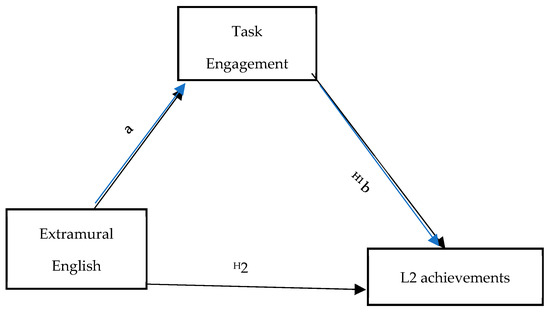
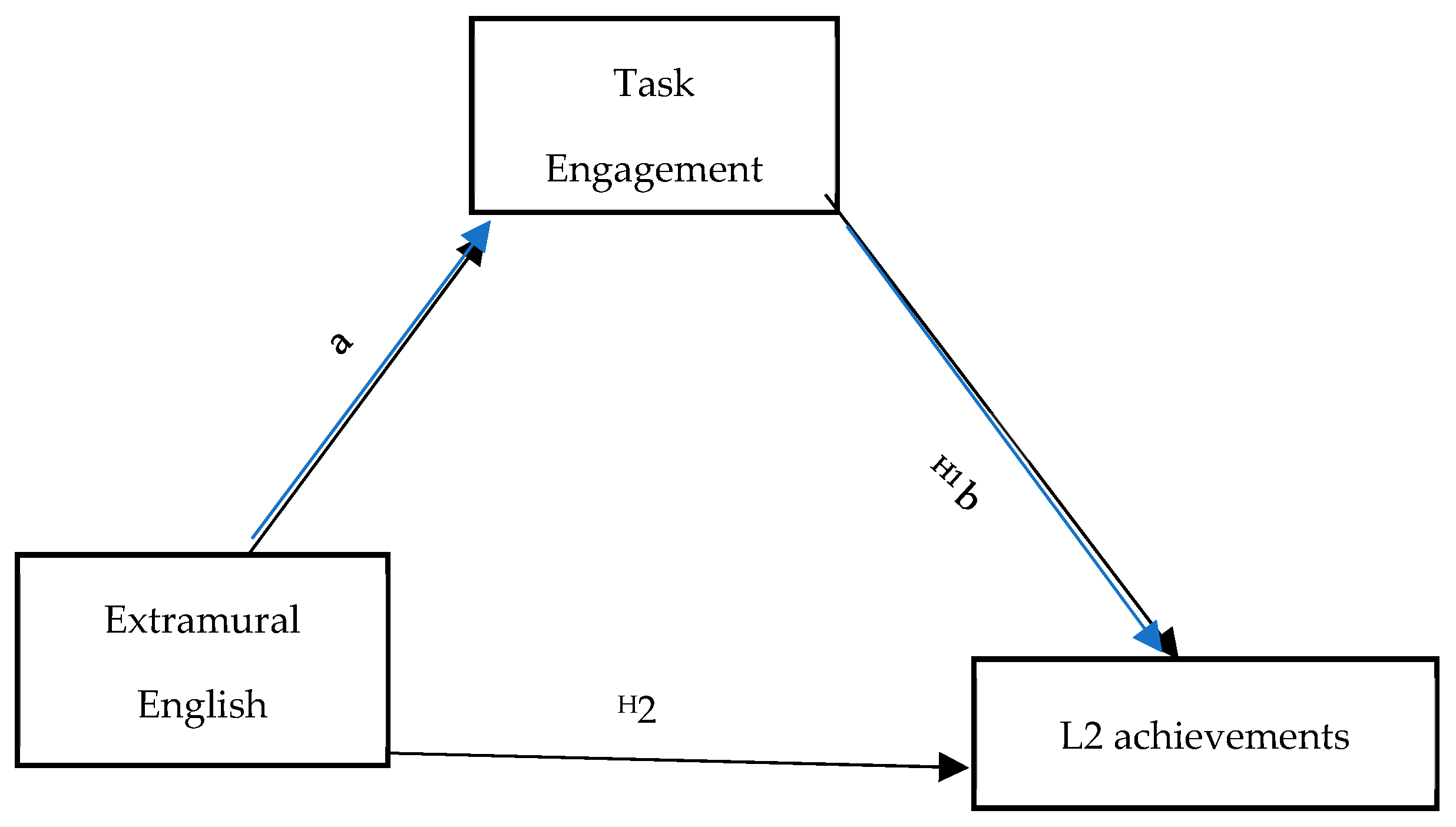
Based on all these findings, we assume that task engagement works as a mediator variable between extramural English and L2 achievements. L2 learners are less likely to be aware of the linguistic features gained from their leisure L2 activities. Task engagement might enable them to apply extramural English while performing L2 tasks in their English classes and to transform into measurable L2 achievements. Grounded in the conceptual relatedness of task engagement, extramural English, and L2 achievements, the present research tested three hypotheses and a model based on them (Figure 1).
Figure 1.
The hypothesized model. Note: Engagement in extramural English has a significant direct pathway to task engagement (a), Task engagement has a significant direct pathway to L2 achievements (b).
H1.
Task engagement in English classes has a significant positive effect on L2 achievements.
H2.
Engagement in extramural English activities has a significant positive effect on L2 achievements.
H3.
Task engagement significantly mediates the relationship between extramural English and L2 achievements.
3. Methods
3.1. Research Design
The present research comprises an initial qualitative and a subsequent quantitative phase, following an exploratory mixed-methods design (Creswell, 2012). As the study context has been so far unexplored regarding the interplay among students’ cognitive, behavioural, social, and emotional engagement with classroom tasks and extramural English activities, and their English proficiency, first, we used an exploratory qualitative approach. We involved a small number of participants to gain in-depth understanding of the complex and unfamiliar phenomena. Then, a follow-up quantitative study analyzed a larger dataset to ensure generalizability to other contexts (Johnson & Onwuegbuzie, 2004).
3.2. Participants
In the initial phase, qualitative data were elicited from eight female participants. Four students majored in English, and four were non-majors. In the second phase, quantitative data were gathered from 336 tertiary students: 70 males (21%) and 266 females (79%). Out of 336 participants, 91 were English-majors, and the others (n = 245) specialized in Physics, Chemistry, Maths, Botany, Zoology, Geology, Biochemistry, Economy, Law, History, Geography, Philosophy, Oriental Studies, and Myanmar.
All participants studied at (Hpa- an University), a public University in Myanmar. Their age ranged between 18 and 22. They were first, second and third-year undergraduate students. We employed convenience sampling method to choose the participants. At the time of data collection, they had learned English as a mandatory course for about 12 years.
3.3. Data Collection Instruments
The instruments include one qualitative and three quantitative instruments. Qualitative data were collected with the help of semi-structured focus group interviews and narratives to inquire into participants’ engagement with activities involving the use of English in and outside their English classes. We developed an interview protocol in a multi-stage process. Grounded in the literature review and research aims, we designed open-ended questions to identify emerging themes regarding task engagement, extramural English and L2 skills development. To ensure the face validity of the interview questions in L2, two senior researchers reviewed the initial protocol. We piloted them with two volunteers and revised some of the wording and removed a few leading questions. In the interviews, the participants responded to seven questions: four elicited their experiences of task engagement and the last three questions concerned extramural activities (Appendix A).
We used a survey consisting of three constructs: (1) task engagement, (2) engagement in extramural activities using English, and (3) English achievements. We adapted an extramural English scale (Sundqvist & Uztosun, 2024) to measure the participants’ engagement with activities in and outside class. The two scales on the frequency of engagement used a four-point Likert scale ranging from (1 = never, 2 = rarely, 3 = sometimes, 4 = very often). Each engagement scale included forty items: ten items for each dimension. Participants’ level of proficiency was measured by a self-assessment proficiency scale adopted from the Common European Framework of Reference for Languages (Council of Europe, 2020). Two experts on educational research reviewed the items and rubrics. We piloted all the scales with a smaller sample (n = 60) to assess the appropriacy of the items in the target context. We revised the items to avoid the ambiguity and to be in line with the purpose of the survey. The final survey included 23 items on task engagement, 28 items on engagement in extramural English, and six CEFR-aligned items.
3.4. Procedure
An ethical approval was obtained from the Institutional Review Board (Doctoral School of Education, University of Szeged) (protocol code, 24/2024 and date of approval, 10 November 2024). Permission from the participants’ university was granted by administrators (reference number, 4034, date of approval, 18 December 2024). Participants in both phases were informed that participation was voluntary, and they could withdraw from the study without any consequences. All participants gave their written consent in a Google form. Their privacy and confidentiality were ensured by keeping all datasets coded in separate files.
The first author conducted two focus group interviews. The first interview was conducted with four English majors, and the second one with four non-major students. The interviews were conducted via Zoom between 22 December 2024 and 10 January 2025. The follow-up interviews were also conducted. In the second phase, quantitative data were gathered using a Google form between 7 June and 12 July 2025.
The qualitative and quantitative phases of the study were connected sequentially. The two authors coded the transcripts independently. Conceptual discrepancies were resolved through consensus meetings, and we refined the codes across the transcripts until we reached full agreement. The interview data informed how the participants engaged with L2 tasks in their English classes and extramural activities. Based on the emerging themes in the qualitative phase, we included all four dimensions of engagement, L2 achievements as a dependent variable and adapted the items of the survey. We adapted the items of the two constructs, task engagement and extramural English engagement, aligning with tasks and activities mentioned by the interviewees. Furthermore, the qualitative findings were integrated with descriptive statistics and SEM results to explain the relationships among the observed variables.
3.5. Reliability of the Survey and Data Analysis
We calculated the reliabilities values of the questionnaires following the guidelines suggested by (Dörnyei & Taguchi, 2010). The alpha value of overall classroom engagement scale is (α = 0.90, 23 items). The reliabilities of the subscales are cognitive (α = 0.76, 4 items), behavioural (α = 0.89, 7 items), social (α = 0.84, 5 items), and emotional dimension (α = 0.88, 7 items). The reliability value (α = 0.95, 28 items) of the extramural scale is acceptable. The alpha values of the subscales are cognitive (α = 0.90, 8 items), behavioural (α = 0.87, 5 items), social (α = 0.93, 8 items), and emotional dimension (α = 0.95, 7 items). The reliability of the self-assessment grid measuring the participants’ English proficiency is α = 0.94.
Data analysis was conducted separately for the qualitative and quantitative phases. The interviews were analyzed in six steps (Creswell, 2012). The first step comprised transcription of the oral texts and followed by preparing the data for analysis. Then, transcriptions of the students’ groups were translated into English, checked by using backtranslation with the help of a colleague. Then, to obtain the general information included in the data, the first author listened to the audio recordings and read the transcripts again. As a next step, based on the research questions, codes were generated line-by-line for thematic analysis (Saldaña, 2021) and the texts were coded by the two authors. We discussed discrepancies and made refinements to establish a consistent and trustworthy coding system. Next, emerging themes were identified. All the emerging themes were revised and reviewed again to match the research questions. Finally, findings were reported based on the emerging themes from the dataset. The interview transcripts were presented to the participants to validate appropriate reflection on their perspectives, accuracy of verbatim quotes, and to get their agreement on using these quotes in the reports (Creswell & Poth, 2018).
We analyzed the quantitative data set using Statistical Packages for the Social Sciences (SPSS, version 28) and AMOS 23 to run Exploratory Factor Analysis (EFA), Confirmatory Factor Analysis (CFA), and Structural Equation Model (SEM).
4. Results
4.1. Engagement in Classroom Tasks and Extramural Activities in English
We present the qualitative findings integrated with their descriptive statistics to document how the thematic analysis informed the subsequent survey analysis. First, we identified classroom tasks, including speaking, listening, reading, and writing tasks, presentations, group work, role plays, discussions, quizzes, and vocabulary games. For example, S2 responded, ‘We do role plays, pair works, presentations, and group works in our English classes.’ The Word Cloud result in NVivo 15 (Figure 2) shows classroom tasks mentioned by the eight participants. The larger a word appears, the more frequently it was mentioned in the database.
Figure 2.
Word Cloud analysis of classroom tasks.
The eight students in the two groups mentioned multiple extramural activities. These include engagement with social media, watching movies, series, and video clips on YouTube, listening to or watching something related to their interest in English (e.g., songs, podcasts, TED talks, recipes, knitting), playing digital games, writing in English (e.g., diary), reading in English (e.g., biographies, fiction), and speaking with someone in English. For example, S4 stated, ‘I watch travel or food bloggers on YouTube.’ Another interviewee, S1 said, ‘I like knitting. So, I watch knitting tutorials in English on YouTube.’ Figure 3 is a visual representation of extramural activities mentioned by students.
Figure 3.
Word Cloud analysis of extramural activities.
We identified different dimensions of engagement in the data and explored how themes related to the subsequent quantitative constructs (Appendix B). The thematic analysis reflected the participants’ physical and mental participation in performing L2 tasks, their positive moods and attitudes, examples of cooperation and interaction among peers. For example, S2 said, ‘I love group discussions and presentations. I volunteer to be group representative and do presentations. But before the presentation, we generate and share ideas. We asked the teachers when we were not sure about the instructions.’ These points reflected their cognitive, behavioural, social and emotional engagement in L2 tasks including group work, discussions, and presentations. These thematic reflections are in line with the descriptive statistics documenting their high levels of overall engagement (M = 3.15, SD = 0.35), as well as their cognitive (M = 3.11, SD = 0.48), behavioural (M = 3.20, SD = 0.51), social (M = 3.06, SD = 0.48), and emotional engagement (M = 3.22, SD = 0.46). Low SD values evidenced that participants in the cohort had similar engagement levels.
The qualitative phase suggested that the participants tried to or managed to put cognitive effort into extramural activities such as reading, watching, and listening in English. S1 said, ‘I find fiction in English and read. I read a short fiction within two days.’ Another example is by S5: ‘I like watching movies and cartoons in English. And I like make-up. So, I watch make-up tutorials in English on YouTube. I translate subtitles into L1’. Their enjoyment attained from doing these activities revealed emotional engagement. S7 responded, ‘When I read biographies, I do not feel bored.’ S6 accounted, ‘I’m interested in reading English novels. I also love reading posts uploaded by travel bloggers.’ They interacted with friends as they played online games or joined online groups. As S7 stated, ‘I have international friends as I play online games and join online Idol group, called fandom. We speak in English every night.’ Hence, the thematic analysis identified the participants’ engagement with extramural English for various purposes. This finding was underpinned by the quantitative result. Their engagement in extramural activities was moderate (M = 2.76, SD = 0.48). They had moderate levels of cognitive (M = 2.80, SD = 0.52), behavioural (M = 2.96, SD = 0.56), social (M = 2.80, SD = 0.59) and emotional engagement (M = 2.47, SD = 0.71). The low SD values documented the similarity of the participants’ level of engagement in activities outside their English classes. Compared to engagement with extramural activities (M = 2.76, SD = 0.48), their classroom engagement (M = 3.15, SD = 0.35) is higher with the lower standard deviation.
The interviewees claimed that tasks improve their English skills as they participate in oral presentations, and work in groups or pairs. They mentioned that extramural activities such as watching YouTube videos, listening to English songs and reading in English enhanced their English proficiency. For example, S7 said, ‘We have a chance to speak in English when we brainstorm in group. So, speaking skill is improved.’ Another reflection on the improvement of vocabulary, listening and speaking skills was narrated by S8: ‘I watch making facial scrubs videos. I improve using vocabulary items and listening skill. As I repeat these, my speaking skill is also improved.’ Their self-assessed proficiency in English was typically at B2 level (M = 2.30, SD = 0.46). The SD value indicates that most respondents were clustered around the mean and there was a high level of consistency within the cohort of participants. Furthermore, we found that the respondents applied or shared the knowledge gained from extramural English with their peers in their L2 classes. For example, S3 said, ‘I demonstrate using technology tutorials on my phone when my group do presentation on giving technology instructions’, reflecting the conceptual relatedness between task engagement and extramural English. This finding was underpinned by the survey result: a positive significant association between classroom and extramural engagement (r = 0.439, p < 0.001).
4.2. The Relationships Among the Observed Variables
4.2.1. Preliminary Results
The correlation analysis (Table 1) shows positive and statistically significant relationships among the participants’ L2 classroom engagement, L2 extramural engagement, and self-reported proficiency in English (r = 0.439, 0.393 and 0.220, p < 0.001). The moderate and significant association between classroom and extramural engagement (r = 0.439, p < 0.001) suggests that students who engaged with extramural activities also tended to engage with classroom tasks. A moderate and statistically significant relationship between task engagement and self-reported L2 proficiency (r = 0.393, p < 0.001) indicates that those who engaged with tasks in the English classes, typically self-assessed their English skills as better. The relationship between extramural engagement and the participants’ self-perceived L2 competency is weak but statistically significant (r = 0.220, p < 0.001) suggesting that those who engaged with autonomous activities in English in their spare time had better L2 outcomes.
Table 1.
Correlation matrix presenting three variables (n = 336).
We conducted Exploratory Factor Analysis (Kline, 2023) to assess the extent of shared-method variance. The single factor accounted for 26.437% of the total variance, which is below the 50% threshold, suggesting that the data is safe and self-perception bias does not significantly exist. We applied Confirmatory Factor Analyses to assess the construct validity of the scales (Furr, 2022). The fitness indices should have the specific cutoff values; χ2 (χ2/df) < 5, the GFI, TLI, and CFI should exceed 0.90, SRMR and RMSEA should be less than 0.10 (Tabachnick & Fidell, 2013). The fit indices of each scale are acceptable (Table 2).
Table 2.
Reliabilities and fit indices of the scales.
The convergent and discriminant validity of the task engagement scale (Table 3) is acceptable. The composite reliability (CR) values range from 0.70 to 0.90, and the average variance extracted (AVE) values exceed 0.5 (Kline, 2023). The values of Maximum Shared Variance (MSV) were lower than that of AVE, and the square roots of AVE (0.746, 0.675, 0.721 and 0.731) were greater than the inter-construct correlations (0.544, 0.136, 0.702, 0.252, 0.674 and 0.153) (Hair et al., 2017).
Table 3.
Convergent and discriminant validity of the task engagement scale.
The construct validity of the extramural engagement with English activities scale also meets the requirements (Table 4). The CR values range from 0.70 to 0.90, and the AVE values exceed 0.5. The values of MSV were lower than that of AVE, and the square roots of AVE (0.735, 0.791, 0.862, and 0.761) were greater than the inter-construct correlations (0.638, 0.467, 0.694, 0.610, 0.648, and 0.458).
Table 4.
Convergent and discriminant validity of the extramural engagement scale.
4.2.2. Hypothesis Testing
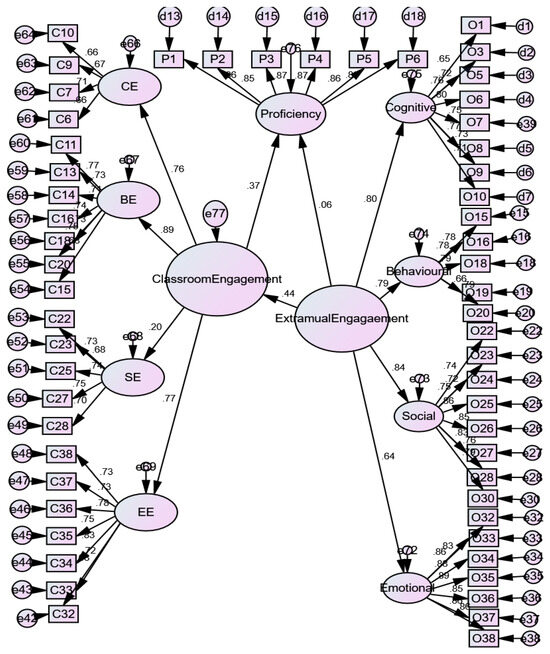
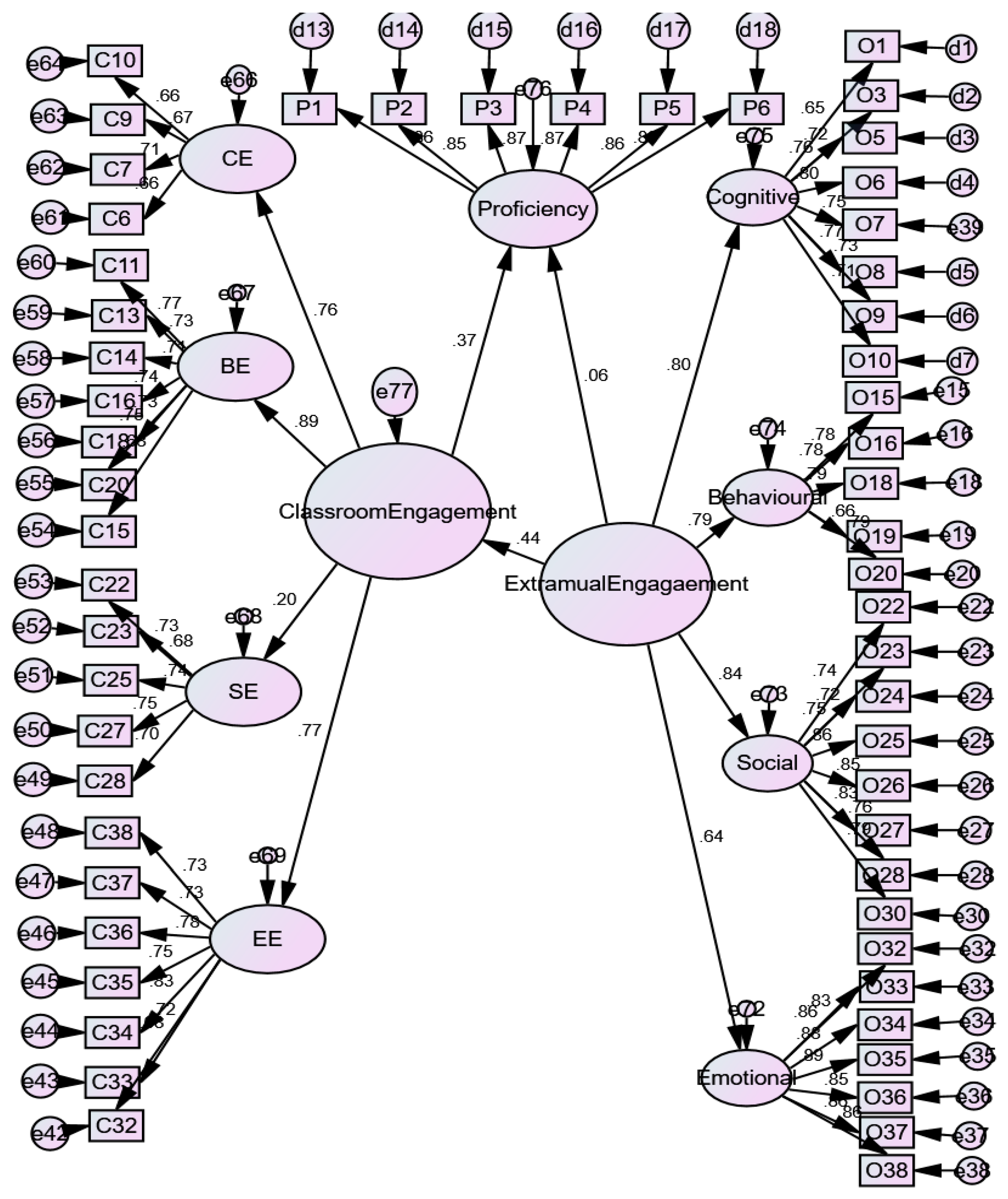
The hypothesized model was tested with the help of SEM. We developed a full Structural Equation Model using all measurements. The model fit indices were within the acceptable range: χ2 = 2431.677, df = 1528, χ2/df = 1.591, GFI = 0.915, TLI = 0.925, CFI = 0.928, SRMR = 0.042, and RMSEA = 0.038 (Figure 4).
Figure 4.
Full Structural Equation Model.
We examined the effect size and significance of the path coefficients of the observed variables. The SEM results indicated that the direct pathway of task engagement to self-assessed L2 achievements was positive and statistically significant (β = 0.367, p < 0.001), in line with Hypothesis 1; whereas, the direct path of extramural engagement in English activities to students’ self-reported English proficiency (β = 0.059, p > 0.05) was statistically not significant, rejecting Hypothesis 2. The pathway of extramural English engagement to classroom tasks engagement was direct, positive and statistically significant (β = 0.439, p < 0.001).
We conducted bias-corrected bootstraps test (2000 times iterations) to examine the mediating role of L2 task engagement between engagement with extramural English and the participants’ self-reported proficiency in English. The results of mediation analysis (Table 5) documented that the direct pathway of extramural engagement variable to self-assessed English proficiency (β = 0.059, p > 0.05, 95%CI [−0.096, 0.209]) was not significant. The results evidenced that the task engagement variable mediated the relationship between extramural engagement and self-perceived L2 proficiency variables (β = 0.161, p < 0.001, 95%CI [0.093, 0.267]). The mediation analysis indicated that the L2 task engagement variable functioned as a mediator between engagement in extramural English and students’ self-assessed L2 competency in line with Hypothesis 3. This means that participants’ engagement with extramural activities had a positive directional pathway to their L2 skills through their active participation in classroom tasks. This resonates with the qualitative findings, where the interviewees noted that their English skills improved as they applied extramural English knowledge and experiences to accomplish the assigned L2 tasks.
Table 5.
Mediation effects.
5. Discussion
This exploratory mixed-methods study examined the interconnected relationships among participants’ engagement in EFL classroom tasks, extramural activities using English, and their self-assessed proficiency in English reported by undergraduate students (N = 336) at a university in Myanmar, where no previous study had been conducted. The thematic analysis reflected that the participants improved their L2 skills as they cognitively, behaviourally, socially and emotionally engaged with L2 activities in and outside their L2 classes. This outcome aligns with the large-scale data analysis: the positive and significant relationships among task engagement, extramural English and self-perceived L2 proficiency. We documented that students who actively participated in classroom tasks had better L2 skills in line with the findings of multiple previous studies (e.g., Alzahrani, 2025; Dincer et al., 2019; Tong & Singh, 2025). Students’ active participation in accomplishing L2 tasks enables them to use and produce the linguistic forms and features of the target language, thus enhancing their L2 skills.
We found that participants engaged with autonomous activities corresponding to their hobbies and personal interests in alignment with Sundqvist’s (2009) findings, indicating that learners are likely to engage in extramural activities they enjoy and find intrinsically motivating. They engaged with a wide range of authentic videos and tutorials (e.g., on knitting, baking, cooking, drawing, workouts, folding paper and clothes, making scrubs, mindfulness exercises) reflecting their own intrinsic motives and choices. What they heard and saw in these autonomously selected multimedia segments made meaning clear to them in context, based on their background knowledge of the world.
The present study documented a statistically significant relationship between the participants’ engagement in extramural English and their self-reported L2 developmental level, indicating that those who engaged in self-selected autonomous activities such as watching YouTube videos, joining online fan groups, writing comments in English and listening to podcasts reported better English proficiency. This outcome resonates with the findings of several earlier studies (e.g., Busby, 2021; Imsa-ard, 2025; Uztosun & Sundqvist, 2025; De Wilde et al.’s 2020a, 2020b) claiming that students’ attainment in speaking and listening skills, width of vocabulary, and general English proficiency improved as a result of extramural English activities, for example, listening to talk shows, watching series with English subtitles, and using social media. They all enhanced their learning opportunities for new lexis and linguistic features. The possible explanation for this association is that they were unknowingly processing meaning, form and uses of the target language as they engaged with outside class L2 activities. For instance, they recited lyrics of songs, explained game instructions in their L1 and chatted in English with their online friends. These uses must have enhanced their L2 skills.
We found evidence that students’ engagement with extramural English did not directly predict their L2 outcomes in our cohort. Their engagement in autonomously chosen uses of English beyond their English classes had a significant and direct pathway to their engagement in English class tasks, which significantly predicted their self-perceived English skills. We investigated the contribution of outside class L2 activities to students’ L2 learning process in line with Sundqvist’s (2024) ideas suggesting that extramural English may serve as a foundation in L2 learning. However, our findings documented that engagement in extramural English does not directly lead to the participants’ self-reported English proficiency in the large group of Myanmar undergraduates.
L2 learners’ English tends to improve when they actively participate in their English classes using their L2 knowledge gained from autonomous L2 activities. Such activities like watching English movies, reading English texts, and listening to songs, provide students with incidental or implicit L2 learning opportunities, although they do not seem to be aware of having learned linguistic features of the target language. Classroom task engagement enables them to apply and practice their extramural English while performing L2 tasks and to turn their implicit L2 knowledge into explicit language awareness and L2 use. Engaging in well-designed L2 tasks relating to students’ extramural experiences tends to facilitate their L2 skills. Schurz and Sundqvist (2025) suggested connecting students’ extramural English experiences with L2 tasks as students engage more with English-mediated outside class activities. Along similar lines, R. Zhang et al. (2021) reported that extramural language learning activities might not necessarily lead to better English, and instructed learning opportunities offered in school contexts were necessary for language development.
We must note that as the present study relies on the participants’ self-assessed L2 proficiency, they might over or underestimated their actual L2 abilities. The findings reflected the relationships among the participants’ task engagement, extramural English and their self-perceived English competency rather than specific test scores or objective assessment of their proficiency in English. Furthermore, as this inquiry used a cross-sectional design, the SEM results proved the significant pathways among the three variables rather than causality.
Overall, our study evidenced that engagement with both classroom tasks and extramural activities are conducive to better achievements in L2 learning. More specifically, we presented evidence that classroom engagement with English tasks enables students to refine and transfer their English skills gained from extramural English to result in better proficiency. Students had access to not only a lot of comprehensible and intrinsically motivating input in English as they engaged with autonomously chosen activities, but they also had special opportunities to put their English into practice through interactions with other users. Their task engagement in English classes turned what they gained in these autonomous uses into improved English abilities. We documented that task engagement plays a vital role in successful L2 learning as extramural English alone is less likely to enhance learners’ English competency. Students’ extramural English experiences may more probably be beneficial when they are connected to L2 tasks in their English classes.
6. Conclusions and Pedagogical Implications
6.1. Conclusions
This mixed methods study investigated the connections between tertiary students’ engagement with tasks in English classes, extramural English activities, and their self-assessed proficiency in English. The findings evidenced that engagement with in and outside class activities in English were positively and significantly related to participants’ self-perceived level of English. Students’ engagement with autonomous L2 activities beyond English classes, however, had no direct prediction on their self-reported L2 outcomes. The pathway was through their engagement with classroom tasks. Classroom engagement mediated the associations between engagement with L2 activities in their spare time and their self-assessed L2 proficiency. Based on these findings, we suggest connecting L2 tasks with students’ extramural experiences to enhance their English proficiency.
6.2. Pedagogical Implications
The findings of this study provide L2 educators with new insights regarding the mediating role of task engagement between extramural English and successful L2 learning. Educators should convert L2 learners’ extramural experiences to cognitive, behavioural, social and emotional engagement in classroom tasks to enhance their L2 achievements. They should go beyond sticking on the prescribed textbooks and create appropriate L2 tasks where students can transform their extramural knowledge into L2 skills. For instance, teachers can give opportunities to students to select a movie or book review, ask them to analyze the linguistic features and to present or debate the content with peers. Then they are assigned to write and upload their own reviews on their Facebook or Instagram accounts and check peer feedback and teachers’ comments on their posts. Another example of innovative classroom task of bridging in and outside class L2 activity is assigning fan-meeting roleplays or as a group work, students watch different YouTube tutorials on cooking, analyze the use of vocabulary, intonation and syntax, and they create recipes using knowledge gained from tutorials. L2 educators need to select relevant materials based on their students’ extramural interests. They should provide their students with opportunities and encourage them to engage with both types of activities as Casale and Olsson (2025) suggested, considering extramural English as students’ own contribution to their L2 classes. Additionally, teachers should acknowledge their students’ autonomous learning as a contribution to L2 success and encourage them to share their extramural experiences with their peers in their L2 classes.
7. Limitations and Recommendations
This study has some limitations. First, we relied on a cross-sectional design, and it could not tap into the dynamic changes in students’ engagement over time. Second, we investigated the associations among engagement with classroom tasks and extramural English activities and participants’ self-perceived English proficiency. However, we could not examine the causality of all dimensions of engagement on students’ English. Third, we used self-report scales and interviews to collect data on the four dimensions of engagement. Data triangulation was limited to comparing qualitative and quantitative results. Finally, we used a self-assessed L2 achievement scale, as we had no access to test results on the participants’ English skills. Methodologically, we examined the students’ self-reported L2 competency rather than data on objective measures documenting their level of English proficiency. Using a proficiency exam in English or a standardized test would be better options.
Thus, we recommend future research on engagement in classroom tasks and extramural activities through longitudinal approaches using data triangulation to gain deeper insights into how the fluctuating nature of students’ engagement changes over time and associates with their L2 achievements. Also, teachers’ perceptions would also be helpful to allow for a better understanding of the whole picture.
Author Contributions
M.M.A.: conceptualization, methodology, data curation, formal analysis, investigation, writing-original draft, writing review and editing; M.N.: supervision, writing review and editing. All authors have read and agreed to the published version of the manuscript.
Funding
This study was supported by the University of Szeged Open Access Fund. Grant ID:8917.
Institutional Review Board Statement
The study was conducted in accordance with the Declaration of Helsinki and approved by the Institutional Review Board of the Doctoral School of Education, University of Szeged (protocol code 24/2024 and date of approval, 10 November 2024). Permission and approval by the participants’ university were also granted (reference number, 4034 and date of approval 18 December 2024).
Informed Consent Statement
Informed consent was obtained from all participants involved in the study. The participants were all adults, and no minor participant was included. The participation was entirely voluntary.
Data Availability Statement
Dataset regarding this research is unavailable due to privacy and ethical restrictions.
Acknowledgments
The first author is a recipient of a Stipendium Hungaricum Scholarship sponsored by the Hungarian government. We acknowledged the University of Szeged for giving us access to the necessary sources. We express our special thanks to all volunteer participants.
Conflicts of Interest
There is no conflict of interest in this study.
Appendix A
| Interview Protocol |
| Study: Exploratory qualitative study on undergraduates’ task engagement, engagement with extramural English and L2 achievements Data collection from 22 December 2024 to 10 January 2025 Place: Zoom Platform Interviewer: First author Interviewees: Eight undergraduates |
| Dear participants, I am xxx, a teacher of English and xxxxxxxxx. I want to find out experiences regarding your task engagement, how you engage with activities outside your English classes and how you improve your English. Myanmar students’ experiences have not been studied, so I would like to fill this gap. Thank you for agreeing to this interview. This is voluntary participation, and you can withdraw from the interview without any consequences at any time. I would like to record our conversation. The recording will be transcribed and used anonymously for analysis. Have the interviewee read and sign the consent form. Questions
Date. ------------- I -------------------------(name) give my consent to the first author to transcribe and use the data which has been recorded. The researcher has explained to me that the transcribed material will be used in her thesis. The researcher has explained to me that it is voluntary, and I can withdraw from the interview protocol at any time, and that I can ask for my contribution to the data not to be used. The researcher has explained to me that my name is not included, and only coded data will be used. Signature---------------- |
Appendix B. Sample Thematic Analysis
| Illustrative Quotes | Codes | Themes | Variables | Constructs/ Related Constructs |
| ‘We generate ideas when we do writing tasks together.’ | generate ideas together | cognitive effort cooperation | cognitive (engagement) social | Task engagement |
| ‘I volunteer to participate in role plays.’ | volunteer/participation | physical effort | behavioural | Task engagement |
| ‘I ask the teachers when I am not sure about the instructions.’ | ask | action interaction | behavioural social | Task engagement |
| ‘I love to participate in role plays.’ | love | emotion | emotional | Task engagement |
| ‘We help each other to improve our English skills’. | help improve | cooperation L2 skills | social L2 achievement | Task engagement L2 achievement |
| ‘I love group discussions and presentations. I volunteer to be group representative and do presentations. But before the presentation, we generate and share ideas. We ask the teachers when we are not sure about the instructions.’ | love volunteer generate ideas share ask | emotion physical effort cognitive effort cooperative interaction/action | emotional behavioural cognitive social social/behavioural | Task engagement |
| ‘We have a chance to speak in English when we brainstorm in group. So, speaking skill is improved.’ | speak brainstorm speaking skill | action cognitive effort L2 skill achievement | behavioural cognitive L2 achievement | Task engagement L2 achievement |
| ‘I find fiction in English and read. I read a short fiction within two days.’ | find read | physical effort action/cognitive effort | behavioural cognitive | Extramural English engagement |
| ‘I like watching movies and cartoons in English. And I like make-up. So, I watch make-up tutorials in English on YouTube. I translate subtitles into L1’. | like watch translate | emotion action cognitive effort | emotional behavioural cognitive | Extramural English engagement |
| ‘When I read biographies, I do not feel bored.’ | read no boring | action emotion | behavioural emotional | Extramural English engagement |
| ‘I’m interested in reading English novels. I also love reading posts uploaded by travel bloggers.’ | interest love | emotions | emotional | Extramural English engagement |
| ‘I have international friends as I play online games and join online Idol group, called fandom. We speak in English every night.’ | play join speak | action interaction interaction | behavioural social | Extramural English engagement |
| ‘I watch making facial scrubs videos. I improve using vocabulary items and listening skill. As I repeat these, my speaking skill is also improved.’ | watch repeat vocabulary listening speaking skill | action L2 improvement | behavioural L2 achievement | Extramural English engagement L2 achievement |
| ‘I can write accurate recipes in class as I watch cooking tutorials on YouTube.’ | write watch | action/ L2 improvement action | L2 achievement behavioural | Task engagement L2 achievement Extramural English engagement |
| ‘I demonstrate using technology tutorials on my phones when my group do presentation on giving technology instructions’. | demonstrate using technology tutorials do presentation | action action | behavioural behavioural | Task engagement Extramural English engagement |
References
- Alzahrani, I. H. (2025). The relationship between students’ L2 engagement and learning success. Journal of Language Teaching and Research, 16(1), 266–273. [Google Scholar] [CrossRef] [Scilit]
- Benson, P. (2001). Teaching and researching autonomy in language learning. Pearson Education. [Google Scholar]
- Bronfenbrenner, U. (1974). Developmental research, public policy, and the ecology of childhood. Child Development, 45(1), 1. [Google Scholar] [CrossRef] [PubMed]
- Busby, N. L. (2021). Words from where?: Predictors of L2 English vocabulary among Norwegian university students. ITL—International Journal of Applied Linguistics, 172(1), 58–84. [Google Scholar] [CrossRef] [Scilit]
- Casale, A., & Olsson, E. (2025). Extramural English and English teaching. A survey study among primary school teachers in Sweden. Innovation in Language Learning and Teaching, 1–21. [Google Scholar] [CrossRef] [Scilit]
- Council of Europe. (2020). Common European framework of reference for languages: Learning, teaching, assessment-companion volume. Council of Europe Publishing. [Google Scholar]
- Creswell, J. W. (2012). Educational research: Planning, conducting, and evaluating quantitative and qualitative research (4th ed.). Pearson. [Google Scholar]
- Creswell, J. W., & Poth, C. N. (2018). Qualitative inquiry and research design (4th ed.). Sage Publications. [Google Scholar]
- Dao, P. (2021). Effects of task goal orientation on learner engagement in task performance. International Review of Applied Linguistics in Language Teaching, 59(3), 315–334. [Google Scholar] [CrossRef] [Scilit]
- De Wilde, V., Brysbaert, M., & Eyckmans, J. (2020a). Learning English through out-of-school exposure: How do word-related variables and proficiency influence receptive vocabulary learning? Language Learning, 70(2), 349–381. [Google Scholar] [CrossRef] [Scilit]
- De Wilde, V., Brysbaert, M., & Eyckmans, J. (2020b). Learning English through out-of-school exposure. Which levels of language proficiency are attained and which types of input are important? Bilingualism: Language and Cognition, 23(1), 171–185. [Google Scholar] [CrossRef] [Scilit]
- Dincer, A., Yeşilyurt, S., Noels, K. A., & Vargas Lascano, D. I. (2019). Self-determination and classroom engagement of EFL learners: A mixed-methods study of the self-system model of motivational development. Sage Open, 9(2), 2158244019853913. [Google Scholar] [CrossRef] [Scilit]
- Dörnyei, Z., & Kormos, J. (2000). The role of individual and social variables in oral task performance. Language Teaching Research, 4(3), 275–300. [Google Scholar] [CrossRef] [Scilit]
- Dörnyei, Z., & Taguchi, T. (2010). Questionnaires in second language research: Construction, administration, and processing (2nd ed.). Routledge. [Google Scholar]
- Finn, J. D., & Zimmer, K. S. (2012). Student engagement: What is it? Why does it matter? In S. L. Christenson, A. L. Reschly, & C. Wylie (Eds.), Handbook of research on student engagement (pp. 97–131). Springer US. [Google Scholar] [CrossRef] [Scilit]
- Forsman, L. (2004). Language, culture, and context: Exploring knowledge and attitudes among Finland-Swedish EFL-students with particular focus on extracurricular influence. Vasa Åbo Akademi. [Google Scholar]
- Fredricks, J. A., Blumenfeld, P. C., & Paris, A. H. (2004). School engagement: Potential of the concept, state of the evidence. Review of Educational Research, 74(1), 59–109. [Google Scholar] [CrossRef] [Scilit]
- Fredricks, J. A., & McColskey, W. (2012). The measurement of student engagement: A comparative analysis of various methods and student self-report instruments. In S. L. Christenson, A. L. Reschly, & C. Wylie (Eds.), Handbook of research on student engagement (pp. 763–782). Springer US. [Google Scholar] [CrossRef] [Scilit]
- Furr, R. M. (2022). Psychometrics: An introduction (4th ed.). SAGE Publications. [Google Scholar]
- Hair, J. F., Babin, B. J., & Krey, N. (2017). Covariance-Based Structural Equation Modeling in the Journal of Advertising: Review and recommendations. Journal of Advertising, 46(1), 163–177. [Google Scholar] [CrossRef] [Scilit]
- Henry, A., & Thorsen, C. (2020). Disaffection and agentic engagement: ‘Redesigning’ activities to enable authentic self-expression. Language Teaching Research, 24(4), 456–475. [Google Scholar] [CrossRef] [Scilit]
- Hiver, P., Al-Hoorie, A. H., Vitta, J. P., & Wu, J. (2024). Engagement in language learning: A systematic review of 20 years of research methods and definitions. Language Teaching Research, 28(1), 201–230. [Google Scholar] [CrossRef] [Scilit]
- Imsa-ard, P. (2025). Extramural English (EE): Its effects on EFL undergraduates’ L2 vocabulary knowledge and affective variables. Social Sciences & Humanities Open, 12, 102286. [Google Scholar] [CrossRef] [Scilit]
- Johnson, R. B., & Onwuegbuzie, A. J. (2004). Mixed methods research: A research paradigm whose time has come. Educational Researcher, 33(7), 14–26. [Google Scholar] [CrossRef] [Scilit]
- Kline, R. B. (2023). Principles and practice of structural equation modeling (5th ed.). The Guilford Press. [Google Scholar]
- Lambert, C., Philp, J., & Nakamura, S. (2017). Learner-generated content and engagement in second language task performance. Language Teaching Research, 21(6), 665–680. [Google Scholar] [CrossRef] [Scilit]
- Li, J., King, R. B., & Wang, C. (2022). Profiles of motivation and engagement in foreign language learning: Associations with emotional factors, academic achievement, and demographic features. System, 108, 102820. [Google Scholar] [CrossRef] [Scilit]
- Mayer, R. E. (2009). Multimedia learning (2nd ed.). Cambridge University Press. [Google Scholar]
- Mercer, S., & Dörnyei, Z. (2020). Engaging language learners in contemporary classrooms (1st ed.). Cambridge University Press. [Google Scholar] [CrossRef] [Scilit]
- Modiano, M. (2005). Cultural studies, foreign language teaching and learning practices, and the NNS practitioner. In Non-native language teachers: Perceptions, challenges and contributions to the profession (pp. 25–43). Springer. [Google Scholar]
- Oga-Baldwin, W. L. Q. (2019). Acting, thinking, feeling, making, collaborating: The engagement process in foreign language learning. System, 86, 102128. [Google Scholar] [CrossRef] [Scilit]
- Olsson, E., & Sylvén, L. (2015). Extramural English and academic vocabulary. Apples—Journal of Applied Language Studies, 9(2), 77–103. [Google Scholar] [CrossRef] [Scilit]
- Philp, J., & Duchesne, S. (2016). Exploring engagement in tasks in the language classroom. Annual Review of Applied Linguistics, 36, 50–72. [Google Scholar] [CrossRef] [Scilit]
- Qiang, N., Hai, T., & Wolff, M. (2007). China EFL: Teaching with movies. English Today, 23(2), 39–46. [Google Scholar] [CrossRef] [Scilit]
- Reeve, J. (2012). A self-determination theory perspective on student engagement. In S. L. Christenson, A. L. Reschly, & C. Wylie (Eds.), Handbook of research on student engagement (pp. 149–172). Springer US. [Google Scholar] [CrossRef] [Scilit]
- Saldaña, J. (2021). The coding manual for qualitative researchers (4th ed.). SAGE Publications. [Google Scholar]
- Sang, Y., & Hiver, P. (2021). Engagement and companion constructs in language learning: Conceptualizing learners’ involvement in the L2 classroom. In Student engagement in the language classroom (pp. 17–37). Multilingual Matters. [Google Scholar]
- Schurz, A., & Sundqvist, P. (2025). Considering extramural English in class: Exploring teachers’ activity ideas in secondary school classrooms in four countries. Applied Linguistics, 1–20. [Google Scholar] [CrossRef] [Scilit]
- Storch, N. (2008). Metatalk in a pair work activity: Level of engagement and implications for language development. Language Awareness, 17(2), 95–114. [Google Scholar] [CrossRef]
- Sundqvist, P. (2009). Extramural English matters: Out-of school English and its impact on Swedish ninth graders’ oral proficiency and vocabulary. Karlstad University Press. [Google Scholar]
- Sundqvist, P. (2021). Extramural English in language education. In H. Mohebbi, & C. Coombe (Eds.), Research questions in language education and applied linguistics (pp. 201–205). Springer International Publishing. [Google Scholar] [CrossRef] [Scilit]
- Sundqvist, P. (2024). Extramural English as an individual difference variable in L2 research: Methodology matters. Annual Review of Applied Linguistics, 44, 79–91. [Google Scholar] [CrossRef] [Scilit]
- Sundqvist, P., & Sylvén, L. K. (2016). Extramural English in teaching and learning: From theory and research to practice. Palgrave Macmillan UK. [Google Scholar] [CrossRef] [Scilit]
- Sundqvist, P., & Uztosun, M. S. (2024). Extramural English in Scandinavia and Asia: Scale development, learner engagement, and perceived speaking ability. TESOL Quarterly, 58(4), 1638–1665. [Google Scholar] [CrossRef] [Scilit]
- Svalberg, A. M.-L. (2009). Engagement with language: Interrogating a construct. Language Awareness, 18(3–4), 242–258. [Google Scholar] [CrossRef] [Scilit]
- Sylvén, L. K., & Sundqvist, P. (2012). Gaming as extramural English L2 learning and L2 proficiency among young learners. ReCALL, 24(3), 302–321. [Google Scholar] [CrossRef] [Scilit]
- Tabachnick, B. G., & Fidell, L. S. (2013). Using multivariate statistics (6th ed.). Pearson. [Google Scholar]
- Tong, Y., & Singh, B. S. M. (2025). The interaction between learning engagement and academic achievement in second language acquisition: A multivariate analysis. Forum for Linguistic Studies, 7(7), 386–401. [Google Scholar] [CrossRef] [Scilit]
- Uztosun, M. S., & Sundqvist, P. (2025). Extramural English activities and their relationship with L2 English proficiency at a Turkish university context. The Literacy Trek, 11(1), 56–78. Available online: https://izlik.org/JA77WF26JX (accessed on 7 February 2026).
- Wang, M.-T., Degol, J. L., & Henry, D. A. (2019). An integrative development-in-sociocultural-context model for children’s engagement in learning. American Psychologist, 74(9), 1086–1102. [Google Scholar] [CrossRef] [Scilit] [PubMed]
- Zhang, R., Zou, D., Cheng, G., Xie, H., Wang, F., & Au, O. (2021). Target languages, types of activities, engagement, and effectiveness of extramural language learning. PLoS ONE, 16(6), e0253431. [Google Scholar] [CrossRef] [Scilit] [PubMed]
- Zhang, X., Dai, S., & Ardasheva, Y. (2020). Contributions of (de)motivation, engagement, and anxiety to English listening and speaking. Learning and Individual Differences, 79, 101856. [Google Scholar] [CrossRef] [Scilit]





Disclaimer/Publisher’s Note: The statements, opinions and data contained in all publications are solely those of the individual author(s) and contributor(s) and not of MDPI and/or the editor(s). MDPI and/or the editor(s) disclaim responsibility for any injury to people or property resulting from any ideas, methods, instructions or products referred to in the content. |
© 2026 by the authors. Licensee MDPI, Basel, Switzerland. This article is an open access article distributed under the terms and conditions of the Creative Commons Attribution (CC BY) license.