Article

Antecedents and Consequences of AI Misuse Among University Students: An Empirical Investigation
School of Public Policy & Management, China University of Mining and Technology, Xuzhou 221116, China
*
Author to whom correspondence should be addressed.
Educ. Sci. 2026, 16(7), 1087; https://doi.org/10.3390/educsci16071087
Submission received: 24 May 2026 / Revised: 25 June 2026 / Accepted: 29 June 2026 / Published: 7 July 2026

Abstract

AI misuse has become a significant challenge and concern in higher education. Existing research has focused separately on either antecedents or consequences of AI misuse and has relied on a single theoretical perspective. There is a notable lack of empirical research investigating the antecedents and consequences of AI misuse among university students. To address this gap, this study constructs an integrated research model for the antecedents and consequences of AI misuse based on the fraud triangle theory, deterrence theory, and social cognitive theory. Data were collected from 493 university students through a questionnaire survey and analyzed using structural equation modeling (SEM) to test the proposed hypotheses. The results indicate that ease of use, academic pressure, and peer influence significantly promote AI misuse. Policy deterrence and academic self-efficacy can effectively inhibit AI misuse. Furthermore, AI misuse impairs students’ innovation ability. This study advances the systematic understanding of AI misuse and consolidates its theoretical and empirical underpinnings. It enables universities to better govern AI misuse and foster students’ innovation ability.

1. Introduction

AI has widely penetrated and transformed various sectors and industries (Dakakni & Safa, 2023; Saihi et al., 2024; Sharadgah & Sa’di, 2022), and the education sector is no exception (Crompton & Burke, 2023). Higher education is closely intertwined with the development of information technology (Chan, 2023; Chu et al., 2022), and the introduction of AI into education has ushered in a new era for education (Fahimirad & Kotamjani, 2018; Ou et al., 2024). Therefore, AI has become an indispensable component of higher education institutions (Aldosari, 2020; Jafari & Keykha, 2024). AI has profoundly revolutionized learning, teaching, scientific research, and educational administration (Chiu et al., 2023; Jacques et al., 2024; Saaida, 2023; Xia et al., 2024; K. Zhang & Aslan, 2021). Consequently, it offers opportunities to transform traditional teaching methods and the educational ecosystem (Bates et al., 2020; Belkina et al., 2025; Fowler, 2023), facilitating personalized learning experiences, automating administrative tasks, and strengthening research capacities (Jafari & Keykha, 2024), thereby enhancing the efficiency of higher education (Jacques et al., 2024) and bringing about a paradigm shift in the sector (Castillo-Martínez et al., 2024).
Moreover, AI also presents challenges for education, such as data privacy risks, fairness, and algorithmic bias (Alqahtani et al., 2023; Alshahrani et al., 2024; Holmes et al., 2023; Khan et al., 2025). The misuse of AI by university students has a detrimental impact on academic integrity, academic ethics, academic writing and critical thinking (Michel-Villarreal et al., 2023; A. Nguyen et al., 2024). Therefore, how to ensure that university students use AI in an ethical and appropriate manner has become an important issue that demands urgent attention (Bond et al., 2024; Gonsalves, 2025; Holmes et al., 2022).
Existing studies on the misuse of AI have mainly focused on its antecedents or consequences. However, these studies suffer from two major limitations. First, the analysis of influencing factors remains fragmented, lacking a comprehensive research perspective. Extant evidence is split into two isolated streams: individual-level predictors (e.g., AI literacy, ethical awareness, over-reliance on AI) and contextual factors (e.g., institutional enforcement), with few attempts to integrate them (Hashmi & Bal, 2024; Barrett & Pack, 2023; S. Zhang et al., 2024; Goyal et al., 2026). This study contributes a novel integrated framework that systematically combines individual and environmental antecedents within a cohesive theoretical system, addressing the lack of a holistic perspective in prior research. Second, although prior studies have empirically examined various consequences of AI misuse, such as its effects on critical thinking (Essien et al., 2024) and writing skills (Janković & Kulić, 2025), limited attention has been paid to how AI misuse affects students’ innovative behavior, and few studies provide explicit theoretical rationales for this linkage. Thus, the objective of this study is to explain the antecedents and consequences of AI misuse among university students. Specifically, the answers to two research questions are sought: (1) What factors affect the misuse of AI? (2) How does misuse of AI diminish students’ innovative ability?
To address these gaps, this study constructs an integrated research model of the antecedents and consequences of AI misuse based on the fraud triangle theory, deterrence theory, and social cognitive theory.

2. Literature Review

AI misuse has become a significant challenge and concern in higher education (Pierrès et al., 2025; Veluru, 2024), thus emerging as a key issue for the application of AI in this domain. Previous research has focused on its antecedents and consequences.
AI misuse is defined as any use that negatively affects student learning or academic research (Goyal et al., 2026; Ugon et al., 2026; Yeung et al., 2026). Its manifestations include: the main arguments and content of the paper being generated by AI, the direct use of AI-generated content for certain parts, and the use of AI to revise content without verifying the sources and credibility (Yeung et al., 2026). Therefore, AI misuse threatens academic integrity (Lyu et al., 2025; Ogunleye et al., 2024; Shaw, 2025) and course fairness (Michel-Villarreal et al., 2023; Lyu et al., 2025). It also weakens students’ critical thinking (Aylsworth & Castro, 2024; Essien et al., 2024; Moorhouse et al., 2023; Wang et al., 2024) and writing skills (Janković & Kulić, 2025; Lancaster et al., 2025), and increases learning burnout (Dong et al., 2025; Hosseini, 2025). Most importantly, prior studies have suggested that AI misuse reduces students’ creativity (Ivanov, 2023; K. V. Nguyen, 2025; S. Zhang et al., 2024). However, most existing discussions on this outcome remain at a conceptual or correlational level, with limited empirical research specifically examining how AI misuse affects students’ innovative behavior.
The main causes of AI misuse among college students can be broadly categorized into individual factors and environmental factors. Individual factors include: (1) Lack of proper understanding of the limitations and functioning of AI (Hashmi & Bal, 2024; Stöhr et al., 2024). Some students have come to recognize, through hands-on practice, issues such as the lack of references and unverifiable information in AI-generated content (Al-Sofi, 2024). (2) Insufficient awareness of academic misconduct or AI ethics (Barrett & Pack, 2023; O’Dea, 2024). According to the survey, students’ ambiguous understanding of the ethical implications of AI use is not an isolated phenomenon (Egunjobi, 2024). (3) An over-reliance on AI, as students with lower academic self-efficacy are more prone to excessive dependence on such tools (S. Zhang et al., 2024). (4) Lack of learning interest may lead students to use AI as a shortcut for assignments, resulting in superficial learning (Hosseini, 2025). Environmental factors include: (5) Situational factors such as academic stress—greater academic pressure is associated with a higher tendency toward AI misuse (Mendolia, 2024; S. Zhang et al., 2024). (6) Social factors such as peer influence, which represents a significant predictor of AI misuse (Gazadinda et al., 2026; Gonsalves, 2025). (7) Institutional factors such as inadequate disciplinary mechanisms or insufficient penalties, which fail to deter AI misuse by weakening students’ perceived certainty and severity of punishment (Goyal et al., 2026).
These factors are identified and integrated based on fraud triangle theory, social cognitive theory, and deterrence theory, which correspond respectively to the situational, social, and institutional environmental factors outlined above, thereby ensuring tight logical connections between the theoretical framework, the existing literature, and the key constructs in this study.

3. Research Model and Hypotheses

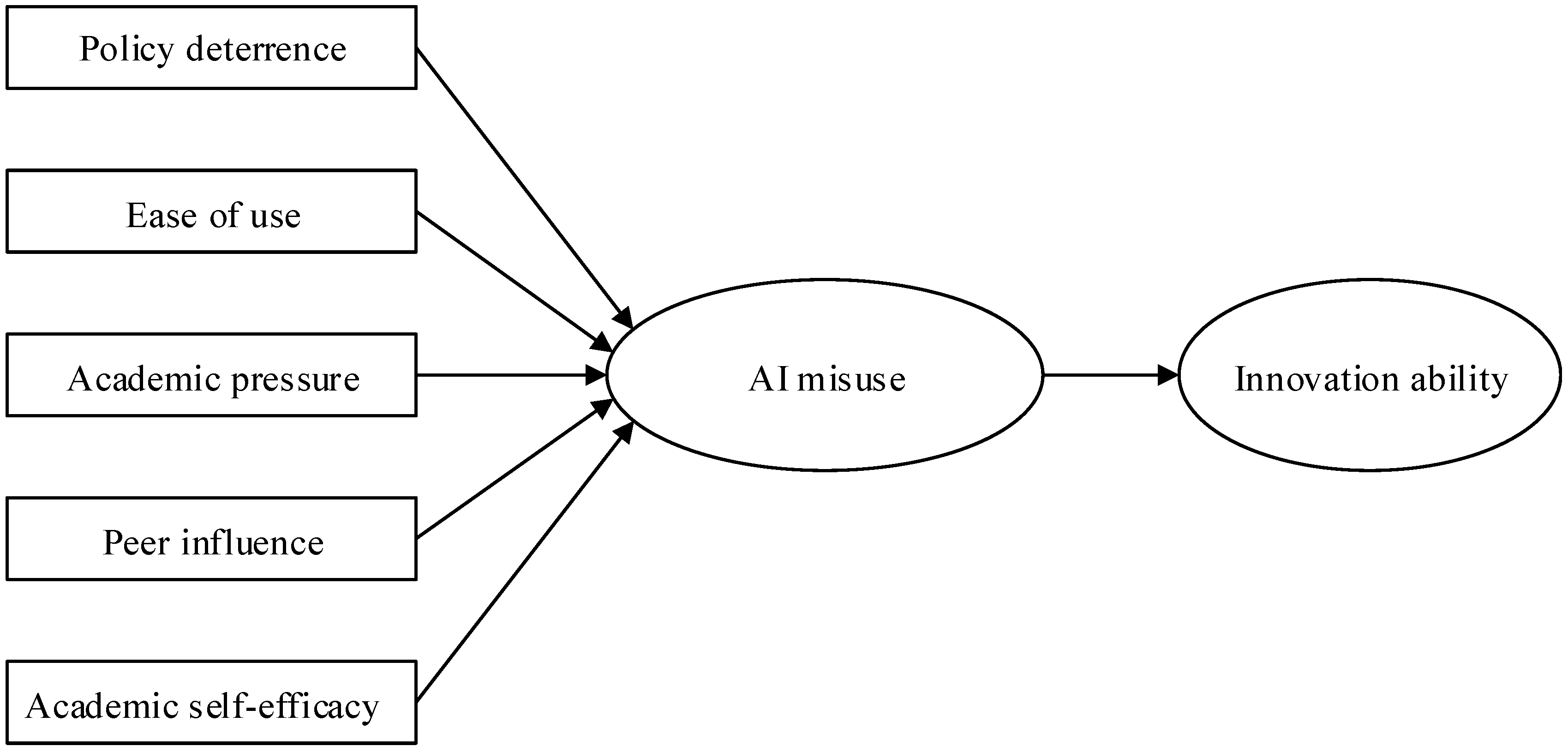
Although most existing studies have explored university students’ AI misuse behavior from the perspective of a single theory, with limited attempts to integrate multiple theoretical perspectives, AI misuse, as an emerging technology-driven deviant behavior, involves an interplay of institutional constraints, individual cognition, and situational triggers. A single theory is insufficient to fully explain this complex phenomenon. Therefore, this study attempts to integrate deterrence theory, social cognitive theory, and the fraud triangle theory to extract key independent variables from the policy level, individual level, and situational level, respectively, and use them to jointly predict AI misuse behavior. On this basis, this study further examines the potential inhibitory effect of AI misuse behavior on university students’ innovative ability. The model framework is shown in Figure 1.

3.1. Policy Deterrence (PD)

Classic deterrence theory posits that the greater the certainty, severity, and celerity of sanctions, the more likely individuals are to be deterred from committing illegal acts (Gibbs, 1975). Because AI misuse is a subset of information technology misuse and shares similar characteristics with it, deterrence theory has been introduced into the research on AI misuse (Goyal et al., 2026). Policy represents one of the most common and foundational approaches to deterrence. The lack of policies related to AI fails to guarantee its ethical use, which in turn may result in academic dishonesty (Abbas, 2025; A. Nguyen et al., 2024; Qadhi et al., 2024; Wang et al., 2024). Developing clear policies that specify the circumstances under which AI may be used appropriately, establish detection mechanisms, and impose sanctions on university students who violate the policies (Al-Sofi, 2024; Barus et al., 2025; Chan, 2023; Khlaif et al., 2024). Therefore, the following hypothesis was formulated:
H1. 
Policy deterrence has a negative effect on AI misuse.

3.2. Academic Self-Efficacy (ASE)

Self-efficacy originates from social cognitive theory (Bandura, 1986) and has been widely applied across different fields. In educational research, this concept is commonly specified as academic self-efficacy (Honicke & Broadbent, 2016). It refers to a person’s belief in their ability to complete academic tasks (Bong & Skaalvik, 2003; Odaci, 2011). Academic self-efficacy is one of the important predictors of university students’ problematic behaviors (S. Zhang et al., 2024). Prior research has empirically demonstrated that academic self-efficacy serves as a protective factor against problematic use of internet and AI among university students (Odaci, 2011; S. Zhang et al., 2024). Based on the information offered in these studies, the following hypothesis was proposed:
H2. 
Academic self-efficacy has a negative effect on AI misuse.

3.3. Ease of Use (EU)

Fraud triangle theory identifies three core factors that lead to fraudulent behavior: opportunity, pressure, and rationalization (Cressey, 1953). This theory has been applied to research on AI misuse (Alshurafat et al., 2024; Mendolia, 2024). In this study, we refine these three factors by incorporating the characteristics of university students’ AI misuse in academic contexts. Opportunity factors are reflected in the easy accessibility and low barriers to using AI tools. This study conceptualizes these factors as ease of use, referring to the degree to which university students believe that using AI tools would be free of effort (Davis, 1989). Ease of use can effectively promote users’ adoption and use of AI (Nikolic et al., 2024; Pillai et al., 2024). However, the ease of text generation (A. Nguyen et al., 2024) and the fact that operation requires no specialized knowledge (Marchal et al., 2024) facilitate AI misuse, such as plagiarism and cheating (Bittle & El-Gayar, 2025; Marchal et al., 2024; McDonald et al., 2025). Therefore, the following hypothesis was formulated:
H3. 
Ease of use has a positive effect on AI misuse.

3.4. Academic Pressure (AP)

Regarding the pressure factor, academic pressure is a significant trigger for college students’ AI misuse. Academic pressure manifests itself in the pursuit of higher grades, better academic rankings, and scholarships (Mendolia, 2024; Yeung et al., 2026). When students experience tremendous academic pressure, they are prone to develop cognitive laziness and tend to avoid deep thinking (Pitts et al., 2025). Therefore, students may cross the boundaries of academic ethics and lead to the misuse of AI (Abbas et al., 2024; Gonsalves, 2025; Pérez-Portabella et al., 2026a). Previous research has also shown that the greater the academic pressure, the higher the tendency toward AI misuse (Mendolia, 2024; S. Zhang et al., 2024). Hence, the following hypothesis was formulated:
H4. 
Academic pressure has a positive effect on AI misuse.

3.5. Peer Influence (PI)

In university settings, the rationalization mechanism mainly operates through peer influence. University students establish their own criteria for judging whether AI-related use behaviors are appropriate or not by observing their peers’ behavior (Pérez-Portabella et al., 2026b). Therefore, peer influence serves as a significant indicator for predicting AI misuse (Evangelista, 2025). When AI misuse is considered acceptable among peers, ethical rules will not be followed and such behavior will increase. (Gonsalves, 2025; Pérez-Portabella et al., 2026b). This leads to the following hypothesis:
H5. 
Peer influence has a positive effect on AI misuse.

3.6. AI Misuse (AIM)

AI promotes innovation in the education field by providing innovative tools (Abbas, 2025; Gumiran & Ambida, 2025). AI can enhance university students’ skills, facilitate idea generation, and thereby stimulate innovation (Dwivedi et al., 2023; Ifelebuegu et al., 2023). However, AI misuse can hinder the development of college students’ creative thinking and innovation ability (Al-Sofi, 2024; Farangi et al., 2025; Ivanov, 2023; Rezaei et al., 2024). Students obtaining answers through AI leads to reduced learning engagement, which in turn hinders the improvement of their innovation ability (Dong et al., 2025). Moreover, information inaccuracy, overload, and over-reliance on AI directly inhibit the development of their innovation ability (Al-Sofi, 2024; S. Zhang et al., 2024). Hence, the following hypothesis was formulated:
H6. 
AI misuse has a negative effect on students’ innovation ability.

4. Research Method

To test the hypotheses and provide data for the conceptual model, a survey method was employed for data collection. Questionnaires were distributed to university students across nine universities in Jiangsu Province, China. SEM was utilized to evaluate the hypotheses presented in the conceptual model.

4.1. Construct Operationalization

To facilitate cumulative knowledge, the operationalization of constructs from previous research was employed. Given that this study focuses on the antecedents and consequences of AI misuse, several modifications were made to the existing scale. A five-point Likert scale (1 = strongly disagree, 5 = strongly agree) was utilized for all items. Specifically, PD was adapted from Herath and Rao (2009), EU from Davis (1989), ASE from Nielsen et al. (2018), AP from Abbas et al. (2024), AIM from Goyal et al. (2026) and Pérez-Portabella et al. (2026a), PI from Taylor and Todd (1995), and innovation ability from Zhou et al. (2025).

4.2. Data Collection

Data were collected from the sample by using a questionnaire survey. A structured questionnaire was developed based on validated scales in prior relevant studies to ensure content validity. This questionnaire includes participants’ demographic characteristics and measurement scales for the research variables. Additionally, the questionnaire was translated and adapted into Chinese following standard back-translation procedures.
This study was granted an ethics exemption by the School of Public Policy & Management, China University of Mining and Technology. The research involved a non-interventional, anonymous questionnaire survey. No personally identifiable information was collected, and the questionnaire contained no sensitive topics. All participants were informed of the study purpose and provided voluntary informed consent before participation. The study was conducted in accordance with the ethical principles of the Declaration of Helsinki.
A stratified sampling method was adopted to recruit participants from nine universities across Jiangsu Province, China. The sample covered four institutional tiers—two 985 universities, one 211 university, four regular undergraduate institutions, and two vocational and technical colleges—to enhance sample representativeness. The questionnaires were distributed to students through an online survey platform. A total of 541 students were recruited from the nine institutions, and 520 questionnaires were returned (response rate = 96.12%). The following criteria were used to identify invalid questionnaires: (1) incomplete responses with missing values; (2) straight-lining responses; and (3) response time of less than one minute. Based on these criteria, 27 questionnaires were excluded, yielding 493 valid responses for final data analysis (effective rate = 91.13%). The demographic data of the respondents are presented in Table 1.
As shown in Table 1, the gender distribution among respondents was 39.96% male and 60.04% female. Over 50% of the respondents were from general undergraduate universities, while 18.86% were from 985 universities and 17.65% from 211 universities (non-985). The respondents’ year of study is as follows: 23.73% freshman, 24.34% sophomore, 20.69% junior, 24.54% senior and 6.70% graduate students. In terms of frequency of AI use, 14.40% of respondents always used AI, 56.39% frequently used AI, 29.01% occasionally used AI, and 0.20% never used AI.

4.3. Scale Validation

Validating a scale involves assessing its reliability, along with its convergent and discriminant validity (Fornell & Larcker, 1981). Construct reliability and convergent validity are typically evaluated using Cronbach’s alpha values and factor loadings. As shown in Table 2, the seven constructs in the model demonstrated good reliability with alpha values exceeding 0.8. Furthermore, all factor loading values ranged from 0.717 to 0.817 and were statistically significant at p < 0.001. Therefore, the criteria for construct reliability and convergent validity were met.
Discriminant validity was assessed based on the criteria proposed by Fornell and Larcker (1981): the square root of the average variance extracted (AVE) must surpass the correlations between the construct and other constructs in the model. As illustrated in Table 3, the AVEs for all constructs exceeded their corresponding cross-correlations, thereby confirming that the criteria for discriminant validity were met.

5. Results

5.1. Model Testing Results

The structural model was tested using SEM conducted in AMOS 25. As summarized in Table 4, χ2/df (χ2 = 358.21, df = 310) was 1.156, which is less than 3.0. Additionally, NFI, GFI, and CFI all exceeded 0.9, while RMSEA was 0.018 and less than 0.1. These results indicate that the model fit exceeded the commonly accepted levels, suggesting that all indices demonstrate a very good fit.

5.2. Hypothesis Testing

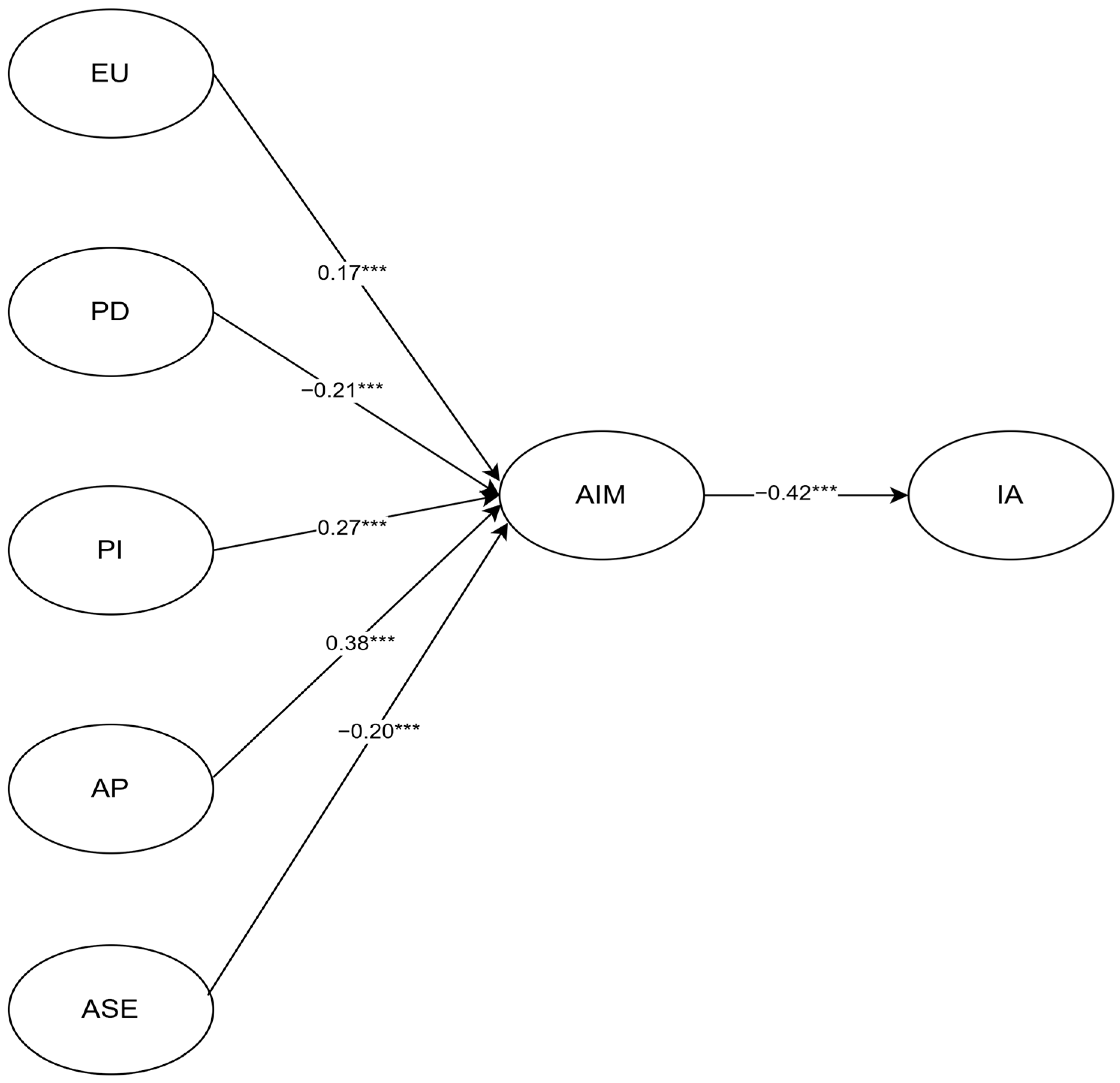
The hypotheses were tested collectively by examining the significance of the relationships in the SEM model. The path significance of each hypothesized association in the research model and the variance explained (R2 value) were examined. Figure 2 shows the standardized path coefficients and their corresponding significance levels for the research model.
All hypothesized paths illustrated in Table 5 were found to be significant. EU (β = 0.172, p < 0.001), PI (β = 0.268, p < 0.001) and AP (β = 0.380, p < 0.001) each demonstrated a significant positive impact on AIM. PD (β = −0.210, p < 0.001) and ASE (β = −0.199, p < 0.001) both had a significant negative effect on AIM. AIM (β = −0.423, p < 0.001) had a significant negative effect on IA. Thus, all hypotheses in the research model were supported.

6. Discussion

There is a notable lack of empirical research investigating the antecedents and consequences of AI misuse among university students. This study constructs an integrated research model for the antecedents and consequences of AI misuse based on the fraud triangle theory, deterrence theory, and social cognitive theory. The findings indicate that all five antecedents have a significant effect on AI misuse. AI misuse negatively impacts students’ innovation ability. The following sections discuss the theoretical mechanisms underlying these findings.
The results indicate that ease of use has a significant positive effect on AI misuse. This finding is consistent with the opportunity element of the fraud triangle theory (Cressey, 1953) and supports recent empirical studies applying this theory to AI misuse (Alshurafat et al., 2024; Başer et al., 2026; Mendolia, 2024). Unlike traditional cheating as documented by McCabe et al. (2001), AI reduces execution costs to nearly zero while offering greater concealment, creating a low-cost, high-reward tempting option (Amichai-Hamburger, 2017). Furthermore, AI ease of use produces a subtle cognitive vigilance reduction effect: constrained by their own knowledge, students lack the ability to effectively review and verify AI-generated content, while the superficially high quality of such content further numbs their alertness, forming a cognitive trap (Kahneman, 2011). This finding enriches the opportunity dimension of fraud triangle theory by revealing how AI-specific technical features reshape opportunity structures in academic misconduct, moving beyond opportunity conceptualizations in traditional contexts.
The results show that academic pressure significantly increases AI misuse. This finding is consistent with the pressure element of the fraud triangle theory (Cressey, 1953) and supports recent empirical studies applying this theory to AI misuse (Alshurafat et al., 2024; Mendolia, 2024). In the AI context, some students skip legitimate approaches and directly use AI. Pressure is no longer merely a trigger but becomes a decisive switch. Furthermore, academic pressure induces a temporal discounting effect: under high pressure, students overestimate short-term gains while underestimating long-term costs, and the instant output of AI caters to this cognitive bias (Kirby & Herrnstein, 1995). This study extends the pressure mechanism of fraud triangle theory by linking academic pressure to AI usage, offering a new cognitive perspective to explain why students engage in AI misuse under stress.
The results also confirm that peer influence has a positive effect on AI misuse. This finding is consistent with the rationalization element of the fraud triangle theory (Cressey, 1953) and supports recent empirical studies applying this theory to AI misuse (Alshurafat et al., 2024; Mendolia, 2024). Peer behavior influences individual choices (McCabe et al., 2001), and this influence is more direct in the AI context. The prevalence of group behavior triggers a diffusion of responsibility effect, creating an illusion of “everyone is doing it, so I won’t be caught” (Darley & Latané, 1968). This psychological comfort reduces immediate guilt and increases the likelihood of future misuse through positive reinforcement. This finding advances the rationalization pillar of fraud triangle theory by unpacking how peer behavior fosters moral neutralization in AI misuse, complementing existing rationality-based explanations with social psychological mechanisms.
The results indicate that clear policy deterrence effectively curbs AI misuse, which is consistent with deterrence theory (Nagin, 2013), specifically the principle that sanction certainty is the key to deterrence effectiveness. Current course assignments largely rely on teachers’ verbal requirements, resulting in low perceived probability of punishment and limited deterrence effectiveness. In contrast, theses have clear AI-generated content limits, and exceeding these limits leads to failed reviews—a certainty-based punishment that significantly curbs misuse. Unlike traditional contexts (Paternoster, 1987), AI offers greater concealment, and students require a certainty of being caught signal for deterrence to work. Furthermore, over-reliance on AI detection may lead students to pursue AI compliance rates rather than genuine learning (Deci & Ryan, 2000). This study refines deterrence theory in the AI era by highlighting that sanction certainty becomes even more critical given AI’s high concealability, providing empirical evidence for optimizing institutional deterrence policies in higher education.
The results indicate that academic self-efficacy has a significant negative effect on AI misuse. This finding is consistent with social cognitive theory (Bandura, 1986). Self-efficacy influences behavioral choices (Zimmerman, 2000), and this influence is more extreme in the AI context. High self-efficacy students tend to avoid using AI-generated content, whereas low self-efficacy students, due to insufficient knowledge and skills, exclude the option of autonomous completion from the outset and directly turn to AI (Pajares, 1996). This means that self-efficacy directly affects the decision-making starting point of whether to try—low-efficacy students give up autonomous effort before even beginning the task. Some students submit assignments without even adjusting the original AI-generated formatting. For these students, AI becomes the default first choice rather than a last resort. This study extends social cognitive theory by clarifying how academic self-efficacy acts as a protective factor against AI misuse at the initial decision stage, offering a new motivational perspective for understanding student avoidance of AI misuse.
The results indicate that AI misuse has a significant negative effect on students’ innovation ability. Consistent with Carr (2020) on technology dependence, outsourcing thinking to AI leads to cognitive decline due to lack of exercise. Unlike traditional learning tools as documented by Clark and Mayer (2023), AI directly outputs complete answers, bypassing users’ thinking processes, making it more likely to induce cognitive inertia. Furthermore, AI misuse weakens critical thinking: AI-generated content may contain errors, and if students use it uncritically, their critical thinking is not only not exercised but actively weakened (Elder & Paul, 2020). Critical thinking and knowledge integration skills are the core foundations of innovation ability. By establishing a clear theoretical and empirical link between AI misuse and innovation ability, this study fills a critical theoretical gap within the field of AI in higher education, providing a foundational mechanism for understanding how AI overuse erodes core innovation ability.

7. Implications

7.1. Implications for Theory

First, this study broadens the research scope of AI misuse. Previous research on influencing factors remains fragmented, lacking a comprehensive research perspective. Moreover, discussions of its impacts have largely remained at the experiential level, with limited empirical research. This study constructs an integrated research model for the antecedents and consequences of AI misuse and empirically validates it using data collected from university students.
Second, this study constructs an integrated theoretical framework of AI misuse. Most existing studies have explored university students’ AI misuse behavior from the perspective of a single theory. However, AI misuse, as an emerging technology-driven deviant behavior, involves an interplay of institutional constraints, individual cognition, and situational triggers. A single theory is insufficient to fully explain this complex phenomenon. Therefore, this study integrates deterrence theory, social cognitive theory, and the fraud triangle theory to jointly predict AI misuse behavior from the policy, individual, and situational levels, respectively.
Third, this study is among the few investigations that apply the fraud triangle theory to AI misuse and explore its antecedents. However, previous research has used the three elements—opportunity, pressure, and rationalization—as general constructs without further concretizing them in the AI context. The present study refines these three factors by incorporating the characteristics of university students’ AI misuse in academic contexts, operationalizing opportunity as ease of use, pressure as academic pressure, and rationalization as peer influence.

7.2. Implications for Practice

First, universities should actively formulate AI policies. This study finds that clear policy deterrence can effectively curb AI misuse, while verbal requirements have limited effectiveness. A complete ban on AI use is inadvisable; instead, universities should actively leverage advanced AI to promote teaching and research development while governing its misuse. Based on broad consultations with faculty and students, universities should develop clear AI usage policies that clearly define what constitutes appropriate and inappropriate use. Clear thresholds for the proportion of AI-generated content in assignments and theses should be established, with differentiated penalties corresponding to the severity of misuse. By establishing certainty-based punishment mechanisms, universities can harness the positive role of AI while effectively curbing its misuse.
Second, universities should actively develop AI training programs. This study finds that peer influence provides psychological support for AI misuse, while students with low academic self-efficacy are more prone to AI misuse due to insufficient knowledge and skills. Therefore, universities should systematically train students in AI-related knowledge and skills, helping them distinguish between appropriate AI use (e.g., language polishing) and inappropriate use (e.g., directly generating complete answers, ghostwriting papers). Through training, universities can foster a correct understanding of AI use and encourage students to voluntarily resist misuse. Beyond technical skills, institutions should strengthen academic and AI ethics education, using case-based teaching and value-guided reflection to internalize external rules into students’ self-regulation. Additionally, fostering a campus culture that endorses appropriate AI use, supported by peer monitoring and mutual supervision, can convert peer influence into a positive constraint, collectively reducing AI misuse.
Third, universities should scientifically redesign academic curricula and syllabi. This study finds that academic pressure drives students to choose AI shortcuts, while students with low academic self-efficacy are more prone to AI misuse. Based on these findings, on the one hand, universities should arrange course schedules more reasonably to avoid concentrating multiple high-load courses in the same semester, thereby reducing students’ academic burden and decreasing pressure-driven AI misuse. On the other hand, universities should increase the offering of academic skills courses, ideally starting from the fourth semester, including research methodology and academic writing. These courses will help students develop the core competencies needed to complete academic tasks independently, gradually building their academic confidence and self-efficacy, thereby fundamentally reducing students’ dependence on AI and inappropriate use.
Fourth, universities should systematically enhance faculty AI literacy. Faculty members who can identify AI-generated content are better placed to exercise their authoritative role—not just as deterrents, but as guides. If students know their instructors can reliably spot unreflective AI use, they may think twice before submitting such work. More importantly, faculty members can model appropriate AI use and set clear expectations, showing students how to critically engage with AI-generated content without outsourcing their thinking. This helps prevent unscrutinized submissions while fostering a culture of responsible AI engagement.

8. Limitations and Future Research

Although this study draws on a relatively large sample that strengthens the reliability of its findings, the data were collected solely from university students in one province of China. This geographical and institutional concentration may limit the extent to which the results can be generalized to other educational settings. To address this, further research could extend the investigation to other provinces and different types of institutions, which would help test the stability of our findings and offer a more complete picture of student misuse of AI.
This study mainly examined the impact of AI misuse on students’ innovative ability, without addressing other potentially important outcome variables. Future research could investigate the impact of AI misuse on other important student outcomes, such as knowledge acquisition and long-term academic achievement, to better understand the full range of consequences that AI misuse may bring to students’ educational development.

9. Conclusions

AI misuse has become a significant challenge and concern in higher education. This study developed and validated an integrated model for the antecedents and consequences of AI misuse based on multi-theoretical perspectives. The results indicate that ease of use, academic pressure and peer influence significantly promote AI misuse, while policy deterrence and academic self-efficacy can effectively inhibit such behaviors. Furthermore, AI misuse significantly impairs students’ innovation ability. This study advances the systematic understanding of AI misuse and consolidates its theoretical and empirical underpinnings. It enables universities to better govern AI misuse and enhance students’ innovation ability.

Author Contributions

Conceptualization, H.Z.; methodology, Y.C.; software, Y.C.; investigation, Y.C.; data curation, Y.C.; writing—original draft preparation, H.Z.; writing—review and editing, H.Z.; All authors have read and agreed to the published version of the manuscript.

Funding

This paper supported by the Key Projects of the 14th Five-Year Plan for Education Science Planning in Jiangsu Province [B-b/2024/01/164].

Institutional Review Board Statement

The study was conducted in accordance with the Declaration of Helsinki. Ethical review and approval were waived for this study because it involved an anonymous, low-risk, non-interventional online survey. An ethics exemption was granted by the School of Public Policy & Management, China University of Mining and Technology.

Informed Consent Statement

Verbal informed consent was obtained from the participants. Verbal consent was obtained rather than written because the study involved an anonymous, low-risk online survey; completion and submission of the questionnaire was considered as consent.

Data Availability Statement

The data supporting the conclusions of this article will be made available by the authors on request due to the data being part of an ongoing study.

Acknowledgments

The authors would like to express their gratitude to the editor and the anonymous reviewers for their diligent work and valuable comments during the review process.

Conflicts of Interest

The authors declare no conflicts of interest.

Abbreviations

The following abbreviations are used in this manuscript:
PDPolicy deterrence
ASEAcademic self-efficacy
EUEase of use
APAcademic pressure
PIPeer influence
AIMAI misuse
IAInnovation ability

References

  1. Abbas, M. (2025). Challenges and misuses of generative AI and the quest for mitigation. In Navigating generative AI in higher education (pp. 179–193). Edward Elgar Publishing. [Google Scholar] [CrossRef]
  2. Abbas, M., Jam, F. A., & Khan, T. I. (2024). Is it harmful or helpful? Examining the causes and consequences of generative AI usage among university students. International Journal of Educational Technology in Higher Education, 21, 10. [Google Scholar] [CrossRef]
  3. Aldosari, S. A. M. (2020). The future of higher education in the light of artificial intelligence transformations. International Journal of Higher Education, 9(3), 145–151. [Google Scholar] [CrossRef]
  4. Alqahtani, T., Badreldin, H. A., Alrashed, M., Alshaya, A. I., Alghamdi, S. S., Saleh, K. B., Alowais, S. A., Alshaya, O. A., Rahman, I., Al Yami, M. S., & Albekairy, A. M. (2023). The emergent role of artificial intelligence, natural learning processing, and large language models in higher education and research. Research in Social and Administrative Pharmacy, 19(8), 1236–1242. [Google Scholar] [CrossRef] [PubMed]
  5. Alshahrani, B. T., Pileggi, S. F., & Karimi, F. (2024). A social perspective on AI in the higher education system: A semisystematic literature review. Electronics, 13(8), 1572. [Google Scholar] [CrossRef]
  6. Alshurafat, H., Al Shbail, M. O., Hamdan, A., Al-Dmour, A., & Ensour, W. (2024). Factors affecting accounting students’ misuse of ChatGPT: An application of the fraud triangle theory. Journal of Financial Reporting and Accounting, 22(2), 274–288. [Google Scholar] [CrossRef]
  7. Al-Sofi, B. B. M. A. (2024). Artificial intelligence-powered tools and academic writing: To use or not to use ChatGPT. Saudi Journal of Language Studies, 4(3), 145–161. [Google Scholar] [CrossRef]
  8. Amichai-Hamburger, Y. (2017). Internet psychology: The basics. Routledge. [Google Scholar]
  9. Aylsworth, T., & Castro, C. (2024). Should I use ChatGPT to write my papers? Philosophy & Technology, 37(4), 117. [Google Scholar] [CrossRef]
  10. Bandura, A. (1986). Social foundations of thought and action (pp. 23–28). Stanford University. [Google Scholar]
  11. Barrett, A., & Pack, A. (2023). Not quite eye to AI: Student and teacher perspectives on the use of generative artificial intelligence in the writing process. International Journal of Educational Technology in Higher Education, 20(1), 59. [Google Scholar] [CrossRef]
  12. Barus, O. P., Hidayanto, A. N., Handri, E. Y., Sensuse, D. I., & Yaiprasert, C. (2025). Shaping generative AI governance in higher education: Insights from student perception. International Journal of Educational Research Open, 8, 100452. [Google Scholar] [CrossRef]
  13. Başer, M. Y., Kozak, M., & Erdoğan, İ. H. (2026). Do we worry about the use of artificial intelligence and plagiarism? Students’ AI-giarism behaviour through the fraud triangle. The Internet and Higher Education, 69, 101071. [Google Scholar] [CrossRef]
  14. Bates, T., Cobo, C., Mariño, O., & Wheeler, S. (2020). Can artificial intelligence transform higher education? International Journal of Educational Technology in Higher Education, 17(1), 42. [Google Scholar] [CrossRef]
  15. Belkina, M., Daniel, S., Nikolic, S., Haque, R., Lyden, S., Neal, P., Grundy, S., & Hassan, G. M. (2025). Implementing generative AI (GenAI) in higher education: A systematic review of case studies. Computers and Education: Artificial Intelligence, 8, 100407. [Google Scholar] [CrossRef]
  16. Bittle, K., & El-Gayar, O. (2025). Generative AI and academic integrity in higher education: A systematic review and research agenda. Information, 16(4), 296. [Google Scholar] [CrossRef]
  17. Bond, M., Khosravi, H., De Laat, M., Bergdahl, N., Negrea, V., Oxley, E., Pham, P., Chong, S. W., & Siemens, G. (2024). A meta systematic review of artificial intelligence in higher education: A call for increased ethics, collaboration, and rigor. International Journal of Educational Technology in Higher Education, 21, 4. [Google Scholar] [CrossRef]
  18. Bong, M., & Skaalvik, E. M. (2003). Academic self-concept and self-efficacy: How different are they really? Educational Psychology Review, 15(1), 1–40. [Google Scholar] [CrossRef]
  19. Carr, N. (2020). The shallows: What the internet is doing to our brains. WW Norton & Company. [Google Scholar]
  20. Castillo-Martínez, I. M., Flores-Bueno, D., Gómez-Puente, S. M., & Vite-León, V. O. (2024). AI in higher education: A systematic literature review. Frontiers in Education, 9, 1391485. [Google Scholar] [CrossRef]
  21. Chan, C. K. Y. (2023). A comprehensive AI policy education framework for university teaching and learning. International Journal of Educational Technology in Higher Education, 20, 38. [Google Scholar] [CrossRef]
  22. Chiu, T. K., Xia, Q., Zhou, X., Chai, C. S., & Cheng, M. (2023). Systematic literature review on opportunities, challenges, and future research recommendations of artificial intelligence in education. Computers and Education: Artificial Intelligence, 4, 100118. [Google Scholar] [CrossRef]
  23. Chu, H. C., Hwang, G. H., Tu, Y. F., & Yang, K. H. (2022). Roles and research trends of artificial intelligence in higher education: A systematic review of the top 50 most-cited articles. Australasian Journal of Educational Technology, 38(3), 22–42. [Google Scholar]
  24. Clark, R. C., & Mayer, R. E. (2023). E-learning and the science of instruction: Proven guidelines for consumers and designers of multimedia learning. Wiley. [Google Scholar]
  25. Cressey, D. (1953). Other people’s money: A study in the social psychology of embezzlement. Free Press. [Google Scholar]
  26. Crompton, H., & Burke, D. (2023). Artificial intelligence in higher education: The state of the field. International Journal of Educational Technology in Higher Education, 20, 22. [Google Scholar] [CrossRef]
  27. Dakakni, D., & Safa, N. (2023). Artificial intelligence in the L2 classroom: Implications and challenges on ethics and equity in higher education: A 21st century Pandora’s box. Computers and Education: Artificial Intelligence, 5, 100179. [Google Scholar] [CrossRef]
  28. Darley, J. M., & Latané, B. (1968). Bystander intervention in emergencies: Diffusion of responsibility. Journal of Personality and Social Psychology, 8(4), 377–383. [Google Scholar] [CrossRef] [PubMed]
  29. Davis, F. D. (1989). Perceived usefulness, perceived ease of use, and user acceptance of information technology. MIS Quarterly, 13(3), 319–340. [Google Scholar] [CrossRef] [PubMed]
  30. Deci, E. L., & Ryan, R. M. (2000). The “what” and “why” of goal pursuits: Human needs and the self-determination of behavior. Psychological Inquiry, 11(4), 227–268. [Google Scholar] [CrossRef]
  31. Dong, X., Wang, Z., & Han, S. (2025). Mitigating learning burnout caused by generative artificial intelligence misuse in higher education: A case study in programming language teaching. Informatics, 12(2), 51. [Google Scholar] [CrossRef]
  32. Dwivedi, Y. K., Kshetri, N., Hughes, L., Slade, E. L., Jeyaraj, A., Kar, A. K., & Wright, R. (2023). “So what if ChatGPT wrote it?” Multidisciplinary perspectives on opportunities, challenges and implications of generative conversational AI for research, practice and policy. International Journal of Information Management, 71, 102642. [Google Scholar] [CrossRef]
  33. Egunjobi, J. P. (2024). Artificial intelligence and academic writing: A global exploration of students perceptions and attitudes. West Africa Journal of Arts and Social Sciences, 4(1), 125–144. [Google Scholar] [CrossRef]
  34. Elder, L., & Paul, R. (2020). Critical thinking: Tools for taking charge of your learning and your life. Bloomsbury Publishing USA. [Google Scholar]
  35. Essien, A., Bukoye, O. T., O’Dea, X., & Kremantzis, M. (2024). The influence of AI text generators on critical thinking skills in UK business schools. Studies in Higher Education, 49(5), 865–882. [Google Scholar] [CrossRef]
  36. Evangelista, E. D. L. (2025). Ensuring academic integrity in the age of ChatGPT: Rethinking exam design, assessment strategies, and ethical AI policies in higher education. Contemporary Educational Technology, 17(1), ep559. [Google Scholar] [CrossRef] [PubMed]
  37. Fahimirad, M., & Kotamjani, S. S. (2018). A review on application of artificial intelligence in teaching and learning in educational contexts. International Journal of Learning and Development, 8(4), 106–118. [Google Scholar] [CrossRef]
  38. Farangi, M. R., Nejadghanbar, H., & Hu, G. (2025). Use of generative AI in research: Ethical considerations and emotional experiences. Ethics & Behavior, 35(7), 527–543. [Google Scholar] [CrossRef]
  39. Fornell, C., & Larcker, D. F. (1981). Evaluating structural equation models with unobservable variables and measurement error. Journal of Marketing Research, 18(1), 39–50. [Google Scholar] [CrossRef]
  40. Fowler, D. S. (2023). AI in higher education: Academic integrity, harmony of insights, and recommendations. Journal of Ethics in Higher Education, 3, 127–143. [Google Scholar] [CrossRef]
  41. Gazadinda, R., Qonita, A., Nuraisyah, Z., Maulana, A. T., Yudhistira, S., Medellu, G. I. R., Rangkuti, A. A., & Fauzia, J. H. (2026). Academic dishonesty and its contributing factors among Indonesian first-year college students in the AI era. Jurnal Ilmiah Psikologi Terapan, 14(1), 43–52. [Google Scholar] [CrossRef]
  42. Gibbs, J. P. (1975). Crime, punishment, and deterrence. Elsevier. [Google Scholar]
  43. Gonsalves, C. (2025). Addressing student non-compliance in AI use declarations: Implications for academic integrity and assessment in higher education. Assessment & Evaluation in Higher Education, 50(4), 592–606. [Google Scholar] [CrossRef]
  44. Goyal, S., Chauhan, S., & Motiwalla, L. (2026). Examining business students’ intentions to misuse ChatGPT through the lens of deterrence and neutralisation theories. Behaviour & Information Technology, 45(4), 660–679. [Google Scholar] [CrossRef]
  45. Gumiran, I., & Ambida, M. (2025). AI chatbot misuse in education: Ethical and pedagogical risks. AsTEN Journal of Teacher Education, 1–16. [Google Scholar] [CrossRef]
  46. Hashmi, N., & Bal, A. S. (2024). Generative AI in higher education and beyond. Business Horizons, 67(5), 607–614. [Google Scholar] [CrossRef]
  47. Herath, T., & Rao, H. R. (2009). Protection motivation and deterrence: A framework for security policy compliance in organizations. European Journal of Information Systems, 18(2), 106–125. [Google Scholar] [CrossRef]
  48. Holmes, W., Iniesto, F., Anastopoulou, S., & Boticario, J. G. (2023). Stakeholder perspectives on the ethics of AI in distance-based higher education. International Review of Research in Open and Distributed Learning, 24(2), 96–117. [Google Scholar] [CrossRef]
  49. Holmes, W., Porayska-Pomsta, K., Holstein, K., Sutherland, E., Baker, T., Shum, S. B., Santos, O. C., Rodrigo, M. T., Cukurova, M., Bittencourt, I. I., & Koedinger, K. R. (2022). Ethics of AI in education: Towards a community-wide framework. International Journal of Artificial Intelligence in Education, 32(3), 504–526. [Google Scholar] [CrossRef]
  50. Honicke, T., & Broadbent, J. (2016). The influence of academic self-efficacy on academic performance: A systematic review. Educational Research Review, 17, 63–84. [Google Scholar] [CrossRef]
  51. Hosseini, S. M. (2025). AI misuse and passiveness of students in medical education. Advances in Physiology Education, 49(4), 1009–1013. [Google Scholar] [CrossRef] [PubMed]
  52. Ifelebuegu, A. O., Kulume, P., & Cherukut, P. (2023). Chatbots and AI in Education (AIEd) tools: The good, the bad, and the ugly. Journal of Applied Learning & Teaching, 6(2), 332–345. [Google Scholar] [CrossRef]
  53. Ivanov, S. (2023). The dark side of artificial intelligence in higher education. The Service Industries Journal, 43(15–16), 1055–1082. [Google Scholar] [CrossRef]
  54. Jacques, P. H., Moss, H. K., & Garger, J. (2024). A synthesis of AI in higher education: Shaping the future. Journal of Behavioral and Applied Management, 24(2), 103–111. [Google Scholar] [CrossRef]
  55. Jafari, F., & Keykha, A. (2024). Identifying the opportunities and challenges of artificial intelligence in higher education: A qualitative study. Journal of Applied Research in Higher Education, 16(4), 1228–1245. [Google Scholar] [CrossRef]
  56. Janković, A., & Kulić, D. (2025). Use and misuse of ChatGPT in academic writing among the English language students. Information Technologies and Learning Tools, 105(1), 178. [Google Scholar] [CrossRef]
  57. Kahneman, D. (2011). Thinking, fast and slow. Farrar, Straus and Giroux. [Google Scholar]
  58. Khan, S., Mazhar, T., Shahzad, T., Khan, M. A., Rehman, A. U., Saeed, M. M., & Hamam, H. (2025). Harnessing AI for sustainable higher education: Ethical considerations, operational efficiency, and future directions. Discover Sustainability, 6(1), 23. [Google Scholar] [CrossRef]
  59. Khlaif, Z. N., Ayyoub, A., Hamamra, B., Bensalem, E., Mitwally, M. A., Ayyoub, A., Hattab, M. K., & Shadid, F. (2024). University teachers’ views on the adoption and integration of generative AI tools for student assessment in higher education. Education Sciences, 14(10), 1090. [Google Scholar] [CrossRef]
  60. Kirby, K. N., & Herrnstein, R. J. (1995). Preference reversals due to myopic discounting of delayed reward. Psychological Science, 6(2), 83–89. [Google Scholar] [CrossRef]
  61. Lancaster, T., Glendinning, I., Dann, S., Crockett, R., & Draper, M. (2025). Developing policies to address historic contract cheating and misuse of generative artificial intelligence. Journal of Academic Writing, 15(S1), 1–13. [Google Scholar] [CrossRef]
  62. Lyu, W., Zhang, S., Chung, T., Sun, Y., & Zhang, Y. (2025). Understanding the practices, perceptions, and (dis) trust of generative AI among instructors: A mixed-methods study in the US higher education. Computers and Education: Artificial Intelligence, 8, 100383. [Google Scholar] [CrossRef]
  63. Marchal, N., Xu, R., Elasmar, R., Gabriel, I., Goldberg, B., & Isaac, W. (2024). Generative AI misuse: A taxonomy of tactics and insights from real-world data. arXiv, arXiv:2406.13843. [Google Scholar] [CrossRef]
  64. McCabe, D. L., Trevino, L. K., & Butterfield, K. D. (2001). Dishonesty in academic environments: The influence of peer reporting requirements. The Journal of Higher Education, 72(1), 29–45. [Google Scholar] [CrossRef]
  65. McDonald, N., Johri, A., Ali, A., & Collier, A. H. (2025). Generative artificial intelligence in higher education: Evidence from an analysis of institutional policies and guidelines. Computers in Human Behavior: Artificial Humans, 3, 100121. [Google Scholar] [CrossRef]
  66. Mendolia, T. A. (2024). Academic dishonesty in the age of AI: Connecting student generative AI use and the fraud triangle within health professions education. University of North Texas. [Google Scholar]
  67. Michel-Villarreal, R., Vilalta-Perdomo, E., Salinas-Navarro, D. E., Thierry-Aguilera, R., & Gerardou, F. S. (2023). Challenges and opportunities of generative AI for higher education as explained by ChatGPT. Education Sciences, 13(9), 856. [Google Scholar] [CrossRef]
  68. Moorhouse, B. L., Yeo, M. A., & Wan, Y. (2023). Generative AI tools and assessment: Guidelines of the world’s top-ranking universities. Computers and Education Open, 5, 100151. [Google Scholar] [CrossRef]
  69. Nagin, D. S. (2013). Deterrence in the twenty-first century. Crime and Justice, 42(1), 199–263. [Google Scholar] [CrossRef] [PubMed]
  70. Nguyen, A., Hong, Y., Dang, B., & Huang, X. (2024). Human-AI collaboration patterns in AI-assisted academic writing. Studies in Higher Education, 49(5), 847–864. [Google Scholar] [CrossRef]
  71. Nguyen, K. V. (2025). The use of generative AI tools in higher education: Ethical and pedagogical principles. Journal of Academic Ethics, 23(3), 1435–1455. [Google Scholar] [CrossRef]
  72. Nielsen, T., Dammeyer, J., Vang, M. L., & Makransky, G. (2018). Gender fairness in self-efficacy? A Rasch-based validity study of the General Academic Self-efficacy scale (GASE). Scandinavian Journal of Educational Research, 62(5), 664–681. [Google Scholar] [CrossRef]
  73. Nikolic, S., Wentworth, I., Sheridan, L., Moss, S., Duursma, E., Jones, R. A., Ros, M., & Middleton, R. (2024). A systematic literature review of attitudes, intentions and behaviours of teaching academics pertaining to AI and generative AI (GenAI) in higher education: An analysis of GenAI adoption using the UTAUT framework. Australasian Journal of Educational Technology, 40(6), 56–75. [Google Scholar] [CrossRef]
  74. Odaci, H. (2011). Academic self-efficacy and academic procrastination as predictors of problematic internet use in university students. Computers & Education, 57(1), 1109–1113. [Google Scholar] [CrossRef]
  75. O’Dea, X. (2024). Generative AI: Is it a paradigm shift for higher education? Studies in Higher Education, 49(5), 811–816. [Google Scholar] [CrossRef]
  76. Ogunleye, B., Zakariyyah, K. I., Ajao, O., Olayinka, O., & Sharma, H. (2024). Higher education assessment practice in the era of generative AI tools. Journal of Applied Learning & Teaching, 7(1), 46–56. [Google Scholar] [CrossRef]
  77. Ou, A. W., Stöhr, C., & Malmström, H. (2024). Academic communication with AI-powered language tools in higher education: From a post-humanist perspective. System, 121, 103225. [Google Scholar] [CrossRef]
  78. Pajares, F. (1996). Self-efficacy beliefs in academic settings. Review of Educational Research, 66(4), 543–578. [Google Scholar] [CrossRef]
  79. Paternoster, R. (1987). The deterrent effect of the perceived certainty and severity of punishment: A review of the evidence and issues. Justice Quarterly, 4(2), 173–217. [Google Scholar] [CrossRef]
  80. Pérez-Portabella, A., de Andrés-Sánchez, J., Arias-Oliva, M., & Padilla-Castillo, G. (2026a). Ethical judgments and weakness of will in the misuse of generative AI: The case of academic essay production among higher education students. Innovative Higher Education, 51, 453–479. [Google Scholar] [CrossRef]
  81. Pérez-Portabella, A., de Andrés-Sánchez, J., Arias-Oliva, M., & Souto-Romero, M. (2026b). Explaining higher education social sciences students’ misuse of generative artificial intelligence: Evidence from a multidimensional ethics scale. SN Social Sciences, 6(1), 18. [Google Scholar] [CrossRef]
  82. Pierrès, O., Darvishy, A., & Christen, M. (2025). Exploring the role of generative AI in higher education: Semi-structured interviews with students with disabilities. Education and Information Technologies, 30(7), 8923–8952. [Google Scholar] [CrossRef]
  83. Pillai, R., Sivathanu, B., Metri, B., & Kaushik, N. (2024). Students’ adoption of AI-based teacher-bots (T-bots) for learning in higher education. Information Technology & People, 37(1), 328–355. [Google Scholar] [CrossRef]
  84. Pitts, G., Rani, N., Mildort, W., & Cook, E. M. (2025). Students’ reliance on AI in higher education: Identifying contributing factors. In International conference on human-computer interaction (pp. 86–97). Springer Nature. [Google Scholar] [CrossRef]
  85. Qadhi, S. M., Alduais, A., Chaaban, Y., & Khraisheh, M. (2024). Generative AI, research ethics, and higher education research: Insights from a scientometric analysis. Information, 15(6), 325. [Google Scholar] [CrossRef]
  86. Rezaei, M., Salehi, H., & Tabatabaei, O. (2024). Uses and misuses of ChatGPT as an AI-language model in academic writing. In 10th international conference on artificial intelligence and robotics (pp. 256–260). IEEE. [Google Scholar] [CrossRef]
  87. Saaida, M. B. (2023). AI-Driven transformations in higher education: Opportunities and challenges. International Journal of Educational Research and Studies, 5(1), 29–36. [Google Scholar]
  88. Saihi, A., Ben-Daya, M., Hariga, M., & As’ad, R. (2024). A Structural equation modeling analysis of generative AI chatbots adoption among students and educators in higher education. Computers and Education: Artificial Intelligence, 7, 100274. [Google Scholar] [CrossRef]
  89. Sharadgah, T. A., & Sa’di, R. A. (2022). A systematic review of research on the use of artificial intelligence in English language teaching and learning (2015–2021): What are the current effects? Journal of Information Technology Education: Research, 21, 337–377. [Google Scholar] [CrossRef] [PubMed]
  90. Shaw, D. (2025). The digital erosion of intellectual integrity: Why misuse of generative AI is worse than plagiarism. AI & Society, 40(8), 5819–5821. [Google Scholar] [CrossRef]
  91. Stöhr, C., Ou, A. W., & Malmström, H. (2024). Perceptions and usage of AI chatbots among students in higher education across genders, academic levels and fields of study. Computers and Education: Artificial Intelligence, 7, 100259. [Google Scholar] [CrossRef]
  92. Taylor, S., & Todd, P. A. (1995). Understanding information technology usage: A test of competing models. Information Systems Research, 6(2), 144–176. [Google Scholar] [CrossRef]
  93. Ugon, J., Pierce, C., Cain, A., & Laird, B. (2026). “You’re not learning”: A layered formative intervention to turn AI misuse into a learning opportunity. In Proceedings of the 28th australasian computing education conference (pp. 112–118). Association for Computing Machinery. [Google Scholar] [CrossRef]
  94. Veluru, C. S. (2024). Responsible artificial intelligence on large scale data to prevent misuse, unethical challenges and security breaches. Journal of Artificial Intelligence & Cloud Computing, 3(1), 1–6. [Google Scholar] [CrossRef]
  95. Wang, H., Dang, A., Wu, Z., & Mac, S. (2024). Generative AI in higher education: Seeing ChatGPT through universities’ policies, resources, and guidelines. Computers and Education: Artificial Intelligence, 7, 100326. [Google Scholar] [CrossRef]
  96. Xia, Q., Weng, X., Ouyang, F., Lin, T. J., & Chiu, T. K. F. (2024). A scoping review on how generative artificial intelligence transforms assessment in higher education. International Journal of Educational Technology in Higher Education, 21, 40. [Google Scholar] [CrossRef]
  97. Yeung, L. K. C., Chow, D. P. L., Wong, P. H., & Lau, S. S. S. (2026). In ChatGPT they trust: A study of students’ perceptions and misuse of ChatGPT in higher education. AI and Ethics, 6(1), 11. [Google Scholar] [CrossRef]
  98. Zhang, K., & Aslan, A. B. (2021). AI technologies for education: Recent research & future directions. Computers and Education: Artificial Intelligence, 2, 100025. [Google Scholar] [CrossRef]
  99. Zhang, S., Zhao, X., Zhou, T., & Kim, J. H. (2024). Do you have AI dependency? The roles of academic self-efficacy, academic stress, and performance expectations on problematic AI usage behavior. International Journal of Educational Technology in Higher Education, 21, 34. [Google Scholar] [CrossRef]
  100. Zhou, X., Sun, K., Zhu, K., Feng, L., Sun, Q., & Zhong, D. (2025). The impact of digital literacy on university students’ innovation capability: Evidence from Ningbo, China. Frontiers in Psychology, 16, 1548817. [Google Scholar] [CrossRef] [PubMed]
  101. Zimmerman, B. J. (2000). Self-efficacy: An essential motive to learn. Contemporary Educational Psychology, 25(1), 82–91. [Google Scholar] [CrossRef] [PubMed]
Figure 1. Research model.
Education 16 01087 g001
Figure 2. SEM analysis of the research model, *** p < 0.001.
Education 16 01087 g002
Table 1. Descriptive statistical analysis of samples.
MeasureItemsFrequencyPercentage
GendersMale19739.96%
Female29660.04%
University985 universities9318.86%
211 universities (non-985)8717.65%
General undergraduate universities24750.10%
Vocational and technical colleges6613.39%
Year of studyFreshman11723.73%
Sophomore12024.34%
Junior10220.69%
Senior12124.54%
Graduate336.70%
Frequency of AI useNever10.20%
Occasionally14329.01%
Frequently27856.39%
Always7114.40%
Table 2. Measure scales and convergent validity.
ConstructMeasureLoadingCRAVE
PDMy academic practices are properly monitored for policy violations0.7640.8180.600
If I violate university AI policies, I would probably be caught0.779
The university disciplines Students who break AI rules0.780
EULearning to operate AI would be easy for me0.7670.8460.578
I would find AI to be flexible to interact with0.755
It would be easy for me to become skillful at using AI0.739
I would find AI easy to use0.779
APThe teacher gives too much work to do0.7310.8430.573
My academic workload is too heavy0.817
I do not have enough time to prepare for my class projects0.739
I find it difficult to submit my assignments and projects within the deadlines0.737
PIMy friends would think that I should use AI for assignments0.7560.8480.582
My classmates would think that I should use AI for assignments0.764
I want to follow my classmates’ opinions and use AI for assignments0.754
I want to follow my friends’ opinions and use AI for assignments0.776
ASEI generally manage to solve difficult academic problems if I try hard enough0.7880.8620.610
I know I can stick to my aims and accomplish my goals in my field of study0.751
I will remain calm in my exam because I know I will have the knowledge to solve the problems0.808
I know I can pass the exam if I put in enough work during the semester0.775
AIMI intend to use AI intensively to complete assignments0.7940.8550.596
I will use AI intensively to complete assignments0.772
I would use AI for assignments even if the professor prohibits it0.778
I would use AI for assignments if the professor issued a do-not-use guideline0.744
IAI can identify core problems effectively in my assignments0.8050.8390.567
I am able to evaluate information critically in my studies0.749
I often come up with original ideas for my academic tasks0.717
I am capable of managing my own learning without relying on others0.737
Table 3. AVE and correlation of latent variables.
ConstructAVEFactor Correlation
EUPDPIAPASEAIMIA
EU0.5780.760
PD0.6000.1640.775
PI0.5820.2380.0990.763
AP0.5730.2890.1210.2990.757
ASE0.6100.2300.1300.3670.4280.781
AIM0.5960.260−0.1140.3470.405−0.1070.772
IA0.567−0.1470.098−0.090−0.1380.122−0.3740.753
Table 4. Overall model-fit indices for the research model.
Model-Fit IndicesResultsRecommended Value
Chi-square statistic χ2/df1.156 (358.21/310)≤3
NFI0.941≥0.9
GFI0.950≥0.9
CFI0.992≥0.9
RMSEA0.018<0.1
Table 5. Research hypothesis testing results.
Research HypothesisT-ValueβρR2Support or Not
EU → AIM3.5660.172***0.360Support
AP → AIM7.0310. 380***Support
PI → AIM5.1500.268***Support
PD → AIM−4.155−0.210***Support
ASE → AIM−4.104−0.199***Support
AIM → IA−7.821−0.423***0.179Support
*** p < 0.001.
Disclaimer/Publisher’s Note: The statements, opinions and data contained in all publications are solely those of the individual author(s) and contributor(s) and not of MDPI and/or the editor(s). MDPI and/or the editor(s) disclaim responsibility for any injury to people or property resulting from any ideas, methods, instructions or products referred to in the content.