1. Introduction
The invitation to write about transforming collegiate Science, Technology, Engineering, Mathematics, and Medicine (STEMM) education toward fertile conditions for student thriving seems both familiar (the problem seems to recur or remain) and a bit monumental (we are after large, systemic change). These two realizations might not be independent. They signal perhaps a stuck cycle of problem posing and solution seeking. Below the radar of our awareness, moving in a polarized and polarizing world shapes how we frame possibilities for transformation—the questions we ask to address it, and our approaches to solution finding. Systemic change happens gradually, over long periods of time. It comes about from accumulated actions, relatively small and regular by comparison, and often scattered across place and time. The state of affairs in STEMM education, the academy, or even the world today—whatever we may conceive it to be—is a point-in-time snapshot of what systemic change (intentional or not) brings about. Counter to what it may first suggest, this realization is agentic. Almost anything we do or do not do ends up counting in shaping systemic change.
Our orientation toward urgency along with a blind faith on the capacities of the rational mind, however, will likely protest, ignore, despair, insist, demand. It might seek and try sweeping, top-down solutions—ignoring the deeper fragmentation and polarization they might cause. And it will generally lament and discount the small, the local, the slow, the transrationally informed. But there are hidden gems here too. “The solutions to our problems are part of the problem” offers
Akomolafe (
2023), pointing to a circular stuckness in our typical solution-finding ways and suggesting value in the information oozing from “the \cracks\” (
Akomolafe, 2024)—manifestations of the questions not yet asked, the “oblique realities” not yet traced out. We cannot solve our problems with the same level of thinking that created them, offers Albert Einstein (
Amrine, 1946), suggesting the need for a higher level of collective consciousness, a consciousness resonant with causes and intelligences beyond those of the mind (e.g.,
Kimmerer, 2013;
Ram Dass, 1974;
Scharmer, 2018).
Guided by the possibilities in the oblique—that which is transversal, the slant paths that neither engage nor fight polarization, and with attunement to the intelligence of the heart—what makes us whole and naturally binds us, I propose and illustrate an oblique approach to transforming STEMM higher education in today’s world, leaning on land and place as architectures of connection (
Klatzky, 2023;
Scharmer & Klatzky, 2023). In this, obliqueness (see
Section 3) is an orientation to change that reframes our usual approaches to problem framing and problem solving. Architecting connection (see
Section 4) is one specific form of obliqueness for engaging change in the STEMM teaching and learning context. My intent in writing this theoretical/conceptual piece is roughly three-fold. First, I aim to heighten our awareness about, and refine our attunement with, the essence of obliqueness as an orientation to change at all levels, gradual systemic change, in particular. In attuning to possibilities to nurture something new and seemingly removed from yet encompassing of the symptoms of the original “problem,” the oblique entails a rather organic stability, rooted naturally in both what is and what the future could bring. Second, I seek to awaken and move us to lean more into our transrational ways of coming to know, especially the intelligence of the heart. On one hand, the heart’s intelligence seeds our creativity to both ideate and engage oblique approaches to change. On the other, it fuels the particular oblique approach discussed in this paper, namely architecting connection through land and place. To guide us, we begin by exploring the centrality of the awakened heart in shaping generative social fields (
Scharmer, 2018)—essentially, any social space (classrooms, labs, academic units, professional forums, institutions) with capacity for “something new to be created” (
Klatzky, 2023). Architecting connection nurtures generative social fields, and hence also the conditions for thriving that lead to what we might consider “traditional” outcomes in the academy (e.g., achievement and graduation for students, but also tenure and promotion for faculty).
Third, I offer an example (
Section 3 and
Section 5) of what I consider an oblique approach to transforming STEMM teaching and learning—mathematics teaching and learning in particular. The example illustrates how obliqueness in addressing STEMM education change can be recognized, and how architecting connection through land and place as a form of obliqueness might be engaged. The Grounded in Place effort (henceforth
Grounded) is a placed-based curriculum alongside a Professional Development (PD) and community of practice, which centers the heart’s intelligence by design (
Lozano, 2023;
Lozano et al., 2026). More specifically,
Grounded leans on land, place and heritage to offer a mathematical experience that enables cultivating reciprocal relationships between and across the mathematics, the land, and the humans engaged (e.g., students and educators). In this, I argue land and place serve as architectures of connection within the
Grounded experience. Through them,
Grounded offers an oblique approach to change.
While it may directly resonate with the interests of some readers, the
Grounded effort is featured here only to seed ideation and illustrate possibilities. It offers nothing more and nothing less than a concrete example of what might be possible by considering oblique approaches to persistently stuck “problems” at various levels, including systemic ones. As we might come to directly sense, the awakened heart is key. Without it, neither
Grounded, nor any other curricular or pedagogical intervention can architect connection towards fruitful systemic change. Polarization and the “solutions” it spawns, thrive in part on our overreliance on thought and argument above all other forms of coming to know. Overprivileged, under the pressure of urgency and working in isolation, the mind does not and cannot know its own limitations. It is the heart that breaks the patterns and tills the soil for our “highest future possibility” (
Scharmer, 2018, p. 17) to emerge.
2. Positionality and Background
I write as an academic who, in various ways, has always been oriented toward cultivating possibility in STEMM education—teaching and learning practice and research, more generally. I also write as someone who walks and finds profound insight in liminal spaces—particularly those at the intersection of the academic, the human and the more than human experience. The perspective I offer here is inspired and informed both by my experience within academic realities—including the lenses we use to understand those realities and “improve” them—and my attunement with insights, perspectives and practices that lay generally beyond what we center or attend to in the academy, including our collective and individual sense of being and the intelligence of the heart.
The perspective in this paper was constructed over time and somewhat below the radar of my awareness as I learned, trained and practiced in spaces outside the academy while simultaneously leading large grant-funded efforts oriented towards thriving in STEMM teaching and learning. Everything can inform everything if we let it, if we are open to contemplating what we know and what we do not yet know with atemporal curiosity and generous doses of humility and wonderment.
Scharmer’s (
2018) work on social fields and architectures of connection (
Scharmer & Klatzky, 2023) came to me in the middle of my experience with the
Grounded PD and community of practice that serves (in part) to illustrate the outlook on change this paper articulates. Indeed, it is not enough to design STEMM curricula or pedagogies with the capacity to enable coming into meaningful relationship with each other, the planet and, say, mathematics, like the
Grounded curriculum aims to do. To be realized the possibilities seeded in such materials and pedagogies must be embodied, co-cultivated, tended to, nourished, fertilized. This was what the
Grounded PD and community aimed to do, and what Scharmer’s work on architecting connection independently calls for and validates.
Yet, as essential as they might be, attending to the heart’s intelligence and cultivating our coming into relation with each other are not things we center in the United States (U.S.) academy, STEMM teaching and learning in particular. How do we make room to nurture something we deem essential within structures and frameworks that keep being constructed to disattend its value? One possibility is to weave it in obliquely. It occurred to me this is what
Grounded managed: to seed and activate the heart’s intelligence along the mind’s through co-constructing a mathematics teaching and learning experience grounded in land and place. The idea for this paper was born from realizing that (1) land and place can catalyze architecting connection in
Scharmer’s (
2018) sense in the mathematics teaching and learning experience, and (2) within the context of STEMM higher education, such a viewpoint constitutes an oblique approach to change.
3. Obliqueness as Resource for Change
Obliqueness is visionary, creative orientation that looks past traditional frameworks for defining problems and engaging solutions. The term oblique—in physical contexts—generally connotes a transversal, slant quality to an object or a movement neither with nor against “the wood grain” but across it. In medicine, the word is associated with minimally invasive surgical procedures that rely on lateral insertions to safeguard a variety of living tissues. In architecture, the word names Claude Parents’ particular approach to socially and culturally informed architectural design—Oblique Function—centering inclined planes (as opposed to the usual vertical and horizontal surfaces) as a means to promote fluidity of movement and allow the body to adapt to instability (
Lucan, 1996 as cited in
Siddiqui, 2024, p. 80). In mathematics, oblique (or slant) asymptotes (among other slant objects) capture “in between” growth trends, subtler and gentler than those depicted by their vertical or horizontal counterparts. Beyond characterizing various objects and forms, the term oblique is also leaned upon in poetry, psychology, art, and music to suggest a shift from the usual linear, conventional thinking (e.g.,
Cropley, 2015), towards subtler, lateral viewpoints (
De Bono, 1992).
Generally, as in this paper, an oblique perspective invites a novel outlook on familiar, possibly stuck views—a gazing anew that originates beyond preconceptions and assumptions, suspends judgment (
Clapham, 2003), fertilizes creativity and engages our transrational ways of coming to know, including those of the heart. By its very nature, obliqueness is context dependent and is not definable, scaffoldable, structurable, or replicable as we might be accustomed to in STEMM. As
Akomolafe (
2023) offers, attempting to define the oblique beyond recognizing it through contextual characteristics would render counter to its nature.
Eno and Schmidt’s (
1975/2001) Oblique Strategies cards, for example, were conceived as a “practical tool for generating creative ideas […] and breaking free of stale thought patterns” (
Popova, 2014). Widely used since 1975 by artists, writers and musicians (among others), the cards include calls to “consult other sources—promising—unpromising,” “discover the recipes you are using and abandon them,” “listen to the quiet voice” and “humanize something free of error” (
Eno & Schmidt, 1975/2001). Within the context of Hispanic Serving Institutions (HSIs)—a federal designation in the U.S. bestowed upon certain specific colleges and universities serving Hispanic/Latine populations—I propose that
Garcia’s (
2017) notion of
servingness may be seen as an oblique approach to transformation at the institutional level. This is because servingness calls for attending to something other than graduation and achievement (e.g., identities and culture) as a means to attain them. (I caution, however, that understanding servingness just as an oblique approach to change is inaccurate and misses conveying the true ethos of Garcia’s concept, both practically and theoretically.)
This paper proposes the oblique perspective as an emergent, underutilized resource for visioning change in academic spaces, including, but not limited to STEMM teaching and learning. In this context, I propose the oblique takes shape as neither countering nor following a current reality or state of affairs, but as a transversal threshold into possibility, at once natural, organic and yet strategic in its creativity. “When faced with a problem or obstacle, do not dig deeper, dig elsewhere” writes
Runco (
2023), citing
De Bono (
1992) on lateral, oblique thinking. For the purposes of this Special Issue, if the “problem” is “fixing” ineffective institutional approaches for “serving current and future demographic populations to thrive in STEMM,” obliqueness would engage our curiosity past traditional lenses for understanding this problem and its solutions (e.g., improving retention, broadening participation, modifying success metrics, changing admissions). The “digging elsewhere” equates to focusing on something new (e.g., tapping into our highest future potential,
Scharmer, 2018—see
Section 4) and seemingly unrelated to the original “problem” yet indirectly encompassing of its symptoms (e.g., attrition, subpar academic outcomes).
What this “something new” is, can vary and may actually emerge from the creativity afforded by the oblique orientation. For example, as I argue in
Section 4, Scharmer’s work reveals a blind spot of most attempts to improve STEMM teaching and learning: attending to the condition of the social fields that underlie our direct attempts to “improve” and “change.” Engaging this blind spot through architecting connection (rather than fixing or preserving, lowering or raising, including or excluding, etc.), constitutes, in the STEMM context, an oblique orientation to change. Leaning on land and place to architect connection in mathematics teaching and learning is the specific
form of the obliqueness for improving STEMM education this paper explores—it is the “something new” in the earlier sense, the “digging elsewhere” I propose we consider. Put another way, I propose that centering land and place (as architectures of connection) in mathematics teaching and learning, constitutes an oblique approach to nurturing thriving in STEMM teaching and learning communities, both in terms of what we traditionally consider learning (and teaching) success, but also—and perhaps more importantly—in terms of sustainably coming into fecund relationship with mathematics and each other, drawing reciprocally upon mind, heart and experience through shared attunement to place.
As mentioned in the opening paragraphs, the particular resources I draw upon for centering land and place in collegiate mathematics teaching and learning are the
Grounded precalculus curriculum
1 (
Lozano, 2023) and the associated
Grounded PD and community of practice (
Lozano et al., 2026). Both were created through a U.S. Department of Education Title V grant, to support the grant’s goal of centering servingness (
Garcia, 2017) in the college pathway, through a specially designed mathematics precalculus curriculum and dual-enrollment course. Since 2022 the course has been taught for dual-credit (i.e., college and high school credit) at several local high schools, free of cost to students. Since 2023 the year-long
Grounded PD and community of practice (the effort offers both professional learning and a sustained community space to cultivate coming into relation with each other through place-based mathematics) has been attended by two cohorts of high school teachers, alongside community college and university instructors teaching with
Grounded materials in the Southwestern U.S. Beyond the particular goals of the initial grant, the
Grounded resources were conceived as enablers to a mathematics teaching and learning experience that leans on our shared human attunement to land and place to transform our relationship to mathematics and each other through collectively engaging heart alongside mind. It is in centering land and place as canvas for relation that the
Grounded approach (and possibly others similarly inspired) offers an oblique pathway to reshaping the mathematics learning and teaching experience for today and tomorrow’s world. Through engaging land as an oblique pathway,
Grounded nimbly moves through stuck cycles of rejection and acquiescence typically engaged in “fixing” people (faculty, students, administrators) or things (requirements, learning goals, processes, outcomes) and instead cultivates fertile transversal spaces for change.
Obliqueness can be recognized through characteristics that reveal it relative to a particular problem, context or situation. What characteristics of
Grounded speak to its obliqueness in addressing change in STEMM education? I identify four dimensions—curricula, achievement, stakeholders, and worldviews—which I argue help illustrate how
Grounded engages obliqueness in our context and also the particular form of obliqueness engaged—a type of architecting connection (
Scharmer & Klatzky, 2023) through land and place. In general, these dimensions (and others) may also serve as guideposts for recognizing obliqueness in the design, redesign, structuring and implementation of STEMM teaching and learning efforts that hold promise and relevance for current and future demographics (both students and educators). The particular form of the obliqueness need not be the same, however. For each obliquely engaged dimension, I provide a brief example of how it is engaged through
Grounded.
Curricula
Grounded neither rejects nor submits to traditional mathematics learning objectives and outcomes; it weaves, instead, heart, relationality, heritage and lived experience into them, obliquely. Along with other themes (see
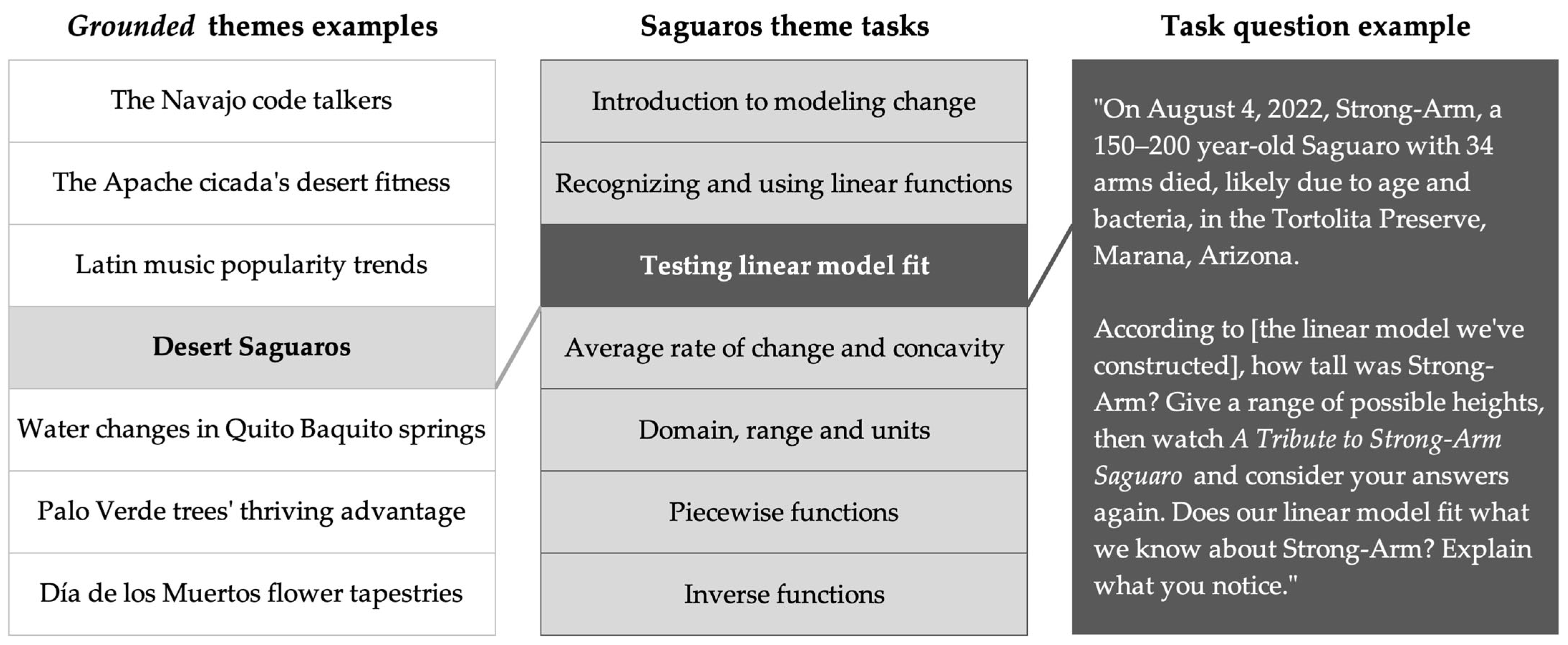
Figure 1, left panel), including native Sonoran Desert fauna (e.g., the Apache cicada) and flora (e.g., the Palo Verde tree),
Grounded centers the Saguaro cactus—unique to the Southwestern U.S. borderlands, sacred to the O’odham peoples, and strikingly present in both the surrounding desert and the cityscape—as a recurrent place-based theme and mathematics tasks progression (see
Figure 1, middle and right panels). Throughout the curriculum, the mathematics learning objectives and outcomes remain unchanged (e.g., recognize a linear function through its constant rate of change), but the contexts through which these are learned are experiential, relational, heart-centering (e.g., What images does the Sonoran Desert bring to mind? How much might a mature Saguaro grow in a year? What land holds meaning for you?). In such ways,
Grounded’s obliqueness suggests itself as one of architecting connection (
Scharmer & Klatzky, 2023) through land and place. It engages our sensing-thinking selves (
Rendón, 2023) and our individual and collective Funds of Knowledge (
Moll et al., 1992) changing the mathematical experience (e.g.,
Figure 1, right panel) without changing the underlying mathematics.
Achievement
Grounded neither seeks to improve performance, nor lowers the bar for it; it invites, instead, the cultivation of a novel, heart-centered relating among students, teachers and the planet, within the mathematics experience. Through four tenets (
Lozano, 2023)—robust mathematics (conceptually grounded and connected), authentic mathematics (elucidated from and elucidating of land and place, see
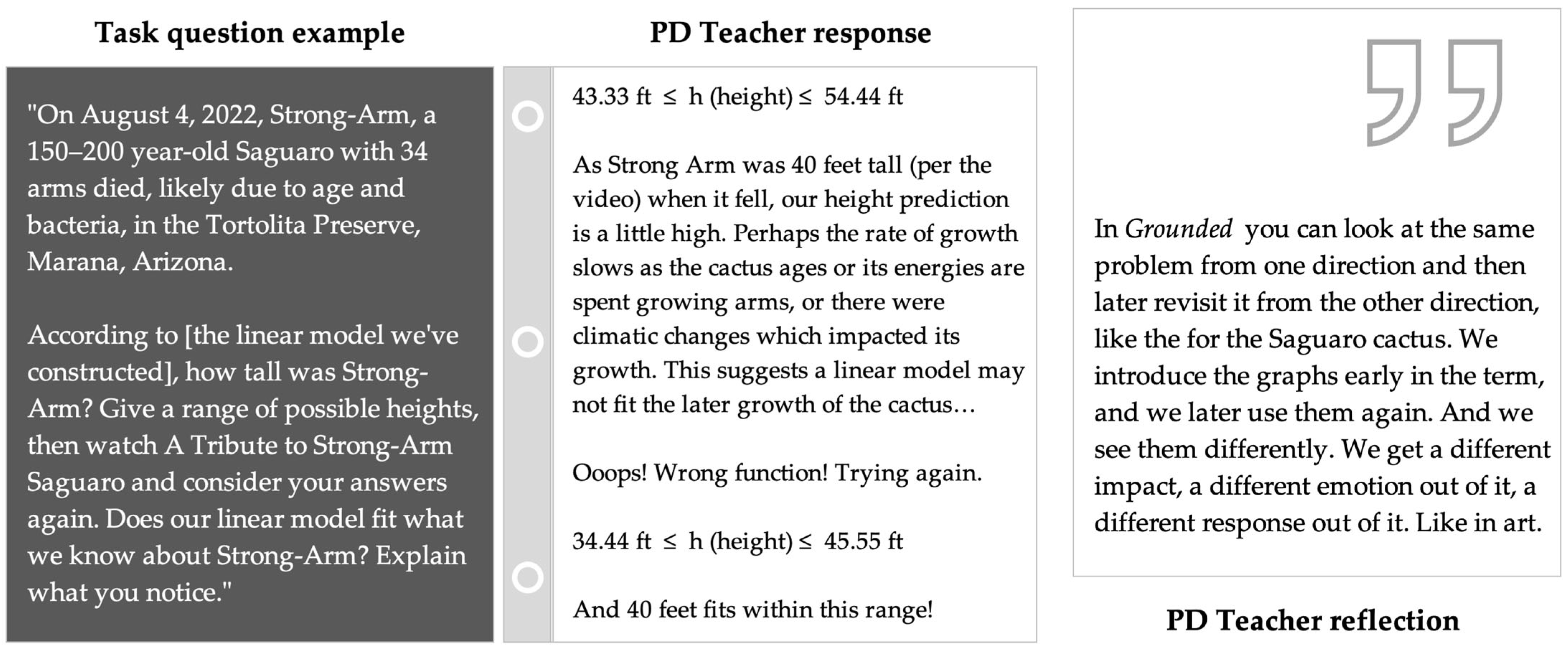
Figure 2, left and middle panels), asset-affirming contexts (eliciting individual and collective light, heart and relationality), and place-based contexts (centering experience of and connectedness to land and place, see
Figure 1, left panel)—the
Grounded curriculum interweaves mind, heart and relation as a canvas for the mathematics learning and also the mathematics teaching experience. The blend is a form of servingness (
Garcia, 2017) in that it substantively shifts the conditions for student achievement and teacher engagement (
Figure 2, middle and right panels), without directly seeking to. This suggests again the form of
Grounded’s obliqueness as one of architecting connection (
Scharmer & Klatzky, 2023) through land and place.
Stakeholders
Grounded neither seeks to convince, nor puts down the skeptics among us; it cultivates, instead, those of us who are curious and open. Engagement with
Grounded is birthed from and fertilizes educators’ desire to connect to place, come into meaningful relation with students and colleagues, find meaning and beauty in the teaching practice, and engage our transrational ways of coming to know in work usually reserved for the rational mind. As shared in a recent chapter about the
Grounded PD and community of practice, “desire-based approaches to teaching and learning can be transformationally powerful. They can drive ‘community-rooted pedagogies’ (
Wong, 2019, p. 469) and enable us to ‘take up joy alongside pain and offer a deeper love of ourselves and our young people’ (
Alim et al., 2020, p. 270)” (
Lozano et al., 2026, p. 250). In a polarized and polarizing world, we often disattend our true purpose for the sake of convincing, or antagonizing, those who doubt or discount it. Re-engaging our purpose and kindling budding desire is a form of obliqueness.
Worldviews
Grounded neither fights nor acquiesces to particular viewpoints, cultures or worldviews; it builds, instead, shared new ground for connection, obliquely. A well-known quote by the Sufi poet Rumi says: “Out beyond ideas of right and wrong, there is a field. I will meet you there.” In
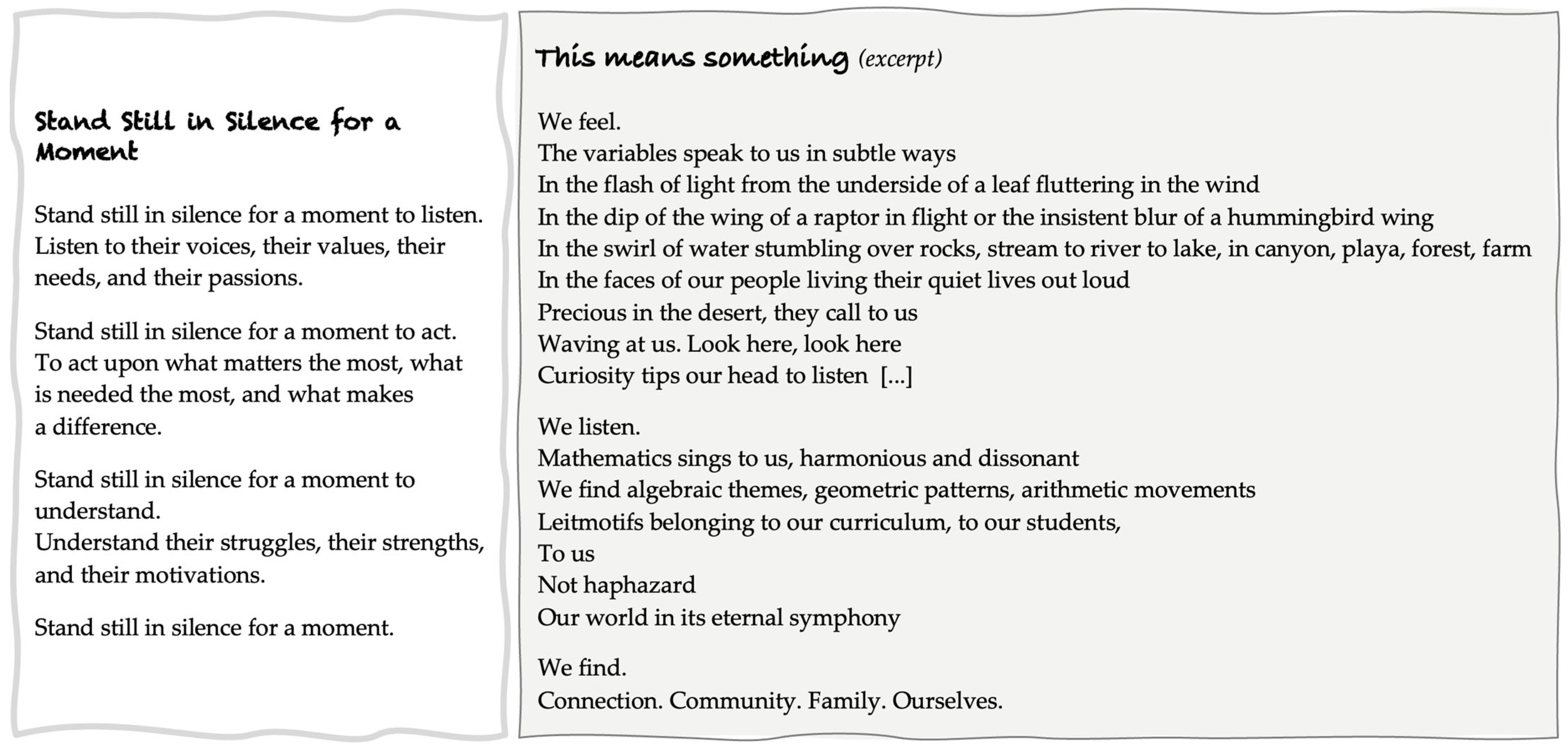
Grounded, land and place provide a third space to come into relation. PD participants seem to speak to this third space in their recipes for creating critically conscious classroom moments (see
Figure 3), an explicit invitation the
Grounded PD and community of practice offer to seed awareness and agency in creating such third spaces for our students. The implicit norms and structures of the academic classroom, the implicit “currencies” of ability and performance, are not directly engaged, nor judged. The many dualities and identities that trigger divisiveness and seed fragmentation, seem to rest. Land, place, and heritage—through listening, introspecting, relating—meet us in a place where we might come into relation with each other anew. Nurturing connection beyond polarities is a form of obliqueness.
The above dimensions reveal not only how
Grounded’s design obliquely approaches change in STEMM education, but also the form of
Grounded’s obliqueness as one that centers land and place as architectures of connection (
Scharmer, 2018;
Scharmer & Klatzky, 2023). To consider how these and other dimensions may enable promising oblique pathways to change in your own STEMM context, ask yourself: to what extent do the programs, organizations, or methods I am part of, help shape, influence or engage oblique lenses on dimensions central to change? How might oblique lenses guide a possible shift in the programs, organizations, methods I engage with, help influence, or envision anew? If not architecting connection through land and place, what form of obliqueness might be fruitful, fertile, emergent in my context? What is the “digging elsewhere” appropriate or meaningful in my setting? As stated earlier, obliqueness is context dependent. In particular, oblique perspectives need not always catalyze meaningful change or align with emergent futures. In the words of
De Bono (
1992), it is not enough to avoid “digging deeper” into what’s broken. It is also important to choose the form of the obliqueness—the “elsewhere” location for our digging anew.
In the case of
Grounded, the “elsewhere” is not just centering land and place as a canvas for robust and authentic mathematics, but doing so honoring the four tenets described earlier, including being asset-affirming—cultivating light, shared experience, and relationality in reciprocity with each other. In this,
Grounded’s obliqueness seems implicitly guided by what
Scharmer and Klatzky (
2023) refer to as architecting connection. I next draw on the work of
Scharmer (
2018) and others (
Klatzky, 2023;
Scharmer & Klatzky, 2023) to argue that the
Grounded obliqueness is promising in that it centers land and place as architectures of connection.
4. Architecting Connection
Building upon work on social fields and leading from the future (
Scharmer, 2018), Otto Scharmer and systems thinking collaborator Antoinette Klatzky use the term
architectures of connection (
Scharmer & Klatzky, 2023) to refer to structures or resources that support the cultivation of
generative social fields—relational spaces whose quality enables the co-creation of something new and emergent in the now, informed by attunement to what Scharmer calls “our highest future potential” (
Scharmer, 2018, p. 19). In bringing this viewpoint to the context of the academy and the theme of this Special Issue, I posit the invitation is to orient our lens on institutional change towards nourishing social fields within the academy, STEMM education in particular. As proposed in
Section 3, such an orientation to change is oblique to the problem at hand: it does not “dig deeper” into the usual directions for improving STEMM education, but instead “digs elsewhere” (
De Bono, 1992) centering the question of tapping into our highest future potential. It concerns itself with something other than subscribing to, or opposing, the usual metrics of productivity and success lining the fabric of the academy as we know it. Such an orientation suggests we shift our attention away from academic achievement (the processes and outputs—graduation, tenure, etc.) in the direction of inner and relational thriving (the practices and actors—students, faculty, etc.) as thresholds for engaging “our highest future potential,” not separately from the teaching and learning experience but as part and parcel of it, embedded within its form and ethos. To be realized, the possibilities in the oblique invite our creativity.
What might it take, then, to architect connection toward cultivating generative social spaces in the context of higher education, STEMM teaching and learning in particular? The traditional academic orientation might suggest such work is large and out of reach for most of us. Yet, as with almost everything that seeds lasting change, the beauty is that the power is in the small, the slow, the oblique, in the creative “digging elsewhere” (
De Bono, 1992). Indeed, the tending to the renewal of “the essence of our humanity” (
Scharmer, 2018, p. 18) begins small, synchronously yet in scattered places (much like nature’s root systems) and through an awakened heart. In practice—in contexts including but not limited to the academy and higher education—architecting connection entails identifying or creating tools and practices that contribute to tilling the “social soil” (
Scharmer, 2018, p. 26), fertilizing the relational space from which processes (e.g., teaching, learning, training, leading) and outcomes (e.g., vision, service, knowledge, growth, academic success) stem from. For the purposes of this article and Special Issue, I highlight three elements in
Scharmer’s (
2018) work that stand out as fundamental in architecting connection, yet are largely foreign to standard academic practice, STEMM teaching and learning in particular. As anticipated in
Section 2 and illustrated in
Section 5, I see these elements as resonant with the design of the
Grounded mathematics curriculum (
Lozano, 2023) and its associated PD and community of practice (
Lozano et al., 2026). In this sense, regardless of their direct utility to readers, the
Grounded approach and its educator community serve to illustrate how architecting connection might look in practice as an oblique approach to STEMM education change.
Scharmer and Klatzky (
2023) and many others (e.g.,
Kimmerer, 2013;
O’Donohue, 1998;
Ram Dass, 1974;
Rendón, 2023) recognize and advocate for the value of engaging transrational ways of coming to know alongside rational, intellectual and analytic thought—the latter being what we primarily privilege, center and train in STEMM higher education. Such alternate ways of knowing include the capacity of the heart to attune and discern in ways the rational mind alone struggles to grasp, map or explain. Awakening the intelligence of the heart,
Scharmer (
2018) explains, entails a shift from an ego-system awareness—an individualistic stance of beingness and attention—to an eco-system awareness, one that “attends to the well-being of all” (p. 18). Activating the intelligence of the heart means lending nourishment to the light and beauty within us—individually, collectively, systemically; watering what binds us, rather than continually attempting to fix what has failed us or is broken—what fragments us.
Shifts from ego- to eco-awareness cannot be externally imposed in general, even (especially)
in order to comply with mandates or solve persisting problems or brokenness, however critical. The effect of sweeping, top-down approaches—not foreign to the academy—is fragmentation, polarization, the creation of architectures of separation (
Scharmer & Klatzky, 2023). Yet, movement toward eco-awareness can be co-cultivated through behaviors, tools and practices engaged “further upstream in the process of social reality creation” (
Scharmer, 2018, p. 25), that is, tools and practices that seek to architect connection for its own essential sake, deliberately and authentically. Such practices bring about
freedom to vs.
freedom from (a distinction Thomas Hübl highlights in his teachings), and are rooted in
being before
doing, for example. Creating spaces (e.g., PDs, communities of practice, classrooms) that change the making of relationships (among and across teachers, students and the mathematics, for example) entails unlearning our inertial tendencies towards chasing outcomes and achievement, and attending to the relational qualities that invisibly bind us—listening, introspecting, reflecting—cultivating social spaces “with a soul” (
Scharmer & Klatzky, 2023).
The choice of the words
awakening or
activating in reference to the heart’s intelligence is not metaphorical. Ancient Eastern traditions and recent Western science recognize our human capacity to develop (or not) attunement to transrational ways of coming to know, nurturing seeds (e.g.,
Scharmer & Klatzky, 2023) that live within us all. Whether we consider the value of attunement and attention practices from the viewpoint of the brain’s neuroplasticity or the nature of organizations, what we attend to, grows (
brown, 2017, p. 42). The fertilization of the social soil is tending to the conditions for future possibilities to take root and emerge—conditions relevant to the quality of our “inner soil” (
Hübl, 2025) and to the collective soil, the soil the sustains and creates the conditions for our systemic thriving. In the context of HSIs in the U.S., servingness (
Garcia, 2017) may be operationalized in practice as one means of tilling the social soil. The quality of the social soil “is the quality of relationships among individuals, teams, and institutions that give rise to collective behavior and practical results” (
Scharmer, 2018, p. 26).
As we transition into illustrating how land and place might serve as architectures of connection through the
Grounded curriculum and community, I pause to notice that, as educators, administrators, leaders, etc., we are continually immersed in the business of creating and shaping social fields: in our classes, labs, professional forums, and daily interactions with students, colleagues, community. Our focus may be on outcomes and achievements—what the social fields “produce” one student at a time. Yet, as
Scharmer (
2018) suggests, what fields “produce” depends on the quality of their soil, and what is done to regularly nourish that quality. Depleted fields, fragmented fields will not bear healthy or copious fruit. No matter our specific academic role, social field shaping is actually our primary function—constantly on and running. Just coming into that awareness can be deeply promising in how we, individually and collectively, orient ourselves to transforming the future. What intelligences shape the social fields we influence? What is the quality of the relationships we are part of? How do we tend to them, to the soil upon which “our highest future potential” (
Scharmer, 2018, p. 19) emerges and bears fruit? Forms and ways of architecting connection sprout almost in real time when our orientation to change shifts in that direction. The opportunities are peppered everywhere, and the seeds are in all of us, more than we realize. The presence of those seeds becomes more evident as we engage, for example, in the practices that we implicitly learn to devalue and minimize in today’s urgent-paced, outcome-driven world. And the more we tend to these practices, the more they yield. Nurtured, these seeds are attractive. The “solutions” that keep eluding us seek, perhaps, a new quality of soil to emerge and thrive.
5. Land and Place as Architectures of Connection
Place is the roomiest of containers for human meaning.
—Adam Nicolson, Sissinghurst: An unfinished history
The land where I grew tall is filled with meaning for me—it’s the land of hop gardens and apple orchards, of garlic and golden sun-reflecting celandines. This love of place is part of my mythology, a delicate web across my heart.
—Jacqueline Winspear, This time next year we’ll be laughing
The first evening I walked into the Arizona/Sonora borderlands, I felt a companionship with the desert life that surrounded me. The land was asking me to pay attention to it, to respond to it whole-heartedly, openly, without forethought of consequence, and with the confidence that I was supposed to be there.
—Erin Blanding, Falling in Love with the Land: A Desert Love Story
As you read these quotes, what thoughts, emotions, sensations arise in you? Pause and notice. Take 2–3 minutes to describe those in writing, without trying to change them. What is a place that feels like home to you? Journal to this question for 2–3 minutes.
The above quotes, questions and invitation to journal, frame the opening to a variety of
Grounded convenings—from large keynote addresses to intimate PD and community of practice gatherings with educators. In writing this very section in this article—on how land and place may awaken the intelligence of heart and guide us in changing the ways we come into and fertilize relation—I am struck, once again, by the difference between
writing about doing this and
writing from doing this here with you, the reader, in real time. The space to consider, pause and journal, taps directly into our shared heart intelligence, bringing us into relation not via the anticipated intellectual exchange, or “in order to,” but further up the stream of consciousness, closer to what Scharmer calls “the source” (
Scharmer, 2018, p. 20). Had you, the reader, and I been in each other’s presence, the cadence of my voice and the rhythm of your writing—your beingness and mine—would have invisibly yet unquestionably shaped the connection being architected. Did you pause and heed the invitation to hold the quotes, attune inwards and write? Or did you continue reading, looking for what came next? Just notice, without judgment. If you paused, you may now have a clearer sense of how awakening the intelligence of the heart (
Scharmer, 2018, p. 18) can be given space, and how it may begin to architect connection through changing the making of the relationship (
Scharmer, 2018, p. 25). The relationship between you and I here, yes, but also our own relating with the land, with the place-based mathematics that will follow, with our students and colleagues, with others.
In considering how to draw from the
Grounded effort, both the mathematics curriculum and the PD and community of practice, to illustrate how land and place help us architect connection, the possibilities seem endless. Consistent with a systems thinking view (
Ramage & Shipp, 2020), any particular choice is partial, insufficient when considered in isolation or even along a list of others that could seemingly complement it. Architecting connection happens
in and
through relating in a myriad forms and timelines—synchronously, asynchronously, atemporally. It is a process whose quality is best appraised by the heart, not the intellectual mind. In the end, what makes a difference is neither in the processes, nor in the outcomes, but in the “source” these stem from (
Scharmer, 2018, p. 20). What
Grounded does and makes possible is best replicated by matching a state of heart.
5.1. Bringing in the Heart, Not Just the Mind
Seek not the footsteps of the wise. Seek what they sought.
—Matsuo Bashō, Japanese poet, Edo period
In retrospect, perhaps the
Grounded story implicitly began with the idea of leaning on land and place as common relational ground, as collective canvas to awaken the intelligence of the heart. The small group of us that began the writing—including four doctoral students in mathematics and applied mathematics—had gathered together to create precalculus mathematics tasks that would serve students by tapping into their light—their lived experience of place, their heritage, sense of self, sense of wonder and possibility. We knew mathematical thinking could not inform this particular (essential) aspect of the work to be done. It is the guidance of the heart not the mind that best serves us in eliciting and kindling each other’s light. So, mathematical expertise would initially take a back seat. The work would begin by finding contexts, themes that awakened the heart through their connection to place, land, culture, identity and heritage. We would explore from our hearts, trusting this might serve those who would eventually teach and learn through
Grounded, eliciting light and heart in return. What would heart-guided mathematics of land and place look like? Some members of our writing team were drawn to nature: the song of the Apache cicada, hummingbirds and bats dwelling in the Sonoran Desert, the rides and paths in the Tucson mountains, the desert’s Saguaro cacti (see
Figure 1 and
Figure 2), its Palo Verde trees, the sharpness of the stars in the Arizona sky. Some others were drawn to culture and identity of place: the prevalence and suitability of adobe as a building material, a blossoming street mural art scene, the internationally known Día de los Muertos and its live flower and sawdust street tapestries (see
Figure 1). As the mathematics latent in each theme was chiseled out, our writing team was slowly but surely reinventing how to come into relation with each other in doing mathematics, and how to newly come into relation with the mathematics itself—unearthing it together from land, place and tradition that kindled the heart. Leaning on awakening the heart through this work felt vulnerable, tender, touching…and also strange, awkward, unnecessary at times—at odds with the values and expectations of academic curricula and STEMM teaching practice. And yet, a delicate web was forming. Something with promise to nourish a larger eco-system. A web that somehow breathed on its own and led the work forward—what
Scharmer (
2018) calls a generative social field, a social field “with a soul” (
Scharmer & Klatzky, 2023). This delicate web saw the members of our team individually and collectively, reflecting us, cultivating us; and in some cases, nourishing us anew:
This is the first collaboration in a math space where I feel like the knowledge and experiences that I have and my family, community are actually valuable and are validated by others on the team too.
—Doctoral student, Grounded writing team
Some feel this delicate web gets passed on and rewoven, extended whenever the heart is engaged in solving, preparing for, or reflecting on
Grounded tasks—something witnessed time and again in conferences and community of practice gatherings. Yet, as noted in
Section 2, the tasks alone cannot do it. It is not just the tools but the invisible qualities of the social field (
Scharmer, 2018) that are essential for awakening hearts and beginning to architect connection. It is the nature of the relationships we enter through the
Grounded tasks that matter (e.g.,
Witt et al., 2024), an attunement to self and others that is generous, curious, open, attentive, humble, generative.
5.2. Changing How We Come into Relationships
A recent chapter about the
Grounded PD and community of practice (
Lozano et al., 2026) discusses three practices for growing “our own capacity to relate to our whole selves and each other by centering place in our mathematics teaching” (p. 240): journaling, relating to the mathematics through heart, and building community and sense of purpose. Each of these practices activates the intelligence of the heart. And each changes the making of particular relationships tied to land and place: our relationship with self (journaling), our relationship with the mathematics (relating through heart), and our relationship with each other (building community and sense of purpose). How does leaning on land and place shift the way we enter into these relationships? How is connection architected when such relationships are made anew?
Becoming learners of land and place, for example, seeds our relation to mathematics anew. This is how the
Grounded curriculum was born (see
Section 5.1), and the nature of its authenticity tenet (
Lozano, 2023): In our haste to chase outcomes we often treat the mathematics as “a pill” better swallowed with an ill-fitting, real-world scenario “coating.” Such coming into relationship with mathematics serves to architect separation (
Scharmer & Klatzky, 2023), not connection. It kindles desires to be
free from the mathematical experience, rather than
free to engage in it. In each
Grounded theme (
Figure 1, left panel), however, the land leads: Why do Saguaros thrive in the wet desert? How long do they live? What determines whether or not they grow arms? Why do they have such presence? The mathematics eventually follows: Is a Saguaro’s height modellable by some kind of function? Does its growth rate change with age? How does the number of arms matter? (see
Figure 1 and
Figure 2). Spurred through the heart, our initial writing team began learning what the place, land and heritage surrounding us offered—we read, listened, watched, and co-experienced, venturing to explore beyond our mathematical expertise, with fresh eyes. We reinvented ourselves as expert-servers (
Lozano, 2023): experts in mathematics, in service of the light in others—in all of us—leaning on land and place to architect connection.
Drawing on our experiential sense of land and place also seeds our relationship to the mathematics anew. This is a regular practice in
Grounded educator gatherings—participants’ experiences of land and place frame and inform everyone’s mathematics engagement, and vice versa (e.g.,
Figure 2 and
Figure 3). Educators elicit their funds of knowledge (
Moll et al., 1992) by journaling about insects they remember growing up, considering trees they might sit under, describing Saguaro cacti they know or admire. They might then segue into mathematically interpreting the heat-shedding fitness of the Apache cicada and inventing stories about fictional insects that fit other cooling and heating trends (
Lozano et al., 2026). Or educators consider the leaf-area index of Palo Verde trees to model carbon dioxide absorption and eventually estimate the number of Palo Verdes needed to offset certain carbon emissions values (
Lozano et al., 2021). Or they explore the growth trends of Saguaro cacti and assess model fit against features of well-known Saguaros (see
Figure 1 and
Figure 2, middle and right panels). When we engage this way, in seemingly slowing down to interweave our sense of place with the mathematics, we deepen both. We tend to the relational quality of our time together deliberately. We nurture it reciprocally, through listening, introspecting, envisioning classroom moments (e.g.,
Figure 3), offering perspectives and insights.
A striking classroom example of how funds of knowledge and experiential sense of place seeded students’ relationship to the mathematics anew, appears in
Lozano (
2024): A student recognized the trend depicted in an (unlabeled) polynomial graph as matching historical events explaining the fluctuation in the percentage of Spanish speakers in Southern Arizona over the last 300 years:
As this student spoke and their classmates listened, groups of students considered and revised their thoughts about what this particular graph represented. […] Beautifully, the sharing revealed direct connections between mathematics, local history, identity, storytelling and opportunities to grow our relationality through being open to each other’s knowledges and experiences.
As the quote above suggests,
seeing one another anew through land and place also changes how we come into relation with each other. This often amplifies and deepens our individual and collective experience. Land, place and heritage seem to connect us through our differences, not in spite of them: “Heart can manifest as the glue, an enabler to witness each other with curiosity […] anew each time” (
Lozano et al., 2026, p. 243).
5.3. Tilling the Collective Soil
What you pay attention to grows.
—adrienne maree brown, Emergent strategy
Grounded encodes mechanisms to till the soil through interlocking circles of reciprocity (e.g.,
Kimmerer, 2013;
Rendón, 2023). “Reciprocity is about mathematics, its contexts and ourselves giving back to each other” (
Lozano et al., 2026, p. 248). The land illuminates the mathematics, and the mathematics, in turn, the land. Our minds befriend the mathematics, and the mathematics, in turn, cultivates our minds. The land awakens our hearts, and our hearts, in turn, engage through the land (e.g.,
Figure 3, right panel). Chances to come into relation and give back in these ways are latent in each
Grounded theme, recur throughout the curriculum (e.g., the wet desert borderlands, desert Saguaros, the Spanish language, etc., see
Figure 1) and in almost every task. As
Grounded PD and community of practice participants embrace these latent opportunities with regularity, the quality of relationships—the shared social soil—begins to feel increasingly fertile, as if, like
Scharmer and Klatzky (
2023) name, the small
Grounded communities forged “a soul.”
Grounded educator participants also engage in collective listening and reflecting practices that help build conscious awareness of the generative social field being co-constructed, the “soul”
Scharmer and Klatzky (
2023) refer to. Fire-side chats with academic leaders help situate the value of this kind of effort within higher education, both in terms of faculty thriving and student success. And voices outside the academy reaffirm the value of engaging the heart, architecting connection, and relating to land through multiple disciplinary lenses. These lenses include collective healing (
Hübl & Avritt, 2020), systems change (e.g.,
Klatzky, 2023;
Ramage & Shipp, 2020), postactivism (
Akomolafe, 2023), and oneness with the land (
Ghosthorse, 2025). Cultivating this kind of collective conscious awareness is another way of tending the soil.
6. Birthing Emergent Futures
How do we awaken our “highest future potential” (
Scharmer, 2018, p. 19)? The question, encompassing of all of us—students, educators, administrators, communities, leaders, the privileged and the left out, the influential and the unheard, the oppressed and the oppressor—asks something different than what we might be accustomed to. It does not directly seek to better STEMM education, or to fix something broken, or to level fields, or to wield tools that seed fragmentation, even if used in the name of justice. The question elevates, instead, the level of consciousness from which to consider possibilities. As proposed in
Section 3, the form of the question suggests “digging elsewhere” (
De Bono, 1992), exploring oblique lenses to change, informed by questions and viewpoints other than the ones we are used to. One form of the answer—architecting connection, perhaps through land and place—offers
one oblique approach to bring about (gradual) systemic change.
The
Grounded effort, and the centering of land and place foundational to it, was designed with the intent to nourish and tend to what binds us; to “restore balance” to our coming together to learn and teach, not through “fixing” but through kindling our individual and collective light, beyond worldviews and polarities (e.g.,
Figure 3). Efforts so conceived are self-sustainable in that they are guided by our highest future potential. Hence, they ripple outward naturally, no matter how small or how scattered they might be. Their essence shapes, perhaps invisibly, systemic transformation. The curriculum, and the PD and community of practice that followed, came about largely from heeding a knowing of the heart, and from being met by others in that knowing. Our initial task writing team did not (could not, and cannot) know if or how the specific place-based contexts and themes in
Grounded would meet students. We enlisted our hearts to choose with care, declining at times the intellectual arguments of the mind to keep mathematically-rich contexts we felt would not serve (
Lozano, 2023). But we eventually understood that the appeasement the mind sought and the ethos of this place-based mathematics curriculum could only arise through cultivating educators’ ability to embody what we seek to pass on to students (
Lozano et al., 2026), not from the tasks themselves. In Scharmer’s terminology, the
Grounded PD and community of practice effort was created to architect connection—to come together as and with educators in awakening the intelligence of the heart along the mind’s, to change how we enter into relation, and to till the inner and collective soil. As argued earlier (
Section 3) this intentional leaning on land and place as architectures of connection (
Scharmer, 2018;
Scharmer & Klatzky, 2023) is an oblique approach to STEMM education change.
Lasting transformation stems from what we embody, however tiny and inconsequential that may ring in a world oriented towards the fast, the sweeping, the certain. “The success of an intervention depends on the interior condition of the intervener,”
Scharmer (
2018, p. 21) reminds us quoting Bill O’Brien. Seeing STEMM classrooms as potentially generative social spaces within and across other potentially generative social fields we directly shape and influence in the academy (from an office hour to an institution, and beyond), repositions our agency towards systemic change that includes “serving current and future demographic populations to thrive in STEMM” and much more. Whether it is land and place, or some other meaningful, perhaps locally relevant lens that supports architecting connection, there is emergent possibility in the oblique, addressed through the awakened heart.