


Abstract
Despite many design-based learning (DBL) studies, longitudinal evidence on how course demands and resources shape design thinking competence (DTC) via study engagement remains scarce. Building on the job demands–resources (JD–R) theory, this study aims to examine whether program demands (project characteristics) and program resources (the role of the teacher, assessment, and social context) promote study engagement, which in turn predicts DTC. We conducted a three-wave (T1/T2/T3) longitudinal survey at Weeks 1, 5, and 8 in a user interface (UI) design course in China (N = 166). T1 collected demographics and prior UI experience (covariates), T2 measured program demands, program resources, and study engagement, and T3 measured DTC. Data were analysed using structural equation modelling (SEM) with bootstrapped indirect effects. Program demands (project characteristics) positively predicted study engagement (β = 0.174, p = 0.020). Among program resources, the role of the teacher (β = 0.313, p < 0.001), assessment (β = 0.280, p < 0.001), and social context (β = 0.253, p = 0.009) were significant, and study engagement positively predicted DTC (β = 0.535, p < 0.001). Direct paths from program demands and resources to DTC were non-significant, while all indirect effects via study engagement were significant. In DBL, a well-calibrated configuration of program demands and resources energized study engagement, which subsequently fostered DTC.
1. Introduction
Design education has gained broad traction in higher education globally, with related courses and programs steadily increasing (Wrigley & Straker, 2017). Design-led disciplines such as architecture, graphic design, and industrial design have long embedded project-based, studio-oriented pedagogies as a core instructional approach, situating students in authentic problem-solving contexts and developing design capabilities through iterative making, critique, and reflection (Cross, 2011; Schön, 1983/2017). Yet despite this longstanding practice, systematic empirical research on the specific instructional mechanisms through which DBL shapes key competence outcomes remains limited, and no consensus has emerged on best practices for cultivating design talent. Design thinking competence (DTC) is an integrative learning outcome that is increasingly regarded as important for students’ professional development and innovation potentials. It typically involves key cognitive and procedural abilities for tackling real-world problems, such as visualization, problem finding, prototyping, and evaluative reflection (Badding, 2017). More specifically, although improvements in DTC may yield more creative and socially valuable design outcomes, existing research has paid limited attention to the processes through which this competence develops (Razzouk & Shute, 2012). Prior studies have used DTC as an indicator of students’ learning outcomes or course effectiveness (H. Y. Liu, 2023, 2024; McLaughlin et al., 2022). However, systematic research on the effects of course features in design-based learning (DBL) education on students’ DTC is limited, and the field still lacks a structured explanatory model (Gómez Puente et al., 2013; Panke, 2019).
The indirect pathway through which project characteristics shape the development of DTC has not been clearly articulated (Panke, 2019; Razzouk & Shute, 2012). To explain how project characteristics may affect students’ DTC, we adopt the job demands–resources (JD–R) framework, which models how demands and resources combine to drive study engagement and performance (Bakker & Demerouti, 2008, 2017). In contemporary higher education, learning activities are increasingly modelled after workplace settings. Students undertake goal-directed tasks under time and performance constraints, and meeting course goals requires sustained effort and cognitive resources (Bakker & Demerouti, 2017). In design-based courses, the analogy is even sharper, as students work in authentic problem contexts, moving from early ideation to prototyping, gathering user feedback, and iterating toward implementable solutions that satisfy course deliverables (Oo et al., 2024).
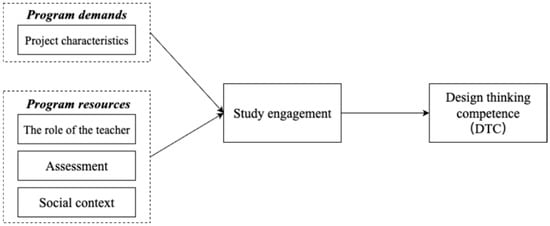
DBL is a project-centered instructional approach. DBL courses are typically characterized along four core dimensions: (1) project characteristics (tasks that are open-ended, hands-on, authentic, and multidisciplinary), (2) the role of the teacher (instructors coach and scaffold the design process, provide process guidance and monitoring, and support self-directed development), (3) assessment (a mix of formative and summative assessments at both individual and team levels, with systematic use of feedback and peer assessment), and (4) social context (an emphasis on team collaboration and peer interaction within an authentic community of practice) (Gómez Puente, 2014). In line with JD–R (Bakker & Demerouti, 2008, 2017), we operationalize program demands as project characteristics, whereas program resources comprise the role of the teacher, assessment, and social context. JD–R further posits that a well-calibrated combination of resources and challenge demands fosters students’ study engagement and, in turn, enhances learning outcomes. Extending this line of inquiry, we expect that challenge demands and program resources will foster study engagement, which will, in turn, be positively related to DTC.
This study investigates how program demands and program resources in DBL influence students’ DTC via study engagement. Grounded in the JD–R framework, this study models project characteristics as program demands and the role of the teacher, assessment practices, and social context as program resources, and tests their relations with study engagement and DTC in DBL (Bakker & Demerouti, 2008, 2017; Gómez Puente, 2014). This study offers three theoretical contributions and one practical contribution. First, we extend JD–R to the design education context, providing a structured framework and empirical evidence where applications have remained underexplored (Bakker & Demerouti, 2017). Second, we adapt and examine psychometric evidence for an established measure of DTC for use in design higher education, clarifying the construct and its assessment in this setting (Badding, 2017). Third, we specify and test a mediational model in which study engagement transmits the effects of demands and resources to DTC, advancing an instructional-design, motivational-mechanism, competence-development account (Bakker & Demerouti, 2017). Finally, the findings inform task design and resource allocation in university design courses to enhance students’ engagement and DTC.
2. Theoretical Framework and Hypotheses
2.1. Job Demands–Resources Theory
The JD–R theory originated in organisational behaviour and explains how job demands and resources influence employee well-being and performance through two parallel mechanisms: a motivational pathway and a strain pathway (Oo et al., 2024). It posits that, when applied to education, challenge demands and adequate resources foster intrinsic motivation through the motivational pathway, thereby enhancing learners’ study engagement and performance. Within this framework, moderately challenging tasks relate to goal-oriented learning by encouraging students to pursue mastery, while sufficient resources reduce perceived burden and reinforce persistence, ultimately fostering sustained and meaningful engagement in learning. In educational contexts, the JD–R framework has been conceptually extended to suggest that academic challenges and learning resources may stimulate students’ engagement and motivation. Analogous to work engagement, study engagement refers to a positive, fulfilling, and sustained psychological state in academic settings, typically characterized by vigor, dedication, and absorption (Bakker et al., 2015). Specifically, vigor refers to students’ energy and resilience when coping with academic demands, dedication reflects their deep involvement and sense of purpose in learning, and absorption denotes a high level of concentration and immersion in academic activities.
Recent empirical studies have increasingly applied the JD–R model in higher education contexts to explore how learning resources and demands influence students’ study engagement and competence development. For instance, Lesener et al. (2020) proposed and validated the JD–R framework in a large-scale survey of university students, revealing that learning resources and learning demands play a critical role in shaping both study burnout and study engagement. Bakker and Mostert (2024) further extended this model by demonstrating that study resources significantly enhance students’ study engagement, which in turn positively predicts their academic achievement and subjective well-being. Although based on graduate students, Han and Wang (2025) provided supplementary evidence for the psychological mechanism of the demands–resources model in higher education. They found that perceived academic stress reduced research commitment through emotional exhaustion, while academic support enhanced engagement and commitment by promoting mastery-oriented learning strategies.
Of particular relevance, M. Liu (2023) conducted an empirical study on entrepreneurship education in Dutch universities and confirmed that both challenging project goals and teacher support significantly enhanced students’ study engagement and entrepreneurial competence. This study highlights the mediating role of study engagement in linking instructional resources to students’ capability development, offering direct theoretical support for the present research on the pathway from teaching resources to study engagement and ultimately to DTC within design education settings.
Teaching resources can enhance study engagement by reducing perceived barriers and fostering intrinsic motivation. In turn, elevated engagement is expected to facilitate the development of core design thinking competencies. Thus, this study investigates study engagement as a key mediating mechanism through which instructional resources influence students’ DTC in DBL contexts within higher design education.
2.2. DBL and Study Engagement
According to the JD–R theory, job characteristics are classified into job demands and job resources (Bakker et al., 2007; Bakker & Demerouti, 2008). Job resources are generally considered to stimulate individuals’ positive psychological states, particularly by promoting their engagement, initiative, and overall well-being (Bakker & Demerouti, 2017). The influence of job demands on engagement is twofold. On the one hand, excessive demands that require a significant amount of time and energy, if not balanced by adequate recovery, may lead to fatigue and exhaustion. On the other hand, challenging demands can activate individuals’ positive coping motivation, thereby enhancing their engagement and performance (Bakker & Demerouti, 2017). The effects of demands thus depend on their nature. While challenging demands support goal attainment and foster engagement and performance, hindrance demands, which involve unnecessary constraints or obstacles, tend to undermine these outcomes. This study focuses on the positive role of challenge demands in academic contexts. We hypothesize that, when students perceive both challenging demands and support resources, they will experience motivational states characterized by vigor, dedication, and absorption, the three core components of study engagement, in line with the motivational pathway proposed by the JD–R theory.
DBL encompasses core pedagogical features that align with the JD–R framework’s conceptualization of challenge demands. In particular, project characteristics require students to grapple with ill-defined problems, synthesize interdisciplinary knowledge, and iterate through cycles of testing and refinement (Gómez Puente et al., 2013). These cognitively demanding activities may elevate learners’ perceived cognitive load, which can function as a motivational cost (Evans et al., 2024). Nevertheless, when embedded in well-structured and supportive environments, such challenges have been found to foster intrinsic motivation, sustained mental effort, and heightened study engagement (Evans et al., 2024; Feldon et al., 2019). Accordingly, we propose the following hypothesis:
Hypothesis 1.
Within DBL, project characteristics are positively associated with students’ study engagement.
Building on the JD–R model, supportive pedagogical resources embedded in DBL can function as job resources that foster study engagement. These resources include (a) the role of the teacher, (b) assessment, and (c) social context. Teachers in DBL often adopt a facilitative role, offering both constructive feedback and emotional encouragement, which have been shown to relate to cognitive and emotional engagement (Chi et al., 2017; W. Guo et al., 2025). Assessment practices, especially formative and peer-based evaluation, serve as motivational scaffolds that enhance self-regulation and intrinsic motivation by providing timely and targeted feedback. Emotional support from teachers further mediates the relationship between formative assessment and engagement (Black & Wiliam, 1998; Wu & Yu, 2025), while active involvement in peer and self-assessment fosters agentic engagement (Mohammadi Zenouzagh et al., 2025). Furthermore, the social context, including peer collaboration, mutual support and dialogue, and teacher-facilitated group dynamics, plays an important role in sustaining participation. Peer interactions cultivate emotional safety and a shared sense of responsibility (Brouwer et al., 2016; Chi et al., 2017). Teachers further reinforce inclusion and student voice through the organization of collaborative learning (Mulholland & O’Connor, 2016; Sormunen et al., 2020). Accordingly, we propose the following hypothesis:
Hypothesis 2.
Within DBL, the presence of supportive instructional resources, including (a) the role of the teacher, (b) assessment, and (c) social context, significantly enhances higher levels of student study engagement.
The proposed conceptual model is presented in Figure 1.
Figure 1.
Concept model.
2.3. Study Engagement and DTC
Contemporary design education emphasizes project-based tasks that mirror real-world challenges to relate to interdisciplinary thinking, collaboration, and complex problem-solving skills (Jia et al., 2023). As a widely adopted approach, DBL further fosters innovation through user-centred and problem-driven learning environments (Gómez Puente et al., 2013). DBL, by situating learning in authentic problem contexts, enables students to develop key competencies such as creative thinking, user insight, and iterative solution development (Gómez Puente et al., 2015). Within this context, study engagement is regarded as a critical driving force behind the continuous development of students’ design capabilities (J. Guo, 2018; Salanova et al., 2010). As a core indicator for evaluating the effectiveness of design education, DTC reflects not only the integration of creative and practical abilities in design practices but also provides a theoretical foundation for instructional design, curriculum planning, and learning assessment. According to the structural model proposed by Badding (2017), DTC comprised four core dimensions: visualization, exploration, prototyping, and evaluation, encompassing 18 specific items that span the entire process from problem identification to solution validation. This framework offers a structured basis for students to guide their practice.
Study engagement is often characterized by positive emotional experiences such as concentration, curiosity, and a sense of achievement (Fredricks et al., 2004). Engaged students consistently invest time and energy in learning tasks and immerse themselves in exploration and reflection. This sustained involvement enables them to accumulate experience, refine strategies, and gradually enhance their DTC. In both organizational and educational contexts, empirical studies have consistently shown that individuals’ engagement levels are strongly associated with their performance outcomes (Fredricks et al., 2004). For instance, Salanova et al. (2010) found that the positive impact of learning facilitators on students’ future academic performance was mediated by study engagement, which exerted a stronger predictive effect than negative psychological states such as study burnout. Similarly, J. Guo (2018) demonstrated that students’ positive perceptions of course experiences significantly relate to the development of their generic skills through the mediating role of study engagement. Collectively, these findings suggest that study engagement not only enhances short-term academic success but also facilitates the internalization and long-term development of key competencies. Taken together, these findings suggest that in the context of design education, sustained engagement in design tasks may serve as a crucial mechanism linking instructional support to the development of DTC. Accordingly, the following hypothesis is proposed:
Hypothesis 3.
Within DBL, study engagement is positively associated with the development of DTC over time.
3. Methodology
3.1. Sample and Procedure
This research was conducted at a public university in China. We collected survey data from third-year undergraduates who enrolled in an 8-week user interface (UI) design course in the spring semester of 2025. The course was designed to equip students with essential knowledge and skills in interface design through real-world project tasks, aiming to enhance their awareness of user experience and visual communication competence. The course content included theoretical lectures, practical training, and project presentations. The course adopted the DBL approach, embedding learning activities into real problem scenarios and encouraging students to engage in interdisciplinary collaboration, iterative optimization, and reflective practice around specific tasks. Throughout the project, instructors required students to complete the full process from problem identification, concept development, to prototype creation and evaluation by applying design thinking strategies. The students continuously refined their solutions based on formative feedback from instructors and peers.
To explore the influence of teaching characteristics on students’ study engagement and DTC, this study collected longitudinal data at three time points, enabling the examination of potential causal pathways among the variables. We conducted the first wave (T1) in the first week of the course, gathering students’ informed consent forms, basic demographic information (gender, age, academic background, year of study, prior UI project experience). We implemented the second wave (T2) around Week 5 of the course, focusing on assessing students’ study engagement levels during the project process, as well as their perceptions of key features in the teaching process, including project characteristics, the role of the teacher, assessment methods, and social context. We conducted the third wave (T3) in the last week (Week 8) of the course, focusing on the measurement of DTC to reflect students’ progress during the course intervention. Students received a personalized learning report based on formative assessments and were additionally provided with a design-related resource package as a token of appreciation.
All participants voluntarily took part in this study after being fully informed, and the research protocol was approved by the university ethics review committee. Before analysis, we anonymized all questionnaire data to ensure participant privacy and confidentiality. A total of 180 students enrolled in this course, of whom 178 completed the pre-test, 172 completed the mid-test, and 168 completed the post-test questionnaire. Ultimately, 166 students completed all three rounds of assessment, and we included their data in the longitudinal analyses. Participants’ ages ranged from 18 to 27 years (M = 22.33, SD = 2.66), with females accounting for 80.12% (N = 133). Furthermore, most students (86.75%, N = 144) had not received any formal training in UI design before the course.
3.2. Measures
We adapted all measurement items from established instruments to ensure content validity. We employed a standard back-translation procedure (Brislin, 1970). Item wording was contextualized to design education so that the instruments functioned appropriately in a design-education context.
The project characteristics subscale from the five-dimensional DBL questionnaire developed by Gómez Puente (2014) was used at T2. It comprised 11 items on a 5-point Likert scale (1 = strongly disagree; 5 = strongly agree). Representative items included “The project is open-ended” and “Students are required to gather information independently, interpret results, and experiment with new ideas.” In the present study, internal consistency and convergent validity were acceptable (Cronbach’s α = 0.953, CR = 0.954, and AVE = 0.652).
The role of the teacher was assessed at T2 with 5 items adapted from the Good Teaching subscale of the Course Experience Questionnaire (CEQ) (Kember & Leung, 2008), focusing on students’ perceptions of teacher support and responsiveness. A sample item is “I feel that our teaching staff understood our learning needs.” Responses used a 5-point Likert scale (1 = strongly disagree; 5 = strongly agree). The scale demonstrated acceptable internal consistency (Cronbach’s α = 0.906, CR = 0.907, and AVE = 0.663).
Assessment was measured using the Student Perceptions of Assessment Practices scale developed by Gerritsen-van Leeuwenkamp et al. (2019). The scale consists of 12 items, and students responded on a 5-point Likert scale (1 = strongly disagree; 5 = strongly agree). An example item is: “I received enough feedback to improve my work.” The instrument demonstrated good internal consistency (Cronbach’s α = 0.919, CR = 0.924, AVE = 0.522).
Social context was measured by items drawn from Walker and Baepler’s (2017) Social Context and Learning Environments (SCALE). The scale consists of 12 items, and students responded on a 5-point Likert scale. Sample statements include: “My instructor encourages questions and comments from students,” and “The people sitting near me have learned something from me this semester.” Internal consistency was good (Cronbach’s α = 0.951, CR = 0.951, AVE = 0.685).
Study engagement was assessed at T2 using the 9-item Utrecht Work Engagement Scale (UWES-9), developed by Schaufeli et al. (2006). The scale comprises three dimensions: vigor, dedication, and absorption. Example items included: “When I am studying, I feel bursting with energy,” and “When I am immersed in my studies, I feel happy.” Responses were recorded on a 7-point Likert scale ranging from 1 (never) to 7 (always). In the present study, the scale demonstrated excellent internal consistency and convergent validity (Cronbach’s α = 0.940, CR = 0.939, AVE = 0.858).
DTC was assessed at T3 using the Creative Synthesis Inventory (CSI), originally developed by Badding (2017) and adapted into the Taiwanese version (CSI-TW) by H. Y. Liu (2023) for educational settings. Self-report measures of perceived competence have been widely used in educational research as indicators of learners’ confidence and readiness to apply skills in practice (Artino, 2012; Zimmerman, 2000). This 18-item scale comprises four dimensions: visualization, exploration, prototyping, and evaluation. Example items included: “Convert reality into abstract thought,” and “Explore feasibility through mock-ups.” Respondents used a 5-point Likert scale ranging from 1 (strongly disagree) to 5 (strongly agree). In the present study, internal consistency was strong and convergent validity acceptable (Cronbach’s α = 0.969, CR = 0.969, AVE = 0.887).
The control variables included student demographic characteristics, such as age, gender (coded as 1 for male and 0 for female), and prior UI project experience (coded as 1 for those with experience and 0 for those without).
3.3. Data Screening and Assumptions
This study treated Likert-type indicators as approximately continuous (Rhemtulla et al., 2012). Analyses were conducted in R (lavaan 0.6–19) (Rosseel, 2012) using maximum likelihood (ML) with full information maximum likelihood (FIML) for missing data. Univariate normality was acceptable; multivariate normality was assessed with Mardia’s test, and multivariate outliers were screened using Mahalanobis distance (p < 0.001) (Kline, 2023). Risk of common method variance was reduced via temporal separation (T1/T2/T3) and further checked using a single-factor CFA with poor fit relative to the hypothesized model (Podsakoff et al., 2003).
4. Results
4.1. Descriptive Statistics
Table 1 presents construct-level means (M), standard deviations (SD), reliability, and latent correlations. All Cronbach’s alpha coefficients were ≥0.70 (Nunnally, 1978). Composite Reliability (CR = 0.907–0.969) and average variance extracted (AVE = 0.522–0.887) met recommended thresholds (Fornell & Larcker, 1981; Hair et al., 2010), supporting convergent validity. Pairwise latent correlations among project characteristics, the role of the teacher, assessment, social context, study engagement, and DTC were positive and mostly significant, consistent with the theorized directions.
Table 1.
Descriptive statistics, reliability, and correlations (N = 166).
4.2. Hypothesis Testing
Analyses were conducted in R (lavaan) (Rosseel, 2012). We used Structural equation modelling (SEM) with ML estimation and FIML for missing data (Enders, 2022). To address mild non-normality, we retained ML/FIML and evaluated overall fit with χ2/df, RMSEA, CFI, TLI, and SRMR (Marsh et al., 2004). SEM tested the hypotheses (Kline, 2023; Little et al., 2007), and indirect effects were estimated with bias-corrected bootstrap (5000 resamples), yielding 95% CIs (Preacher & Hayes, 2008; Shrout & Bolger, 2002).
Models predicting DTC controlled for covariates only (age, gender, major, prior UI project experience). Models predicting study engagement also controlled for the covariates only. None of these control variables yielded statistically significant paths to either study engagement or DTC (all p > 0.05), indicating that the observed relationships among the primary study variables were not attributable to demographic differences. All latent constructs were specified as reflective and most were indicated by their respective items, whereas study engagement was indicated by three parcels (vigor, dedication, absorption). DTC was indicated by four subdimensions (visualization, exploration, prototyping, and evaluation).
Measurement Model 1 (MM1) included project characteristics and study engagement (T2). MM2 additionally included the role of the teacher, assessment, and social context. MM 3 further incorporated DTC (T3). Table 2 presents fit indices for MM1, MM2 and MM3.
Table 2.
Model fit indices for MM and SM.
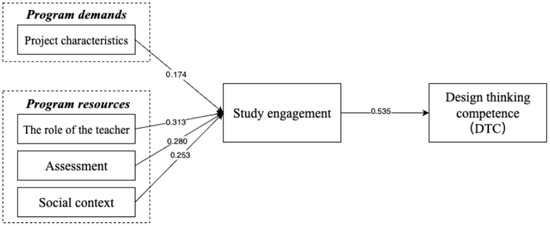
To test Hypothesis 1 concerning the relationship between project characteristics (demands) and study engagement, we specified a path from project characteristics to study engagement. This formed Structural Model 1 (SM1), which showed a good fit to the data (χ2/df = 1.995, RMSEA = 0.077, CFI = 0.910, TLI = 0.900, SRMR = 0.069). The results indicated a significant positive path from project characteristics to study engagement (β = 0.174, p = 0.020). Therefore, Hypothesis 1 was supported.
Regarding Hypothesis 2 (program resources and study engagement), we extended SM1 by adding paths from the role of the teacher, assessment practices, and social context to study engagement. This yielded SM2, which showed a good fit to the data (χ2/df = 1.497, RMSEA = 0.055, CFI = 0.897, TLI = 0.891, SRMR = 0.065). The results indicated that the role of the teacher (β = 0.313, p < 0.001) and assessment (β = 0.280, p < 0.001), and social context (β = 0.253, p = 0.009) were positively related to study engagement. Thus, Hypotheses 2a, 2b, and 2c were supported.
For Hypothesis 3, we extended SM2 by adding DTC as the outcome and a path from study engagement to DTC, plus direct paths from demands and resources to DTC. SM3 showed an acceptable fit (χ2/df = 1.463, RMSEA = 0.053, CFI = 0.883, TLI = 0.879, SRMR = 0.065). Study engagement had a significant positive effect on DTC (β = 0.535, p < 0.001). The direct path from challenge demands and program resources to DTC was not significant (p > 0.05). Instead, their effects on DTC were transmitted indirectly via study engagement and all indirect effects were significant (bootstrap, 95% bias-corrected and accelerated (BCa) CIs excluded zero), thus supporting Hypothesis 3. Figure 2 presents the standardized path coefficients of the final model, and Table 3 summarizes the tests of the three hypotheses.
Figure 2.
Standardized path coefficients.
Table 3.
SEM results for testing hypotheses.
It is worth noting that, for the more complex models involving all constructs simultaneously (MM3, SM2, and SM3), CFI and TLI fell marginally below the conventional 0.90 threshold (MM3: CFI = 0.897, TLI = 0.892; SM2: CFI = 0.897, TLI = 0.891; SM3: CFI = 0.883, TLI = 0.879). This pattern is not uncommon when multiple multi-item latent variables are modelled simultaneously with a relatively modest sample size (N = 166; Marsh et al., 2004). Critically, χ2/df, RMSEA, and SRMR remained within acceptable ranges across all models, indicating adequate global fit. We therefore interpret these borderline CFI/TLI values as reflecting model complexity rather than structural misspecification.
5. Discussion
Grounded in JD–R, this study used a three-wave design (T1/T2/T3) to test study engagement as the mechanism linking DBL program demands and resources to DTC. Our findings showed that program demands (project characteristics) positively predicted study engagement. Among resources, the role of the teacher, assessment, and social context were positively related to study engagement. In turn, the T2 study engagement prospectively predicted the T3 DTC.
5.1. JD–R Theory
This study uses the JD–R framework to integrate project characteristics and program resources into a single explanatory model and provides longitudinal empirical support that they relate to DTC via study engagement. This adds a testable pathway to the mechanism literature in design education and answers calls to improve evaluation and mechanism-oriented inquiry (Gómez Puente et al., 2013; Panke, 2019; Razzouk & Shute, 2012). Prior studies generally report that DBL enhances DTC, yet they have rarely examined how specific instructional arrangements and interpersonal structures operate (Gómez Puente et al., 2013, 2015; Oo et al., 2024). Within JD–R, the role of the teacher, transparent assessment practices, and a collaborative social context, there are job resources that energize study engagement, whereas challenging project characteristics operate as a challenge demand that also contributes to study engagement. Taken together, these patterns indicate that study engagement is the proximal mechanism linking course demands and resources to subsequent development of DTC, rather than direct effects of individual course features in isolation.
A closer examination of the relative effect sizes reveals a theoretically informative pattern. Program resources, particularly the role of the teacher and assessment practices, exerted a substantially stronger influence on study engagement than project characteristics as a challenge demand. This differential is consistent with Lesener et al.’s (2020) large-scale study of university students, which found that learning resources exert a larger and more consistent effect on study engagement than learning demands. One interpretation is that challenge demands must be embedded in adequate scaffolding before they can activate motivational states; without sufficient support, open-ended design projects may be experienced as frustrating rather than as stimulating challenges (Evans et al., 2024). This conditional logic suggests a potential moderation account, in which the motivating potential of project characteristics depends on the simultaneous availability of instructional resources, a proposition that future studies could test explicitly within the JD–R framework (Bakker & Demerouti, 2007). The complete mediation pattern observed, whereby direct paths from demands and resources to DTC were non-significant while all indirect paths via study engagement were significant, suggests that engagement is not merely correlated with DTC but serves as the primary channel through which instructional features translate into competence development. This extends Bakker and Mostert’s (2024) proposition that motivational states transmit the effects of study conditions on performance outcomes, applying this mechanism specifically to the domain of design competence.
Our findings also resonate with scholarship in architecture and design studio education, where disciplines such as graphic design and industrial design have long embedded project-based, critique-centred pedagogies that share core structural features with DBL, including iterative project work, peer review, and learning through making (Cross, 2011; Schön, 1983/2017). Research in these fields has consistently found that the quality of the coaching relationship is among the strongest predictors of students’ creative engagement (Lawson, 2010), a pattern that directly parallels our finding that the role of the teacher was the strongest predictor of study engagement. This convergence suggests that the facilitative function of the teacher may be a cross-disciplinary cornerstone of effective design pedagogy, and points to the value of integrating the JD–R framework more explicitly with design studio education traditions.
5.2. DTC
Secondly, we add to current insights by examining DTC as a learning outcome of DBL and by interpreting our findings through that lens. Within design education, prior work has more often emphasized outcomes such as students’ motivation, creativity, design skills, satisfaction, and engagement (Gómez Puente et al., 2013, 2015; Oo et al., 2024), whereas explicitly treating DTC itself as a course outcome and operationalising it with validated instruments has been less common. Only a limited number of studies have examined DTC directly as the learning outcome. For example, Badding (2017) developed and validated the Creative Synthesis Inventory to operationalize DTC in educational settings, and subsequent studies have used this instrument to evaluate course outcomes (H. Y. Liu, 2023). Similarly, Cai and Yang (2023) developed and validated the Scale of Design Thinking for Teaching (SDTT), articulating a teachable set of design-thinking competencies that can be cultivated and assessed in formal courses. Furthermore, to our knowledge, this study is among the first in DBL to treat DTC as a course-level outcome within DBL and to examine how specific educational characteristics shape it.
The strength of the engagement-DTC path warrants discussion. This effect size is notably larger than those typically observed in engagement-performance relationships in general higher education contexts (Fredricks et al., 2004; J. Guo, 2018). One explanation is that design thinking competence, as operationalised by the CSI (Badding, 2017), is particularly sensitive to the quality and depth of students’ involvement in the design process, because DTC requires not only declarative knowledge but also the accumulated experiential learning that emerges from sustained, reflective engagement with iterative design cycles. A counter-argument worth considering, however, is that both study engagement and DTC were self-reported, and although they were measured at different time points (T2 and T3, respectively), shared method variance cannot be entirely excluded. Future research employing performance-based assessments of design output, such as instructor-rated portfolio quality or peer-rated prototype evaluations, would provide a stronger test of the engagement-DTC relationship. Furthermore, because the CSI measures perceived design thinking competence rather than directly observed design behaviour, our findings speak to students’ confidence and readiness to engage in design thinking rather than to observable design quality per se (Artino, 2012). The relationship between engagement-induced perceived competence and actual design performance remains an open question for future research.
5.3. Limitations and Future Directions
Despite its strengths, this study has several limitations that should be acknowledged. First, limitations related to research design and causal inference warrant attention. Although a three-wave longitudinal design improved temporal ordering, key program characteristics and study engagement were primarily measured within the same wave, and reverse paths were not explicitly modelled. Therefore, causal interpretations should be made with caution. Given constraints related to course equity and class size, we prioritized longitudinal tracking and measurement quality. Consequently, more complex manipulations and tests of interactions were beyond the scope of the present study. Future work could implement quasi-experimental manipulations at the course level (Anderson-Cook, 2005), such as calibrating project challenge (Bakker & Demerouti, 2017), and varying the frequency of teacher feedback, coupled with finer-grained temporal tracking to strengthen causal identification (Zirkel et al., 2015).
Second, the measurement scope and level are not fully aligned. This study relied mainly on student self-report questionnaires collected at the same time and from the same source, which may inflate or attenuate observed relationships. Moreover, self-report measures reflect participants’ subjective evaluations and may not fully capture actual performance. In addition, social context is closer to a group climate, yet we used individual perceptions as a proxy, which may underestimate its true effect. Future work can improve in three ways: (1) diversify data sources by incorporating peer assessments alongside teacher ratings, (2) use the group as the unit of analysis where appropriate, that is, first check within-group agreement and then analyze group means (LeBreton & Senter, 2008), and (3) separate measurement occasions and stagger survey administration across time (Podsakoff et al., 2003). More broadly, the exclusive reliance on quantitative self-report data constrains the depth of mechanistic explanation that this study can offer. Given the complexity of the interactions among project demands, instructional resources, study engagement, and DTC, complementary qualitative methods, such as design-process interviews, reflective journals, or observational protocols of studio sessions, would have provided richer and more fine-grained insights into how and why students’ engagement develops and how it shapes the competence-building process. The absence of such data means that the present account of mechanisms remains necessarily inferential. Future mixed-methods studies are needed to illuminate the experiential processes underlying the observed quantitative relationships and to clarify the conditions under which study engagement most effectively fosters DTC.
Third, there are also limitations related to context and external validity. Our data came from a single DBL course at one institution, so whether the findings generalize to other settings remains to be verified. Future studies can replicate the analyses across different disciplines and regions. It would also be useful to compare results under varying levels of implementation intensity to see in which contexts the effects are stronger or weaker, thereby clarifying boundary conditions (Durlak & DuPre, 2008).
Fourth, CFI and TLI fell marginally below 0.90 in the more complex structural models (MM3, SM2, SM3). While χ2/df, RMSEA, and SRMR remained within acceptable ranges, future studies with larger sample sizes would be better positioned to achieve stable fit across all incremental criteria.
5.4. Practical Implications
Despite its limitations, this study offers practical implications for course leaders and instructors in design-oriented higher education programmes. Design disciplines such as graphic design, industrial design, and interface design have long embraced project-based, studio-oriented pedagogies as a core instructional approach, with DBL principles deeply embedded in their educational practice (Cross, 2011; Schön, 1983/2017). The guidance below is therefore not intended to argue for the introduction of DBL where it does not yet exist, but rather for the deliberate optimisation of its core feature configuration, encompassing project design, teacher facilitation, assessment, and social context, to maximise study engagement and, in turn, DTC development. As shown by our structural models, program demands and program resources positively predict study engagement, and their effects on DTC are transmitted via engagement, while direct paths to DTC are non-significant. Accordingly, these recommendations are organised around four levers: (1) project characteristics, (2) the role of the teacher, (3) assessment, and (4) social context.
- (1)
- Project characteristics. Given the positive relationship between project characteristics and study engagement (β = 0.174, p = 0.020), we suggest prioritizing anchoring projects in authentic use contexts or user needs, to produce a traceable set of constraints, and, on that basis, protect a phased exploration process to avoid premature commitment to a particular design structure. Teams should submit evidence-based decision logs, independent information should be gathered before concept generation, and a Discovery Pack should be compiled to guide subsequent design work. Across the process, moderate under-specification should be deliberately introduced, clarifying fixed constraints while preserving exploration space for students. Especially in design, systematic reuse and adaptation of precedents can be supported by building a precedent library and transferring elements to the current context with clear justification and boundaries (Bakker & Demerouti, 2017; Gómez Puente et al., 2013). By calibrating project complexity and preserving authentic problem contexts, instructors can harness the motivating potential of challenge demands to sustain student engagement throughout the design process, thereby laying the groundwork for progressive DTC development.
- (2)
- The role of the teacher. The role of the teacher showed the strongest positive path to study engagement (β = 0.313, p < 0.001) among all predictors, suggesting that teacher facilitation practices offer the greatest leverage for raising student engagement in DBL contexts. Accordingly, we recommend first making feedback usable, providing criterion-referenced, process-oriented feedback in which each comment specifies the gap, next step, and evidence (Hattie & Timperley, 2007). Subsequently, motivation should align with attainable stretch goals to encourage the best work. The clarity and effectiveness of explanations could be improved, to promptly sense and understand students’ difficulties and therefore enable light-touch interventions. Finally, course interest can be enhanced where resources allow. Taken together, these facilitative practices position the teacher as a key resource that fuels students’ psychological investment in learning, an investment that, as our findings indicate, is central to DTC development.
- (3)
- Assessment. Assessment showed a significant positive relationship with study engagement (β = 0.280, p < 0.001), making it the second strongest instructional resource in our model. We recommend first balancing team- and individual-level assessment, with explicit weightings specified in the rubric. Next, assessments should be authentic and practice-oriented by using real-context tasks and external critiques, requiring that each feedback episode include actionable next steps. Timely turnaround ensures that feedback can be acted upon in subsequent tasks, enabling instructors to track evidence of student uptake and improvement. These foundations will encourage creative solutions by incorporating criteria that reward the generation and comparison of alternatives (Black & Wiliam, 2010). When assessment is experienced as a developmental scaffold rather than a summative endpoint, it can meaningfully raise the quality of engagement that students bring to successive design iterations, thereby supporting cumulative DTC growth.
- (4)
- Social context. The structural model showed a significant positive path from social context to study engagement (β = 0.253, p = 0.009). We therefore recommend prioritizing the cultivation of a cooperative learning community by forming teams with complementary skills and establishing inclusive discussion norms so that “different ideas” can be voiced safely (Brookfield & Preskill, 2005; Oakley et al., 2004). A workable method of lowering the cost of seeking help is to maintain a visible task board to track progress and sustain collaborative momentum (Fernandes et al., 2021). In parallel, students’ sense of being needed and valued can be strengthened by making individual contributions visible at both the team and class levels. Finally, we suggest improving the constructiveness of peer feedback through structured peer review. A collaborative learning climate in which students feel valued, heard, and mutually accountable appears to be a foundational condition for the sustained, effortful engagement through which design competence is progressively built.
6. Conclusions
In summary, longitudinal evidence grounded in the JD–R framework shows that, in DBL settings, challenging project characteristics, the role of the teacher, assessment, and social context are positively related to study engagement, which in turn predicts higher levels of DTC at T3. These findings offer actionable directions for DBL course design and evaluation, including prioritizing calibrating project challenge and structuring tiered milestones, strengthening teacher facilitation and timely feedback, and making assessment goals and standards transparent while reinforcing formative assessment. Future research should replicate and extend these patterns across disciplines and institutions and examine boundary conditions across contexts. More broadly, these findings advance a motivation-mechanism account of instructional effectiveness in design education, offering a replicable JD–R-based framework that other project-based learning disciplines can adapt and test.
Author Contributions
Conceptualization, Z.L., M.J. and J.S.; methodology, Z.L. and J.S.; software, Z.L.; validation, Z.L., M.J., J.S. and D.L.; formal analysis, Z.L.; investigation, Z.L. and D.L.; resources, D.L. and J.S.; data curation, Z.L.; writing—original draft preparation, Z.L.; writing—review and editing, M.J., J.S. and D.L.; visualization, Z.L.; supervision, M.J. and J.S.; project administration, Z.L. and J.S. All authors have read and agreed to the published version of the manuscript.
Funding
This research received no external funding.
Institutional Review Board Statement
The study was conducted in accordance with the Declaration of Helsinki and approved by the Ethics Committee of Kunming University of Science and Technology (KUST) (Approval No. 2025090102, approved on 1 September 2025).
Informed Consent Statement
Written informed consent was obtained from all participants involved in the study.
Data Availability Statement
The de-identified data presented in this study are available on reasonable request from the corresponding author. The data are not publicly available due to privacy and ethical restrictions related to the student participants.
Acknowledgments
The authors would like to thank the students who participated in this study and the instructors who supported the implementation of the learning activities. During the preparation of this manuscript, the authors used ChatGPT (GPT-4o, OpenAI, 2025) only for language refinement and editorial suggestions. The authors have reviewed and edited the output and take full responsibility for the content of this publication.
Conflicts of Interest
The authors declare no conflicts of interest.
Abbreviations
The following abbreviations are used in this manuscript:
| DBL | Design-Based Learning |
| DTC | Design Thinking Competence |
| JD–R | Job Demands–Resources |
| UI | User Interface |
| SEM | Structural Equation Modelling |
| T1/T2/T3 | Time 1/Time 2/Time 3 |
| ML | Maximum Likelihood |
| FIML | Full Information Maximum Likelihood |
| CFA | Confirmatory Factor Analysis |
| RMSEA | Root Mean Square Error of Approximation |
| CFI | Comparative Fit Index |
| TLI | Tucker–Lewis Index |
| SRMR | Standardized Root Mean Square Residual |
| CR | Composite Reliability |
| AVE | Average Variance Extracted |
| UWES-9 | Utrecht Work Engagement Scale-9 |
| CEQ | Course Experience Questionnaire |
| SCALE | Social Context and Learning Environments |
| CSI | Creative Synthesis Inventory |
| CSI-TW | Taiwanese version of the Creative Synthesis Inventory |
| SDTT | Scale of Design Thinking for Teaching |
References
- Anderson-Cook, C. M. (2005). Experimental and quasi-experimental designs for generalized causal inference. Journal of the American Statistical Association, 100(470), 708. [Google Scholar] [CrossRef] [Scilit]
- Artino, A. R. (2012). Academic self-efficacy: From educational theory to instructional practice. Perspectives on Medical Education, 1(2), 76–85. [Google Scholar] [CrossRef] [Scilit] [PubMed]
- Badding, S. (2017). The creative synthesis inventory: Constructing quantitative measures capturing attributes of design thinking [Doctoral dissertation, Colorado State University]. [Google Scholar]
- Bakker, A. B., & Demerouti, E. (2007). The job demands-resources model: State of the art. Journal of Managerial Psychology, 22(3), 309–328. [Google Scholar] [CrossRef] [Scilit]
- Bakker, A. B., & Demerouti, E. (2008). Towards a model of work engagement. Career Development International, 13(3), 209–223. [Google Scholar] [CrossRef] [Scilit]
- Bakker, A. B., & Demerouti, E. (2017). Job demands–resources theory: Taking stock and looking forward. Journal of Occupational Health Psychology, 22(3), 273–285. [Google Scholar] [CrossRef] [Scilit] [PubMed]
- Bakker, A. B., Hakanen, J. J., Demerouti, E., & Xanthopoulou, D. (2007). Job resources boost work engagement, particularly when job demands are high. Journal of Educational Psychology, 99(2), 274–284. [Google Scholar] [CrossRef] [Scilit]
- Bakker, A. B., & Mostert, K. (2024). Study demands–resources theory: Understanding student well-being in higher education. Educational Psychology Review, 36(3), 92. [Google Scholar] [CrossRef] [Scilit]
- Bakker, A. B., Sanz Vergel, A. I., & Kuntze, J. (2015). Student engagement and performance: A weekly diary study on the role of openness. Motivation and Emotion, 39(1), 49–62. [Google Scholar] [CrossRef] [Scilit]
- Black, P., & Wiliam, D. (1998). Assessment and classroom learning. Assessment in Education: Principles, Policy & Practice, 5(1), 7–74. [Google Scholar] [CrossRef] [Scilit]
- Black, P., & Wiliam, D. (2010). Inside the black box: Raising standards through classroom assessment. Phi Delta Kappan, 92(1), 81–90. [Google Scholar] [CrossRef] [Scilit]
- Brislin, R. W. (1970). Back-translation for cross-cultural research. Journal of Cross-Cultural Psychology, 1(3), 185–216. [Google Scholar] [CrossRef] [Scilit]
- Brookfield, S., & Preskill, S. (2005). Discussion as a way of teaching: Tools and techniques for democratic classrooms (2nd ed.). Jossey-Bass. [Google Scholar]
- Brouwer, J., Jansen, E., Flache, A., & Hofman, A. (2016). The impact of social capital on self-efficacy and study success among first-year university students. Learning and Individual Differences, 52, 109–118. [Google Scholar] [CrossRef] [Scilit]
- Cai, Y., & Yang, Y. (2023). The development and validation of the scale of design thinking for teaching (SDTT). Thinking Skills and Creativity, 48, 101255. [Google Scholar] [CrossRef] [Scilit]
- Chi, X., Liu, J., & Bai, Y. (2017). College environment, student involvement, and intellectual development: Evidence in China. Higher Education, 74(1), 81–99. [Google Scholar] [CrossRef] [Scilit]
- Cross, N. (2011). Design thinking: Understanding how designers think and work. Berg. [Google Scholar]
- Durlak, J. A., & DuPre, E. P. (2008). Implementation matters: A review of research on the Influence of Implementation on program outcomes and the factors affecting implementation. American Journal of Community Psychology, 41(3–4), 327–348. [Google Scholar] [CrossRef] [Scilit] [PubMed]
- Enders, C. K. (2022). Applied missing data analysis (2nd ed.). Guilford Press. [Google Scholar]
- Evans, P., Vansteenkiste, M., Parker, P., Kingsford-Smith, A., & Zhou, S. (2024). Cognitive load theory and its relationships with motivation: A self-determination theory perspective. Educational Psychology Review, 36(1), 7. [Google Scholar] [CrossRef] [Scilit]
- Feldon, D. F., Callan, G., Juth, S., & Jeong, S. (2019). Cognitive load as motivational cost. Educational Psychology Review, 31(2), 319–337. [Google Scholar] [CrossRef] [Scilit]
- Fernandes, S., Dinis-Carvalho, J., & Ferreira-Oliveira, A. T. (2021). Improving the performance of student teams in project-based learning with scrum. Education Sciences, 11(8), 444. [Google Scholar] [CrossRef] [Scilit]
- Fornell, C., & Larcker, D. F. (1981). Evaluating structural equation models with unobservable variables and measurement error. Journal of Marketing Research, 18(1), 39–50. [Google Scholar] [CrossRef] [Scilit]
- Fredricks, J. A., Blumenfeld, P. C., & Paris, A. H. (2004). School engagement: Potential of the concept, state of the evidence. Review of Educational Research, 74(1), 59–109. [Google Scholar] [CrossRef] [Scilit]
- Gerritsen-van Leeuwenkamp, K. J., Joosten-ten Brinke, D., & Kester, L. (2019). Students’ perceptions of assessment quality related to their learning approaches and learning outcomes. Studies in Educational Evaluation, 63, 72–82. [Google Scholar] [CrossRef] [Scilit]
- Gómez Puente, S. M. (2014). Design-based learning: Exploring an educational approach for engineering education [Ph.D. thesis, Technische Universiteit Eindhoven]. Available online: https://research.tue.nl/en/publications/designbased-learning--exploring-an-educational-approach-for-engineering-education(379c7a0d-9a34-4a48-bb2b-22a348bf8789).html (accessed on 22 June 2026).
- Gómez Puente, S. M., Van Eijck, M., & Jochems, W. (2013). A sampled literature review of design-based learning approaches: A search for key characteristics. International Journal of Technology and Design Education, 23(3), 717–732. [Google Scholar] [CrossRef] [Scilit]
- Gómez Puente, S. M., Van Eijck, M., & Jochems, W. (2015). Professional development for design-based learning in engineering education: A case study. European Journal of Engineering Education, 40(1), 14–31. [Google Scholar] [CrossRef] [Scilit]
- Guo, J. (2018). Building bridges to student learning: Perceptions of the learning environment, engagement, and learning outcomes among Chinese undergraduates. Studies in Educational Evaluation, 59, 195–208. [Google Scholar] [CrossRef] [Scilit]
- Guo, W., Wang, J., Li, N., & Wang, L. (2025). The impact of teacher emotional support on learning engagement among college students mediated by academic self-efficacy and academic resilience. Scientific Reports, 15(1), 3670. [Google Scholar] [CrossRef] [Scilit] [PubMed]
- Hair, J. F., Jr., Black, W. C., Babin, B. J., & Anderson, R. E. (2010). Multivariate data analysis (7th ed.). Pearson Education. [Google Scholar]
- Han, J., & Wang, T. (2025). Exploring graduate students’ research characteristics, emotional exhaustion, mastery approach, and research career commitment: Insights from the JD-R theory. Studies in Higher Education, 50(2), 306–320. [Google Scholar] [CrossRef] [Scilit]
- Hattie, J., & Timperley, H. (2007). The power of feedback. Review of Educational Research, 77(1), 81–112. [Google Scholar] [CrossRef] [Scilit]
- Jia, L., Jalaludin, N. A., & Rasul, S. (2023). Design thinking and project-based learning (DT-PBL): A review of the literature. International Journal of Learning, Teaching and Educational Research, 22(8), 376–390. [Google Scholar] [CrossRef] [Scilit]
- Kember, D., & Leung, D. Y. P. (2008). Establishing the validity and reliability of course evaluation questionnaires. Assessment & Evaluation in Higher Education, 33(4), 341–353. [Google Scholar] [CrossRef] [Scilit]
- Kline, R. B. (2023). Principles and practice of structural equation modeling (5th ed.). Guilford Press. [Google Scholar]
- Lawson, B. (2010). How designers think: The design process demystified (Reprint). Elsevier Architectural Press. [Google Scholar]
- LeBreton, J. M., & Senter, J. L. (2008). Answers to 20 questions about interrater reliability and interrater agreement. Organizational Research Methods, 11(4), 815–852. [Google Scholar] [CrossRef] [Scilit]
- Lesener, T., Pleiss, L. S., Gusy, B., & Wolter, C. (2020). The study demands-resources framework: An empirical introduction. International Journal of Environmental Research and Public Health, 17(14), 5183. [Google Scholar] [CrossRef] [Scilit] [PubMed]
- Little, T. D., Bovaird, J. A., & Card, N. A. (2007). Modelling contextual effects in longitudinal studies. Routledge. [Google Scholar]
- Liu, H. Y. (2023). Measuring design thinking competence in Taiwanese nursing students: A cross-cultural instrument adaptation. BMC Medical Education, 23(1), 927. [Google Scholar] [CrossRef] [Scilit] [PubMed]
- Liu, H. Y. (2024). Effects of the design thinking pedagogy on design thinking competence of nursing students in Taiwan: A prospective non-randomized study. Nurse Education Today, 138, 106197. [Google Scholar] [CrossRef] [Scilit] [PubMed]
- Liu, M. (2023). How entrepreneurship programs foster students’ study engagement and entrepreneurship competence: Insights from job demands-resources theory. The International Journal of Management Education, 21(3), 100890. [Google Scholar] [CrossRef] [Scilit]
- Marsh, H. W., Hau, K. T., & Wen, Z. (2004). In search of golden rules: Comment on hypothesis-testing approaches to setting cutoff values for fit indexes and dangers in overgeneralizing Hu and Bentler’s (1999) Findings. Structural Equation Modeling: A Multidisciplinary Journal, 11(3), 320–341. [Google Scholar] [CrossRef] [Scilit] [PubMed]
- McLaughlin, J. E., Chen, E., Lake, D., Guo, W., Skywark, E. R., Chernik, A., & Liu, T. (2022). Design thinking teaching and learning in higher education: Experiences across four universities. PLoS ONE, 17(3), e0265902. [Google Scholar] [CrossRef] [Scilit] [PubMed]
- Mohammadi Zenouzagh, Z., Admiraal, W., & Saab, N. (2025). Empowering students’ agentive engagement through formative assessment in online learning environment. International Journal of Educational Technology in Higher Education, 22(1), 9. [Google Scholar] [CrossRef] [Scilit]
- Mulholland, M., & O’Connor, U. (2016). Collaborative classroom practice for inclusion: Perspectives of classroom teachers and learning support/resource teachers. International Journal of Inclusive Education, 20(10), 1070–1083. [Google Scholar] [CrossRef] [Scilit]
- Nunnally, J. C. (1978). Psychometric theory (2nd ed.). McGraw-Hill. [Google Scholar]
- Oakley, B., Brent, R., Felder, R., & Elhajj, I. (2004). Turning student groups into effective teams. Journal of Student Centered Learning, 2(1), 9–34. [Google Scholar]
- Oo, T. Z., Kadyirov, T., Kadyjrova, L., & Józsa, K. (2024). Design-based learning in higher education: Its effects on students’ motivation, creativity and design skills. Thinking Skills and Creativity, 53, 101621. [Google Scholar] [CrossRef] [Scilit]
- Panke, S. (2019). Design thinking in education: Perspectives, opportunities and challenges. Open Education Studies, 1(1), 281–306. [Google Scholar] [CrossRef] [Scilit]
- Podsakoff, P. M., MacKenzie, S. B., Lee, J.-Y., & Podsakoff, N. P. (2003). Common method biases in behavioral research: A critical review of the literature and recommended remedies. Journal of Applied Psychology, 88(5), 879–903. [Google Scholar] [CrossRef] [Scilit] [PubMed]
- Preacher, K. J., & Hayes, A. F. (2008). Asymptotic and resampling strategies for assessing and comparing indirect effects in multiple mediator models. Behavior Research Methods, 40(3), 879–891. [Google Scholar] [CrossRef] [Scilit] [PubMed]
- Razzouk, R., & Shute, V. (2012). What is design thinking and why is it important? Review of Educational Research, 82(3), 330–348. [Google Scholar] [CrossRef] [Scilit]
- Rhemtulla, M., Brosseau-Liard, P. É., & Savalei, V. (2012). When can categorical variables be treated as continuous? A comparison of robust continuous and categorical SEM estimation methods under suboptimal conditions. Psychological Methods, 17(3), 354–373. [Google Scholar] [CrossRef] [Scilit] [PubMed]
- Rosseel, Y. (2012). lavaan: An R package for structural equation modeling. Journal of Statistical Software, 48, 1–36. [Google Scholar] [CrossRef] [Scilit]
- Salanova, M., Schaufeli, W., Martinez, I., & Breso, E. (2010). How obstacles and facilitators predict academic performance: The mediating role of study burnout and engagement. Anxiety, Stress, and Coping, 23(1), 53–70. [Google Scholar] [CrossRef] [Scilit] [PubMed]
- Schaufeli, W. B., Bakker, A. B., & Salanova, M. (2006). The measurement of work engagement with a short questionnaire: A cross-national study. Educational and Psychological Measurement, 66(4), 701–716. [Google Scholar] [CrossRef] [Scilit]
- Schön, D. A. (2017). The reflective practitioner: How professionals think in action. Routledge. (Original work published 1983). [Google Scholar] [CrossRef] [Scilit]
- Shrout, P. E., & Bolger, N. (2002). Mediation in experimental and nonexperimental studies: New procedures and recommendations. Psychological Methods, 7(4), 422–445. [Google Scholar] [CrossRef]
- Sormunen, K., Juuti, K., & Lavonen, J. (2020). Maker-centered project-based learning in inclusive classes: Supporting students’ active participation with teacher-directed reflective discussions. International Journal of Science and Mathematics Education, 18(4), 691–712. [Google Scholar] [CrossRef] [Scilit]
- Walker, J. D., & Baepler, P. (2017). Measuring social relations in new classroom spaces: Development and validation of the social context and learning environments (SCALE) survey. Journal of Learning Spaces, 6(3), 34–41. [Google Scholar]
- Wrigley, C., & Straker, K. (2017). Design thinking pedagogy: The educational design ladder. Innovations in Education and Teaching International, 54(4), 374–385. [Google Scholar] [CrossRef] [Scilit]
- Wu, J., & Yu, X. (2025). The influence of formative assessment on academic performance: Exploring the role of teachers’ emotional support. Frontiers in Psychology, 16, 1567615. [Google Scholar] [CrossRef] [Scilit] [PubMed]
- Zimmerman, B. J. (2000). Self-efficacy: An essential motive to learn. Contemporary Educational Psychology, 25(1), 82–91. [Google Scholar] [CrossRef] [Scilit] [PubMed]
- Zirkel, S., Garcia, J. A., & Murphy, M. C. (2015). Experience-sampling research methods and their potential for education research. Educational Researcher, 44(1), 7–16. [Google Scholar] [CrossRef] [Scilit]

Disclaimer/Publisher’s Note: The statements, opinions and data contained in all publications are solely those of the individual author(s) and contributor(s) and not of MDPI and/or the editor(s). MDPI and/or the editor(s) disclaim responsibility for any injury to people or property resulting from any ideas, methods, instructions or products referred to in the content. |
© 2026 by the authors. Licensee MDPI, Basel, Switzerland. This article is an open access article distributed under the terms and conditions of the Creative Commons Attribution (CC BY) license.