


Abstract
Global competences are important capacities that students should develop to effectively function in the 21st century. There is a need to understand the factors associated with the components of global competence in specific educational systems. In this study, we use data from 15-year-old Filipino students in the 2018 Programme for International Student Assessment (PISA) to explore predictors of three cognitive skills underlying global competence: perspective taking, cognitive flexibility/adaptability, and intercultural communication ability. Machine learning approaches were used to model the three cognitive skills, with XGBoost outperforming the other techniques across the target outcomes. The XGBoost models showed moderate predictive performance, with training R2 values ranging from 0.4953 to 0.5394 and test R2 values ranging from 0.3896 to 0.4469. Shapley Additive Explanations approach was used to identify variables that had the most impact on the model of each cognitive skill index. The results suggest that perspective taking could be a skill that underlies all three cognitive skills, but that intercultural communication ability seems to be the cognitive skill that is more strongly associated with intercultural and global knowledge and experiences than the other two. The results are discussed in terms of how the cognitive components of global competence might be a disjoint set of factors that are beginning to show connections in the cognitive repertoire of Filipino learners.
1. Introduction
Global competences comprise a set of important knowledge and skills that students should develop in schools (UNESCO, 2016). There have been a range of definitions and frameworks suggested regarding the dimensions and structure of global competences (Pashby et al., 2020), and in different parts of the world, different abilities are proposed to form the core of these global competences (Jeong & Bang, 2020; UNICEF & SEAMEO, 2019; Yusof et al., 2019). These frameworks typically focus on knowledge related to global issues and on intercultural attitudes. While there are variations in the specific components of these frameworks, there is consensus that there are underlying cognitive skills that support the development of the other global competences (Schejbal & Irvine, 2009; Weenink, 2008), which include critical thinking, perspective taking, cognitive flexibility and adaptability, and intercultural communication abilities. The 2018 Programme for International Student Assessment (PISA; OECD, 2019) developed an assessment of global competences that measured knowledge, attitudes, and abilities of 15-year-old learners. The assessment included cognitive measures of these cognitive skills, but also self-report measures of some of these cognitive skills (i.e., perspective taking, cognitive flexibility, and intercultural communication). In the current study, we explore the individual, family, and instructional factors that are associated with each of these self-reported abilities among Filipino learners. We used a machine-learning approach to explore the large dataset that includes individual-level abilities, knowledge, beliefs, attitudes, perceptions, family, and school experiences as they predict each of the three self-reported cognitive skills. Understanding the predictors should provide insights into how the three abilities may or may not be related to each other, but also into how aspects of the Filipino students’ experiences may or may not be associated with these abilities.
1.1. Global Competences in Education
Many social changes associated with globalization have contributed to people in different countries being more interconnected. These social changes include the integration of markets, migration, social networking through digital technologies, and other global changes that have created an awareness of how most of the important and long-standing problems faced by human beings (e.g., health pandemics; environmental threats associated with climate change) can be more effectively addressed with collective action of people from different countries (Lamborg, 2004). As such, there has been an increasing push to develop competences that promote mutual values, knowledge, modes of thinking and problem solving that are needed to participate more effectively in a globalized world (Wittmann, 2020). There have been different frameworks proposed to characterize these competences (Pashby et al., 2020; Sanz Leal et al., 2022; Schulz et al., 2010), and articulated competences typically reflect national and regional perspectives on how global competence relates to national educational priorities (Boix Mansilla & Jackson, 2013; Jeong & Bang, 2020; UNICEF & SEAMEO, 2019; Yusof et al., 2019).
Although there is no universal definition of global competence, there is some consensus that it refers to (a) knowledge about global issues, (b) cognitive skills related to engaging these global issues, and (c) positive attitudes/values related to these issues (OECD, 2019; Reimers, 2009; Schejbal & Irvine, 2009). Of these three dimensions of the construct, there is less consensus on the domains of knowledge (e.g., climate change, socioeconomic inequality, human rights, migration) and types of attitudes (e.g., intercultural sensitivity, empathy, global mindedness, valuing diversity). There seems to be more consensus on the importance of the second dimension (Sälzer & Roczen, 2018).
1.2. Cognitive Skills Underlying Global Competences
There is consensus on the importance of a set of cognitive skills that will support the development of knowledge and attitudes across the different domains (Mannion et al., 2016; Schejbal & Irvine, 2009; Weenink, 2008). The first category of these cognitive skills is generic higher-order thinking skills under the umbrella of critical thinking, analytic thinking, creative thinking skills, and other abilities that can be applied to different global issues (Liu et al., 2014).
The second category of cognitive skills is more specific; perspective taking refers to the ability to identify and to appreciate diverse and even conflicting viewpoints and is important in problem solving and conflict resolution (Kuhn & Weinstock, 2002), understanding global interdependence (Osler & Starkey, 2003), and open-mindedness in engaging people from diverse backgrounds (Galinsky & Moskowitz, 2000).
The third category is cognitive flexibility, or the ability to adapt one’s thinking and behavior to better respond to changing circumstances, perspectives, or new information in the environment, and usually supports perspective taking in problem-solving and conflict resolution activities (Kuhn & Weinstock, 2002; Laureiro-Martínez & Brusoni, 2018). The adaptability also relates to effective adaptation in intercultural contexts (Bernardo & Presbitero, 2018) and supports forming and sustaining more collaborative interpersonal relationships in intercultural environments (Williams et al., 2020).
The final category refers to cognitive skills related to communication in intercultural and multilingual contexts, which does not only refer to knowing languages other than one’s own, but also knowledge, sensitivity, and ability to adjust to communication norms in different contexts (Fantini, 2020), and is essential for effective engagement in intercultural contexts (Deardorff, 2012; Gudykunst, 2004).
1.3. Cognitive Skills in PISA Global Competence Assessment
The different cognitive skills are assumed to work together to support the enhancement of global competence in the PISA 2018 (OECD, 2019; Sälzer & Roczen, 2018), and the four cognitive skills are considered in the design of the measures of global competence across the different domains of global issues. As such, it is not possible to directly study the nature of each of these cognitive skills separately. However, the PISA 2018 survey included a student survey on students’ self-reports that pertain to three cognitive skills: perspective taking, cognitive flexibility, and intercultural communication ability. We focus on these three self-report measures in the current study.
While all three abilities are assumed to help individuals function more effectively in intercultural contexts, the intercultural dimension is most apparent in the intercultural communication ability, as it explicitly assumes contact and dealings with persons from other cultures, who speak languages different from one’s own (see details on the ability self-report measures in Section 2.1 below). Some items in the perspective taking and cognitive flexibility scales make references to other cultures, but the cognitive skill applies to complex situations that are not necessarily intercultural.
Indeed, both perspective taking and cognitive flexibility are cognitive functions that are used in various social contexts. Both involve attentional control to focus on relevant social information and to respond appropriately (Bukowski et al., 2024; Rodriguez et al., 2022). Both also require mindfulness and metacognitive awareness in social situations (Mata, 2019; Moore & Malinowski, 2009). It is not surprising that the two cognitive skills tend to be correlated throughout the lifespan (De Lillo & Ferguson, 2023; Kloo et al., 2024).
Intercultural communication abilities also relate to effective processing of social information and are likely to also require some of the same fundamental cognitive skills as perspective taking and cognitive flexibility. However, the component abilities in intercultural communication are specific to multilingual social environments and require a host of other abilities including cultural awareness (Hamilton & Woodward-Kron, 2010), linguistic and metalinguistic competences (Lysiuchenko et al., 2021), and other skills that are important in intercultural contexts (Zhang & Noels, 2024). In contrast to the first two global competences, intercultural communication is likely to be associated with a different, potentially more challenging, set of learning experiences.
In this regard, it is conceivable that the cognitive components of perspective taking and cognitive flexibility are related to experiences in a range of social contexts (even those not involving intercultural interactions); but intercultural communication ability can develop in contexts that require some form of intercultural engagement or interactions, and more specifically those where multilingual communication is encountered. As such, we expect that the three abilities will be associated with different sets of personal, family, and educational factors, intercultural communication ability likely being the most distinct from the other two by being more strongly associated with intercultural experiences and/or global knowledge.
1.4. The Current Study
The construct of global competence is a relatively young concept, the definition of which is still evolving as its scope and significance is still being interrogated in many different domains of global interactions. But there seems to be some acknowledgement of some fundamental cognitive skills that support the range of global competences that are being considered by various scholars and educators; three of these abilities have been measured in the PISA 2018 survey: perspective taking, cognitive flexibility, and intercultural communication ability. The current study uses machine learning to explore the correlates of each of these three cognitive skills among Filipino students. Machine learning has been previously used to a broader range of global citizenship competences among younger Filipino students (Bernardo et al., 2022). The exploration is intended to address two broad aims as they apply to Filipino students: (a) to see if the nomological network of factors that predict the three cognitive skills can indicate overlaps and/or distinctions among the three, and (b) to point to possible factors that can be leveraged to strengthen the basic cognitive skills that support global competences.
We needed a theoretical framework to guide the exploration of the possible factors. However, recent systematic reviews of the global citizenship education literature (Amin et al., 2026; Guillén-Yparrea & Ramírez-Montoya, 2023) indicate that while there is much interest in important variables and pedagogical approaches to nurturing global competences in schools, there are not yet fully articulated frameworks to account for the best predictors of developing global competences. This is not surprising, as global competence education is still an emerging domain of learning in education. For this study, we refer to a broad framework that indicates the range of factors that are relevant to understanding global competences, even if the exact mechanisms are not defined precisely. This framework is the competence tree proposed by Leeds-Hurwitz (2013) to serve as a metaphor for the different constructs and factors that need to be considered.
Leeds-Hurwitz’ (2013) metaphor distinguishes among leaves, branches, the trunk, and roots of intercultural competence. Leaves represent the articulation of specific skills, which would include the three cognitive skills in the current study, but a host of other specific knowledge, values, and attitudes, individual and collective behaviors. Branches refer to the operational steps that include curriculum and instruction, school and community activities intended to develop specific leaves. The trunk refers to foundational values, such as value for cultural diversity, respect for human rights, intercultural dialogue, and collective action. Roots are macrolevel cultural processes, such as shared identities and values, linguistic discourses, that anchor the other competences. The competence tree metaphor provides an encompassing, albeit inexact, framework for mapping the possible factors that can predict global competences.
The variables in the PISA 2018 survey include some that could be considered as leaves and branches in the competence tree. Specifically, aside from the three target cognitive skills, the survey included self-report measures referring to other global competences. These include knowledge (i.e., awareness of global issues), attitudes (attitudes towards immigrants, interest in learning about other cultures), values (global mindedness, respect for people from other cultural backgrounds), self-beliefs (self-efficacy regarding global issues), and behaviors (engagement regarding global issues), which are different leaves in the competence tree. The PISA survey also includes numerous instructional and experiential variables that could be considered stems in the competence tree: global competence activities in school, number of foreign languages in school, intercultural attitudes of teachers, contact with people from other countries, number of languages spoken by parents, among others. There was a total of 83 such variables (see Appendix A for a summary of the categories of these variables) that were included in the analysis to address the two objectives of the current study.
2. Materials and Methods
2.1. The Dataset
The data were derived from the Philippine sample in the PISA 2018 database (publicly accessible at https://www.oecd.org/pisa/data/2018database/, accessed on 17 February 2020). For the Philippine data, a two-stage stratified random sampling system was applied (OECD, 2019). First, 187 schools were randomly chosen across the 17 regions. This was followed by the random selection of students for each school, resulting in a total sample of 7233 15-year-old students. As mentioned earlier, the PISA 2018 defines global competence as having numerous dimensions, but in this study, we focused on three cognitive skills: perspective taking (PERSPECT), cognitive flexibility/adaptability (COGFLEX), and intercultural communication ability (AWACOM).
Each of these abilities was assessed using self-report measures that were adapted from different existing measures so that they apply to adolescents. The items for perspective taking and cognitive flexibility are given the prompt question: “How well does each of the following statements below describe you?” First, self-reported perspective taking was assessed using five items that refer to perspective taking and empathy (sample item: “I believe that there are two sides to every question, and I try to look at them both”). The self-reported cognitive flexibility and adaptability measure comprised six items that ask students how they deal with challenges in new or unusual situations (“I can change my behavior to meet the needs of new situations”). The prompt question for the intercultural communication ability was: “Imagine you are talking in your native language to people whose native language is different from yours. To what extent to you agree with the following statement?” Seven items refer to different communication strategies (“I frequently check that we are understanding each other correctly” and “I choose my words carefully”).
Indexes were constructed for each of the three cognitive skills by scaling of multiple designated items using a two-parameter item-response model. The values of the index correspond to Warm likelihood estimates (Warm, 1989). In addition to the focal indexes, another 83 variables in the data set were analyzed representing the individual items in the scale and other global citizenship items as predictors of the three focal ability indexes (see Appendix A for a summary of the categories of these 83 variables). In this article, we will refer to the predictors as variables (in contrast to the index that they are predicting; so the dataset analyzed comprised three indexes and 83 variables.
To avoid mechanical prediction, variables used to construct a given target index were excluded from the predictor set for that outcome-specific model. In addition, the other global competence indexes were excluded from the predictor set. After these exclusions, the final predictor sets included 74 predictors for COGFLEX, 73 predictors for AWACOM, and 75 predictors for PERSPECT. In this way, the models were designed to predict each focal index from individual questionnaire items and related predictor variables, rather than from overlapping composite indexes.
2.2. Machine Learning Methodologies
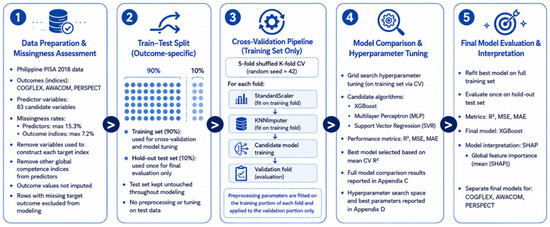
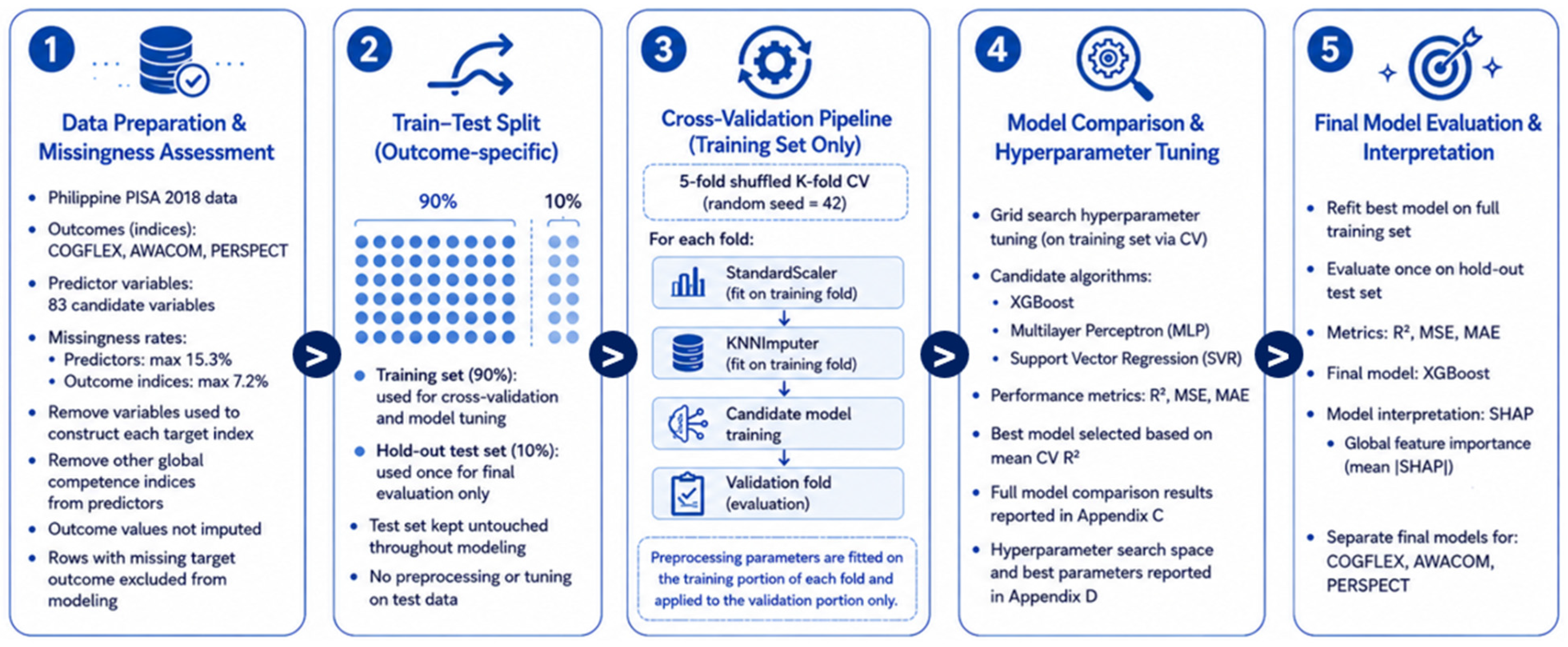
We used several data mining techniques to discover useful patterns amidst the pool of initially meaningless values. Figure 1 summarizes the components of the machine learning methodology.
Figure 1.
Summary of the machine learning methodologies for outcome-specific prediction of cognitive skill indexes.
The framework follows an outcome-specific modeling approach. For each target index, variables used to construct the target index and the other global competence indexes were removed from the predictor set. The remaining data were split into training and hold-out test sets. Preprocessing, including standardization and KNN imputation, was conducted within the cross-validation pipeline. Candidate algorithms were then compared, and the best-performing model was interpreted using SHAP.
We should note that we did not use the student weight and replicate weights in the machine learning analysis because the machine learning models generated do not estimate population parameters. Instead, the models were developed for prediction and feature-importance analysis. Thus, all observations were treated with equal weight during model training, validation, and SHAP analysis, and thus the reported model performance and SHAP-based predictor rankings should be interpreted as model-based patterns in the analyzed PISA 2018 sample, rather than as weighted population-level estimates.
2.2.1. Data Description and Processing
The data mining task involved developing regression models to predict three cognitive skill indexes: cognitive flexibility/adaptability (COGFLEX), awareness of intercultural communication (AWACOM), and perspective taking (PERSPECT). The models were estimated separately for each target index. For each outcome-specific model, the items used to construct the target index were excluded from the predictor set.
Missingness was assessed before imputation. The missingness rates for the predictor variables and the outcome indices are reported in Supplementary Figure S1a and Figure S1b, respectively. The highest missingness rate among the predictor variables was 15.3%, while the highest missingness rate among the outcome index variables was 7.2%. Outcome values were not imputed in the revised modeling workflow. For each outcome-specific model, observations with missing values in the target outcome index were excluded. After observations with missing outcome values were excluded, the final analytical samples included 6885 samples for COGFLEX, 6882 for AWACOM, and 6906 for PERSPECT. Missing predictor values were handled within the machine-learning pipeline using k-nearest neighbors (with k = 5) imputation. Non-numeric missing-value codes were first converted to missing values. Within each cross-validation fold, the preprocessing steps were fitted only on the training portion of the fold and then applied to the corresponding validation portion. Specifically, predictors were standardized using z-score standardization and missing predictor values were imputed using KNN imputation. This procedure ensured that information from the validation fold or hold-out test set was not used during preprocessing.
2.2.2. Training, Cross Validation, and Model Selection
For each outcome index, the data were first divided into a training set and a hold-out test set, with 10% of the observations reserved for final model evaluation. The hold-out test set was not used during preprocessing, hyperparameter tuning, or model selection. Hyperparameter tuning was conducted only on the training set using 5-fold cross-validation with shuffled folds and a fixed random seed of 42 to improve reproducibility. Stratified cross-validation was not applied because the outcome indexes are continuous variables. Instead, standard shuffled K-fold cross-validation was used; the approach randomly partitions the training data into five folds without replacement, with each fold serving once as the validation set while the remaining folds are used for training. The cross-validated R2 was used to compare hyperparameter combinations in model selection.
The preprocessing and model estimation steps were implemented as a single machine-learning pipeline. Each pipeline consisted of standardization, K-nearest neighbors imputation, and model fitting. For each cross-validation fold, the scaler and imputer were fitted only on the training portion of the fold and then applied to the corresponding validation portion. This ensured that information from the validation fold was not used during preprocessing. After the best hyperparameters were selected, the final model was refitted on the full training set and evaluated once on the hold-out test set using R2, mean squared error, and mean absolute error.
Three candidate regression algorithms were evaluated to determine the best model for the three cognitive skill indexes: support vector regression, XGBoost, and multilayer perceptron. Finally, the Shapley Additive Explanations (SHAP) approach was applied to explain each regression model. Based on cooperative games theory, SHAP quantifies the impact of each variable on the model’s predictions by averaging the marginal contributions of each variable across all possible subsets of variables. The approach ensures that each variable’s contribution is fairly evaluated in the context of all other variables. By averaging the absolute SHAP values across all instances in the dataset, a global feature importance ranking is derived, which helps find the most influential variables in the prediction model. For this work, SHAP values were computed using the fitted final XGBoost model and the processed hold-out test set. Global predictor importance was summarized as the mean absolute SHAP value across hold-out test observations.
3. Results
3.1. Machine Learning Model Results
The grid search results indicate that XGBoost achieved the most consistent predictive performance across the three outcome models compared with SVM and MLP (see Supplementary Figure S2 for full details of the model comparisons). For COGFLEX, XGBoost produced the highest testing R2 (0.4469) and the lowest testing MSE and MAE among the three models. For AWACOM, XGBoost outperformed both SVM and MLP across all testing metrics, with the highest testing R2 (0.4195) and the lowest testing MSE and MAE. For PERSPECT, XGBoost again achieved the highest testing R2 (0.3896) and the lowest testing MSE, although SVM produced a slightly lower testing MAE. Overall, these results suggest that XGBoost provided the best balance of predictive accuracy and generalization across the three cognitive skill indices.
We therefore present three final XGBoost models, one for each cognitive skill index: COGFLEX, AWACOM, and PERSPECT. Table 1 summarizes the predictive performance of the final XGBoost models. For additional details about the final XGBoost model, the cross-validated mean and standard deviations for R2, MSE, and MAE are summarized Supplementary Table S1; and the hyperparameter search space and selected parameters are reported in Supplementary Table S2.
Table 1.
R2 values with the actual average train and test R2 performance values of the best XGBoost models for predicting the PISA cognitive skill indexes.
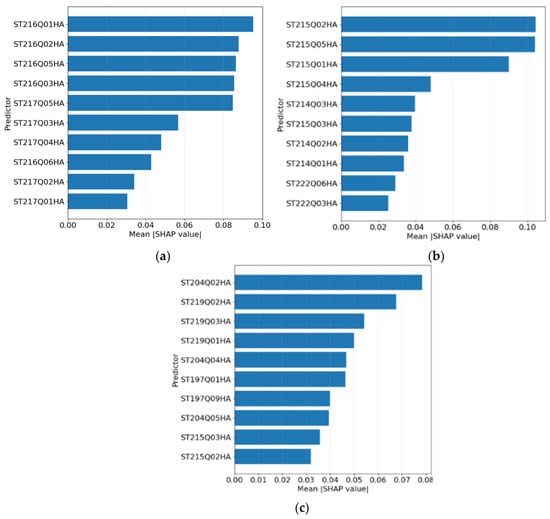
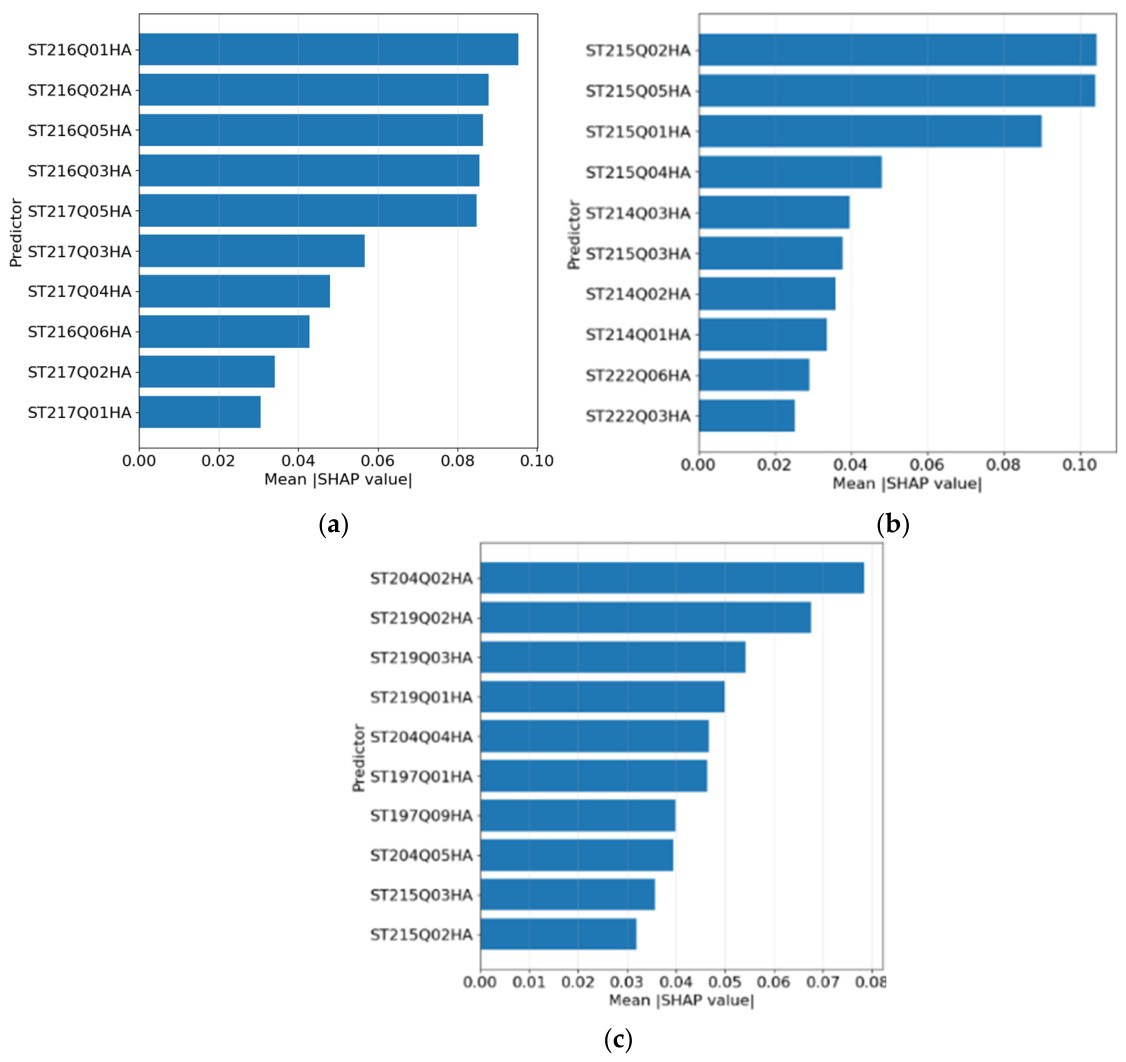
Figure 2 summarizes the key SHAP analysis results for each of the indexes, which refer to the top ten predictors of each index. While there are a few significant predictors shared by the indexes, generally, the patterns differ noticeably across the three cognitive skill indexes.
Figure 2.
Top 10 predictors for the indexes, (a) PERSPECT, (b) COGFLEX, and (c) AWACOM, ranked on the y-axis by their importance from highest to lowest. The x-axis represents the magnitude of their importance based on SHAP.
3.1.1. Perspective Taking
The SHAP analysis showed that ten strongest predictors of Filipino students’ perspective taking were all strong predictors. All ten were variables that directly measured two cognitive skills: cognitive flexibility and respect for other cultures. Five items that measured cognitive flexibility were among the best predictors of perspective taking: ST216Q01HA (“I can deal with unusual situations”), ST216Q02HA (“I can change my behaviour to meet the needs of new situations”), ST216Q05HA (“When encountering difficult situations with other people, I can think of a way to resolve the situation”), ST216Q03HA (“I can adapt to different situations even when under stress or pressure”), and ST216Q06HA (“I am capable of overcoming my difficulties in interacting with people from other cultures”). The five other best predictors were items that measured respect for other cultures. These were: ST217Q05HA (“I value the opinions of people from different cultures”), ST217Q03HA (“I give space to people from other cultures to express themselves”), ST217Q04HA (“I respect the values of people from different cultures”), ST217Q02HA (“I treat all people with respect regardless of their cultural background”), and ST217Q01HA (“I respect people from other cultures as equal human beings”). The ten strongest predictors suggest that perspective taking is a cognitive skill that is strongly associated with a willingness to be flexible related to respect with people from different cultures. We address this point more carefully in Section 4.
3.1.2. Cognitive Flexibility and Adaptability
The top ten predictors of Filipino students’ cognitive flexibility were three clusters of factors. Five predictors were measures of perspective taking, which is reflective of how cognitive flexibility items predicted perspective taking (see Section 3.1.1). These five were ST215Q02HA (“I believe there are two sides to every question and try to look at them both”), ST215Q05HA (“When I am upset at someone, I try to take the perspective of that person for a while”), ST215Q01HA (“I try to look at everybody’s side of a disagreement before I make a decision”), ST215Q04HA (“Before criticizing somebody, I try to imagine how I would feel if I were in their place”), and ST215Q03HA (“I sometimes try to understand my friends better by imagining how things look from their perspective.”). Three predictors relate to interest in other cultures: ST214Q03HA (“I am interested in how people from various cultures see the world”), ST214Q01HA (“I want to learn how people live in different countries”), and ST214Q02HA (“I want to learn more about the religions of the world”). The other two best predictors both related to the students’ involvement in pro-environmental action: ST222Q06HA (“I boycott products or companies for political, ethical, or environmental reasons”), and ST222Q03HA (“I sign environmental or social petitions online”). The ten strongest predictors reinforce the conceptual association between cognitive flexibility and perspective taking, but also underscore the association with cognitive interests in other cultures. The involvement in pro-environmental activities suggests that there are also behavioral correlates of this cognitive competence.
3.1.3. Intercultural Communication Ability
There was less overlap between the predictors of intercultural communication ability and those of the other two cognitive skills. The predictors of the third cognitive competence came from four factors. First, three predictors related to attitudes towards migrants: ST204Q02HA (“Immigrant children should have the same opportunities for education that other children in the country have”), ST204Q04HA (“Immigrants should have the opportunity to continue their own customs and lifestyle”), and ST204Q05HA (“Immigrants should have all the same rights that everyone else in the country has”). All three predictors express agreement with how immigrants should enjoy the same rights as non-immigrants in a country. Three predictors were items that express global citizenship values: ST219Q02HA (“When I see the poor conditions that some people in the world live under, I feel a responsibility to do something about it”), ST219Q01HA (“I think of myself as a citizen of the world”), and ST219Q03HA (“I think my behaviour can impact people in other countries.”). Two predictors were items that indicated the students’ familiarity and knowledge about global concerns, specifically, ST197Q01HA (“climate change and global warming), and ST197Q09HA (“causes of poverty”). The final two predictors are the only two that overlap with those for the other two cognitive skills: ST215Q04HA (“Before criticizing somebody, I try to imagine how I would feel if I were in their place”), and ST215Q03HA (“I sometimes try to understand my friends better by imagining how things look from their perspective.”).
4. Discussion
The study was undertaken to explore the predictors of three cognitive skills related to global competences among Filipino students, first to ascertain whether the three involve related or unrelated components and develop from similar or different experiences. Using Leeds-Hurwitz’ (2013) competence tree metaphor, we expected that the three leaves—perspective taking, cognitive flexibility, and intercultural communication ability—would be associated with each other through common types of predictor variables. But we expected that intercultural communication ability would share fewer predictors with the other two, as they would come from different branches, so to speak. As discussed earlier, the core components of intercultural communication may involve distinct abilities (Lysiuchenko et al., 2021) compared to the fundamental cognitive components of perspective taking and cognitive flexibility (Kloo et al., 2024). The results align with these expectations. First, perspective taking variables seem to be an important connecting variable for all three cognitive indexes, which suggests that the ability to appreciate diverse viewpoints is a crucial cognitive competence that is strongly associated with the related set of cognitive skills. As perspective taking has been previously associated with open-mindedness in engaging people from diverse backgrounds (Galinsky & Moskowitz, 2000) and with understanding global interdependence (Osler & Starkey, 2003), it is not surprising that this competence might be a critical connecting one.
Looking at the strongest predictors of perspective taking and cognitive flexibility, we notice that these were almost all variables that indicate one of the other components (i.e., affective, knowledge, behavioral) of global competence. In contrast, fewer such variables were strong predictors of intercultural communication; instead, the strong predictors of the latter were variables associated with some cultural and global experience or issue. As discussed earlier, intercultural communication represents skills that are important in intercultural contexts (Zhang & Noels, 2024) and is likely to be relevant in experience were intercultural and global knowledge is also salient. In a manner of speaking, although the three leaves in the competency metaphor are in the same tree, they may be attached to different branches.
This set of results points to some complications of constructing global competence as a multidimensional ability construct, as the results suggest that factors that may be associated with some dimensions might be structured not in neatly bounded yet related categories. Instead, the relationships among the different cognitive skills might be in complex networks that reflect different specific experiences and knowledge where sets of cognitive competences are associated in non-linear or non-hierarchical ways. But these patterns of associations are important to consider as frameworks of global citizenship competency tend to characterize the competency as being necessarily multidimensional (Reimers, 2009; Schejbal & Irvine, 2009), but also one that involves many different domains (OECD, 2019).
The second aim of the study was to explore the factors that could be considered in the development of global cognitive skills among Filipino students. Interestingly, there were no instructional factors that were among the strongest predictors of any of the three cognitive skills. The closest to being instructional variables are those that refer to knowledge about global issues (e.g., global poverty, migrants, how well-being of people in different countries is interconnected, etc.), which may be topics in the school curriculum. However, Filipino students may acquire knowledge and attitudes related to these topics outside of the academic activities in school. Nevertheless, the results suggest that an interrelated set of knowledge and attitudes may be strongly associated with components of global competence, even as the processes of acquiring this interrelated knowledge may or may not happen within the school.
In a sense, it should not be surprising that curriculum and instructional variables were not strong predictors of the cognitive skills given that there is no global citizenship curriculum in the Philippines, and global competences are supposed to be embedded in many different subjects that Filipino students take in the elementary and high school curriculum (Maribojoc, 2018). The absence of a focal curriculum should be considered in interpreting the results of the exploratory study. The present reality that the teaching of global competences is not an explicit goal in the Philippine basic education curriculum might explain why instructional variables were not strong predictors in the models. Whether or not the Philippines mandates a separate global citizenship course or not, the challenge will be how to nurture knowledge, beliefs, values, attitudes, and behaviors that reference global intercultural experiences.
We also acknowledge some important limitations of the current study related to aspects of the methodology. The foremost of which is the assumption that the measures of the cognitive skills were valid measures for the Filipino sample, without direct information on the validity. Note that the PISA 2018 assessment framework was developed and validated for all the participating countries (but country-specific validity information was not provided) (OECD, 2019). Second, the Filipino students in the study answered the survey questions in English, which was not their first language. So it is possible that there might have been comprehension issues as regards some survey items. The significance of this limitation cannot be overemphasized, as the measure of the cognitive skills and also most of the predictor variables studies were self-report measures that depended on the students’ appropriate understanding of the item described. The possibility of misunderstanding specific phrases and idioms in English cannot be ruled out but could also not be controlled for in the current analysis. Nevertheless, the OECD researchers have indicated that the scales have adequate psychometric properties in each of the participating countries. Third, we underscore that the results of our study should not be interpreted as providing estimates of any population parameters. As clarified in Section 2, the machine learning models were developed for prediction and feature importance analysis, and the sample weights and replicate weights were not considered in the analysis. Thus, the results of the study should be interpreted as model-based patterns in the analyzed PISA 2018 sample. Future research might consider exploring distinct predictors and correlates of the cognitive skills in subsamples of the Filipino student population. Although, the stratified sampling procedure used in PISA 2018 might not allow for adequate sampling for all relevant subsamples, future studies can gather specific data that give appropriate weights to particular target subpopulations for comparison.
Finally, we note that the exploratory study was also limited in its atheoretical consideration of the predictors of the three cognitive skills related to global citizenship. The competence tree metaphor of Leeds-Hurwitz (2013) that we used to guide our selection of the predictor variables does not provide precise theoretical mechanisms for how the components of the tree metaphor relate to each other. A better test of the relatedness of these ability factors would have involved measures of more theoretically prescribed set of shared and distinct components.
These limitations notwithstanding, this exploratory study that applied machine learning approaches to discern patterns underlying the cognitive components of global competences reveal some useful insights. In particular, the results point to how the nomological network of the three cognitive skills that seem to embody the emergence of global competences that connect cognitive, affective, and behavioral subcomponents. Although there are distinct sets of strong predictors for each of the cognitive skills (especially for intercultural communication abilities), there are emergent affinities that are consistent with multidimensional conceptions of global competences. A more critical perspective on the result might underscore the disjoint nature of the cognitive components of a multidimensional competence construct, but we also need to keep in mind that the Filipino students do not have a mandatory global competence course, and as such we cannot reasonably expect a neat convergence of the theoretical subcomponents of global competence. Indeed, the results could be viewed as underscoring the complicated and potentially challenging approach of trying to develop this global competence in learners in different subjects, instead of in one course with a coherent set of learning outcomes.
But perhaps the global competences of Filipinos are related to intercultural experiences outside school. For example, research with older Filipino students suggests that engagement in digital platforms and social media is associated with global civic engagement (Cleofas, 2025; Cleofas & Labayo, 2024), which are expressions of global competences. Having parents who are overseas Filipino workers was hypothesized to positively relate to intercultural attitudes, but the results suggest that the reverse might be true (Bernardo et al., 2025). Individual self-beliefs, specifically growth mindsets, were also shown to be an amplifier of global citizenship competences in different Southeast Asian countries (Nob et al., 2025). So there might be relevant non-educational processes that need to be studied to better understand the nature of global competences of Filipino learners, as this might become a truly important competency in the coming decades.
Supplementary Materials
The following supporting information can be downloaded at: https://www.mdpi.com/article/10.3390/educsci16071076/s1, Figure S1: Missingness Rate of Predictors and Indices; Figure S2: Model comparison across candidate algorithms; Table S1: Cross-validated mean and standard deviations for R2, MSE, and MAE; Table S2: Hyperparameters search field for the XGBoost grid search; Table S3: Software and Reproducibility.
Author Contributions
Conceptualization, A.B.I.B., M.O.C.II; machine learning methodology, M.O.C.II; data preprocessing, machine learning modelling and evaluation: J.G.E.R.; writing—original draft preparation, A.B.I.B., M.O.C.II; manuscript review and editing, A.B.I.B.; project administration, M.O.C.II; funding acquisition, A.B.I.B., M.O.C.II. All authors have read and agreed to the published version of the manuscript.
Funding
This research was funded by SEAMEO-INNOTECH, Research Partnership Agreement No. ERIO/ERU 2021-09. The APC was funded by De La Salle University.
Institutional Review Board Statement
Ethical review and approval were waived for this study, since it is a secondary analyses of the officially published public PISA 2018 dataset.
Informed Consent Statement
Informed consent was waived for this study, since it is a secondary analyses of the officially published public PISA 2018 dataset.
Data Availability Statement
The data analyzed in this study are available in the PISA 2018 Database page on the website of the Organisation for Economic Co-operation and Development at https://www.oecd.org/pisa/data/2018database/ (accessed on 17 February 2020). In addition, the code, processed data, and outputs are publicly available in the following repository: https://github.com/maccordel/pisa-global-competence-ml.git (accessed on 28 June 2026).
Acknowledgments
The authors thank the student research assistants who provided very capable support in various aspects of the machine learning methodology: Abien Fred M. Agarap, Edward Rainier C. Curugan, Jared Blase D. Sy, Gerald F. Dalan; the leadership of SEAMEO INNOTECH: Ramon C. Bacani and Philip J. Purnell; and the members of the SEAMEO INNOTECH Educational Research Unit: Sherlyn Almonte-Acosta, Keven Lee Galanida, Anneraine Colobong, Katherine Torralba, Christian Leubert Malimbing, and Erlene Umali for various forms of assistance and support.
Conflicts of Interest
The authors declare no conflicts of interest. The funders had no role in the design of the study; in the collection, analyses, or interpretation of data; in the writing of the manuscript, or in the decision to publish the results.
Abbreviations
The following abbreviations are used in this manuscript:
| AWACOM | Intercultural Communication Ability |
| COGFLEX | Cognitive Flexibility |
| OECD | Organisation for Economic Co-operation and Development |
| PERSPECT | Perspective Taking |
| PISA | Programme for International Student Assessment |
| SEAMEO | Southeast Asian Ministers of Education Organization |
| SHAP | Shapley Additive Explanations |
| UNESCO | United Nations Educational, Scientific, and Cultural Organization |
| UNICEF | United Nations Children’s Fund |
Appendix A. Summary of Main Categories of Predictors of the Cognitive Skill Indexes from the PISA
| Variable Category | Description |
| ST196 | Self-efficacy regarding global issue |
| ST197 | Awareness of global issues |
| ST215 | Perspective taking |
| ST216 | Adaptability |
| ST218 | Awareness of intercultural communication |
| ST222 | Student’s engagement regarding global issues |
| ST214 | Interest in learning about other cultures |
| ST220 | Contact with people from other countries |
| ST217 | Respect for people from other cultural backgrounds |
| ST219 | Global mindedness |
| ST204 | Attitudes towards immigrants |
| ST177 | Number of languages spoken |
| ST189 | Number of foreign languages at school |
| ST221 | Global competence activities at school |
| ST223 | Intercultural attitudes of teachers |
| Note: The specific items in each category may be viewed at: https://www.oecd.org/content/dam/oecd/en/data/datasets/pisa/pisa-2018-datasets/questionnaires/STUDENTS%20questionnaire%20PISA%202018%20main.pdf (accessed on 17 February 2020). | |
References
- Amin, H., Zaman, A., & Tok, E. (2026). Education for sustainable development and global citizenship education in the GCC: A systematic literature review. Globalisation, Societies and Education, 24(2), 359–374. [Google Scholar] [CrossRef] [Scilit]
- Bernardo, A. B. I., Cordel, M. O., Ricardo, J. G. E., Galanza, M. A. M. C., & Almonte-Acosta, S. (2022). Global citizenship competencies of Filipino students: Using machine learning to explore the structure of cognitive, affective, and behavioral competencies in the 2019 Southeast Asia primary learning metrics. Educational Science, 12, 547. [Google Scholar] [CrossRef] [Scilit]
- Bernardo, A. B. I., Mata, K. K. C., & Garabiles, M. R. (2025). Cultural ideologies and outgroup action tendencies of left-behind children of overseas Filipino workers. Cogent Psychology, 12(1), 2478710. [Google Scholar] [CrossRef] [Scilit]
- Bernardo, A. B. I., & Presbitero, A. (2018). Cognitive flexibility and cultural intelligence: Exploring the cognitive aspects of effective functioning in culturally diverse contexts. International Journal of Intercultural Relations, 66, 12–21. [Google Scholar] [CrossRef] [Scilit]
- Boix Mansilla, V., & Jackson, A. (2013). Educating for global competence: Learning redefined for an interconnected world. In V. Boix Mansilla, A. W. Jackson, H. H. Jacobs, W. Kist, H. S. Tavangar, & S. R. Tolisano (Eds.), Mastering global literacy: Contemporary perspectives (pp. 1–23). Solution Tree. [Google Scholar]
- Bukowski, M., Śpiewak, S., Różańska, A., & Gruszka, A. (2024). Personal control and cognitive flexibility: Does uncontrollability reduce flexible shifting of attention? Learning and Motivation, 87, 102024. [Google Scholar] [CrossRef] [Scilit]
- Cleofas, J. V. (2025). Kabataang Pinoy online: Digital citizenship and global civic engagement among Filipino young netizens. Journal of Applied Youth Studies, 8(2), 173–192. [Google Scholar] [CrossRef] [Scilit]
- Cleofas, J. V., & Labayo, C. C. (2024). Youth netizens as global citizens: Digital citizenship and global competence among undergraduate students. Frontiers in Communication, 9, 1398001. [Google Scholar] [CrossRef] [Scilit]
- Deardorff, D. K. (2012). Framework: Intercultural competence model. In D. K. Deardoff, & K. Berardo (Eds.), Building intercultural competence (pp. 45–52). Routledge. [Google Scholar]
- De Lillo, M., & Ferguson, H. J. (2023). Perspective-taking and social inferences in adolescents, young adults, and older adults. Journal of Experimental Psychology: General, 152(5), 1420–1438. [Google Scholar] [CrossRef] [Scilit] [PubMed]
- Fantini, A. E. (2020). Reconceptualizing intercultural communicative competence: A multinational perspective. Research in Comparative and International Education, 15(1), 52–61. [Google Scholar] [CrossRef] [Scilit]
- Galinsky, A. D., & Moskowitz, G. B. (2000). Perspective-taking: Decreasing stereotype expression, stereotype accessibility, and in-group favoritism. Journal of Personality and Social Psychology, 78(4), 708–724. [Google Scholar] [CrossRef] [PubMed]
- Gudykunst, W. B. (2004). Bridging differences: Effective intergroup communication (4th ed.). Sage. [Google Scholar]
- Guillén-Yparrea, N., & Ramírez-Montoya, M. S. (2023). Intercultural competencies in higher education: A systematic review from 2016 to 2021. Cogent Education, 10(1), 2167360. [Google Scholar] [CrossRef] [Scilit]
- Hamilton, J., & Woodward-Kron, R. (2010). Developing cultural awareness and intercultural communication through multimedia: A case study from medicine and the health sciences. System, 38(4), 560–568. [Google Scholar] [CrossRef] [Scilit]
- Jeong, B., & Bang, Y. (2020). Study of teacher’s perception on global citizenship education in ASEAN region. Journal of Education for International Understanding, 15(3), 141–203. [Google Scholar] [CrossRef] [Scilit]
- Kloo, D., Kaltefleiter, L. J., & Sodian, B. (2024). Early perspective taking predicts later cognitive flexibility: A longitudinal study. Infant and Child Development, 33(6), e2537. [Google Scholar] [CrossRef] [Scilit]
- Kuhn, D., & Weinstock, M. (2002). What is epistemological thinking and why does it matter. In B. K. Hofer, & P. R. Pintrich (Eds.), Personal epistemologies (pp. 121–144). Routledge. [Google Scholar]
- Lamborg, B. (Ed.). (2004). Global crises, global solutions. Cambridge University Press. [Google Scholar]
- Laureiro-Martínez, D., & Brusoni, S. (2018). Cognitive flexibility and adaptive decision-making: Evidence from a laboratory study of expert decision makers. Strategic Management Journal, 39, 1031–1058. [Google Scholar] [CrossRef] [Scilit]
- Leeds-Hurwitz, W. (2013). Intercultural competences: Conceptual and operational framework. UNESCO. [Google Scholar]
- Liu, O. L., Frankel, L., & Roohr, K. C. (2014). Assessing critical thinking in higher education: Current state and directions for next-generation assessment. Educational Testing Service. [Google Scholar] [CrossRef] [Scilit]
- Lysiuchenko, O., Sydorenko, Y., Oleksiienko, L., Lysenko, T., & Hulych, M. (2021). Intercultural communicative competence in the development of students’ linguistic skills. Linguistics and Culture Review, 5(S4), 1202–1226. [Google Scholar] [CrossRef] [Scilit]
- Mannion, G., Biesta, G., Priestley, M., & Ross, H. (2016). The global dimension in education and education for global citizenship: Genealogy and critique. In V. Andreotti (Ed.), The political economy of global citizenship education (pp. 134–147). Routledge. [Google Scholar]
- Maribojoc, J. G. (2018). The Philippines: Global citizenship education (GCED) and education for sustainable development (ESD) in basic education. In 2018 Asia pacific regional global citizenship education network meeting. UNESCO. [Google Scholar]
- Mata, A. (2019). Social metacognition in moral judgment: Decisional conflict promotes perspective taking. Journal of Personality and Social Psychology, 117(6), 1061–1082. [Google Scholar] [CrossRef] [Scilit] [PubMed]
- Moore, A., & Malinowski, P. (2009). Meditation, mindfulness and cognitive flexibility. Consciousness and Cognition, 18(1), 176–186. [Google Scholar] [CrossRef] [Scilit] [PubMed]
- Nob, R. M., Bernardo, A. B. I., Manguiat, G. C., & Arenillo, A. P. D. C. (2025). Growth mindset strengthens the relationship between intercultural attitudes and global citizenship competence in Indonesia, the Philippines, and Thailand: A cross-cultural study of PISA 2018 data. Social Psychology of Education, 28, 27. [Google Scholar] [CrossRef] [Scilit]
- OECD. (2019). PISA 2018 assessment and analytical framework. OECD Publishing. [Google Scholar] [CrossRef] [Scilit]
- Osler, A., & Starkey, H. (2003). Learning for cosmopolitan citizenship: Theoretical debates and young people’s experiences. Educational Review, 55, 243–254. [Google Scholar] [CrossRef] [Scilit]
- Pashby, K., Da Costa, M., Stein, S., & Andreotti, V. (2020). A meta-review of typologies of global citizenship education. Comparative Education, 56, 144–164. [Google Scholar] [CrossRef] [Scilit]
- Reimers, F. (2009). Educating for global competency. In J. E. Cohen, & M. B. Malin (Eds.), International perspectives on the goals of universal basic and secondary education (pp. 183–202). Routledge. [Google Scholar]
- Rodriguez, C., Montandon, M., Herrmann, F. R., Pegna, A. J., & Giannakopoulos, P. (2022). Cognitive and emotional determinants of automatic perspective taking in healthy adults. Frontiers in Psychology, 13, 883929. [Google Scholar] [CrossRef] [Scilit] [PubMed]
- Sanz Leal, M., Orozco Gómez, M. L., & Bogdan Toma, R. (2022). Conceptual construction of global competence in education. Teoría de la Educación, 34, 83–103. [Google Scholar] [CrossRef] [Scilit]
- Sälzer, C., & Roczen, N. (2018). Assessing global competence in PISA 2018: Challenges and approaches to capturing a complex construct. International Journal of Development Education and Global Learning, 10, 5–20. [Google Scholar] [CrossRef] [Scilit]
- Schejbal, D., & Irvine, G. (2009). Global competencies, liberal studies, and the needs of employers. Continuing Higher Education Review, 73, 125–142. [Google Scholar]
- Schulz, W., Ainley, J., Fraillon, J., Kerr, D., & Losito, B. (2010). Initial findings from the IEA international civic and citizenship education study. International Association for the Evaluation of Educational Achievement. [Google Scholar]
- UNESCO. (2016). Education 2030: Incheon declaration and framework for action for the implementation of sustainable development goal 4: Ensure inclusive and equitable quality education and promote lifelong learning opportunities for all. UNESCO. [Google Scholar]
- UNICEF & SEAMEO. (2019). SEA-PLM 2019 assessment framework (1st ed.). UNICEF & SEAMEO, SEA-PLM Secretariat. [Google Scholar]
- Warm, T. A. (1989). Weighted likelihood estimation of ability in item response theory. Psychometrika, 54(3), 427–450. [Google Scholar] [CrossRef] [Scilit]
- Weenink, D. (2008). Cosmopolitanism as a form of capital: Parents preparing their children for a globalizing world. Sociology, 42, 1089–1106. [Google Scholar] [CrossRef] [Scilit]
- Williams, M., Belkin, L. Y., & Chen, C. C. (2020). Cognitive flexibility matters: The role of multilevel positive affect and cognitive flexibility in shaping victims’ cooperative and uncooperative behavioral responses to trust violations. Group & Organization Management, 45(2), 181–218. [Google Scholar] [CrossRef] [Scilit]
- Wittmann, V. (2020). Educating global citizens an imperative of science in the 21st century. Global Processes Journal, 3, 8–17. [Google Scholar]
- Yusof, H., Noor, M. A. M., Jalil, N. A., Mansor, M., & Nordin, J. (2019). Teachers’ perception of students’ knowledge, skills and attitudes on global citizenship. International Journal of Academic Research in Business and Social Sciences, 9(9), 153–164. [Google Scholar] [CrossRef] [Scilit] [PubMed]
- Zhang, Y. S. D., & Noels, K. A. (2024). Understanding the interrelations between cultural empathy, intercultural communication competence, and the psychosocial adjustment of international students in Canada: A longitudinal examination. International Journal of Intercultural Relations, 102, 102023. [Google Scholar] [CrossRef] [Scilit]

Disclaimer/Publisher’s Note: The statements, opinions and data contained in all publications are solely those of the individual author(s) and contributor(s) and not of MDPI and/or the editor(s). MDPI and/or the editor(s) disclaim responsibility for any injury to people or property resulting from any ideas, methods, instructions or products referred to in the content. |
© 2026 by the authors. Licensee MDPI, Basel, Switzerland. This article is an open access article distributed under the terms and conditions of the Creative Commons Attribution (CC BY) license.