


Abstract
This study aims to identify math students’ argumentation processes and how the design of interactive materials may serve such processes. Despite the increasing use of such materials in mathematics education, their role in shaping students’ argumentation processes remains underexplored. The case study to be reported here is part of a project aimed at examining the potential of interactive materials to support students’ argumentation processes. Three 13- and 14-year-old students were challenged by a task presented as a guiding interactive diagram centered on an animation of multi-process motion and parallel time-position graphs. The study was based on a framework for analyzing the pedagogical functionality of interactive diagrams and the Toulmin model for analyzing the argument structure. The argumentation processes evolved from claiming a discrepancy between the two hot-linked representations in the diagram. The students used backing to generate mathematical ideas and rebuttals to strengthen them by analyzing exceptional cases. The study provides evidence of the contribution of the guiding interactive diagram design to the emergence of rich argumentation processes. The students engaged in deeper argumentation and used rebuttal as a way to address the semiotic conflict prompted by the design into their broader argument structure.
1. Introduction
Using technology to develop interactive mathematics materials is an attempt to create new paths for developing mathematical practices (e.g., Naftaliev, 2018; Naftaliev & Barabash, 2024), among others, for argumentation processes such as looking for data, formulating conjectures based on the data, looking for ways to justify the conjectures, and stating claims and rules. Mathematical argumentation processes are one of the key components of mathematical thinking and communication. Argumentation in the scientific sense involves collaborative discussion to explore and resolve an issue and construct an explanation that best fits the available data and logic (Berland & Reiser, 2009). Argumentation offers the potential for purposefully guiding students to focus on the mathematical content and on how the mathematical content can be used to respond to a problem or dilemma (e.g., Prusak et al., 2012). Yet, implementing the practice of building mathematical arguments in classrooms and developing curricula that effectively integrate argumentation into mathematical learning environments remains a significant challenge in math education.
Curriculum materials, such as textbooks, are considered a key resource in learning-teaching processes. New technologies allow the production of new, interactive materials that make it possible for richer interaction between users and the content than traditional printed materials (e.g., playing a video clip, interacting with an animation, changing examples, etc.; Naftaliev & Barabash, 2024; Naftaliev & Yerushalmy, 2022; Swidan, 2022). Interaction with technology-based materials plays a central role in shaping logical, mathematical ways of thinking and argumentation (Arzarello et al., 2009; Bartolini Bussi & Mariotti, 2008; Radford, 2003).
One of the main characteristics and challenges of interactive materials is that computer technology makes it possible to design a variety of interactive diagrams (IDs) for the same concept (e.g., Naftaliev, 2017, 2018). Deciding which design to adopt for what purpose and how to implement it for teaching-learning are considered urgent issues facing educators when they intend to use interactive curriculum materials. Naftaliev and Yerushalmy (2017) characterized the interactive materials by three types of ID functions that address a variety of learning and teaching settings. The presentational function refers to three types of examples in IDs: specific, random, and generic. The “sketchiness” vs. “rigorousness” of diagrams is an important factor in user orientation. The organizational function refers to the connection between all the components of the ID, so IDs can be designed to function in three different ways: illustrating, elaborating, and guiding. Each type of design enables particular kinds of student interaction with interactive materials, which ultimately result in different paths of learning (e.g., Naftaliev, 2017; Naftaliev & Yerushalmy, 2017).
Understanding argumentation processes requires an understanding of how novel interactive materials become an integral part of pedagogical practices. The design of interactive materials according to different pedagogical functions may suggest a variety of affordances and constraints for the development of argumentation processes by learners. The influence of the design of interactive technological materials on the development of argumentation processes has not been sufficiently studied. The present research aims to identify the students’ argumentation processes and specify how the design of interactive materials may serve as affordances in such processes. Identifying the argumentation processes and the role of the design of interactive materials has both theoretical and pedagogical contributions. Theoretically, the study sheds light on the role of specific elements in guiding interactive materials designed to trigger semiotic conflicts in learners’ argumentation processes. Pedagogically, it describes productive ways for mathematics educators to guide the design and use of interactive materials in a way that fosters learners’ argumentation processes.
2. Theoretical Background
2.1. Argumentation in Mathematics Education
Hanna (2020) described argumentation as a set of strategies employed to convince others of the soundness of one’s reasoning. She further emphasized that argumentation encompasses collaborative activities such as exchanging and evaluating claims to reach the most reasonable conclusion, even in the face of incomplete understanding. Krummheuer (2000) underscored the need to separate discussions of argumentation in mathematics education from formal proof, stressing that it should not be equated solely with traditional logical reasoning or formal deductive systems. His earlier work (1995) characterized classroom argumentation as a discursive event made up of interrelated statements that fulfill specific functions within social interactions (Krummheuer, 1995). This perspective positions argumentation as inherently dialogic and collaborative rather than an individualistic endeavor. As Krummheuer (1995) observed, argumentation typically unfolds through contributions from multiple participants due to the dynamic nature of classroom discourse.
In mathematics education, the constructs—argumentation, reasoning, justification, explanation, and proof—are closely related but analytically distinct. In this study, we define reasoning as the process through which students generate and connect mathematical ideas. Explanation refers to making one’s thinking understandable to others, whereas justification concerns providing support for the validity of a claim. Proof is treated as a formally structured and institutionally accepted form of justification grounded in deductive reasoning. By contrast, argumentation is conceptualized here as the socially situated process through which students formulate, negotiate, support, challenge, and refine mathematical claims in interaction with others and with mathematical representations and interactive materials. Thus, while reasoning, explanation, and justification may function as components within argumentation, they are not treated as synonymous constructs.
While the term “argumentation” may carry varied interpretations across the field, there is broad agreement among scholars that it is a critical component of mathematical learning. It is considered vital in helping students construct mathematical knowledge and refine their reasoning skills (Jones, 2000). Laborde (2005) similarly highlighted that mathematical understanding often arises through processes of argumentation. Moreover, argumentation is an essential part of the mathematics discipline and a key indicator of mathematical competence (Graham & Lesseig, 2018). In the process of building arguments and criticizing the reasoning of others, students develop their understanding of underlying mathematical ideas and engage in critical thinking activities (Graham & Lesseig, 2018; Yackel & Hanna, 2003).
The role of argumentation in mathematics education has been extensively emphasized due to its connection with conjecture-making, mathematical communication, and the development of knowledge. Balacheff (1999) emphasized that research on argumentation has demonstrated its productive, indispensable, and socially grounded nature, highlighting that the collaborative dynamics of argumentation play a vital role in shaping mathematical understanding. Developing argumentation skills supports mathematics learners in grasping alternative viewpoints, critically examining the strength and necessity of reasoning, and judging the validity of widely held conjectures (Lin & Mintzes, 2010). According to Schwarz et al. (2010), argumentation plays a central role in mathematics and serves as a fundamental process through which individuals shape and refine their opinions.
Researchers are also interested in understanding the argumentation processes of students who learn with interactive materials. The present research in this issue focused mainly on three themes: (a) the role of the dynamic geometry software in argumentation processes when students are conjecturing and checking conjectures with various hypothesis-testing devices (e.g., Arzarello et al., 2012; Baccaglini-Frank & Mariotti, 2010; Campbell & Zelkowski, 2020; Prusak et al., 2012); (b) the role of digital discussion maps—composed of interconnected visual-language cards, each representing a particular component of an argument (e.g., argument, claim, question, explanation)—in promoting argumentation processes when students are preparing their contribution using one of the options and link it to one or more contributions in the discussion map (e.g., Abdu et al., 2015; Albano et al., 2020; Schwarz et al., 2015); (c) the relationship between argumentation and meaning-making while students learn with digital tools (e.g., Bikner-Ahsbahs, 2022; Swidan, 2022; Swidan et al., 2020). In this context, argumentation may serve as a mechanism through which students negotiate, refine, and construct mathematical meanings while interacting with mathematical representations and digital tools.
In the present study, argumentation refers to the collaborative process through which students construct, coordinate, justify, challenge, and refine mathematical claims while interacting with guiding interactive diagrams. Our focus is therefore not on formal proof production, but on the evolving structure of students’ mathematically oriented discourse and the ways in which semiotic conflict contributes to the development of claims, warrants, backing, and rebuttals.
2.2. Semiotic Conflict and Its Role in Argumentation
Semiotic conflict is pivotal in understanding the dynamics of argumentation in educational settings. Semiotic conflict occurs when learners encounter challenges in interpreting and translating meanings across semiotic systems, such as verbal, graphic, and symbolic representations. Godino et al. (2007) defined it as “disparities between the student’s interpretation and the meaning in the mathematics institution.” Semiotic conflict can serve both as a catalyst for productive argumentation and a hindrance to it. On one hand, it provides opportunities for learners to engage in discussions to resolve the disparities between their interpretations and mathematical meaning. For example, when students interpret a mathematical graph differently, their debate can lead to a deeper understanding of the represented concept (Lin & Mintzes, 2010; Schwarz et al., 2010). Constructing and evaluating arguments while navigating and resolving these conflicts can be important in students’ development and refinement of their mathematical meaning and their ability to argue mathematically. On the other hand, unresolved semiotic conflicts can hinder argumentation. Misinterpretations or a lack of representational fluency may lead to confusion, frustration, or disengagement, which can limit learners’ ability to engage in meaningful discourse (Bikner-Ahsbahs, 2022). To mitigate these challenges, educators can provide scaffolding by explicitly connecting different semiotic representations and fostering collaborative problem-solving environments (Naftaliev & Yerushalmy, 2013; Swidan et al., 2020).
The implications of semiotic conflict are particularly important in mathematics education. Duval’s analysis of semiotic representations in mathematics shows that transforming these representations is crucial for mathematical understanding, suggesting that resolving semiotic conflicts can enhance learning outcomes (Duval, 2006). Semiotic conflict has the potential to challenge prevailing understandings and promote deeper conceptual learning. Therefore, to improve students’ argumentation skills, it is important to recognize and address semiotic conflicts. On the other hand, while semiotic conflict may stimulate mathematical argumentation and conceptual development, its productive potential should not be assumed. If students lack the resources needed to coordinate competing interpretations, semiotic conflict may instead result in persistent misunderstanding, frustration, or disengagement. The educational value of semiotic conflict, therefore, depends not only on its emergence but also on the availability of resources that support its resolution.
2.3. The Design of Interactive Diagrams and Their Role in Argumentation
As noted, e.g., Naftaliev and Yerushalmy (2013, 2017) identified several types of interactive diagrams (IDs) that vary in their level of openness, the degree to which they offer guidance, and the kind of real-time feedback they provide. For example, illustrating IDs are highly directed, with specific constraints and prompts that direct learners’ attention to particular mathematical properties. Elaborating IDs are more open, allowing learners to manipulate parameters or objects freely without prespecified pathways. Guiding IDs lie somewhere in between, offering partial constraints or suggesting potential exploration pathways, leaving room for guiding inquiry. These types of IDs fundamentally shape the nature of learners’ interactions, influencing the likelihood and depth of argumentation that may emerge.
When learners work with illustrating IDs, they tend to focus on verifying established properties or relationships. The structured prompts and explicit constraints may reduce their awareness of semiotic conflict because these diagrams do not offer a variety of tools for the learner’s engagement with the ID. As a result, argumentation in these environments may focus on making claims and possibly justifying them. By contrast, when learners engage with elaborating IDs, they have greater freedom and therefore greater potential for semiotic conflict. Without strict guidance in exploring the diagram, students may adopt a range of notational, symbolic, or conceptual strategies, leading to different interpretations. This may hinder the achievement of learning goals if the interpretations are not provided with appropriate guidance. Guiding IDs allow learners to interact with the ID to achieve learning goals (Naftaliev & Yerushalmy, 2017, 2022). Our working hypothesis is that the resources and constraints provided by the guiding IDs encourage students to engage with the conflicting viewpoints and tackle them, enriching their argumentative processes.
3. Research Questions
This study is guided by the following two research questions.
- (1)
- What are the students’ argumentation processes when they engage with a guiding ID?
- (2)
- How do the designed resources and constraints of guiding IDs serve the argumentation processes?
4. Materials and Methods
We adopted the case study methodology, which is well-suited for examining complex processes, such as the development of students’ argumentation in a specific context (Yin, 2018). Some case studies involve multiple cases or groups, but a single-case design is equally valid, particularly when the aim is to provide an in-depth exploration of a certain phenomenon (Yin, 2018; Stake, 1995). By focusing on one group, we were able to conduct a fine-grained, turn-by-turn analysis of the students’ argumentation processes, capturing the many ways in which interactive materials shape these processes in real time. Although our broader project—examining the potential of interactive materials to support students’ argumentation—includes six groups comprising 19 students who worked with the same guiding ID. All sessions were video recorded and subjected to preliminary analysis focusing on the emergence and development of argumentation structures. The present paper reports on one focal case selected through a purposive sample (Patton, 2014). We chose to present data from this case because it exhibited all major argumentation components identified across the broader dataset, including claims, warrants, backing, and rebuttals, and because the development of these components could be traced continuously throughout a single interaction episode. By concentrating on this one, we were able to illustrate both the structure of the arguments and how they developed over the course of the task. Thus, the selected case was not intended to be statistically representative but analytically informative, providing a particularly rich example of the argumentation processes investigated in this study.
4.1. Guiding ID Design
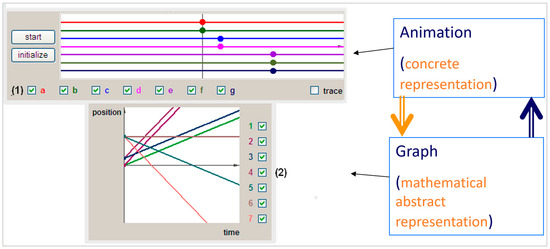
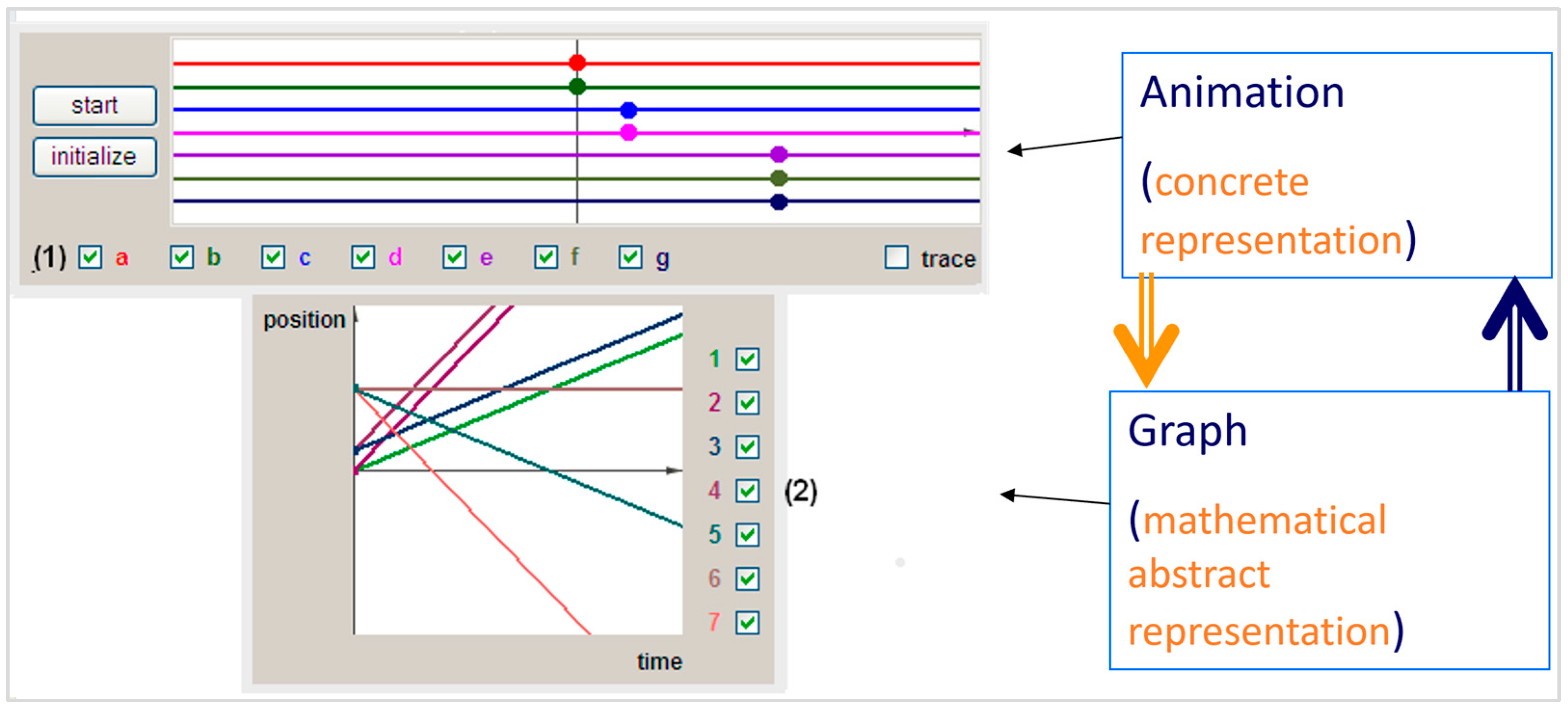
In this study, we focused on guiding ID (Figure 1). The guiding ID is designed to call for action in a specific way that supports developing particular mathematical ideas within constraints and resources designed in the ID. On one hand, the ID provides resources that promote inquiry; on the other, they set the constraints that offer guidance for the inquiry.
Figure 1.
Guiding diagram. (1) On/Off toggles to choose the appearing animated cars; (2) On/Off toggles for choosing moving dots on the graphs.
The task is to identify the seven graphs that represent the seven moving dots (representing cars) in the animation. The animation and the graph in the ID are only partially linked; motion occurs simultaneously in the animation and on the graph, but there is no color matching, and so no obvious way of knowing which graph corresponds to which dot in the animation. So, the identification process requires extracting data from the simulation and the graph in order to link them.
The ID was designed to represent four kinds of motion: (a) motion in one of two possible directions, (b) starts and ends in different positions, (c) pairs of dots each run at the same speed; the others at different speeds, and (d) one static dot-exceptional example in a list of examples that are aimed at focusing on a motionless situation over time. The design of an example focused on generic combinations of constant speed motion was intended to support the development of awareness of kinematic phenomena and the analysis of their mathematical model.
The following constraints contribute to making the task an interesting challenge: the two given representations, the partial linking between the representations, the absence of controls that could turn the given schematic nature of the representations into an accurate metric diagram, the exceptional example in a list of generic combinations of objects exhibiting different types of motion, and motion that cannot be paused and must be observed continuously.
The guiding ID design provides students with strong initial visual hints, helping them in the first stages of the discovery of the semiotic conflict. The conflict represents a misinterpretation of the graph, which describes a state of standing in place (Naftaliev & Yerushalmy, 2013). Learners have identified dynamically linked multiple representations of motion and the operations performed on them as challenging because they involve situations of uncertainty and conflict (Naftaliev & Yerushalmy, 2013). For a detailed discussion of the rationale behind the guiding ID’s design choices, see Naftaliev and Yerushalmy (2013, 2017). In this study, we examined how the design of the guiding IDs is reflected in students’ argumentation processes.
4.2. Procedure and Participants
The participants in this study were three male students, aged 13 and 14, in their second year of algebra studies. They had some experience with technology in mathematics, particularly in viewing graphs and numeric tables for function expressions. The students attended a public middle school in Israel serving a low-to-middle socioeconomic community. Based on teacher evaluations and school performance, they were classified into three levels of mathematical achievement: low, average, and high. The students participated voluntarily and were interviewed outside of regular school hours. All eighth-grade students in the school were invited to participate after the project was presented; the participating group consisted of those who expressed interest and obtained parental consent. The students studied in the same class, belonged to the same group of friends, and used to spend time together. The friendship relations among the participants were considered potentially relevant to the interactional dynamics observed during the task. Their prior familiarity appeared to support spontaneous discussion, mutual questioning, and the expression of tentative ideas. While friendship may have influenced the flow of the conversation, it was not treated as an analytical variable in the present study. Rather, it formed part of the natural context within which the students’ argumentation developed. The students used public transportation to return home after the interview.
The students were encouraged to voice their ideas, share them with their friends, reflect upon their friends’ ideas, and to engage with the activity as long as they wanted.
4.3. Identification of Semiotic Conflict
Semiotic conflict was identified through qualitative analysis of students’ interactions with the guiding interactive diagram.
Following Godino et al. (2007), we analyzed episodes in which students manifested a disparity while coordinating meanings across multiple representations. Specifically, utterances were considered evidence of a semiotic conflict when students explicitly expressed contradictions or inconsistencies between the animation and the graph, questioned the validity of one representation in relation to the other, or expressed uncertainty regarding how the representations should be interpreted. For instance, students’ statements such as “It doesn’t make sense,” and their questioning of why a point appeared motionless in the animation while all graph traces appeared to move, were treated as indicators of semiotic conflict. These utterances reflected a discrepancy between the students’ personal meaning (their initial interpretation of the graph) and the institutional meaning (the mathematical representation of a constant position over changing time). Critically, semiotic conflict was distinguished from a traditional misunderstanding. While a misunderstanding is typically conceptualized as an internal deficit within the student’s cognitive structures, a semiotic conflict shifts the focus from internal mental states to external communicative interactions and systems of practices. In this study, the focus was on the tension between competing interpretations arising from the coordination of distinct semiotic representations. Resolution of the conflict was considered to occur when students produced mathematically accepted interpretations that consistently aligned personal and institutional meanings across the animation and graph representations, subsequently using these interpretations to justify their claims. For example, a conflict was deemed resolved when students successfully coordinated the meanings of the two representations by recognizing that a horizontal line on the graph represented a fixed position over changing time, thereby resolving the contradiction that had initiated the conflict.
4.4. Data Analysis
Analysis of student arguments in this study is presented with diagrams inspired by the work of Toulmin (2003). Each diagram shows the claims, data, warrants, backing, and rebuttal offered by the students during their engagement with the ID and their discussion.
Toulmin’s Model and Argumentation
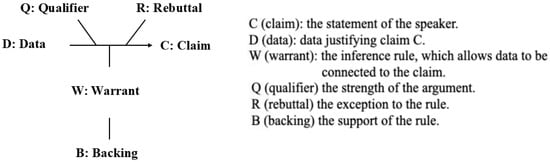
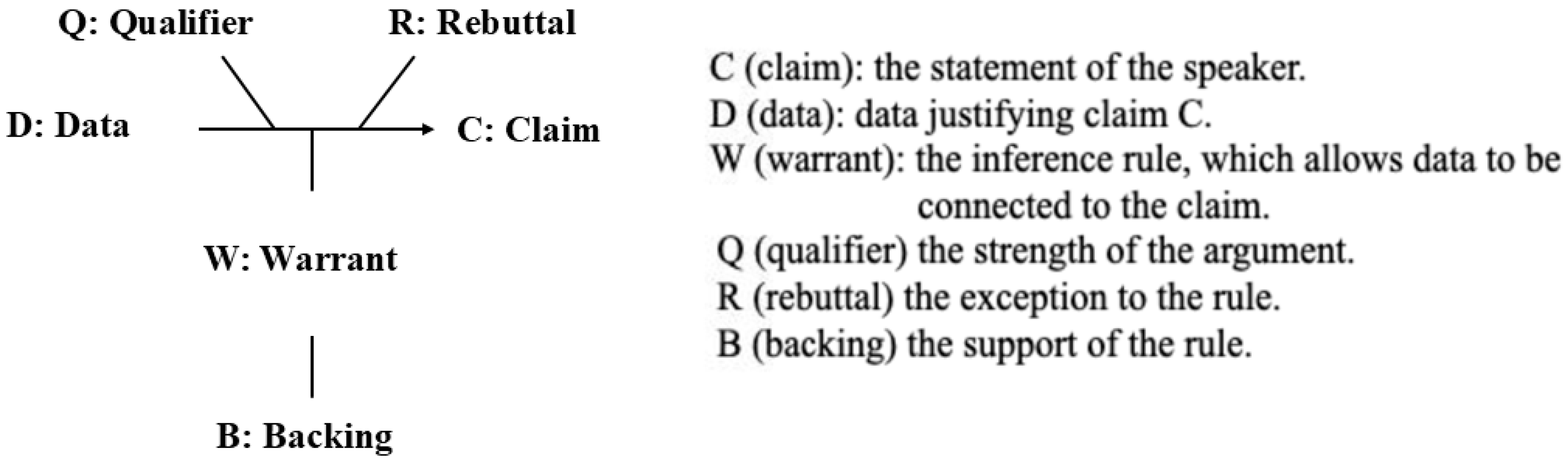
Although Toulmin’s model has sometimes been used in studies of proof construction, in the present study, it serves as an analytical framework for examining the evolving structure of students’ informal mathematical argumentation rather than the formal validity of deductive proofs. We used the Toulmin model to identify and analyze students’ argumentation as they worked with guiding IDs. Toulmin’s model of argumentation contains up to six related components (Figure 2). According to Toulmin (2003), an argument is represented by an assertion referred to as the claim (C), which is the speaker’s statement, data (D), which justify and support the claim, and a warrant (W) that provides the justification for using the data. The warrant is conceived as a support for the data-claim relationships, and it acts as a bridge between the data and the claim. Toulmin’s model considers three other components as well that may be necessary to describe the argument: qualifier, rebuttal, and backing (Toulmin, 2003). The qualifier (Q) represents the strength and the stability of the claim. The rebuttal (R) represents exceptions to the rule, and it generally weakens the force of the warrant. Finally, the backing (B) is used to reinforce the warrant if its authority is not readily accepted.
Figure 2.
The six components of the Toulmin model.
Analytically, coding decisions were guided by Toulmin’s functional definitions. An utterance was coded as data when it provided observations or information used to support a claim. A claim was coded when a student asserted a conclusion or interpretation. A warrant was coded when a student explained why particular data supported a claim. A backing was coded when additional support was provided for a warrant. A rebuttal was coded when a student identified an exception, limitation, or counterexample that challenged the generality of a claim or warrant.
The analysis was conducted in two stages. In the first stage, the interaction was examined turn by turn. Each verbal contribution was analyzed according to its argumentative function and coded as data, claim, warrant, backing, or rebuttal following Toulmin’s framework. Gestures and interactions with the interactive diagram were not coded as independent Toulmin components. Instead, they were used as contextual evidence when interpreting the argumentative role of students’ verbal contributions.
In the second stage, the coded contributions were assembled into argument diagrams. An argument was defined as a coherent argumentative structure consisting of at least a claim and supporting data. Additional elements, such as warrants, backing, and rebuttals, were identified when present. Following Prusak et al. (2012) and Conner et al. (2014), argumentation was viewed as iterative and potentially nested. Therefore, the diagrams were used not only to represent individual arguments but also to capture relationships among arguments, including cases in which a warrant or backing from one argument functioned as data for a subsequent argument. The final analysis focused on the development and interconnection of arguments across the interaction, as represented in the argument diagrams, rather than on individual utterances alone.
In each diagram, we coded the argument components using the letters D, C, W, B, and R for Data, Claim, Warrant, Backing, and Rebuttal. A letter with a number represents the sequential number of the component, e.g., C6 means the sixth claim, and W3 is the third warrant we identified in our data. To assign the components of a given argument, we used the code, the letter of the component, the sequential number of its appearance in our data, and the code A_x to refer to the number of the argument. For example, D6(A_3) means the data, whose sequential number is 6, belongs to the third argument. To consider the function of the ID in the argumentation processes, we also distinguished between its two main components, the animation and the graph, indicating An when students’ statements referred to the animation, and G when they referred to the graph. If the same statement referred to both, we used the code An&G. For example, coding an utterance as W7(A5)-G means that it is a warrant to the fifth argument, its sequential number is 7, and the student’s utterance refers to the graph in the ID. There may have been several students contributing to an argument, so the statements of one or more students—separated in time—could be continuations of their own narrative, rather than contributions to the argumentation of others. Thus, we present an interpretation of the structure of the complex arguments of the students.
To reliably analyze the data, the two authors independently coded it in the first phase. Each researcher analyzed the interaction turn by turn and assigned Toulmin elements to the students’ contributions. The researchers then compared their analyses and discussed disagreements until a consensus was reached. A third coder, an expert in mathematics argumentation, independently analyzed six arguments chosen randomly from the dataset. The third coder’s analysis was consistent with the authors’ analyses.
5. Results
5.1. Argument 1: It Doesn’t Make Sense
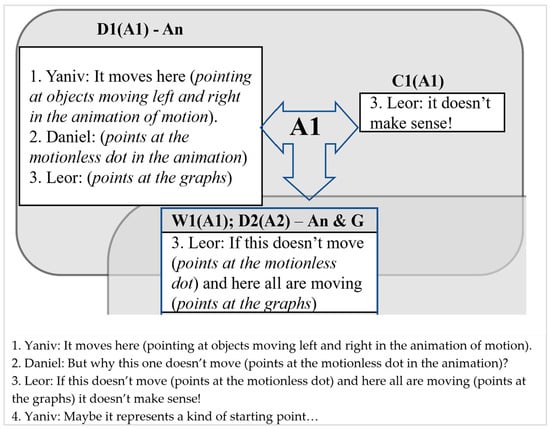
Daniel, Leor, and Yaniv began their work by activating the animation and observing the motion of the cars (which they called “dots”), as well as the related animated dots on the graphs. They continued to run the animation, asking questions such as, “Why are only six dots moving, whereas in the graph the dots move on seven lines?” The semiotic conflict between the two animated representations, one of the actual motions, the other representing a change of position in time, triggered a discussion about the representations. This semiotic conflict appeared when students questioned why only six dots appeared to move in the animation, whereas all seven graph traces appeared to move. Their statement that the situation ‘doesn’t make sense’ indicated a perceived contradiction between the two representations.
The semiotic conflict that emerged from the two animated representations, one of the actual motions and the other representing a change of position in time, triggered the emergence of the first argument (A1, Figure 3). The data of A1 were derived by Yaniv, Leor, and Daniel [Figure 3, lines 1–3] from the graph and the animation. Following Yaniv and Daniel, Leor claimed that the situation they were observing was not reasonable. Leor warranted their claim by referring to the two dynamic representations: the graphs and the animation. He noted that one of the seven dots in the animation did not move, but all seven dots on the graphs were moving.
Figure 3.
Argument 1: It doesn’t make sense.
5.2. Argument 2: The Position Is Fixed and the Time Doesn’t Move
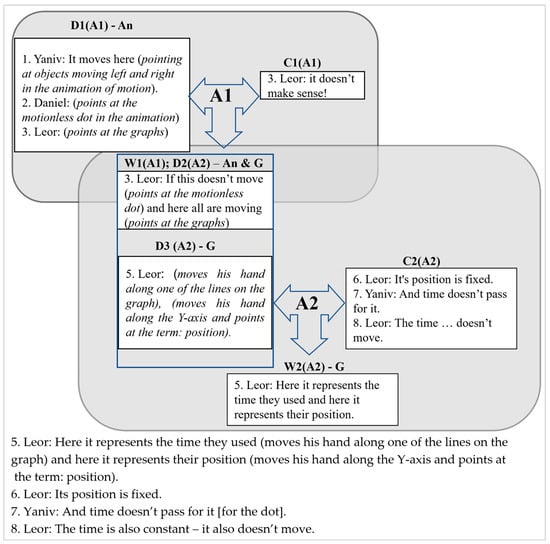
In the ensuing discussion, the students tried to solve the semiotic conflict. They started to interpret the graph with the description of a process taking place over time. They discussed the graph in the static state and began interpreting it.
The claim of the A2 (Figure 4) was that the time and the position are fixed and “don’t move” for the motionless point in the animation [Figure 4, lines 6–8]. The students used two kinds of data: (a) the motion dots on the graph and one motionless dot in the animation [Figure 4, line 3], and (b) the terms that appeared in the labels of the axes, i.e., “position” and “time” [Figure 4, line 5]. The students warranted their claim by interpreting the graph representation [Figure 4, line 5], in an attempt to resolve the conflict that emerged in the first argument. Observing the two representations in the same diagram appeared to foster the emergence of the semiotic conflict, which is rooted in the disparities between the students’ interpretation of the graph representation and the mathematical meaning of the representation.
Figure 4.
Argument 2: the position is fixed, and the time doesn’t move.
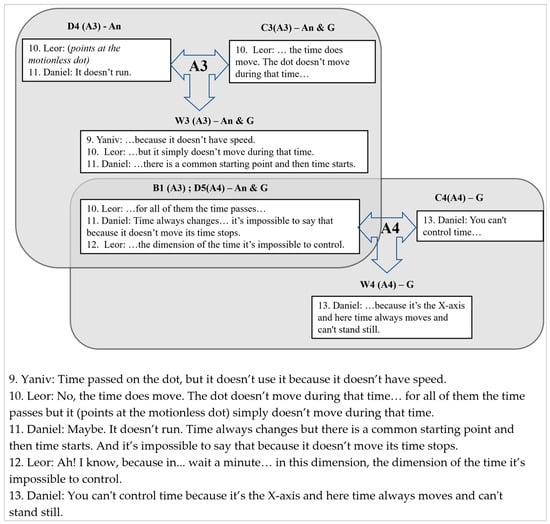
5.3. Arguments 3 and 4: The Position Is Fixed and the Time Moves; It Is Impossible to Control the Dimension of Time
Argument 3 (Figure 5) emerged from argument 2, where students talked about the variables (time and position) and explored them. In arguments 3 and 4, the students focused on the animation and graph, using the terms from argument 2: time and position. At this point, the students used the time-position variables as data for this argument. They worked with the diagram in static mode.
Figure 5.
Arguments 3 and 4: the position is fixed and the time moves; it is impossible to control the dimension.
The students claimed that if in the graphs that describe the motion of dots the value of time changes, the value of time must also change for a motionless dot—time cannot be stopped just because the dot is not moving [Figure 5, line 10]. The students warranted their claim by considering time as a continuous variable in the motion process [Figure 5, lines 9–11]. The students backed their warrant by considering time as an independent variable: time always changes and cannot be stopped, and the passage of time cannot be controlled. The work they performed was mental: formulating hypotheses and reaching conclusions.
The data of the fourth argument [Figure 5, lines 10–12] emerged from the backing of the third argument (Figure 5). While the students were focusing on the graph, they claimed [Figure 5, line 13] that they were not able to control the time. They warranted their claim [Figure 5, line 13] by describing the time as an independent variable while referring to the X-axis of the graph.
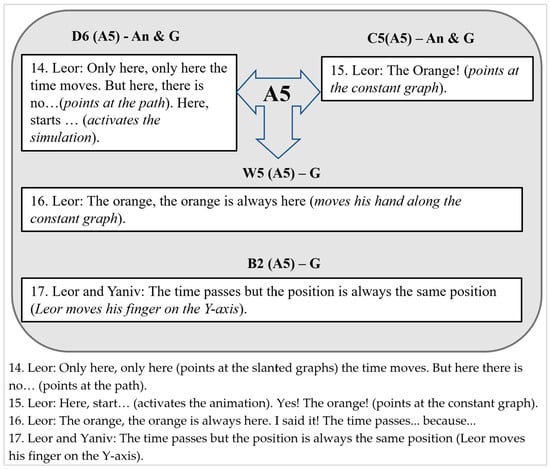
5.4. Argument 5: Correspondence Between the Constant Graph and the Motionless Dot in the Animation
In this argument (Figure 6), after making the three previous arguments in static mode, the students activated the animation, for the second time, in an attempt to warrant their claim concerning the graph that matched the motionless dot.
Figure 6.
Argument 5: correspondence between the constant graph and the motionless dot in the animation.
By referring to the orange graph on the screen, the students claimed that the constant graph is associated with the motionless point in the animation [Figure 6, line 15]. They derived the data of the argument [Figure 6, line 14] from the graph and animation in the static mode of the diagram. The students activated the animation to warrant their claim [Figure 6, line 16]. In doing so, they used the graph in dynamic mode to show that the position of the motionless point, represented by the constant graph, did not change. They backed their claim [Figure 6, line 17] by emphasizing that in the constant graph, the position does not change, but the time does.
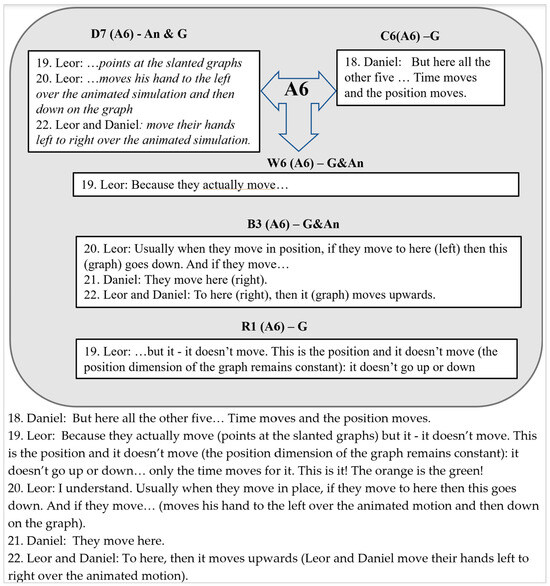
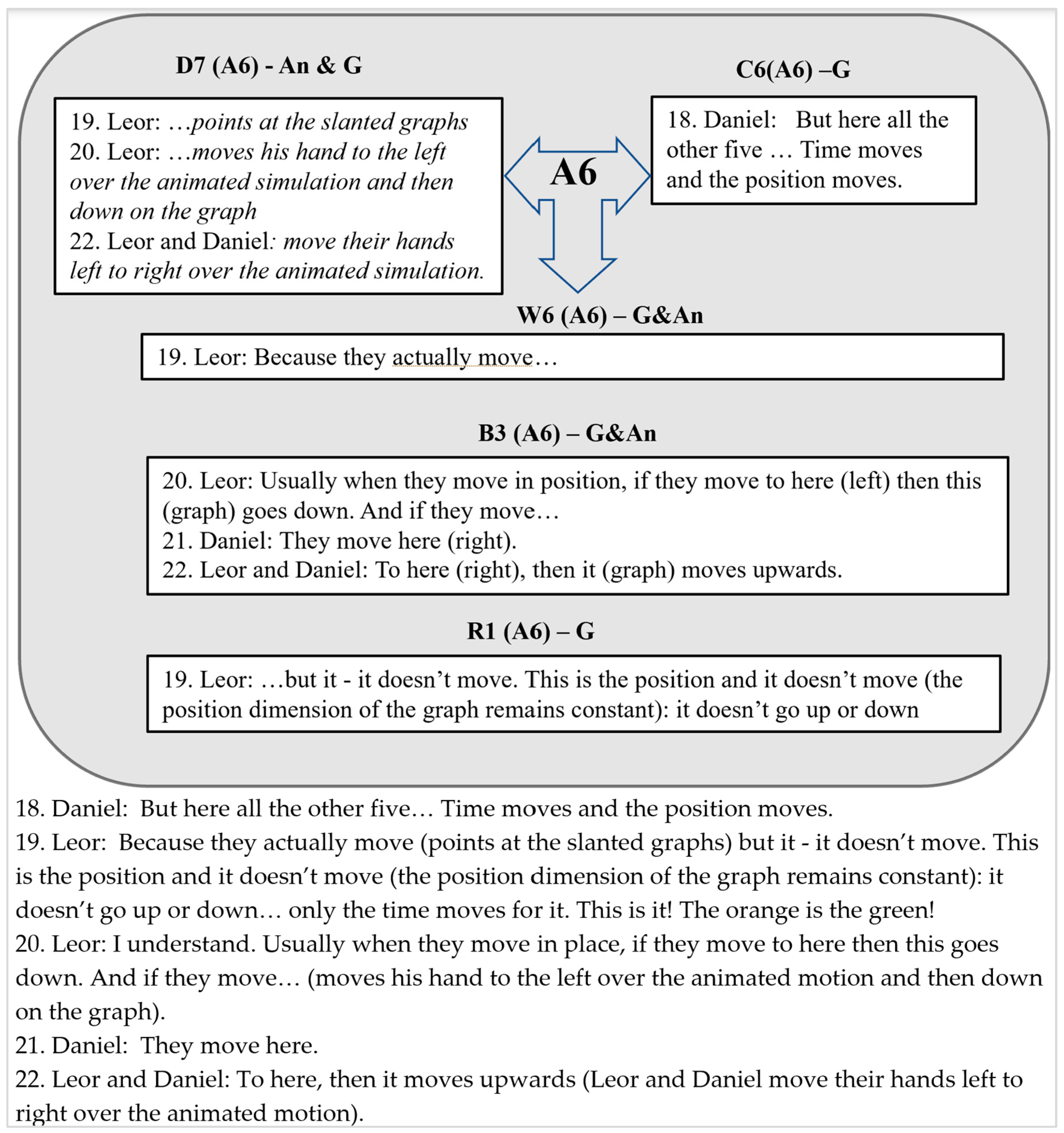
5.5. Argument 6: Time Moves and the Position Moves
In argument 6 (Figure 7), the students explained the conclusion they arrived at in the previous arguments regarding the motionless point. In this argument, they did not activate the animation again. They focused on the analysis of the graphs and on the dimensions of position and time, as they appeared on the axes and the graphs.
Figure 7.
Argument 6: Time moves and position moves.
In this argument, the students claimed that the time and the position of the other five dots that move in the animation are changed [Figure 7, line 18]. Leor warranted the claim by referring to the motion process of the dots represented by the animation and the non-constant graphs [Figure 7, line 19]. Furthermore, the students backed Leor’s warrant by associating the direction of the movement of the dots in the animation with the inclination of the lines in the graphs. They associated the movement to the right (left) side with the increase (decrease) of the line. The rebuttal in the argument is found in line [Figure 7, line 19] where Leor is discussing the motionless dot, which is the exception case of the motion process represented in the diagram. They stressed that the position of the motionless dot does not change; it does not go up and down.
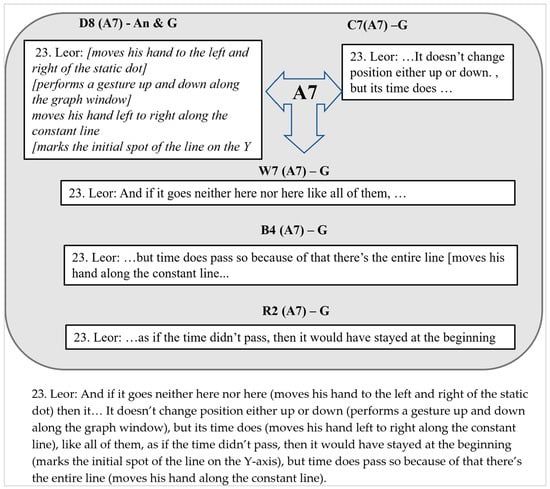
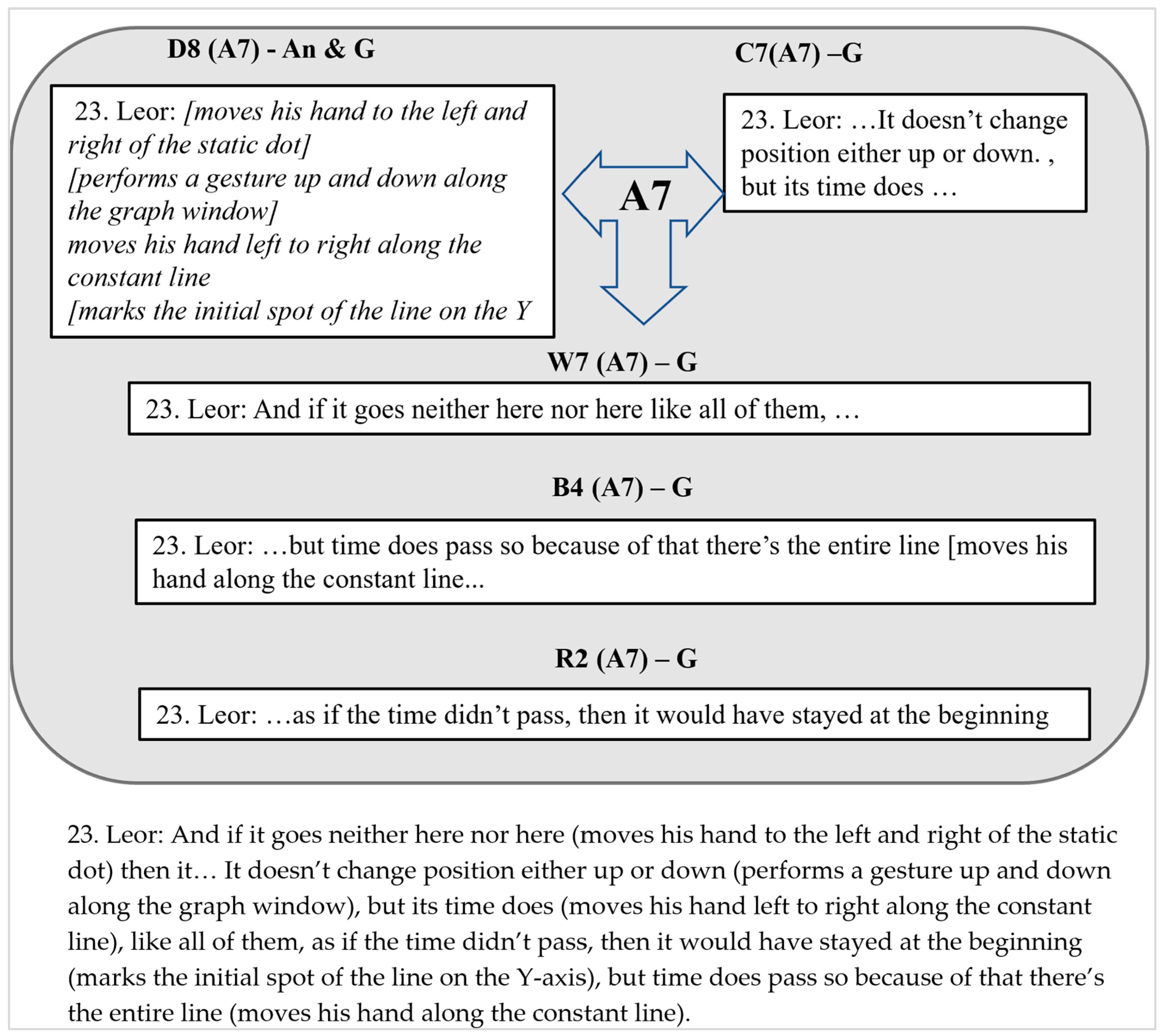
5.6. Argument 7: Because the Point Is Not Moving Up and Down but the Time Is, It Is Constant
In this argument (Figure 8), the students solved the semiotic conflict that arose at the beginning of the analyzed episode by endowing the two representations with mathematically accepted meanings. Here, they continue to discuss the motion by imagining and gesturing rather than activating the animation.
Figure 8.
Argument 7: Because the point is not moving up and down, but the time is, it is constant.
Leor claimed that the position of the motionless dot is not changing, its corresponding graph does not go up or down, but the time does change [Figure 8, line 23]. He warranted his claim by comparing the change in the position of the motionless dot with that of the other dots that are moving. He backed his claim by referring to the constant line in the graph. For him, the entire constant graph indicates the change in time. Leor’s utterance “if the time did not pass, then it would stay at the beginning” suggests that he was considering the exception to the rule that the time changed. Discussing the exceptions to the rule suggests that Leor is providing a rebuttal to the argument.
5.7. Evolution of the Argumentation Process
Table 1 provides a synthesis of the seven arguments and illustrates the evolution of students’ argumentation throughout their engagement with the guiding ID. The table summarizes the main argumentative focus of each argument, the Toulmin components that emerged, the role of the semiotic conflict, and the contribution of specific design features of the diagram to the development of the argumentation process.
Table 1.
Evolution of students’ argumentation during engagement with the guiding interactive diagram.
Taken together, the seven arguments reveal a progressive development of students’ argumentation. The process began with the emergence of a semiotic conflict (Argument 1), where students identified a contradiction between the animation and the graph. Arguments 2–4 focused on interpreting the meanings of position and time and exploring possible explanations for the observed discrepancy. In Arguments 5–7, students coordinated the two representations, tested their interpretations against the animation, and gradually constructed a mathematically accepted explanation. The appearance of backing in Arguments 3–7 reflects increasing efforts to justify claims, while the emergence of rebuttal in Arguments 6 and 7 indicates that students had begun to distinguish the exceptional case from the general pattern represented in the diagram. Thus, the argumentation process evolved from identifying a contradiction toward constructing, refining, and qualifying a coherent mathematical interpretation.
6. Discussion
The present study aimed to identify and characterize the structure of students’ argumentation while they interacted with a guiding ID and examine how the resources and constraints used to design the diagram served the students’ argumentation. To this end, we formulated two research questions: (a) What are the students’ argumentation processes when they engage with a guiding ID? (b) How do the designed resources and constraints of guiding IDs serve the argumentation processes?
The study suggests that specific design features of the guiding ID may have afforded the development of argumentation processes as the students engaged with the diagram. This finding is consistent with prior research by Prusak et al. (2012), who noted the role of visual reasoning in fostering logical necessity through argumentation. It also extends Balacheff’s (1999) argument that the inherently social and interactive nature of argumentation can be harnessed to construct mathematical concepts, particularly when mediated by thoughtfully designed interactive materials. At the same time, the present study does not permit isolation of the contribution of the ID design from other features of the learning situation. The observed argumentation processes may also have been shaped by contextual factors, including students’ prior knowledge, peer relationships, characteristics of the task, and the absence of teacher intervention during the interaction. Accordingly, the findings should be interpreted as suggesting that the design features of the guiding ID may have supported argumentation, rather than demonstrating a direct causal effect.
Regarding the first research question, the study demonstrated that students used various components of the Toulmin model in their argumentation process. The mathematics education literature (e.g., Pedemonte, 2008; Prusak et al., 2012; Conner et al., 2014; Nordin & Boistrup, 2018; Van Ness & Maher, 2019) identifies four components of the argumentation processes: data, claim, warrant, and backing. In our study, however, when the students engaged with guiding IDs, their argumentation processes involved, in addition to four components, also included the rebuttal (argument 7). Regarding the second research question, the analysis suggests that the resources and constraints incorporated in the guiding ID may have contributed to the emergence of rich argumentation processes. The ID was designed around a known semiotic conflict about a time-position graph describing a “motionless” situation over continuously running time. The semiotic conflict emerged as a result of disparities between the students’ interpretation of the motionless point in the simulation and the mathematical meaning of the graphs in the Cartesian system. This finding shows the importance of semiotic conflict in triggering students’ argumentative processes, which aligns with prior studies by Schwarz and Linchevski (2007) and Prusak et al. (2012), demonstrating that conflicts can promote the development of argumentation skills. Yet, whereas these studies focused broadly on the role of digital tools and conflicts in supporting argumentation, our study identified how particular design features of guiding IDs—such as emphasizing exceptional cases and fostering semiotic conflict—may influence the richness and structure of students’ argumentation. This extends Balacheff’s (1999) claim about the productive and interactive nature of argumentation by suggesting that semiotic conflicts embedded in interactive materials may support mathematical reasoning. The graph and the animation were only partially linked: motion occurred simultaneously on the animation and the graph, but there was no color match, so the identification process required extracting data from the simulation and the graph to link the two. The students developed new claims using warrants to support them. The absence of representations and controls that could turn the given schematic nature of the representations into an accurate metric diagram focused the students on analyzing the whole process, and became the basis for a great deal of mental work and discussions while looking for warrants, backing, and rebuttals. The students used backing to generate mathematical ideas and rebuttals to strengthen them by analyzing exceptional cases. The analysis suggests that several design features of the ID—including the partial linkage between representations, the absence of direct matching cues, and the inclusion of an exceptional case—may have served as resources for the development of these processes. The exceptional example, which focused on a motionless situation over time, was part of a generic list of examples that served as the example space where the processes occurred.
The rebuttal appeared at the advanced stages of the students’ engagement with the ID (arguments 6 and 7). Looking for similarities and differences between the cases in the general example designed in the guiding ID, it seems that the example fostered the emergence of rebuttal in the students’ argument. As we showed in the data analysis section, the rebuttal emerged in the students’ argument because of the design of the ID, which emphasized the exceptional case, that is, the motionless car among the ones moving in opposite directions. This exceptional case might prompt the students to distinguish it from the other cases of motion. This distinction was the main idea providing a rebuttal for the argument. A possible interpretation of the appearance of the rebuttal may have had to do with the definition of generalization mentioned by Kant (2003) and Davydov (1990), who argued that to generalize something is to see the similarity between different objects and the difference between similar ones. Another possible explanation lies in the role of semiotic conflict, which was possibly prompted by the ID design, which created an expectation for the students to identify a rule or relationship that was shared by the cases. The exceptional case, however, violated this expectation, generating a semiotic conflict. In their effort to resolve this conflict, the students resorted to the resources of the ID. They engaged in argumentation and used rebuttal as a way to address and incorporate the exceptional case into their broader argument structure. This dual influence of generalization and the expectation-induced semiotic conflict demonstrates how the ID design supported the emergence of student argumentation and rebuttal.
The argumentation processes in the study evolved without the teacher’s intervention. The evolution of the argumentation processes occurred while students interacted with the guiding ID in the absence of teacher intervention. Despite this finding, we believe that the teacher’s role is crucial in supporting and fostering argumentation processes; furthermore, this role should be adapted to the specific affordances of the IDs. Educators must be aware of both the affordances and limitations of these new types of curriculum materials, allowing them to design learning environments that support rich argumentation processes in their classrooms. The findings suggest several pedagogical considerations. When semiotic conflicts emerge, teachers may support students by encouraging them to articulate competing interpretations, justify their claims using evidence from multiple representations, and compare exceptional cases with more general patterns. Structured prompts that direct attention to discrepancies between representations, as well as opportunities for peer discussion, may help students transform initial contradictions into productive argumentation. In this sense, the teacher’s role is not necessarily to eliminate semiotic conflict but to support students in exploring and resolving it.
This study is the first step in a long-term research project examining argumentation processes while students engage with different types of ID according to the framework of pedagogical functionality (e.g., Naftaliev & Yerushalmy, 2017). Although the study identified argumentation processes that emerged during engagement with the guiding ID, the small number of participants, students belonging to the same context, use of only one ID, the specific kind of ID used in this study, and the specific mathematical content of the ID are limitations of the study. Additional limitations include the friendship relations among participants, the possibility that prior mathematical knowledge influenced the observed argumentation, and the selection of a particularly information-rich case for detailed analysis. Finally, the focal group was selected as a particularly informative case from a broader dataset and, therefore, should not be interpreted as representative of all student groups. Consequently, the findings should be understood as suggesting possible affordances of the guiding ID rather than demonstrating causal effects of the design.
Taking into account the limitations of this study, further research is needed to deepen our understanding of the role that various types of IDs play in the argumentation process. In our future research, we will seek to explore the role of each type of ID more systematically, examining whether and how they contribute to fostering argumentation. Specifically, we plan to investigate the role of semiotic conflict in greater depth, analyzing its relationship with the emergence of argumentation. Additionally, we will seek to understand how other types of IDs may produce contradictions and tensions and how these elements influence students’ argumentation processes. This study focused on algebra, but we intend to broaden the scope of our research to include other mathematical domains, such as calculus, to examine whether similar patterns of argumentation and interaction with IDs emerge in different mathematical content areas. These directions promise to shed further light on the intricate connections between instructional design, semiotic conflict, and the development of students’ argumentation skills.
Author Contributions
Conceptualization, E.N. and O.S.; Methodology, E.N. and O.S.; Validation, E.N. and O.S.; Formal analysis, E.N. and O.S.; Investigation, E.N. and O.S.; Resources, E.N.; Data curation, E.N.; Writing—original draft, E.N. and O.S.; Visualization, E.N. and O.S. All authors have read and agreed to the published version of the manuscript.
Funding
This research received no external funding.
Institutional Review Board Statement
The protocol followed by this research was approved by the Chief Scientist Office at the Ministry of Education (Approval number 10.32 376).
Informed Consent Statement
All participants and their parents provided informed consent before participating.
Data Availability Statement
No new data were created or analyzed in this study.
Conflicts of Interest
The authors declare no conflicts of interest.
Abbreviations
The following abbreviation is used in this manuscript:
| ID | Interactive diagram |
References
- Abdu, R., Schwarz, B., & Mavrikis, M. (2015). Whole-class scaffolding for learning to solve mathematics problems together in a computer-supported environment. ZDM, 47(7), 1163–1178. [Google Scholar] [CrossRef] [Scilit]
- Albano, G., Capobianco, G., & Iacono, U. D. (2020). An online environment for promoting mathematical argumentation in primary school. Journal of Computers in Mathematics and Science Teaching, 39(3), 185–206. [Google Scholar] [CrossRef] [Scilit]
- Arzarello, F., Bartolini Bussi, M. G., Lun Leung, A. Y., Mariotti, M. A., & Stevenson, I. (2012). Experimental approaches to theoretical thinking: Artefacts and proofs. In G. Hanna, & M. de Villiers (Eds.), Proof and proving in mathematics education (pp. 97–137). Springer. [Google Scholar]
- Arzarello, F., Paola, D., Robutti, O., & Sabena, C. (2009). Gestures as semiotic resources in the mathematics classroom. Educational Studies in Mathematics, 70(2), 97–109. [Google Scholar]
- Baccaglini-Frank, A., & Mariotti, M. A. (2010). Generating conjectures through dragging in dynamic geometry: The maintaining dragging model. International Journal of Computers for Mathematical Learning, 15(3), 225–253. [Google Scholar] [CrossRef] [Scilit]
- Balacheff, N. (1999). Is argumentation an obstacle? Invitation to a debate. International newsletter on the teaching and learning of mathematical proof. Available online: http://eric.ed.gov/PDFS/ED435644.pdf (accessed on 6 May 2026).
- Bartolini Bussi, M. G., & Mariotti, M. A. (2008). Semiotic mediation in the mathematics classroom: Artifacts and signs after a Vygotskian perspective. In L. English, M. Bartolini Bussi, G. A. Jones, R. A. Lesh, & D. Tirosh (Eds.), Handbook of international research in mathematics education (Vol. 2, pp. 746–783). Lawrence Erlbaum. [Google Scholar]
- Berland, L. K., & Reiser, B. J. (2009). Making sense of argumentation and explanation. Science Education, 93(1), 26–55. [Google Scholar]
- Bikner-Ahsbahs, A. (2022). Adaptive teaching of covariational reasoning: Networking “the way of being” on two layers. The Journal of Mathematical Behavior, 67, 100967. [Google Scholar] [CrossRef] [Scilit]
- Campbell, T. G., & Zelkowski, J. (2020). Technology as a support for proof and argumentation: A systematic literature review. International Journal for Technology in Mathematics Education, 27(2), 113–123. [Google Scholar] [CrossRef] [Scilit]
- Conner, A., Singletary, L. M., Smith, R. C., Wagner, P. A., & Francisco, R. T. (2014). Teacher support for collective argumentation: A framework for examining how teachers support students’ engagement in mathematical activities. Educational Studies in Mathematics, 86(3), 401–429. [Google Scholar] [CrossRef] [Scilit]
- Davydov, V. (1990). Types of generalization in instruction: Logical and psychological problems in the structuring of school curricula. In Soviet studies in mathematics education (Vol. 2). NCTM. [Google Scholar]
- Duval, R. (2006). A cognitive analysis of problems of comprehension in a learning of mathematics. Educational Studies in Mathematics, 61(1), 103–131. [Google Scholar] [CrossRef] [Scilit]
- Godino, J. D., Batanero, C., & Font, V. (2007). The onto-semiotic approach to research in mathematics education. ZDM Mathematics Education, 39, 127–135. [Google Scholar] [CrossRef] [Scilit]
- Graham, M., & Lesseig, K. (2018). Back-pocket strategies for argumentation. The Mathematics Teacher, 112(3), 172–178. [Google Scholar] [CrossRef] [Scilit]
- Hanna, G. (2020). Mathematical proof, argumentation, and reasoning. In Encyclopedia of mathematics education (pp. 561–566). Springer International Publishing. [Google Scholar]
- Jones, K. (2000). Providing a foundation for deductive reasoning: Students’ interpretations when using dynamic geometry software and their evolving mathematical explanations. Educational Studies in Mathematics, 44(1), 55–85. [Google Scholar] [CrossRef] [Scilit]
- Kant, I. (2003). Critique of pure reason (N. K. Smith, Trans.). St. Martin’s Press. [Google Scholar]
- Krummheuer, G. (1995). The ethnography of argumentation. In P. Cobb, & H. Bauersfeld (Eds.), The emergence of mathematical meaning: Interaction in classroom cultures (pp. 229–269). Erlbaum. [Google Scholar]
- Krummheuer, G. (2000). Mathematics learning in narrative classroom cultures: Studies of argumentation in primary mathematics education. For the Learning of Mathematics, 20(1), 22–32. [Google Scholar]
- Laborde, C. (2005). The hidden role of diagrams in students’ construction of meaning in geometry. In J. Kilpartrick, C. Hoyles, O. Skovsmose, & P. Valero (Eds.), Meaning in mathematics education (pp. 159–179). Springer. [Google Scholar]
- Lin, S., & Mintzes, J. J. (2010). Learning argumentation skills through instruction in socioscientific issues: The effect of ability level. International Journal of Science and Mathematics Education, 8(6), 993–1017. [Google Scholar] [CrossRef] [Scilit]
- Naftaliev, E. (2017). Interactive diagrams used for collaborative learning concerning mathematical models of motion. In G. Stillman, W. Blum, & G. Kaiser (Eds.), Mathematical modelling and applications. International perspectives on the teaching and learning of mathematical modelling. Springer. [Google Scholar] [CrossRef]
- Naftaliev, E. (2018). Prospective teachers’ interactions with interactive diagrams: Semiotic tools, challenges and well-trodden paths. In L. Fan, L. Trouche, C. Qi, S. Rezat, & J. Visnovska (Eds.), Research on mathematics textbooks and teachers’ resources: Advances and issues (pp. 297–314). Springer. [Google Scholar]
- Naftaliev, E., & Barabash, M. (2024). Teachers’ professional development for inclusion of experimental mathematics and interactive resources in the classroom. ZDM—Mathematics Education, 56(4), 681–694. [Google Scholar] [CrossRef] [Scilit]
- Naftaliev, E., & Yerushalmy, M. (2013). Guiding explorations: Design principles and functions of interactive diagrams. Computers in the Schools, 30(1–2), 61–75. [Google Scholar] [CrossRef] [Scilit]
- Naftaliev, E., & Yerushalmy, M. (2017). Design digital tasks: Interactive Diagrams as resource and constraint. In A. Leung, & A. Baccaglini-Frank (Eds.), The role and potential of using digital technologies in designing mathematics education tasks (pp. 153–173). Springer. [Google Scholar]
- Naftaliev, E., & Yerushalmy, M. (2022). Guiding students’ learning with an interactive diagram: The case of equations. The Journal of Mathematical Behavior, 68, 101008. [Google Scholar] [CrossRef] [Scilit]
- Nordin, A. K., & Boistrup, L. B. (2018). A framework for identifying mathematical arguments as supported claims created in day-to-day classroom interactions. The Journal of Mathematical Behavior, 51, 15–27. [Google Scholar] [CrossRef] [Scilit]
- Patton, M. Q. (2014). Qualitative research & evaluation methods: Integrating theory and practice. Sage publications. [Google Scholar]
- Pedemonte, B. (2008). Argumentation and algebraic proof. ZDM, 40(3), 385–400. [Google Scholar] [CrossRef] [Scilit]
- Prusak, N., Hershkowitz, R., & Schwarz, B. B. (2012). From visual reasoning to logical necessity through argumentation design. Educational Studies in Mathematics, 79(1), 19–40. [Google Scholar] [CrossRef] [Scilit]
- Radford, L. (2003). Gestures, speech, and the sprouting of signs: A semiotic-cultural approach to students’ types of generalization. Mathematical Thinking and Learning, 5(1), 37–70. [Google Scholar] [CrossRef] [Scilit] [PubMed]
- Schwarz, B. B., De Groot, R., Mavrikis, M., & Dragon, T. (2015). Learning to learn together with CSCL tools. International Journal of Computer-Supported Collaborative Learning, 10(3), 239–271. [Google Scholar] [CrossRef] [Scilit]
- Schwarz, B. B., Hershkowitz, R., & Prusak, N. (2010). Argumentation and mathematics. In K. Littleton, & C. Howe (Eds.), Educational dialogues: Understanding and promoting productive interaction (pp. 103–127). Taylor & Francis. [Google Scholar]
- Schwarz, B. B., & Linchevski, L. (2007). The role of task design and argumentation in cognitive development during peer interaction: The case of proportional reasoning. Learning and Instruction, 17(5), 510–531. [Google Scholar] [CrossRef] [Scilit]
- Stake, R. E. (1995). The art of case study research. SAGE Publications. [Google Scholar]
- Swidan, O. (2022). Meaning making through collective argumentation: The role of students’ argumentation discourse in their exploration of the graphic relationship between a function and its anti-derivative. Teaching Mathematics and Its Applications: An International Journal of the IMA, 41(2), 92–109. [Google Scholar] [CrossRef] [Scilit]
- Swidan, O., Sabena, C., & Arzarello, F. (2020). Disclosure of mathematical relationships with a digital tool: A three layer-model of meaning. Educational Studies in Mathematics, 103(1), 83–101. [Google Scholar]
- Toulmin, S. E. (2003). The uses of argument. Cambridge University Press. [Google Scholar]
- Van Ness, C. K., & Maher, C. A. (2019). Analysis of the argumentation of nine-year-olds engaged in discourse about comparing fraction models. The Journal of Mathematical Behavior, 53, 13–41. [Google Scholar] [CrossRef] [Scilit]
- Yackel, E., & Hanna, G. (2003). Reasoning and proof. In J. Kilpatrick, W. G. Martin, & D. Schifter (Eds.), A research companion to principles and standards for school mathematics (pp. 227–236). National Council of Teachers of Mathematics. [Google Scholar]
- Yin, R. K. (2018). Case study research and applications: Design and methods (6th ed.). SAGE Publications. [Google Scholar]

Disclaimer/Publisher’s Note: The statements, opinions and data contained in all publications are solely those of the individual author(s) and contributor(s) and not of MDPI and/or the editor(s). MDPI and/or the editor(s) disclaim responsibility for any injury to people or property resulting from any ideas, methods, instructions or products referred to in the content. |
© 2026 by the authors. Licensee MDPI, Basel, Switzerland. This article is an open access article distributed under the terms and conditions of the Creative Commons Attribution (CC BY) license.