Beyond the Single Story: How Preservice Teachers Curate Primary Sources in Early Education




Abstract
1. Introduction
2. Literature Review
2.1. Preservice Teachers and the Challenge of Representation
2.2. Primary Sources as Opportunity and Oversight
2.3. Instructional Constraints and Curricular Habits
2.4. Framing the Gap
3. Theoretical Framework
3.1. Critical Educational Theory: Linking Education and Power
3.2. Reflective Teaching Practices: Developing Critical Awareness
3.3. Culturally Sustaining Pedagogies: Centering Diversity and Identity
3.4. Intersections of the Frameworks: A Holistic Approach
4. Methods
4.1. Participants
4.2. Instructional Intervention
4.3. Data Sources
4.4. Data Analysis
4.4.1. First-Cycle Coding
- A primary source featuring Abraham Lincoln, for example, was coded as a dominant narrative source, due to its centering of a White, male, Euro-American historical figure commonly featured in traditional curricula.
- A source highlighting Harriet Tubman was coded as a counternarrative, as it disrupted the White-male normative by foregrounding the resistance and contributions of a Black woman.
- A Día de los Muertos altar photo was classified as a culturally sustaining source, as it affirmed ongoing cultural identity, language, and tradition—particularly those relevant to the backgrounds of many of our participants’ future students.
- Some sources, such as those featuring Eleanor Roosevelt, were simultaneously coded as both dominant narrative and counternarrative. While Roosevelt’s status as a prominent White political figure aligns with dominant narratives, her advocacy for women and civil rights positions her within counternarrative discourses—especially when PSTs interpreted her legacy in relation to gender equity.
4.4.2. Second-Cycle Coding and Theme Development
5. Findings
5.1. Dominant Narratives
5.2. Counternarratives and Culturally Sustaining Sources
5.3. Additional Source Types: Spatial, Set-Based, and Unclassified Materials
6. Discussion
6.1. Reinforcing the Norm
6.2. Cultural Identity and Curricular Choice
6.3. From Representation to Resistance
6.4. Designing Around Absence
7. Implications
7.1. Implications for Teacher Education
7.2. Navigating Curricular and Policy Constraints
7.3. Cultivating Critical Consciousness as Civic Practice
7.4. Limitations and Directions for Future Research
7.5. Final Thoughts
Author Contributions
Funding
Institutional Review Board Statement
Informed Consent Statement
Data Availability Statement
Conflicts of Interest
References
- Banks, J. A. (1993). The canon debate, knowledge construction, and multicultural education. Educational Researcher, 22(5), 4–14. [Google Scholar] [CrossRef] [Scilit]
- Banks, J. A. (2004). Multicultural education: Historical development, dimensions, and practice. In J. A. Banks, & C. A. M. Banks (Eds.), Handbook of research on multicultural education (2nd ed., pp. 3–29). Jossey-Bass. [Google Scholar]
- Banks, J. A. (2020). Approaches to multicultural curriculum reform. In J. A. Banks, & C. A. McGee Banks (Eds.), Multicultural education: Issues and perspectives (10th ed., pp. 137–157). Wiley. [Google Scholar]
- Barton, K. C., & Levstik, L. S. (2004). Teaching history for the common good. Routledge. [Google Scholar]
- Berson, I. R., & Berson, M. J. (2014). Developing multiple literacies of young learners with digital primary sources. In W. B. Russell (Ed.), Digital social studies (pp. 45–60). Information Age Publishing. [Google Scholar]
- Berson, I. R., & Berson, M. J. (2019). Disrupting perspectives on civic education for children and youth in a multicultural society. Multicultural Perspectives, 21(2), 75–76. [Google Scholar] [CrossRef] [Scilit]
- Berson, I. R., & Berson, M. J. (2024). Cultivating wonder: A design-based approach to elevating social studies in the early years. The New Educator, 20(3–4), 221–241. [Google Scholar] [CrossRef] [Scilit]
- Berson, I. R., Berson, M. J., Dennis, D. V., & Powell, R. (2017). Leveraging literacy: Research on critical reading in the social studies. In M. M. Manfra, & C. M. Bolick (Eds.), Handbook of social studies research (pp. 414–439). Wiley-Blackwell. [Google Scholar]
- Berson, I. R., Berson, M. J., & López de Méndez, A. (2019). Images, civic identity, and cultural narratives of Puerto Rico: Using intertextual articulation to develop culturally responsive practices. Multicultural Perspectives, 21(2), 85–90. [Google Scholar] [CrossRef] [Scilit]
- Berson, I. R., & Camicia, S. (2013). Early childhood social studies: A national study of challenges and promising practices. In J. Passe, & P. G. Fitchett (Eds.), The status of social studies: View from the field (pp. 65–76). Information Age Publishing. [Google Scholar]
- Beyer, L. E. (2001). The value of critical perspectives in teacher education. Journal of Teacher Education, 52(2), 151–163. [Google Scholar] [CrossRef] [Scilit]
- Bickford, J. H., Clabough, J., & Taylor, T. N. (2020). Fourth-graders’ reading, thinking, and writing about historical sources. Social Studies Research and Practice, 15(1), 57–82. [Google Scholar]
- Bober, T. (2019). Elementary educator’s guide to primary sources: Strategies for teaching (1st ed.). Libraries Unlimited. [Google Scholar] [CrossRef] [Scilit]
- Bonilla-Silva, E. (2002). The linguistics of color blind racism: How to talk nasty about blacks without sounding “racist”. Critical Sociology, 28(1–2), 41–64. [Google Scholar] [CrossRef] [Scilit]
- Council of Chief State School Officers [CCSSO]. (2018). The marginalization of social studies. Available online: https://www.socialstudies.org/sites/default/files/civic-seal/Marginalization%20of%20Social%20Studies%20Infographic-20.pdf (accessed on 2 October 2024).
- Cummings, R. D. (2019). Justice then and now: Engaging students in critical thinking about justice and history. The Social Studies, 110(6), 281–292. [Google Scholar] [CrossRef] [Scilit]
- Dewey, J. (1986). How we think: A restatement of the relation of reflective thinking to the educative process. In J. A. Boydston (Ed.), The later works of John Dewey, 1925–1953 (Vol. 8, pp. 105–352). Southern Illinois University Press. (Original work published 1933). [Google Scholar]
- Epstein, T., & Shiller, J. (2005). Perspective matters: Social identity and the teaching and learning of national history. Social Education, 69(4), 201–204. [Google Scholar]
- Fitchett, P. G., & Heafner, T. L. (2010). A national perspective on the effects of high-stakes testing and standardization on elementary social studies marginalization. Theory & Research in Social Education, 38(1), 114–130. [Google Scholar] [CrossRef] [Scilit]
- Fook, J. (2015). Reflective practice and critical reflection. In J. Lishman (Ed.), Handbook for practice learning in social work and social care: Knowledge and theory (3rd ed., pp. 440–454). Jessica Kingsley Publishers. [Google Scholar]
- Foster, S. (2006). Whose history? Portrayal of immigrant groups in U.S. history textbooks, 1800–Present. In S. J. Foster, & K. A. Crawford (Eds.), What shall we tell the children? International perspectives on school history textbooks (pp. 155–178). Information Age Publishing. [Google Scholar]
- Gay, G. (2018). Culturally responsive teaching: Theory, research, and practice (3rd ed.). Teachers College Press. [Google Scholar]
- Gay, G. (2023). Educating for equity and excellence: Enacting culturally responsive teaching. Teachers College Press. [Google Scholar]
- Guo, D. (2026). Developing pre-service teachers’ disciplinary literacy skills in social studies: An inquiry-based project. The New Educator. [Google Scholar] [CrossRef] [Scilit]
- Hammond, Z. L. (2014). Culturally responsive teaching and the brain: Promoting authentic engagement and rigor among culturally and linguistically diverse students. Corwin Press. [Google Scholar]
- Harris, C. (1993). Whiteness as property. Harvard Law Review, 106(8), 1707–1791. [Google Scholar] [CrossRef] [Scilit]
- Helfenbein, R. J., & Taylor, L. H. (2009). Critical geographies in/of education: Introduction. Educational Studies, 45(3), 236–239. [Google Scholar] [CrossRef] [Scilit]
- Howard, T. C. (2010). Why race and culture matter in schools: Closing the achievement gap in America’s classrooms. Teachers College Press. [Google Scholar]
- Howard, T. C., & Milner, H. R. (2021). Teacher preparation for urban schools. Routledge. [Google Scholar]
- Hubbard, J. (2013). Social studies marginalization: Examining the effects on K-6 pre-service teachers and students. The Journal of Social Studies Research, 37(3), 137–150. [Google Scholar] [CrossRef] [Scilit]
- Jerasa, S., Ura, S. K., Chapman, B., Kaufman, B., & Pirolla, T. (2026). Teaching through content area texts: Exploring how preservice teachers curate and use anti-bias and culturally sustaining collections. Teaching and Teacher Education, 176, 105542. [Google Scholar] [CrossRef] [Scilit]
- Ladson-Billings, G. (1995). Toward a theory of culturally relevant pedagogy. American Educational Research Journal, 32(3), 465–491. [Google Scholar] [CrossRef]
- Ladson-Billings, G. (2014). Culturally relevant pedagogy 2.0: A.k.a. the remix. Harvard Educational Review, 84(1), 74–84. [Google Scholar] [CrossRef] [Scilit]
- Lawrence, S. A., Langan, E., & Maurer, J. (2019). Using primary sources in content areas to increase disciplinary literacy instruction. The Language and Literacy Spectrum, 29(1), 1–18. [Google Scholar]
- Levstik, L. S., & Barton, K. C. (2011). Doing history: Investigating with children in elementary and middle schools (4th ed.). Routledge. [Google Scholar]
- Lincoln, Y. S., & Guba, E. G. (1985). Naturalistic inquiry. SAGE Publications. [Google Scholar]
- Loewen, J. W. (1995). Lies my teacher told me: Everything your American history textbook got wrong. The New Press. [Google Scholar]
- Martell, C. C. (2022). A longitudinal study of beginning elementary teachers’ beliefs and inquiry-based practices in the history classroom. Teacher Development, 26(5), 627–643. [Google Scholar] [CrossRef] [Scilit]
- Martell, C. C., & Stevens, K. M. (2019). Culturally sustaining social studies teachers: Understanding models of practice. Teaching and Teacher Education, 86, 102897. [Google Scholar] [CrossRef] [Scilit]
- Miles, M. B., Huberman, A. M., & Saldaña, J. (2013). Qualitative data analysis: A methods sourcebook (3rd ed.). SAGE Publications. [Google Scholar]
- Milner, H. R. (2010). Start where you are, but don’t stay there: Understanding diversity, opportunity gaps, and teaching in today’s classrooms. Harvard Education Press. [Google Scholar]
- Morgan, D. N., & Rasinski, T. V. (2012). The power and potential of primary sources. The Reading Teacher, 65(8), 584–594. [Google Scholar] [CrossRef] [Scilit]
- Morowski, D., & McCormick, T. (2017). Did it count? Preservice teachers’ reflections on historical thinking skills in methods courses. Social Studies Research and Practice, 12(3), 13–21. [Google Scholar]
- National Center for Education Statistics. (2023). Characteristics of public school teachers. Condition of education. U.S. Department of Education, Institute of Education Sciences. Available online: https://nces.ed.gov/programs/coe/indicator/clr (accessed on 13 January 2025).
- National Council for the Social Studies. (2025). Powerful, purposeful teaching and learning in elementary social studies: A position statement of National Council for the Social Studies. Social Studies and the Young Learner, 37(3), 26–32. [Google Scholar]
- Neumann, D. J. (2010). “What is the text doing?” Preparing pre-service teachers to teach primary sources effectively. The History Teacher, 43(4), 489–511. [Google Scholar]
- Nowell, S. D., & Fisher, R. R. (2023). Using primary sources to foster difficult dialogues. Journal of Folklore and Education, 10(2), 265–271. [Google Scholar]
- Oigara, J. (2024). Integrating primary sources into the elementary social studies classroom. In Proceedings of the society for information technology & teacher education international conference, Las Vegas, NV, USA, 25–29 March 2024 (pp. 1863–1867). Association for the Advancement of Computing in Education (AACE). [Google Scholar]
- Pace, J. L. (2011). The complex and unequal impact of high stakes accountability on untested social studies. Theory & Research in Social Education, 39(1), 32–60. [Google Scholar] [CrossRef] [Scilit]
- Paris, D. (2012). Culturally sustaining pedagogy: A needed change in stance, terminology, and practice. Educational Researcher, 41(3), 93–97. [Google Scholar] [CrossRef] [Scilit]
- Paris, D. (2021). Culturally sustaining pedagogies and our futures. The Educational Forum, 85(4), 364–376. [Google Scholar] [CrossRef] [Scilit]
- Paris, D., & Alim, H. S. (Eds.). (2017). Culturally sustaining pedagogies: Teaching and learning for justice in a changing world. Teachers College Press. [Google Scholar]
- Parkhouse, H. (2018). Pedagogies of naming, questioning, and demystification: A study of two critical U.S. history classrooms. Theory & Research in Social Education, 46(2), 277–317. [Google Scholar] [CrossRef] [Scilit]
- Picower, B. (2009). The unexamined whiteness of teaching: How white teachers maintain and enact dominant racial ideologies. Race Ethnicity and Education, 12(2), 197–215. [Google Scholar] [CrossRef] [Scilit]
- Quinn, A. M., & Hakim, A. (2023). Straight to the sources: Analyzing elementary preservice teachers’ use of primary sources. The Journal of Social Studies Research, 47(3–4), 210–229. [Google Scholar]
- Rodríguez, N. N., & Swalwell, K. (2025). Social studies for a better world: An anti-oppressive approach for elementary educators (2nd ed.). Routledge. [Google Scholar]
- Saldaña, J. (2013). The coding manual for qualitative researchers (2nd ed.). SAGE Publications. [Google Scholar]
- Saldaña, J. (2016). The coding manual for qualitative researchers (3rd ed.). SAGE Publications. [Google Scholar]
- Salinas, C., Blevins, B., & Sullivan, C. C. (2016). Critical historical thinking: When official narratives collide with other narratives. Multicultural Perspectives, 18(4), 226–234. [Google Scholar]
- Schön, D. A. (1983). The reflective practitioner: How professionals think in action. Basic Books. [Google Scholar]
- Schwier, C., Flynn, K., Billeaudeaux, B., Stecklein, H. J., & Bibens, H. (2026). Openness in the archives: Educational equity and primary sources. Portal: Libraries and the Academy, 26(2), 337–361. [Google Scholar] [CrossRef] [Scilit]
- Sleeter, C. E. (2011). The academic and social value of ethnic studies: A research review. National Education Association. [Google Scholar]
- Sleeter, C. E. (2017). Critical race theory and the whiteness of teacher education. Urban Education, 52(2), 155–169. [Google Scholar] [CrossRef] [Scilit]
- Solórzano, D. G., & Yosso, T. J. (2002). Critical race methodology: Counter-storytelling as an analytical framework for education research. Qualitative Inquiry, 8(1), 23–44. [Google Scholar] [CrossRef] [Scilit]
- Thornton, S. J. (2005). Teaching social studies that matters: Curriculum for active learning. Teachers College Press. [Google Scholar]
- Torrez, C. F., & Waring, S. M. (2009). Elementary school students, artifacts and primary sources: Learning to engage in historical inquiry. Social Studies Research and Practice, 4(2), 79–86. [Google Scholar] [CrossRef] [Scilit]
- Tracy, S. J. (2010). Qualitative quality: Eight “big-tent” criteria for excellent qualitative research. Qualitative Inquiry, 16(10), 837–851. [Google Scholar] [CrossRef] [Scilit]
- Van Hover, S., & Hicks, D. (2006). “They know it’s not high school”: The implementation of a ninth-grade state-mandated world geography test. Theory & Research in Social Education, 34(3), 329–356. [Google Scholar]
- VanSledright, B. (2008). Narratives of nation-state, historical knowledge, and school history education. Review of Research in Education, 32(1), 109–146. [Google Scholar] [CrossRef] [Scilit]
- Waring, S. M. (2021). Integrating primary and secondary sources into teaching: The SOURCES framework for authentic investigation. Teachers College Press. [Google Scholar]
- Waring, S. M., & Cruz, N. (2024). Using SOURCES to examine and understand immigrants’ journeys to the United States through Ellis Island. The Social Studies, 115(2), 47–64. [Google Scholar] [CrossRef] [Scilit]
- Waring, S. M., & Torrez, C. A. (2010). Using digital primary sources to teach historical perspective to preservice teachers. Contemporary Issues in Technology and Teacher Education, 10(3), 294–308. [Google Scholar]
- Wineburg, S. S. (2001). Historical thinking and other unnatural acts: Charting the future of teaching the past. Temple University Press. [Google Scholar]
- Zeichner, K. M. (2008). A critical analysis of “reflection” as a goal for teacher education. Educação & Sociedade, 29(103), 535–554. [Google Scholar] [CrossRef] [Scilit]


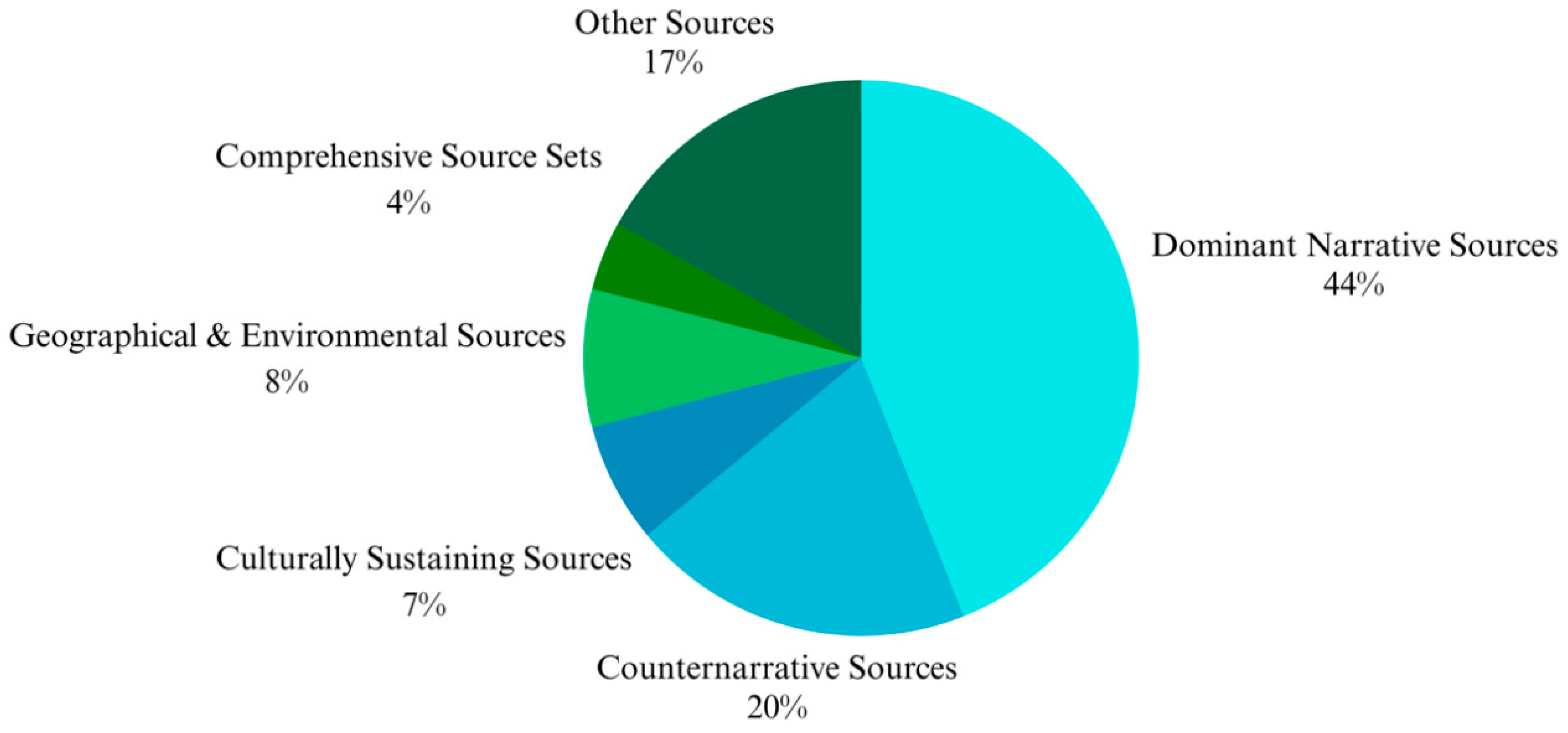
| Code Category | Definition | Example of Primary Source |
|---|---|---|
| Dominant Narrative Sources | Centers White, male, Eurocentric figures or perspectives; reinforces traditional power structures. | Portrait of George Washington; Photo of White students in a 1900s classroom |
| Counternarrative Sources | Highlights voices traditionally marginalized in dominant historical accounts. | Photo of African American sponge divers; Image of Zora Neale Hurston; Photo of the Little Rock Nine walking to school under guard, LGBTQ protest image |
| Culturally Sustaining Sources | Affirms and supports the cultural identities of students and communities, including ongoing traditions and resistance. | Día de los Muertos altar photo; Images of Seminole Native America Tribe |
| Geographical & Environmental Sources | Maps, landscapes, and spatial representations that contextualize events. | 1507 Waldseemüller map; Map of Seminole territories |
| Comprehensive Source Sets | Multi-perspective collections that include various voices and artifacts. | Library of Congress’s baseball set |
| Other Sources | Primary sources that did not clearly align with the other categories but supported inquiry or critical engagement. | Image of a Florida citrus billboard |
| Group | White n = 69 | Hispanic n = 22 | Black n = 6 | AAPI n = 5 | Native American n = 1 |
|---|---|---|---|---|---|
| Dominant Narrative Sources | 111 (48%) | 27 (35%) | 8 (40%) | 6 (38%) | 1 (25%) |
| Counternarrative Sources | 39 (17%) | 22 (28%) | 5 (25%) | 1 (6%) | 1 (25%) |
| Culturally Sustaining Sources | 14 (6%) | 6 (8%) | 2 (10%) | 2 (13%) | 1 (25%) |
| Other | 66 (29%) | 22 (29%) | 5 (25%) | 7 (44%) | 1 (25%) |
| Totals | 230 | 77 | 20 | 16 | 4 |
Disclaimer/Publisher’s Note: The statements, opinions and data contained in all publications are solely those of the individual author(s) and contributor(s) and not of MDPI and/or the editor(s). MDPI and/or the editor(s) disclaim responsibility for any injury to people or property resulting from any ideas, methods, instructions or products referred to in the content. |
© 2026 by the authors. Licensee MDPI, Basel, Switzerland. This article is an open access article distributed under the terms and conditions of the Creative Commons Attribution (CC BY) license.
Share and Cite
Sauberer, P.G.; Berson, I.R.; Berson, M.J. Beyond the Single Story: How Preservice Teachers Curate Primary Sources in Early Education. Educ. Sci. 2026, 16, 1057. https://doi.org/10.3390/educsci16071057
Sauberer PG, Berson IR, Berson MJ. Beyond the Single Story: How Preservice Teachers Curate Primary Sources in Early Education. Education Sciences. 2026; 16(7):1057. https://doi.org/10.3390/educsci16071057
Chicago/Turabian StyleSauberer, Paul G., Ilene R. Berson, and Michael J. Berson. 2026. "Beyond the Single Story: How Preservice Teachers Curate Primary Sources in Early Education" Education Sciences 16, no. 7: 1057. https://doi.org/10.3390/educsci16071057
APA StyleSauberer, P. G., Berson, I. R., & Berson, M. J. (2026). Beyond the Single Story: How Preservice Teachers Curate Primary Sources in Early Education. Education Sciences, 16(7), 1057. https://doi.org/10.3390/educsci16071057