


Abstract
The study synthesizes scientific evidence on the reconfiguration of teacher autonomy and professional judgment in the face of pedagogical automation within post-digital professionalism. Following the PRISMA guidelines and using searches of Scopus and Web of Science using eligibility criteria, the study analyzes evidence from 27 peer-reviewed documents to explore how algorithmic mediation influences decision-making in post-digital environments. The results indicate that while automation improves administrative efficiency, it frequently induces pedagogical deskilling and ethical dilemmas related to algorithmic vulnerability and invisible repair work. Key findings identify a shift toward a new professional profile characterized by socio-technical stewardship, where critical AI literacy and intersubjective attunement serve as defensive competencies against EdTech standardization. Based on the synthesized corpus, it is concluded that the analyzed literature highlights a trend where safeguarding teacher autonomy requires a transition from technical competence to ethical reflexivity, suggesting that automated systems should complement, rather than substitute for human pedagogical integrity. The systematic review protocol was registered on the OSF platform.
1. Introduction
Educational systems have undergone a transformation mediated by technological advancements in the digital era (Lovato Sagrado & Galván Fernández, 2025). In this context, the demand for virtual platforms and the adoption of tools powered by generative artificial intelligence (AI) have supported the increasing digitalization, automation, and standardization of current pedagogical practices (Macías Galeas & Betancourt Anangono, 2025). However, according to the United Nations Educational, Scientific and Cultural Organization (UNESCO, 2023), these tools have marked a turning point in the role of teachers, their sense of autonomy, and the level of judgment required to make independent pedagogical decisions (Lovato Sagrado & Galván Fernández, 2025; UNESCO, 2023).
The UNESCO international report published in 2023 highlights the negative effects of the constant use of technological resources in pedagogy and learning. The report suggests that educational institutions may compel teachers to use these digital systems, which restrict teachers’ freedom to select the tools they wish to apply in their educational practice. Similarly, the Organisation for Economic Co-operation and Development (OECD, 2026) noted that artificial intelligence (AI) has triggered a redefinition of professional identity, conditioned by pedagogical automation that limits teachers’ agency, reducing their role to that of algorithmic data managers and supervisors of automated systems.
1.1. Tension Between Pedagogical Automation and Teacher Autonomy in Post-Digital Professionalism
As stated by Eedelouei (2026), decision-making and pedagogical judgment are essential competencies that allow teachers to act with determination and autonomy in the face of the unique demands of the educational system. Under this premise, teacher autonomy is defined as the capacity to act according to one’s own professional judgment, which implies having a critical sense to reflect on one’s praxis and the freedom to make pedagogical decisions that lead to improved learning outcomes (Doğuş & Tabak, 2024; Lundie, 2016).
Nevertheless, due to the proliferation of digital platforms providing ed(tech) services, alongside the launch of intelligent systems, responsibility for the design and management of educational content has shifted toward the use of data-driven models. For example, when AI systems automatically assign the same learning tasks to all students based on test scores, teachers lose the opportunity to use their own expertise to adapt assessments to the specific needs of their students. This leads to a cycle of pedagogical automation that affects the teacher’s capacity for judgment in evaluating student characteristics and adapting instruction to diverse contexts (Artelt & Gräsel, 2009; Eedelouei, 2026).
In line with the above, post-digital professionalism is understood as the reconfiguration of the professional role and the scope of practice in an era dominated by the omnipresence of analog–digital systems (Lovato Sagrado & Galván Fernández, 2025; Macías Galeas & Betancourt Anangono, 2025). In this context, automation emerges as a critical dimension of teacher agency, allowing for the simulation, emulation, and execution of educational actions without human intervention (Macías Galeas & Betancourt Anangono, 2025; Marrujo-Ingunza & Paico-Campos, 2026).
This practice encompasses the use of tools such as generative AI systems, machine learning (ML), the Internet of Things (IoT), and learning analytics, which allow for the maximization and optimization of the efficiency of pedagogical and administrative tasks (Gan, 2019; Hooda et al., 2022; Mubin et al., 2013; Petrović et al., 2021). However, although there are benefits to the automation of these intelligent models, decisions regarding course content, how to teach it, and how to structure it are increasingly delimited by the presence of such tools (Lovato Sagrado & Galván Fernández, 2025; Macías Galeas & Betancourt Anangono, 2025).
The OECD (2026) report posits that pedagogical automation leads to a depersonalization of learning and may affect the teaching staff’s critical judgment in making decisions regarding their educational practice. Along these lines, Mai et al. (2022) point out that learning analytics systems, while useful for processing performance on virtual platforms, also generate biases that alter student performance results. This can lead to erroneous judgments by teachers during assessment processes by omitting a direct comparison of data with learning outcomes. Furthermore, the application of these technological tools has sparked debates regarding their ethical and social implications, highlighting issues related to the security and privacy of personal information (Merino-Campos, 2025). Studies such as that of Mateu-Luján et al. (2026) highlight that some teachers minimize the risks related to the use of automated platforms for the collection of students’ personal data, either because the tools are provided by the administration itself or because they are satisfied with basic security measures.
Furthermore, evidence indicates that intelligent tutoring systems, such as chatbots, force educators to navigate complex anxieties regarding their professional identity. Teachers often experience pressure to seek constant validation from these AI-generated outputs to confirm the accuracy of their pedagogical decisions, as they fear algorithmic errors may compromise student learning outcomes (Al-Zahrani, 2024). A recent example is the study by Alhur et al. (2025), which evaluated the impact of AI on medical teachers in Palestine, revealing that its excessive use has significant consequences for pedagogical autonomy, critical thinking, and professional identity. The integration of AI into the design of activities that require a degree of personal reflection limits the development of essential competencies within the teaching profile, such as reflective thinking, originality, and creativity. For this reason, the report emphasizes the importance of the human principle in the supervision and management of teaching, as well as the need to foster an informed and contextualized practice of AI-powered digital resources for professional development in pedagogical decision-making (OECD, 2026).
Based on the above, the study defines pedagogical automation in professionalism as the process by which intelligent systems and digital platforms largely take over the management, execution, and evaluation of pedagogical tasks (Lovato Sagrado & Galván Fernández, 2025; Macías Galeas & Betancourt Anangono, 2025). This phenomenon does not merely imply technical optimization, but manifests as a form of reconfiguration of teacher agency, as standardizing educational decisions alters autonomy and professional judgment, causing a shift from their role as a critical orchestrator toward that of a mere manager of algorithmic trajectories.
1.2. Previous Review Studies
Given the prevalence of digital automation, several systematic reviews have been conducted addressing the application of ICTs and the use of generative AI tools, with an emphasis on the pedagogical management of teaching. Basilotta-Gómez-Pablos et al. (2022) conducted a review on digital competencies aimed at improving technological literacy in the university context; the study concluded that there is a knowledge gap between the digital training received by faculty and the effective application of automated tools in daily pedagogical practice. In the same vein, Vallejo Chacha et al. (2025) examined digital literacy and the integration of educational technologies in classrooms; through an analysis based on 47 published studies, they underscored that it is imperative for teachers to develop pedagogical criteria when including technology in their educational practice.
For their part, Zhu et al. (2025) proposed a systematic review on how AI tools shape the professional identity of English language teachers, highlighting three important mechanisms: depth of reflection, support for self-efficacy, and expansion of literacy in AI-powered resources. Another study by Zawacki-Richter et al. (2019) provided a general overview of the application of AI in higher education levels, revealing that its scope encompasses academic, institutional, and administrative support services. It also declared that the lack of critical reflection poses ethical and social implications for teaching. Previous research has highlighted the need to reinforce teachers’ digital competencies in the university context due to the existing knowledge gap between digital training and the application of these resources in pedagogical practice (Basilotta-Gómez-Pablos et al., 2022).
Furthermore, other studies have focused on how artificial intelligence (AI) benefits the professional competence of teachers, highlighting three important mechanisms: depth of reflection, support for self-efficacy, and expansion of literacy in AI-powered resources. However, few studies have linked how these algorithmic models transform the dimensions of the professional profile, with a special emphasis on the autonomy and critical judgment required for the use of these resources, which have become an essential component of pedagogical management within current educational contexts (Lovato Sagrado & Galván Fernández, 2025; Macías Galeas & Betancourt Anangono, 2025).
Therefore, the objective of this research is to synthesize the scientific evidence on the reconfiguration of teacher autonomy and judgment in the face of pedagogical automation in post-digital professionalism. To address this objective, the following research questions are established:
- (1)
- How does pedagogical automation in professionalism mediate teacher autonomy and judgment in the post-digital era?
- (2)
- What practical dilemmas emerge in the exercise of post-digital professionalism when pedagogical decision-making is mediated by automated systems?
- (3)
- What competencies emerge in professionalism regarding teacher autonomy and judgment in post-digital environments?
1.3. Theoretical Perspective
In this sense, the review is grounded in an integrated theoretical framework that connects the ecological theory of teacher agency (Priestley et al., 2015) and the Aristotelian vision of practical wisdom (phronesis) with the complexity of the post-digital era. According to Priestley et al. (2015), their ecological theory posits that the capacity to act with autonomy is neither an inherent property of the individual nor a static trait. Instead, it constitutes an emergent phenomenon derived from dynamic interactions within the teacher’s educational environment. This ecological model operates across three specific dimensions: (1) the iterative dimension, understood as the professional history that connects praxis with previous experiences; (2) the projective dimension, associated with future trajectories; and (3) the practical-evaluative dimension, which guides the teacher in performing specific actions within an immediate context (Priestley et al., 2015).
Given that the automation of intelligent systems, conversational agents, and AI-based feedback providers has impacted diverse areas of professional action in the educational field, it is imperative to understand that autonomy and pedagogical judgment are not simply constrained by the advancement of technological innovation, but rather undergo constant transformation due to the possibilities and limitations imposed by these algorithmic tools (Yan et al., 2025). In this regard, although the ecological framework of Priestley et al. (2015) successfully maps how teacher agency is structured and distributed, its descriptive nature regarding ethical quality does not fully explain how teachers evaluate the pedagogical validity of algorithmic guidelines when making sound decisions in the classroom (Mouta et al., 2025).
Therefore, to address this analytical gap, the study integrates the Aristotelian concept of phronesis (practical wisdom) as a pivot that links ethics and teacher pedagogical judgment within post-digital professionalism. Far from being a relic of classical philosophy, phronesis represents the human intellectual virtue that enables individuals to discern what is ethically correct (Gellera, 2017). Consequently, in this review, phronesis represents the ethical discernment necessary for educators to evaluate the application of their agency in data-mediated environments, ensuring that automated efficiency does not overdetermine the teacher’s pedagogical integrity (Farazouli, 2024).
2. Materials and Methods
This research adopted a systematic literature review based on the standards proposed by the PRISMA 2020 statement (Haddaway et al., 2022; Page et al., 2021). This type of review consists of systematic and well-defined methods to identify, collect, appraise, and synthesize all primary research evidence regarding the topic in question (Ranganathan & Aggarwal, 2020). In this sense, it is considered particularly suitable for addressing emerging and complex phenomena in the post-digital era, where the convergence of technology and teaching professionalism generates new ethical and operational uncertainties.
Following the guidelines set forth by Siddaway et al. (2019), the sample was constituted through a cyclical and structured process that began with the definition of research questions and eligibility criteria, based on the SPIDER framework (Table 1). Furthermore, the technical execution—which included searching indexed databases through phases covering title and abstract screening, full-text review, and data extraction—was carried out by the first author and verified at multiple stages by an independent reviewer who did not participate in drafting the manuscript.
Table 1.
Application of the SPIDER model for the review.
This review was pre-registered in the OSF database (https://doi.org/10.17605/OSF.IO/J24AD), reinforcing its compliance with international best practices for systematic research.
2.1. Development of the Search Strategy
Relevant documents were identified through searches of Scopus and Web of Science (WoS). These databases were selected for their broad coverage of peer-reviewed scientific literature and their capacity to index a vast output of international scholarship. While we acknowledge that these platforms exhibit limitations, such as a linguistic bias toward English and certain gaps in geographic or disciplinary coverage, their use responds to the need to capture a diverse spectrum of publications indexed under criteria of scientific rigor.
Databases specializing in education (such as ERIC, PsycINFO, or Education Source) constitute robust alternative repositories. However, they were excluded from this review due to structural and epistemic limitations regarding the object of analysis. The phenomenon studied—pedagogical automation within post-digital professionalism—is intrinsically multidisciplinary. It is situated at the intersection of critical sociology of technology, data science, human–computer interaction (HCI), and professional ethics, extending beyond traditional pedagogical instruction or curricular design.
To ensure the relevance of the corpus, Boolean operators (“AND”, “OR”) and terms such as “teacher autonomy”, “teacher judgment”, “pedagogical automation” and “post-digital professionalism” were applied. The search strategy was specifically adapted for each database (Table 2) to maximize the retrieval of quantitative, qualitative, and mixed-methods studies. This downloadable information can also be found in the Supplementary Materials S1: Search equation.
Table 2.
Search equation and initial results.
2.2. Data Selection
To ensure the final sample was relevant to the research objectives, the following inclusion criteria were established for the screening process: Timeliness (studies published up to 2026), Language (publications in Spanish and English), Topic (research analyzing technological mediation in teacher decision-making), and Quality (articles in peer-reviewed indexed journals and book chapters from academic publishers). Furthermore, studies focusing exclusively on student learning without mentioning teaching practice were excluded, as were gray literature (conference proceedings without peer review or editorials) and records without full-text access.
2.3. Graphical Representation and Data Analysis
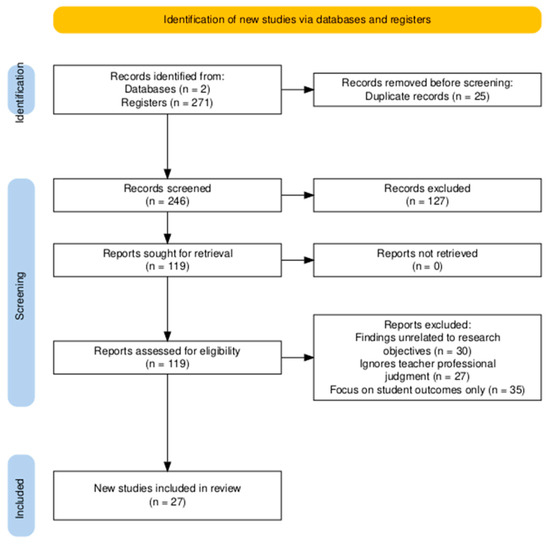
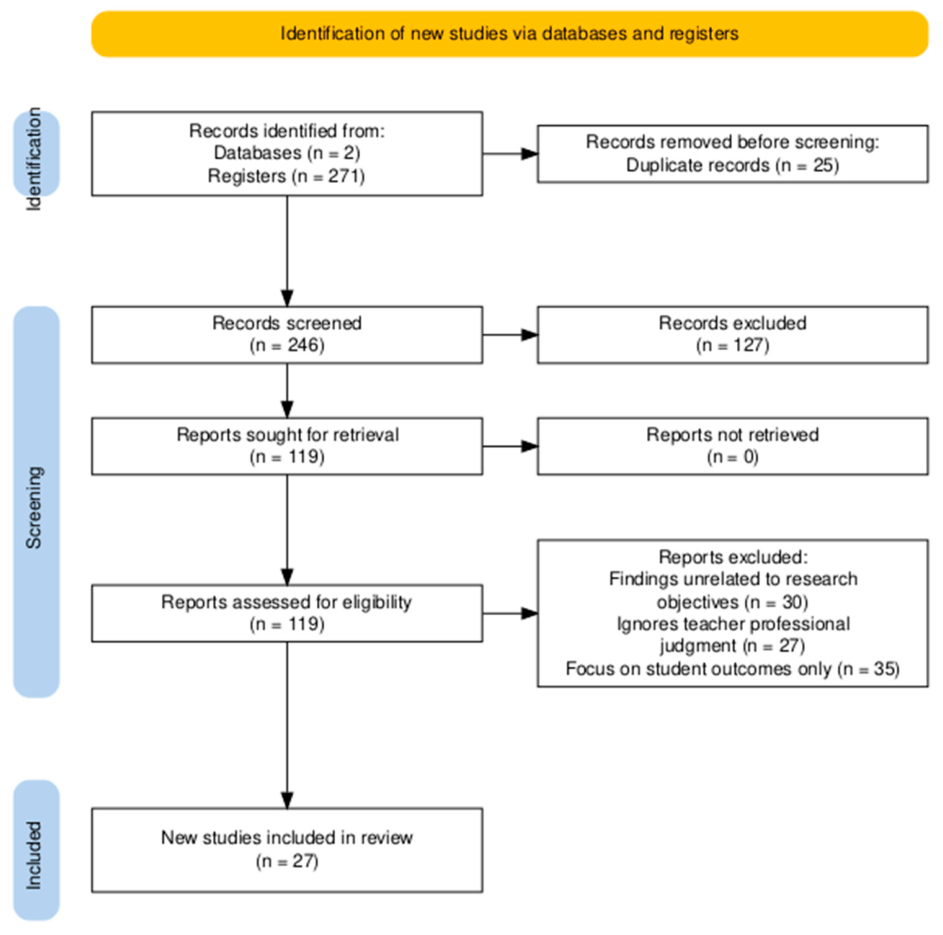
The graphical representation of the study selection process was facilitated by the flowchart proposed by Haddaway et al. (2022), which establishes three phases: 1. Identification (locating records in databases and removing duplicates); 2. Screening (reading titles/abstracts, followed by full-text reading of pre-selected articles while applying the inclusion criteria); and 3. Inclusion (defining the final sample for data analysis) (Figure 1).
Figure 1.
PRISMA Flowchart: Study Selection.
The first level, designated as the Identification Phase, involved the initial localization of scientific evidence through high-impact databases. A total of 271 records were retrieved from Scopus (n = 143) and Web of Science (n = 128). Following this initial collection, a technical cleaning of the corpus was conducted by removing 25 duplicate records, resulting in a total of 246 unique articles ready for evaluation in the subsequent stage.
The second phase, termed the Screening Phase, consisted of a comprehensive two-stage evaluation to ensure thematic relevance. Initially, the 246 records were filtered through title and abstract screening, leading to the exclusion of 127 documents that did not meet the inclusion criteria. Subsequently, 119 reports were successfully retrieved, and a full-text assessment was conducted. During this in-depth analysis, 92 additional articles were discarded for specific reasons: 30 were unrelated to the study objectives, 27 omitted the analysis of professional teacher judgment, and 35 focused exclusively on student learning outcomes without considering the role of teaching staff.
The third level, the Inclusion Phase, represents the consolidation of the final sample that supports the results of the review. Once quality and relevance criteria were applied, 27 definitive studies were selected. This final corpus is characterized by its temporal currency (2016–2026) and its methodological diversity.
Subsequently, a narrative method was used to analyze the 27 selected studies, which present diverse methodological approaches (Table 3). To synthesize the evidence, the process proposed by Braun and Clarke (2019) for thematic analysis was applied:
Table 3.
Distribution of research methodology in the selected studies.
- Familiarization and preliminary synthesis: In the first step, an exhaustive reading of each article was conducted to extract key data and produce a detailed synthesis table outlining study characteristics, including the type of automation technology analyzed and the educational context.
- Code generation and epistemological orientation: Following a second reading, the coding of text segments was initiated using a predominantly deductive (directed) reflexive thematic analysis approach, grounded in the theoretical framework of teacher agency and prior sociotechnical literature. While remaining open to emerging codes, the categorization process was conceptually structured to directly address the dimensions of the phenomenon under study.
- Theoretical support for synthesis: In this thematic synthesis stage, priority was given to integrating findings that explain the reconfiguration of teacher autonomy and judgment in post-digital environments. The construction of the final themes was deliberately and deductively aligned with the three predefined research questions (RQs), ensuring a directed, rigorous, and transparent epistemological framework for synthesis that allows evaluation of how the theory holds up or fractures in the face of the analyzed empirical evidence.
As a result of this process, three central themes aligned with the study’s research questions were constructed:
- Theme 1: Mediation of automation in pedagogical sovereignty (linked to RQ1): Explores how automated systems redefine the teacher’s decision-making space.
- Theme 2: Ethical dilemmas and operational fractures in decision-making (linked to RQ2): Focuses on the tensions between algorithmic efficiency and professional ethics.
- Theme 3: Emerging competencies for agency in the post-digital era (linked to RQ3): Identifies the critical skills necessary to strengthen teacher autonomy and judgment in the face of automation.
2.4. Bias Risk Assessment
The risk of bias in the empirical studies was assessed using the Mixed Methods Appraisal Tool (MMAT, version 2018, Canada) tool, revealing that 17 of the 27 studies selected for this review possess a high standard of methodological rigor. Within the quantitative, qualitative, and mixed-methods categories, 16 studies (Al-Zahrani, 2024; Amhag et al., 2019; Bernik et al., 2025; Damşa et al., 2021; Du et al., 2026; Duan & Zhao, 2024; Ho & Lee, 2025; Hong & Lee, 2026; Küçükuncular & Ertugan, 2025; Lovato Sagrado & Galván Fernández, 2025; Macías Galeas & Betancourt Anangono, 2025; Moylan et al., 2025; Niu et al., 2024; Restiglian et al., 2023; Selwyn et al., 2025; Zhou et al., 2024) achieved a rating of ‘High’ quality due to appropriate sampling strategies, validated measurement protocols, and robust statistical analyses.
Meanwhile, the study by García et al. (2024) received a ‘Moderate’ rating due to limitations in the transparency of the methodological reporting. It is important to note that, prior to the evaluation process, 10 theoretical or review-based studies (such as systematic reviews, mappings, conceptual analyses, and critical essays) were excluded, as their design rendered them inapplicable to the MMAT risk-of-bias tool. This exclusion allowed the analysis to be concentrated on primary empirical research, ensuring comprehensive narrative coverage while adjusting the weight of the interpretations based on the included studies.
2.5. Ethical Considerations
As this was a review of published literature, approval from an ethics committee was not required. Furthermore, scientific integrity was ensured by adhering to the PRISMA protocol, respecting the original authorship of the included studies, and maintaining a reflective stance to minimize bias.
3. Results
3.1. Synthesizing Scientific Evidence on the Reconfiguration of Teacher Autonomy and Judgment in the Face of Pedagogical Automation Within Post-Digital Professionalism
Table 4 details the final sample for this review, consisting of 27 documents published between 2016 and 2026, reflecting the current relevance of the debate on pedagogical automation. The evidence is distributed across diverse geographic areas, with a significant presence of studies from Europe, Asia, and Latin America, covering educational levels ranging from early childhood education to higher education.
Table 4.
Systematization of the included evidence.
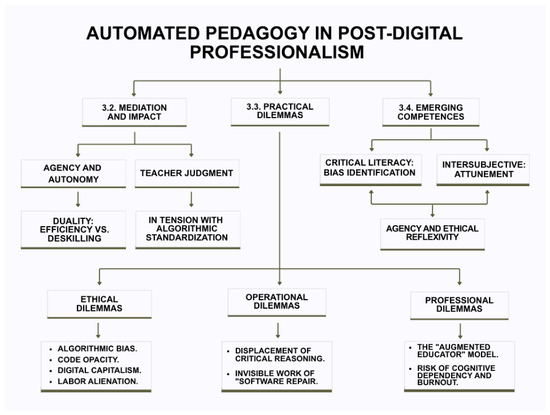
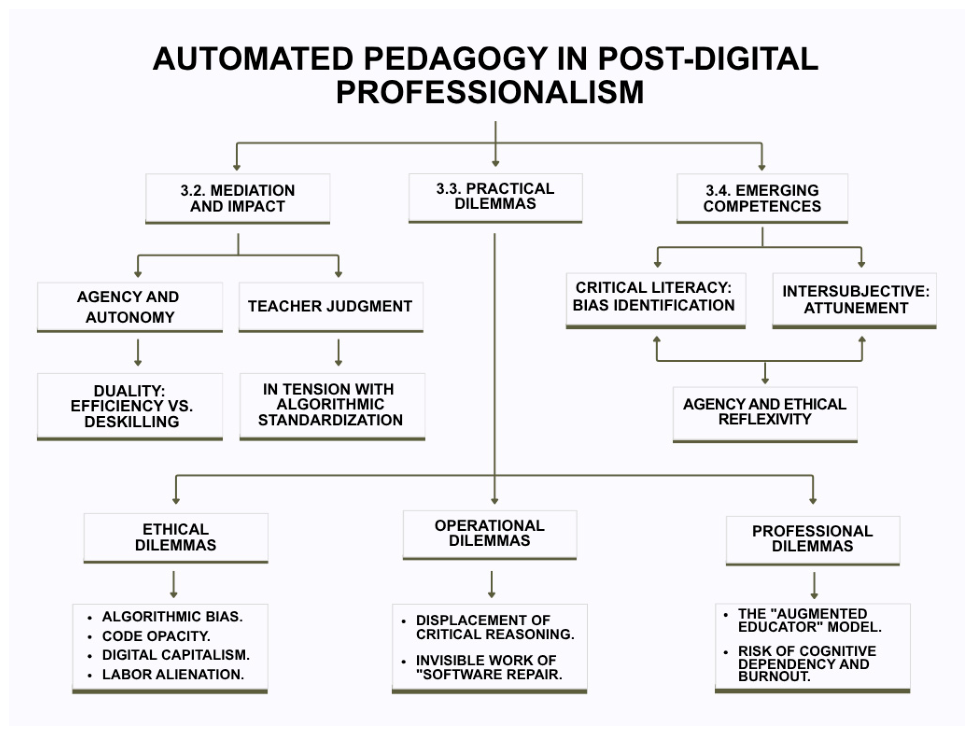
To facilitate a general understanding of the findings and improve the readability of the synthesis, a map of the analytical categories has been integrated (Figure 2). This graphic synthesis illustrates how automated pedagogy in post-digital professionalism operates across three key aspects: the mediation of automation in pedagogical sovereignty (Section 3.2), the operationalization of dilemmas (Section 3.3), and the configuration of competencies (Section 3.4). By visually representing these interconnections, the figure highlights the tension between technological efficiency and human pedagogical judgment, serving as a structural guide for the comprehensive results detailed below.
Figure 2.
Conceptual map of automated pedagogy dimensions in post-digital professionalism.
3.2. How Does Pedagogical Automation in Professionalism Mediate Teacher Autonomy and Judgment in the Post-Digital Era?
The systematic analysis identified that pedagogical automation, driven primarily by Artificial Intelligence (AI) and the creation of platforms, does not act merely as a neutral tool, but functions as a transformative mediator of teacher professionalism at various levels. From this perspective, the mediation operates in three main areas: the reconfiguration of professional autonomy, the algorithmic standardization of pedagogical judgment, and the emergence of post-digital professional identities.
3.2.1. Reconfiguration of Professional Agency and Autonomy
Evidence points to a dual impact on teacher autonomy. On one hand, AI applications for lesson planning and administrative automation can improve efficiency, potentially freeing educators to focus on personalized instruction (Duan & Zhao, 2024). However, this is often offset by a process called pedagogical disablement. Rind (2026) and Lundie (2016) argue that when teachers delegate key pedagogical decisions to automated grading systems, they stop guiding the learning process and instead become simple facilitators of routes defined by the system (Rind, 2026; Lundie, 2016). This transition often diminishes the practical-evaluative capacity described by Damşa et al. (2021), as educators feel pressured to align their teaching practice with the operational logic of digital platforms (Damşa et al., 2021).
3.2.2. Standardization Versus Pedagogical Judgment
A significant body of literature highlights the tension between algorithmic standardization and the irreducibility of pedagogical judgment. Macías Galeas and Betancourt Anangono (2025) identify pedagogical resistance among educators who face the standardization of educational technology, where the digitized nature of platform-based education reduces complex human interactions to finite information transactions. The opacity and inherent bias of AI systems (Al-Zahrani, 2024) further complicate professional judgment, as teachers must contend with the algorithmic vulnerability of their students while maintaining ethical oversight. Furthermore, the results indicate that while AI can provide support for formative assessment, it cannot replicate the relational presence and embodied practice identified by Hong and Lee (2026) as essential teaching competencies.
3.2.3. Subjectivities and Teacher Professionalism in the Post-Digital Era
In the post-digital era, teacher identity is increasingly constituted through human–AI collaboration. Van Zoost (2025) emphasizes that technologies of the self, such as prompt engineering, become spaces of governmentality, where the ethical and moral subjectivities of teachers are transformed through their interactions with AI. Professionalism among educators in early childhood and higher education is currently facing a dilemma, caught between the logic of platformization and the traditional values of pedagogical documentation and autonomy (Restiglian et al., 2023).
However, the transition toward automated pedagogy introduces new psychological risks. Studies such as those by Du et al. (2026) analyze the factors that lead to AI addiction or excessive dependence, which can impair the development of cognitive load and reflective practice. This dependence often leads to digital burnout, particularly when institutional implementation pressures override the teacher’s capacity for professional judgment (Moylan et al., 2025).
Under this consensus, the findings indicate that the integration of pedagogical automation in the post-digital era limits teacher autonomy by creating a hybrid environment where professional judgment is constantly pitted against algorithmic dictates. While automation offers support for certain cognitive tasks, the findings highlight that preserving teacher autonomy requires intentional ethical integration, continuous faculty training, and a human-centered approach that considers AI as a complement, rather than a substitute, for the intrinsic human elements of pedagogy.
3.3. What Practical Dilemmas Emerge in the Exercise of Post-Digital Professionalism When Pedagogical Decision-Making Is Mediated by Automated Systems?
The integration of automated systems in educational environments has given rise to complex dilemmas that challenge the boundaries of teacher autonomy and professional judgment. These dilemmas are classified into ethical, operational, and professional dimensions in Table 5:
Table 5.
Practical dilemmas in the exercise of post-digital professionalism.
The exercise of teacher professionalism is increasingly mediated by automated systems, creating a fundamental tension between technological efficiency and human pedagogical judgment. When analyzed through an ecological lens, these practical dilemmas represent major structural fractures within the practical-evaluative dimension of teacher agency. A primary ethical dilemma lies in the opaque nature of AI, where algorithmic bias and the lack of transparency in assessment systems—such as automated grading via code—call into question the role of the teacher as an impartial evaluator (Bernik et al., 2025; Ho & Lee, 2025). This technological opacity severely compromises the teacher’s capacity to exercise phronesis, as the datafication of learning processes restricts the contextual information required for authentic ethical discernment. This automation often reduces complex pedagogical interactions to mere information transactions, which overdetermine the educational space and marginalize teachers’ relational dimension and self-perception (Lundie, 2016; Moylan et al., 2025).
The literature also indicates that teachers face an operational dilemma regarding technological weaknesses. When generative AI tools do not provide accurate or contextualized results, educators must perform intensive “repair work,” which paradoxically increases their workload and undermines their perceived autonomy (Selwyn et al., 2025; Webb & Galamba, 2026). Furthermore, the standardization imposed by educational technology platforms fosters a digital capitalism that makes teaching work precarious, transforming educators into mere facilitators of predesigned algorithmic paths (Giovine et al., 2025; Lovato Sagrado & Galván Fernández, 2025; Macías Galeas & Betancourt Anangono, 2025).
A fundamental concern is the emergence of AI dependency, where the convenience of automated lesson planning and content creation can lead to a regression in relevant cognitive load and reflective practice (Du et al., 2026; Rind, 2026). This is exacerbated by the ethical burden of protecting student data within platforms that prioritize digitization over privacy (Al-Zahrani, 2024; Restiglian et al., 2023). Even in specialized fields such as meditation teaching, the displacement of bodily presence by digital mediators creates a conflict regarding teacher authority and authentic connection (Hong & Lee, 2026).
However, the evidence also points toward an augmented professionalism model. Some records highlight that when teachers exercise a high degree of autonomy, they can navigate these limitations to foster personalized learning environments (Damşa et al., 2021; Kim et al., 2025). The transition to this post-digital state requires a redefinition of teacher identities, moving from traditional roles to cognitive orchestrators who must balance human intuition with algorithmic information (Engeness, 2021; Trevisan et al., 2024; Van Zoost, 2025). Achieving this balance is essential to prevent digital burnout and ensure that AI serves as a tool for empowerment rather than alienation (Duan & Zhao, 2024; García et al., 2024; Küçükuncular & Ertugan, 2025; Zhou et al., 2024).
In general, the literature warns that, without effective public oversight and a commitment to human-centered AI, the automation of pedagogy threatens to replace the teacher’s ethical wisdom with the sterile logic of the algorithm (García et al., 2024; Niu et al., 2024; Urmeneta & Romero, 2024).
3.4. What Competencies Emerge in Professionalism Regarding Teacher Autonomy and Judgment in Post-Digital Environments?
The systematic analysis allowed for the identification of the emergent competencies of post-digital professionalism necessary to safeguard teacher autonomy and judgment. These are organized in Table 6 below:
Table 6.
Emergent competencies regarding teacher judgment and autonomy.
The analysis indicated that post-digital professionalism is defined by the capacity to manage the tension between technological efficiency and pedagogical integrity. These emergent competencies are not merely isolated technical skills; rather, they represent a radical reconfiguration of the iterational and projective resources that teachers must possess to sustain their agency. Post-digital competencies move beyond basic operational literacy toward a sophisticated form of cognitive orchestration (Rind, 2026), where the professional profile requires the systematic deployment of data-driven phronesis as a defensive competence against pedagogical deskilling.
On one hand, a fundamental competency is critical AI literacy and ethical awareness. This implies not only the functional use of tools, but also the ability to identify algorithmic biases (Al-Zahrani, 2024; Bernik et al., 2025) and maintain ethical integration to prevent teacher alienation (Küçükuncular & Ertugan, 2025). Teachers must develop the discernment to know when AI complements or undermines intellectual autonomy. This is reflected in Ho and Lee (2025), who emphasize ethical intuition as the driving force of professional action.
The literature also highlights relational presence and empathy as irreplaceable human competencies. In the era of automated feedback, relational machines cannot replace the intersubjective attunement provided by human educators (Hong & Lee, 2026; Kim et al., 2025). Teacher professionalism now demands the ability to design AI-augmented environments that prioritize the emotional and cognitive needs of students without reducing teaching to a mere data transaction (Kim et al., 2025; Lundie, 2016; Moylan et al., 2025).
Pedagogical agency emerges as a defensive competency against the standardization imposed by educational technology (Macías Galeas & Betancourt Anangono, 2025). Teachers demonstrate agency through practical-evaluative action, adjusting their practice despite institutional limitations (Damşa et al., 2021). This implies a digital identity in constant evolution as teachers interact with digital environments (Engeness, 2021; Trevisan et al., 2024) and use formative assessment as a transformative tool rather than merely an administrative one (Webb & Galamba, 2026; Amhag et al., 2019).
Furthermore, the formation of teacher identity is increasingly linked to technological interaction, such as prompt engineering, which Van Zoost (2025) identifies as a space of subjectivity. Self-regulation competencies are essential to avoid AI addiction or excessive dependence (Du et al., 2026), ensuring that future educators remain critical users (García et al., 2024). This digital competency is reinforced when basic psychological needs are met within the work environment, allowing teachers to act as autonomous professionals rather than mere platform operators (Duan & Zhao, 2024).
Consequently, this study underscores the need for a comprehensive skill set in technological management. Educators must understand how the widespread use and capitalism of digital platforms (Giovine et al., 2025) can impact their working conditions and professional stability (Lovato Sagrado & Galván Fernández, 2025). Professionalism in this context requires the ability to perform repair work around the fragilities of AI (Selwyn et al., 2025), while maintaining professional judgment amidst datafication (Restiglian et al., 2023) and ensuring that the human educator remains a central figure in the higher education landscape.
4. Discussion
The present systematic review offered a critical synthesis of teacher autonomy and professional judgment in the face of pedagogical automation. As educational environments transition toward post-digital professionalism, the traditional boundaries of teaching work are being redefined through algorithmic mediation. This study contributes to the educational-technological field by identifying that automation is not merely a technical improvement, but a disruptive force that demands a shift from purely pedagogical skills to a complex set of sociotechnical and ethical competencies. The importance of this study lies in its ability to highlight the invisible work of teachers, such as system repair and ethical oversight, which is often ignored in institutional policies regarding technology adoption.
The synthesis of the 27 included studies suggests that the analyzed dimensions of teacher professionalism are experiencing a notable qualitative reconfiguration. The findings indicate that within the evaluated contexts, automation acts as an algorithmic regulator that simultaneously enables and restricts professional action. This dual nature coincides with the work of Petko et al. (2025), who argue that technological integration is never neutral and requires a deep intersection between pedagogical and content knowledge (TPACK), which must now include algorithmic awareness. The mechanism underlying this reconfiguration is primarily sociomaterial; teachers do not merely use AI, but are reconstituted by it, transforming their decision-making processes from intuitive-heuristic to reactive and data-driven.
The findings identify that automation mediates autonomy through a process of standardized empowerment. While it increases efficiency, it decreases the capacity for spontaneous pedagogical judgment. This finding coincides with Karamuk (2025), who posits that learning in education through automated systems carries the risk of eliminating the educational element, risk, and human encounter in the classroom. The divergence lies in the fact that, while traditional literature considers technology as an external tool, these results point to a posthumanist mechanism in which the teacher’s agency is shared with the software, which often entails the loss of practical wisdom (phronesis) essential for teaching (Gellera, 2017). From an ecological perspective, this loss directly fractures the practical-evaluative dimension of agency, as algorithmic automation actively prevents the teacher from deploying real-time ethical discernment in fluid classroom contexts.
Regarding the identified practical dilemmas, the synthesis emphasizes that algorithmic vulnerability is a significant byproduct of the post-digital era. The results highlight a tension between institutional pressure for efficiency and the teacher’s moral responsibility. This coincides with the findings of Jones et al. (2020) and Luo (2025), who suggest that the lack of transparency in educational data mining generates a trust gap. The underlying mechanism is digital alienation: when a teacher cannot explain why a system issued a specific grade or recommendation, they become alienated from their own professional judgment, transforming from a creative professional into a data manager.
On the other hand, the emergence of critical AI literacy and relational empathy as core competencies marks a clear shift in professional identity. This study reveals that the most valuable post-digital skills are the most human ones. This result is supported by Suasnabas Pacheco et al. (2025), who maintain that the arrival of AI in education increases the importance of human intelligence (social, emotional, and meta-intelligence). The underlying mechanism is compensatory experience; as machines take over low-level cognitive tasks (grading, planning), the teacher must overcompensate in high-level relational and ethical domains to maintain the educational integrity of the environment. This compensatory mechanism reconfigures both the iterational dimension—by demanding new automated literacies from past professional training—and the projective dimension of agency, as teachers reshape their future professional aspirations around socio-technical orchestration rather than technical subjection.
Under these positions, the consensus among the analyzed studies highlights that preserving autonomy and judgment requires intentional pedagogical resistance. Findings indicate that teachers who maintain a high level of autonomy achieve this by treating AI as a “boundary object” rather than an absolute authority. This reflects a theoretical mechanism of autonomy in practice, where professionalism is redefined as the capacity to navigate, critique, and occasionally subvert algorithmic suggestions to meet the idiosyncratic needs of students, a perspective that expands upon classical theories of teacher professionalism.
In practice, these findings serve as a warning for educational leaders who view automation as a solution to teacher shortages or workload overload. The results emphasize that, without specific training in algorithmic ethics and error management, automation can increase burnout and reduce the quality of the teacher–student relationship. Practical teacher training programs should prioritize human-centered AI strategies, ensuring that educators retain veto power over automated decisions to protect student data privacy and pedagogical diversity.
Despite rigorous adherence to the PRISMA 2020 statement, the present review acknowledges limitations intrinsic to the speed of technological evolution. A critical methodological finding, rather than an imposed restriction, is the concentration of evidence between 2016 and 2026. It is imperative to specify that, although the search was executed without an initial date restriction to capture the historical trajectory of the phenomenon, no records meeting the eligibility criteria were identified before 2016. This temporal distribution does not constitute a selection bias, but rather acts as an indicator of the emergence of the post-digital paradigm; scientific discourse on pedagogical automation only reached academic maturity following the integration of advanced analytics and large language models into the education sector.
Consequently, an inevitable recency bias exists; the most recent studies (2024–2026) describe capabilities of automated systems that did not exist in the 2016 corpus, which creates an asymmetry in the applicability of historical data compared to contemporary hybrid environments. This transition highlights the lack of prior literature linking teacher autonomy and judgment with specific post-digital constructs, confirming that the literature is facing a professional reconfiguration of a recent and disruptive nature.
To deepen the understanding of teacher professionalism in the post-digital era, future research must move from theoretical syntheses to multidimensional empirical inquiries. Therefore, future lines of research should explore the phenomenon of pedagogical de-skilling to determine whether prolonged dependence on automated systems affects professional prudence or, conversely, fosters new forms of cognitive orchestration. Furthermore, it is essential to conduct cross-cultural research that analyzes algorithmic resistance and ethical agency, ensuring that the evolution of teacher autonomy and judgment is analyzed from a perspective of digital equity rather than mere technical efficiency.
5. Conclusions
The present systematic review synthesized an emerging body of literature concerning teacher autonomy and professional judgment under the influence of pedagogical automation. Based exclusively on the evidence evaluated within this 27-study corpus (2016–2026), the following conclusions are proposed, acknowledging the contextual boundaries of the data:
The reviewed literature suggests that, within the investigated educational environments, concepts of teacher professionalism display signs of transitioning from individual, heuristic autonomy toward a hybrid socio-technical agency. This detected reconfiguration implies that teaching judgment is increasingly exercised in tension with algorithmic mediation. Rather than a definitive structural shift, this phenomenon manifests in the sample as a tension of standardized empowerment: while automation provides expanded data-processing capabilities, it is also frequently described as a factor that may restrict spontaneity and phronesis, potentially leading to a reliance on platform-predefined metrics over real-time reflective decisions.
Furthermore, the synthesized findings characterize automation as a significant mediating factor in pedagogical practice within the studied cohorts. The analysis identified a dual trend: an operational mediation that optimizes administrative tasks, and a cognitive mediation that bears the potential to induce features of pedagogical deskilling. In several monitored cases, educators faced the risk of shifting from autonomous orchestrators of learning toward managers of algorithmic pathways, where professional choices appeared conditioned by software logic. Consequently, the analyzed literature highlights a need to support pedagogical sovereignty against technology-driven standardization. Within the ecological framework, these findings suggest that, to safeguard practical-evaluative agency, the iterational and projective dimensions of professionalism should be deliberately aligned with algorithmic literacy.
The reviewed evidence also points to critical ethical and operational dilemmas tied to algorithmic vulnerability. A recurring challenge in the sample is the perceived opacity of automated evaluation systems, which can distance educators from their own evaluative reasoning. Additionally, the literature reports an operational burden linked to “repair work,” where teachers invest substantial time monitoring and correcting the errors or biases of automated tools. This tension between institutional efficiency and professional responsibility highlights the role of pedagogical ethics as a key factor in mitigating educational dehumanization.
Ultimately, within the limits of the synthesized corpus, the competencies identified as vital for post-digital professionalism are not merely technical, but critically reflexive. Advanced data literacy and algorithmic awareness are framed by the current literature as protective skills enabling teachers to identify biases and maintain necessary educational oversight. The emerging professional profile reflects a need for socio-technical stewardship, where intersubjective attunement, relational empathy, and ethical reflexivity serve to complement automated systems. Rather than asserting a universal transformation, this review concludes that the analyzed literature outlines a clear imperative to treat technology as a complementary asset that must not substitute for human pedagogical integrity.
Supplementary Materials
The following supporting information can be downloaded at: https://www.mdpi.com/article/10.3390/educsci16071055/s1, S1: Search equation.
Author Contributions
Conceptualization, M.M.G.E. and W.A.Z.V.; methodology, W.A.Z.V., M.M.G.E. and S.P.C.S.; formal analysis, W.A.Z.V. and M.M.G.E.; investigation, M.M.G.E., W.A.Z.V., S.P.C.S., E.I.C.A. and E.I.D.C.; resources, E.I.C.A. and E.I.D.C.; data curation, S.P.C.S. and E.I.C.A.; writing—original draft preparation, M.M.G.E. and W.A.Z.V.; writing—review and editing, W.A.Z.V., S.P.C.S. and E.I.D.C.; visualization, S.P.C.S. and E.I.C.A.; supervision, W.A.Z.V.; project administration, W.A.Z.V. and M.M.G.E.; funding acquisition, M.M.G.E. and W.A.Z.V. All authors have read and agreed to the published version of the manuscript.
Funding
This research was funded by the Universidad Estatal Península de Santa Elena: 005.
Institutional Review Board Statement
Not applicable.
Informed Consent Statement
Not applicable.
Data Availability Statement
The data supporting the findings of this systematic review, including the study protocol, search strategies, and the data extraction matrix, are openly available in the Open Science Framework (OSF) at https://doi.org/10.17605/OSF.IO/J24AD.
Acknowledgments
The authors would like to thank the Universidad Estatal Península de Santa Elena for the institutional support and funding provided for the development of this research. Furthermore, during the preparation of this manuscript, the authors used Scopus AI, developed by Elsevier (Netherlands), to identify and expand the literature, and the Gemini 3 Flash language model, developed by Google (United States), for translating the text from Spanish to English. The authors have reviewed and edited the final output and assume full responsibility for the content of this publication.
Conflicts of Interest
The authors declare no conflicts of interest.
References
- Alhur, A. A., Khlaif, Z. N., Hamamra, B., & Hussein, E. (2025). Paradox of AI in higher education: Qualitative inquiry into AI dependency among educators in Palestine. JMIR Medical Education, 11, e74947. [Google Scholar] [CrossRef] [Scilit] [PubMed]
- Al-Zahrani, A. M. (2024). Unveiling the shadows: Beyond the hype of AI in education. Heliyon, 10(9), e30696. [Google Scholar] [CrossRef] [Scilit] [PubMed]
- Amhag, L., Hellström, L., & Stigmar, M. (2019). Teacher educators’ use of digital tools and needs for digital competence in higher education. Journal of Digital Learning in Teacher Education, 35(4), 203–220. [Google Scholar] [CrossRef] [Scilit]
- Artelt, C., & Gräsel, C. (2009). Diagnostische kompetenz von lehrkräften. Zeitschrift für Pädagogische Psychologie, 23(34), 157–160. [Google Scholar] [CrossRef] [Scilit]
- Basilotta-Gómez-Pablos, V., Matarranz, M., Casado-Aranda, L.-A., & Otto, A. (2022). Teachers’ digital competencies in higher education: A systematic literature review. International Journal of Educational Technology in Higher Education, 19(1), 8. [Google Scholar] [CrossRef] [Scilit]
- Bernik, A., Radošević, D., & Čep, A. (2025). AI-powered learning: Revolutionizing education and automated code evaluation. Information, 16(11), 1015. [Google Scholar] [CrossRef] [Scilit]
- Braun, V., & Clarke, V. (2019). Reflecting on reflexive thematic analysis. Qualitative Research in Sport, Exercise and Health, 11(4), 589–597. [Google Scholar] [CrossRef] [Scilit]
- Damşa, C., Langford, M., Uehara, D., & Scherer, R. (2021). Teachers’ agency and online education in times of crisis. Computers in Human Behavior, 121, 106793. [Google Scholar] [CrossRef] [Scilit] [PubMed]
- Doğuş, F., & Tabak, S. (2024). Teacher autonomy from the perspective of middle school teachers. Asia Pacific Journal of Education and Society, 12(2), 59–78. [Google Scholar] [CrossRef] [Scilit]
- Du, Y., Tang, M., Jia, K., Wang, C., & Zou, B. (2026). Are teachers addicted to AI? analysing factors influencing dependence on generative AI through the I-PACE model. Journal of Computer Assisted Learning, 42(1), e70174. [Google Scholar] [CrossRef] [Scilit]
- Duan, H., & Zhao, W. (2024). The effects of educational artificial intelligence-powered applications on teachers’ perceived autonomy, professional development for online teaching, and digital burnout. The International Review of Research in Open and Distributed Learning, 25(3), 57–76. [Google Scholar] [CrossRef] [Scilit]
- Eedelouei, S. (2026). Factors influencing language teachers’ judgements and decision-making about the use of generative AI tools: A systematic review. Teaching and Teacher Education, 171, 105333. [Google Scholar] [CrossRef] [Scilit]
- Engeness, I. (2021). Developing teachers’ digital identity: Towards the pedagogic design principles of digital environments to enhance students’ learning in the 21st century. European Journal of Teacher Education, 44(1), 96–114. [Google Scholar] [CrossRef] [Scilit]
- Farazouli, A. (2024). Automation and assessment: Exploring ethical issues of automated grading systems from a relational ethics approach. En framing futures in postdigital education. Springer Nature. [Google Scholar] [CrossRef] [Scilit]
- Gan, B. (2019). Design and application research of VR/AR teaching experience system. Journal of Physics: Conference Series, 1187(5), 052079. [Google Scholar] [CrossRef] [Scilit]
- García, N., Hernández, M. L., & Suárez Lantarón, B. (2024). Docentes y tecnología: ¿Cómo enfrenta el futuro profesorado el uso de la Inteligencia Artificial? Revista Electrónica Interuniversitaria de Formación del Profesorado, 28(1), 155–168. [Google Scholar] [CrossRef] [Scilit]
- Gellera, G. (2017). An analysis of Aristotle’s nicomachean ethics. Macat Library. [Google Scholar] [CrossRef] [Scilit]
- Giovine, M. A., Antolín Solache, A., González, F. J., & Rincón Báez, W. U. (2025). Plataformización del trabajo docente: Caracterización de las relaciones y condiciones laborales. Revista Española de Educación Comparada, (48), 419–441. [Google Scholar] [CrossRef] [Scilit]
- Haddaway, N. R., Page, M. J., Pritchard, C. C., & McGuinness, L. A. (2022). PRISMA2020: An R package and Shiny app for producing PRISMA 2020-compliant flow diagrams, with interactivity for optimised digital transparency and open synthesis Campbell systematic reviews. Campbell Systematic Reviews, 18(2), e1230. [Google Scholar] [CrossRef] [Scilit] [PubMed]
- Ho, C. S. M., & Lee, J. C.-K. (2025). From intuition to action: Exploring teachers’ ethical awareness in the use of AI tools in education. Computers and Education: Artificial Intelligence, 9, 100502. [Google Scholar] [CrossRef] [Scilit]
- Hong, M. J., & Lee, S. Y. (2026). Subjective perceptions of south korean meditation teachers on meditation teaching competencies in the age of artificial intelligence. Religions, 17(3), 286. [Google Scholar] [CrossRef] [Scilit]
- Hooda, M., Rana, C., Dahiya, O., Rizwan, A., & Hossain, M. S. (2022). Artificial Intelligence for assessment and feedback to enhance student success in higher education. Mathematical Problems in Engineering, 2022, 5215722. [Google Scholar] [CrossRef] [Scilit]
- Jones, K. M. L., Asher, A., Goben, A., Perry, M. R., Salo, D., Briney, K. A., & Robertshaw, M. B. (2020). “We’re being tracked at all times”: Student perspectives of their privacy in relation to learning analytics in higher education. Journal of the Association for Information Science and Technology, 71(9), 1044–1059. [Google Scholar] [CrossRef] [Scilit]
- Karamuk, E. (2025). The automation trap. In The automation trap: Unpacking the consequences of over-reliance on AI in education and its hidden costs (pp. 147–170). IGI Global Scientific Publishing. [Google Scholar] [CrossRef] [Scilit]
- Kim, H., Park, J., Jeon, H., Fels, S. S., Dodson, S., & Seo, K. (2025). Augmented educators and AI: Shaping the future of human-AI collaboration in learning. In Proceedings of the extended abstracts of the CHI conference on human factors in computing systems (pp. 1–6). Association for Computing Machinery. [Google Scholar] [CrossRef] [Scilit]
- Küçükuncular, A., & Ertugan, A. (2025). Teaching in the AI era: Sustainable digital education through ethical integration and teacher empowerment. Sustainability, 17(16), 7405. [Google Scholar] [CrossRef] [Scilit]
- Lovato Sagrado, A., & Galván Fernández, C. (2025). Capitalismo digital y educación: La precarización docente en la red estatal de enseñanza del estado de Paraná, Brasil. Revista Española de Educación Comparada, (48), 214–231. [Google Scholar] [CrossRef] [Scilit]
- Lundie, D. (2016). Authority, autonomy and automation: The irreducibility of pedagogy to information transactions. Studies in Philosophy and Education, 35(3), 279–291. [Google Scholar] [CrossRef] [Scilit]
- Luo, J. (2025). How does GenAI affect trust in teacher-student relationships? Insights from students’ assessment experiences. Teaching in Higher Education, 30(4), 991–1006. [Google Scholar] [CrossRef] [Scilit]
- Macías Galeas, I., & Betancourt Anangono, D. I. (2025). Algoritmos y autonomía docente: Resistencias pedagógicas ante la estandarización EdTech en la era de la IA generativa. Revista Española de Educación Comparada, (48), 442–460. [Google Scholar] [CrossRef] [Scilit]
- Mai, L., Köchling, A., & Wehner, M. C. (2022). “This student needs to stay back”: To what degree would instructors rely on the recommendation of learning analytics? SN Computer Science, 3(4), 259. [Google Scholar] [CrossRef] [Scilit] [PubMed]
- Marrujo-Ingunza, C., & Paico-Campos, M. (2026). Technological applications of automation and artificial intelligence in education: A systematic review. Multidisciplinary Reviews, 9(8), 2026365. [Google Scholar] [CrossRef] [Scilit]
- Mateu-Luján, B., Suárez-Guerrero, C., & Lloret-Catala, C. (2026). Visión pedagógica de la plataformización en Educación Primaria: Discursos docentes y problemáticas emergentes en la Comunidad Valenciana. Digital Education Review, (48), 94–111. [Google Scholar] [CrossRef] [Scilit]
- Merino-Campos, C. (2025). The Impact of artificial intelligence on personalized learning in higher education: A systematic review. Trends in Higher Education, 4(2), 17. [Google Scholar] [CrossRef] [Scilit]
- Mouta, A., Torrecilla-Sánchez, E. M., & Pinto-Llorente, A. M. (2025). Comprehensive professional learning for teacher agency in addressing ethical challenges of AIED: Insights from educational design research. Education and Information Technologies, 30(3), 3343–3387. [Google Scholar] [CrossRef] [Scilit]
- Moylan, R., Code, J., & O’Brien, H. (2025). Teaching and AI in the postdigital age: Learning from teachers’ perspectives. Teaching and Teacher Education, 153, 104851. [Google Scholar] [CrossRef] [Scilit]
- Mubin, O., Stevens, C. J., Shahid, S., Al Mahmud, A., & Dong, J.-J. (2013). A review of the applicability of robots in education. Technology for Education and Learning, 1(1), 13. [Google Scholar] [CrossRef] [Scilit]
- Nguyen, K. V. (2025). The use of generative AI tools in higher education: Ethical and pedagogical principles. Journal of Academic Ethics, 23(3), 1435–1455. [Google Scholar] [CrossRef] [Scilit]
- Niu, W., Zhang, W., Zhang, C., & Chen, X. (2024). The role of artificial intelligence autonomy in higher education: A uses and gratification perspective. Sustainability, 16(3), 1276. [Google Scholar] [CrossRef] [Scilit]
- Organización para la Cooperación y el Desarrollo Económicos. (2026). OECD digital education outlook 2026. OECD Publishing. [Google Scholar] [CrossRef] [Scilit]
- Page, M. J., McKenzie, J. E., Bossuyt, P. M., Boutron, I., Hoffmann, T. C., Mulrow, C. D., Shamseer, L., Tetzlaff, J. M., Akl, E. A., Brennan, S. E., Chou, R., Glanville, J., Grimshaw, J. M., Hróbjartsson, A., Lalu, M. M., Li, T., Loder, E. W., Mayo-Wilson, E., McDonald, S., … Moher, D. (2021). The PRISMA 2020 statement: An updated guideline for reporting systematic reviews. Systematic Reviews, 10(1), 89. [Google Scholar] [CrossRef] [Scilit] [PubMed]
- Petko, D., Mishra, P., & Koehler, M. J. (2025). TPACK in context: An updated model. Computers and Education Open, 8, 100244. [Google Scholar] [CrossRef] [Scilit]
- Petrović, L., Stojanović, D., Mitrović, S., Barać, D., & Bogdanović, Z. (2021). Designing an extended smart classroom: An approach to game-based learning for IoT. Computer Applications in Engineering Education, 30(1), 117–132. [Google Scholar] [CrossRef] [Scilit]
- Priestley, M., Biesta, G., & Robinson, S. (2015). Teacher agency: An ecological approach. Bloomsbury Publishing. [Google Scholar]
- Ranganathan, P., & Aggarwal, R. (2020). Study designs: Part 8—Meta-analysis (I). Perspectives in Clinical Research, 11(4), 178. [Google Scholar] [CrossRef] [Scilit] [PubMed]
- Restiglian, E., Raffaghelli, J. E., Gottardo, M., & Zoroaster, P. (2023). Pedagogical documentation in the era of digital platforms: Early childhood educators’ professionalism in a dilemma. Education Policy Analysis Archives, 31, 1–27. [Google Scholar] [CrossRef] [Scilit]
- Rind, I. A. (2026). Conceptualizing the impact of AI on teacher knowledge and expertise: A cognitive load perspective. Education Sciences, 16(1), 57. [Google Scholar] [CrossRef] [Scilit]
- Selwyn, N., Ljungqvist, M., & Sonesson, A. (2025). When the prompting stops: Exploring teachers’ work around the educational frailties of generative AI tools. Learning, Media and Technology, 50(3), 310–323. [Google Scholar] [CrossRef] [Scilit]
- Siddaway, A. P., Wood, A. M., & Hedges, L. V. (2019). How to do a systematic review: A best practice guide for conducting and reporting narrative reviews, meta-analyses, and meta-syntheses. Annual Review of Psychology, 70(1), 747–770. [Google Scholar] [CrossRef] [Scilit] [PubMed]
- Suasnabas Pacheco, L. S., Contreras Suasnabas, G. G., Carranco Madrid, S. D. P., Muñoz Ortiz, W. W., Quiñónez Bustos, J. P., Altamirano Barahona, A. D., Santacruz Peralta, I. A., Suriaga Sánchez, M. A., Trujillo Coloma, M. J., & Sarmiento Montoya, L. M. (2025). Inteligencia artificial en la educación. Herramientas para potenciar el proceso educativo en la era de la inteligencia artificial. Ediciones Mawil. [Google Scholar] [CrossRef] [Scilit]
- Trevisan, O., Christensen, R., Drossel, K., Friesen, S., Forkosh-Baruch, A., & Phillips, M. (2024). Drivers of digital realities for ongoing teacher professional learning. Technology, Knowledge and Learning, 29(4), 1851–1868. [Google Scholar] [CrossRef] [Scilit]
- United Nations Educational, Scientific and Cultural Organization. (2023). Global education monitoring report 2023: Technology in education: A tool on whose terms? GEM Report. UNESCO. [Google Scholar] [CrossRef] [Scilit]
- Urmeneta, A., & Romero, M. (2024). Creative applications of artificial intelligence in education. Springer Nature. [Google Scholar] [CrossRef] [Scilit]
- Vallejo Chacha, D. B., Chacha Barba, D. R., & Vilema Villa, C. M. (2025). Alfabetización digital docente y su relación con el aprovechamiento de las TIC en el aula. Un estudio comparativo. DISCE. Revista Científica Educativa y Social, 2(2), 287–303. [Google Scholar] [CrossRef] [Scilit]
- Van Zoost, S. (2025). Prompting teacher identities: A model for teacher subjectivities constituted through artificial intelligence. Journal of Teaching and Learning, 19(4), 198–215. [Google Scholar] [CrossRef] [Scilit]
- Webb, M., & Galamba, A. (2026). Transforming pedagogy with GenAI-supported formative assessment: Challenges for teacher education. British Journal of Educational Technology, 57(3), 690–706. [Google Scholar] [CrossRef] [Scilit]
- Yan, L., Pammer-Schindler, V., Mills, C., Nguyen, A., & Gašević, D. (2025). Beyond efficiency: Empirical insights on generative AI ’s impact on cognition, metacognition and epistemic agency in learning. British Journal of Educational Technology, 56(5), 1675–1685. [Google Scholar] [CrossRef] [Scilit]
- Zawacki-Richter, O., Marín, V. I., Bond, M., & Gouverneur, F. (2019). Systematic review of research on artificial intelligence applications in higher education—Where are the educators? International Journal of Educational Technology in Higher Education, 16(1), 39. [Google Scholar] [CrossRef] [Scilit]
- Zhou, J., Shen, L., & Chen, W. (2024). How ChatGPT transformed teachers: The role of basic psychological needs in enhancing digital competence. Frontiers in Psychology, 15, 1458551. [Google Scholar] [CrossRef] [Scilit] [PubMed]
- Zhu, M., Hussin, S., & Hashim, H. (2025). EFL pre-service teachers’ professional identity in the age of AI: An integrative review (2015–2025). Environment and Social Psychology, 10(12), 1–22. [Google Scholar] [CrossRef] [Scilit]

Disclaimer/Publisher’s Note: The statements, opinions and data contained in all publications are solely those of the individual author(s) and contributor(s) and not of MDPI and/or the editor(s). MDPI and/or the editor(s) disclaim responsibility for any injury to people or property resulting from any ideas, methods, instructions or products referred to in the content. |
© 2026 by the authors. Licensee MDPI, Basel, Switzerland. This article is an open access article distributed under the terms and conditions of the Creative Commons Attribution (CC BY) license.