


Abstract
The aim of this study was to reconstruct the subjective theories of national parent associations in Chile regarding school violence in the post-pandemic period. We performed a collective case study, employing a qualitative, interpretative, and exploratory approach. Information was produced through semi-structured interviews with leaders of four national associations. The information was examined using inductive thematic analysis. In general, parent association representatives largely described school violence as a loss of parental and pedagogical authority, weakening of the family–school bond, centralized school administration, and social vulnerability factors, intensified by the psychosocial impact of the COVID-19 pandemic lockdowns. The interviewees emphasized preventive and community-based approaches, including strengthening family involvement, incorporating school climate specialists, and implementing educational and recreational activities. Overall, the interviews show that parent association representatives tended to regard violence as a multisystemic phenomenon that, according to their accounts, requires joint efforts involving families, schools, the state, and communities rather than punitive or individualized approaches.
1. Introduction
Chile was among the OECD member countries in which schools stayed closed the longest during the COVID-19 pandemic (OECD, 2022). After schools reopened in 2022, a significant increase in school violence was observed relative to previous years (Bullying Sin Fronteras, 2023). Several studies have revealed the major worldwide impact of this unprecedented situation on children’s and adolescents’ mental health, with negative consequences especially for sociability, socioemotional development, and school climate (Llorent et al., 2023; Samji et al., 2022; UNICEF, 2021). In Chile, a Ministry of Education survey of school principals revealed that 32% of respondents identified violence as one of the main challenges of the post-pandemic period (MINEDUC et al., 2022).
In the field of educational policy, this increase in violence prompted the development of the Educational Reactivation Plan, covering school climate, well-being, and mental health as strategic targets (MINEDUC, 2023). This process is part of a conceptual shift aimed at overcoming punitive and control-based approaches to school violence (Ascorra et al., 2018; Morales & López, 2019) by promoting a multilevel, ecological understanding of this phenomenon that considers the interplay of individual, relational, institutional, and contextual factors (Klun et al., 2025). Nevertheless, this conceptual shift is not always conveyed consistently in the explanations constructed by social actors, whose interpretations may instead be grounded in normative, moral, or experiential frameworks. This is exemplified by Chile’s Ministry of Education, which, despite ongoing epistemological reform, tweeted in 2022 that school violence was an expression of structural problems that should be managed and eradicated from schools through judicial means (P. J. Castro-Carrasco et al., 2025). Likewise, teachers and principals have been found to ascribe school violence to factors external to schools (Roe & Castro, 2017). Less is known about how associations that represent parents and guardians of students view this issue.
In parallel, despite the key role that they played during the remote education period, families and national parent associations (NPAs; defined as groups of parent associations with the power to represent their members and influence public affairs) were also less involved in the design and implementation of educational strategies during the post-pandemic period (Jornet-Meliá et al., 2022; Sánchez-Delgado et al., 2022). Families had been included in the updated version of the Policy for Family and Community Participation (MINEDUC, 2017b), School Inclusion Law (MINEDUC, 2017a), and Self-Evaluation Form of the Comprehensive School Safety Plan (Superintendencia de Educación, 2021) before the pandemic. However, there is no evidence of the formal involvement of NPAs in recent school violence policy. Internationally, organizations such as the Spanish Confederation of Students’ Parents (https://ceapa.es) or Mexico’s National Association of Parents have played a larger role in policy design (Secretaría de Educación Pública, 2021). In Chile, although general parent–teacher associations are organized on a national level (Biblioteca del Congreso Nacional de Chile, 2009), they have played only a minor role in policy development and research on school climate and school violence.
Building on the ecological model advanced by Bronfenbrenner (2005), the literature has highlighted the major influence of families on school climate and students’ integral education (Bolaños & Stuart Rivero, 2019; Tapullima-Mori et al., 2023). However, research on school violence has historically focused on individual or familial risk factors, neglecting the involvement of parent organizations (Bordin & Handegård, 2023; Gallego-Jiménez et al., 2021). This exclusion is reinforced by the perception that families play only a minor role in formal decision-making in schools, both in Chile and elsewhere (Álvarez & Bilbao, 2023). For instance, studies in Spain have suggested that even though official norms recognize families’ right to influence school life, their participation in school councils and parent associations is limited (Álvarez & Bilbao, 2023). Consequently, NPAs have been largely disregarded in research, despite their potential capacity to explain phenomena and make proposals to address them.
Only a handful of studies have examined school climate and violence from the perspective of families, focusing on their individual parental role or experience as local leaders, but leaving out their status as national actors with an influence on public affairs (Asociación de Municipalidades de Chile, 2022; Cuadra-Martínez et al., 2021; Vivallo-Urra et al., 2024). Although a positive school climate fosters family–school alliances (Povey et al., 2016), studies on leaders of parent associations have focused on organizational aspects, such as funding, inclusion, disability, or migratory processes (Álvarez-Álvarez, 2020; Lundqvist et al., 2019), offering no further explanations for school violence.
Theoretically, an approach based on subjective theories (STs) can enrich the study of school violence by shedding light on the explanations that actors construct to make sense of reality and orient their actions (Catalán, 2010, 2018; Gadewoltz, 2026). This approach has been widely applied to the analysis of educational beliefs constructed by teachers (P. Castro-Carrasco et al., 2024; Janssens & Kelchtermans, 1997), members of the press (Rodríguez-Pastene et al., 2025), and Ministry of Education leaders (P. J. Castro-Carrasco et al., 2025), particularly the explanatory arguments contained within beliefs. Thus, this approach has been established for decades in the field of educational process studies (Flick, 1987; Gadewoltz, 2026). However, efforts to analyze the explanations of parents and NPAs remain in their early stages (Cuadra-Martínez et al., 2021). Given that STs are explanatory arguments that describe, prescribe, and guide actions (Gadewoltz, 2026), in a broader study of Chilean public discourse on violence and school coexistence, the ST approach proved useful for understanding the potential influences of these associations’ explanations in the public sphere and educational policies. The explanations of these organizations regarding school violence in the post-pandemic period are hypothesized to involve several levels, including macrosocial factors, school dynamics, and proposals for managing school climate. In this context, the aim of the present study was to reconstruct the STs of Chilean NPAs regarding the causes, contextual factors, and strategies for action linked to school violence in the post-pandemic period.
2. Materials and Methods
The aim of this study was to reconstruct the STs of NPA leaders regarding post-pandemic school violence and identify recurring explanatory patterns and proposed strategies. Adopting an interpretive paradigm, the present study sought to explore the meanings that participants attribute to phenomena from their perspective (Krause, 1995). The design was qualitative, exploratory, and descriptive, consisting of a retrospective collective case study (Stake, 2005). This technique assumes that participants do not literally reconstruct or interpret experiences and positions they held in the past. Therefore, the STs reconstructed in this study should not be understood as a direct, fixed window into original perceptions from 2022, but rather as situated narrative reconstructions influenced or mediated by subsequent processes of reflection, reinterpretation, and reframing. In fact, the reconstructed narratives provide access to not only past experiences but also the current interpretive frameworks through which those experiences acquire meaning.
2.1. Participants
In the Chilean educational system, in individual schools, the organizations that represent parents are referred to as parent and guardian centers. At the regional or national level in Chile, the entities that represent families and coordinate multiple parent and guardian centers are known as NPAs (Biblioteca del Congreso Nacional de Chile, 1990). National associations play a representative role, bringing together centers established in schools with administrative and funding arrangements, and are located throughout Chile. A review of official records of NPAs in Chile revealed the absence of an up-to-date public directory of such organizations. In response, an independent search of institutional websites and social media (Facebook and Instagram) identified six active NPAs at the time of the study. Based on available contact information, communications were established via telephone, email, and direct messages on social media. Several months after initial contact and follow-up, four associations volunteered to participate in the study, comprising the final sample.
Though a complete collection strategy was initially considered, the low participation rate encountered led to the use of purposive sampling based on substantial criteria (Flick, 2023), complemented by Maxwell’s (2012) principle of heterogeneity. The following inclusion criteria were set: (a) representation of parent centers from schools of various administrative types (public, subsidized private, and private) to reflect the socioeconomic segmentation of the Chilean school system (Elacqua & Santos, 2013); (b) interregional territorial scope; and (c) boards of directors in operation during 2022. The sample was composed of the presidents of these four associations (see Table 1). Although the participating organizations are based in the country’s capital (central macrozone), they represent parent groups from schools across the country.
Table 1.
Participant characteristics.
Of the four participating associations, three were legal entities and had participated in policy discussions, either through consultative processes or in committees. Specifically, these associations had been involved in the Policy for Family and Community Participation in Schools (MINEDUC, 2017b), School Inclusion Law (MINEDUC, 2017a), and Self-Evaluation Form of the Comprehensive School Safety Plan (Superintendencia de Educación, 2021).
These accounts reflect the perspectives of organizational leaders in their representative roles but do not necessarily capture the full diversity of views in each association.
2.2. Information Production Techniques
Information was collected through semi-structured interviews (García, 2014) to explore participants’ explanations, interpretations, and proposals for action regarding school violence in the post-pandemic period. This technique made it possible to access the meanings that the participants ascribed to the phenomenon, together with their insights into its causes and associated institutional and social responses.
The interviews were held in person and on Zoom between April and November 2024, lasted between 60 and 90 min, and were recorded and fully transcribed in accordance with ethical protocols (Resolución N°05-23 CEC-ULS). The interviews followed a semi-structured thematic script, constructed based on the study’s objectives and the dimensions of the ST approach (Catalán, 2018). They covered three core analytic aspects: meanings ascribed to school violence, explanatory factors associated with school climate, and intervention strategies proposed by the participants.
2.3. Information Analysis Procedure
Interview data were analyzed using thematic analysis, following the guidelines proposed by Braun and Clarke (2006). This methodological strategy is characterized by its flexibility and focus on detecting, analyzing, and presenting recurrent meanings or themes in qualitative data. In this framework, analysis provides a deeper understanding of the meanings that participants construct in their discourse (Flick, 2014). Specifically, inductive analysis was conducted, involving a progressive theoretical generation process based on the empirical material, with topics emerging directly from the data rather than predefined analytic categories or closed theoretical models (Braun & Clarke, 2019). This analytic process involved two complementary levels. First, an intracase analysis was performed, consisting of the individual examination of each interview. Second, an intercase analysis was conducted to compare the themes constructed by the participants. Because the goal of the study was to reconstruct STs, the results presented here only reflect the latter analysis. This process featured three consecutive stages adapted from thematic analysis (Braun & Clarke, 2006; Flick, 2014).
First, the transcripts were coded using an identification system consisting of the letter A (for association), followed by the association number and line numbers indicating the location of the quoted excerpt in the transcript (e.g., A1:20–31). In the second stage, these codes were compared, rearranged, and grouped according to emerging patterns, consistent with the goals of the study, which yielded provisional themes. Finally, in the third stage, the topics were refined, hierarchized, and related to one another to construct a thematic map that represented the phenomenon in a descriptive and relational manner, emphasizing causal relations and strategies for action in the STs of NPAs. This process was managed and systematized in Microsoft Excel, which facilitated the organization of codes, categories, and relevant textual excerpts. To promote analytic rigor, the coding and interpretation process was triangulated by the research team. This involved independent coding by multiple researchers, followed by comparison and discussion of discrepancies until consensus was reached regarding category definitions and relationships among themes (Mucchielli, 2001).
To enhance transparency, an example of the analytic process is provided. For instance, segments referring to “lack of parental authority,” “absence of norms at home,” and “parents’ fear of their children” were initially coded separately. During the second stage, these codes were grouped under a broader thematic category related to parental authority. In the final stage, these patterns were reformulated into STs by identifying their implicit causal structure and expressing them as explanatory propositions (e.g., if parents do not establish norms, then children may show lower adherence to school rules).
In this study, STs were operationalized as structured explanatory arguments that linked causes, contextual conditions, consequences, and strategies for action as expressed in the participants’ narratives. After the coding and thematic grouping phases, the research team analyzed the relationships established by the participants among the various elements of their discourse, particularly causal attributions, conditional statements, justifications, and explanations regarding school violence and coexistence. The arguments used by the participants were reconstructed as STs when they contained an implicit or explicit causal structure, were repeated among participants, or emerged as a prominent explanatory pattern in a case and could be reformulated as explanatory propositions with at least one antecedent and one consequent (cause and effect). Thus, the themes were progressively reorganized into hierarchically superior (or supraordinate) explanatory structures that articulated causes, contextual factors, and strategies for action. The transition from themes to STs consisted of not merely grouping frequent content but rather identifying the explanatory structure—that is, the deep structure present in the participants’ textual discourse (surface structure). This process of reconstruction involved a shift in interpretation from descriptive thematic categories (first-cycle analysis) to analytically reconstructed explanatory formulations (second-cycle analysis; Saldaña, 2025) grounded in participants’ discourse.
Data analysis followed an iterative process in which coding and categorization were continuously refined across cases. It is important to note that this study faced limitations in accessing a larger sample size. This is due to the small number of national organizations representing parent associations in Chilean schools (six organizations). Of those, only four agreed to participate, so theoretical intercase saturation was not achieved. Intercase saturation was considered achieved when no substantially new themes or explanatory patterns emerged in the second-cycle analysis, and recurring patterns were consistently identified across participants.
An audit trail was maintained throughout the analytic process, including records of coding decisions, category development, and iterative refinements, which supported the consistency and transparency of the analysis.
3. Results
The STs presented in this section correspond to analytic reconstructions derived from participants’ discursive accounts. These reconstructions are not direct or literal statements but interpretative formulations developed through thematic analysis to capture recurring explanatory patterns across cases. The 37 STs identified should be understood as analytic units derived from the coding process, representing variations and nuances in broader thematic patterns rather than fully independent explanatory systems.
The analysis revealed 37 STs, reflecting explanatory systems shared by the participating NPA representatives. Of these theories, 19 referred to the causes of school violence, eight referenced contextual conditions that influence the phenomenon, and 10 reflected action strategies aimed at addressing and preventing school violence.
3.1. Causes of School Violence
Table 2 summarizes the reconstructed STs related to the perceived causes of school violence. The table presents the analytical progression from initial coding to the reconstructed subjective theories, grouped into the thematic categories identified during the second cycle of analysis.
Table 2.
STs related to the causes of school violence.
Based on the first and second cycles of analysis, STs were reorganized into three broader thematic categories to reduce conceptual overlap and capture higher-order interpretative patterns. These categories were: (a) crisis of authority and socialization processes, (b) exclusionary school governance and institutional management, and (c) structural and institutional conditions fostering school violence.
The categories mentioned most frequently were those linked to changes in crisis of authority and socialization processes (Themes 1 and 2). The four participating association representatives reported a clear weakening of parental authority and families’ ability to set norms and boundaries and, thus, control their children’s episodes of school violence (ST1–ST7). They partly ascribed this situation to some parents’ neglect due to their work demands during the pandemic lockdowns (ST3). In addition, some interviewees said that many parents tend to delegate their children’s education to the school or state (ST6).
Look, I think parents are really lost, too. They don’t have a clear idea of where to go. So, you don’t see parents establishing order, but actually, if they ask them to come to the school because their kid misbehaved, because he didn’t do what he was asked to do in class, then parents come here to fight. Because it’s the school’s fault. Because the school didn’t set clear rules. Because the school doesn’t make the children behave. … So, they’re leaving everything in the hands of the school or the state, and they wash their hands of the whole issue. … So, I guess there’s a lack of interest in raising their children well, and when you see how violent parents are when they come here, well, that’s when you start wondering what you can expect from the children.(A3:168–188)
Other responses linked perceived changes in parent–child relationships with parents’ fear of their children (ST5). According to this theory, many children and young people returned to their schools “ignoring rules and regulations” (A1:296), despite schools being characterized by rigid norms that must be conformed to without exception (ST1, ST2). Thus, participants regarded the increase in intraschool violence observed after the lockdowns as a consequence of a broader erosion of normative authority and socialization mechanisms.
Also, the children came back, ignoring rules or regulations. So, it was more frustrating for them whenever they had to meet the school’s rule that forces them to, I don’t know, spend two hours in the classroom listening to the teacher without being able to run or play. So, logically, we’re making them feel frustrated, but to me, that’s the result of their frustration.(A1:296–299)
The theory regarding the delegation of educational responsibility to the school appeared to be linked to the perception that Chile has been permeated by a culture of individual rights that has led parents to feel that they are “caught between a rock and a hard place,” preventing the use of corrective measures at school and in the household.
The state pressures us with children’s rights. We can’t yell at them, we can’t tell them off, we can’t look for the school we want, we can’t choose a really strict school, and even the strict school can’t set its own rules because the superintendency punishes them. So, we’re between a rock and a hard place, and parents say, what can we do? Well, we let them do as they wish and let the state take charge.(A3:193–200)
Participants also linked this perceived authority crisis to the weakening of the family–school relationship. This theory seemed to be causally constructed based on the perceived distance between these institutions and the impersonal, adversarial relationships between school professionals and families (ST8). Participants complemented this belief with the idea that, alongside the authority crisis in families, there is a crisis of pedagogical authority (ST9) that explains some degree of animosity between teachers and parents (ST10). Furthermore, some interviewees argued that the internalization of a discourse centered on individual rights has limited the implementation of corrective measures both at school and in families, leaving parents feeling “caught between a rock and a hard place.”
Nowadays, when a child gets home complaining, we have parents here complaining and criticizing the teacher because their child said such-and-such. And they came to the school to file a complaint, as if they wanted to get her fired for that.(A1:430–436)
A second explanatory dimension referred to exclusionary school governance and institutional management (Theme 3). Participants ascribed school violence to a type of school administration that limits the involvement of parents’ centers in decision-making (ST11), thus tending to centralize the establishment of norms and sanctions (ST13) and exclude families from the development of policies and rules related to school violence and school climate (ST12). In addition, interviewees also noted the insufficient training received by officials in charge of school climate (ST14). Some participants also associated school violence with the emergence of ideological positions that legitimize violence as a form of political expression, thereby normalizing violent behavior among some students (ST7).
Finally, participants referred to broader structural and institutional conditions associated with school violence (Themes 4–6). Though less frequently, some association representatives referred to other exosystemic factors such as social vulnerability in some territories (A1, A4); the Chilean school admission system (A3); and the state’s slow response to instances of school violence (A1). As shown in Table 3, two participants (A1, A4) ascribed the incidence of school violence to school types and situations affecting certain territories (ST15–ST17). Particularly, the interviewees argued that violence is more prevalent in public and semipublic schools and areas characterized by high rates of drug and alcohol use (normally neighborhoods with a larger concentration of economically disadvantaged families).
Table 3.
STs related to contextual factors that affect school violence.
Violent events happen in those schools. Violence occurs in public education in general. That’s where children are more exposed, more vulnerable, more violent. That’s where you see more drug trafficking, more drug use, more alcohol. It is in those schools where violence indices are higher, and clearly, families are a major factor for violent kids.(A1:283–287)
Participants viewed dissatisfaction with the school admission system as a consequence of legal regulations that hinder freedom to choose a school. Although this mechanism is aimed at ensuring educational equality, some families are not assigned to the school that they desire, generating a context of frustration that these participants perceived as fostering school violence (ST18). In addition, some interviewees perceived the state as a bureaucratic institution that responds slowly and inefficiently to school violence (ST19).
In the end, parents give up and enroll their child in whatever school they are assigned to. And so, we have kids feeling lost in schools they don’t like, where they don’t want to be, and they start engaging in violence, not studying, escaping from the classroom, and looking for places to smoke.(A3:158)
All the red tape you need to go through to get a solution in Chile these days is also a type of violence against us. When a violent incident occurs in a school, or when there’s sexual abuse, months and months can pass from the time you file a complaint until the problem is resolved. Actually, we have some students who have required psychological aid, and they’ve had to wait 435 days for an appointment. And when you consider that the health system is a support network, that’s violence, too.(A1:146–157)
Taken together, these STs explain school violence as the result of transformations in authority, socialization, and institutional regulation across family, school, and societal contexts. In this explanatory structure, violence is attributed to weakened parental and pedagogical authority, fragile family–school relationships, exclusionary school governance, and structural conditions of social precarity and institutional dissatisfaction.
3.2. Contextual Factors That Affect School Violence
As shown in Table 3, on the second level of analysis, participants’ STs were organized into two broader categories: (a) psychosocial impact of the lockdowns for young people and families and (b) individualist culture. In the reconstructed STs, contextual conditions with an impact on school violence were described by participants as factors that may have intensified and accelerated the emergence of the phenomenon, especially in the post-pandemic period.
These STs are grouped into higher-order categories that synthesize recurring contextual patterns identified across participants.
Participants primarily interpreted the pandemic lockdowns as a process that negatively affected young people’s psychosocial development, emotional regulation, and interpersonal relationships. According to the interviewees, prolonged social isolation contributed to difficulties with social interaction, low frustration tolerance, and mental health problems among students and their families (ST20, ST22). Some participants also mentioned systematic exposure to video games with violent content during lockdowns as a factor that may have normalized aggressive behaviors and forms of interaction (ST21).
They spent two years locked up, watching violence on their screens all day, playing violent games. When we had online meetings, we asked the parents to set parental controls on their devices so they wouldn’t see more violence, because the kids were going to go back on the streets at some point, and they were going to express all this violence. And it’s like we prophesied it, because they went out on the streets to beat each other up.(A3:279–287)
In addition, the interviewees considered higher levels of intrafamily violence (ST24, ST25) and child loneliness (ST23) to be contextual factors capable of explaining school violence during 2022. Many young people witnessed violent incidents such as abuse and assault in their homes. The participants described these experiences as ways for children and young people to learn violence through social modeling (ST10). They viewed these conditions not as direct causes, but as contextual frameworks that amplified prior vulnerabilities, especially with respect to students’ emotional regulation, mental health, socialization, and interpersonal relationships.
The second contextual factor mentioned by the participants concerned Chile’s economic, political, and social model, which they said encouraged the development of individualism in the population (ST26). The interviewees described this cultural phenomenon as a source of the lack of solidarity and defensive attitudes they perceived among people (ST27).
We were immersed in—well, we’re still immersed in a highly devastating economic, political, and social model that forces you to become individualistic, and within that individualism, I’m better than you. Therefore, my self-centeredness is based on this: that’s what I was talking about. I give you a dirty look, I don’t like you, I don’t like her, or she gave me a dirty look.(A2:171–172)
3.3. Strategies for Action
As shown in Table 4, on the third level of analysis, the STs related to strategies for action or possible solutions to school violence were classified into three categories: school management, family-oriented strategies, and student-oriented strategies. In general, participants viewed these strategies as ways to prevent school violence, consisting of the strengthening of community bonds and institutional capabilities.
Table 4.
STs related to action strategies for addressing school violence.
The action-oriented STs are organized into broader strategic domains, which integrate conceptually related proposals and reduce fragmentation across individual formulations.
Regarding school management and based on observation of school experiences deemed successful by these authorities, one ST stands out: Participants suggested that school violence may be mitigated through a community-oriented (or open-door) institutional logic characterized by interlevel participation and collaboration. This logic would emphasize the participation of organizations representing families at all levels of institutional decision-making and in classroom work (ST30–ST32).
We have very active parents’ centers as well as wonderful schools that reported no serious violent incidents during the whole year. These parents’ centers are actively working to improve school climate, and they are making a real effort, because remember, the school climate official has to be constantly organizing activities for parents, for students. And we see that they’re managing school climate well. There’s good communication among teachers, parents, educational assistants, and students.(A1:476–490)
In this context, support provided by professionals (such as psychologists) and school climate officials (ST28, ST29) appeared to be part of the interviewees’ explanations. With respect to family-oriented strategies, the participants proposed educational activities for families, led by specialists external to the schools (ST33, ST34). These activities included schools for parents, ideally consisting of workshops on wide-ranging topics such as civics and the prevention of drug and alcohol use (ST33, ST34). All these activities require the support of public organizations that specialize in these topics.
With respect to students, participants from associations that represent semipublic schools proposed increasing pedagogical innovation through extracurricular activities (ST35), recreational and hands-on activities for students (ST36), and other activities that allow them to express personal problems and receive support (ST37). The interviewees said these activities should ensure that students stay protected and busy while benefiting from adequate psychological support.
4. Discussion
The following discussion presents an interpretive synthesis of the findings. In particular, the proposed model is not a direct empirical result but rather an analytic construction developed by the authors to integrate and relate the STs identified in the Section 3. This is a theoretical hypothesis that seeks to integrate the themes identified into a broader, comprehensive framework. It is an interpretive proposal that we invite future research to test, with the aim of uncovering and analyzing STs regarding post-pandemic school violence held by other actors in the school system.
4.1. Interpretive Model: A Comprehensive Map of Reconstructed STs
It is important to note that this model represents an interpretive synthesis grounded in participants’ accounts and does not imply direct causal verification of macro-level processes.
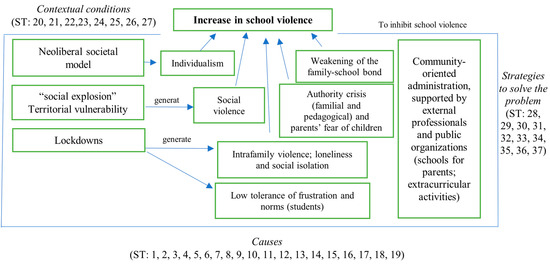
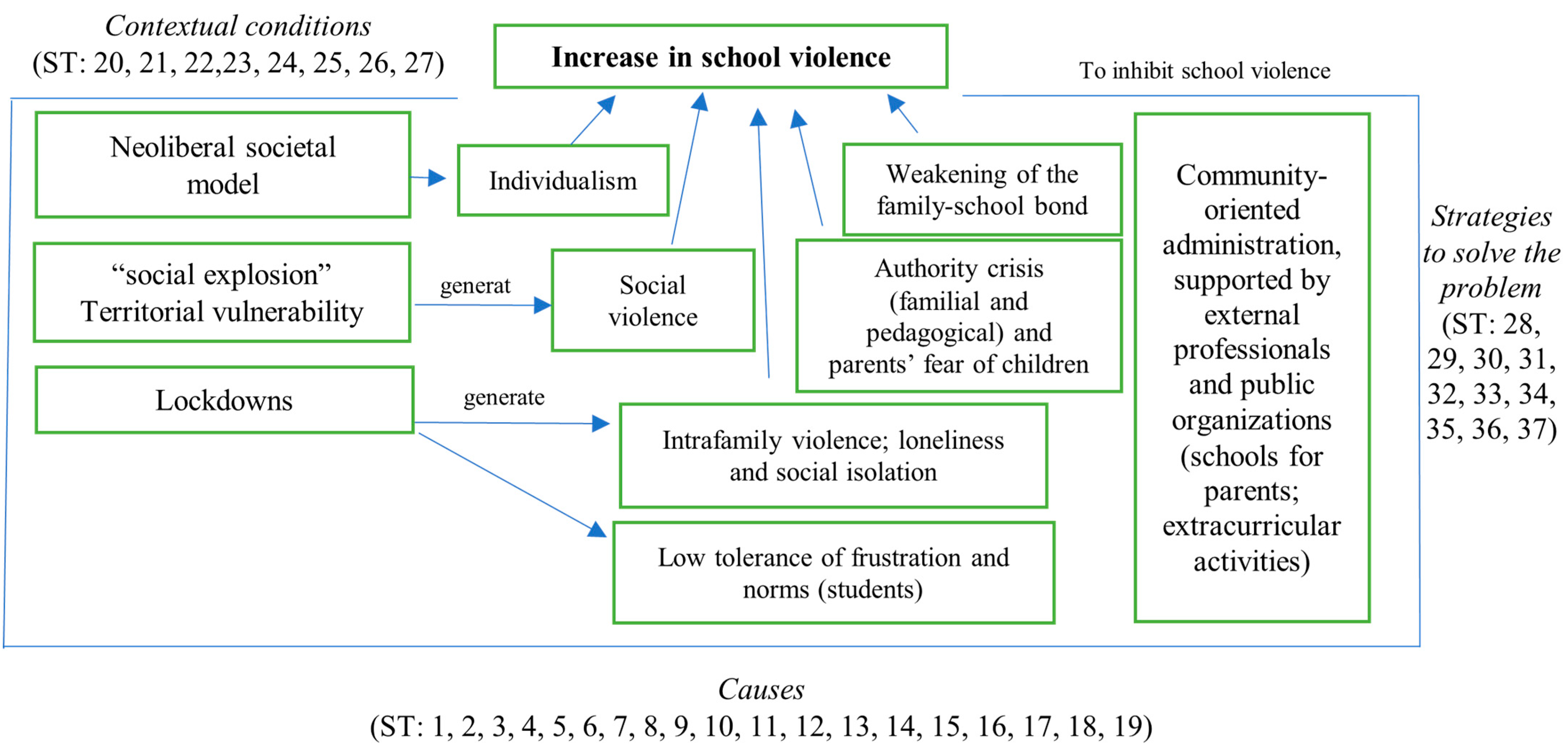
In line with studies that analyzed the STs of other actors in the Chilean education system (Chilean Ministry of Education leaders, teachers, and school principals), from the perspective of the participating associations, participants tended to view school violence as not primarily originating in schools, but rather as an external or “imported” phenomenon grounded in wider structural and contextual conditions (P. J. Castro-Carrasco et al., 2025; Roe & Castro, 2017). As Figure 1 shows, participants’ accounts suggest that the sources of school violence may include factors such as the period of nationwide social upheaval in 2019, the socioeconomic vulnerability of local territories (e.g., municipalities and regions in which schools are located), pandemic lockdowns, and what participants described as broader features of the social and economic organization of society. Based on participants’ accounts, these conditions can be interpreted as contributing to an environment of systemic tension that may indirectly influence schools.
Figure 1.
Conceptual diagram of school violence.
One relevant finding concerns the association between work demands and the weakening of parents’ roles and authority, which participants linked to the delegation of educational responsibilities to the school. They associated this dynamic with a lack of norms, failure to transmit values, and parents’ fear of exercising authority, leading students to be intolerant of institutional norms, thus influencing the expression of school violence. Likewise, participants interpreted the lockdowns as a critical event that was interpreted by participants as intensifying intrafamily violence issues, mental health problems, and child loneliness. They also linked the emergence of social violence to the 2019 social uprising in Chile (Jiménez-Yañez, 2020)—a wave of nationwide protests that affected multiple regions of the country—and to what participants described as territorial vulnerability, a term used to refer to municipalities or regions characterized by a high concentration of poverty and social exclusion (Sánchez-Martí, 2024). Overall, participants described these conditions as external influences that exceed the school’s mandate and educational capacity, reinforcing a sense of institutional impotence in addressing school violence.
Faced with this situation, the participating association representatives proposed strategies aimed at managing and addressing school violence, reflecting a new comprehension of the problem characterized by a shift to community-based and systemic approaches rather than punitive or individualized ones. They identified incorporating school climate experts as a key strategy for dealing with institutional impotence and the insufficiency of school climate training, along with improving the response to issues associated with intrafamily violence, mental health, and child loneliness. In addition, participants described extracurricular and recreational activities as mechanisms for addressing students’ low tolerance of institutional norms. Finally, they discussed collaborative work across levels, together with initiatives like schools for parents and an open-door school policy, to strengthen parents’ role and authority and restore the concept of shared educational responsibility. Taken together, these strategies indicate that for these participants, participants emphasized that school violence should be addressed through a collective process aimed at reconstructing the social fabric among family, school, and community.
Although the interpretive model emphasizes multisystemic and structural explanations, alternative readings of the data are also possible. Some of the STs identified—particularly those referring to parental authority, lack of norms, or transmission of values—can be interpreted in more normative or moral frameworks that emphasize individual or family responsibility. These perspectives coexist with more systemic and community-oriented interpretations, reflecting underlying tensions in how school violence is understood. Acknowledging these alternative interpretations helps to avoid a unidirectional reading of the findings and highlights the plurality of explanatory logics present in participants’ accounts.
4.2. Implications
The findings of this study have relevant implications for educational practice and policy, particularly regarding how school violence is conceptualized and addressed. The STs identified suggest that families tend to interpret violence through a multisystemic lens, linking it to family dynamics, school organization, and broader social conditions. These findings suggest the relevance of moving beyond individual or punitive approaches, as reflected in the emphasis placed on research on school violence (Turanovic & Siennick, 2022) and policies regarding educational reactivation and school coexistence in Chile (Ascorra et al., 2018; Morales & López, 2019), and strengthening school climate policies grounded in collaboration among families, schools, and communities. In practical terms, this involves promoting participatory governance structures, integrating specialized school climate professionals, and designing interventions that address socioemotional development, communication, and conflict resolution across levels of the educational system.
At the same time, the presence of normative and moral explanations—such as the emphasis on parental authority or the transmission of values—suggests that interventions must also consider the belief systems that orient family and institutional practices. Rather than dismissing these perspectives, educational policies and programs should engage with them critically, creating spaces for dialogue and training that support families in their educational role while aligning with evidence-based approaches to school convivencia. This includes the development of parent education initiatives, community-based programs, and intersectoral support networks capable of addressing issues such as mental health, intrafamily violence, and social vulnerability, which are perceived as underlying conditions of school violence (Cuadra-Martínez et al., 2021).
5. Conclusions
The results presented in this article reveal the importance of NPAs’ attachment to parental authority, school management, the nature of the family–school relationship, the psychosocial characteristics of the neighborhood contexts in which schools are located, and timely state intervention as relevant dimensions for explaining school violence during the post-pandemic period. Taken together, these explanations may contribute to formulating causal hypotheses at multiple systemic and ecological levels, consistent with the model advanced by Bronfenbrenner (2005) and recent multilevel approaches to the study of school violence (Klun et al., 2025). The STs identified in the study point to both macrosystemic factors—such as migratory processes, the social explosion of 2019, and the primacy of individualist cultural values in Chilean society—and institutional and relational dynamics typical of school and family settings. Likewise, all participants acknowledged the impact of the lockdowns and prolonged interruption of in-person classes on children’s and adolescents’ socialization, emotional well-being, and behavioral regulation. These explanations are consistent with the international literature, which has documented the psychosocial effects of the pandemic on children and adolescents and its association with increased school conflict (Llorent et al., 2023; Samji et al., 2022; UNICEF, 2021).
Nevertheless, the analysis also revealed the presence of moral and normative narratives, particularly in connection with the parental authority crisis or the view that violence stems from a lack of values. These interpretations, which had already been supported in several studies about authority figures in Chile (Araujo, 2022), are relevant inasmuch as they orient proposals for action toward restoring discipline and obedience, rather than strengthening socioemotional capacities and community work. Though these positions convey legitimate concerns of families, they also reproduce conceptual frameworks associated with punitive approaches to school violence and school climate that have been widely challenged in critical educational research (Ascorra & Morales, 2019).
Future studies could explore in greater depth the distinction between the descriptive and prescriptive dimensions of subjective theories, analyzing how particular explanations of school violence are associated with specific normative assumptions and action-oriented proposals.
The results also reveal internal tensions among these NPAs, expressed through the coexistence of divergent ways of interpreting and addressing school violence. Although some participants emphasized the authority crisis and the need for greater institutional control, others stressed the importance of community governance, parental training, and the strengthening of bonds among school, family, and territory. These tensions reflect the opposition between control-oriented approaches and community-based views of school climate (Morales & López, 2019) and include minority voices that warn of the politicization of certain parents’ centers. Thus, NPAs do not constitute a homogeneous actor; rather, they hold heterogeneous ideological positions that directly influence their diagnoses and proposals for action.
With respect to strategies for action, the participants widely regarded school as a community-oriented, open, and participatory space that is closely linked with its social environment. However, they said this ideal is hindered by insufficient public support. The association representatives criticized the excessive bureaucratization of school management and the primacy of administrative and control-oriented approaches over policies focused on strengthening professional capacities, pedagogical management, and educational programs for families and students. These criticisms are in line with diagnoses that question the bureaucratic and managerialist character of Chile’s educational policy, especially with respect to how school climate and school violence are addressed (Morales & López, 2019).
6. Study Limitations
This study has several limitations. First, the sample was small (n = 4) and drawn from a limited and hard-to-reach population. Chile lacks an official registry of NPAs or legislation governing their operation, and only six active associations were identified through independent searches, of which four agreed to participate. Furthermore, purposive sampling and the focus on association presidents limit the scope of the findings. Although these participants provided informed perspectives in their representative roles, their views cannot be assumed to reflect those of all families, parent organizations, or even the full executive boards of their associations.
Second, the study adopted a qualitative and interpretative design aimed at reconstructing STs and identifying recurring explanatory patterns. Consequently, the findings should be understood as exploratory rather than statistically representative, reflecting interpretations constructed in the Chilean post-pandemic context. Future research could expand these findings by incorporating larger and more diverse samples, including additional members of parent organizations and other educational actors.
Despite these limitations, the study contributes a novel perspective by making visible the STs of Chilean NPAs, an actor that has received little scholarly attention and for which few official records exist. The findings provide an initial analytic understanding of the explanatory frameworks that orient their collective action while highlighting multisystemic explanations and internal ideological tensions regarding school violence. They also offer relevant insights for policies that recognize parent associations as actors in public affairs and promote shared responsibility among schools, families, communities, and the state.
Author Contributions
Conceptualization, V.G., P.F., C.C.-A. and P.J.C.-C.; methodology, V.G., P.F. and V.C.-V.; software, P.F.; validation, C.C.-A. and V.C.-V.; formal analysis, V.G. and P.F.; resources, P.J.C.-C. and V.G.; writing—original draft preparation, V.G. and P.F.; writing—review and editing, C.C.-A.; visualization, F.R.-P.V.; supervision, P.J.C.-C.; project administration, P.J.C.-C.; funding acquisition, P.J.C.-C. All authors have read and agreed to the published version of the manuscript.
Funding
This research was funded by ANID/Fondecyt Regular No. 1231667, “La construcción social en Chile de la convivencia y violencia escolar post vuelta a la educación presencial. Un estudio de teorías subjetivas colectivas”; ANID/Fondecyt Regular Nº 1250042, “Convivencia Escolar: La formación de Conflictividad y Colaboración en la Relación Familias-Escuela desde las Teorías Subjetivas”, and RYC2023-042800-I funded by MCIN/AEI/10.13039/501100011033 and by ESF+.
Institutional Review Board Statement
The study was conducted in accordance with the Declaration of Helsinki and approved by the Ethics Committee of Universidad de La Serena (approval code N°05-23 CEC-ULS, approval date 4 May 2023).
Informed Consent Statement
Informed consent was obtained from all participants involved in the study.
Data Availability Statement
The researchers cited materials they deposited in a trusted repository.
Acknowledgments
The authors have reviewed and edited the output and take full responsibility for the content of this publication.
Conflicts of Interest
The authors declare no conflicts of interest.
Abbreviations
The following abbreviations are used in this manuscript:
| NPA | National parent association |
| ST | Subjective theory |
References
- Araujo, K. (2022). Figuras de autoridad: Transformaciones históricas y ejercicios contemporáneos. LOM Ediciones. [Google Scholar]
- Ascorra, P., López, V., Carrasco-Aguilar, C., Pizarro, I., Cuadros, O., & Núñez, C. G. (2018). Significados atribuidos a la convivencia escolar por equipos directivos, docentes y otros profesionales de escuelas chilenas. Psykhe, 27(1), 1–12. [Google Scholar] [CrossRef] [Scilit]
- Ascorra, P., & Morales, M. (2019). Finalidades de la política educativa en convivencia escolar en América latina: Algunas lecciones que sacar. In Una década de investigación en convivencia escolar (P. Ascorra, & V. López, Coord.; pp. 51–81). Ediciones Universitarias de Valparaíso. [Google Scholar]
- Asociación de Municipalidades de Chile. (2022). Sondeo de opinión a padres, madres y/o apoderados sobre violencia escolar en Chile. Available online: https://amuch.cl/wp-content/uploads/2025/07/Encuesta-nacional-sobre-Violencia-Escolar_compressed.pdf (accessed on 8 October 2025).
- Álvarez, C. Á., & Bilbao, E. S. P. (2023). Asociaciones de familiares en centros públicos de educación secundaria. Contextos Educativos, 32, 325–346. [Google Scholar] [CrossRef] [Scilit]
- Álvarez-Álvarez, C. (2020). Parental involvement in Spanish schools: The role of parents’ associations (AMPAs). Improving Schools, 23(2), 125–139. [Google Scholar] [CrossRef] [Scilit]
- Biblioteca del Congreso Nacional de Chile. (1990). Decreto 565: Aprueba reglamento general de centros de padres y apoderados para los establecimientos educacionales reconocidos oficialmente por el Ministerio de Educación. Available online: https://www.bcn.cl/leychile/navegar?idNorma=14275 (accessed on 9 October 2025).
- Biblioteca del Congreso Nacional de Chile. (2009). Ley No. 20.370: Establece la ley general de educación, Ministerio de Educación. Available online: https://www.bcn.cl/leychile/navegar?idNorma=1006043 (accessed on 10 October 2025).
- Bolaños, D., & Stuart Rivero, A. J. (2019). La familia y su influencia en la convivencia escolar. Revista Universidad y Sociedad, 11(5), 140–146. [Google Scholar]
- Bordin, I. A., & Handegård, B. H. (2023). Factors associated with peer victimization among Brazilian low-income adolescents. Journal of Aggression, Maltreatment and Trauma, 32(11), 1511–1530. [Google Scholar] [CrossRef] [Scilit]
- Braun, V., & Clarke, V. (2006). Using thematic analysis in psychology. Qualitative Research in Psychology, 3(2), 77–101. [Google Scholar] [CrossRef] [Scilit]
- Braun, V., & Clarke, V. (2019). Reflecting on reflexive thematic analysis. Qualitative Research in Sport, Exercise and Health, 11(4), 589–597. [Google Scholar] [CrossRef] [Scilit]
- Bronfenbrenner, U. (2005). Making human beings human: Bioecological perspectives on human development. Sage. [Google Scholar]
- Bullying Sin Fronteras. (2023). Estadísticas mundiales de bullying. Available online: https://bullyingsinfronteras.blogspot.com/2018/11/estadisticas-de-bullying-en-chile.html (accessed on 8 October 2025).
- Castro-Carrasco, P., Cuadra-Martínez, D., Gubbins, V., Rodríguez-Pastene-Vicencio, F., Carrasco-Aguilar, C., Caamaño-Vega, V., & Zelaya, M. (2024). Subjective theories of the Chilean teachers’ union about school climate and violence after the pandemic: A study of web news. Frontiers in Education, 9, 1455387. [Google Scholar] [CrossRef] [Scilit]
- Castro-Carrasco, P. J., Gubbins, V., Caamaño, V., González-Palta, I., Rodríguez-Pastene Vicencio, F., Zelaya, M., & Carrasco-Aguilar, C. (2025). Public discourse of the Chilean Ministry of Education on school violence and convivencia escolar: A subjective theories approach. Social Sciences, 14(9), 539. [Google Scholar] [CrossRef] [Scilit]
- Catalán, J. (2010). Teorías subjetivas: Aspectos teóricos y prácticos. Universidad de La Serena. [Google Scholar]
- Catalán, J. (2018). Interpretación y cambio de teorías subjetivas. Universidad de La Serena. [Google Scholar]
- Cuadra-Martínez, D., Castro-Carrasco, P. J., Tognetta, L. R. P., Pérez-Zapata, D., Véliz-Vergara, D., & Menares-Ossandón, N. (2021). Teorías subjetivas de la convivencia escolar: ¿Qué dicen los padres? Psicología Escolar e Educacional, 25, e221423. [Google Scholar] [CrossRef] [Scilit]
- Elacqua, G., & Santos, H. (2013). Preferencias reveladas de los proveedores de educación privada en Chile: El caso de la ley de subvención escolar preferencial. Gestión y Política Pública, 22(1), 85–129. [Google Scholar]
- Flick, U. (1987). Das subjekt als theoretiker? Zur subjektiviät subjektiver theorien. In J. Bergold, & U. Flick (Eds.), Ein-sichten: Zugänge zur sicht des subjekts mittels qualitativer forschung (pp. 125–134). Deutsche Gesellschaft für Verhaltenstherapie e.V. [Google Scholar]
- Flick, U. (2014). Handbook of qualitative data analysis. Sage. [Google Scholar]
- Flick, U. (2023). An introduction to qualitative research. Sage. [Google Scholar]
- Gadewoltz, P. N. (2026). The research program subjective theories: A methodological concept for a wide range of applications. GMS Journal for Medical Education, 43(1), 5. [Google Scholar] [CrossRef] [Scilit] [PubMed]
- Gallego-Jiménez, M. G., Rodríguez Otero, L. M., & Solís García, P. (2021). El bullying en el marco de la escuela inclusiva: Revisión sistemática. Páginas de Educación, 14(1), 26–51. [Google Scholar] [CrossRef] [Scilit]
- García, S. O. (2014). Alternativas para llevar a cabo entrevistas retrospectivas en investigaciones sobre la adquisición de la producción oral en español como lengua extranjera. Linred: Lingüística en la Red, 12, 11. [Google Scholar]
- Janssens, S., & Kelchtermans, G. (1997, March 24–28). Subjective theories and professional self of beginning teachers [Presentation]. Annual Meeting of the American Educational Research Association, Chicago, IL, USA. [Google Scholar]
- Jiménez-Yañez, C. (2020). #Chiledespertó: Causas del estallido social en Chile [#ChileWokeUp: Causes of the social uprising in Chile]. Revista Mexicana de Sociología, 82(4), 949–957. [Google Scholar] [CrossRef] [Scilit]
- Jornet-Meliá, J. M., Sancho-Álvarez, C., & Bakieva-Karimova, M. (2022). Analysis of profiles of family educational situations during COVID-19 lockdown in the Valencian community (Spain). Societies, 13(1), 10. [Google Scholar] [CrossRef] [Scilit]
- Klun, M., Bučar Ručman, A., & Frangež, D. (2025). Violence against parents by adult children: A systematic literature review of empirical studies. Trauma, Violence, and Abuse, 26(3), 451–467. [Google Scholar] [CrossRef] [Scilit] [PubMed]
- Krause, M. (1995). La investigación cualitativa: Un campo de posibilidades y desafíos. Temas de Educación, 7, 19–39. [Google Scholar] [CrossRef] [Scilit]
- Llorent, V. J., Seade-Mejía, C., & Vélez-Calvo, X. (2023). Lockdown, cyberhate, and protective factor of social-emotional and moral competencies in primary education. Comunicar, 31(77), 105–114. [Google Scholar] [CrossRef] [Scilit]
- Lundqvist, J., Westling Allodi, M., & Siljehag, E. (2019). Values and needs of children with and without special educational needs in early school years: A study of young children’s views on what matters to them. Scandinavian Journal of Educational Research, 63(6), 951–967. [Google Scholar] [CrossRef] [Scilit]
- Maxwell, J. A. (2012). The importance of qualitative research for causal explanation in education. Qualitative Inquiry, 18(8), 655–661. [Google Scholar] [CrossRef] [Scilit]
- MINEDUC. (2017a). Ley de inclusión escolar: El primer gran debate de la reforma educacional. Available online: https://centroestudios.mineduc.cl/wp-content/uploads/sites/100/2018/03/libro_Inclusi%C3%B3n_final.pdf (accessed on 9 June 2025).
- MINEDUC. (2017b). Política de participación de las familias y la comunidad en instituciones educativas. Available online: https://convivenciaparaciudadania.mineduc.cl/wp-content/uploads/2022/07/Politica_de_Participacion_FamiliasyComunidad.pdf (accessed on 10 June 2025).
- MINEDUC. (2023). Plan de reactivación educativa 2023. Available online: https://reactivacioneducativa.mineduc.cl/wp-content/uploads/sites/127/2023/07/Plan-de-Reactivacion-Educativa.07.2023-1.pdf (accessed on 10 December 2025).
- MINEDUC, CIAE & PUC. (2022). Análisis de resultados de encuesta nacional de monitoreo de establecimientos de educación en pandemia: Aprendiendo desde la realidad nacional. Available online: https://www.covideducacion.cl/_files/ugd/493531_4708db006b894723aefe856119b9101e.pdf (accessed on 11 December 2025).
- Morales, M., & López, V. (2019). Políticas de convivencia escolar en América Latina: Cuatro perspectivas de comprensión y acción. Education Policy Analysis Archives, 27, 5. [Google Scholar] [CrossRef] [Scilit]
- Mucchielli, A. (2001). Diccionario de métodos cualitativos. Síntesis. [Google Scholar]
- OECD. (2022). Education at a glance 2022: OECD indicators. OECD. [Google Scholar] [CrossRef] [Scilit]
- Povey, J., Campbell, A. K., Willis, L. D., Haynes, M., Western, M., Bennett, S., Antrobus, E., & Pedde, C. (2016). Engaging parents in schools and building parent-school partnerships: The role of school and parent organisation leadership. International Journal of Educational Research, 79, 128–141. [Google Scholar] [CrossRef] [Scilit]
- Rodríguez-Pastene, F., Sorza, S., Castro-Carrasco, P. J., Carrasco-Aguilar, C., Gubbins, V., Caamaño-Vega, V., & Zelaya, M. (2025). Press and school violence: Subjective theories in the post-pandemic narratives in Chilean online newspapers. COVID, 5(12), 208. [Google Scholar] [CrossRef] [Scilit]
- Roe, G. R., & Castro, P. J. (2017). Teorías subjetivas de profesores acerca de su rol en la construcción de la convivencia escolar. Polis, 16(46), 321–345. [Google Scholar] [CrossRef] [Scilit]
- Saldaña, J. (2025). The coding manual for qualitative researchers (5th ed.). Sage. [Google Scholar]
- Samji, H., Wu, J., Ladak, A., Vossen, C., Stewart, E., Dove, N., Long, D., & Snell, G. (2022). Mental health impacts of the COVID-19 pandemic on children and youth—A systematic review. Child and Adolescent Mental Health, 27(2), 173–189. [Google Scholar] [CrossRef] [Scilit] [PubMed]
- Sánchez-Delgado, P., Bakieva-Karimova, M., Sancho-Álvarez, C., & Jornet-Meliá, J. M. (2022). Estudio diferencial del rol familiar en la educación a distancia en confinamiento debido al COVID-19. Revista Electrónica de Investigación Educativa, 24, e16. [Google Scholar] [CrossRef] [Scilit]
- Sánchez-Martí, J. A. (2024). Poverty and economic inequality according to territorial vulnerability. European Public & Social Innovation Review, 9, 1–18. [Google Scholar] [CrossRef] [Scilit]
- Secretaría de Educación Pública. (2021). Boletín SEP no. 123 refrenda SEP trabajo colaborativo con la asociación nacional de padres de familia. Available online: https://www.gob.mx/sep/es/articulos/boletin-sep-no-123-refrenda-sep-trabajo-colaborativo-con-la-asociacion-nacional-de-padres-de-familia (accessed on 22 March 2026).
- Stake, R. E. (2005). Qualitative case studies. Sage. [Google Scholar]
- Superintendencia de Educación. (2021). Formulario de autoevaluación Plan Integral de Seguridad Escolar (PISE). Available online: https://www.supereduc.cl/wp-content/uploads/2021/10/modelo_orientador21.pdf (accessed on 12 November 2024).
- Tapullima-Mori, C., Pizzán Tomanguillo, S. L., & Pizzán Tomanguillo, N. D. P. (2023). Violencia familiar en el comportamiento académico reactivo adolescente: Una revisión sistemática. Propósitos y Representaciones, 112, e1766. [Google Scholar] [CrossRef] [Scilit]
- Turanovic, J. J., & Siennick, S. E. (2022). The causes and consequences of school violence: A review. National Institute of Justice. Available online: https://files.eric.ed.gov/fulltext/ED619329.pdf (accessed on 13 November 2024).
- UNICEF. (2021). Life in lockdown: Child and adolescent mental health and well-being in the time of COVID-19. Available online: https://www.unicef.org/innocenti/media/5216/file/UNICEF-Life-in-Lockdown-2021.pdf (accessed on 29 May 2025).
- Vivallo-Urra, Ó. G., Dougnac-Quintana, P. A., Rosas-Leutenegger, M., & Castro-Machuca, Y. C. (2024). Redes de gobernanza escolar: Experiencia y desafíos de mujeres líderes de centros de padres y apoderados de establecimientos educacionales públicos del territorio Costa Araucanía (Chile). Iberoamerican Journal of Development Studies, 13(1), 136–160. [Google Scholar] [CrossRef] [Scilit]

Disclaimer/Publisher’s Note: The statements, opinions and data contained in all publications are solely those of the individual author(s) and contributor(s) and not of MDPI and/or the editor(s). MDPI and/or the editor(s) disclaim responsibility for any injury to people or property resulting from any ideas, methods, instructions or products referred to in the content. |
© 2026 by the authors. Licensee MDPI, Basel, Switzerland. This article is an open access article distributed under the terms and conditions of the Creative Commons Attribution (CC BY) license.