


Abstract
In the current higher education landscape, students frequently resort to “cramming” or massed study practices, which often lead to superficial learning and rapid information decay rather than long-term memory (LTM) consolidation. This systematic review aims to analyze the evidence on the effectiveness of neurodidactic strategies based on spaced learning for LTM consolidation in university contexts. Following the PRISMA statement and the PICOS model, a comprehensive search was conducted in Scopus and Web of Science, identifying 19 empirical studies that met the eligibility criteria. The corpus was then subjected to a risk of bias assessment using RoB-2, ROBINS-I, and MMAT. The results indicate that neurodidactic strategies—categorized into operative, methodological, and socio-emotional types—are associated with improved knowledge retention in several contexts when learning episodes are distributed over time. Some studies report positive trends in retention compared to massed practice, particularly in health sciences and language learning, but the heterogeneity of methodologies and outcome measures limits definitive conclusions. Therefore, while the integration of spaced learning within a neurodidactic framework appears promising, the evidence should be interpreted as suggestive rather than conclusive, and further research is needed to confirm these observations across diverse settings. This systematic review has been registered in the Open Science Framework (OSF).
1. Introduction
1.1. Rationale
In the current higher education landscape, students face a critical dilemma. Despite having unlimited access to vast amounts of resources, academic pressure for immediate results has led to information overload and inefficient time management (Xavier & Meneses, 2022). This environment often triggers superficial learning and cognitive fatigue, where knowledge is acquired rapidly to satisfy evaluative processes, yet information fails to consolidate into long-term memory (LTM) (French et al., 2024). Studies such as that of Lenny (2025) indicate that the single-examination modality reinforces “cramming” or massed study practices at the last minute, resulting in cognitive overload and lower post-exam content retention. Consequently, there is a major need to move beyond traditional rote memorization and adopt pedagogical approaches that address these specific challenges, providing tangible solutions for the student.
In this regard, neurodidactics has gained significant relevance due to its potential to transform traditional methodologies into more effective, learner-centered practices focused on understanding how the brain learns and retains information (Cordero & Aguirre, 2024). According to Romero (2024), it is recognized as an emerging field of pedagogy that integrates neuroscience and cognitive science with education to design more effective didactic strategies that enhance brain development; Casasola (2022) includes it in the processes of research and pedagogical innovation that seek to unify findings related to brain function and place them at the service of education. In other words, it allows for the translation of neuroscientific evidence into concrete classroom actions that support the configuration and optimization of the teaching–learning process.
Sánchez et al. (2023) argue that neurodidactic strategies improve students’ ability to “learn how to learn” by aligning educational practices with individual skills and talents; simultaneously, they seek to achieve learning outcomes consistent with educational policies and established curricula. In addition, Tacca et al. (2019) emphasize that these strategies prioritize the construction of meaning through sustained peer interaction, contextualized analysis of concepts and cases, problem formulation, real-world application of content, the generation of novel solutions, and the development of systemic and speculative thinking supported by effective emotional regulation. Similarly, Espinoza et al. (2022) identify neurodidactic strategies as innovative approaches that strengthen teaching practice and contribute to the development of transferable learning in both academic contexts and daily life.
In recent years, research by Condori (2021); Espinoza et al. (2022); Ocampo (2020); and Sánchez et al. (2023) has adopted the categorization of neurodidactic strategies originally proposed by Boscán (2011), which identified three main types: operative, methodological, and socio-emotional. According to Tacca et al. (2019), operative strategies refer to creative stimuli through which teachers apply methods, techniques, and tools aligned with students’ prior knowledge, needs, and contextual characteristics, fostering inquiry, analysis, and knowledge construction through logical processes. Methodological strategies function as knowledge organizers, comprising structured steps and procedures that allow for self-regulated learning construction. Meanwhile, socio-emotional strategies focus on understanding and supporting the emotional and affective states of students to improve learning processes, including practices such as peer tutoring, reflective activities, relaxation techniques, feedback, and awareness-raising strategies. Together, these strategies can be used to optimize academic results and improve the engagement and commitment of students within the educational experience.
However, despite the growing evidence supporting innovative alternatives like neurodidactic strategies, the consolidation of long-term memory (LTM) in future professionals remains limited by a continued reliance on traditional pedagogical methods (Vagha et al., 2025). These methods implicitly promote massed study behaviors among university students, where learning is concentrated into short, uninterrupted sessions focused on the rapid accumulation of information (Burel et al., 2025). Although this approach may improve immediate performance (Namaziandost et al., 2020), records indicate that massed conditions do not allow for the creation of lasting memory traces, as the absence of temporal distribution limits consolidation processes and increases susceptibility to forgetting curves (Cepeda et al., 2006). As a result, the knowledge acquired by the student exhibits low retention stability and reduced transferability (Jape et al., 2022), restricting the effective application of what has been learned in authentic and complex problem-solving situations.
In contrast, Al-Khasawneh (2023), Kim and Webb (2022) and Walsh et al. (2023) point to spaced learning as an effective study alternative that improves memory when learning episodes are distributed over time rather than concentrated in a single session. Furthermore, Yang et al. (2025) explain that prolonged intervals between learning sessions allow for spontaneous neuronal reproduction and integration processes, facilitating hippocampal–cortical transfer and the stabilization of memory traces. Al-Khasawneh (2023) argues that learning episodes typically include review practices, where students are re-exposed to content, and retrieval practices, which require them to actively recall previously learned information. When these practices are implemented using intervals ranging from minutes to months and interspersed with rest periods, the spacing effect emerges, which is associated with significant improvements in memory retention (Cepeda et al., 2006; Khalafi et al., 2024; Llorens-Gámez et al., 2022).
Studies have reported positive results for spaced learning in higher education, particularly in the health sciences (Versteeg et al., 2020). The findings of Chugh and Tripathi (2020) indicate that the administration of spaced educational material led to significant improvements in formative assessment scores over a 24-week period and knowledge retention at 72 weeks. Similarly, Vagha et al. (2025) implemented digital flashcards with spaced repetition intervals of 1, 3, 7, 14, and 28 days, reporting significantly higher post-test scores in the intervention group compared to the control group (16.24 vs. 11.89; p < 0.0001); moreover, over 90% of intervention participants showed improvements in retention, engagement, and confidence. Extending these findings to pre-academic contexts, Burel et al. (2025) reported that medical school applicants who successfully passed entrance exams used spaced repetition strategies much more frequently than non-admitted candidates (44.8% vs. 20.3%). Incorporating this practice reveals a consistent association between spaced learning, retrieval processes, LTM consolidation, and a higher probability of successful recall, which supports sustained academic performance and future professional competence.
In light of these findings, spaced learning can be understood as a response to the progressive shift away from rote memorization and traditional study practices in educational discourse (Mawson & Kang, 2025), as it is widely considered one of the primary techniques for processing new information and developing LTM (Smolen et al., 2016). To conceptualize LTM, it is essential to recognize memory as the brain’s ability to encode, store, and retrieve information when needed. This capacity is indispensable for daily functioning, relationship formation, learning, and personal development, fundamentally contributing to human identity (Jawabri & Cascella, 2025).
In the multi-store model of memory proposed by Atkinson and Shiffrin in 1968, also known as the modal model, it is assumed that memory consists of three structural storage components: the sensory register (or sensory memory), short-term memory (STM), and long-term memory (LTM) (Baddeley et al., 2019). The sensory register is responsible for the initial assimilation of information obtained through the senses (Goldstein, 2019), while STM—also known as primary or active memory—facilitates the temporary storage and manipulation of limited information for brief periods, typically up to 30 s. In contrast, LTM is associated with the prolonged retention of information and is characterized by its virtually unlimited capacity and duration, allowing information to be stored and accessed over extended periods (Finotelli & Eustache, 2023; Jawabri & Cascella, 2025).
Camina and Güell (2017) state that LTM can be subdivided into declarative (or explicit) memory and non-declarative (or implicit) memory. The former refers to the ability to evoke information about events or objects (DeBrigard et al., 2013), which essentially depends on the medial temporal lobe; the hippocampus plays a leading role in acquiring new memories and integrating them into existing cognitive frameworks (Dickerson & Eichenbaum, 2010). Declarative memory is further divided into two main subcategories: episodic memory, which covers memories of personal experiences and specific events, and semantic memory, which integrates general knowledge about the world, concepts, and facts (Sridhar et al., 2023). In this sense, the formation of these memories involves a complex process of consolidation, where information is initially processed in the hippocampus and gradually transferred to the neocortex for long-term retention.
On the other hand, non-declarative memory is a fundamental cognitive architecture responsible for managing memories and skills that operate below conscious awareness, thus facilitating the automatic execution of tasks without requiring excessive cognitive effort. According to Squire and Zola (1996), this system is involuntary and consists of procedural memory for motor skills and habits, associative and non-associative learning driven by environmental conditioning, and priming, which improves information recognition based on previous exposure. By allowing the brain to process and store complex information without conscious intervention, the system establishes an essential foundation for autonomous learning, enabling a fluid transition from initial instruction to the effortless mastery of certain skills (Camina & Güell, 2017).
It is worth noting that Finotelli and Eustache (2023) based their multi-store model on previous empirical findings, particularly the studies of Hebb (1961) and Melton (1963), which demonstrated that repeated exposure to information strengthens LTM. This perspective is also closely linked to the seminal work of Ebbinghaus (1913) on memory, which demonstrates that forgetting increases when information is studied or revisited fewer times. These key findings provide a direct basis for spaced learning, as they highlight repetition as a crucial mechanism for durable memory formation while underscoring the limitations of infrequent or poorly structured practice. Spaced learning extends this principle by distributing repetitions over time rather than concentrating them in a single session, thereby optimizing consolidation processes in LTM. By counteracting the rapid decay described in the forgetting curve, spaced learning facilitates more stable encoding and more efficient retrieval, ultimately promoting long-term retention of information and its transfer to new learning contexts and professional problem-solving scenarios.
The Cognitive Load Theory (CLT) posits that effective learning depends on the balance between the biological limitations of working memory and the unlimited capacity of long-term memory (Zou et al., 2025). According to this framework, pedagogical efficiency is achieved by managing three critical dimensions: minimizing extraneous load caused by poor instructional design, modulating intrinsic load linked to the complexity of the material, and enhancing germane load to facilitate the construction of solid mental schemas (Paas & Van Merriënboer, 2020). Thus, if the sum of these factors exceeds the student’s available resources, cognitive overload occurs, hindering the processing of new information (Leppink et al., 2013). Therefore, the design of educational strategies must optimize memory processes to ensure that mental effort is focused on the construction of meaningful knowledge, effectively preventing information saturation and guaranteeing successful LTM retention.
Although spaced learning has been extensively replicated within cognitive science, its empirical evidence has not yet been comprehensively organized through a structured pedagogical lens within higher education contexts. To address this gap, this systematic review introduces a tripartite classification model—categorizing interventions into operative, methodological, and socio-emotional strategies. It is critical to acknowledge the post hoc nature of this conceptual framework; the primary studies included in this corpus were originally designed as experiments on standard cognitive spacing, automated retrieval, or distributed practice, rather than explicitly operationalized under a neurodidactic paradigm. Therefore, this framework serves as an interpretive, retrospective typology constructed by the authors of this review to synthesize the structural and pedagogical features of distributed practice, thereby bridging the epistemological gap between basic memory science and applied university instruction.
It is worth noting that while the evidence on spaced learning, or distributed practice, is supported by robust experimental paradigms and replicated neuroscientific findings (Cepeda et al., 2006; Smolen et al., 2016), it is important to emphasize that neurodidactics as an integrative field is still in an emerging phase and its empirical foundation is less consolidated. Thus, this manuscript establishes a conceptual distinction: on one hand, the effects of spaced learning are recognized as a fundamentally demonstrated phenomenon in the cognitive literature; on the other, the neurodidactic interpretation presented here—including the tripartite classification of strategies—constitutes a retrospective analytical and pedagogical construction, proposed by the authors to organize and transfer knowledge to the university context. This distinction is intended to avoid overinterpretation and reflects that the neurodidactic framework used serves as an interpretive lens rather than a direct reflection of all primary experimental designs.
Although the spacing effect is recognized as a solid psychological law, in this review, neurodidactics is used as an integrative conceptual framework. Thus, widely proven principles of memory science, such as distributed practice, not only find support in empirical neuroscience but are also deliberately presented to enhance their applicability and accessibility among university educators. This approach facilitates the translation of fundamental cognitive phenomena into concrete pedagogical strategies, connecting scientific theory with effective classroom implementation.
Consequently, to build a holistic and scientifically grounded neurodidactic framework, this review bridges the gap between applied classroom interventions and basic memory science. To achieve this, pedagogical outcomes are examined alongside mechanistic neuroscience benchmarks (e.g., neuroimaging and electroencephalography laboratory trials). These laboratory studies provide the necessary biological validation—such as tracking cortical–hippocampal transfer and neural pattern stability—that justifies and explains the cognitive efficacy of the distributed practice models implemented in higher education classrooms.
1.2. Objectives
The main objective of this study is to analyze evidence on the efficacy of neurodidactic strategies based on spaced learning for the consolidation of long-term memory in university contexts. To do so, we conducted a systematic review that compiled scientific articles indexed in high-impact academic databases such as Scopus and Web of Science (WoS). In this context, to achieve our general objective, the following research questions are proposed:
1. What are the methodological characteristics described in empirical studies on neurodidactic strategies based on spaced learning for LTM consolidation?
2. What types of neurodidactic strategies based on spaced learning are employed for LTM consolidation?
3. What are the results documented in the literature regarding the efficacy of neurodidactic spaced learning strategies on LTM?
In concrete terms, the development of neurodidactic strategies also provides a transferable model backed by a foundation that deepens the understanding of spaced learning. Furthermore, it allows educational stakeholders to recognize and implement methodologically rigorous cognitive interventions with greater confidence and coherence, ensuring that higher education practices align with the cognitive mechanisms involved during information retention. By achieving these objectives, this study addresses the methodological gap in the literature on LTM consolidation, providing practical information to researchers and educators for designing and refining neurodidactic models, proposing a structured foundation for this technique through the systematic integration of operative, methodological, and socio-affective strategies in the university setting.
To this end, the remainder of this article is organized as follows. Section 2 describes the methodological design of the systematic literature review, including the protocol and registry adopted to ensure rigor, transparency, and thematic coherence. Section 3 provides a comprehensive synthesis of the findings, categorized into three review axes. Section 4 presents a discussion based on interpretations of the results and a comparison with previous studies. Finally, Section 5 outlines our conclusions, summarizing the study’s contributions and limitations as well as avenues for future research.
2. Materials and Methods
In the present study, we adopted a systematic review methodology, as it allowed for a detailed, rigorous, transparent, and reproducible synthesis, while also reducing the risk of bias (Munn et al., 2018). Thus, complex and multidisciplinary literature was synthesized into evidence-based conclusions (Moosapour et al., 2021). To this end, the procedure involved 1. the formulation of research questions and a predefined protocol; 2. an exhaustive bibliographic search; 3. selection of studies; 4. critical evaluation of methodological quality; 5. data extraction; and 6. qualitative synthesis of the evidence.
2.1. Protocol and Registration
The review was conducted in accordance with the PRISMA (Preferred Reporting Items for Systematic Reviews and Meta-Analyses) statement (Page et al., 2021). The checklist PRISMA is located in Supplementary Materials: Tables S1 and S2.
Additionally, a detailed protocol was prospectively registered in the Open Science Framework (OSF) regarding data extraction to promote transparency and prevent subsequent modifications of methods. The protocol can be accessed via the following link: https://doi.org/10.17605/OSF.IO/2C7YR.
2.2. Eligibility Criteria
The research problem was framed using the PICOS model: Population (P), University students at the undergraduate/postgraduate level, or healthy young adult cohorts (university-aged laboratory subjects) undergoing neurological memory consolidation protocol; Intervention (I), application of neurodidactic strategies explicitly based on spaced learning or distributed practice; Comparison (C), traditional teaching methods, massed practice, or control groups without spacing interventions; Outcome (O), empirical effectiveness of the strategies demonstrated in the consolidation of long-term memory (LTM); and Study Design (S), primary empirical investigations: RCTs, experimental (between/within-subjects), quasi-experimental, ex post facto/correlational, cohorts, and mixed-methods, and laboratory-controlled cognitive neuroscience experiments utilizing neuroimaging (fMRI) or electroencephalography (EEG) as mechanistic benchmarks.
From this perspective, the inclusion and exclusion criteria used to mitigate selection bias in the scientific literature are detailed in Table 1:
Table 1.
Inclusion and exclusion criteria.
During the systematic review process, significant heterogeneity was identified in the existing empirical designs within the literature. Because of this, and in order to capture the contextual reality and ecological validity of neurodidactic interventions, eligibility was deliberately expanded to include:
- Retrospective cohort studies and correlational designs which, although they do not conduct a direct experimental comparison, allow for the analysis of the association between the use of spaced learning strategies and long-term memory outcomes in real-world contexts.
- Mechanistic laboratory studies that provide evidence on the biological and neurophysiological foundations of spaced learning, even if they do not always include a traditional massed comparison condition.
In this way, the review integrates both controlled efficacy trials and observational and mechanistic evidence, enriching the analysis and the applicability of the conclusions. The inclusion of these non-experimental studies is justified by their value in complementing the narrative synthesis, providing external validity data, and offering fundamental biological benchmarks for a comprehensive understanding of the phenomenon. In the synthesis of results, the findings from these studies are interpreted with caution and are explicitly differentiated from the results obtained from direct experimental comparisons.
2.3. Information Sources and Search Strategy
The search was conducted across high-impact academic databases: Scopus and Web of Science (WoS). No time filters were applied; thus, all available evidence up to 2026 was searched. The search string utilized Boolean operators (AND/OR) and combined controlled vocabulary and free-text terms in fields such as Title, Abstract, and Keywords. The use of various terminological tags to describe spaced learning in the search engine is justified by the literature, as multiple authors—such as Bego et al. (2024); Namaziandost et al. (2020); and Timmer et al. (2020)—have conceptualized this technique using different terms. The full advanced Boolean strings were structured as follows (Table 2).
Table 2.
Search strategy.
2.4. Selection Process and Operational Classification Protocol
Search results were compiled and deduplicated using reference management software (Zotero, version 9.0.4, created at George Mason University and maintained in Virginia by the non-profit corporation Digital Scholar). Two independent reviewers blindly screened 100% of the titles and abstracts against the predefined PICOS eligibility criteria. To systematically organize the highly heterogeneous data, both reviewers independently categorized the eligible studies into the post hoc tripartite framework based on the primary nature of the intervention:
1. Operative Strategies: Interventions focusing on external stimuli, sensory-logical scheduling, or automated algorithmic intervals.
2. Methodological Strategies: Interventions evaluating structured curricular frameworks, long-term course integration, or self-regulated study logs.
3. Socio-emotional Strategies: Interventions incorporating interactive feedback (expert or AI-driven), peer tutoring, or affective reflections alongside spacing.
The inter-rater agreement for this classification process was formally calculated using Cohen’s Kappa, yielding a highly robust coefficient (k = 0.88). Minor classification discrepancies were resolved via consensus-driven deliberations involving a third senior researcher.
2.5. Data Collection and Items
Data extraction was performed independently by two reviewers using a standardized Excel form. The following information was collected:
1. Bibliographic data: Authors, year, and country.
2. Sample characteristics: Size and age range.
3. Intervention details: Duration, frequency, time intervals between sessions, and didactic context.
4. Long-term memory outcomes: Specific measures of memory consolidation.
5. Main findings: Effect directions and relevance of neurodidactic strategies.
2.6. Assessment of Study Risk of Bias
To ensure a rigorous methodological appraisal aligned with the diverse study designs comprising the 19 included articles, a differentiated multi-diagnostic quality assessment framework was deployed (PRISMA 2020, Item 11). Rather than excluding non-interventional studies or inappropriately forcing a single tool onto structurally incompatible research architectures, each study was appraised using a validated instrument specifically engineered for its design:
- Cochrane RoB 2 Tool (Cochrane Bias Methods Group, led by researchers from the University of Bristol; Bristol, United Kingdom): Utilized exclusively for the four Randomized Controlled Trials (RCTs) (Studies 12, 13, 14, 18) to evaluate domains including the randomization process, deviations from intended interventions, missing outcome data, measurement of the outcome, and selection of the reported result.
- Cochrane ROBINS-I Tool (Cochrane Bias Methods Group, in collaboration with international academic institutions (also led by the Bristol core team); Bristol, United Kingdom): Applied to the quasi-experimental and non-randomized longitudinal intervention designs (Studies 1, 5, 7) to assess bias due to confounding, selection of participants, classification of interventions, deviations from intended interventions, missing data, measurement of outcomes, and selection of the reported results.
- Mixed Methods Appraisal Tool (MMAT, McGill University, led by Dr. Pierre Pluye and his research team; Montreal (Quebec), Canada): Employed to evaluate the structural quality, internal validity, and methodological rigor of the remaining 12 empirical studies (Studies 2, 3, 4, 6, 8, 9, 10, 11, 15, 16, 17, and 19). Depending on the specific design architecture, different methodological categories of the MMAT were leveraged: Category 2 (Quantitative Non-Randomized) was used for cohort and ex post facto/correlational tracking; Category 4 (Quantitative Descriptive) was applied to laboratory-controlled between/within-subject experimental task designs; and Category 5 (Mixed Methods) was utilized to examine the multi-method integration profile.
Table 3 has been optimized with two specific columns that accurately indicate the tool and risk-of-bias rating for each of the 19 studies. This eliminates inconsistency and provides a fully transparent review process.
Table 3.
Comprehensive data extraction and methodological quality synthesis of included studies.
2.7. Presentation of Results
Due to the heterogeneity identified in the various neurodidactic spaced-learning-based intervention modalities and the variability in LTM measurement instruments used, a qualitative narrative synthesis was performed. Consequently, the synthesis process was structured into three analytical axes:
1. Analysis of Methodological Characteristics.
2. Classification of Neurodidactic Strategies.
3. Evaluation of Efficacy in LTM.
3. Results
3.1. Study Selection
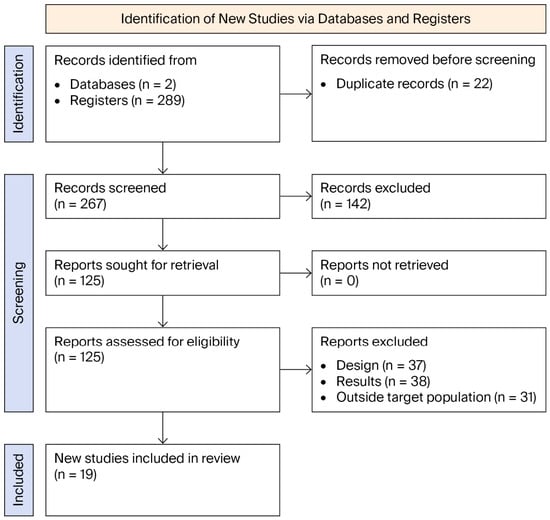
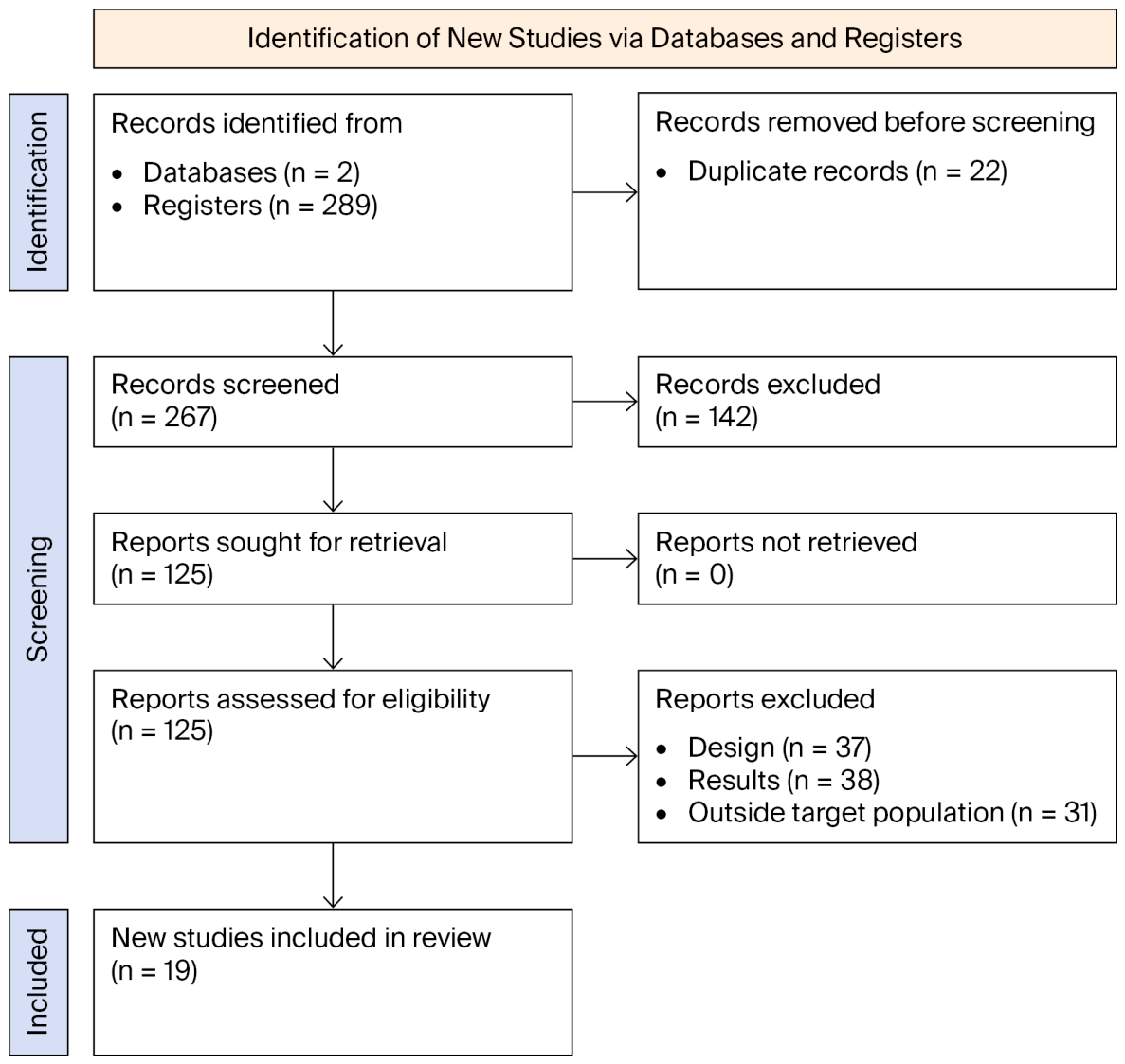
The evidence selection process was rigorously structured across three levels following the PRISMA protocol (Figure 1). It began with an identification phase in which 289 records were located across two databases, of which 22 duplicates were removed. In the second level, corresponding to the screening phase, 267 titles and abstracts were examined, resulting in the exclusion of 142 documents. This left a total of 125 reports sought for retrieval, all of which were subsequently assessed for eligibility. During the full-text review process, 106 studies were discarded due to design deficiencies (n = 37), insufficient results (n = 38), or targeting a population outside the study’s scope (n = 31). From this total, the final inclusion phase consolidated a corpus of 19 empirical articles that met all criteria for methodological rigor criteria and were subsequently integrated into the review.
Figure 1.
PRISMA flow diagram.
Specifically, of the initial corpus of 289 publications (100%), 19 studies were included (6.57%). The selected studies are presented below in Table 3.
A subset of the included corpus corresponds to high-precision cognitive neuroscience laboratory experiments (e.g., Feng et al., 2019; Litman & Davachi, 2008; Zhao et al., 2015). While laboratory trials do not constitute contextualized didactic designs in a physical university classroom, they operate within this review as vital mechanistic benchmarks. By utilizing neuroimaging (fMRI) and electroencephalography (EEG), these studies provide the underlying biological validation—such as tracking neural pattern similarity and hippocampal–cortical transfer dynamics—that justifies the translation of the spacing effect into applied “neurodidactic” classroom strategies. They bridge the gap between basic synaptic plasticity and pedagogical modeling.
3.2. Risk-of-Bias Assessment
3.2.1. Assessment of Randomized Controlled Trials (RoB 2)
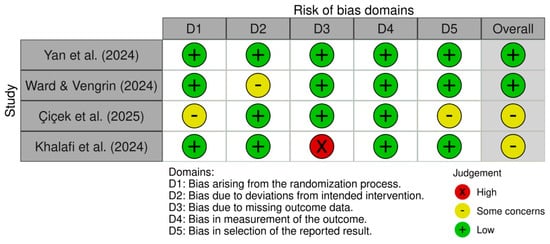
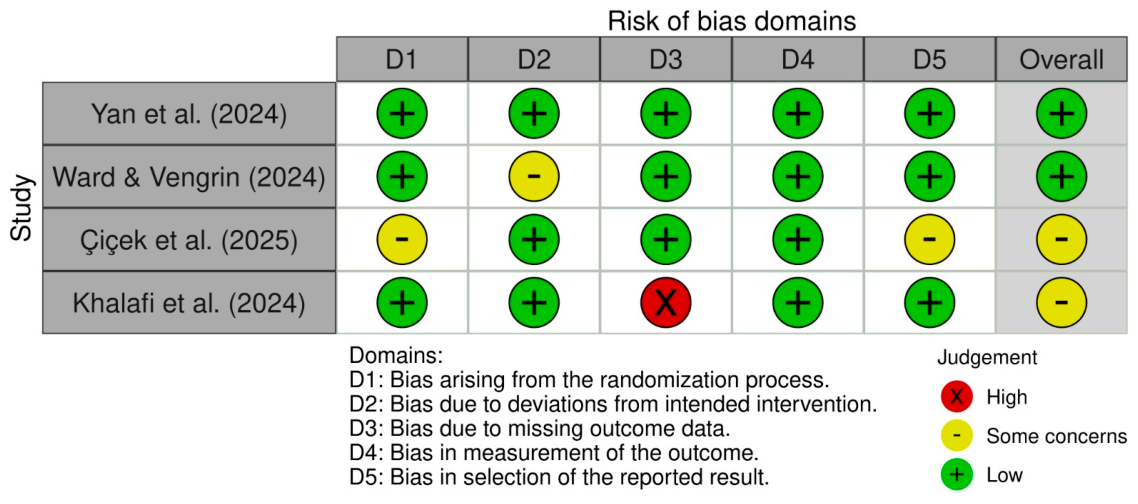
The evaluation of randomized controlled trials reveals a robust methodological framework (Figure 2). Studies such as those by Çiçek et al. (2025) and Khalafi et al. (2024) showed a “low risk” of bias across critical domains, including the randomization process (D1), missing outcome data (D3), and outcome measurement (D4). This high level of structural integrity suggests that the effects recorded in long-term memory consolidation are supported by reliable experimental controls.
Figure 2.
Risk-of-bias summary of randomized controlled trials (RoB 2). Sources. Risk-of-bias summary of randomized controlled trials (RoB 2) for Yan et al. (2024), Ward & Vengrin (2024), Çiçek et al. (2025), Khalafi et al. (2024).
Furthermore, the assessment of the studies of Yan et al. (2024) and Ward and Vengrin (2024) reinforces the consistency of the evidence. Yan et al. (2024) obtained a “low risk” rating in all major domains, thereby indicating execution with high standards of control for the neurodidactic intervention. In contrast, the study by Ward and Vengrin (2024) exhibited “some concerns,” focusing primarily on the randomization process (D1) and the selection of the reported result (D5). These results tend to arise due to a lack of detailed information regarding the allocation process or the absence of a pre-established statistical analysis plan.
3.2.2. Assessment of Non-Randomized Studies (ROBINS-I)
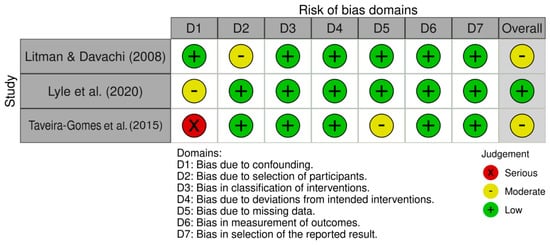
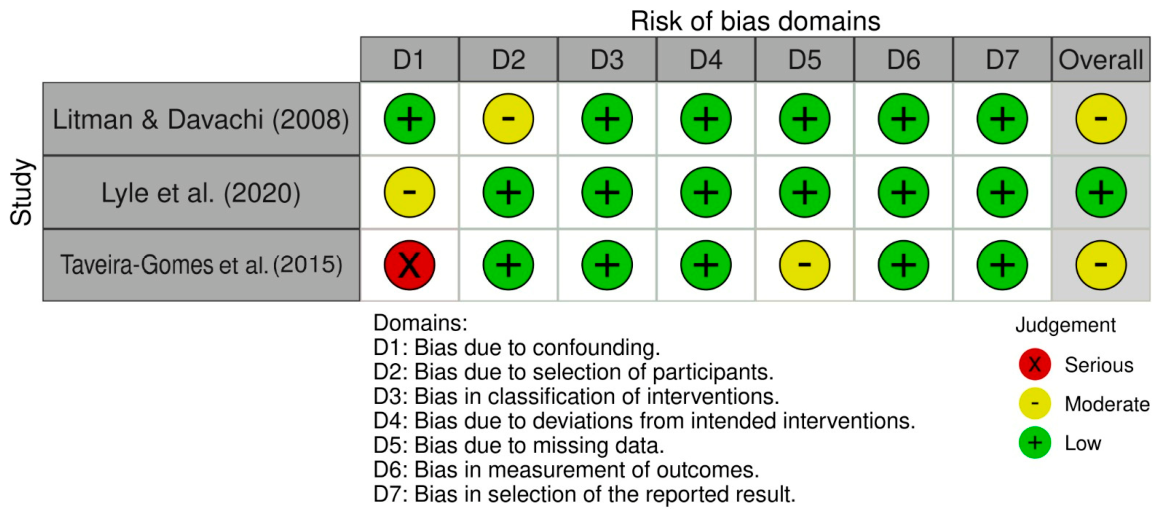
A more heterogeneous methodological landscape was observed in non-randomized interventions (Figure 3). The analysis indicates that, although most studies maintained a “low risk” in the classification of interventions (D3) and the selection of reported results (D7), critical vulnerabilities were identified in the pre-intervention phase. Specifically, the domains of “bias due to confounding” (D1) and “bias in the selection of participants” (D2) resulted in “moderate” risk levels.
Figure 3.
Risk-of-bias assessment for non-randomized studies of interventions (ROBINS-I). Sources. Risk-of-bias summary of randomized controlled trials (ROBINS-I) for Litman and Davachi (2008), Lyle et al. (2020), Taveira-Gomes et al. (2015).
In studies such as those of Lyle et al. (2020) and Taveira-Gomes et al. (2015), the lack of formal randomization introduced potential confounding variables—such as prior knowledge or varying levels of baseline cognitive load—which may have interacted with the spacing effect. Additionally, bias in the measurement of outcomes (D6) raised certain doubts in cases where long-term memory was not evaluated using objective standardized tests. Consequently, while the evidence from these studies supports the efficacy of spaced learning, the overall risk of bias suggests that these findings should be corroborated by experimental designs with greater rigor.
3.2.3. MMAT (Mixed Methods Appraisal Tool)
The remaining 12 empirical investigations were appraised using the MMAT (2018), demonstrating generally robust methodological quality. Within the quantitative descriptive and non-randomized categories (leveraged for laboratory tasks, cohorts, and survey designs), 7 out of 12 studies (Azim et al., 2025; Feng et al., 2019; Gilbert et al., 2023; Burel et al., 2025; Katz & Wiseheart, 2025; Katz et al., 2021; Hopkins et al., 2016) achieved a ‘High’ quality appraisal due to appropriate sampling strategies, low attrition, and validated measurement protocols. Five studies (Simmons, 2012; Schuetze, 2015; Melnikova & Patrina, 2025; Zubenko et al., 2022; Chang & Wimmers, 2017) received a “Moderate” rating, primarily due to insufficient reporting of participant recruitment clear-cut profiles or potential confounding factors in ecological classroom environments. No study was excluded due to low quality, ensuring comprehensive narrative coverage while adjusting the weight of interpretive claims according to these quality tiers.
3.3. Methodological Study Characteristics
The methodological landscape of the analyzed studies is predominantly defined by quantitative frameworks, with a strong emphasis on experimental and quasi-experimental designs. Randomized controlled trials (RCTs) were the most frequent approach used to validate the spacing effect, as evidenced in clinical training, procedural skills, and reasoning tasks (Çiçek et al., 2025; Khalafi et al., 2024; Yan et al., 2024). Furthermore, several studies employed within-subject designs to control for individual student variability, effectively comparing massed versus distributed retrieval practice within the same cohorts of engineering, medicine, and language students (Hopkins et al., 2016; Litman & Davachi, 2008; Lyle et al., 2020; Schuetze, 2015; Zubenko et al., 2022).
Moreover, data collection tools throughout the corpus integrated traditional academic metrics with advanced digital tracking and performance scales. Researchers utilized high-impact standardized assessments, such as the USMLE Step 1 and institutional final exams, to measure long-term knowledge retention (Azim et al., 2025; Burel et al., 2025; Chang & Wimmers, 2017; Gilbert et al., 2023; Ward & Vengrin, 2024). Additionally, the use of Spaced Repetition Software (SRS) and specialized e-learning platforms, such as Anki and the ALERT STUDENT system, provided detailed metrics including “recall accuracy” and “judgments of learning” (Gilbert et al., 2023; Taveira-Gomes et al., 2015). For procedural and sensorimotor memory, validated tools such as the Objective Structured Assessment of Technical Skills (OSATS), microlearning capsules, and rhythmic/melodic precision metrics were implemented to capture implicit memory consolidation (Katz & Wiseheart, 2025; Melnikova & Patrina, 2025; Simmons, 2012; Yan et al., 2024).
Regarding data analysis and reliability, inferential statistics, including ANOVA, t-tests, and multivariate regression, were systematically applied to establish the significance of time intervals and identify predictors of academic success (Burel et al., 2025; Khalafi et al., 2024; Simmons, 2012). A distinctive methodological feature is the rigorous use of delayed post-tests, ranging from two weeks to one year, serving as the primary indicator of internal validity for long-term memory (LTM) consolidation rather than transitory performance (Hopkins et al., 2016; Katz et al., 2021; Ward & Vengrin, 2024; Zubenko et al., 2022). Reliability was further reinforced through neurophysiological mapping (such as EEG pattern similarity analysis) (Feng et al., 2019) and, in studies involving qualitative components such as student reflections, the application of abductive coding and inter-rater reliability checks (Azim et al., 2025).
3.4. Typology of Neurodidactic Strategies Based on Spaced Learning
3.4.1. Methodological Strategies
A prevalence of methodological neurodidactic strategies designed to optimize cognitive load and facilitate the transition from STM to LTM was identified. These strategies focus on the structural organization of learning episodes, such as the implementation of “spaced lectures” subdivided into 20-to-30 min sessions (Khalafi et al., 2024), and the comparison of uniform versus expanding repetition intervals to stabilize vocabulary acquisition (Schuetze, 2015; Zubenko et al., 2022). Furthermore, methodological approaches in clinical and motor skill environments emphasized the “study-phase retrieval” and “encoding variability” hypotheses, utilizing longitudinal integration and interleaved practice to ensure that foundational knowledge was revisited across different semesters (Azim et al., 2025; Feng et al., 2019; Hopkins et al., 2016; Litman & Davachi, 2008; Lyle et al., 2020; Yan et al., 2024).
3.4.2. Operative Strategies
Operative strategies were the most visible technical layer, characterized by the use of specialized tools and creative stimuli to apply spaced repetition in contextualized settings. A significant portion of the evidence highlights the effectiveness of Spaced Repetition Software (SRS) and digital “flashcards,” such as Anki and the ALERT STUDENT system, which allow for high-frequency retrieval practice tailored to individual student needs (Gilbert et al., 2023; Taveira-Gomes et al., 2015). Other operative techniques include the use of “microlearning capsules” for language teaching and musical sequences designed to leverage 24 h sleep-dependent consolidation intervals (Katz et al., 2021; Katz & Wiseheart, 2025; Melnikova & Patrina, 2025; Simmons, 2012). These tools act as operative mediators that transform theoretical knowledge into logical and actionable processes within long-term memory.
3.4.3. Socio-Emotional Strategies
On the other hand, socio-emotional strategies emerged as a fundamental support system, centered on feedback and reflective practices to manage the affective states of higher education students. Several studies demonstrated that providing immediate feedback—whether expert-written or AI-generated—during spaced retrieval sessions significantly improved clinical reasoning and reduced academic stress (Chang & Wimmers, 2017; Çiçek et al., 2025). Additionally, strategies including peer tutoring and qualitative student reflections allowed learners to self-regulate their progress and perceive a higher degree of readiness for high-stakes examinations (Azim et al., 2025; Burel et al., 2025; Ward & Vengrin, 2024). By addressing the emotional burden of high-volume curricula, these strategies ensure that the neurological environment is optimized for effective memory consolidation.
3.5. Efficacy of Spaced Neurodidactic Strategies in LTM Consolidation
The reviewed evidence suggests that neurodidactic strategies based on spaced learning are frequently associated with better outcomes in long-term memory consolidation compared to massed practice, particularly in academic contexts and under controlled conditions (Burel et al., 2025; Gilbert et al., 2023; Hopkins et al., 2016; Lyle et al., 2020; Ward & Vengrin, 2024). However, the magnitude and consistency of these effects vary across studies and contexts. For example, while some works report statistically significant differences in retention, others show more modest benefits and limitations in ecological validity (Ward & Vengrin, 2024). Consequently, the results should be interpreted with caution, considering design differences and population heterogeneity.
In the linguistic and explicit cognitive domain, various studies have documented potential benefits of spacing for the acquisition of vocabulary and grammar in a second language, although these effects are not uniform and depend on the type of interval, task, and context evaluated (Schuetze, 2015; Melnikova & Patrina, 2025; Zubenko et al., 2022). For example, Schuetze (2015) found that uniform spacing schemes favored long-term retention, while other studies report less pronounced differences. Additional neurophysiological data suggest associations between longer intervals and specific neural patterns, although these findings require further replication and do not allow for the establishment of universal causality (Feng et al., 2019; Litman & Davachi, 2008).
Regarding implicit or procedural memory, some studies indicate that the distribution of practice—especially with overnight intervals—may favor the consolidation of motor and technical skills (Yan et al., 2024; Katz & Wiseheart, 2025; Simmons, 2012). Nevertheless, the diversity of methodologies and the presence of possible biases prevent drawing definitive conclusions about the magnitude of the benefit in all domains, and the results should be considered preliminary and subject to future validation.
Additionally, the potential efficacy of these strategies appears to be mediated by contextual factors such as the quality of feedback, curricular integration, and the socio-emotional conditions of the classroom (Çiçek et al., 2025; Azim et al., 2025). While some data suggest a reduction in academic burnout and an improvement in psychological well-being (Cepeda et al., 2006; Kim & Webb, 2022), these observations come from isolated studies with varying methodological rigor. Overall, while spaced neurodidactic strategies demonstrate promising trends in supporting long-term memory consolidation, the heterogeneity across methodologies and contexts precludes any claim of universal or maximal efficacy. The findings should thus be interpreted in light of study design limitations and population variability.
4. Discussion
Our synthesis of the included literature indicates that distributed practice protocols are associated with positive trends in long-term memory retention across several university contexts (Li & Yang, 2025; Yang et al., 2025), offering a valuable interpretive lens for neurodidactic framework development. These observed patterns align with Cognitive Load Theory, suggesting that inserting temporal intervals between learning episodes assists working memory constraints by preventing cognitive saturation (Szulewski et al., 2022).
4.1. Methodological Heterogeneity and Quality Calibration
The methodological landscape of the included studies reveals substantial heterogeneity, both in design architecture and in quality calibration. To ensure a rigorous and nuanced assessment, this review implemented a differentiated risk of bias assessment protocol tailored to the diversity of study types: Cochrane RoB 2 was applied exclusively to randomized controlled trials (RCTs) (Çiçek et al., 2025; Khalafi et al., 2024; Yan et al., 2024; Ward & Vengrin, 2024), ROBINS-I to quasi-experimental and non-randomized longitudinal designs (Lyle et al., 2020; Taveira-Gomes et al., 2015; Litman & Davachi, 2008), and the Mixed Methods Appraisal Tool (MMAT, 2018 version) to the remaining studies, including descriptive quantitative, cohort/ex post facto/correlational, and mixed-methods research (Hopkins et al., 2016; Feng et al., 2019; Gilbert et al., 2023; Burel et al., 2025; Azim et al., 2025; Simmons, 2012; Schuetze, 2015; Zubenko et al., 2022; Melnikova & Patrina, 2025; Chang & Wimmers, 2017; Katz et al., 2021; Katz & Wiseheart, 2025).
This approach enabled the evaluation of each study with the instrument best suited to its methodological structure, avoiding the inappropriate application of one-size-fits-all frameworks that could distort risk estimates (Page et al., 2021). In randomized controlled trials (RCTs), risk of bias assessments (RoB 2) generally indicated low risk of bias in key domains such as randomization, outcome measurement, and data integrity (Çiçek et al., 2025; Khalafi et al., 2024; Yan et al., 2024). Non-randomized interventions, assessed using ROBINS-I, showed moderate to low risks, particularly regarding participant selection and confounding variables (Lyle et al., 2020; Taveira-Gomes et al., 2015).
The use of MMAT added an additional layer of methodological calibration, revealing a generally high level of internal validity in studies employing advanced neurophysiological markers (e.g., EEG, standardized performance metrics) (Feng et al., 2019; Katz et al., 2021; Katz & Wiseheart, 2025) or high-impact academic assessments (Gilbert et al., 2023; Burel et al., 2025; Azim et al., 2025). However, moderate ratings were observed in smaller-scale experiments or those with limited control of the learning environment, primarily due to sample representativeness or protocol adherence issues (Simmons, 2012; Schuetze, 2015; Zubenko et al., 2022; Melnikova & Patrina, 2025; Chang & Wimmers, 2017).
Consequently, absolute generalizations regarding pedagogical efficacy must be approached with caution, as the diversity in content domains (e.g., mathematics vs. surgical skills) and specific temporal intervals across the 19 studies precludes a single monolithic conclusion. For instance, the premise that a strict 24 h interval is universally fundamental should be qualified (Valderama & Oligo, 2021; Zhao et al., 2015); this pattern is documented predominantly within non-declarative, procedural motor skill acquisition (Khalafi et al., 2024), whereas explicit conceptual and lexical mastery demonstrates superior consolidation via longer, expanding multi-day schedules (Vagha et al., 2025; Al-Khasawneh, 2023).
4.2. Advancements Beyond Existing Literature
This systematic review advances beyond previous synthesis papers on distributed practice. While earlier foundational reviews focused exclusively on narrow medical education cohorts (Versteeg et al., 2020) or specific language vocabulary learning dynamics (Kim & Webb, 2022), our analysis successfully synthesizes findings across disparate disciplines (STEM, humanities, health sciences). By mapping these outcomes onto an overarching, interpretive tripartite pedagogical framework, this study offers university educators actionable structural categories (operative tools, methodological schedules, and socio-emotional feedback loops) (Chee, 2025; Martin & Ochsner, 2016) to systematically operationalize basic cognitive science into multidisciplinary higher education curricula.
4.3. Limitations
This review is subject to several limitations. This review synthesizes a heterogeneous corpus by design, combining ecological classroom interventions with highly controlled mechanistic laboratory studies (e.g., Litman & Davachi, 2008; Feng et al., 2019). While this dual approach provides a comprehensive view—offering both biological validation and practical pedagogical utility—it presents distinct methodological implications. Laboratory findings possess high internal validity but limited ecological validity, as computerized spacing tasks do not replicate the cognitive load of a university lecture. Conversely, classroom quasi-experiments offer high ecological relevance but face confounding variables (e.g., student motivation, unmeasured self-study). Rather than viewing these architectures as contradictory, this review positioning laboratory data as a foundational explanation of the neural constraints (the ‘why’) behind the operational success of spaced learning in authentic educational software and designs (the ‘how’).
Furthermore, the search was restricted to articles in English and Spanish within Scopus and Web of Science, which may have omitted relevant findings from other regions or languages. Additionally, there is a clear sectoral imbalance, with a high concentration of studies in health sciences, which may limit the generalizability of specific intervals to more abstract fields. Similarly, variability in the definitions of “spacing”—ranging from minutes to months—makes it difficult to establish a universal “optimal” interval for university students. Finally, while the review focused on peer-reviewed empirical data, the exclusion of gray literature might have overlooked innovative practical applications currently being tested in non-academic professional training environments.
5. Conclusions
This systematic review analyzed 19 empirical studies on the application of neurodidactic strategies based on spaced learning for the consolidation of long-term memory (LTM) in higher education. The findings show that the temporal distribution of learning episodes is associated, across diverse contexts and disciplines, with improvements in knowledge retention compared to massed study practices. However, the magnitude and consistency of these benefits vary among the studies and sectors examined, and statistically significant differences or robust effects are not always reported in all domains.
In this regard, it was observed that the included studies display considerable methodological diversity, both in the designs employed (randomized controlled trials, quasi-experimental designs, cohort studies, and mixed methods) and in the measurement instruments used to assess LTM. Methodological strengths and limitations were also identified, such as the control of confounding variables, sample representativeness, and the ecological validity of the interventions, which provide a basis for interpreting the findings of neurodidactic interventions in university settings with caution.
According to the typology of strategies, the analysis allowed for the organization of interventions into three main categories: methodological strategies (focused on the structured organization of content and the scheduling of spaced sessions), operational strategies (use of digital tools, microlearning, and personalized spaced repetition), and socioemotional strategies (incorporation of feedback and emotional support). The integration of these approaches appears to be associated, in several contexts, with positive trends in knowledge retention and reductions in cognitive fatigue.
Regarding efficacy, the reviewed evidence indicates that neurodidactic strategies based on spaced learning are frequently associated with better LTM retention outcomes compared to massed or intensive practice, particularly in disciplines such as health sciences and language learning. Nevertheless, it is important to emphasize that the magnitude of these effects varies across studies and contexts, and the absence of meta-analyses and methodological heterogeneity preclude the extraction of generalizable conclusions or the assertion of the universal superiority of these strategies.
While there is substantial experimental support for the benefits of spaced learning in long-term memory consolidation, the application and categorization of these benefits as “neurodidactic strategies” remains, at present, a theoretically promising but empirically underexplored pedagogical approach. Thus, the conclusions regarding the efficacy of neurodidactic frameworks should be interpreted as a synthesis of existing foundational research and pedagogical interpretation, rather than as a direct empirical finding.
In light of the identified limitations, future research should prioritize the implementation of randomized controlled trials with representative samples and more rigorous control of contextual variables, especially in disciplinary areas that remain underexplored outside the clinical and linguistic fields. Furthermore, it will be relevant to investigate the interaction between digital spaced repetition tools and individual factors such as students’ cognitive profiles or socioemotional characteristics. Finally, the development of meta-analyses is recommended to more precisely quantify the effect size of neurodidactic interventions, as well as the design of longitudinal studies to assess the sustained impact of spaced learning on LTM and future professional performance.
Supplementary Materials
The following supporting information can be downloaded at https://www.mdpi.com/article/10.3390/educsci16060962/s1. Table S1: PRISMA_2020_abstract_checklist. Table S2: PRISMA_2020_checklist.
Author Contributions
Conceptualization, M.S.S., G.A.L.Q. and W.A.Z.V.; methodology, W.A.Z.V. and M.S.S.; software, W.A.Z.V.; validation, M.S.S., G.A.L.Q. and W.A.Z.V.; formal analysis, W.A.Z.V. and M.S.S.; investigation, M.S.S. and G.A.L.Q.; resources, W.A.Z.V.; data curation, M.S.S. and G.A.L.Q.; writing—original draft preparation, M.S.S. and G.A.L.Q.; writing—review and editing, W.A.Z.V., M.S.S. and G.A.L.Q.; visualization, W.A.Z.V.; supervision, W.A.Z.V.; project administration, W.A.Z.V. All authors have read and agreed to the published version of the manuscript.
Funding
This research received no external funding.
Institutional Review Board Statement
Not applicable.
Informed Consent Statement
Not applicable.
Data Availability Statement
The data supporting the findings of this systematic review, including the study protocol, search strategies, and the data extraction matrix, are openly available in the Open Science Framework (OSF) at https://doi.org/10.17605/OSF.IO/2C7YR.
Acknowledgments
The authors express their gratitude for the commitment shown throughout the development of this study, which was fundamental to its completion. In accordance with the journal’s transparency guidelines regarding generative artificial intelligence, the authors state that AI tools were utilized strictly under human supervision and for the following specific purposes: -Scopus AI (2026 Edition): Developed by Elsevier (Amsterdam, The Netherlands). Utilized during the preliminary exploratory and contextualization phases of this study. Specifically, the tool assisted with mapping conceptual semantic variants, identifying historical synonyms for distributed practice in the cognitive literature, and retrieving related literature to enhance and enrich the contextual framework presented in the Introduction. Crucially, Scopus AI was not employed to build, modify, or supplement the formal bibliographic corpus; the final 19 studies included in this review were obtained strictly through the execution of the pre-registered PRISMA search protocol detailed above. Artificial Intelligence was used exclusively for the translation of the manuscript from. The authors thoroughly reviewed, refined, and edited the final product, and assume full responsibility for the content, accuracy, and integrity of this publication.
Conflicts of Interest
The authors declare no conflicts of interest.
References
- Al-Khasawneh, F. M. (2023). The acquisition of foreign language vocabulary: Does spacing effect matter? The Education and Science Journal, 25(3), 174–193. [Google Scholar] [CrossRef] [Scilit]
- Azim, H. M., Santare, J. A., Sprague, A. V., Murphy, R. J., Miller, L. C., Perrotta, S. E., Maddahi, Y. N., & Record, M. J. (2025). How about an anatomy elective? Making a case for utilizing spaced repetition and longitudinal integration of anatomy in medical curricula. BMC Medical Education, 25(1), 462. [Google Scholar] [CrossRef] [Scilit] [PubMed]
- Baddeley, A. D., Hitch, G. J., & Allen, R. J. (2019). From short-term store to multicomponent working memory: The role of the modal model. Memory & Cognition, 47(4), 575–588. [Google Scholar] [CrossRef] [Scilit]
- Bego, C. R., Lyle, K. B., Ralston, P. A. S., Immekus, J. C., Chastain, R. J., Haynes, L. D., Hoyt, L. K., Pigg, R. M., Rabin, S. D., Scobee, M. W., & Starr, T. L. (2024). Single-paper meta-analyses of the effects of spaced retrieval practice in nine introductory STEM courses: Is the glass half full or half empty? International Journal of STEM Education, 11(1), 9. [Google Scholar] [CrossRef] [Scilit]
- Boscán, A. (2011). Modelo didáctico basado en las neurociencias para la enseñanza de las ciencias naturales [Ph.D. thesis, Universidad Rafael Belloso Chacín]. Available online: http://virtual.urbe.edu/tesispub/0090256/intro.pdf (accessed on 2 May 2026).
- Burel, J., Trost, O., Demeyere, M., Rives, N., Estour, F., Ladner, J., Crampon, F., Deneuve, S., & Maquet, C. (2025). Spaced repetition and other key factors influencing medical school entrance exam success: Insights from a French survey. BMC Medical Education, 25(1), 1036. [Google Scholar] [CrossRef] [Scilit] [PubMed]
- Camina, E., & Güell, F. (2017). The neuroanatomical, neurophysiological and psychological basis of memory: Current models and their origins. Frontiers in Pharmacology, 8, 438. [Google Scholar] [CrossRef] [Scilit] [PubMed]
- Casasola, W. (2022). La neurodidáctica en los procesos de enseñanza y aprendizaje ¿un nuevo paradigma en educación? Revista Científica Arbitrada de la Fundación MenteClara, 7, 268. [Google Scholar] [CrossRef] [Scilit]
- Cepeda, N. J., Pashler, H., Vul, E., Wixted, J. T., & Rohrer, D. (2006). Distributed practice in verbal recall tasks: A review and quantitative synthesis. Psychological Bulletin, 132(3), 354–380. [Google Scholar] [CrossRef] [Scilit] [PubMed]
- Chang, E. K., & Wimmers, P. F. (2017). Effect of repeated/spaced formative assessments on medical school final exam performance. Health Professions Education, 3(1), 32–37. [Google Scholar] [CrossRef] [Scilit]
- Chee, K. N. (Ed.). (2025). Pedagogical approaches to bridging emotional and cognitive learning. IGI Global Scientific Publishing. [Google Scholar] [CrossRef] [Scilit]
- Chugh, P. K., & Tripathi, C. (2020). Spaced education and student learning: Results from a medical school. The Clinical Teacher, 17(6), 655–660. [Google Scholar] [CrossRef] [Scilit] [PubMed]
- Condori, R. F. (2021). Neurodidáctica en ambientes virtuales de aprendizaje para la capacitación del personal de una aeronáutica. Revista Simón Rodríguez, 1(1), 10–21. [Google Scholar] [CrossRef] [Scilit]
- Cordero, N. I., & Aguirre, C. M. (2024). Neurodidactics in university education. Noesis, 1(2), 17–25. [Google Scholar] [CrossRef] [Scilit]
- Çiçek, F. E., Ülker, M., Özer, M., & Kıyak, Y. S. (2025). ChatGPT versus expert feedback on clinical reasoning questions and their effect on learning: A randomized controlled trial. Postgraduate Medical Journal, 101(1195), 458–463. [Google Scholar] [CrossRef] [Scilit] [PubMed]
- DeBrigard, F., Giovanello, K. S., & Kaufer, D. I. (2013). Memory. In D. B. Arciniegas, C. A. Anderson, & C. M. Filley (Eds.), Behavioral neurology & neuropsychiatry (pp. 161–173). Cambridge University Press. [Google Scholar] [CrossRef] [Scilit]
- Dickerson, B. C., & Eichenbaum, H. (2010). The episodic memory system: Neurocircuitry and disorders. Neuropsychopharmacology, 35(1), 86–104. [Google Scholar] [CrossRef] [Scilit] [PubMed]
- Ebbinghaus, H. (1913). Memory; a contribution to experimental psychology. Martino Fine Books. Available online: https://books.google.com.ec/books?id=QnRtpwAACAAJ (accessed on 2 May 2026).
- Espinoza, J. K., Cisneros León, J. C., & Valverde Pereira, A. M. (2022). Neurodidáctica, alternativa de innovación aplicada a estudiantes de educación superior, en el periodo del 2017–2021. Horizontes. Revista de Investigación en Ciencias de la Educación, 6(24), 1162–1175. [Google Scholar] [CrossRef] [Scilit]
- Feng, K., Zhao, X., Liu, J., Cai, Y., Ye, Z., Chen, C., & Xue, G. (2019). Spaced learning enhances episodic memory by increasing neural pattern similarity across repetitions. The Journal of Neuroscience, 39(27), 5351–5360. [Google Scholar] [CrossRef] [Scilit] [PubMed]
- Finotelli, P., & Eustache, F. (2023). Mathematical modeling of human memory. Frontiers in Psychology, 14, 1298235. [Google Scholar] [CrossRef] [Scilit] [PubMed]
- French, S., Dickerson, A., & Mulder, R. A. (2024). A review of the benefits and drawbacks of high-stakes final examinations in higher education. Higher Education, 88(3), 893–918. [Google Scholar] [CrossRef] [Scilit]
- Gilbert, M. M., Frommeyer, T. C., Brittain, G. V., Stewart, N. A., Turner, T. M., Stolfi, A., & Parmelee, D. (2023). A cohort study assessing the impact of Anki as a spaced repetition tool on academic performance in medical school. Medical Science Educator, 33(4), 955–962. [Google Scholar] [CrossRef] [Scilit] [PubMed]
- Goldstein, E. B. (2019). Cognitive psychology: Connecting mind, research, and everyday experience. Cengage. Available online: https://books.google.com.ec/books?id=ZyNGuwEACAAJ (accessed on 2 May 2026).
- Hebb, D. O. (1961). Distinctive features of learning in the higher animal. Delafresnaye, Brain Mechanisms and Learning, 37, 46. [Google Scholar]
- Hopkins, R. F., Lyle, K. B., Hieb, J. L., & Ralston, P. A. S. (2016). Spaced retrieval practice increases college students’ short- and long-term retention of mathematics knowledge. Educational Psychology Review, 28(4), 853–873. [Google Scholar] [CrossRef] [Scilit]
- Jape, D., Zhou, J., & Bullock, S. (2022). A spaced-repetition approach to enhance medical student learning and engagement in medical pharmacology. BMC Medical Education, 22(1), 337. [Google Scholar] [CrossRef] [Scilit] [PubMed]
- Jawabri, K. H., & Cascella, M. (2025). Physiology, explicit memory. StatPearls Publishing. Available online: http://europepmc.org/books/NBK554551 (accessed on 2 May 2026).
- Katz, J. J., Ando, M., & Wiseheart, M. (2021). Optimizing song retention through the spacing effect. Cognitive Research: Principles and Implications, 6(1), 79. [Google Scholar] [CrossRef] [Scilit] [PubMed]
- Katz, J. J., & Wiseheart, M. (2025). Spaced learning and melodic memory. Psychology of Music, 03057356251401906. [Google Scholar] [CrossRef] [Scilit]
- Khalafi, A., Fallah, Z., & Sharif-Nia, H. (2024). The effect of spaced learning on the learning outcome and retention of nurse anesthesia students: A randomized-controlled study. BMC Medical Education, 24(1), 322. [Google Scholar] [CrossRef] [Scilit] [PubMed]
- Kim, S. K., & Webb, S. (2022). The effects of spaced practice on second language learning: A meta-analysis. Language Learning, 72(1), 269–319. [Google Scholar] [CrossRef] [Scilit]
- Lenny. (2025). Detrimental impacts of cramming: A critical analysis. Asian Journal of Education and Social Studies, 51(11), 893–898. [Google Scholar] [CrossRef] [Scilit]
- Leppink, J., Paas, F., Van Der Vleuten, C. P. M., Van Gog, T., & Van Merriënboer, J. J. G. (2013). Development of an instrument for measuring different types of cognitive load. Behavior Research Methods, 45(4), 1058–1072. [Google Scholar] [CrossRef] [Scilit] [PubMed]
- Li, C., & Yang, J. (2025). Salient memory: Effects of distributed learning on Cortical regions during memory retrieval. Human Brain Mapping, 46(11), e70301. [Google Scholar] [CrossRef] [Scilit] [PubMed]
- Litman, L., & Davachi, L. (2008). Distributed learning enhances relational memory consolidation. Learning & Memory, 15(9), 711–716. [Google Scholar] [CrossRef] [Scilit] [PubMed]
- Llorens-Gámez, M., Higuera-Trujillo, J. L., Omarrementeria, C. S., & Llinares, C. (2022). The impact of the design of learning spaces on attention and memory from a neuroarchitectural approach: A systematic review. Frontiers of Architectural Research, 11(3), 542–560. [Google Scholar] [CrossRef] [Scilit]
- Lyle, K. B., Bego, C. R., Hopkins, R. F., Hieb, J. L., & Ralston, P. A. S. (2020). How the amount and spacing of retrieval practice affect the short- and long-term retention of mathematics knowledge. Educational Psychology Review, 32(1), 277–295. [Google Scholar] [CrossRef] [Scilit]
- Martin, R. E., & Ochsner, K. N. (2016). The neuroscience of emotion regulation development: Implications for education. Current Opinion in Behavioral Sciences, 10, 142–148. [Google Scholar] [CrossRef] [Scilit] [PubMed]
- Mawson, R. D., & Kang, S. H. K. (2025). The distributed practice effect on classroom learning: A meta-analytic review of applied research. Behavioral Sciences, 15(6), 771. [Google Scholar] [CrossRef] [Scilit] [PubMed]
- Melnikova, K. V., & Patrina, E. V. (2025). Microlearning for lasting learning: Perspectives on memory retention in language education. European Journal of Contemporary Education, 14(4), 482–495. [Google Scholar] [CrossRef] [Scilit]
- Melton, A. W. (1963). Implications of short-term memory for a general theory of memory. Journal of Verbal Learning and Verbal Behavior, 2, 1–21. [Google Scholar] [CrossRef] [Scilit]
- Moosapour, H., Saeidifard, F., Aalaa, M., Soltani, A., & Larijani, B. (2021). The rationale behind systematic reviews in clinical medicine: A conceptual framework. Journal of Diabetes & Metabolic Disorders, 20(1), 919–929. [Google Scholar] [CrossRef] [Scilit] [PubMed]
- Munn, Z., Peters, M. D. J., Stern, C., Tufanaru, C., McArthur, A., & Aromataris, E. (2018). Systematic review or scoping review? Guidance for authors when choosing between a systematic or scoping review approach. BMC Medical Research Methodology, 18(1), 143. [Google Scholar] [CrossRef] [PubMed]
- Namaziandost, E., Mohammed Sawalmeh, M. H., & Izadpanah Soltanabadi, M. (2020). The effects of spaced versus massed distribution instruction on EFL learners’ vocabulary recall and retention. Cogent Education, 7(1), 1792261. [Google Scholar] [CrossRef] [Scilit]
- Ocampo, D. (2020). Estrategia Neurodidáctica para la formación de investigadores sociales. Delectus, 3(3), 14–27. [Google Scholar] [CrossRef] [Scilit]
- Paas, F., & Van Merriënboer, J. J. G. (2020). Cognitive-load theory: Methods to manage working memory load in the learning of complex tasks. Current Directions in Psychological Science, 29(4), 394–398. [Google Scholar] [CrossRef] [Scilit]
- Page, M. J., McKenzie, J. E., Bossuyt, P. M., Boutron, I., Hoffmann, T. C., Mulrow, C. D., Shamseer, L., Tetzlaff, J. M., Akl, E. A., Brennan, S. E., Chou, R., Glanville, J., Grimshaw, J. M., Hróbjartsson, A., Lalu, M. M., Li, T., Loder, E. W., Mayo-Wilson, E., McDonald, S., … Moher, D. (2021). The PRISMA 2020 statement: An updated guideline for reporting systematic reviews. BMJ, 372, n71. [Google Scholar] [CrossRef] [Scilit] [PubMed]
- Romero, D. (2024). Neurodidactics and vocabulary acquisition in Cuban teacher trainees: Emerging trends. Bulletin of the Transilvania University of Brasov. Series IV: Philology and Cultural Studies, 17, 43–62. [Google Scholar] [CrossRef] [Scilit]
- Sánchez, N. E., Valadez Mena, V., Luna García, M. D. R., & Valadez Mena, M. E. (2023). Estrategias neurodidácticas para aprender a aprender. Revista RELEP- Educación y Pedagogía en Latinoamérica, 5(3), 55–72. [Google Scholar] [CrossRef] [Scilit]
- Schuetze, U. (2015). Spacing techniques in second language vocabulary acquisition: Short-term gains vs. long-term memory. Language Teaching Research, 19(1), 28–42. [Google Scholar] [CrossRef] [Scilit]
- Simmons, A. L. (2012). Distributed practice and procedural memory consolidation in musicians’ skill learning. Journal of Research in Music Education, 59(4), 357–368. [Google Scholar] [CrossRef] [Scilit]
- Smolen, P., Zhang, Y., & Byrne, J. H. (2016). The right time to learn: Mechanisms and optimization of spaced learning. Nature Reviews Neuroscience, 17(2), 77–88. [Google Scholar] [CrossRef] [Scilit] [PubMed]
- Squire, L. R., & Zola, S. M. (1996). Structure and function of declarative and nondeclarative memory systems. Proceedings of the National Academy of Sciences, 93(24), 13515–13522. [Google Scholar] [CrossRef] [Scilit] [PubMed]
- Sridhar, S., Khamaj, A., & Asthana, M. K. (2023). Cognitive neuroscience perspective on memory: Overview and summary. Frontiers in Human Neuroscience, 17, 1217093. [Google Scholar] [CrossRef] [Scilit] [PubMed]
- Szulewski, A., Van Gog, T., Paas, F., & Sweller, J. (2022). Cognitive load theory: Researching and planning teaching to maximise learning. In J. Cleland, & S. J. Durning (Eds.), Researching medical education (1st ed., pp. 303–314). Wiley. [Google Scholar] [CrossRef] [Scilit]
- Tacca, D. R., Tacca Huamán, A. L., & Alva Rodriguez, M. A. (2019). Estrategias neurodidácticas, satisfacción y rendimiento académico en estudiantes universitarios. Cuadernos de Investigación Educativa, 10(2), 15–32. [Google Scholar] [CrossRef] [Scilit]
- Taveira-Gomes, T., Prado-Costa, R., Severo, M., & Ferreira, M. A. (2015). Characterization of medical students recall of factual knowledge using learning objects and repeated testing in a novel e-learning system. BMC Medical Education, 15(1), 4. [Google Scholar] [CrossRef] [Scilit] [PubMed]
- Timmer, M. C. J., Steendijk, P., Arend, S. M., & Versteeg, M. (2020). Making a lecture stick: The Effect of spaced instruction on knowledge retention in medical education. Medical Science Educator, 30(3), 1211–1219. [Google Scholar] [CrossRef] [Scilit] [PubMed]
- Vagha, K., Choudhari, S., Taksande, A., Tembhurne, J., Vagha, J., & Vagha, S. (2025). Implementation of a spaced-repetition approach to enhance undergraduate learning and engagement in paediatrics. Frontiers in Medicine, 12, 1601614. [Google Scholar] [CrossRef] [Scilit] [PubMed]
- Valderama, J., & Oligo, J. (2021). Learning retention in mathematics over consecutive weeks: Impact of motivated forgetting. International Journal of Evaluation and Research in Education (IJERE), 10(4), 1245. [Google Scholar] [CrossRef] [Scilit]
- Versteeg, M., Hendriks, R. A., Thomas, A., Ommering, B. W. C., & Steendijk, P. (2020). Conceptualising spaced learning in health professions education: A scoping review. Medical Education, 54(3), 205–216. [Google Scholar] [CrossRef] [Scilit] [PubMed]
- Walsh, M. M., Krusmark, M. A., Jastrembski, T., Hansen, D. A., Honn, K. A., & Gunzelmann, G. (2023). Enhancing learning and retention through the distribution of practice repetitions across multiple sessions. Memory & Cognition, 51(2), 455–472. [Google Scholar] [CrossRef] [Scilit]
- Ward, J. L., & Vengrin, C. A. (2024). The effect of repeated review of course content on medium- and long-term retention in an elective veterinary cardiology course. Journal of Veterinary Medical Education, 51(5), 630–642. [Google Scholar] [CrossRef] [Scilit] [PubMed]
- Xavier, M., & Meneses, J. (2022). Persistence and time challenges in an open online university: A case study of the experiences of first-year learners. International Journal of Educational Technology in Higher Education, 19(1), 31. [Google Scholar] [CrossRef] [Scilit]
- Yan, X., Abudouresuli, A., Yuemaier, A., Ge, Y., Shang, S., Yang, J., & Zhang, L. (2024). Enhancing cosmetic suturing skill acquisition in surgical residents through spaced learning training: A randomized controlled trial. Annals of Medicine, 56(1), 2363940. [Google Scholar] [CrossRef] [Scilit] [PubMed]
- Yang, Y., Huang, Z., Yang, Y., Fan, M., & Yin, D. (2025). Time-dependent consolidation mechanisms of durable memory in spaced learning. Communications Biology, 8(1), 535. [Google Scholar] [CrossRef] [Scilit] [PubMed]
- Zhao, X., Wang, C., Liu, Q., Xiao, X., Jiang, T., Chen, C., & Xue, G. (2015). Neural mechanisms of the spacing effect in episodic memory: A parallel EEG and fMRI study. Cortex, 69, 76–92. [Google Scholar] [CrossRef] [Scilit] [PubMed]
- Zou, L., Zhang, Z., Mavilidi, M., Chen, Y., Herold, F., Ouwehand, K., & Paas, F. (2025). The synergy of embodied cognition and cognitive load theory for optimized learning. Nature Human Behaviour, 9(5), 877–885. [Google Scholar] [CrossRef] [Scilit] [PubMed]
- Zubenko, T., Gavrylenko, A., Zhyvotovska, T., & Vasylieva, N. (2022). Spaced vocabulary acquisition while incidental listening by ESL university students. Advanced Education, 9, 79–87. [Google Scholar] [CrossRef] [Scilit]

Disclaimer/Publisher’s Note: The statements, opinions and data contained in all publications are solely those of the individual author(s) and contributor(s) and not of MDPI and/or the editor(s). MDPI and/or the editor(s) disclaim responsibility for any injury to people or property resulting from any ideas, methods, instructions or products referred to in the content. |
© 2026 by the authors. Licensee MDPI, Basel, Switzerland. This article is an open access article distributed under the terms and conditions of the Creative Commons Attribution (CC BY) license.