


Abstract
The state of STEM interventions focused on broadening participation remains uncertain due to federal funding cuts made by the Trump administration. Though long-standing STEM interventions, such as Louis Stokes Alliances for Minority Participation, no longer exist in the same format, we argue that evidence from these interventions can assist researchers and educators in their pursuit of STEM equity moving forward, especially concerning STEM transfer students. Our qualitative embedded multi-case study sought to investigate how racially minoritized STEM vertical transfer students (i.e., community college transfer to 4-year institutions) navigate the transfer process within institutions that make up the Illinois Louis Stokes Alliances for Minority Participation. Leveraging Perna’s college access and choice model and Ray’s theory of racialized organizations, our study was guided by the following research questions: (1) How do racially minoritized students experience and interpret the transfer process from a two-year institution to a four-year Alliance institution, particularly in relation to organizational structures, practices, and interactions? (2) How does the Alliance organize, enact, and institutionalize transfer support across partner two-year and four-year institutions, and how do these processes shape racially minoritized students’ transfer experiences? Findings highlight a racialized transfer process that includes multiple contextual layers. Contextual layers are discussed in relation to the current state of STEM interventions, and considerations moving forward are provided.
1. Introduction
In April 2025, the Trump administration halted federal grants for diversity, equity, and inclusion (DEI) programs and initiatives, including programs like the Illinois Louis Stokes Alliances for Minority Participation (IL-LSAMP) (Mervis, 2025). Funded by the National Science Foundation (NSF), the LSAMP or Alliance program has, for over 30 years, sought to support higher education institutions in increasing the number of underrepresented racial minority (URM) students majoring and graduating in science, technology, engineering, and mathematics (STEM) (Baber & Jackson, 20181; National Science Foundation, 20202). There has been an expectation that funded universities should institutionalize the Alliance’s programs and improve vertical transfer rates at community colleges (Baber & Jackson, 2018). Yet, many Alliances had not made significant headway in their effort to institutionalize all programs and initiatives (Okstad et al., 2023). Nevertheless, some LSAMP programs have successfully designed and implemented intentional plans to facilitate 2- to 4-year transfers but remain dependent on NSF funding to do so (San Miguel & Gates, 2021; Birkes et al., 2021).
Moreover, this funding loss comes at a time when higher education is tasked with supporting and cultivating STEM graduates (Briggs, 2016) as the United States and global workforce continue to seek skilled STEM professionals (Okrent & Burke, 2021). Students who hold minoritized identities (Harper, 2010) are typically underrepresented in STEM majors and are essential to fostering a robust STEM workforce (National Academy of Sciences et al., 2011). An opportunity and strategy to increase the number of skilled STEM graduates able to contribute to the STEM workforce is to tap into STEM transfer students at community colleges (Zhang et al., 2019). In light of the funding deficit and the absence of institutionalized mechanisms, assessing the intervention retrospectively enables a critical examination of both the adequacy of transfer support and the progress toward institutionalization.
For the purposes of this study, we refer to vertical or upward transfer, focusing on students who transfer from a 2-year to a 4-year college or are in the process of doing so. The limited opportunities for STEM community college students to transfer to four-year universities (Burt et al., 2020) and the threat of funding loss prompted our research team to investigate the transfer experiences of vertical transfer students (i.e., those who have completed or are in the process of completing a transfer) within a STEM intervention program (i.e., IL-LSAMP Alliance). Consequently, the research questions that guided this study are:
- How do racially minoritized students experience and interpret the transfer process from a two-year institution to a four-year Alliance institution, particularly in relation to organizational structures, practices, and interactions?
- How does the Alliance organize, enact, and institutionalize transfer support across partner two-year and four-year institutions, and how do these processes shape racially minoritized students’ transfer experiences?
2. Literature Review
In this section, we provide an overview of the project’s background and offer additional insight into the unique context of the study, the IL-LSAMP. LSAMP initiatives have a long-standing history of supporting efforts to expand STEM opportunities for students from underrepresented racial and ethnic backgrounds (URM). However, program outcomes are often constrained by organizational barriers (Okstad et al., 2023; López et al., 2022; Morgan et al., 2021), including limited institutional buy-in. Institutional buy-in frequently reflects efforts to protect organizational interests and comfort. It is embedded within racialized organizational structures (Ray, 2019), whereby institutions perpetuate white supremacy through unequal resource distribution and the privileging of white norms. These dynamics shape not only the experiences of URM students but also the broader experience of community colleges as a racialized organization within higher education systems. As McCambly et al. (2023) note, community colleges themselves are racialized within these systems, which constrains their capacity to support and educate students effectively and to facilitate transfer to four-year institutions. The transfer process is further mediated by students’ “transfer student capital” (TSC), defined as the knowledge and skills required to navigate transfer pathways successfully (Holland Zahner, 2022; Laanan et al., 2011). For STEM transfer students, success requires both an understanding of transfer processes and the development of a science identity, an endeavor often rendered culturally misaligned by the field’s entrenched norms of objectivity and detachment (Burt et al., 2020) and by the absence of bonded mentoring relationships (López et al., 2025). Taken together, these program-level and organizational dynamics and their cumulative impact on STEM transfer students underscore the need for a critical analysis of LSAMP transfer experiences, with particular attention to identifying practices that can be sustained and scaled.
2.1. Programmatic Context: Barriers to Institutionalization and Transfer Support
LSAMP programs began in 1987 with “six alliances across 40 postsecondary institutions to 45 LSAMP Alliances that connect over 600 colleges and universities” (Baber & Jackson, 2018). Through this growth, LSAMP has evolved to not only serve more institutions and students but also to increase opportunities for research and mentoring, foster student-focused instructional practices, and extend the STEM pipeline by incorporating a focus on community college transfers and graduate degree attainment. Many programs have yielded encouraging results for URM students (Burt et al., 2020), with some also demonstrating improved outcomes for STEM community college students.
In fact, San Miguel and Gates (2021) described a robust transfer culture and process between two New Jersey State LSAMPs, including summer research at 4-year institutions, joint research conferences, annual transfer admission event, peer mentoring between 2 and 4-year institutions, and professional development. They described this relationship as a synergistic collaboration aimed at improving “the success of URM community college students on a regional, rather than institutional, scale” (San Miguel & Gates, 2021, p. 10). Similarly, the Georgia State Perimeter College LSAMP has implemented a transfer bridge program that is “designed to support the successful transition of underrepresented STEM students transferring from a 2-year to 4-year institution” with preliminary results that look promising (Birkes et al., 2021). Yet, this research focuses on several interventions that, while proven to improve STEM outcomes (e.g., undergraduate student research, mentoring, etc.) (Burt et al., 2020), lack mention of the sustainability of these programs. Failing to address institutionalization efforts, that is, embedding these approaches as normative practices within colleges and universities, not only disregards NSF directives but, more critically, leaves institutions without sustainable recourse or strategies now that external funding has ended.
We also know that sustainable change interventions are not a “one-size-fits-all approach” (Okstad et al., 2023, p. 64). More accurately, institutionalization is complex and requires transparency and clear communication within institutional structures and leaders, as well as across institutional collaborations like the Alliances. Indeed, San Miguel and Gates (2021) attribute the success of the New Jersey collaborations to an “expanded learning community” (p. 2). They describe a “web of interaction” across multiple levels and institutions and refer to “solid relationships” (San Miguel & Gates, 2021, p. 10) and yet provide little detail about how these relationships were formed and sustained. This omission is regrettable, as leaders and researchers often prioritize the programmatic aspects of interventions over preparing the context, specifically, by cultivating support across leadership levels and securing resources necessary to build and maintain such relationships, both critical aspects of institutionalization (López et al., 2022).
Moreover, Okstad et al. (2023) argue that inefficient processes and inadequate buy-in from institutional leaders hinder institutionalization despite Alliance leaders’ best intentions. In particular, a lack of understanding about how racism impacts STEM outcomes, as well as inconsistent access to resources and support, more specifically, institutional knowledge and capital to connect to leaders or funding. López et al. (2022) remind us that inconsistent commitment is related to individual beliefs and values, as well as to varying organizational structures and the ways each is compelled to change. To clarify, this requires attention not only to insights and motivation but also to the systems and structures that shape institutional practice. Yet the notion of buy-in often serves as coded language for protecting self-interests. Institutional self-interest, in turn, is frequently linked to efforts to minimize the costs of supporting URM STEM programs in order to protect funding for projects deemed worthy, resulting in “the appearance of, rather than a real commitment” (López et al., 2022, p. 11). As López et al. (2022) further note, “higher-level organizational learning requires changing mission and direction rather than simply behaviors and rules” (p. 12). This form of relationship building, professional development, and organizational restructuring not only contributes to contextual readiness but also yields enduring impacts that extend beyond the grant funding.
In contrast to higher-level organizational learning, lower-level organizational learning constrains change to what is familiar and can be understood as a function of racialized organizational structures, meaning organizations are not race-neutral and perpetuate white supremacy, and by extension, inequities (Ray, 2019). López et al. (2022) explicitly refer to the racialization of structures that serve URM STEM students and perpetuate inequities toward these students. However, McCambly et al. (2023) provide a compelling argument that community colleges, as a whole, are racialized organizations within higher education systems. This is established through community colleges’ limited access to resources, dependency on racialized funding, segregated funding through a pretense of meritocracy and competition, and neoliberalism that emphasizes students as clients and efficiency at the cost of outcomes. We would add to this an unwillingness to classify a community college education as equal to a 4-year education (Prager, 1993; Montague, 2012), specifically invoking whiteness as a credential. Montague (2012) cited long-standing assumptions about community college curriculum and pedagogy being inferior to those at 4-year universities as a reason students encounter challenges when transferring. With these realities in mind (i.e., ineffective institutionalization, resource dependency, racialization of programs and institutions), we turn to the transfer process to examine more closely the challenges and opportunities for Alliance students.
2.2. Student Experience: Significance & Challenges of Developing STEM Transfer Student Capital
Transfer enrollment from 2-year to 4-year institutions decreased by almost 8% from fall 2021 to fall 2022 (National Student Clearinghouse, 2022). The decrease in upward or vertical transfer indicates that attaining a baccalaureate degree for community college students is becoming more difficult due to several factors (e.g., the COVID-19 pandemic, limited resources, and variable levels of institutional support). Although this framing shifts responsibility to students, one way to illuminate issues associated with the transfer process is by understanding the concept of transfer capital or “the process through which community college students acquire knowledge and skills necessary to navigate vertical transfer” (Holland Zahner, 2022, p. 4) or the “transfer process” (Laanan et al., 2011, p. 177) more generally. Often referred to as transfer student capital (TSC), research on TSC has focused on TSC typology, while research on how students use and gain TSC is limited (Maliszewski Lukszo & Hayes, 2020).
While scholars often conceptualize TSC broadly, existing research also examines TSC within STEM contexts and among specific STEM transfer populations (e.g., Latinx students, female students). Findings from these studies underscore the importance of identifying the unique position of STEM transfer students and the capital they hold and acquire across their various transitions (Hug et al., 2025; Starobin et al., 2016). While factors that support STEM transfer students have been identified (e.g., faculty mentoring), there is an opportunity to expand this line of inquiry to include racially minoritized STEM transfer students. Specifically, how their TSC affects their transfer experience and how that experience is shaped within a STEM intervention program. This is critical because racially minoritized STEM transfer students navigate not only the challenges inherent in the transfer process but also the complexities of their racial and ethnic identities within academic fields in which they remain historically underrepresented (National Science Foundation, 2020). This suggests that STEM transfer students are operating within and across multiple racialized organizational contexts, realities that are not always acknowledged and supported.
Developing a STEM or science identity amid the transfer process, while underexplored, is an important aspect of TSC for STEM transfer students and could contribute to positive outcomes for racially minoritized students (Brickhouse et al., 2000; Carlone & Johnson, 2007). Science identity is a critical concept because a student’s perception of themselves as a scientist (Brickhouse et al., 2000) not only fosters students’ sense of belonging and comfort in STEM settings, but it is also essential for supporting persistence and facilitating their eventual shift to a STEM-related career (Carlone & Johnson, 2007). Burt et al. (2020) describe STEM identity as a developing concept and state that “STEM identity tends to be described as an individual’s self-perception of their connection to the STEM community, both locally (e.g., school/college) and generally (e.g., field of study)” (p. 6). The development of this identity derives from an intersection of experiences, including participation in STEM opportunities and recognition by others within their STEM discipline (Tonso, 2006). Often, students who hold minoritized racial and gender identities struggle to develop a STEM identity and see themselves as future STEM professionals (e.g., mathematicians, scientists) (Archer et al., 2013; Neumann et al., 2016; Sorge et al., 2000).
Developing meaningful faculty mentoring relationships has also improved STEM students’ self-efficacy and sense of belonging. These insights have led to prioritizing faculty mentoring (Griffin, 2012) to connect with students and further integrate them into their STEM disciplines. Mentoring takes various forms in STEM, from informal and formal course advising to incorporating students into research projects and career planning. Research has found that faculty–student interactions can increase students’ graduate school enrollment and involvement in STEM-related careers (Hathaway et al., 2002). Overall, positive faculty mentor relationships with minoritized students in STEM can improve these students’ collegiate experience (May & Chubin, 2003). Although the Alliance prioritizes STEM identity development through faculty mentoring and undergraduate research experiences, this programmatic support comes at a cost that many transfer students cannot access. For example, Burt et al. (2020) argue that STEM identity may be misaligned with cultural values, in that “a scientist may be rooted in traditional scientific epistemology, which stresses detached observation” (p. 10). Similarly, López et al. (2025) posit that Latina students may need a cultural and bonded approach to mentoring that emphasizes a reciprocal, affirming bond with mentors. How these relationships support individual students in their efforts to transfer into four-year STEM programs remains unclear. It is also unclear whether students experience these practices primarily within their community college, through the Alliance, or in other contexts, and whether the associated costs can be absorbed in the event of funding loss, a concern that has become a reality.
2.3. Conceptual Framework
With these complexities in mind, we combined two theories into a conceptual framework to center both how racially minoritized STEM students experience the transfer process and how IL-LSAMP institutions can support their transition. This dual focus is necessary because, as the literature review makes plain, the transfer process is multifaceted, and focusing on just students or organizational insights minimizes knowledge and implications at the intersection of the two realities.
2.4. Perna’s (2006) Conceptual Model
While Perna’s model is intended for traditional college-bound students transitioning from high school to college, we chose it for its focus on both the economic and social factors that can influence student choice. We adjust it here to apply to the transfer process. Perna describes four layers of context affecting a student’s college access and choice process. The first layer is habitus, which includes students’ many social identities. This layer also includes the cultural and social capital students carry with them. While Perna (2006) utilizes Bourdieu’s (1986) cultural and social capital theory, we argue that Yosso’s (2005) community cultural wealth would be more appropriate for the LSAMP student population because of its focus on students who are racially minoritized. Additionally, this layer would allow for analysis of students’ transfer capital (Holland Zahner, 2022).
The second layer looks at the school and community context, specifically the support and resources available to students at their high school in choosing a college. In this case, the school context will refer to the student’s first institution. The third layer refers to the higher education context, which in this research will mean the 4-year institution students transferred to (or were in the process of transferring to at the time of data collection) and how they experienced the process. The fourth layer is a new layer for this study, which will examine the impact of the Alliance on the students’ transfer experience and their subsequent involvement in a STEM field. The final and fifth layer is concerned with broader social issues and policies. For example, how financial aid policies, pandemic changes, and citizenship status might impact student access and choice.
2.5. Ray’s (2019) Racialized Organizations Theory
Perna (2006) acknowledged that organizational habitus and structures can contribute to the reproduction of inequity. Yet, the model fails to address the specific ways racism is reflected within organizations themselves. Therefore, Ray’s theory of racialized organizations (2019) provides an expanded framework within those institutional layers (e.g., layers 2–4) to understand how the transfer process is influenced by racialization. Ray developed four tenets of racialized organizations. The first is that racialized organizations enhance or diminish the agency of racial groups. This happens by controlling time, the ability to plan, forced waiting, and limiting emotional expression. Second, racialized organizations legitimize the unequal distribution of resources. In other words, White organizations are considered neutral and normative, which in turn segregates them and under-resources minoritized groups within them. Third, in racialized organizations, Whiteness is a credential and there are different returns on the same credential. The last tenet states that formal rules are decoupled from organizational practice in racialized ways. This means that rules are ignored or broken for White students, there are contradictions in rules and policies, and/or there is often no response to discrimination. Ray’s theory of racialized organizations is essential to new understandings of the transfer process within the LSAMP, in that students may be experiencing an exponential effect of racialized organizations due to the many institutions and organizations they are participating in.
Ultimately, we end with three layers, the community college, the university, and the LSAMP, which can each contribute to encountering racialized organizations. Additionally, we moved community from layer two to the same plane as habitus since the students who participate in the LSAMP program are students with minoritized identities and often claim collectivist orientations about their academic trajectories (López, 2023). This new STEM Transfer Student Contextual Framework guided our data analysis by allowing us to focus on students in anti-deficit ways that acknowledge their capital and the various racialized organizations they must navigate to transfer from a community college to a university.
3. Research Design
This study is part of a larger, ongoing, constructivist (Wortham & Jackson, 2008) qualitative, multi-site, multi-case study (Yin, 2018). An embedded multi-case case study design (Yin, 2018) was selected for this study because a multi-case study design allows for “an empirical inquiry method that investigates a contemporary phenomenon (the ‘case’) in depth and within its real-world context” (Yin, 2018, p. 15). In particular, a multi-case study design enabled us to better understand the 2- to 4-year transfer experience from various stakeholder perspectives, thereby improving the practices of 2- and 4-year institutions and the Alliance activities as a whole. The phenomenon of interest is the experiences of racially minoritized STEM transfer students and the Alliance’s positioning in the transfer process. This phenomenon was bound within the IL- LSAMP Alliance two years before federal funding was cut broadly to LSAMP Alliances (Mervis, 2025).
3.1. Sampling & Data Collection
At the time of data collection, the IL-LSAMP comprised three 2-year institutions, nine 4-year institutions, and two industry partners. A core focus of IL-LSAMP was to support 2-year students in completing their degrees and transferring to a 4-year institution within the Alliance (National Science Foundation, 2020). However, this focus was not a primary initiative of the Alliance relative to other programming efforts such as undergraduate research opportunities, professional development, STEM mentoring, and curriculum reform (i.e., Learning Assistant Model). To best address our research questions, our team decided to engage both transfer students and coordinators in order to gain insight into the student experience and Alliance support of transfer student experiences.
The first phase of data collection took place in Spring 2023. Our purposive sampling strategy was informed by our multi-case study design (Yin, 2018), where a combination of students, faculty, and program coordinators were recruited to participate in data collection (Table 1). Students who indicated interest in this study via a STEM student experience survey that was sent to all IL-LSAMP students were contacted. Additionally, our research team recruited students at an IL-LSAMP symposium, where IL-SAMP students attended in-person. 13 students, who all held a racially minoritized identity, were interviewed through semi-structured interviews or focus groups. These students represented six institutions within the Alliance: nine students currently attending a 2-year institution and intending to transfer to a 4-year institution, and four 4-year institution students who had previously transferred from a 2-year institution. Interviews were conducted to enable researchers to explore participants’ individual understanding of the transfer process, including definitions, assumptions, and circumstances (Jones et al., 2022). Focus groups were conducted to “bring forth different viewpoints and explore collective meaning making” (Jones et al., 2022, p. 174). These interviews and focus groups lasted 30–45 min on average and were conducted in person or via Zoom. Students were compensated with a gift card for their participation.
Table 1.
Participants Overview.
The second phase of data collection took place in Summer 2023. Faculty and academic program coordinators from the students’ home institutions were invited to participate, and snowball sampling (Hays & Singh, 2011) was then used to expand the participant pool at these institutions. Six faculty and program coordinators were interviewed using semi-structured interviews, with two from a 4-year institution and four from a 2-year institution. Within the Alliance, faculty and academic program coordinators were responsible for shepherding Alliance initiatives, mentoring and supporting STEM students, and serving as a conduit between the Alliance and university stakeholders. They represented four institutions of the LSAMP Alliance. Interviews lasted an average of 45 min and were conducted via Zoom. Additionally, pseudonyms were self-selected by all participants in an effort to capture how they wanted their experiences to be documented without identifying who they are.
3.2. Analysis
To begin our analysis, interviews and focus groups were professionally transcribed, checked for accuracy, and uploaded to qualitative analysis software (e.g., Dedoose). Braun and Clarke’s (2006) six-phase thematic analysis served as a guide for our first phase of data analysis. This approach is compatible with case study methods and constructivist research, as we used their checklist on “good thematic analysis” (p. 79) to maintain alignment between our practice and research design. Specifically, thematic analysis allowed for our research team to unpack participant perceptions and how they experienced the transfer process within the Alliance. The first phase, familiarizing yourself with the data, involved reading and reviewing transcripts.
The second phase, generating initial codes, was done through inductive and deductive coding. Codes were identified by team members from our conceptual framework and created during the first round of coding. These codes included aspects of students’ habitus, or “an individual’s internalized system of thoughts, beliefs, and perceptions that are acquired from the immediate environment” (Perna, 2006, p. 113). These were derived specifically from Yosso’s (2005) community cultural wealth and included capital such as navigational, aspirational, and linguistic. We also coded aspects of racialized organizations (Ray, 2019), such as effects on agency, resource distribution, and decoupling of formal rules. We ensured we coded by institutional type and Alliance to better understand when students relied on their community cultural wealth and when they were impacted by racialized organizations, using simultaneous coding. Deductive coding examples included “access to information on transferring” and “academic support resources.” Each transcript was reviewed and coded by at least two team members.
The third phase, searching for themes, was conducted independently by team members after coding concluded. Individually, team members noted patterns that stood out from their engagement with the data and created descriptions of each. Descriptions were supported by rationale and/or excerpts from the data. The fourth phase, reviewing potential themes, was done individually and included reviewing other team members’ identified initial themes. This allowed team members to identify overlaps and discrepancies when it came to theme interpretation. The fifth phase, defining and naming themes, was an ongoing process that took place during team meetings. Discrepancies were reviewed and discussed until consensus was reached. This included discussions around how the themes existed within and/or were informed by the contextual layers from the previously mentioned frameworks. All themes and names were agreed upon by the research team, culminating in five layers as discussed in Section 4. The sixth phase, producing the report, was done through data analysis memos, team meeting notes, and reflections.
3.3. Positionality
Our research team comprises six members with diverse social identities (e.g., race, gender, sexual orientation) and professional experiences. Our varying identities, worldviews and experiences have significantly shaped our interest in conducting this study, as well as influenced the ways in which we make meaning of the data and conceptual framework (Holmes, 2020; Tracy, 2010). For example, the combination of professional student affairs experience (Authors 1, 2, 4 and 5) coupled with experience with STEM organizational research and practice (Authors 1, 2, 3, 6) informed research team discussions during data collection and analysis. While some of our research team have worked with transfer students in their previous roles (e.g., coordinating transfer orientations, advising transfer support programs), it is important to acknowledge that none of the research team have attended a 2-year institution or were vertical transfer students. In addition to a broad range of professional experiences, the team also has a range of engagement with IL-LSAMP (i.e., co-principal investigator, research team member, research team volunteer).
3.4. Trustworthiness
Trustworthiness was central to our study through collective engagement. This was done by developing the study’s data collection methods, such as assigning multiple authors to a single transcript for coding, utilizing team meetings to discuss analysis strategies and themes in the data, and preparing for a second round of coding (Tracy, 2010). Team meetings were also used to discuss variances in how data was interpreted and captured and any tension in analysis through collected notes, discussion on how the themes align with making a significant contribution and were grounded with the conceptual framework, and affirmation that there was meaningful coherence that the study achieved what we sought to find (Tracy, 2010). Though the participant sample size is smaller, these participants were reflective of the Alliance transfer population at time of data collection. Showcasing how the Alliance structure was not entirely attuned to this population. The following section presents our findings with respect to the Alliance-specific STEM intervention, which are expanded upon more generally in the Section 5.
4. Findings
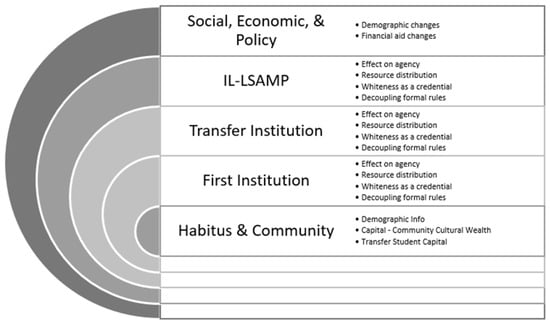
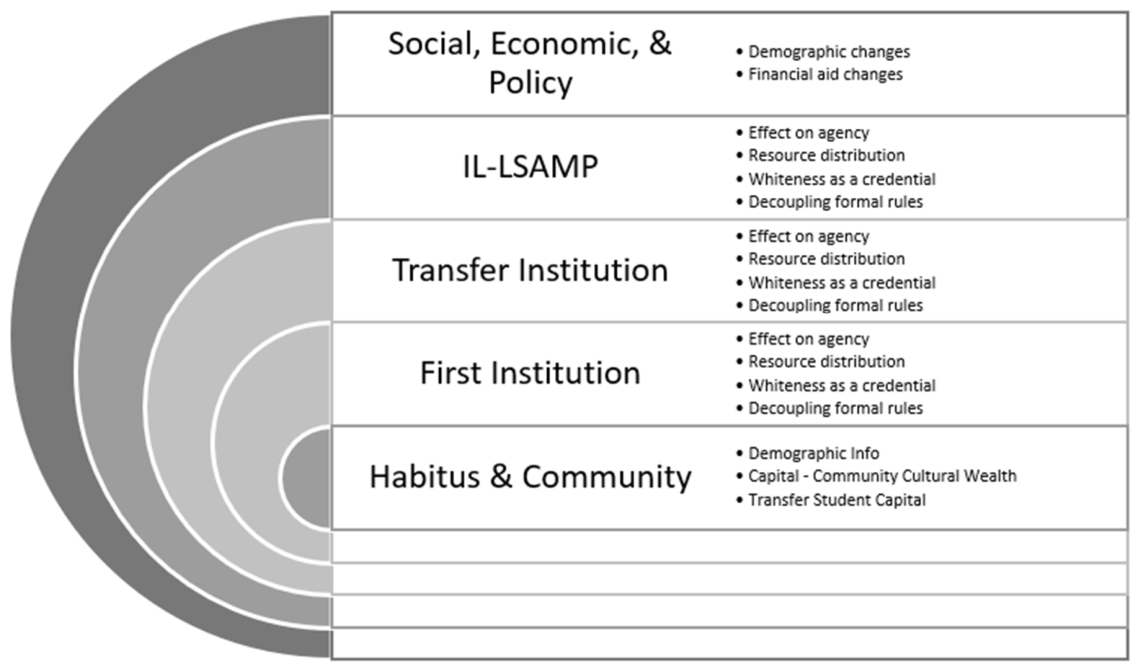
The findings begin to describe the multiple layers of racialized organizations that URM STEM students face in the transfer process from a 2-year institution to a 4-year institution. Despite students’ capital and affirming mentors, the multiple levels of structural racism challenge the LSAMP mission to encourage and aid students pursuing advanced degrees in STEM and underscore the inconsistent focus on this important process. Five layers were observed in this study: (1) Tapping into Existing Expertise: Student Context, (2) Exploring Available Resources: Community College Context, (3) Considering Transfer Reception: 4-year Institution Context, (4) Limited Intervention: Alliance Context, and (5) Understanding External Forces: Social, Economic, and Policy Context. However, layers one, two, and four, which highlight the Habitus and Community, First Institution and the IL-LSAMP layers from the STEM Transfer Student Contextual Framework (i.e., Figure 1), are presented in this manuscript. Additional research is needed to expand on layers three and five, which are representative of Transfer Institution and Social, Economic, and Policy layers in the STEM Transfer Student Contextual Framework.
Figure 1.
STEM Transfer Student Contextual Framework (Holland Zahner, 2022; Ray, 2019; Yosso, 2005).
4.1. Tapping into Existing Expertise: Student Context
The first layer, the student context, highlights the forms of capital that racially minoritized STEM transfer students utilize to navigate their undergraduate transfer process. Influenced by their identities and the way they understand processes and higher education spaces, students experience the transfer process in bureaucratic ways but apply their community cultural wealth (Yosso, 2005) in their navigation of these. The following quote shows Rachel’s (a student at a 4-year institution who previously transferred from a community college) perspective on the transfer process: “It wasn’t super stressful. At that point, I’d just done so much paperwork with the US government because of my undocumented status and DACA renewal and stuff like that. So as far as paperwork’s concerned, it was the least of it.” Rachel’s navigational capital, developed while managing her Deferred Action for Childhood Arrivals (DACA) application, equipped her to handle complex administrative paperwork similar to the transfer process (Perna, 2006). She had a strong foundation in navigational capital (i.e., habitus and community layer) (Yosso, 2005) that could be transmitted to transfer capital.
On the other hand, other students may be discouraged from entering the STEM field even before starting their time at any higher education institution. To show the influence race and gender have on this experience, Josie, a student at a community college within the Alliance who was in the process of transferring to a 4-year institution, stated:
This quote underscores the micro-steps by which students leverage their expertise, aspirational, and navigational capital to deal with external messaging. Expressing frustration but resolving to do their own research is the type of resilient processing we heard frequently. Another source of expertise that students described was their familial context and capital (Yosso, 2005), which can be a very beneficial resource for students navigating higher education. One community college student in the Alliance, who was in the process of transferring, shared in a focus group the role their siblings play in their educational journey:Because growing up for me, when I told my teacher I wanted be in STEM, they laugh. They was like, “You can’t do it.” And I was like, “What are you talking about?” And so, I had to do my own research to see the women of color in STEM. And I was just like, “That is frustrating.”
For me, a lot of mine is my family, because I have four siblings who have all gone to college, thankfully. So I ask them a lot of questions and they’re like, “No, you need to be doing this, or you should be taking this class.” But even sometimes they don’t know because they went to school 15 years ago. So a lot of things are changing. And so if they don’t know it, then I kind of feel like stuck because I don’t really have anyone else to reach out to.
These representative quotes begin to demonstrate an important starting point, or “input,” for the transfer process. Namely, that students can carry enough community cultural wealth to be successful in their transfer process. Their own intrapersonal processing and positive external supports are important precursors to the vertical transfer process; however, students can be stalled or propelled by the next four layers they are navigating.
4.2. Exploring Available Resources: Community College Context
The second layer, the community college context, encompasses the students in our study’s entire experience at their community college (i.e., First Institution layer). Students found solace and shortcomings in their 2-year institutions, reflecting on their social and academic preparation for a 4-year institution, their sense of belonging and community, and the support they received from the staff and faculty. An example of feeling supported and encouraged through connections with faculty comes from Jess, a student at a community college in the Alliance who was in the process of transferring to a 4-year institution, who shared:
I think my chemistry professor, she really inspired me a lot. Honestly, I hated chemistry, and at least I took AP chemistry in high school, and I’m like, “This is not for me. No thanks.” I like math, but I’m like, “No, no, no.” But she was a really good teacher, and I was talking to her so much. She’s like, “You remind me of me when I was younger.” And I’m like, “Oh my God, that means a lot to me.” And I don’t know, she would really help me a lot with homework and stuff. So, I would think of her.
Jess’s reflection highlighted how personal connection was meaningful in their own navigation of the community college context (Perna, 2006). Having a STEM faculty member who was unwavering in their support and who related to her changed her perspective on pursuing chemistry. This type of validation, though not explicitly tied to her racial identity, shows how affirming bonds (López et al., 2025) with mentors can help students with minoritized identities pursue STEM knowledge.
An example of some of the shortcomings comes from Cynthia, a student at a community college in the Alliance, who was in the process of transferring to a 4-year institution, who shared:
Cynthia’s reflection shows the importance of identity acknowledgement in the transfer process, whether identities are shared or differ. This acknowledgement has the potential to enhance or diminish students’ confidence and overall STEM identity.If you don’t show me that I matter to you, then how do I know? How am I supposed to know that? But with the advisor that I just got, he went through this plan with me too, and I was like, “Thank you.” Because the last advisor I had, she technically kind of made me feel bad for stuff. Because as a woman, you also made me feel like I was nothing.
Community colleges have unique student populations that may influence how the institution frames resources. Cindy, a 2-year faculty member, explained that STEM departments do not clearly convey how they address social issues, which can negatively influence students’ interest, especially among those who value contributing to their communities in meaningful ways. This alludes to STEM’s organizational approach as neutral and objective (Ray, 2019), which falsely positions STEM as separate from social issues and contexts (Barak, 2025; King et al., 2023). Cindy stated:
I remember the first student who told me, you know, well, STEM doesn’t help people so I can’t. I can’t pursue it. Um, and so we’ve got a culture here who grew up being told you had to have jobs that help people. And there were certain categories that fell into, and so chemist, physicists, computer scientist, engineer, those weren’t even part of the conversations.
Professor Sasha, a community college faculty member, felt that transferring is not a priority in the advising offered at community colleges, a common stance among other community college faculty interviewed. This faculty member implies that institutional and programmatic interests prevail over student interests. Professor Sasha stated:
So if you come in and you say, “hey, I wanna do nursing,” then some people, ‘cause [Alliance university/college has a nursing program, at least to an associate degree in nursing. So then they’ll put them on that track as opposed to saying, oh, these students actually wanna do a B.S.N., you know, and then, that’s a different track, I think. I mean, so [redacted], some of it is just self-serving. Like, we wanna fill up our own programs. Right. But even though that could be a potentially longer path for the students to get to what they want.
The totality of these illustrative quotes begins to show how quickly and easily students’ TSCs become nuanced and complicated by the organizational realities of their institutions. While there are some bright spots (e.g., faculty mentoring), the general sentiment was that, left to its own devices for these STEM students, the community college context was insufficiently generative in their transfer experience (e.g., culture, poor advising). This leads to the final context we are expanding on, which purports to be the type of intervention that might provide a backstop and bridge support to institutions to aid in the transfer process.
4.3. Limited Intervention: Alliance Context
The fourth layer, Alliance context (i.e., IL-LSAMP layer), addresses the influence of the Alliance (e.g., resources, support staff, student experiences) on these students’ transfer experiences. References to the Alliance by students reflected a positive impact on student experience but were overall limited. An example can be seen from Breaunne, a student at a 4-year institution within the Alliance who had previously transferred from a 2-year institution outside of the Alliance. This student wanted autonomy and agency in her STEM research, which she found in the LSAMP experience at her four-year institution. Here, LSAMP was able to counter an established STEM practice of conducting research, not necessarily rooted in detachment but instead in connection and joy (Burt et al., 2020). Breaunne stated:
It is important to acknowledge that many student participants were not aware of Alliance-specific support, resources and/or guidance; therefore, examples were mostly specific to their Student or Community College Context. Faculty members, who had more knowledge of Alliance infrastructure, provided specific Alliance observations in ways that were not accessible to students.Because I was a bio lab TA when I was at [redacted], and I saw kids come in to do research and they just kept playing with fruit flies and looking at Petri dishes. And I was so bored. I was like, “No, I don’t want to do that.” But then when I got to LSAMP, they said that I can do my own research, and I get to choose the question, and I get to basically learn about things that I care about. And I really enjoyed that aspect.
Two-year faculty members referenced not feeling supported, not being adequately informed about resources, and not being aware of how faculty can work across Alliance institutions to best support STEM transfer students. These statements reflected a strained relationship within the Alliance and an inability to create and maintain support structures for transfer STEM students. It also emphasizes a differentiation between 2 and 4-year credentials, with many faculty feeling that 4-year credentials and experience are valued more (McCambly et al., 2023). Cindy, a 2-year faculty member, noted that research opportunities offered through the Alliance often do not consider community college students and that community colleges receive fewer resources when creating research opportunities. Cindy stated:
I don’t think that they need to baby our students or give them any special treatment, but just the offer of hey, we have this, like a lot of the stuff that comes through the Alliance isn’t for community college students. It’s junior or senior level. Um, you know what, so like I appreciate the [redacted Alliance partner] internships are for all stages.
Josh, a 2-year faculty member, felt that the community colleges were not prioritized in the Alliance and believed they were added to the Alliance to be perceived as more inclusive for funding purposes (McCambly et al., 2023; Ray, 2019). This sentiment was echoed by the majority of the 2-year faculty interviewed. Josh stated:
It’s like, okay, let’s just bring you on board, attach your name, and kind of, uh, how do I say it now? Get a good PR with your membership. That is the way it looks to me. So I don’t think the 2-year college is, uh, like the main piece of the pie for the Alliance, uh, focus. So overall the resources for the 2-year courses is small, to just answer your question directly. Yeah. And the influence they have on local policies of instruction and curriculum is also very small.
Professor Sasha, a faculty member at a 2-year institution, articulated how the Alliance’s lack of institutionalization, given its longevity, highlights issues that ultimately negatively impact students. Information is not shared well or widely, which disadvantages and stalls students’ progress toward their transfer goals, reflecting racialized resource distribution (Ray, 2019). Professor Sasha stated:
So now I have to tell my students specifically like, no, no, no, you’re an LSAMP scholar. This is what you do. You know what I mean? We give them a little letter and stuff so they, they know like, put this on your resume. This is the verbiage that you’re gonna use. But those things are not, um, it’s not institutionalized across the Alliance. So that part is frustrating to me, especially when we think about like how long the Alliance has been, um, been around. Yeah. You know, like these certain things I should as a new site coordinator, I should get a manual. This is what you do. You know, implement this, this, this and this. These are the that you should do before you are even accepted maybe into the Alliance. Can you do these things? If you can’t, then, you know, maybe you should spend some time ramping up, you know? So that makes sense. It’s those kind of things that I think, um, would, would help our students be more successful. It would help the Alliance to be what I would consider then a true Alliance. Um, and I’m not sure why we’re not quite there yet.
While community college faculty referenced the need for improvement within the Alliance, 4-year LSAMP faculty members felt more adequately supported and informed in supporting this student population, which confirmed the disparate experiences of 2- and 4-year institutions. Margaret, a faculty member at a 4-year institution, discussed the benefits of the various research opportunities available to the students she works with. Margaret stated:
I feel like I’ve just been so lucky. Like the students I’ve worked with are just, um, capitalizing on every opportunity that’s thrown at them. And I think that the LSAMP Alliance has really helped them a lot and it’s given them a lot of confidence. So the research they do with me is just like a little launching point to where, you know, you work with me for like a semester or two and then we submit applications to do an [redacted] or you work at, you know, they’re working at [institution redacted] or um, one of these other local places that, um, you know, we have a lot of folks that want our students to do summer internships. And so, I feel like this is all sort of possible because of this, um, the support that they’re getting through LSAMP.
In all, these quotes paint a complex picture of the LSAMP’s efforts and inconsistent success in supporting the transfer process. The quotes underscore the organizational challenges that contextualize the community college, and student input demonstrates the capital students bring to the transfer process, against the backdrop of racialized organizational systems that can limit students’ capacity for vertical transfer. This showcases how each layer in the STEM Transfer Student Contextual Framework, including those not presented in this manuscript, informs and intersects with one another.
5. Discussion
Our study sought to better understand the experiences of racially minoritized STEM transfer students who transfer from a 2-year to a 4-year institution while also examining how a STEM intervention (i.e., LSAMP Alliance) supports/challenges students in this process. Additionally, our study explored how transfer support facilitated by a STEM intervention can be effectively institutionalized between institution types. The results of our study begin to qualitatively confirm that students are navigating racialized transfer processes and experiences within racialized organizations (i.e., higher education institutions, alliances). Though our findings are specific to the Alliance, we believe they can be applicable more broadly when investigating STEM interventions moving forward. As STEM interventions adapt to a landscape of reduced federal grant funding and restrictions on equity-related programming and language (Gretzinger et al., 2025), priming institutional context has become even more imperative. Reliance on federal funding alone to champion these pursuits is unrealistic; therefore, the hope for a diverse and growing STEM workforce is constrained if institutional recognition and integration of broadening participation in STEM are not prioritized (e.g., institutional mission, vision, strategic planning). This is concerning in terms of technology development and scientific breakthroughs, which do not take into account diverse populations, risk being ineffective, inequitable, and unrepresentative of the global population (Gruber & Johnson, 2019), all of which can contribute to broader issues of access (e.g., education, health, technology), health disparities, and infrastructure efficiencies. Accordingly, the contributions of this project rest on how our study helps to unearth and draw attention to previously obscure but no less critical nuances in the STEM transfer process. As a result, we assert that the priming of institutional contexts moving forward needs to consider and prioritize minoritized STEM transfer students, who already have an interest and desire to pursue STEM careers.
The first area of contribution is related to how the student context layer operates in our model (Figure 1) and recognizes the various forms of capital (e.g., transfer, navigational, familial) that students utilize throughout different stages of their transfer process. This layer is informed by their prior higher education experiences, their social identities, and the various relationships these STEM transfer students have within and outside their college or university. We found that there is an overlap between TSC and community cultural wealth (Yosso, 2005), as seen with Rachel, who utilized navigational capital with her DACA renewal in her transfer journey. Maliszewski Lukszo and Hayes (2020) noted that literature on how transfer students gain and use TSC is limited, and from our findings, there is an opportunity to expand how we understand the use of TSC within a STEM intervention specifically. Our findings suggest that although TSC can be supported or stifled by various organizational structures and processes, students are still utilizing it, whether consciously or unconsciously. Research and programming that investigate the organic development and use of STEM TSC may provide avenues for institutional- and geographic region-specific strategies to increase vertical transfer between 2- and 4-year institutions. The implications of such research could not only facilitate a less stressful transfer process for minoritized STEM students but also contribute to a more streamlined pathway to STEM careers.
In addition, another contribution to the nuance of TSC is that students in our study are developing their own STEM identity while navigating the transfer process and STEM disciplines where their racial identities, and in many cases other intersecting identities (e.g., gender, disability status) have been underrepresented (National Academy of Sciences et al., 2011). Highlighting this intersection of TSC and STEM identity is important, in that these students are uniquely positioned in institutional settings that may or may not have the infrastructure to support the development of both or even acknowledge the existence of both, thus further complicating their transfer process and putting the onus back on students. Investigating how STEM TSC and STEM identity inform one another has potential to inform best practices when it comes to identifying the needs of these students and providing structural support for those needs (e.g., community building among STEM transfer students), since our study, in agreement with others (Hurtado et al., 2012; Johnson et al., 2022), underscores that student inputs alone may, at times, be insufficient.
The community college context layer consists of the resources (e.g., academic, transfer counseling, mentorship, transfer centers) available to students at their community colleges to assist them in their transfer journey. Additionally, this layer is inclusive of the community college’s position within the Alliance and the higher education field. Often, 2-year faculty felt unsupported and undervalued within the Alliance and frustrated that the education offered at their institutions was not recognized as rigorous by 4-year institutions. This reflects Ray’s (2019) tenets of whiteness as a credential, in that 4-year institutions are seen as more prestigious and valid than community colleges, and the decoupling of formal rules, in that no attention is paid to the inequity between the institution types within the Alliance. Literature around articulation agreements, which refer to established partnerships between 2-year and 4-year higher education institutions that include “institutional policies or other structures that are implemented to encourage, facilitate, and monitor the student transfer process” (Hezel Associates, 2009, p. 3), and transfer credit policies notes how transfer students were typically the ones to suffer when elitism positioned community colleges as less than 4-year institutions (e.g., delay of credit transfers, delay of graduation, cost of continuing education) (Prager, 1993; Montague, 2012; Senie, 2016).
While a STEM intervention may not change the elitism embedded in higher education, there is evidence that a transfer-affirming culture can be developed and/or pursued through STEM interventions (Birkes et al., 2021; San Miguel & Gates, 2021). In interviews and focus groups with students and faculty, we learned that the community college context layer was inconsistent with transfer-specific support. Even if the 2-year institution included a transfer center or a transfer advisor, which are institutional resources focused on helping students understand the transfer process (Felix & Trinidad, 2018), the resources were not STEM-specific (resulting in conflicting academic advising), were understaffed, and/or students were unaware of their existence. Due to the inconsistency in transfer and STEM centers across Alliance institutions, there is an opportunity for future STEM interventions to serve as a bridge between transfer institutions. This would look different depending on institution type and regional constraints, but further exploration of STEM interventions as connectors rather than standalone approaches could help institutionalize efforts moving forward.
The Alliance context layer reveals a pronounced asymmetry in faculty experiences across institutional type. Faculty at 2-yearinstitutions articulated significant frustration, reflecting structural constraints and limited institutional leverage within the Alliance. In contrast, faculty at 4-yearinstitutions reported little to no frustration, describing strong support from the Alliance and perceiving it as an abundant source of opportunities and resources for their students. This supports Ray’s (2019) tenet of the unequal distribution of resources, as 2-year and 4-year institutions within the Alliance receive varying levels of support. Within the Alliance context layer, students found Alliance resources (e.g., research opportunities) helpful, but examples mentioned by students were limited. The limited responses regarding Alliance resources may result from students not grasping the scope of the Alliance and the distinction between Alliance-specific resources and those of their institutions. While the loss of federal funding complicates the time and resources available, institutions do have existing infrastructure that can benefit minoritized STEM transfer students if better advertised and introduced earlier in their transfer process. STEM centers, though not consistently available across Alliance institutions at the time of data collection, have been created at colleges and universities to address STEM workforce shortages and center STEM learning at the institution (Carlisle & Weaver, 2018). Identifying other STEM organizational resources (e.g., departmental organizations, student organizations) available and utilizing existing partnerships between previous Alliance faculty may provide a pathway forward to connecting minoritized STEM transfer students with STEM opportunities and a broader STEM community.
The findings indicate that students acquire transfer student capital (TSC) by drawing on their community cultural wealth (CCW) and strategically applying it to the transfer process. However, despite possessing both TSC and CCW, these students must navigate racialized organizations at multiple levels. Within their community colleges, they pursue STEM education while holding minoritized identities and often rely on fragmented and inconsistent institutional support to advance both their majors and transfer goals. At the Alliance level, community colleges are frequently positioned as academically inferior, which complicates efforts for their students to be recognized as legitimate STEM students and for faculty to secure support for programming that facilitates access to opportunities at four-year institutions.
6. Looking Ahead
The loss of NSF funding and the sunsetting of historical STEM interventions, like IL-LSAMP, will likely have adverse consequences for the STEM pipeline. Nevertheless, this funding loss may also create an opportunity to critically examine how students with minoritized identities are supported in STEM fields. To more intentionally center students’ community cultural wealth and address structural racism within community colleges, institutions might prioritize STEM identity development by shifting away from norms of objectivity (Burt et al., 2020) and toward bonded mentoring practices (López et al., 2025). The reimagining of cultivating a seamless transfer student process is centered around a myriad of factors associated with TSC (Holland Zahner, 2022; Laanan et al., 2011) and organizational support (Carlisle & Weaver, 2018; Felix & Trinidad, 2018; Hezel Associates, 2009; Senie, 2016; Zamani, 2001), especially when seeking to address underrepresentation of and support of minoritized student populations.
To address racialized organizational dynamics across institutional sectors, 2 and 4-year institutions could sustain selected aspects of their collaborative relationships, thereby fostering mutual respect for the educational opportunities and contributions of community colleges. San Miguel and Gates’ (2021) New Jersey State LSAMP programs provide a prime example of implementing a program that adheres to closing the vertical transfer gap by encompassing the following: summer research at 4-year institutions, joint research conferences, annual transfer admission event, peer mentoring between 2 and 4-year institutions, and professional development. This proactive approach affirms students’ sense of belonging in pursuing a 4-year degree and counters the deficit narratives reflected in our findings. Faculty at current LSAMPs could focus on what aspects of their collaborations can be maintained without federal funding. Collaborations that faculty continue because of genuine relationships, rather than a directive, may have a better foundation for mutual regard. Furthermore, students can share their community’s cultural wealth and transfer capital with each other in ways they may find validating. Many of the students in the focus groups expressed a need and interest in having conversations about how they navigate STEM and the transfer process.
7. Conclusions
The state of STEM interventions attempting to address issues concerning equity in STEM remains uncertain at present. Though efforts have been made, prior to the current presidential administration, to address underrepresentation in STEM more broadly, the issues remain persistent and ever challenging. Though long-standing STEM interventions, such as LSAMP Alliances, no longer exist in the same format, we argue that evidence from these interventions can assist researchers and educators in their pursuit of STEM equity moving forward, especially concerning STEM transfer students. Furthermore, we emphasize the need for current and future STEM interventions to prioritize approaches and research that embed processes that lead to sustainability. Funding and access to resources will continue to fluctuate for the foreseeable future; therefore, approaches must center on organizational change from conceptualization to implementation. Rather than only creating new programmatic processes and resources through STEM interventions that often solve issues temporarily, we urge consideration of the importance of relationship building and utilization of existing structures already embedded within institutions that could contribute to a transfer-affirming culture and experiences for STEM students.
Our findings not only highlight how the transfer process is racialized but also that it is a disservice to students to ignore how racialization impacts each layer and context of the STEM transfer process. Racially minoritized STEM transfer students are utilizing transfer student capital and community cultural wealth to navigate the transfer process. Our interview protocol focused on resources, both individual and structural, and so additional research is needed to learn more about students’ experiences with transfer reception at their 4-year institution, as well as how policies impact their transfer journey. With this additional research, there is an opportunity to expand on these contextual layers to better understand how the shifting nuances of each inform not only the transfer experience but also potential implications for research and practice.
Author Contributions
Conceptualization, V.E.C., N.L., J.J.O. and D.L.M.; methodology, formal analysis and investigation, V.E.C., N.L., J.J.O., C.O. and D.P.; resources, V.E.C. and D.L.M.; data curation, V.E.C.; writing—original draft preparation, V.E.C., N.L., J.J.O., C.O. and D.P.; writing—review and editing, V.E.C., N.L. and D.L.M.; visualization, N.L.; supervision, V.E.C. and D.L.M.; project administration, V.E.C.; funding acquisition, D.L.M. All authors have read and agreed to the published version of the manuscript.
Funding
This research was funded by the National Science Foundation (NSF) grant award number HRD-1911341.
Institutional Review Board Statement
The study was conducted in accordance with the Declaration of Helsinki, and approved by the Institutional Review Board (or Ethics Committee) of Loyola University Chicago (project number 2804, first approval date 30 September 2021 and final approval date 22 February 2024).
Informed Consent Statement
Informed consent was obtained from all subjects involved in the study.
Data Availability Statement
The data is not publicly available due to privacy and ethical restrictions, as they involve human participants and include potentially identifying information obtained through individual and/or focus group interviews.
Conflicts of Interest
The authors declare no conflict of interest.
Abbreviations
The following abbreviations are used in this manuscript:
| DACA | Deferred Action for Childhood Arrivals |
| LSAMP | Louis Stokes Alliances for Minority Participation |
| IL-LSAMP | Illinois Louis Stokes Alliances for Minority Participation |
| TSC | Transfer Student Capital |
Notes
| 1 | This source has been pulled from the website due to changes to NSF programming by the Trump Administration. |
| 2 | see Note 1. |
References
- Archer, L., DeWitt, J., Osborne, J., Dillon, J., Willis, B., & Wong, B. (2013). ‘Not girly, not sexy, not glamorous’: Primary school girls’ and parents’ constructions of science aspirations. Pedagogy, Culture & Society, 21(1), 171–194. [Google Scholar] [CrossRef] [Scilit]
- Baber, L. D., & Jackson, J. (2018). From the edge of success to the center: Development of LSAMP alliances, 1987–2017. IINSPIRE LSAMP Research Brief, 2. [Google Scholar]
- Barak, B. (2025, May 2). I teach computer science, and that is all. The New York Times. Available online: https://www.nytimes.com/2025/05/02/opinion/work-school-classroom-politics-harvard.html (accessed on 1 November 2025).
- Birkes, A. Y., DeMeester, K. M., Major, M. H., & Simmons, B. W. (2021). Georgia state university perimeter college LSAMP transfer bridge program: A path forward for broadening participation in stem. Frontiers in Education, 6, 684291. [Google Scholar] [CrossRef] [Scilit]
- Bourdieu, P. (1986). The forms of capital. In J. Richardson (Ed.), Handbook of theory and research for the sociology of education (pp. 241–258). Greenwood. [Google Scholar]
- Braun, V., & Clarke, V. (2006). Using thematic analysis in psychology. Qualitative Research in Psychology, 3(2), 77–101. [Google Scholar] [CrossRef] [Scilit]
- Brickhouse, N. W., Lowery, P., & Schultz, K. (2000). What kind of a girl does science? The construction of school science identities. Journal of Research in Science Teaching, 37, 441–458. [Google Scholar] [CrossRef] [Scilit]
- Briggs, C. (2016). The policy of STEM diversity: Diversifying STEM programs in higher education. Journal of STEM Education, 17(4), 5–7. [Google Scholar]
- Burt, B. A., Stone, B. D., Motshubi, R., & Baber, L. D. (2020). STEM validation among underrepresented students: Leveraging insights from a STEM diversity program to broaden participation. Journal of Diversity in Higher Education, 16(1), 53. [Google Scholar]
- Carlisle, D. L., & Weaver, G. C. (2018). STEM education centers: Catalyzing the improvement of undergraduate STEM education. International Journal of STEM Education, 5, 47. [Google Scholar] [CrossRef] [Scilit] [PubMed]
- Carlone, H. B., & Johnson, A. (2007). Understanding the science experiences of successful women of color: Science identity as an analytic lens. Journal of Research in Science Teaching, 44, 1187–1218. [Google Scholar] [CrossRef] [Scilit]
- Felix, E. R., & Trinidad, A. (2018). Fulfilling the transfer mission at an urban technical college: How a transfer center mediates baccalaureate aspirations for students. Community College Journal of Research and Practice, 42(12), 861–877. [Google Scholar]
- Gretzinger, E., Hicks, M., Dutton, C., Smith, J., Cutler, S., & Baiocchi, A. (2025). Tracking higher Ed’s dismantling of DEI. The Chronicle of Higher Education. Available online: https://www.chronicle.com/article/tracking-higher-eds-dismantling-of-dei?emailConfirmed=true&=&supportSignUp=true&=&supportForgotPassword=true&=&email=jmhaines@usnews.com&=&success=true&=&code=success&=&bc_nonce=cnv4ii2r0qhyojoykomje (accessed on 1 December 2025).
- Griffin, K. A. (2012). Black professors managing mentorship: Implications of applying social exchange frameworks to our understanding of the influence of student interaction on scholarly productivity. Teachers College Record, 114(5), 1–37. [Google Scholar]
- Gruber, J., & Johnson, S. (2019). Jump-starting America: How breakthrough science can revive economic growth and the American dream. Hachette Book Group. [Google Scholar]
- Harper, S. R. (2010). An anti-deficit achievement framework for research on students of color in STEM. New Directions for Institutional Research, 2010(148), 63–74. [Google Scholar] [CrossRef] [Scilit]
- Hathaway, R. S., Nagda, B. A., & Gregerman, S. R. (2002). The relationship of undergraduate research participation to graduate and professional education pursuit: An empirical study. Journal of College Student Development, 43(5), 614–631. [Google Scholar]
- Hays, D. G., & Singh, A. A. (2011). Qualitative inquiry in clinical and educational settings. Guilford Press. [Google Scholar]
- Hezel Associates. (2009). Best practices in statewide articulation and transfer systems, research literature overview. Western Interstate Commission for Higher Education and Lumina Foundation for Education. [Google Scholar]
- Holland Zahner, D. G. (2022). Opening the black box of vertical transfer admission: The experiences of community college students in STEM majors. Community College Journal of Research and Practice, 48(6), 344–368. [Google Scholar] [CrossRef] [Scilit]
- Holmes, A. G. D. (2020). Researcher positionality—A consideration of its influence and place in qualitative research—A new researcher guide. Shanlax International Journal of Education, 8(4), 1–10. [Google Scholar] [CrossRef] [Scilit]
- Hug, S., Arnett, S. M., & Way, S. M. (2025). From invisible to invaluable: The critical role of recognition in Latina STEM capital activation. Journal of Women and Minorities in Science and Engineering, 31(6), 47–71. [Google Scholar] [CrossRef] [Scilit]
- Hurtado, S., Alvarez, C. L., Guillermo-Wann, C., Cuellar, M., & Arellano, L. (2012). A model for diverse learning environments: The scholarship on creating and assessing conditions for student success. In Higher education: Handbook of theory and research (Vol. 27, pp. 41–122). Springer. [Google Scholar]
- Johnson, R. M., Anya, U., & Garces, L. M. (2022). Racial equity on college campuses: Connecting research and practice. SUNY Press. [Google Scholar]
- Jones, S. R., Torres, V., & Arminio, J. (2022). Negotiating the complexities of qualitative research in higher education: Fundamental elements and issues (3rd ed.). Routledge. [Google Scholar]
- King, G. P., Russo-Tait, T., & Andrews, T. C. (2023). Evading race: STEM faculty struggle to acknowledge racialized classroom events. CBE—Life Sciences Education, 22(1), ar14. [Google Scholar] [CrossRef] [Scilit] [PubMed]
- Laanan, F. S., Starobin, S. S., & Eggleston, L. E. (2011). Adjustment of community college students at a 4-year university: Role and relevance of transfer student capital for student retention. Journal of College Student Retention: Research, Theory & Practice, 12, 175–209. [Google Scholar] [CrossRef] [Scilit]
- López, N. (2023). “Hold up”: Linking collectivism to critical consciousness in the academic identity development of Latinx/a/o college students. The Journal of Latinos and Higher Education, 23(2), 628–641. [Google Scholar]
- López, N., Chaidez, C., Matamoros, D., Parker, D., & Morgan, D. L. (2025). Cultivating comunidad: The role of collectivism on Latina/x STEM identity. Journal of Postsecondary Student Success, 5(1), 110–130. [Google Scholar] [CrossRef] [Scilit]
- López, N., Morgan, D. L., Hutchings, Q. R., & Davis, K. (2022). Revisiting critical STEM interventions: A literature review of STEM organizational learning. International Journal of STEM Education, 9(1), 39. [Google Scholar] [CrossRef] [Scilit] [PubMed]
- Maliszewski Lukszo, C., & Hayes, S. (2020). Facilitating transfer student success: Exploring sources of transfer student capital. Community College Review, 48(1), 31–54. [Google Scholar] [CrossRef] [Scilit]
- May, G. S., & Chubin, D. E. (2003). A retrospective on undergraduate engineering success for underrepresented minority students. Journal of Engineering Education, 92(1), 27–39. [Google Scholar] [CrossRef] [Scilit]
- McCambly, H. N., Aguilar-Smith, S., Felix, E. R., Hu, X., & Baber, L. D. (2023). Community colleges as racialized organizations: Outlining opportunities for equity. Community College Review, 51(4), 658–679. [Google Scholar] [CrossRef] [Scilit]
- Mervis, J. (2025, May 16). NSF’s grant cuts fall heaviest on scientists from underrepresented groups. Science. Available online: https://www.science.org/content/article/nsf-s-grant-cuts-fall-heaviest-scientists-underrepresented-groups (accessed on 25 January 2026).
- Montague, N. R. (2012). Articulation agreements: No credits left behind. Issues in Accounting Education, 27(1), 281–298. [Google Scholar] [CrossRef] [Scilit]
- Morgan, D. L., Callais, V. E., Acevedo, M., & Davis, K. B. (2021). A potential canary in the coal mine: A critical policy analysis of the Illinois LSAMP during the COVID-19 pandemic. Frontiers in Education, 6, 668394. [Google Scholar] [CrossRef] [Scilit]
- National Academy of Sciences, National Academy of Engineering & Institute of Medicine. (2011). Expanding underrepresented minority: America’s science and technology talent at the crossroads. The National Academies Press. [Google Scholar]
- National Science Foundation. (2020). Louis stokes alliances for minority participation. Available online: https://beta.nsf.gov/funding/opportunities/louis-stokes-alliances-minority-participation (accessed on 2 January 2024).
- National Student Clearinghouse. (2022). Transfer and progress: Fall 2022 report. Available online: https://nscresearchcenter.org/wp-content/uploads/TransferProgressFall22.pdf (accessed on 2 April 2023).
- Neumann, M. D., Lathem, S. A., & Fitzgerald-Riker, M. (2016). Resisting cultural expectations: Women remaining as civil and environment engineering majors. Journal of Women and Minorities in Science and Engineering, 22(2), 139–158. [Google Scholar] [CrossRef] [Scilit]
- Okrent, A., & Burke, A. (2021). National science board- science and engineering indicators. In The STEM labor force of today: Scientists, engineers, and skilled technical workers. National Science Foundation. Available online: https://ncses.nsf.gov/pubs/nsb20212 (accessed on 4 September 2021).
- Okstad, J. J., Callais, V. E., López, N., Ojikutu, F., Morgan, D. L., & Abdelghaffar, A. (2023). It’s in our DNA: Leadership perspectives on institutionalizing STEM success in an alliance. Journal of Postsecondary Student Success, 2(2), 57–80. [Google Scholar] [CrossRef] [Scilit]
- Perna, L. W. (2006). Studying college access and choice: A proposed conceptual model. In J. C. Smart (Ed.), Higher education: Handbook of theory and research (pp. 99–157). Springer. [Google Scholar] [CrossRef] [Scilit]
- Prager, C. (1993). Transfer and articulation within colleges and universities. The Journal of Higher Education, 64(5), 539–554. [Google Scholar] [CrossRef] [Scilit]
- Ray, V. (2019). A theory of racialized organizations. American Sociological Review, 84(1), 26–53. [Google Scholar] [CrossRef] [Scilit]
- San Miguel, C., & Gates, A. E. (2021). Synergistic interaction of LSAMP alliances to improve the graduation and transfer of community college students in New Jersey United States. Frontiers in Education, 6, 679865. [Google Scholar] [CrossRef] [Scilit]
- Senie, K. C. (2016). Implementing transfer and articulation: A case study of community colleges and state universities. Community College Journal of Research and Practice, 40(4), 269–284. [Google Scholar]
- Sorge, C., Newson, H. E., & Hagerty, J. J. (2000). Fun is not enough: Attitudes of Hispanic middle school students toward science and scientists. Hispanic Journal of Behavioral Sciences, 22, 332–345. [Google Scholar] [CrossRef] [Scilit]
- Starobin, S. S., Smith, D. J., & Santos Laanan, F. (2016). Deconstructing the transfer student capital: Intersect between cultural and social capital among female transfer students in STEM fields. Community College Journal of Research and Practice, 40(12), 1040–1057. [Google Scholar] [CrossRef] [Scilit]
- Tonso, K. L. (2006). Student engineers and engineer identity: Campus engineer identities as figured world. Cultural Studies in Science Education, 1, 273–307. [Google Scholar] [CrossRef] [Scilit]
- Tracy, S. J. (2010). Qualitative quality: Eight ‘big-tent’ criteria for excellent qualitative research. Qualitative Inquiry, 16(10), 837–851. [Google Scholar] [CrossRef] [Scilit]
- Wortham, S., & Jackson, K. (2008). Educational constructionism. In J. A. Holstein, & J. F. Gubrium (Eds.), Handbook of constructionist research (pp. 107–128). The Guilford Press. [Google Scholar]
- Yin, R. K. (2018). Case study research design and methods (6th ed.). Sage Publications. [Google Scholar]
- Yosso, T. J. (2005). Whose culture has capital? A critical race theory discussion of community cultural wealth. Race Ethnicity and Education, 8(1), 69–91. [Google Scholar] [CrossRef] [Scilit]
- Zamani, E. M. (2001). Institutional responses to barriers to the transfer process. New Directions for Community Colleges, 2001(114), 15–24. [Google Scholar] [CrossRef] [Scilit]
- Zhang, Y. L., Adamuti-Trache, M., & Connolly, J. (2019). From community college attendants to baccalaureate recipients: A planned behavior model for transfer students in STEM fields of study. The Journal of Higher Education, 90(3), 373–401. [Google Scholar] [CrossRef] [Scilit]

Disclaimer/Publisher’s Note: The statements, opinions and data contained in all publications are solely those of the individual author(s) and contributor(s) and not of MDPI and/or the editor(s). MDPI and/or the editor(s) disclaim responsibility for any injury to people or property resulting from any ideas, methods, instructions or products referred to in the content. |
© 2026 by the authors. Licensee MDPI, Basel, Switzerland. This article is an open access article distributed under the terms and conditions of the Creative Commons Attribution (CC BY) license.