


Abstract
Transformational leadership (TL) remains a dominant framework in educational leadership, yet its effectiveness appears inconsistent across institutional contexts, including higher education (HE). This study develops a contingent explanation of TL using the Motivation–Ability–Opportunity (MAO) lens. Drawing on an integrative review of 19 empirical studies, the analysis examines how TL practices interact with organisational conditions to produce transformational or symbolic outcomes. The findings indicate that TL operates through three interdependent mechanisms: motivational alignment, capability development, and structural empowerment. However, these mechanisms are fragile and contingent upon contextual factors including governance autonomy, resource infrastructure, organisational culture, leadership-system maturity, and strategic orientation. When these conditions are aligned, TL fosters sustained engagement, innovation, and institutional learning. When they are misaligned, TL can devolve into rhetorical or symbolic practice, generating cynicism and inertia. The study contributes to the theory and practice of leadership in HE by reconceptualising TL as a conditional system rather than a universally effective leadership style, highlighting the importance of organisational context in enabling or constraining leadership impact.
1. Introduction
Transformational leadership (TL) has long shaped debates about effective leadership in education (Bellibaş et al., 2021). Conceived as a moral process that elevates both leader and follower (Burns, 1978) and later operationalised through behavioural dimensions (Bass & Riggio, 2006), TL remains one of the most widely applied frameworks in educational leadership research. Its enduring appeal lies in the promise of reconciling managerial accountability with professional autonomy by motivating staff, stimulating innovation, and fostering shared purpose.
However, evidence pertaining to TL effectiveness across higher education (HE) institutions is uneven. While some studies identify TL as a catalyst for engagement, collaboration, and creativity, others reveal merely symbolic or short-term effects. HE provides a theoretically distinctive context for examining TL. Universities are professional and knowledge-intensive organisations in which authority is distributed across academic, administrative, and disciplinary structures (Birnbaum, 1991). They also operate through collegial governance traditions, disciplinary cultures, and academic autonomy, which complicate simple top-down models of leadership influence (Bolden et al., 2009). In addition, HE institutions pursue multiple and sometimes competing missions, including teaching, research, service, innovation, and public engagement (Marginson, 2016). These features make leadership effectiveness highly dependent on organisational context rather than leader behaviour alone (Hallinger, 2018).
Empirical research in HE reflects this contextual complexity. Some studies associate TL with innovation, knowledge sharing, empowerment, sustainability practices, and performance (Al-Husseini & Elbeltagi, 2016; Elrehail et al., 2018; Al-Husseini et al., 2021; Bin Bakr & Alfayez, 2022; Nguyen et al., 2025). Other studies show more conditional or indirect effects, where TL depends on strategic-planning involvement, knowledge-sharing norms, organisational support, psychological empowerment, or leadership-transition conditions (Al-Aamri et al., 2024; Al-Mansoori & Koç, 2019; Wen & Harms, 2025). Critical scholarship also warns that TL may become top-down or symbolic when it masks power asymmetries rather than enabling genuine participation (Tourish et al., 2010).
These mixed findings indicate that the effectiveness of TL in HE is not self-evident. Rather, it depends on the organisational conditions that enable leadership behaviours to become meaningful practice. This study therefore asks: What are the strengths and limitations of TL in HE, and what contingency factors influence its effectiveness? To address these questions, the study uses the Motivation–Ability–Opportunity (MAO) framework (Blumberg & Pringle, 1982) as an analytical lens. MAO links leadership influence to three interdependent conditions: whether staff are motivated to contribute, whether they have the ability to do so, and whether institutional structures provide genuine opportunities for action. Drawing on an integrative conceptual synthesis of 19 empirical studies, the study develops an integrative framework explaining when TL in HE is more likely to produce substantive rather than symbolic outcomes.
2. Conceptual Foundations of TL in HE
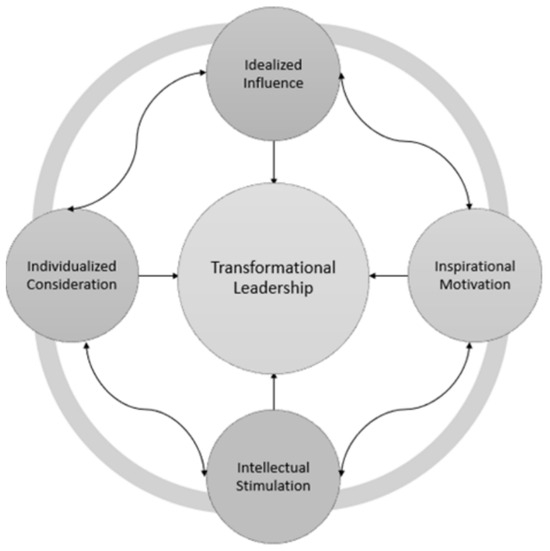
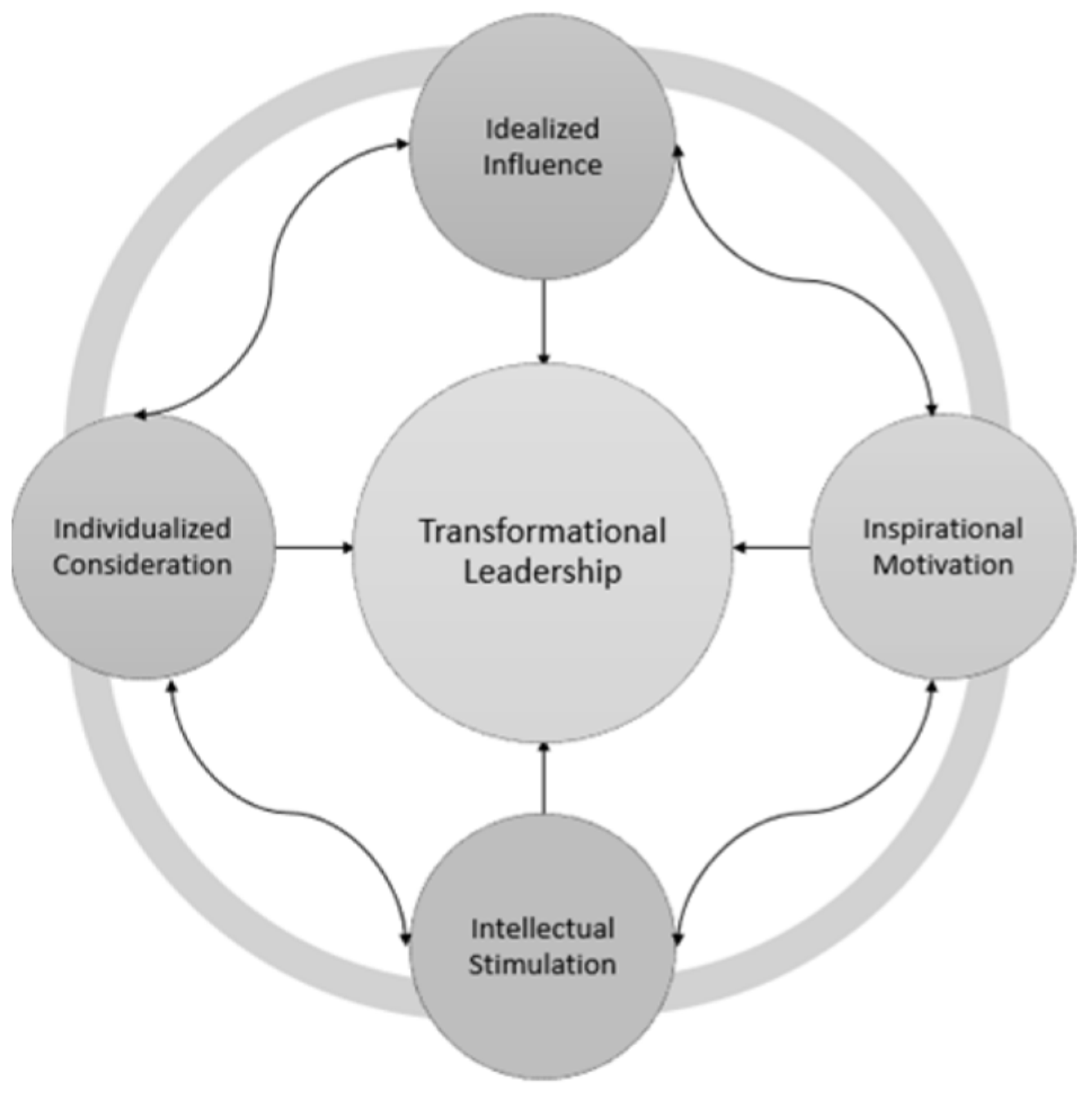
TL originated in Burns’ (1978) distinction between transactional and transformational exchanges, whereby leaders and followers “raise one another to higher levels of morality and motivation” (p. 20). Bass (1985) reconceptualised this moral ideal into observable behaviours, proposing four dimensions—idealised influence (attributes and behaviours), inspirational motivation, intellectual stimulation, and individualised consideration (see Figure 1)—later validated through empirical instruments (Bass & Avolio, 1994; Bass & Riggio, 2006).
Figure 1.
TL model. Northouse (2016).
Within education, Leithwood and Jantzi (2005) adapted TL to school and university contexts, positioning it as a vehicle for cultural change, teacher empowerment, and learning-centred reform. Their model emphasised moral purpose and collaboration as mechanisms for improvement, inspiring subsequent HE research linking TL with innovation, engagement, and sustainability.
Nevertheless, conceptual tensions persist. Critics argue that TL overstates leaders’ moral virtue and underplays the influence of organisational systems and collective agency (Evers & Lakomski, 2012; Bush, 2020). Others caution that charisma-based influence may foster conformity or emotional dependency rather than critical reflection (Tourish et al., 2010). These issues are particularly salient in HE, where collegial governance and ‘academic freedom’ complicate hierarchical authority and challenge leader-centric models of influence.
Despite these critiques, TL endures because it integrates affective, cognitive, and behavioural processes within a coherent relational framework. Contemporary studies extend TL to distributed, ethical, and inclusive forms of leadership (Ritchie-Dunham et al., 2023; Al-Aamri et al., 2024), aligning it with contemporary expectations of accountability, equity, and sustainability in universities.
Yet a theoretical gap remains. TL clarifies what effective leaders are expected to do, but it less convincingly explains why similar leadership behaviours produce different outcomes across HE settings. This issue is especially important in universities, where leadership influence is filtered through professional autonomy, collegial norms, disciplinary cultures, governance structures, and uneven access to resources. The missing link concerns the organisational conditions that enable or constrain transformational impact. Addressing this limitation requires an analytical framework that connects leadership behaviour with systemic context. The MAO framework (Blumberg & Pringle, 1982) provides such a bridge by identifying three interdependent conditions—motivation, ability, and opportunity—that jointly shape whether staff can translate leadership influence into action. The next section explains how MAO extends the explanatory power of TL in HE by linking leadership practice to contextual enablers and constraints.
3. Analytical Lens: The MAO Framework
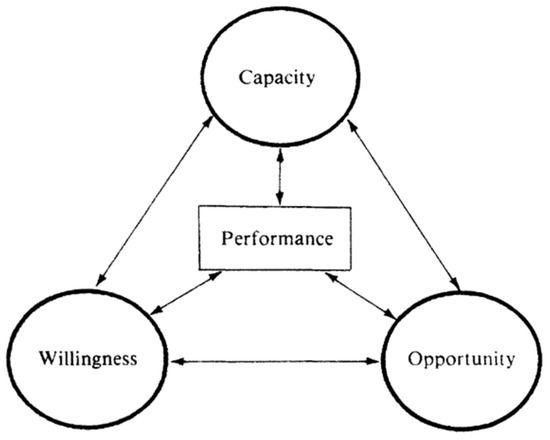
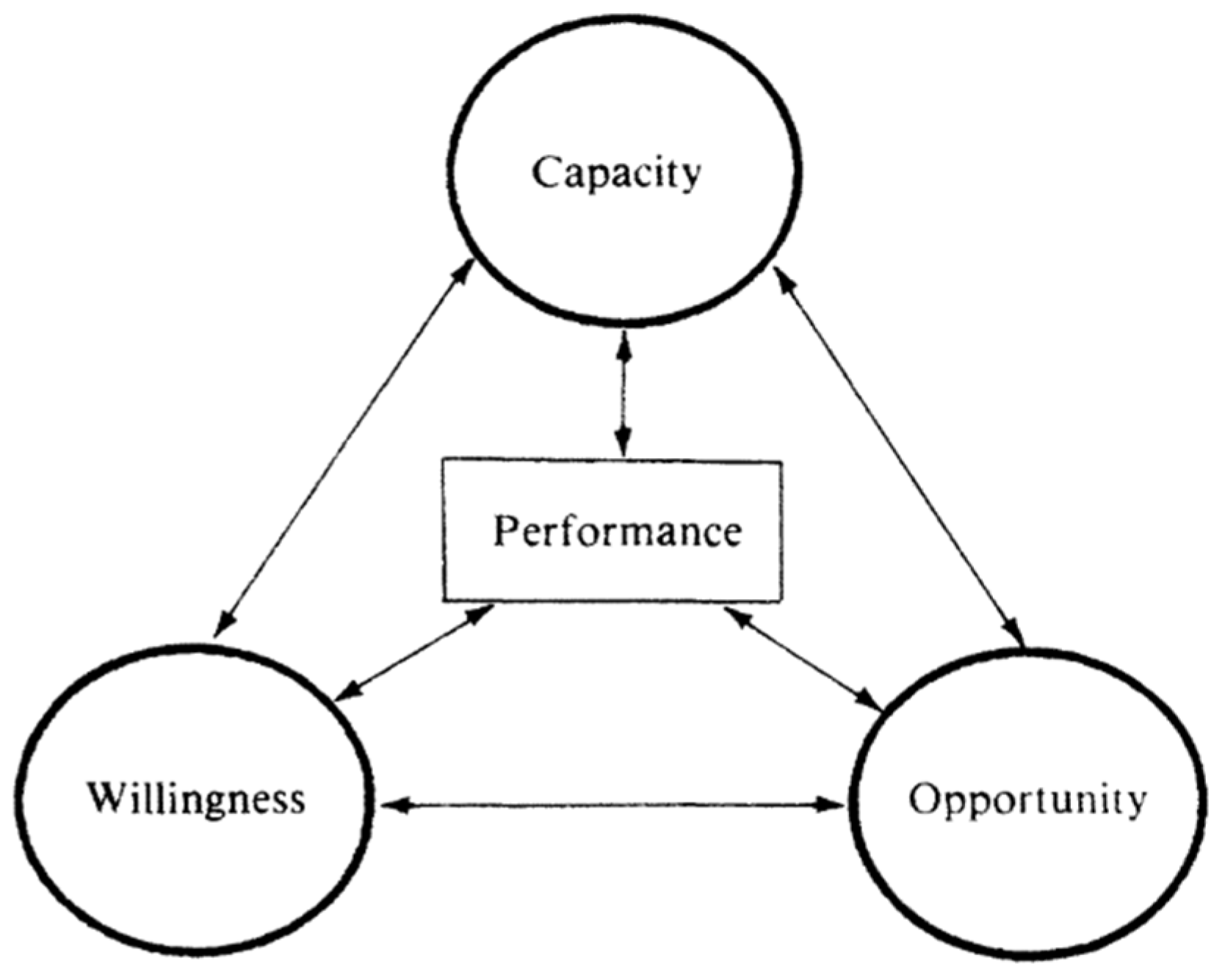
Originally developed by Blumberg and Pringle (1982) and later refined in human resource research (Siemsen et al., 2008), the MAO framework posits that performance depends on three interdependent conditions: motivation (willingness to act), ability (capability to act), and opportunity (structural or social permission to act) (see Figure 2). These conditions interact interdependently, meaning that weakness in any one dimension constrains overall effectiveness.
Figure 2.
MAO dimensions. Blumberg and Pringle (1982, p. 565).
In organisational research, MAO explains performance as the joint effect of willingness, capability, and enabling conditions. Appelbaum et al. (2000) use this logic in their account of high-performance work systems, where employee contribution depends on skills, incentives, and opportunities to participate. Jiang et al. (2012) similarly show that human resource management practices influence organisational outcomes through three pathways: skill-enhancing, motivation-enhancing, and opportunity-enhancing mechanisms. Kellner et al. (2019) further clarify that MAO is useful precisely because employee performance cannot be explained by motivation alone. This distinction is also relevant to educational leadership. Leithwood et al. (2004) argue that leadership influences improvement by shaping staff motivation, developing professional capacities, and redesigning organisational conditions. Robinson et al. (2008) show that leadership effects are strongest when leaders promote and participate in teacher learning and development, rather than relying only on vision or inspiration.
Applied to the leadership domain, MAO clarifies why might identical behaviours yield divergent outcomes across contexts. TL behaviours such as articulating vision, encouraging creativity, and recognising individual contribution stimulate motivational and cognitive engagement among followers, but their success depends on whether organisational systems provide the ability and opportunity to respond. A motivated yet overworked academic, or a capable educator lacking decision latitude, may not realise transformation. In HE, motivation may involve commitment to teaching, research, institutional mission, or public value. Ability may involve pedagogical, research, leadership, and change-management capability. Opportunity may involve collegial decision-making, workload space, professional-learning access, autonomy, and cross-unit collaboration. These examples show why TL cannot operate through inspiration alone. Staff may be motivated by a compelling institutional vision but unable to act if they lack capability, resources, authority, or meaningful participation.
Consequently, integrating MAO with TL enables simultaneous consideration of behavioural mechanisms and contextual contingencies. It shifts analysis from individual attributes to systemic alignment, examining how leaders activate conditions that sustain motivation, build capability, and expand opportunity. In this literature review, MAO functions as an interpretive framework for analysing the empirical literature (rather than as an additional theory).
4. Methods
4.1. Research Design
This study adopts an integrative conceptual literature review approach (Torraco, 2005) to develop a theoretically informed synthesis of TL in HE. The focus is on identifying how contextual conditions influence TL’s capacity to generate meaningful change. Because TL scholarship in HE remains conceptually dispersed, a conceptual integration was most suitable for synthesising empirical and theoretical insights.
In this study, HE is treated as a heterogeneous organisational context rather than as a uniform sector. The included studies examine leadership in universities, faculties, departments, doctoral programmes, and formal leadership-development settings. They also include different actor groups, such as academic staff, administrative staff, academic leaders, and mixed professional groups. This variation reflects the organisational complexity of HE, where leadership is enacted across multiple levels rather than located only in senior executive roles.
Accordingly, the review does not claim statistical or sector-wide representativeness. Instead, HE is used as a bounded review context for analysing how TL operates across diverse post-secondary institutional settings. The purpose is to identify recurring conceptual patterns across the reviewed studies, not to generalise universally to all HE systems. This distinction is important because HE systems vary substantially across national, institutional, cultural, and organisational contexts. The synthesis therefore supports analytic transferability and conceptual refinement rather than population-level generalisation.
Therefore, an integrative conceptual literature review was appropriate for three reasons. First, the literature on TL in HE is methodologically heterogeneous, including quantitative, qualitative, mixed-methods, and configurational studies. Second, the studies examine different outcomes, including innovation, knowledge sharing, empowerment, sustainability, performance, strategic-planning involvement, and entrepreneurial behaviour. Third, the study seeks to explain variation in TL effectiveness rather than test a single causal relationship. For these reasons, meta-analysis was not suitable, while a purely narrative review would have offered less methodological transparency.
Finally, the study was guided by an abductive reasoning strategy (Kovács & Spens, 2005), enabling continuous movement between the empirical literature and the MAO framework. This approach was useful because the review began with an established theoretical lens but remained open to patterns emerging from the studies themselves.
4.2. Framework Development
To ensure rigour and transparency, the study adapted the six-step framework outlined by Durach et al. (2017) for review research:
Step 1: Defining the Research Question: The investigation was directed by the following research question: What are the strengths and limitations of TL in HE? and what contingency factors influence its effectiveness?
These questions were explored through the MAO lens (Blumberg & Pringle, 1982), which links individual leadership behaviours with organisational and systemic enablers. The aim was to clarify the interplay between motivational, developmental, and structural dynamics underlying TL outcomes.
Step 2: Defining Search Terms: A systematic search was undertaken using the Web of Science database. Search strings were designed to capture variations in TL terminology and the HE context while maintaining precision and manageability:
TS = (“transformational leadership” OR “transformative leadership” OR “transforming leadership”)
AND TS = (“higher education” OR “university” OR “college” OR “tertiary education”)
AND TS = (“education research” OR “educational practice” OR “educational leadership”)
Refined by: LANGUAGE: (English) AND DOCUMENT TYPES: (Article)
Indexes: SSCI, ESCI
Timespan: All years
Step 3: Initial Search Results (Baseline Sample): The initial query produced 21 peer-reviewed journal articles. These were imported into a reference manager for screening and de-duplication. Only papers focusing explicitly on TL within tertiary or university settings were retained.
Step 4: Refinement of the Initial Search Results (Synthesis Sample): Screening and refinement occurred in three sequential stages to ensure conceptual relevance and analytical depth.
- Title and abstract screening excluded papers unrelated to TL or HE.
- Full-text examination retained studies explicitly analysing TL—conceptually or empirically—within HE settings.
- Theoretical sufficiency testing ensured that each paper contained adequate conceptual elaboration to support abductive synthesis through the MAO framework.
After this multi-stage review, 19 studies were retained for the final synthesis sample. These works represent diverse methodological traditions (quantitative = 11; qualitative = 3; mixed-methods = 5) and span multiple geographical regions, including Asia (e.g., Jordan, Malaysia, Vietnam, China, Indonesia, Oman), Africa (Cameroon, Ghana, Nigeria), the Middle East (UAE, Saudi Arabia), Europe (Netherlands), and North America (United States). Together they capture a wide range of institutional and cultural contexts—public and private universities, academic and administrative staff, and both Western and non-Western HE systems.
Each study was coded using a structured template (see Supporting Information) that recorded:
- Title, Journal, Author(s)/Year
- Aim and Methodology (including sample, instruments, and analytic technique)
- Context (region, HE level, and actor group)
- Definition or conceptualisation of TL
- Strengths or theoretical contributions
- Limitations and critiques
- Contingency factors moderating TL effectiveness
- Mapping to the MAO dimensions
- Dependent variable or outcome measure
This schema allowed consistent comparison across heterogeneous studies while preserving the nuances of each empirical design. Coding highlighted that most definitions of TL converged on Bass’s (1985) four-dimensional model—idealised influence, inspirational motivation, intellectual stimulation, and individualised consideration—but differed in contextual emphasis. For instance, Elrehail et al. (2018), Al-Husseini et al. (2021), and Al-Mansoori and Koç (2019) foregrounded TL’s link with innovation, whereas Bin Bakr and Alfayez (2022) and Etomes et al. (2025) connected TL to empowerment and productivity outcomes. Qualitative and mixed-method contributions such as Ritchie-Dunham et al. (2023) and Owusu-Agyeman (2021) extended the construct to include collaborative and participatory leadership dimensions aligned with sustainability and inclusion agendas.
The resulting database thus provided a coherent yet varied empirical base for abductive theorising. It illuminated recurring contingency themes—governance autonomy, resource infrastructure, organisational culture, leadership-system maturity, and strategic orientation—that informed the subsequent Gioia-based analysis. By aligning descriptive evidence with the MAO lens, the synthesis sample established a systematic foundation for identifying how motivation, capability, and opportunity jointly determine TL’s effectiveness in HE.
Step 5: Data Analysis: The analysis used a Gioia-informed coding structure (Gioia et al., 2013) to support transparent concept development. The approach was adapted for secondary literature synthesis and was not used to claim grounded theory generation from primary qualitative data. This distinction is important because the reviewed articles already contain authors’ interpretations of empirical data. The present analysis therefore involved a second-order interpretation of published studies rather than direct coding of interview or observational material. This adaptation is consistent with recent review-based studies that have used Gioia-informed data structures to organise derived concepts from the literature into higher-order themes and aggregate dimensions (Gotsch & Schögel, 2023; Westen & Graça, 2026).
First-order coding captured the language, constructs, and findings reported in the reviewed studies. These included, for example, references to vision, motivation, trust, intellectual stimulation, knowledge sharing, strategic involvement, autonomy, mentoring, resource support, and participative decision-making. Second-order coding then grouped these concepts into broader analytical themes. Finally, aggregate dimensions were interpreted through the MAO lens as motivational alignment, capability development, and structural empowerment.
This Gioia-informed structure was used as a transparency device for organising the synthesis. It allowed traceable movement from study-level findings to higher-order conceptual categories. However, because the analysis relied on published studies rather than primary data, the resulting framework should be understood as an interpretive synthesis rather than a fully developed grounded theory.
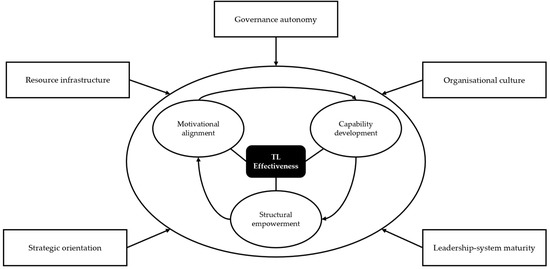
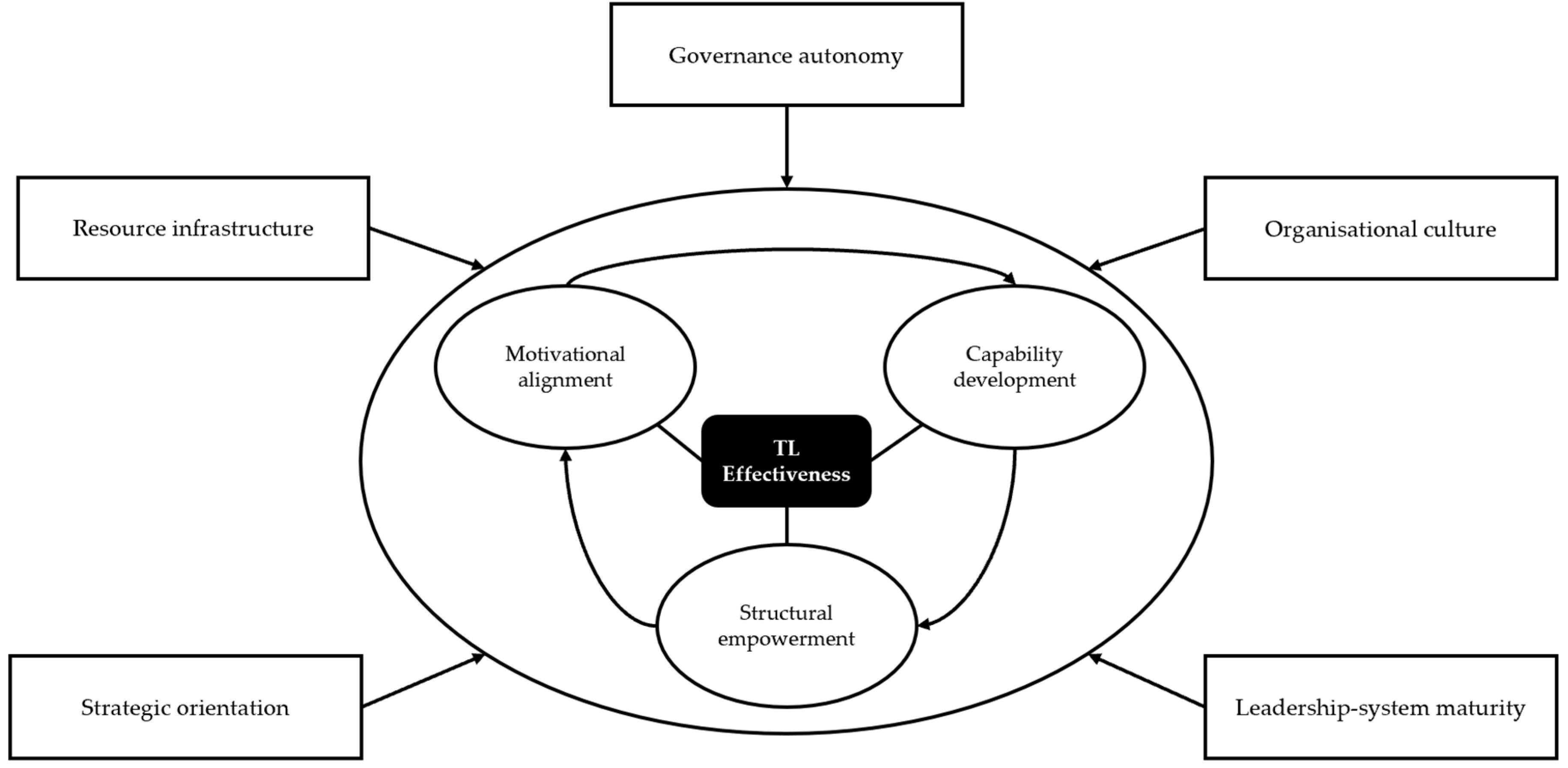
Step 6: Conceptual Framework Development: Synthesised findings were consolidated into an integrative framework (see Figure 3), portraying TL as a conditional system dependent on alignment among motivational, cognitive, and structural forces.
Figure 3.
Integrative framework.
The framework links TL mechanisms to five recurring contextual domains: governance autonomy, resource infrastructure, organisational culture, leadership-system maturity, and strategic orientation. Together, these factors determine whether TL realises transformational or symbolic outcomes.
4.3. Mitigating Bias and Ensuring Trustworthiness
To enhance trustworthiness (Lincoln & Guba, 1985), multiple safeguards were built into the analysis:
- Iterative memoing and audit trails documented analytic decisions;
- Cross-source triangulation verified theme convergence;
- Explicit linkage of codes to source citations maintained traceability;
- Within-study coherence was evaluated for each included article.
These procedures strengthened interpretive credibility and ensured that the resulting framework rests on transparent, verifiable logic rather than selective interpretation.
5. Findings
This section synthesises evidence from the studies included in the review. The findings are organised around the research questions concerning the strengths, limitations, and contingency factors shaping TL in HE. Rather than treating TL as a universally effective leadership style, the synthesis examines how its effects are represented across the reviewed literature and how these effects appear to vary according to motivational, capability-related, and opportunity-related conditions. The findings are therefore presented as patterns within the synthesis sample, not as generalisable claims about the HE sector as a whole.
5.1. Descriptive Profile of the Synthesis Sample
The review sample spans 2010–2025 and reflects growing interest in TL within HE. Earlier studies treated TL as a behavioural construct linked to motivation and commitment (e.g., Tourish et al., 2010), whereas later work positions it as a driver of innovation, empowerment, and sustainability (Elrehail et al., 2018; Bin Bakr & Alfayez, 2022; Nguyen et al., 2025). Most research in the sample originates from Asia, Africa, and the Middle East, with smaller representation from Western contexts, revealing an empirical bias toward reformist (Hallinger, 2018) HE systems. Roughly two-thirds adopt quantitative, cross-sectional designs using the MLQ-5X, while qualitative and mixed-methods studies add depth through case and comparative analyses. Despite methodological diversity, few (e.g., Al-Aamri et al., 2024; Wen & Harms, 2025; Etomes et al., 2025; Nguyen et al., 2025) examine institutional moderators, underscoring a persistent theoretical gap.
5.2. Strengths of TL in HE
Across the reviewed studies, TL is associated with three recurring mechanisms through which institutional effectiveness may be supported: motivational alignment, capability development, and structural empowerment.
Motivational alignment presents as TL’s most robust strength. The analysis indicates that leaders who communicate a compelling vision, demonstrate integrity, and model ethical conduct foster identification and trust. This moral credibility encourages intrinsic motivation and discretionary effort (Meng, 2022; Bin Bakr & Alfayez, 2022). Studies highlight how shared purpose transforms compliance into commitment, sustaining engagement during reform and hardship (Leithwood & Jantzi, 2005). Such alignment cultivates collective efficacy—staff perceive institutional goals as authentic, enhancing morale and cooperation (Ritchie-Dunham et al., 2023). Motivational cohesion also stabilises organisations through uncertainty, providing meaning and moral direction that buffer against change fatigue.
Capability development characterises TL’s cognitive engine. Through intellectual stimulation and formative feedback, leaders promote experimentation and reflective practice. Empirical evidence links these behaviours to, for example, innovation, critical thinking, and pedagogical renewal (Nguyen et al., 2025; Al-Aamri et al., 2024). Individualised consideration ensures that creative risk-taking is balanced with mentoring support. TL thus converts enthusiasm into competence and embeds learning cycles that enhance institutional adaptability (Etomes et al., 2025; Tambaip et al., 2023). Moreover, TL creates a psychologically safe space where enquiry and error are reframed as growth opportunities—an essential precursor to knowledge sharing and interdisciplinary collaboration.
Structural empowerment transforms TL from individual charisma into collective capability. When authority and information are shared through participatory structures, staff experience greater autonomy and ownership (Wen & Harms, 2025). Delegation and open dialogue foster psychological safety (Bin Bakr & Alfayez, 2022), enabling creativity and accountability. Evidence shows that such climates enhance organisational citizenship behaviour and cross-faculty cooperation (Ritchie-Dunham et al., 2023). Importantly, empowerment endures when it is institutionalised through governance and workload systems rather than being dependent on personal leadership style.
5.3. Limitations of TL in HE
The synthesis also identifies recurring limitations in how TL is represented across the reviewed studies. These limitations can be grouped into three MAO-related risks: motivational fragility, capability constraints, and structural inertia. Each risk reflects a situation in which leadership behaviours are not matched by the organisational conditions required for sustained change.
Motivational fragility arises when vision outpaces delivery. Studies show that enthusiasm diminishes when promised participation or resources fail to appear, breeding cynicism (Tourish et al., 2010). Charisma can temporarily elevate morale but often masks transactional realities; without tangible reciprocity, followers perceive dissonance between words and deeds (Tambaip et al., 2023). Sustained motivation therefore depends on consistency between moral rhetoric and operational follow-through. In volatile HE environments, symbolic leadership without reinforcement accelerates burnout and disengagement (Liu et al., 2015).
Capability constraints surface when leaders encourage creativity without the infrastructure to support it. TL’s developmental power relies on institutional scaffolding—time allocation, mentoring, and access to learning platforms (Nguyen et al., 2025; Al-Aamri et al., 2024). Yet many HE institutions operate under intensified workloads and resource compression, leaving limited capacity for reflective learning. As a result, intellectual stimulation may produce anxiety or cognitive overload rather than growth. This disconnect highlights that capability development is a collective investment, not an automatic outcome of inspirational behaviour.
Structural inertia reflects the gap between TL’s emancipatory ideals and the bureaucratic architecture of universities. Formal hierarchies, audit cultures, and centralised reward systems constrain participation, converting empowerment discourse into symbolic consultation (Tourish et al., 2010; Wen & Harms, 2025). In these conditions, TL risks legitimising existing power asymmetries by masking them in participatory language. Structural rigidity thus neutralises transformational potential, reinforcing rather than challenging institutional conservatism.
5.4. Contingency Factors Influencing TL Effectiveness
The reviewed studies suggest that TL effectiveness is shaped by contextual alignment among motivational, capability-related, and opportunity-related conditions. Five contingency domains recur across the synthesis sample (see Table 1).
Table 1.
Contingency factors.
Governance autonomy: Decentralised authority enables TL to convert shared vision into coordinated action, while hierarchical or compliance-driven governance renders it symbolic (Al-Aamri et al., 2024). Where decision-making is participatory, TL strengthens trust and collective accountability; where power remains centralised, innovation stagnates.
Resource infrastructure: Adequate time, funding, and mentoring sustain capability. Without them, stimulation becomes stress (Nguyen et al., 2025; Etomes et al., 2025). Resourced learning ecosystems amplify TL’s effects by translating enthusiasm into tangible competence, underscoring the link between human resource investment and leadership impact.
Organisational culture: Trust-based, collegial climates boost TL’s moral and motivational appeal, while politicised or low-trust cultures distort its intent (Tourish et al., 2010). Cultural congruence between rhetoric and behaviour maintains credibility; incongruence invites scepticism.
Leadership-system maturity: In mature systems, mentoring and succession planning institutionalise TL practices, ensuring continuity and distributed ownership (Ritchie-Dunham et al., 2023). Immature systems rely on charismatic individuals and lose momentum when leadership turnover occurs.
Strategic orientation: TL flourishes when institutional strategy aligns with educators’ values and societal contribution. Externally imposed or market-driven agendas create cognitive dissonance that undermines moral legitimacy (Etomes et al., 2025). Authentic strategy transforms TL from rhetoric into sustained reform.
5.5. Integrative Framework
Based on the findings, TL is best understood as a conditional leadership process rather than a universally effective style. Its outcomes derive from dynamic alignment among motivational, cognitive, and structural processes moderated by contextual enablers.
At its core, TL’s triadic engine operates most effectively when reinforced by supportive governance, adequate resources, and congruent organisational culture. The synthesis suggests that TL may contribute to engagement, innovation, and institutional learning when motivational, capability, and opportunity conditions are aligned. Yet fragilities persist: inspiration without reciprocity erodes trust; stimulation without infrastructure overwhelms; empowerment without autonomy becomes performative.
The integrative framework presented in Figure 3 repositions TL as systemically embedded leadership rather than a personality trait. It underscores a dual-effect principle: identical mechanisms can enable or impede transformation depending on contextual alignment. Understanding TL through this equilibrium lens integrates behavioural and structural perspectives, illustrating that MAO must converge for transformation to endure. Within HE, TL thus represents a relational balance between leader intent and institutional capacity—a dynamic configuration that explains both its successes and its failures.
6. Illustrative Configurations from the Synthesis Sample
The following examples illustrate how the integrative framework can be read across selected studies in the synthesis sample. They are not presented as confirmatory evidence for the framework. Rather, they show how different combinations of motivation, ability, opportunity, and contextual conditions appear in specific HE settings.
6.1. Innovation and Research Renewal
Elrehail et al. (2018) examined academic leaders driving research innovation across Jordanian universities. Deans who articulated a collective research vision and recognised staff achievements activated motivational alignment by linking individual purpose to institutional goals. When combined with structural opportunities, such as knowledge-sharing norms and collaborative platforms, these behaviours generated measurable innovation outcomes. Where administrative burdens persisted, enthusiasm declined, illustrating TL’s motivational fragility when inspiration is unsupported by systemic capacity or institutional resources.
6.2. Teaching and Leadership Development
In leadership-development programmes analysed by Lamm et al. (2021) and Ritchie-Dunham et al. (2023), convenors enacted TL through capability development. Mentoring, peer dialogue, and reflective systems-thinking activities converted intellectual challenge into professional competence and adaptive capacity. Participants reported growth in leadership confidence and pedagogical innovation, suggesting that TL strengthens capability when opportunity structures, such as feedback loops and collaborative safety, are present. Conversely, limited mentoring time and resource pressure constrained deeper learning, exemplifying capability constraint under structural tension.
6.3. Participative Strategic Leadership
Al-Aamri et al. (2024) found that Omani academic leaders who engaged staff in strategic-planning activities embodied structural empowerment. Co-constructed vision fostered collective ownership, demonstrating TL’s dependence on governance autonomy as a contingency factor. When participation became tokenistic, staff disengaged, revealing how empowerment without genuine decision latitude turns symbolic—a manifestation of structural inertia.
7. Limitations and Future Research
This study has some limitations. First, the synthesis is based on 19 empirical studies and should not be interpreted as statistically representative of the global HE sector. The included studies vary by national context, institutional type, organisational level, actor group, research design, and outcome variable. This heterogeneity supports conceptual comparison but limits claims of generalisability. Second, because the review uses published studies as data, the analysis depends on authors’ reported findings and interpretations. The Gioia-informed coding therefore involves secondary interpretation rather than direct analysis of primary empirical material. Third, although the framework identifies recurring MAO-related conditions shaping TL effectiveness, it remains an interpretive synthesis rather than a fully tested theory. Future research should test the proposed framework through longitudinal, comparative, and multi-level empirical designs across different HE systems.
8. Conclusions
This study set out to address the following questions: What are the strengths and limitations of TL in HE? and what contingency factors influence its effectiveness? Analysing nineteen empirical studies (informed by MAO framework) suggests that TL’s influence stems from its ability to align motivation, build capability, and institutionalise (structural) empowerment. Its limitations arise from rhetorical excess, under-resourced learning systems, and restricted opportunity structures. Governance, culture, resources, and strategic orientation moderate these relationships, determining whether TL generates sustainable transformation or symbolic compliance.
The integrative framework developed in this study positions TL as a conditional equilibrium—effective when organisational and behavioural forces are synchronised, fragile when they are not. Theoretically, this supports a reconceptualisation of TL as an institutional process embedded within systemic conditions rather than merely a leader-centric trait. Practically, it guides educational leaders to design environments that enable the motivational, cognitive, and structural conditions they seek to inspire.
Supplementary Materials
The following supporting information can be downloaded at: https://www.mdpi.com/article/10.3390/educsci16060903/s1, Table S1: Organisation of the synthesis sample (19 articles). References (Habeeb & Eyupoglu, 2024; Tapsir et al., 2025) are cited in Supplementary Materials.
Funding
This research received no external funding.
Institutional Review Board Statement
Not applicable.
Informed Consent Statement
Not applicable.
Data Availability Statement
The original contributions presented in this study are included in the article/Supplementary Material. Further inquiries can be directed to the corresponding author.
Conflicts of Interest
The author declares no conflict of interest.
References
- Al-Aamri, M. S. H., Soliman, M., & Ponniah, L. S. (2024). Influencers of academic staff performance in higher education: The role of motivation, transformational leadership and involvement in strategic planning. Journal of Applied Research in Higher Education, 16(5), 1355–1372. [Google Scholar] [CrossRef] [Scilit]
- Al-Husseini, S., & Elbeltagi, I. (2016). Transformational leadership and innovation: A comparison study between Iraq’s public and private higher education. Studies in Higher Education, 41(1), 159–181. [Google Scholar] [CrossRef] [Scilit]
- Al-Husseini, S., Elbeltagi, I., & Moizer, J. (2021). Transformational leadership and innovation: The mediating role of knowledge sharing amongst higher education faculty. International Journal of Leadership in Education, 24(5), 670–689. [Google Scholar] [CrossRef] [Scilit]
- Al-Mansoori, S., & Koç, M. (2019). Transformational leadership, systems, and intrinsic motivation impacts on innovation in higher education institutes. Sustainability, 11(15), 4072. [Google Scholar] [CrossRef] [Scilit]
- Appelbaum, E., Bailey, T., Berg, P., & Kalleberg, A. L. (2000). Manufacturing advantage: Why high-performance work systems pay off. Cornell University Press. [Google Scholar]
- Bass, B. M. (1985). Leadership and performance beyond expectations. Free Press. [Google Scholar]
- Bass, B. M., & Avolio, B. J. (1994). Improving organizational effectiveness through transformational leadership. SAGE Publications. [Google Scholar]
- Bass, B. M., & Riggio, R. E. (2006). Transformational leadership (2nd ed.). Lawrence Erlbaum Associates Publishers. [Google Scholar]
- Bellibaş, M. Ş., Kılınç, A. Ç., & Polatcan, M. (2021). The moderation role of transformational leadership in the effect of instructional leadership on teacher professional learning and instructional practice: An integrated leadership perspective. Educational Administration Quarterly, 57(5), 793–830. [Google Scholar] [CrossRef] [Scilit]
- Bin Bakr, A. M., & Alfayez, H. A. (2022). Transformational leadership and the psychological empowerment of female leaders in Saudi higher education: An empirical study. Higher Education Research & Development, 41(6), 1805–1817. [Google Scholar] [CrossRef] [Scilit]
- Birnbaum, R. (1991). How colleges work: The cybernetics of academic organization and leadership. John Wiley & Sons. [Google Scholar]
- Blumberg, M., & Pringle, C. D. (1982). The missing opportunity in organizational research: Some implications for a theory of work performance. Academy of Management Review, 7(4), 560–569. [Google Scholar] [CrossRef] [Scilit]
- Bolden, R., Petrov, G., & Gosling, J. (2009). Distributed leadership in higher education: Rhetoric and reality. Educational Management Administration & Leadership, 37(2), 257–277. [Google Scholar] [CrossRef] [Scilit]
- Burns, J. M. (1978). Leadership. Harper & Row. [Google Scholar]
- Bush, T. (2020). Theories of educational leadership and management (5th ed.). SAGE Publications. [Google Scholar]
- Durach, C. F., Kembro, J., & Wieland, A. (2017). A new paradigm for systematic literature reviews in supply chain management. Journal of Supply Chain Management, 53(4), 67–85. [Google Scholar] [CrossRef] [Scilit]
- Elrehail, H., Emeagwali, O. L., Alsaad, A., & Alzghoul, A. (2018). The impact of transformational and authentic leadership on innovation in higher education: The contingent role of knowledge sharing. Telematics and Informatics, 35(1), 55–67. [Google Scholar] [CrossRef] [Scilit]
- Etomes, E. E., Nsor, C. A., & Agbor, E. E. (2025). Transformational leadership for sustainable productivity in higher education institutions of Cameroon. Higher Education, 90(3), 521–538. [Google Scholar] [CrossRef] [Scilit]
- Evers, C. W., & Lakomski, G. (2012). Leadership for learning: A philosophical analysis. Bloomsbury Academic. [Google Scholar]
- Gioia, D. A., Corley, K. G., & Hamilton, A. L. (2013). Seeking qualitative rigor in inductive research: Notes on the Gioia methodology. Organizational Research Methods, 16(1), 15–31. [Google Scholar] [CrossRef] [Scilit]
- Gotsch, M. L., & Schögel, M. (2023). Addressing the privacy paradox on the organizational level: Review and future directions. Management Review Quarterly, 73, 263–296. [Google Scholar] [CrossRef] [Scilit]
- Habeeb, R. U., & Eyupoglu, S. Z. (2024). Strategic planning, transformational leadership and organizational performance: Driving forces for sustainability in higher education in Nigeria. Sustainability, 16(11), 4348. [Google Scholar] [CrossRef] [Scilit]
- Hallinger, P. (2018). Bringing context out of the shadows of leadership. Educational Management Administration & Leadership, 46(1), 5–24. [Google Scholar] [CrossRef] [Scilit]
- Jiang, K., Lepak, D. P., Hu, J., & Baer, J. C. (2012). How does human resource management influence organizational outcomes? A meta-analytic investigation of mediating mechanisms. Academy of Management Journal, 55(6), 1264–1294. [Google Scholar] [CrossRef] [Scilit]
- Kellner, A., Cafferkey, K., & Townsend, K. (2019). Ability, motivation and opportunity theory: A formula for employee performance? In K. Townsend, K. Cafferkey, A. M. McDermott, & T. Dundon (Eds.), Elgar introduction to theories of human resources and employment relations (pp. 311–323). Edward Elgar Publishing. [Google Scholar] [CrossRef] [Scilit]
- Kovács, G., & Spens, K. M. (2005). Abductive reasoning in logistics research. International Journal of Physical Distribution & Logistics Management, 35(2), 132–144. [Google Scholar] [CrossRef] [Scilit]
- Lamm, K. W., Sapp, L. R., Randall, N. L., & Lamm, A. J. (2021). Leadership development programming in higher education: An exploration of perceptions of transformational leadership across gender and role types. Tertiary Education and Management, 27(4), 297–312. [Google Scholar] [CrossRef] [Scilit] [PubMed]
- Leithwood, K., & Jantzi, D. (2005). Transformational leadership. In B. Davies (Ed.), The essentials of school leadership (pp. 31–43). SAGE Publications. [Google Scholar]
- Leithwood, K., Louis, K. S., Anderson, S., & Wahlstrom, K. (2004). How leadership influences student learning. The Wallace Foundation. Available online: https://wallacefoundation.org/report/how-leadership-influences-student-learning (accessed on 2 June 2026). [CrossRef] [Scilit]
- Lincoln, Y. S., & Guba, E. G. (1985). Naturalistic inquiry. SAGE Publications. [Google Scholar]
- Liu, H., Cutcher, L., & Grant, D. (2015). Doing authenticity: The gendered construction of authentic leadership. Gender, Work & Organization, 22(3), 237–255. [Google Scholar] [CrossRef] [Scilit]
- Marginson, S. (2016). The dream is over: The crisis of Clark Kerr’s California idea of higher education. University of California Press. [Google Scholar]
- Meng, Q. (2022). Analysis of the relationship between transformational leadership and educational management in higher education based on deep learning. Computational Intelligence and Neuroscience, 2022, 7208072. [Google Scholar] [CrossRef] [Scilit]
- Nguyen, T. M. L., Nguyen, P. V., & Nguyen, T. T. (2025). Employee informal coaching and job performance in higher education: The role of perceived organizational support and transformational leadership. PLoS ONE, 20(1), e0312345. [Google Scholar] [CrossRef] [Scilit]
- Northouse, P. G. (2016). Leadership: Theory and practice (7th ed.). SAGE Publications. [Google Scholar]
- Owusu-Agyeman, Y. (2021). Transformational leadership and innovation in higher education: A participative process approach. International Journal of Leadership in Education, 24(5), 695–714. [Google Scholar] [CrossRef] [Scilit]
- Ritchie-Dunham, S., Martínez-Fernández, M. A., Rodríguez, I., & Escudero, A. (2023). Advancing sustainability leadership by shifting relational ‘agreement structures’: A transformational higher education change program. Journal of Integrative Environmental Sciences, 20(1), 2190385. [Google Scholar] [CrossRef] [Scilit]
- Robinson, V. M. J., Lloyd, C. A., & Rowe, K. J. (2008). The impact of leadership on student outcomes: An analysis of the differential effects of leadership types. Educational Administration Quarterly, 44(5), 635–674. [Google Scholar] [CrossRef] [Scilit]
- Sarmento, A., & Riana, I. G. (2024). Lecturer performance in higher education: Transformational leadership, knowledge sharing, change adaptability and its relationship. Pegem Journal of Education and Instruction, 14(1), 261–269. [Google Scholar] [CrossRef] [Scilit]
- Siemsen, E., Roth, A. V., & Bala, H. (2008). How motivation, opportunity, and ability drive knowledge sharing: The MOA model of knowledge-sharing behavior. Journal of Operations Management, 26(3), 426–445. [Google Scholar] [CrossRef] [Scilit]
- Tambaip, A., Kambuaya, T., & Wambrauw, M. (2023). Higher education transformational leadership in Papua: Analysis of behavioral and competency aspects. Eurasian Journal of Educational Research, 23(103), 267–278. [Google Scholar]
- Tapsir, S., Ahmad, N. H., & Mohd-Yusoff, Y. (2025). Transformational leadership, Green HRM and top management commitment: Pathways to sustainability in Malaysian higher education. Journal of Applied Research in Higher Education, 17(2), 10–20. [Google Scholar] [CrossRef] [Scilit]
- Torraco, R. J. (2005). Writing integrative literature reviews: Guidelines and examples. Human Resource Development Review, 4(3), 356–367. [Google Scholar] [CrossRef] [Scilit]
- Tourish, D., Craig, R., & Amernic, J. (2010). Transformational leadership education and agency perspectives in business school pedagogy: A marriage of inconvenience? British Journal of Management, 21(s1), S40–S59. [Google Scholar] [CrossRef] [Scilit]
- Wen, R., & Harms, P. D. (2025). Transformational leadership transitions and employees’ entrepreneurial behavior in higher education institutions: A fuzzy-set qualitative comparative analysis. International Journal of Leadership in Education, 1–29. [Google Scholar] [CrossRef] [Scilit]
- Westen, W., & Graça, M. (2026). Managerial identity work: A systematic literature review with a conceptual model. Management Review Quarterly, 76, 61–89. [Google Scholar] [CrossRef] [Scilit]

Disclaimer/Publisher’s Note: The statements, opinions and data contained in all publications are solely those of the individual author(s) and contributor(s) and not of MDPI and/or the editor(s). MDPI and/or the editor(s) disclaim responsibility for any injury to people or property resulting from any ideas, methods, instructions or products referred to in the content. |
© 2026 by the author. Licensee MDPI, Basel, Switzerland. This article is an open access article distributed under the terms and conditions of the Creative Commons Attribution (CC BY) license.