Article

Enhancing Mental Calculation Through Game-Based Learning: Evidence from a Study on Divisibility in Primary Education

by
Leonardo Tortorelli
*,
Francesco Saverio Tortoriello
and
Ilaria Veronesi
DipMat, University of Salerno, 84084 Fisciano, Italy
*
Author to whom correspondence should be addressed.
Educ. Sci. 2026, 16(6), 904; https://doi.org/10.3390/educsci16060904
Submission received: 22 April 2026 / Revised: 26 May 2026 / Accepted: 2 June 2026 / Published: 6 June 2026
(This article belongs to the Special Issue Game-Based Learning: Strategies, Outcomes and Challenges)

Abstract

This study investigates the effectiveness of a Game-Based Learning (GBL) itinerary designed to enhance mental calculation (MC) skills related to divisibility in primary education. Grounded in the theoretical perspective of MC as a strategic and adaptive process, the study addresses the gap between performance-based outcomes and the qualitative emergence of flexible strategies. A mixed-methods design was employed with 104 Year 5 pupils divided into an experimental group (Mentematiko) and a control group receiving traditional instruction. Quantitative results showed comparable improvements in execution speed, while the GBL group achieved a markedly greater increase in calculation accuracy. Qualitative validation, based on individual post-test interviews conducted with all participants, revealed that the game-based environment promoted the emergence of flexible and relational calculation strategies rather than procedural reproduction. Social interaction and argumentative practices embedded in gameplay appeared to make mathematical reasoning more visible and adaptive. The study’s originality lies in integrating quantitative performance measures with a qualitative validation procedure aimed at distinguishing genuine flexible mental calculation strategies from numerically correct but procedurally reproduced responses. Methodologically, the findings highlight the importance of analysing actual strategy use when evaluating instructional interventions in mathematics education.

1. Introduction

The following subsections present the theoretical and literature background underlying the study.

1.1. Theoretical and Literature Background

1.1.1. Mental Calculation

Several studies highlight the benefits of mental calculation (MC), including the fact that, unlike the use of written algorithms, it enables students to develop a deeper understanding of number sense (Reys, 1984; McIntosh et al., 1992; Thompson, 1999; Maclellan, 2001; Verschaffel et al., 2007; Thompson, 2010). In particular, Thompson (1999) highlights that practising MC helps students to view numbers as quantities rather than mere digits, and a greater ability to solve problems involving mental calculation is observed. Others argue that this skill contributes to the development of mathematical reasoning (Carvalho & da Ponte, 2013). Beishuizen (1997) argues that the oral practice of MC develops memory and attention and promotes mental flexibility in calculation, as students conceive of numbers in different forms. According to Anghileri (2001), an effective approach to MC emphasises strategic thinking rather than relying exclusively on mechanical processes. Recent studies continue to emphasise the importance of strategic diversity and flexibility in mental calculation, showing that success in MC tasks is positively associated with the variety of strategies employed by students (Pjanić et al., 2025). Threlfall (2009) observes that a further advantage of MC is its ability to foster flexibility by adapting to various factors, such as the available calculation strategies and the counting methods used (such as counting forwards or backwards), and all of this provides an excellent opportunity to engage in adaptive decision-making (Hatano & Oura, 2003).
Over time, the concept of mental calculation has evolved from the ability to perform calculations quickly in one’s head without using a calculator or pen and paper to the ability to flexibly devise optimal strategies for the calculation at hand. In this section, without claiming to be exhaustive, we present some extracts from studies on MC to give an idea of how this concept has evolved over time. The first reference considered is Hall’s (1954) definition:
Mental calculation [is defined as] problems in which paper and pencil or other mechanical devices, such as calculators, are not used to record the intermediate steps between the statement of the problem and its answer.
(Hall, 1954, p. 353)
In the sources consulted, at least up to the 1980s, the emphasis is on the absence of external tools during calculation. For example, in that decade, Reys writes:
Mental calculation is the process of producing an exact answer to a computational problem without the aid of external computational aids (such as paper and pencil or a calculator).
(Reys, 1984, p. 5)
During this period, however, there has also been discussion on how to enhance MC skills, and in this regard, Winn’s (1990) position is of interest; according to him, to develop MC skills, it is important to improve the cognitive processes of pre-arithmetic skills that precede the acquisition of syntactic knowledge of numbers in written form. A few years later, McIntosh et al. (1992) stated that MC is like a ‘flexible map’ in which, rather than following a single rigid path (the written algorithm), one must be able to break down and reassemble numbers (decomposition/recomposition) to find the quickest and simplest route to the result.
At the end of the same decade, Thompson clarified at the opening of his work that, within the British educational context, mental calculation is not merely a mnemonic activity, but a strategic process.
There is a growing consensus in this country that mental calculation is different from mental arithmetic: the latter may involve mental recall alone, whereas the former requires mental strategies as well as recall. […] Mental strategies are more about the application of known or quickly calculated number facts in combination with specific properties of the number system to find the solution of a calculation whose answer is not known. They also incorporate the idea that, given a collection of numbers to work with, children will select the strategy that is the most appropriate for the specific numbers involved.
In the same paper, Thompson also defines what is meant by mental calculation strategies:
Mental calculation ‘strategies’ are about the application of known or quickly calculated number facts in combination with specific properties of the number system to find the solution of a calculation whose answer is not known.
To this, Threlfall (2002) adds that MC activities are emergent processes rather than a ‘choice’ between predefined strategies, and speaks of an indispensable skill which he calls flexibility:
The ability to be flexible in mental calculation by using a method that is efficient for calculating the particular problem being faced is an important aim of teaching in this area. Flexibility is commonly seen as arising from a rational choice between mental calculation ‘strategies’, based on the characteristics of the problem faced.
The characteristic of flexibility implies that mental calculation is not about memorising and mechanically applying pre-packaged techniques. In the same year, Vergnaud observed that MC avoids the need to fragment one’s concentration by using a calculator to perform straightforward calculations (Vergnaud, 2002).

1.1.2. Board Game-Based Learning and Educational Maths Games

The GBL (Game-Based Learning) approach creates an active, engaging and social learning environment that players can explore, whilst developing meaningful and contextually relevant knowledge, skills and competences (Bayeck, 2020). According to Nicholson (2011), to achieve meaningful learning outcomes through games, it is essential that the gaming experience is designed in such a way that there is a constructive alignment between learning objectives and game objectives. In other words, the gaming experience is most effective at generating knowledge when educational content is integrated into the gameplay, that is, when such content is necessary for making meaningful decisions within the game. Indeed, several studies have demonstrated the effectiveness of specific games in developing numerical (Hendrix et al., 2020; Skillen et al., 2018) and geometry competencies (Piu et al., 2016) from kindergarten to higher education. To this aim, board games can be employed to promote strategic thinking. As Smith and Golding (2018, p. 25) summarize, “The use of game-play allows participants to develop a strategy for success over the long term […]”. Acquisition of strategic thinking competencies can happen unconsciously; however, board games, especially collaborative games, foster the verbalization of strategic thinking through player interaction (Berland & Lee, 2011), thus providing an invaluable resource to “make visible” (Hattie, 2008) the acquisition of such skills. There are several studies conducted on primary school children (Lee et al., 2004; Shin et al., 2006; Miller & Robertson, 2011; Tortorelli, 2024; Tortorelli & Tinterri, 2024; Tortorelli & Tortoriello, 2024) in which the use of mathematical games was associated with improved learning outcomes compared to traditional instructional conditions. Shin et al. found a correlation between the scores obtained in the game and those obtained in a maths test. Miller and Robertson, on the other hand, found that the use of maths games in 5th grade led to an increase in accuracy and speed of mental calculation. These findings can also be interpreted in light of recent studies on mental arithmetic and interactivity. Ross et al. suggest that the characteristics of the learning environment and the manipulation of external representations may significantly influence children’s arithmetic performance and reasoning processes (Ross et al., 2020).
Within the broader landscape of mathematics-oriented Game-Based Learning environments, Mentematiko shares several characteristics with educational games designed to promote strategic thinking, numerical flexibility, and collaborative mathematical interaction. Similar to other mathematics games discussed in the literature, the game environment encourages active participation, repeated exposure to numerical relationships, and socially mediated reasoning processes. However, Mentematiko was specifically designed so that divisibility relationships and mental calculation strategies are not simply embedded as thematic content, but function as operational mechanisms required for decision-making and progression within gameplay itself. This structural integration between mathematical reasoning and gameplay mechanics represents one of the defining pedagogical characteristics of the proposed environment.
Mentematiko’s contribution does not consist merely in presenting arithmetic exercises within a playful context. Rather, the game was specifically designed so that divisibility relationships and mental calculation strategies become functional components of the gameplay itself. In order to progress in the game, pupils must continuously interpret numerical structures, justify moves, adapt calculations dynamically, and respond strategically to opponents’ actions. From this perspective, Mentematiko transforms mental calculation from a predominantly procedural computational activity into a form of relational numerical reasoning emerging through socially mediated interaction.
Tortorelli, Tortorelli and Tinterri, and Tortorelli and Tortoriello, however, found similar results in the field of plane geometry, particularly regarding the theory of quadrilaterals and the meta-concept of definition.
The originality of the present study does not lie solely in the use of a board game to support mathematical learning, nor exclusively in the focus on divisibility-related mental calculation tasks. Rather, the study’s main contribution is methodological: the introduction of a mixed-methods validation layer aimed at distinguishing numerically correct answers generated through genuine flexible mental calculation strategies from those obtained through memorisation or procedural reproduction. Within this framework, the gameplay environment functions as a pedagogically structured setting designed to support and reveal pupils’ strategic reasoning processes.

1.2. Research Questions

The development of MC skills is often not given sufficient attention in the curriculum. This is evident when pupils demonstrate the calculation techniques they use and describe in their own words the algorithms they have learnt for written calculations. Students rarely develop these skills on their own, as they generally use a calculator to do their maths exercises whenever this is not expressly prohibited. The aim of our study is to investigate the effectiveness of a cognitive itinerary designed to facilitate the learning and enhancement of specific MC skills in terms of speed of execution and accuracy of calculation. This cognitive itinerary is of the bGBL (Board Game-Based Learning) type and is based on the maths learning game Mentematiko MC (Tortorelli, 2023). Mentematiko MC was designed by one of the authors of the present study. However, the pedagogical implementation of the intervention followed shared instructional procedures across all participating classes, and the same researcher supervised both the experimental and control conditions in order to reduce potential biases in the delivery of the activities. The mathematical content selected is the concept of divisibility and the divisions carried out using MC. The concept of divisibility was selected because it constitutes a particularly suitable mathematical domain for investigating flexible mental calculation processes and is intrinsically embedded within the gameplay architecture of Mentematiko MC itself. Many of the game dynamics require players to recognise numerical relationships, identify divisibility structures, decompose and reorganise quantities, and adapt calculations dynamically according to the characteristics of the numbers involved. Consequently, divisibility-related activities naturally elicit forms of relational and strategic numerical reasoning that are coherent with the theoretical perspectives on mental calculation proposed by Thompson (1999) and Threlfall (2002). Furthermore, division represents one of the most procedurally demanding arithmetic operations in primary education and is often taught through rigid written algorithms requiring sequential execution steps. The study therefore sought to investigate whether a Game-Based Learning environment centred on divisibility could encourage the emergence of more flexible, relational, and cognitively economical forms of numerical reasoning based on mental calculation strategies rather than on the mental reproduction of written procedures.
This paper concerns only the first phase of a broader study, which is summarised in the following simple research questions:
[RQ1]
Does the cognitive itinerary based on the use of the educational game Mentematiko improve MC skills in terms of speed of execution in calculations that directly or indirectly involve the concept of divisibility (divisions related to checking divisibility by a number, prime numbers, greatest common divisor)?
[RQ2]
Does the cognitive itinerary based on the use of the educational game Mentematiko improve pupils’ MC skills in terms of the accuracy of calculations that directly or indirectly involve the concept of divisibility (divisions related to checking divisibility by a number, checking hypothetical prime numbers and the greatest common divisor)?
Positive answers to these research questions pave the way for a new phase of research aimed at discovering how Mentematiko MC affects the speed and accuracy of mental calculations related to the concept of divisibility. We will also investigate whether Mentematiko influences the meta-content of the concept of divisibility. Given the greater complexity of these studies, it is believed that an advanced theory such as the Theory of Semiotic Mediation (Bartolini Bussi & Mariotti, 2008) will be required, based on a more in-depth qualitative analysis of the mathematical discussions (Bartolini Bussi, 1998) that take place in the classroom during the game, as facilitated by the teacher. Beyond the specific effectiveness of the game environment, the present study also aims to contribute methodologically to research on mental calculation. The originality of the present study does not lie exclusively in the use of the Mentematiko game itself, nor solely in the investigation of mental calculation strategies. Rather, the main contribution of the research consists of integrating a Game-Based Learning environment specifically designed to elicit flexible mental calculation processes with a mixed-methods validation procedure aimed at distinguishing genuine strategic reasoning from numerically correct responses generated through memorisation or procedural reproduction. From this perspective, Mentematiko functions not merely as a motivational tool, but as a pedagogically structured environment intended to make students’ numerical reasoning processes observable and analysable.

1.3. Theoretical Framework

1.3.1. Game-Based Learning (GBL)

Van Eck and Dempsey (2002), studying a longitudinal sample, conclude that mathematical games are more effective when integrated into the curriculum during lesson time and when their use in the classroom is structured through the implementation of organised teaching activities. Van Eck and Dempsey, in agreement with McFarlane et al. (2002), conclude that games can have an impact on education in three different areas: metacognitive skills, skills and knowledge related to the subject content being taught, and affective aspects (increased motivation towards mathematics).

1.3.2. Mental Calculation (MC)

In our study, we refer to MC as a form of mathematical computation that requires a cognitive effort consistent with the strategy of mental calculation as its defining characteristic (Thompson, 2001). When we speak of strategies, we adhere to Thompson’s definition, according to which MC involves flexible numerical reasoning and the use of calculation strategies that creatively manipulate number facts (results to be recalled in a matter of seconds without activating computational skills such as times tables or the squares of the first 10–20 natural numbers), which are retrieved from long-term memory as required and applied to the properties of mathematical operations with the aim of performing calculations whose results are not initially known (Thompson, 1999). In essence, mental calculation strategies encompass various approaches to the mental resolution of arithmetic problems, without resorting to external calculation tools or the algorithms typical of written calculation. We therefore consider MC not as a simple mnemonic activity, but as a strategic process. Recent research has further highlighted that school mathematics instruction often fails to foster the flexible use of mental calculation strategies, as students frequently continue to rely on previously acquired written algorithms even when engaged in mental calculation tasks (Jurić & Pjanić, 2023).
Alongside this, we also consider Threlfall’s (2002) concept of flexibility. Based on this assumption, it is believed that when an individual approaches a mental calculation task (in Thompson’s sense), there is no initial conscious choice of method. Threlfall (2002), in fact, considers the classic sequence of processes in the teaching of mental calculation to be flawed: observation of the numbers and operations involved in the calculation (problem); comparison of the various known strategies; selection of one of these strategies; execution of the chosen strategy. This step is fundamental because the ‘construction of a strategy’ is no longer merely regarded as a guide for the calculation activity, but as the true objective of the mental calculation activity. Only in hindsight, by observing the entire process, can the teacher say: ‘Here you used a compensation strategy’ or ‘Here you used a rounding strategy’. The student, therefore, did not decide on the strategy beforehand, but it emerges from the sequence of steps. Threlfall (2002) appropriately uses the verb ‘emerge’ in relation to the problem-solving process used in MC because the calculation process arises from what the student observes in the numbers (proximity, decompositions, relationships) and from the correct use of what they need to operate (recalling number facts, sums, differences between smaller numbers, etc.). In conclusion, since the strategy is not decided in advance, it makes no sense to teach flexibility as a ‘choice between strategies’. Based on these theoretical assumptions, it is believed that the transition from standard algorithmic calculation to the MC is a necessary step in moving from mechanical-operational procedural knowledge to conceptual knowledge. The aim is to develop an understanding of procedures through an understanding of the underlying relationships, rather than relying solely on mechanical execution (Sfard, 1991). Therefore, a learning game suitable for developing MC must force students to abandon the constraints of written algorithms and explore the creation of new MC strategies.
Finally, we agree with Threlfall’s (2002) classification of the ways in which a student can arrive at a correct answer to a mental calculation question.
Answers to mental calculation problems can be arrived at in different ways, not all of which are equally suited to the longer-term purposes. Students can be correct:
  • By recall of, or ‘just knowing’, a number fact;
  • By a simple counting procedure, in which the number sequence is recited (privately) while keeping track of the count;
  • By making a mental representation of a ‘paper and pencil’ method (commonly a vertically represented ‘sum’), and working through the procedure mentally;
  • By constructing a sequence of transformations of the number problem to arrive at a solution, for example adding 36 to 28 by first adding 20 to 36 (making 56) then thinking of the remaining 8 to be added as two fours, adding the first four to make 60 then adding the remaining 4 to arrive at 64 as the answer.
Any of these could bring success in particular calculations, but approaches of the fourth kind, often referred to as ‘strategies’, are usually considered to be vital to the broader purposes for mental calculation (Threlfall, 2002, p. 30).
Unlike studies relying exclusively on test accuracy and completion time, the present study incorporated an additional qualitative validation layer aimed at determining whether correct responses were actually generated through flexible mental calculation strategies rather than memorisation or procedural reproduction. This mixed-methods component constituted a central methodological element of the research design and informed the distinction between raw and refined data discussed in the following sections.

1.3.3. Arguments

The rules of Mentematiko MC stipulate that calculations must be performed using mental calculation and that, following the communication of the result, they must be justified. In this study, argumentation is considered a verbal practice that produces a justification according to the framework proposed by Toulmin’s model. Toulmin (2003) proposes the core structure of an argumentative step, viewing argumentation as a text consisting of one or more linked argumentative steps. An Argumentative Step starts from the data and justifies the validity of a claim on the basis of a warrant. In this context, backing is defined as a knowledge system to which the warrant refers explicitly or implicitly. Argumentative concatenation occurs when the claim of an inference is also the data (or part of it) for the subsequent inference.
In the present study, Toulmin’s framework primarily functions as a theoretical reference for interpreting the argumentative dimension of gameplay interactions and for guiding the broader qualitative development of the research programme. A systematic Toulmin-based analysis of students’ argumentative structures will constitute the focus of subsequent investigations building upon the present study.

2. Materials and Methods

2.1. Description of the Mentematiko Learning Game and How It Works

Mentematiko (Tortorelli, 2023) is a complex artefact; we will therefore focus on the essential description of the elements directly involved in the analysis of its educational potential. There are essentially two elements of interest to us: the deck of Numeric Cards and the rules of the game that enable the skills covered by this study to be practiced.

2.1.1. Deck of Numeric Cards

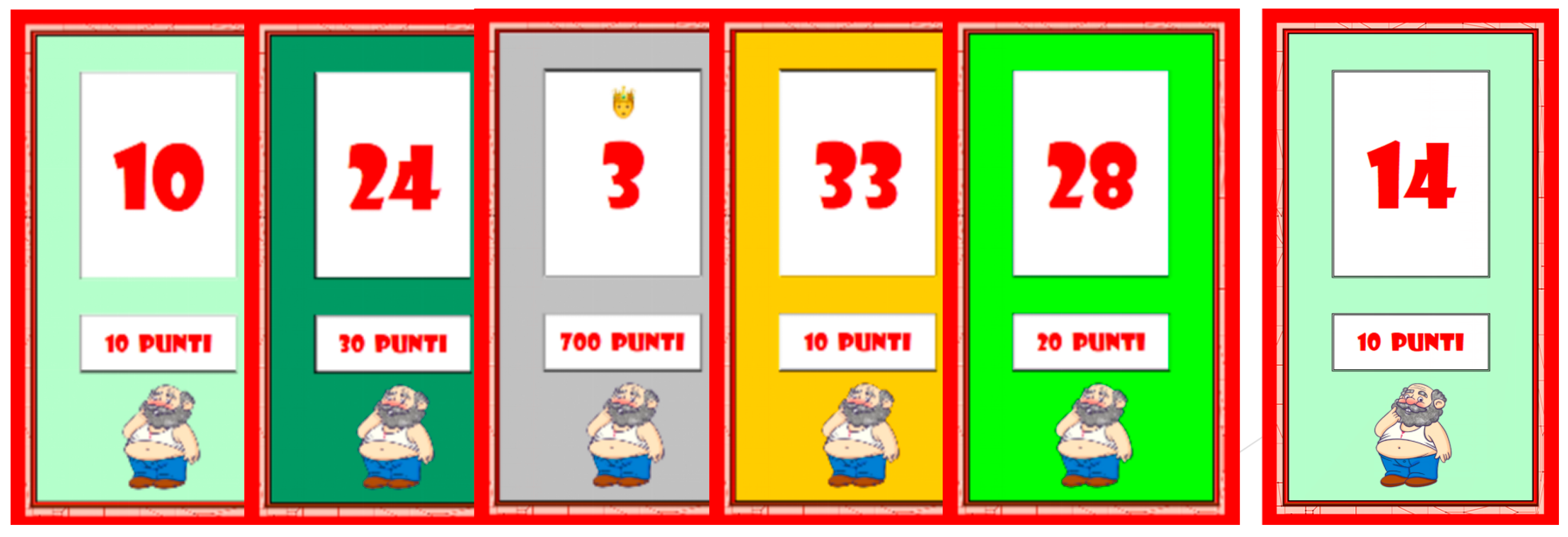
The deck consists of 101 Numeric Cards (NC for short), as shown in Figure 1. Each card semiotically represents a natural number between 0 and 100. Each NC is assigned a score between 10 and 1000 points according to a criterion based on the concept of divisibility between numbers. We shall not go into the details of this criterion, as, although interesting from a mathematical point of view, it is not relevant to the objectives of this paper.

2.1.2. Game Context

The teacher organises a class tournament of Mentematiko between teams made up of pairs of students. At the start of the game, each pair has 7 different number cards. The game takes place during maths lessons and the use of any calculation aids is strictly forbidden. The game is played with cards face up and all teams are seated around the same card table. Throughout the game, NCs are constantly gained and lost, primarily through actions involving the concept of divisibility.

2.1.3. Objective of the Game

The teacher organises a class tournament of Mentematiko between teams made up of pairs of students.

2.1.4. Extract from the Game Rules Used in the Experiment

The team in possession of the game (which we will call Alpha) makes its move by being obliged to discard one of its NCs onto the card table. This strategic action is influenced by several factors: the cards currently on the card table and, in particular, the last card (the last card refers to the card played by the team before Alpha), the NCs held by Alpha and, finally, the NCs held by the team (which we will call Delta) that will make the next move (the game is played with cards face up). Players take turns (clockwise) according to their seating arrangement around the table.
The player whose turn it is may perform 12 possible ‘arithmetic actions’. We focus solely on the actions relating to the skills analysed in this experiment, what they entail in the game, and a clarifying example.
Action 1. Alpha plays an NC such that it is a divisor of the Last Card.
Game rule: “We play a divisor of the Last Card, and the quotient is q”.
Consequence. Alpha collects the last q cards played from the game card table, where q is the quotient of the Last Card and the NC played by Alpha.
Example. On the card table (Figure 1), there are 5 NCs, placed from left to right in the order in which they were played (10, 24, 3, 33 and finally the 28, which is the Last Card). This is followed by the NC played by Alpha (14). The quotient is 2 (q = 28:14 = 2) and therefore Alpha takes the last 2 cards played, namely NC 28 and NC 33. NC 14 remains in the pot along with the remaining cards (10, 24 and 3). NC 14 is the new Last Card and play continues with the next team.
Action 4. Alpha plays an NC representing a prime number.
Game ruling: “Let’s play a prime number”.
Consequence: the next 3 teams give Alpha one of their NCs at random. The prime numbers, therefore, increase their score at the expense of their opponents’ scores.
Action 5. Play the card representing zero.
Game ruling: “You cannot divide by zero!”
Consequence: division by zero causes the quotient to “explode”, and all cards on the card table are returned to the deck of unused NCs. For the next turn, only the zero remains on the table, becoming the new Last Card.
Action 12. Alpha plays an NC that is the greatest common divisor of the NCs on the card table.
Game ruling: “We play the greatest common divisor of the NCs on the card table”.
Consequence: Alpha scores 1000 points.
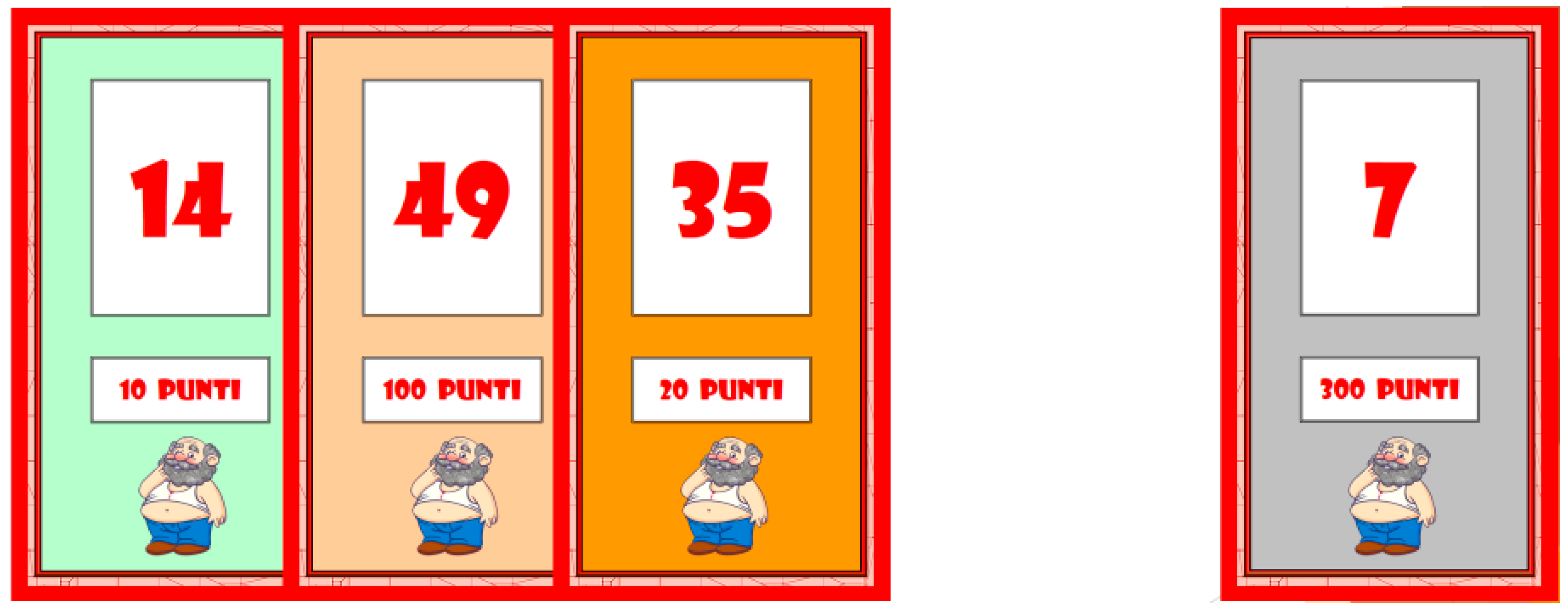
Example. On the card table (Figure 2), there are 3 NCs, placed from left to right in the order in which they were played (14, 49 and the Last Card 35). The NC played by Alpha is 7. In this case, if Alpha declares that 7 is the greatest common divisor of the 3 cards on the table, they earn 1000 points. The NC 7 is added to the others on the table and becomes the new Last Card on which the next team will play.
If none of the 12 actions provided for in the game can be performed with the number card played, the team must declare: “No action is possible!” In this case, no consequence is triggered. In summary, Team Alpha plays its NC and must declare all the actions triggered by its move. If Alpha makes incorrect declarations (for example, plays NC 8 and declares it to be a prime number) or forgets to declare one or more actions, it is penalised by losing one NC for each undeclared action. For example, still referring to Figure 2, three actions must be declared: Action 1 (7 is a divisor of the last card 35), Action 4 (7 is a prime number) and Action 12 (7 is the Greatest Common Divisor of all the numbers on the card table: 14, 21 and 28). If the team fails to declare, for example, Action 1 and Action 12, it is penalised with the loss of two of its NCs at random. In this case, we refer to the Principle of Superposition of Effects. The penalties associated with undeclared or incorrectly justified actions were used exclusively as part of the game mechanics and classroom regulation system. These penalties were not included in the research dataset and did not contribute in any way to the quantitative analyses reported in the study. In the example in Figure 2, the effects of the three individual actions (if recognised and declared by Alpha) are activated simultaneously, overlapping. Therefore, after the three correct game rulings have been issued: Alpha collects the last q cards played from the game card table, where q is the quotient of the Last Card and the Numeric Card played by Alpha (as a consequence of Action 1), the 3 teams following Alpha give him one of their own NCs (consequence of Action 4) and Alpha gains 1000 points (consequence of Action 12). The rules require the mandatory justification of all game decisions because the referee (teacher) must ensure that, where possible, Alpha has used mental calculation strategies as per the rules. Mentematiko has its roots in Vygotsky’s socio-historical school and shares the construct of the Zone of Proximal Development (Vygotsky, 1978). Based on this belief, which is also supported by recent studies (Abdu et al., 2022; Černilec et al., 2023; Olsher et al., 2025), it was decided to form the various game teams in a heterogeneous manner (heterogeneous grouping).

2.2. Experimental Context

The experiment took place during the 2023/2024 school year. It involved 104 Year 5 pupils from five classes across four primary schools in southern Italy. The children came from diverse social backgrounds.
The participating schools included two centrally located urban schools and two urban peripheral schools within the same province. Three schools were public state schools, while one was a private state-recognised school. The student population was culturally heterogeneous and included approximately 20% immigrant pupils. The schools also reflected considerable socio-economic variability within the local educational context. The experiment was conducted in two phases: a theoretical phase involving all 104 pupils, and a practical exercise phase in which the pupils were divided into two groups of equal size (the Mentematiko Group and the Control Group), which followed different instructional pathways.
As the study was conducted in authentic school settings, the participants belonged to pre-existing classroom groups and the research therefore followed a quasi-experimental design. However, to reduce potential threats related to initial group differences, each of the five participating classes was divided into two subgroups of equal numerosity and comparable mathematical attainment prior to the intervention. This balancing procedure was based primarily on the Placement Test results and was further refined through the evaluations provided by each class’s mathematics teacher.
Consequently, the M-Group and the Control Group were composed of pupils of comparable age, school level, and initial mathematical performance, all working within the same classroom contexts. Furthermore, both groups received the same theoretical instruction during the first phase of the experiment, worked on the same mathematical content, completed equivalent assessment instruments, and differed only in the instructional modality adopted during the second phase (GBL-based activities for the M-Group and traditional practice activities for the Control Group). The Placement Test therefore functioned not only as a baseline measure, but also as an additional indicator supporting the initial comparability of the two groups.

2.3. First Phase of the Experiment (Theoretical Phase)

The first phase was the same for all the children and lasted one month (October 2023, two hours a week). To standardise the educational programme for the children from the four different schools, the theory lessons were delivered by a single member of our research team, working alongside the maths teacher from each class. During the theory phase, they first refreshed fundamental concepts that the children had previously studied, such as divisibility (and divisors), multiples, prime numbers, and the role of zero in division. Subsequently, the researchers brought forward by one year certain topics not included in the 5th grade curriculum of the Italian National Primary School Guidelines, namely powers of natural numbers, factorisation into prime numbers, least common multiple and greatest common divisor. To focus on concepts rather than calculation, examples during the lessons were kept simple, using the first 50 natural numbers. In this first phase (in which the children do not play), ample attention was given to the concept of MC (MC strategies and flexibility) in the sense described at length in the theoretical framework. This was important because in the second phase of the experiment, the children are asked to develop MC strategies.

2.4. Placement Test

After the end of the first phase and one week before the start of the second phase of the experiment, the researchers administered and marked a test (Placement test, see Appendix A). This test serves to establish the starting levels regarding the content covered by the experiment, which the children had already studied prior to the experiment and consolidated with the researcher during the first phase. The test consists of 15 items based on divisibility and related concepts (divisibility, prime numbers, the role of zero in division and the greatest common divisor). The placement test (and Exit test) consisted of a combination of True/False items and short open-ended mental calculation tasks.

2.5. Second Phase of the Experiment (Practical Phase)

In the second phase of the trial (which lasted approximately two months, from December 2023 to January 2024), each of the five participating classes was divided into two groups with, on average, the same level of mathematical attainment (the M-Group, standing for “Mentematiko Group”, and the C-Group, standing for “Control Group”). The balancing procedure was based primarily on the Placement Test results and was further refined through the evaluations provided by each class’s mathematics teacher.
The M-Group, consisting of 52 children, took part in a Mentematiko class tournament structured into 30 rounds divided into 6 sessions of 5 rounds each (each round lasting approximately 15 min, including discussion). One session was held every 10 days.
The C-Group, also consisting of 52 pupils, began the programme 10 days later, coinciding with Session 2 of the M-Group. The C-Group completed six 75-min sessions, remaining one session behind the M-Group throughout the experiment. This one-session delay was intentional, since during each traditional session the researcher asked the C-Group to complete the same MC exercises that the M-Group had previously encountered through the Mentematiko game during the preceding session.
During the practical phase, the Control Group worked on the same mathematical content and completed the same types of exercises proposed within the Mentematiko activities, but in a traditional non-game format. Pupils in the Control Group worked in pairs, similarly to the pair-based structure adopted during the Mentematiko sessions, and all activities were conducted within equivalent instructional timeframes.
Both groups operated in the presence of the classroom mathematics teacher and the same member of the research team who conducted the Mentematiko sessions. Collective correction and immediate feedback were provided in both conditions.
Particular attention was devoted to reducing methodological asymmetries between the two instructional conditions. Although the Control Group did not use the Mentematiko game environment, pupils completed the same mathematical exercises previously encountered by the M-Group and participated in collective mathematical discussions guided by the same researcher and classroom teachers involved in the experimental condition. Pupils in the Control Group were also asked to explain and justify their reasoning processes during the activities, in order to maintain forms of strategic reflection and verbalisation that were as comparable as possible to those elicited within gameplay interactions. The principal difference between the two conditions therefore concerned the presence or absence of the game-based environment itself rather than differences in mathematical content, instructional time, or opportunities for discussion and justification.
Whenever appropriate, mathematical discussions were encouraged by the researcher in both the Mentematiko Group and the Control Group.
Consequently, the experimental design sought to minimise methodological differences between the two instructional conditions so that the principal distinction between the groups remained the presence or absence of the Mentematiko game environment itself.

2.6. Exit Test

At the end of the experiment, the researchers administered and marked an exit test to establish the final levels and to enable a comparative analysis of the results with the placement test regarding speed of execution and accuracy of calculation. The test consists of 15 questions, some of which are identical and the rest similar to the items in the Placement Test (see Appendix B).

2.7. Description of the Data Collected to Answer the Research Questions

The present study adopted a mixed-methods design combining quantitative and qualitative data. The quantitative data consisted of the closed-ended responses to the two assessment instruments (Placement Test and Exit Test) administered to both the M-Group and the Control Group during the two phases of the experiment.
These data were used to address Research Questions [RQ1] and [RQ2] through comparative analyses of pupils’ performance in terms of accuracy and completion time.
The qualitative data consisted of individual post-test interviews conducted immediately after pupils had completed the tests. During these interviews, pupils were asked to explain the reasoning processes and calculation strategies used to obtain their answers. This qualitative layer allowed the researchers to distinguish, for each correct response, between answers generated through genuine mental calculation strategies and answers obtained through memorisation or procedural reproduction.
Although the research questions were formulated primarily in quantitative terms, the qualitative component of the study was methodologically necessary in order to validate the epistemic meaning of the quantitative results themselves. Within mental calculation research, a numerically correct answer does not necessarily constitute evidence of strategic MC activity, since correct responses may also derive from memorisation or from the mental reproduction of written algorithms. For this reason, the post-test interviews were not conceived as an independent qualitative strand addressing separate research questions, but as a validation procedure directly informing the interpretation and refinement of the quantitative dataset.
Although the assessment instruments included some conceptually oriented items (e.g., prime numbers, greatest common divisor, and divisions involving zero), these tasks were designed to require the activation of mental calculation processes in order to be solved efficiently. More specifically, the tests required pupils to perform divisions mentally and to mobilise flexible numerical reasoning processes such as decomposition, divisibility-based transformations, multiplicative reasoning, factor recognition, and adaptive restructuring of numerical relationships. This requirement was made explicit in the test instructions, which asked pupils to “perform all the divisions required to solve this test using only mental calculation techniques”.
In this sense, conceptually oriented items were not treated as isolated measures of declarative knowledge, but as mathematical situations intended to elicit strategic numerical reasoning coherent with the construct of mental calculation adopted in this study. Accordingly, the assessment design distinguished between items directly aimed at eliciting flexible mental calculation strategies and items serving a conceptually supportive function within the broader construct investigated.
Furthermore, the assessment instruments were designed within a broader research programme investigating the role of mental calculation in relation to divisibility, prime numbers, greatest common divisor, and divisions involving zero. Consequently, some conceptually oriented items were intentionally retained not only for construct coherence, but also to support the longitudinal development of subsequent qualitative and theoretical analyses within the wider project.
All correct answers were subsequently subjected to a qualitative validation procedure based on individual post-test interviews in order to verify whether they reflected genuine flexible mental calculation strategies rather than memorisation or procedural reproduction. The interview protocol, coding framework, reliability procedures, and validation criteria adopted for the refinement of the data are described in detail in Section 2.8.

2.8. Validation Interview Coding Procedure

To address the well-documented difficulty of distinguishing genuine mental calculation (MC) strategies from rote recall, counting procedures, or mental reproductions of written algorithms, all correct responses obtained in both the Placement Test and the Exit Test were subjected to a post-test qualitative validation procedure. The purpose of this procedure was not simply to verify numerical correctness, but rather to determine whether the pupil had actually employed a flexible mental calculation strategy consistent with the theoretical framework adopted in this study.
Immediately after completing the tests, each pupil participated in an individual semi-structured interview lasting approximately 10 min. Interviews were conducted by a member of the research team together with the classroom teacher. This dual presence allowed the interviewer to collect detailed information regarding pupils’ reasoning processes while simultaneously ensuring contextual familiarity with the pupil’s communicative style and mathematical behaviour. Moreover, the presence of the classroom teacher—a relationally familiar figure for the pupils—contributed to reducing the potential impact of emotional factors such as shyness, communicative anxiety, or cognitive inhibition that might have emerged in the presence of the researcher alone, who was inevitably perceived as an external figure within the classroom context. In this sense, the teacher’s relational mediation helped create communicative conditions that were more natural and ecologically coherent with the ordinary forms of mathematical explanation and argumentation experienced by pupils in everyday classroom practice.
During the interviews, pupils were asked to explain how they had mentally obtained specific answers provided in the tests. The main prompt used was: “How did you find the answer? Can you explain what you thought?” Additional follow-up prompts were used when necessary to clarify the pupil’s reasoning process, including questions such as: “Can you explain better?”, “Why did you do it that way?”, “What did you calculate first?”, and “Did you use a multiplication table or a strategy?” These prompts were intended to clarify the cognitive structure underlying the response rather than to guide pupils toward specific strategies.
Interview responses were documented in written form by both the researcher and the classroom teacher during the interview itself. Immediately after each interview, the two interviewers compared their notes to ensure consistency and completeness of the recorded observations.
The qualitative validation process was grounded in Threlfall’s (2002) distinction between different forms of numerical processing. More specifically, each correct response was analysed to determine whether it reflected: (1) direct recall or memorisation; (2) counting-based procedures; (3) mental reproduction of written algorithms; or (4) genuine flexible mental calculation strategies involving adaptive numerical reasoning.
The operational identification of Category 4 strategies was based on the presence of cognitive processes such as decomposition, compensation, flexible numerical transformation, relational reasoning, restructuring of quantities, use of divisibility relationships, shortcut reasoning, or other forms of adaptive strategic manipulation of numbers coherent with Threlfall’s framework (Threlfall, 2002). Importantly, the coding process focused on the mathematical substance of pupils’ reasoning rather than on the linguistic sophistication of their explanations.
This distinction proved particularly relevant in the case of pupils with linguistic difficulties or reduced verbal fluency. In some cases, especially among immigrant pupils or pupils from socio-culturally disadvantaged backgrounds, mathematically coherent reasoning emerged through partial, fragmented, or linguistically simplified explanations. In such cases, coders evaluated the implicit mathematical structure of the reasoning process rather than the formal quality of verbal expression alone. For example, one pupil explained the result of 29 ÷ 2 as follows: “Fifteen for one child and fifteen for the other … but there is one extra, so I take half from one and half from the other … 14.5”. Although linguistically fragmented, this explanation clearly revealed decomposition and compensation processes and was therefore validated as evidence of flexible strategic numerical reasoning.
By contrast, responses such as “I already knew it because I memorised the multiplication table” or “I did the division in columns in my head” were not validated as Category 4 strategies, despite the correctness of the final numerical answer. The first example was classified as recall-based processing, while the second was classified as mental reproduction of a written algorithm.
To strengthen the reliability of the validation procedure, two additional members of the research team independently coded all correct responses using the predefined coding framework. Initial inter-rater agreement reached 82%. Cases of disagreement were subsequently discussed until consensus was achieved. In situations where the coders could not identify sufficient evidence of flexible strategic reasoning with reasonable confidence, the response was conservatively classified as non-validated.
This validation procedure allowed the distinction between “raw data” (all numerically correct responses) and “refined data” (responses supported by evidence of genuine mental calculation strategy use). The refined-data analysis therefore aimed to reduce the risk of false positives, namely situations in which pupils obtained correct answers through memorisation or procedural reproduction rather than through flexible mental calculation processes. The notion of “false positive” adopted in this study should not be interpreted in psychometric terms, but rather as an operational category used to distinguish numerically correct responses unsupported by evidence of validated flexible mental calculation processes.

2.9. Description of the Teacher’s Role

The teacher notes down any misconceptions observed during each round and discusses them immediately after the round ends, or at the end of the daily session of five rounds if more time is needed for the discussion. This activity relates to the broader issue of how playing with Mentematiko ties in with content knowledge. The teacher assesses justifications on multiple levels and, in particular, evaluates the acceptability or otherwise of the structure of a mathematical argument, and the knowledge and correct application of the content covered; at a meta-level, the ability to create complete, relevant and effective MC strategies is assessed.

3. Results and Discussion

3.1. Method of Analysis

[RQ1]. A quantitative approach was adopted for the data analysis aimed at answering the first research question. [RQ1] essentially asks whether (insofar as the mathematical content covered is concerned), the cognitive pathway based on the use of the educational game Mentematiko improves mental arithmetic skills in terms of speed of execution. The criterion considered in this case is that of a two-way comparison. The first comparison involves examining the M-Group to verify whether the average completion time for the Exit test is reduced or not compared to that taken to complete the Placement test. This is an initial absolute result. To enrich the analysis, a second comparison of a relative nature is carried out. For the two groups, the variation in average completion times is calculated, i.e., the difference between the average time per student to complete the Exit test and the average time to complete the Placement test. Bearing in mind that the two groups covered the same mathematical content in the same way in the first phase, but with a different approach in the second phase (exercises using Mentematiko for the M-Group and the same exercises proposed by the game’s developers in traditional mode for the C-Group), it is possible to estimate whether or not the use of Mentematiko produces better results in terms of speed of completion.
[RQ2]. A mixed-methods approach was adopted for the data analysis aimed at answering the second research question. [RQ2] essentially asks whether (limited to the mathematical content covered), the cognitive itinerary based on the use of the educational game Mentematiko (whose mental calculations performed during the game are also presented as exercises to be carried out in a traditional setting for the Control group) improves mental calculation skills in terms of the accuracy of results. For the quantitative analysis of the data aimed at answering [RQ2], two comparison criteria similar to those outlined for answering [RQ1] are considered. The first comparison involves examining the M-Group to verify whether and by how much the average score achieved in the Exit test (considered as a measure of the accuracy of calculation results) improves compared to that obtained in the Placement test. This is an initial absolute measurement. The second comparison criterion involves calculating the changes in the average scores of the two groups achieved in the Exit test and the Placement test. Bearing in mind that the M-Group and the control group carried out the same type of work between the two tests but using different methods (traditional method and GBL method), we can observe whether the use of Mentematiko produces better results in terms of calculation accuracy. At this point, we are aware of a potential objection. Given that the two tests administered are mental calculation tests, the question naturally arises: “If the two previous quantitative results were to suggest a positive outcome, are we certain that this is sufficient to claim that the M-Group has improved its accuracy in mental calculation questions?” In other words, if the result for one of the items is numerically correct, are we certain that the student achieved it by applying MC strategies rather than following one of the first three modes outlined in Threlfall’s classification (Threlfall, 2002)? In light of these observations, our team felt the need to add a qualitative analysis and a third criterion. We reduced the number of test items (from 30 to 15) by removing the more conceptually divisible items where MC did not come into play. However, a few conceptual items were retained for further development of this research. Shortening the two tests made it possible to interview, within the time available, all the students who took part in the experiment immediately after the tests had finished. The brief interview lasted between 5 and 10 min and was conducted by the research team. The interview served as a means of validating the correct answers. In other words, for all items with a correct answer, we investigated whether the result was the result of applying a mental calculation strategy (Case 4 of Threlfall’s classification) or obtained through one of the other three routes indicated by Threlfall’s classification. Thus, a numerically correct result was considered valid for the purposes of answering [RQ2] if and only if it was validated by the post-test interview.

3.2. Analysis of Results and Answers to the Research Questions

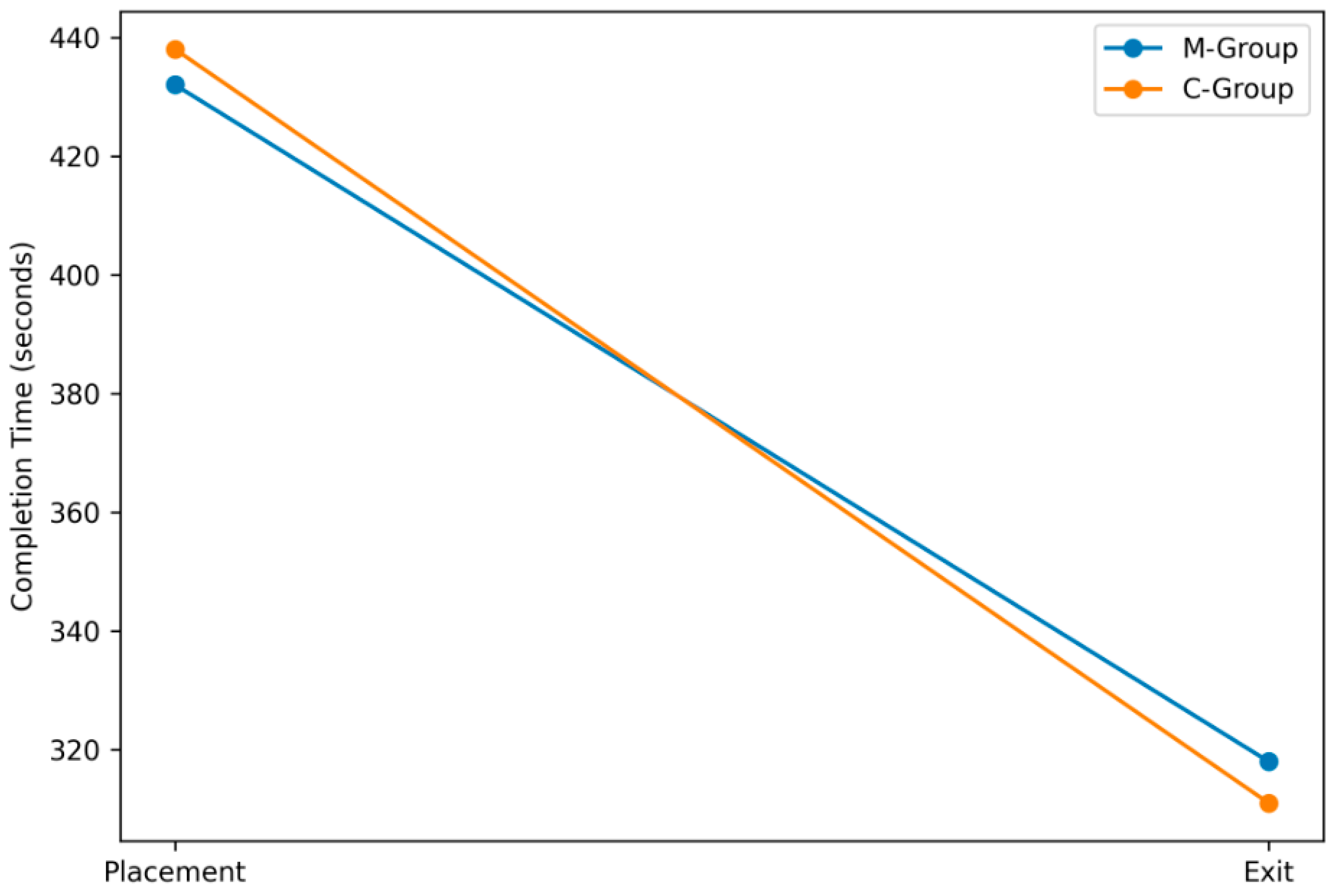
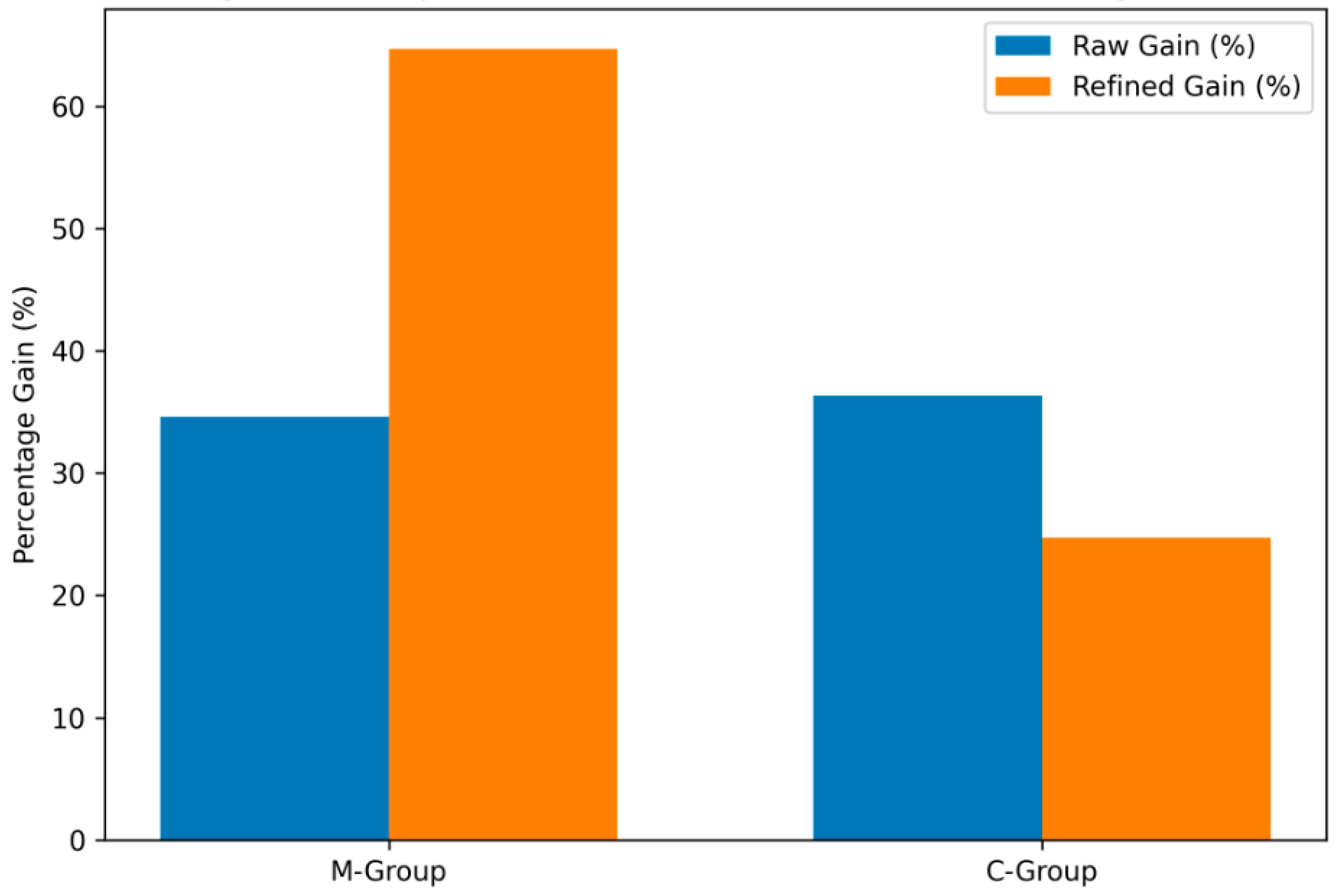
The descriptive statistics reported in Table 1 and visually summarised in Figure 3 and Figure 4 provide an overview of the principal quantitative results emerging from the comparison between the Mentematiko Group and the Control Group.
The comparison between raw and refined datasets highlights the methodological relevance of the qualitative validation procedure adopted in the present study.
The figure shows the percentage improvement between the Placement and Exit Tests before and after the qualitative validation procedure. Whilst the raw data suggest comparable gains for the two instructional approaches, the refined-data analysis reveals a substantially greater increase in validated mental calculation performance within the Mentematiko Group.
Placement and Exit Tests for the M-Group and C-Group. Both instructional approaches were associated with comparable decreases in completion time, suggesting similar improvements in execution speed across the two groups.

3.2.1. Answer to [RQ1]

[RQ1] Does the cognitive pathway based on the use of the educational game Mentematiko improve MC’s skills in terms of speed of execution in calculations that directly or indirectly involve the concept of divisibility (divisions related to checking divisibility by a number, prime numbers, greatest common divisor)?
In short, the answer is positive, and we will explain the reasons below. The maximum time allocated for each of the two tests was 7 min and 30 s (an average of 30 s for each of the 15 items). The M-Group went from an average completion time of 7 min and 11 s for the Placement test to an average completion time of 5 min and 17 s for the Exit test, representing an improvement of 1 min and 54 s. This represents a 26.4% reduction in completion time for the M-Group compared to the Placement test. These results suggest that the cognitive itinerary based on the use of the Mentematiko educational game improves MC skills in terms of speed of execution. A slightly better result was observed for the C-Group; in fact, it went from an average completion time of 7 min and 18 s for the Placement test to a shorter time of 5 min and 10 s in the Exit test; there was therefore a reduction in completion time of 2 min and 7 s, corresponding to a percentage reduction in completion time compared to the Placement Test of 29.1%. Comparing the completion times recorded by the two groups in the two tests, therefore, we can observe that they were reduced by a fairly similar amount of time (approximately 2 min). Thus, both pathways followed by the two groups showed a similar reduction in completion times and, consequently, comparable progress in terms of the speed of mental calculation relating to the concept of divisibility. These findings provide preliminary evidence that the GBL-type cognitive itinerary based on Mentematiko may support improvements in execution speed, although the results observed were comparable to those obtained through the traditional instructional pathway. We are aware that a reduction in execution times is not absolute proof that the speed of mental calculation has improved (compared to a baseline measurement). This is because, at this stage of the analysis, we are not certain that the students who followed the Mentematiko-based cognitive itinerary used MC strategies whilst performing the two tests. At present, therefore, we can only say that the answer to [RQ1] appears to be positive and that for further evaluation, reference should be made to the qualitative component of the mixed analysis (second phase of the analysis) aimed at answering [RQ2]. Within the theoretical framework adopted in this study, execution speed was not considered an isolated indicator of effective mental calculation. Rather, speed was interpreted in relation to the quality and flexibility of the underlying numerical reasoning processes. Consequently, whilst [RQ1] addressed the operational dimension of mental calculation performance, the refined-data analysis developed in response to [RQ2] was considered theoretically more central to the interpretation of genuine mental calculation activity.

3.2.2. Answer to [RQ2]

[RQ2] Does the cognitive itinerary based on the use of the educational game Mentematiko improve MC’s skills in terms of the accuracy of calculations that directly or indirectly involve the concept of divisibility (divisions related to checking divisibility by a number, checking hypothetical prime numbers and the greatest common divisor)?
By accuracy, we mean the correctness of the results. In this initial quantitative phase of the analysis relating to [RQ2], we assume that the students always used MC strategies in their calculations to obtain the correct results. The validity of this experimental hypothesis will be investigated in the second phase of this analysis. The maximum score for each of the two tests is 15 points (1 point per item). Based on the experimental hypothesis and this initial research hypothesis, the results obtained were as follows: the average score of each of the 52 students in the M-Group in the Placement test was 7.7, whilst the score of the same group in the Exit test was 10.3. Therefore, the average progress for the students in the G-Group compared to their starting levels was 2.6 points (+35.0%). This result appears to be a first useful element in formulating a positive response to [RQ2]. The second element of analysis consists of a comparison with the performance of the control group. The idea is that by comparing the variation in the results of the two tests obtained by the control group (traditional method) with the variation in the results of the two tests obtained by the experimental group (GBL method), we can quantify the effects of the play experience and consequently verify whether it improves MC performance beyond the effects expected from participation in a traditional cognitive itinerary. The average score of each of the 52 students in the C-Group in the Placement Test was 8.3 (slightly better than that of the M-Group), whilst the score of the same group in the Exit Test was 11.3 (again, better than that of the M-Group). The average improvement for the C-Group students compared to their starting levels was 3.0 points (+35.9%). Therefore, both groups appear to have achieved good results of a similar magnitude (approximately 35% greater accuracy). There are essentially two conclusions from this first quantitative phase of the analysis: the first is that, from a comparison of the results of the two tests, it appears that the GBL-based method yields substantial improvements (+35%). The second conclusion, contrary to expectations, is that at this preliminary stage of the raw-data analysis, the two instructional approaches appeared to produce broadly comparable improvements in calculation accuracy. More precisely, the traditional method (accuracy variation +35.9%) offers slightly better results than the GBL method (accuracy variation +35.0%). At this point, we questioned the validity of the experimental hypothesis, namely that ‘all students worked on all items using only the MC’. This issue had already been identified prior to the experiment; for this reason, we conducted brief interviews with each student after the submission of each test. The aim of the interview was to determine, for each of the 15 responses, whether an MC strategy was used and where this was not the case. At this stage, we rewrote the summary table of all responses, resetting the scores for items with correct answers obtained through one of Threlfall’s first three classes and validating the scores assigned to those correct answers resulting from a Threlfall class 4 process (Threlfall, 2002). This adjustment eliminates the experimental hypothesis that ‘weakens’ the consistency of the results, as it removes all false positives. Using these new ‘refined’ data, we repeat the comparative analysis previously carried out with the ‘raw’ data to check whether the conclusions change. By assigning a single point only to correct answers obtained through the application of MC strategies, it appears that the average score of each of the 52 students in the M-Group in the Placement Test, due to the refinement of the data, drops from 7.7 to 6.0, whilst the score of the same group in the Exit Test drops from 10.3 to 9.9. Therefore, the average progress for the M-Group students compared to their starting levels was 3.9 points (+64.7%). This result is substantially stronger than that obtained from the raw data (+35.0%), since the refined-data analysis almost doubled the estimated improvement in validated mental calculation accuracy within the M-Group. The switch to refined data thus confirms the positive response to [RQ2]. We now proceed with the comparative analysis against the control group’s results. The average score of each student in the C-Group on the Placement Test following data refinement fell from 8.3 to 6.6, whilst the score of the same group on the Exit Test was adjusted from 11.3 to 8.3. The average progress for C-Group students relative to their starting levels was therefore revised downwards to 1.7 points (+24.6%). This result is less favourable than that obtained from the raw data (+35.9%). Importantly, the refinement procedure was not intended to determine whether pupils possessed or did not possess mathematical knowledge related to divisibility. Rather, its purpose was to distinguish between numerically correct responses generated through genuine flexible mental calculation strategies and those produced through memorisation, direct recall, or procedural reproduction. In this sense, the higher number of false positives observed within the Control Group should not be interpreted as evidence of mathematical failure, but rather as an indication that correct answers were more frequently obtained without the activation of validated mental calculation processes coherent with the theoretical framework adopted in the present study. The refined-data analysis led to a substantially different interpretation of the comparative results. Whilst the raw data suggested broadly comparable improvements in calculation accuracy for the two instructional approaches (approximately 35% in both groups), the refined data revealed a far more marked divergence between the groups. After refinement, the M-Group showed a 64.6% improvement in validated mental calculation accuracy, compared to a 24.6% improvement observed in the control group. In the Placement test, the students came from the same theoretical training phase for both groups, and the number of items marked incorrect was practically the same (86 false positives for the C-Group and 87 false positives for the M-Group). The Exit test was conducted after a training period in which the pupils completed the same exercises but using different methods. The post-Exit test interviews led to a result that surprised our research team, as the number of items marked incorrect for the two groups in this case was markedly different: 156 false-positive items for the C-Group compared to 25 false-positive items for the M-Group. One possible interpretation of this substantial divergence in false positives is that the Mentematiko environment systematically encouraged pupils to rely on flexible and relational forms of numerical reasoning rather than on procedural reproduction or memorised responses. During gameplay, pupils were repeatedly required not only to produce answers, but also to justify moves, respond to opponents’ actions, and adapt calculations dynamically within a socially interactive setting. These conditions may have reduced the viability of rigid algorithmic reproduction and favoured the emergence of genuine mental calculation strategies consistent with Threlfall’s fourth category (Threlfall, 2002).
By contrast, although the Control Group completed the same mathematical exercises, the traditional non-game format may have allowed a greater persistence of procedural or recall-based approaches capable of generating numerically correct but strategically non-validated responses. From this perspective, the refinement procedure does not merely reveal differences in accuracy, but highlights a progressive divergence in the nature of the numerical reasoning processes activated within the two instructional environments.
These observations suggest that, from the perspective of validated mental calculation accuracy, the GBL-type cognitive itinerary based on Mentematiko may provide more favourable outcomes than the traditional instructional pathway adopted in the control group.
The findings emerging from the refined-data analysis appear consistent with the theoretical perspective proposed by Thompson (1999) and Threlfall (2002), according to which mental calculation should not be interpreted as the rapid mental reproduction of written algorithms, but rather as a flexible and adaptive process of numerical reasoning. The substantial reduction in false positives observed within the Mentematiko Group suggests that the game-based environment may have promoted forms of strategic relational thinking that became progressively less dependent on memorised procedures and rigid algorithmic schemas.
These results also appear coherent with Nicholson’s (2011) conception of meaningful Game-Based Learning, according to which educational content becomes pedagogically effective when it is structurally embedded within gameplay mechanics rather than externally superimposed upon them. In Mentematiko, divisibility relationships and numerical transformations were not merely the thematic content of the activities, but functioned as operational conditions required to progress strategically within the game environment. From this perspective, the observed improvements in validated mental calculation performance may be interpreted not simply as an effect of increased motivation, but as the consequence of repeated engagement with flexible numerical reasoning under socially interactive conditions.
Furthermore, the findings appear compatible with more recent studies on mental arithmetic and interactivity (Ross et al., 2020), which suggest that arithmetic reasoning may be influenced by the characteristics of the learning environment and by the manipulation of external representations. The argumentative dimension of gameplay interactions, together with the obligation to justify moves and calculations, may therefore have contributed to making pupils’ mathematical thinking more explicit, discussable, and strategically adaptable.

4. Conclusions

In conclusion, the study conducted on the effectiveness of the cognitive itinerary based on the Mentematiko game has provided significant evidence in support of integrating Game-Based Learning to enhance mental calculation (MC). Summarising the results in light of the research questions and the theoretical framework, a number of observations emerge. Analysis of the quantitative data revealed that, although both the GBL and traditional approaches improve speed of execution (answer to [RQ1]), the Mentematiko-based programme was associated with a markedly greater increase in calculation accuracy, with an improvement rate of 64.6% compared to a 24.6% increase achieved by the control group (answer to [RQ2]). This suggests that the game-based environment may support more flexible and relational engagement with mathematical concepts such as divisibility and prime numbers. Initial qualitative analyses confirm the model proposed by Thompson (1999) and Threlfall (2002); indeed, the results support the view of MC not as a mere mnemonic activity, but as a strategic and flexible process. In line with Threlfall’s (2002) theory, the gaming experience allowed strategies to emerge spontaneously from what the student observes in the numbers (relationships, decompositions) rather than from the rigid application of pre-packaged algorithms. One possible explanation for the substantial reduction in false positives observed in the Mentematiko Group may lie in the mathematical architecture of the game itself. Since divisibility relationships are intrinsically embedded within the gameplay dynamics, pupils were repeatedly encouraged to identify numerical structures, reorganise quantities, and adapt calculation procedures strategically in response to evolving game situations. In this sense, the game environment may have progressively reduced students’ reliance on rigid procedural reproduction and favoured the emergence of relational and flexible forms of numerical reasoning coherent with Thompson’s and Threlfall’s perspectives on mental calculation (Threlfall, 2002).
Future research will investigate more deeply how specific game mechanics within Mentematiko may facilitate the emergence of flexible mental calculation processes and mathematical reasoning. A qualitative follow-up study based on the analysis of students’ argumentative interactions during gameplay has recently been initiated through the lens of Toulmin’s model and the Theory of Semiotic Mediation. Preliminary observations suggest that the requirement to justify moves during the game may help make students’ mathematical reasoning processes more visible and support forms of strategic numerical thinking that differ from the mere mental reproduction of written algorithms. Thus, the constructive alignment between learning objectives and game mechanics has enabled a shift from mechanical procedural knowledge to solid conceptual knowledge. Ultimately, the findings suggest that intentionally designed educational games may represent a promising pedagogical approach for supporting the development of number sense, strategic reasoning, and cognitive flexibility in mental calculation activities. However, further studies based on more rigorous inferential analyses and broader qualitative investigation are needed before drawing stronger conclusions regarding the comparative effectiveness of GBL and traditional instructional approaches.
This study and its future developments aim to contribute to mathematics education research not only by examining the effectiveness of educational games, but also by investigating how specific game structures may shape mathematical reasoning and classroom teaching-learning interactions. In this perspective, Mentematiko is not conceived merely as a motivational tool. Rather, it is interpreted as a pedagogical artefact capable of supporting the emergence of mathematical meanings through social interaction, strategic reasoning, and teacher-mediated discussion. Further studies grounded in the Theory of Semiotic Mediation will be necessary to investigate these processes more rigorously.

Author Contributions

Conceptualization, L.T. and F.S.T.; methodology, L.T., F.S.T. and I.V.; validation, L.T., F.S.T. and I.V.; formal analysis, L.T.; resources, F.S.T.; data curation, L.T. and I.V.; writing—original draft preparation, L.T.; writing—review and editing, L.T., F.S.T. and I.V.; supervision, L.T. and F.S.T.; project administration, F.S.T.; funding acquisition, F.S.T. All authors have read and agreed to the published version of the manuscript.

Funding

This research received no external funding.

Institutional Review Board Statement

The study was conducted according to local, national, and international laws and guidelines.

Informed Consent Statement

Written informed consent was obtained from the participants.

Data Availability Statement

The data supporting the conclusions of this article will be made available by the authors on request.

Conflicts of Interest

The authors declare no conflicts of interest.

Appendix A. Placement Test

Perform all the divisions required to solve this test using only mental calculation techniques.
  • Section [P1]—The concept of a divisor and the operation of division
Tick TRUE or FALSE for the following statements:
[P1.1] 41 is divisible by2[TRUE] [FALSE]
If the answer is [TRUE], calculate mentally: [41:2 = _____]
[P1.2] 48 is divisible by3[TRUE] [FALSE]
If the answer is [TRUE], calculate mentally: [48:3 = _____]
[P1.3] 66 is divisible by6[TRUE] [FALSE]
If the answer is [TRUE], calculate mentally: [66:6 = _____]
[P1.4] 52 is divisible by13[TRUE] [FALSE]
If the answer is [TRUE], calculate mentally: [52:13 = _____]
[P1.5] 64 is divisible by4[TRUE] [FALSE]
If the answer is [TRUE], calculate mentally: [64:4 = _____]
[P1.6] 84 is divisible by6[TRUE] [FALSE]
If the answer is [TRUE], calculate mentally: [84:6 = _____]
[P1.7] 96 is divisible by8[TRUE] [FALSE]
If the answer is [TRUE], calculate mentally: [96:8 = _____]
[P1.8] 192 is divisible by12[TRUE] [FALSE]
If the answer is [TRUE], calculate mentally: [192:12 = _____]
  • Section [P2]—Prime Numbers
We have defined a Prime Number as: a natural number, different from 1, that is divisible only by 1 and itself and, finally, is not divisible by any other numbers apart from 1 and itself.
Tick TRUE or FALSE for the following statements:
[P2.1] 58 is a prime number[TRUE] [FALSE]
If [FALSE], indicate one of its divisors other than 1 and itself.
[P2.2] 83 is a prime number[TRUE] [FALSE]
If [FALSE], indicate one of its divisors other than 1 and itself.
[P2.3] 51 is a prime number[TRUE] [FALSE]
If [FALSE], indicate one of its divisors other than 1 and itself.
[P2.4] Factorise the number 68 into its prime factors.
  • Section [P3]—Division by Zero
Solve the following divisions:
[P3.1] 0:11 = ___
[P3.2] 30:0 = ___
  • Section [P4]—Greatest Common Divisor (GCD)
[P4.1] Calculate the Greatest Common Divisor (GCD) of the numbers 13, 26, 39 and 52.

Appendix B. Exit Test

Perform all the divisions required to solve this test using only mental calculation techniques.
  • Section [E1]—The concept of a divisor and the operation of division
Tick TRUE or FALSE for the following statements:
[E1.1] 29 is divisible by2[TRUE] [FALSE]
If the answer is [TRUE], calculate mentally: [29:2 = _____]
[E1.2] 51 is divisible by3[TRUE] [FALSE]
If the answer is [TRUE], calculate mentally: [51:3 = _____]
[E1.3] 77 is divisible by7[TRUE] [FALSE]
If the answer is [TRUE], calculate mentally: [77:7 = _____]
[E1.4] 72 is divisible by12[TRUE] [FALSE]
If the answer is [TRUE], calculate mentally: [72:12 = _____]
[E1.5] 64 is divisible by4[TRUE] [FALSE]
If the answer is [TRUE], calculate mentally: [64:4 = _____]
[E1.6] 84 is divisible by6[TRUE] [FALSE]
If the answer is [TRUE], calculate mentally: [84:6 = _____]
[E1.7] 96 is divisible by8[TRUE] [FALSE]
If the answer is [TRUE], calculate mentally: [96:8 = _____]
[E1.8] 192 is divisible by12[TRUE] [FALSE]
If the answer is [TRUE], calculate mentally: [192:12 = _____]
  • Section [E2]—Prime Numbers
We have defined a Prime Number as: a natural number, different from 1, that is divisible only by 1 and itself and, finally, is not divisible by any other numbers apart from 1 and itself.
Tick TRUE or FALSE for the following statements:
[E2.1] 78 is a prime number[TRUE] [FALSE]
If [FALSE], indicate one of its divisors other than 1 and itself.
[E2.2] 89 is a prime number[TRUE] [FALSE]
If [FALSE], indicate one of its divisors other than 1 and itself.
[E2.3] 87 is a prime number[TRUE] [FALSE]
If [FALSE], indicate one of its divisors other than 1 and itself.
[E2.4] Factorise the number 78 into its prime factors.
  • Section [E3]—Division by Zero
Solve the following divisions:
[E3.1] 0:12 = ___
[E3.2] 20:0 = ___
  • Section [E4]—Greatest Common Divisor (GCD)
[E4.1] Calculate the Greatest Common Divisor (GCD) of the numbers 17, 34, 51 and 68.

References

  1. Abdu, R., Olsher, S., & Yerushalmy, M. (2022). Pedagogical considerations for designing automated grouping systems: The case of the parabola. Digital Experiences in Mathematics Education, 8(1), 99–124. [Google Scholar] [CrossRef] [Scilit] [PubMed]
  2. Anghileri, J. (2001). Intuitive approaches, mental strategies and standard algorithms. In J. Anghileri (Ed.), Principles and practices in arithmetic teaching: Innovative approaches for the primary classroom (pp. 79–94). Open University Press. [Google Scholar]
  3. Bartolini Bussi, M. G. (1998). Verbal interaction in the mathematics classroom: A Vygotskian analysis. In H. Steinbring, M. G. Bartolini Bussi, & A. Sierpinska (Eds.), Language and communication in the mathematics classroom (pp. 65–84). National Council of Teachers of Mathematics. [Google Scholar]
  4. Bartolini Bussi, M. G., & Mariotti, M. A. (2008). Semiotic mediation in the mathematics classroom: Artifacts and signs from a Vygotskian perspective. In L. D. English (Ed.), Handbook of international research in mathematics education (2nd ed., pp. 746–783). Routledge. [Google Scholar]
  5. Bayeck, R. Y. (2020). Examining board game play and learning: A multidisciplinary review of recent research. Simulation & Gaming, 51(4), 411–431. [Google Scholar] [CrossRef] [Scilit]
  6. Beishuizen, M. (1997). Two types of mental arithmetic and the empty numberline. Proceedings of the British Society for Research into Learning Mathematics, 18, 1–6. [Google Scholar]
  7. Berland, M., & Lee, V. R. (2011). Collaborative strategic board games as a site for distributed computational thinking. International Journal of Game-Based Learning, 1(2), 65–81. [Google Scholar] [CrossRef] [Scilit]
  8. Carvalho, R., & da Ponte, J. P. (2013). Students’ mental computation strategies with fractions. In B. Ubuz, C. Haser, & M. A. Mariotti (Eds.), Proceedings of the eighth congress of the European Society for Research in Mathematics Education (pp. 283–292). Middle East Technical University. [Google Scholar]
  9. Černilec, B., Cotič, M., Felda, D., & Doz, D. (2023). Differences in students’ mathematics knowledge in homogeneous and heterogeneous groups. European Journal of Science and Mathematics Education, 11(1), 15–32. [Google Scholar] [CrossRef] [Scilit] [PubMed]
  10. Hall, J. V. (1954). Mental arithmetic: Misunderstood terms and meanings. The Elementary School Journal, 54(6), 349–353. [Google Scholar] [CrossRef] [Scilit]
  11. Hatano, G., & Oura, Y. (2003). Reconceptualising school learning using insights from expertise research. Educational Researcher, 32(8), 26–29. [Google Scholar] [CrossRef] [Scilit]
  12. Hattie, J. (2008). Visible learning: A synthesis of over 800 meta-analyses relating to achievement. Routledge. [Google Scholar]
  13. Hendrix, N. M., Hojnoski, R. L., & Missall, K. N. (2020). Promoting numeracy skills through board game play. Young Exceptional Children, 23(2), 100–111. [Google Scholar] [CrossRef] [Scilit]
  14. Jurić, J., & Pjanić, K. (2023). An overview of mental calculation strategies and the frequency of their application. Journal of Elementary Education, 16(3), 277–294. [Google Scholar] [CrossRef] [Scilit]
  15. Lee, J., Luchini, K., Michael, B., Soloway, E., & Norris, C. (2004). More than just fun and games: Assessing the value of educational video games in the classroom. In CHI ’04 extended abstracts on Human factors in computing systems (pp. 1375–1378). Association for Computing Machinery. [Google Scholar]
  16. Maclellan, E. (2001). Mental calculation: Its place in the development of numeracy. Westminster Studies in Education, 24(2), 145–154. [Google Scholar] [CrossRef]
  17. McFarlane, A., Sparrowhawk, A., & Heald, Y. (2002). Report on the educational use of games: An exploration by TEEM of the contribution which games can make to the educational process. TEEM. [Google Scholar]
  18. McIntosh, A., Reys, B. J., & Reys, R. E. (1992). A proposed framework for examining basic number sense. For the Learning of Mathematics, 12(3), 2–8. [Google Scholar]
  19. Miller, D. J., & Robertson, D. P. (2011). Educational benefits of using game consoles in a primary classroom: A randomised controlled trial. British Journal of Educational Technology, 42(5), 850–864. [Google Scholar] [CrossRef] [Scilit]
  20. Nicholson, S. (2011). Making gameplay matter: Designing modern educational tabletop games. Knowledge Quest, 40(1), 60–65. [Google Scholar]
  21. Olsher, S., Abdu, R., & Shalata, M. (2025). The relationships between student content-specific grouping and teacher-student interactions during online collaborative mathematical task solving. Educational Studies in Mathematics, 119(2), 249–268. [Google Scholar] [CrossRef] [Scilit]
  22. Piu, A., Fregola, C., & Barbieri, B. (2016). Geometry classrooms with simulation/games: Research results and future developments. Simulation & Gaming, 47(6), 796–817. [Google Scholar] [CrossRef] [Scilit]
  23. Pjanić, K., Jurić, J., & Mišurac, I. (2025). The use of different strategies and their impact on success in mental calculation. Educational Sciences, 15(9), 1098. [Google Scholar] [CrossRef] [Scilit]
  24. Reys, R. E. (1984). Mental computation and estimation: Past, present, and future. The Elementary School Journal, 84(5), 546–557. [Google Scholar] [CrossRef] [Scilit]
  25. Ross, W., Vallée-Tourangeau, F., & Van Herwegen, J. (2020). Mental arithmetic and interactivity: The effect of manipulating external number representations on older children’s mental arithmetic success. International Journal of Science and Mathematics Education, 18(5), 985–1000. [Google Scholar] [CrossRef] [Scilit]
  26. Sfard, A. (1991). On the dual nature of mathematical conceptions: Reflections on processes and objects as different sides of the same coin. Educational Studies in Mathematics, 22(1), 1–36. [Google Scholar] [CrossRef] [Scilit]
  27. Shin, N., Norris, C., & Soloway, E. (2006). Effects of handheld games on students’ learning in mathematics. In Proceedings of the 7th international conference on learning sciences (pp. 678–684). International Society of the Learning Sciences. [Google Scholar]
  28. Skillen, J., Berner, V. D., & Seitz-Stein, K. (2018). The rule counts! Acquisition of mathematical competencies with a number board game. The Journal of Educational Research, 111(5), 554–563. [Google Scholar] [CrossRef] [Scilit]
  29. Smith, E., & Golding, L. (2018). Use of board games in higher education: A literature review. MSOR Connections, 16(2), 22–33. [Google Scholar] [CrossRef] [Scilit]
  30. Thompson, I. (1999). Mental calculation strategies for addition and subtraction: Part 1. Mathematics in School, 28(5), 2–4. [Google Scholar]
  31. Thompson, I. (2001). Issues for classroom practices in England. In J. Anghileri (Ed.), Principles and practices in arithmetic teaching (pp. 68–78). Open University Press. [Google Scholar]
  32. Thompson, I. (Ed.). (2010). Issues in teaching numeracy in primary schools (2nd ed.). Open University Press. [Google Scholar]
  33. Threlfall, J. (2002). Flexible mental calculation. Educational Studies in Mathematics, 50(1), 29–47. [Google Scholar] [CrossRef] [Scilit]
  34. Threlfall, J. (2009). Strategies and flexibility in mental calculation. ZDM, 41, 541–555. [Google Scholar] [CrossRef] [Scilit]
  35. Tortorelli, L. (2023). Mentematiko. Edizioni Dedalo. [Google Scholar]
  36. Tortorelli, L. (2024, September 9–10). GBL in plane geometry: Developing definitional thinking. International Workshop: Game-Based and Playful Approaches to Mathematics Education, Rome, Italy. [Google Scholar]
  37. Tortorelli, L., & Tinterri, A. (2024, September 9–10). Geometriko academy. Game-Based and Playful Approaches to Mathematics Education, Rome, Italy. [Google Scholar]
  38. Tortorelli, L., & Tortoriello, F. S. (2024). Development of definitional and classificatory thinking in geometry through storytelling and GBL activities. Education Sciences, 14(5), 471. [Google Scholar] [CrossRef] [Scilit]
  39. Toulmin, S. E. (2003). The uses of argument (Updated ed.). Cambridge University Press. [Google Scholar]
  40. Van Eck, R., & Dempsey, J. (2002). The effect of competition and contextualized advisement on the transfer of mathematics skills a computer-based instructional simulation game. Educational Technology Research and Development, 50(3), 23–41. [Google Scholar] [CrossRef] [Scilit]
  41. Vergnaud, G. (2002). Conceptualisation: The cornerstone of the relationship between practice and theory. In Analysis of teachers’ practices and professionalism. Eduscol. [Google Scholar]
  42. Verschaffel, L., Torbeyns, J., De Smedt, B., Luwel, K., & Van Dooren, W. (2007). Strategy flexibility in children with low achievement in mathematics. Educational and Child Psychology, 24(2), 16–27. [Google Scholar] [CrossRef] [Scilit]
  43. Vygotsky, L. S. (1978). Mind in society: The development of higher psychological processes (M. Cole, V. John-Steiner, S. Scribner, & E. Souberman, Eds.). Harvard University Press. [Google Scholar]
  44. Winn, W. (1990). Some implications of cognitive theory for instructional design. Instructional Science, 19(1), 53–69. [Google Scholar] [CrossRef] [Scilit]
Figure 1. A picture of some Numeric Cards.
Education 16 00904 g001
Figure 2. Example of Action 12.
Education 16 00904 g002
Figure 3. Comparison between raw and refined accuracy gains in the M-Group and C-Group.
Education 16 00904 g003
Figure 4. Reduction in mean completion times between the Placement and Exit Tests for the M-Group and C-Group.
Education 16 00904 g004
Table 1. Descriptive statistics for raw and refined accuracy scores and completion times in the Placement and Exit Tests.
MeasureGroupPlacement
Test
Exit
Test
Absolute
Gain
Percentage
Gain
Raw accuracy (/15)Control G.8.311.3+3.0+36.3%
Mentematiko G.7.710.3+2.7+34.6%
Refined accuracy (/15)Control G.6.68.3+1.6+24.7%
Mentematiko G.6.09.9+3.9+64.7%
Completion time (s)Control G.438311−127−29.0%
Mentematiko G.432318−114−26.4%
Disclaimer/Publisher’s Note: The statements, opinions and data contained in all publications are solely those of the individual author(s) and contributor(s) and not of MDPI and/or the editor(s). MDPI and/or the editor(s) disclaim responsibility for any injury to people or property resulting from any ideas, methods, instructions or products referred to in the content.