


Abstract
Aesthetic education is a crucial component of the integrated development of moral, intellectual, physical, aesthetic, and labour education. It holds a significant position in Chinese higher education in the new era. Drawing on constructivist learning theory, cognitive psychology, positive psychology, and self-determination theory, this study developed an integrated cognition–emotion–motivation model to examine how aesthetic education is associated with graduate students’ research innovation ability. Survey data were collected from 1208 graduate students, and the proposed model was tested using structural equation modelling and mediation analysis. The results showed that aesthetic education was positively associated with research innovation ability. Three mediating pathways were supported: analogical transfer ability served as a cognitive pathway; art immersive experience and research resilience formed an emotional pathway; and aesthetic value recognition and exploratory research motivation constituted a motivational pathway. In addition, an aesthetic education environment strengthened the relationship between aesthetic education and analogical transfer ability, while supervisor support strengthened the relationship between art immersive experience and research resilience. These findings clarify the mechanisms through which aesthetic education is related to graduate students’ innovation-related capacities and highlight the importance of integrating aesthetic education, supportive environments, and supervisory guidance into research-oriented graduate training.
1. Introduction
Aesthetic education in higher education refers to the process of cultivating aesthetic perception and shaping aesthetic behaviour based on aesthetic principles through aesthetic practice (Lee & Chao, 2023). Aesthetic education aims to develop students’ capacities for critical judgement, reflective thinking, and open-ended inquiry beyond merely transmitting knowledge about art or beauty. In the context of Chinese graduate education, aesthetic education has become an increasingly significant component of holistic educational development. It designed not only to enhance artistic and cultural literacy but also to foster broader cognitive, emotional, and motivational competencies that underpin research innovation (J. Wang, 2025). By engaging with diverse aesthetic experiences, students are encouraged to actively construct knowledge, critically analyse complex information, and integrate multiple perspectives into problem-solving.
However, universities often implement aesthetic education in a manner that prioritises form over substance, constrained by the traditional mindset that prioritises “knowledge-focused education over aesthetic education” (Zheng, 2024). Students may participate in aesthetic activities without achieving meaningful insight and thus reducing the potential benefits for creativity or research capacity. In contrast, this study conceptualises aesthetic education as a multi-dimensional process that fosters critical reflection, cognitive flexibility, and intrinsic motivation. Students can internalise principles of pattern recognition, structural analysis, and expressive communication through sustained engagement with aesthetic experiences (M. Wang & Zhang, 2022). It is transferable to scientific and technical problem-solving contexts.
Developing innovative talent is a central goal of modern higher education, particularly in the context of national strategies to strengthen scientific and technological capabilities (Lenhart et al., 2023; L. Zhang & Reyes, 2024; X. Zhang et al., 2012). Despite this, a persistent gap exists between specialised scientific training and broader humanities and arts education. Research innovation is often constrained to conventional and narrowly defined problem-solving approaches (McManus & Furnham, 2006). Historical evidence highlights that significant scientific breakthroughs often arise at the intersection of artistic and scientific inquiry. From Leonardo da Vinci’s integration of anatomical knowledge with the art of painting, to Einstein’s imaginative proposal of relativity through “thought experiments”. These examples underscore the potential for aesthetic education to cultivate the cognitive, emotional, and motivational capacities necessary for innovative research.
Therefore, this study is grounded in constructivist learning theory and integrates principles from cognitive psychology, positive psychology, and self-determination theory to form a comprehensive framework for understanding the mechanisms through which aesthetic education may be associated with graduate students’ research innovation ability. Specifically, the study examines three mediating pathways: (1) analogical transfer ability, which represents the cognitive application of patterns and structures learned through aesthetic experiences to novel problems; (2) art immersive experience leading to research resilience, capturing the emotional and psychological benefits derived from deep engagement with art; and (3) aesthetic value recognition influencing exploratory research motivation, reflecting how the internalisation of aesthetic principles can inspire curiosity and intrinsic motivation in scientific research. Additionally, the study evaluates the potential moderating effects of the aesthetic education environment, including access to rich resources and interdisciplinary activities, and supervisor support, which may enhance the effectiveness of these pathways.
The study offers a systematic explanation of how aesthetic education is associated with research innovation, moving beyond prior research that considered these factors in isolation. It emphasises the interaction of cognitive, emotional, and motivational processes, providing insight into the complex and synergistic mechanisms by which aesthetic education may contribute to graduate students’ innovative capacities. This comprehensive framework highlights the importance of creating educational environments that not only provide aesthetic experiences but also support reflection, critical dialogue, and the application of learned insights to scientific inquiry. This study offers practical guidance for designing and implementing graduate aesthetic education programmes by articulating the relationships among aesthetic education, cognitive flexibility, emotional resilience, and intrinsic motivation. Institutions can leverage these findings to foster interdisciplinary thinking, enhance critical reflection, and cultivate innovative, resilient, and self-motivated researchers.
2. Literature Review
2.1. Aesthetic Education (AE)
Aesthetics originates from the Greek words “aisthetikos” and “aesthetics” (meaning “I feel”) (D’Olimpio, 2022; Xenakis & Arnellos, 2014). Traditionally, it encompasses the appreciation and study of taste, beauty, and sensory and emotional responses generated through values, nature, art, and aesthetic experiences. The modern concept of aesthetic education, significantly shaped by Schiller in the 18th century, arose from the conviction that engagement with beauty and art elevates both the individual and society (Zheng, 2024). Schiller’s vision was not one of indoctrination but of liberation and harmonisation of human faculties. Aesthetic education is an approach that promotes appreciation, critical reflection, cultural understanding, and participatory engagement with art and creative works (Greene, 2001). Its significance far exceeds the narrow confines of technical art instruction. It communicates human thought, culture, and emotion by stimulating the senses and inviting learners into a dialogue with various artistic media and the aesthetic dimensions of the environment itself (D. Hu, 2024; Xia et al., 2024).
In this study, aesthetic education is positioned as a constructivist pedagogical practice. It fosters graduates’ active construction of understanding in form, structure, and meaning through open artistic experiences, critical dialogue, and reflective spaces, thereby influencing their research and innovation capabilities rather than instilling fixed aesthetic standards. From a constructivist perspective, the primary characteristic of graduate aesthetic education is problem-driven, deep inquiry. It advocates integrating diverse disciplinary thinking paradigms and expressive approaches within the problem domain of the real world (Karavakou et al., 2023). Aesthetic education cultivates students’ critical reflective capacity, enabling them to analyse, interpret, and evaluate artistic works and the aesthetic qualities of their surroundings not merely based on preference, but through reasoned discourse (Carr, 2023). As (Greene, 2001) powerfully argues, aesthetic education is vital for cognitive, perceptual, emotional, and creative development. It plays a crucial role in fostering the comprehensive growth of students by empowering them to challenge assumptions, imagine alternatives, and construct personal and intellectual meanings through encounters with aesthetic forms (M. Han & Lu, 2024). It aligns with the university’s core mission of fostering open inquiry and critique. The aesthetic education serves not as a transmitter of canonical beauty, but as a provocation to deeper seeing, thinking, and feeling, which is a foundation upon which innovative and resilient thought can be built (L. Wang et al., 2022).
2.2. Research Innovation Ability (RIA)
Innovation ability refers to the ability of individuals or teams to apply creative thinking and skills to propose novel and practical solutions when facing problems or challenges (L. Zhang & Reyes, 2024). Innovation capability can be regarded as a set of abilities composed of various competencies or skills, which include but are not limited to the ability to identify problems, critical thinking, resistance to interference, adaptability, and adjustment skills. Innovation is regarded as a crucial component of individual competence (Pérez Peñalver et al., 2018). Research innovation ability, as a key indicator of graduate education quality, is far more than just rigorous logical thinking and profound professional knowledge. Its essence stems deeper from unconventional imagination, profound insight, unwavering resilience in the face of challenges, and an aesthetic pursuit that elevates problem-solving into artistic creation (L. Zhang & Reyes, 2024).
A series of systematic strategies has been proposed in existing studies to enhance the research and innovation capabilities of graduate students. Optimising the graduate curriculum system (L. Wang et al., 2017), strengthening mentor guidance and teamwork (J. Y. Han et al., 2022), and fostering a positive academic environment (X. Han et al., 2023) are effective strategies for enhancing academic success. The Chinese government has proposed the “Fivefold Integration” development theory in recent years. It requires the comprehensive development of moral, intellectual, physical, aesthetic, and labour education to enhance the research and innovation capabilities of graduate students. The importance of aesthetic education has garnered increasing attention. Aesthetic education cultivates students’ pursuit of scientific phenomena and theories, stimulating their curiosity, imagination, and innovative consciousness (M. Liu, 2021). It encourages interdisciplinary thinking and practice, which is crucial for addressing today’s complex scientific challenges. Moreover, aesthetic education plays a significant role in improving students’ humanistic literacy and shaping sound personalities (Gao et al., 2023). This holistic development helps researchers cultivate a positive research attitude, resilient willpower, and professional ethics—essential internal drivers for innovation activities. Therefore, this study hypothesises the following: H1: Aesthetic education has a significant positive impact on the research innovation ability of graduate students.
2.3. Analogical Transfer Ability (ATA)
Analogy serves as the foundation for creative problem-solving in science and technological innovation (Kittur et al., 2019). From the perspective of combining constructivism and cognitive psychology, aesthetic education expands the cognitive schema of graduates, provides diverse knowledge structures and representation methods, and promotes cognitive flexibility. It accelerates the process of scientific discovery by transferring solutions or principles from known domains to novel problems. It can foster interdisciplinary knowledge integration as a cognitive tool. Analogical transfer ability enables students to apply patterns, structures, or principles acquired in aesthetic education fields such as art, literature, and philosophy to non-artistic domains like science and engineering (J. Zhang, 2014). Recent research suggests that analogical transfer facilitates the application of experiential knowledge from one domain (the source domain) to novel problem-solving in another distinct domain (the target domain), thereby promoting innovative design and scientific discovery (Guo et al., 2025; Kalogerakis et al., 2010).
Analogical transfer is one of the core mechanisms in cognitive processes, as viewed from the perspective of cognitive psychology (Reeves & Weisberg, 1994). It is not merely a simple superficial match but involves the mapping and application of deep structural features. This integrative ability is crucial for solving complex problems, as many innovations often stem from the cross-fertilisation of different disciplines. Moreover, analogical transfer ability enables researchers to break free from existing mental frameworks and draw inspiration from seemingly unrelated source domains, thereby uncovering breakthrough solutions. Therefore, this study hypothesises the following: H2: Analogical transfer ability plays a mediating role between aesthetic education and research innovation ability.
2.4. Art Immersive Experience (AIE) and Research Resilience (RR)
Positive psychology points out that immersive experiences provide emotional investment and pleasure, while psychological resilience is an individual’s ability to actively adapt and persevere in the face of setbacks (Mao et al., 2024). From a constructivist perspective, aesthetic education provides opportunities for deep artistic immersion, helping graduate students experience conflicts, transformations, and narratives emotionally, thereby constructing psychological resources to cope with research setbacks and enhancing resilience to persist in exploration.
Art immersive experience refers to an individual’s complete engagement in art activities, resulting in a state of self-forgetfulness that leads to profound emotional and cognitive experiences (N. Zhang & Shen, 2023). Crucially, this immersion is not a passive reception but an active, dialogical process of encounter (Du et al., 2026). It can challenge preconceptions, disrupt habitual thinking, and open pathways to novel understandings. The connection between art and science is often found at this level of deep engagement. Art immersion facilitates interdisciplinary and analogical thinking by encouraging researchers to adopt perspectives, frameworks, and sensibilities from outside their immediate disciplinary confines (Mun, 2021). Furthermore, AIE cultivates a heightened state of aesthetic awareness and perceptual acuity. This refined sensitivity allows individuals to detect nuances, patterns, problems, and opportunities in their environment—whether in a laboratory or a dataset—with greater sharpness. This enhanced perception is not merely about appreciating beauty superficially. It involves discerning underlying structures, tensions, and potential harmonies, a skill directly transferable to identifying research questions and conceptual models.
Research resilience refers to the ability of researchers to maintain a positive attitude, persistently overcome difficulties, and ultimately achieve research goals when facing research challenges and pressures (Hong et al., 2026). Researchers with strong research resilience can quickly find solutions to scientific problems, thereby improving innovation efficiency (Ojo & Volkova, 2023; X. Zhang & Wei, 2025). They will not give up easily, but actively seek new ideas and methods, ultimately overcoming difficulties and achieving innovation. In the process of innovation, one can strive for excellence and continuously improve one’s research results, thereby enhancing the quality of innovation (J. Y. Han et al., 2022). They will not be satisfied with initial results, but will continue to improve and optimise, striving to reach a higher level.
Scientific research often comes with immense pressure and anxiety, and immersive experiences in art can help researchers relax and alleviate stress and anxiety. Meanwhile, art immersive experiences can enhance the psychological regulation ability of researchers, enabling them to better cope with setbacks and failures in scientific research (Swiatek et al., 2024). In the world of art, researchers can experience a range of emotions and perspectives, gain a deeper understanding of human nature and life, and enhance their psychological adaptability and regulatory abilities. Therefore, this study hypothesises the following: H3: aesthetic education positively influences research innovation ability through the sequential mediating effect of “art immersion experience → research resilience”.
2.5. Aesthetic Value Recognition (AVR) and Exploratory Research Motivation (ERM)
The self-determination theory suggests that intrinsic motivation is driven by autonomy, ability, and belongingness needs, while value identification is the process of critically internalising external values into personal values (Bandhu et al., 2024). Combining constructivism, aesthetic education guides graduate students to form personalised value judgments in critical aesthetic dialogue, thereby internalising the “pursuit of beauty” as an internal driving force for scientific research exploration, making scientific research a conscious pursuit of meaning.
Aesthetic value recognition refers to an individual’s affirmation and internalisation of the value of beauty, which can stimulate students’ internal motivation and encourage them to actively explore and discover beauty (Xiao, 2024). AVR in this study refers not to the passive acceptance or internalisation of externally defined standards of beauty, but to an active, reflective process through which individuals critically engage with aesthetic phenomena, discern value within them, and gradually develop a personal, reasoned stance toward what they find meaningful, coherent, or beautiful. This process of recognition holds significant potential for fostering scientific innovation. The pursuit of aesthetic value and the quest for scientific truth share foundational roots in human curiosity, the desire for understanding, and an appreciation for order, pattern, and elegance. When researchers develop a deep, critically informed appreciation for aesthetic qualities—such as symmetry, simplicity, narrative cohesion, or expressive power—they often begin to seek these same qualities in their scientific work. Aesthetic value recognition can thereby reframe research as a form of meaning-making and creative synthesis, prompting closer attention to the elegance of a hypothesis, the coherence of a model, or the expressive clarity of a finding.
Exploratory research motivation refers to an individual’s curiosity and thirst for knowledge in unknown fields, as well as the intrinsic driving force for pursuing discoveries and creations in scientific research activities (Huang et al., 2023). Exploratory research motivation is an essential prerequisite for scientific innovation activities. It can help researchers maintain a high level of interest and enthusiasm in scientific research activities. Researchers will become more focused and engaged, enhancing the sustainability and efficiency of scientific research activities.
The pursuit of beauty is a natural part of human nature (Mendelson et al., 2025). Aesthetic education can awaken students’ deep desire for beauty, stimulate their curiosity, and spark their thirst for knowledge about the unknown world. This curiosity and thirst for knowledge are crucial sources of motivation for exploratory research. Aesthetic education can enhance students’ aesthetic appreciation ability, enabling them to appreciate the beauty of science and discover the artistic value in scientific research. The aesthetic appreciation ability will enhance students’ interest and enthusiasm for scientific research activities, thereby stimulating their exploratory research motivation. Therefore, this study hypothesises the following: H4: Aesthetic education positively influences research innovation ability through the sequential mediating effect of “aesthetic value recognition → exploratory research motivation”.
2.6. Aesthetic Education Environment (AEE) and Supervisor Support (SS)
A well-designed aesthetic education environment typically features an abundance of artistic resources, including libraries, art galleries, and music halls. These resources provide students with exposure to different types of artworks, thereby enhancing their aesthetic vision and knowledge reserves. Students are encouraged to participate in artistic and cultural activities, thereby increasing their aesthetic interest and participation in such an environment. In addition, a good aesthetic education environment promotes interdisciplinary communication and cooperation, such as combining art with science, technology, and other fields, which helps students understand problems from different perspectives and facilitates the transfer and application of knowledge. Therefore, this study hypothesises the following: H5: The aesthetic education environment plays a positive regulatory role in the relationship between aesthetic education and analogical transfer. The better the aesthetic education environment in universities, the stronger the positive predictive effect of aesthetic education level on analogical transfer.
The supervisor’s support is crucial in graduate education, as it can significantly influence the research abilities and innovative behaviours of graduate students. A supervisor’s support can take various forms, such as providing timely guidance, offering positive feedback, and offering emotional encouragement. Research has shown that advice and support from mentors are key to improving the quality of graduate education (Ren & Li, 2024). A graduate is more likely to actively participate in research, overcome challenges, and ultimately enhance their research skills in a supportive academic environment. A supervisor’s support can improve the emotional satisfaction and happiness that graduates experience in artistic activities (Adarlo et al., 2025). Graduates are more likely to actively participate in creative activities and gain greater emotional benefits from them when they feel cared for and supported by their supervisors (Cai et al., 2026). A supervisor can help a graduate connect art experiences with scientific research work, thereby promoting cognitive integration. Additionally, supervisors can offer opportunities and resources for graduates to engage in art activities and provide guidance on how to apply art experiences to their scientific research. Therefore, this study proposes the following hypothesis: H6: Supervisor’s support plays a positive moderating role in the relationship between art immersive experience and research resilience. The higher the super’s support, the stronger the positive predictive effect of an art immersive experience on research resilience.
2.7. Research Model
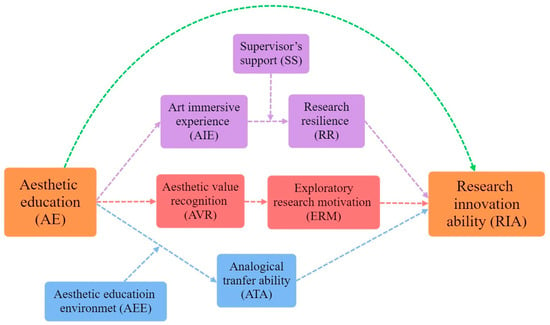
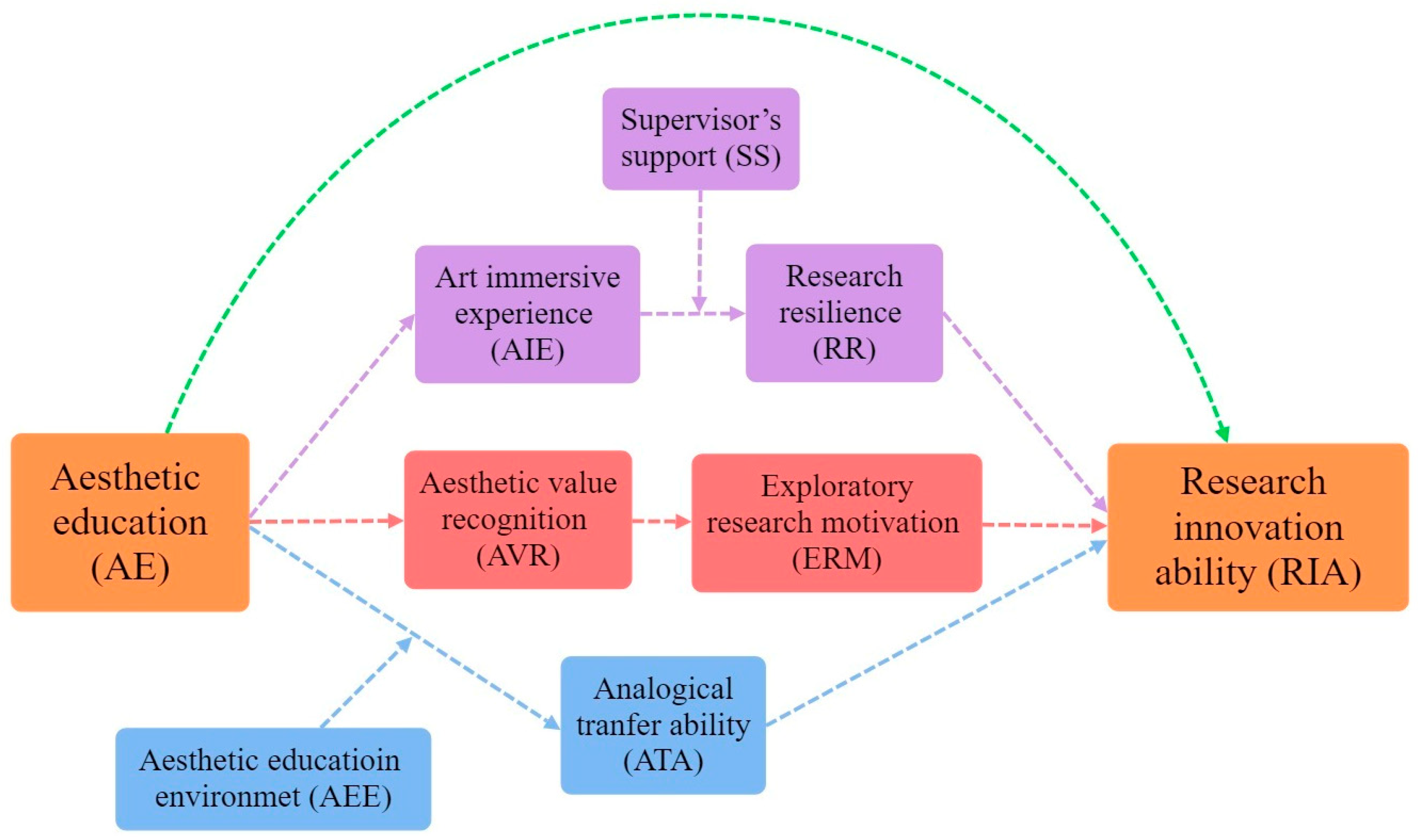
The model presented in this study is illustrated in Figure 1, based on the previous analysis and hypothesis testing.
Figure 1.
The schematic diagram of the assumed model.
3. Methods
3.1. Study Design and Participants
This study employed a cross-sectional survey design to examine the associations between aesthetic education and graduate students’ research innovation ability. A questionnaire with 11 items and 63 topics was designed. The program determines the sample size and power through G*power 3.1 analysis. The results show that a model with an α level of 0.05 and a power level of 0.95 needs at least 153 samples. Therefore, 300 samples were used for questionnaire verification in this study. The Cronbach’s α of the scale and the structural validity of the CFA analysis are shown in Table S1 in the Supplementary Material, which align with expectations after verification. Data were collected from a total of 1208 graduate students (610 males and 598 females) enrolled at Chinese Universities, spanning multiple disciplines including science, engineering, and humanities. Participants are master’s and doctoral students.
3.2. Procedure
The questionnaire was administered online through the Sojump platform (https://www.wjx.cn), and participants were recruited using random sampling. Participation was voluntary, and respondents were informed about the purpose of the study, the confidentiality of their responses, and their right to withdraw at any time. No personal identifying information was collected to ensure anonymity.
3.3. Measures
This study designed nine scales for AE, RIA, ATA, AIE, RR, AVR, ERM, AEE, and SS. The contents of the scale are shown in Supporting Information. The scales were all 5-point Likert scales (1 = strongly disagree, 5 = strongly agree). The Cronbach’s α of the final scale and the structural validity of the CFA analysis are shown in Table 1.
Table 1.
The reliability and construct validity of the scale.
3.4. Statistical Processing
Data analyses were conducted using SPSS 26.0 and AMOS 29. Descriptive statistics, Pearson correlation analyses, and reliability assessments were performed in SPSS. SEM was used in AMOS to test the hypothesised relationships among constructs. Mediation effects were examined using the Process macro (version 4.1) for SPSS. To assess potential common method variance (CMV), Harman’s single-factor test was conducted.
4. Results
4.1. Descriptive Statistics and Correlation Analysis
The mean value, standard deviations, and Pearson correlation matrix are presented in Table 2. Correlation analysis revealed that educational level and gender were not significantly correlated with AE, RIA, ATA, AIE, RR, AVR, and ERM. By contrast, AE was significantly and positively correlated with RIA, ATA, AIE, RR, AVR, and ERM. RIA was also significantly and positively correlated with AE, ATA, AIE, RR, AVR, and ERM. These results provide preliminary support for the proposed associations among aesthetic education, the three mediating mechanisms, and graduate students’ research innovation ability.
Table 2.
Descriptive statistics and correlation analysis of variables.
Harman’s single-factor test was conducted to assess the potential risk of common method variance because all variables were measured using self-reported questionnaires at a single time point. The results of the unrotated exploratory factor analysis showed that 12 factors had eigenvalues greater than 1, and these factors jointly explained 67.4% of the total variance. The first factor accounted for 24.9% of the variance, which was below the commonly used threshold of 40%. Therefore, no single dominant factor emerged, suggesting that common method variance was unlikely to seriously affect the interpretation of the results.
4.2. Structural Equation Model (SEM)
The model established in this study is complex, comprising three mediation paths, with two of them exhibiting moderated effects. In this study, Amos 29 software was used to establish the SEM, excluding the moderate effect, as shown in Figure S1 in the Supplementary Material.
The model fitness test results are presented in Table S2 in the Supplementary Material after calculation. The χ2/df is less than 3, and the RMSEA is less than 0.08. Additionally, the GFI, CFI, IFI, and TLI results are all greater than 0.9. RMR is 0.095, which is higher than 0.08. It may be due to the large number of variables and paths in the model, which makes the model more complex and leads to a higher RMR (Kline, 2015). The model is considered to be able to reasonably reflect the data situation, given that all other fitting indicators have reached their respective benchmark values (L. T. Hu & Bentler, 1999).
This study uses SEM to test the theoretical hypothesis model. The path coefficient and significance level are shown in Table 3. The results showed that the standardised coefficients of all paths were greater than 0, indicating statistical significance, and the model fitted well. AE was significantly and positively associated with RIA (β = 0.473, p < 0.05), which verifies the establishment of H1. In the cognitive path, AE was significantly associated with ATA (β = 0.706, p < 0.01), and ATA was significantly associated with RIA (β = 0.124, p < 0.05). The indirect effect of AE on RIA through ATA was 0.088, supporting H2. The coefficient of the ATA → RIA path remained statistically significant, though it was relatively small. It suggests that ATA may represent a meaningful cognitive mechanism linking aesthetic education and RIA.
Table 3.
Path coefficients of the SEM.
In the cognitive path, AE was significantly associated with ATA (β = 0.706, p < 0.01), and ATA was significantly associated with RIA (β = 0.124, p < 0.05). The indirect effect of AE on RIA through ATA was 0.088, supporting H2. The coefficient of the ATA → RIA path remained statistically significant though it was relatively small. It suggests that ATA may represent a meaningful cognitive mechanism linking aesthetic education and RIA.
In the emotional path, AE was significantly associated with AIE (β = 0.686, p < 0.05), AIE was significantly associated with RR (β = 0.548, p < 0.001), and RR was significantly associated with RIA (β = 0.144, p < 0.01). The sequential indirect effect of AE on RIA through AIE and RR was 0.054, supporting H3. These results indicate that AIE and RR may jointly explain part of the relationship between aesthetic education and research innovation ability.
In the motivation path, AE was significantly associated with AVR (β = 0.722, p < 0.05), AVR was significantly associated with ERM (β = 0.535, p < 0.01), and ERM was significantly associated with RIA (β = 0.193, p < 0.01). The sequential indirect effect of AE on RIA through AVR and ERM was 0.075, supporting H4. These findings suggest that AVR and ERM may constitute an important motivational mechanism through which aesthetic education is associated with research innovation ability.
Among the three mediation paths, the cognitive pathway showed the largest indirect effect, followed by the motivational pathway and the emotional pathway. However, the three pathways represent different theoretical dimensions and should be interpreted as complementary rather than competing mechanisms. The cognitive pathway reflects the role of cross-domain structural mapping, the emotional pathway reflects the role of psychological resilience developed through immersive experience, and the motivational pathway reflects the role of internalised aesthetic value and exploratory motivation.
4.3. Moderating Effect
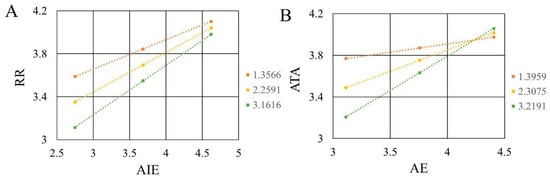
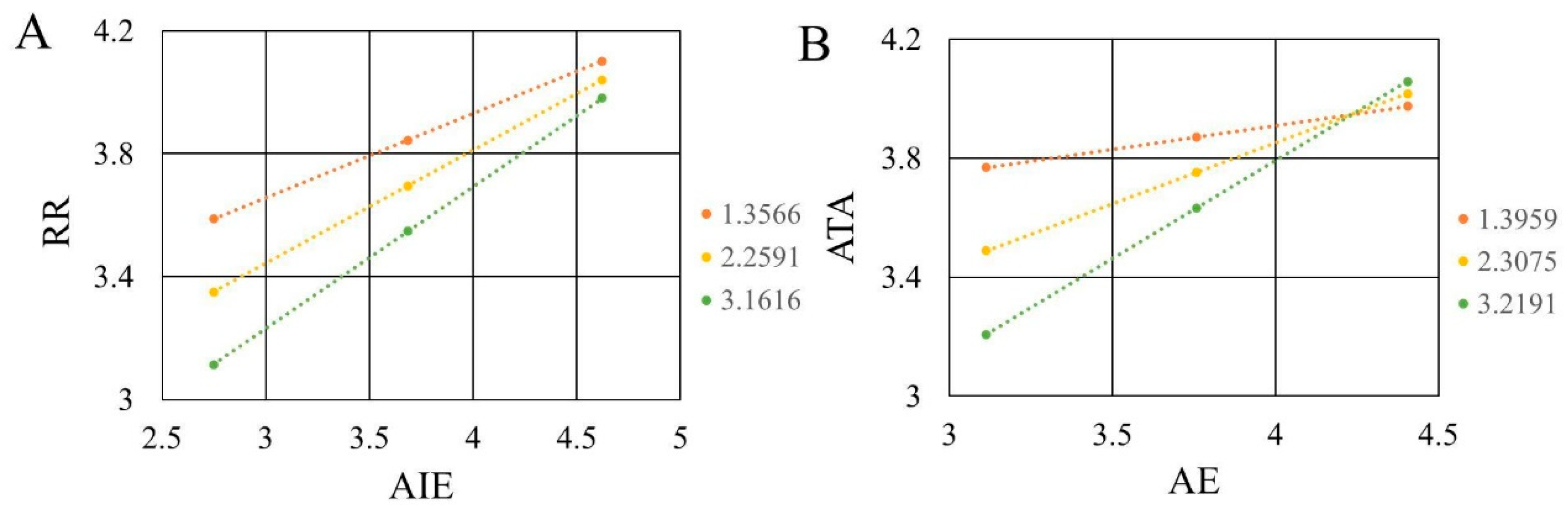
The moderating effect of supervisor support (SS) on the relationship between AIE and RR was analysed and the results are presented in Table S3 in the Supplementary Material. The results show that the interaction term of AIE and SS has a significant and positive predicted RR (β = 0.1044), indicating that SS moderated the relationship between AIE and RR. Simple slope analysis further showed that the positive association between AIE and RR varied across different levels of SS, as illustrated in Figure 2A. When SS was low, the association between AIE and RR was relatively weak (β = 0.2746). At the mean level of SS, the association became stronger (β = 0.3688). When SS was high, the association was strongest (β = 0.4630). These findings indicate that supervisor support strengthens the positive relationship between art immersive experience and research resilience, supporting H5.
Figure 2.
Simple slopes for the interaction of SS and AIE (A), AE and AEE (B).
The moderating effect of aesthetic education environment (AEE) on the relationship between AE and ATA was also examined. As shown in Table S4, the interaction term between AE and AEE significantly and positively predicted ATA (β = 0.2738), indicating that AEE moderated the relationship between AE and ATA. The overall model is significant (R2 = 0.2741, F(3, 1204) = 151.57), indicating that the model explained 27.41% of the variance in ATA. Simple slope analysis showed that the positive association between AE and ATA increased as the level of AEE increased. When AEE was low, the association between AE and ATA was relatively weak (β = 0.1586). At the mean level of AEE, the association was stronger (β = 0.4081). When AEE was high, the association was strongest (β = 0.6577). These results suggest that a supportive aesthetic education environment enhances the positive relationship between aesthetic education and analogical transfer ability, supporting H6.
Therefore, the moderation analyses indicate that both individual learning contexts and supervisory support conditions shape the strength of the proposed mechanisms. Specifically, the aesthetic education environment appears to strengthen the cognitive pathway from AE to ATA, whereas supervisor support appears to strengthen the emotional pathway from AIE to RR.
5. Discussion
This study constructed and empirically tested an integrated model linking aesthetic education with graduate students’ research innovation ability through cognitive, emotional, and motivational mechanisms. The research results not only confirm the direct promoting effect of aesthetic education but also systematically reveal the core issue of “how aesthetic education enables scientific research innovation” through three paths of cognition, emotion, and motivation. It clarifies the role of aesthetic education in university education as one of stimulating inquiry rather than indoctrinating norms. These findings provide empirical support for understanding aesthetic education not merely as a form of cultural or artistic enrichment, but as an educational practice that may contribute to the cultivation of innovative research capacities among graduate students.
5.1. Theoretical Significance of the Cognition–Emotion–Motivation Framework
A central contribution of this study is the development of a cognition–emotion–motivation framework for explaining the association between aesthetic education and research innovation ability. Previous studies have shown that aesthetic education may improve students’ aesthetic literacy, humanistic quality, creativity, and artistic engagement (M. Han & Lu, 2024; Lee & Chao, 2023; M. Wang & Zhang, 2022). However, many studies have examined these outcomes separately and have not sufficiently explained the internal mechanisms through which aesthetic education relates to graduate students’ research innovation ability. The present study addresses this limitation by integrating constructivist learning theory, cognitive psychology, positive psychology, and self-determination theory into a unified model.
The results suggest that the value of aesthetic education for graduate research innovation should not be understood through a single psychological process. It appears to involve the interaction of multiple mechanisms. Cognitively, aesthetic education may broaden students’ representational systems and support analogical transfer. Emotionally, immersive aesthetic experiences may provide psychological resources that are associated with stronger research resilience. Motivationally, recognition of aesthetic value may stimulate exploratory research motivation by helping students perceive scientific inquiry as a meaningful and creative pursuit. This integrated explanation advances the literature by showing how aesthetic education may be linked with innovation through a coordinated system of thinking, feeling, and motivation.
5.2. Cognitive Pathway: Analogical Transfer as a Bridge
The cognitive pathway showed that AE was positively associated with ATA, and ATA was further associated with RIA. This finding is consistent with the view that analogy is a key mechanism in creative problem solving and scientific discovery (Kalogerakis et al., 2010; Kittur et al., 2019; Reeves & Weisberg, 1994). Aesthetic education exposes students to diverse forms, symbols, structures, and narratives, which may expand the cognitive resources available for solving research problems. When students encounter artistic forms, literary metaphors, or design principles, they may learn to identify deep structural similarities across apparently unrelated domains (Ibáñez & Cervel, 2023). Such capacity is important for research innovation because innovative ideas often emerge when knowledge from one domain is transferred to another (Keshwani & Casakin, 2024).
The path from ATA to RIA remained statistically significant, though the path coefficient was relatively small. This result should be interpreted carefully. The modest effect may indicate that analogical transfer is only one component of research innovation ability and that its influence depends on other factors, such as disciplinary knowledge, methodological training, research environment, and academic experience. Nevertheless, even a small cognitive pathway may be meaningful in graduate education because research innovation is a complex outcome shaped by multiple interacting factors. The significance of ATA lies in its role as a bridge between aesthetic learning and scientific problem solving, rather than as a sole determinant of innovation.
The moderating role of AEE further supports this interpretation. The association between AE and ATA became stronger when students perceived a richer aesthetic education environment. This suggests that aesthetic education is more likely to support cognitive transfer when universities provide sufficient resources, interdisciplinary activities, artistic spaces, and opportunities for reflection (Zhou, 2024). Aesthetic education should therefore not be reduced to isolated courses or occasional cultural activities. Its cognitive benefits may depend on whether students are situated in an environment that encourages cross-domain observation, comparison, and application.
5.3. Emotional Pathway: Art Immersive Experience and the Development of Research Resilience
The emotional pathway indicated that AE was associated with AIE, which in turn was associated with RR, and RR was further associated with RIA. This finding is consistent with positive psychology research suggesting that immersive experiences and emotional engagement can contribute to psychological resilience and sustained effort (Mao et al., 2024). Scientific research often involves uncertainty, repeated failure, delayed rewards, and psychological pressure. Resilience becomes an important psychological resource that helps graduate students maintain motivation, adjust strategies, and persist in research tasks.
An art immersive experience may support research resilience by offering emotional regulation, psychological restoration, and tolerance for ambiguity (C. Liu et al., 2024). Deep engagement with art often involves conflict, transformation, uncertainty, and reconstruction. These experiences may help students develop the ability to interpret difficulties from multiple perspectives and respond more adaptively to setbacks. In this sense, art immersion is not merely an enjoyable aesthetic activity but may function as an emotional resource for research persistence.
The moderating role of SS shows that this emotional mechanism is shaped by the supervisory context. The relationship between AIE and RR was stronger when supervisor support was higher. This finding is consistent with studies showing that supervisor support is important for graduate students’ research ability and innovative behaviour (J. Y. Han et al., 2022; Ren & Li, 2024). Supportive supervisors can provide emotional encouragement, tolerate exploratory attempts, and help students connect aesthetic experience with research practice. Thus, supervisor support may help transform aesthetic immersion into psychological resilience in the research process.
5.4. Motivational Pathway: Aesthetic Value Recognition and Exploratory Research Motivation
The motivational pathway showed that AE was associated with AVR, AVR was associated with ERM, and ERM was further associated with RIA. This pathway explains how aesthetic education may influence students’ internal motivation for research. According to self-determination theory, individuals are more likely to engage persistently in an activity when they internalise its value and regard it as personally meaningful (Bandhu et al., 2024). In this study, aesthetic value recognition refers not to the passive acceptance of externally defined beauty, but to an active process through which students develop personal understanding of order, coherence, elegance, and meaning.
When students recognise aesthetic value in scientific inquiry, research may be experienced not only as a task for graduation or publication, but also as a creative and meaningful process. They may begin to appreciate the elegance of theoretical models, the coherence of research design, the clarity of academic expression, and the beauty of discovering hidden patterns. This recognition can stimulate curiosity and exploratory motivation, which are important for sustained research engagement. This interpretation is consistent with the view that scientific creativity depends not only on technical competence, but also on imagination, intrinsic interest, and the pursuit of meaningful patterns (Bandhu et al., 2024; L. Zhang & Reyes, 2024).
5.5. Necessity of the Model Structure and Practical Implications
Although the model includes three mediating pathways and two moderating variables, its complexity is theoretically justified. Research innovation ability is multidimensional and cannot be fully explained by one mechanism. The cognitive pathway reflects the ability to transfer and reconstruct knowledge, the emotional pathway reflects the capacity to persist under uncertainty, and the motivational pathway reflects the internal drive to explore unknown problems. These three pathways are complementary rather than competing explanations.
The moderate explanatory power of the model is also reasonable. Innovation ability among graduate students is shaped by numerous individual, disciplinary, and institutional factors. The purpose of this study is not to exhaust all predictors of innovation, but to clarify meaningful mechanisms through which aesthetic education is associated with innovation-related capacities. The inclusion of AEE and SS further indicates that aesthetic education works within a broader educational ecology. A supportive environment strengthens cognitive transfer, while supervisor support strengthens the emotional transformation from art immersion to research resilience.
5.6. Practical Enlightenment
These findings have practical implications for graduate education. First, universities should regard aesthetic education as part of research talent cultivation rather than as an optional cultural supplement. Aesthetic courses and activities should encourage interpretation, reflection, analogy, and interdisciplinary application. Second, universities should strengthen aesthetic education environments by providing artistic resources, interdisciplinary workshops, public cultural spaces, and art–science activities. Third, supervisors should recognise their role not only as providers of technical guidance, but also as supporters of emotional resilience and exploratory thinking. By encouraging students to reflect on elegance, coherence, creativity, and meaning in research, supervisors can help connect aesthetic experience with scientific inquiry.
5.7. Limitations and Future Research
Several limitations should be noted. First, the causal conclusions of this study cannot be drawn because of the cross-sectional survey data. Although SEM can test theoretically hypothesised relationships, the findings should be interpreted as associations rather than evidence of causality. Future studies could use longitudinal designs, experimental interventions, or mixed-method approaches to further examine causal mechanisms.
Second, all variables were measured through self-reported questionnaires, which may introduce common method variance and social desirability bias. Harman’s single-factor test showed that the first factor explained 24.9% of the variance, below the commonly used 40% threshold, suggesting that common method variance was unlikely to seriously bias the results. Nevertheless, future research should combine self-report data with supervisor evaluations, peer assessments, behavioural tasks, or objective indicators of research performance.
Third, although the scales showed acceptable reliability and construct validity, they were developed for this study. Future research should further examine their criterion validity by comparing them with established measures of flow, aesthetic experience, creativity, research self-efficacy, and innovation competence. Finally, the sample came from one university context, which may limit generalizability. Future studies should include students from different universities, disciplines, and cultural contexts to examine whether the proposed model remains stable across settings.
6. Conclusions
This study systematically reveals the impact mechanism of aesthetic education on graduates’ research innovation ability by constructing and verifying an integrated model including three intermediary paths of cognition, emotion, and motivation. It not only provides a new framework for interdisciplinary research at the intersection of aesthetic education and scientific innovation but also offers a theoretical basis for universities to construct an aesthetic education system that supports critical dialogue, disciplinary integration, and open inquiry. Consequently, it aligns aesthetic education with the fundamental mission of higher education which is to cultivate questioning and innovative minds.
Supplementary Materials
The following supporting information can be downloaded at: https://www.mdpi.com/article/10.3390/educsci16060902/s1, Figure S1: Structural equation model; Table S1: The reliability and construct validity of the preliminary research scale; Table S2: The results of the goodness-of-fit test for the structural equation model; Table S3: Results of the moderation model; Table S4: Results of the moderation model.
Author Contributions
Conceptualization, L.D., Z.L. and Y.L.; Methodology, L.D.; Formal analysis, L.D.; Investigation, L.D.; Data curation, Lei Deng; Writing—original draft, L.D.; Writing—review & editing, L.D., Z.L. and Y.L.; Funding acquisition, L.D. All authors have read and agreed to the published version of the manuscript.
Funding
This research was funded by the Research Project on Youth Art Education in Sichuan Province (QWLXM252001).
Institutional Review Board Statement
This study was conducted in accordance with the ethical standards of the institutional and national research committee. According to Article 32 of the Ethical Review Measures for Life Sciences and Medical Research Involving Humans (National Health Commission of China, 2023), this study was exempt from institutional review board approval because it involved anonymous surveys and interviews that posed no more than minimal risk to participants. It did not involve sensitive personal information and had no potential for physical, psychological, or social harm. The need for ethical approval was waived by the Sichuan University Institutional Review Board. All procedures performed in this study were in compliance with the 1964 Helsinki declaration and its later amendments. Informed consent was obtained from all individual participants included in the study. Participants were informed about the purpose of the study, the voluntary nature of their participation, and their right to withdraw at any time without penalty.
Informed Consent Statement
Informed consent was obtained from all subjects involved in the study.
Data Availability Statement
The data that support the findings of this study are available upon request from the corresponding author.
Acknowledgments
We would like to express our gratitude to all the participants involved in this research for their strong support for this study. We are deeply grateful to the editor and the anonymous reviewers for their insightful comments and constructive feedback, which greatly contributed to the improvement of this manuscript. The author has reviewed and edited the output and takes full responsibility for the content of this publication. Deepseek V4 was utilised for the polishing of language in this study.
Conflicts of Interest
The authors declare no conflicts of interest.
References
- Adarlo, G. M., Wang, Y., & King, R. B. (2025). Exploring the role of supervisors in supporting graduate students’ psychological needs and well-being. Journal of Further and Higher Education, 49, 831–852. [Google Scholar] [CrossRef] [Scilit]
- Bandhu, D., Mohan, M. M., Nittala, N. A. P., Jadhav, P., Bhadauria, A., & Saxena, K. K. (2024). Theories of motivation: A comprehensive analysis of human behavior drivers. Acta Psychologica, 244, 104177. [Google Scholar] [CrossRef] [Scilit]
- Cai, X. M., He, J., Zou, X. D., Peng, X. N., & Feng, T. T. (2026). The relationship among supervisor support, academic passion, academic engagement, and critical thinking in Guangdong tourism management graduate students. Frontiers in Psychology, 17, 1750840. [Google Scholar] [CrossRef] [Scilit]
- Carr, D. (2023). What are the implications of aesthetics for moral development and education? Teachers College Record: The Voice of Scholarship in Education, 115, 80–97. [Google Scholar] [CrossRef] [Scilit]
- D’Olimpio, L. (2022). Aesthetica andeudaimonia: Education for flourishing must include the arts. Journal of Philosophy of Education, 56, 238–250. [Google Scholar] [CrossRef] [Scilit]
- Du, L. J., Kuo, W. T., Tang, Y. M., & Ho, G. (2026). Comparative analysis of traditional and metaverse-based education: Impacts on students’ all-round development. BMC Psychology, 14, 259. [Google Scholar] [CrossRef] [Scilit] [PubMed]
- Gao, W., Zhang, T., Wang, H., Wang, W., & Wang, S. (2023). Research progress and reflections on aesthetic education in nursing professional education. Health Vocational Education, 41, 4–8. [Google Scholar] [CrossRef]
- Greene, M. (2001). Variations on a blue guitar: The Lincoln center institute lectures on aesthetic education. Teachers College, Columbia University. [Google Scholar]
- Guo, H., Zhou, Z., & Ma, F. (2025). Exploring the roles of paradoxical tensions, paradoxical thinking, and team psychological capital on the creativity of engineering university students. BMC Psychology, 13, 117. [Google Scholar] [CrossRef] [Scilit]
- Han, J. Y., Liu, N. N., & Wang, F. F. (2022). Graduate students’ perceived supervisor support and innovative behavior in research: The mediation effect of creative self-efficacy. Frontiers in Psychology, 13, 875266. [Google Scholar] [CrossRef] [Scilit]
- Han, M., & Lu, M. (2024). The important role of aesthetic education in universities: An empirical research of the effects of aesthetic experience on the emotions of university students in China. Empirical Studies of the Arts, 43, 1097–1110. [Google Scholar] [CrossRef] [Scilit]
- Han, X., Xu, Q., Xiao, J., & Liu, Z. (2023). Academic atmosphere and graduate students’ innovation ability: The role of scientific research self-efficacy and scientific engagement. European Journal of Psychology of Education, 39, 1027–1044. [Google Scholar] [CrossRef] [Scilit]
- Hong, J. C., Lin, K. Y., Chang, M. W., & Chiang, C. H. (2026). Comparing the Aha! experience to resilience in innovation performance predicted by creative self-efficacy. Thinking Skills and Creativity, 59, 101992. [Google Scholar] [CrossRef] [Scilit]
- Hu, D. (2024). Research on the impact of music aesthetic education on the cultivation of students’ aesthetic appreciation. Journal of Art Culture and Philosophical Studies, 1, 17. [Google Scholar] [CrossRef] [Scilit]
- Hu, L. T., & Bentler, P. M. (1999). Cutoff criteria for fit indexes in covariance structure analysis: Conventional criteria versus new alternatives. Structural Equation Modeling: A Multidisciplinary Journal, 6, 1–55. [Google Scholar] [CrossRef] [Scilit]
- Huang, J., Tong, L., & Cao, Q. W. (2023). Political motivation of entrepreneurial orientation: An integrated perspective of knowledge acquisition and institutions. Journal of Business Research, 168, 114211. [Google Scholar] [CrossRef] [Scilit]
- Ibáñez, F. J. R. D., & Cervel, M. S. P. (2023). Structural similarity in figurative language: A preliminary cognitive analysis. Lingua, 290, 103541. [Google Scholar] [CrossRef] [Scilit]
- Kalogerakis, K., Lüthje, C., & Herstatt, C. (2010). Developing innovations based on analogies: Experience from design and engineering consultants. Journal of Product Innovation Management, 27, 418–436. [Google Scholar] [CrossRef] [Scilit]
- Karavakou, M., Kynigos, C., & Sinclair, N. (2023). Bridging disciplinary aesthetics: When mathematics meets art through educational technology. Frontiers in Education, 8, 1284718. [Google Scholar] [CrossRef] [Scilit]
- Keshwani, S., & Casakin, H. (2024). Comparing analogy-based methods-bio-inspiration and engineering-domain inspiration for domain selection and novelty. Biomimetics, 9, 344. [Google Scholar] [CrossRef] [Scilit]
- Kittur, A., Yu, L., Hope, T., Chan, J., Lifshitz-Assaf, H., Gilon, K., Ng, F., Kraut, R. E., & Shahaf, D. (2019). Scaling up analogical innovation with crowds and AI. Proceedings of the National Academy of Sciencesof the United States of America, 116, 1870–1877. [Google Scholar] [CrossRef] [Scilit]
- Kline, R. B. (2015). Principles and practice of structural equation modeling (4th ed.). Guilford Press. [Google Scholar]
- Lee, L., & Chao, P.-J. (2023). Perceptions of and reflections on aesthetic education training from the perspective of Taiwanese preschool educators. Education Sciences, 13, 96. [Google Scholar] [CrossRef] [Scilit]
- Lenhart, C., Bouwma-Gearhart, J., Keszler, D. A., Giordan, J., Carter, R., & Dolgos, M. (2023). STEM graduate students’ development at the intersection of research, leadership, and innovation. Journal of College Science Teaching, 52, 9. [Google Scholar] [CrossRef] [Scilit]
- Liu, C., Xie, Y., Xu, Y. W., Song, Z. H., Tang, J. Y., Shen, J. J., Jiang, Z., Shen, C., Zhan, X. Y., & Zheng, C. (2024). Assessing the stress-relief impact of an art-based intervention inspired by the broaden-and-build theory in college students. Frontiers in Psychology, 15, 1324415. [Google Scholar] [CrossRef] [Scilit]
- Liu, M. (2021). Aesthetic education and cultivation of innovative talents based on aesthetic needs. Advances in Educational Technology and Psychology, 23, 54–57. [Google Scholar]
- Mao, Y., Luo, X., Wang, S., Mao, Z., Xie, M., & Bonaiuto, M. (2024). Flow experience fosters university students’ well-being through psychological resilience: A longitudinal design with cross-lagged analysis. British Journal of Educational Psychology, 94, 518–538. [Google Scholar] [CrossRef] [Scilit] [PubMed]
- McManus, I. C., & Furnham, A. (2006). Aesthetic activities and aesthetic attitudes: Influences of education, background and personality on interest and involvement in the arts. British Journal of Psychology, 97, 555–587. [Google Scholar] [CrossRef] [Scilit] [PubMed]
- Mendelson, T. C., Renoult, J. P., Rosenthal, G. G., & Shuker, D. M. (2025). On the biological basis of beauty. Biological Reviews, 100, 1578–1593. [Google Scholar] [CrossRef] [Scilit]
- Mun, K. (2021). Aesthetics and STEAM education: The case of Korean STEAM curricula at the art high school. International Journal of Science Education, 44, 854–872. [Google Scholar] [CrossRef] [Scilit]
- Ojo, K. S., & Volkova, N. V. (2023). Modelling Innovation competence profiles: The empowering roles of self-monitoring and resilience. BMC Psychology, 11, 293. [Google Scholar] [CrossRef] [Scilit]
- Pérez Peñalver, M. J., Aznar Mas, L. E., & Montero Fleta, B. (2018). Identification and classification of behavioural indicators to assess innovation competence. Journal of Industrial Engineering and Management, 11, 87–115. [Google Scholar] [CrossRef] [Scilit]
- Reeves, L. M., & Weisberg, R. W. (1994). The role of content and abstract information in analogical transfer. Psychological Bulletin, 115, 381–400. [Google Scholar] [CrossRef]
- Ren, J. J., & Li, X. C. (2024). Mentor support and postgraduate research ability: The role of research self-efficacy and academic atmosphere. Asia Pacific Journal of Education, 1–15. [Google Scholar] [CrossRef] [Scilit]
- Swiatek, A. H., Szczesniak, M., Stempien, M., Wojtkowiak, K., & Chmiel, M. (2024). The mediating effect of the need for cognition between aesthetic experiences and aesthetic competence in art. Scientific Reports, 14, 3408. [Google Scholar] [CrossRef] [Scilit]
- Wang, J. (2025). Research on aesthetic education practice in higher education. Journal of Research in Vocational Education, 7, 21–23. [Google Scholar] [CrossRef] [Scilit]
- Wang, L., Hui, L., Xu, L., & Ma, S. (2017). On the cultivation of postgraduate students′innovation-driven scientific research ability. Journal of Shenyang Aerospace ace University, 34, 113–115. [Google Scholar] [CrossRef]
- Wang, L., Li, Y., & Fang, M. (2022). Aesthetic education curriculum construction and innovation in the new engineering education:An example of teaching an art appreciation aesthetics education course. Advances in Education, Humanities and Social Science Research, 1, 369. [Google Scholar] [CrossRef] [Scilit]
- Wang, M., & Zhang, L. (2022). Analyzing the influence of college aesthetic education teaching on college students’ innovation ability and artistic literacy based on decision tree classification model. Mobile Information Systems, 2022, 1–12. [Google Scholar] [CrossRef] [Scilit]
- Xenakis, I., & Arnellos, A. (2014). Aesthetic perception and its minimal content: A naturalistic perspective. Frontiers in Psychology, 5, 1038. [Google Scholar] [CrossRef] [Scilit]
- Xia, J., Yuizono, T., Wang, T.-Y., & Kim, E. (2024). Intangible cultural heritage course design in the digital age and its effects of interdisciplinary workshop. Education Sciences, 14, 325. [Google Scholar] [CrossRef] [Scilit]
- Xiao, X. (2024). The enlightenment significance and value function of aesthetic psychological structure theory to contemporary aesthetic education. Economic Society and Humanities, 1, 56–74. [Google Scholar] [CrossRef] [Scilit]
- Zhang, J. (2014). Analogical transfer: A practical approach to innovative product design. Research in Materials and Manufacturing Technologies, 834–836, 1687–1690. [Google Scholar] [CrossRef] [Scilit]
- Zhang, L., & Reyes, R. (2024). Examining graduate student innovation ability: Insights from Chinese research. International Journal of Education and Humanities, 16, 1–5. [Google Scholar] [CrossRef] [Scilit]
- Zhang, N., & Shen, H. (2023). Promoting the effect of higher vocational aesthetic education based on “art experience”. Advances in Education Humanities and Social Science Research, 7, 162. [Google Scholar] [CrossRef] [Scilit]
- Zhang, X., Li, W., Li, H., & Yang, Z. (2012). Research on cultivation of innovative capability of graduate students. Journal of Hebei Polytechnic University:Social Science Edition, 12, 111–113. [Google Scholar]
- Zhang, X., & Wei, Y. M. (2025). The impact mechanism of AI technology on enterprise innovation resilience. Sustainability, 17, 5169. [Google Scholar] [CrossRef] [Scilit]
- Zheng, Z. (2024). The current situation and development of aesthetic education practice in colleges and universities under the background of new liberal arts. Higher Education and Practice, 1, 1–6. [Google Scholar] [CrossRef] [Scilit]
- Zhou, W. (2024). Research on the construction and development of aesthetic education bases in higher education institutions. Journal of Contemporary Educational Research, 8, 48–53. [Google Scholar] [CrossRef] [Scilit]

Disclaimer/Publisher’s Note: The statements, opinions and data contained in all publications are solely those of the individual author(s) and contributor(s) and not of MDPI and/or the editor(s). MDPI and/or the editor(s) disclaim responsibility for any injury to people or property resulting from any ideas, methods, instructions or products referred to in the content. |
© 2026 by the authors. Licensee MDPI, Basel, Switzerland. This article is an open access article distributed under the terms and conditions of the Creative Commons Attribution (CC BY) license.