


Abstract
Digitainability is increasingly invoked at the intersection of sustainability and digital transformation. In education, however, the two discourses are still often negotiated separately. This conceptual paper addresses that gap by focusing on educational debates across Germany, Austria and Switzerland (the DACH region) and by developing a conceptual–synthetic argument based on a purposive reconstruction of key reference texts. It argues that sustainability-related educational aims—particularly SDG target 4.7—remain conceptually under-specified when digitality is primarily understood as a toolkit rather than a socio-technical condition. It also contends that the digital transformation in education can only be assessed and shaped responsibly when sustainability and justice are treated as integral to the analysis and design of educational processes. Against this backdrop, the paper develops the Digitainability Framework as a heuristic for reflection, analysis, and design. The framework proposes a double perspective: sustainable digitality (the design of ‘onlife’ environments) and sustainability under conditions of digitality (the negotiation of sustainability-related conflicts in media-shaped, increasingly platformised publics). Across both perspectives, the framework makes explicit four intersecting framings—cultural, power-related, discursive, and agent-related—while keeping sustainability in view across its social, ecological, and economic dimensions. A brief example illustrates the framework’s potential.
1. Introduction
1.1. Research Gap and Aim
Sustainable development and contemporary digital developments are widely recognised as two megatrends of our time (Schmidt, 2023, p. 5). Following Naisbitt (1982), megatrends denote long-term transformations with profound impacts across almost all areas of life and with global significance. In this sense, sustainable development can be understood as a normatively framed and contested process of transformation and negotiation across social, ecological, and economic dimensions (Pettig & Singer-Brodowski, 2025). In turn, developments related to digital technologies extend beyond technical re-engineering and increasingly shape—under conditions of digitality—a media-structured space of information, communication, and learning in which social practices, publics, and education are being reconfigured (Stalder, 2016). In light of these dynamics, interdependencies between sustainability and digitality do not lend themselves to one-dimensional evaluation, as they generate both positive and negative effects that can reinforce one another. These effects manifest at different levels and across different dimensions of (un)sustainable development (Hauck-Thum et al., 2023).
However, joint consideration of these transformations has gained momentum only recently (Lichtenthaler, 2021). A bibliometric snapshot of the Web of Science Core Collection1 suggests that research increasingly invokes sustainability and digitality together, yet this trend often reflects a rhetoric of overlap rather than a conceptually elaborated integration. By introducing the label digitainability, Gupta et al. (2020) offered a terminological integration that has so far been taken up primarily in business and economic debates and only sporadically in educational research across Germany, Austria, and Switzerland (the DACH region; e.g., Hauck-Thum, 2025). Beyond the label itself, links between education for/as sustainable development (ESD) and digitality are increasingly discussed in research, bridge-building pedagogical contributions, as well as in policy and curricular documents (e.g., Grünberger, 2022; Muheim, 2021; Rau & Rieckmann, 2023; Ring, 2020; Schluchter, 2020; Schluchter & Maurer, 2021; WBGU, 2019; Engagement Global, 2025). Even so, the two debates are still often negotiated separately (Hauck-Thum et al., 2023).
Taken together, these developments point to a conceptual gap in educational discourse: while educational debates on sustainability are only beginning to address digitality as a socio-technical condition, debates on digital transformation in education still too rarely engage questions of sustainability and justice in a systematic way. This paper therefore asks how both discourses can be brought into a more systematic relation in educational terms and what conceptual perspective is needed to analyse and shape that relation.
1.2. Scope and Methodological Approach
The paper focuses on educational discourses in the DACH region, with particular attention to debates in and around formal education. It examines how sustainability and digitality are framed, related, and educationally specified within this context. Methodologically, the paper follows a conceptual–synthetic approach based on a purposive reconstruction of key reference texts. The corpus includes discourse-shaping theoretical contributions as well as selected educational, policy, and curricular texts that are particularly relevant for specifying the relationship between ESD and digitality. Rather than aiming at exhaustive coverage, this selective procedure is used to identify central lines of argument, recurring educational orientations, and conceptual tensions within both discourses and to bring them into relation in a way that supports further theoretical clarification.
On this basis, the paper first reconstructs key orientations in ESD and digitality as two still largely separate educational discourses (Section 2.1 and Section 2.2). It then develops the Digitainability Framework as a heuristic for reflection, analysis, and design by synthesising shared concerns, asymmetries, and points of tension across both fields (Section 3.1). A brief use case illustrates how the framework can be used in relation to questions of educational practice (Section 3.2). The subsequent discussion considers the paper’s contribution and its implications (Section 4.1), addresses limitations (Section 4.2), and outlines directions for further research, practice, and professional development (Section 4.3). The conclusion returns to the central argument and brings the paper’s main lines of reasoning together (Section 5).
2. Starting Points in Disciplinary Discourses: Sustainability and Digitality in Education
2.1. Sustainability and (Education for/as) Sustainable Development
Understandings of sustainability vary across contexts (Di Giulio, 2004). In international debates, sustainability is commonly anchored in the UN-related notion of sustainable development associated with the Brundtland Report from 1987. In this view, sustainability refers to a global trajectory of societal development that meets (basic) needs and aspirations for a good life while ensuring that this remains possible for future generations. Building on Di Giulio (2004), sustainability can be understood as comprising (i) an abstract horizon of aims and (ii) a specification across social, ecological, and economic dimensions, often visualised in triad models (see Hauff & Kleine, 2005; Ketter, 2021). In these debates, culture is frequently treated as a cross-cutting element that shapes perceptions and negotiation processes through subtle everyday ideologies (Singer-Brodowski, 2016; Stoltenberg, 2010).
There is broad agreement that sustainable development will not be achievable without learning processes (Rieckmann, 2016). For this reason, the 2030 Agenda for Sustainable Development—adopted by the UN General Assembly in 2015—articulates this concern explicitly in SDG target 4.7. Within this policy context, ESD is commonly framed as aiming to enable people to participate in societal learning and deliberative processes around sustainable development (Rieckmann, 2016). Within DACH debates, this aim is often linked to the notion of action competence (Gestaltungskompetenz) as a central educational objective (Haan, 2008). In this sense, ESD is shaped not only within schools and higher education institutions but also through civil-society actors (e.g., NGOs and extracurricular providers) as independent drivers of educational agendas and programmes, addressing students and, increasingly over time, teachers and teacher educators (Rieckmann & Barth, 2022).
There is less agreement, however, on what ESD should do in practice. In the DACH discussions of transformative education, a central tension becomes visible: the relationship between an orientation towards societal transformation and the openness of educational processes. A strong orientation towards societal transformation (e.g., WBGU, 2011) may slide into an instrumental logic in which learners are positioned as means to predetermined ends (Singer-Brodowski, 2016). Vare and Scott (2007) capture this tension by distinguishing ESD 1 (instrumental approach; education for sustainable development) from ESD 2 (emancipatory approach; education as sustainable development). While ESD 1 foregrounds the promotion of ‘sustainable’ practices, ESD 2 treats sustainable development as an open societal learning process in which it often remains uncertain what counts as the more sustainable option (Rieckmann, 2016; Schluchter, 2020). More recently, Pettig and Singer-Brodowski (2025) develop these perspectives further as ESD 3 (transformative approach): Learning and transformation are treated as processual; sustainability is approached through a more-than-human lens; normative orientations are treated as questions of legitimation; and emotional dimensions are acknowledged as constitutive for educational processes. Accordingly, sustainable development is framed not as a clearly delineated goal but as a contested transformation process shaped by power relations, uncertainty, and paradoxes—one that education must engage with as an open and contingent question (Pettig & Singer-Brodowski, 2025). The educational aim is to enable reasoned judgement and responsible orientations for action under conditions of not-knowing, goal conflicts, and contradictory demands. As the most recent elaboration of this line of debate, ESD 3 provides the primary orientation for the further argument developed here.
Although ESD 3 is not a single teaching strategy, the literature repeatedly addresses a set of educational questions that are also pertinent to the discussion of digitality developed in Section 2.2 (e.g., Rieckmann, 2021; Riess et al., 2022; Hauck-Thum et al., 2023): how learning is understood, which issues are selected as educationally relevant, which pedagogical principles guide practice, which methods are considered appropriate, and how learning arrangements are organised. For the purposes of the present paper, these questions are brought together in five organising dimensions: (a) conceptions of learning and education, (b) content selection, (c) pedagogical principles, (d) methods, and (e) learning arrangements.
(a) Conceptions of learning and education: Within ESD 3, learning is understood as ongoing, relational, and situated. It unfolds through engagement with contested issues and within social practices in which perspectives meet, reasons are examined, and meanings are (co)constructed—grounded in a view of the subject that treats learners as agents capable of decision-making and reflection (Ketter, 2021). In learning and educational theory, ESD is often underpinned in a twofold way: constructivist perspectives emphasise learning as a (co)constructive process, while cognitivist perspectives foreground knowledge building and conceptual clarification as prerequisites for robust judgement and argumentation (Riess et al., 2022).
(b) Content selection: Such a conception of learning and education favours content selection that focuses on sustainability issues of societal and everyday relevance, opens up multiple perspectives, and makes trade-offs, interests, and normative assumptions amenable to analysis (Muheim, 2021; Rau & Rieckmann, 2023; Riess et al., 2022). Normative orientations are not merely stated but critically examined. Responsibility, justice, and inclusion structure the engagement and foreground the justification of value commitments (Muheim, 2021; Pettig & Singer-Brodowski, 2025; Rau & Rieckmann, 2023; Schluchter, 2020). Substantive, disciplinarily grounded sustainability knowledge provides the argumentative basis on which positions and decisions can be justified in a transparent and traceable way (Riess et al., 2022).
(c) Pedagogical principles: A key principle is a futures orientation that designs learning processes so that alternative liveable futures can be imagined, negotiated, and experienced. Within an ‘enabling pedagogical approach’, this orientation is typically characterised by learner-centredness, action-and-reflection-oriented approaches, participation, and systemic thinking (Muheim, 2021; Rau & Rieckmann, 2023; Rieckmann, 2021; Singer-Brodowski, 2016). It is also characteristic that disciplinary clarification, social deliberation, self-positioning, and methodically supported analysis are deliberately connected within the learning process (Rau & Rieckmann, 2023; Rieckmann, 2021).
(d) Methods: Recommended approaches often combine open inquiry and project work (e.g., case studies, future workshops, role plays/simulations, portfolios, service learning) with structured inputs and guided deliberation that support knowledge building and conceptual clarification. Their role is to scaffold understanding within a reflexive overall design that keeps contested sustainability questions open for deliberation (Rieckmann, 2021; Riess et al., 2022).
(e) Learning arrangements: Finally, the literature often emphasises learning arrangements that make ESD tangible as socially situated learning: collaboration with external partners, collaborative projects in ‘real-world’ situations, and learning opportunities in informal contexts (Ketter, 2021; Rieckmann, 2021; Singer-Brodowski, 2016). Such arrangements open up spaces for action in which participation, assuming responsibility, and self-efficacy can be explored (Rau & Rieckmann, 2023; Riess et al., 2022).
Overall, these considerations amount to a normative-pedagogical programme that is more strongly elaborated at the level of educational aims and orientations than at the level of empirically consolidated evidence. In particular, the empirical evidence for the recommended principles, methods, and learning arrangements remains limited to date (Riess et al., 2022). With these orientations in ESD in place, Section 2.2 turns to digitality as the second discursive reference point for the synthesis that follows.
2.2. Digitality
In DACH debates, a common distinction is drawn between digitization and digitality (Hauck-Thum et al., 2023).
From a computer science perspective, digitization denotes converting analogue quantities into discrete binary values so they can be stored, processed, and networked electronically. In education, digitization often appears as the replacement of analogue media and procedures with digital ones (e.g., digital student administration, worksheets, tests)—frequently linked to an expectation of ‘added value’, understood as achieving familiar goals more efficiently (Krommer, 2021; Schrüfer & Eckstein, 2022).
In media-educational and media-sociological perspectives, digitality is commonly used to denote the societal transformation processes that accompany digitization and, in turn, shape and intensify ongoing digitization. Digitality draws on a concept of media popularised by McLuhan (1964) in the dictum “The medium is the message”: Media constitute the conditions under which perception, communication, and social practice are configured. In this view, digitality is neither a programme that could simply be ‘switched off’ nor an optional environment one might choose to enter or exit (Allert & Asmussen, 2017). Beyond tool substitution, digitality foregrounds the analogue–digital coupling (Baecker, 2017), which Floridi (2015) describes as ‘onlife’. This coupling reshapes action and thought and informs cultural and societal realities and ways of life.
In the DACH region, the concept of digitality has been influenced significantly by Stalder’s account of a Kultur der Digitalität (2016; literal translation: Culture of Digitality; English title: The Digital Condition, Stalder, 2018). He describes digitality as a socio-technical condition in which culture—conceived as shared meaning—expands into a greatly multiplied space of possibilities, while meaning-making follows three basic patterns: referentiality, communality, and algorithmicity.
Referentiality denotes the selective appropriation and recombination of existing cultural material for meaning-making and self-positioning: Agents pick, assemble, and circulate fragments (texts, images, videos, links) and thereby mark what counts as relevant and worth attention. Communality stabilises these references through social validation and further circulation—through agreement, evaluation, and connective practices—so that shared horizons of meaning emerge within which orientations such as ‘important/unimportant’ or ‘right/wrong’ become socially plausible. Algorithmicity describes the automated pre-structuring of these horizons: Platforms reduce information overload by ranking, recommending, and filtering content based on probabilistic inferences from prior interactions, while human feedback simultaneously feeds back into and recalibrates these selections. This pre-sorting is enabling in that it produces a discernible set of options in the first place and thus makes agency possible. At the same time, it shifts substantive judgement downstream, because much has already been decided before agents can reflect and deliberate.
Under these conditions, digitality’s transformative character becomes visible in changes to how people inform themselves and learn, how publics take shape, and how interests and power relations are (re)produced and contested. Educationally, this plays out as shifts in knowledge regimes, teaching and learning practices, and pedagogical roles within digital–analogue entanglements. Education is increasingly situated in networked, media-structured contexts that intertwine institutional and extra-institutional reference points. Importantly, within the understanding of digitality outlined here, these developments can be conceptualised as discursively negotiated processes, which avoids a deterministic reading (Krotz, 2017).
The concept of Culture of Digitality is descriptive in origin. It seeks to capture a reality that has moved beyond the typographic paradigm. Media-educational debates build on this concept to ask how life under these conditions should be organised in socially responsible ways, and what kinds of lives we want (and ought) to live in such a context (Niesyto, 2017). This opens up an educational perspective in which media education—or, more broadly, education in the digital age—is understood as an integral part of general education (Herzig, 2023; Rau & Rieckmann, 2023). The aims that follow are therefore framed as normative responses to digitality.
In governance and policy discourse—a prominent strand of the broader, multi-perspectival educational debate in the DACH context—frameworks such as the strategy Education in the Digital World of the Standing Conference of the Ministers of Education and Cultural Affairs of the Länder in the Federal Republic of Germany (KMK, 2016) and follow-up recommendations (KMK, 2021) provide orientation for schools. However, these documents have also been criticised for privileging instrumental and competence framings of digitization over cultural and societal dimensions of digitality (Braun et al., 2021). One further example of such resources is the Navigator BD (Eickelmann et al., 2024), synthesising the state of digital transformation in Germany’s schools and bundling strategic fields of action and thematic areas as an orientation tool and, prospectively, as a template for monitoring.
Beyond policy agendas and scholarly heuristics, media-educational discourse itself has been shaped by historical shifts in its guiding assumptions. Niesyto (2017) systematises these developments as changing emphases within media education—ranging from protection-oriented and ideology-critical approaches, through action- and competence-oriented perspectives, to digitality-related framings and positions grounded in societal and structural critique.
These latter positions suggest that, after the turn towards subject orientation, parts of media education approached social transformation too narrowly in subject-theoretical terms. Niesyto (2017) argues that this pushed structural media influences, unequal resources, and relations of power and domination into the background. More specifically, he argues that, under conditions of digital capitalism, platform-mediated spaces of communication and the formation of publics require analytic and reflexive attention, particularly with regard to their political–economic structuring, including data economies and platform power, beyond questions of use and competence. Since the 2010s, these perspectives have regained prominence (Niesyto, 2017). In this view, media education combines active and productive media practice with the development of structural knowledge about digital media environments and the political and economic interests at stake. The socio-critical and media-critical reorientation he reconstructs thus reconnects media education with broader questions of societal transformation and structural critique. Read alongside Stalder’s widely received account of digitality as a socio-technical condition, this reorientation helps to also reconstruct those educational orientations that are particularly influential and resonant within educational research in the DACH context.
To facilitate the subsequent synthesis, the educational orientations in digitality are organised along the same set of dimensions as in Section 2.1—covering (a) conceptions of learning and education, (b) content selection, (c) pedagogical principles, (d) methods, and (e) learning arrangements.
(a) Conceptions of learning and education: Under conditions of digitality, learning is understood as processual, relational, and situated, grounded in constructivist assumptions. Knowledge and meaning emerge through communicative negotiation and collaborative engagement with digitally shaped practices and positionings (Autenrieth & Nickel, 2020). Such an understanding implies a subject-centred conception of education. This becomes particularly visible in debates on digital sovereignty, where learners’ critical agency and self-determination are foregrounded in relation to platform infrastructures, data practices, and algorithmic ordering. It also draws attention to shifts in roles and responsibilities, and to their entanglement with media infrastructures, as constitutive features of the learning conditions themselves (Döbeli Honegger, 2022; Krommer, 2021).
(b) Content selection: Content builds on learners’ experiences in digitally shaped contexts and treats these experiences as relevant objects of reflection and judgement (Autenrieth & Nickel, 2020; Niesyto, 2017). This includes examining the conditions under which digital participation and expression become possible (e.g., data-driven personalisation, algorithmic selection, logics of visibility and attention, and dependencies on platforms), as opportunities, risks, and questions of responsibility take concrete form there (Niesyto, 2017). Institutional prerequisites (e.g., support, learning spaces, equipment, professional development) also need to be considered, as they influence how such issues can be addressed within the education system (Eickelmann et al., 2024).
(c) Pedagogical principles: An ‘enabling pedagogical approach’ supports learners in productive, collaborative work on their own artefacts and contributions in (semi)public contexts (Autenrieth & Nickel, 2020; Krommer, 2021). A complementary critical–analytical approach examines the preconditions, consequences, and structuring effects of digital practices. Normative orientations are not treated as externally given, but as reference points that must be made visible, examined, and negotiated discursively within the learning process (Niesyto, 2017). In line with an open and iterative model of learning, adaptability and a constructive approach to mistakes can be understood as core pedagogical principles (Eickelmann et al., 2024).
(d) Methods: Methodologically, media-educational work under conditions of digitality tends to interweave active, project-based media practice with discursive and analytical inquiry. Typical formats include collaboratively designing and publishing artefacts and critically analysing platform conditions (e.g., data traces, visibility and attention logics, misinformation, and algorithmic curation). These are often complemented by simulations or game-based formats that invite learners to explore dilemmas and conflicting aims, including probable, plausible, desirable, and/or dystopian ‘onlife futures’. Structuring inputs and guided reflection help to keep open-ended processes on track and safeguard quality (Autenrieth & Nickel, 2020; Niesyto, 2017; Döbeli Honegger, 2022; Krommer, 2021).
(e) Learning arrangements: Learning arrangements are designed so that the Culture of Digitality becomes accessible as a space for experience and action—cooperative, networked, and (semi)public, within and beyond formal institutions (Autenrieth & Nickel, 2020). Attention is also directed to enabling conditions such as learning spaces, infrastructure, support, school culture, and leadership practices, as well as to unequal starting points that may constrain participation (Döbeli Honegger, 2022; Eickelmann et al., 2024). Participation thus remains reflexively oriented towards its own conditions (Niesyto, 2017).
This set of analytic dimensions serves as a heuristic synthesis of key strands in media-educational debates. Their educational significance, however, depends on how a Culture of Digitality is interpreted in educational contexts (Hauck-Thum et al., 2023). In (higher) educational practice, digital media are still widely approached as means of supporting existing instructional and institutional development goals (Döbeli Honegger, 2022; Krommer, 2021). Whether this shifts towards a more reflective engagement with changing conditions of learning, publics, and participation depends largely on educators’ and teacher educators’ pedagogical judgement and the beliefs that inform it. In this context, Prestridge’s (2024) focus on pedagogical beliefs marks a key leverage point: unless established conceptions of teaching and learning are disrupted—and actively ‘unlearned’—cooperative, open, and reflexively framed forms of learning remain difficult to realise, even where digital infrastructure is available (see also Döbeli Honegger, 2022; Krommer, 2021).
Across dimensions (a) to (e), digitality can thus be specified as a space of possibility marked by cultural normalisation and by power relations. These are materialised in platform architectures, defaults, rankings, as well as data- and attention-driven logics. At the same time, it is characterised by discursive contestation over how these orders are interpreted, legitimised, and regulated. Its uptake and educational shaping remain agent-related, as they depend on actors’ dispositions, beliefs, and situated starting points. Taken together, this reconstruction shows that digitality cannot be reduced to questions of tool use or individual competence alone; instead, it must be understood as a socio-technical condition. Linking digitality with ESD therefore requires a perspective that relates these cultural, power-related, discursive, and agent-related dimensions systematically within educational reflection, analysis, and design. The following section develops the Digitainability Framework as that perspective.
3. Integrating the Discourses: The Digitainability Framework for a Twin Transformation
3.1. Synthesis and Framework Outline
The preceding sections reconstructed sustainability/ESD (especially ESD 3) and digitality through a shared set of organising dimensions. Building on this reconstruction, the following synthesis identifies key convergences and asymmetries between the two discourses. It proceeds in three steps: First, it identifies shared shifts across the five organising dimensions. Second, it works out the asymmetries in normative horizons and their accounts of the conditions under which orientation, judgement, and action take shape. Third, it translates these findings into the framework outlined below.
The two debates share substantial common ground in how they conceptualise learning and education. In both, education is tied to capacities for orientation, judgement, and action in a world increasingly shaped by volatility, uncertainty, complexity, and ambiguity (VUCA) (Hadar et al., 2020). What matters, then, is the capacity to relate perspectives to one another, justify positions, make informed decisions, and remain accountable for their consequences.2 The connection between the two discourses lies less in a one-to-one overlap in content than in a shared shift in how education is understood, as both move away from linear input–output models and towards education as a situated and relational practice in open-ended problem situations in which knowledge remains provisional, contestable, and revisable in and through action.
This shared reorientation also becomes visible pedagogically, methodologically, and in terms of learning arrangements. Pedagogically, both discourses favour approaches that connect reflection, deliberation, participation, and responsibility. Methodologically, both discourses support open, often project-based forms of inquiry that combine analysis, negotiation, and action while keeping contested questions open to scrutiny, justification, and revision. In terms of learning arrangements, both point towards settings in which issues are encountered as carrying tangible stakes—for example through engagement with publics beyond the classroom, collaboration with external partners, or action-oriented tasks whose consequences can be made visible, discussed, and reconsidered.
In ESD 3, this logic becomes apparent when sustainable development is not reduced to desirable behavioural routines but approached as a societal arena of negotiation in which trade-offs and normative questions (justice, responsibility) are made explicit and taken up as objects of learning. In media-educational accounts of digitality, a comparable structure emerges once digitality is not treated as a question of tools but understood as a condition that reshapes orders of perception, knowledge, communication, and participation. From this perspective, digitality becomes educationally relevant because it shapes how issues appear, how claims gain plausibility, and how participation and responsibility are organised.
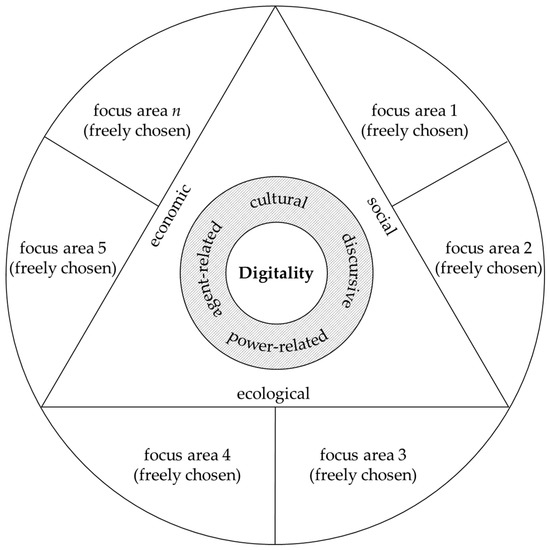
The synthesis nevertheless brings important differences into view. In the ESD discourse, sustainability functions as an explicit horizon of aims, and ESD 3 addresses the legitimacy of normative commitments, responsibility, and trade-offs within broader transformation processes. By contrast, the digitality discourse starts from the conditions under which orientations, claims to evidence, and possibilities for action are produced in digitally mediated environments. It also asks how these conditions are shaped by platform architectures, data economies, and attention regimes that distribute visibility, participation, and interpretive authority. Media-educational approaches to digitality have long been guided by emancipatory concerns, but they have not articulated a normative horizon such as sustainability with the same degree of explicitness (cf. Schluchter & Maurer, 2021). It is precisely this tension that the Digitainability Framework (Figure 1) takes up and structures.
Figure 1.
Digitainability Framework (author’s own illustration).
Following the argument of this paper, sustainable development is a contested process of learning and societal negotiation. Under conditions of digitality, these processes of learning and negotiation increasingly unfold within media-structured publics that distribute visibility, participation, and interpretive authority (Allert & Asmussen, 2017). By foregrounding digitality as a socio-technical condition, the framework moves beyond add-on/toolbox framings of digitization. It draws attention to how claims, evidence, and responsibilities are negotiated. In this sense, addressing SDG 4.7 requires systematically accounting for digitality—hence its central position in Figure 1.
At that digitality-centre of the framework are agents capable of orientation, judgement, and action. Their agency, however, is not unmediated. Rather, it is culturally framed through interpretive repertoires, routines, norms, and expectations that shape what comes to appear self-evident, meaningful, or ‘good’. It is power-related insofar as platform architectures, defaults, rankings, and data- and attention-driven logics, as well as governance rules that are already in place open up or constrain room for manoeuvre. It is discursively negotiated across media publics, political–legal arenas, and organisational–institutional settings in which rules, demands, and responsibilities are continually contested and rearticulated. Finally, it is agent-related because engagement with and redesign of onlife environments depends on individual prerequisites, beliefs, and dispositions.
Understood in this way, digitality is not merely a precondition for addressing sustainability questions; it is also the medium and an object of sustainability-focused orientation, judgement, and action. On this basis, digitainability can be specified through a double perspective (cf. Rau & Rieckmann, 2023):
First, a perspective on sustainable digitality asks how onlife environments—as media-cultural orders carried by practices, narratives, processes of normalisation, visibility orders, and modes of governance—can be organised to have sustainable effects. Social sustainability is at stake where opportunities for participation expand, recognition and belonging become possible, and inequalities can be surfaced and addressed through participatory provisions. The guiding questions are: Which access routes and communicative practices are normalised as ‘good’ digital participation, and what protective and participatory provisions are put in place? Ecological sustainability concerns whether the material and energy footprint of digital communication is reflected upon culturally and translated into practice: Which routines of acceleration, streaming, or short-lived device use become taken for granted—and which alternatives are framed as legitimate, attractive, and acceptable? Economic sustainability, finally, turns on the business models and incentive structures that organise digital publics: Which models govern communication (e.g., attention as commodity, data as resource, engagement as key metric), and which public-interest-oriented, transparent, and fair arrangements gain traction?
Second, a perspective on sustainability under conditions of digitality examines how sustainability issues are renegotiated under digital conditions. Digital practices (referentiality, communality, algorithmicity) reconfigure what comes to appear relevant, credible, and action-guiding—and they influence how conflicts become publicly visible or remain unnoticed (Stalder, 2016). This shifts not only how sustainability is discussed, but also which sustainability conflicts gain resonance, which attributions of responsibility become plausible, and which forms of collective action become thinkable and organisable in the first place. The political economies of digital communication also come into view as an interplay of business models, power relations, and regulation: Sustainability communication is not simply ‘out there on the internet’ as a neutral medium; it unfolds within attention architectures, platform logics, and competing interpretive offers that amplify some problem framings while damping others.
The two perspectives are tightly interwoven and point to a twin transformation understood as mutually reinforcing processes of reconfiguration. Onlife environments are reorganised in ways that shift their social, ecological, and economic effects. At the same time, sustainability conflicts become negotiable in different ways under these conditions. The coupling works in both directions: how (un)sustainably onlife environments are organised helps determine what can become publicly negotiable as sustainability, while sustainability discourses within onlife environments, in turn, reshape what their organisation is expected to deliver.
Educational practice may approach the twin transformation as a learning trajectory in which the two perspectives continually inform one another. Sustainable digitality becomes an object of inquiry and capability development; sustainability under conditions of digitality provides the complementary lens through which sustainability conflicts are examined, debated, and worked on. Organising learning along these lines also reorients learning culture towards open, collaborative, and reflexively structured arrangements that deliberately connect disciplinary inquiry with action-oriented experimentation.
Against this backdrop, the Digitainability Framework can be understood as the heuristic that translates this coupling into educational reflection, analysis, and design. It frames digitality as a possibility space shaped by cultural, power-related, discursive, and agent-related conditions, while keeping sustainability and its social, ecological, and economic dimensions in view. In this way, it can be used to analyse complex issues, guide the selection of topics, examine materials and digital conditions from multiple perspectives, justify pedagogical choices, design learning settings, and reflect on possible courses of action in concrete situations.
3.2. Example Use Case and Illustrative Application of the Framework
The following example shows one concrete way in which the Digitainability Framework can be used in formal educational contexts. Focusing on “social media as discursive spaces for climate-related issues”, it approaches the topic primarily from the perspective of sustainability under conditions of digitality (cf. Herasimenka et al., 2025). It is intended not as a full teaching model, but as an example of how the framework can orient topic selection, structure analysis, and support pedagogical decision-making. It proceeds from a particular learning-theoretical orientation aligned with the framework’s five organising dimensions (a)–(e): (a) Learning and education are understood as justificatory, judgement-oriented engagement with contested questions under digitally shaped conditions. (b) Taking social media as the object of study foregrounds a topic that is multi-perspectival, conflict-laden, and salient, while also resonating with the media realities and everyday lives of many students (mpfs, 2025). (c) The guiding pedagogical direction is towards orientation, judgement, and action in sustainability conflicts under conditions of digitality. Accordingly, the framework can be used flexibly across different phases and learning aims—for orientation (structuring relevant conditions), for judgement (weighing conflicts and responsibilities in a reasoned way), and for action (developing and reflecting options). (d) Methodologically, it assumes that analysing and discussing platform conditions, visibility, and justificatory patterns is framed cooperatively and reflexively. (e) Learning arrangements are conceived as cooperative, networked, and (semi)public, so that digitality becomes practically accessible in schools and higher education institutions as a space for experience and action.
What follows is an analysis of the concrete ‘social-media issue’ based on the application of the framework, illustrating how such issues can be addressed in formal educational contexts.
From a social perspective, social media can provide powerful arenas for democratic deliberation by lowering barriers to information access and enabling organisation and networking across local, regional, national, and international contexts (e.g., in protest movements). Content is often condensed into short, audience-oriented formats, and global perspectives as well as timely reporting from diverse contexts can become widely available (Ring, 2020). The conditions under which this becomes possible are cultural, as within a Culture of Digitality, the use of social media as discursive spaces, the communicative styles treated as credible, and the ways plausibility is established (e.g., through community-specific norms) are part of culturally patterned practices of public sense-making and relevance attribution (Stalder, 2016). They are also discursive, as climate-related knowledge is negotiated through competing interpretive frames—science-aligned, politically normative, and everyday framings that foreground different emphases (Rau & Rieckmann, 2023). The agents’ dispositions matter as well; judgements and subsequent engagement are influenced by prior assumptions, identities, and confirmation tendencies—that is, by how well claims fit established beliefs and interpretive patterns (Herasimenka et al., 2025).
From an economic perspective, these discursive spaces are closely coupled to attention and monetisation logics: Advertising and creator economies turn visibility into an economic asset, often privileging content that generates high interaction (Stalder, 2016). These dynamics are also tied to power relations: They operate at the level of platformisation itself, beyond individual platform rules. Information and public debate increasingly run through a small number of platforms, and growing numbers of users rely on them as their primary source of information (Behre et al., 2025; mpfs, 2025), concentrating attention as a societal resource. What gets said, and what gains traction, is also affected by algorithmic selection, sometimes aligned with optimisation incentives (Stalder, 2016). Platforms thus accrue structural power, and that very increase is, in turn, contested discursively in political and societal arenas: Debates centre on platforms’ responsibility for information orders and on whether transparency requirements, risk minimisation, or regulatory options are needed (Rau & Rieckmann, 2023; Ring, 2020).
From an ecological perspective, social media function simultaneously as spaces for climate information and climate-related action, with effects that run along two interwoven lines. One concerns discourse: Circulating content can consolidate climate knowledge, problem diagnoses, and options for action, and may foster awareness (for indicative evidence, see Hajj-Hassan et al., 2024). At the same time, misleading or manipulative content can circulate, affecting public understanding and either strengthening or undermining support for climate action (Herasimenka et al., 2025; Ring, 2020). The other concerns material infrastructures: Social media use depends on devices, data centres, and data traffic and therefore entails energy and resource demand (Hajj-Hassan et al., 2024; Ring, 2020). This ambivalence is not simply a given; it remains subject to ongoing discursive contestation and—like the other dimensions—is culturally mediated, structured through power relations, and situated in agents’ dispositions.
It is important to note that content circulates across onlife environments, is recontextualised, and feeds back into other publics—for instance via intermedia references in journalistic reporting (Stalder, 2016). These circulation dynamics make visible how interpretations, attributions of responsibility, and perceived options for action travel between publics and are transformed along the way. The present analysis is therefore illustrative rather than exhaustive. As an educational use case, it shows how the framework can support justification-oriented deliberation and orient the development of reflective options for action in formal educational contexts. In teacher education, for example, this could be translated into analysing platform-based materials, designing lesson sequences on sustainability conflicts under conditions of digitality, or formulating reflection prompts for pedagogical decision-making.
4. Implications, Limitations, and Future Directions
4.1. Implications of the Framework
In educational discourse, ESD and digitality are often approached as adjacent rather than mutually constitutive transformations. Sustainability is commonly framed as a normatively structured process of societal negotiation (Singer-Brodowski, 2016), whereas digitality is often reduced to questions of tool implementation (Krommer, 2021). This leaves a central gap in the discourse: The conditions of digitality under which sustainability-related orientation, judgement, and action become possible remain insufficiently reflected, while processes of digital transformation in education are still too rarely assessed in relation to sustainability and justice (Hauck-Thum et al., 2023; Niesyto, 2017).
In response, the paper develops Gupta et al.’s (2020) notion of digitainability into a double perspective and frames sustainable and digital transformation in education as a mutually coupled twin transformation. Sustainable digitality addresses the question of how digital infrastructures, platform and governance configurations, and analogue–digital entanglements of practice can be designed so that they do not erode social participation, externalise ecological burdens, or uncritically reproduce economic logics of valorisation. Sustainability under conditions of digitality, in turn, addresses how sustainability conflicts are perceived, negotiated, and acted upon within media-shaped publics and information orders. These are structured by visibility, attention and data practices, as well as by discursive dynamics. From this perspective, SDG target 4.7 comes into view as an educational task that requires both perspectives to be considered together and taken up reflexively in educational processes.
The framework’s contribution lies in connecting two discourses that remained only loosely related in much of educational debate, while also making visible both their key convergences in pedagogical orientations and asymmetries in analytical emphases. Taken together, the framework links a horizon of responsibility, justice, and educational judgement across social, ecological, and economic dimensions with the socio-technical conditions of visibility, participation, and governance under which judgement and action emerge. It thus offers a heuristic for reflection, analysis, and design that can inform research, educational practice, as well as teacher education and professional development.
For research, the proposed heuristic entails a twofold shift in analytic focus within the scope of this paper. Studies in sustainability education would examine processes of judgement and contestation as they unfold within media-shaped regimes. Studies of digital transformation in education, in turn, would treat infrastructures, platform configurations, and governance arrangements as conditions that structure participation opportunities, accountability relations, and resource implications. At the same time, the framework makes clear that the sustainability implications observed for specific digitization initiatives (whether beneficial or harmful) do not, by themselves, indicate that sustainability—as an educational and socio-political process under conditions of digitality—has already been achieved or fallen short.
For educational practice, attention shifts away from choosing the ‘right tools’ and towards critically engaging with the conditions under which orientation, judgement, and action become possible in media-shaped orders, communication, and governance. Illustrative issues, accordingly, should not be approached merely as matters of content; they should also be examined through the framework’s intersecting framings.
For teacher education and professional development, this calls for a recalibration of educators’ professional agency. Beyond routine instructional practices, the focus shifts to applying criteria and exercising judgement in relation to platform and governance configurations, and to facilitating open—yet responsibility-oriented—engagement with contested sustainability questions in learning environments embedded in information flows and public visibility.
4.2. Limitations of the Framework
The Digitainability Framework is proposed as a heuristic for organising reflection, analysis, and design. Its categories are therefore intended as analytical points of orientation rather than as a fixed taxonomy. This requires making explicit the framework’s scope, its limits, and the conditions under which it is most productively applied. Doing so helps clarify what the framework is designed to illuminate, where its explanatory reach remains bounded, and where further development may be warranted.
First, the argument is conceptual and integrative; it does not aim to be exhaustive in the sense of a systematic review. While the focus on the DACH context offers analytic traction, it also situates the framework within specific Central European discursive and institutional conditions. Contributions from other knowledge contexts—including perspectives informed by Global South scholarship—may draw on different epistemic traditions, normative commitments, and governance experiences, and may therefore unsettle, enrich, or redirect the framework’s assumptions. Even where the framework is intended to speak beyond the DACH context, the conceptual vocabulary and standards of evaluation mobilised here remain grounded in that positioning. The framework should therefore be read as a provisional organising proposal that gains robustness through dialogic testing across settings.
Second, the four framings are analytically distinct but often intertwined in practice and reinforce one another. Power-structured orders, for instance, are often discursively justified, while discursive conflict is, in turn, shaped by infrastructural mediation and platform architectures. The point is therefore not to produce clean separations, but to support reflection across recurrent perspectives and to push back against reductive readings.
Third, a major limitation concerns empirical uptake. The social media example illustrates the framework’s logic, while testing remains for future work. Open questions include how well the framework carries across different learning arrangements, subject domains, and age groups, and what kinds of support are needed so that reflection does not turn into over-complexity or become normatively foreclosed. Relatedly, it remains to be examined how learners handle uncertainty, not-knowing, and goal conflicts, and how evaluative criteria can be designed without closing down the openness of deliberation.
Fourth, the framework’s double perspective raises an additional challenge for empirical work. Depending on the object of study, the educational setting, and the data available, researchers need to decide how sustainable digitality and sustainability under conditions of digitality can be made empirically visible without blurring the distinction between them or reducing their complexity. This also requires explicit framing: It should be transparent which perspective is central and on what conceptual and (where relevant) methodological basis the two are brought into relation. Rather than indicating a weakness, this reflects the challenge of making the entanglement between both perspectives visible while retaining their analytical distinction.
4.3. Future Directions for Research, Practice, and Professional Development
Building on these implications and limitations, future work can now focus on iterative use, contextual refinement, and empirical elaboration. Future studies might (1) examine its empirical adequacy as an analytic lens—particularly where trade-offs, ambivalence, and the conditions of public negotiation are salient; (2) deploy it as a reflection guide within learning arrangements; and (3) translate the insights gained into formats for teacher education and professional development. Comparative engagement with discursive settings beyond the DACH context would further help to identify context-bound assumptions and to revise or expand categories where necessary. On this basis, the framework can serve the role it was designed for, being a starting point for critique, adaptation, and empirical work.
5. Conclusions
This paper has argued that ESD and digitality need to be brought into a more systematic relation in educational discourse. Its central claim is that SDG 4.7 remains conceptually incomplete under tool-only readings of digitality. Conversely, digital transformation in education can only be assessed and addressed responsibly when it is explicitly related to questions of sustainability and justice.
To address this issue, the paper proposed the Digitainability Framework. It brings together two perspectives that are analytically distinguishable yet closely intertwined in educational practice. Sustainable digitality concerns the socially inclusive, ecologically responsible, and economically fair design of analogue–digital entanglements of practice and infrastructure. Sustainability under conditions of digitality concerns the ways sustainability-related conflicts are perceived, negotiated, and acted upon within media-shaped publics. Across both perspectives, the framework foregrounds four intersecting framings—cultural, power-related, discursive, and agent-related—and thereby offers a structured way of relating sustainability and digitality without collapsing either into the other.
In this sense, the framework’s contribution lies in making the relation between sustainability and digitality available for educational reflection, analysis, and design in a more systematic way. It helps to examine how both influence educational processes jointly in the selection of issues, in pedagogical judgement, in the organisation of learning arrangements, and in the design of educational responses to contested societal questions.
Further work is needed to test the framework empirically, to specify its context-dependent scope and limits, and to explore its use in learning arrangements as well as in teacher education and professional development, including in comparison with discursive contexts beyond the DACH region.
Funding
This research received no external funding.
Institutional Review Board Statement
Not applicable.
Informed Consent Statement
Not applicable.
Data Availability Statement
No new data were created in this study.
Conflicts of Interest
The author declares no conflicts of interest.
Abbreviations
The following abbreviations are used in this manuscript:
| DACH | Germany, Austria, and Switzerland |
| ESD | Education for/as Sustainable Development |
| KMK | Standing Conference of the Ministers of Education and Cultural Affairs of the Länder in the Federal Republic of Germany |
| SDGs | Sustainable Development Goals |
| VUCA | Volatility, Uncertainty, Complexity, Ambiguity |
| WBGU | German Advisory Council on Global Change |
Notes
| 1 | For transparency, the bibliometric query used the following Web of Science search strings (retrieved 30 December 2025): (TS = (sustainab* AND digital*)) refined by “Research Areas: Education Educational Research”; and (TS = (“digitainability”)). |
| 2 | This cross-curricular framing aligns with the future-skills debate, in which the 4Cs—creativity, critical thinking, collaboration, and communication—are highlighted as key components (Kotsiou et al., 2022; Krommer, 2021; Singer-Brodowski et al., 2025). |
References
- Allert, H., & Asmussen, M. (2017). Bildung als produktive Verstrickung. In H. Allert, M. Asmussen, & C. Richter (Eds.), Digitalität und Selbst (pp. 27–68). Transcript. [Google Scholar]
- Autenrieth, D., & Nickel, S. (2020). Kultur der Digitalität = Kultur der Partizipation? Medienimpulse, 58(4), 32. [Google Scholar] [CrossRef]
- Baecker, D. (2017). Wie verändert die Digitalisierung unser Denken und unseren Umgang mit der Welt? In R. Gläß, & B. Leukert (Eds.), Handel 4.0 (pp. 3–24). Springer. [Google Scholar] [CrossRef] [Scilit]
- Behre, J., Hölig, S., Stöwing, E., & Möller, J. (2025). Reuters Institute digital news report 2025: Ergebnisse für Deutschland. Leibniz-Institut für Medienforschung. [Google Scholar] [CrossRef]
- Braun, T., Büsch, A., Dander, V., Eder, S., Förschler, A., Fuchs, M., Gapski, H., Geisler, M., Hartong, S., Hug, T., Kübler, H.-D., Moser, H., Niesyto, H., Pohlmann, H., Richter, C., Rummler, K., & Sieben, G. (2021). Positionspapier zur Weiterentwicklung der KMK-Strategie ‹Bildung in der digitalen Welt›. MedienPädagogik: Zeitschrift für Theorie und Praxis der Medienbildung, 1–7. [Google Scholar] [CrossRef] [Scilit]
- Di Giulio, A. (2004). Die Idee der Nachhaltigkeit im Verständnis der Vereinten Nationen: Anspruch, Bedeutung und Schwierigkeiten. LIT-Verlag. [Google Scholar]
- Döbeli Honegger, B. (2022). Was unter “Individuelle Förderung und Digitalität” verstanden wird, ist oft sehr individuell … und wird zunehmend von der eingesetzten Software geprägt. DDS—Die Deutsche Schule, 114(3), 298–311. [Google Scholar] [CrossRef] [Scilit]
- Eickelmann, B., Gerick, J., Hauck-Thum, U., & Maaz, K. (2024). Navigator Bildung Digitalisierung: Konzeptionierung und Orientierung zum Stand der digitalen Transformation im schulischen Bildungsbereich in Deutschland. Forum Bildung Digitalisierung. [Google Scholar]
- Engagement Global (Ed.). (2025). Orientierungsrahmen Globale Entwicklung: Bildung für nachhaltige Entwicklung in der gymnasialen Oberstufe. Westermann. [Google Scholar]
- Floridi, L. (2015). The onlife manifesto. Springer. [Google Scholar] [CrossRef] [Scilit]
- Grünberger, N. (2022). Didaktische Überlegungen an der Nahtstelle von Nachhaltigkeit und Digitalität. Open Online Journal for Research and Education, 1–10. [Google Scholar] [CrossRef] [Scilit]
- Gupta, S., Motlagh, M., & Rhyner, J. (2020). The digitalization sustainability matrix: A participatory research tool for investigating digitainability. Sustainability, 12(21), 9283. [Google Scholar] [CrossRef] [Scilit]
- Haan, G. de. (2008). Gestaltungskompetenz als Kompetenzkonzept der Bildung für nachhaltige Entwicklung. In I. Bormann, & G. de Haan (Eds.), Kompetenzen der Bildung für nachhaltige Entwicklung (pp. 23–43). VS Verlag für Sozialwissenschaften. [Google Scholar] [CrossRef] [Scilit]
- Hadar, L. L., Ergas, O., Alpert, B., & Ariav, T. (2020). Rethinking teacher education in a VUCA world: Student teachers’ social-emotional competencies during the COVID-19 crisis. European Journal of Teacher Education, 43(4), 573–586. [Google Scholar] [CrossRef] [Scilit]
- Hajj-Hassan, M., Chaker, R., & Cederqvist, A.-M. (2024). Environmental education: A systematic review on the use of digital tools for fostering sustainability awareness. Sustainability, 16(9), 3733. [Google Scholar] [CrossRef] [Scilit]
- Hauck-Thum, U. (2025). Bildung zwischen Digitalität und Nachhaltigkeit: Wie Schule Zukunft gestalten kann. Campus Schulmanagement. Available online: https://evido-magazin.de/artikel/bildung-zwischen-digitalitaet-und-nachhaltigkeit-wie-schule-zukunft-gestalten-kann (accessed on 1 April 2026).
- Hauck-Thum, U., Heinz, J., & Hoiß, C. (Eds.). (2023). Gerecht, digital, nachhaltig! Interdisziplinäre Perspektiven auf Lehr- und Lernprozesse in der digitalen Welt. OAPublishing Collective. [Google Scholar] [CrossRef]
- Hauff, M. v., & Kleine, A. (2005). Methodischer Ansatz zur Systematisierung von Handlungsfeldern und Indikatoren einer Nachhaltigkeitsstrategie: Das integrierende Nachhaltigkeits-Dreieck. Volkswirtschaftliche Diskussionsbeiträge an der Universität Kaiserslautern. [Google Scholar]
- Herasimenka, A., Wang, X., & Schroeder, R. (2025). A systematic review of effective measures to resist manipulative information about climate change on social media. Climate, 13(2), 32. [Google Scholar] [CrossRef] [Scilit]
- Herzig, B. (2023). Digitalität, Mediatisierung und Bildung. In S. Aßmann, & N. Ricken (Eds.), Bildung und Digitalität (pp. 99–125). Springer. [Google Scholar] [CrossRef] [Scilit]
- Ketter, V. (2021). Digital geprägte Bildung für nachhaltige Entwicklung: Eine systematische Betrachtung medienpädagogischer Praxis. Merz | Medien + Erziehung, 65(4), 46–55. [Google Scholar] [CrossRef] [Scilit]
- KMK. (2016). Bildung in der digitalen Welt: Strategie der Kultusministerkonferenz. Beschluss vom 08.12.2016. KMK. [Google Scholar]
- KMK. (2021). Lehren und Lernen in der digitalen Welt: Die ergänzende Empfehlung zur Strategie “Bildung in der digitalen Welt”. Beschluss vom 09.12.2021. KMK. [Google Scholar]
- Kotsiou, A., Fajardo-Tovar, D. D., Cowhitt, T., Major, L., & Wegerif, R. (2022). A scoping review of future skills frameworks. Irish Educational Studies, 41(1), 171–186. [Google Scholar] [CrossRef] [Scilit]
- Krommer, A. (2021). Mediale Paradigmen, palliative Didaktik und die Kultur der Digitalität. In U. Hauck-Thum, & J. Noller (Eds.), Was ist Digitalität? Philosophische und pädagogische Perspektiven (pp. 57–72). Springer. [Google Scholar] [CrossRef] [Scilit]
- Krotz, F. (2017). Explaining the mediatisation approach. Javnost—The Public, 24(2), 103–118. [Google Scholar] [CrossRef] [Scilit]
- Lichtenthaler, U. (2021). Digitainability: The combined effects of the megatrends digitalization and sustainability. Journal of Innovation Management, 9(2), 64–80. [Google Scholar] [CrossRef] [Scilit]
- McLuhan, M. (1964). Understanding media: The extensions of man. The New American Library. [Google Scholar]
- mpfs (Ed.). (2025). JIM-Studie 2025: Jugend, information, medien. Basisuntersuchung zum Medienumgang 12- bis 19-Jähriger. mpfs. [Google Scholar]
- Muheim, V. (2021). Bildung für nachhaltige Entwicklung und Medienpädagogik: Desiderate und Denkanstöße. Merz|Medien + Erziehung, 65(4), 38–45. [Google Scholar] [CrossRef] [Scilit]
- Naisbitt, J. (1982). Megatrends: Ten new directions transforming our lives. Warner Books. [Google Scholar]
- Niesyto, H. (2017). Medienpädagogik und digitaler Kapitalismus. Für die Stärkung einer gesellschafts- und medienkritischen Perspektive. MedienPädagogik: Zeitschrift für Theorie und Praxis der Medienbildung, 27, 1–29. [Google Scholar] [CrossRef] [Scilit]
- Pettig, F., & Singer-Brodowski, M. (2025). Learning in relation with a changing world: Thinking beyond ESD 1 and ESD 2 towards ESD 3. Journal of Education for Sustainable Development, 18(2), 176–201. [Google Scholar] [CrossRef] [Scilit]
- Prestridge, S. (2024). Pedagogical beliefs matter ‘more’ in the age of disruptive technologies. In R. Blankenship, & T. Cherner (Eds.), Research highlights in technology and teacher education special edition (pp. 268–280). Association for the Advancement of Computing in Education (AACE). [Google Scholar]
- Rau, F., & Rieckmann, M. (2023). Bildung in einer Kultur der Nachhaltigkeit und Digitalität. In U. Hauck-Thum, J. Heinz, & C. Hoiß (Eds.), Gerecht, digital, nachhaltig! Interdisziplinäre Perspektiven auf Lehr- und Lernprozesse in der digitalen Welt (pp. 21–46). OAPublishing Collective. [Google Scholar]
- Rieckmann, M. (2016). Bildung für nachhaltige Entwicklung: Konzeptionelle Grundlagen und Stand der Implementierung. In M. K. Schweer (Ed.), Bildung für nachhaltige Entwicklung in pädagogischen Handlungsfeldern (pp. 11–32). Peter Lang. [Google Scholar]
- Rieckmann, M. (2021). Bildung für nachhaltige Entwicklung: Ziele, didaktische Prinzipien und Methoden. Merz | Medien + Erziehung, 65(4), 12–19. [Google Scholar] [CrossRef] [Scilit]
- Rieckmann, M., & Barth, M. (2022). Educators’ competence frameworks in education for sustainable development. In P. Vare, N. Lausselet, & M. Rieckmann (Eds.), Competences in education for sustainable development (pp. 19–26). Springer. [Google Scholar] [CrossRef] [Scilit]
- Riess, W., Martin, M., Mischo, C., Kotthoff, H.-G., & Waltner, E.-M. (2022). How can education for sustainable development (ESD) be effectively implemented in teaching and learning? An analysis of educational science recommendations of methods and procedures to promote ESD goals. Sustainability, 14(7), 3708. [Google Scholar] [CrossRef] [Scilit]
- Ring, S. (2020). Digitalisierung—Bildung—Nachhaltige Entwicklung: Werte nachhaltiger Entwicklung für die Medienpädagogik. In M. Dietrich, B. Friedrich, & S. Ring (Eds.), Medien bilden Werte: Digitalisierung als pädagogische Aufgabe (pp. 85–91). kopaed. [Google Scholar]
- Schluchter, J.-R. (2020). Medienbildung und (Bildung für) nachhaltige Entwicklung. Merz|Medien + Erziehung, 64(5), 67–73. [Google Scholar] [CrossRef] [Scilit]
- Schluchter, J.-R., & Maurer, B. (2021). Medienbildung für nachhaltige Entwicklung. Merz|Medien + Erziehung, 65(4), 7–11. [Google Scholar] [CrossRef] [Scilit]
- Schmidt, C. M. (Ed.). (2023). Digitainability: Digital technologies for environmentally sustainable economic activity: Market potential and strategic implications. acatech STUDY. [Google Scholar] [CrossRef]
- Schrüfer, G., & Eckstein, V. (2022). Chancen und Möglichkeiten im Zeitalter der Digitalität aus Perspektiven globalen Lernens/BNE. In A. Eberth, A. Goller, J. Günther, M. Hanke, V. Holz, A. Krug, & K. Rončević (Eds.), Bildung für nachhaltige Entwicklung: Impulse zu Digitalisierung, Inklusion und Klimaschutz (pp. 74–91). Barbara Budrich. [Google Scholar]
- Singer-Brodowski, M. (2016). Transformative Bildung durch transformatives Lernen: Zur Notwendigkeit der erziehungswissenschaftlichen Fundierung einer neuen Idee. Zeitschrift für internationale Bildungsforschung und Entwicklungspädagogik, 39(1), 13–17. [Google Scholar] [CrossRef]
- Singer-Brodowski, M., Henkel, G.-M., Reith, A., Frank, P., & Rieckmann, M. (2025). What is needed to act as a professional change agent for sustainability? A scoping review. International Review of Education. Advance online publication. [CrossRef] [Scilit]
- Stalder, F. (2016). Kultur der Digitalität. Suhrkamp. [Google Scholar]
- Stalder, F. (2018). The digital condition. Polity Press. [Google Scholar]
- Stoltenberg, U. (2010). Kultur als Dimension eines Bildungskonzepts für eine nachhaltige Entwicklung. In O. Parodi, G. Banse, & A. Schaffer (Eds.), Wechselspiele: Kultur und Nachhaltigkeit: Annäherungen an ein Spannungsfeld (pp. 293–312). Nomos. [Google Scholar] [CrossRef] [Scilit]
- Vare, P., & Scott, W. (2007). Learning for a change: Exploring relationships between education and sustainable development. Journal of Education for Sustainable Development, 1(2), 191–198. [Google Scholar] [CrossRef] [Scilit]
- WBGU. (2011). Gesellschaftsvertrag für eine Große Transformation. WBGU. [Google Scholar]
- WBGU. (2019). Unsere gemeinsame digitale Zukunft. WBGU. [Google Scholar]
Disclaimer/Publisher’s Note: The statements, opinions and data contained in all publications are solely those of the individual author(s) and contributor(s) and not of MDPI and/or the editor(s). MDPI and/or the editor(s) disclaim responsibility for any injury to people or property resulting from any ideas, methods, instructions or products referred to in the content. |
© 2026 by the author. Licensee MDPI, Basel, Switzerland. This article is an open access article distributed under the terms and conditions of the Creative Commons Attribution (CC BY) license.