


Abstract
Academic stress is prevalent among university students and affects their evaluation of educational environment quality, fairness, and supportiveness. Based on the challenge–hindrance stressor framework and transactional stress-coping model, this study explores how challenge and hindrance stressors (HSs) shape perceived decent education (DE), focusing on the mediating role of artificial intelligence use (AIUSE) and moderating effect of interpersonal interaction (II). Using partial least squares structural equation modeling (PLS-SEM) to analyze survey data from 520 university students, the results show that both stressors positively predict AIUSE, which in turn improves perceived DE and mediates the stressor-DE relationship. II negatively moderates the AIUSE–DE link: the positive effect weakens as II increases. Moderated mediation analysis indicates that the indirect effects via AIUSE are only significant at low II levels. These findings highlight AI-enabled learning as an adaptive coping strategy and the necessity of integrating technological and interpersonal resources to enhance student well-being in higher education.
1. Introduction
Contemporary university students face a variety of stressors throughout their academic journey, including both growth-oriented challenge stressors (CSs) and hindrance stressors (HSs) that impede academic goal achievement. CSs refer to stressful situations conducive to personal growth and a sense of accomplishment, such as demanding yet meaningful learning tasks and time-sensitive course projects. In contrast, HSs denote negative stressful situations that hinder personal development, such as bureaucratic requirements, insufficient resources, or interpersonal conflicts (Lepine et al., 2005). Extensive research has confirmed that in workplace contexts, CSs are often linked to positive outcomes, while HSs are more likely to lead to negative consequences like burnout (Horan et al., 2020; Cheng et al., 2023). However, the mechanisms of stress in higher education may be more complex. Moderate CSs may stimulate students’ engagement in the learning environment (Bao et al., 2024), whereas excessive stress, particularly from HSs, may damage students’ mental health and their evaluation of the educational environment (Adedoyin & Soykan, 2020). Nevertheless, some studies suggest that under certain conditions, academic stress is not always detrimental and may even positively promote student engagement (Acosta-Gonzaga, 2023). Therefore, it is essential to explore in depth how different types of stress perceived by university students affect their educational experience and outcomes.
In recent years, the rapid development of generative artificial intelligence (AI) technologies (Lee & Park, 2026), such as large language models exemplified by ChatGPT4.0, has accelerated the integration of intelligent systems into educational settings (Ouyang et al., 2023). Research is clearly shifting towards an integrated explanation of “technical attributes + psychological mechanisms + organizational support + social contexts.” Surveys indicate that over 80% of students believe that using AI helps improve academic performance (Vieriu & Petrea, 2025). AI Use (AIUSE) should not be understood only as a general technology adoption behavior (Essien et al., 2024). Under academic pressure, it may also function as a coping-oriented behavior through which students seek clarification, task assistance, and immediate support. For example, AIUSE may provide students with novel strategies and resources to cope with academic stress: when faced with heavy tasks or challenging knowledge points, students can leverage AI to obtain problem-solving ideas, materials, or personalized tutoring, thereby alleviating stress and improving learning outcomes (Adamson et al., 2014). According to the transactional model of stress and coping, individuals who perceive a stressful situation as a “challenge” typically employ active, problem-focused coping strategies. In contrast, those who interpret it as a “threat” or “hindrance” are more prone to negative emotional responses and may resort to avoidance or less effective coping mechanisms (de Cordova et al., 2024). Based on this framework, it is hypothesized that students perceiving CSs may be more inclined to cope with learning demands through active means (such as AIUSE) to achieve better learning results; conversely, students perceiving HSs may reduce their willingness to seek help from new tools due to frustration. However, it is also plausible that in highly digitalized learning environments, HSs motivate students to seek alternative technological solutions, such as AI tools, as a compensatory coping strategy. It remains unclear whether there are significant differences in the AIUSE behaviors of university students when facing stressors of different natures and whether this behavior can mediate the relationship between stress and educational outcomes.
Moreover, university students’ Interpersonal Interaction (II) (e.g., discussing learning problems with classmates, participating in group collaboration) is also a crucial factor influencing the learning experience. Adequate social support and interaction help students buffer the impact of stress and maintain mental health (Acoba, 2024). In educational contexts, students with frequent II may receive emotional and academic support from peers or teachers, thereby reducing their reliance on AI tools; conversely, students lacking II might be more inclined to seek help via AI. In other words, the level of II may moderate the effect of students’ use of AI tools on enhancing their learning experience. This relates not only to the interaction mechanism between technology and interpersonal resources but also to the construction of a positive educational ecology.
Decent Education (DE) is the core outcome variable in this study. This concept is derived from the extension of the “Decent Work” philosophy (Duffy et al., 2022, 2023), aiming to measure students’ subjective evaluation of whether the higher education they receive possesses “decent” characteristics such as safety, inclusivity, fairness, and high quality (Levin et al., 2025; Liu et al., 2025). Specifically, DE encompasses ensuring students’ physical and mental safety, eliminating discrimination and bullying, providing equal learning opportunities and support, fostering good interpersonal relationships and a sense of belonging, and offering high-quality teaching and diverse development opportunities. Achieving DE is a significant reflection of educational equity and quality, as well as a key factor influencing student well-being (Kenny et al., 2023). UNESCO emphasizes the importance of ensuring that all learners have access to safe and inclusive learning environments and enjoy high-quality education equally. However, in an environment characterized by intense competition for further studies and employment, if university students endure excessive stress for prolonged periods without adequate support, their recognition of the quality and fairness of their education may be diminished, subsequently affecting their engagement and development (Hollebeek et al., 2023; Wei et al., 2024). Although the scale was originally developed outside the Chinese higher education context, its underlying dimensions are highly relevant to contemporary Chinese universities, where students navigate intense academic competition, rapid digitalization, unequal access to support, and growing concerns about well-being and educational quality. Therefore, it is necessary to explore how to enhance students’ positive perception of the educational environment under stressful conditions. This study adopts DE as an important indicator measuring students’ overall educational experience and welfare, aiming to provide empirical evidence for constructing DE by investigating its influencing factors.
In summary, the spread of AI in higher education has changed not only how students learn but also how they cope with academic pressure (Buizza et al., 2026). Existing research has usually examined academic stress, technology use, and educational experience in parallel rather than in one integrated framework. The present study addresses this gap in three ways. First, it examines whether AIUSE can be conceptualized as a coping-related response through which students manage both challenge and hindrance stressors. Second, it links these stress processes to DE, thereby extending the discussion from performance or engagement outcomes to students’ broader evaluations of educational quality, fairness, and supportiveness. Third, it investigates whether II conditions the value of AIUSE, thereby clarifying how technological and interpersonal resources jointly shape students’ educational experiences. Accordingly, this study addresses three questions: (1) How do CSs and HSs influence university students’ use of AI tools for academic support? (2) Does AIUSE mediate the relationships between academic stressors and DE? (3) How does II condition the effect of AIUSE on DE? By answering these questions with survey data and PLS-SEM, the study aims to refine theory on stress adaptation in higher education and provide actionable guidance for designing supportive learning environments.
2. Theoretical Basis and Hypothesis Development
2.1. Challenge Stressors (CSs) and Hindrance Stressors (HSs): A Coping Process Model Perspective
Lazarus and Folkman’s Transactional Model of Stress and Coping conceptualizes stress as a dynamic interaction between the individual and the environment, emphasizing the pivotal role of cognitive appraisal in determining coping responses (Spaccarelli, 1994). When individuals encounter stressors, they engage in an initial appraisal to assess the relevance and impact of the situation on their well-being (Stanisławski, 2019). If appraised as a challenge, the situation, though demanding, offers potential gains and growth opportunities, thereby inciting positive emotions and problem-focused coping strategies; if appraised as a threat or hindrance, individuals tend to experience negative emotions such as anxiety and may resort to emotion-focused strategies like avoidance or stress reduction. Within this framework, Ferris et al. (2015) distinguished workplace stressors into two categories, challenge and hindrance, proposing that they have opposite effects on outcomes such as individual motivation and performance. CSs refer to situations that, while causing tension, are accompanied by opportunities for growth or achievement, such as heavy workloads (study loads), tight deadlines, and complex tasks (Podsakoff et al., 2023). HSs refer to situations detrimental to goal achievement and lacking value for growth, such as bureaucracy, “red tape,” role conflict, and unfairness (Pindek et al., 2024). The Challenge–Hindrance Stressor Model has been widely validated in organizational contexts: CSs are often positively correlated with work engagement and performance, while HSs are negatively correlated with burnout and turnover intention (Kubicek et al., 2022). However, recent scholars have questioned this model, suggesting that the relationship between different stressors and outcomes is not monolithic; for instance, CSs may produce negative effects in certain contexts, requiring consideration of situational and individual factors (Nielsen et al., 2023). Meanwhile, although HSs are generally viewed as detrimental to adaptive coping, their effects may vary in technology-rich learning contexts where AI provides readily accessible compensatory resources.
In the university context, heavy coursework, time pressure, and course difficulty can be analogously viewed as CSs, while unclear course requirements, insufficient resources, and interpersonal conflicts belong to HSs (Bao et al., 2024). The Challenge-Hindrance Stressor framework offers a useful foundation for interpreting student stress, but academic coping increasingly unfolds in technology-rich environments in which students can mobilize new forms of support. When academic demands are experienced as challenging but meaningful, students are likely to adopt active, problem-focused strategies, including the use of AI tools for explanation, planning, and task completion. By contrast, HSs are more likely to undermine students’ sense of control and initiative, thereby reducing willingness to engage proactively with new learning resources. This remains the dominant theoretical expectation and forms the basis of the present hypotheses. At the same time, the possibility of compensatory technology use under hindrance is acknowledged and revisited in the discussion section, especially because students in highly digitalized settings may sometimes turn to AI when other support is insufficient. Based on the dominant theoretical logic, we propose the following hypotheses:
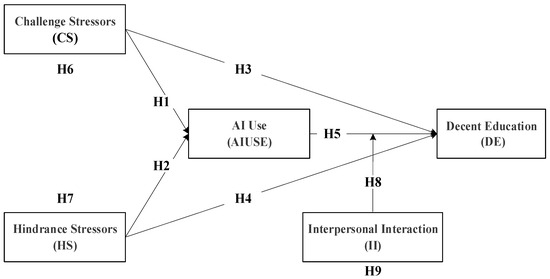
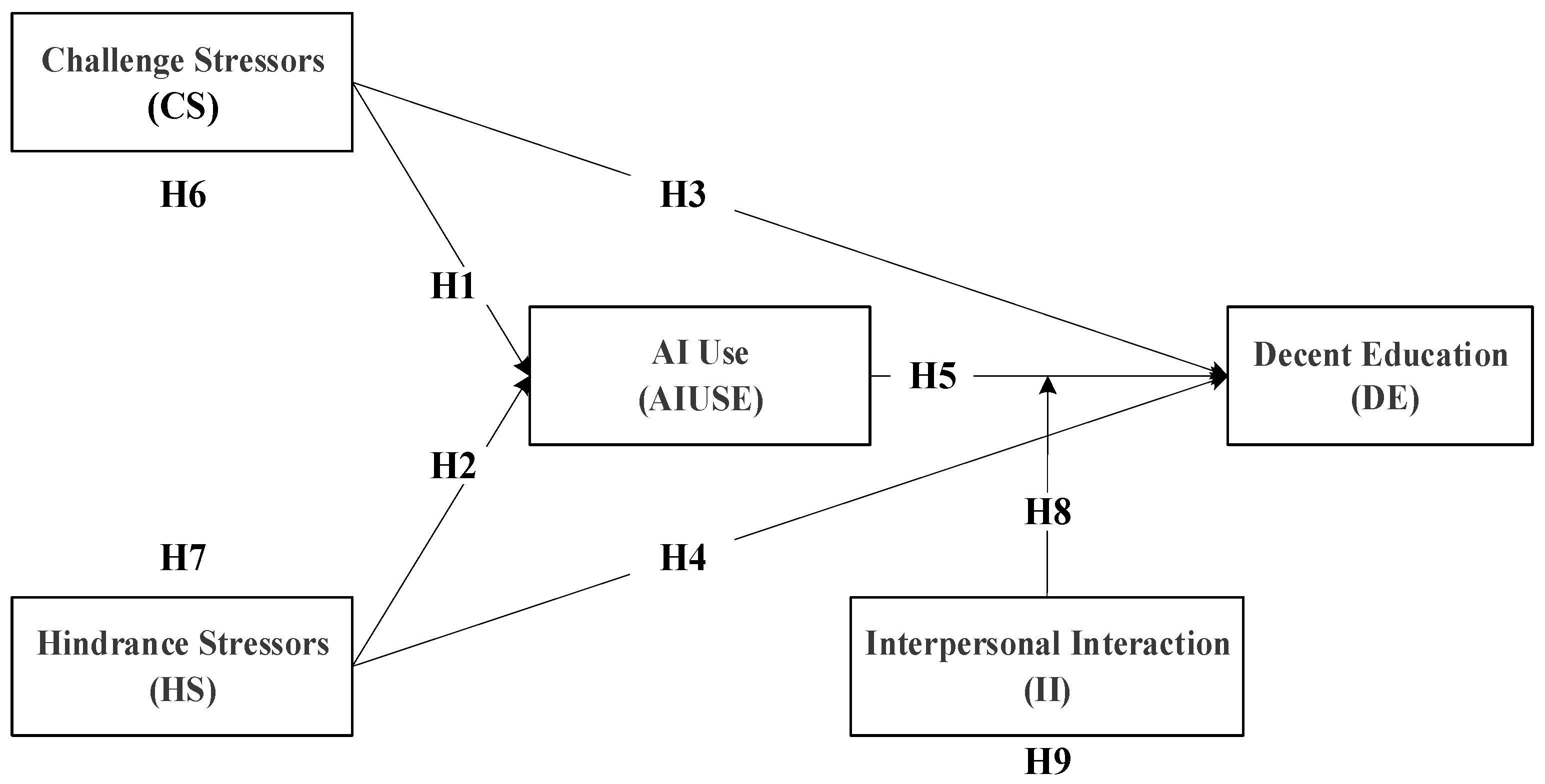
H1.
CSs have a positive effect on AIUSE.
H2.
HSs have a negative effect on AIUSE.
Furthermore, stress may shape how students evaluate the decency of their educational experience. Within a certain range, CSs may strengthen students’ sense of growth and their recognition of educational value, because successfully addressing demanding tasks can produce achievement and satisfaction (Daniel et al., 2024). By contrast, if HSs remain unresolved, they are more likely to generate dissatisfaction with institutional support, reduce perceptions of fairness, and weaken confidence in educational quality. From the perspective of DE, this means that challenge within a supportive environment may help students recognize the value of education, whereas persistent hindrance may make students feel that they are not receiving equitable and supportive educational treatment (Levin et al., 2025). Accordingly, we propose:
H3.
CSs have a positive effect on university students’ DE.
H4.
HSs have a negative effect on university students’ DE.
2.2. The Mediating Role of AI Use (AIUSE)
When confronted with academic stress, university students are active agents who employ a range of coping strategies, such as seeking social support, engaging in problem-solving, or adopting avoidance tactics (Zhang et al., 2025). As AI technology integrates into education, using intelligent tools to solve learning problems has become one of the new important coping methods. AI can play the role of a virtual assistant or tutor in the learning process, providing students with support such as information retrieval, problem-solving steps, and personalized practice feedback (Labadze et al., 2023). This technology-enabled learning support helps alleviate students’ time pressure and task load, improving learning efficiency (Rohil et al., 2024). Empirical evidence indicates that students experiencing elevated academic stress are more likely to utilize technological solutions, including AI, to accomplish academic tasks, suggesting that psychological stress can drive engagement with AI-based learning tools (Qian et al., 2025). Based on this, this study posits that CS may bring about positive effects by promoting AIUSE: under CSs, students will more actively use AI tools, thereby completing learning tasks more effectively and obtaining a better learning experience. This mechanism can be viewed as an indirect action chain of stress-behavior-outcome. Similarly, HSs may affect students’ educational perception by reducing or increasing AIUSE. For example, if HSs create a sense of powerlessness in students, making them unwilling to use AI for help, their perception of the educational environment may become more negative. Therefore, AIUSE behavior may play a mediating role between different stressors and DE. We propose:
H5.
The higher the degree of AIUSE among university students, the stronger their DE.
H6.
AIUSE plays a mediating role between CSs and DE. CSs indirectly enhance university students’ DE by increasing AIUSE.
H7.
AIUSE plays a mediating role between HSs and DE. HSs indirectly inhibit university students’ DE by inhibiting AIUSE.
2.3. The Moderating Role of Interpersonal Interaction (II)
Social interaction is an important component of the university learning experience because it provides informational support, emotional reassurance, feedback, and a sense of belonging. Social support theory suggests that such interaction can buffer stress and shape how students evaluate their learning environment. In the present model, II may also alter the functional value of AIUSE. When students frequently communicate with peers and instructors, they already have access to explanatory help, encouragement, and problem-solving pathways through interpersonal channels. Under these conditions, AI may still be useful, but its incremental contribution to DE may be smaller. By contrast, when II is limited, AI may become a more salient compensatory resource, partially substituting for missing or delayed support. This does not imply that technological and interpersonal resources are inherently opposed; rather, their relationship may be conditional and partly substitutive in the specific pathway from AIUSE to DE (Crawford et al., 2024). On this basis, II is expected to moderate the relationship between AIUSE and DE. We propose the following hypothesis:
H8.
The level of II moderates the effect of AIUSE on DE. When students’ II is frequent, the promoting effect of AIUSE on their DE may be weaker; whereas when the degree of II is low, the effect of AIUSE on DE will be stronger.
Furthermore, if H6 and H7 verify the mediating effect of AIUSE, the moderating role of II may also extend to the entire indirect path, constituting a moderated mediation model. We expect that under different II contexts, the intensity of the indirect effects of CSs and HSs on DE via AIUSE will differ. Thus, we propose:
H9.
II moderates the mediating effects of the stressors on DE via AIUSE.
Specifically, as the degree of peer interaction increases, the indirect effects of challenge and hindrance stressors through AI use become weaker or may even disappear; conversely, lower levels of peer interaction amplify these indirect effects.
These hypotheses collectively inform the conceptual model presented in Figure 1. Consistent with prior research, demographic factors, including gender and academic level, are incorporated as control variables to enhance the robustness of the findings.
Figure 1.
Theoretical Model Framework.
3. Methods
3.1. Participants and Procedure
This study recruited current university students as research participants. Data collection was facilitated by research team members, course instructors from multiple universities, and student club leaders. Questionnaires were distributed through student organizations using convenience and snowball sampling methods. The online survey was conducted from November to December 2025, hosted on the “Wenjuanxing” platform. All participants were required to read the study instructions and provide informed consent before accessing the questionnaire. Participants were informed that their involvement was entirely voluntary, with the option to withdraw at any point. No personally identifiable information was collected, and all responses were used exclusively for scholarly purposes, with no connection to course grades, awards, or financial incentives, thereby reducing social desirability bias. Ethical clearance for this research was granted by 2023JYB1724.
To ensure data quality, device and IP restrictions were implemented to prevent duplicate responses; attention check items were included to screen for random answering; a minimum response time threshold was set, and responses with abnormally short completion times (less than 120 s) or excessive homogeneity (90% identical answers) were excluded (Lyu et al., 2025). A total of 806 questionnaires were distributed, resulting in 520 valid responses and an effective response rate of 64.52%. The sample structure included students from junior college, undergraduate, and postgraduate levels, with a balanced gender ratio (47.7% male, 52.3% female). The sample covered multiple disciplines and institutions, enhancing the external validity of the findings.
3.2. Measures
In this study, all core constructs were assessed using well-established and validated scales from the extant literature and were carefully adapted to fit the context of Chinese higher education. The original English survey items were translated into Chinese and then underwent a meticulous back-translation process to ensure both semantic accuracy and cultural relevance. To further enhance content validity, an expert panel comprising two assistant professors in management and nineteen university students reviewed the questionnaire, providing feedback on clarity, accuracy, and relevance to the target population. Based on their suggestions, minor revisions were made to item wording to ensure comprehensibility and consistency with local linguistic habits. All items were evaluated using a five-point Likert scale, ranging from 1 (“Strongly Disagree”) to 5 (“Strongly Agree”).
CSs were measured using a five-item instrument originally developed by Ferris et al. (2015), which was modified to align with the academic experiences of university students. The items assessed the extent to which students perceived their learning tasks as demanding, time-pressured, and complex, yet potentially conducive to personal growth and achievement. Example items included statements such as “I need to complete a large number of learning tasks” and “To complete learning tasks, I must study at a fast pace.” This scale has demonstrated robust psychometric properties in prior research and was found to be reliable in the present study.
HSs were assessed using a five-item scale developed by Ferris et al. (2015), modified to capture the types of obstacles and frustrations commonly encountered in academic settings. The items focused on factors such as bureaucratic procedures, unclear requirements, insufficient resources, and interpersonal conflicts that may impede students’ progress and development. Representative items included “There are some cumbersome administrative or procedural issues in the learning process” and “Different courses or teachers place conflicting demands on my learning.” The scale exhibited satisfactory reliability and validity in this study.
AIUSE was assessed using four items adapted from the measurement approach of Yam et al. (2022), which originally focused on interaction with AI in workplace settings. For this study, the items were adapted to the academic setting to assess how frequently and to what extent students engaged with AI tools to facilitate their learning. The items encompassed various aspects of AI-assisted learning, such as decision-making, problem-solving, knowledge acquisition, and reasoning analysis. An example item is “In the current learning process, I use AI tools to assist in solving learning problems.” The internal consistency of this scale was high, with a Cronbach’s α coefficient of 0.841.
II was measured using four items derived from the “Social Interaction” dimension of the Work Design Questionnaire developed by Morgeson and Humphrey (2006), with adaptations for the academic environment. These items captured the degree of communication, collaboration, and social engagement students experienced in their learning or practical activities. Sample items included “In learning or related activities, I need to spend a lot of time communicating with others” and “My learning or practical activities involve a lot of interpersonal interaction.” The scale demonstrated good reliability in the current sample.
DE, the primary outcome variable, was evaluated using the Decent Education Scale developed by Levin et al. (2025), which operationalizes the conceptual work of Duffy et al. (2022). The instrument consists of eighteen items covering six dimensions: safety, respect, equal support, social connection, teaching quality, and development opportunities. Because the scale was originally developed outside China, we took additional steps to strengthen contextual fit for Chinese higher education. The items were translated and back-translated, reviewed by the expert panel, and refined for semantic clarity and local relevance. This was important because the meaning of decent education in the present study is closely tied to how Chinese university students experience fairness, support, safety, belonging, and developmental opportunity under academically competitive conditions. Example items include “During university, I was free from any form of interpersonal harassment or harm,” “During university, I was able to access learning opportunities and resources equally,” “During university, I thought the teaching quality was high,” and “During university, the school provided diverse projects or courses.”
3.3. Common Method Bias and Data Quality Control
Given the cross-sectional and self-reported nature of the data collection, particular attention was devoted to minimizing potential common method bias and maintaining high data quality throughout the research process. A combination of procedural and statistical controls was implemented. First, during the questionnaire design and administration, participants were assured of complete anonymity and confidentiality, and it was emphasized that there were no right or wrong answers, thereby reducing social desirability effects and evaluation apprehension. Additionally, randomly embedded attention-check items were included to identify and exclude inattentive or careless responses. The survey platform was configured to restrict multiple submissions from the same device or IP address, thereby preventing duplicate entries.
After data collection, several statistical techniques were employed to assess and control for common method bias (CMB). Harman’s single-factor test was conducted by subjecting all measurement items to an unrelated exploratory factor analysis. The results indicated that the first factor accounted for only 32.6% of the total variance, well below the commonly accepted 50% threshold, suggesting that CMB was not a significant concern in this study (Kock, 2015). Furthermore, the variance inflation factors (VIFs) for each construct were calculated, with all values falling below 2.34, indicating the absence of multicollinearity. Collectively, these procedures ensured the reliability and validity of the data for subsequent analyses.
3.4. Analysis Strategy
To rigorously examine the hypothesized relationships among the study variables, PLS-SEM was employed using SmartPLS 4 software. This analytical approach was chosen due to its suitability for complex models involving multiple latent constructs, mediation, and moderation effects, as well as its robustness to violations of normality assumptions and its effectiveness with relatively large sample sizes (Akter et al., 2017).
The analysis followed a two-step procedure. First, the measurement model was evaluated to ensure the reliability and validity of all latent constructs. This involved assessing internal consistency reliability (using Cronbach’s alpha and composite reliability, CR), convergent validity (using average variance extracted, AVE), and discriminant validity (using the Fornell-Larcker criterion and the heterotrait-monotrait ratio of correlations. Only after confirming that the measurement model met all recommended thresholds did the analysis proceed to the structural model.
Second, the structural model was tested to evaluate the hypothesized direct, indirect (mediation), and interaction (moderation) effects among the variables. The significance of path coefficients was determined using a bootstrapping procedure with 5000 resamples, providing robust estimates of standard errors and confidence intervals for hypothesis testing. Mediation and moderation effects were specifically examined through the analysis of indirect effects and interaction terms, respectively. This comprehensive analytical strategy ensured a rigorous and transparent evaluation of the proposed research model.
4. Results
4.1. Measurement Model Testing
To ensure the robustness and validity of the measurement instruments employed in this study, a comprehensive assessment of reliability and validity was conducted for all latent variables. As presented in Table 1, the internal consistency reliability of each construct was evaluated using Cronbach’s alpha coefficients, which ranged from 0.823 to 0.954, indicating strong reliability across all scales. CR values were similarly high, falling between 0.882 and 0.958, and further confirming the consistency of the measures. Convergent validity was assessed using the AVE, with all constructs exhibiting AVE values ranging from 0.560 to 0.677, exceeding the recommended threshold of 0.50 (Yang et al., 2025). Collectively, these findings indicate that the measurement model exhibits robust reliability and convergent validity.
Table 1.
Reliability, convergent validity, and Fornell–Larcker criterion for latent variables.
Discriminant validity was assessed using both the Fornell-Larcker criterion and the heterotrait-monotrait (HTMT) ratio, following the recommendations of Hair et al. (2019). The square roots of AVE for each construct, presented on the diagonal in Table 1, consistently exceeded the corresponding inter-construct correlations, thereby supporting discriminant validity. Additionally, all HTMT values (Table 2) were substantially below the conservative threshold of 0.85, providing additional evidence that the constructs are empirically distinct. These rigorous assessments provide strong evidence for the psychometric adequacy of the measurement instruments, thereby justifying their use in subsequent structural analyses.
Table 2.
Heterotrait-Monotrait (HTMT) ratio values for discriminant validity.
4.2. Structural Model and Hypothesis Testing
Following the confirmation of the measurement model’s reliability and validity, the structural model was subsequently assessed to examine the hypothesized associations among the study constructs. The model exhibited a satisfactory overall fit, as indicated by a standardized root mean square residual (SRMR) value of 0.040, which is well below the recommended threshold of 0.08, suggesting a good fit between the model and the observed data.
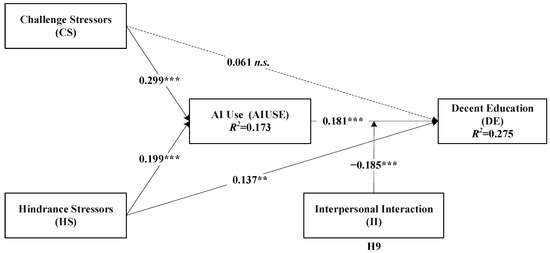
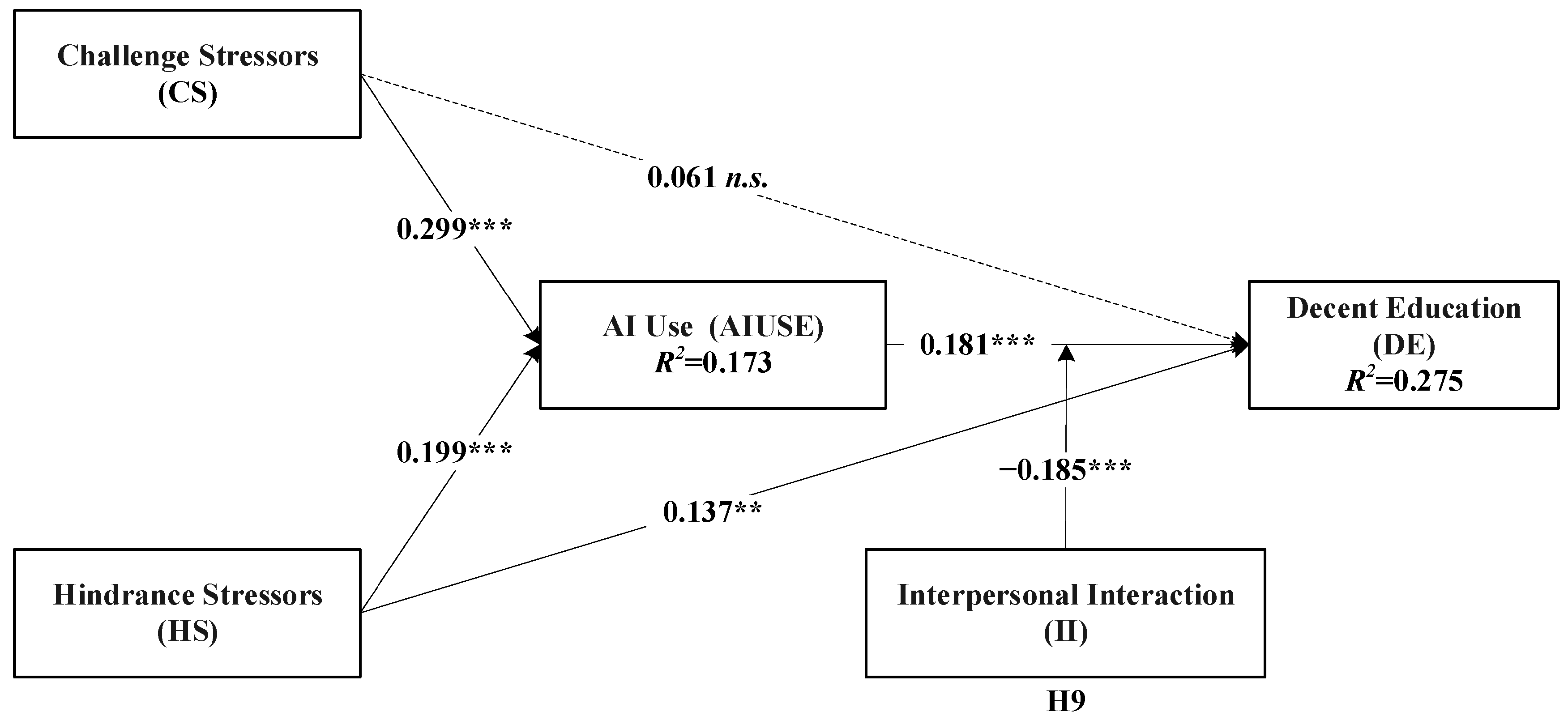
In terms of explanatory power, the two independent variables—CSs and HSs—jointly accounted for 17.0% of the variance in AIUSE, as reflected by an R2 value of 0.170. Moreover, the primary predictor variables, including the interaction term, accounted for 27.2% of the variance in DE (R2 = 0.272), reflecting moderate explanatory capacity for the model.
A summary of the hypothesis testing results is presented in Figure 2 and Table 3. Specifically, the analysis demonstrated that CSs exerted a significant positive effect on AIUSE (β = 0.299, t = 6.318, p < 0.001), thereby supporting Hypothesis 1. HSs exhibited a significant positive effect on AIUSE (β = 0.199, t = 4.176, p < 0.001), which does not support Hypothesis 2 and suggests that students experiencing HSs may also increase their use of AI tools. With respect to the direct effects on DE, CSs did not significantly predict DE (β = 0.061, t = 1.439, p = 0.150), so Hypothesis 3 was not supported. In contrast to the original hypothesis (H4), HSs exhibited a significant positive effect on DE (β = 0.137, t = 2.700, p < 0.01). AIUSE was positively associated with DE (β = 0.181, t = 4.329, p < 0.001), providing support for Hypothesis 5. Finally, the interaction between II and AIUSE had a significant negative effect on DE (β = −0.185, t = 4.784, p < 0.001), indicating that II moderates the relationship between AIUSE and perceptions of DE, in line with Hypothesis 8.
Figure 2.
Results of hypothesis testing in the structural model. ** and *** is the digital number that not show.
Table 3.
Structural model path coefficients and hypothesis testing results.
To further examine the robustness of the results, additional analyses were conducted by including gender and grade as control variables. The results indicate that the effect of gender on perceived decent education was not significant (β = −0.020, n.s.), and the effect of grade was also not significant (β = 0.025, n.s.). These findings suggest that the main relationships in the model remain stable after controlling for demographic factors.
These findings are visually depicted in Figure 2, which illustrates the structural relationships and the significance of each hypothesized path that presents a comprehensive overview of the path coefficients, t-values, p-values, and the extent of empirical support for each hypothesis (see Table 3).
Taken together, these results provide nuanced insights into the interplay between academic stressors, AIUSE, and II in shaping university students’ perceptions of DE. The unexpected positive effects of HS on both AIUSE and DE warrant further investigation and are discussed in detail in the subsequent section.
4.3. Mediation Effect Testing
To further elucidate the mechanisms underlying the relationships among CSs, HSs, AIUSE, and DE, mediation analyses were conducted using the bootstrapping method with 5000 resamples. This approach provides robust estimates of indirect effects and their confidence intervals, thereby allowing for rigorous hypothesis testing.
The outcomes of the mediation analysis are summarized in Table 4. The indirect effect of CSs on DE via AIUSE was statistically significant, with an estimated effect size of 0.054 and a 95% bias-corrected confidence interval of 0.028–0.090. As this interval does not include zero, the mediation effect is supported, providing empirical evidence for Hypothesis 6. This finding indicates that the positive influence of CSs on students’ perceptions of DE is, at least in part, explained by increased use of AI tools for learning support.
Table 4.
Mediation effect testing results.
Likewise, the indirect effect of HSs on DE through AIUSE was also significant, yielding an effect estimate of 0.036 and a 95% confidence interval of 0.015–0.066. However, it is important to note that this effect was positive, which is contrary to the original hypothesis (H7) that anticipated a negative indirect effect. This unexpected result suggests that, within this sample, HSs may also drive students to utilize AI as a compensatory coping strategy, thereby indirectly enhancing their perceptions of DE.
4.4. Moderation and Moderated Mediation Effects
To investigate the moderating influence of II on the relationship between AIUSE and perceptions of DE, as well as within the broader indirect pathways, both moderation and moderated mediation analyses were performed.
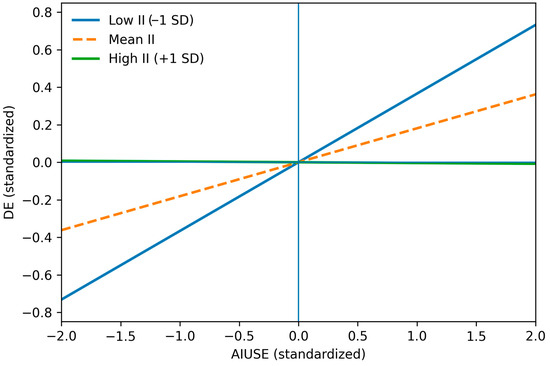
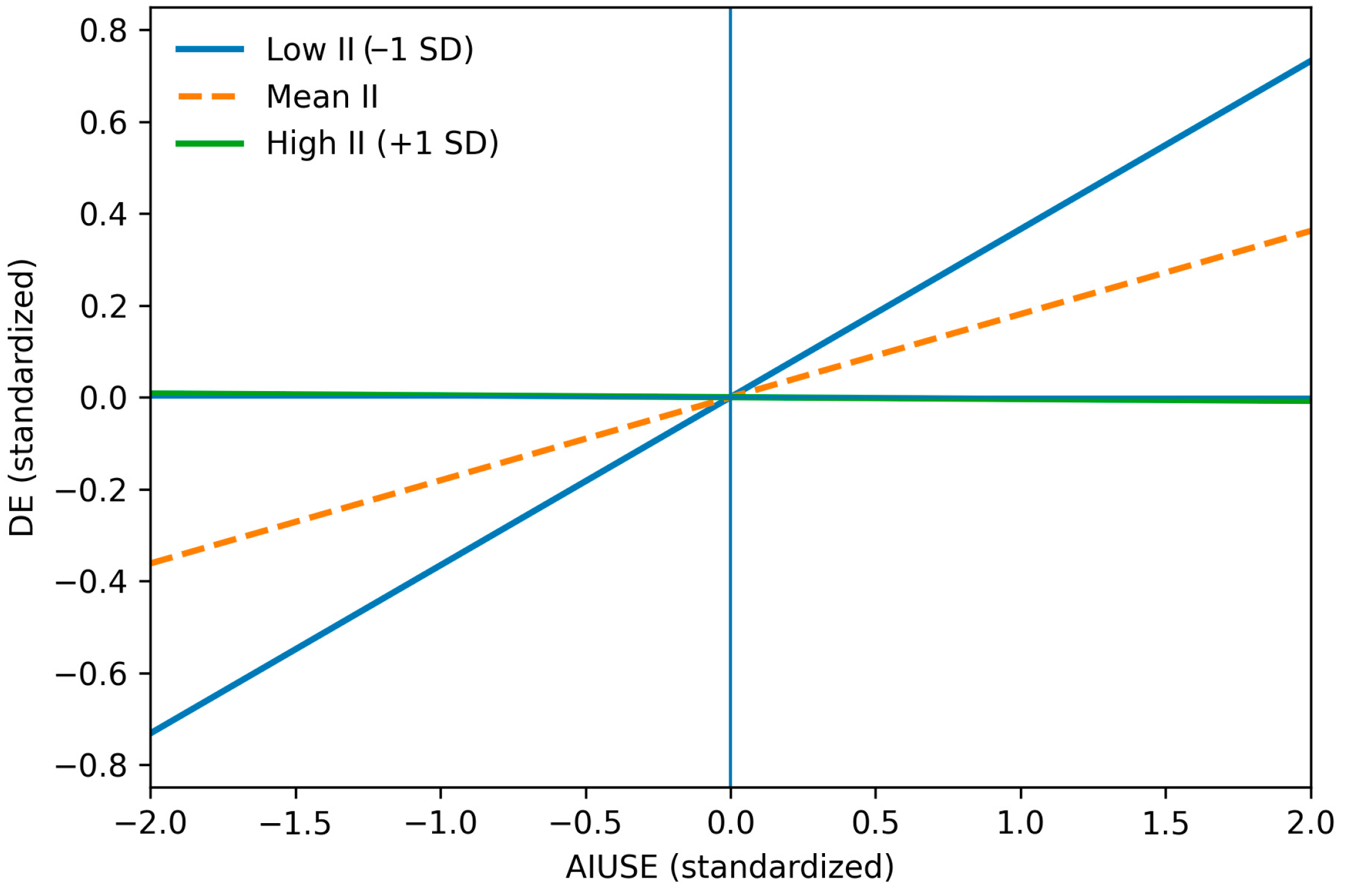
A simple slope analysis was conducted to examine the conditional effect of AIUSE on DE at varying levels of II. The results revealed a pronounced moderation effect: when II was low (one standard deviation below the mean), the positive association between AIUSE and DE was strong and statistically significant (simple slope = 0.110, p < 0.001). In contrast, when II was high (one standard deviation above the mean), the relationship between AIUSE and DE was negligible and non-significant (simple slope ≈ −0.001, p = 0.936). This pattern is visually depicted in Figure 3, which illustrates that the beneficial effect of AIUSE on students’ perceptions of DE is most salient among those who experience lower levels of II. Stated differently, AI functions as a particularly vital compensatory resource for students who have limited access to social support or collaborative opportunities.
Figure 3.
Moderation effect of interpersonal interaction (II) on the relationship between AIUSE (AIUSE) and decent education (DE).
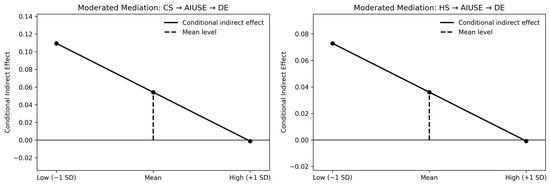
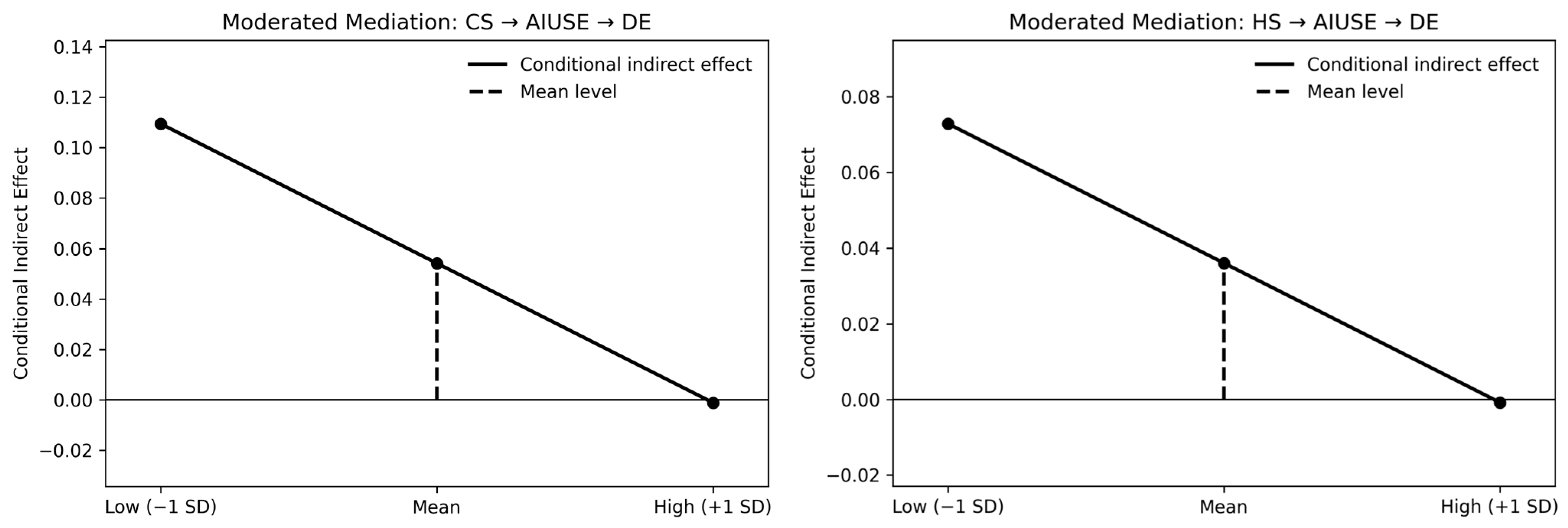
Building on these results, a moderated mediation analysis was undertaken to determine whether the indirect effects of CSs and HSs on DE via AIUSE were contingent upon the level of II (see Figure 4). The results confirmed that the indirect effects were significant only when II was low, thereby supporting Hypothesis 9. Specifically, the positive indirect effects of both CSs and HSs on DE through AIUSE were observed among students with lower levels of II, whereas these effects were not significant among those with higher levels of II. This suggests that the mediating role of AIUSE in translating academic stressors into positive educational perceptions is particularly pronounced for students who have limited access to interpersonal resources.
Figure 4.
Moderated mediation effect: The indirect effects of CSs and HSs on DE via AIUSE at different levels of II. Note: High II refers to II score = Mean + 1 SD, Low II refers to II score = Mean − 1 SD. The simple slope test demonstrates that the positive association between AIUSE and DE is significant only when II is low.
Taken together, these findings highlight the necessity of integrating both technological and social resources when examining how students manage academic stress and develop perceptions of educational quality. The nuanced interplay between AIUSE and II provides valuable insights for the design of supportive educational environments in the era of digital transformation.
5. Discussion
5.1. Key Findings
The study constructed and empirically validated a comprehensive framework to examine the impact of CSs and HSs on university students’ perceptions of DE, emphasizing the mediating function of AIUSE and the moderating influence of II (Appendix A, Appendix B and Appendix C). Drawing on data from 520 Chinese university students, several key findings emerged.
First, CSs significantly increased AIUSE. This finding is broadly consistent with the challenge-hindrance stressor framework and with problem-focused coping logic. When students interpret academic demands as effortful but meaningful, they appear more willing to mobilize available tools to manage workload, clarify content, and maintain progress. In this context, AIUSE can be understood as an active coping-related behavior rather than merely as a neutral technology practice.
Second, HSs also showed a significant positive association with AIUSE and, in the present sample, a positive direct association with DE, both of which run counter to the original negative expectation. Rather than indicating that hindrance stressors are beneficial, this pattern suggests that students in highly digitalized learning environments may respond to obstruction by seeking alternative support resources that are immediate, low-threshold, and continuously available. When course requirements are unclear, resources are insufficient, or institutional processes generate friction, AI tools may be used as a compensatory mechanism to restore functional control. However, these positive associations should be interpreted cautiously. They may reflect short-term adaptation rather than evidence that hindrance improves students’ educational conditions.
Third, CSs did not significantly predict DE directly, which suggests that challenge alone does not automatically produce more positive evaluations of educational quality. Students may experience demanding learning as worthwhile only when they also possess resources that help them convert effort into growth. The mediation results further indicate that the pathway from academic stress to educational evaluation is not purely direct; it is shaped by the coping behaviors students adopt. In this study, AIUSE played exactly such a role, positively linking both types of stressors to DE through technology-enabled support.
Fourth, the negative moderating effect of II indicates that the value of AIUSE is conditional on the surrounding social environment. When students have low levels of interpersonal support, AI appears to serve as a stronger compensatory resource. When interpersonal resources are already abundant, the marginal contribution of AI becomes smaller. This pattern suggests a partly substitutive relationship in the specific AIUSE-DE pathway while also reinforcing the broader importance of integrating technological and social resources when examining student well-being and educational experience.
Finally, the moderated mediation results show that the indirect effects of both CSs and HSs on DE through AIUSE were significant only when II was low. In other words, AI becomes especially consequential when students lack stronger interpersonal resources. This finding deepens understanding of how students balance technological and relational support when coping with academic pressure.
5.2. Theoretical Contributions
This study offers several significant theoretical advancements to the literature on academic stress, technology integration, and educational quality. First, it extends the challenge-hindrance stressor framework into the context of AI-supported higher education. Prior work has often examined academic stress in relation to engagement, burnout, or performance, whereas AI research in education has frequently focused on adoption, attitudes, or effectiveness. By integrating these strands, the present study shows that AIUSE can be conceptualized as a coping-related behavior through which students manage academic demands.
Second, the study deepens understanding of how hindrance stressors operate in highly digitalized learning environments. The dominant theoretical expectation is that hindrance reduces adaptive action. Our results do not invalidate that expectation, but they do suggest that additional mechanisms may emerge when students have access to readily available digital support. In such settings, hindrance may trigger compensatory help-seeking through AI rather than simple withdrawal. This contributes to a more nuanced view of stressor-coping relationships under contemporary educational conditions.
Third, the study contributes to the emerging literature on DE by linking stressor appraisal, AI-enabled coping, and educational evaluation within one moderated mediation model. In addition, the contextualized use of the Decent Education Scale in the present Chinese university sample broadens the empirical conversation on how educational fairness, support, belonging, and developmental opportunity are subjectively experienced under conditions of academic pressure.
Taken together, these contributions suggest that future theory on student experience should pay closer attention to the joint functioning of technological and interpersonal resources, rather than treating them as separate domains of educational life.
5.3. Practical Implications
The results of this study provide several practical recommendations for higher education leaders, instructors, and policymakers. For universities, the findings suggest that AI should be incorporated into student-support strategies in a structured rather than ad hoc way. Institutions should provide AI literacy training, clear guidance on acceptable educational uses, and access to vetted tools that support learning without encouraging misconduct. At the same time, universities should avoid a technology-only approach. Because the findings show that AI is especially consequential when II is low, AI provision should be paired with accessible tutorial support, peer mentoring, and opportunities for meaningful faculty-student contact.
For instructors, the results suggest the need for clearer course-level governance of AI. Teachers should explain when AI can be used for idea generation, clarification, or formative support and when students should rely on direct human feedback and independent reasoning. Classroom design also matters. Collaborative tasks, peer discussion, structured feedback, and regular consultation opportunities remain essential for preserving the interpersonal conditions that support belonging and educational trust.
For policymakers and institutional leaders, the key implication is that the governance of educational AI should be tied to student well-being and educational quality rather than framed only as a matter of control or prohibition. If AI becomes a compensatory channel for students facing ambiguity, weak support, or fragmented interaction, then policy should address not only tool access but also the structural conditions that create such compensatory dependence.
5.4. Limitations and Future Directions
This study has several limitations. First, the data are cross-sectional and self-reported, which restricts strong causal inference even though procedural and statistical remedies were used to reduce common method bias. Longitudinal and experimental designs would provide a stronger basis for identifying how stressors, AIUSE, II, and DE influence one another over time.
Second, the study was conducted in the context of Chinese higher education. Although this context is substantively important, the meanings of academic stress, educational fairness, and AI-assisted coping may differ across national and institutional settings.
Third, although the Decent Education Scale showed acceptable overall reliability in this study, it was originally developed in a Western context. While we adapted the scale for use in China, we did not conduct a full cross-cultural validation. Therefore, its dimensional structure should be interpreted with caution in the Chinese higher education context. Future research should further validate the scale across different cultural settings.
Fourth, some contextual variables such as school and discipline could not be included in the empirical analysis due to substantial missing values in the dataset. As a result, their potential moderating roles were not examined in this study. Given that learning environments, institutional resources, and the use of AI tools may differ significantly across schools and academic disciplines, future research should explicitly incorporate these variables to better understand how contextual factors shape the relationships identified in this study.
Finally, the positive associations involving HSs should be interpreted with caution, because they may reflect compensatory coping in technology-rich environments but may also indicate a reactive reliance on AI when formal support is insufficient.
6. Conclusions
This study examined how CSs and HSs shape university students’ perceptions of DE, focusing on the mediating role of AIUSE and the moderating role of II. The findings show that both types of stressors positively predict AIUSE, that AIUSE contributes positively to perceived DE, and that the positive role of AIUSE is substantially weaker when II is high. These results suggest that AI can function as a coping-related educational resource, especially for students who lack stronger interpersonal support. The study therefore contributes to the literature by integrating academic stress, AI-enabled coping, interpersonal support, and DE within a single framework. Practically, it suggests that universities should avoid framing AI as either a threat or a complete solution. The more promising path is thoughtful integration, in which AI helps students manage immediacy, clarification, and task burden while interpersonal interaction continues to support trust, belonging, and deeper pedagogical engagement. Future research should examine whether these patterns remain stable over time, whether they vary across disciplines and institutional environments, and whether different forms of AI support produce distinct effects on students’ evaluations of educational quality. Such work would help clarify when AI functions as a productive coping resource, when it reflects compensatory adaptation to weak support conditions, and how universities can balance technological integration with the preservation of meaningful human interaction.
Author Contributions
Conceptualization, Y.D. and Y.Z.; methodology, Y.D. and Y.Z.; software, Y.D.; validation, Y.D., Y.Z. and K.P.W.; formal analysis, Y.D.; investigation, Y.D. and K.P.W.; resources, Y.D., Y.Z. and J.Y.T.; writing—original draft preparation, Y.D.; writing—review and editing, Y.Z. and K.P.W.; visualization, Y.D.; supervision, Y.Z. and J.Y.T.; project administration, Y.Z. and J.Y.T.; funding acquisition, Y.Z. All authors have read and agreed to the published version of the manuscript.
Funding
This research was supported by the Philosophy and Social Sciences Research Project of Jiangsu Universities (2023SJYB1724), the Key Project of Jiangsu Education Science Planning (B-b/2024/01/65), and the Qing Lan Project of Jiangsu Universities (2023).
Institutional Review Board Statement
The study was conducted in accordance with the Declaration of Helsinki and approved by the Institutional Review Board (or Ethics Committee) of School of YonYou Digital and Intelligence, Nantong Institute of Technology (approval number: NTIT-YYDI-2025061002-b).
Informed Consent Statement
Informed consent was obtained from all subjects involved in the study.
Data Availability Statement
The raw data supporting the conclusions of this article will be made available by the authors on request.
Acknowledgments
The 520 anonymous college students who agreed to complete the questionnaire and the permission obtained from the Institutional Review Board (or Ethics Committee) used in this study are highly appreciated.
Conflicts of Interest
The authors declare no conflicts of interest.
Abbreviations
The following abbreviations are used in this manuscript:
| AI | Artificial Intelligence |
| AIUSE | Artificial Intelligence Use |
| AVE | Average Variance Extracted |
| CMB | Common Method Bias |
| CR | Composite Reliability |
| CSs | Challenge Stressors |
| DE | Decent Education |
| HSs | Hindrance Stressors |
| HTMT | Heterotrait-Monotrait Ratio |
| II | Interpersonal Interaction |
| PLS-SEM | Partial Least Squares Structural Equation Modeling |
| SRMR | Standardized Root Mean Square Residual |
| VIF | Variance Inflation Factor |
Appendix A. Measurement Items
- Interpersonal Interaction Scale (Morgeson & Humphrey, 2006)
- In my learning or related activities, I need to spend a great deal of time interacting with others.
- My learning or practical activities involve interacting with people from diverse backgrounds.
- During my learning or practical activities, I frequently need to communicate and collaborate with others.
- My learning or practical activities involve a high level of interpersonal interaction.
- Challenge Stressors Scale (Ferris et al., 2015)
- I have to complete a large amount of academic work.
- There is significant time pressure in my studies.
- I must work at a rapid pace to complete my academic tasks.
- My academic tasks are often highly complex.
- I frequently have to manage multiple courses or academic projects at the same time.
- Hindrance Stressors Scale (Ferris et al., 2015)
- There are many administrative or procedural hassles that interfere with my academic work.
- The requirements of some courses or academic tasks are unclear.
- Different instructors or courses place conflicting demands on me.
- I lack sufficient resources (e.g., time, materials, or support) to complete my academic tasks.
- I experience conflict with peers during group work or collaborative learning.
- Decent Education Scale (Levin et al., 2025)
- During my university years, I felt physically safe while traveling to campus.
- During my university years, I felt physically safe in class.
- During my university years, I felt physically safe in campus areas outside the classroom.
- During my university years, I was free from interpersonal harassment or harm.
- During my university years, I was free from verbal bullying.
- During my university years, I was not discriminated against based on my personal characteristics.
- During my university years, I had equal access to learning opportunities and resources.
- During my university years, I received support comparable to that received by other students.
- During my university years, I had access to academic or career development support comparable to that of my peers.
- During my university years, I maintained positive social connections with others.
- During my university years, I had people I could rely on.
- During my university years, I had a close circle of friends.
- During my university years, I perceived the quality of teaching to be high.
- During my university years, I learned valuable knowledge from my instructors.
- During my university years, the teaching provided by instructors was engaging.
- During my university years, the university offered diverse programs or courses to help prepare me for life after graduation.
- During my university years, the university provided sufficient opportunities to help me reflect on my future.
- During my university years, I was encouraged to seriously consider my future academic or career plans.
- AI Use Scale (Yam et al., 2022)
- In my current studies, I use artificial intelligence tools to support learning-related decision making.
- In my current studies, I use artificial intelligence tools to help solve academic problems.
- In my current studies, I use artificial intelligence tools to support learning and knowledge acquisition.
- In my current studies, I use artificial intelligence tools to assist with reasoning, analysis, and logical thinking.
Appendix B. Cross Loadings
| Items | HS | AIUSE | II | DE | CS |
| HS1 | 0.801 | 0.251 | 0.294 | 0.266 | 0.339 |
| HS2 | 0.740 | 0.242 | 0.254 | 0.298 | 0.262 |
| HS3 | 0.805 | 0.239 | 0.291 | 0.216 | 0.265 |
| HS4 | 0.811 | 0.239 | 0.252 | 0.269 | 0.272 |
| HS5 | 0.808 | 0.247 | 0.282 | 0.284 | 0.294 |
| AIUSE1 | 0.297 | 0.811 | 0.267 | 0.274 | 0.297 |
| AIUSE2 | 0.235 | 0.813 | 0.238 | 0.298 | 0.285 |
| AIUSE3 | 0.236 | 0.826 | 0.273 | 0.330 | 0.309 |
| AIUSE4 | 0.245 | 0.840 | 0.261 | 0.317 | 0.331 |
| II1 | 0.311 | 0.250 | 0.813 | 0.275 | 0.228 |
| II2 | 0.310 | 0.279 | 0.862 | 0.326 | 0.302 |
| II3 | 0.274 | 0.295 | 0.819 | 0.292 | 0.239 |
| II4 | 0.212 | 0.182 | 0.731 | 0.223 | 0.184 |
| DE1 | 0.250 | 0.295 | 0.230 | 0.735 | 0.224 |
| DE2 | 0.245 | 0.243 | 0.235 | 0.714 | 0.205 |
| DE3 | 0.272 | 0.315 | 0.279 | 0.730 | 0.233 |
| DE4 | 0.273 | 0.322 | 0.312 | 0.791 | 0.258 |
| DE5 | 0.303 | 0.289 | 0.292 | 0.783 | 0.271 |
| DE6 | 0.264 | 0.246 | 0.238 | 0.749 | 0.198 |
| DE7 | 0.271 | 0.306 | 0.245 | 0.785 | 0.230 |
| DE8 | 0.260 | 0.267 | 0.241 | 0.799 | 0.258 |
| DE9 | 0.263 | 0.297 | 0.257 | 0.723 | 0.209 |
| DE10 | 0.249 | 0.206 | 0.225 | 0.730 | 0.215 |
| DE11 | 0.293 | 0.282 | 0.318 | 0.765 | 0.207 |
| DE12 | 0.189 | 0.305 | 0.286 | 0.737 | 0.235 |
| DE13 | 0.223 | 0.280 | 0.216 | 0.689 | 0.254 |
| DE14 | 0.287 | 0.296 | 0.309 | 0.806 | 0.261 |
| DE15 | 0.207 | 0.234 | 0.236 | 0.727 | 0.225 |
| DE16 | 0.225 | 0.295 | 0.226 | 0.733 | 0.241 |
| DE17 | 0.224 | 0.255 | 0.267 | 0.744 | 0.205 |
| DE18 | 0.246 | 0.235 | 0.263 | 0.725 | 0.194 |
| CS1 | 0.285 | 0.284 | 0.222 | 0.256 | 0.798 |
| CS2 | 0.228 | 0.245 | 0.221 | 0.208 | 0.766 |
| CS3 | 0.318 | 0.364 | 0.275 | 0.279 | 0.830 |
| CS4 | 0.299 | 0.277 | 0.214 | 0.232 | 0.790 |
| CS5 | 0.299 | 0.289 | 0.253 | 0.237 | 0.794 |
Appendix C. Literature Review
| Authors | Theoretical Framework | Main Conclusions |
| Nikolic et al. (2024) | UTAUT | Academics see both benefits and risks in AI/GenAI use. Adoption depends largely on policy, training, and institutional support. |
| Li (2025) | TAM + TPACK | Teacher attitude is central to AI adoption. TPACK, contextual factors, and institutional support also matter. |
| Hazzan-Bishara et al. (2025) | Extended TAM | Credible AI information and institutional support increase teachers’ intention to adopt AI. |
| Kizilcec (2024) | TAM, Academic Resistance Model, trust/explainability perspectives | Effective AI use in education depends strongly on educators’ trust, perceptions, and understanding. |
| Shahzad et al. (2024) | Extended TAM with perceived intelligence and trust | Students’ ChatGPT adoption is driven by awareness, usefulness, ease of use, intelligence, and trust. |
| Shata and Hartley (2025) | TAM + Social Cognitive Theory | Perceived usefulness, trust, and social influence are key drivers of faculty GenAI adoption. |
| Lee and Park (2026) | Technology change and task-substitution perspective | This is not a core education-adoption study; it shows digital technology adoption may reduce wages for some workers. |
| Weinhandl et al. (2025) | Modified UTAUT | Teachers’ continuance intention is strengthened by performance expectancy, facilitating conditions, and compatibility, but weakened by anxiety. |
| Barra et al. (2024) | UTAUT | Digital skills and positive technology perceptions increase students’ technology adoption intention. |
| Daud (2025) | UTAUT-related adoption perspective in a technostress context | Technology adoption in hybrid learning can also increase technostress. |
References
- Acoba, E. F. (2024). Social support and mental health: The mediating role of perceived stress. Frontiers in Psychology, 15, 1330720. [Google Scholar] [CrossRef] [Scilit]
- Acosta-Gonzaga, E. (2023). The effects of self-esteem and academic engagement on university students’ performance. Behavioral Sciences, 13(4), 348. [Google Scholar] [CrossRef] [Scilit]
- Adamson, D., Dyke, G., Jang, H., & Rosé, C. P. (2014). Towards an agile approach to adapting dynamic collaboration support to student needs. International Journal of Artificial Intelligence in Education, 24(1), 92–124. [Google Scholar] [CrossRef] [Scilit]
- Adedoyin, O. B., & Soykan, E. (2020). COVID-19 pandemic and online learning: The challenges and opportunities. Interactive Learning Environments, 31(2), 863–875. [Google Scholar] [CrossRef] [Scilit]
- Akter, S., Fosso Wamba, S., & Dewan, S. (2017). Why PLS-SEM is suitable for complex modelling? An empirical illustration in big data analytics quality. Production Planning and Control, 28(11–12), 1011–1021. [Google Scholar] [CrossRef] [Scilit]
- Bao, D., Mydin, F., Surat, S., Lyu, Y., Pan, D., & Cheng, Y. (2024). Challenge-hindrance stressors and academic engagement among medical postgraduates in China: A moderated mediation model. Psychology Research and Behavior Management, 17, 1115–1128. [Google Scholar] [CrossRef] [Scilit]
- Barra, C., Grimaldi, M., Muazzam, A., Troisi, O., & Visvizi, A. (2024). Digital divide, gender gap, and entrepreneurial orientation: How to foster technology adoption among Pakistani higher education students? Socio-Economic Planning Sciences, 93, 101904. [Google Scholar] [CrossRef] [Scilit]
- Buizza, C., Dagani, J., & Ghilardi, A. (2026). Is the rise of artificial intelligence redefining Italian university students’ learning experiences? Perceptions, practices, and the future of education. Education Sciences, 16(16), 258. [Google Scholar] [CrossRef] [Scilit]
- Cheng, B., Lin, H., & Kong, Y. (2023). Challenge or hindrance? How and when organizational artificial intelligence adoption influences employee job crafting. Journal of Business Research, 164, 113987. [Google Scholar] [CrossRef] [Scilit]
- Crawford, J., Allen, K.-A., Pani, B., & Cowling, M. (2024). When artificial intelligence substitutes humans in higher education: The cost of loneliness, student success, and retention. Studies in Higher Education, 49(5), 883–897. [Google Scholar] [CrossRef] [Scilit]
- Daniel, K., Msambwa, M. M., Antony, F., & Wan, X. (2024). Motivate students for better academic achievement: A systematic review of blended innovative teaching and its impact on learning. Computer Applications in Engineering Education, 32(4), e22733. [Google Scholar] [CrossRef] [Scilit]
- Daud, N. M. (2025). From innovation to stress: Analyzing hybrid technology adoption and its role in technostress among students. International Journal of Educational Technology in Higher Education, 22, 31–51. [Google Scholar] [CrossRef] [Scilit]
- de Cordova, P. B., Reilly, L. L., Pogorzelska-Maziarz, M., Gerolamo, A. M., Grafova, I., Vasquez, A., & Johansen, M. L. (2024). A theoretical framework for acute care nurse stress appraisal: Application of the transactional model of stress and coping. Journal of Advanced Nursing, 80(9), 3835–3845. [Google Scholar] [CrossRef] [Scilit]
- Duffy, R. D., Blustein, D. L., Perez, G., & Smith, C. (2023). Psychology of working theory. In W. B. Walsh, L. Y. Flores, P. J. Hartung, & F. T. L. Leong (Eds.), Career psychology: Models, concepts, and counseling for meaningful employment (pp. 59–78). American Psychological Association. [Google Scholar]
- Duffy, R. D., Kim, H. J., Perez, G., Prieto, C. G., Torgal, C., & Kenny, M. E. (2022). Decent education as a precursor to decent work: An overview and construct conceptualization. Journal of Vocational Behavior, 138, 103771. [Google Scholar] [CrossRef] [Scilit]
- Essien, A., Bukoye, O. T., O’Dea, X., & Kremantzis, M. (2024). The influence of AI text generators on critical thinking skills in UK business schools. Studies in Higher Education, 49(5), 865–882. [Google Scholar] [CrossRef] [Scilit]
- Ferris, D. L., Yan, M., Lim, V. K. G., Chen, Y., & Fatimah, S. (2015). An approach–avoidance framework of workplace aggression. Academy of Management Journal, 59(5), 1777–1800. [Google Scholar] [CrossRef] [Scilit]
- Hair, J. F., Risher, J. J., Sarstedt, M., & Ringle, C. M. (2019). When to use and how to report the results of PLS-SEM. European Business Review, 31(1), 2–24. [Google Scholar] [CrossRef] [Scilit]
- Hazzan-Bishara, A., Kol, O., & Levy, S. (2025). The factors affecting teachers’ adoption of AI technologies: A unified model of external and internal determinants. Education and Information Technologies, 30, 15043–15069. [Google Scholar] [CrossRef] [Scilit]
- Hollebeek, L. D., Hammedi, W., & Sprott, D. E. (2023). Consumer engagement, stress, and conservation of resources theory: A review, conceptual development, and future research agenda. Psychology and Marketing, 40(5), 926–937. [Google Scholar] [CrossRef] [Scilit]
- Horan, K. A., Nakahara, W. H., DiStaso, M. J., & Jex, S. M. (2020). A review of the challenge-hindrance stress model: Recent advances, expanded paradigms, and recommendations for future research. Frontiers in Psychology, 11, 560346. [Google Scholar] [CrossRef] [Scilit]
- Kenny, M. E., Wu, X., Guterres, K. M. P., Gordon, P., Schmidtberger, R., Masters, A., Tanega, C., & Cunningham, S. (2023). Youth perspectives on decent education and college and career readiness. Journal of Career Assessment, 32(3), 598–618. [Google Scholar] [CrossRef] [Scilit]
- Kizilcec, R. F. (2024). To advance AI use in education, focus on understanding educators. International Journal of Artificial Intelligence in Education, 34, 12–19. [Google Scholar] [CrossRef] [Scilit]
- Kock, N. (2015). Common method bias in PLS-SEM: A full collinearity assessment approach. International Journal of e-Collaboration, 11(4), 1–10. [Google Scholar] [CrossRef] [Scilit]
- Kubicek, B., Uhlig, L., Hülsheger, U. R., Korunka, C., & Prem, R. (2022). Are all challenge stressors beneficial for learning? A meta-analytical assessment of differential effects of workload and cognitive demands. Work and Stress, 37(3), 269–298. [Google Scholar] [CrossRef] [Scilit]
- Labadze, L., Grigolia, M., & Machaidze, L. (2023). Role of AI chatbots in education: Systematic literature review. International Journal of Educational Technology in Higher Education, 20, 56, (Correction in 2024, International Journal of Educational Technology in Higher Education, 21(1), 28). [Google Scholar] [CrossRef] [Scilit]
- Lee, S., & Park, J. (2026). Impact of digital transformation technology adoption on worker wages. Research Policy, 55, 105399. [Google Scholar] [CrossRef] [Scilit]
- Lepine, J. A., Podsakoff, N. P., & Lepine, M. A. (2005). A meta-analytic test of the challenge stressor–hindrance stressor framework: An explanation for inconsistent relationships among stressors and performance. Academy of Management Journal, 48(5), 764–775. [Google Scholar] [CrossRef] [Scilit]
- Levin, N., Duffy, R. D., Cerantola, M., Greve, M. S., Masdonati, J., Massoudi, K., Park, J., Choi, Y., Kim, H. J., Bridges, B., Steranka, M., Hardin, E., & Gibbons, M. (2025). The development and validation of the decent education scale and the retrospective decent education scale. Journal of Counseling Psychology, 72(5), 446–462. [Google Scholar] [CrossRef] [Scilit] [PubMed]
- Li, M. (2025). Integrating artificial intelligence in primary mathematics education: Investigating internal and external influences on teacher adoption. International Journal of Science and Mathematics Education, 23, 1283–1308. [Google Scholar] [CrossRef] [Scilit]
- Liu, Y., Zeng, B., & Chang, L. (2025). Examining the links between sense of belonging, conflict resolution skills, emotional intelligence, and life satisfaction in Chinese universities. BMC Psychology, 13(1), 431. [Google Scholar] [CrossRef] [Scilit]
- Lyu, T., Geng, Q., Chen, H., Wang, H., & Wang, X. (2025). Understanding the antecedent factors of autonomous delivery vehicles usage intention: A moderating perspective of individual traits. International Journal of Logistics Research and Applications, 28(3), 1–25. [Google Scholar] [CrossRef] [Scilit]
- Morgeson, F. P., & Humphrey, S. E. (2006). The work design questionnaire (WDQ): Developing and validating a comprehensive measure for assessing job design and the nature of work. Journal of Applied Psychology, 91(6), 1321–1339. [Google Scholar] [CrossRef] [Scilit] [PubMed]
- Nielsen, J., Firth, B., & Crawford, E. (2023). For better and worse: How proactive personality alters the strain responses to challenge and hindrance stressors. Organization Science, 34(2), 589–612. [Google Scholar] [CrossRef] [Scilit]
- Nikolic, S., Wentworth, I., Sheridan, L., Moss, S., Duursma, E., Jones, R. A., Ros, M., & Middleton, R. (2024). A systematic literature review of attitudes, intentions and behaviours of teaching academics pertaining to AI and generative AI (GenAI) in higher education: An analysis of GenAI adoption using the UTAUT framework. Australasian Journal of Educational Technology, 40, 56–75. [Google Scholar] [CrossRef] [Scilit]
- Ouyang, F., Wu, M., Zheng, L., Zhang, L., & Jiao, P. (2023). Integration of artificial intelligence performance prediction and learning analytics to improve student learning in online engineering course. International Journal of Educational Technology in Higher Education, 20(1), 4. [Google Scholar] [CrossRef] [Scilit] [PubMed]
- Pindek, S., Meyer, K., Valvo, A., & Arvan, M. (2024). A dynamic view of the challenge-hindrance stressor framework: A meta-analysis of daily diary studies. Journal of Business and Psychology, 39(5), 1107–1125. [Google Scholar] [CrossRef] [Scilit]
- Podsakoff, N. P., Freiburger, K. J., Podsakoff, P. M., & Rosen, C. C. (2023). Laying the foundation for the challenge–hindrance stressor framework 2.0. Annual Review of Organizational Psychology and Organizational Behavior, 10(1), 165–199. [Google Scholar] [CrossRef] [Scilit]
- Qian, J., Chen, J., & Zhao, S. (2025). “Remaining vigilant” while “enjoying prosperity”: How artificial intelligence usage Impacts employees’ innovative behavior and proactive skill development. Behavioral Sciences, 15(4), 465. [Google Scholar] [CrossRef] [Scilit]
- Rohil, M. K., Mahajan, S., & Paul, T. (2024). An architecture to intertwine augmented reality and intelligent tutoring systems: Towards realizing technology-enabled enhanced learning. Education and Information Technologies, 30(3), 3279–3308. [Google Scholar] [CrossRef] [Scilit]
- Shahzad, M. F., Xu, S., & Javed, I. (2024). ChatGPT awareness, acceptance, and adoption in higher education: The role of trust as a cornerstone. International Journal of Educational Technology in Higher Education, 21, 46. [Google Scholar] [CrossRef] [Scilit]
- Shata, A., & Hartley, K. (2025). Artificial intelligence and communication technologies in Academia: Faculty perceptions and the adoption of generative AI. International Journal of Educational Technology in Higher Education, 22, 14. [Google Scholar] [CrossRef] [Scilit]
- Spaccarelli, S. (1994). Stress, appraisal, and coping in child sexual abuse: A theoretical and empirical review. Psychological Bulletin, 116(2), 340–362. [Google Scholar] [CrossRef]
- Stanisławski, K. (2019). The coping circumplex model: An integrative model of the structure of coping with stress. Frontiers in Psychology, 10, 694. [Google Scholar] [CrossRef] [Scilit]
- Vieriu, A. M., & Petrea, G. (2025). The impact of artificial intelligence (AI) on students’ academic development. Education Sciences, 15(3), 343. [Google Scholar] [CrossRef] [Scilit]
- Wei, J., Chan, S. H. J., & Gao, H. (2024). Influence of mobility constraints and educational experiences on future decent work access among Chinese emerging adults. Journal of Career Assessment, 33(1), 92–110. [Google Scholar] [CrossRef] [Scilit]
- Weinhandl, R., Helm, C., Anđić, B., & Grosse, C. S. (2025). Decoding digital integration: Exploring factors influencing mathematics teachers’ technology adoption. Education and Information Technologies, 30, 24505–24541. [Google Scholar] [CrossRef] [Scilit]
- Yam, K. C., Tang, P. M., Jackson, J. C., Su, R., & Gray, K. (2022). The rise of robots increases job insecurity and maladaptive workplace behaviors: Multimethod evidence. Journal of Applied Psychology, 108(5), 850–870. [Google Scholar] [CrossRef] [Scilit] [PubMed]
- Yang, M., Talha, M., Zhang, S., & Zhang, Y. (2025). Exploring the mechanisms linking digital leadership to employee creativity: A moderated mediation model. Behavioral Sciences, 15(8), 1024. [Google Scholar] [CrossRef] [Scilit]
- Zhang, J., Liang, W., Tang, Z., Li, X., & Hu, Q. (2025). The impact of gratitude on coping styles among Chinese college students: The mediating effects of perceived social support and self-esteem. Studia Psychologica, 67(2), 107–120. [Google Scholar] [CrossRef] [Scilit]

Disclaimer/Publisher’s Note: The statements, opinions and data contained in all publications are solely those of the individual author(s) and contributor(s) and not of MDPI and/or the editor(s). MDPI and/or the editor(s) disclaim responsibility for any injury to people or property resulting from any ideas, methods, instructions or products referred to in the content. |
© 2026 by the authors. Licensee MDPI, Basel, Switzerland. This article is an open access article distributed under the terms and conditions of the Creative Commons Attribution (CC BY) license.