


Abstract
The rapid proliferation of generative artificial intelligence (GenAI) tools has created an urgent need for instruments to evaluate their educational value as teachers, faculty, administrators, and instructional designers consider adopting them. While rubrics exist to assess mobile applications and virtual reality tools, no comparable instrument has been developed specifically for large language models (LLMs) and AI media generators. The authors reviewed existing evaluation rubrics for edtech and GenAI tools, with edtech meaning digital tools that support ethical teaching to improve student learning and GenAI referring to neural networks that simulate human interactions by contextualizing relevant content based on learning needs. Grounded in Waks’ framework, the resulting Edu-GenAI Rubric comprises multiple dimensions organized into five domains: the Instrumental, Technical, Hedonic, Use, and Beneficial values. Dimensions include accuracy, productivity, personalization, citation, user interface, user experience, sharing, storage, and ethical dimensions encompassing data privacy, data transparency, guardrails, fair use, and algorithmic discrimination. The Edu-GenAI Rubric offers decision-makers with a preliminary, theory-informed instrument for evaluating GenAI tools in educational contexts that can be applied to institutional adoption decisions, developer benchmarking, and future research.
1. Introduction
To deliver impactful learning experiences with any technology, thoughtful, critical tool selection is required. As new instructional technologies such as mobile applications (apps) and virtual reality (VR) have emerged, researchers have developed rubrics to assess these tools based on how well they support teaching and learning (Fegely & Cherner, 2021; C. Lee & Cherner, 2015). With the meteoric rise of generative artificial intelligence (GenAI) tools (Turck, 2024), a similar rubric is needed to rigorously scrutinize these tools before they are used in education (Sheehan, 2023).
With GenAI tools (Maturure & Mukhalela, 2026), educators must resist the temptation to evaluate them solely on what these tools might do wrong. When thoughtfully selected and integrated, these tools hold tremendous promise for education (Prather et al., 2025). They can serve as personalized tutors (Leon, 2024), tailor content delivery to individual learners (Karpouzis et al., 2024), and support the creation of multimodal learning experiences (Baidoo-Anu & Ansah, 2023). As GenAI’s adoption in compulsory education will likely expand (Toner, 2024), there is a critical need to evaluate the appropriateness of their functionalities for educational purposes, as well as how they handle data from students and educators.
This article presents a theory-informed rubric designed to guide decision-makers—teachers, faculty, administrators, and instructional designers—in assessing the educational value of GenAI tools. The authors designed this rubric specifically for evaluating large language models (LLMs) and AI media generators—GenAI tools that produce images, videos, presentations, audio, and 3D elements—because those tools are most frequently used in educational contexts (UK Department for Education, 2023; UNESCO, 2023). To fully explain the rubric’s development and application, the authors proceed in five steps. First, they contextualize and review current efforts to evaluate GenAI tools for education. Second, they explain Waks’ (2016) theory of educational value and how it serves as their rubric’s conceptual framework. Third, they outline the development and procedures used to sustain the rubric. Fourth, they detail the rubrics’ dimensions. They conclude by outlining procedures for implementing the rubric along with explaining educational use cases for applying it.
1.1. Context
The Organization for Economic Co-operation and Development (OECD, 2023) explains that “GenAI can turn classrooms into spaces where learning is more dynamic, flexible, collaborative and individualized… it could help accelerate what many see as a much-needed transformation of traditional education systems” (p. 3). The OECD further discusses the opportunities and challenges that GenAI presents for education, with a main recommendation to include teachers in the design of GenAI tools and to support teachers in using them. However, Alier et al. (2024) wisely contend that while the promises of GenAI are exciting, adopting these tools for teaching and learning “necessitates relentless study, design, experimentation, and evaluation” (p. 11), and researchers are responding.
Regarding its benefits, Law (2024) reviewed 41 studies on GenAI and language learning, mostly conducted in university settings. Law (2024) found that GenAI effectively personalized learning experiences and provided students with tailored feedback, thereby increasing their motivation and engagement. To support the development of personalized learning experiences, Dickey and Bejarano (2024) presented a detailed instructional design framework that leverages GenAI to produce learning experiences and scale them for students. The value of this work is its emphasis on teachers using these tools, not merely reacting to them, representing a shift in how teachers may approach GenAI. By using the tools, teachers integrate them into their instruction. When responding to them, teachers create barriers to prevent the tools from being used. In another example, Ali et al. (2023) developed a chatbot that supports student self-directed learning and assessment. With the chatbot, students engaged in autonomous learning and assessment activities, infused with constructivist-based prompts to increase their motivation. These uses of GenAI collectively improved the students’ learning outcomes, which demonstrates how instructors can be pioneers and innovators by experimenting with GenAI for educational purposes. However, even with these promising results, there is significant concern about the hype surrounding them.
1.2. The Hype and Concerns About GenAI
Researchers across disciplines have cautioned against the hype surrounding GenAI. Dežman (2024) explained that “The problem of AI hype in contemporary media is ultimately a problem of the circulation and amplification of a certain socio-technical imaginary through a digital ecosystem of human and nonhuman actors” (p. 9). From Dežman’s (2024) perspective, news organizations have emphasized a vision of a GenAI future that can be both startling and fascinating and yet hyperbolic. For example, legal scholars have asked, “Will the introduction of GenAI turn lawyers into ‘prompt engineers’? Will it entirely eliminate the need for human lawyers, at least for certain repetitive legal tasks and work product? Or are we living through yet another ‘Big Tech’ hype cycle?” (Karr & Schultz, 2024, p. 1868). This concern about replacing lawyers carries over to education. For example, Latham (2025) proposed an AI university and described its impacts on students, faculty, and financials. However, researchers have expressed concerns with this type of university, noting that GenAI is not capable of making context-specific decisions (Holmes, 2023), that the technology is too underdeveloped for such a task (P. T. Tran & Nguyen, 2025), and that GenAI lacks the soft skills (e.g., socio-emotional competencies, mentorship) required for effective teaching (C. K. Y. Chan & Lee, 2023). Overall, researchers also recommend positioning GenAI as a supplement for teaching, not as a replacement for teachers (Searson et al., 2024).
1.3. Attempting to Contextualize the Number of GenAI Tools and Their Quality
Despite these concerns, GenAI’s potential to advance teaching and learning, along with favorable financial forecasts (e.g., HolonIQ, 2023), has led to an explosion in GenAI tools (Kumar & Sharma, 2025). While a specific number of GenAI tools for education is challenging to pinpoint because of their rapid development and the ways that they are made available (e.g., through a website portal, as a GPT loaded into a store, a tool to be downloaded), searching for them online or prompting an LLM for a list quickly demonstrates the vast quantity of GenAI tools that have already been developed and are available. In fact, Turck’s (2024) infographic “Machine Learning, Artificial Intelligence, & Data Landscape” provides an impressive visual of the current GenAI tools. Moreover, with bloggers and companies writing lists of the “best” GenAI tools (e.g., Eklavvya, n.d.; Tyagi, 2024), educators face further challenges in discerning and evaluating the quality of these tools. For example, when using a database to search for and read about GenAI tools, such as the ChatGPT Store (2024), users often receive generic five-star ratings. Figure 1 shows an example of that scale for Universal Primer, a GPT designed to explain complex topics and claims, helping users quickly learn anything.
Figure 1.
The Universal Primer listing and ratings from the ChatGPT Store.
In this example, Universal Primer earned an average of 4.6 out of 5 stars, with the distribution of ratings shown. While the specific distribution of ratings is available, it does not include exact counts of 5, 4, 3, 2, and 1 ratings, nor does it provide the rationale behind them. This lack of information poses a significant challenge when determining the benefits and risks of using that tool in educational contexts. For example, while most ratings are 5 or 4 stars, there are more 1-star ratings than 3- or 2-star ratings, leaving questions about the number of 1-star ratings unanswered.
Prior tools designed to evaluate edtech (Ritzhaupt et al., 2020) products have criticized 5-star rating scales as generic, such as those for educational applications for mobile devices (C. Lee & Cherner, 2015) and virtual reality applications designed for educational purposes (Fegely & Cherner, 2021). In these instances, such as in the Universal Primer GPT example, the ratings provide only a quantitative snapshot and do not provide qualitative information, making it challenging to discern the rationale for the quantitative ratings. Evaluative criteria specific to each technology type are needed to assess the educational value of different technologies. While C. Lee and Cherner (2015) used criteria to assess applications for mobile devices (e.g., smartphones and tablets), and Fegely and Cherner (2021) identified criteria for evaluating virtual reality applications, researchers have not developed a detailed instrument of this kind for GenAI tools geared toward education. This article presents a rubric designed to help decision-makers assess the educational value of GenAI tools, specifically LLMs and AI media generators.
1.4. Approaches for Evaluating GenAI Tools for Educational Purposes
Before designing the rubric, the authors searched for prior rubrics focused on GenAI. Using Google Scholar, the Electronic Registration Information Center, and a large university’s library database, the authors entered keyword combinations including generative artificial intelligence, rubric, evaluate, and education. After an extensive search, the authors did not find any instruments designed to assess GenAI tools for teaching and learning. They did, however, find ample guidance for creating rubrics using GenAI (H. C. Chan, 2023; Fernández-Sánchez et al., 2025) and the ways that GenAI can use premade rubrics to grade student work (Escalante et al., 2023; Chiu, 2024).
Next, the authors prompted Consensus AI (www.consensus.app/search, accessed on 10 January 2025), a GenAI application designed for scholars to input questions. Consensus AI answers questions by summarizing research articles related to them. In this case, the authors asked: How have researchers created instruments or rubrics to evaluate the potential educational value of generative AI for teaching and learning? In response, Consensus AI reported several articles, but none included a rubric to evaluate GenAI in general or for educational purposes. Examples included Petrovska et al.’s (2024) evaluation of how ChatGPT used a variety of assessment types to determine its ability to code, make ethical decisions, and debate the use of GenAI in the workplace and schools. Thanh et al. (2023) developed a framework to evaluate the ability of popular LLMs (e.g., Google Bard, ChatGPT 3.5 and 4, and Microsoft Bing) to solve complex problems. They found that the LLMs were better suited to solve mathematical problems than other GenAI tools, and that they were better at recalling information than at creating it. In sum, the articles were evaluations of the performance and output of GenAI tools, and not the tool itself.
To continue, the authors used the Google Search Engine (www.google.com) and repeated the search using the same prompt they input for their first search. This time, they did locate tools to evaluate the educational potential of GenAI. Most notably, Curts (2024) self-published the “Rubric for Evaluating AI Tools in Education” (https://bit.ly/curts-airubric, accessed on 17 February 2025). The rubric includes 18 dimensions, including Alignment to Curriculum, Content Filtering, and Integration. Figure 2 shows a representative dimension that includes a heading, two questions for evaluators to consider, a space for notes, and a box to record the final score.
Figure 2.
Engagement section from Curts’ “Rubric for Evaluating AI Tools in Education”.
The rubric repeats this format for all 18 elements. The authors’ concerns for this rubric include its formatting and lack of guidance for determining a final score. Regarding its formatting, though it is called a rubric, it lacks descriptors aligned with the heading. Without those descriptors, users of the rubric do not know the criteria that GenAI tools must meet when evaluated by it. Then, when converting their assessment of a GenAI tool into a final score, Curts (2024) provides open-ended guidance, stating that teams of users “are given the flexibility to determine their scoring scale (e.g., 1–5, 1–10, or qualitative descriptors like Excellent, Good, Fair, Poor). It is important to define this scale clearly before beginning the evaluation to ensure consistency and objectivity across all criteria” (para. 4). While Curts (2024) offers flexibility and emphasizes the need for consistency, he does not provide any validity testing guidance, which limits his rubric’s ability to ensure reliable, consistent scoring.
Outside of Curts’ rubric, the authors did not locate additional ones. Instead, they found more resources for creating rubrics using GenAI (e.g., Codone, 2024; Janz, 2024) and strategies for redesigning assessments due to GenAI (Bearman et al., 2023; University of Michigan, n.d.). While research is emerging about using GenAI for educational purposes, the lack of instruments designed to evaluate the actual value of GenAI tools for educational purposes is a severe gap. This study addresses it, and the next section describes how the authors developed such a tool.
2. Rubric Development Process
2.1. Theoretical Framework for Identifying the Educational Value of Technologies
Researchers have assessed the educational value of technologies from multiple angles, identifying that these technologies can support content mastery (Ranchod et al., 2014), foster essential technical skills (Rodrigues et al., 2021), and cultivate curiosity, creativity, and critical thinking through promoting learning experiences (Asad et al., 2021). To align these approaches, Waks (2016) offers a structured framework grounded in Dewey’s progressive educational philosophy (Pavlis & Gkiosos, 2017). Waks argues that value in education must be assessed by (1) what technological tools accomplish and (2) how they contribute to learners’ development over time. Waks identifies five distinct types of educational value, which offer a strong foundation for assessing the promise and limitations of technological tools in education:
- Instrumental value asks whether a tool reliably supports learners in completing educational tasks;
- Technical value examines whether a tool helps learners improve their intellectual and practical skills;
- Hedonic value focuses on the pleasure and engagement learners derive from the tool;
- Use value assesses whether a tool has the capacity to support learners in accomplishing their academic goals;
- Beneficial value identifies how a tool contributes to a learner’s emotional resilience, sense of purpose, and overall well-being.
Waks originally applied this value framework to assess the educational benefits of Massive Open-Online Courses (MOOCs), asking not only whether they functioned effectively (instrumental value), but if they supported skill development (technical value), learner engagement (hedonic value), goal-directed application (use value), and ultimately, the learner’s sense of purpose and satisfaction (beneficial value). Waks foregrounds education as a vehicle for sustained personal and social growth rather than as a content-delivery mechanism. The authors extend Waks’ framework to evaluate LLMs and AI media generators. Waks’ five types of educational value comprise the Edu-GenAI Rubric’s conceptual backbone and guided the authors’ selection and organization of its dimensions, which reflect how GenAI tools can meaningfully support learning. Table 1 aligns each value type with an illustrative example of how it can be applied to a GenAI tool.
Table 1.
Examples of applying Waks’ values to GenAI tools.
By grounding Wak’s value types in concrete examples, the authors clarify what these values look like when applied to GenAI tools in educational settings. The authors then searched existing research to operationalize the terms and organize them into dimensions for the Edu-GenAI Rubric. The authors organized Appendix A to align the rubric’s values and dimensions with the findings from the next three subsections.
2.2. Procedures for Identifying and Operationalizing Rubric Dimensions
2.2.1. Search and Selection Procedures for Conceptualizing the Edu-GenAI Rubric
Anchored in Waks’ (2016) framework, the authors used an iterative process to identify, screen, and operationalize the dimensions of the Edu-GenAI Rubric. For the Instrumental, Technical, Hedonic, and Use values, the authors systematically searched scholarly article databases to ground their work. For the Beneficial value, the authors used a specific set of existing materials. The authors will next explain their procedures for locating and using resources for Waks’ first four values, followed by his final one.
For the first phase, the authors used Google Scholar, ERIC, and a large university’s library database to locate articles about Waks’ first four values, with searches conducted from January 2025 through to March 2025. For their search, the authors iteratively combined targeted keyword combinations to identify relevant literature (Aliyu, 2017). The authors used the keyword strings in Table 2 for their search.
Table 2.
Search strings used to locate literature for the Edu-GenAI Rubric.
Several scholarly works were reported for each search, approximately 50–100 per value. Next, the authors winnowed the works in a second phase by excluding those published without peer review (e.g., preprints, presentation slides, white papers). They did include proceedings from international conferences that focused on the design and functionality of GenAI tools, such as the Association for Computing Machinery (ACM) and the Institute of Electrical and Electronics Engineers (IEEE), which reduced about 20% of the articles across each value.
In the third phase, the authors reviewed the works’ titles and abstracts to ensure that they were focused on the design and functionality of LLMs and AI media generators. While examples of GenAI tools for game-based learning (e.g., Huang & Chen, 2025), grading (e.g., Li et al., 2025), and translation (e.g., Maci, 2025) were considered, the articles had to discuss a design element or functionality that the authors could connect back to a value from Waks’ framework to be included. For that check, the authors reviewed each article’s introduction, implications, and discussion sections to seek these insights. In all, 5–10 articles were identified for each value, which the authors collaboratively classified into categories based on the insights they identified from the articles, as shown in Appendix A. These categories grew to become the rubric’s dimensions. Next, the authors addressed the Beneficial value.
2.2.2. Identifying Beneficial Dimensions
The authors used inductive strategies to identify and operationalize the rubric’s Beneficial dimensions. This choice was deliberate because non-governmental organizations and researchers have published foundational principles that continue to inform the ethical treatment of GenAI. Table 3 lists examples of these publications.
Table 3.
Theoretical base for safety dimensions using deductive reasoning.
Collectively, this set of documents is foundational to the ethical use of GenAI. The authors reviewed the range of topics in these documents and classified them into categories that would serve as dimensions in their rubric. The table in Appendix A shows the alignment between the documents, Beneficial value, and the rubric’s dimensions.
2.2.3. Review of Existing Rubrics
Multiple rubrics created to assess edtech provided a third data source to inform the Edu-GenAI Rubric’s dimensions. The authors conducted a review of these rubrics to determine their areas of focus and align those with their rubric. For example, in Curts’ (2024) rubric for evaluating AI, he named dimensions such as Content Accuracy, assessing the accuracy of a GenAI tool’s output; Bias and Fairness, identifying safeguards and reporting mechanisms to quell the spread of inappropriate content; and Data Privacy, ensuring that data are handled with care and compliance with policies. In Lee and Cherner’s rubric for evaluating mobile applications for tablets, they identified functionalities that applications needed to have to be useful in educational contexts, such as Cooperative Learning, allowing users to share learning artifacts, communicate information, and collaborate on projects; Ease of Use, ensuring that the application’s interface is intuitive, and Navigation, providing users with quality experiences when engaging with the application. The authors included the dimensions from these rubrics in Appendix A and used them to inform the design of their Edu-GenAI Rubric.
With a safety threshold established, the authors analyzed the educational value of GenAI tools based on their performance. To focus their assessment, the authors operationalized performance to mean the characteristics, features, and functionalities of LLMs and Media AI generators that users can leverage for educational purposes. Because no instrument has been developed to evaluate the educational value of these tools, the authors used inductive reasoning (Hayes et al., 2010) to create these dimensions. To that end, the authors used several GenAI tools and focused on how instructors and students could use them for educational purposes.
2.3. Sampling of LLMs and AI Media Generators
Overall, the authors sampled over 70 tools that they selected by reviewing “top lists” of LLMs and AI media generators for education published to attract practitioners such as Miller (2025), Patel (2025), and Tarver (2024). The authors were deliberate in choosing these tools because they wanted their selection to be reasonably in line with how educators at all levels may select GenAI tools. To be systematic in their selection process, the authors used a multi-pronged approach.
First, they used “top LLMs and AI generators for education” to query the Google Search Engine (www.google.com) and Perplexity AI. They chose Google because it is the most frequently used search engine (StatCounter, 2026), and Perplexity AI because it is an established LLM that provides links to the sources from which it drew information, allowing the authors to click the links and access the primary sources. To be included, the LLMs and AI media generators had to (a) clearly be an LLM or AI media generator, and (b) provide free access to the tool’s essential components (meaning that users can generate materials from the tool at no cost). From these queries, the authors recorded more than 70 GenAI tools that met their criteria. Currently, resources that track analytics regarding the most frequently used GenAI tools do not exist. Therefore, the authors triangulated three data points to help ensure that the tools they recorded existed and were likely used by teachers (Kern, 2018), with the intent of providing authentic examples for the rubric.
For the second stage, the authors used the Google search engine to locate the recommended “best” and “top” GenAI tools for education. While blogs are not peer-reviewed publications, they are written to be optimized for search engines to report them when individuals are seeking specific information (Kaiwade & Bhamangol, 2019). In this case, the individuals are intended to be teachers, faculty, and other educational stakeholders searching for GenAI tools. For this first check, the authors identified blogs that highlighted the GenAI tool. The authors did not include social media posts or articles written by a developer or owner of a tool. Appendix B provides an example blog for each tool.
Next, the authors used SimilarWeb’s (www.similarweb.com/) website traffic checker to gauge the monthly traffic to a GenAI tool’s website. Because these GenAI tools exist as mobile applications, websites, and browser extensions, there is no single resource that tracks analytics about the number of users by tool. However, because all the GenAI tools on the author’s original list included a website, they recorded the amount of monthly traffic for each tool’s website, as reported in Appendix B.
Finally, the authors searched databases that allow individuals to locate GenAI tools by functionality (e.g., image generation, productivity, writing). The authors were purposeful to include a swath of databases, as the originators of these databases include universities, non-profits, academics, companies, and more. Moreover, the content of the entries for GenAI tools varies widely, with some providing little information, others copying content from the tool’s website to additional ones crowdsourcing information, and a few offering original content. These databases allow individuals to search for tools by name and most offer a menu to select tools by function. The authors did not include Google Play or the App Store in this category because they wanted databases that do not make the GenAI tools available for download but provide information. Appendix B includes one database per tool.
Using these three data sources—practitioner-facing recommendation blogs, website traffic estimates, and independent AI/EdTech databases—the authors constructed a purposive, practice-oriented sample of GenAI tools. This triangulation helps to increase confidence that the tools included in Appendix B are visible in practice, actively used, and independently recognized, thereby offering authentic examples for applying the Edu-GenAI Rubric.
2.3.1. Testing GenAI Tools
The authors tested each tool to ensure that it met the inclusion parameters. While the quality of the tools varied, each author tested the tool’s functionality and reviewed the documentation against the rubric’s emerging dimensions. The authors then identified the top 2–3 tools for each dimension and coded them based on the rubric’s emerging dimensions. In their review, the authors grouped the tools into two categories:
- GenAI Designed for Education: This category includes tools specifically developed for educational use by instructors and students. The tools’ websites often use endorsements, examples, and testimonials from educators and influencers to market them. For example, Magic School (www.magicschool.ai) positions itself as “AI for teachers” and offers over 60 “magic” tools (www.magicschool.ai/magic-tools, accessed on 17 February 2025) designed for teachers, such as generating lesson plans, emailing families in multiple languages, and creating questions from YouTube videos. While students may benefit from their teachers using Magic School, the tool’s intended end users are teachers. In another example, Tutor Ocean (www.tutorocean.com/ai) markets itself as a “personal learning companion” for students and offers features such as on-demand tutoring on any topic, writing support, and test preparation. Its end users are students, and it provides them with a customized dashboard for tracking their progress. Although their end users differ, both Magic School and Tutor Ocean are GenAI tools designed for educational purposes.
- GenAI Leveraged for Education: This category includes tools that can be used for various purposes, such as business planning, data analysis and visualization, and text translation, as well as education. Examples include LLMs like ChatGPT (www.chatgpt.com), Gemini (gemini.google.com/app) (www.gemini.google.com), and Perplexity AI (www.perplexity.ai), along with AI media generators such as Adobe FireFly (www.adobe.com/products/firefly.html, accessed on 17 February 2025), Meshy AI (www.meshy.ai), and Open Art (www.openart.ai). In educational contexts, instructors can use these tools to outline lessons and lectures, draft assignments and rubrics, and brainstorm learning activities. Students may use them to summarize long text-based passages, create graphics for presentations and reports, and obtain feedback on assignments before submitting them. While they can be used for a range of purposes, they have educational benefits.
When sampling them, the authors drew on their background knowledge of edtech and the learning sciences, beliefs about teaching and learning with technology, and experience in public schools and universities to explain how these tools could benefit teachers and students. Unlike mobile applications and other technologies designed for education that teach a skill in isolation, provide information about a set of parameters, or offer opportunities to create learning artifacts (Cherner et al., 2014), the robustness of LLMs and AI media generators allows a single, GenAI-powered tool to be deployed for multiple purposes. As the authors continued experimenting, they recognized that strategically prompting the tools increases their value. Whereas novice users may prompt a tool to answer a question, write a text, or create an image, advanced users with deeper knowledge of GenAI can input more sophisticated prompts that result in the tool completing complex tasks, such as creating personalized learning experiences based on students’ prior performances, differentiating instruction to accommodate students’ learning needs, and providing rich feedback to students. These tasks showcase the potential educational value of GenAI tools. After testing the tools and discussing them, the authors collaboratively selected one tool for each dimension they identified as an exemplar.
2.3.2. Design of Pre-Existing Rubrics
With only one pre-existing rubric identified, the authors drew on previous instruments designed to evaluate educational technology (edtech) products. These rubrics are from industry and professional organizations, including LearnPlatform’s “Research-based Rubric for Grading EdTech” (Instructure, 2025), which uses eight dimensions to evaluate edtech products, with each dimension including descriptors to assess it on a 5-point scale. In another example, World Education (n.d.) published its “Online Tool/Resource Evaluation Rubric”, which includes nine dimensions for assessing an edtech product. The rubric does not include descriptors for any of its dimensions. Instead, it assesses the edtech based on how frequently “evident” a characteristic of a dimension is identified in the product. Like Curts’ (2024) rubric, World Education’s rubric relies on subjective measures to make these evidentiary evaluations because of its lack of dimension descriptors. Anstey and Watson (2018) published the “Rubric for eLearning Tool Evaluation”, designed to assess edtech used in higher education. The rubric is very detailed, with 27 dimensions organized into classifications. Each dimension is aligned with three descriptors, ranging from the edtech working well to serious concerns.
Next, the authors searched for rubrics designed to evaluate edtech published in academic journals. C. Lee and Cherner (2015) developed a detailed rubric to evaluate the quality of educational mobile applications. Their rubric includes 24 dimensions organized into three classifications. Five descriptors guide the evaluation of each dimension, and they provide examples to help evaluators use the rubric. Scholars have recognized their rubric for its comprehensiveness (Papadakis et al., 2017), and it was the first in a series of rubrics. Cherner et al. (2016) published a follow-up rubric to evaluate “teacher resource” applications that supported educators in tasks such as lesson planning, attendance, and classroom management. Their rubric was similar in form and style to C. Lee and Cherner’s (2015) original rubric, but shifted its focus from students being the end users of the applications to teachers. Next, Fegely and Cherner (2021) published an addendum to C. Lee and Cherner’s (2015) rubric for evaluating virtual reality applications, which included 14 dimensions grouped into four categories.
Finally, as open education resources (OERs) rose in popularity during the late 2000s and early 2010s, researchers developed multiple rubrics to assess their quality. In 2015, Yuan and Recker (2015) conducted a systematic review of 14 rubrics designed to evaluate OERs. They found that the rubrics focused on different aspects, such as an OER’s pedagogical value, alignment to standards, and reusability. Yuan and Recker noted that the rubrics were often divided into indicators or dimensions used to evaluate the OERs’ overall quality. Finally, the descriptors used to evaluate each category varied: some rubrics lacked descriptors, others offered a binary choice (e.g., yes/no), and others used a multi-point rating scale.
From this review, the authors identified a variety of rubrics and their designs. As they were creating a rubric that more closely replicated C. Lee and Cherner’s (2015) original rubric, they decided to structure it similarly.
2.3.3. Reducing Overlap
The Edu-GenAI Rubric extends C. Lee and Cherner’s (2015) original rubric for assessing the educational value of mobile applications designed for teaching and learning, rather than replicating it. In it, C. Lee and Cherner (2015) grouped their dimensions into three categories:
- Instruction. The rigor, assessment, and personalization of the learning experience provided by the application.
- Design. The application’s functionality, including whether users can save their progress, intuitively navigate its interface, and access information.
- Engagement. The methods the application uses to motivate users through the learning experience, such as allowing the customization of settings, adjusting the pace of information, and aligning content with their interests.
With GenAI, users can prompt these tools in ways that result in the instructional benefits, design considerations, and engagement strategies that C. Lee and Cherner (2015) identified as essential for mobile applications. For example, whereas an application may focus on providing historical information about a specific event, instructors and students can prompt LLMs and media AI generators to create content about it. Therefore, the authors focused on the characteristics needed for GenAI to be an effective tool for teaching and learning, rather than on areas that have already been addressed. In this way, the authors intentionally developed dimensions unique to LLMs and media AI generators, ultimately reducing overlap with prior, more general rubrics.
3. Results
This section discusses the Edu-GenAI Rubric’s dimensions, designed to assess the educational value of LLMs and AI media generators. The full rubric is in Appendix C, including all of its dimensions and descriptors. The following discussion is organized according to the rubric’s dimensions, based on Waks’ five domains (Table 1). In it, the authors describe each dimension by first grounding it in research, and then offering an example of a GenAI tool aligned to it.
To clarify the types of evidence needed to make determinations based on the rubric, the authors distinguish three sources:
- Generated content. Users test the tool by repeatedly prompting it and evaluating whether patterns related to the dimension’s focus appear in the generated content.
- Tool features and functionalities. Users analyze how the tool completes tasks beyond generating content, such as saving, exporting, sharing, organizing, or otherwise managing the outputs it produces.
- Public documentation. Users review authentic materials provided by the developer and/or vendor (e.g., help pages, feature descriptions, privacy policies, terms of use) for the tool, not external to them, to identify specific language that supports their judgments based on the dimension.
- Contextualized examples. Users draw on brief, task-specific scenarios that illustrate how a dimension can appear in a specific setting or practice.
To support users in identifying the type of evidence needed to evaluate the tool, the authors included a “Look For” sentence at the end of each dimension’s description before the example to guide them in selecting and applying the appropriate evidence source.
3.1. Domain A: Instrumental Value
Instrumental value refers to a tool’s reliability and effectiveness in carrying out core educational functions, including producing accurate, dependable outputs and improving users’ efficiency when completing academic tasks. Tools that score highly in this domain help users work efficiently, resulting in usable content with minimal friction or correction.
3.1.1. Accuracy
The “Accuracy” dimension focuses on the degree to which the tool provides correct, verifiable, and reliable information. Users of GenAI tools have repeatedly expressed concerns with the technology’s tendency to hallucinate information. Though definitions vary, the term hallucinates commonly means that the content generated by the tool is inconsistent with previously established knowledge bases, theories, and other information about the topic (Buholayka et al., 2023; Fan et al., 2023). Depending on the tool, these hallucinations will appear in different ways. For example, when using an LLM to provide information, a hallucination will occur if it gives the wrong dates about a historical event, incorrectly solves a math problem, or provides entirely false information (Judijanto et al., 2025). When using AI media generators that convert text-based prompts into visual representations, hallucinations may occur if the tool misinterprets keywords, leading to images that are poorly aligned with the prompt and are distorted. In addition, acknowledging that hallucinations occur, GenAI tools should provide guidance to users by proactively taking actions they can use to identify these hallucinations and minimize them. While GenAI is an emerging technology and developers continue improve the quality of the content that these tools produce, the tools must still produce accurate content.
Look For—Generated Content. Users should analyze the tool-generated content to ensure its accuracy when evaluating it.
Example Tool for Accuracy. Magic School AI is a comprehensive tool designed to support educators in completing tasks such as generating worksheets, assessments, report card comments, emails, rubrics, and lessons. While no GenAI tool can ensure 100% accuracy at this point, Magic School AI promotes best practices to ensure the accuracy of its content. For example, Magic School AI addresses these concerns by acknowledging that hallucinations are part of its tool. “AI can occasionally produce biased, fictitious, or otherwise incorrect content” (Magic School AI, 2024, para. 9). In response, it emphasizes an 80–20 approach, with the tool doing 80% of the work by generating the content. Teachers then do 20% of the work by reviewing the content and ensuring its accuracy (Magic School AI, 2024). In the authors’ testing, Magic School AI produced mostly accurate content for typical K–12 planning tasks; its 80–20 guidance was therefore treated as a complement to, not a substitute for, output accuracy, and the authors did not treat documentation as sufficient evidence for accuracy. Overall, Magic School AI expresses confidence in its tool’s functionalities and involves educators in vetting the content it generates. Given both the observed quality of its content and its explicit approach for addressing hallucinations, Magic School AI scores exemplarily in the Accuracy dimension.
3.1.2. Productivity
The “Productivity” dimension evaluates whether the GenAI tool saves users time while producing higher-quality output when completing a task compared to users completing the task themselves or being assisted by search engines, websites, and other Web 2.0 tools. For example, researchers have found that GenAI tools can reduce the time required to create and compile resources (C. K. Y. Chan & Lee, 2023), analyze qualitative and quantitative data (Platt & Platt, 2023), and produce multimedia content (Casteleiro-Pitrez, 2024). However, even with these benefits, the outputs created by GenAI tools must be of an acceptable quality for users to derive value. Completing a task quickly but poorly will cost users more time, require more effort, and lessen their overall efficiency. For a GenAI tool to be valuable, it must reduce the time users spend producing acceptable content and achieving high-quality results. If users continually prompt the tool to create content needed for a task, but it takes them longer to prompt the tool to create the content than to create the content themselves without the tool, the tool’s value decreases. However, the tool’s value increases if it saves users time and produces satisfactory content.
Look For—Contextualized Example. Users should test how the tool can save them time and increase productivity when completing a task to make this evaluation.
Example Tool for Productivity. Tools that have specific purposes score well on this dimension. Quillbot is a GenAI tool designed to support users’ writing. When launching the tool, users can choose a functionality, including paraphrasing text, checking grammar, detecting AI-generated writing, summarizing text, generating citations, translating text from one language to another, and writing text. As users engage with its features, Quillbot provides additional capabilities. For example, when using the “Quillbot Flow” feature to write text, users can click the “research” option to locate further information about a topic, the “source” option to cite an argument made in the writing, the “notes” option to record their thoughts about a topic they are addressing, the “AI review” option for feedback about their writing, and the “plagiarism checker” to identify any mis-attributed information. Because Quillbot integrates these functions within its writing tool, users become more efficient than when using multiple external tools. As users can maximize their time when writing with Quillbot to achieve their desired results and improve their overall writing productivity, it scores well on this dimension.
3.1.3. Pedagogical Implications for Instrumental Value
LLMs and AI media generators must provide reliable information if instructors and students use them for teaching and learning. Hallucinated or inaccurate information and images lead to the dissemination of disinformation that students must “unlearn” before they are ready to acquire new knowledge. Regardless of whether the information is text, images, audio, or another media form, persistent inaccuracies will hinder productivity for instructors and students, who must constantly verify the outputs of these tools. Therefore, tools with high accuracy rates increase productivity, making them reliable tools.
3.2. Domain B: Technical Value
Technical value focuses on how effectively a GenAI tool supports the development of users’ intellectual and practical competencies. In educational settings, this value includes helping learners build writing, problem-solving, and analysis skills through scaffolded, responsive feedback. Tools that demonstrate strong technical value function as a “more knowledgeable other” (M. Tran et al., 2025), helping to enhance the learners’ capacity to complete tasks independently over time.
3.2.1. Personalization
The “Personalization” dimension assesses the degree to which GenAI tools can learn from users to customize their experience when using the tool, and LLMs are particularly apt in this area. Z. Chen et al. (2023) explain that advances in natural language processing and information retrieval have enabled LLMs to provide and communicate personalized outputs by identifying and recalling specific details about users, their preferences, and their contexts. These tools learn about their users over time based on those elements. However, as part of that process, users must be able to input the necessary data (Borah et al., 2024) or prompts (Karpouzis et al., 2024) for LLMs to provide a customized experience, and this process is not immediate. The educational benefit is that LLMs can personalize learning based on students’ preferences and prior knowledge, thereby increasing engagement, motivation, and learning (Hornbæk & Hertzum, 2017; Kadaruddin, 2023). As LLMs become more integrated into teaching and learning practices, a significant promise for education is the personalization of student learning experiences.
Look For—Generated Content. After engaging with the GenAI tool, users should prompt it to determine whether the prior conversation affects the current exchange by directing it to respond based on the prior thread(s).
Example Tool for Personalization. Tools that access users’ prior interactions and use them to create personalized learning score well in this area. For example, ChatGPT, a well-known LLM, encapsulates these qualities. By storing and drawing on previous conversations and interactions, ChatGPT learns from its users and provides more personalized responses to prompts as it gathers information about them. Moreover, when users input data into ChatGPT via a well-crafted prompt, it can provide personalized information specific to the user and prompt. In educational settings, students can create and train their own generative pre-trained transformer (i.e., chatbot) using ChatGPT, so it provides examples based on their interests, scaffolds materials to their zone of proximal development, assesses their learning, identifies areas for remediation and tutoring, and much more. There are potentially enormous educational benefits for ChatGPT and other LLMs that share these capacities, but these LLMs need to be trained by individual users over time to achieve the best results. Because it can customize experiences for users based on their prior interactions, ChatGPT excels in this dimension.
3.2.2. Citation
The “Citation” dimension addresses the “black box” metaphor that is often used to describe the process GenAI uses to create content. In an interview with Samir Rawashdeh (Blouin, 2023), an Associate Professor of Electrical and Computer Engineering who specializes in machine learning, about the black box, Rawashdeh explained that AI systems “are now regularly used to make judgements about humans in contexts ranging from medical treatments, to who should get approved for a loan, to which applicants should get a job interview. In each of these areas, it has been demonstrated that AI systems can reflect unwanted biases from our human world” (para. 4). While users may never be able to see the interactions between the neurons that result in the generation of content and decision-making processes, GenAI tools can cite the sources they used as the basis for their responses. By including citations, the content produced by GenAI can be traced to its sources, allowing users to make critical, informed choices regarding its quality, whether the source itself contains biases, and its overall accuracy. Citations also build trust in the results (Ding et al., 2025). In educational settings, providing citations and linking to sources helps students develop the habit of mind needed to verify information, rather than passively accepting it. Making these decisions supports the development of critical thinking skills, an intellectual competency. GenAI tools score well in this dimension if they include the sources they use to respond to prompts and make those sources accessible.
Look For—Generated Content. After prompting the tool, users should check the response for clickable links, icons, and previews that lead back to the response’s primary source(s).
Example Tool for Citation. Perplexity AI is an AI-powered search engine released in 2022. Like other LLMs, users enter a text prompt, and the tool generates a response. A significant difference, however, is that Perplexity AI was one of the first tools to provide a direct link to the sources it used as the basis for its response. With the link, users can access the information’s primary source and use it to help determine the quality and accuracy of its response. In addition, Perplexity AI includes thumbnails that link to the sources and display the title, text, and images for users to preview. If users suspect inaccuracies, they can use the links to evaluate the quality of sources that the tool used to inform its response. Because Perplexity provides thumbnail previews of the sources it used in its response, along with links to them, it scores well in this dimension.
3.2.3. Pedagogical Implications for Technical Value
The promise of personalization is a key driver for the adoption of GenAI tools in education. LLMs are particularly attractive for personalized learning because users can train them based on their preferences, background knowledge, and interests. Moreover, they can break complex concepts into chunks, making them more manageable for students. Instructors also benefit because they can differentiate instruction based on students’ needs. Citations are essential because they enable instructors and students to access the sources used by LLMs and AI media generators to produce content and make decisions, thereby promoting transparency and accountability in those processes. When working together, these elements strengthen the tool’s academic integrity and overall technical value.
3.3. Domain C: Hedonic Value
Hedonic value refers to the enjoyment, satisfaction, and engagement that users experience when interacting with GenAI tools. In educational contexts, this value fosters curiosity, sustains attention, and increases motivation, all of which are critical to meaningful learning and tool adoption (Almassaad et al., 2024). A tool with high hedonic value functions well and is enjoyable to use, while low-scoring tools may lead to a low adoption rate.
3.3.1. User Interface
The “User Interface” (UI) dimension focuses on the design of a GenAI tool. Sridevi (2014) explains UI using a window metaphor. If the window is dirty, smudged, or unclean, it is hard to see through it. However, when a window is pristine, free of streaks or smears, it allows users a direct, unobstructed view. With GenAI tools, UI is similar. Unlike windows, which are passive panes of glass, GenAI tools are active digital surfaces consisting of buttons, symbols, graphics, and other digital elements (Sindiramutty et al., 2025), more like stained glass in a cathedral. Based on those elements, a GenAI tool’s UI is evaluated by how easily users can intuitively understand the meaning, design, and appearance of those elements (Stone et al., 2005). If users struggle to understand the design, it reduces the likelihood that they will adopt the tool or use it effectively, requiring more support when using it (Holden & Karsh, 2010). Conversely, if the UI is intuitive, it provides a user-friendly experience, likely improving the users’ overall efficiency when interacting with the tool (Dakulagi et al., 2025). This dimension specifically examines the tool’s design and layout.
Look For—Tool Features and Functionalities. Users should explain how the location, aesthetics, and/or design of icons and features helped them understand and use the tool.
Example Tool for User Interface. Gamma is an AI media generator that enables users to create multimedia content, including presentations, webpages, documents, and social media posts. Once logged in, Gamma presents users with a dashboard that has three clearly labeled options:
- Build their content using Gamma’s GenAI,
- Create their own without using GenAI, or
- Import existing texts and decide whether to refine them using GenAI.
If users click the first option, Gamma launches a new screen with three distinct options, each with its own icon. In brief, the “Paste in text” option allows users to copy any text (e.g., bulleted list, outline, paragraphs), the “Generate” option lets users write a short phrase, and the “Import” option lets users upload a file (e.g., doc, PDF, slides). After choosing an option, Gamma provides users with an outline and additional design options: themes, text length, image directions, and AI model type. After making their selections, Gamma builds the desired content. Before finalizing the generated content, users can customize the font, styles, wording, and more with the tools on the right side of the screen. They can also preview all of the content by scrolling through the thumbnails on the left side. Overall, Gamma maintains a polished, branded look throughout its screens, creating a sense of flow. Gamma’s color scheme is highly accessible, making it easy for users to focus on the information. Moreover, Gamma integrates other options throughout its interface, all clearly labeled, with many options featuring images and icons, which helps increase its intuitive appeal. Finally, the menus, features, and buttons are logically placed, making them easy to locate. For these reasons, Gamma scores high on this dimension.
3.3.2. User Experience
The “User Experience” (UX) dimension assesses the users’ actual interaction with the tool, focusing on whether they can generate the content they wish with it. Ingrained within that outcome are additional considerations including efficiency, completing tasks in short amounts of time (Pan, 2024); satisfaction, being pleased with the outcomes (Kim et al., 2025); trust, knowing that the tool will complete the actions at an adequate level (R. Wang et al., 2024); and engagement, enjoying interacting with the tool (Kim et al., 2025). When these elements are enacted within the context of a tool, it ideally supports users in accomplishing their goals more smoothly (Spallazzo et al., 2025). When these elements are not aligned, users will have a poor experience that can deter them from adopting it (Hornbæk & Hertzum, 2017). This dimension determines whether those elements are present in the tool and if they support users’ engagement with it.
Look For—Contextualized Example. Users should explain how the tool increased their ability to complete realistic, discipline-specific tasks while feeling that the workflow was smooth, reliable, and enjoyable.
Example Tool for User Experience. Poe is an LLM that includes a chatbot and gateway to additional GenAI tools. After registering, the main front-end interface appears, displaying a dialog box. To support users, the “Start a new chat” option appears in the dialog box, prompting them to click it and enter their prompt. They can also click the “+” icon to add an attachment to their prompt.
Below the main dialogue box are several categories of GenAI tools, and each category displays the icons for multiple GenAI tools aligned with it. For example, the “Search Bots” category lists tools for quickly locating information about any topic, often including the source citation. The “Text Analysis Bots” category includes tools that correct grammar, summarize long texts, and add details to previously posted text. To access these tools, users click the Poe tool icon, and the other tool will open within the Poe tool, without users needing to exit the tool.
Poe also includes a menu on the left side of the screen that saves users’ chats. This functionality allows users to search for specific bots, view their profiles, send feedback, download the Poe mobile app, and access paid features (e.g., creators and subscription options).
In all, Poe embeds many tools within its own interface. These tools are grouped into classifications to help users select the tools needed to complete a task. This design then supports users in selecting the tools needed for specific tasks, resulting in higher task completion rates and a high-quality user experience based on this dimension’s criteria.
3.3.3. Pedagogical Implications for Hedonic Value
For GenAI tools to be adopted by instructors and students, they must be enjoyable to use. That enjoyment begins with the tool’s interface and extends to how instructors and students engage with it to complete tasks. The pedagogical implications align with that enjoyment. If teachers and students do not enjoy the tool, it becomes a nuisance, detracts from the learning experience, impairs pedagogy, and ultimately decreases its educational value. However, when instructors and students are delighted with a tool’s design and the experience it offers, it can boost their motivation to create and complete learning experiences, thereby increasing the tool’s overall educational value.
3.4. Domain D: Use Value
Use value captures the extent to which a GenAI tool helps learners accomplish meaningful, goal-directed tasks within an educational setting. This domain emphasizes what a tool can generate and how easily users can integrate it into their workflows. A tool with strong use value supports collaboration, iteration, and sustained project work across time, and this domain uses two dimensions to make this determination.
3.4.1. Sharing
The “Sharing” dimension evaluates how a tool allows multiple users to access the same generated content. This access includes a range of possibilities, such as providing users with links to content, posting content directly onto other platforms (e.g., social media sites), providing embed codes to upload content to a website, or downloading content to a personal device. In addition, this dimension considers limitations regarding the number of people with whom the tool allows the content to be shared. In reviewing the literature about GenAI, the ability to share seldom appears. However, Wright (2024) emphasized that users should understand that intellectual property concerns can arise when sharing GenAI-generated content. From a practical standpoint, sharing is a quintessential feature for GenAI to be used effectively for educational purposes. For example, if instructors use GenAI to create educational materials (e.g., documents, presentations, images), they must ensure that students have access to those materials. In another example, if students are working on a project together, and one of them is prompting an LLM for information about their project, there is a benefit in that student being able to share that chat with the other students in the group, so that they can all use the information to advance their work. In this way, the practicality of sharing content is an understated yet essential function of GenAI when used for educational purposes.
Look For—Tool Features and Functionalities. Users should examine how the tool enables them to grant other users access to the content they generated with it.
Example Tool for Sharing. Google Gemini is an LLM that can function as a learning resource for students. The tool allows students to ask questions using its chat feature. When Gemini responds, it includes a share icon that when clicked, provides the share options shown in Figure 3.
Figure 3.
Example link for sharing content generated by Gemini.
Users can then click “Share conversation” to access a direct link to the content or post it to a social media site. In addition, because Gemini is a Google product, users who log in and have a Google account can click “Export to Docs” to add the content to a Google Doc in their Google Drive or click “Draft in Gmail” to have Gemini write the results as an email. Users can also manually copy and paste the content. Gemini’s simple interface makes it easy for users to share generated content, which scores well in this dimension.
3.4.2. Storage
The “Storage” dimension focuses on the length of time a tool keeps the past interactions that users have had with it. For LLMs, these interactions are the conversations. For AI media generators, the interactions include the images, presentations, and other media that the tool has generated. Important to this dimension is that GenAI tools typically run on cloud and data-center infrastructure that combines accelerator hardware with large-scale storage systems to process data requests and generate content, which uses drives connected to the processing units and servers to store the generated content (M. Liu et al., 2023; Zhang et al., 2021). Companies then incur a cost to maintain the data on a server and manage where and how long that data are stored, leading providers to actively optimize their storage capacity and retention for controlling cost (M. Liu et al., 2023). Therefore, there is a cost incentive to reduce the amount of content stored on a server and the length of time it is stored. Because this rubric evaluates GenAI’s educational value and benefits from the perspectives of instructors and students, the authors highlight storage costs. Tools that store generated content for users and keep it for longer at no cost likely have greater value than those with shorter storage capacities or that cost more.
Look For—Tool Features and Functionalities—Public Documentation. Users should review information provided by the tool’s developers or vendors regarding the amount of content and the length of time they can store images, text, and other media generated with the tool.
Example Tool for Storage. Tools that store users’ previously generated content are rated highest in this category. Meshy AI, a tool that generates 3D assets from images and text, permanently saves the assets it generates (Anita, personal communication, 21 May 2024). In addition, Meshy AI allows users to title their generated content and delete, copy, or refine it at any time. Tools with advanced storage capacity offer students opportunities to reflect on their learning over time and self-assess their growth. These tools also allow students to work on a project for a sustained period of time, letting them iterate, experiment, and revise. Though storage does have a cost, providing it to students has educational benefits. Because Meshy AI has unlimited storage at no cost, it scores well in this dimension.
3.4.3. Pedagogical Implications for Use Value
Community and collaboration are essential for teaching and learning. LLMs and AI media generators must actively support this interconnectedness if they are to be used for educational purposes. To actualize collaboration, teachers and students must be able to share generated resources using links, embed codes, and quick response codes. This sharing facilitates professional learning communities, project-based learning assignments, group work, and more. If teachers and students cannot share generated content, the tool’s overall usability declines because it hinders their ability to collaboratively analyze, critique, and evaluate resources. As teachers and students engage in these activities, robust storage capabilities are necessary to ensure that the resources remain accessible for extended periods. Limitations in content storage or access further inhibit collaboration by restricting the ability of teachers and students to revisit and use generated materials. The functionalities of sharing and storage are critical enablers for realizing the diverse learning opportunities that generative AI-powered tools provide within a learning community.
3.5. Domain E: Beneficial Value
Beneficial value focuses on the ethics and societal outcomes a tool offers. A tool with low ethics can harm the learner, school, and society, while one with high ethics can improve and support them. The ethics are grounded in the tool’s development and deployment (Cherner et al., 2024). This domain also includes direct and indirect benefits to learners grounded in ethics. Direct benefits include fostering confidence, independence, and critical thinking, and indirect benefits include protecting students’ data and promoting equitable access. Because of this domain’s complex, high-stakes nature, it comprises five dimensions that collectively assess whether a GenAI tool enhances users’ learning experiences.
3.5.1. Data Privacy
The “Data Privacy” dimension focuses on how a GenAI tool handles users’ data. This dimension is critical in educational contexts because users of GenAI tools will include students. Shukla et al. (2022) explain data privacy as a set of ethical standards that guide how data are collected, processed, shared, archived, and deleted. Rajasegar et al. (2024) highlight that stakeholders must consider legal, technical, and organizational elements related to data privacy when selecting tools. Sood et al. (2023) explain data privacy as “ensuring that sensitive information, such as personal identification or financial data, is protected from unauthorized access and that it cannot be tampered with” (p. 97). In all, data privacy is a responsibility that developers must uphold when designing and deploying GenAI tools to ensure their users’ safety.
To handle data safely, the tool must inform users of the types of data it collects when they register. Furthermore, that information should be presented in a comprehensible manner so that users can understand it; data privacy policies should not be written in dense legalese. When storing data, protection against breaches and identity theft is essential. Traceable data should also be anonymized to help ensure user safety. Finally, privacy policies should explain that developers will not sell their users’ data or, if they do, outline to whom and under what circumstances a sale will be made.
Look For—Public Documentation. Users should inspect the tool’s privacy policies for information regarding what data are collected, how it is stored and protected, how long it is retained, and whether it is shared or used for model training.
Example Tool for Data Privacy. Notion AI is designed to support users in organizing their thoughts, brainstorming ideas, providing overall writing support, and allowing for collaboration. Within the platform is an “Ask AI” option that lets users prompt the tool, like an LLM, to ask questions. Regarding data privacy, Notion AI (2025a) states: “The Notion AI Writing Suite will not use your data to train our models. Any information used to power Notion AI will be shared with our partners for the sole purpose of providing you with the Notion AI features. We do not allow any partners or 3rd parties to use your data for training their models or any other purpose” (para. 11). According to these policies, Notion AI only uses the data from its users to improve the tool. They will not use the data to train their tool or provide it to other external models. Notion AI (2025b) also has a “Security & Privacy” page (www.notion.so/security, accessed on 17 February 2025) that further addresses issues related to its infrastructure, operations, and product. The Privacy section explains how Notion AI handles user data, agreements to ensure compliance with data protection legislation, governance for how data are secured when they are first procured and eventually deleted, policies aimed at providing transparency in its data handling processes, and alignment with the General Data Protection Regulation required by the European Union. All these policies are written in plain language, allowing users to read and understand them more easily without having to decipher specialized legalese that can be used to hide disagreeable clauses. For these reasons, Notion AI scores high on this dimension.
3.5.2. Data Transparency
The “Transparency” dimension examines developers’ disclosure regarding how they handle the data their tools collect from users. Walmsley (2021) explains that developers “should be open about the values and motivations that drive them” (p. 590). From selling data to the highest bidder to storing it securely and confidentially, developers have a range of options for handling data. Moreover, while the “Privacy” dimension determines the appropriateness of that sharing, this dimension focuses on whether and to what extent developers publicly communicate what they do with that data (Huang et al., 2024). In this context, Hacker et al. (2023) refer to the Italian Data Protection Authority’s decision to ban ChatGPT (Altomani, 2023), as they found that OpenAI, the company that developed ChatGPT, was not accurately informing its users about how their data were being used and processed. Disclosing this information in an accessible manner empowers users to make critical choices about tool adoption based on its data handling, the content they input, and the generated content. Ideally, developers should post this information on their tool’s main website, so that users can easily locate it when searching the tool’s support documentation. In addition, these policies should also be written in plain, everyday language, not dense legalese, to make them more accessible, further reducing the chances that the language hides clauses that users may find disagreeable. Without accessible information about the location of the terms and how they are written, users are disadvantaged and uninformed when engaging with the tool.
Look For—Public Documentation—Contextualized Example. Users should locate and review the tool’s privacy policies and describe how easy the policies are to find and whether the policy language is written in clear, accessible terms or relies heavily on technical/legal jargon.
Example Tool for Transparency. Tools that exemplify this dimension offer clear access to their data privacy terms, both in locating and comprehending them. For example, Tutor Ocean functions as a learning resource for students. It allows users to ask questions and will recommend either a human tutor or its AI tutor to further their learning. If they choose the AI tutor option, users can ask questions with its chat feature, take quizzes, generate lessons about topics, and receive feedback and support for their writing. The AI tutor also provides a link to its Privacy Policy at the bottom of its main pages. In lay terms, the website provides information about how it handles customers’ data, with rationales explaining what data it collects, who it shares the data with, and how Tutor Ocean complies with required data-handling procedures. The shortcoming is that once users log in to Tutor Ocean, the tool’s Privacy Policy link is no longer available. Therefore, the authors rate Tutor Ocean as a 4 in this category.
3.5.3. Guardrails
The “Guardrails” dimension focuses on the tool’s ability to spread misinformation and the precautions or safety mechanisms it has in place to address that ability. While researchers (Ferrara, 2024; Flanagan, 2024) and governments (e.g., Dawson et al., 2019) have expressed concerns about the potential misuses of this technology (e.g., protecting user data, vulnerability to cyberattacks, use of natural resources), there is shared concern about tools generating misinformation that users spread within their own personal and professional networks (Shin et al., 2024). More specifically, while other dimensions like “Algorithmic Discrimination” and “Accuracy” focus on the quality of th e content generated, this dimension focuses on the tool’s functionality to prevent users from intentionally generating misinformation (Gehrmann et al., 2025; Shanmughan, 2025). While ensuring that the spread of misinformation does not occur is unrealistic, this dimension focuses on the proactive strategies and stated commitments of the tool’s developers to help minimize the likelihood of its spread. With appropriate safeguards in place, the tool will better position itself to benefit all members of society.
Look For—Generated Content. Depending on their comfort level, users can test the tool using controversial prompts to determine whether it refuses to generate content and, if so, whether it provides a rationale for its refusal.
Example Tool for Guardrails. Meta AI is an LLM and image generator developed by Meta (formerly known as Facebook). In the tool’s terms of service, Meta (2024) lists eight cautions for using Meta AI, such as not using it in ways that violate any laws, promote harmful or illegal activities, cause emotional or physical harm, deceive or mislead others, infringe on the rights of others, or solicit professional advice. These cautions are in many LLMs’ terms of service (e.g., Anthropic, 2023; OpenAI, 2024), and it is important to note that they are not unique to Meta AI. Instead, they constitute a set of default principles that appear in the terms of service for many GenAI tools. When testing Meta AI, the authors were interested in whether safeguards were in place by inputting political and controversial prompts. Figure 4 shows the exchange between an author and Meta AI’s LLM on the left, and the exchange with Meta AI’s text-to-image generator is on the right.
Figure 4.
“Political and Controversial” exchanges in Meta AI.
In both examples, the Meta AI tool declined to generate content in response to the prompt. For the LLM, Meta AI stated that it had no opinion and offered to summarize “significant efforts” made by Joe Biden, a former President of the United States. In the image generator, Meta AI again declined the prompt, explaining that those images “might be used to spread political misinformation” by portraying Joe Biden with the tagline of another politician. In further testing, when entering the names of other politicians, Meta AI would not give opinions or generate images. In fact, the Meta AI image generator would not create an image of any person. These declines by Meta AI are safeguards built into the tool’s algorithm to help prevent the spread of disinformation. Along with offering educational value and providing safeguards, this functionality can serve as a teachable moment. When students encounter this safeguard, teachers can have them reflect on why the tool declined and consider their next steps. Because Meta AI includes these functionalities, it scores high on this dimension.
3.5.4. Fair Use
The “Fair Use” dimension assesses whether the data used to train the tool were legally and ethically sourced. It is important to identify the type(s) of data used to train the tool, because those results will inform the tool’s output. Examples of commonly used data sources for this purpose include (Du et al., 2024; Whang et al., 2023):
- Crowdsourcing: Data created by users and posted to a platform, such as customer reviews of products and services, along with information content posted to sites like Wikipedia.
- Web Scraping: Searching websites for new content, including news websites and weather reports.
- Synthetic Data: Having one GenAI tool create content about a topic that is then used to train another GenAI tool.
- Public Datasets: Using freely available data in the form of texts, images, audio, and video.
- User-Generated Content: Like crowdsourced data, user-generated content is created by individuals through blogs, social media posts, and similar content, but there are more restrictions on accessing and using it.
- Data Augmentation: Data are generated by changing key aspects of previously collected data, like using synonyms for several words in a passage or rotating, distorting, or recoloring an image.
- Customer Data: Gathering and transcribing audio and video recordings of customer interactions with companies.
Because an enormous amount of data are needed to train a GenAI tool, developers are challenged to obtain and maintain access to current data. However, individuals and companies have argued that GenAI tool developers have used their data without their consent and have taken legal action against them. For example, the New York Times argued that a major company violated its copyrights when developing its tool (Reed, 2024), and actress Scarlett Johansson claimed that the same company used her voice to train its tool, without her consent or knowledge, until the tool was released (Guynn & Schulz, 2024). Therefore, this dimension examines whether developers disclose the data type (s) used to train the tool and how they accessed it.
Look For—Public Documentation. Users should review documents provided by the tool’s developers or vendors that explain the types of data and content used to train the tool and how that training material was obtained, owned, or licensed, and when available, cross-reference these claims with independent reports or audits.
Example Tool for Fair Use. The Adobe FireFly tool is an image generator that, unlike similar tools, uses its own intellectual property and image-based assets to train the tool. Adobe (2024) explains that the tool was “trained on a dataset of licensed content, such as Adobe Stock, and public domain content where copyright has expired” (para. 31). Issues regarding the use of images generated by other AI tools that were posted in the public domain and used to train Adobe FireFly exist. Adobe estimates that 5% of the images used to train the tool come from that group (Metz & Ford, 2024). The educational value of this dimension is for students to deepen their AI literacy by examining the data used to train the tool, deciding whether they agree and support how that data were sourced, and determining who does and does not benefit from the practice. For these reasons, Adobe FireFly scores well on this dimension.
3.5.5. Algorithmic Discrimination
The “Algorithmic Discrimination” dimension assesses how GenAI tools treat groups of people, and researchers have found that these differences exist in technologies that precede GenAI (Noble, 2018; O’Neil, 2016). For example, Cherner et al. (2020) analyzed the images reported by search engines in response to key search terms, such as rich person, poor person, happy person, and sad person. They found that different demographics and characteristics (e.g., white men smiling, women crying) were unevenly represented in the images based on the search term. In GenAI, this form of discrimination continues, with the implicit bias of the tools’ developers seeping into the algorithms they design, resulting in the misrepresentation of groups of people (J. Lee, 2022; O’Neil, 2016). Ferrara (2023) further explains that “in the context of AI, bias can arise from various sources, including data collection, algorithm design, and human interpretation” (p. 2). Due to the implicit nature of algorithmic discrimination embedded within GenAI tools, the authors believe that removing bias from GenAI tools is not possible. Therefore, this dimension focuses on recognizing algorithmic oppression in GenAI and on proactive strategies to address it when it occurs.
Look For—Public Documentation. Users should review the tool’s policy and supporting materials to find information on reporting instances of algorithmic discrimination and the actions they can take when they identify it, and, when possible, consult any empirical studies or third-party evaluations that describe how these reporting processes function in practice.
Example Tool for Algorithmic Discrimination. Tools score well in this dimension if their terms of service and privacy policies include specific language that addresses algorithmic discrimination and related issues. For example, Character AI is a proprietary LLM with “capabilities well-suited for entertainment, roleplay and emotional connections” (Bowden, 2023), according to the tool’s founders. When logged in, users can create a character for their chatbot, interact with it, and engage chatbots made by other users. To address algorithmic discrimination, the company includes specific language in its privacy policy and terms of service. Within their privacy policy, the company states that “You also have the right not to be discriminated against” (Character AI, 2023a, para. 14). In their terms of service, Character AI (2023b) requires users to conduct themselves responsibly, and users can be restricted if their behavior “constitutes hate speech that demeans or promotes discrimination or violence on the basis of race, ethnicity, gender, religion, age, or other social, physical or mental characteristics” (para. 6). In addition, when a concern does arise, Character AI encourages users to contact them about it. While mitigating all forms of algorithmic discrimination is not possible, Character AI does include language aimed at curtailing potential misuse of its tool1. The educational value, then, is to provide a safe environment for students to interact with the platform’s characters, and it scores well.
3.5.6. Pedagogical Implications for Beneficial Value
A prerequisite for learning is safety. In the context of LLMs and AI media generators, safety encompasses the information generated by these tools and the protections they provide for users and their data. If instructors use GenAI tools of any kind and have students engage with them, there must be assurances that the learning experience is safe. While the Accuracy dimension in the Instrumental domain governs the factual correctness of content, the Guardrails and Algorithmic Discrimination dimensions focus on the portrayal of information, ensuring that it is as free as possible from biases, slurs, and disinformation. Students deserve to see themselves and their cultures fairly represented in generated content, and the dimensions in place help ensure that happens. The Data Privacy, Data Transparency, and Fair Use dimensions focus on how these tools handle user data. When students engage in LLMs and AI media generators, they trust the tools to handle their data appropriately. Ensuring the policies governing how the tools handle data and that developers obtain the data to train their tools lawfully, are necessary checks. If instructors and students use these tools for pedagogical purposes, these precautions must be followed to ensure their safety.
3.6. Validity and Reliability Checks
It is crucial to ensure the validity of tools used by practitioners and researchers. Yusoff (2019) explains content validity, “as the degree to which elements of an assessment instrument are relevant to and representative of the targeted construct for a particular assessment purpose” (p. 49). With this rubric, strong content validity indicates that its domains and dimensions provide a relevant set of criteria for assessing the educational value of LLMs and AI media generators (Moskal & Leydens, 2000).
In addition, inter-rater reliability means that multiple individuals with expertise in a field have reached similar conclusions about a phenomenon (Gwet, 2021). When individuals’ ratings are similar, it indicates higher inter-rater reliability. If the ratings are dissimilar, it indicates lower levels of inter-rater reliability. In the current context, the phenomenon is the application of the rubric to evaluate GenAI tools.
To assess both construct validity and inter-rater reliability, the authors recruited five experts in the field to serve as reviewers and provide preliminary appraisals of the Edu-GenAI Rubric. All the reviewers worked in higher education, held advanced degrees in either information technology or the social sciences, and regularly used GenAI tools. Four of them taught the students and faculty to use GenAI tools, and all have presented studies on GenAI tools, with three also publishing peer-reviewed articles. To recruit them, the authors emailed 20 members of special-interest groups affiliated with a professional organization. Of them, five agreed to complete the validity and reliability testing for the rubric.
For testing, the authors converted the rubric into a form, with each dimension including a heading and three questions. The heading introduced the rubric’s domain, and it led into the questions. The first question asked them to score the Duck AI (www.duck.ai) LLM along a rubric dimension. The second question asked them to rate the adequacy of the dimension, meaning whether the dimension and descriptors clearly focused on that component of the rubric. The third question was open-ended, so reviewers could provide any additional comments about that dimension. Figure 5 shows the Instructional value heading and questions aligned with the “Accuracy” dimension.
Figure 5.
Section of form used for validity and reliability testing.
All five reviewers completed the form, allowing the authors to export the data and share preliminary results about the rubric’s construct validity and inter-rater reliability.
Preliminary Construct Validity and Inter-Rater Reliability Results
The results from the construct validity and inter-rater reliability were encouraging. For the construct validity, the reviewers rated the rubric’s 13 dimensions as clear and appropriate for evaluating Duck AI, with adequacy scores ranging from “Good” to “Very Good” across all dimensions. The authors analyzed the open-ended questions for each dimension, and they did not find a consistent pattern of concerns. Many of the comments provided meaningful insights into a dimension but did not require further action. For example, one reviewer noted about the Sharing dimension, “With the advancing capabilities of these tools, we no longer want only text outputs. We may want help with media or other products. In those cases, the sharing dimension is also very important”. In another example, a reviewer commented about the Productivity dimension, “This is one of the main promises of AI, so including it is very important”. In other instances, they recommended slight revisions to wording. In relation to the User Experience, a reviewer commented that “The term ‘performance’ seems a little bit disconnected from ‘enjoyment, satisfaction, and engagement’”. The authors used that feedback to revise the descriptor. In all, the reviewers’ data supported the rubric as plausibly representing the value-based constructs that the authors proposed for assessing the educational value of LLMs and AI media generators.
For inter-rater reliability, the authors compared the five reviewers’ ratings for each dimension. The reviewers were asked to evaluate Duck AI using the rubric without any training, meaning that they were not privy to the guidance offered in the “Look For” elements the authors included. The authors accounted for this limitation by assessing the inter-rater reliability based on adjacent agreement (Eppich et al., 2015), meaning that the ratings from the rubric were within one point of each other. Graham et al. (2012) explain that “When there are more than 4 or 5 rating levels, exact and adjacent agreement may be a more realistic measure to use” (p. 7), and it is a common method when working with rubric-based assessments (e.g., Mickelson & Schaffer, 2025; Tanner & Balzotti, 2019). In this study, the authors treat3e within-one-point agreement as an exploratory indicator of consistency, with the understanding that future studies will more fully validate the rubric using stringent inter-rater reliability statistics (e.g., Gwet’s AC, Fleiss’ kappa). The authors report the one-point adjacent scores in Table 4.
Table 4.
Initial inter-rater reliability scores.
The reviewers’ scores for 10 of the 13 dimensions differed by 1 point, with 2 of the remaining 3 by 2 points. The Algorithmic Discrimination was the lowest-scoring dimension. In reviewing the construct validity scores for it, all reviewers rated the wording and description for the Algorithmic Discrimination dimension as “Good” or “Very Good”, and the only comment was “Not sure users would be able to detect algorithmic discrimination”. These data provided the authors with a choice: to cut the dimension due to low inter-rater reliability or to improve the dimension. The authors strongly believe that this dimension is crucial when assessing a GenAI tool, and they chose to retain and improve it. As such, they added the “Look For” element and provided guidance for assessing that dimension in their scoring example (Appendix C). They also contacted the reviewers with the additional information. Upon reviewing the materials for the three dimensions, the reviewers revisited their scores for Personalization, Data Privacy, and Algorithmic Discrimination and agreed that the improved language was clarifying.
In all, the preliminary testing for construct validity and inter-rater reliability provides initial support for the Edu-GenAI Rubric. While additional validation with larger and more diverse samples is still needed, these first results suggest that the rubric is a promising tool for evaluating GenAI tools in educational contexts.
4. Discussion
The adoption of GenAI tools, particularly LLMs and AI media generators, should be based on the educational value they offer, and that evaluation should not be made in isolation. An educational experience comprises technology used in tandem with pedagogical practices and content knowledge within a given context (Mishra, 2019; Mishra et al., 2023). This rubric focuses on the technological component of that relationship. In this section, the authors explain the procedures for evaluating GenAI tools using the rubric, followed by the guidelines for using it.
4.1. Procedures for Using the Rubric to Evaluate LLMs and AI Media Generators
The authors recommend that users follow a series of steps to complete an evaluation using the rubric, as outlined in Table 5. These steps begin with the assumption that users have identified a GenAI tool to evaluate, one or more users have agreed to evaluate the tool, and users completing the evaluation have reviewed the Edu-GenAI Rubric. Users should progress through the steps to conduct their evaluation.
Table 5.
Steps for evaluating LLMs and AI media generators using the Edu-GenAI Rubric.
The authors encourage users to modify these procedures as needed. However, they emphasize the need to build familiarity with the tool and rubric before conducting the evaluation. In addition, building consensus around tool adoption is essential, especially if that decision will impact other users, as discussed further as a use case.
Example Evaluation
To demonstrate the rubric’s application, the authors will share how they evaluated Duck AI (www.duck.ai), an LLM developed by DuckDuckGo. To begin, the authors completed Step 1 by clarifying their focus: determining the value of Duck AI specifically for students enrolled in typically required 100-level courses, such as composition, biology, algebra, and similar courses. Students could use Duck AI as a tutor and for feedback on the assignment they completed prior to submitting it for grading.
For Step 2, the authors opened Duck AI using Google Chrome in incognito mode. While incognito still collects their IP address, cookies are disabled (Tait, 2025), which helped ensure that the authors did not unknowingly have any previously used login credentials saved on their computer. To test it, the authors inputted a series of prompts to Duck AI, with examples including defining specific terms in biology, revising a discussion board post, explaining the procedures for solving slope and y-intercept problems, summarizing uploaded texts, and requesting feedback on an essay. These prompts allowed the authors to review the speed, quality, and options for generating content with Duck AI.
Next, the authors addressed Step 3 by locating documentation on Duck AI’s data-handling policies. To access the documentation, the authors clicked the “by DuckDuckGo” option under the “Settings & More” heading at the bottom of the tool’s interface, which loaded the “About DuckDuckGo” site (https://duckduckgo.com/about, accessed on 17 February 2025). They reviewed the information, which focused more on DuckDuckGo’s browser and search engine. The only mention of Duck AI was on its timeline, which shared that it launched on 6 June 2024, and that it updated a subscription package that bundled Duck AI as a new benefit on 7 August 2025. They then scrolled to the bottom of the About Page and clicked the Privacy Policy (https://duckduckgo.com/privacy, accessed on 17 February 2025). On it, the authors reviewed the policies for how DuckDuckGo handles data across its browser, search engine, apps, and extensions.
After reviewing the data, the authors addressed Step 4 by copying the dimensions from the Edu-GenAI Rubric into a Google Form, which enabled them to share the form with one another and easily export the results. At this point, they each progressed to Step 5, evaluating Duck AI based on the rubric’s criteria. The authors then met and synthesized their evaluations. Appendix D includes their combined evaluation for Duck AI.
4.2. Guidelines for Using the Rubric
First, LLMs and AI media generators will perform differently depending on how they were developed, and this difference will be reflected in their evaluations. While an LLM or AI media generator can score high on each dimension, the rubric is not intended to discard GenAI tools that fail to score high across the dimensions. Therefore, the authors recommend using the rubric as a holistic measure to identify a tool’s strengths and shortcomings.
Second, the rubric is an instrument to assess the educational value of LLMs and AI media generators. Applying the rubric to other types of GenAI tools is inappropriate, as it was not designed for them. Therefore, the authors recommend that users ensure that the GenAI tool they are evaluating aligns with the rubric’s focus.
Third, the rubric can identify a tool’s strengths to inform its adoption. Depending on their needs, users may select a tool with a specific educational value, such as high Instrumental value scores for conducting research, while others might emphasize a tool’s Use value when creating images and videos from existing sources. Therefore, the authors recommend that users identify their needs and select tools that address them using the rubric.
Fourth, when evaluating a GenAI tool using the rubric, users should identify whether they are using it holistically or limiting it to specific dimensions. When making holistic evaluations, the authors recommend that users keep the dimension weights uniform. This way, their evaluation will result in an evenly distributed score across the dimensions. However, if users are focusing their evaluation on a specific value—Instrumental, Technical, Hedonic, Use, or Beneficial—the authors recommend comparing tools by dimension.
To compare tools by dimension, the authors recommend that users select one or more dimensions for their evaluation. Users should then follow the procedures recommended for using the rubric to evaluate LLMs and AI media generators. Once users have completed their evaluations, they can carry out dimension-by-dimension analyses. The benefit of this evaluative method is that users can pinpoint a tool’s strengths and shortcomings relative to another tool along specific dimensions.
The authors do not suggest increasing the weight of specific dimensions because it can be challenging to identify a tool’s strengths and weaknesses. For instance, the rubric has 13 dimensions across five values, with each dimension using 5 as its top score and 1 as its lowest score, resulting in a maximum of 65 points. If users weighted the rubric towards Instrumental value, for example, they could increase the scores for that value’s dimensions so that 10 points is the top score, and then tier down the following dimensions. The result is that the rubric would be worth 75 points in total. The concern is that if a tool scores well in Instrumental value but poorly in Technical value, the inflated Instrumental value score may mask its shortcomings, particularly at a cursory glance, compared to a tool that scores moderately well across all dimensions. This result could be problematic. As a result, the authors suggest not weighing the dimensions but making tool-by-tool comparisons across values.
5. Implications
The authors used a “backward design” approach when developing the rubric to ensure that it would benefit both practitioners and researchers. Ziegenfuss and LeMire (2019) describe backward design as a planning process that begins by thinking about the summative outcome of an experience and how to achieve it through an instructional intervention. While Ziegenfuss and LeMire focus on traditional backward design, which is rooted by first identifying the learning outcomes for students after an instructional intervention and then planning it (Wiggins & McTighe, 2005), Mills et al. (2019) explain it as a “focus on the big ideas or enduring understanding” (p. 157) that is remembered over time. For their rubric, the authors aligned with the approach used by Mills et al. (2019) because the rubric is not a piece of instruction, though there are implications for using it that way. Instead, the rubric offers ideas for evaluating the educational value of GenAI tools based on Waks’ (2016) framework. Thus, the “big ideas” are the rubric’s dimensions and overall use cases.
5.1. Use Case #1—Vetting GenAI Tools, Top-Down and Bottom-Up
The decisions that higher education institutions face when adopting GenAI tools are well-documented. Organizations such as Educause (McCormack, 2023), UNESCO (2025), and the Association of Pacific Rim Universities (D. Y. T. Liu & Bates, 2025), among others, have published guidance and identified challenges related to adopting GenAI tools. Decision-makers considering adopting a GenAI tool in higher education and compulsory educational settings can use this rubric to begin assessing a tool’s educational value through a “Top-Down” and “Bottom-Up” process.
From the “Top-Down” perspective, educational organizations are responsible for ensuring that the technological tools they adopt and provide to their instructors and students are of high quality and enhance educational opportunities. With GenAI tools, these decisions include assurances that the organization’s infrastructure is suitable, and that the devices needed to engage with GenAI tools are accessible to instructors and students. With these elements in place, the next consideration is to assess whether the tools provide educational value. The adage “Just because we can doesn’t mean we should” must be heeded in this context. Not all GenAI tools offer the same educational benefits, and the authors designed the rubric for top-level members of an organization (e.g., chief technology officers, professional development professionals, and information technologists) to use when assessing whether to adopt an LLM or an AI media generator. At this level, they will be familiar with the infrastructure needed to operate these tools, the organizational policies that may impact adoption, and the instructional practices and needs across the organization.
From the “Bottom-Up” perspective, instructors (e.g., classroom teachers, faculty members) have the clearest understanding of their students’ learning needs. Moreover, as new GenAI tools are continually introduced and marketed to them, the Edu-GenAI Rubric provides instructors with a resource for evaluating newly released LLMs and AI media generators. Based on their students’ needs and the functionalities and benefits of a GenAI tool, instructors can assess whether the tool would add educational value to their classroom, teaching, and student learning. In addition to safety concerns, instructors must ensure that the tool’s interface offers students a high-quality user experience, provides accurate and timely information, and allows them to share generated content with each other and their instructor over time.
Using the Edu-GenAI Rubric from both the “Top-Down” and “Bottom-Up” perspectives facilitates a thorough, inclusive assessment of LLMs and AI media generators. The authors encourage higher education institutions and compulsory education providers to use this rubric to combine both perspectives when considering GenAI tool adoption.
5.2. Use Case #2—Partnering Developers with Teachers
Companies and individuals using GenAI to create tools with educational implications for students need clear guidelines to ensure the quality of the tools they develop. They can use this rubric to benchmark their tools, determining strengths and areas for improvement within an educational context. Each rubric dimension has a specific element focused on an educational value, explains that dimension, and provides an example in an educational context. In partnership, developers should work with teachers to co-create GenAI tools for education, and they can use this rubric to evaluate tools. For example, when a developer presents a tool to teachers for feedback, the teachers can evaluate it by providing short descriptions and rationales aligned with the rubric’s dimensions. Completing this process will build trust and confidence in their tool, as it will have been reviewed by practitioners who used a theory-informed rubric to evaluate the new GenAI tool. Moreover, companies and developers could hire independent, third-party evaluators to assess their tool using this rubric to address any questions about bias or influence in the review process.
5.3. Use Case #3—Informing Future Research
With GenAI being such an impactful, disruptive technology in the field of education, researchers are responding to it by conducting literature reviews, critical analyses, and case studies, among other scholarly pursuits. Researchers need criteria as they conduct these studies to limit the scope of their literature reviews, set boundaries for their critical analyses, and define the parameters of their case study. This rubric provides criteria for those researchers to use when setting inclusion criteria for their studies. For example, researchers may choose only to include tools in their literature reviews or critical analyses based on the dimensions of a particular educational value. Alternatively, they could be more specific and base their decision on the rubric’s inclusion criteria.
Researchers conducting case studies can use this rubric to help them select one or more GenAI tools. For case studies examining two or more tools, they can use this rubric to help identify and explain the tools’ strengths and shortcomings. Alternatively, if choosing a tool as an intervention and testing its impact with participants, researchers can use this rubric to justify their tool selection.
6. Future Areas for Research
The research base for evaluating the educational implications of GenAI tools is still nascent. As discussed, a few tools have been designed for that purpose, and their quality varies. The rubric discussed in this article is among the first to explicitly tie research contextualized to education. The rubric presented in this article is a starting point and offers opportunities for future research. Regarding the current rubric, future researchers could add new dimensions, reject existing dimensions, and revise dimensions as needed. As the current authors drafted this rubric, they adjusted it as the functionalities of GenAI improved and new tools were released. These advances will likely continue, and future researchers would be wise to update the rubric.
Second, the authors geared this rubric toward LLMs and AI media generators, which represent only two categories of GenAI tools. Many types of GenAI tools have implications for education, including tutoring systems, feedback tools, and adaptive learning platforms. This rubric was created to be general and address the most popular and accessible GenAI tools. More specialized tools will likely require additional, nuanced dimensions.
Finally, GenAI will likely continue to expand its impact in education well into the foreseeable future, and educators need to be critical of GenAI while also preparing students to use it. Therefore, the programs and organizations that prepare educators must develop their knowledge and attitudes about GenAI. This rubric can be part of that work, and best practices are needed. While the authors did not intend for educators to be the primary users of this rubric, they did plan for individuals who credential educators to use it, such as teacher educators. These individuals can identify and validate best practices for distilling the information from this rubric and use it to help future educators assess and select GenAI tools.
7. Conclusions
There is a pressing need to ensure the quality of GenAI tools before adopting them for instructional purposes, research initiatives, and institutional deployment. This rubric is intended as a tool for decision-makers charged with selecting GenAI tools. Using existing research on best practices for developing GenAI tools, paired with an existing framework for assessing educational value, this rubric can provide decision-makers with the guidance and information to select tools. However, this rubric is a starting point, not a finish line, and that is an important distinction.
GenAI’s functionalities, complexities, and proliferation will only continue advancing, and with them, the technology’s impact on education will continue to grow. This rubric is an assessment tool, informed by theory, for determining the educational value of GenAI tools based on research. As researchers gain new insights into the technology and how to leverage it for various educational purposes, the authors encourage them to revise it and complete additional validation tests.
In conclusion, the authors of this rubric charge future researchers with monitoring the rubric’s currency and revising it as needed to strengthen its relevance and usefulness as a tool for assessing the educational value of GenAI tools. If done well, this rubric will continue to serve individuals charged with deciding which GenAI tools to adopt based on the value they can provide to students, instructors, researchers, and institutions.
Limitations
When developing the rubric, the authors made decisions that limited it. This section lists those limitations, and future researchers are encouraged to address them in future updates.
First, the authors aligned their rubric to Waks’ (2016) framework for assessing the educational value of MOOCs. While the educational value aligns well with GenAI tools, other frameworks may also align well with this area of inquiry. The authors may have overlooked those frameworks.
Second, additional dimensions can be added to this framework. In their work, the authors discussed:
- The environmental impact of GenAI tools;
- The accuracy of using GenAI tools to translate text, and
- The degree to which a GenAI tool avoids “AI speak” but flows naturally, more closely resembling human writing.
The authors did not include these ideas in the final rubric, but these dimensions very well may impact the selection process, which represents another limitation.
Third, this rubric focuses on LLMs and AI media generators. Although several other types of GenAI tools are available, limiting the rubric to these two types narrows its overall focus.
Fourth, the amount of research on GenAI tools in education is an emerging field with new articles being published. Though the authors were conscientious with their search strategy, it is likely that new articles have been published since their search, and articles that provided relevant information could have been overlooked.
Fifth, the authors used validity procedures to ensure the quality of their rubric. These procedures are a limitation because experts hold specific viewpoints about the criteria needed for such a rubric, which may influence it. In addition, the validation is preliminary and involved five reviewers with advanced degrees in information technology or the social sciences. Including more experts from different fields may result in further feedback that would have informed the final rubric.
These limitations were part of the authors’ decisions as they completed this work.
Author Contributions
Conceptualization, T.C. and M.D.; Methodology, T.C.; Investigation, T.C. and M.D. All authors have read and agreed to the published version of the manuscript.
Funding
This research received no external funding.
Institutional Review Board Statement
Not applicable.
Informed Consent Statement
Not applicable.
Data Availability Statement
The original contributions presented in this study are included in the article. Further inquiries can be directed to the corresponding author(s).
Conflicts of Interest
The authors declare no conflicts of interest.
Abbreviations
The following abbreviations are used in this manuscript:
| AI | Artificial intelligence |
| Edtech | Education technology |
| GenAI | Generative artificial intelligence |
| LLM | Large language model |
Appendix A. Alignment Table of Research, Guidance, and Prior Rubrics to the Edu-GenAI Rubric’s Values and Dimensions
| Value | Dimension | Source |
| Instrumental | Accuracy | Scholarly Works. Buholayka et al. (2023); Fan et al. (2023); Judijanto et al. (2025) Prior Rubrics. Instructure (2025); Curts (2024) |
| Productivity | Scholarly Works. C. K. Y. Chan and Lee (2023); Platt and Platt (2023), Casteleiro-Pitrez (2024) Prior Rubrics. Cherner et al. (2016) | |
| Technical | Personalization | Scholarly Works. Borah et al. (2024); Z. Chen et al. (2023); Kadaruddin (2023) Prior Rubrics. C. Lee and Cherner (2015); Curts (2024) |
| Citation | Scholarly Works. Blouin (2023); Ding et al. (2025); Germani and Spitale (2025) | |
| Hedonic | User Interface | Scholarly Works. Dakulagi et al. (2025); Sindiramutty et al. (2025); Sridevi (2014) Prior Rubrics. Curts (2024); Instructure (2025) |
| User Experience | Scholarly Works. Kim et al. (2025); Pan (2024); R. Wang et al. (2024) Prior Rubrics. Cherner et al. (2016); C. Lee and Cherner (2015) | |
| Use | Sharing | Scholarly Works. Wright (2024) Prior Rubrics. C. Lee and Cherner (2015); Cherner et al. (2016) |
| Storage | Scholarly Works. M. Liu et al. (2023); Zhang et al. (2021) Prior Rubrics. C. Lee and Cherner (2015) | |
| Beneficial | Data Privacy | Ethical Principles. Future of Life Institute (2017); Leikas et al. (2019); Nguyen et al. (2023); Université de Montréal (2018) Scholarly Works. Shukla et al. (2022); Sood et al. (2023) |
| Data Transparency | Ethical Principles. Nguyen et al. (2023); Oniani et al. (2023); Université de Montréal (2018) Scholarly Works: Huang et al. (2024); Walmsley (2021) | |
| Guardrails | Ethical Principles. Amnesty International and Access Now (2008); Nguyen et al. (2023); Université de Montréal (2018) Scholarly Works: Gehrmann et al. (2025); Shanmughan (2025) | |
| Fair Use | Ethical Principles. Amnesty International and Access Now (2008); Oniani et al. (2023), Université de Montréal (2018) Scholarly Works: Du et al. (2024); Whang et al. (2023) | |
| Algorithmic Discrimination | Ethical Principles. Oniani et al. (2023); Amnesty International and Access Now (2008); Université de Montréal (2018) Scholarly Works: Cherner et al. (2020); Noble (2018) |
Appendix B. List of LLMs and AI Media Generators Reviewed
| Large Language Models (LLMs) | |||
| Tool & URL | Blog Source | Monthly Traffic | Repository Listing |
| Audio Pen (audiopen.ai) | Aziz and Drope (2026) | 100,343 | AI Pioneers |
| Brisk Teaching (briskteaching.com) | Svernlöv (2024) | 850,467 | AVID Open Access |
| ChatGPT (chatgpt.com) | Aziz and Jundanian (2026) | 5,730,000,000 | There’s an AI for That |
| Claude (claude.ai) | Desai (2026) | 61,370,000 | Future Tools |
| Conker (conker.ai) | Testportal (2023) | 64,748 | AI Pioneers |
| Consensus AI (consensus.app) | Perkel (2025) | 5,100,000 | University of Virginia LibGuides |
| Diffit (web.diffit.me) | Lessonsquill (2026) | 105,999 | AI Pioneers |
| Eduaide.AI (eduaide.ai) | University of San Diego (2026) | 186,475 | AVID Open Access |
| Education Copilot (educationcopilot.com) | University of San Diego (2026) | 7079 | AI Pioneers |
| Eightfiy (eightify.app) | Scripsy.ai (2025) | 117,811 | AI Tools Inc |
| Elicit (elicit.com) | Avidnote (n.d.) | 2,161,000 | Tool Hunter AI |
| Formative AI (formative.com) | The Fullstack Academy Team (2025) | 4,443,000 | AI Pioneers |
| FlintK12 (flintk12.com/) | Miller (2025) | 897,661 | Web Catalog |
| Gemini (gemini.google.com) | Forlini and Circelli (2026) | 2,595,000,000 | AI Pioneers |
| Gibbly AI (gibbly.co) | Fitzpatrick (2026) | 1666 | There’s An AI for That |
| Goblin.Tools (goblin.tools) | Olexa (2026) | 917,805 | Web Catalog |
| Grammarly (grammarly.com) | Think Academy US (2025) | 63,620,000 | Web Catalog |
| gotFeedback (feedback.gotlearning.com) | Humy Technologies AB (2026) | 2475 | AI Pioneers |
| Gradescope (gradescope.com) | Shah (2026). | 13,690,000 | AI Tool Directory |
| Khanmigo (khanmigo.ai) | Taskade Team (2026) | 271,404 | AI Agent Store |
| Magic Write (canva.com/magic-write) | The School House (2025) | 981,600,000 | Towson University |
| MagicSchool AI (magicschool.ai) | Full SPED Ahead (2025) | 3,222,000 | AI Pioneers |
| Microsoft Copilot (copilot.microsoft.com) | Valchanov (2024) | 123,800,000 | Web Catalog |
| MirrorTalk (mirrortalk.ai) | Miller (2025) | 20,336 | Web Catalog |
| NotebookLM (notebooklm.google) | Mabe (2025) | 34,640,000 | Future Tools |
| OpusClip (opus.pro) | Anderson (2024) | 5,095,000 | There’s an AI for That |
| Otter.ai (otter.ai) | Tasker (2025) | 8,337,000 | G2 |
| Padlet TA/Magic Padlet (padlet.com) | Wissner (2025) | 31.,740,000 | Gartner Peer Insights |
| Perplexity AI (perplexity.ai) | Kratochvil (2025) | 166,800,000 | TMPDIR |
| QuestionsWell (questionwell.org) | Graded Pro (2025) | 51,635 | Saint Joseph University of Beirut |
| ReadCube Papers AI (readcube.com) | AI in Education (2026) | 258,628 | Railway |
| Research Rabbit (researchrabbit.ai) | Christy (2023) | 1,165,000 | Purdue University |
| SchoolAI (schoolai.com) | Abbamonte (2026) | 550,472 | Future Tools |
| Scispace (scispace.com) | Kharbach (2025) | 5,834,000 | Roxbury Community College |
| Socratic (socrat.ai) | Anaswara (2025) | 40,582 | Future Tools |
| Tutor Ocean AI (tutorocean.com) | Jovanovic (2024) | 168,680 | Web Catalog |
| Twee (twee.com) | Europass Teacher Academy (2024) | 300,742 | There’s an AI for That |
| AI Media Generators | |||
| Tool & URL | Example Source | Monthly Traffic | Repository Listing |
| Adobe Firefly (firefly.adobe.com) | Anderson (2024) | 18,350,000 | BYU Idaho |
| Beautiful.ai (beautiful.ai) | Manus (2026) | 1,299,000 | AIXPLORIA |
| Canva Magic Design (canva.com/magic-design) | Abbamonte (2026) | 981,600,000 | Browse AI Tools |
| Craiyon (craiyon.com) | Jones (2024) | 1,606,000 | AI Top Tools |
| DALL-E (https://openai.com/index/dall-e-3, accessed on 17 February 2025) | Hollowell (n.d.) | 203,700,000 | University of Michigan |
| Descript (descript.com) | Generoso (2025a) | 3,182,000 | Future Tools |
| ElevenLabs (elevenlabs.io) | AI Tools Network (2026) | 32,180,000 | AIXPLORIA |
| Fliki (fliki.ai) | Callens (2025) | 7,384,888 | Teachers LoveAI |
| Fotor AI Image (fotor.com/ai-image-generator) | AI Tools (2026) | 10,150,000 | IA Venture |
| Gamma AI (gamma.app) | Arora (2025) | 31,680,000 | St. Leo University |
| GenCraft (gencraft.com) | John (2024) | 186,176 | Logic Balls |
| HeyGen (heygen.com) | Eklavvya (2023a) | 10,620,000 | Future Tools |
| Ideogram (ideogram.ai) | Kumar (2026) | 3,147,000 | Agent AI |
| ImagineArt (imagine.art) | Nirmal (2026) | 3,377,000 | AI Catalog |
| InVideo AI (invideo.io) | Top 10 AI Video Generation Tools for Teachers in 2025 (2025) | 7,833,000 | University of Cincinnati |
| Kaiber (kaibarai.com) | Ferlazzo (2023b) | 129,139 | Tool Hunter AI |
| Kapwing AI Tools (kapwing.com) | Bhatnagar (2025) | 6,100,000 | Callin.io |
| Leonardo.AI (leonardo.ai) | Generoso (2025a) | 11,300,000 | Future Tools |
| Lumen5 (lumen5.com) | Karageorgakis (2025) | 331,594 | There’s an AI for That |
| Meshy AI (meshy.ai) | Malik (2026) | 5,422,000 | Product Hunt |
| Midjourney (midjourney.com) | Eklavvya (2023b) | 13,600,000 | Future Tools |
| Murf.AI (murf.ai) | Generoso (2025b) | 7,789,915 | Gartner Peer Insights |
| NightCafe Studio (creator.nightcafe.studio) | Farley (2026) | 2,822,000 | Krain |
| OpenArt (openart.ai) | Ferlazzo (2023a) | 9,091,000 | AI Tool Hunter |
| OpusClip (opus.pro) | Risepoint (2023) | 5,095,000 | AIXPLORIA |
| Pika Labs (pollo.ai) | Park (2026) | 9,505,000 | There’s an AI for That |
| RunwayML (runwayml.com) | Education Exclusive (2026) | 6,184,000 | AI Top Tools |
| SlidesGo (slidesgo.com) | Textify Analytics (2026) | 7,502,000 | Seekool.com |
| Soundraw (soundraw.io) | Mitchell (2025) | 380,679 | AI Tools Directory |
| Stable Diffusion (stablediffusionweb.com) | Jones (2024) | 2,146,000 | Hugging Face |
| Suno (suno.com) | Curts (2024) | 75,030,000 | Future Tools |
| Synthesia (synthesia.io) | Karageorgakis (2023) | 1,762,000 | AI Agents Directory |
| Tome (tomeapp.ai) | D. W. Chen (2025) | 321,484 | AI Tool Tips |
| Veed.io AI (veed.io) | CapCut (2026) | 11,760,000 | Max Productive AI |
Appendix C. The Edu-GenAI Rubric
Appendix C.1. Domain A: Instrumental Value
Instrumental value refers to a tool’s reliability and effectiveness in carrying out core educational functions, including the production of accurate, dependable outputs and improving the users’ efficiency when completing academic tasks. Tools that score highly in this domain help users work efficiently, resulting in usable content with minimal friction or correction.
| Accuracy: How well does the GenAI provide error-free information in response to a prompt? | ||||
| 5 | 4 | 3 | 2 | 1 |
| The GenAI tool’s output is reliable and rarely contains inaccurate information. The tool recommends actions for how users can check generated content for accuracy. | The GenAI tool’s output is dependable but occasionally includes inaccurate information. The tool recommends that users check the generated content for accuracy. | The GenAI tool’s output is usable, though there is some inaccurate information. The tool provides little to no guidance for checking its content for inaccuracies. | The GenAI tool’s output is questionable and frequently includes inaccurate information. The tool does not provide guidance for how users should check the generated content for inaccuracies. | The GenAI tool’s output is error-prone and frequently includes inaccuracies. The tool provides no guidance for accuracy checks. |
| Productivity: Does the GenAI tool increase users’ efficiency for completing a task? | ||||
| 5 | 4 | 3 | 2 | 1 |
| The GenAI tool supports users in completing tasks in a significantly shorter amount of time, with an improved output. | The GenAI tool supports users in completing tasks in a somewhat shorter amount of time, with an improved output. | The GenAI tool supports users in completing tasks at the same rate they would without the tool, but with an improved output. | The GenAI tool supports users in completing tasks in a shorter amount of time, but the output is of a low quality. | The GenAI tool does not shorten the amount for completing tasks and its output is of a low quality. |
Appendix C.2. Domain B: Technical Value
Technical value focuses on how effectively a GenAI tool supports the development of users’ intellectual and practical competencies. In educational settings, this value includes helping learners build skills such as writing, problem-solving, or analysis through scaffolded, responsive feedback. Tools that demonstrate strong technical value function as a “more knowledge other” (M. Tran et al., 2025), helping to enhance learners’ capacity to complete tasks independently over time.
| Personalization: Does the GenAI tool customize the users’ experience and results based on their interactions (e.g., prompts, responses) to support their learning? | ||||
| 5 | 4 | 3 | 2 | 1 |
| When users prompt the tool, it draws from all prior interactions to provide users with customized responses based on their prior interactions to support their learning. | When users prompt the tool, it draws from only recent threads (e.g., the last 3–5 threads) to provide users with tailored responses to support their learning. | When users prompt the tool, it draws from prior interactions, and the learning support is general and not customized to the user. | When users prompt the tool, it draws from only recent threads, and the learning support is inappropriate or misaligned to the users’ needs. | When users prompt the tool, it is unable to draw from prior interactions to inform its responses and support learning. |
| Citations: How does the GenAI tool reference the sources it used to inform its response to a prompt? | ||||
| 5 | 4 | 3 | 2 | 1 |
| The tool automatically provides links to several reputable sources it used to inform its response to a prompt, and includes previews to them (e.g., thumbnails, menus). When a link is clicked, the source opens in a separate tab. | The tool automatically provides links to reputable sources it used to inform its response to a prompt, but without previews (e.g., footnotes, list of references). When a link is clicked, the source opens in a separate tab. | When prompted by the user, the tool provides links to verifiable sources used to inform its response to the prompt. The tool may include previews or a list of links to the sources. | Automatically or when prompted, the tool may provide links to potentially unsafe, predatory, or third-party websites that promote disinformation, provide inaccurate data, or agenda-driven results. The tool may include previews or a list of links to sources. | The tool does not provide links to the sources it used to inform its response to the prompt. |
Appendix C.3. Domain C: Hedonic Value
Hedonic value refers to the enjoyment, satisfaction, and engagement that users experience when interacting with a GenAI tool. In educational contexts, this value can foster curiosity, sustain attention, and increase motivation—all of which are critical to meaningful learning and tool adoption (Almassaad et al., 2024). A tool with a high hedonic value functions well and is enjoyable to use. This domain is designed to analyze those aspects of GenAI tools.
| User Interface: How intuitive is the GenAI’s tool’s design for supporting users to engage its features and functionalities? | ||||
| 5 | 4 | 3 | 2 | 1 |
| The tool’s design is intuitive and includes well-placed buttons, accessible color schemes, and easy-to-use functionalities, resulting in users being able to quickly engage the tool with few challenges. | The tool’s design is mostly intuitive and often includes well-placed buttons, accessible color schemes, and easy-to-use functionalities, though there could be confusion that results in modest challenges for users who are trying to adopt the tool. | The tool’s design is somewhat intuitive and generally includes well-placed buttons, accessible color schemes, and easy-to-use functionalities, though some are misleading or cause confusion, resulting in severe challenges for users trying to adopt the tool. | The tool’s design is not intuitive and contains few well-placed buttons, color schemes, and easy-to-use functionalities, causing user dissatisfaction with the tool. | The tool’s design is clumsy, and does not contain well-placed buttons, accessible color schemes, or easy-to-use functionalities, resulting in users being unable to adopt the tool. |
| User Experience: How easily can users generate their desired content when engaging with the GenAI tool? | ||||
| 5 | 4 | 3 | 2 | 1 |
| When prompted to complete tasks, the tool significantly increases user enjoyment, resulting in users having high levels of trust and satisfaction when using the tool. | When prompted to complete tasks, the tool somewhat increases user enjoyment, resulting in users trusting and being satisfied with the tool. | When prompted to complete tasks, the tool slightly increases user enjoyment but has limited impact on their trust, resulting in users being mildly satisfied with the tool. | When prompted to complete tasks, the tool does not increase or decrease overall user enjoyment, trust, or satisfaction, resulting in users being largely indifferent about the tool. | When prompted to complete tasks, the tool decreases user enjoyment, resulting in users having lower levels of satisfaction and trust in the tool. |
Appendix C.4. Domain D: Use Value
Use value captures the extent to which a GenAI tool helps learners accomplish meaningful, goal-directed tasks within an educational setting. This domain emphasizes what a tool can generate, and how easily it can be integrated into workflows. A tool with strong use value supports collaboration, iteration, and sustained project work across time. The rubric includes two dimensions to make this determination.
| Sharing: After generating content, how does the tool allow users to share it? | ||||
| 5 | 4 | 3 | 2 | 1 |
| The tool allows users to export content in multiple file types (e.g., documents, presentations, PDFs), import into cloud-based file sharing systems (e.g., Google Drive, Microsoft Teams), share via link or invitation to other users, and provides embed codes. | The tool allows users to export content in multiple file types (e.g., documents, presentations, PDFs) or share via link or invitation to other users but not import into cloud-based file sharing systems (e.g., Google Drive, Microsoft Teams) or provides embed codes. | The tool allows users to export content in multiple file types (e.g., documents, presentations) but not import into other systems, share via link or invitation to other users, or provides embed codes. | The tool only allows users to share content by limited means (e.g., copying-and-pasting the text, taking a screenshot of an image). | The tool prevents users from taking screenshots of generated content by automatically blurring images, including watermarks, or distorting the content in another way. |
| Storage: Does the tool maintain a library of past content that it has generated for users? | ||||
| 5 | 4 | 3 | 2 | 1 |
| The GenAI tool stores an unlimited amount of generated content in perpetuity at no cost. | The GenAI tool stores an unlimited amount of generated content for up to 12 months at no cost. | The GenAI tool stores a limited amount of generated content for up to 12 months at no cost. | The GenAI tool stores a limited amount of generated content for up to 12 months, with a cost associated to it. | The GenAI tool does not store generated content. |
Appendix C.5. Domain E: Beneficial Value
Beneficial value refers to the overall ethics of a tool offers its users. A tool with low ethics has the potential to harm the learner, school, and society, while a tool with high ethics will improve each of those stakeholder groups. The ethics are grounded in the tool’s development and deployment. In addition, this domain includes the direct and indirect benefits to learners grounded in those ethics. Direct benefits include fostering confidence, independence, and critical thinking, and indirect benefits include protecting students’ data or promoting equitable access. Because of the complex and high-stakes nature of this domain, the rubric includes six dimensions that collectively evaluate whether a GenAI tool enhances the learners’ safety.
| Data Privacy: How does the GenAI tool handle user data? | ||||
| 5 | 4 | 3 | 2 | 1 |
| The GenAI tool has a clear data privacy policy about collecting and sharing data from its users, that includes not selling users’ data to third parties. The tool allows users to opt-out of data sharing, if they wish. | The GenAI tool has a data privacy policy that includes some ambiguities about its specific practices for collecting, sharing, and selling user data. The tool allows users to opt-out of data sharing, if they wish. | The GenAI tool has a data privacy policy about collecting and sharing data, but it does not address selling user data. The tool does not include an opt-out option for users. | The GenAI tool has a data privacy policy but does not provide specifics about collecting, sharing, or selling user data, only general statements about its practices. The tool does not include an opt-out option for users. | The GenAI tool does not have a data privacy policy, and there is no indication of how or whether it collects, shares, or sells user data. The tool does not include an opt-out option for users. |
| Data Transparency: To what extent do the developer(s) of the GenAI tool disclose what they do with user data? | ||||
| 5 | 4 | 3 | 2 | 1 |
| The data policy terms are linked directly to the tool’s main page. The terms are written in accessible language. | The data policy terms are linked to the tool’s main page but require multiple steps to access. The terms are written in accessible language. | The data policy terms are located on a page external to the tool’s interface, which may require multiple steps to access. The terms are written in accessible language. | The data policy terms are located on a page external to the tool’s interface, which may require multiple steps to access. The terms may be written in technical or legal jargon. | The data policy terms are not available, are extremely difficult to locate, or are written in such dense language that they are challenging for users to comprehend. |
| Guardrails: Does the tool the screen for disinformation, vulgarity, and discriminatory content it may generate? | ||||
| 5 | 4 | 3 | 2 | 1 |
| The tool does not respond to prompts that may generate disinformation or contribute to misuse, and it provides a specific rationale for why it was unresponsive to those prompts. | The tool does not respond to prompts that may generate disinformation or contribute to misuse, and it provides a general rationale for why it was unresponsive to those prompts. | The tool does not respond to prompts that may generate disinformation or contribute to misuse. It does not provide a rationale for being unresponsive to those prompts. | The tool responds to prompts that may generate disinformation or misuse by creating problematic content. The tool may or may not warn users about the potential danger of the generated content. | The tool responds to all prompts regardless of their potential for disinformation or misuse. |
| Fair Use: Was the GenAI tool trained on data that were sourced in an ethical manner? | ||||
| 5 | 4 | 3 | 2 | 1 |
| The tool’s documentation states that it was trained on data that the developers owned, licensed, and/or were in the public domain. The tool provides a detailed overview of the content on which it was trained. | The tool’s documentation states that it was trained mostly on data that the developers owned, licensed, and/or were in the public domain. The GenAI tool provides a basic overview of the content on which it was trained. | The tool’s documentation states that it was trained on some data that the developers owned, licensed, or were in the public domain, but may also have used data without the owners’ consent. The GenAI tool may provide some information about the sources on which it was trained. | The tool’s documentation does not provide information about the sources on which it was trained. | The tool’s documentation states it was trained on data obtained without regard to copyright or ownership of content. |
| Algorithmic Discrimination: How frequently does the GenAI tool misrepresent groups of people? | ||||
| 5 | 4 | 3 | 2 | 1 |
| The tool includes specific language about algorithmic discrimination on its platforms and in their policies, with multiple actions users can take if it does appear. | The tool includes language about algorithmic discrimination on its platforms and in their policies, with one action users can take if it does appear. | The tool includes language about algorithmic discrimination on its platforms and in their policies, but it does not list actions users can take if it does appear. | The tool includes vague language related to algorithmic discrimination in its policies, with no guidance for actions users can take if it does appear. | The tool does not include any mention of algorithmic discrimination in its policies. |
Appendix D. Example Scoring Procedures
Table A1.
Authors’ evaluation of Duck AI.
Note
| 1 | The preceding language is based on Character.ai’s terms of use. There have been legal cases brought against Character.ai. Please see Dincer’s May 2025 TechPolicy. Press Roundup for more information (https://www.techpolicy.press/may-2025-tech-litigation-roundup/, accessed on 17 February 2025). |
References
- Abbamonte, K. (2026, March 26). Our top picks: The 8 best AI tools for teachers to maximize productivity. Jotform Blog. Available online: https://www.jotform.com/ai/agents/best-ai-tools-for-teachers/ (accessed on 24 April 2026).
- Adobe. (2024). The new Firefly. Now smarter than ever. [Where does FireFly get its data from?]. Available online: https://www.adobe.com/products/firefly.html#:~:text=Where%20does%20Firefly%20get%20its,content%20where%20copyright%20has%20expired (accessed on 21 February 2025).
- AI in Education. (2026). Best AI research tools (2026)—Top picks. AI in Education. [Google Scholar]
- AI Tools. (2026). AI text to image tools (Text to image tools, page 2; Sujan Sarkar, Author). AITools. Available online: https://aitools.xyz/categories/text-to-image-tools?page=2 (accessed on 25 April 2026).
- AI Tools Network. (2026). Empowering educators with artificial intelligence: Top AI tools for teachers who want to transform their classrooms. Available online: https://aitoolsnetwork.com/top-ai-tools-for-teachers/ (accessed on 25 April 2026).
- Ali, F., Choy, D., Divaharan, S., Tay, H., & Chen, W. (2023). Supporting self-directed learning and self-assessment using TeacherGAIA, a generative AI chatbot application: Learning approaches and prompt engineering. Learning: Research and Practice, 9, 135–147. [Google Scholar] [CrossRef] [Scilit]
- Alier, M., García-Peñalvo, F., & Camba, J. D. (2024). Generative artificial intelligence in education: From deceptive to disruptive. International Journal of Interactive Multimedia and Artificial Intelligence, 8(5), 5–14. [Google Scholar] [CrossRef] [Scilit]
- Aliyu, M. B. (2017). Efficiency of Boolean search strings for information retrieval. American Journal of Engineering Research, 6(11), 216–222. [Google Scholar]
- Almassaad, A., Alajlan, H., & Alebaikan, R. (2024). Student perceptions of generative artificial intelligence: Investigating utilization, benefits, and challenges in higher education. Systems, 12, 385. [Google Scholar] [CrossRef] [Scilit]
- Altomani, P. (2023, April). Italian Garante bans Chat GPT from processing personal data of Italian data subjects. Norton Rose Fulbright Data Protection Report. Available online: https://www.dataprotectionreport.com/2023/04/italian-garante-bans-chat-gpt-from-processing-personal-data-of-italian-data-subjects/ (accessed on 23 February 2025).
- Amnesty International & Access Now. (2008). Toronto declaration: Protecting the right to equality in machine learning. Available online: https://www.torontodeclaration.org/ (accessed on 15 January 2025).
- Anaswara, M. P. (2025, September 27). Top 5 AI tools every teacher should try in 2025. Medium. Available online: https://medium.com/@anaswarasanthosh20/top-5-ai-tools-every-teacher-should-try-in-2025-7e8d869d9989 (accessed on 24 April 2026).
- Anderson, M. (2024, October 24). 32 AI tools to support your teaching and their learning. ICTEvangelist. Available online: https://ictevangelist.com/32-ai-tools-to-support-your-teaching-and-their-learning/ (accessed on 24 April 2026).
- Anstey, L., & Watson, G. (2018, September). A rubric for evaluating e-learning tools in higher education. Educause Review. Available online: https://er.educause.edu/articles/2018/9/a-rubric-for-evaluating-e-learning-tools-in-higher-education (accessed on 28 February 2025).
- Anthropic. (2023, May). Claude’s constitution. Available online: https://www.anthropic.com/news/claudes-constitution (accessed on 24 April 2025).
- Arora, L. (2025, November 23). Top 11 AI tools for teachers to upgrade your teaching. TalentGro Global. Available online: https://talentgroglobal.com/top-11-ai-tools-for-teachers/ (accessed on 25 April 2026).
- Asad, M. M., Naz, A., Churi, P., & Tahanzadeh, M. M. (2021). Virtual reality as pedagogical tool to enhance experiential learning: A systematic literature review. Education Research International, 2021(1), 7061623. [Google Scholar] [CrossRef] [Scilit]
- Avidnote. (n.d.). Top 10 AI tools for research in 2025. Available online: https://avidnote.com/top-10-ai-tools-for-research-in-2025/ (accessed on 24 April 2026).
- Aziz, M., & Drope, L. (2026, March 31). 7 best AI note-taking apps: I tested and ranked them for 2026. Lindy. Available online: https://www.lindy.ai/blog/ai-note-taking-app (accessed on 24 April 2026).
- Aziz, M., & Jundanian, J. (2026, April 21). The 18 best AI platforms in 2026–Tested & reviewed. Lindy. Available online: https://www.lindy.ai/blog/ai-platforms (accessed on 24 April 2026).
- Baidoo-Anu, D., & Ansah, L. O. (2023). Education in the era of generative artificial intelligence (AI): Understanding the potential benefits of ChatGPT in promoting teaching and learning. Journal of AI, 7(1), 52–62. [Google Scholar] [CrossRef] [Scilit]
- Bearman, M., Ajjawi, R., Boud, D., Tai, J., & Dawson, P. (2023). CRADLE suggests… assessment and GenAI. Centre for Research in Assessment and Digital Learning, Deakin University. [Google Scholar] [CrossRef]
- Bhatnagar, T. (2025, October 23). Top AI video software in 2025 for business, education & marketing. vidBoard.ai. Available online: https://www.vidboard.ai/ai-video-software-2025/ (accessed on 25 April 2026).
- Blouin, L. (2023, March 5). AI’s mysterious “black box” problem, explained. University of Michigan–Dearborn. Available online: https://umdearborn.edu/news/ais-mysterious-black-box-problem-explained (accessed on 15 January 2025).
- Borah, A. R., Nischith, T. N., & Gupta, S. (2024, January). Improved Learning Based on GenAI. In 2024 2nd international conference on intelligent data communication technologies and internet of things (IDCIoT) (pp. 1527–1532). IEEE. [Google Scholar]
- Bowden, A. (2023, March). Character.AI pulls in $150M for smart chatbot companions. Built In SF. Available online: https://www.builtinsf.com/articles/characterai-rasies-150m-series-a-hiring (accessed on 1 April 2025).
- Buholayka, M., Zouabi, R., & Tadinada, A. (2023). The readiness of ChatGPT to write scientific case reports independently: A comparative evaluation between human and artificial intelligence. Cureus, 15(5), e39386. [Google Scholar]
- Callens, D. (2025, August 1). Top 20 AI tools for teachers to improve efficiency. The Cautiously Optimistic Teacher. Available online: https://teachers-blog.com/ai-tools-for-teachers/ (accessed on 25 April 2026).
- CapCut. (2026, April 14). Best AI video maker tools for educators 2026 guide. Available online: https://www.capcut.com/resource/top-7-ai-video-tools-for-educators (accessed on 25 April 2026).
- Casteleiro-Pitrez, J. (2024). Generative artificial intelligence image tools among future designers: A usability, user experience, and emotional analysis. Digital, 4(2), 316–332. [Google Scholar] [CrossRef] [Scilit]
- Chan, C. K. Y., & Lee, K. K. (2023). The AI generation gap: Are Gen Z students more interested in adopting generative AI such as ChatGPT in teaching and learning than their Gen X and millennial generation teachers? Smart Learning Environments, 10(1), 60. [Google Scholar] [CrossRef] [Scilit]
- Chan, H. C. (2023, November). Grading generative AI-based assignments using a 3R framework. In 2023 IEEE international conference on teaching, assessment and learning for engineering (TALE) (pp. 1–5). IEEE. [Google Scholar]
- Character AI. (2023a, October). Privacy policy. Available online: https://character.ai/privacy (accessed on 20 February 2025).
- Character AI. (2023b, October). Terms of service. Available online: https://character.ai/tos (accessed on 20 February 2025).
- ChatGPT Store. (2024, January). Introducing the GPT store. OpenAI. Available online: https://openai.com/index/introducing-the-gpt-store/ (accessed on 12 February 2025).
- Chen, D. W. (2025, November 26). The 8 best AI tools for productivity in 2026: Notion AI, Motion & more. Life Note. Available online: https://blog.mylifenote.ai/the-8-best-ai-tools-for-productivity-in-2026/ (accessed on 25 April 2026).
- Chen, Z., Jiang, Z., Yang, F., He, Z., Hou, Y., Cho, E., McAuley, J., Galstyan, A., Hu, X., & Yang, J. (2023). The first workshop on personalized generative AI @ CIKM 2023: Personalization meets large language models. In Proceedings of the 32nd ACM international conference on information and knowledge management. Association for Computing Machinery. [Google Scholar] [CrossRef] [Scilit]
- Cherner, T., Dix, J., & Lee, C. (2014). Cleaning up that mess: A framework for classifying educational apps. Contemporary issues in technology and teacher education, 14(2), 158–193. [Google Scholar]
- Cherner, T., Fegely, A., Mitchell, C., & Gleason, C. (2020). Addressing implicit bias in educator preparation programs through search engines: An alternative to implicit association tests. Journal of Technology and Teacher Education, 28(4), 639–663. [Google Scholar] [CrossRef] [Scilit]
- Cherner, T., Foulger, T. S., & Donnelly, M. (2024). Introducing a generative AI decision tree for higher education: A synthesis of ethical considerations from published frameworks & guidelines. TechTrends, 68(6), 84–99. [Google Scholar] [CrossRef] [Scilit]
- Cherner, T., Lee, C.-Y., Fegely, A., & Santaniello, L. (2016). A detailed rubric for assessing the quality of teacher resource apps. Journal of Information Technology Education: Innovations in Practice, 15, 117–143. [Google Scholar] [CrossRef] [Scilit]
- Chiu, T. K. (2024). Future research recommendations for transforming higher education with generative AI. Computers and Education: Artificial Intelligence, 6, 100197. [Google Scholar] [CrossRef] [Scilit]
- Christy. (2023, October 17). The 6 best AI tools for teachers & lecturers. Ask Christy. Available online: https://www.ask-christy.com/best-ai-tools-for-teachers/ (accessed on 24 April 2026).
- Codone, S. (2024). Using generative AI to perform stacked evaluations of educational documents: Provoking students to think on successively higher levels. UEN Digital Press. Available online: https://uen.pressbooks.pub/teachingandgenerativeai/chapter/using-generative-ai-to-perform-stacked-evaluations-of-educational-documents-provoking-students-to-think-on-successively-higher-levels/ (accessed on 2 April 2025).
- Curts, E. (2024, April). Rubric for evaluating AI tools in education. Control Alt Achieve. Available online: https://bit.ly/curts-airubric (accessed on 24 November 2024).
- Dakulagi, V., Yeap, K. H., Nisar, H., Dakulagi, R., Basavaraj, G. N., & Galindo, M. V. (2025). An overview of techniques and best practices to create intuitive and user-friendly human-machine interfaces. In A. Subasi, S. M. Qaisar, & H. Nisar (Eds.), Artificial intelligence and multimodal signal processing in human-machine interaction (pp. 63–77). ScienceDirect. [Google Scholar]
- Dawson, D., Schleiger, E., Horton, J., McLaughlin, J., Robinson, C., Quezada, G., Scowcroft, J., & Hajkowicz, S. (2019). Artificial intelligence: Australia’s ethics framework. Data61 CSIRO. Available online: https://www.csiro.au/-/media/D61/Reports/Artificial-Intelligence-ethics-framework.pdf (accessed on 23 March 2025).
- Desai, R. (2026, March 24). Best LLM leaderboard 2026: AI model rankings, benchmarks & pricing. Onyx AI. Available online: https://onyx.app/llm-leaderboard (accessed on 24 April 2026).
- Dežman, D. V. (2024). Promising the future, encoding the past: AI hype and public media imagery. AI and Ethics, 4(3), 743–756. [Google Scholar] [CrossRef] [Scilit]
- Dickey, E., & Bejarano, A. (2024). GAIDE: A framework for using generative AI to assist in course content development. In Proceedings of the 2024 IEEE frontiers in education conference (FIE) (Paper 10893132). IEEE. [Google Scholar] [CrossRef] [Scilit]
- Ding, Y., Facciani, M., Joyce, E., Poudel, A., Bhattacharya, S., Veeramani, B., Aguinaga, S., & Weninger, T. (2025). Citations and trust in LLM generated responses. In Proceedings of the thirty-ninth AAAI conference on artificial intelligence (AAAI-25). Association for the Advancement of Artificial Intelligence. [Google Scholar]
- Du, F., Ma, X.-J., Yang, J.-R., Liu, Y., Luo, C.-R., Wang, X.-B., Jiang, H.-O., & Jing, X. (2024). A survey of LLM datasets: From autoregressive model to AI chatbot. Journal of Computer Science and Technology, 39(3), 542–566. [Google Scholar] [CrossRef] [Scilit]
- Education Exclusive. (2026). The top AI tools transforming education. Available online: https://educationexclusive.com/news/technology-updates/top-ai-tools-education (accessed on 25 April 2026).
- Eklavvya. (n.d.). Best generative AI tools for education in 2024. Available online: https://www.eklavvya.com/blog/generative-ai-tools-2024/ (accessed on 26 April 2026).
- Eklavvya. (2023a). 10 best AI tools for education content creation. Eklavvya. Available online: https://www.eklavvya.com/blog/ai-tools-education-content/ (accessed on 25 April 2026).
- Eklavvya. (2023b). 31 best AI tools for education (2026)–Free & paid. Splashgain Technology Solutions Pvt. Ltd. Available online: https://www.eklavvya.com/blog/ai-edtech-tools/ (accessed on 25 April 2026).
- Eppich, W., Nannicelli, A. P., Seivert, N. P., Sohn, M. W., Rozenfeld, R., Woods, D. M., & Holl, J. L. (2015). A rater training protocol to assess team performance. Journal of Continuing Education in the Health Professions, 35(2), 83–90. [Google Scholar] [CrossRef] [Scilit]
- Escalante, J., Pack, A., & Barrett, A. (2023). AI-generated feedback on writing: Insights into efficacy and ENL student preference. International Journal of Educational Technology in Higher Education, 20(1), 57–76. [Google Scholar] [CrossRef] [Scilit]
- Europass Teacher Academy. (2024, August 7). Artificial intelligence tools for teachers. Europass Teacher Academy. Available online: https://www.teacheracademy.eu/blog/artificial-intelligence/ (accessed on 24 April 2026).
- Fan, A., Gokkaya, B., Harman, M., Lyubarskiy, M., Sengupta, S., & Yoo, S. (2023). Large language models for software engineering: Survey and open problems. In 2023 IEEE/ACM international conference on software engineering: Future of software engineering (ICSE-FoSE). IEEE. [Google Scholar] [CrossRef] [Scilit]
- Farley, R. (2026, March 31). 11 best AI image generators of 2026. Jotform Blog. Available online: https://www.jotform.com/ai/best-ai-image-generator/ (accessed on 25 April 2026).
- Fegely, A., & Cherner, T. (2021). A comprehensive rubric for evaluating EduVR. Journal of Information Technology Education: Research, 20, 137–171. [Google Scholar] [CrossRef] [Scilit]
- Ferlazzo, L. (2023a, January 1). The best resources for teaching & learning with AI art generation tools. Larry Ferlazzo’s Websites of the Day. Available online: https://larryferlazzo.edublogs.org/2023/01/01/the-best-resources-for-teaching-learning-with-ai-art-generation-tools/ (accessed on 25 April 2026).
- Ferlazzo, L. (2023b, March 1). This week’s free & useful artificial intelligence tools for the classroom. Larry Ferlazzo’s Websites of the Day. Available online: https://larryferlazzo.edublogs.org/2023/03/01/this-weeks-free-useful-artificial-intelligence-tools-for-the-classroom-4/ (accessed on 25 April 2026).
- Fernández-Sánchez, A., Lorenzo-Castiñeiras, J. J., & Sánchez-Bello, A. (2025). Navigating the future of pedagogy: The integration of AI tools in developing educational assessment rubrics. European Journal of Education, 60(1), e12826. [Google Scholar] [CrossRef] [Scilit]
- Ferrara, E. (2023). Fairness and bias in artificial intelligence: A brief survey of sources, impacts, and mitigation strategies. Sci, 6(1), 3. [Google Scholar] [CrossRef] [Scilit]
- Ferrara, E. (2024). GenAI against humanity: Nefarious applications of generative artificial intelligence and large language models. Journal of Computational Social Science, 7(1), 549–569. [Google Scholar] [CrossRef] [Scilit]
- Fitzpatrick, D. (2026, April 13). Best free AI tools for teachers in 2026. The AI Educator. Available online: https://blog.aieducator.tools/posts/best-free-ai-tools-for-teachers-2026 (accessed on 24 April 2026).
- Flanagan, M. (2024). AI and environmental challenges. University of Pennsylvania. Available online: https://environment.upenn.edu/events-insights/news/ai-and-environmental-challenges (accessed on 25 April 2025).
- Forlini, E., & Circelli, R. (2026, February 8). The best AI chatbots for 2026. PCMag. Available online: https://www.pcmag.com/picks/the-best-ai-chatbots (accessed on 24 April 2026).
- Full SPED Ahead. (2025, January 5). 4 easy AI websites for teachers. Available online: https://www.fullspedahead.com/ai-websites-for-teachers/ (accessed on 17 February 2025).
- Future of Life Institute. (2017). Asilomar AI principles. Available online: https://futureoflife.org/open-letter/ai-principles/ (accessed on 5 November 2025).
- Gehrmann, S., Huang, C., Teng, X., Yurovski, S., Bhorkar, A., Thomas, N., Doucette, J., Rosenberg, D., Dredze, M., & Rabinowitz, D. (2025). Understanding and mitigating risks of generative AI in financial services. In Proceedings of the 2025 ACM conference on fairness, accountability, and transparency (FAccT ‘25), Athens, Greece, 23–26 June 2025. ACM. [Google Scholar] [CrossRef] [Scilit]
- Generoso, A. (2025a, March 18). 50+ best AI tools for education every teacher should know. Edcafe AI. Available online: https://www.edcafe.ai/blog/best-ai-tools-for-education (accessed on 25 April 2026).
- Generoso, A. (2025b, August 26). 8 best AI tools for instructional design that power ADDIE. Edcafe AI. Available online: https://www.edcafe.ai/blog/ai-tools-for-instructional-design (accessed on 25 April 2026).
- Germani, F., & Spitale, G. (2025). Source framing triggers systematic bias in large language models. Science Advances, 11(45), eadz2924. [Google Scholar] [CrossRef] [Scilit]
- Graded Pro. (2025). 10 best AI tools for teachers to save time in 2025. Available online: https://graded.pro/pages/10-best-ai-tools-for-teachers (accessed on 24 April 2026).
- Graham, M., Milanowski, A., & Miller, J. (2012). Measuring and promoting inter-rater agreement of teacher and principal performance ratings (ED532068). Center for Educator Compensation Reform. Available online: https://eric.ed.gov/?id=ED532068 (accessed on 23 March 2026).
- Guynn, J., & Schulz, B. (2024, May). Scarlett Johansson says OpenAI copied her voice for ChatGPT’s Sky. Sam Altman denies it. USA today. Available online: https://www.usatoday.com/story/tech/news/2024/05/20/scarlett-johansson-chatgpt-openai-voice-sky/73778960007/ (accessed on 12 January 2025).
- Gwet, K. L. (2021). Handbook of inter-rater reliability: Analysis of quantitative ratings (5th ed., Vol. 2). AgreeStat Analytics. [Google Scholar]
- Hacker, P., Engel, A., & Mauer, M. (2023, June). Regulating ChatGPT and other large generative AI models. In Proceedings of the 2023 ACM conference on fairness, accountability, and transparency (pp. 1112–1123). Association for Computing Machinery. [Google Scholar]
- Hayes, B. K., Heit, E., & Swendsen, H. (2010). Inductive reasoning. Wiley Interdisciplinary Reviews: Cognitive Science, 1(2), 278–292. [Google Scholar] [CrossRef] [Scilit]
- Holden, R. J., & Karsh, B. T. (2010). The technology acceptance model: Its past and its future in health care. Journal of Biomedical Informatics, 43(1), 159–172. [Google Scholar] [CrossRef] [Scilit]
- Hollowell, M. (n.d.). #38: AI tools every teacher needs to know with Dan Fitzpatrick. Science of Reading Formula. Available online: https://scienceofreadingformula.com/38-ai-tools-every-teacher-needs-to-know-with-dan-fitzpatrick/ (accessed on 25 April 2026).
- Holmes, W. (2023). The unintended consequences of artificial intelligence and education. Education International. Available online: https://www.ei-ie.org/en/item/28115:the-unintended-consequences-of-artificial-intelligence-and-education (accessed on 12 January 2025).
- HolonIQ. (2023). Global education outlook 2023. Available online: https://www.holoniq.com/notes/2023-global-education-outlook (accessed on 15 November 2024).
- Hornbæk, K., & Hertzum, M. (2017). Technology acceptance and user experience: A review of the experiential component in HCI. ACM Transactions on Computer-Human Interaction, 24(5), 33. [Google Scholar] [CrossRef] [Scilit]
- Huang, K., & Chen, C. H. (2025). Instructional video and GenAI-supported chatbot in digital game-based learning: Influences on science learning, cognitive load and game behaviours. Journal of Computer Assisted Learning, 41(4), e70094. [Google Scholar] [CrossRef] [Scilit]
- Huang, K., Huang, J., & Catteddu, D. (2024). GenAI data security. In K. Huang, Y. Wang, B. Goertzel, Y. Li, S. Wright, & J. Ponnapalli (Eds.), Generative AI security (pp. 133–162). Springer. [Google Scholar] [CrossRef] [Scilit]
- Humy Technologies AB. (2026, February 27). The top 5 AI tools for history teachers: A comparison guide. Humy.ai. Available online: https://www.humy.ai/blog/the-top-5-ai-tools-for-history-teachers-a-comparison-guide (accessed on 24 April 2026).
- Instructure. (2025). The edtech grading rubric. Available online: https://www.instructure.com/resources/infographic/edtech-grading-rubric (accessed on 24 November 2024).
- Janz, A. (2024, March). Create a rubric. University of South Florida. Available online: https://mediaspace.usf.edu/media/Create+a+Rubric/1_6dm8nh6w (accessed on 24 November 2024).
- John. (2024, February 29). 5 Best AI art apps to transform your imagination in 2025. MagicShot. Available online: https://magicshot.ai/blog/5-best-ai-art-generator-apps/ (accessed on 25 April 2026).
- Jones, J. (2024). Best AI tools for educators. Available online: https://www.jethrojones.com/bestai (accessed on 25 April 2026).
- Jovanovic, I. (2024, August 9). 6 best online tutoring platforms in 2024 (August). Medium. Available online: https://medium.com/@igordr3/6-best-online-tutoring-platforms-in-2024-august-81ca7e75a6ea (accessed on 24 April 2026).
- Judijanto, L., Utama, A. S., & Setiyawan, H. (2025). Implementation of ethical artificial intelligence law to prevent the use of AI in spreading false information (deepfake) in Indonesia. The Easta Journal Law and Human Rights, 3(2), 101–109. [Google Scholar] [CrossRef] [Scilit]
- Kadaruddin, K. (2023). Empowering education through generative AI: Innovative instructional strategies for tomorrow’s learners. International Journal of Business, Law, and Education, 4(2), 618–625. [Google Scholar] [CrossRef] [Scilit]
- Kaiwade, A., & Bhamangol, B. (2019). To study the search engine optimization strategy for effective and efficient result: A literature review. International Journal of Advance and Innovative Research, 6(1), 63–69. [Google Scholar]
- Karageorgakis, T. (2023, September 17). Best 100 AI apps for teachers and the classroom. Educraft. Available online: https://educraft.tech/best-100-ai-apps-for-teachers/ (accessed on 25 April 2026).
- Karageorgakis, T. (2025, January 4). 200 AI tools reviewed-here are the best. Educraft. Available online: https://educraft.tech/best-ai-tools-for-teachers-2024-survey/ (accessed on 25 April 2026).
- Karpouzis, K., Pantazatos, D., Taouki, J., & Meli, K. (2024). Tailoring education with GenAI: A new horizon in lesson planning. In 2024 IEEE global engineering education conference (EDUCON). IEEE. [Google Scholar] [CrossRef] [Scilit]
- Karr, J., & Schultz, J. (2024). The legal imitation game: Generative AI’s incompatibility with clinical legal education. Fordham Law Review, 92(5), 1867–1886. [Google Scholar]
- Kern, F. G. (2018). The trials and tribulations of applied triangulation: Weighing different data sources. Journal of Mixed Methods Research, 12(2), 166–181. [Google Scholar] [CrossRef] [Scilit]
- Kharbach, M. (2025, November 7). Best AI tools for teachers in 2025. Educational AI Newsletter. Available online: https://medkharbach.substack.com/p/best-ai-tools-for-teachers-in-2025 (accessed on 24 April 2026).
- Kim, J. S., Kim, M., & Baek, T. H. (2025). Enhancing user experience with a generative AI chatbot. International Journal of Human–Computer Interaction, 41(1), 651–663. [Google Scholar] [CrossRef] [Scilit]
- Kratochvil, A. (2025, May 19). Best AI tools for teachers: Your favorite new time-saving superpower. Share My Lesson. Available online: https://sharemylesson.com/blog/best-ai-tools-for-teachers (accessed on 24 April 2026).
- Kumar, R. (2026, January 26). The 39 best free AI tools in 2026: A complete guide. DataCamp. Available online: https://www.datacamp.com/blog/free-ai-tools (accessed on 25 April 2026).
- Kumar, R., & Sharma, S. (2025). Secondary school teachers’ perspectives on GenAI proliferation: Generating advanced insights. International Journal for Educational Integrity, 21(1), 2–17. [Google Scholar] [CrossRef] [Scilit]
- Latham, S. (2025, April 8). Are you ready for the AI university? The Chronicle of Higher Education. Available online: https://www.chronicle.com/article/are-you-ready-for-the-ai-university (accessed on 12 January 2025).
- Law, L. (2024). Application of generative artificial intelligence (GenAI) in language teaching and learning: A scoping literature review. Computers and Education Open, 6, 100174. [Google Scholar] [CrossRef] [Scilit]
- Lee, C., & Cherner, T. (2015). A comprehensive evaluation rubric for assessing instructional apps. Journal of Information Technology Education: Research, 14, 21–53. [Google Scholar] [CrossRef] [Scilit] [PubMed]
- Lee, J. (2022). Algorithmic bias and the New Chicago School. Law, Innovation and Technology, 14, 95–112. [Google Scholar] [CrossRef] [Scilit]
- Leikas, J., Koivisto, R., & Gotcheva, N. (2019). Ethical framework for designing autonomous intelligent systems. Journal of Open Innovation: Technology, Market, and Complexity, 5(1), 18. [Google Scholar] [CrossRef] [Scilit]
- Leon, M. (2024). Leveraging generative AI for on-demand tutoring as a new paradigm in education. International Journal on Cybernetics & Informatics (IJCI), 14(14), 17–29. [Google Scholar]
- Lessonsquill. (2026, March 4). Best AI tools for teachers in 2026 (reviewed & compared). Lessonsquill. Available online: https://www.lessonsquill.com/blog/best-ai-tools-for-teachers-2026 (accessed on 24 April 2026).
- Li, Y., Shan, Z., Raković, M., Guan, Q., Gašević, D., & Chen, G. (2025). When AI explains in natural language: Unveiling the impact of generative AI explanations on educators’ grading and feedback practices. Education and Information Technologies, 30(17), 24931–24964. [Google Scholar] [CrossRef] [Scilit]
- Liu, D. Y. T., & Bates, S. (2025, January 14). Generative AI in higher education: A framework for action and future innovation Whitepaper. Association of Pacific Rim Universities (APRU). [Google Scholar]
- Liu, M., Pan, L., & Liu, S. (2023). Cost optimization for cloud storage from user perspectives: Recent advances, taxonomy, and survey. ACM Computing Surveys, 55(12), 1–36. [Google Scholar] [CrossRef] [Scilit]
- Mabe, A. (2025, March 5). Top AI tools for educators: My favorites and new ones to try. Miami EdTech. Available online: https://miamiedtech.com/top-ai-tools-for-educators/ (accessed on 24 April 2026).
- Maci, S. M. (2025). The impact of artificial intelligence (AI) on translation: An overview. International Journal of Language Studies, 19(2), 147. [Google Scholar] [CrossRef]
- Magic School AI. (2024, August). Terms of service. Available online: https://www.magicschool.ai/privacy-security/terms-of-service (accessed on 2 December 2024).
- Malik, C. (2026, February 7). AI tools that help students design 3D models: 17 best options. SelfCAD. Available online: https://www.selfcad.com/blog/ai-tools-that-help-students-design-3d-models-17-best-options (accessed on 25 April 2026).
- Manus. (2026, November 14). AI presentation tools for education: Top 5 tools every teacher should try. Meta. Available online: https://manus.im/blog/presentation-tools-for-education (accessed on 25 April 2026).
- Maturure, R., & Mukhalela, B. U. (2026). The role of generative artificial intelligence (GenAI) in enhancing education and learning outcomes. In B. Chaparausha, C. T. Chisita, & M. Fombad (Eds.), Innovating in libraries: Surviving technological lethargy in times of endless transformation (Vol. 1, pp. 87–116). Emerald Publishing Limited. [Google Scholar]
- McCormack, M. (2023, April). EDUCAUSE QuickPoll results: Adopting and adapting to generative AI in higher ed tech. Available online: https://er.educause.edu/articles/2023/4/educause-quickpoll-results-adopting-and-adapting-to-generative-ai-in-higher-ed-tech (accessed on 12 December 2024).
- Meta. (2024). Meta AIs terms of service. Available online: https://www.facebook.com/policies/other-policies/ais-terms (accessed on 4 April 2025).
- Metz, R., & Ford, B. (2024, April 12). Adobe’s ‘ethical’ Firefly AI was trained on Midjourney images. Bloomberg. Available online: https://www.bloomberg.com/news/articles/2024-04-12/adobe-s-ai-firefly-used-ai-generated-images-from-rivals-for-training?embedded-checkout=true (accessed on 30 March 2025).
- Mickelson, N., & Schaffer, T. (2025). How does the use of contract grading affect the quality of student writing?: A comparative study of essays from first-year writing courses. College Teaching. advance online publication. [Google Scholar] [CrossRef] [Scilit]
- Miller, M. (2025, September 30). 50 AI tools for teachers, educators and classrooms (free and paid). Ditch That Textbook. Available online: https://ditchthattextbook.com/ai-tools/ (accessed on 24 April 2026).
- Mills, J., Wiley, C., & Williams, J. (2019). “This is what learning looks like!”: Backward design and the framework in first year writing. portal: Libraries and the Academy, 19(1), 155–175. [Google Scholar] [CrossRef] [Scilit]
- Mishra, P. (2019). Considering contextual knowledge: The TPACK diagram gets an upgrade. Journal of Digital Learning in Teacher Education, 35(2), 76–78. [Google Scholar] [CrossRef] [Scilit]
- Mishra, P., Warr, M., & Islam, R. (2023). TPACK in the age of ChatGPT and generative AI. Journal of Digital Learning in Teacher Education, 39(4), 235–251. [Google Scholar] [CrossRef] [Scilit]
- Mitchell, G. (2025, November 11). Best AI for music teachers: Lesson plans and theory explanations. AIonX. Available online: https://aionx.co/service-industries/best-ai-music-teachers/ (accessed on 25 April 2026).
- Moskal, B. M., & Leydens, J. A. (2000). Scoring rubric development: Validity and reliability. Practical Assessment, Research, and Evaluation, 7(1), 10. [Google Scholar]
- Nguyen, A., Ngo, H. N., Hong, Y., Dang, B., & Nguyen, B.-P. T. (2023). Ethical principles for artificial intelligence in education. Education and Information Technologies, 28(4), 4221–4241. [Google Scholar] [CrossRef] [Scilit]
- Nirmal, A. (2026, March 11). 8 best AI character generators (tried & tested). Pixelbin Blog. Available online: https://www.pixelbin.io/blog/best-ai-character-generators (accessed on 25 April 2026).
- Noble, S. U. (2018). Algorithms of oppression: How search engines reinforce racism. NYU Press. [Google Scholar]
- Notion AI. (2025a). Using Notion AI to extend your impact. Notion Help Center. Available online: https://www.notion.com/help/guides/using-notion-ai (accessed on 25 April 2026).
- Notion AI. (2025b). Notion security & compliance | SOC 2 certified, trusted by enterprises. Available online: https://www.notion.com/security (accessed on 25 April 2026).
- Olexa, K. (2026, January 2). Best ADHD apps for focus, planning & time management (2026). Morgen. Available online: https://www.morgen.so/blog-posts/adhd-productivity-apps (accessed on 24 April 2026).
- O’Neil, C. (2016). Weapons of math destruction: How big data increases inequality and threatesn democracy. Crown. [Google Scholar]
- Oniani, D., Hilsman, J., Peng, Y., Poropatich, R. K., Pamplin, J. C., Legault, G. L., & Wang, Y. (2023). Adopting and expanding ethical principles for generative artificial intelligence from military to healthcare. npj Digital Medicine, 6, 225. [Google Scholar] [CrossRef] [Scilit]
- OpenAI. (2024, January). Usage policies. Available online: https://openai.com/policies/usage-policies/ (accessed on 23 March 2025).
- Organisation for Economic Co-operation and Development [OECD]. (2023, May). Generative AI in the classroom: From hype to reality? No. JT03523503. Available online: https://one.oecd.org/document/EDU/EDPC%282023%2911/en/pdf (accessed on 22 November 2025).
- Pan, X. (2024). Enhancing efficiency and innovation with generative AI. Journal of Artificial Intelligence and Autonomous Intelligence, 1(1), 72–81. [Google Scholar] [CrossRef] [Scilit]
- Papadakis, S., Kalogiannakis, M., & Zaranis, N. (2017). Designing and creating an educational app rubric for preschool teachers. Education and Information Technologies, 22, 3147–3165. [Google Scholar] [CrossRef] [Scilit]
- Park, J. (2026, April 1). AI video making for kids: Best tools (2026) (Version 2.4). KidsAiTools. Available online: https://www.kidsaitools.com/en/articles/ai-video-maker-for-kids (accessed on 25 April 2026).
- Patel, T. (2025, August 28). 15 best AI tools for teachers: Boost efficiency and save time in 2025. Available online: https://www.thirdrocktechkno.com/blog/top-ai-tools-for-teachers/ (accessed on 25 March 2026).
- Pavlis, D., & Gkiosos, J. (2017). John Dewey, from philosophy of pragmatism to progressive education. Journal of Arts and Humanities, 6(9), 23–30. [Google Scholar] [CrossRef] [Scilit]
- Perkel, Z. (2025, November 23). Top 10 AI tools for research in 2025: Features & pricing. Julius AI. Available online: https://julius.ai/articles/top-10-ai-tools-for-research (accessed on 24 April 2026).
- Petrovska, O., Clift, L., Moller, F., & Pearsall, R. (2024). Incorporating generative AI into software development education. In Proceedings of the 8th conference on computing education practice. Association for Computing Machinery. [Google Scholar] [CrossRef] [Scilit]
- Platt, M., & Platt, D. (2023). Effectiveness of generative artificial intelligence for scientific content analysis. In 2023 IEEE 17th international conference on application of information and communication technologies (AICT) (pp. 1–4). IEEE. [Google Scholar] [CrossRef] [Scilit]
- Prather, J., Leinonen, J., Kiesler, N., Gorson Benario, J., Lau, S., MacNeil, S., Norouzi, N., Opel, S., Pettit, V., Porter, L., Reeves, B. N., Savelka, J., Smith, D. H., IV, Strickroth, S., & Zingaro, D. (2025). Beyond the hype: A comprehensive review of current trends in generative AI research, teaching practices, and tools. In 2024 working group reports on innovation and technology in computer science education (pp. 300–338). Association for Computing Machinery. [Google Scholar]
- Rajasegar, R. S., Gouthaman, P., Ponnusamy, V., Arivazhagan, N., & Nallarasan, V. (2024). Data privacy and ethics in data analytics. In P. Singh, A. R. Mishra, & P. Garg (Eds.), Data analytics and machine learning. Studies in big data (Vol. 145). Springer. [Google Scholar] [CrossRef] [Scilit]
- Ranchod, A., Gurau, C., Loukis, E., & Trivedi, R. (2014). Evaluating the educational effectiveness of simulation games: A value generation model. Information Sciences, 264, 75–90. [Google Scholar] [CrossRef] [Scilit]
- Reed, R. (2024, May). ChatNYT. Harvard law today. Available online: https://hls.harvard.edu/today/does-chatgpt-violate-new-york-times-copyrights/ (accessed on 13 April 2025).
- Risepoint. (2023, September). AI tools to support your teaching. Faculty eCommons. Available online: https://faculty.risepoint.com/ai-tools-to-support-your-teaching/ (accessed on 25 April 2026).
- Ritzhaupt, A., Heggart, K., Prokes, C., Amri, K. A., Dash, M., Gould, M. R., & Kimmons, R. (2020). AECT definition for educational technology. Available online: https://www.aect.org/aect/about/aect-definition (accessed on 24 March 2026).
- Rodrigues, H., Almeida, F., Figueiredo, V., & Lopes, S. L. (2021). Tracking e-learning through published papers: A systematic review. Education and Information Technologies, 26(5), 5885–5911. [Google Scholar] [CrossRef] [Scilit]
- Scripsy.ai. (2025, February 12). Best AI YouTube summarizers in 2025 (free & paid). Available online: https://www.scripsy.ai/blog/best-ai-youtube-summarizers-in-2025-(free-paid) (accessed on 25 April 2026).
- Searson, M., Langran, E., & Trumble, J. (2024). Exploring new horizons: Generative artificial intelligence and teacher education. Association for the Advancement of Computing in Education. [Google Scholar]
- Shah, U. (2026, March 2). 13 best AI tools for education (2026). ImagineArt. Available online: https://www.imagine.art/blogs/ai-tools-for-education (accessed on 24 April 2026).
- Shanmughan, V. K. (2025). Safeguarding AI: The imperative of GenAI-firewalls for data privacy and acceptable use. Journal of Computer Science and Technology Studies, 7(8), 565–572. [Google Scholar] [CrossRef]
- Sheehan, T. (2023, September). Generative AI in education: Past, present, and future. Educause. Available online: https://er.educause.edu/articles/sponsored/2023/9/generative-ai-in-education-past-present-and-future (accessed on 12 November 2024).
- Shin, D., Koerber, A., & Lim, J. S. (2024). Impact of misinformation from generative AI on user information processing: How people understand misinformation from generative AI. New Media & Society, 27(7), 4017–4047. [Google Scholar] [CrossRef] [Scilit]
- Shukla, S., George, J. P., Tiwari, K., & Kureethara, J. V. (2022). Data ethics and challenges. Springer. [Google Scholar] [CrossRef] [Scilit]
- Sindiramutty, S. R., Prabagaran, K. R. V., Akbar, R., Hussain, M., & Malik, N. A. (2025). Generative AI for secure user interface (UI) design. In N. Z. Jhanhi (Ed.), Reshaping cybersecurity with generative AI techniques (pp. 333–394). IGI Global. [Google Scholar]
- Sood, S. K., Kaur, A., & Kaur, G. (2023). Enhancing data privacy. In Proceedings of the 2023 international conference on electrical, electronics, information, and communication technologies (ICEEICT) (pp. 93–99). IEEE. [Google Scholar] [CrossRef] [Scilit]
- Spallazzo, D., Sciannamè, M., & Ceconello, M. (2025). User experience + artificial intelligence: Assessing the qualities of AI-infused systems. Springer Nature Switzerland. [Google Scholar] [CrossRef] [Scilit]
- Sridevi, S. (2014). User interface design. International Journal of Computer Science and Information Technology Research, 2(2), 415–426. [Google Scholar]
- StatCounter. (2026). Search engine market share worldwide. Available online: https://gs.statcounter.com/search-engine-market-share (accessed on 25 July 2025).
- Stone, D., Jarrett, C., Woodroffe, M., & Minocha, S. (2005). User interface design and evaluation. Morgan Kaufmann. [Google Scholar]
- Svernlöv, O. (2024, December 8). 11 best AI tools for teachers to simplify teaching in 2025. Mentimeter. Available online: https://www.mentimeter.com/blog/education/ai-tools-for-teachers (accessed on 24 April 2026).
- Tait, A. (2025, January 16). Does incognito mode hide your IP address? IP Burger. Available online: https://www.ipburger.com/blog/incognito-mode-hide-your-ip-address/ (accessed on 13 April 2025).
- Tanner, L., & Balzotti, J. (2019). Testing the test: Expanding the dialogue on technical writing assessment in the academy and workplace. Journal of Technical Writing and Communication, 49(1), 105–123. [Google Scholar] [CrossRef] [Scilit]
- Tarver, T. (2024, March 6). 21 amazing AI tools to level up your teaching. Available online: https://www.carnegielearning.com/blog/21-ai-tools-for-teachers (accessed on 1 February 2025).
- Taskade Team. (2026, April 10). 17 best AI tools for teachers in 2026 (free and classroom-tested). Taskade Blog. Available online: https://www.taskade.com/blog/ai-tools-teachers (accessed on 24 April 2026).
- Tasker, R. (2025, February 25). Best AI tools for teachers to enhance productivity and engagement. Otter.ai. Available online: https://otter.ai/blog/best-ai-tools-for-teachers (accessed on 24 April 2026).
- Testportal. (2023). Best AI question generators 2023. Available online: https://www.testportal.com/en/blog/best-ai-question-generators-2023/ (accessed on 24 April 2026).
- Textify Analytics. (2026). Top AI tools for education in 2025 (latest). Available online: https://textify.ai/5-best-ai-tools-for-education/ (accessed on 25 April 2026).
- Thanh, B., Vo, D., Nhat, M., Pham, T., Trung, H., & Xuan, S. (2023). Race with the machines: Assessing the capability of generative AI in solving authentic assessments. Australasian Journal of Educational Technology, 39(5), 59–81. [Google Scholar] [CrossRef] [Scilit]
- The Fullstack Academy Team. (2025, June 25). 12 top-rated generative AI tools in 2025: Your expert guide. University of Oklahoma Outreach Tech Bootcamps. Available online: https://bootcamp.outreach.ou.edu/blog/best-generative-ai-tools (accessed on 24 April 2026).
- The School House. (2025). Top 10 AI education tools for modern learning. The School House. Available online: https://www.theschoolhouse.org/post/ai-education-tools-modern-learning (accessed on 24 April 2026).
- Think Academy US. (2025, October 3). Best AI learning tools for K12 education success. Think Academy US Blog. Available online: https://www.thethinkacademy.com/blog/edubriefs-best-ai-learning-tools-for-k12-education-success/ (accessed on 24 April 2026).
- Toner, M. (2024, January). Generative AI and global education. NAFSA. Available online: https://www.nafsa.org/ie-magazine/2024/1/10/generative-ai-and-global-education (accessed on 17 January 2025).
- Tran, M., Balasooriya, C., Semmler, C., & Rhee, J. (2025). Generative artificial intelligence: The ‘more knowledgeable other’ in a social constructivist framework of medical education. Digital Medicine, 8(1), 430. [Google Scholar] [CrossRef] [Scilit]
- Tran, P. T., & Nguyen, H. L. T. (2025). Optimizing ChatGPT-assisted evaluation of Vietnamese English majors’ research proposals: A tree-of-thought and rubric-based approach. In V. P. H. Pham, A. Lian, A. Lian, & J. White (Eds.), Empowering educators: Integrating AI tools for personalized language instruction. Studies in computational intelligence. Springer. [Google Scholar] [CrossRef] [Scilit]
- Turck, M. (2024, March 31). The 2024 MAD (machine learning, artificial intelligence & data) landscape. Available online: https://api.mattturck.com/landscape/mad2024.pdf (accessed on 22 November 2024).
- Tyagi, A. (2024, March). Top 25 AI tools for educators in 2024. Analytics Vidhya. Available online: https://www.analyticsvidhya.com/blog/2024/03/top-ai-tools-for-educators/ (accessed on 25 March 2026).
- UK Department for Education. (2023, November). Generative AI in education: Call for evidence—Summary of responses. Available online: https://assets.publishing.service.gov.uk/media/65609be50c7ec8000d95bddd/Generative_AI_call_for_evidence_summary_of_responses.pdf (accessed on 12 January 2025).
- UNESCO. (2023). Empowering minds: A round table on generative AI and education in Asia-Pacific. Available online: https://unesdoc.unesco.org/ark:/48223/pf0000388367/PDF/388367eng.pdf.multi (accessed on 14 January 2025).
- UNESCO. (2025, April). Guidance for generative AI in education and research. Available online: https://www.unesco.org/en/articles/guidance-generative-ai-education-and-research (accessed on 14 January 2025).
- Université de Montréal. (2018). Montréal declaration on responsible AI. Available online: https://montrealdeclaration-responsibleai.com/ (accessed on 14 January 2025).
- University of Michigan. (n.d.). Designing teaching activities in the generative ai era. Academic Technology. Available online: https://academictechnology.umich.edu/instructional-resources/generative-ai/designing-teaching-activities (accessed on 26 March 2026).
- University of San Diego. (2026). 20 AI resources for teachers to start using right now. Online Degrees, University of San Diego. Available online: https://onlinedegrees.sandiego.edu/ai-for-teachers/ (accessed on 24 April 2026).
- Valchanov, I. (2024, September 18). 12 best AI tools for teachers in 2026. Juma (Team-GPT). Available online: https://juma.ai/blog/best-ai-tools-for-teachers (accessed on 24 April 2026).
- Waks, L. J. (Ed.). (2016). MOOCs and educational value. In The evolution and evaluation of massive open online courses: MOOCs in motion (pp. 1–10). Palgrave Macmillan US. [Google Scholar] [CrossRef] [Scilit]
- Walmsley, J. (2021). Artificial intelligence and the value of transparency. AI & Soc, 36, 585–595. [Google Scholar] [CrossRef] [Scilit]
- Wang, R., Cheng, R., Ford, D., & Zimmermann, T. (2024). Investigating and designing for trust in AI-powered code generation tools. In Proceedings of the 2024 ACM conference on fairness, accountability, and transparency (FAccT ’24) (pp. 1475–1493). Association for Computing Machinery. [Google Scholar] [CrossRef] [Scilit]
- Whang, S. E., Roh, Y., Song, H., & Lee, J. G. (2023). Data collection and quality challenges in deep learning: A data-centric AI perspective. The VLDB Journal, 32(4), 791–813. [Google Scholar] [CrossRef] [Scilit]
- Wiggins, G., & McTighe, J. (2005). Understanding by design (2nd ed.). Association for Supervision and Curriculum Development. [Google Scholar]
- Wissner, A. (2025). Mr. W’s list of the most amazing AI teacher tools of 2025. Available online: https://americanus.github.io/ (accessed on 24 April 2026).
- World Education. (n.d.). Online tool/resource evaluation rubric. Available online: https://edtech.worlded.org/wp-content/uploads/2020/02/TTALE-Rubric-2.26.pdf (accessed on 25 November 2024).
- Wright, E. (2024). Professionals beware: The opportunities and risks of generative AI in legal practice. In Intellectual property forum. Intellectual and Industrial Property Society of Australia and New Zealand Inc. Available online: https://opus.lib.uts.edu.au/rest/bitstreams/69e2716d-6b80-490d-9246-8cab35ed04fc/retrieve (accessed on 13 March 2025).
- Yuan, M., & Recker, M. (2015). Not all rubrics are equal: A review of rubrics for evaluating the quality of open educational resources. International Review of Research in Open and Distributed Learning, 16(5), 16–38. [Google Scholar] [CrossRef] [Scilit]
- Yusoff, M. S. B. (2019). ABC of content validation and content validity index calculation. Education in Medicine Journal, 11(2), 49–54. [Google Scholar] [CrossRef] [Scilit]
- Zhang, Q., Buyya, R., & Goudar, R. H. (2021). A survey of data center consolidation in cloud computing systems. Journal of Network and Computer Applications, 173, 102870. [Google Scholar] [CrossRef]
- Ziegenfuss, D. H., & LeMire, S. (2019). Backward design. Reference & User Services Quarterly, 59(2), 107–112. [Google Scholar]
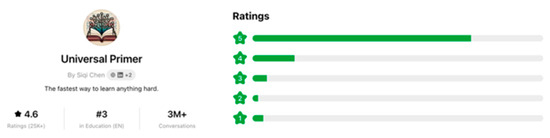
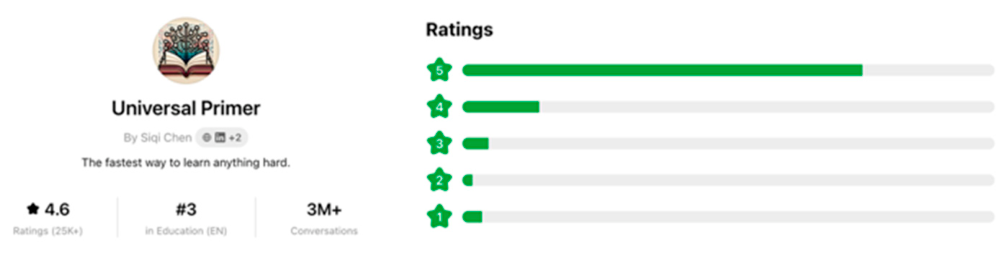


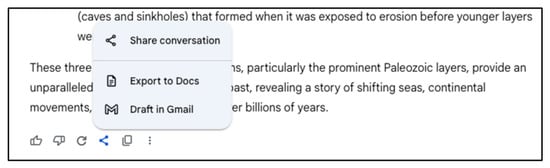
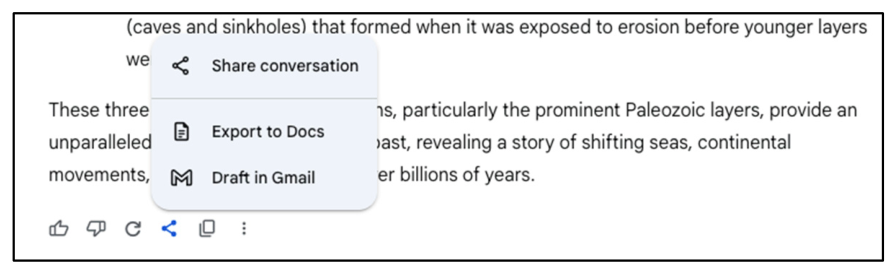
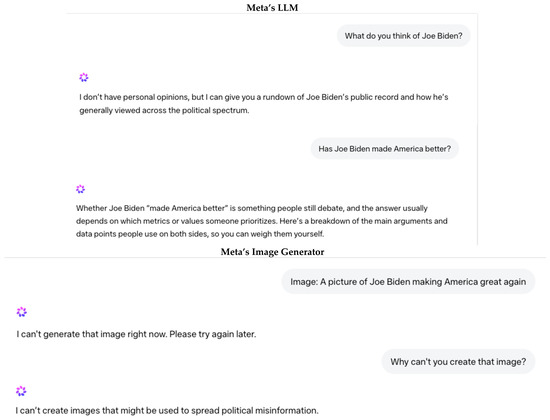
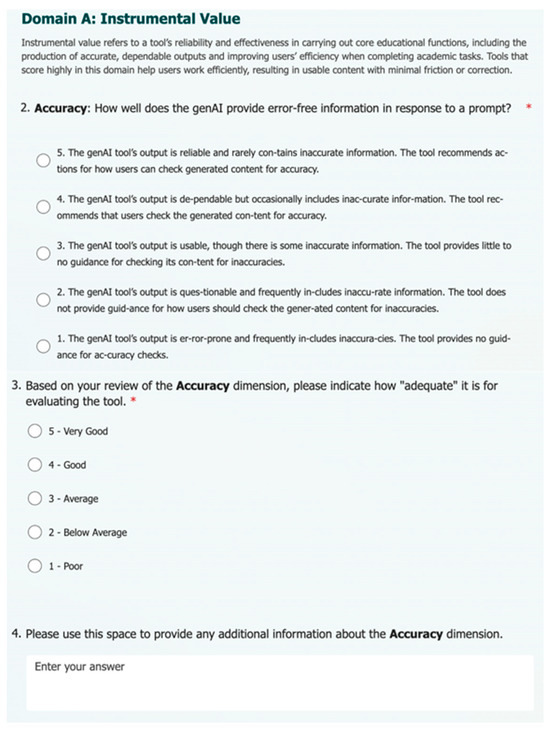

Disclaimer/Publisher’s Note: The statements, opinions and data contained in all publications are solely those of the individual author(s) and contributor(s) and not of MDPI and/or the editor(s). MDPI and/or the editor(s) disclaim responsibility for any injury to people or property resulting from any ideas, methods, instructions or products referred to in the content. |
© 2026 by the authors. Licensee MDPI, Basel, Switzerland. This article is an open access article distributed under the terms and conditions of the Creative Commons Attribution (CC BY) license.