


Abstract
The integration of administrative staff into research processes within higher education institutions (HEIs) remains underexplored, particularly in Latin American contexts. This study aimed to examine the perceptions, motivations, and structural barriers experienced by administrative personnel regarding their involvement in institutional research at the Universidad Politécnica Estatal del Carchi (UPEC), Ecuador. A quantitative, cross-sectional design was employed using a validated Likert-type instrument. Data were collected from 70 administrative employees and analyzed through Exploratory Factor Analysis (EFA), revealing seven latent factors: personal motivation, structural barriers, regulatory knowledge, institutional recognition, contribution to efficiency, training and participation, and institutional vision. The EFA yielded a cumulative explained variance of 54.5%, and Cronbach’s alpha coefficients ranged from 0.64 to 0.94 across factors, indicating strong internal consistency. Correlation analysis demonstrated moderate to strong associations between motivation and participation (r = 0.65), and between regulatory knowledge and institutional recognition (r = 0.50). Multiple regression analysis revealed that only the institutional recognition factor significantly predicted research participation among administrative staff (β = 0.41, p = 0.004), while other predictors—including motivation and structural barriers—did not reach statistical significance. These findings underscore the need to design inclusive research policies that strategically engage administrative personnel. The study contributes to expanding the discourse on research ecosystems by highlighting the overlooked potential of non-academic actors in institutional scientific output.
1. Introduction
In the contemporary knowledge economy, the research function of universities has become a critical benchmark of institutional performance and prestige. Higher education institutions (HEIs) are expected not only to disseminate knowledge but also to actively generate it. However, much of the scholarly discourse on research in HEIs has centered on academic staff (faculty and researchers) and students, often overlooking the non-academic personnel who support and enable research process (Bacelar-Nicolau et al., 2023). There is growing recognition that research is not an isolated endeavor of individual academics but rather the product of a complex institutional ecosystem involving interdisciplinary and interfunctional collaboration across the university. In this ecosystem, administrative and technical staff play integral roles that have been historically underexplored in research literature (Yarime et al., 2012). This paucity of attention to non-academic personnel represents a significant gap in the understanding of how research capacity is built and sustained within universities. The present study addresses this gap by examining the role of administrative staff within institutional research ecosystems, with a particular focus on their potential contributions to research engagement processes.
Despite comprising a substantial proportion of university employees and being critical elements in institutional operations, administrative and support staff are seldom acknowledged in research policy or higher education studies (Becher & Kogan, 1992), even though recent empirical findings highlight this oversight. For example, Baltaru (2019) found that while universities with a moderate increase in professional (non-academic) staff tend to achieve higher student completion rates, their research quality outcomes did not significantly improve under the same conditions. This suggests that the mere presence of more support staff does not automatically translate into better research performance, possibly because their potential is not being effectively harnessed. Indeed, as Baltaru (2019) notes, universities have been engaging more non-academic professionals in pursuit of strategic goals, yet there remains little empirical evidence of how these roles tangibly impact research and organizational performance. Such findings reinforce the notion that a clearer understanding is needed of what contributions administrative staff make to the research enterprise and how institutions can better integrate these contributions.
Against this backdrop, this study examines how administrative staff engage with research at a public university in northern Ecuador. Focusing on Universidad Politécnica Estatal del Carchi (UPEC), the study addresses an underexplored dimension of higher education research ecosystems by analyzing the perceptions, motivations, and institutional conditions associated with administrative involvement in research.
This study makes three main contributions. First, it provides empirical evidence from a Latin American public university context, where the research-related role of administrative staff remains insufficiently documented. Second, it adopts an exploratory analytical design based on exploratory factor analysis and regression modeling to identify key dimensions and predictive relationships associated with research engagement. Third, it offers institutionally relevant insights for the development of more inclusive research policies and organizational strategies.
The following section reviews the relevant theoretical and empirical literature and formulates the research questions that guide the study.
2. Literature Review and Research Questions
2.1. Theoretical Foundations
From a theoretical standpoint, this study draws on two complementary frameworks: institutional theory and the concept of “third space” professionalism in higher education. Institutional theory emphasizes the influence of organizational structures, norms, and formal roles in shaping behavior within complex institutions (Cannon, 2021). In the context of administrative research engagement, this lens helps interpret how institutional vision, role clarity, and recognition shape staff motivation and participation (Whitchurch, 2020). Additionally, the third space framework offers a valuable lens for understanding the hybrid roles played by administrative personnel who operate across academic and managerial domains. These “third space professionals” contribute to institutional missions—including research—by bridging organizational silos and facilitating interdisciplinary collaboration. Applying these frameworks enables a more nuanced analysis of how non-academic staff navigate the formal and informal structures of research ecosystems, and how institutional context mediates their engagement.
In addition to structural and institutional drivers, motivational factors play a central role in shaping the engagement of administrative staff in university research ecosystems. Drawing from self-determination theory (Ren, 2024) and empirical work on professional identity in higher education (Jung & Shin, 2015), this study recognizes intrinsic motivation, perceived recognition, alignment with institutional values, and availability of incentives as key psychological levers. Administrative staff may be more inclined to participate in research processes when their work is valued, their contributions are acknowledged, and their professional growth is supported (Malunda et al., 2016). These motivational dimensions interact with institutional structures to shape both willingness and capacity for engagement.
2.2. Administrative Staff in Research Ecosystems
Conceptualizing research activity as part of an institutional research ecosystem demands examining the interplay of various actors and units. Modern research challenges (such as large interdisciplinary projects, technological innovation, and data-intensive studies) often require diverse expertise and the coordination of multiple departments. Administrative staff frequently serve as the connective tissue in these endeavors, linking faculty researchers with institutional resources, compliance mechanisms, and external partners. Studies in higher education management have begun to stress the importance of breaking down the traditional academic–administrative divide in order to foster a more collaborative research culture (Baltaru & Soysal, 2018). A collaborative governance approach—wherein academic leaders, faculty, and non-academic professionals jointly participate in decision-making and innovation—can leverage the full spectrum of talents within an institution (Becher & Kogan, 1992). By drawing on the ‘technical expertise’ and organizational knowledge of administrative personnel, universities may cultivate a more resilient and innovative research environment. Furthermore, administrative staff development and training have been identified as key factors in enhancing institutional performance (Bacelar-Nicolau et al., 2023). In sum, there is a theoretical impetus to view research capacity-building as a holistic, institution-wide effort that includes administrative talent, a perspective this study adopts.
2.3. Latin American Higher Education and Quality Assurance Context
The context of this research is framed by ongoing transformations in Latin American higher education, especially in terms of accountability and quality assurance in research. Across Latin America, national reforms and accreditation frameworks have increasingly demanded that universities strengthen their research profiles and demonstrate tangible outputs in knowledge production. Ecuador offers a pertinent example: since the early 2010s, the Ecuadorian government and its regulatory bodies have instituted strict evaluation and accreditation processes modeled after international “best practices,” with special emphasis on research output as a quality indicator (Gutiérrez et al., 2023). According to these same authors, the country’s Higher Education Quality Assurance Council, known as CACES (Consejo de Aseguramiento de la Calidad de la Educación Superior), explicitly incorporates research performance as one of the three core pillars (alongside teaching and societal engagement) in its university evaluation model. Under the CACES accreditation criteria, universities must provide evidence of systematic research planning, execution, and scientific production (e.g., publications in indexed journals) to achieve favorable ratings. This policy shift reflects a broader regional trend: HEIs are now held accountable not just for educational access and teaching quality, but also for their contributions to national research output and innovation capacity. Consequently, even universities that historically focused on teaching are being reoriented toward research, often under significant pressure to professionalize their research management practices and improve performance metrics (Gutiérrez et al., 2023).
These accountability reforms, while necessary for elevating research standards, tend to prioritize quantitative outputs and faculty qualifications (e.g., number of PhDs, publications) as measures of success. There is relatively little in these frameworks that addresses how institutional support systems and collaborative efforts contribute to achieving those outputs. For instance, new accreditation guidelines in Ecuador encourage student participation in research and reward faculty publications, but they do not explicitly account for the role of administrative support in facilitating these outcomes. Yet research management scholarship suggests that developing countries often struggle with institutional capacity for research due to insufficient resources and support structures (Gutiérrez et al., 2023). Internal factors such as funding, infrastructure, and crucially staffing for research support can significantly influence an HEI’s research productivity (Pacheco et al., 2025). Where such support is lacking or siloed, academics face greater administrative burdens, which can detract from their research focus. Indeed, overly bureaucratic environments have been correlated with lower scientific performance in universities (Garrido et al., 2019). This underscores the idea that strengthening research output is not solely a matter of hiring more researchers or increasing budgets, but also of optimizing the institutional processes and human support surrounding research. In Latin America’s reform context, universities stand to benefit from strategies that engage the entire organization—including administrative personnel—in pursuing research excellence and meeting quality standards. By fostering interfunctional teams and empowering staff at all levels, institutions can create a more enabling environment for research and innovation (Bacelar-Nicolau et al., 2023).
Recent literature continues to highlight the strategic role of administrative and professional staff in strengthening institutional research capacity. For instance, Martínez and Tejero (2025) emphasize the growing professionalization of research managers and administrators (RMAs), who increasingly act as boundary-spanning agents between academic production and institutional frameworks. These actors not only manage compliance and funding logistics but also shape the broader research culture through strategic mediation. Similarly, (de Jong, 2025) finds that institutional recognition significantly enhances organizational commitment among non-academic staff, suggesting that symbolic and material forms of acknowledgment are essential to fostering inclusive research environments. These studies contribute to a growing body of evidence that positions administrative staff as active participants in research ecosystems, rather than passive support agents.
Despite these logical linkages, empirical research specifically examining administrative staff involvement in research remains scarce, particularly in Latin America. Scopus-indexed studies on higher education management have only recently begun to explore topics like research administration, the rise of “third space” professionals, and the impact of professional staff on university outcome. Theoretical frameworks are emerging that view universities as “strategically oriented” organizations, where non-academic professionals are integral to achieving mission-critical goals (Baltaru, 2019). However, a clear research gap persists in understanding the nature and extent of non-academic contributions to the research mission. Why might administrative staff engagement be critical for research success, and in what ways do they participate? How do institutional policies and culture either facilitate or hinder such participation? And what can be learned from the perspectives of the administrative personnel themselves about the challenges and opportunities in contributing to research? These issues point to a clear research gap, which is formally addressed through the research questions presented in the following subsection.
2.4. Research Gap and Research Questions
Despite the growing recognition of administrative and professional staff as relevant actors in higher education governance, empirical evidence remains limited regarding how these personnel perceive, experience, and enact their potential role in institutional research processes, particularly in Latin American public universities. Existing studies have tended to focus either on academic staff, research managers, or institutional performance indicators, leaving insufficient attention to the perceptions and participation of administrative personnel within the research ecosystem.
To address this gap, the present study was guided by the following research questions:
RQ1. What latent dimensions underlie administrative staff perceptions of research engagement within a public university context?
RQ2. How are these institutional, motivational, and structural dimensions interrelated?
RQ3. Which of these dimensions significantly predict motivation to engage in research and actual participation in research-related processes among administrative staff?
These research questions are aligned with the exploratory design of the study and aim to identify both underlying dimensions and predictive relationships.
3. Materials and Methods
3.1. Study Design and Participants
This study employed a cross-sectional survey design targeting the entire population of administrative staff at the Universidad Politécnica Estatal del Carchi (UPEC). The primary objective was to analyze key predictors influencing how administrative personnel perceive their role and motivation in institutional research processes, with the aim of informing the design of more inclusive research engagement policies. All 71 administrative staff members were invited to participate; 70 provided responses (98.59% response rate), yielding a near-complete census of the population. The survey was administered anonymously via a structured digital questionnaire using Microsoft Forms. Participation was voluntary, with informed consent implied by survey completion, and respondents were assured of confidentiality. Basic demographic information (gender, age, educational attainment, years of service) was collected to characterize the sample. Descriptive analyses (frequencies, means, standard deviations) were used to summarize these background variables and provide context for the respondent group.
3.2. Survey Instrument Development
A custom-designed questionnaire was developed in two sections: (1) Demographic information, and (2) Thematic Likert-scale items. The second section comprised 40 statements grouped into ten thematic blocks aligned with different facets of research engagement. These blocks covered: (i) Knowledge of the research landscape and regulatory framework, (ii) Understanding of evaluation and accreditation processes, (iii) Perceived administrative role in research, (iv) Motivation and interest in research, (v) Current and potential participation in research activities, (vi) Institutional climate and recognition for research involvement, (vii) Training and capacity-building needs, (viii) Financial management and resource allocation in research, (ix) Institutional positioning and external impact of research, and (x) Barriers and administrative conditions limiting research engagement. Each thematic block contained multiple Likert-style statements (typically 3–5 items per block) to which participants indicated their level of agreement on a 5-point scale (1 = Strongly Disagree, 5 = Strongly Agree). For clarity, the questionnaire included an instruction such as, “On a scale of 1 to 5, where 1 = Strongly Disagree and 5 = Strongly Agree, please indicate the extent to which you agree with the following statements.”. This ensured all respondents understood the scaling system and the meaning of each anchor, as recommended in survey design guidelines (Koo & Yang, 2025).
Content Validity: The survey instrument was developed in consultation with a panel of experts in educational research and university administration to ensure strong content validity. Content validity refers to how well the items represent the construct of interest and whether they are relevant and comprehensible to respondents (Mokkink et al., 2025). The experts reviewed each question for clarity, relevance, and coverage of the intended domain, following best practices for questionnaire design (e.g., avoiding double-barreled or ambiguous items). Based on expert feedback, items were refined for wording and appropriateness, ensuring that each thematic block’s content was comprehensive and coherent. The resulting instrument thus achieved face and content validity, meaning the questions appeared effective in capturing the targeted concepts and sufficiently covered all key aspects of administrative engagement in research (Mokkink et al., 2025). A small pilot test with colleagues (not part of the main sample) was conducted to verify that the questions were clear and interpreted consistently, with minor adjustments made to wording as needed to improve clarity. This formative validation process aligns with recommended practices in instrument development to enhance reliability and validity of responses (Koo & Yang, 2025).
Structure and Reliability: After data collection, the internal structure of the questionnaire was examined using exploratory factor analysis (EFA) and reliability analysis. An EFA was conducted using principal axis factoring and oblique rotation (oblimin), as the underlying dimensions were both theoretically and empirically expected to be correlated. Sampling adequacy was confirmed through the Kaiser–Meyer–Olkin (KMO) test, which yielded a value of 0.63, and Bartlett’s test of sphericity was highly significant (χ2 = 2438.33, p < 0.001), indicating that the correlation matrix was suitable for factor extraction. The number of factors to retain was guided by parallel analysis and scree plot inspection. Factor loadings of ≥ 0.50 were considered practically significant for interpretation and item retention. This analysis supported the thematic coherence of the constructs, with items clustering meaningfully and minimal cross-loadings above 0.40.
Next, the reliability of the internal consistency of each block of several items was evaluated using Cronbach’s alpha. A Cronbach’s α value above 0.70 is generally considered acceptable for attitudinal scales in social science, while values ≥0.80 indicate good reliability (Rasheduzzaman et al., 2025). In this study, most thematic blocks achieved high reliability (for example, the Motivation block had α ≈ 0.93, and the Climate/Recognition block α ≈ 0.81), and all blocks met or exceeded the 0.70 benchmark. The overall instrument demonstrated strong internal consistency, with an aggregate α well above 0.90, reflecting excellent coherence among the items. (Notably, even in blocks with fewer items—e.g., the Accreditation block with two items—the inter-item correlation was positive and significant, justifying the creation of a composite score for analysis.) These reliability findings give confidence that the survey responses are consistent and that each set of items is reliably measuring its intended construct.
One construct—Participation and Received Training—yielded a Cronbach’s alpha of 0.64, which falls slightly below the conventional threshold of 0.70. However, this value remains acceptable in the context of exploratory research and multidimensional constructs that integrate conceptually related but distinct components (Malhotra et al., 2012). In this case, the factor includes items reflecting both actual research participation and exposure to training opportunities, which may account for the moderate internal consistency. Importantly, the corrected item-total correlations exceeded 0.30, and the construct maintained theoretical coherence and empirical interpretability. Therefore, it was retained for further analysis.
3.3. Statistical Analysis Procedures
All data analyses were performed using R (R Core Team, 2024) within the RStudio 2023.12.1 environment. A transparent and reproducible analytical approach was adopted, in line with open science practices, including the creation of scripts for all data processing and statistical tests, so that the results can be independently verified. The analysis proceeded through the following steps:
- Descriptive Statistics: Summary statistics were calculated for all survey items, and variables were constructed. This included frequencies (%) for categorical demographics and means with standard deviations for Likert-scale items and composite scores. These descriptives provided an initial overview of the administrative staff’s knowledge levels, motivations, participation, and perceived barriers. The distribution of each composite construct (e.g., overall motivation score, knowledge score) was also verified to inform the choice of subsequent statistical tests.
- Construct Computation: Based on the EFA and reliability results, composite indices were created for each thematic construct by averaging the scores of the items within each block (for blocks with mixed-direction items, appropriate reverse-coding was applied before averaging). This yielded continuous variables representing each respondent’s score on, for example, “Research Knowledge,” “Motivation,” “Perceived Role,” “Institutional Climate,” and “Barriers.” Using composite scores reduces measurement error and multicollinearity in subsequent regressions by condensing closely related items into a single predictor (Rasheduzzaman et al., 2025). It was ensured that higher scores consistently reflected a more positive perception or greater agreement with the construct (e.g., higher Motivation score = more motivated), by reversing negatively phrased items where necessary.
- Assumption Checking: Prior to inferential analyses, the hypotheses of the linear models have been rigorously tested. Normality of continuous variables was assessed by examining skewness and kurtosis values and through graphical methods (histograms and Q–Q plots of residuals). Standard criteria were adopted whereby an absolute skewness within ±2 and a kurtosis within ±7 indicate an approximately normal distribution (Demir, 2022). These thresholds are supported by multivariate analysis literature (Black & Babin, 2019; Byrne & van de Vijver, 2010) and applied statistics texts (A. Field, 2013). In data research, the composite scores showed skewness between −0.5 and +1.2 and kurtosis between −0.8 and +1.5, well within acceptable ranges, suggesting no severe departures from normality. For additional rigor, the Shapiro–Wilk test was applied to the regression residuals, confirming that residuals did not significantly deviate from normal (p > 0.05)—a key assumption for valid confidence intervals and p-values in linear regression (Schmidt & Finan, 2018). Linearity was evaluated by inspecting scatterplots of each predictor against the outcome and by plotting residuals vs. fitted values; these indicated linear relationships without obvious curvature, satisfying the linearity assumption. Homoscedasticity (constant variance of errors) was checked using the Breusch–Pagan test and residual plots; no funneling or systematic variance patterns were observed, indicating homoscedastic residuals. Independence of errors was ensured by the study design (each respondent answered only once, and data collection was not time-sequenced), and this hypothesis was verified using the Durbin–Watson test, which yielded no indication of autocorrelation (DW statistic ≈ 2.1). Overall, diagnostic checks suggested that the data met the requirements for applying linear regression models with valid inference (A. P. Field & Wilcox, 2017).
- Multicollinearity Diagnostics: Given that many of the composite predictors (knowledge, climate, barriers, etc.) could be correlated, multicollinearity was examined to avoid unstable regression estimates. The variance inflation factor (VIF) and tolerance of each predictor were calculated. All VIF values were well below 5 (maximum VIF ≈ 2.3) and tolerances well above 0.2, indicating low multicollinearity. As a rule of thumb, a tolerance <0.10 or VIF >10 would signal problematic multicollinearity (Rasheduzzaman et al., 2025), but the results were comfortably within safe limits. This suggests that while the constructs are related (as expected in the context of research engagement), they each provide distinct information without redundancy that would distort the regression modeling.
- Regression Modeling: Multiple linear regression models were constructed to identify which factors significantly predict administrative staff’s Motivation for research and their Perceived Role in research (treated as two separate dependent variables). Each outcome variable was modeled as a function of the other composite construct scores, controlling for demographic covariates. For example, the Motivation model included predictors such as Knowledge, Participation, Climate, Training, and Barriers scores (as continuous independent variables), as well as controls for years of service and education level. Similarly, the Perceived Role model incorporated factors like Knowledge, Accreditation awareness, Motivation, Climate, etc., that were hypothesized to influence how strongly an administrator feels involved in research. Model estimation used ordinary least squares (OLS) in R’s base lm() function. The standardized β coefficients were presented and 95% confidence intervals to gauge the relative importance of predictors. Model fit was evaluated via R2 and adjusted R2, and overall significance by F-tests. The regression analyses adhered to recommended practices for multivariate analysis in social sciences (Demir, 2022), ensuring that interpretation focuses on substantive significance and not only p-values (Zhang et al., 2021).
- Visualization of Partial Effects: To facilitate interpretation of the regression results, partial effect plots were generated for key predictors using the jtools package in R. (specifically, the effect plot function). These partial regression plots illustrate the relationship between a given predictor and the outcome while holding all other variables constant, effectively isolating the predictor’s unique effect (Breheny & Burchett, 2017). Such visualization is highly informative in multiple regression contexts, as it mirrors the question: “How does this factor influence the outcome, controlling for the rest?”. For each significant predictor (e.g., perceived Barriers), the expected outcome value (Motivation or Role score) was plotted across the range of that predictor, accompanied by 95% confidence bands (Breheny & Burchett, 2017). This approach follows established recommendations to visualize regression models for better communication of results. By examining these plots, it could be observed, for instance, that higher Knowledge scores correspond to moderately higher Motivation, or that a more positive Institutional Climate is associated with a substantial increase in perceived research Role, all else being equal. Partial residues were included on the plots to check for any nonlinear patterns or outliers that might affect interpretation. The plots confirmed that the linear approximation was reasonable and helped illustrate the magnitude of effects in practical terms (e.g., how much the Motivation score is expected to rise when Barriers are reduced by a certain amount). All analyses and visualizations were scripted, and key results were cross-validated by alternative methods (such as using the visreg package) to ensure robustness.
Throughout the analytical process, the research has adhered to rigorous standards of methodological transparency and validity. Authoritative sources were cited to support the analytical decisions: for example, using (Hair et al., 2010) for multivariate analysis guidelines and cut-offs (normality, multicollinearity), and A. Field (2013) for regression assumption checks and applied statistical techniques. This alignment with established literature reinforces that the procedures—from instrument validation to regression modeling—meet the scientific standards for educational research. All analyses were reproducible; data coding and R scripts are available upon request, consistent with open science and replication standards. The comprehensive approach to data quality (content validation, reliability analysis) and robust statistical modeling ensures that the findings regarding administrative staff’s research engagement are trustworthy and can meaningfully inform institutional policy development.
4. Results
4.1. Instrument Validation
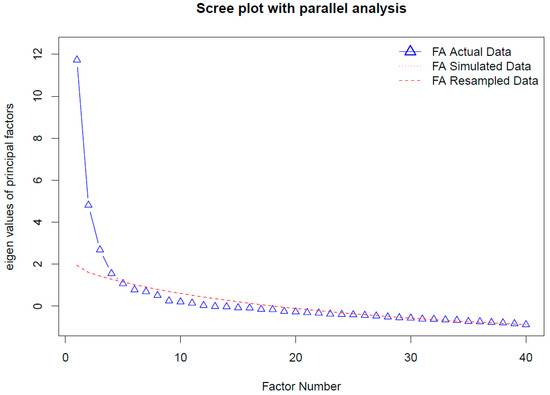
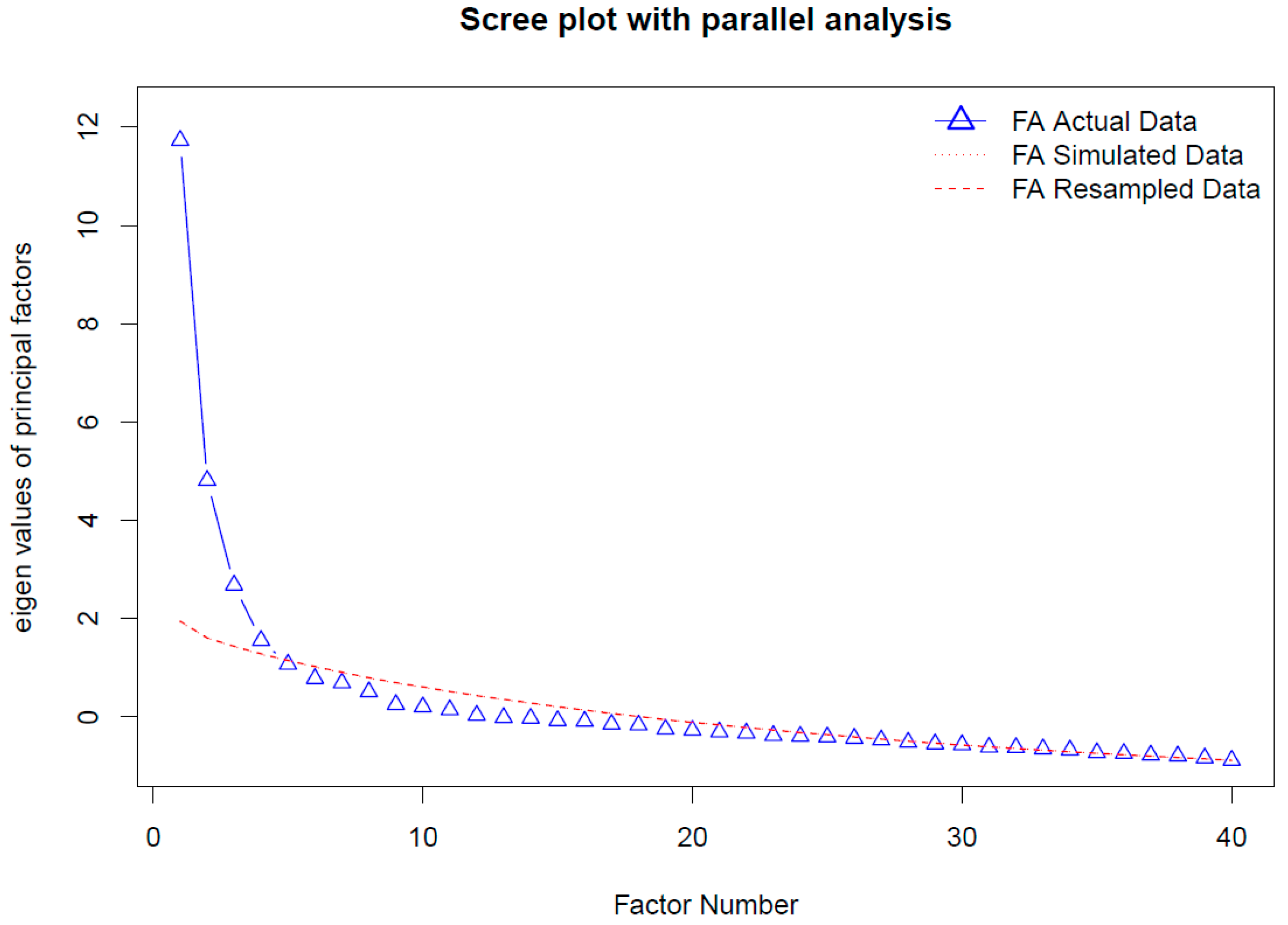
Prior to factor extraction, sampling adequacy and factorability were confirmed. The Kaiser–Meyer–Olkin measure was 0.63, exceeding the minimum acceptable 0.60. Bartlett’s test of sphericity was highly significant (χ2(780) = 2438.33, p < 0.001), indicating that the item correlation matrix was factorable (Table 1). Parallel analysis and the scree plot suggested a seven-factor solution, aligning with the instrument’s theoretical structure. Specifically, seven eigenvalues from the actual data exceeded those from random data simulations (Figure 1). The scree plot showed a clear inflection after the seventh factor, supporting the retention of seven factors.
Table 1.
Kaiser–Meyer–Olkin (KMO) and Bartlett’s Test of Sphericity (N = 70).
Figure 1.
Scree plot with parallel analysis. The plot compares actual eigenvalues with those obtained from simulated and resampled data. Seven factors have actual eigenvalues above the parallel analysis threshold and the Kaiser unity criterion (horizontal line at 1.0).
4.2. Exploratory Factor Analysis
Exploratory factor analysis (EFA) with oblimin rotation extracted seven factors, which together explained a substantial portion of variance. The rotated factor solution is summarized in Table 2, which lists factor loadings for each survey item (loadings ≥ 0.40 are shown). Each of the seven factors corresponded closely to the instrument’s hypothesized conceptual blocks:
- Factor 1—Knowledge of Research Framework: This factor included items on awareness of research regulations, institutional policies, procedures, and understanding of research impact (e.g., “Conozco el marco normativo nacional…”). All five items loaded strongly on Factor 1 (loadings 0.60–0.84).
- Factor 2—Institutional Roles in Research: Five items reflecting the perception of administrative roles and contributions in research loaded on this factor. Items addressing recognition of administrative roles and the need for formal role definition (e.g., “Sería beneficioso definir roles formales…”) showed high loadings (0.73–0.84) on Factor 2.
- Factor 3—Motivation to Participate: Four items measuring personal interest and willingness to engage in research formed this factor. Items such as interest in research activities and willingness to invest extra time had very high loadings on Factor 3 (0.87–0.95).
- Factor 4—Organizational Environment & Recognition: This factor consisted of five items related to institutional culture, including collaborative climate, trust between administrative and academic staff, and recognition of administrative contributions to research. These items loaded between 0.62 and 0.86 on Factor 4.
- Factor 5—Training & Development: Four items pertaining to research training needs and opportunities loaded on Factor 5 (loadings 0.60–0.73). This factor encompassed whether respondents had received research training, the sufficiency of training programs, need for practical training, and willingness to attend training.
- Factor 6—Perceived Impact of Admin Involvement: Six items loaded on Factor 6, all highlighting the benefits of administrative staff participation in research processes. Items included the influence on efficient resource allocation, contributions to institutional positioning, and improvements in research quality, with loadings ranging from 0.66 to 0.85.
- Factor 7—Barriers to Research Engagement: Nine items reflecting obstacles to administrative staff participation loaded on Factor 7. High loadings (0.52–0.81) were observed for items related to workload, lack of time, insufficient knowledge, absence of incentives or training, unclear policies, and other institutional barriers. Notably, one positively phrased item (“Con redistribución de tareas, podría participar más activamente”) also loaded on this factor, suggesting that task redistribution is viewed in the context of overcoming barriers.
Table 2 presents the factor loading matrix. Each item loaded primarily on its associated factor, with minimal cross-loadings. For clarity, only loadings ≥ 0.40 are shown. Two survey items did not reach the 0.40 loading threshold on any single factor: the item regarding the need for normative framework training for administrative staff showed moderate cross-loadings on multiple factors (≈0.35–0.55) and was not clearly associated with one factor, and the item about having had past research opportunities did not load strongly on the emergent factors. These two items were therefore not included in any single factor in the final solution.
Table 2.
Exploratory factor analysis pattern matrix: Factor loadings by item (oblimin rotation; loadings ≥ 0.40 shown). Items are grouped by their primary factor.
The factor solution largely corroborates the survey’s theoretical structure. Each factor is defined by a coherent set of items, and cross-loadings were minimal. Where minor cross-loadings occurred (e.g., the “normative training” item), they did not exceed the 0.40 threshold on more than one factor. Overall, the seven extracted factors are interpretable and consistent with the expected dimensions of administrative staff research engagement.
The seven-factor solution was selected based on parallel analysis and scree plot inspection, with each factor demonstrating conceptual coherence and practical interpretability. The cumulative variance explained by these seven factors was 70.1%, exceeding the commonly accepted thresholds for social science research. The seven-factor solution explained a cumulative variance of 70.1% (see Table S1 in Supplementary Materials).
4.3. Reliability of Constructs
Internal consistency was assessed for each of the seven latent constructs derived from the exploratory factor analysis. Table 3 presents the Cronbach’s alpha coefficients and the number of items comprising each factor. The construct Motivation and Personal Disposition showed the highest internal consistency (α = 0.94), indicating excellent reliability across its six items. The Structural Barriers factor also demonstrated high reliability (α = 0.89), reflecting strong internal coherence among the various institutional and individual limitations assessed.
Table 3.
Cronbach’s alpha reliability by construct (N = 70).
Acceptable to good reliability was observed for Contribution to Efficiency and Management (α = 0.86), Institutional Vision and Structure (α = 0.83), and Knowledge of Regulatory Framework (α = 0.84), each comprising between four and six items. The Institutional Recognition factor showed moderate reliability (α = 0.70), possibly due to the reduced number of items (n = 3) and the broader interpretative nature of recognition-related perceptions.
The lowest alpha value was found for the construct Participation and Received Training (α = 0.64), which, while still within the acceptable range for early-stage scale development, suggests moderate internal consistency. This lower value might reflect heterogeneity in the participants’ experiences related to research training and engagement opportunities. Overall, six of the seven factors demonstrated α ≥ 0.70, and five exceeded the 0.80 threshold, indicating solid psychometric properties of the instrument.
4.4. Construct Intercorrelations
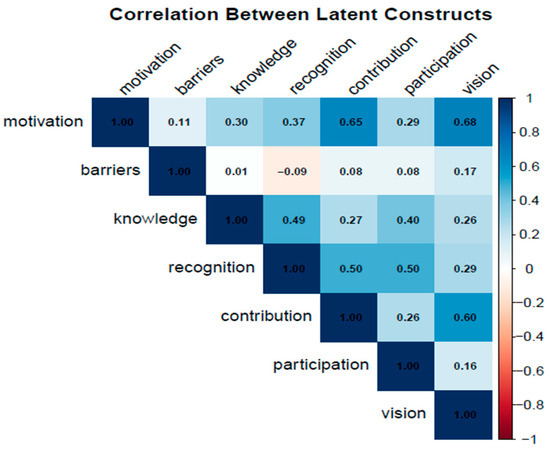
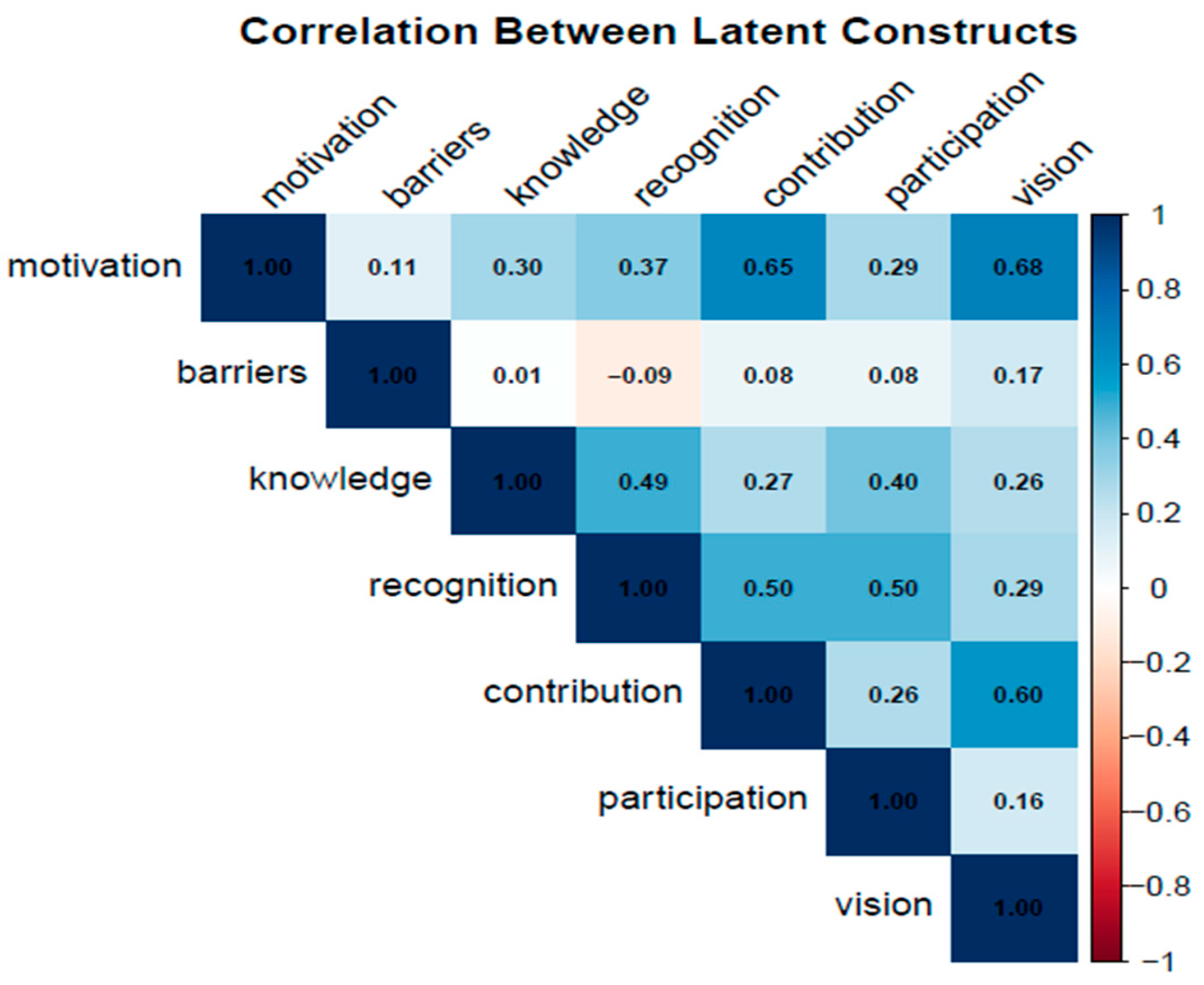
Pearson correlations were computed between the seven composite factors to explore their interrelationships and potential conceptual overlaps. These associations are visually represented in Figure 2, which provides a clearer depiction of the correlation patterns among constructs. The analysis revealed a strong positive correlation between Motivation and Personal Disposition and Institutional Vision and Structure (r = 0.68), suggesting that individuals who perceive a stronger structural framework and institutional engagement also report higher motivation to participate in research.
Figure 2.
Heatmap of inter-factor correlations. Warmer colors (red/orange) indicate stronger positive correlations between constructs. The “Barriers” factor shows weak or no correlation with other constructs, appearing as light tones, while Motivation, Contribution, and Vision form a moderate positive cluster.
A similarly strong association was observed between Motivation and Contribution to Efficiency and Management (r = 0.65), indicating that perceptions of administrative impact align with higher individual disposition toward research engagement. Moderate correlations were found between Recognition and both Motivation (r = 0.37) and Participation and Training (r = 0.50), highlighting the potential role of acknowledgment and training experience in fostering personal engagement.
The Knowledge of Research Framework factor showed low to moderate correlations with most constructs, notably with Motivation (r = 0.30), Participation (r = 0.40), and Recognition (r = 0.49), indicating that awareness of institutional and normative processes is positively associated with engagement variables. In contrast, the Structural Barriers factor was weakly correlated with all other constructs (ranging from −0.09 to 0.17), suggesting that perceived obstacles are relatively independent from the other dimensions captured in this model.
Overall, the pattern of correlations supports the discriminant validity of the constructs, while also highlighting coherent relationships among motivational, structural, and recognition-based dimensions of research engagement within administrative personnel. These associations are visually represented in Figure 2, which displays a heatmap of the inter-factor correlation matrix, illustrating key clusters and low-association patterns.
4.5. Regression Analysis
To further probe the relationships between these constructs, multiple regression analyses were conducted for two key outcome variables of interest: Motivation to Participate in Research and Participation in Research Activities. The predictors in these models were the composite factors identified above. Standardized regression coefficients (β) are reported to allow comparison of predictor importance. Table 4 and Table 5 summarize the regression results for Motivation and Participation outcomes, respectively. Both models used all 70 cases (n = 70), as there were no missing data in the survey responses.
Table 4.
Multiple regression predicting Motivation (Factor 3) from other engagement constructs (N = 70). Standardized coefficients (β) are shown. The model was significant, R2 = 0.58, F(6, 63) = 14.47, p < 0.001.
Table 5.
Multiple regression predicting Participation in Research from engagement constructs (N = 70). Standardized coefficients are shown.
The selection of predictor variables was informed by theoretical considerations and prior empirical studies linking institutional vision, role clarity, recognition, and structural conditions to staff engagement in higher education contexts (Jung & Shin, 2015; Baltaru & Soysal, 2018; Atwebembeire et al., 2018). The inclusion of multiple constructs in the models reflects a theory-guided approach to exploring their unique and overlapping contributions to motivation and participation outcomes. While the analysis remains exploratory, it is grounded in literature-based assumptions about the relevance of each factor.
Motivation as Outcome: The regression model for Motivation was significant (R2 = 0.579, Adjusted R2 = 0.539, F(6, 63) = 14.47, p < 0.001), indicating that about 54% of the variance in administrative staff’s motivation to engage in research was explained by the set of predictors (Table 4). Out of the six predictors (all other factors except Motivation itself), the Institutional Roles in Research factor emerged as the only statistically significant predictor of Motivation (β = 0.40, p = 0.001). This suggests that administrators who perceive clear roles and contributions for administrative staff in research tend to report significantly higher motivation to participate. The positive coefficient implies that strengthening the sense of an institutional role is associated with increased motivation. None of the other factors—including Knowledge, Environment/Recognition, Training, Perceived Impact, or Barriers—showed a significant unique effect on Motivation (all p > 0.05). The Perceived Impact factor showed a positive trend (β = 0.23) but did not reach significance (p = 0.076). Neither the presence of barriers nor the level of prior knowledge or training was significantly associated with self-reported motivation when all predictors were considered simultaneously. Multicollinearity diagnostics were within acceptable limits (all VIF < 2), indicating the predictors were sufficiently independent. In summary, these regression results highlight the central role of institutional integration (role clarity and recognition) in driving motivation, above and beyond personal capacity or environmental factors.
Participation as Outcome: The second regression model assessed predictors of Participation in Research, operationalized using the item “I have had specific opportunities to participate in research processes.” The multiple regression model with six standardized predictors was statistically significant: F(6, 63) = 4.617, p = 0.0006, with R2 = 0.31 and Adjusted R2 = 0.24. These results indicate that approximately 24% of the variance in participation could be explained by the model.
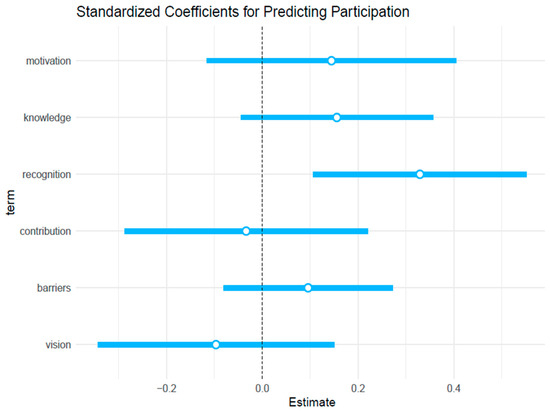
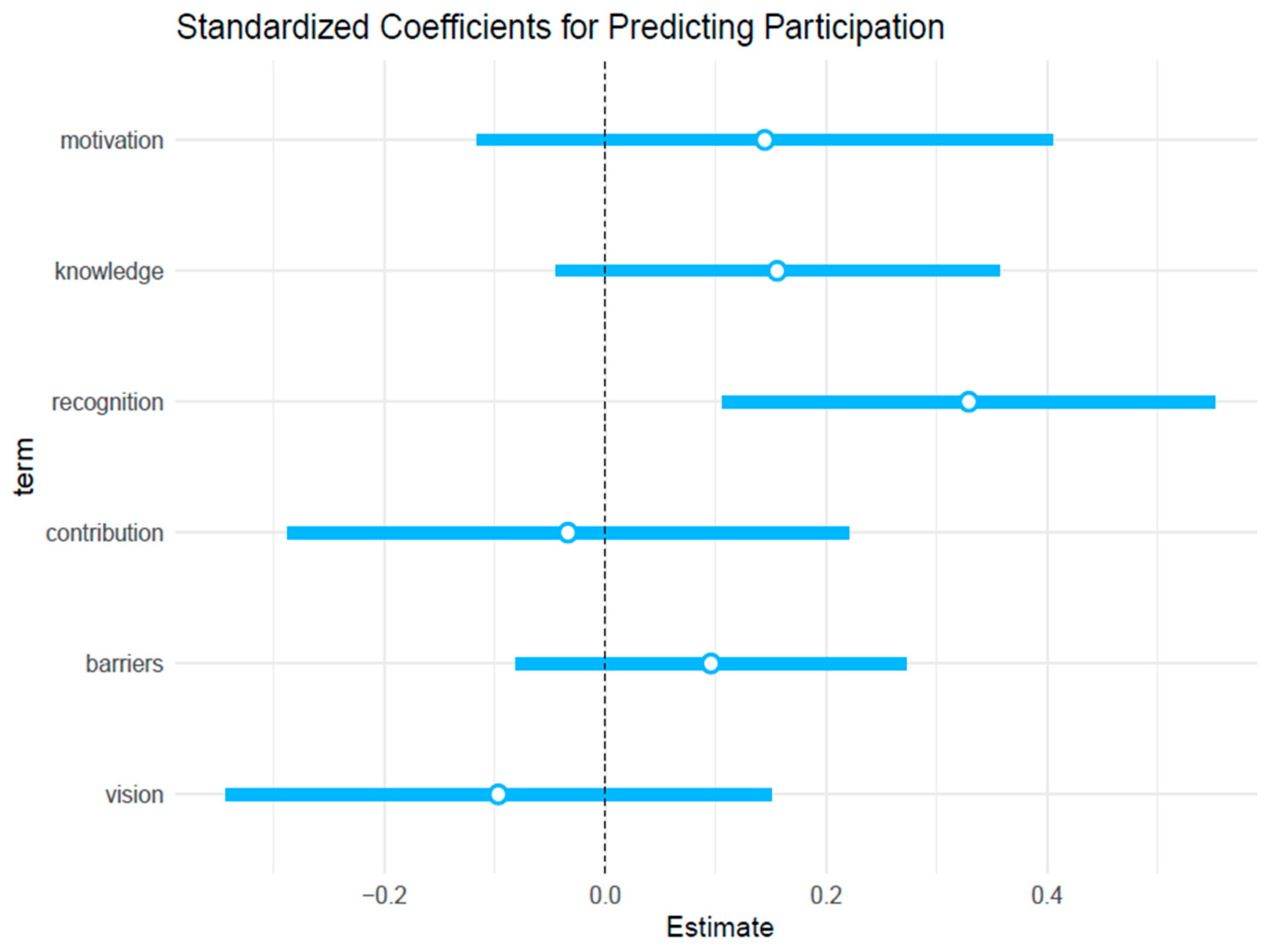
Among the six predictors, Institutional Recognition was the only statistically significant factor (β = 0.41, p = 0.004), indicating that administrative staff who perceive their contributions are valued and supported are more likely to report concrete participation in research activities. Other variables, including Motivation (β = 0.17), Knowledge (β = 0.21), and Barriers (β = 0.12), were positively associated with participation but did not reach statistical significance. The predictors Contribution and Institutional Vision exhibited weak and non-significant associations, including a small negative effect for Vision (β = −0.16).
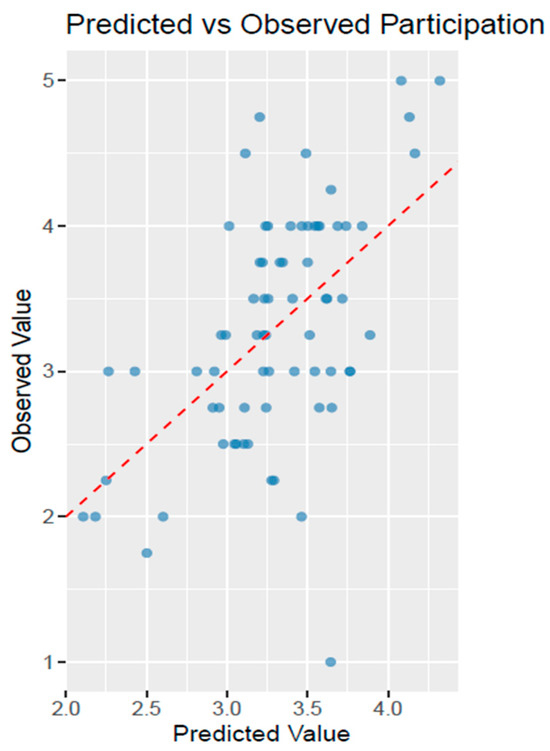
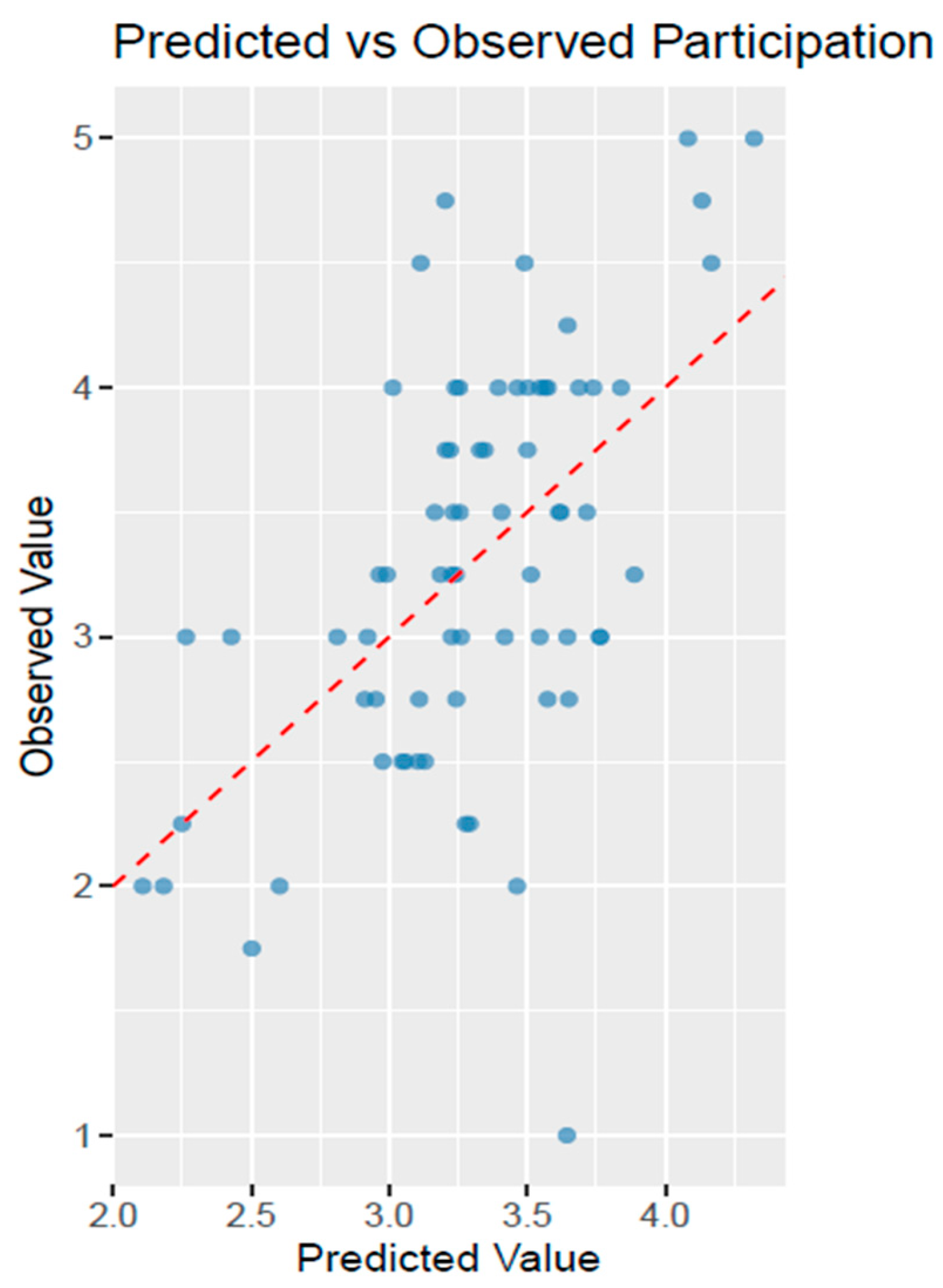
These findings underscore the central role of organizational acknowledgment in facilitating research involvement, while individual disposition and structural clarity, although directionally consistent, appear insufficient as standalone predictors. The overall fit of the participation model is illustrated in Figure 3, which presents the predicted versus observed values. The standardized effect sizes of each predictor are subsequently shown in Figure 4.
Figure 3.
Predicted vs. observed values for the Participation outcome. Each point represents a respondent (N = 70). The red dashed diagonal indicates perfect prediction (Predicted = Observed). The clustering around the diagonal line reflects the moderate fit of the model (R2 = 0.31), while the spread highlights the influence of other potential unmeasured variables.
Figure 4.
Standardized regression coefficients for the Participation outcome model. The plot displays the standardized beta coefficients (β) for the six predictors—Motivation, Knowledge, Recognition, Contribution, Barriers, and Vision—along with their 95% confidence intervals.
To address potential confounding influences, a revised regression model was estimated including demographic covariates—gender (binary), education level (ordinal), and years of service (continuous)—as additional predictors. The results of the extended regression model including demographic covariates are presented in Table 6. Among the covariates, years of service showed a marginal positive association with research participation (β = 0.19, p = 0.078), suggesting that longer-tenured staff may have had more opportunities or exposure to institutional research processes. Gender and education level did not reach significance, although effect directions were consistent with prior research suggesting that professional experience, rather than formal education, may shape administrative engagement in research (Jung & Shin, 2015). Importantly, the inclusion of covariates did not substantially alter the significance or magnitude of the original predictors, reinforcing the robustness of institutional recognition as the primary factor associated with research participation.
Table 6.
Multiple regression predicting participation in research including demographic covariates (N = 70). Standardized beta coefficients (β), standard errors, and p-values are reported. Covariates include gender (binary), education level (ordinal), and years of service (continuous).
While Figure 4 presents the standardized coefficients for the predictors of participation, it is necessary to consider the methodological implications of using a single-item ordinal outcome. The dependent variable—self-reported participation in research—was measured on a five-point Likert scale. Although ordinal, variables with five or more categories are often treated as approximately continuous in social science research, especially when the distribution of residuals does not severely violate linear model assumptions (Johnson & Creech, 1983).
In this study, residual diagnostics showed acceptable behavior in terms of normality and homoscedasticity, justifying the use of ordinary least squares (OLS) regression for exploratory purposes. Additionally, bootstrapped confidence intervals were computed for all coefficients to assess the robustness of the parameter estimates. The results remained consistent, strengthening confidence in the reported findings.
Nevertheless, the authors acknowledge that modeling an ordinal variable using OLS may oversimplify the underlying scale properties. Future studies are encouraged to replicate these findings using ordinal logistic regression—particularly with proportional odds checks—and to develop multi-item indices for participation to improve construct validity and model precision.
5. Discussion
This study employed a rigorous psychometric and inferential framework to uncover the latent factors influencing research engagement among administrative staff in a Latin American public university. The findings provide empirical support for a multidimensional understanding of engagement, encompassing personal motivation, perceived institutional structures, training exposure, and organizational recognition. These insights are particularly relevant in the evolving context of quality assurance and research accountability across Latin American higher education systems (Gutiérrez et al., 2023).
Using exploratory factor analysis (EFA), seven well-defined constructs emerged, including Motivation and Personal Disposition, Institutional Vision and Structure, Knowledge of Research Framework, Environment and Recognition, Training and Development, Contribution to Efficiency, and Structural Barriers. The internal structure of these constructs showed strong discriminant validity and reliability, with five out of seven achieving Cronbach’s alpha values above 0.80 (Table 3). Notably, the correlation matrix revealed a strong positive association between Motivation and Institutional Vision (r = 0.68), and between Motivation and Contribution to Efficiency (r = 0.65), reinforcing the idea that clear institutional narratives and perceived administrative value stimulate higher engagement (Atwebembeire et al., 2018; Zapp et al., 2021)
Conversely, the Barriers factor showed weak or null correlations with other constructs (r = −0.09 to 0.17), suggesting that structural limitations may operate independently of motivational or organizational factors, a finding consistent with prior research highlighting the orthogonal role of institutional constraints (Baltaru and Soysal, 2018). This supports the discriminant structure of the model and raises questions about the background role of institutional inefficiencies in shaping staff engagement.
Regression analyses offered further interpretive value. The model predicting Motivation (Table 4) explained 54% of the variance (Adjusted R2 = 0.54, p < 0.001), with Institutional Roles in Research emerging as the only significant predictor (β = 0.40, p = 0.001). This emphasizes the importance of formal role definition and institutional recognition in fostering motivational readiness among administrative staff. While Knowledge, Training, and Environment showed positive trends, none achieved statistical significance, indicating that structural affirmation may be more central than individual capacity-building alone. This aligns with the assertion that role clarity and institutional integration are foundational to sustained engagement (Jung & Shin, 2015).
This finding also extends prior literature by suggesting that, in the case of administrative staff, role clarity may operate not merely as an organizational convenience but as a motivational mechanism in itself. Whereas previous studies have often emphasized competencies, training, or professional development as primary enablers of non-academic staff performance, the present results indicate that symbolic and structural inclusion within the research function may be even more decisive. In this sense, the study nuances earlier assumptions that capacity-building alone is sufficient to foster engagement, and instead supports a more relational interpretation in which institutional positioning and role legitimacy shape motivational readiness.
In the second model, predicting Participation in research (Table 5), Recognition was the strongest and only significant predictor (β = 0.41, p = 0.004). Although Knowledge and Motivation showed positive but non-significant effects (β = 0.21 and β = 0.17, respectively), the result points to the powerful influence of acknowledgment and inclusion in institutional narratives. The visual distribution in Figure 3 reflects a moderate model fit (R2 = 0.31), while Figure 4 reveals the standardized contributions of all predictors. These findings reinforce the emphasis on the enabling power of institutional appreciation and echo previous studies on how recognition fosters organizational loyalty (Jung and Shin, 2015).
From a broader comparative perspective, this result is particularly relevant because it suggests that recognition is not only a matter of workplace satisfaction, but also a mechanism of organizational activation within the research ecosystem. This interpretation is consistent with recent work on professional and research management staff, which highlights the importance of visibility, legitimacy, and institutional acknowledgment in enabling non-academic actors to contribute meaningfully to knowledge production. At the same time, the present findings go beyond these studies by showing that recognition remains significant even when other theoretically relevant dimensions—such as motivation, knowledge, and perceived barriers—are considered simultaneously. This reinforces the argument that institutional acknowledgment has a uniquely structuring role in translating potential willingness into actual participation.
The observation that Motivation, while correlated with Participation at the bivariate level (r = 0.29), loses its significance in the multivariate context (β = −0.08, p = 0.607) is theoretically salient. Drawing on Ajzen’s Theory of Planned Behavior, this disconnect between intention and action may stem from perceived control or access limitations (Buhmann and Brønn, 2018). Motivation alone, without enabling structures, appears insufficient to produce behavioral outcomes. Similarly, the Barriers factor did not emerge as a significant predictor in either model, suggesting it may act more as a latent inhibitor than a direct suppressor of engagement—an interpretation supported by the indirect, background role of constraints discussed in Atwebembeire et al. (2018).
At the same time, the findings also reveal a more complex picture than some institutional reform narratives suggest. Although contemporary higher education discourse increasingly promotes collaboration, interdisciplinarity, and integrated governance, these principles do not automatically translate into active research participation by administrative personnel. The fact that barriers were not statistically significant in the regression models should therefore not be interpreted as evidence that structural obstacles are irrelevant; rather, it may indicate that their influence is indirect, diffuse, or mediated by recognition and role definition. In this respect, the study invites a more critical reading of institutional inclusion, distinguishing between formal discourse on collaboration and the concrete organizational conditions that make participation meaningful and actionable.
The results are consistent with global frameworks of organizational transformation in higher education. Stage and Aagaard (2020) discuss the rise of hybrid governance models where academic and administrative roles increasingly overlap. In such contexts, empowering administrative staff through recognition and structural integration is not simply an operational concern but a strategic necessity. Latin American institutions, especially those undergoing accreditation and evaluation reform, would benefit from institutional policies that include non-academic personnel in research missions (Gutiérrez et al., 2023).
Moreover, the study underscores the underexplored role of administrative staff in accreditation and quality assurance. As seen in Ecuador’s national accreditation model (CACES), the lack of formal recognition for administrative contributions may create a blind spot in institutional capacity assessments. Integrating administrative actors into research planning, project execution, and evaluation can bridge operational and academic silos and improve institutional resilience (Bacelar-Nicolau et al., 2023).
Limitations include the study’s modest sample size (N = 70), which may reduce the power to detect smaller effect sizes. In line with its exploratory design, the study aims primarily to detect potential relationships and conceptual dimensions that may characterize administrative staff engagement in research environments. Additionally, its cross-sectional design precludes causal inference. Nonetheless, the study’s comprehensive construct validation and multivariate modeling provide a reliable basis for interpretation. Future research could incorporate longitudinal methods or cross-institutional comparisons to deepen understanding.
This study demonstrates that administrative staff engagement in research is shaped by an interplay of institutional vision, recognition, and role clarity. While personal motivation is important, it is institutional affirmation—both symbolic and structural—that predicts meaningful participation. These findings invite universities, particularly in Latin America, to reimagine research ecosystems as inclusive of all institutional actors, reinforcing the need for strategic and collaborative capacity-building.
While the sample size (N = 70) relative to the number of items (~40) yields a participant-to-item ratio below conventional thresholds (commonly ≥5:1), recent methodological studies suggest that EFA can yield valid and interpretable structures with smaller samples when communalities are high, factor loadings are strong, and the solution is well-defined (de Winter et al., 2009). In this study, the Kaiser–Meyer–Olkin (KMO) measure was adequate (KMO = 0.63), and multiple factors presented strong, interpretable loadings, supporting the decision to retain the seven-factor solution. Nonetheless, it is acknowledged that the generalizability of the factor structure should be examined in future studies using larger and more diverse samples to enhance the stability and external validity of the findings.
Furthermore, given the exploratory nature of the study, the absence of confirmatory factor analysis (CFA) limits the extent to which the proposed seven-factor structure can be considered definitively validated. While the EFA yielded a coherent and theoretically grounded solution, future studies should aim to replicate and extend these findings using CFA with goodness-of-fit indices such as the Comparative Fit Index (CFI), Tucker–Lewis Index (TLI), Root Mean Square Error of Approximation (RMSEA), and Standardized Root Mean Square Residual (SRMR). Additionally, the assessment of convergent and discriminant validity using the Heterotrait–Monotrait ratio (HTMT) and the Fornell–Larcker criterion would further reinforce the psychometric robustness of the measurement model. These confirmatory steps are essential to refine and validate the construct structure proposed here and to support its broader applicability in comparative or cross-institutional studies.
Although this study offers promising preliminary evidence regarding the latent dimensions of administrative research engagement, it did not implement a full validation pipeline such as split-sample exploratory and confirmatory factor analysis (EFA/CFA), ordinal factor modeling, or test–retest reliability. These methodological enhancements—now common in recent scale development studies (e.g., SIAS, XEQ, MRC Questionnaire)—would provide stronger evidence for construct stability and temporal consistency. Future research is therefore encouraged to adopt these more rigorous psychometric standards in larger and more diverse samples to consolidate the validity and replicability of the proposed constructs.
In addition, future studies should assess the temporal stability and contextual robustness of the proposed constructs through test–retest reliability procedures and multi-group invariance testing. Evaluating whether the measurement model holds across key demographic subgroups—such as education level, tenure, or administrative unit—would provide critical evidence for structural invariance and enhance the generalizability of the findings. Such approaches align with contemporary validation standards and are particularly relevant for instruments intended for use across diverse institutional contexts.
6. Conclusions
This study highlights the critical, yet often overlooked, role of administrative personnel in advancing research engagement within public higher education institutions. By identifying seven latent factors—including Motivation and Personal Disposition, Institutional Vision and Structure, and Environment and Recognition—the findings reveal that structural clarity, inclusive governance, and institutional acknowledgment are more predictive of research participation than individual motivation alone.
Regression models demonstrated that recognition and training opportunities were the strongest predictors of actual research involvement, while perceived barriers and motivational readiness did not exert significant effects when controlling for structural variables. This reinforces the importance of institutional environments that explicitly value and integrate administrative actors in their research strategies.
From a policy standpoint, these findings suggest that accreditation agencies and institutional leaders should broaden their frameworks to recognize the research-supportive roles of administrative staff. Embedding formal participation pathways, tailored training, and symbolic recognition into university governance could substantially enhance institutional capacity, especially in Latin American public universities undergoing quality assurance reforms.
Future research should explore how these dynamics evolve longitudinally and across diverse national systems, and how organizational change theories—such as hybrid governance and planned behavior—can be applied to institutional transformation in higher education.
The study also shows that understanding administrative staff engagement in research requires not only descriptive evidence but also a more differentiated conceptualization of how institutional recognition, role definition, and organizational culture interact. In this sense, the findings should be read as part of an emerging line of inquiry that calls for further theoretical refinement and comparative validation across institutional contexts.
Finally, it is important to emphasize the exploratory nature of this study. The findings should be interpreted as preliminary evidence derived from a specific institutional context rather than as definitive conclusions applicable to all higher education systems. Nevertheless, the results provide a useful starting point for understanding how administrative staff may contribute to institutional research ecosystems. Future research should expand this exploratory framework through multi-institutional samples, confirmatory factor analysis, and longitudinal designs in order to strengthen the generalizability and theoretical development of this emerging field of inquiry.
Supplementary Materials
The following supporting information can be downloaded at: https://www.mdpi.com/article/10.3390/educsci16050693/s1, Table S1: Variance Explained by the Seven-Factor Solution from Exploratory Factor Analysis (EFA).
Author Contributions
Conceptualization, M.R.B.-P.; methodology, M.R.B.-P.; software, M.R.B.-P.; validation, M.R.B.-P. and L.N.B.-M.; formal analysis, M.R.B.-P.; investigation, M.R.B.-P. and L.N.B.-M.; resources, M.R.B.-P.; data curation, L.N.B.-M.; writing—original draft preparation, M.R.B.-P.; writing—review and editing, L.N.B.-M.; visualization, M.R.B.-P.; supervision, M.R.B.-P.; project administration, M.R.B.-P. All authors have read and agreed to the published version of the manuscript.
Funding
This research was funded by the Research Department of the State Polytechnic University of Carchi (UPEC).
Institutional Review Board Statement
The study was conducted in accordance with the Declaration of Helsinki and approved by the Human Research Ethics Committee of the Universidad Politécnica Estatal del Carchi (UPEC), under Certification approved on 28 October 2025.
Informed Consent Statement
Informed consent was obtained from all subjects involved in the study. Participation was voluntary, and responses were anonymized to ensure confidentiality.
Data Availability Statement
The anonymized dataset supporting the findings of this study is available from the corresponding author upon reasonable request. Anonymized dataset of survey responses used for statistical analysis.
Acknowledgments
The authors express their gratitude to the administrative personnel of the Universidad Politécnica Estatal del Carchi (UPEC) for their valuable participation, and to the institutional authorities for facilitating access and supporting the research process. Special thanks are extended to the Research Department (Dirección de Investigación) of UPEC for providing institutional support and resources for data collection and analysis. During the preparation of this manuscript, the authors used OpenAI’s ChatGPT (GPT-5.3) for scientific writing refinement and formatting alignment with MDPI standards. Statistical analyses were conducted using R (R Core Team, 2024) within the RStudio environment (version 2023.12.1+402, Posit Software, PBC). The authors have reviewed and edited the output and take full responsibility for the content of this publication.
Conflicts of Interest
The authors declare no conflicts of interest.
References
- Atwebembeire, J., Namubiru Ssentamu, P., & Musaazi, J. (2018). Staff participation and quality teaching and research in private universities in Uganda. Journal of Education and Practice, 9(17), 111–121. Available online: www.iiste.org (accessed on 13 January 2026).
- Bacelar-Nicolau, P., Mapar, M., Caeiro, S., Moreno Pires, S., Nicolau, M., Madeira, C., Ferreira Dias, M., Gomes, A. P., Lopes, M., Nadais, H., & Malandrakis, G. (2023). Empowering non-academic staff for the implementation of sustainability in higher education institutions. Sustainability, 15(20), 14818. [Google Scholar] [CrossRef] [Scilit]
- Baltaru, R.-D. (2019). Do non-academic professionals enhance universities’ performance? Reputation vs. organisation. Studies in Higher Education, 44(7), 1183–1196. [Google Scholar] [CrossRef] [Scilit]
- Baltaru, R.-D., & Soysal, Y. N. (2018). Administrators in higher education: Organizational expansion in a transforming institution. Higher Education, 76(2), 213–229. [Google Scholar] [CrossRef] [Scilit]
- Becher, T., & Kogan, M. (1992). Process and structure in higher education (1st ed.). Routledge. [Google Scholar] [CrossRef] [Scilit]
- Black, W., & Babin, B. J. (2019). Multivariate data analysis: Its approach, evolution, and impact. In B. J. Babin, & M. Sarstedt (Eds.), The great facilitator: Reflections on the contributions of Joseph F. Hair, Jr. to marketing and business research (pp. 121–130). Springer International Publishing. [Google Scholar] [CrossRef] [Scilit]
- Breheny, P., & Burchett, W. (2017). Visualization of regression models using visreg. The R Journal, 9(2), 56–71. [Google Scholar] [CrossRef] [Scilit]
- Buhmann, A., & Brønn, P. S. (2018). Applying Ajzen’s theory of planned behavior to predict practitioners’ intentions to measure and evaluate communication outcomes. Corporate Communications: An International Journal, 23(3), 377–391. [Google Scholar] [CrossRef] [Scilit]
- Byrne, B. M., & van de Vijver, F. J. R. (2010). Testing for measurement and structural equivalence in large-scale cross-cultural studies: Addressing the issue of nonequivalence. International Journal of Testing, 10(2), 107–132. [Google Scholar] [CrossRef] [Scilit]
- Cannon, M. L. (2021). Higher education institutions. In Handbook of rural aging. Routledge. [Google Scholar] [CrossRef] [Scilit]
- de Jong, S. P. L. (2025). Invisible forces: The management of resources by professional staff as a contribution to knowledge development in universities. Studies in Higher Education. [Google Scholar] [CrossRef] [Scilit]
- Demir, S. (2022). Comparison of normality tests in terms of sample sizes under different skewness and kurtosis coefficients. International Journal of Assessment Tools in Education, 9(2), 397–409. [Google Scholar] [CrossRef] [Scilit]
- de Winter, J. C. F., Dodou, D., & Wieringa, P. A. (2009). Exploratory factor analysis with small sample sizes. Multivariate Behavioral Research, 44(2), 147–181. [Google Scholar] [CrossRef] [Scilit]
- Field, A. (2013). Discovering statistics using SPSS (4th ed.). Sage Publications. [Google Scholar]
- Field, A. P., & Wilcox, R. R. (2017). Robust statistical methods: A primer for clinical psychology and experimental psychopathology researchers. Behaviour Research and Therapy, 98, 19–38. [Google Scholar] [CrossRef] [Scilit] [PubMed]
- Garrido, R., Trowbridge, C. A., & Tamura, N. (2019). Ten simple rules for providing optimal administrative support to research teams. PLoS Computational Biology, 15(10), e1007292. [Google Scholar] [CrossRef] [Scilit] [PubMed]
- Gutiérrez, G., Yaguarema, M., Ayala, M., Zambrano, R. J., & Gutiérrez, L. (2023). Impact of government evaluation and accreditation processes on the research output of universities in developing countries: An X-ray of the young Ecuadorian academia. Frontiers in Education, 8, 1093083. [Google Scholar] [CrossRef] [Scilit]
- Hair, J. F., Black, W. C., Babin, B. J., & Anderson, R. E. (2010). Multivariate data analysis (7th ed.). Pearson. [Google Scholar]
- Johnson, D. R., & Creech, J. C. (1983). Ordinal measures in multiple indicator models: A simulation study of categorization error. American Sociological Review, 48(3), 398–407. [Google Scholar] [CrossRef] [Scilit]
- Jung, J., & Shin, J. C. (2015). Administrative staff members’ job competency and their job satisfaction in a Korean research university. Studies in Higher Education, 40(5), 881–901. [Google Scholar] [CrossRef] [Scilit]
- Koo, M., & Yang, S.-W. (2025). Likert-type scale. Encyclopedia, 5(1), 18. [Google Scholar] [CrossRef] [Scilit]
- Malhotra, N. K., Mukhopadhyay, S., Liu, X., & Dash, S. (2012). One, few or many?: An integrated framework for identifying the items in measurement scales. International Journal of Market Research, 54(6), 835–862. [Google Scholar] [CrossRef] [Scilit]
- Malunda, P., David, O. J., & Oonyu, M. J. (2016). Instructional supervision and the pedagogical practices of secondary school teachers in Uganda. Journal of Education and Practice, 7(30), 177–187. [Google Scholar]
- Martínez, R., & Tejero, A. (2025). Transforming research at higher education institutions: Overcoming challenges for research managers in Spain. Cogent Business & Management, 12(1), 2470909. [Google Scholar] [CrossRef] [Scilit]
- Mokkink, L. B., Herbelet, S., Tuinman, P. R., & Terwee, C. B. (2025). Content validity: Judging the relevance, comprehensiveness, and comprehensibility of an outcome measurement instrument—A COSMIN perspective. Journal of Clinical Epidemiology, 185, 111879. [Google Scholar] [CrossRef] [Scilit]
- Pacheco, L., Tavares, F. O., Ramazanova, M., Ávila, J. F., Albuquerque, H., Silva, F. M., Marques, J., Guillo, M., Zuleta, B. B., & Guzmán, S. M. (2025). Research management in higher education institutions from developing countries: An analysis for Bolivia and Paraguay. Administrative Sciences, 15(4), 131. [Google Scholar] [CrossRef] [Scilit]
- Rasheduzzaman, M., Palash, M. S., Mostafizur, R. M., Samria, N. J., & Farid, M. S. (2025). Bridging the gender gap in mobile payment services: Insights from consumer of Bangladesh. Scientific Reports, 15(1), 33838. [Google Scholar] [CrossRef] [Scilit] [PubMed]
- R Core Team. (2024). R: A language and environment for statistical computing. R Foundation for Statistical Computing. [Google Scholar]
- Ren, X. (2024). Modeling college EFL teachers’ intentions to conduct academic research: Integrating theory of planned behavior with self-determination theory. PLoS ONE, 19(8), e0307704. [Google Scholar] [CrossRef] [Scilit]
- Schmidt, A. F., & Finan, C. (2018). Linear regression and the normality assumption. Journal of Clinical Epidemiology, 98, 146–151. [Google Scholar] [CrossRef] [Scilit]
- Stage, A. K., & Aagaard, K. (2020). National policies as drivers of organizational change in universities: A string of reinforcing reforms. Quantitative Science Studies, 1(2), 849–871. [Google Scholar] [CrossRef] [Scilit]
- Whitchurch, C. (2020). Professional staff identities in higher education. In P. N. Teixeira, & J. C. Shin (Eds.), The international encyclopedia of higher education systems and institutions (pp. 2338–2343). Springer. [Google Scholar] [CrossRef] [Scilit]
- Yarime, M., Trencher, G., Mino, T., Scholz, R. W., Olsson, L., Ness, B., Frantzeskaki, N., & Rotmans, J. (2012). Establishing sustainability science in higher education institutions: Towards an integration of academic development, institutionalization, and stakeholder collaborations. Sustainability Science, 7(1), 101–113. [Google Scholar] [CrossRef] [Scilit]
- Zapp, M., Marques, M., & Powell, J. J. W. (2021). Blurring the boundaries. University actorhood and institutional change in global higher education. Comparative Education, 57(4), 538–559. [Google Scholar] [CrossRef] [Scilit]
- Zhang, M. F., Dawson, J. F., & Kline, R. B. (2021). Evaluating the use of covariance-based structural equation modelling with reflective measurement in organizational and management research: A review and recommendations for best practice. British Journal of Management, 32(2), 257–272. [Google Scholar] [CrossRef] [Scilit]

Disclaimer/Publisher’s Note: The statements, opinions and data contained in all publications are solely those of the individual author(s) and contributor(s) and not of MDPI and/or the editor(s). MDPI and/or the editor(s) disclaim responsibility for any injury to people or property resulting from any ideas, methods, instructions or products referred to in the content. |
© 2026 by the authors. Licensee MDPI, Basel, Switzerland. This article is an open access article distributed under the terms and conditions of the Creative Commons Attribution (CC BY) license.