


Abstract
Robotic process automation, data analytics abilities and artificial intelligence, among other technological advances, have increased the volume of data usage and applications. The increase in data is affecting various industries and roles, including accounting. Accountants are now required to collect, analyse, and transform data quickly and efficiently, with fewer errors and more insightful information for decision-making. The literature indicates that, now more than ever, accountants need critical thinking and problem-solving skills to navigate these new roles brought about by the changes in the technological landscape. However, developing these skills in accounting programmes has been challenging due to a lack of alignment in critical thinking. This study aimed to develop an aligned definition of critical thinking in accounting based on interviews with three important stakeholders: academics, professional bodies, and employers. The study employed a two-phase sequential approach, beginning with an SLR of 14 articles, to examine how CT is conconceptualised. Phase 2 employed thematic analysis, yielding seven themes regarding how critical thinking is understood as a process-orientated construct. The results indicate that CT in accounting is defined as a structured and iterative process involving problem definition, data evaluation, data transformation, decision-making, and communication, underpinned by reflective and inquisitive dispositions.
1. Introduction
Once formerly characterised by ledgers and compliance, the accounting profession currently finds itself at the forefront of a technological revolution that is reshaping roles, tasks and required skills. This technological revolution is characterised by digital technologies and systems such as artificial intelligence (AI), machine learning (ML), predictive analytics, blockchain, big data, the Internet of Things (IoT), modular devices, various digital applications, and operating systems (Khan et al., 2020). Technologies, such as robotic process automation (RPA) are significantly impacting accounting activities, including invoice processing, payroll data collection, asset management and transactions processing (Kokina & Blanchette, 2019). These technologies are enhancing efficiency, accuracy and control while simultaneously reducing the need for manual, rule-based tasks (Möller et al., 2020). Consequently, the traditional role of the accountant is shifting from information preparation to analysis, interpretation and strategic decision-making.
In this evolving environment, the value of accountants increasingly lies in their ability to engage with complex data, exercise judgement, challenge assumptions and communicate insights in uncertain contexts (Brink & Stoel, 2018; Goh et al., 2019; Jackson & Meek, 2021). As automation handles routine tasks, the accountant’s value increasingly lies in their ability to carry out these new activities. Consequently, problem-solving and critical thinking (CT) are becoming essential skills for accounting graduates (Jackson et al., 2022). To properly integrate these emerging technologies, accountants and auditors must acquire new skills beyond standard accounting education (Al-Htaybat et al., 2018; Qasim & Kharbat, 2020).
According to some researchers (Al-Htaybat et al., 2018; Qasim & Kharbat, 2020), successfully integrating these technologies in organisations requires updating the accounting curriculum and redefining professional accounting roles. The need to update the curriculum has also been emphasised by the International Federation of Accountants (IFAC), which has also recommended universities to integrate non-technical skills such as CT into their courses (de Bruyn, 2023). While professional accounting bodies have adopted these requirements into their competency frameworks, there remains divergence in CT definitions and priorities. Professional bodies such as SAICA (South African Institute of Chartered Accountants), CPA (Certified Public Accountant), and AICPA (Association of International Certified Professional Accountants) use inconsistent vocabulary across their competency frameworks to refer to CTS. Most of the frameworks emphasise activities such as the process of decision-making, including judgement and problem-solving, over explicit CT conceptualisations. Furthermore, important CT dispositions such as self-regulation and inference are frequently overlooked in these frameworks (Terblanche et al., 2023). Prior research also highlights the differences in how CT is understood across different stakeholder groups, with academics, employers and students having different interpretations of what constitutes CT in accounting (Baril et al., 1998; Terblanche & De Clercq, 2021).
The lack of a shared and contextual definition of CT limits the ability of accounting education to effectively develop these skills and align graduate competencies with workplace expectations. Addressing this gap is particularly important in a technology-driven environment, where the ability to interpret, evaluate, and apply information is critical. Therefore, this study aims to develop a contemporary aligned definition and components of CTS as perceived by accounting employers, professional bodies, and academics by addressing the following research question: “What are the contemporary definition and components of CTS as perceived by accounting employers, professional bodies, and academics?”. Guided by stakeholder theory (Giacomini et al., 2025), this study integrates insights from multiple stakeholder groups to provide an aligned and practice-relevant understanding of CT in the accounting profession.
2. Literature Review
2.1. The Changing Role of Accountants
The changing business environment requires new accounting graduates to possess more than just traditional technical skills. Technical skills, defined as technical competence in various accounting courses, such as auditing, tax, and accounting (Rebele & St. Pierre, 2019), were historically sufficient for a successful career in accounting. However recent studies indicate that while technical skills remain important, they are no longer considered the most crucial skills (De Villiers, 2021; Dolce et al., 2020; Tan & Laswad, 2018; Tempone et al., 2012; Terblanche & De Clercq, 2021). Over the past decade, organisations have increasingly emphasised non-technical or soft skills (Succi & Canovi, 2019). Soft skills include complex problem-solving, critical thinking, creativity, and interpersonal skills (Succi & Canovi, 2019). Among these soft skills, CTS has emerged as particularly important in response to the increase in digital technologies in accounting. Accountants’ greater use of digital technologies requires CTS to analyse results and identify limitations, underlying ethical issues, and inherent biases in the data (Tavares et al., 2023).
As new technologies such as AI and RPA continue to automate routine accounting tasks and provide more support for complex non-routine tasks (Cooper et al., 2019), greater emphasis is placed on accountants’ higher-order cognitive abilities. As such, accountants will need to actively develop and foster CT skills to oversee, interpret, and add to machine-driven processes. While competencies such as business acumen and critical and analytical thinking have always been important, the infusion of technology and data has amplified the significance of these skills in accounting (Möller et al., 2020). Therefore, it is important for accounting education and professional development to include more advanced cognitive skills, with CT as a central skill for modern accountants.
2.2. Conceptualisation of Critical Thinking (CT)
To further understand how critical thinking is conceptualised within accounting education across different contexts, a structured literature review was conducted. This review focused on studies that explicitly defined or conceptualised critical thinking within accounting and related disciplines. Articles were identified using the Scopus database and screened based on their relevance to the definition and components of critical thinking. Further details of the analysis are briefly discussed in Section 3. The following themes emerged from literature.
2.2.1. Theme 1: Lack of Explicit Definition
Despite the increased attention given to critical thinking in the literature, there continues to be a lack of clear and standardised acknowledged definition of CTS (R. Ennis, 2013; P. A. Facione, 2011; Halpern, 2013; Terblanche & De Clercq, 2021; Thonney & Montgomery, 2019). There is also a lack of consensus on the meaning of the concept (Terblanche & De Clercq, 2021). Consequently, various definitions have been used, each emphasising different elements of critical thinking. CT is usually associated with elements such as critical thought, analysis, synthesis, problem recognition, problem-solving, inference and evaluation (Terblanche et al., 2023). While there is general agreement on these underlying elements of CT, there remains no unified definition that integrates all of them into an integrated conceptualisation. The foundational literature on the definition of CT conceptualises it as “reflective and reasonable thinking that is focused on deciding what to believe or do” (R. H. Ennis, 1985), while others emphasise its disciplined nature as “self-directed thinking that exemplifies the perfection of thinking appropriate to a particular mode or domain of thought” (Paul, 1992). In the seminal work of the Delphi report on CT, it was defined as purposeful, self-regulating judgement based on interpretation, analysis, evaluation, and inference. This definition is widely used in educational settings. The Delphi report was derived after a group of experts from different fields collaborated to create a universally accepted definition for CT (P. Facione, 1990). While all these definitions highlight the concept of purposeful and reflective judgement, they differ on the emphasis placed on certain elements. Dwyer et al. (2014)’s conceptualisation highlight CT as a metacognitive process that increases the chances of producing logical conclusions. Other literature adopts a more operational view, describing it as an intellectually disciplined process of actively and skilfully conceptualising, applying, analysing, synthesising, and/or evaluating information (Terblanche et al., 2023). These variations in the definition of CT suggest that critical thinking is a multidimensional and complex construct. These variations also lead to its fragmented conceptualisation, limiting its application in various disciplines including accounting. The challenges that stem from the lack of definition are amplified by the use of related or surrogate terms in the literature when referring to CT. Terms such as higher-order thinking, problem-solving, rational thought, analytical thinking, creative thinking, judgement, critical evaluation, reflective thinking, and reasoning are frequently used interchangeably with CT (Asonitou & Hassall, 2019; Dwaase et al., 2020; Howcroft, 2017; Tsiligiris & Bowyer, 2021). The literature indicates that the challenge is not only the lack of a clear definition but also the use of various related terms to indirectly define CT.
2.2.2. Theme 2: CT as a Combination of Various Components
Owing to the lack of a clear definition, the literature mostly defines CT through its individual components. Most studies define critical thinking as a set of cognitive skills such as analysis, evaluation, inference, and judgement which are often strengthened by dispositional elements such as open-mindedness and reflection. The CT Delphi report experts identified six components of CT, namely interpretation, analysis, evaluation, inference, explanation, and self-regulation, categorising critical thinking into cognitive skills and dispositions. Most studies define CT through its cognitive dimensions (R. Ennis, 2013; Huffman et al., 1991; Kimmel, 1995). In addition, within the cognitive dimensions, analysis and evaluation are mostly used to refer to CT. Analysis involves identifying inferential relationships among statements, questions, concepts and representations as well as examining ideas, arguments, data and potential courses of action (P. Facione, 1990; Terblanche et al., 2023). The literature also emphasises the evaluation of information. CT is often described as determining whether the information is sufficient, accurate, reliable, or representative. Simpson and Courtney (2002) termed CT as the ability to evaluate information to ascertain its probable trustworthiness and relevance to the user. In their study exploring CT competencies, the educator group also defined CT as the ability to interrogate information (Terblanche & De Clercq, 2021). In specifically defining CT in financial accounting, Steenkamp and Brink (2026) also referred to CT as understanding and evaluating information provided in financial accounting assessments. This highlights that in accounting, where decisions usually depend on incomplete, complex, or potentially biassed information, information evaluation becomes important. Bloom’s taxonomy is widely used when referring to cognitive dimensions. Bloom’s taxonomy differentiates between lower-order activities, such as recall and comprehension, and higher-order activities, such as analysis, synthesis, and evaluation, which are often linked to CT. For example, according to Steenkamp and Brink (2026), in financial accounting, CT becomes visible when students move beyond remembering to the top four levels in Bloom’s taxonomy (Steenkamp & Brink, 2026). In addition to cognitive skills, the literature highlights the role of metacognitive processes in critical thinking. Metacognitive processes include self-regulation, reflective judgement, and the ability to monitor and evaluate one’s own thinking processes. Metacognition enables individuals to recognise limitations in their reasoning, reconsider assumptions, and refine their conclusions, thereby enhancing the quality of decision-making. Although cognitive skills are emphasised in the literature, these skills are often considered as separate components, reducing CT to a checklist of skills without an indication of how these skills interact as part of a process of reasoning.
The debate on whether CT is domain-specific or domain-general has also added to the challenge of CT conceptualisation. Other researchers argue that CT requires domain-specific knowledge; hence, its definition varies according to the discipline (Jones, 2010; McPeck, 1981). CTS varies by discipline because generic qualities and skills are moulded by disciplinary and professional knowledge (Jones, 2010). Thus, the definition of CT varies by field, including accounting. This theme suggests that while literature identifies the cognitive components of CT, it tends to reduces these constructs to a list of discrete abilities. Furthermore, it highlights what critical thinkers should be able to do but provides no indication of how these skills should be enacted, sequenced, or integrated in practice.
2.2.3. Theme 3: Process and Application of CT
CT is often defined as a process rather than a list of skills. It is defined as a process of actively applying, analysing, or evaluating information or processes that increase the chances of producing a logical conclusion (Terblanche et al., 2023). Kurfiss (1988) termed CT as an investigation conducted to arrive at a conclusion that integrates available information. The author suggested that in all disciplines, CT involves two phases: discovery and justification of ideas. In the discovery phase, the thinker searches for patterns and formulates interpretations (Kimmel, 1995). It is not a single process that can be divided into several steps. Instead, it is a family of processes that enlighten and support each other (Reinstein & Bayou, 1997). The authors highlight that as clients now expect professional accountants to add value by evaluating complex systems and information, detecting patterns, predicting, advising, and recommending suitable actions rather than performing routine tasks, CT is the process that encompasses all these actions (Reinstein & Bayou, 1997). This process also includes judgement that results in a conclusion or course of action that can be justified (Kurfiss, 1988). While CT as a process has been highlighted, there remains a lack of clarity regarding how this process unfolds in accounting.
2.2.4. Theme 4: Dispositions Enabling CT
In addition to cognitive skills and processes, the literature highlights the importance of dispositional and affective dimensions in enabling CT. According to R. H. Ennis (1985), dispositions are the motivation or desire to engage in CT. Dispositions determine whether one uses their thinking skills when necessary (P. Facione, 1990). These dimensions refer to attitudes, values, and behavioural tendencies that influence how individuals engage in critical thinking. Dispositions such as open-mindedness, inquisitiveness, truth-seeking, confidence in one’s reasoning ability, flexibility, intellectual integrity, perseverance, and reflection shape how one approaches evidence in their thinking process. Being open-minded means having an appreciation for alternative perspectives, while being inquisitive enables one to be curious and enthusiastic about acquiring knowledge and understanding how things work (L. M.-H. Mphahlele, 2023). CT dispositions have also been linked to overcoming cognitive bias in reasoning (Quinn et al., 2020). Dispositions are also referred to as habits of mind (R. H. Ennis, 1985). Huffman et al. (1991)’s framework emphasises integrating affective, cognitive and behavioural components in engaging in CT. In his framework, the affective dimension includes valuing truth above self-interest, accepting change, empathising, welcoming divergent views, tolerating ambiguity, and recognising personal biases. According to the author, CT is enacted through reasoning and attitudes. In an attempt to develop CT in accounting, Kimmel (1995) formulated a framework for incorporating CT into accounting education. According to the author, CT in accounting requires cognitive, behavioural, and dispositional or habitual thinking. Kimmel (1995) asserted that these components collectively enable an individual’s capacity to effectively engage in CT. While dispositions are acknowledged as important, they are often treated as supplementary to the process of analysis and evaluation. Furthermore, dispositions are identified as important by some stakeholders in accounting, while others only focus on the cognitive elements of CT.
2.2.5. Theme 5: Differences in Stakeholders’ Conceptualisation of CT
The literature also highlights that CT is defined differently by various stakeholder groups. Academics, professional bodies, and employers influence accounting education. Higher education aims to prepare graduates for entry-level jobs (Jackling & De Lange, 2009; Kavanagh & Drennan, 2008). Employers are highly represented in the literature, as most studies consider the skills required by this stakeholder group. However, it is equally important to acknowledge the significant role of accounting academics. Accounting academics must adapt the curriculum to meet employers and graduates’ needs (Al-Htaybat et al., 2018). Professional accounting bodies also influence accounting education by representing potential employers and acting as stewards of the labour markets for entry-level accountants. In their research, Baril et al. (1998) found that there were disparities between the CT definitions provided by professional accounts and academic models. The authors found that professional accountants found it harder to articulate CT and accept a loose definition, highlighting the potential disparity between academics and employers’ definitions. Similar differences were found by Terblanche and De Clercq (2021), who reported that only educational experts and educators identified CT competencies such as cognitive skills and dispositions. Educators emphasise the importance of developing students’ ability to “think outside the box”, adapt their thinking to different situations, and engage in problem-solving, reflection, and ethical reasoning (Terblanche & De Clercq, 2021). More recently, in a bibliometric study on CT in accounting, L. Mphahlele et al. (2024) found that various definitions have been used in instructional cases of CT. The authors noted that some of the CT definitions included issue identification, analysis of alternatives, application of relevant knowledge and facts, tentative conclusions regarding the appropriate course of action, and making sound decisions in difficult real-world situations using available data, among other definitions (L. Mphahlele et al., 2024). Professional bodies also present inconsistencies in their conceptualisation of CT. While some professional bodies do not explicitly define CT, others use CT-related terms to refer to CT. For example, the AICPA framework does not explicitly use CT and uses terms such as decision-making and strategic thinking. CPA Canada emphasises analytical and integrative thinking and identifies problem-solving and decision-making as enabling competencies. SAICA, in South Africa, is the only professional body that explicitly defines CT as examining and interpreting information critically, integrating multiple sources, and applying professional judgement (Terblanche & De Clercq, 2021). Furthermore, CT dispositions, such as self-regulation and inference, are often underrepresented in these frameworks. The alignment of the CT definition among professional bodies is important, as universities that integrate their accounting curriculum with professional body competency standards are accredited (Lansdell et al., 2020). In South Africa, accounting graduates from universities accredited by professional bodies may be exempt from certain professional body examinations. This is also similar to the situation in the United Kingdom through the AICPA. Some authors have highlighted this accreditation as a limitation in developing CT in universities. According to Douglas and Gammie (2019), the lack of CT in accounting is a result of professional body accreditations imposing module material that is too technical, making it difficult to develop other soft skills. However, while the development of CT is important, it is essential to first have an aligned contemporary definition before examining the content of accounting programmes and how to integrate CT. The differing definitions of CT among stakeholders also highlight that defining CT in accounting may be challenging because of the different expectations that different stakeholders have.
Collectively, the literature demonstrates that CT in accounting is not clearly defined, highlights various components, and is defined differently by various stakeholders. While progress is evident in identifying the cognitive skills, processes, and dispositions required for one to engage in CT, these elements are still identified separately and not in an integrated manner. Furthermore, while there has been research on CT from various stakeholders, these frameworks seek to understand CT and not produce an aligned, stakeholder-informed CT definition in accounting. Addressing this gap is important to align educational processes, professional expectations, and workplace demands. Accordingly, this study seeks to develop a stakeholder-informed definition of CT in accounting by examining the perspectives of academics, employers and professional bodies
3. Materials and Methods
This study employed a qualitative, exploratory approach to gain a contextual understanding of CT in accounting education. A qualitative research method was employed to ensure that the participants could freely express their opinions and perceptions (Creswell & Poth, 2016). Owing to the lack of a unified definition of CT in accounting, an interpretivist methodology was deemed appropriate to investigate how CT is defined and perceived by key stakeholders in the accounting field. This study followed a two-phase sequential design. The first phase involved a structured literature review analysis to identify how CT is defined and conceptualised in accounting-related research. The second phase involved semi-structured interviews with key stakeholder groups. The findings from both phases were integrated to develop a stakeholder-informed definition of CT in accounting.
3.1. Phase 1: Structured Literature Review Analysis
The SLR was based on a structured search of the Scopus database using the terms “critical thinking” AND “accounting”. An initial sample of 696 articles were refined through title and abstract screening to 14 articles that explicitly conceptualised CT. The articles were imported into Atlas.ti and analysed using inductive thematic coding, generating initial codes such as definitions, cognitive skills, dispositions, process, evaluation of information, and stakeholders, among other codes. Through an iterative process, the codes were grouped into broader themes of (1) lack of explicit definition, (2) CT as a combination of various components, (3) process and applications of CT, (4) dispositions enabling CT, and (5) differences in stakeholders’ conceptualisation of CT, as presented in the literature review. These themes also served as the initial analytical framework of the study.
3.2. Phase 2: Semi-Structured Interviews
3.2.1. The Research Sample
The research participants were selected using a purposive sampling approach. The selection criteria used for the three stakeholder groups are presented below.
Professional Bodies
Professional accounting bodies that accredit or partially exempt South African universities were considered, including SAICA, AICPA/CIMA, the Association of Chartered Institute of Certified Accountants (ACCA), and the South African Institute of Professional Accountants (SAIPA). SAICA is South Africa’s largest professional accounting body (Lubbe, 2020). The United Kingdom professional accounting bodies ACCA and AICPA also operate in South Africa (Lubbe, 2020). Professional bodies’ websites were used to identify relevant individuals with knowledge of the competency framework. The identified individuals were sent a sample of the interview questions to review. Five participants from three of the four professional bodies’ stakeholder groups were interviewed.
Universities
As the leading professional body in South Africa offering full accreditation to selected universities (Lansdell et al., 2020), SAICA was used as a criterion for the universities to be included in the study. The institutions were also chosen based on the pass rate of the initial SAICA professional examination (Initial Test of Competence—ITC), which all accounting graduates must take (SAICA, n.d.). Public universities with a first-time ITC pass rate of 75% from 2015 to 2021 were considered (L. M.-H. Mphahlele, 2023); thus, a total of six public universities were included (Universities South Africa, n.d.). Another criterion for selection involved selecting individuals who oversaw accounting programmes in these universities, who were typically Head of Department (HoD) in the accounting faculty (Douglas & Gammie, 2019). In a case where the HoD felt that they did not have a detailed overview of CTS within the programme, they suggested a programme leader (PL) or a senior lecturer (SL). In total, seven participants from the respective universities were interviewed: two HoDs and five SLs.
Employers
Two specific criteria were employed to obtain knowledgeable individuals in the employer stakeholder group: (a) the industry and (b) the role of the individuals. A survey conducted by an organisation was used to identify the leading employers of recent graduates in South Africa (SA). This organisation was identified through an internet search. The organisation’s website listed the top employers for 2022, which was used to identify the leading employers. Similarly to Baril et al. (1998), the companies were distributed across various areas of specialisation in finance and accounting, as depicted in Table 1.
Table 1.
Employer sample database.
In line with the method used by Penkauskienė et al. (2019), a potential employer stakeholder participant was an individual who met the following criteria:
- Possessed a minimum of three years of managerial experience within the current organisation
- Held a position as a head/senior specialist responsible for recruiting or was involved in the process of recruiting accounting graduates.
Five Employer Stakeholders were interviewed for this study. The sample comprised two participants from the financial services—banking sector, two participants representing the financial services—insurance sector, and one participant representing the professional services—accounting/auditing sector.
Participant Identifiers
The interview participants in this study were categorised into the following three categories: Academic Stakeholders (ASs), Professional Body Stakeholders (PBSs), and Employer Stakeholders (ESs). The abbreviations also functioned as unique identifiers assigned to the interview participants to retain their confidentiality in the study. For example, the identifier “AS 1” will be used to refer to the first participant in the Academic Stakeholder group.
3.2.2. Research Instrument
An interview guide with specific questions was developed to conduct the interviews and collect data to ensure consistency across the participants. The questionnaire comprised one introductory question and six analytical questions, as shown in Table 2. While more questions were asked in the interview, only questions relevant to this study were incorporated, as presented in Table 2.
Table 2.
Interview Questions.
The interview questions were based on the literature and adapted from various studies (Baril et al., 1998; Penkauskienė et al., 2019).
Interviews
An interview guide was used for the in-depth interviews. Seventeen interviews of 30–45 min were conducted between August and October 2022. Except for one individual based in the United Kingdom, all participants were based in South Africa. The interviews were conducted and recorded using a virtual video platform.
3.2.3. Data Analysis
Data analysis began with interviews transcribed by an expert transcriber. To ensure confidentiality, the stakeholders were assigned numbers based on their stakeholder group, as indicated in the “participant identifiers” section of this article. The six steps of inductive theme analysis were used to analyse the transcripts (Braun & Clarke, 2006). Under inductive thematic analysis, the codes emerge purely from the data. The researcher used a Computer-Assisted Qualitative Data Analysis Software (CAQDAS) called ATLAS.ti. version ATLAS.ti 22 to simplify the categorising and organising of the data. A systematic process of identifying themes was undertaken as follows.
- Step 1: Familiarisation with the data
All transcripts were transcribed verbatim and read multiple times to ensure immersion in the data. Initial observations were made during this step regarding how the participants described CT.
- Step 2: Generating initial codes (inductive coding)
- The inductive coding process was undertaken on Atlas.ti, where segments of data were coded without imposing predefined categories. Codes captured units such as:
- “identify the problem themselves” coded as problem definition;
- “use the correct information correctly” coded as data selection;
- “evaluate the source” coded as data evaluation;
- “form an opinion” coded as making a decision;
- “transfer that knowledge to another party” coded as communication.
At this stage, the coding was broad and descriptive, resulting in 106 initial codes that reflected the stakeholder language.
- Step 3: Searching for initial themes
- The initial codes were grouped into broad themes based on conceptual similarity.
- Codes related to identifying and framing issues were grouped under problem definition.
- Codes related to selecting and filtering information were grouped under identifying relevant data.
- Codes related to assessing credibility and bias were grouped under evaluation of data.
The aim of this step was to develop thematic structures.
- Step 4: Reviewing and refining themes (and integrating with literature)
The themes identified from the participants were reviewed and defined by comparing them with the dataset and framework derived from the literature. During this step, ambiguous themes were clarified, overlapping themes were combined, and the differences between the literature and practice were identified. For example, the literature categorises cognitive skills under analysis and evaluation, but the empirical data distinguished between identifying relevant data and evaluating data as separate and important steps in the CT process.
After the initial stage of coding, the codes were transferred to Microsoft Excel to formulate the themes. The themes underwent evaluation and refinement, resulting in the identification of the final themes and subthemes.
- Step 5: Naming the final themes
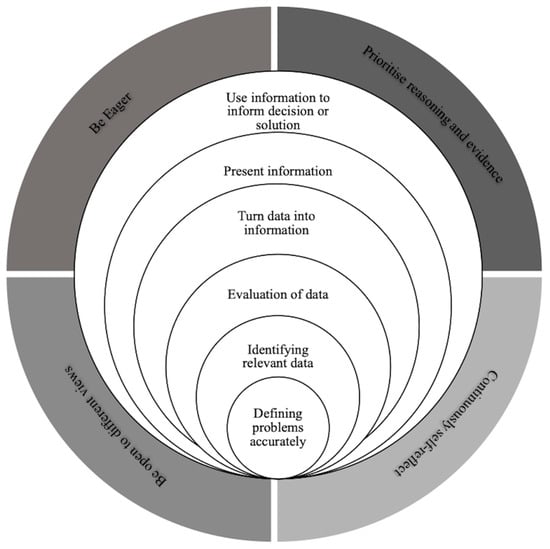
- The process resulted in seven final themes, as presented in Figure 1.Figure 1. CTS in accounting components.
- Defining problems accurately (Section 4.1)
- Identifying relevant data (Section 4.2)
- Evaluation of data (Section 4.3)
- Turning data into information (Section 4.4)
- Presenting information (Section 4.5)
- Using information to inform for decision-making (Section 4.6)
An additional theme, Attitudes required to engage with the process (Section 4.7), were identified across all six themes, serving as the foundational theme, including dispositions such as being eager, being open to different views, continuously self-reflecting and prioritising reasoning and evidence.
- Step 6: The final themes
The final themes were used to structure Section 4. Quotations from Academic Stakeholders (ASs), Employer Stakeholders (ESs) and Professional Body Stakeholder (PBSs) were included to illustrate each theme and demonstrate how they emerged from the data.
4. Results and Discussion
This section presents and interprets the seven themes that emerged from the interviews. Each theme is supported by an illustrative quotation and discussed in relation to the existing literature and the broader context of accounting education. The seven themes that emerged as an aligned definition of CTS among the key stakeholders are presented in Figure 1.
4.1. Defining Problems Accurately
Participants repeatedly emphasised the importance of problem formulation when confronted with data. They stressed the importance of accounting graduates and students being able to accurately define the nature of the problem that they are attempting to solve before applying any logic to it. The most significant emphasis on defining problems accurately was the need for students to engage in problem identification and formulation without any explicit guidance.
“To identify the problem themselves. We often, and I mean I was guilty of that when I was a lecturer as well, tell students what the problem is, so we package everything together: the problem, how the problem should be solved, and how it is solved altogether in a transfer of knowledge exercise. But they should learn to identify the problem themselves.”(PBS 4)
This theme aligns with various problem-solving models, specifically that of Normand and Dudley (2004), who emphasise that the first step in solving a problem is to identify, define, and represent the problem accurately. Defining problems accurately enables one to identify the relevant data to solve the problem or come to a conclusion. Practically, this suggests that accounting education should expose students to more ill-structured or ill-defined problems, encouraging them to ask clarifying questions and use diagnostic reasoning before solving them. Participants’ emphasis on defining the problem rather than simply answering a question suggests a disconnect between how CT is assessed in academic settings and how it is expected in professional practice. This suggests that assessments in accounting curricula should be reconsidered. This is especially important in the accounting profession, where poorly defined problems can lead to misaligned audits, budgetary errors, and miscommunication in client advisory. Participants stated that accurately identifying a problem or issue is the foundation for the subsequent step of CT, which is acquiring and evaluating relevant facts.
4.2. Identifying Relevant Data
Once the problem is clearly defined, stakeholders expect students to gather relevant data to solve the problem. Identifying relevant data requires students and graduates to carefully review the facts presented to them and select only the data that are important in addressing the problem at hand. This process is not just about the collection of data for its own sake but about knowing what information matters and what does not in each context.
“So, the ability to judge, the ability to use information, using the correct information correctly”.(Academic Stakeholder, AS 1)
The stakeholders indicated that this skill is especially important as it will help students or graduates navigate the increasing amount of data generated by various technologies, in light of the growing prevalence of misinformation and the rise of “fake news” (Calma & Davies, 2021). Owing to the increase in information and data from many sources, businesses seek individuals who can recognise when information is needed, evaluate its reliability and usefulness, and organise it so that it can be analysed and used for decision-making (Moffitt et al., 2018; Qasim et al., 2020; Sestino & De Mauro, 2022). This theme aligns with the analysis and inference dimensions of the Delphi definition (P. Facione, 1990) and CT research in accounting, which emphasises data prioritisation under time constraints (Barac & Du Plessis, 2019).
Thematic interpretation suggests that stakeholders see CT as essentially selective, as data must be selected, weighted, and prioritised based on relevance, reliability, and the decision context. Therefore, accounting education should emphasise data filtering and analytic reasoning, where students must justify their selection of data and facts. Furthermore, identifying the relevant data and their sources would enable one to critically evaluate the information before using it for decision-making, linking closely to the next theme of evaluating data.
4.3. Evaluation of Data
Linked to the increase in data and the potential for misinformation, judging the validity, completeness, and bias of the data was identified as an important part of CT. The evaluation of data is concerned with assessing the credibility of the data presented to students to ensure that it is complete, accurate, and can be used in decision-making or solving problems. The integrity of the data is critical, as inaccurate information can compromise the quality of decisions. The stakeholders emphasised that the evaluation process should begin with examining the sources from which the data originated as well as evaluating its consistency within the broader disciplinary context. Examining sources also includes assessing the purpose and intended use of the data presented to them. Ascertaining the original use of data could reveal underlying biases present in the data. The stakeholders indicated that such biases could affect the data itself and its interpretation.
But if we think about what an entry-level accountant or trainee needs to have, they need the core underlying of how the information gets there and how they audit that information.(AS 3)
This theme aligns with P. Facione’s (1990) evaluation and self-regulation components, as well as the literature on professional scepticism, which is identified as a core skill in accounting practice by professional bodies. Collectively, all the components that the stakeholders identified as requirements for evaluating information also aligned with the cognitive components identified by Kimmel (1995) in their framework for CT in accounting. CTS includes gathering and seeking information, as well as questioning and investigating the information before using it (Chan, 2013). In addition, CT also includes understanding the implications and consequences of information and the decisions made based on the said information (Sinnewe et al., 2023).
“Another important component of evaluating data was assessing whether the data were consistent with the existing information that the students or graduates knew. You need to understand either the perspective it’s been written on, or you need to explore writings or concepts from various perspectives”(ES 3)
This process of evaluation is foundational in accounting, especially due to the increase in data from various sources. As noted in the literature review, businesses now seek individuals who can recognise when information is needed, evaluate its reliability, and organise it for decision-making purposes. Consequently, the curriculum should go beyond providing students with relevant information and include opportunities for students to question source motives, organise the needed data, and understand the implications of incomplete data. Accounting education must move beyond “what” to think and begin scaffolding “how to evaluate” the reliability of both qualitative and quantitative data. Academics can include these through activities which require students to triangulate sources, perform bias assessments and carry out judgement tasks in modules such as auditing and financial reporting.
4.4. Turning Data into Information
Turning data into information was consistently emphasised by academics as the core aspect of CT. This includes applying higher-order thinking skills, such as analysis, and applying concepts or principles to various contexts. This process involves breaking off problems into different components, engaging deeply with the available data, comparing evaluating and synthesising the data and ultimately using the insights obtained in making well-reasoned judgments.
“So, I think what I’m what I’m honing on in here is analytical thinking and thinking about the big picture and the implications of the information that we generate as accountants.”(AS 4)
This aligns with P. Facione (1990) inference components. The inference process is concerned with using information to arrive at reasonable and logical conclusions. In the literature, this part of CT is referred to as cognitive components or the actual actions involved in making decisions about solving problems (Constantino & Rodzinka, 2022). In practice, this implies that students must be given opportunities to construct meaning from data through integrated studies, role play, or simulations that demand not just calculations but also interpretations of these calculations together with other information.
4.5. Presenting Information
Participants stressed that CT extends beyond analysis and includes communicating reasoning used in the process. According to the participants, the student’s capacity to present or articulate their decision or solution logically and cohesively is crucial and a key indicator of effective communication skills. They also emphasised the importance of graduates being able to identify the specific stakeholders who would utilise the information and determining appropriate methods for presenting the information to them in a manner that facilitates stakeholder comprehension.
“And you know, you’ve got to be able to take the opinion that you formed or the facts that you’ve extracted or whatever you’ve done with that content and be able to transfer that knowledge and that information onto another party in an understandable way. I think if we do not consider those other softer skills, then we are failing the students as well.”(AS 6)
Therefore, according to the stakeholders, communication was an important component of CT as it provided a way for the student or graduate to demonstrate the thought process involved in CT. This is strongly related to the explanation component of Facione’s approach, and research shows that structured written and oral communication improves both perceived and real CT capacity (Mhlongo, 2020). Our findings extend the literature on the importance of communication in accounting to highlight the need to demonstrate the thought process when engaging in CT to make a decision or solve a problem.
4.6. Using Information to Inform Decisions or Solutions
All participants consistently emphasised that CT should result in a well-reasoned decision and rather than remaining at the level of analysis and evaluation.
“Now, if I can just emphasise, I think we are doing a disservice to students and employers if we send them out here into the market and you know they aren’t able to critically think, solve problems and analyse information to form an opinion.”(AS 6)
Another important element in using the information is the need to consider the objectives or interests of the various stakeholders who could be affected by the decision and analysing the data together with the consideration of the stakeholders. The academics also emphasised the evaluation and synthesis levels of Bloom’s taxonomy. Evaluation involves judging the value of information (Krathwohl, 2010) while synthesis level focuses on integrating different elements to provide a complete picture and understanding. This integrative process aligns closely with inference (P. Facione, 1990). Inference is concerned with using information to arrive at reasonable and logical conclusions from available information. This theme supports the argument in literature that the role of accountants has evolved beyond the preparation of financial information. Accountants are increasingly now also expected to also provide strategic analysis and serve as business analysts and partners across cross-functional teams (Jackson et al., 2022). Accordingly, accounting education must move towards designing learning environments and assessments that reflect real-world contexts with complexity, ambiguous data, ethical trade-offs, and competing stakeholder interests. Requiring students to select and defend a course of action in such contexts prepares students to apply CT in practice. Developing students’ ability to identify and evaluate information and take responsibility for judgement-based decisions is important for accounting graduates. However, for students to meaningfully engage in using information, it is important for them to be disposed to applying their CTS.
4.7. Attitudes Required to Engage in Critical Thinking
Across stakeholder groups, participants emphasised the importance of attitudes and dispositions, highlighting that CT is not only a set of skills, but also a mindset issue. Employer Stakeholders commented that these attitudes were evident in graduates who actively sought to engage in CT. This aligns with the literature, which emphasises the role of attitudes such as inquisitiveness, intellectual curiosity, and the desire to know as important for engaging in CT (Kimmel, 1995; Terblanche & De Clercq, 2021). A key attitude emphasised by stakeholders was eagerness to find the best information in a situation. The stakeholders used words such as “inquisitiveness”, “hunger to learn”, “having a questioning mind”, “eager”, and “curious”, among other terms. As one stakeholder commented:
“So, the behaviours would be someone that has an inquiring mind…They really want to apply their mind. So, it is not just, you know, pulling numbers together; it is actually to understand what these numbers mean.”(ES 2)
One stakeholder also noted that this eagerness was evident in the way students approached questions in their academic or professional assessments:
“Finding new creative solutions rather than merely choosing the best solution from a list of alternatives.”(PBS4)
Eagerness to find the best information requires students and graduates to prioritise the use of reasoning and evidence to solve problems while remaining open to different perspectives during this process. One employer stakeholder noted that prioritising reasoning is often evident during an interview, particularly in how a graduate would respond to questions posed to them, stating:
“Again, it is not about the right answer; it is around what you process to get to that point”.(ES 4)
Similarly, Rogaten et al. (2019) emphasised that a learner’s inquisitiveness is evidenced by their eagerness to find the best information in any given situation. Additionally, being open to different views further requires one to be open-minded, which, in turn, enables an individual to become aware of their own biases through self-reflection. According to the stakeholders, self-reflection was not only important for identifying biases but also for evaluating why a certain formulated solution was effective or ineffective.
“But also, we also look at it as a point of, are they able to self-reflect to see if, in the situation that, their original assumption may not have held true and they’re able to adapt and to change and to see a new point of view”.(ES 3)
In line with the stakeholder perspective, the literature suggests that being open-minded is important for CT as it promotes authentic openness to new ideas, supports their critical evaluation, and encourages a willingness and eagerness to change one’s beliefs based on evidence. Self-reflection, in turn, helps one apply CT with an awareness of alternative findings or solutions (Dwyer et al., 2014). Given the emphasis placed on dispositions by both the literature and stakeholders, it is suggested that accounting education should extend beyond solely focusing on developing cognitive skills and actively cultivate these attitudes. Although the literature indicates that attitudes are the most difficult to cultivate, pedagogical approaches such as reflection journals, structured feedback loops, and group debrief can support the development of self-awareness and cultivate these attitudes.
Collectively, these findings suggest that CT in accounting should be understood as a multi-dimensional construct that integrates cognitive skills, processes, dispositions, and the influence of various contexts. Therefore, CT in accounting can be conceptualised as a structured, iterative, and reflective process through which individuals define problems, identify and evaluate relevant data, transform data into meaningful information, and use this information to make and justify sound decisions. This process concludes with clear communication of insights and is underpinned by dispositions such as inquisitiveness, open-mindedness, and reflective judgement, which enable one to effectively engage with large volumes of data in complex and uncertain environments.
5. Conclusions
This study aimed to develop an aligned definition of CT as perceived by key stakeholders in accounting education, specifically academics, employers, and professional bodies. Utilising qualitative interview data analysed through thematic analysis, seven interconnected core dimensions of CT were identified: (Section 4.1) defining problems accurately, (Section 4.2) identifying relevant data, (Section 4.3) evaluation of data, (Section 4.4) turning data into information, (Section 4.5) using information to inform decision or solution, (Section 4.6) presenting the information and (Section 4.7) attitudes necessary for in engaging in CT. Importantly, attitudes, emerged as an transcending, emphasising that a willingness to think critically is fundamental at every stage of the process.
Collectively, these findings conceptualise CT in accounting as a structured and iterative process involving problem definition, data evaluation, data transformation, decision-making, and communication, underpinned by dispositions such as inquisitiveness, open-mindedness and reflective judgement. This conceptualisation emphasises the importance of accounting education moving beyond a narrow focus on technical knowledge, as its standalone significance is increasingly limited, towards a deliberate and explicit integration of soft skills, such as CT into the curriculum.
This study contributes to the accounting education literature by responding to calls for stronger alignment between curriculum design, assessment practices and the evolving real-world demands placed on graduates. It also expands the CT literature by demonstrating the continued relevance of established frameworks, such as those proposed by Kimmel (1995) while also highlighting the growing importance of evaluating data for credibility and substance in an era characterised by increasing data availability and risks of misinformation and disinformation.
These findings have multiple practical implications for practice. Curriculum designers should explicitly embed CT within technical accounting modules using ill-structured problems and simulated workplace tasks and activities. Lecturing approaches should actively aim to cultivate dispositions such as inquisitiveness, open-mindedness, and self-reflection, through structured reflective practices and feedback mechanisms. Assessment practices should extend beyond correctness to rewarding evidence of logical reasoning, evidence-based judgement, and clear justifications for decisions or answers. Concurrently, professional bodies should consider refining their competency frameworks to make the expectations and assessment of CT more explicit and discipline-specific.
These recommendations are particularly relevant in the context of increasing environmental complexity in the and technological disruptions, where accounting professionals are required to operate as analysts and strategic partners rather than solely as preparers of financial information.
Although this study offers significant insights, several limitations must be acknowledged. The focus on South African stakeholders may limit the transferability of findings to other contexts. Additionally, while the study provides a theoretically grounded and stakeholder aligned definition of CT in accounting, it does not suggest ways to operationalise the definition. Therefore, future studies should focus on developing and testing pedagogical and assessment interventions that operationalise this definition in practice.
In conclusion, this study demonstrated that CT in accounting is not a single skill but a multifaceted, context-dependent capability. Addressing this complexity requires a shift in how CT is conceptualised, taught, and assessed, moving towards integrated, practice orientated and reflective approaches that more accurately reflect the demands of the profession.
Author Contributions
Conceptualization, L.M.-H.M.; Methodology, L.M.-H.M.; Formal Analysis, L.M.-H.M.; Writing—Original Draft, L.M.-H.M.; Writing—Review and Editing, B.M. and T.M.; Supervision, B.M. and T.M. All authors have read and agreed to the published version of the manuscript.
Funding
This research received no external funding.
Institutional Review Board Statement
This study was conducted in accordance with the Declaration of Helsinki and approved by the School of Accounting Research Ethics Committee at the University of Johannesburg (SAREC20220524/04 and 24 May 2022).
Informed Consent Statement
Informed consent was obtained from all subjects involved in this study.
Data Availability Statement
The data presented in this study are available on request from the corresponding author.
Conflicts of Interest
The authors declare no conflict of interest.
Abbreviations
The following abbreviations are used in this manuscript:
| AS | Academic Stakeholder |
| CT | Critical Thinking |
| CTS | Critical Thinking Skills |
| ES | Employer Stakeholder |
| PBS | Professional Body Stakeholder |
References
- Al-Htaybat, K., von Alberti-Alhtaybat, L., & Alhatabat, Z. (2018). Educating digital natives for the future: Accounting educators’ evaluation of the accounting curriculum. Accounting Education, 27, 333–357. [Google Scholar] [CrossRef] [Scilit]
- Asonitou, S., & Hassall, T. (2019). Which skills and competences to develop in accountants in a country in crisis? International Journal of Management Education, 17, 100308. [Google Scholar] [CrossRef] [Scilit]
- Barac, K., & Du Plessis, L. (2019). Teaching pervasive skills to South African accounting students. Southern African Business Review, 18, 53–79. [Google Scholar] [CrossRef] [Scilit] [PubMed]
- Baril, C. P., Cunningham, B. M., Fordham, D. R., Gardner, R. L., & Wolcott, S. K. (1998). Critical thinking in the public accounting profession: Aptitudes and attitudes. Journal of Accounting Education, 16(3–4), 381–406. [Google Scholar] [CrossRef] [Scilit]
- Braun, V., & Clarke, V. (2006). Using thematic analysis in psychology. Qualitative Research in Psychology, 3, 77–101. [Google Scholar] [CrossRef] [Scilit]
- Brink, W. D., & Stoel, M. D. (2018). Analytics knowledge, skills, and abilities for accounting graduates. In T. G. Calderon (Ed.), Advances in accounting education: Teaching and curriculum innovations (Vol. 22). Emerald Publishing Limited. [Google Scholar] [CrossRef] [Scilit]
- Calma, A., & Davies, M. (2021). Critical thinking in business education: Current outlook and future prospects. Studies in Higher Education, 46, 2279–2295. [Google Scholar] [CrossRef] [Scilit]
- Chan, Z. C. Y. (2013). A systematic review of critical thinking in nursing education. Nurse Education Today, 33, 236–240. [Google Scholar] [CrossRef] [Scilit]
- Constantino, L., & Rodzinka, J. (2022). The role of soft skills in employability in the financial industry. Financial Internet Quarterly, 18, 44–55. [Google Scholar] [CrossRef] [Scilit]
- Cooper, L. A., Holderness, D. K., Sorensen, T. L., & Wood, D. A. (2019). Robotic process automation in public accounting. Accounting Horizons, 33, 15–35. [Google Scholar] [CrossRef] [Scilit]
- Creswell, J., & Poth, C. (2016). Qualitative inquiry& research design choosing among five approaches (2nd ed., Vol. 3). SAGE Publications. [Google Scholar]
- de Bruyn, M. (2023). Emotional intelligence capabilities that can improve the non-technical skills of accounting students. Accounting Education, 32, 61–89. [Google Scholar] [CrossRef] [Scilit]
- De Villiers, R. (2021). Seven principles to ensure future-ready accounting graduates—A model for future research and practice. Meditari Accountancy Research, 29, 1354–1380. [Google Scholar] [CrossRef] [Scilit]
- Dolce, V., Emanuel, F., Cisi, M., Ghislieri, C., Dolce, V., Emanuel, F., Cisi, M., Ghislieri, C., Dolce, V., & Emanuel, F. (2020). The soft skills of accounting graduates: Perceptions versus expectations. Accounting Education, 29, 57–76. [Google Scholar] [CrossRef] [Scilit]
- Douglas, S., & Gammie, E. (2019). An investigation into the development of non-technical skills by undergraduate accounting programmes. Accounting Education, 28, 304–332. [Google Scholar] [CrossRef] [Scilit]
- Dwaase, D. A., Awotwe, E., & Smith, E. O. (2020). Skills requirements of the professional accountant in a changing work environment. IOSR Journal of Humanities And Social Science (IOSR-JHSS), 25, 12–17. Available online: https://www.iosrjournals.org/iosr-jhss/papers/Vol.25-Issue12/Series-7/C2512071217.pdf (accessed on 6 March 2026).
- Dwyer, C. P., Hogan, M. J., & Stewart, I. (2014). An integrated critical thinking framework for the 21st century. Thinking Skills and Creativity, 12, 43–52. [Google Scholar] [CrossRef] [Scilit]
- Ennis, R. (2013). Critical thinking across the curriculum. Inquiry: Critical Thinking Across the Disciplines, 28, 25–45. [Google Scholar] [CrossRef] [Scilit]
- Ennis, R. H. (1985). A logical basis for measuring critical thinking skills. Educational Leadership, 43(2), 44–48. [Google Scholar]
- Facione, P. (1990). Critical thinking: A statement of expert consensus for purposes of educational assessment and instruction (The Delphi Report). T. C. A. Press. Available online: https://stearnscenter.gmu.edu/wp-content/uploads/12-The-Delphi-Report-on-Critical-Thinking.pdf?__cf_chl_tk=5zQHiJjYhuaGPNsmwwAndIy3Sp9hSmsfuuw6i6ZL_BQ-1776807894-1.0.1.1-41xoxw1uvGP8GtL2kAXucPbKeKMjmvdJrYneah2.1Iw (accessed on 6 March 2026).
- Facione, P. A. (2011). Critical thinking: What it is and why it counts. Insight Assessment, 1(1), 1–23. Available online: https://www.researchgate.net/profile/Peter-Facione/publication/251303244_Critical_Thinking_What_It_Is_and_Why_It_Counts/links/5849b49608aed5252bcbe531/Critical-Thinking-What-It-Is-and-Why-It-Counts.pdf?origin=publication_detail&_tp=eyJjb250ZXh0Ijp7ImZpcnN (accessed on 6 March 2026).
- Giacomini, D., Rocca, L., & Tonoli, D. (2025). Exploring materiality and stakeholder engagement in European water utilities’ sustainability strategies, organizational practices, and reporting. Business Strategy and the Environment, 34(2), 2607–2629. [Google Scholar] [CrossRef] [Scilit]
- Goh, C., Pan, G., Seow, P. S., LEE, B. H. Z., & Yong, M. (2019). Charting the future of accountancy with AI. CPA Australia. [Google Scholar]
- Halpern, D. F. (2013). Thought and knowledge: An introduction to critical thinking (5th ed., pp. 1–637). Taylor and Francis. [Google Scholar] [CrossRef] [Scilit]
- Howcroft, D. (2017). Graduates’ vocational skills for the management accountancy profession: Exploring the accounting education expectation-performance gap. Accounting Education, 26, 459–481. [Google Scholar] [CrossRef] [Scilit]
- Huffman, K., Williams, B., & Vernoy, M. (1991). Psychology in action (2nd ed., pp. 1–679). Wiley. [Google Scholar]
- Jackling, B., & De Lange, P. (2009). Do accounting graduates’ skills meet the expectations of employers? A matter of convergence or divergence. Accounting Education, 18, 369–385. [Google Scholar] [CrossRef] [Scilit]
- Jackson, D., & Meek, S. (2021). Embedding work-integrated learning into accounting education: The state of play and pathways to future implementation. Accounting Education, 30(1), 63–85. [Google Scholar] [CrossRef] [Scilit]
- Jackson, D., Michelson, G., & Munir, R. (2022). Developing accountants for the future: New technology, skills, and the role of stakeholders. Accounting Education, 32(2), 150–177. [Google Scholar] [CrossRef] [Scilit]
- Jones, A. (2010). Generic attributes in accounting: The significance of the disciplinary context. Accounting Education, 19(1–2), 5–21. [Google Scholar] [CrossRef] [Scilit]
- Kavanagh, M., & Drennan, L. (2008). What skills and attributes does an accounting graduate need? Evidence from student perceptions and employer expectations. Accounting & Finance, 48, 279–300. [Google Scholar] [CrossRef] [Scilit]
- Khan, W. Z., Rehman, M. H., Zangoti, H. M., Afzal, M. K., Armi, N., & Salah, K. (2020). Industrial internet of things: Recent advances, enabling technologies and open challenges. Computers & Electrical Engineering, 81, 106522. [Google Scholar] [CrossRef] [Scilit]
- Kimmel, P. (1995). A framework for incorporating critical thinking into accounting education. Journal of Accounting Education, 13(3), 299–318. [Google Scholar] [CrossRef] [Scilit]
- Kokina, J., & Blanchette, S. (2019). Early evidence of digital labor in accounting: Innovation with robotic process automation. International Journal of Accounting Information Systems, 35, 100431. [Google Scholar] [CrossRef] [Scilit]
- Krathwohl, D. R. (2010). A revision of bloom’s taxonomy: An overview. Theory into Practice, 41, 212–218. [Google Scholar] [CrossRef] [Scilit]
- Kurfiss, J. G. (1988). Critical thinking: Theory, research, practice, and possibilities (ashe-eric higher education report No. 2). ERIC. Available online: https://eric.ed.gov/?id=ED304041 (accessed on 6 March 2026).
- Lansdell, P., Marx, B., & Mohammadali-Haji, A. (2020). Professional skills development during a period of practical experience: Perceptions of accounting trainees. South African Journal of Accounting Research, 34, 115–139. [Google Scholar] [CrossRef] [Scilit]
- Lubbe, I. (2020). Towards a global model of accounting education—A South African case study. Journal of Accounting in Emerging Economies, 10, 601–620. [Google Scholar] [CrossRef] [Scilit]
- McPeck, J. (1981). Critical thinking and education. In Issues and ideas in educational series (pp. 1–170). Martin Robertson. [Google Scholar]
- Mhlongo, F. (2020). Pervasive skills and accounting graduates’ employment prospects: Are South African employers calling for pervasive skills when recruiting? Journal of Education (University of KwaZulu-Natal), 80, 49–71. [Google Scholar] [CrossRef] [Scilit]
- Moffitt, K. C., Rozario, A. M., & Vasarhelyi, M. A. (2018). Robotic process automation for auditing. Journal of Emerging Technologies in Accounting, 15, 1–10. [Google Scholar] [CrossRef] [Scilit]
- Möller, K., Schäffer, U., & Verbeeten, F. (2020). Digitalization in management accounting and control: An editorial. Journal of Management Control, 31, 1–8. [Google Scholar] [CrossRef] [Scilit]
- Mphahlele, L., Benjamin, M., & Moloi, T. (2024). Critical thinking skills in accounting: A bibliometric analysis. In International Conference of Accounting & Business. Springer Nature. [Google Scholar]
- Mphahlele, L. M.-H. (2023). A framework for developing critical thinking skills for accounting students [Ph.D. thesis, University of Johannesburg]. Available online: https://www.proquest.com/openview/da2c328115e2cf497883d83e590f099c/1?pq-origsite=gscholar&cbl=2026366&diss=y (accessed on 6 April 2026).
- Normand, C. J., & Dudley, L. W. (2004). Teaching problem solving in accounting courses using a generic problem-solving model. Journal of Accounting & Finance Research, 12(2), 62–77. [Google Scholar]
- Paul, R. (1992). Critical thinking: What, why, and how. New Directions for Community Colleges, 1992(77), 3–24. [Google Scholar] [CrossRef] [Scilit]
- Penkauskienė, D., Railienė, A., & Cruz, G. (2019). How is critical thinking valued by the labour market? Employer perspectives from different European countries. Studies in Higher Education, 44, 804–815. [Google Scholar] [CrossRef] [Scilit]
- Qasim, A., Issa, H., El Refae, G. A., & Sannella, A. J. (2020). A model to integrate data analytics in the undergraduate accounting curriculum. Journal of Emerging Technologies in Accounting, 17, 31–44. [Google Scholar] [CrossRef] [Scilit]
- Qasim, A., & Kharbat, F. F. (2020). Blockchain technology, business data analytics, and artificial intelligence: Use in the accounting profession and ideas for inclusion into the accounting curriculum. Journal of Emerging Technologies in Accounting, 17, 107–117. [Google Scholar] [CrossRef] [Scilit]
- Quinn, S., Hogan, M., Dwyer, C., Finn, P., & Fogarty, E. (2020). Development and Validation of the Student-Educator Negotiated Critical Thinking Dispositions Scale (SENCTDS). In Thinking skills and creativity (Vol. 38, p. 100710). Elsevier Ltd. [Google Scholar]
- Rebele, J. E., & St. Pierre, E. K. (2019). A commentary on learning objectives for accounting education programs: The importance of soft skills and technical knowledge. Journal of Accounting Education, 48, 71–79. [Google Scholar] [CrossRef] [Scilit]
- Reinstein, A., & Bayou, M. E. (1997). Critical thinking in accounting education: Processes, skills and applications. Managerial Auditing Journal, 12(7), 336–342. [Google Scholar] [CrossRef] [Scilit]
- Rogaten, J., Rienties, B., Sharpe, R., Cross, S., Whitelock, D., Lygo-Baker, S., & Littlejohn, A. (2019). Reviewing affective, behavioural and cognitive learning gains in higher education. Assessment & Evaluation in Higher Education, 44, 321–337. [Google Scholar] [CrossRef] [Scilit]
- SAICA. (n.d.). ITC examinations. Available online: https://www.saica.org.za/become-a-member/future-members/exam-information (accessed on 22 August 2022).
- Sestino, A., & De Mauro, A. (2022). Leveraging artificial intelligence in business: Implications, applications and methods. Technology Analysis & Strategic Management, 34, 16–29. [Google Scholar] [CrossRef] [Scilit]
- Simpson, E., & Courtney, M. (2002). Critical thinking in nursing education: Literature review (Vol. 8, pp. 89–98). John Wiley & Sons, Ltd. [Google Scholar]
- Sinnewe, E., Yao, D., & De Zwaan, L. (2023). Developing critical thinking: An examination of contemporary practices in accounting. Accounting and Finance, 63, 403–425. [Google Scholar] [CrossRef] [Scilit]
- Steenkamp, G., & Brink, S. M. (2026). Defining critical thinking in financial accounting: Perceptions of students and lecturers. Journal of Accounting Education, 73, 101003. [Google Scholar] [CrossRef] [Scilit]
- Succi, C., & Canovi, M. (2019). Soft skills to enhance graduate employability: Comparing students and employers’ perceptions. Studies in Higher Education, 45, 1834–1847. [Google Scholar] [CrossRef] [Scilit]
- Tan, L. M., & Laswad, F. (2018). Professional skills required of accountants: What do job advertisements tell us? Accounting Education, 27, 403–432. [Google Scholar] [CrossRef] [Scilit]
- Tavares, M. C., Azevedo, G., Marques, R. P., & Bastos, M. A. (2023). Challenges of education in the accounting profession in the Era 5.0: A systematic review. Cogent Business & Management, 10(2), 2220198. [Google Scholar] [CrossRef] [Scilit]
- Tempone, I., Kavanagh, M., Segal, N., Hancock, P., Howieson, B., & Kent, J. (2012). Desirable generic attributes for accounting graduates into the twenty-first century: The views of employers. Accounting Research Journal, 25, 41–55. [Google Scholar] [CrossRef] [Scilit]
- Terblanche, E. A. J., & De Clercq, B. (2021). A critical thinking competency framework for accounting students. Accounting Education, 30(4), 325–354. [Google Scholar] [CrossRef] [Scilit]
- Terblanche, E. A. J., Shuttleworth, C. C., van Rooyen, A. A., & Masela, R. N. (2023). Critical thinking: Stakeholder expectations and challenges for Accountancy educators. South African Journal of Accounting Research, 37(3), 225–244. [Google Scholar] [CrossRef] [Scilit]
- Thonney, T., & Montgomery, J. C. (2019). Defining critical thinking across disciplines: An Analysis of community college faculty perspectives. College Teaching, 67, 169–176. [Google Scholar] [CrossRef] [Scilit]
- Tsiligiris, V., & Bowyer, D. (2021). Exploring the impact of 4IR on skills and personal qualities for future accountants: A proposed conceptual framework for university accounting education. Accounting Education, 30, 621–649. [Google Scholar] [CrossRef] [Scilit]
- Universities South Africa. (n.d.). South Africa’s 26 public universities. Available online: https://usaf.ac.za/prospective-students/#public-universities (accessed on 22 August 2022).

Disclaimer/Publisher’s Note: The statements, opinions and data contained in all publications are solely those of the individual author(s) and contributor(s) and not of MDPI and/or the editor(s). MDPI and/or the editor(s) disclaim responsibility for any injury to people or property resulting from any ideas, methods, instructions or products referred to in the content. |
© 2026 by the authors. Licensee MDPI, Basel, Switzerland. This article is an open access article distributed under the terms and conditions of the Creative Commons Attribution (CC BY) license.