AI-Assisted Career Preparation and Skill Gap Awareness: A Retrospective Pretest-Posttest Study

 ,
,  and
and
Abstract
1. Introduction
2. Literature Review
2.1. Skills, Skills Gaps, and Career Readiness
2.2. Approaches to Identifying Skills and Gaps
2.3. Career Development Theory
2.4. Stakeholder Roles in Career Preparation
2.5. Gap and Research Questions
3. Methodology
3.1. Career-Preparation Exercise
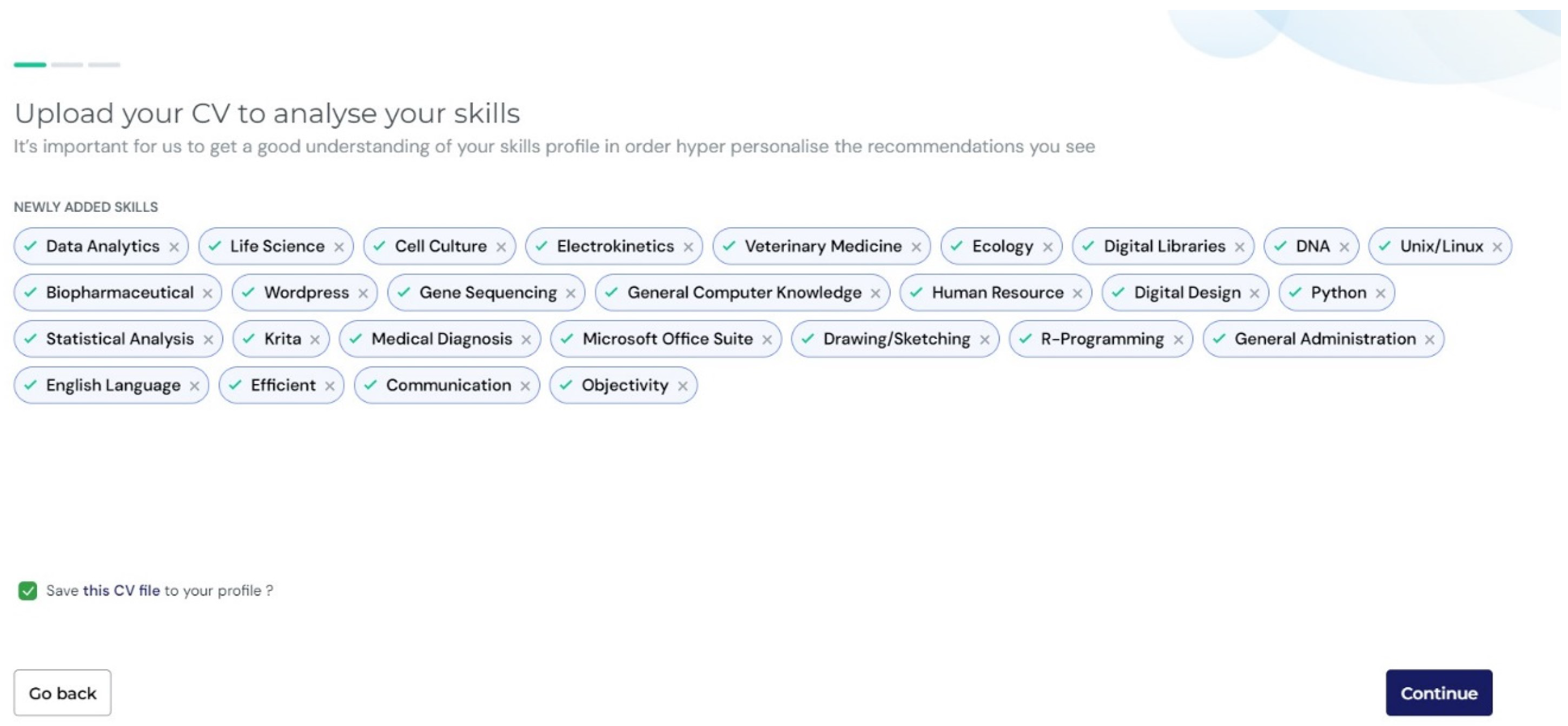
- Resume Upload for Skill Profiling: Students upload their resumes, which the platform uses to analyze and map out their skill sets (see Figure 1). This is the primary data source from prospective applicants. This process creates a personalized skills profile that identifies relevant strengths and competencies through AI methods. Students can add additional skills via a search bar or from recommended options.
- Pathway Exploration and Role Addition: Once the platform has created a skills profile, it presents students with possible career pathways to explore. Students also have the flexibility to manually add desired roles from a drop-down bar or choose from suggested roles.
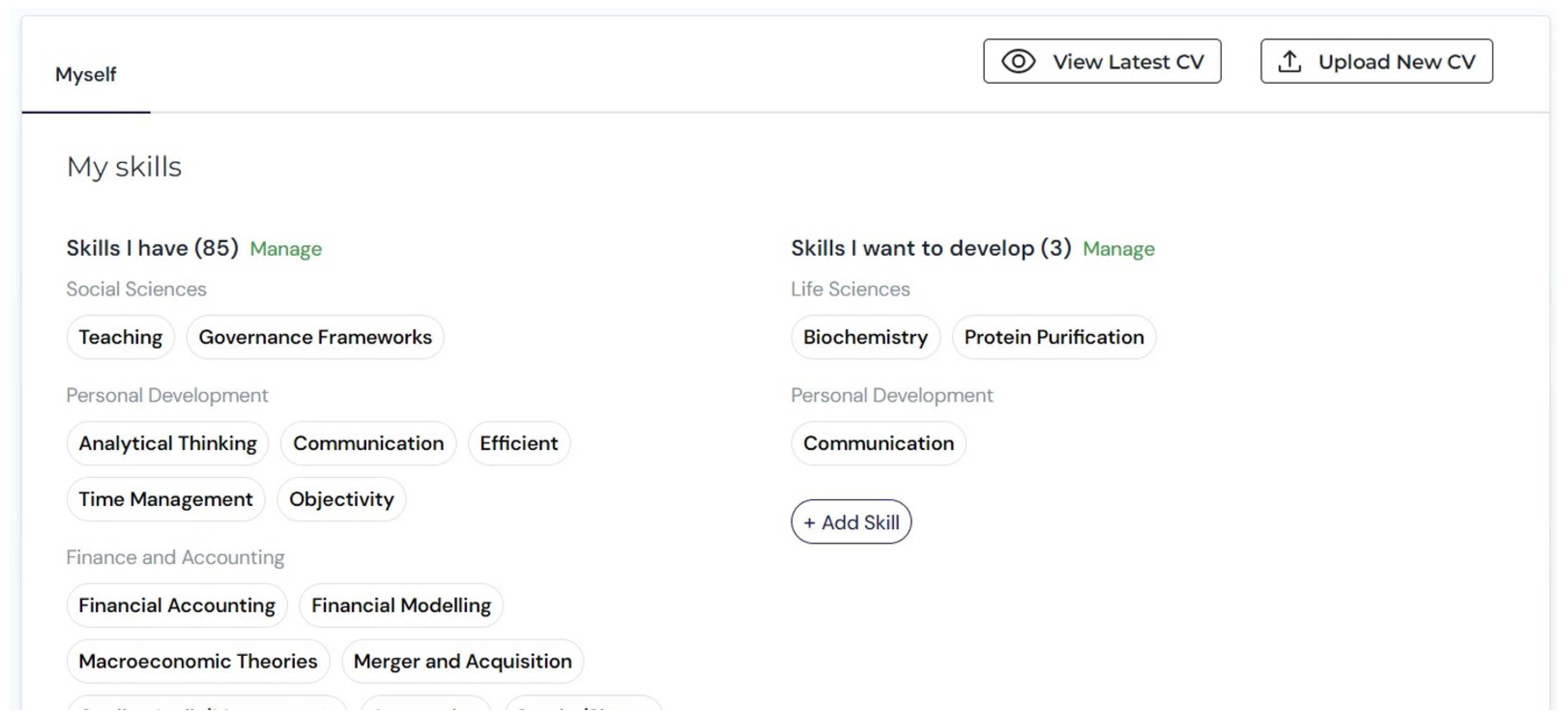
- Dynamic Skill Development Suggestions and Profile: Based on the student’s profile, the platform automatically identifies essential skills for development. Students can access a full overview of their current skills and see which ones they want to develop (see Figure 2). This provides a holistic understanding of where they stand and what areas need further growth.
- Tailored Internship Recommendations: The platform then recommends internship opportunities based on students’ current skill sets and their aspired roles. These recommendations are categorized into buckets that reflect how well the student’s skills align with various roles. A strong fit suggests that most of the student’s skills can be transferred to the role, making it a good match. These skills are extracted by proprietary AI technology that tags job descriptions, provided by employers, with appropriate skills.
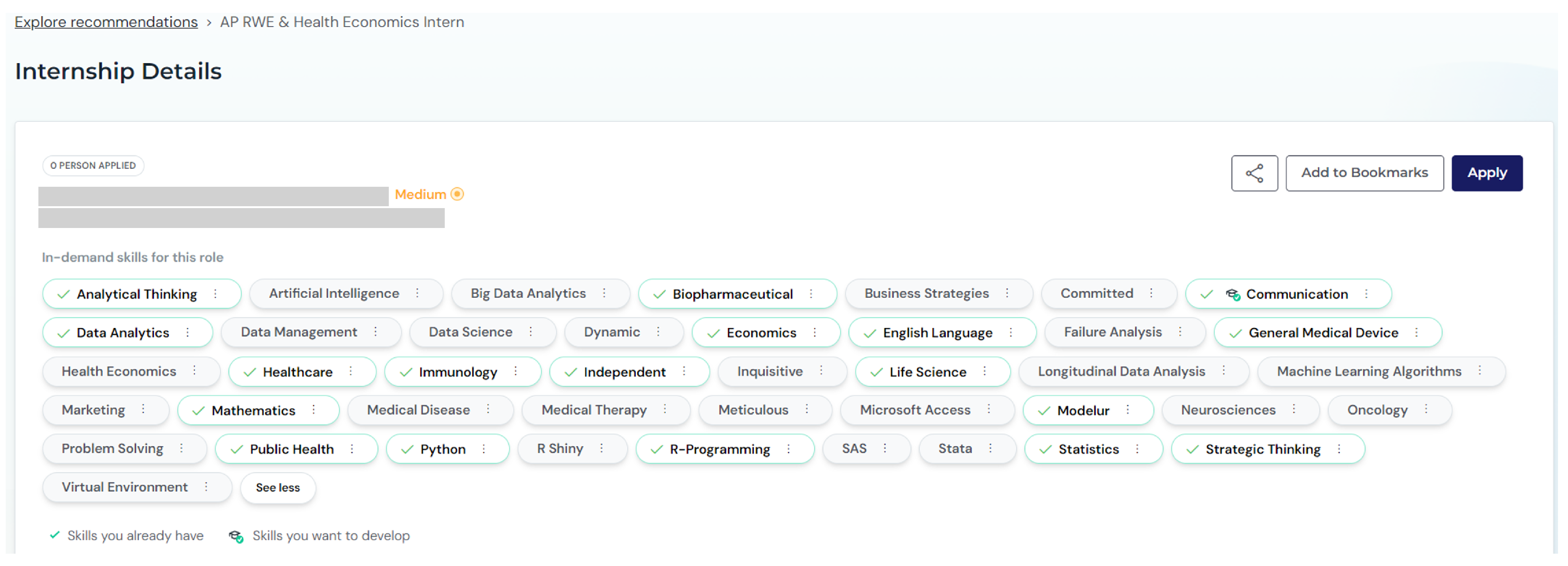
- Detailed Internship Insights: Students can click on any internship tile to view comprehensive details about the opportunity. This includes a breakdown of the skills required for the internship and highlights (in green) the skills the student already possesses, allowing them to see their strengths relative to the role requirements clearly (see Figure 3).
3.2. Survey-Based Data Collection
- Pre-exercise survey;
- Career preparation exercise with a customized career portal;
- Post-exercise survey.
3.3. Data Analysis
4. Results & Discussion
4.1. Pre-Exercise vs. Post-Exercise Comparative Responses
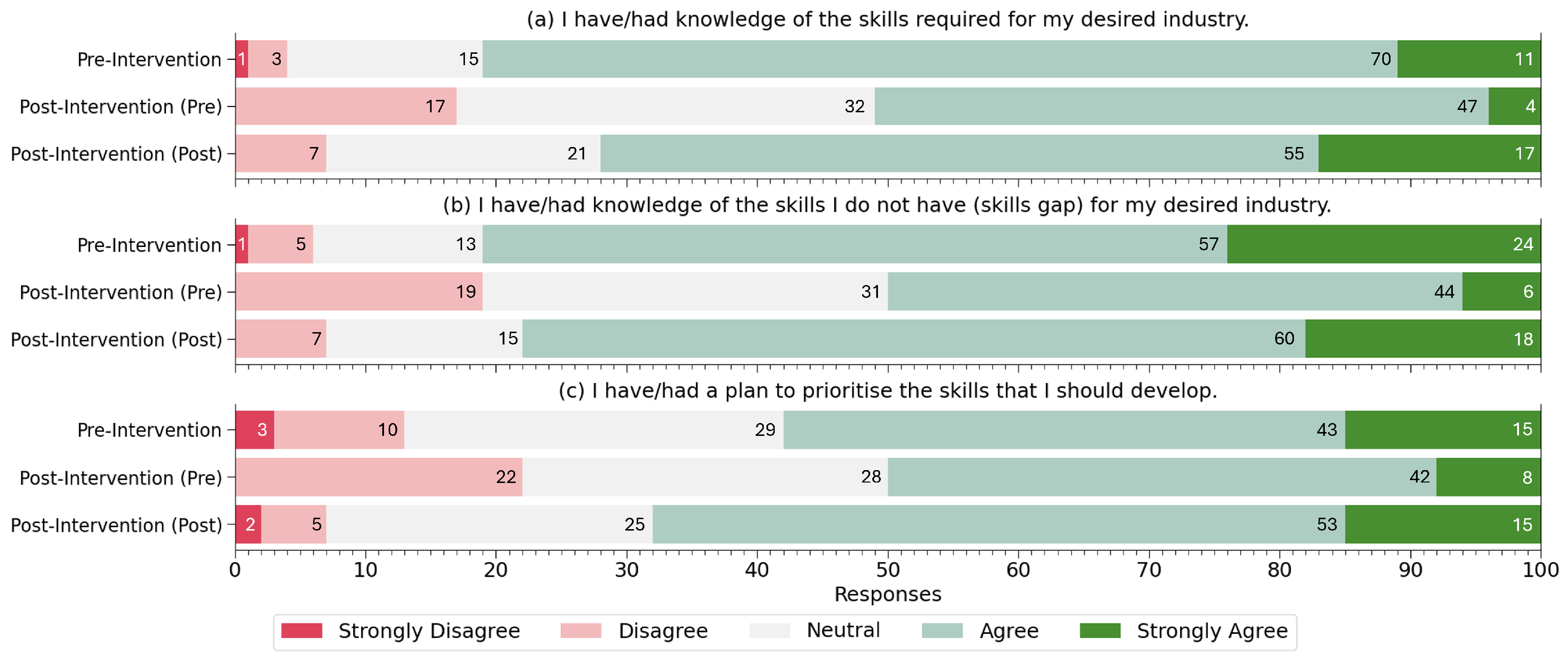
- Knowledge of skills required for one’s desired industry;
- Knowledge of skills gap to one’s desired industry;
- Plan to prioritize the skills one should develop.
4.2. Post-Exercise Retrospective Pretest Responses
4.3. Construct Perception Study
5. Implications and Future Work
5.1. Enhancing Career Platform Features
- By analyzing user behavior and feedback trace data, AI-driven personalization features can offer targeted recommendations that are more likely to influence decision-making.
- Adding features like decision trees, skill gap analysis tools, or interactive questionnaires could make the information more engaging and actionable. These tools could guide users through a structured process of identifying their needs and help them make informed decisions about their career development.
- Providing users with real-time updates on institution-wide academic and co-curricular activities and external courses classified by skill types relevant to their professional growth could further enhance the utility of career preparation platforms.
- Using ML algorithms, career preparation platforms could predict future skill gaps based on industry trends and user behavior, offering proactive recommendations to users on courses or skills they should focus on before these gaps become critical in the job market.
5.2. Improve Data-Driven Insights
5.3. Longitudinal and Regional Studies and Feedback Loops
5.4. Limitations
6. Conclusions
Author Contributions
Funding
Institutional Review Board Statement
Informed Consent Statement
Data Availability Statement
Acknowledgments
Conflicts of Interest
Appendix A

| I Had/Have... | |
|---|---|
| RET.A | knowledge of the skills I possessed. |
| RET.B | knowledge of the skills required for my desired industry. |
| RET.C | knowledge of the skills I do not have (skills gap) for my desired industry. |
| RET.D | a list of career options. |
| RET.E | a plan to prioritize the skills that I should develop. |
| RET.F | an action plan of the courses I should take. |
| RET.G | knowledge of resources that can help me research my career options. |
| RET.H | confidence in my ability to research career, employment, and available training. |
| RET.I | effective strategies to keep myself on track to achieve my educational and employment goals. |
| RET.J | confidence in my ability to manage future career changes. |
| Construct 1: Features and usability | |
| FEA.A | The app is user-friendly and easy to use. |
| FEA.B | I can intuitively navigate through the app. |
| FEA.C | I did not face any technical difficulties when using the app. |
| FEA.D | The app loads and operates at a speed I found satisfactory. |
| FEA.E | I am overall satisfied with the usability of the app. |
| FEA.F | I trust the app to correctly analyse my current skills. |
| FEA.G | I trust the app to correctly evaluate the skills required for the current job market. |
| Construct 2: Usefulness for career preparation and progression | |
| I will... | |
| CAR.A | use the app to facilitate my decision-making process on which course(s) I should take. |
| CAR.B | use the app to facilitate my decision on the internship I should apply for. |
| CAR.C | use the app to find out how to narrow my skills gap within my desired industry. |
| CAR.D | use the app to find out how to narrow my skills gap to facilitate a job change to another industry. |
| CAR.E | recommend other NTU students and alumni to use the app. |
References
- Abbas, J., & Sagsan, M. (2019). Identification of key employability attributes and evaluation of university graduates’ performance: Instrument development and validation. Higher Education, Skills and Work-Based Learning, 10(3), 449–466. [Google Scholar] [CrossRef] [Scilit]
- Akhtar, P., Moazzam, M., Ashraf, A., & Khan, M. N. (2024). The interdisciplinary curriculum alignment to enhance graduates’ employability and universities’ sustainability. The International Journal of Management Education, 22(3), 101037. [Google Scholar] [CrossRef] [Scilit]
- Braun, G., Rikala, P., Järvinen, M., Hämäläinen, R., & Stahre, J. (2024). Bridging skill gaps—A systematic literature review of strategies for industry. In Sustainable production through advanced manufacturing, intelligent automation and work integrated learning (pp. 687–696). IOS Press. [Google Scholar] [CrossRef] [Scilit]
- Bridgstock, R. (2009). The graduate attributes we’ve overlooked: Enhancing graduate employability through career management skills. Higher Education Research & Development, 28(1), 31–44. [Google Scholar] [CrossRef] [Scilit]
- Cappelli, P. H. (2015). Skill gaps, skill shortages, and skill mismatches: Evidence and arguments for the United States. ILR Review, 68(2), 251–290. [Google Scholar] [CrossRef] [Scilit]
- Chen, I.-C., Bradford, L., & Schneider, B. (2022). Learning career knowledge: Can AI simulation and machine learning improve career plans and educational expectations? In Ai in learning: Designing the future (pp. 137–158). Springer International Publishing. [Google Scholar] [CrossRef] [Scilit]
- Cho, E. (2016). Making reliability reliable: A systematic approach to reliability coefficients. Organizational Research Methods, 19(4), 651–682. [Google Scholar] [CrossRef] [Scilit]
- Cliff, N. (1993). Dominance statistics: Ordinal analyses to answer ordinal questions. Psychological Bulletin, 114(3), 494–509. [Google Scholar] [CrossRef]
- Cronbach, L. J. (1951). Coefficient alpha and the internal structure of tests. Psychometrika, 16(3), 297–334. [Google Scholar] [CrossRef] [Scilit]
- Davis, F. D. (1989). Perceived usefulness, perceived ease of use, and user acceptance of information technology. MIS Quarterly, 13(3), 319. [Google Scholar] [CrossRef] [Scilit]
- Gadermann, A., Guhn, M., & Zumbo, B. D. (2023). Ordinal alpha. In Encyclopedia of quality of life and well-being research (pp. 4865–4867). Springer International Publishing. [Google Scholar] [CrossRef] [Scilit]
- Garcia-Esteban, S., & Jahnke, S. (2020). Skills in European higher education mobility programmes: Outlining a conceptual framework. Higher Education, Skills and Work-Based Learning, 10(3), 519–539. [Google Scholar] [CrossRef] [Scilit]
- Ginzberg, E., Ginsburg, S. W., Axelrad, S., & Herma, J. L. (1951). Occupational choice: An approach to a general theory. Columbia University Press. [Google Scholar]
- Goulart, V. G., Liboni, L. B., & Cezarino, L. O. (2021). Balancing skills in the digital transformation era: The future of jobs and the role of higher education. Industry and Higher Education, 36(2), 118–127. [Google Scholar] [CrossRef] [Scilit]
- Hooley, T., Marriott, J., & Sampson, J. P., Jr. (2011). Fostering college and career readiness: How career development activities in schools impact on graduation rates and students’ life success (Technical Report). International Centre for Guidance Studies, University of Derby. [Google Scholar]
- Hora, M. T. (2016). Beyond the skills gap: Preparing college students for life and work. Harvard Educational Publishing Group. [Google Scholar]
- Howard, G. S., & Dailey, P. R. (1979). Response-shift bias: A source of contamination of self-report measures. Journal of Applied Psychology, 64(2), 144–150. [Google Scholar] [CrossRef]
- Howard, G. S., Ralph, K. M., Gulanick, N. A., Maxwell, S. E., Nance, D. W., & Gerber, S. K. (1979). Internal invalidity in pretest-posttest self-report evaluations and a re-evaluation of retrospective pretests. Applied Psychological Measurement, 3(1), 1–23. [Google Scholar] [CrossRef] [Scilit]
- Jiang, Z., Newman, A., Le, H., Presbitero, A., & Zheng, C. (2019). Career exploration: A review and future research agenda. Journal of Vocational Behavior, 110, 338–356. [Google Scholar] [CrossRef] [Scilit]
- Jones, K., Leonard, L. N. K., & Lang, G. (2016). Desired skills for entry level IS positions: Identification and assessment. Journal of Computer Information Systems, 58(3), 214–220. [Google Scholar] [CrossRef] [Scilit]
- Kang, D. (2023). Prioritizing career preparation: Learning achievements and extracurricular activities of undergraduate students for future success. Behavioral Sciences, 13(7), 611. [Google Scholar] [CrossRef] [Scilit]
- Karimi, H., & Pina, A. (2021). Strategically addressing the Soft skills gap among STEM undergraduates. Journal of Research in STEM Education, 7(1), 21–46. [Google Scholar] [CrossRef] [Scilit]
- Kim, J. (2021). Development and validation of the career adaptability scale for undergraduates in Korea. Sustainability, 13(19), 11004. [Google Scholar] [CrossRef] [Scilit]
- Kleckner, M. J., & Butz, N. (2020). Addressing undergraduate skill gaps in higher education: Revisiting communication in the major course outcomes. Journal of Education for Business, 96(7), 411–423. [Google Scholar] [CrossRef] [Scilit]
- Knight, P., & Yorke, M. (2003). Learning, curriculum and employability in higher education. Routledge. [Google Scholar] [CrossRef] [Scilit]
- Lahoud, C., Moussa, S., Obeid, C., Khoury, H. E., & Champin, P.-A. (2022). A comparative analysis of different recommender systems for university major and career domain guidance. Education and Information Technologies, 28(7), 8733–8759. [Google Scholar] [CrossRef] [Scilit]
- Lai, J. W., Zhang, L., Chan, Y. S., Sze, C. C., & Lim, F. S. (2024). Compelling educational offerings: A study on the efficacy of skills identification platforms with course descriptions. In Inted2024 proceedings. IATED. [Google Scholar] [CrossRef] [Scilit]
- Lai, J. W., Zhang, L., Sze, C. C., & Lim, F. S. (2025). Learning analytics for bridging the skills gap: A data-driven study of undergraduate aspirations and skills awareness for career preparedness. Education Sciences, 15(1), 40. [Google Scholar] [CrossRef] [Scilit]
- Lam, T. C., & Bengo, P. (2003). A comparison of three retrospective self-reporting methods of measuring change in instructional practice. The American Journal of Evaluation, 24(1), 65–80. [Google Scholar] [CrossRef] [Scilit]
- Lent, R. W., Brown, S. D., & Hackett, G. (1994). Toward a unifying social cognitive theory of career and academic interest, choice, and performance. Journal of Vocational Behavior, 45(1), 79–122. [Google Scholar] [CrossRef] [Scilit]
- Lewton, J., & Haddad, A. R. (2024). Pharmacy student perceptions of using AI-based interview software (big interview) for career preparation. American Journal of Pharmaceutical Education, 88(9), 101263. [Google Scholar] [CrossRef] [Scilit]
- Li, G., Yuan, C., Kamarthi, S., Moghaddam, M., & Jin, X. (2021). Data science skills and domain knowledge requirements in the manufacturing industry: A gap analysis. Journal of Manufacturing Systems, 60, 692–706. [Google Scholar] [CrossRef] [Scilit]
- Lim, Z. Y., Lai, J. W., Yap, J. H., Mishra, A., Mokhtar, I. A., Yeo, D. J., & Cheong, K. H. (2023a). Unraveling the dynamics of lifelong learning in Singapore: A comparative study. Knowledge, 3(3), 449–460. [Google Scholar] [CrossRef] [Scilit]
- Lim, Z. Y., Munshi, T., Yap, J. H., Mishra, A., Lai, J. W., Yeo, D. J., & Cheong, K. H. (2023b). Using opinion dynamics to identify groups for targeted intervention in lifelong learning: A case study of SkillsFuture in Singapore. International Journal of Modern Physics B, 38(20), 2450257. [Google Scholar] [CrossRef] [Scilit]
- Lim, Z. Y., Yap, J. H., Lai, J. W., Mokhtar, I. A., Yeo, D. J., & Cheong, K. H. (2024). Advancing lifelong learning in the digital age: A narrative review of Singapore’s skillsfuture programme. Social Sciences, 13(2), 73. [Google Scholar] [CrossRef] [Scilit]
- Lise, J., & Postel-Vinay, F. (2020). Multidimensional skills, sorting, and human capital accumulation. American Economic Review, 110(8), 2328–2376. [Google Scholar] [CrossRef] [Scilit]
- Little, T. D., Chang, R., Gorrall, B. K., Waggenspack, L., Fukuda, E., Allen, P. J., & Noam, G. G. (2019). The retrospective pretest–posttest design redux: On its validity as an alternative to traditional pretest–posttest measurement. International Journal of Behavioral Development, 44(2), 175–183. [Google Scholar] [CrossRef] [Scilit]
- Mainga, W., Murphy-Braynen, M. B., Moxey, R., & Quddus, S. A. (2022). Graduate employability of business students. Administrative Sciences, 12(3), 72. [Google Scholar] [CrossRef] [Scilit]
- Mann, H. B., & Whitney, D. R. (1947). On a test of whether one of two random variables is stochastically larger than the other. The Annals of Mathematical Statistics, 18(1), 50–60. [Google Scholar] [CrossRef] [Scilit]
- McGuinness, S., Pouliakas, K., & Redmond, P. (2018). Skills mismatch: Concepts, measurement and policy approaches. Journal of Economic Surveys, 32(4), 985–1015. [Google Scholar] [CrossRef] [Scilit]
- McManus, L., & Rook, L. (2019). Mixed views in the academy: Academic and student perspectives about the utility of developing work-ready skills through WIL. Studies in Higher Education, 46(2), 270–284. [Google Scholar] [CrossRef] [Scilit]
- Moran, N., & Ackerman, D. (2023). “Can AI really help me land a job?” Student reactions to the use of artificial intelligence in career preparation. Journal of Education for Business, 99(2), 103–112. [Google Scholar] [CrossRef] [Scilit]
- Nagarajan, S. V., & Edwards, J. (2015). The role of universities, employers, graduates and professional associations in the development of professional skills of new graduates. Journal of Perspectives in Applied Academic Practice, 3(2), 26–37. [Google Scholar] [CrossRef] [Scilit]
- Nghia, T. L. H. (2018). The skills gap of Vietnamese graduates and final-year university students. Journal of Education and Work, 31(7–8), 579–594. [Google Scholar] [CrossRef] [Scilit]
- OECD. (2023). Oecd employment outlook 2023: Artificial intelligence and the labour market. OECD Publishing. [Google Scholar] [CrossRef] [Scilit]
- Osipow, S. H. (1968). Theories of career development: A comparison of the theories (ERIC Number: ED026698). Appleton-Century-Crofts.
- Pratt, C. C., McGuigan, W. M., & Katzev, A. R. (2000). Measuring program outcomes: Using retrospective pretest methodology. The American Journal of Evaluation, 21(3), 341–349. [Google Scholar] [CrossRef] [Scilit]
- Qamhieh, M., Sammaneh, H., & Demaidi, M. N. (2020). PCRS: Personalized career-path recommender system for engineering students. IEEE Access, 8, 214039–214049. [Google Scholar] [CrossRef] [Scilit]
- Rêgo, B. S., Lourenço, D., Moreira, F., & Pereira, C. S. (2023). Digital transformation, skills and education: A systematic literature review. Industry and Higher Education, 38(4), 336–349. [Google Scholar] [CrossRef] [Scilit]
- Savickas, M. L. (2005). Career development and counseling: Putting theory and research to work (pp. 42–70). John Wiley & Sons, Inc. [Google Scholar]
- Siswipraptini, P. C., Warnars, H. L. H. S., Ramadhan, A., & Budiharto, W. (2024). Personalized career-path recommendation model for information technology students in Indonesia. IEEE Access, 12, 49092–49105. [Google Scholar] [CrossRef] [Scilit]
- Wilcoxon, F. (1945). Individual Comparisons by Ranking Methods. Biometrics Bulletin, 1(6), 80. [Google Scholar] [CrossRef] [Scilit]
- World Economic Forum. (2025). Future of jobs report 2025. Available online: https://www.weforum.org/publications/the-future-of-jobs-report-2025/ (accessed on 1 October 2023).
- Yorke, M. (2006). Employability in higher education: What it is, what it is not (Technical Report). Higher Education Academy. Available online: https://www.advance-he.ac.uk/knowledge-hub/employability-higher-education-what-it-what-it-not (accessed on 1 October 2023).


| Code † | W-Statistic | p-Value | |
|---|---|---|---|
| RET.A | < | ||
| RET.B | < | ||
| RET.C | < | ||
| RET.D | < | ||
| RET.E | < | ||
| RET.F | < | ||
| RET.G | < | ||
| RET.H | < | ||
| RET.I | < | ||
| RET.J | < |
| Code ‡ | Median | Mean | Std Dev | U-Statistic | p-Value | r |
|---|---|---|---|---|---|---|
| FEA.A | 4 | 3.56 | 0.891 | 7500 | < | 0.432 |
| FEA.B | 4 | 3.70 | 0.847 | 8050 | < | 0.527 |
| FEA.C | 4 | 3.53 | 0.937 | 7350 | < | 0.406 |
| FEA.D | 4 | 3.70 | 0.948 | 7900 | < | 0.501 |
| FEA.E | 4 | 3.75 | 0.744 | 8300 | < | 0.570 |
| FEA.F | 4 | 3.39 | 0.920 | 6850 | < | 0.320 |
| FEA.G | 4 | 3.44 | 0.925 | 7050 | < | 0.354 |
| CAR.A | 4 | 3.39 | 0.994 | 6800 | < | 0.311 |
| CAR.B | 4 | 3.81 | 0.907 | 8200 | < | 0.553 |
| CAR.C | 4 | 3.48 | 1.01 | 6850 | < | 0.320 |
| CAR.D | 4 | 3.52 | 1.02 | 7100 | < | 0.363 |
| CAR.E | 4 | 3.79 | 0.946 | 8000 | < | 0.518 |
| Construct | U-Statistic | p-Value | r | |
|---|---|---|---|---|
| FEA: Features and usability | 0.860 | 371,000 | < | 0.445 |
| CAR: Usefulness for career preparation | 0.827 | 184,750 | < | 0.414 |
Disclaimer/Publisher’s Note: The statements, opinions and data contained in all publications are solely those of the individual author(s) and contributor(s) and not of MDPI and/or the editor(s). MDPI and/or the editor(s) disclaim responsibility for any injury to people or property resulting from any ideas, methods, instructions or products referred to in the content. |
© 2026 by the authors. Licensee MDPI, Basel, Switzerland. This article is an open access article distributed under the terms and conditions of the Creative Commons Attribution (CC BY) license.
Share and Cite
Lai, J.W.; Gagero, R.D.H.; Zhang, L.; Sze, C.C.; Lim, F.S. AI-Assisted Career Preparation and Skill Gap Awareness: A Retrospective Pretest-Posttest Study. Educ. Sci. 2026, 16, 689. https://doi.org/10.3390/educsci16050689
Lai JW, Gagero RDH, Zhang L, Sze CC, Lim FS. AI-Assisted Career Preparation and Skill Gap Awareness: A Retrospective Pretest-Posttest Study. Education Sciences. 2026; 16(5):689. https://doi.org/10.3390/educsci16050689
Chicago/Turabian StyleLai, Joel Weijia, Roman Daniel Hernandez Gagero, Lei Zhang, Chun Chau Sze, and Fun Siong Lim. 2026. "AI-Assisted Career Preparation and Skill Gap Awareness: A Retrospective Pretest-Posttest Study" Education Sciences 16, no. 5: 689. https://doi.org/10.3390/educsci16050689
APA StyleLai, J. W., Gagero, R. D. H., Zhang, L., Sze, C. C., & Lim, F. S. (2026). AI-Assisted Career Preparation and Skill Gap Awareness: A Retrospective Pretest-Posttest Study. Education Sciences, 16(5), 689. https://doi.org/10.3390/educsci16050689