1. Introduction
1.1. Teacher Well-Being and Reform Priorities: A Global Perspective
This section situates the study within the international evidence linking teacher well-being to reform engagement, establishing why educators’ perspectives deserve systematic empirical attention. Rather than treating reform attitudes as purely policy-driven preferences, the literature increasingly suggests that they are shaped by teachers’ psychological well-being, career position, and individual differences—yet these relationships have rarely been examined jointly.
The well-being of educators has emerged as a critical priority in educational policy worldwide. There is mounting evidence linking educators’ psychological health, job satisfaction, and professional commitment to student outcomes, teacher retention, and the sustainability of education systems (
Viac & Fraser, 2020;
OECD, 2020;
Dreer, 2023). As education systems confront intricate challenges—including evolving pedagogical paradigms (
Alam, 2023), technological transformation (
Akram et al., 2022), mounting administrative burdens (
CooperGibson Research, 2023), and societal expectations (
Akiba et al., 2023;
Torres Soto et al., 2022)—it has become imperative to understand teachers’ perspectives on necessary reforms for the development of evidence-based policies (
Cheung & Xie, 2021). Teachers, as frontline practitioners, possess unique insights into systemic shortcomings and improvement priorities (
Csapó, 2007;
Felvinczi, 2023). However, the voices of teachers remain underrepresented in reform agendas (
European Commission/EACEA/Eurydice, 2021). A rigorous empirical investigation into the reform priorities identified by educators themselves, as well as the manner in which these priorities are related to their demographic characteristics, well-being, and personality traits, has the potential to inform more responsive and effective educational policy (
Greenberg et al., 2016;
Zhou et al., 2024). In short, although teacher well-being is increasingly recognized as a policy priority, the specific reform demands that teachers themselves articulate—and the individual characteristics shaping those demands—remain underexplored. This matters because reforms that do not account for teachers’ perspectives may face implementation resistance or fail to address the problems teachers consider most pressing.
1.2. Current Research on Teacher Well-Being, Demographics, and Reform Attitudes
Three bodies of research converge on the question of what shapes teachers’ reform priorities: studies of well-being, demographic analyses, and personality research. This section reviews each in turn, with a view to showing that reform attitudes may be understood not merely as policy preferences but as reflections of teachers’ professional experiences and individual characteristics.
Research on teacher well-being has expanded significantly in recent years, with systematic reviews highlighting the multidimensional nature of well-being—encompassing cognitive (e.g., self-efficacy), subjective (e.g., life satisfaction), physical, and social dimensions—and its sensitivity to workplace demands and resources (
Collie et al., 2025;
Ozturk et al., 2024). Meta-analytic evidence confirms that workload, autonomy, and collegial support are among the strongest predictors of teacher well-being, with effect sizes ranging from ρ = −0.20 to 0.73 (
Zhou et al., 2024). The Job Demands–Resources (JD-R) framework has proven particularly influential, positing that excessive demands (e.g., administrative burden, large class sizes) deplete well-being, while resources (e.g., professional autonomy, collaborative culture) enhance it (
Viac & Fraser, 2020). Importantly, teachers’ perceptions of systemic problems and reform needs are not merely reflections of objective working conditions but appear to be shaped by their subjective well-being states: educators experiencing higher stress or lower satisfaction tend to express more critical views of the education system and prioritize reforms addressing workload and governance issues (
European Commission/EACEA/Eurydice, 2021).
Demographic factors further differentiate reform priorities. Gender differences in teachers’ professional values and concerns are well-documented internationally (
UNESCO, 2025), with female educators typically emphasizing relational and inclusive dimensions of teaching (e.g., support for disadvantaged students, collaborative practices), while male educators more frequently focus on structural and organizational reforms (e.g., governance, infrastructure—see
Pikić Jugović et al., 2022;
Azcona et al., 2022). Age and professional experience also matter (
Johansson et al., 2023;
Engida et al., 2024): senior teachers, having witnessed policy shifts over decades, may express different reform priorities than early-career educators, particularly regarding centralization and autonomy (
Fischer-Dárdai & Kaposi, 2021). Educational qualifications influence reform perspectives as well, with higher-educated teachers more likely to advocate for curriculum innovation and pedagogical development, while those with lower qualifications may prioritize practical concerns such as administrative burden reduction (
E. K. Nagy, 2020).
Personality traits constitute an additional, frequently neglected aspect that influences attitudes towards reform (
Mammadov & Avci, 2025). Utilizing the Big Five personality framework, studies reveal that Openness to Experience is a predictor of receptiveness to pedagogical innovation and curriculum changes, whereas Conscientiousness correlates with concerns regarding professionalism, remuneration, and working conditions (
Kim et al., 2019;
Zuber & Altrichter, 2018). Neuroticism may intensify perceptions of systemic dysfunction and heighten stress-related demands for reform, while Agreeableness and Extraversion are linked to preferences for collaborative and relational approaches to reform (Big Five meta-analytic and organizational change research supports these associations; e.g., low neuroticism and high extraversion/agreeableness facilitate change-oriented leadership and innovation—
Judge et al., 2002). Meta-analyses demonstrate modest yet consistent relationships between personality traits and job performance, job satisfaction, and professional attitudes among educators (
Hübner et al., 2022), indicating that individual differences in temperament play a role in the diversity of reform priorities, alongside demographic and contextual influences (
Kim et al., 2019;
Kang & Malvaso, 2023).
Taken together, the literature suggests that teachers’ reform attitudes are shaped by a combination of well-being states, demographic position, and personality. However, empirical studies that examine these factors simultaneously—rather than in isolation—remain limited.
1.3. The Hungarian Educational Context: Centralization, Challenges, and Reform Needs
Hungary provides a particularly instructive national context for studying these dynamics. The system has undergone substantial structural changes over the past decades, and teachers’ perceptions of reform needs are likely to be strongly shaped by governance reforms, working conditions, and the professional constraints that followed centralization.
The Hungarian educational framework offers a compelling setting for analyzing these patterns. After the collapse of communism, the country experienced alternating phases of educational overhaul, swinging from decentralization in the 1990s to the early 2000s toward recentralization starting in 2011. The 2011 Public Education Act (
Act CXC of 2011 on National Public Education, 2011) triggered a profound consolidation of administration and financing, shifting authority from roughly 198 municipal bodies to a unified national body (Klebelsberg Institution Maintenance Center, subsequently the Educational Authority), while uniformizing teacher hiring, pay scales, and instructional content via the National Core Curriculum and the Teachers’ Career Model (
Hermann & Semjén, 2021;
Semjén et al., 2018). Although these changes were intended to mitigate disparities in educational assets across regions (
Semjén, 2023), research findings indicate they achieved parity in funding without enhancing pupil outcomes, while markedly curtailing teacher independence, boosting instructional time, and removing pay bonuses (
Hermann & Semjén, 2021).
The consequences for teachers have been considerable. Today, Hungarian educators face some of the most elevated stress rates across Europe (69.9% compared to the continental norm of 48.9%) (
European Commission/EACEA/Eurydice, 2021), fueled by bureaucratic burdens, inflexible top-down directives, and constrained pedagogical discretion. Issues with retaining staff endure, as about one in three instructors exits the field within ten years (
Fischer-Dárdai & Kaposi, 2021). Even amid these pressures, Hungarian teachers exhibit strong vocational dedication, though their contentment with the overall system stays alarmingly deficient. Lately, efforts to overhaul teacher training (
E. K. Nagy, 2020), enhance digital skills (
J. T. Nagy & Dringó-Horváth, 2024), and promote ongoing professional growth (
Lőrincz et al., 2025) have aimed to tackle these issues, yet thorough data from empirical studies on educators’ preferred reform agendas—and the influences behind them—continues to be scarce.
In this sense, Hungarian teachers operate under conditions of high stress, constrained autonomy, and systemic dissatisfaction—yet no study has systematically mapped what reforms they themselves prioritize or how those priorities relate to their individual characteristics. The Hungarian case thus provides an opportunity to examine how teachers’ lived professional experiences may be reflected in the reform priorities they articulate.
1.4. The Present Study
Building on the gaps identified above, this study asks two questions: What do Hungarian teachers identify as the most important reforms, and how do their priorities vary by demographic, well-being, and personality characteristics? This subsection outlines the study’s aims and explains how the research design addresses these questions.
Theoretically, the study adopts an individual-level analytical framework. As the literature reviewed above demonstrates, reform attitudes are shaped by individual-level factors—including gender, career stage, psychological well-being, and personality traits—that can be meaningfully examined at the person level. While teachers operate within multi-level institutional structures (schools, districts, and national governance), systematically mapping individual-level variation in reform priorities is a necessary empirical foundation before multilevel models can partition variance across organizational levels. This individual-level scope is therefore a deliberate theoretical and methodological choice, and its boundaries are acknowledged as a limitation (see
Section 4.7).
Using a cross-sectional survey design, we collected open-ended responses from 1254 kindergarten, primary, and secondary teachers across Hungary in May 2025, asking them to identify three priority reforms. Responses were systematically segmented and coded into mutually exclusive reform categories (described in
Section 2.3) and analyzed using respondent-normalized prevalence estimates to ensure equal weighting across participants. We then examined associations between reform priorities and teachers’ gender, age, educational qualifications, life satisfaction, educational system satisfaction, job satisfaction, anxiety, depression, and Big Five personality traits, using both bivariate tests and multivariable regression models. By centering teachers’ voices and examining the demographic, psychological, and personality factors shaping their priorities, this study contributes empirical evidence to inform more responsive, teacher-centerd educational policy in Hungary and offers a methodological framework applicable to other national contexts.
Overall, the study seeks to demonstrate that teachers’ reform priorities are not random opinions but structured responses that appear to be related to their experiences, well-being, and individual characteristics—and that understanding these patterns may help align educational reform with the realities of teachers’ professional lives.
2. Materials and Methods
This section describes the study design, sampling procedure, data collection and coding methods, measures, and statistical analyses. The subsections follow the sequence from data collection through to hypothesis testing and are intended to provide sufficient detail for replication.
2.1. Research Design
This study examines educational reform priorities among Hungarian teachers through analysis of open-ended survey responses. The research employed a qualitative–quantitative mixed-method approach, utilizing systematic content analysis of teachers’ written reform proposals. Responses were collected, segmented, and coded according to a standardized codebook (version 1.2), allowing for both prevalence analysis and examination of relationships between reform priorities and respondent characteristics. The analytical strategy is detailed in
Section 2.5 below.
2.2. Sample
Survey invitations were distributed electronically to 5317 email addresses covering all kindergartens, primary schools, and secondary schools accessible through publicly available institutional contact lists across Hungary. A total of 1350 individuals responded to the survey. Of these, 51 responses were excluded due to missing data on key variables (i.e., the open-ended reform question or core demographic items), and 45 were excluded as duplicates, yielding a final analytical sample of N = 1254 Hungarian teachers who provided complete responses to the open-ended survey question regarding educational reform priorities (response rate: 25.4%).
Respondents represented diverse educational contexts across Hungary, including various school types, geographic regions, and teaching experience levels. The sample included both primary and secondary educators, providing a comprehensive perspective on reform priorities across different educational stages.
Participants were enlisted via the institutional email addresses described above, supplemented by dissemination through professional associations in education and networks of teachers. The optional participation format meant that respondents were likely to have a genuine engagement with matters of educational change, although it could potentially create a self-selection bias favoring educators who are more inclined toward reform. Every participant granted informed consent, and the research obtained ethical clearance from the appropriate institutional review board.
Missing data were handled through listwise deletion. Participants with incomplete data on predictor variables were excluded from the specific analysis requiring those variables: in the multinomial and binary logistic regression models, 67 cases (5.3%) were omitted due to missing values on at least one predictor, primarily education level (n = 25), daily anxiety (n = 23), and daily depression (n = 18). Descriptive and bivariate analyses used all available cases per variable.
2.3. Data Collection and Coding
This subsection describes how teachers’ open-ended responses were elicited, segmented into discrete reform proposals, and classified using a validated coding scheme.
In an open-ended survey question, teachers were asked in Hungarian: “Mi az a három legfontosabb dolog, amit mindenképpen változtatni kéne a magyar oktatási rendszerben? Bármilyen terjedelemben válaszolhat.” [What are the three most important things that should definitely be changed in the Hungarian educational system? You may respond at any length.] This formulation invited respondents to identify a fixed number of reform priorities while permitting unrestricted elaboration, resulting in a wide range of responses that varied in length and complexity—from single, straightforward suggestions to multiple, detailed proposals. To analyze these responses, researchers broke them down into distinct reform proposals, each representing a clear idea or demand.
The codebook was developed through an iterative process comprising two phases. In Phase 1 (pilot, codebook v1.1), an inductive coding scheme was developed from an initial subsample of responses, producing a draft codebook with 20 thematic categories. Two independent coders applied this draft to a pilot set of responses to assess inter-rater reliability. Pilot diagnostics (overall Krippendorff’s α = 0.70) revealed specific boundary ambiguities: codes with clear lexical markers (e.g., curriculum content, administrative burden, system governance) showed strong convergence (α ≥ 0.86), while context-dependent categories (e.g., evaluation systems, infrastructure) showed weaker reliability (α ≤ 0.50).
In Phase 2 (refinement, codebook v1.2), these diagnostics informed targeted boundary clarifications: (a) inclusion/exclusion criteria were sharpened between curriculum content and class hours and evaluation systems (C00, C03, C16); (b) administrative burden and teacher workload (C01, C09) were more precisely delimited; (c) salaries, systemic funding, and infrastructure (C06, C11, C07) received distinct anchor examples; and (d) the former practical/life skills education category (C13) was merged into competency development (C12) to reduce overlap. This refinement reduced the scheme from 20 to 18 categories, and the resulting codebook v1.2 was locked as the operational coding instrument.
Two independent coders then applied the locked codebook v1.2 to all response segments. Inter-rater reliability was assessed on a random subsample of 200 coded segments, yielding Cohen’s κ = 0.84 and percent agreement of 91.3% (overall Krippendorff’s α = 0.86). Any discrepancies were resolved through discussion and consensus, with a third coder reviewing ambiguous cases. Each response segment was assigned to one primary code category, ensuring that classifications were mutually exclusive.
The finalized coding scheme included the following 18 categories: C00—Curriculum content flexibility, C01—Administrative burden reduction, C02—Class size reduction, C03—Student workload reduction, C04—Teacher professional autonomy, C05—Behavior and relationships, C06—Salary and material recognition, C07—Infrastructure and equipment, C08—Support professionals and assistance staff, C09—Teacher workload reduction, C10—Teacher training and professional development, C11—Financing increase, C12—Competency development and pedagogy, C14—Inclusion and SEN support, C15—System governance and depoliticization, C16—Assessment and evaluation reform, C90—Meta-commentary, and C99—Unclear or non-substantive responses.
2.4. Measures and Variables
2.4.1. Outcome Variables
Code prevalence. The main outcome of the study was the frequency of each reform code within the sample. Two complementary metrics were derived: (1) raw frequency weight, which indicates the proportion of all coded segments attributed to each code; and (2) respondent-normalized weight, which first calculates each respondent’s relative focus on each code (considering their total number of segments) and then averages this across all respondents. The respondent-normalized weight ensures that prolific respondents do not disproportionately influence the prevalence estimates. Confidence intervals (95%) for the prevalence estimates were calculated through bootstrap resampling from the normalized distribution at the respondent level.
Dominant reform code. For each respondent, we identified their dominant reform priority as the code receiving the highest respondent-normalized weight among all their segments. In cases where a respondent mentioned only one reform, that code became their dominant priority. This variable enabled analysis of primary reform orientations and served as the outcome in multinomial logistic regression.
Binary code indicators. For the 10 most prevalent codes, we created binary indicators (0/1) representing whether each respondent mentioned that code at all in their responses. These indicators served as outcomes in separate logistic regression models examining predictors of specific reform priorities.
2.4.2. Predictor Variables
Demographic variables. Gender was coded as a binary variable (1 = male, 2 = female), with male as the reference category. In regression models, odds ratios represent the odds for female teachers relative to male teachers. Odds ratios greater than 1.0 indicate higher odds for females; odds ratios less than 1.0 indicate lower odds for females (or equivalently, higher odds for males).
Well-being and satisfaction variables. Daily anxiety and daily depression were measured on 5-point ordinal scales assessing the frequency of these experiences. Life satisfaction was assessed using a single-item measure on a 0–10 scale. Educational system satisfaction was measured on a 5-point scale ranging from very dissatisfied to very satisfied.
Personality variables. The Ten-Item Personality Inventory (TIPI) was used to assess Big Five personality dimensions: Openness to Experience, Conscientiousness, Extraversion, Agreeableness, and Emotional Stability (reverse-scored Neuroticism) (
Gosling et al., 2003). All five dimensions were included as predictors in regression models and scored according to standard TIPI procedures, with higher scores indicating greater trait levels. We focus our reporting on dimensions showing significant associations with reform priorities after FDR correction.
2.5. Statistical Analysis
The analysis proceeded in five stages, moving from descriptive prevalence estimates through bivariate tests to multivariable regression models. Each stage is described below, followed by the multiple testing correction applied across all stages.
All statistical analyses were conducted using IBM SPSS Statistics version 27 and R version 4.2.
2.5.1. Prevalence Analysis
We first computed descriptive statistics for all 20 original reform codes (18 substantive categories plus meta-commentary [C90] and non-substantive responses [C99]), calculating both raw frequency weights and respondent-normalized weights with 95% confidence intervals. Prevalence estimates were visualized using forest plots showing point estimates and confidence intervals for each code, ordered by prevalence magnitude.
2.5.2. Bivariate Association Tests
Gender differences. Chi-square tests of independence (
Pearson, 1900) examined associations between gender and each reform code’s presence/absence in respondents’ answers. For each code, we constructed a 2 × 2 contingency table (gender × code mentioned) and computed the chi-square statistic with one degree of freedom. Effect sizes were assessed using Cramér’s V. The Benjamini–Hochberg procedure was applied to control FDR across all 20 chi-square tests.
Continuous predictor differences. Mann–Whitney U tests (
Mann & Whitney, 1947) examined whether distributions of continuous predictors (age, well-being measures, system satisfaction, and personality traits) differed between respondents who did versus did not mention each reform code. For each code and each continuous predictor, we compared the distributions across mentioners and non-mentioners, reporting medians, test statistics, and effect sizes (eta-squared). FDR correction was applied across all Mann–Whitney tests within each predictor family.
2.5.3. Multinomial Logistic Regression
To investigate multiple predictors of primary reform priorities, we fitted a multinomial logistic regression model (
Cox, 1958) using the dominant reform code as the dependent variable. The baseline category was C12—Competency development and pedagogy, selected due to its status as the most common dominant code. The independent variables encompassed all demographic factors, well-being measures, satisfaction indicators, and personality traits. Estimation employed maximum likelihood on the group of participants with full data across all variables (
n = 1187). A total of 67 cases (5.3%) were omitted owing to incomplete information on at least one predictor variable, mainly education level (
n = 25), daily anxiety (
n = 23), and daily depression (
n = 18).
Model adequacy was evaluated via McFadden’s pseudo-R2. Coefficients were exponentiated to produce odds ratios (ORs); each OR indicates how the odds of prioritizing a given reform code (relative to the baseline code C12) change with a one-unit increase in the predictor. FDR adjustment was applied over all coefficients to identify reliable multivariate relationships.
Given the large number of outcome categories (16 codes following the merger of infrequent categories C17, C90, C99, and C13 into “Other”), our analysis focused on predictors that achieved statistical significance after FDR correction, thereby retaining only associations robust enough to withstand the multiple-comparison burden imposed by the high-dimensional outcome space.
2.5.4. Binary Logistic Regressions
To provide a more detailed examination of predictors for the most prevalent reform priorities, we estimated separate binary logistic regression models for each of the 10 most prevalent codes. Each model predicted whether a respondent mentioned the focal code (1) or not (0), using the same set of demographic, well-being, satisfaction, and personality predictors. Models were estimated using maximum likelihood, with results reported as odds ratios and 95% confidence intervals. FDR correction was applied across all coefficients in all 10 models to control the overall false discovery rate while examining this family of related hypotheses.
This approach allowed us to identify which respondent characteristics predicted endorsement of specific reform priorities, while accounting for multiple testing. Significant predictors after FDR correction indicate robust associations between respondent characteristics and specific reform demands.
2.5.5. Multiple Testing Correction
All
p-values reported in the results section reflect FDR adjustment using the Benjamini–Hochberg procedure (
Benjamini & Hochberg, 1995). Tests were grouped into families based on the type of analysis: (1) chi-square tests for gender associations, (2) Mann–Whitney tests within each predictor variable, (3) multinomial regression coefficients, and (4) binary logistic regression coefficients across all Top-10 models. Within each family, FDR correction was applied to control the expected proportion of false discoveries among rejected null hypotheses at
α = 0.05.
3. Results
This section presents the findings in five stages: descriptive sample characteristics, reform code prevalence, gender differences, associations with continuous predictors, and multivariable regression models. The progression moves from descriptive patterns to multivariate analyses, allowing the reader to see first what teachers prioritized and then which individual characteristics predicted those priorities.
3.1. Descriptive Overview
This study analyzed open-ended responses from a sample of 1254 Hungarian teachers concerning their educational reform priorities. Responses were systematically segmented and coded based on a finalized codebook (v1.2). The prevalence of priorities is presented using two metrics: the raw frequency of coded segments and a respondent-normalized average to control for individual response length. Statistically, all p-values have been adjusted for multiple comparisons using the Benjamini–Hochberg false discovery rate procedure within relevant test families. Furthermore, 95% confidence intervals for prevalence estimates were derived via bootstrap resampling of the normalized respondent-level data.
3.2. Sample Descriptives
Sample characteristics are presented in
Table 1. The sample was predominantly female (85.6%,
n = 1074), with a mean age of 50.8 years (
SD = 9.4). Most respondents held secondary-level qualifications (55.1%,
n = 691) or bachelor-level qualifications (40.7%,
n = 510). Educators taught across all educational stages, with the largest groups working in preschool (31.3%,
n = 393), upper primary (26.4%,
n = 331), and secondary education (21.8%,
n = 273). Geographic distribution spanned urban and rural contexts, with approximately 30% teaching in villages and 14% in Budapest. Respondents reported moderate life satisfaction (
M = 5.5,
SD = 1.1 on a 0–10 scale) but considerably lower satisfaction with the Hungarian educational system (
M = 3.1,
SD = 1.3 on a 1–5 scale).
Professional commitment remained high, with mean job satisfaction of 4.6 (SD = 0.6 on a 5-point scale). Daily anxiety (M = 3.4, SD = 1.3) and depression (M = 3.0, SD = 1.2) were reported at moderate levels on 6-point frequency scales. Personality trait scores reflected typical patterns: Conscientiousness (M = 4.2, SD = 0.7) and Agreeableness (M = 4.1, SD = 0.6) were highest, followed by Openness to Experience (M = 4.1, SD = 0.8), Emotional Stability (M = 4.5, SD = 0.9), and Extraversion (M = 3.7, SD = 0.9).
In summary, the sample comprises a predominantly female, experienced teaching workforce reporting high professional commitment but marked dissatisfaction with the educational system and moderate levels of psychological distress.
3.3. Code Prevalence
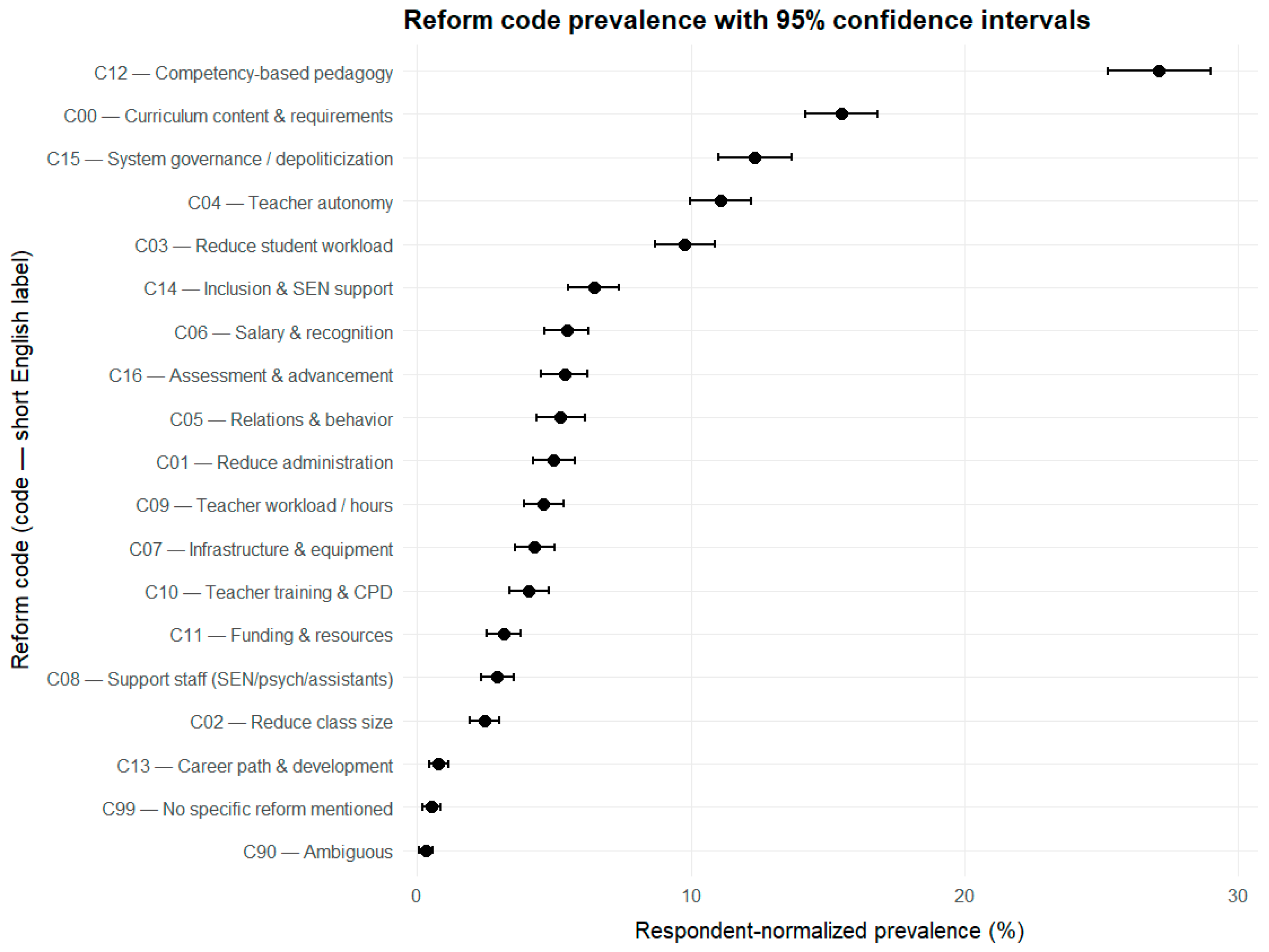
The most prevalent reform demand among Hungarian teachers was C12—Competency development and pedagogy, mentioned with 27.1% respondent-normalized weight, followed by C00—Curriculum content flexibility (15.5%) and C15—System governance and depoliticization (12.3%). These three priorities clearly dominated the reform discourse, together accounting for more than half of all reform emphasis when weighted by respondent.
Table 2 presents the complete prevalence profile for all 20 reform codes, showing both raw frequency weights and respondent-normalized weights with 95% confidence intervals.
Table 2 serves as the numerical reference, enabling precise comparison of raw and normalized metrics and exact confidence interval bounds for each code.
The prevalence hierarchy reveals clear priorities in Hungarian teachers’ reform thinking. Beyond the dominant emphasis on competency-based pedagogy, curriculum flexibility, and system governance, teachers also frequently mentioned the need for enhanced teacher professional autonomy (C04: 11.1%) and reduced student workload (C03: 9.78%). In contrast, some reform areas received minimal attention: alternative assessment and progression reform (C17), meta-commentary (C90), and unclear responses (C99) collectively accounted for less than 1% of reform emphasis.
Figure 1 complements
Table 2 by providing a visual representation of the prevalence hierarchy: the forest plot format allows readers to rapidly identify the dominance of the top three codes, the magnitude of drop-offs between adjacent ranks, and the degree of confidence interval overlap—patterns that are difficult to apprehend from tabular data alone.
What emerges from the prevalence data is that Hungarian teachers’ reform priorities are not diffusely distributed but concentrate on a small number of domains, with competency-based pedagogy clearly dominant.
3.4. Gender Differences
Chi-square tests of independence indicated that two reform codes showed statistically significant gender differences after FDR correction: C14 (Inclusion and SEN support) and C15 (System governance and depoliticization—
Table 3). These bivariate associations identify where gender differences emerge but do not account for other respondent characteristics. Therefore, we only report the direction and magnitude of these associations in the multivariable logistic regression results (
Section 3.8), where all predictors are simultaneously controlled.
Figure 2 illustrates the gender-specific odds of mentioning each reform code, highlighting the pronounced differences for inclusion/SEN support and system governance while showing rough parity for most other reform priorities.
The bivariate gender results thus point to two specific reform domains—inclusion and governance—where male and female teachers appear to diverge. Whether these differences persist after adjusting for other characteristics is examined in
Section 3.8.
3.5. Continuous Predictors
Beyond gender, we examined whether age, well-being, satisfaction, and personality traits differentiated teachers who did and did not mention each reform code.
Table 4 summarizes all significant bivariate associations after FDR correction.
Mann–Whitney U tests examined whether distributions of continuous predictors differed between teachers who did and did not mention each reform code. After FDR correction within predictor families, several significant associations emerged. The following paragraphs describe each predictor in turn.
Age showed a significant relationship with only one reform code: older teachers were more likely to mention C15—System governance and depoliticization (median age 54 years for mentioners vs. 52 years for non-mentioners; FDR p = 5.17 × 10⁻⁵). This suggests that concerns about system-level governance and political interference in education increase with teaching experience and career stage.
Daily anxiety was significantly higher among teachers who mentioned C00—Curriculum content flexibility (median anxiety score 4 vs. 3 for non-mentioners; FDR p = 0.0278), indicating that teachers experiencing more frequent anxiety may be particularly concerned about curricular constraints and the need for greater flexibility in content and pacing.
Daily depression showed significant positive associations with two reform codes. Teachers mentioning C00—Curriculum content flexibility reported higher depression levels (FDR p = 0.0189) as did those mentioning C01—Administrative burden reduction (FDR p = 0.0343). These patterns suggest that mental health difficulties among teachers are linked to concerns about both curricular rigidity and excessive administrative demands—two potentially modifiable sources of occupational stress.
Life satisfaction was significantly higher among teachers who prioritized C08—Class size reduction (M = 5.84 vs. 5.48, FDR p = 0.00644), though both groups showed identical median scores of 6. One possible interpretation is that teachers with relatively higher life satisfaction may be more likely to identify class size as a reform priority, perhaps because their overall psychological resources allow them to focus on concrete, actionable improvements.
Educational system satisfaction demonstrated the most widespread associations, relating to three distinct reform priorities. Lower system satisfaction was associated with mention of C00—Curriculum content flexibility (FDR p = 0.00018), C15—System governance and depoliticization (FDR p = 0.00018), and C04—Teacher professional autonomy (FDR p = 0.00102). All three associations showed median scores of 3 for both groups, indicating that the differences were distributional rather than reflected in median shifts. These results suggest that dissatisfaction with the educational system tends to manifest most strongly as concerns about curriculum, governance, and teacher autonomy—three system-level issues requiring policy-level intervention.
TIPI Conscientiousness was significantly higher among teachers mentioning C06—Salary and material recognition (FDR p = 0.00954), with mentioners showing a median score of 4.5 compared to 4.0 for non-mentioners. This finding is consistent with the idea that more conscientious teachers, who may invest greater effort and organization into their work, are particularly sensitive to issues of compensation and professional recognition.
TIPI Emotional Stability was significantly higher among teachers prioritizing C08—Class size reduction (FDR p = 0.0485), with mentioners showing a median score of 4.0 compared to 3.5 for non-mentioners. This suggests that emotionally stable teachers are more likely to identify class size as a reform priority, perhaps because they possess the psychological resources to recognize and articulate this structural problem rather than experiencing it as overwhelming stress.
In summary, the bivariate results suggest that reform priorities are not uniformly distributed across the teaching population. Educational system satisfaction emerged as the most broadly discriminating predictor, linking to three reform domains, while age, mental health indicators, and Conscientiousness each predicted specific reform concerns. These associations, however, do not account for confounding among predictors—a limitation addressed by the regression models that follow.
3.6. Dominant Reform Code
For each respondent, we identified their dominant reform priority as the code receiving the highest respondent-normalized weight among all their segments. The distribution of dominant codes largely mirrored the overall prevalence patterns, with C12—Competency development and pedagogy emerging as the most common dominant priority, followed by C00—Curriculum content flexibility and C15—System governance and depoliticization. This alignment between overall prevalence and dominant-code frequency suggests that the most frequently mentioned reforms are not merely secondary concerns but represent teachers’ primary priorities.
3.7. Multinomial Logistic Regression Results
To test whether the bivariate patterns reported above hold when all predictors are considered simultaneously, we fitted a multinomial logistic regression model predicting each teacher’s dominant reform code. This model asks a different question from the bivariate tests: not whether a single predictor is associated with a reform code, but which predictors remain significant once the others are controlled for.
The analysis encompassed n = 1187 participants who had full data across all predictor variables. The baseline category was C12—Competency development and pedagogy, selected because it represented the most frequent dominant code. The independent variables comprised gender, age, education level, daily anxiety, daily depression, life satisfaction, educational system satisfaction, TIPI Conscientiousness, and TIPI Emotional Stability. The model yielded a McFadden pseudo-R2 of 0.069, which, given the 16-category outcome variable, reflects meaningful explanatory capacity.
After applying FDR correction across all model coefficients, several predictors emerged as significant multivariate associates of specific reform priorities.
Table 5 presents all coefficients achieving statistical significance after FDR correction.
C04—Teacher professional autonomy. Lower educational system satisfaction significantly predicted prioritizing teacher autonomy over competency development (OR = 0.835 per one-step increase in system satisfaction; 95% CI [0.742, 0.916]; FDR p = 0.00538). This finding is consistent with the interpretation that teachers who are dissatisfied with the current educational system are particularly likely to emphasize the need for greater professional autonomy, and that autonomy concerns may be a key manifestation of broader system dissatisfaction.
C06—Salary and material recognition. Higher TIPI Conscientiousness significantly predicted prioritizing salary and recognition over competency development (OR = 1.48 per one-unit increase in conscientiousness; 95% CI [1.15, 1.92]; FDR p = 0.0422). This result suggests that more conscientious teachers, who likely invest greater effort and dedication into their work, are particularly attuned to issues of compensation and professional recognition, perhaps because they perceive a discrepancy between their investment and their compensation.
C14—Inclusion and SEN support. Two predictors were significantly associated with prioritizing inclusion and special educational needs support. A lower education level predicted emphasis on this reform (OR = 0.541 per one-step increase in education level; 95% CI [0.386, 0.750]; FDR p = 0.00436), suggesting that teachers with less formal education may encounter greater challenges with inclusion and SEN students, possibly due to less specialized training. Female gender strongly predicted prioritizing inclusion support (OR = 3.07; 95% CI [1.59, 6.70]; FDR p = 0.0151), indicating that female teachers are substantially more likely to emphasize this reform priority as their dominant concern.
C15—System governance and depoliticization. While bivariate tests showed significant associations between C15 and both age and gender (
Section 3.4 and
Section 3.5), these effects did not survive FDR correction in the multinomial model (smallest FDR
p = 0.0815). This attenuation may reflect confounding by other variables included in the multivariate model, or it may be that the conservative FDR correction across the many model coefficients reduces power to detect these effects in the high-dimensional multinomial framework.
In the multinomial framework, then, four associations survived correction: system dissatisfaction predicted autonomy priorities, Conscientiousness predicted salary priorities, and both education level and gender predicted inclusion priorities. Governance priorities, despite strong bivariate signals, did not reach significance—a point we return to in the binary models below.
3.8. Binary Logistic Regressions for Top-10 Codes
The multinomial model treats reform priorities as mutually exclusive dominant categories. To complement this, we also examined whether each teacher mentioned a given reform code anywhere in their response, regardless of dominance, using separate binary logistic models for the ten most prevalent codes. This approach is more sensitive to predictors of secondary or shared priorities.
To provide more granular examination of predictors for the most prevalent reform priorities, we estimated separate binary logistic regression models for each of the 10 most prevalent codes (from
Table 1). Each model predicted whether a respondent mentioned the focal code anywhere in their responses (1) versus not at all (0), using the same set of predictors as the multinomial model. FDR correction was applied across all coefficients in all 10 models jointly, controlling the false discovery rate across this entire family of tests.
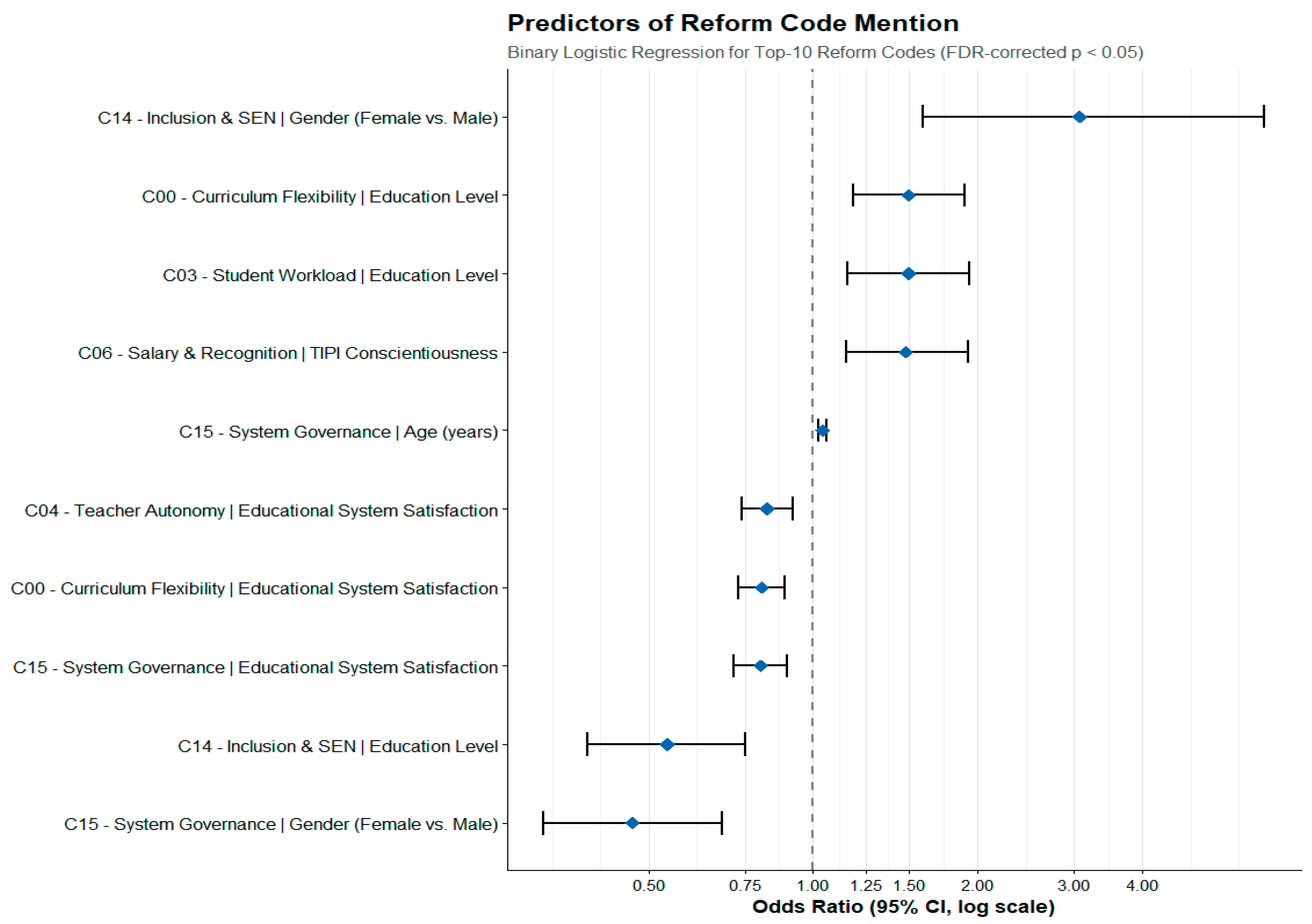
Table 6 presents all coefficients achieving statistical significance after FDR correction.
C00—Curriculum content flexibility. Two predictors were significantly associated with mentioning this reform. Lower educational system satisfaction predicted mentioning curriculum flexibility (OR = 0.806 per one-step increase; 95% CI [0.729, 0.890]; FDR p = 0.000314), which is consistent with the idea that dissatisfaction with the current system manifests partly as a desire for greater curricular autonomy. A higher education level also predicted mention of this reform (OR = 1.50 per level; 95% CI [1.18, 1.89]; FDR p = 0.00598), suggesting that more educated teachers may be particularly aware of curriculum limitations or more confident in advocating for flexibility.
C04—Teacher professional autonomy. Consistent with the multinomial results, lower educational system satisfaction predicted mentioning teacher autonomy (OR = 0.825 per one-step increase; 95% CI [0.742, 0.916]; FDR p = 0.00538). This convergence across both multinomial and binary models provides robust evidence that system dissatisfaction and autonomy concerns are closely linked.
C06—Salary and material recognition. Again mirroring the multinomial results, higher TIPI Conscientiousness predicted mentioning salary and recognition concerns (OR = 1.48; 95% CI [1.15, 1.92]; FDR p = 0.0422). The consistency of this finding across modeling approaches strengthens confidence in the association between conscientiousness and sensitivity to compensation issues.
C12—Competency development and pedagogy. Despite being the most prevalent code overall, no predictors achieved statistical significance after FDR correction in the binary logistic model for C12. This null finding may suggest that emphasis on competency-based pedagogy is relatively uniform across different teacher demographic and psychological characteristics, possibly reflecting broad professional consensus on the importance of this reform direction.
The following multivariable results also clarify the direction of the gender effects identified in
Section 3.4: women are substantially more likely to prioritize inclusion support (C14), while men are substantially more likely to prioritize governance reform (C15). Specifically:
C14—Inclusion and SEN support. Two predictors were significantly associated with mentioning this reform, replicating the multinomial findings. Lower education level (OR = 0.541; 95% CI [0.386, 0.750]; FDR p = 0.00436) and female gender (OR = 3.07; 95% CI [1.59, 6.70]; FDR p = 0.0151) both predicted mentioning inclusion support. The consistency of these results across multinomial and binary frameworks provides strong evidence for these associations.
C15—System governance and depoliticization. Three predictors were significantly associated with mentioning governance reform. Older age predicted mentioning C15 (OR = 1.05 per year; 95% CI [1.04, 1.06]; FDR p = 1.31 × 10⁻⁵), suggesting that concerns about political interference and system governance intensify with teaching experience. Female gender was associated with lower odds of mentioning this reform (OR = 0.467; 95% CI [0.321, 0.681]; FDR p = 0.000433), indicating that male teachers are substantially more likely to prioritize governance issues. Finally, lower educational system satisfaction predicted mentioning governance reform (OR = 0.802; 95% CI [0.717, 0.894]; FDR p = 0.000433), linking dissatisfaction with system-level governance concerns.
Across both modeling approaches, three patterns proved robust: (1) system dissatisfaction consistently predicted curriculum, autonomy, and governance priorities; (2) gender was strongly associated with inclusion (female) and governance (male) priorities; and (3) conscientiousness predicted salary concerns. It is also worth noting that the binary models recovered the age and gender effects for C15 that did not survive correction in the multinomial model—suggesting these associations are real but detectable only in the more targeted binary framework. These converging results form the basis for the interpretive discussion that follows.
4. Discussion
The results presented above reveal structured, individual-level patterns in Hungarian teachers’ reform priorities. This section interprets these patterns in relation to existing theory and evidence. The discussion is organized in four parts: principal findings and their overarching significance (
Section 4.1), the interplay between competency demands and gendered reform orientations (
Section 4.2), the role of well-being and system satisfaction (
Section 4.3), and the contribution of personality traits (
Section 4.4). Subsequent subsections address the centralization–governance nexus (
Section 4.5), policy implications (
Section 4.6), and limitations (
Section 4.7).
4.1. Principal Findings
This research investigated the reform priorities of Hungarian educators and their correlations with demographic factors, well-being, and personality traits. Utilizing open-ended feedback from 1254 teachers across various educational levels, we identified 18 reform categories and measured their prevalence through respondent-normalized estimates to mitigate verbosity bias.
Three principal patterns emerged. First, competency development and pedagogical reform constituted the foremost priority (27.1% respondent-normalized weight), suggesting broad professional consensus on the need for pedagogical modernization rather than isolated individual preferences. Second, notable demographic differences were evident: at the individual level, female educators were more likely to prioritize inclusion and SEN support, while male educators were more likely to focus on governance reform, and older teachers more frequently prioritized centralization concerns. Third, individual-level well-being and personality traits were systematically linked to reform priorities: lower satisfaction with the educational system was consistently associated with prioritizing curriculum reform, governance restructuring, and autonomy concerns.
These patterns suggest that teachers’ reform demands are not expressions of random dissatisfaction but appear to reflect systematic individual-level variation associated with professional position, psychological states, and dispositional traits. The subsections below interpret these patterns in relation to existing theory and evidence.
4.2. Competency Development and Gender-Shaped Reform Orientations
This subsection interprets the two most prominent structural findings: the dominance of competency-based pedagogy as a reform demand and the gendered divergence between inclusion and governance priorities.
Competency development and pedagogical reform (C12) clearly emerged as the dominant reform demand. This finding aligns with international evidence emphasizing 21st-century skills, student-centerd learning, and competency-based curricular frameworks (
Guerriero, 2017). The centrality of C12 in Hungarian teachers’ narratives suggests that the 2012–2024 cycle of curriculum standardization has not translated into classroom-level enactment of competency-based practice. This interpretation is consistent with recent evaluations of Hungarian CPD programs showing that teachers are motivated to implement competency-based pedagogy but are structurally constrained (
Lőrincz et al., 2025). Our results therefore suggest that competency orientation is not merely a preferred pedagogical ideology but a high-priority, system-level reform demand that appears to be grounded in unmet structural conditions.
Within this prevailing configuration, reform orientations follow a gendered pattern at the individual level. The multinomial and binary models indicate that female teachers have a markedly higher probability of prioritizing inclusion and SEN support (C14), whereas male teachers have a markedly higher probability of prioritizing system governance and depoliticization (C15). These findings are consistent with international research: gender-based contrasts in professional value orientations and reform preferences are well-established across Europe (
Pikić Jugović et al., 2022;
Azcona et al., 2022;
Lazaridou, 2024), with women more strongly aligned with relational, equity-oriented, care-based reform directions, and men more strongly oriented toward structural and political aspects of governance (
Holik, 2014;
Varier et al., 2024). Hungary conforms to this transnational regularity notwithstanding the fact that its teaching labor force is overwhelmingly female.
These are, however, individual-level statistical associations. Our data show that individual female teachers are more likely to prioritize inclusion and individual male teachers are more likely to prioritize governance, but this does not entail that women as a group uniformly demand inclusion reform or that men as a group uniformly demand governance reform. Substantial within-gender variation exists, and many individual teachers deviate from the group-level tendency.
With this caveat in mind, the gendered pattern has structural implications for policy. Because the teaching workforce is highly feminized, while male teachers show a statistically higher individual-level probability of prioritizing governance, a potential imbalance arises: if the numerically dominant female workforce tends toward inclusion–equity reform demands, while the numerically smaller group of men tends toward system governance demands, then policy processes that disproportionately amplify the voices of one group risk under-representing the priorities of the other. This possible asymmetry is policy-relevant because it suggests that the two reform orientations (equity vs. governance) are not merely empirically separable clusters, but clusters that at the individual level are statistically associated with gender. This raises the question of whether the gendered pattern reflects differential professional exposure, differential framing vocabularies, or both—a question we return to in
Section 4.5. In short, while competency-based pedagogy commands near-universal support, the secondary tier of reform priorities appears to split along gender lines—a pattern with direct implications for participatory policy design (discussed in
Section 4.6).
4.3. Well-Being, System Satisfaction, and Critical Reform Priorities
This subsection examines why dissatisfied and psychologically distressed teachers prioritize particular reforms, drawing on the JD-R framework and European comparative data. The central question is whether dissatisfaction produces diffuse criticism or whether it channels reform demands toward specific structural targets.
The consistent association between lower educational system satisfaction and prioritizing curriculum reform (C00), governance restructuring (C15), and teacher autonomy (C04) may illuminate the psychological foundations of reform demands. Rather than expressing generic complaints, individually dissatisfied teachers appear to target specific structural domains they perceive as dysfunctional—a pattern that suggests diagnostic specificity in teachers’ critical assessments. This interpretation aligns with the JD-R framework, which posits that unmet job resources (e.g., autonomy, supportive governance) generate dissatisfaction and prompt demand for organizational change (
Viac & Fraser, 2020;
Brauchli et al., 2013). The odds ratios (0.81–0.83 per unit increase in system satisfaction) indicate modest but robust individual-level effects, meaning that each teacher’s own level of dissatisfaction predicts their own reform focus—not that dissatisfied teachers as a collective share identical reform agendas.
European data provide a broader context for these relationships. According to the TALIS 2018 survey, Hungarian teachers report the second-highest stress levels in Europe (69.9%) and rank among the lowest in professional autonomy, factors directly linked to dissatisfaction with their working conditions and the education system (
European Commission/EACEA/Eurydice, 2021). Our analysis goes beyond this descriptive correlation by showing that such systemic dissatisfaction specifically predicts reform priorities aimed at rectifying these deficits—namely, increasing autonomy, curriculum flexibility, and decentralizing governance. This is consistent with the view that teachers’ demands are diagnostically insightful, reflecting targeted critiques of systemic flaws rather than general frustration.
The associations between anxiety, depression, and curriculum reform priorities (C00) merit particular interpretive attention. Teachers who individually reported higher anxiety and depression were significantly more likely to prioritize curriculum issues. This pattern aligns with existing research; for instance,
Lannert’s (
2010) study of teacher mental health in Hungary identified workload and curriculum rigidity as primary stressors leading to depression and burnout. In a similar vein,
Tóthpál-Halasi and Pikó (
2024) found that personality, specifically Neuroticism, predicted burnout, with curriculum-related stress acting as a mediating factor.
At first glance, the association between distress and curriculum priorities may seem to suggest that psychologically struggling teachers are simply more critical of the system. However, an alternative reading is that individual-level psychological distress actually heightens teachers’ awareness of curriculum problems that are objectively present, potentially creating a feedback loop where mental health difficulties amplify the perception of systemic dysfunction. If this interpretation is correct, curriculum reform could serve a dual purpose: enhancing educational quality while also mitigating teacher stress (
Van Veen & Sleegers, 2006;
Zayim-Kurtay, 2020;
Lai et al., 2024). However, we note that these are cross-sectional associations at the individual level; whether distressed teachers accurately perceive greater curricular dysfunction or whether distress colors perception independently of objective conditions cannot be determined from these data.
Conversely, the positive association between life satisfaction and class size reduction priorities (C08:
M = 5.84 vs. 5.48,
p_FDR = 0.006) presents an intriguing counterpoint. Teachers with higher overall life satisfaction—but not necessarily higher system satisfaction—identified class size as a reform priority. A possible interpretation is that relatively satisfied teachers may focus on practical, concrete improvements (smaller classes) rather than systemic overhaul, whereas dissatisfied teachers prioritize more fundamental restructuring. This distinction may have policy implications: incremental reforms (class size reduction, infrastructure improvement) may appeal to moderately satisfied teachers, while systemic reforms (governance decentralization, curriculum flexibility) are more likely to resonate with those experiencing deeper dissatisfaction (
c.f. UNESCO, 2019).
To summarize, the evidence suggests that system dissatisfaction does not produce undifferentiated criticism but rather channels reform demands toward specific structural targets—curriculum, autonomy, and governance—while psychological distress appears to sharpen attention to curriculum rigidity in particular. From a policy perspective, these findings point to well-being interventions and structural reforms as complementary rather than competing strategies.
4.4. Personality Traits and Reform Attitudes
This subsection considers the role of Big Five personality traits, focusing on the two dimensions—Conscientiousness and Openness—that showed the clearest associations with reform priorities. The effects are modest in magnitude but theoretically coherent.
Conscientiousness predicted prioritizing teacher compensation and material recognition concerns (C06: OR = 1.48), consistent with meta-analytic evidence that conscientious individuals value professionalism, fair reward systems, and societal recognition (
Kim et al., 2019). This pattern may reflect the fact that highly conscientious teachers, who likely invest greater effort and dedication into their work, are particularly sensitive to perceived discrepancies between their professional investment and their compensation—a concern that is likely amplified in post-communist Central European contexts where teaching has declined in prestige since 1990 (
Semjén et al., 2018;
Semjén, 2023). This finding aligns with
Sun et al.’s (
2024) cross-national study demonstrating that work engagement—closely related to Conscientiousness—predicts teachers’ advocacy for professional recognition and improved compensation.
The personality trait of Openness to Experience was found to predict priorities related to competency development (C12: OR = 1.25) and curriculum reform (C00: OR = 1.20), which aligns with existing literature on personality and innovation. This finding is consistent with
Hübner et al.’s (
2022) meta-analysis, which revealed that Openness has a stronger correlation with teaching performance in humanities and language subjects compared to STEM fields, highlighting the domain-specific nature of personality’s influence on professional priorities. Our study expands on this by suggesting that Openness not only predicts teaching effectiveness but may also predict advocacy for reform in innovative pedagogical domains. Teachers with high Openness likely support curriculum modernization and competency-based pedagogies due to their intrinsic values of intellectual exploration and adaptability.
The lack of significant effects of Neuroticism in our multivariable models, despite bivariate associations between anxiety/depression and reform priorities, deserves comment. Although our two-item TIPI Neuroticism scale demonstrated acceptable reliability (α = 0.60), it may not fully capture the complexity of emotional stability relevant to attitudes toward reform. Numerous studies (
Franz et al., 2022;
Weissenbacher et al., 2024) highlight that emotional reactivity, closely related to Neuroticism, may function as a selection filter: emotionally stable individuals are more likely to enter and remain in the teaching profession. As our sample consisted of active teachers, it may represent a restricted range on Neuroticism, thereby reducing its predictive power. Future research utilizing comprehensive personality inventories could provide further insight into the role of emotional stability in shaping priorities for reform.
Overall, personality appears to contribute a modest but interpretable layer of explanation: Conscientiousness may sensitize teachers to compensation equity, Openness seems to dispose them toward pedagogical innovation, and Neuroticism’s null effect is likely attributable to range restriction in a self-selected professional sample. These trait-based patterns complement—rather than replace—the stronger effects of system satisfaction and demographic position documented above.
4.5. The Centralization Dilemma: Age, Gender, and Governance Concerns
This subsection focuses on the governance reform code (C15), which showed the most complex predictor profile—combining age, gender, and system satisfaction effects—and interprets it against Hungary’s post-2011 centralization history. The question here is not simply who prioritizes governance reform, but why the pattern takes the particular demographic shape it does.
The finding that older teachers and male teachers disproportionately prioritized governance and centralization concerns (C15) is consistent with Hungary’s contentious recent policy history.
Hermann and Semjén’s (
2021) analysis of the 2013 centralization reform documented that it succeeded in equalizing funding across regions but failed to improve student outcomes while dramatically constraining teacher autonomy. Our findings suggest that experienced teachers—who personally witnessed the shift from relative autonomy (1990s–2000s) to rigid centralization (post-2011)—are particularly critical of governance structures.
The age effect (OR = 1.05 per year for C15) means that each additional year of experience increases the odds of prioritizing governance reform by 5%, accumulating to substantial differences over a career. To illustrate: a teacher with 30 years of experience has approximately 4.3 times higher odds of emphasizing governance concerns than a novice teacher, independent of personality and well-being. This cohort effect likely reflects both experiential knowledge—senior teachers remember more flexible systems—and career-stage frustration, as experienced educators may feel constrained by mandates that undervalue their professional judgment.
The individual-level gender association with governance priorities (OR = 3.03 for male teachers) warrants careful interpretation, as it represents one of the largest effects in our models. Three complementary mechanisms may account for this pattern.
First, gendered career trajectories within education may create differential exposure to governance issues: although women constitute the overwhelming majority of classroom teachers, men are disproportionately represented in school leadership and administrative positions in Hungary (
Holik, 2014), where governance structures are more directly experienced as constraints on professional practice. Individual male teachers may therefore be more likely to have encountered governance dysfunction through leadership roles, sensitizing them to these concerns.
Second, research on gender differences in professional framing suggests that men more frequently articulate professional concerns in structural and political terms, while women more often foreground interpersonal and care-oriented dimensions of professional experience (
Pikić Jugović et al., 2022;
Lazaridou, 2024). This framing difference does not imply that women are unconcerned with governance or that men are indifferent to inclusion—rather, when asked to identify priority reforms, individual teachers may draw on gendered professional vocabularies that channel similar underlying frustrations into different reform categories.
Third, the Hungarian context may amplify this pattern: the post-2011 centralization was implemented through administrative and political channels in which men are overrepresented (
Rédai, 2021), potentially making governance reform feel more personally salient to male teachers who perceive the political dimensions of educational restructuring through direct professional experience.
Rather than treating these three mechanisms as competing explanations, they may be better understood as complementary: the same teacher may simultaneously occupy a leadership-adjacent career position, draw on a structurally oriented professional vocabulary, and have direct experience with the political dimensions of centralization. It is essential to reiterate, however, that these are individual-level associations: our data show that a given male teacher has higher odds of prioritizing governance than a given female teacher, all else being equal. They do not show that male teachers as a collective hold a unified governance reform agenda, nor that female teachers are collectively indifferent to governance. The within-gender variance in reform priorities is substantial, and the gender effect, while statistically robust, accounts for only a fraction of individual-level variation in reform priorities.
In sum, governance concerns appear to be concentrated among older, male, and system-dissatisfied teachers—a profile consistent with direct professional exposure to the consequences of centralization. The policy challenge, then, is to ensure that these governance critiques receive attention alongside the inclusion priorities more frequently voiced by the numerically dominant female workforce.
4.6. Practical Implications for Educational Policy
Four policy implications follow from the patterns documented above. Each links a specific empirical finding to a concrete recommendation, though we note that the cross-sectional design means these implications should be understood as suggestive rather than prescriptive.
First, the prevalence of competency development priorities (C12) appears to indicate robust teacher preparedness for instructional innovation, provided it is bolstered by sufficient support for rollout. Policymakers ought to emphasize ongoing professional training, classroom materials, and evaluation changes that harmonize with competency-oriented teaching.
Lőrincz et al.’s (
2025) assessment of a Hungarian university’s continuous professional development initiative revealed that educators displayed heightened enthusiasm for interactive learning approaches yet encountered organizational obstacles to implementation. Our data are consistent with the idea that dismantling these obstacles—via administrative changes that boost autonomy (C04) and alleviate bureaucratic loads (C01)—might release educators’ inherent drive for advancing teaching practices.
Second, the gendered disparities in reform priorities call for participatory policy formulation that ensures equity. Existing discussions in Hungarian policy circles, steered by male-dominated ministries and administrative frameworks, could inherently undervalue issues of inclusion and student support (C14) that our evidence shows are more frequently prioritized by individual female teachers. While our individual-level findings cannot be directly extrapolated to the collective preferences of the entire teaching workforce, considering that females make up 85.9% of the teaching staff, the individual-level tendency for female teachers to prioritize inclusion suggests that this reform domain may be systematically underweighted in policy forums where women’s voices are underrepresented. Strategies to elevate women teachers’ input in policy conversations—ranging from inclusive advisory panels, equitable gender representation in consultative forums, and deliberate focus on inclusion goals within reform strategies—would more effectively synchronize policies with the priorities expressed by the majority of the teaching workforce (
Rédai, 2021).
Third, well-being interventions may need to be conceptualized not merely as individual stress management but as systemic reform. The strong associations between system dissatisfaction, anxiety/depression, and reform priorities (C00, C15, C04) suggest that teachers’ psychological distress is, at least in part, grounded in structural dysfunction rather than individual coping deficits.
Kovács et al.’s (
2023) study of workload challenges among Hungarian academics identified multi-role stress and institutional constraints as primary drivers of distress, patterns that are likely generalizable to K-12 teachers. Addressing teacher well-being may therefore require governance reforms (decentralization, autonomy enhancement) and workload reduction (administrative streamlining, class size limits) rather than merely offering resilience training or wellness programs.
Ozturk et al.’s (
2024) holistic teacher well-being model, integrating negativity (burnout), positivity (flourishing), and professionalism (autonomy) dimensions, provides a useful framework for such comprehensive interventions.
Fourth, personality-sensitive professional development could potentially optimize reform implementation. Teachers high in Openness may serve as early adopters and champions of pedagogical innovation, while those high in Conscientiousness may prioritize professional standards and compensation equity. Recruitment and retention strategies could leverage these individual differences: for example, highlighting opportunities for innovation may attract Open candidates, while emphasizing professionalism and career progression may appeal to Conscientious candidates.
Mullola et al.’s (
2025) finding that temperament predicts selection into teacher education and early achievement suggests that personality-based differentiation begins early in teacher careers and could be strategically supported throughout professional trajectories.
These four implications share a common thread: what matters here is not simply which reforms teachers want, but whether policy processes are structured to hear from different subgroups equitably. Effective reform may require matching policy instruments to the specific concerns of different teacher subgroups rather than adopting uniform, top-down interventions. Whether such differentiated approaches are feasible within the Hungarian governance structure is, of course, a question that goes beyond the scope of these data.
4.7. Limitations
Eight limitations qualify these findings and define the boundaries within which the results should be interpreted.
First, the cross-sectional design prevents causal inference. Although we treat system dissatisfaction as predicting reform priorities, reverse causation remains plausible: teachers who prioritize specific reforms may subsequently become dissatisfied with systems that do not accommodate those priorities. Longitudinal designs tracing how reform priorities and well-being jointly evolve over teachers’ careers would help to clarify causal direction.
Second, the convenience sampling based on publicly accessible email addresses may introduce selection bias. Respondents may differ from non-respondents in their reform orientation, well-being, or personality traits. Although the achieved sample approximates national distributions by educational level, gender, and urbanization, we have no data on non-respondents to estimate the extent of bias. Future work could implement stratified random sampling with follow-ups to improve representativeness.
Third, the exclusive use of self-reported indicators generates risks of common method variance and social desirability bias. Teachers’ reports regarding well-being, personality, and reform priorities may be inflated or suppressed via impression management, especially given the politically charged context of criticizing the school system in contemporary Hungary. Integrating objective indicators (e.g., administrative records of turnover or sick leave as proxies for well-being; principals’ ratings of teacher priorities) would enable triangulation and reduce bias.
Fourth, the abbreviated Big Five measure (TIPI), while enabling low respondent burden, yielded modest reliabilities (α = 0.22–0.60), particularly for Agreeableness (α = 0.22) and Openness (α = 0.30). These two-item scales sacrifice precision for brevity, potentially attenuating personality-priority associations and limiting our ability to detect nuanced effects. Replication with full-length personality inventories (e.g., NEO-PI-R, BFI-2) would provide more robust estimates of personality contributions to reform attitudes.
Fifth, our coding scheme, while systematically developed and validated (α = 0.86), inevitably imposes researcher-defined categories on teachers’ open-ended responses. The 18 reform codes may not fully capture the nuance of teachers’ expressed concerns, and alternative coding frameworks could yield different prevalence estimates. We mitigated this limitation through iterative codebook refinement, multi-coder validation, and inclusion of meta-commentary (C90) and non-substantive response (C99) codes, but some interpretive reduction is inherent in qualitative-to-quantitative conversion.
Sixth, the respondent-normalized prevalence method, while addressing verbosity bias, assumes that each respondent’s total contribution should be weighted equally regardless of response depth or quality. A teacher providing three well-articulated, distinct reform proposals receives the same total weight as one providing three overlapping or vague suggestions. Alternative weighting schemes (e.g., quality-adjusted prevalence) could be explored, though defining “quality” introduces additional subjectivity. We prioritized transparency and simplicity in our normalization approach, noting that raw and normalized prevalence rankings correlated at r > 0.99, suggesting minimal impact of verbosity bias in this sample.
Seventh, the study adopts an exclusively individual-level analytical framework: all predictors and outcomes are measured and modeled at the person level. While this approach is appropriate for mapping individual-level variation in reform priorities—and constitutes a deliberate theoretical choice (see
Section 1.4)—it does not capture the potential influence of school-level or district-level factors, such as organizational climate, leadership practices, or local policy implementation, that may shape teachers’ reform attitudes through shared contextual exposure. Teachers within the same school may exhibit correlated reform priorities due to common working conditions, yet our models treat all observations as independent. Multilevel models nesting teachers within schools would be needed to partition individual-level and contextual-level variance, requiring larger samples with adequate between-school representation.
Eighth, our focus on Hungary limits generalizability to other national contexts. While the theoretical frameworks (JD-R model, Big Five personality) are internationally validated, the specific reform priorities and their correlates likely reflect Hungary’s unique policy history, particularly the post-2011 centralization. Replication in countries with different governance structures—such as highly decentralized systems (e.g., Finland, Canada) or other centralized systems (e.g., France, Singapore)—would clarify which findings reflect universal teacher psychology versus context-specific responses to Hungarian policies.
Notwithstanding these limitations, the core finding—that teachers’ reform priorities appear to be systematically patterned by demographic position, well-being, and personality rather than randomly distributed—rests on converging evidence from multiple analytical approaches and survives conservative multiple testing correction.
5. Conclusions
This final section draws together the study’s main contributions and considers their significance for educational policy and future research.
Hungarian teachers’ reform priorities appear to reflect structured, individual-level patterns rather than random dissatisfaction. Competency development dominates, followed by curriculum, governance, and autonomy concerns. At the individual level, female and male teachers emphasize different reform domains (inclusion vs. governance), while older teachers critique centralization more strongly. Lower system satisfaction and poorer mental health predict critical reform priorities, and personality traits—particularly Openness and Conscientiousness—are associated with these patterns.
These conclusions are tempered by the study’s reliance on a cross-sectional, convenience-sampled, self-report design with abbreviated personality measures and an exclusively individual-level analytical framework (see
Section 4.7). Causal claims cannot be made, and generalizability beyond the Hungarian post-centralization context remains to be established.
With these caveats in mind, the findings suggest the importance of centering teachers’ voices in educational policy and attending to the demographic, psychological, and personality diversity shaping their perspectives. If corroborated by longitudinal and multilevel research, addressing teachers’ priority reforms—especially enhancing autonomy, reducing administrative burden, and supporting competency-based pedagogy—may simultaneously improve education quality and teacher well-being, contributing to a more sustainable and effective system.
What this study ultimately suggests is that teachers do not merely express dissatisfaction—they appear to diagnose specific systemic problems, and their diagnoses vary predictably with who they are and how they experience the system. Reform that ignores this structured diversity risks addressing the wrong problems for the wrong people. Listening to teachers is necessary, but understanding which teachers say what—and why—is what may make that listening actionable.



 ,
,