


Abstract
Disinformation is a global challenge that affects areas such as politics, health, economics, and science and is spread rapidly by social media (SM), suggesting the necessity of advancing educational proposals to strengthen critical thinking (CT) and digital literacy (DL). This quantitative, non-experimental, descriptive study identified the self-perception that master’s students (n = 72; at three Spanish universities; October 2024–March 2025) have regarding their DL, along with their CT, in post-truth and fake news settings. A self-administered online questionnaire (53 items) was conducted, covering aspects such as the responsible use of information and platforms, algorithmic perceptions, actions taken to verify this information, and concepts of CT, post-truth, and fake news. The results show that Instagram (97%) and WhatsApp (96%) predominated, with a notable proportion of users (86%) reporting that algorithms influenced them ‘highly’ or ‘moderately’. Despite being aware of disinformation they find on social media (65%) as well as its close link to hate speech (90% who ‘strongly’ or ‘somewhat’ agreed), this knowledge does not fully translate into taking measures to counter it. In fact 61% of respondents report sharing news on at least some occasions, while only 25% are able to identify a professional fact-checking organization. In conclusion, these findings suggest the merit of assessing the prevalence of skills such as Critical Thinking (CT) and strategies like fact-checking among students in other postgraduate education systems. Such assessments could inform the potential promotion of media and digital literacy as cross-curricular skills in education. This approach would help bridge the gap between theoretical knowledge and the active verification needed to counter disinformation.
1. Introduction
The advent of the internet, digitization of the media, and the expansion of the social networks have created the largest amount of information known to mankind (Trejo-Quintana et al., 2025; Fernández-Torres et al., 2021). This marks both a technological and social transformation: in February 2025, the world population reached 8.2 billion people and there were 8.78 billion mobile phone connections (or 107% of the population), 5.56 billion internet users (68%), and 5.24 billion active social media users (64%) (Kemp, 2025).
Such access and connectivity could, in principle, be considered beneficial to the general public, as it fosters communication and accessing knowledge. However, at the same time, this has given rise to less favorable phenomena: information saturation, compulsive hyperconnection, and cognitive overload; a diminished ability to understand, analyze, and critically evaluate messages that circulate; and the normalization of consuming content at high speed, which goes unchallenged (Civila et al., 2020; Kim & Kim, 2025).
Before social media, communication with traditional media was one-way. Digital platforms, supported by large-scale socio-technical infrastructures, changed the status quo by turning audiences into prosumers who also produced and shared content. This change heightened narratives about “the real,” but paved the way to constructing public opinions aligned with economic or political interests, with no critical outlook, which encouraged manipulation and social polarization (Civila et al., 2020).
In 2016—the year of the Brexit referendum and Trump’s first election, the Oxford Dictionary recognized the term post-truth as the word of the year to describe settings in which emotions and personal beliefs took precedence over verifiable facts. Similarly, the Diccionario de la Lengua Española (DRAE) and the Cambridge Dictionary emphasize that post-truth involves deliberately distorting information to manipulate beliefs, shape public opinion, and influence social behavior and thus places emotions before evidence (Reale, 2017; Rodrigo-Alsina & Cerqueira, 2019, Rodríguez-Ferrándiz, 2023, 2025).
This reasoning is sustained in digital and audiovisual settings in which highly persuasive “apparent truths” are produced and arranged with a kind of psychopolitics based on data extraction, algorithmic segmentation, and personalized political messages, aimed at influencing, or even dominating, subjects conceived to be voters and consumers (Arriazu, 2018; Lomelí Ponce, 2019).
This is the medium in which fake news thrives. This is understood to be the deliberate production and circulation of falsehoods thinly veiled as journalism, and designed to manipulate (Gelfert, 2018). UNESCO considers it a form of disinformation and proposes critical digital literacy must be a crucial educational tool for combating it (McDougall et al., 2019).
Recent studies show a widespread perception that fake news circulates systematically on social media (Newman et al., 2024; Shearer et al., 2024; Pew Research Center, 2025); furthermore, research has demonstrated its capacity to go viral at significantly higher rates than authentic news (Allcott & Gentzkow, 2017; Vosoughi et al., 2018; Karami et al., 2021; Dabbous et al., 2021). This sustained exposure has led to mistrusting the content circulating on platforms (X, Facebook, Instagram, and TikTok), even though these have become the main sources of information: in 2024, 58% of the audience obtained news through digital media, compared to television (32%), radio (6%), and print media (4%) (Pew Research Center, 2025).
Young people in particular are more prone to using digital media to find out news. While 54% of adults in the US said in 2024 that they “often” or “sometimes” get their news from social media—a lower share than for search engines (66%) and news sites or apps (65%)—the opposite is true for younger cohorts. Specifically, 78% of 18–29-year-olds and 64% of 30–49-year-olds get their news from social media.
While X stands out as a primary news destination, the vast majority of users across all major platforms engage with news through informal, non-journalistic formats. Specifically, for younger cohorts on platforms like TikTok and Instagram, news consumption is predominantly driven by humor, news-related memes, and opinionated commentary from influencers and ordinary individuals rather than traditional news organizations (Shearer et al., 2024; McClain et al., 2024; Pew Research Center, 2025; Alhabash et al., 2024; Scharlach & Hallinan, 2023).
A growing perception was also identified that information “finds” users rather than the other way around (in the literature, news-finds-me) (Gil de Zúñiga et al., 2017; Gil de Zúñiga & Diehl, 2019). This attitude has been linked to news fatigue and news overload (Park, 2019; Skovsgaard & Andersen, 2020; Goyanes et al., 2023, Newman et al., 2024), as well as a greater skepticism about how credible the sources are, especially among young people (Farias-Batlle et al., 2024).
In light of this, there has been growing interest in CT as a cognitive and epistemic strategy for processing information (Himma-Kadakas & Ojamets, 2022). Current requirements in education are to work on CT in parallel with digital literacy and media literacy in order to teach students to interpret, evaluate, produce, and share information found online in an ethical and responsible manner (Scheibe & Rogow, 2012; Hobbs, 2021), as well as to warn them about stereotypes, biases, and disinformation and participate critically as broadcasters.
The need to implement a system for combating disinformation is recognized by the National Association for Media Literacy Education (NAMLE), which links CT with media literacy and defines it as “the ability to access, analyze, evaluate, create, and act using all forms of communication” (National Association for Media Literacy Education, 2023). From this perspective, teaching media literacy entails constantly nurturing inquisitiveness in students and teaching them the skills they need to act as critical thinkers, reflective communicators, and informed and responsible members of society.
This study is part of that educational requirement: it aims to explore how postgraduates perceive their own ability to evaluate, interpret, and act on information circulating in digital environments marked by disinformation and post-truth. Postgraduate education is understood to be a space where CT and DL skills are refined and recontextualized (Jarvis, 2007; UNESCO Institute for Statistics, 2015). However, there is little research on the postgraduate demographic (Gutiérrez-Ángel et al., 2022) and critical digital skills have still not been fully consolidated (Wei et al., 2024), which is why by observing this group we can gain an insight into how effective the previous education system was.
Regarding CT, and given that there is no universally accepted definition (Moore, 2013; Abrami et al., 2015; Dwyer et al., 2017; Vendrell & Rodríguez, 2020; Carbogim et al., 2016), this study adopts a working definition that conceives it as an active, self-regulated metacognitive process in which coordinating cognitive skills, behavioral dispositions, and declarative knowledge enables evidence-based judgments to be made and stances on relevant issues taken (Rodríguez-Díaz, 2026; Rodríguez-Díaz & Rodríguez-Ferrándiz, 2026).
For the second dimension of interest, DL, we start from Gilster’s (1997) pioneering description, one that is broadly recognized internationally, which defines it as the ability to understand and use information in multiple formats in digital environments. Gilster argued that this literacy should be based on CT rather than mere technical skills and arranged it around four competencies: internet search, hypertext navigation, content evaluation, and building knowledge (Gilster, 1997; Sánchez Pizarro, 2011; Tornero, 2017). DL was subsequently reworked until it was established as a key integrative category in contemporary digital culture (Reinking et al., 1997) and placed within the socio-technical, economic, and historical frameworks of power and governance (Nichols & Stornaiuolo, 2019).
For these reasons and for the purposes of this research, the term digital literacy is used instead of computer literacy, information literacy, and media literacy. Here, digital literacy integrates computer, information, and media skills, with a practical focus on understanding, evaluating, and integrating information online (Nichols & Stornaiuolo, 2019).
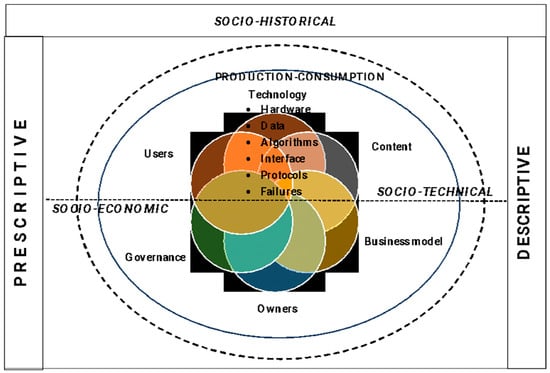
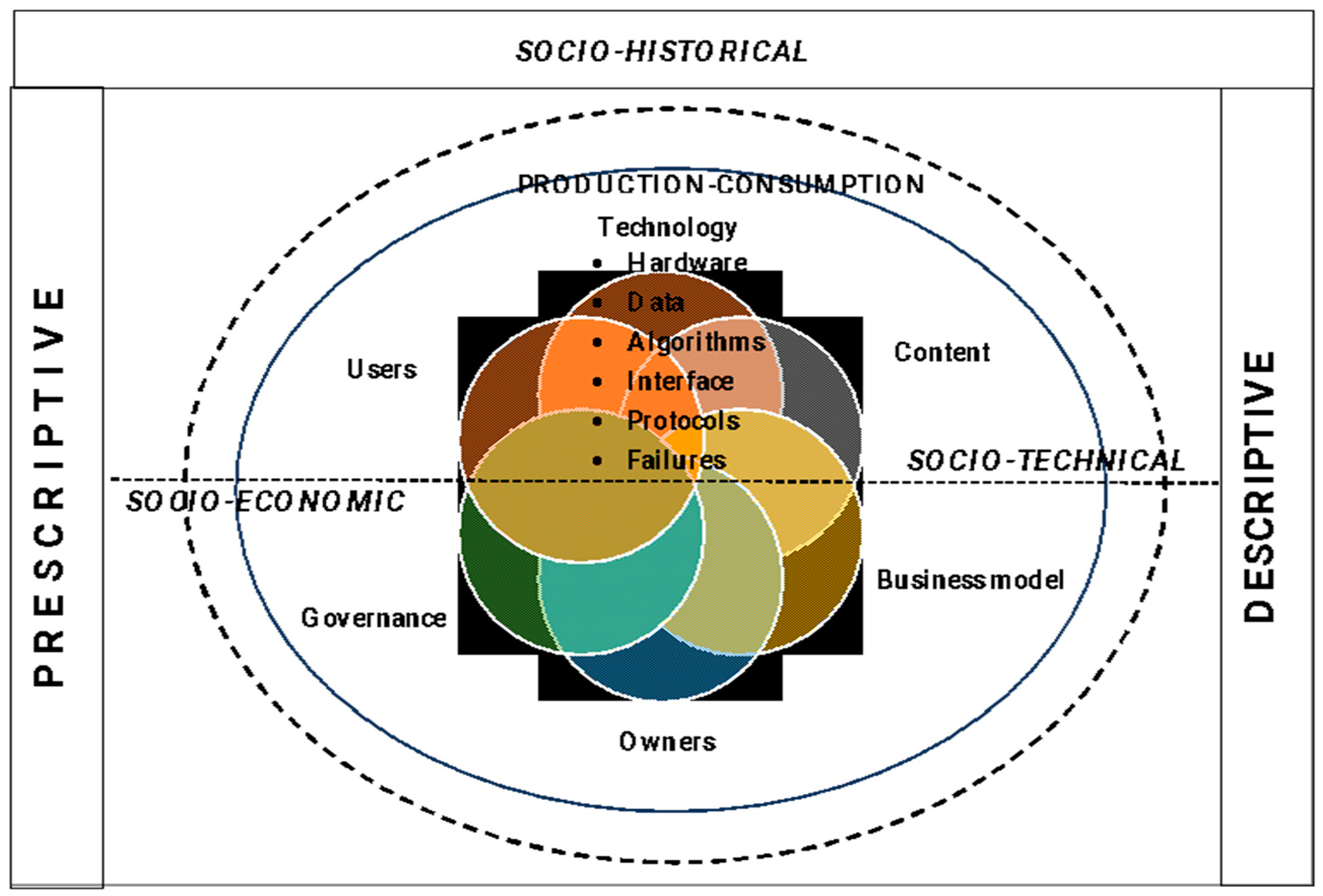
The reorientation of DL towards obtaining a critical understanding of the relationships between users, content, and technologies in social, cultural, political, and economic contexts gave rise to an analytical model (Figure 1) which has three interdependent axes: (1) socio-technical, which includes code, algorithms, and infrastructure as means of regulation; (2) socio-economic, which addresses platform ownership, business models, and governance considerations; and (3) socio-historical, which analyzes the evolution of online activity and its links to political and economic power (Nichols & Stornaiuolo, 2019).
Figure 1.
Digital literacy research model (Nichols & Stornaiuolo, 2019).
This approach, which is both descriptive and prescriptive, conceives DL as an educational, ethical, and political competence aimed at addressing information overload, the proliferation of disinformation, and the lack of social consensus about what constitutes truth. However, the model does not yet address the emerging challenges associated with immersive realities and artificial intelligence.
The working definitions described for CT and DL (Rodríguez-Díaz & Rodríguez-Ferrándiz, 2026; Reinking et al., 1997; Nichols & Stornaiuolo, 2019), and the axes of the Digital Literacy Research Model (Nichols & Stornaiuolo, 2019), are adopted here as analytical frameworks for research.
Based on this framework, an exploratory–descriptive questionnaire was designed as a diagnostic tool. Its purpose is to identify how postgraduate university students in this sample perceive their own DL and CT within contexts of disinformation and post-truth. The aim of this was to provide empirical evidence to show the extent to which this group possesses the critical awareness they claim to have regarding their ability to identify, evaluate, and respond to digital disinformation.
2. Method
This study took a quantitative approach, with a non-experimental design and was descriptive in order to observe the phenomenon naturally, without any educational input or changing any variable. The research aimed to identify how postgraduates perceive their DL and CT skills when faced with disinformation and fake news while receiving, evaluating, and sharing information. Rather than establishing causal relationships or predictive models, the purpose was to describe declared patterns of consumption and critically assess online digital information, considering the socio-technical, socio-historical, and socio-economic dynamics that shape the online world today.
In this analytical framework, DL and CT are addressed as interdependent competencies although both overlap in areas such as verification, ethical evaluation, and using information responsibly. This enables an integrated framework to be built in order to identify gaps and training opportunities in higher education and university classes.
The study was organized around three areas: critical thinking, digital literacy, and post-truth/fake news. Each area was broken down into observable dimensions and items. For CT, the following were considered: (1) definition, (2) skepticism, (3) verification and using information responsibly, and (4) ethics/values. For DL, those considered were (1) content evaluation, which includes the ability to analyze and evaluate arguments, and (2) socio-technical, (3) socio-economic, and (4) socio-historical frameworks. In terms of post-truth/fake news, research was carried out on (1) concepts and (2) fact-checking knowledge and measures (Table 1).
Table 1.
Conceptual domains and operational dimensions 1.
2.1. Participants
The study population consisted of postgraduate students, selected both due to their institutional accessibility and their analytical relevance. From a lifelong learning perspective, postgraduate students are a relevant indicator of the education system’s ability to foster critical reflection and evaluate information in complex online settings from an ethical perspective (Jarvis, 2007; UNESCO Institute for Statistics, 2015).
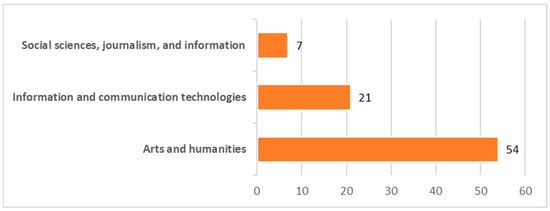
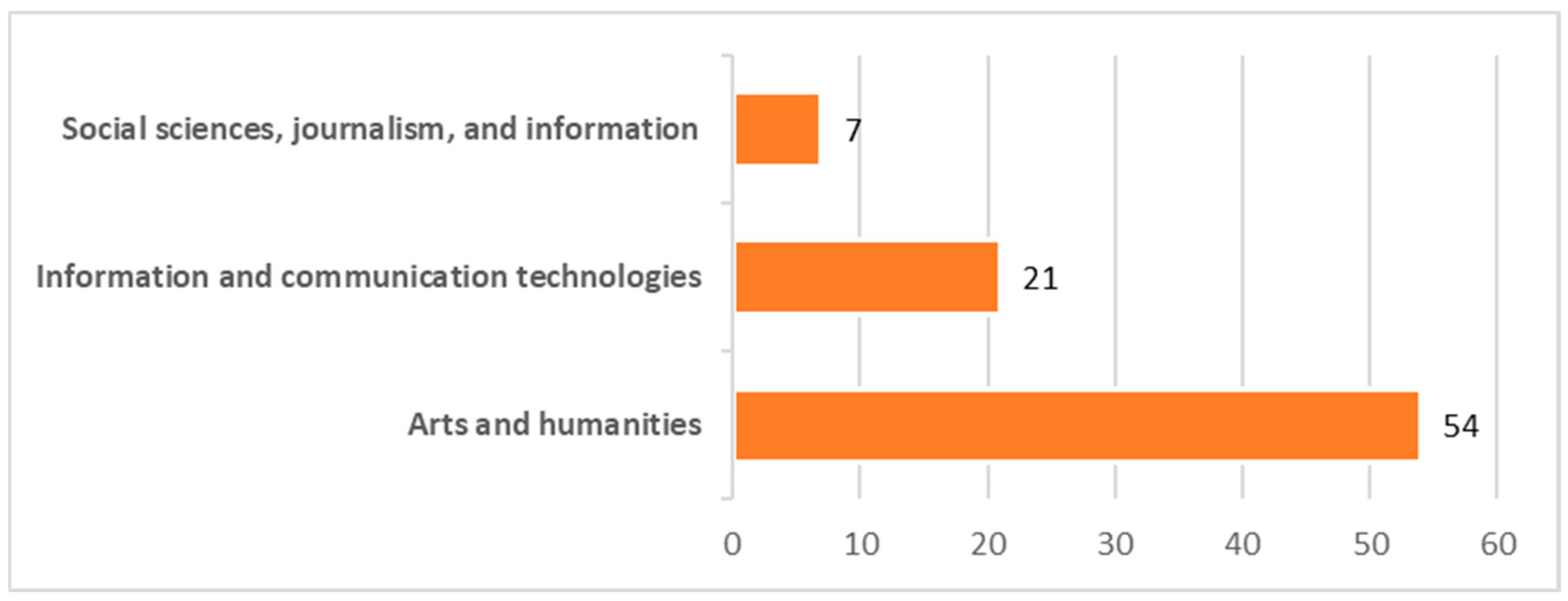
The survey was carried out on a non-probabilistic, intentional, and convenience sample of N = 82 postgraduate students (18 nationalities) from four official master’s programs: (a) Communication and Creative Industries (54); (b) Data Science (15); (c) Mobile Communication and Digital Content (6); and (d) New Trends and Innovation Processes in Communication (7); taught at three Spanish universities (Alicante, Murcia, and Jaume I in Castellón).
UNESCO’s International Standard Classification of Education (ISCED) (UNESCO Institute for Statistics, 2015) was used to categorize the areas of knowledge corresponding to these programs, which are shown in Figure 2. In academic terms, the sample was similar as there was a focus on communication and digital languages, and the areas were predominantly communication (66%), computer science (26%), and journalism (8%), which are relevant to studying disinformation.
Figure 2.
Classification, by areas of knowledge, of the participants’ postgraduate programs, according to ISCED (UNESCO Institute for Statistics).
2.2. Instrument
A self-administered online questionnaire was used to collect data, consisting of 53 items that combined nominal variables (single and multiple responses) and ordinal ones using frequency and agreement scales, as well as Likert scales from 1 to 5 and from 1 to 7 (File S1, Supplementary Materials). The items were designed by the research team based on the specialized literature and conceptual frameworks on CT, DL, post-truth, and fake news we described earlier. Before it was finally used, a review of theoretical consistency was conducted to ensure conceptual dimensions corresponded to the content item. This was achieved by consulting trusted academics and professionals within the education sector—all of whom are named in the acknowledgements—who provided critical feedback on the form’s strengths and weaknesses to guarantee that the content items were robust and theoretically aligned.
Additionally, reliability indices (Cronbach’s α and McDonald’s ω) were calculated for each construct. For the critical thinking construct, internal consistency was acceptable for the dimensions of skepticism (α = 0.517; ω = 0.528) and verification/use of information (α = 0.483; ω = 0.540). An exploratory factor analysis (EFA) using minimum residual extraction with oblimin rotation was conducted to examine the underlying structure. Sampling adequacy was assessed through the Kaiser–Meyer–Olkin (KMO) measure and Bartlett’s test of sphericity. Results indicated that the data were suitable for factor analysis (KMO = 0.554; Bartlett’s χ2 = 87.2, df = 45, p < 0.001). Parallel analysis suggested a two-factor structure consistent with the theoretical dimensions of the construct. Due to the limited sample size, confirmatory factor analysis (CFA) was not performed.
For the digital literacy construct, reliability analysis indicated acceptable internal consistency for several dimensions, including arguments (α = 0.690; ω = 0.694), socioeconomic (α = 0.713; ω = 0.743), and sociohistorical (α = 0.622; ω = 0.665). In contrast, considerably lower reliability values were observed for the trustworthy information (α = 0.224; ω = 0.391) and sociotechnical (α = 0.290; ω = 0.437) dimensions. Exploratory factor analysis suggested a multidimensional structure consistent with the theoretical components of digital literacy. Sampling adequacy was acceptable (KMO = 0.661), and Bartlett’s test of sphericity was significant (χ2 = 535, df = 253, p < 0.001), confirming the suitability of the data for factor analysis.
As the study relied on EFA to explore the underlying structure of the constructs, confirmatory fit indices (CFI, TLI, RMSEA, SRMR) associated with CFA were not reported. These results should therefore be interpreted as exploratory evidence supporting the theoretical structure of the instrument rather than as a final validation of the measurement model.
The questionnaire included items designed to capture key dimensions of critical thinking and digital literacy. For critical thinking, items assessed skepticism and verification practices (e.g., “Do you usually verify the source of the information before sharing it?”; “Do you tend to question the credibility of news you encounter online?”). For digital literacy, items addressed dimensions such as argument evaluation, socioeconomic awareness of platforms, and sociohistorical understanding of information environments (e.g., “How helpful is understanding the economic interests behind digital platforms for evaluating information?”; “To what extent does knowledge of historical information contexts help interpret current news?”). Responses were measured using frequency and agreement scales, including Likert-type scales ranging from 1 to 5 and 1 to 7, depending on the item format.
The questionnaire was carried out during the period from October 2024 to March 2025. The specific items used for each dimension of the questionnaire are presented in File S2, “Types of Questions,” in the Supplementary Materials. This document includes the full text of each question, type of response, the variable it measures, and the corresponding descriptive statistics. This Supplementary Information enables the consistency between the theoretical dimensions and their empirical application to be verified, as well as traceability between constructs, indicators, and results.
2.3. Procedure and Variables Collected
Data were obtained on: use of platforms and news reception; perceptions of algorithmic influence and platform ownership; self-perception of verification and CT skills; verification and news sharing practices; and concepts about CT, post-truth, and fake news. The questionnaire included open-ended questions that provided qualitative data and responses were coded by topic by independent reading and researcher consensus.
2.4. Data Analysis
Data analysis was strictly descriptive (frequencies and percentages; distribution tables by item and topic groupings in order to facilitate interpretation). Given the nature of the sampling (non-probabilistic), sample size, and the prevalence of ordinal items, no parametric inferences were made, nor were any hypotheses proposed about cause.
The results have been interpreted as exploratory evidence about the perceptions postgraduate university students have about their digital competencies and their relationship with the current information ecosystem, characterized by information overload, virality, and the circulation of false or misleading content. In turn, these findings can pave the way for further studies with designs and samples which are suitable for inference.
2.5. Ethical Considerations
The research was carried out in an ethical manner as the study was approved by the participating institutions, and all participants provided informed consent online; the data were treated anonymously and confidentially.
3. Results
The following is a description of the experimental results, as well as their interpretation and experimental conclusions. The general table of results (File S3) can be found in the Supplementary Materials.
3.1. Sample Profile
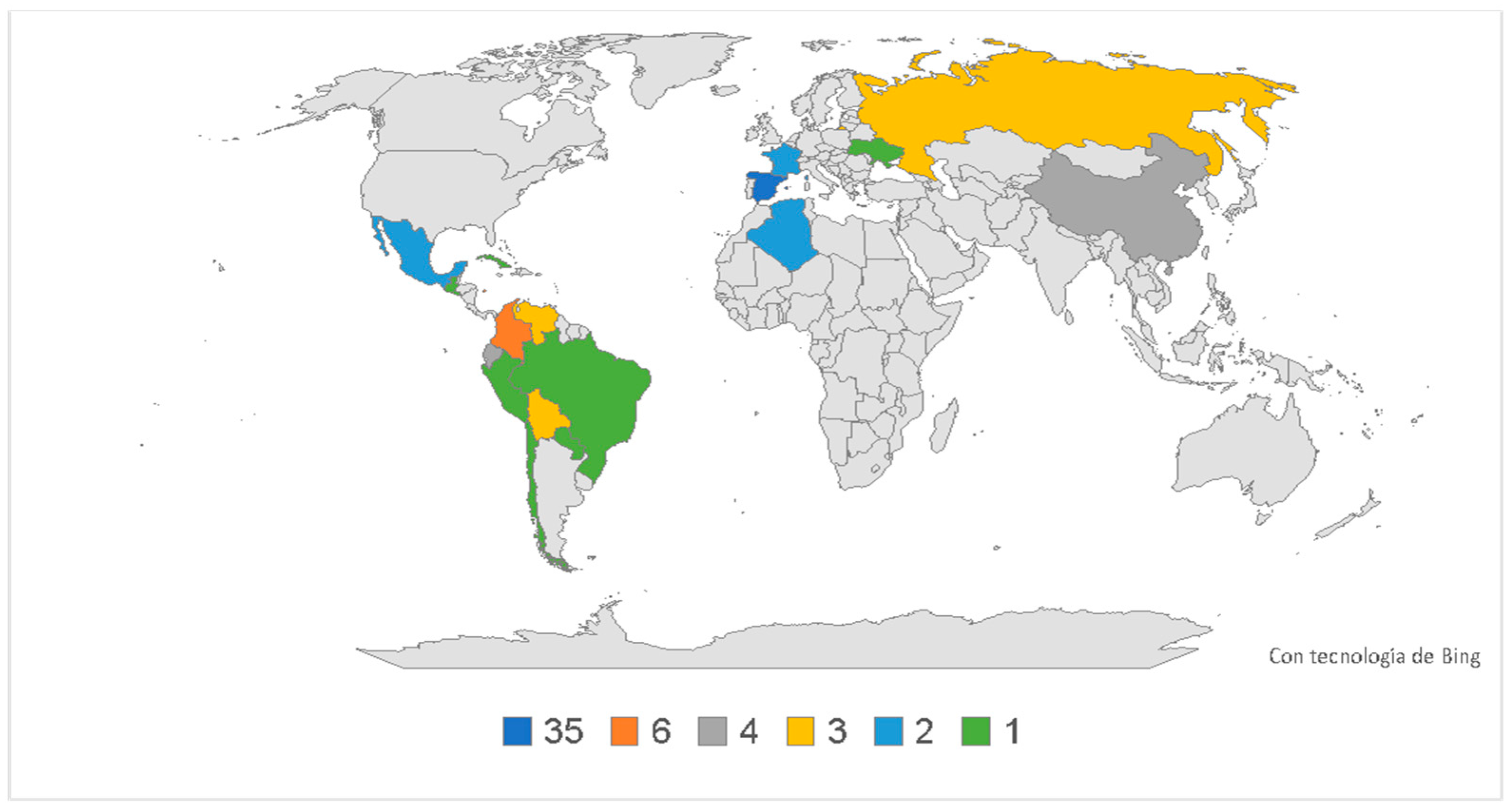
Of the 82 initial respondents, 10 were excluded for failing to meet the inclusion criteria. Specifically, 2 were omitted for reporting no social media usage (Question #7), while 8 others—despite being users—indicated they did not consume news via these platforms (Question #8). Consequently, the final sample comprised 72 participants (60% female, 40% male), with ages ranging from 21 to 49. The sample included various nationalities which had the following distribution by continent: Europe (41), America (25), Asia (4), and Africa (2). Figure 3 shows their countries of origin.
Figure 3.
Countries of origin of participants (“n” per country). Spain, 35; Colombia, 6; China and Ecuador, 4; Bolivia, Venezuela, and Russia, 3; Mexico, France, and Algeria, 2; Chile, Paraguay, El Salvador, Peru, Cuba, Ukraine, Guatemala, and Brazil, 1.
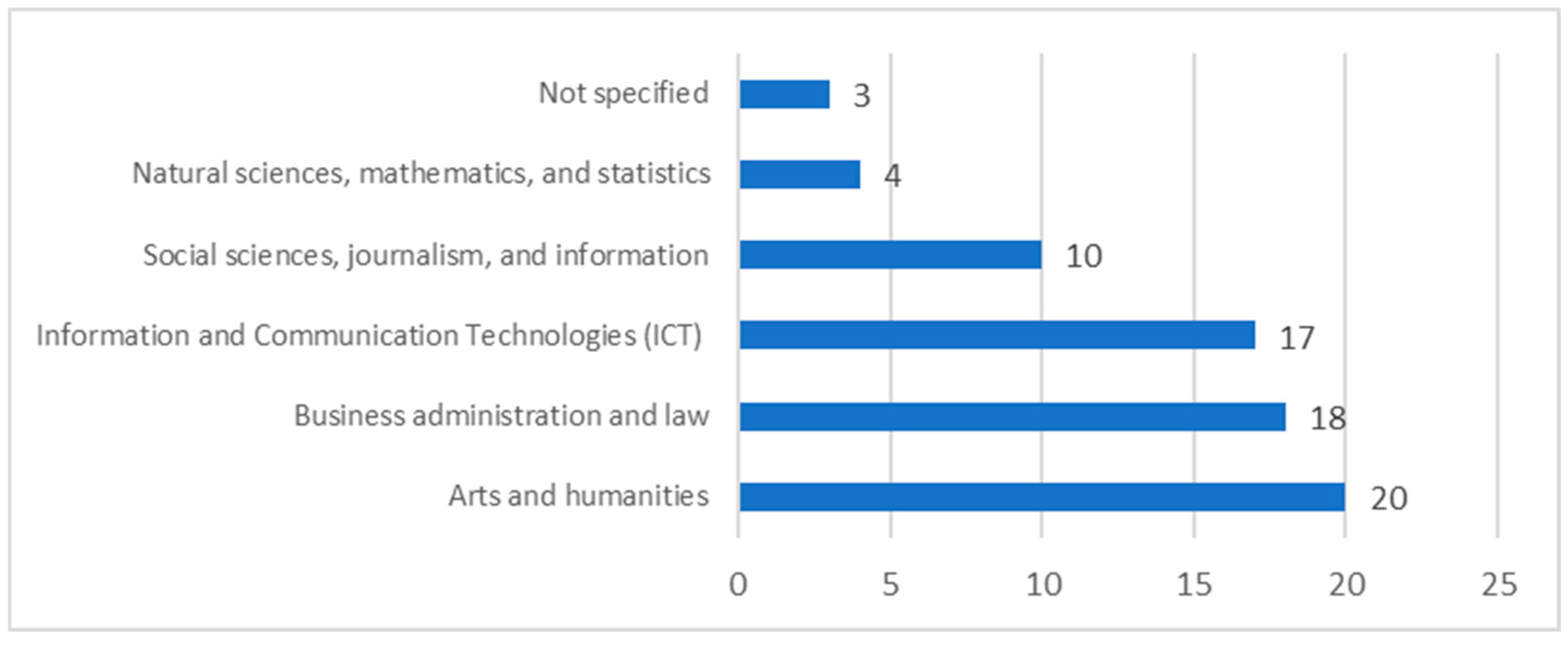
The sample was academically heterogeneous. The participants’ bachelor’s degrees were identified and processed in accordance with the International Standard Classification of Education (ISCED), as shown in Figure 4.
Figure 4.
Areas of knowledge of the participants’ bachelor’s degrees (n per area). Areas were assigned in accordance with the International Standard Classification of Education (ISCED), distinguishing between broad fields, according to the emphasis each academic program had.
Identifying these disciplinary areas contextualizes the range of disciplines in the sample and its relevance to research on CT and DL. As shown in Figure 4, participants mainly studied the arts and humanities, business administration, and law, as well as information and communication technologies (ICT), and to a lesser extent, natural sciences, mathematics, and statistics.
This diversity forms a heterogeneous academic base that enriches the analysis by including perspectives from creative and social sciences, as well as technical and management fields, given that disinformation is relevant to all types of educational profiles. Having described the additional characteristics of the sample, the results are presented below by item.
A descriptive overview of selected survey indicators provides additional context for interpreting the main findings. A majority of respondents reported frequently encountering fake news on social media (59.7%, 95% CI: 48–71). However, a smaller proportion indicated that they frequently verify the credibility of online information sources (45.8%, 95% CI: 34–57). Regarding news-sharing behavior, 38.9% reported frequently sharing news encountered on social media (95% CI: 27.6–50.2). Furthermore, 84.7% reported that online information tends to find them rather than being the result of an active search (95% CI: 76–93), while only 15.3% disagreed with this statement. Chi-square tests of independence were conducted to examine the relationship between the “news-finds-me” perception and two variables: news-sharing behavior and the belief that information received through social media confirms prior beliefs. The analyses did not reveal statistically significant associations in either case (news sharing: χ2 (12, n = 72) = 11.50, p = 0.485; confirmation of prior beliefs: χ2 (9, n = 72) = 14.20, p = 0.116).
3.2. Critical Thinking
CT was addressed in an integrated manner based on the four established operational dimensions: (1) definition, (2) skepticism, (3) verification and responsible use of information, and (4) ethics–values. The results are presented by dimension and summarized in Table 2.
Table 2.
Summary of descriptive results in critical thinking (CT).
3.2.1. Definition
49% of students defined CT in broad terms, linking it to questioning, self-reliance, truthfulness, and social impact. This notion of CT incorporates ethical and contextual dimensions, not just cognitive ones. In contrast, 22% associated it with logical analysis and rigorous argumentation; 15% understood it as reflective thinking in order to make judgments; and 14% narrowed it down to an instrumental skill, the purpose of which was problem solving. Overall, almost half did not define it in purely procedural terms and attributed a critical and transformative role to it.
Thus, the results suggest there is no consensus on what CT is: ethical-social, logical, reflective, and instrumental views coexist. These different views concur with the lack of conceptual consensus described in the literature (Moore, 2013; Abrami et al., 2015; Dwyer et al., 2017; Vendrell & Rodríguez, 2020; Carbogim et al., 2016) and indicate the need for explicit training in CT within DL in postgraduate classes.
3.2.2. Skepticism
Regarding skepticism, 78% of students perceive the information circulating on social media to be biased or distorted, and 57% consider themselves capable of detecting it. However, 85% stated that “the information finds me,” rather than actively seeking it out, and 75% acknowledged that what they consume on social media tends to confirm their own beliefs.
Taken together, these results suggest some incoherence: although many students of the sample claim to be highly skeptical toward disinformation and claim they can recognize it, they also acknowledge passive (“the information finds me”) and self-referential information consumption in which content that reinforces prior beliefs predominates. This mismatch indicates a need for DL that not only encourages students to be wary of bias, but also highlights the role algorithms, personalization, and echo chambers play in building one’s own “information reality.”
3.2.3. Verification and Responsible Use of Information
In this dimension, CT was evaluated not only as a cognitive skill, but also as a commitment to seeking truth and the common good when faced with disinformation. A total of 65% of students of the sample say they frequently verify facts and check their arguments against other sources. However, only 36% say they are willing to change their minds when they find information that clashes with their beliefs; 64% show little flexibility. This stubborn mindset reveals that even if consumers verify information, this does not necessarily translate into a reassessment of their beliefs.
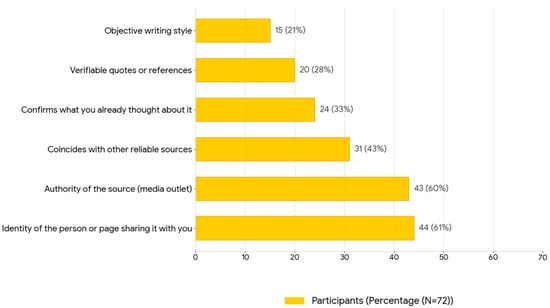
As for the act of sharing information, 61% share news on a regular basis. Consumers mainly share not because they have personally carried out checks on the information, but rather due to the identity of the publisher (61%), the authority the source has (59%), and, to a lesser extent, how consistent it is with other reliable sources (43%), as shown in Figure 5. Only 38% acknowledge social validation (“likes,” views) has a strong influence and 62% state that this factor has “little” or “no” impact.
Figure 5.
Number and percentage of students reporting factors to share online news through social media.
Overall, there is some incoherence: students claim they verify, but on sharing, they equate credibility to how reputable the source is rather than carrying out independent checks. This suggests their notion of CT is based on a kind of outsourced trust, which renders them vulnerable in a post-truth world.
3.2.4. Ethical Values
Ethical responsibility and freedom of speech online were explored, including spreading disinformation, its relationship to hate speech, and the limits to online freedom of speech. A total of 77% attributed sharing fake news to a lack of verification or emotive reasons (interest, surprise, humor, outrage); 15% believed that it is shared because it is believed to be true; and 8% admitted knowingly spreading falsehoods. This suggests verification is not greatly valued and emotions influence the decision to share.
A total of 90% of students perceive that disinformation and hate speech are closely related and show online spaces as arenas for dialogue have been eroded. Only 10% expressed moderate disagreement and no one strongly disagreed, indicating they are willing to work on digital ethics and informed deliberation.
Regarding content moderation, on a scale of 1–7 (1 = unrestricted freedom of speech; 7 = maximum truthfulness), the mean and median were 5. 58% prioritize truthfulness (5–7), 32% adopt an intermediate stance (4), and 10% favor unrestricted freedom of speech (1–3). Overall, most support quality control against false content and in principle have an ethical willingness to accept limits being placed on disinformation and take responsibility for the information they possess as part of their university education.
3.3. Digital Literacy
This category refers to the critical understanding of interactions between users, content, and technologies in social, cultural, political, and economic contexts (Nichols & Stornaiuolo, 2019). It was organized into four subcategories: content evaluation, socio-technical framework, socio-economic framework, and socio-historical framework. The main descriptive findings on DL are summarized in Table 3, with the most representative indicators for each dimension.
Table 3.
Summary of descriptive results in digital literacy (DL).
A composite Digital Literacy Index (DL Index) was calculated by averaging all digital literacy items. The sample showed a mean score of 3.40 (SD = 0.29; median = 3.43), with scores ranging from 2.74 to 3.96 (range = 1.22). These results suggest a relatively homogeneous level of digital literacy among the participants.
3.3.1. Content Evaluation
This covers two key skills: (1) identifying how trustworthy the information is and (2) analyzing and evaluating arguments in order to assess the ability to filter, interpret, and evaluate the quality of online information.
Identifying How Trustworthy the Information Is
This subcategory addresses the students’ ability to evaluate how trustworthy online information is. This is a core skill in critical digital literacy as it activates cognitive filters and verification strategies in a saturated, algorithmic ecosystem prone to disinformation.
To fulfill the sampling requirements, respondents had to be social media users who utilized these platforms as news sources. The mean of the 72 valid responses indicates that participants use an average of 3.61 different social networks (median = 4). With respect to the networks reported as news sources, the mean was 2.08 (median = 2).
These data suggest that participants perceive only half of the social media platforms they habitually use as sources of news content. This does not imply that half of these networks were primarily adopted for news consumption, as the survey did not explicitly inquire about usage motivations. Indeed, previous research (Newman et al., 2024, Shearer et al., 2024; McClain et al., 2024; Pew Research Center, 2025) has established that news-seeking is the least-prioritized motivation across all social networks—with the notable exception of X—and that news exposure on other platforms is predominantly incidental rather than intentional.
These platforms (particularly those with a high visual and algorithmic component) encourage the circulation of short, emotionally charged content, which makes it difficult to identify trustworthy information and influences the decision to share it (Del Moral Pérez et al., 2025, p. 85).
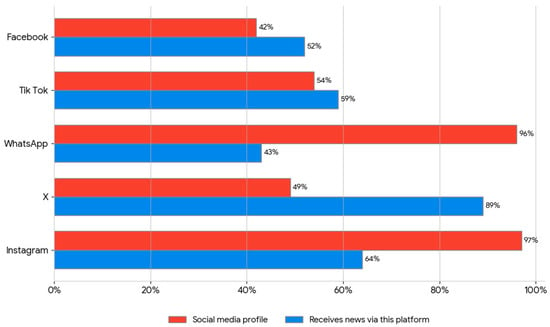
In terms of specific use, Instagram (97%) and WhatsApp (96%) are the most widely used applications, while TikTok reaches 54%, X stands at 49%, and Facebook accounts for only 42%. However, among respondents who report using X, this social network is perceived as a news source by 89% of its users, whereas these figures are more limited for users of Instagram (64%), TikTok (59%), Facebook (52%), and WhatsApp (43%) (Figure 6).
Figure 6.
Number of social media apps used by participants. The red bar represents the percentage of respondents (n = 72) who report using specific social media platforms. The blue bar indicates the percentage of users for each platform who report receiving news through this specific channel.
With WhatsApp, circulation occurs in settings which are closed and hard to evaluate (private groups, encryption), which means the need to have critical skills to filter information before forwarding it is greater still. This pattern is in keeping with global reports (Shearer et al., 2024; Pew Research Center, 2025; Newman et al., 2024; Kemp, 2025), which show the growing dependence on social platforms as the primary means of accessing news and the consequent increased exposure to disinformation.
This exposure is explicit: 99% of students said they frequently encounter fake news. However, there are mixed results on one’s self-perception of their ability to distinguish trustworthy from fake news: 51% considered it easy or very easy to do so, while 49% perceived it as not very easy, difficult, or very difficult. This ambivalence suggests that although they are aware of the problem, there are practical limitations in consistently recognizing disinformation.
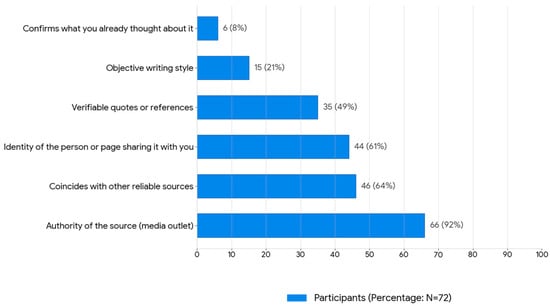
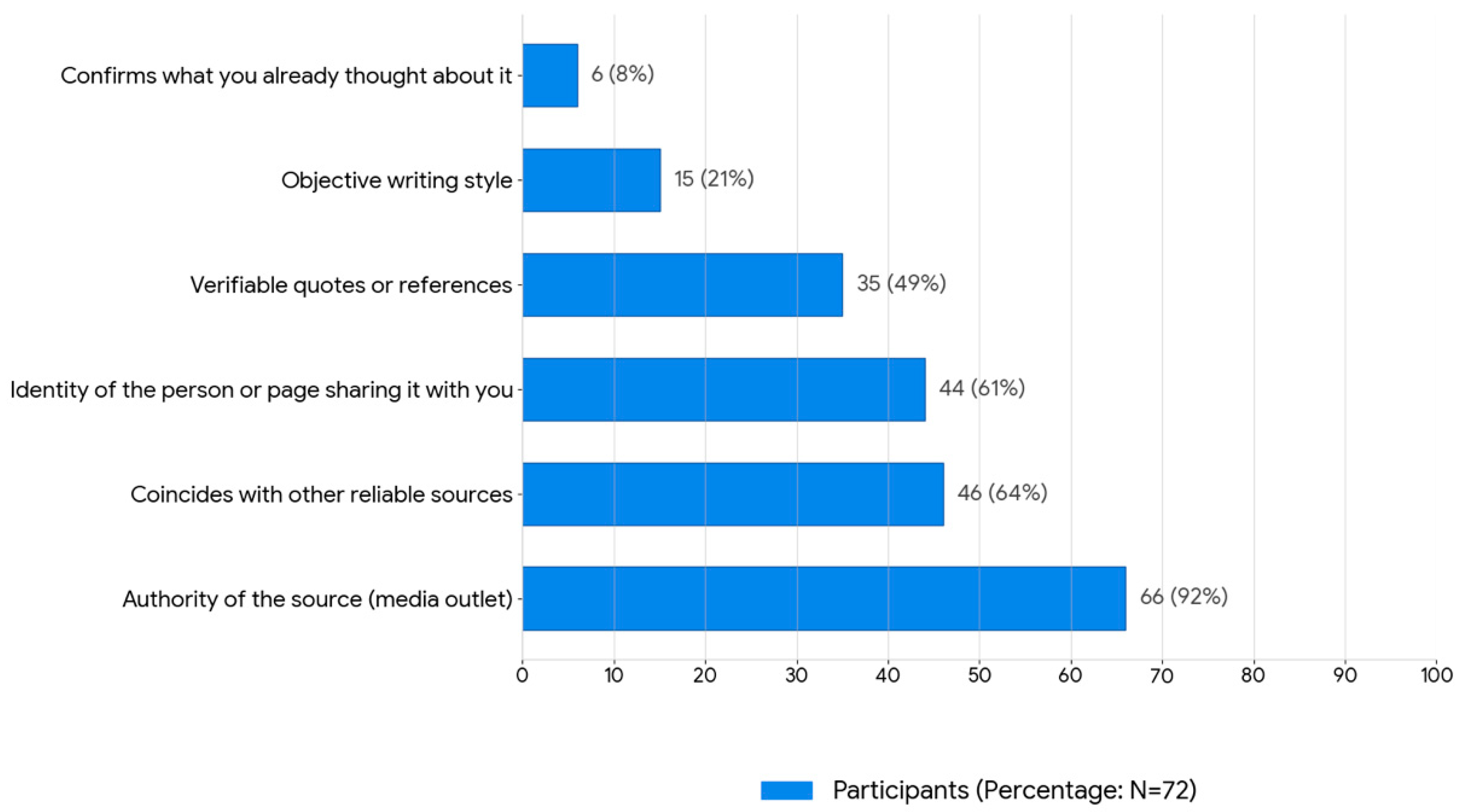
When evaluating the criteria used to decide whether a news item is trustworthy or not (Figure 7), seemingly formal factors predominate: how much authority the original source has (92%), consistency with other trustworthy sources (64%), and identity of the person or page sharing it (61%). In contrast, confirming prior beliefs was of secondary importance (8%). This suggests that students claim they tend to legitimize information based on how reputable the source is, rather than on their own systematic verifications. This “outsourced trust” coincides with what was observed in the previous section on CT: the speaker, rather than an independent verification process, is trusted.
Figure 7.
Number and percentage of students reporting reliability factors in online news reception.
However, this trust they state they have in “legitimate sources” does not always translate into active verification. Only 46% said they verify on a systematic basis (“always” or “often”), compared to 54% who do so sporadically. This discrepancy between knowledge and practice suggests that critical literacy is still at a fledgling stage, and consumers are still influenced by how emotive content is and social validation dynamics. Even so, 76% of students consider themselves to be well informed. However, this positive perception of their digital literacy clashes with data that shows they have limited verification habits (54%) and difficulties in distinguishing false information (49%).
A comparison between the factors that influence news sharing and those that determine how trustworthy it is reveals a consistent pattern: students of the sample place their trust in the reputation or authority sources have rather than making independent verifications. Thus, both in terms of sharing and evaluating content, CT works here by trusting sources believed to be trustworthy, rather than actively contrasting information. Thus, this reflects that their literacy still depends on social references to assess credibility. This dependence brings us to the next dimension, which concerns the analysis and evaluation of the arguments in digital messages.
Analysis and Evaluation of Arguments
This subcategory addresses the students’ ability to identify and evaluate arguments within news encountered online: searching for evidence to support a claim, questioning whether it is logical, and verifying that arguments are based on verifiable facts.
A total of 64% said they look for evidence to support important claims in a news story (“always” or “often”), although this does not seem to be an established habit. Only 46% systematically verify the source, suggesting verification criteria are applied selectively based on suspecting a falsehood or how relevant the content is. This indicates critical literacy is still at a fledgling stage and consumers react more to the content than the source it comes from.
In terms of logical analysis, 74% said they question how consistent arguments are “always/often,” indicating they are willing to embrace critical thinking. However, when judging how trustworthy a news story is, only 49% mentioned the presence of verifiable citations or references, and only 21% considered formal points such as objective writing. This discrepancy reveals that, although the students of the sample claim to be analytical, they use limited rigorous argumentative criteria.
Finally, 75% expressed interest in knowing whether arguments are supported by verifiable facts, but this does not mean they actively search for evidence (64%). Thus, there is an 11% discrepancy between the figures for intention and practice. Overall, the data show consumers deem argumentative evaluation is important, yet there is still a discrepancy between what students of the sample say they value and what they actually do.
3.3.2. Socio-Technical Framework
Before beginning this and the following two sections, it must be noted that, so far in our review of recent literature, we have not found any validated instruments that explicitly integrate three distinct frameworks (socio-technical, socio-economic, and socio-historical) for identifying the self-perception postgraduate students have of their DL (van Dijck et al., 2018; Nichols et al., 2021; Ilomäki et al., 2023; De Groot, 2025; Mensonides et al., 2024).
In this regard, this study poses a preliminarily unification of these frameworks as measurable dimensions. We recognize that there may be some relevant developments we are unaware of and consider this proposal to be merely the first step, which can be compared in the future, refined, and validated. It examines how platform design, automation, and algorithms influence visibility, circulation, and information consumption. That is, technology is biased (van Dijck et al., 2018).
A total of 89% said they were very (47%) or moderately (42%) aware of the influence platform design (e.g., Facebook, X) had on what they consume; in addition, 100% agreed that these platforms prioritize certain content, indicating a widespread perception they are biased. However, this does not imply they know how these platforms work.
Regarding algorithms, 86% perceived themselves as very (28%) or moderately (58%) influenced. At the same time, there are mixed opinions about how much personal control they perceive they have: 51% believe they have a lot/some control and 49% believe they have little/no control. This suggests they have an illusion of control in opaque settings. Likewise, 81% consider that the consumer-technology relationship hinders CT; even so, 96% claim to be aware of how technology influences their decisions and 99% ask for more tools for critically evaluating content.
Overall, the patterns indicate an emerging socio-technical awareness that does not always translate into action but provides a basis upon which educational initiatives focused on helping students understand how these platforms work and external verification as essential aspects of digital literacy. Note, these results come from self-perceptions, rather than a study into cause and effect.
3.3.3. Socio-Economic Framework
This subcategory addresses critical awareness of the commercial interests that shape access to and circulation of information content on social media. These platforms, designed as spaces for social interaction rather than news outlets, increasingly spread information broken up with advertising. Thus, the online world is mediated by commercial interests and business models that affect content accuracy, circulation, and accessibility.
A total of 96% of students in the sample recognized that companies such as Google, Facebook, or X have a strong or moderate influence on the information they consume, and 96% considered it important to know who owns the platforms and media, which shows they are sensitive to this structural variable. Similarly, 87% stated that the business interests of social media owners affect how accurate the news shared is, and 99% stated that corporate funding means the media are biased, suggesting they mistrust those who control the information infrastructure due to their profit-making motivation.
However, 83% said they were aware of the business models that support the platforms; however, there is still a discrepancy between awareness and applying this knowledge in practice: 17% still do not fully use the knowledge they have of such commercial interests when analyzing the information context.
Overall, the results show a significant, albeit incomplete, socio-economic awareness of how business interests influence content circulation, rendering them biased and subjective. This recognition provides a basis upon which critical literacy in education can be built by implementing approaches focused on: (i) showing who owns and funds the media; (ii) understanding monetization mechanisms (sale/transfer of data, targeted advertising, labeling from sponsors); (iii) detecting conflicts of interest; and (iv) understanding profit as a driving force upon which the digital ecosystem is built.
In short, the influence stakeholders and business models have on circulation and how they make content biased paves the way to having a socio-historical perspective: understanding how media and technologies over time have reset power relations, information practices, and credibility criteria.
3.3.4. Socio-Historical Framework
This subcategory explores awareness of the historical, political, and cultural processes that have shaped the information ecosystem today. 97% valued understanding the historical changes that have shaped access to online information; this has nurtured a field of teaching for showing how these transformations have responded to structural dynamics in which power, technology, and discourses on hegemony converge.
As for specific knowledge on where platforms come from and how they develop, 75% said they were very (14%) or moderately (61%) informed, while 25% reported they knew little about this. This indicates that this is an area that must be worked on in education. In addition, 89% considered that media control has changed with new technologies, and 99% stated that technology over time has reestablished the power dynamics between governments, companies, and the public. Finally, 96% recognized how important it is to understand the historical relationships between the media and political or social changes.
In short, there is significant socio-historical awareness, albeit there are discrepancies, and this is why this dimension should be included in critical digital literacy in order to contextualize information processes and analyze how the media not only reflect but also structure the public sphere and its transformations.
Together, the three dimensions (socio-technical, socio-economic, and socio-historical) show that acquiring DL is a complex process in which technology, power, and history interact. Although there are still gaps to bridge in education, students of the sample demonstrate they have a critical awareness of how online information is filtered by these platforms and the social implications this has. These findings confirm the need to strengthen DL on the basis of integrating CT as a cross-curricular competency in higher education. Now, having characterized DL from the dimensions analyzed, we can address the phenomena that hinder it from being practiced daily: post-truth and fake news.
3.4. Post-Truth and Fake News
Post-truth refers not only to deliberately distorting facts, but also to a condition in which emotions, beliefs, and ideological interests take precedence over verifiable data (Reale, 2017; Rodrigo-Alsina & Cerqueira, 2019). Fake news is understood as a tool for manipulation (Gelfert, 2018; McDougall et al., 2019), which circulates easily in a polarized world of algorithms and information overload. Both phenomena require critical CT and DL skills to evaluate truthfulness and the underlying intention behind content in a context in which the media and science are treated with skepticism. Table 4 presents the main descriptive findings for these dimensions and summarizes the most significant indicators.
Table 4.
Summary of key findings on post-truth and fake news.
3.4.1. Post-Truth
90% showed critical understanding: 42% defined it as a structural condition in which emotions/beliefs displace facts; 26% linked it to prejudice and uncritical thinking; 22% to ideological, political, or commercial manipulation; 10% expressed skepticism, and no one considered it a “fad.” Overall, its cognitive, social, and political impact is recognized, thus highlighting the need for critical literacy that addresses polarization, news which plays on our emotions, and the lack of trust in the media and science.
3.4.2. Fake News
A total of 64% defined it as disinformation fabricated for political, economic, or ideological purposes; 22% focused on false/misleading headlines; 8% associated it with parodies or misunderstood jokes. There is widespread awareness that it is manipulative, which is one reason why CT, DL, and verification skills must be built up as civic competencies in order to confront post-truth.
3.4.3. Fact-Checking
A total of 75% of students of the sample (54) did not mention the name of any fact-checker; out of these, 49 said they did not know of any, 3 gave unrelated answers, and 2 did not respond. Among those who did mention a fact-checker (25%, n = 18), only 5 cited more than one. The most frequently mentioned are Maldita.es (9) and Newtral (5); Colombiacheck (2) also appears, and Desenformante, Debunk, Maldito Bulo, Reuters Fact-Check, EFE Verifica, RTVE Verifica, Fastcheckcl, and Ground News, which are each mentioned once. Table 5 shows the statistics, a brief description of these fact-checkers, the websites consulted, and their country of origin.
Table 5.
Verifiers mentioned by participants.
This pattern suggests their lack of awareness about the verification ecosystem: people rely on general heuristics (“common sense,” “official websites”) rather than specialized procedures and sources. To a great extent, the ability they claim they have to distinguish reliable information is not backed up by references (names and use of fact-checkers), which means there is a clear need to provide training on this.
In terms of education, there is a need to integrate specific verification practices (reverse image search, triangulation, tracing to primary sources) and familiarize students with verifiers (what they do, when to use them, how to compare) to convert their critical disposition into procedural competence within DL and CT.
Taken together, the findings on post-truth, fake news, and fact-checking reveal a situation in which there is critical awareness which does not translate into taking action. This discrepancy between perception and practice underscores how urgent it is to build up DL and CT in education in a way that integrates systematic verification as an essential part of critical learning.
4. Discussion
The survey yielded ambivalent results, which led to a discussion on paradoxes associated with the consumption of news through social networks and its viralization by young postgraduate university students of the sample.
To further explore the tensions between stated evaluation criteria and actual sharing practices, a series of exploratory chi-square tests was conducted. These tests assessed whether selected trust criteria were associated with specific news-sharing behaviors. Table 6 summarizes these contrasts, highlighting several empirical patterns that illustrate the paradoxes observed in participants’ information practices, which are discussed below.
Table 6.
Paradoxes between trust criteria and news-sharing factors.
Although not all associations reached statistical significance, the patterns observed suggest emerging tensions between how participants claim to evaluate information and the factors that appear to guide their sharing behavior.
Paradox 1—Reliance and Distrust. Although 69% of them use social media as their main source of news, 59.7% say they always or often encounter fake news on these platforms. These figures rise to 99% when adding those who report encountering fake news ‘sometimes’. This suggests information risk has been normalized: exposure to falsehoods does not mean consumption habits are rectified. This raises at least two questions: (1) Why not avoid sources perceived as purveyors of disinformation? (2) Apart from information, what do these sources provide that makes it worthwhile for consumers?
It has been observed that for many students of the sample, they do not actively search for information, but passively receive it (85% of strongly/somewhat agree). As mentioned above, this phenomenon has been termed the ‘news-finds-me perception’ and has been consistently associated with news overload, news fatigue, and news avoidance. That is, the participants deliberately avoid news labeled as such, tending instead to consume soft news. Rather than being news items strictly speaking—formally labeled and provided with a solid context—these formats function as informal spaces for interpreting or commenting on political and social events (Goyanes et al., 2023; Swart, 2023; Swart & Broersma, 2024).
To empirically illustrate this paradox, we examined the association between trust in the authority of the news source and information-sharing behavior based on the confirmation of prior beliefs. The chi-square test approached statistical significance (χ2 (1, n = 72) = 3.27, p = 0.070), suggesting a tendency for respondents who rely on the authority of the source to also share information that confirms their existing beliefs. Declared trust does not necessarily imply systematic verification; rather, it may coexist with selective cognitive processes associated with confirmation bias, passive consumption, and the normalization of informational risk.
Paradox 2—Distrust and Dissemination. Despite the perceived risk, 61% say they share “always/often/sometimes.” Assuming that sharing information of questionable veracity is ethically problematic, two primary explanations emerge: either partisan-driven motivated reasoning (Osmundsen et al., 2021) or a misapprehension or misjudgment of the falsehood of the shared content (Pennycook & Rand, 2018). However, a third possibility involves challenging the major premise: questioning whether the motivation to share is primarily contingent upon the degree of trust in the news’s plausibility. This third path—which may be described as non-alethic or post-truth—is corroborated by the survey data itself: 77% believe consumers share because it is fun, to cause outrage, or it is popular to do so, regardless of whether the content is true or not.
To further explore this paradox, we examined the association between reliance on cross-source verification and sharing behavior based on the identity of the person or page posting the information. The chi-square test approached statistical significance (χ2 (1, n = 72) = 3.57, p = 0.059), suggesting that even respondents who report verifying information across multiple sources may still share content based on the perceived credibility or affinity of the individual sharing it.
Paradox 3—Should be vs. actual practice. There are signs that students of the sample declared to exercise CT (51% claimed to be skeptical; 64% looked for evidence; 78% considered biases; 76% felt well informed). However, they simultaneously acknowledge that information ‘finds’ them rather than being actively sought (85%), and that this information typically confirms their pre-existing beliefs (75%). Furthermore, a vast majority are unfamiliar with any fact-checking organizations and, consequently, are unable to name a single one (75%). The pattern indicates “should be” situations rather than what students of the sample do in practice.
To explore the gap between declared critical evaluation and actual practices, we examined the association between reliance on citations or references as a trust criterion and sharing behavior based on cross-source coincidence. The chi-square test approached statistical significance (χ2 (1, n = 72) = 3.50, p = 0.061). This pattern suggests that even respondents who report relying on formal indicators of verification may still engage in simplified credibility heuristics, such as sharing information that appears to be corroborated by multiple sources within their informational environment.
Paradox 4—Trusting vs. sharing. The fourth paradox involves a contrastive evaluation of the factors determining news reliability versus those driving shareability. While the decision to trust is framed around journalistic quality and the exercise of critical thinking, the decision to share is dominated by subjective and affective values—such as a prior relationship with the sender or the alignment with one’s own previous assumptions. This suggests a dissociation between considering a news item trustworthy and deciding to share it: the former does not necessarily imply the latter. On the one hand, participants within the sample state that they evaluate news using formal criteria and report sharing online news frequently. On the other hand, they believe that, in general, people share news regardless of its potential truth value, focusing instead on entertainment or the desire to evoke intense emotions.
A statistically significant association was observed between relying on the identity of the person or page as a trust criterion and sharing news based on the identity of the source (χ2 (1, n = 72) = 6.42, p = 0.011). This finding suggests that relational and identity-based cues play a decisive role not only in trust formation but also in sharing behavior. In other words, participants are more likely to share information when it comes from sources with whom they feel an affinity or prior connection, regardless of formal indicators of journalistic quality.
Taken together, these paradoxes suggest that critical evaluation and information-sharing practices do not always operate coherently, highlighting the need to strengthen critical digital literacy as a bridge between knowledge, judgment, and responsible participation in digital information environments.
In this light, and considering the limitations posed by the small and localized nature of the sample, there appears to be a potential risk for education: it is possible that without critical digital literacy more firmly integrated with CT and procedural fact-checking, digital citizenship could develop on the basis of emotional, fragmented, and decontextualized habits within these contexts.
5. Conclusions
Participants use social media as their main source of information and live in a visual-emotional world that favors immediacy over checking sources. Although they claim to be aware of truthfulness criteria and to “know how to detect disinformation,” these are not applied systematically as passive consumption and social validation prevail over rigorous verification procedures.
It has been demonstrated that DL and CT in information management are interdependent but taking action lags behind knowledge. The postgraduate students in the sample have high self-confidence, but at the same time are unfamiliar with verifiers and are reluctant to change their minds. This mismatch may indicate a trend toward the privatization or subjectivization of perceived truth over objective evidence, a phenomenon extensively discussed in the literature concerning the politics of post-truth.
Consequently, critical digital literacy must be conceived as a cognitive, ethical, and civic activity, with an emphasis on systematic verifications (lateral searching, tracing to primary sources, image reversal), cross-checking sources, and using specialized verifiers. Developing independent criteria for interpreting, evaluating, and acting on information is key to bridging the gap between the awareness they claim to have and putting it into practice.
This study is based on self-reporting, so it does not yet include observational tasks (e.g., lateral verification, reverse image search) with which self-perception can be contrasted with performance. In addition, the cross-curricular design does not address causes, and the convenience sample made up of postgraduate students limits the extent to which the results can be extrapolated. Similarly, contextual correlations (e.g., ideological orientation, intensity of use/platform, type of content) were not controlled, nor was qualitative triangulation included in order to complement the data results with narratives or interviews. These decisions concern the exploratory-diagnostic nature of the work and enable us to clearly outline the following roadmaps for improvement.
We propose: (1) statistically validating the structure of the instrument (confirmatory factor analysis, composite reliability, invariance between groups); (2) including behavioral verification tasks (lateral tracking, primary source, reverse image search) to link self-perception and performance; (3) implementing pre–post designs with training micro-interventions in order to estimate changes in DL and its articulation with CT; and (4) expanding the sample and control in order to include other correlational variables (educational level, ideological affiliation, media habits) to better explain the discrepancy between declared awareness and putting one’s knowledge into practice.
Despite its limitations, the study provides an original empirical map of self-perception of DL in tandem with CT and preliminarily integrates three frameworks that are rarely used in the metrics (socio-technical, socio-economic, and socio-historical). It proposes specific measures to be taken in education (systematic verification, transparency of ownership/funding, socio-historical reading of the media) and actionable evidence which can be used in higher education curricula: it identifies that taking action lags behind knowledge (e.g., lack of knowledge of fact-checkers by name), lack of consistency between evaluation and sharing, and the “illusion of control” when dealing with algorithms. In short, it provides a baseline for improving critical digital literacy and guiding educational interventions that integrate CT with verification activities in a post-truth world.
Supplementary Materials
The following supporting information can be downloaded at: https://www.mdpi.com/article/10.3390/educsci16050684/s1, File S1: Survey information via social media; File S2: Types of questions; File S3: Results tables.
Author Contributions
Conceptualization, M.R.-D. and R.R.-F.; methodology, M.R.-D. and R.R.-F.; validation, M.R.-D. and R.R.-F.; formal analysis, M.R.-D. and R.R.-F.; investigation, M.R.-D. and R.R.-F.; resources, M.R.-D. and R.R.-F.; data curation, M.R.-D. and R.R.-F.; writing: preparation of the original draft, M.R.-D. and R.R.-F.; editing for Education Sciences, M.R.-D.; visualization, M.R.-D. and R.R.-F.; supervision, R.R.-F.; project management, M.R.-D.; funding acquisition, R.R.-F. and M.R.-D. All authors have read and agreed to the published version of the manuscript.
Funding
This research has been partially funded by the University of Alicante, the Spanish Ministry of Science and Innovation (MCIN), and the European Regional Development Fund (ERDF) through the projects TRIVIAL (“Technological Resources for Intelligent Viral Analysis through NLP”, PID2021-122263OB-C22) and HEART-NLP (“Human-centered and Knowledge-driven NLP for Ensuring Quality, Integrity, and Transparency in a Trustworthy Digital Ecosystem”, PID2024-156263OB-C22), funded by MCIN/AEI/10.13039/501100011033/ERDF, EU. The authors thank the Tecnológico de Monterrey Publication Support Fund for its funding to support the publication of this article.
Institutional Review Board Statement
The study was conducted in accordance with the protocols of Ethics Committee of University of Alicante (case file UA-2025-11-19_2, and date of approval of 28 November 2025) for studies involving human subjects. The Project complies with the provisions of current data protection legislation (Organic Law 3/2018, of December 5, on the Protection of Personal Data and Guarantee of Digital Rights) and the stipulations of Regulation (EU) 2016/679 of the European Parliament and of the Council of 27 April 2016 (General Data Protection Regulation).
Informed Consent Statement
Patient consent was waived, because verbal consent was obtained from the participants before administering the questionnaire, rather than written consent, because we believed that this was the correct procedure. We subsequently informed the Ethics Committee of the University of Alicante, which, after analyzing the information provided, determined that our study was conducted in accordance with the protocols of the Ethics Committee of the University of Alicante (file UA-2025-11-19_2, approved on 28 November 2025) for studies involving human subjects. The project complies with the provisions of current legislation on data protection (Organic Law 3/2018, of December 5, on the Protection of Personal Data and Guarantee of Digital Rights) and with the provisions of Regulation (EU) 2016/679 of the European Parliament and of the Council of 27 April 2016 (General Data Protection Regulation), as indicated in the article.
Data Availability Statement
The data supporting the results presented can be found at: https://drive.google.com/drive/folders/1qZlzyfRUTpx6rzL_SZgZkWavo6YaQE-f (accessed on 29 January 2026).
Acknowledgments
M.R.-D. would like to thank Yolanda Heredia Escorza for her academic advice and institutional support when the article was under review. The author also wishes to thank Francisco Díaz Estrada, Director of the Ph.D. in Educational Innovation at Tecnológico de Monterrey, for his institutional endorsement and for suggesting the journal Education Sciences, which significantly helped improve the structure of the article, as well as Tecnológico de Monterrey for funding its publication. R.R.-F. thanks David Tomás Díaz (University of Alicante), Javier Marzal Felici (Jaume I University), and Juan Miguel Aguado Terrón (University of Murcia) for facilitating access to their master’s students. To prepare this manuscript, ChatGPT (GPT-5 Thinking, OpenAI) was used as a support tool to correct style; the authors reviewed and approved the final version of the text.
Conflicts of Interest
The authors declare that they have no conflicts of interest. The funders had no role in designing the study, collecting, analyzing, or interpreting the data, drafting the manuscript, or deciding to publish the results.
Abbreviations
The following abbreviations were used in this manuscript:
| CT | Critical thinking |
| DL | Digital literacy |
| e.g. | For example |
References
- Abrami, P. C., Bernard, R. M., Borokhovski, E., Waddington, D. I., Wade, C. A., & Persson, T. (2015). Strategies for teaching students to think critically: A meta-analysis. Review of Educational Research, 85(2), 275–314. [Google Scholar] [CrossRef] [Scilit]
- Alhabash, S., Smischney, T. M., Suneja, A., Nimmagadda, A., & White, L. R. (2024). So similar, yet so different: How motivations to use Facebook, Instagram, Twitter, and TikTok predict problematic use and use continuance intentions. Sage Open, 14(2). [Google Scholar] [CrossRef] [Scilit]
- Allcott, H., & Gentzkow, M. (2017). Social media and fake news in the 2016 election. Journal of Economic Perspectives, 31(2), 211–236. [Google Scholar] [CrossRef] [Scilit]
- Arriazu, R. (2018). A research methodology in the service of critical thinking: Hermeneutic approach in the post-truth era. Education Policy Analysis Archives, 26, 148. [Google Scholar] [CrossRef] [Scilit]
- Carbogim, F. D., de Oliveira, L. B., & Püschel, V. A. (2016). Critical thinking: Concept analysis from the perspective of Rodger’s evolutionary method of concept analysis. Latin American Journal of Nursing, 24, e2785. [Google Scholar] [CrossRef] [Scilit] [PubMed]
- Civila, S., Romero-Rodriguez, L. M., & Aguaded, I. (2020). El lenguaje como creador de realidades y opinión pública: Análisis crítico a la luz del actual ecosistema mediático. Íconos—Revista De Ciencias Sociales, 67, 139–157. [Google Scholar] [CrossRef] [Scilit]
- Dabbous, A., Aoun Barakat, K., & de Quero Navarro, B. (2021). Fake news detection and social media trust: A cross-cultural perspective. Behaviour & Information Technology, 41(14), 2953–2972. [Google Scholar] [CrossRef] [Scilit]
- De Groot, F. O. (2025). Sticky voices: Affect and critical digital literacies in multimodal academic feedback. System, 134, 103808. [Google Scholar] [CrossRef] [Scilit]
- Del Moral Pérez, E., López-Bouzas, N., Castañeda Fernández, J., & Bellver Moreno, M. C. (2025). The critical thinking strategies university students use when dealing with fake news produced by Artifcial Intelligence. Educación XX1, 28(2), 69–121. [Google Scholar] [CrossRef] [Scilit]
- Dwyer, C. P., Hogan, M. J., Harney, O. M., & Kavanagh, C. (2017). Facilitating a student-educator conceptual model of dispositions towards critical thinking through interactive management. Educational Technology Research and Development, 65(1), 47–73. [Google Scholar] [CrossRef] [Scilit]
- Farias-Batlle, P., Córdoba-Cabús, A., & Gómez-Calderón, B. (2024). Young people and social networks: News consumption habits and credibility of the news. Comunicar, 32(78), 155–165. [Google Scholar] [CrossRef] [Scilit]
- Fernández-Torres, M. J., Almansa-Martínez, A., & Chamizo-Sánchez, R. (2021). Infodemic and fake news in Spain during the COVID-19 pandemic. International Journal of Environmental Research and Public Health, 18(4), 1781. [Google Scholar] [CrossRef] [Scilit]
- Gelfert, A. (2018). Fake news: A definition. Informal Logic, 38(1), 84–117. [Google Scholar] [CrossRef] [Scilit]
- Gil de Zúñiga, H., & Diehl, T. (2019). News finds me perception and democracy: Effects on political knowledge, political interest, and voting. New Media & Society, 21(6), 1253–1271. [Google Scholar] [CrossRef] [Scilit]
- Gil de Zúñiga, H., Weeks, B., & Ardèvol-Abreu, A. (2017). Effects of the news-finds-me perception in communication: Social media use implications for news seeking and learning about politics. Journal of Computer-Mediated Communication, 22(3), 105–123. [Google Scholar] [CrossRef] [Scilit]
- Gilster, P. (1997). Digital literacy. Wiley Computer Pub. [Google Scholar]
- Goyanes, M., Ardèvol-Abreu, A., & Gil de Zúñiga, H. (2023). Antecedents of news avoidance: Competing effects of political interest, news overload, trust in news media, and “news finds me” perception. Digital Journalism, 11(1), 1–18. [Google Scholar] [CrossRef] [Scilit]
- Gutiérrez-Ángel, N., Sánchez-García, J.-N., Mercader-Rubio, I., García-Martín, J., & Brito-Costa, S. (2022). Digital literacy in the university setting: A literature review of empirical studies between 2010 and 2021. Frontiers in Psychology, 13, 896800. [Google Scholar] [CrossRef] [Scilit] [PubMed]
- Himma-Kadakas, M., & Ojamets, I. (2022). Debunking false information: Investigating journalists’ fact-checking skills. Digital Journalism, 10(5), 866–887. [Google Scholar] [CrossRef] [Scilit]
- Hobbs, R. (2021). Media literacy in action: Questioning the media. Rowman & Littlefield. [Google Scholar]
- Ilomäki, L., Lakkala, M., Kallunki, V., Mundy, D., Romero, M., Romeu, T., & Gouseti, A. (2023). Critical digital literacies at school level: A systematic review. Review of Education, 11(3), e3425. [Google Scholar] [CrossRef] [Scilit]
- Jarvis, P. (2007). Globalization, lifelong learning and the learning society. Routledge. [Google Scholar] [CrossRef] [Scilit]
- Karami, M., Nazer, T. H., & Liu, H. (2021, August 30–September 2). Profiling fake news spreaders on social media through psychological and motivational factors. 32nd ACM Conference on Hypertext and Social Media (HT ’21) (pp. 225–230), Virtual Event, Ireland. [Google Scholar] [CrossRef] [Scilit]
- Kemp, S. (2025). Digital 2025: Global overview report. We Are Social & Meltwater. Available online: https://datareportal.com/reports/digital-2025-global-overview-report (accessed on 17 January 2026).
- Kim, D., & Kim, T. (2025). Addressing hyperconnected society’s challenges through Laozi–Zhuangzi thought. Religions, 16(6), 712. [Google Scholar] [CrossRef] [Scilit]
- Lomelí Ponce, J. (2019). Post-truth and psychopolitics. Analysis—Colombian Journal of Humanities, 51(95(Jl-Di)), 347–364. [Google Scholar] [CrossRef] [Scilit]
- McClain, C., Anderson, M., & Gelles-Watnick, R. (2024). How Americans navigate politics on TikTok, X, Facebook and Instagram. Pew Research Center. Available online: https://tinyurl.com/26y59teb (accessed on 23 March 2026).
- McDougall, J., Brites, M.-J., Couto, M.-J., & Lucas, C. (2019). Digital literacy, fake news and education. Culture and Education, 31(2), 203–212. [Google Scholar] [CrossRef] [Scilit]
- Mensonides, D., Smit, A., Talsma, I., Swart, J., & Broersma, M. (2024). Digital literacies as socially situated pedagogical processes: Genealogically understanding media, information, and digital literacies. Media and Communication, 12, 8174. [Google Scholar] [CrossRef] [Scilit]
- Moore, T. (2013). Critical thinking: Seven definitions in search of a concept. Studies in Higher Education, 38(4), 506–522. [Google Scholar] [CrossRef] [Scilit]
- National Association for Media Literacy Education. (2023). Core principles of media literacy education. National Association for Media Literacy Education. [Google Scholar]
- Newman, N., Fletcher, R., Robertson, C. T., Ross Arguedas, A., & Kleis Nielsen, R. (2024). Digital news report 2024. Available online: https://reutersinstitute.politics.ox.ac.uk/digital-news-report/2024 (accessed on 8 September 2025).
- Nichols, T. P., Smith, A., Bulfin, S., & Stornaiuolo, A. (2021). Critical literacy, digital platforms, and datafication. In J. C. Pandya, & J. Ávila (Eds.), The handbook of critical literacies (pp. 345–353). Routledge. [Google Scholar] [CrossRef] [Scilit]
- Nichols, T. P., & Stornaiuolo, A. (2019). Assembling digital literacies: Contingent pasts, possible futures. Media and Communication, 7(2), 14–24. [Google Scholar] [CrossRef] [Scilit]
- Osmundsen, M., Bor, A., Vahlstrup, P., Bechmann, A., & Petersen, M. (2021). Partisan polarization is the primary psychological motivation behind political fake news sharing on twitter. American Political Science Review, 115(3), 999–1015. [Google Scholar] [CrossRef] [Scilit]
- Park, C. S. (2019). Does too much news on social media discourage news seeking? Mediating role of news efficacy between perceived news overload and news avoidance on social media. SocialMedia + Society, 5(3), 2056305119872956. [Google Scholar] [CrossRef] [Scilit]
- Pennycook, G., & Rand, D. G. (2018). Lazy, not biased: Susceptibility to partisan fake news is better explained by lack of reasoning than by motivated reasoning. Cognition, 188, 39–50. [Google Scholar] [CrossRef] [Scilit]
- Pew Research Center. (2025). News platform fact sheet. Available online: https://t.ly/ZVkMJ (accessed on 25 February 2026).
- Reale, A. (2017). Argumentation: The post-truth era? University of Buenos Aires. Available online: https://es.scribd.com/document/570477961/Reale-La-era-de-la-posverdad (accessed on 13 March 2025).
- Reinking, D., Labbo, L. D., & McKenna, M. C. (1997). Navigating the changing landscape of literacy: Current theory and research in computer-based reading and writing. In J. Flood, S. B. Heath, & D. Lapp (Eds.), Handbook of research on teaching literacy through the communicative and visual arts (pp. 77–92). Simon & Schuster Macmillan. [Google Scholar]
- Rodrigo-Alsina, M., & Cerqueira, L. (2019). Journalism, ethics, and post-truth. Cuadernos.info, 44, 225–239. [Google Scholar] [CrossRef] [Scilit]
- Rodríguez-Díaz, M. (2026). Enseñanza del pensamiento crítico en instituciones mexicanas de educación superior: Un estudio cualitativo sobre las prácticas docentes en entornos de posverdad y noticias falsas (fake news) [Doctoral thesis, Tecnológico de Monterrey]. [Google Scholar]
- Rodríguez-Díaz, M., & Rodríguez-Ferrándiz, R. (2026). Pensamiento crítico para un fact-checking en el aula. In J. J. Marzal Felici, F. Fernández Beltrán, R. Arnau Roselló, & A. Casero Ripollés (Eds.), La alfabetización mediática e informacional en la era de la desinformación: Retos y propuestas de desarrollo (pp. 467–494). Nau Llibres. Available online: https://shorturl.at/v2u1h (accessed on 23 March 2026).
- Rodríguez-Ferrándiz, R. (2023). An overview of fake news phenomenon: From untruth-driven to post-truth-driven approaches. Media and Communication, 11(2), 15–29. [Google Scholar] [CrossRef] [Scilit]
- Rodríguez-Ferrándiz, R. (2025). Beyond detection and correction: Fake news’ news-ness and shareworthiness as alternative ways to tackle disinformation. Communication & Society, 38(1), 47–62. [Google Scholar] [CrossRef] [Scilit]
- Sánchez Pizarro, C. M. (2011). Entre el reto de la alfabetización… digital ¿una utopía o realidad? Communication, 28, 159–166. [Google Scholar]
- Scharlach, R., & Hallinan, B. (2023). The value affordances of social media engagement features. Journal of Computer-Mediated Communication, 28(6), zmad040. [Google Scholar] [CrossRef] [Scilit]
- Scheibe, C., & Rogow, F. (2012). The teacher’s guide to media literacy. Corwin. [Google Scholar]
- Shearer, E., Naseer, S., Liedke, J., & Matsa, K. E. (2024). How Americans get news on TikTok, X, Facebook and Instagram. Pew Research Center. Available online: https://t.ly/4SAz0 (accessed on 14 June 2025).
- Skovsgaard, M., & Andersen, K. (2020). Conceptualizing news avoidance: Towards a shared understanding of different causes and potential solutions. Journalism Studies, 21(4), 459–476. [Google Scholar] [CrossRef] [Scilit]
- Swart, J. (2023). Tactics of news literacy: How young people access, evaluate, and engage with news on social media. New Media & Society, 25(3), 505–521. [Google Scholar] [CrossRef] [Scilit]
- Swart, J., & Broersma, M. (2024). What feels like news? Young people’s perceptions of news on Instagram. Journalism, 25(8), 1620–1637. [Google Scholar] [CrossRef] [Scilit]
- Tornero, M. (2017). Orígenes de la alfabetización mediática y fundamentación teórica basada en Len Masterman. Revista de Educación de la Universidad de Granada, 24, 99–116. Available online: https://revistaseug.ugr.es/index.php/reugra/article/view/16617 (accessed on 17 January 2026).
- Trejo-Quintana, J., Morales-Martinez, G. E., & Hernandez-Alvarez, B. (2025). Cognitive diagnosis of media and digital literacy knowledge schema in Mexican high school students. Journal of Media Literacy Education, 17(1), 58–74. [Google Scholar] [CrossRef] [Scilit]
- UNESCO Institute for Statistics. (2015). ISCED 2011 operational manual: Guidelines for classifying national education programs and related certifications. UNESCO Institute for Statistics. [Google Scholar]
- van Dijck, J., Poell, T., & de Waal, M. (2018). The platform society: Public values in an online world. Oxford University Press. [Google Scholar]
- Vendrell, M. M., & Rodríguez, M. J. M. (2020). Pensamiento Crítico: Conceptualización y relevancia en el seno de la educación superior. Revista de Educación Superior, 49(194), 9–25. Available online: https://www.scielo.org.mx/scielo.php?script=sci_arttext&pid=S0185-27602020000200009 (accessed on 17 January 2026).
- Vosoughi, S., Roy, D., & Aral, S. (2018). The spread of true and false news online. Science, 359, 1146–1151. [Google Scholar] [CrossRef] [Scilit]
- Wei, C., Nawi, H. M., & Naeem, S. B. (2024). The uses and gratifications (U&G) model for understanding fake news sharing behavior on social media. Journal of Academic Librarianship, 50(5), 102938. [Google Scholar] [CrossRef] [Scilit]

Disclaimer/Publisher’s Note: The statements, opinions and data contained in all publications are solely those of the individual author(s) and contributor(s) and not of MDPI and/or the editor(s). MDPI and/or the editor(s) disclaim responsibility for any injury to people or property resulting from any ideas, methods, instructions or products referred to in the content. |
© 2026 by the authors. Licensee MDPI, Basel, Switzerland. This article is an open access article distributed under the terms and conditions of the Creative Commons Attribution (CC BY) license.