


Abstract
While there has been a recent focus on reforming kindergarten curricula to emphasize a play-based learning (PBL) approach, a lingering dichotomy remains between play-based learning and pedagogical instruction aimed at academic preparation. Early music education is a critical component of the current policy emphasis on arts education and PBL, yet there is scarce research on play-based pedagogy in music education, particularly regarding children’s engagement and the applied instructional models. This study investigates how instructional practices affect children’s behavioral and emotional engagement in musical play. Data were collected at two Hong Kong kindergartens (K1–K3) using classroom observations and the Engagement Check II (ECII) tool. Thematic content analysis revealed three instructional approaches: teacher-directed routines with minimal aspects of play, guided play within structured musical contexts, and open-ended, child-initiated musical play. Analysis of the ECII data revealed high levels of behavioral engagement, with guided-play contexts yielding higher levels of behavioral and emotional engagement compared to highly teacher-directed instructional approaches. Differences in engagement levels during musical play were revealed to be correlated with age. This study highlights the need for culturally responsive music teacher training, supportive school culture, and aligned curriculum and policy implementation.
1. Introduction
Play-based pedagogy represents a crucial focus for early childhood education (ECE) practices globally (Pyle & Danniels, 2017; Fleer, 2013). In the context of Hong Kong, the “Joyful Learning through Play” themed curriculum has officially recommended play as the primary vehicle for young children’s learning, advocating creative and developmentally appropriate practices in the ECE curriculum (Curriculum Development Council [CDC], 2017). Nevertheless, ECE practices in Hong Kong have long been heavily influenced by cultural values and parental expectations that emphasize the importance of rigorous schooling and academic success (Li, 2026). These values include a strong societal demand for academic achievement from an early age, filial and familial values that prompt parents to invest heavily in the early education of their children, and a competitive schooling culture that equates early academic attainment in literacy and numeracy with success (Chung, 2025). These values are evident in common practices such as outcome- and assessment-driven kindergarten approaches and the extensive use of home-based worksheets (Chan, 2016). Consequently, although PBL is an established policy priority in Hong Kong, its implementation is often inadequate and inconsistent.
In Hong Kong, music is officially recommended as a core daily activity in early childhood education. Many studies indicate that musical play is an age-appropriate means for children to explore sound, movement, and storytelling in a playful, creative, and collaborative manner (Chung, 2022; de Vries, 2021; Lew & Campbell, 2005; Zachariou & Whitebread, 2017). However, empirical studies focusing on the implementation of play-based approaches to music in Hong Kong and the extent to which preschool children are engaged in this context are still limited. Local studies have indicated a gap between play advocacy in a policy context and academic learning priorities in school and family contexts (Fung & Cheng, 2012). Additionally, studies have noted the role of school culture in influencing the implementation of PBL in Hong Kong classrooms (Cheung et al., 2022; Yin et al., 2022).
The present study addresses this important research gap by examining children’s engagement in musical play and how different instructional practices shape their engagement. By understanding how teachers implement play-based music pedagogy and how children respond across contexts, this research aims to inform culturally responsive pedagogical practice and guide the design of music instruction training and professional development for in-service ECE teachers.
The study was guided by the following research questions (RQs):
RQ1: How do in-service early childhood teachers in Hong Kong implement a play-based approach to music in kindergarten classrooms?
RQ2: To what extent do preschool children engage behaviorally and emotionally in musical play, and how does engagement vary by grade level (K1, K2, K3) and by type of musical activity?
1.1. Play-Based Learning (PBL) in the Sociocultural Context of Hong Kong
Hong Kong’s Kindergarten Education Curriculum Guide (Curriculum Development Council [CDC], 2017) advocates for play as the primary mode of learning in children, urging teachers to create child-centered environments where students can explore and construct knowledge through meaningful hands-on playful and exploratory activities. However, implementation research shows that the translation from policy to practice is often neither straightforward nor uniform (Pont & Viennet, 2017). For example, Fung and Cheng (2012) found that while stakeholders (including principals, teachers, and parents) in Hong Kong generally expressed positive attitudes toward play, they often considered it secondary to “serious” or “academic” learning, which was associated with teacher-led instruction.
In the sociocultural context of Hong Kong, parental expectations and the competitive schooling trajectory place substantial pressure on kindergartens to help children achieve school readiness—typically operationalized as early literacy and numeracy outcomes (Wong & Rao, 2022). This emphasis often marginalizes the demonstrable benefits of early arts education, including music (Chung, 2023). As a result, pressures to produce measurable academic results can undermine play-based implementation: teachers may shorten free-play time, recast teacher-directed drills as “play,” or deploy play primarily as a behavioral reward (Lau & Grieshaber, 2010), rather than fostering play as the central pedagogy of the early childhood classroom.
Recent research indicates that effective implementation of PBL in Hong Kong is supported by whole-school collaboration, leadership commitment, and systematic teacher professional development (Cheung et al., 2022; To et al., 2023). Keung and Cheung (2019), for instance, reported that schools with strong collegial cultures and structured support for planning and reflection were better able to integrate play into core learning experiences rather than treating it as peripheral. Cheung et al. (2022) similarly emphasized the role of teacher capacity building in translating play-based policy into practice.
1.2. Musical Play and Early Childhood Learning
Musical play has been defined as playful engagement with sounds, rhythm, melody, and movement, often in combination with imaginative and social elements (Niland, 2009). Musical play involves singing and moving together, creating songs, improvising music, moving in response to music, and utilizing music in imaginative play. Associations have been made between musical play and various developmental processes and benefits. For example, rhythmic and musical play have been associated with phonological awareness and emergent literacy skills in children (Moritz et al., 2013). Similarly, singing and moving together have been associated with social connections and empathy (Pearce et al., 2017), while improvisational musical play has been associated with creative and critical thinking and emotional expressiveness (de Bruin, 2018).
Moreover, musical play is a significant tool for enabling children to explore cultural meanings and social roles, and to construct shared meanings and understanding. Barrett (2023) states that musical play is a constituent element of a broader play culture and that it expresses and shapes children’s identities, relationships, and sense of belonging. From a sociocultural perspective, musical play is a tool for cultural participation whereby children, alongside their peers and adults, co-create knowledge and meaning (Marsh, 2017).
However, there is limited research on musical play in East Asian contexts such as Hong Kong. Existing local studies have mostly conceptualized music in schools as a subject or a form of musical performance, such as a school choir or instrumental music training. In addition, Ho et al. (2024) reported that musical activities in Hong Kong preschools often consist of children following teachers’ lead—singing and performing movements within daily routines—rather than participating in the exploratory musical play advocated by the official curriculum guide. Lau and Grieshaber (2010) noted that ECE teachers in Hong Kong often follow textbook instructions closely, resulting in children repeatedly singing songs together. Meanwhile, Chung and Ho (2026) found that Hong Kong ECE teachers reported only moderate confidence in implementing musical play, with their confidence in their musical play content knowledge lower than that in their pedagogical content knowledge.
1.3. Engagement in Early Childhood Classrooms
Engagement in early childhood settings has been defined as the degree to which children are behaviorally and emotionally engaged in age-appropriate classroom activities (McWilliam et al., 2003). Behavioral engagement includes sustained attention, active participation, and instrumental manipulation of materials, while emotional engagement encompasses interest, enjoyment, and curiosity (Skinner & Pitzer, 2012).
Research indicates that children’s positive engagement with their teachers and peers is linked to greater improvements in self-regulation, compliance, and emotion regulation over the preschool year (Coelho et al., 2019). Classroom process quality—such as well-structured, stimulating activities—is associated with higher levels of behavioral engagement, which, in turn, mediates the relationship of classroom quality with early literacy development and later reading achievement (Singer et al., 2014; Franklin & Harrington, 2019).
Interventions that combine social–emotional learning with language and emergent reading instruction—such as Head Start programs—have shown that improvements in preschoolers’ social and emotional skills are related to increased learning engagement and, subsequently, better reading outcomes (Nix et al., 2013). Moreover, child-directed activity settings, where children choose the materials and guide interactions, elicit greater class-wide active engagement than more adult-directed settings (Casey et al., 2012). Altogether, these findings highlight the importance of high-quality, child-centered instructional practices and integrated social-emotional interventions for fostering engagement, which, in turn, supports developmental factors such as early self-regulation and foundational reading skills.
2. Theoretical Framework
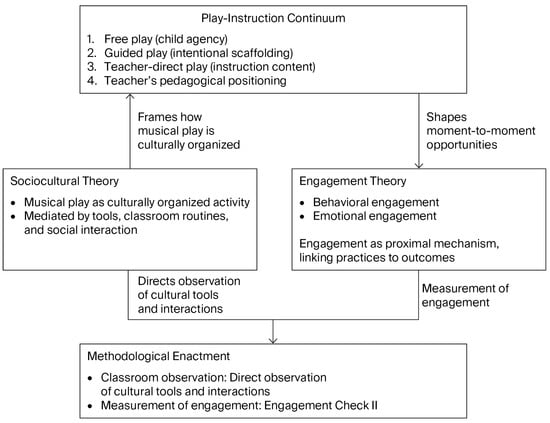
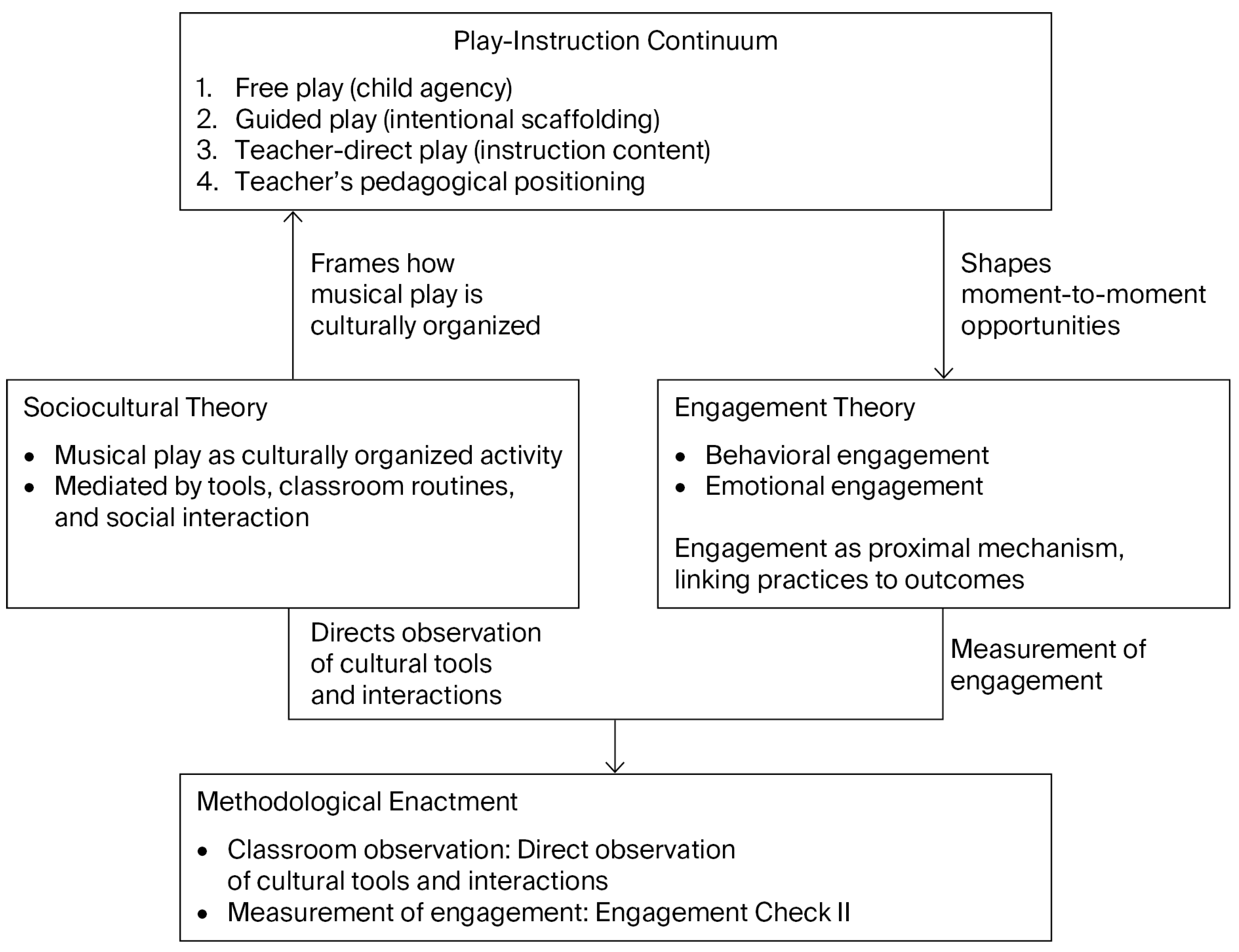
This study adopts an integrated theoretical framework combining sociocultural theory, PBL, and engagement theory to examine how ECE teachers’ music instruction practices shape children’s engagement in Hong Kong kindergartens (See Figure 1). The definition of an “integrated framework” in the context of this study is the purposeful integration of sociocultural theory, PBL, and engagement as complementary frameworks for gathering and interpreting data. Unlike the above-mentioned conceptual lenses, which are considered separately, this framework incorporates such interrelated aspects as the sociocultural background of children’s play, the significance of play as teaching tool, and multiple aspects of engagement (behavioral, emotional, cognitive). More specifically, in this study, sociocultural theory (Vygotsky, 1978) frames musical play as a culturally organized activity mediated by tools (songs, instruments, movement), classroom routines, and social interaction. This perspective identifies teacher–child interaction and curricular priorities within the Confucian-influenced Hong Kong context, explaining how cultural values and institutional contexts may shape pedagogical practice. PBL provides a pragmatic taxonomy for instructional models along a continuum—free play, guided play, and direct instruction—characterizing differences in child engagement, adult structuring, and learning affordances.
Figure 1.
An integrated theoretical framework combining sociocultural theory, play-based learning (PBL), and engagement theory.
3. Materials and Methods
3.1. Research Design
A mixed-methods design (Brown & Coombe, 2015) was employed that included extended classroom observation, video and photographic recording, and engagement measurement using the Engagement Check II (ECII) tool (Casey & McWilliam, 2007). The qualitative component of the design assessed the richness of teachers’ classroom behaviors and children’s musical experiences, while the quantitative component investigated children’s engagement in specific musical activities.
3.2. Setting and Participants
Using the purposive sampling method (Campbell et al., 2020), data were collected from two kindergartens in Hong Kong, which were selected to reflect different kindergarten sizes (small and large), program schedules (half-day and full-day), and management systems (non-profit and private). From each of the kindergartens, one K1, one K2, and one K3 class were selected. The teachers of the selected classes were qualified ECE educators.
In total, six teachers (five females and one male) with a mean age of 33.2 years (SD = 5.6, range 25–45) participated in the study. The teachers had a mean of 7.8 years of teaching experience (SD = 4.3, range 2–18 years); were all generalists with a responsibility for teaching the entire curriculum, including music; and had all learned at least one musical instrument (mean years of learning = 5.1 years, SD = 2.2, range 2–9 years). The number of children in each class ranged between 10 and 25 (M = 17.0, SD = 4.9).
Ethical approval was obtained from the ethics committee of the researcher’s university, and informed consent was obtained from the kindergarten principals, the teachers, and the parents/guardians. The teachers and children were informed of the purpose of the data collection and of their right to opt out. The video recordings and photographs were stored on password-protected devices and servers accessible only by the research team.
3.3. Classroom Observations
Focal classes that included music and movement (e.g., morning assembly, music classes, playtime) were observed, and two visits were made to each class, lasting between 25 and 90 min each. A total of 54 music-related events were recorded in the six focal classes, 27 of which were video recorded, and included music classes, music in storytelling, and music in transitions, as well as small-group musical play.
Field notes were taken during or immediately after each visit and included the following: (i) the presence, type, and content of music-related events; (ii) teachers’ instructional, socio-emotional, and organizational behaviors; (iii) children’s behaviors and interactions, especially in relation to engagement and disengagement; and (iv) physical environments and available resources that support musical play. Video recording of the focal classes involved recording the flow of events as well as children’s behaviors and interactions in the class. These were useful for verifying field notes and for micro-analyzing notable classroom events. To supplement these data, photographs were taken to document the environmental contexts in which affordances and constraints were present.
Additionally, Engagement Check II (Casey & McWilliam, 2007) was administered during 12 focal musical sessions (approximately two sessions per class, with a small number of additional sessions). Each ECII session lasted about 30 min, with 15 s observation intervals (4 intervals per minute), resulting in a total of 120 intervals per session and 1440 intervals in total (12 × 120). For each interval, a researcher scanned the group and immediately recorded the number of children who were not engaged in the musical session.
3.4. Data Analysis
The analysis was informed by an integrated framework drawing on sociocultural theory, PBL, and engagement theory. Sociocultural theory was employed to understand the cultural organization of music practice through social mediation in relation to the dynamics between the teachers and children, the procedures within the classroom, and the institutional context. PBL theory was employed to classify teacher-controlled activities, guided play, and unstructured play into a continuum of structuration based on the agency of adults and children. Engagement theory enabled consideration of the children’s behaviors and emotions during their participation, enabling the researcher to assess not only the frequency of children’s involvement but also its quality. Field notes and video segments were subjected to thematic analysis (Clarke & Braun, 2017), which was performed as follows: First, open coding was conducted on the music session field notes from all 54 sessions, which led to the identification of recurring features of musical play, such as content, child choice/initiation, and teacher prompts/responses. Sample codes such as “vocal repetition,” “teacher demonstration,” “child-initiated instrument play,” “movement improvisation,” and “performance rehearsal” were identified and assembled into categories, which were compared across classes and kindergartens. A discussion among the research team led to the development of three overarching patterns along the PBL continuum: (a) teacher-directed musical education routines with limited play elements, (b) guided play in the context of structured musical frameworks, and (c) child-initiated open-ended musical play. The videos were repeatedly reviewed to identify the presence of engagement indicators, such as gaze, posture, facial expressions, and vocalizations, in relation to teacher prompts/responses, as well as the structure of the musical activity itself.
The data from the ECII (Casey & McWilliam, 2007) was entered into a spreadsheet, where it was verified for accuracy. For each session, an engagement percentage was calculated. Descriptive statistics, including n, mean, SD, minimum, maximum, and median, were calculated for age level and for broad categories of activity type, including teacher-directed routine, guided play, and child-initiated play. The results from the ECII were used for pattern detection and for triangulation with qualitative findings.
4. Results
In the six classrooms, the presence of music was observed not only in music lessons but also in daily routines. However, its frequency and prominence in daily routines varied across classes and age levels. Using the integrated framework, these activities were interpreted as socioculturally situated practices that reflected local expectations (e.g., an emphasis on performance in K3), varied positions along a play-based continuum (from highly structured routines to open-ended musical play), and differing profiles of behavioral and emotional engagement. In all kindergartens, there were dedicated “music class” lessons on a daily basis as recommended by Hong Kong’s official curriculum guide (Curriculum Development Council [CDC], 2017), and the duration of the lessons varied between 25 and 30 min. The music sessions were often integrated with music in combination with drama or movement. In the K1 and K2 classrooms, music was more often observed to be integrated into play and routine activities, while in the K3 classrooms, it was frequently related to the preparation of performances for events like graduation ceremonies, open-house events, and festivals.
4.1. Pattern 1: Teacher-Directed Musical Routines with Limited Play and Constrained Engagement
The most frequently observed pattern, especially in K3 and more academically oriented kindergartens, involved teacher-directed musical education routines with limited play elements, socioculturally organized around institutional expectations for public performance and compliance. Within the play-based continuum, these routines were largely teacher-directed, with high adult-directed structuring and low child autonomy, and engagement observations indicated predominantly compliant engagement (e.g., synchronized actions, choral responses) with relatively constrained emotional expression. Play elements were typically brief, such as a short song-based game at the end of routines, which typically followed a rehearsal model in which a teacher demonstrated or reviewed a song and then led the class in repeated choral singing.
In one K3 class, for example, 20 min of a 25 min session involved a teacher and their class rehearsing a song for a future open-house performance. The teacher stood at the front and modeled gestures such as arm and shoulder movements and facial expressions, and gave the children instructions such as “stand straight,” “hold your hands like this,” and “smile at the audience.” The children responded in near-unison and repeated the song several times as they followed the teacher’s lead, with corrections made by the teacher in terms of timing and synchrony as well as pronunciation and diction.
Socio-emotional support was present in these routines but was often tied to behaviors, with the teacher giving praise such as “Good sitting!” and “Very neat line!” that emphasized external expectations. In terms of organization, children were typically seated or standing in rows and columns; musical instruments were occasionally present but were distributed and then quickly retrieved to minimize noise.
From a sociocultural perspective, these routines positioned children primarily as performers expected to align with institutional norms; in play-based terms, they exemplified teacher-directed play, and engagement data suggested high behavioral but relatively shallow emotional engagement.
4.2. Pattern 2: Guided Play Within Structured Musical Frameworks and Shared Agency
The second pattern, most commonly identified in K2 and kindergartens that supported PBL at a school-wide level, involved guided play in which clear musical frameworks were combined with opportunities for children to demonstrate agency, co-construction, and socially mediated musical exploration. In the play-based continuum, these activities occupied the “mutually directed” middle ground, while sociocultural analysis highlighted how teachers and children jointly shaped the activity through suggestion, negotiation, and co-play. Within this context of guided play, frameworks for children’s actions were provided (e.g., rhythmic frameworks, call-and-response, soundscapes related to stories), and children were encouraged to make suggestions and decisions and to improvise with their teachers’ support.
For example, in a K2 classroom, a teacher initiated a “rainstorm orchestra.” She demonstrated a simple sequence of “drizzle” with finger-tapping, “heavy rain” with clapping, and “thunder” with stomping. She then asked, “What else can we hear in a storm?” Children then came up with ideas, including the use of shaker instruments to make wind sounds, rubbing drums to make rumbling sounds, and using scarves to make “whooshing” sounds. The teacher then incorporated their ideas and divided them into groups, with each group assigned a different sound. Children then took turns “conducting” the class, deciding on the types of sounds, their order, and their volume.
In the context of guided play, socio-emotional support focused on children’s creativity and cooperation. For example, teachers praised children for suggesting ideas, taking risks, and cooperating with others (e.g., “You made a new sound; that’s interesting,” “You listened well to your friend’s turn”), while the classroom structure allowed for flexibility (e.g., small groups, moving around the room, taking turns). Regarding organization, rules were usually clear; for example, children knew when their turn was and what to do with the instruments. In this context, play was central, rather than peripheral, to the activity, and children’s suggestions influenced the direction of play, with teachers usually acting as co-players and facilitators and engaging with the children.
In this pattern, the teacher’s role as a co-player and facilitator supported children’s creative risk-taking and cooperation, illustrating how a structure of socioculturally shared activity in the guided-play portion of the continuum was associated with both high behavioral and rich emotional engagement.
4.3. Pattern 3: Open-Ended Musical Play and Child-Led Engagement
While the third pattern was not as common as the first two, it entailed the use of open-ended musical play, where children initiated and structured the musical activity with little adult intervention; this pattern was most prevalent in play-oriented kindergarten programs, especially K1 and some K2 classes. In terms of child-initiated play, these activities were influenced by the sociocultural environment, wherein the provision of musical materials and settings (such as a music corner containing instruments and floor space) allowed children to construct their own meaning in regard to the musical activity and their social interaction.
For some children, open-ended musical play was diverse and individualistic, with some having played extensively in the music corner, while others did not go there at all. Play with music was often noisy and messy, but also imaginative, creative, and social (Sullivan & Wilson, 2015).
In open-ended musical play, the teachers’ instruction was minimized. They occasionally joined in with the children, mimicking their music, suggesting new ideas, or describing the music (e.g., “That’s very soft; now it’s getting louder”), but did not structure the play with an end result or objective in mind. Socio-emotional support focused on supporting children’s initiatives and peer interactions, and organizational structure emphasized accessibility and autonomy.
In this pattern, occasional, non-directive teacher participation supported children’s use of initiative and peer interactions, underscoring how high child autonomy within a supportive sociocultural environment can foster deep, emotionally enriching engagement in musical play.
While the current research results fit into a broader set of existing typologies and continua regarding play types in early childhood settings (e.g., Edwards & Cutter-Mackenzie, 2013), this study highlights some important nuances related to play within the ECE system in Hong Kong. Firstly, the results indicate how play typologies could be transformed by the context of a high-stakes and performance-oriented kindergarten system where teacher-directed routines involve not only structure and order, but also an orientation toward public accountability and preparing students for primary education. Thus, surface compliance or compliance engagement were prominent in this case, in contrast to more generic play-based approaches to music instruction. Secondly, guided play in this context was observed to serve as a “hybrid space” that allowed teachers to adhere to their institutional responsibilities and curriculum expectations while providing children with opportunities to engage with musical activities on a deeper, embodied, and affective level. Finally, the age distribution of children participating in the three patterns showed how play in kindergarten could be developmental in nature, and opportunities for child-centered musical explorations declined as children entered the last year of their ECE experience.
4.4. Engagement Check II Findings: Linking Engagement Patterns to the Integrated Framework
To examine variation across instructional contexts and age groups, we compared ECII engagement levels across teacher-directed routines, guided play, and open-ended child-initiated play, and separately across K1, K2, and K3 classes. Across the 12 ECII sessions (1440 intervals), behavioral engagement was high; mean engagement across all sessions was 92.3% (SD = 4.8%; session range 81.7–98.9%; median = 92.8%), and 9 of 12 sessions (75%) registered engagement ≥ 90%. Table 1 summarizes engagement by activity type and age group.
Table 1.
Engagement Check II summary by instructional practice type (activity context) and age group.
Lack of engagement was always brief and tended to occur during transitions, waiting periods with no defined activity, and/or repetitive tasks. The routines with teacher direction resulted in high levels of behavioral engagement (mean = 90.1%), but the micro-analysis suggested that children’s emotional engagement levels were low (minimal facial expressions and low-energy singing), indicating that the ECII percentages may sometimes reveal surface rather than deep levels of engagement. Guided play resulted in the highest and most consistent engagement levels (mean = 94.7%); the variety of activities and opportunities to make meaningful choices seemed to promote engagement, with momentary decreases tending to be related to organizational issues such as a lack of clarity in relation to taking turns. Child-initiated play resulted in the highest variability in engagement levels (mean = 88.9%); children displayed the highest levels of engagement and intensity, but brief non-task observations and/or shifting between play activities resulted in lower percentages without necessarily indicating lower-quality pedagogy. The age trends were consistent with the observations, with K1 having more cyclical engagement levels, K2 having more stable engagement levels (especially with guided play), and K3 having the highest engagement levels (though engagement was sometimes surface-level with teacher direction).
These findings collectively imply that the inclusion of guided play and a reduction in unstructured transition/wait times may facilitate the maintenance of deeper and more consistent engagement across age groups, with the interpretation of metrics taking into consideration the intensity of engagement as well as interval percentages.
4.5. Micro-Analysis of Engagement Sessions
In addition to the ECII engagement indicators, selected video recordings were micro-analyzed to observe more detailed interactional/embodied signs of engagement, e.g., gaze, posture, prosodic features, and facial expressions. One of the distinctive features identified in the micro-analysis of the TE-led session was that strong behavioral engagement corresponded to low emotional expressivity in participants. Thus, during a K3 rehearsal session, 22 children were lined up in rows to face the teacher, who directed them to make appropriate gestures and facial expressions (“Smile at the audience… hands like this”). Throughout this minute-long recording, all participants stayed in the right position, sang in chorus, and imitated the teacher’s actions. Nonetheless, in terms of emotional involvement, there was minimal eye contact between children, a low singing volume, and flat facial affect, and children only smiled immediately after receiving positive feedback from the teacher, such as “Good standing” or “Very neat line.” Such behavior exemplifies surface engagement, where all participants appear deeply engaged (aligning with the teacher’s instructions) without being emotionally involved in the process due to its focus on conformity.
The analysis of the guided-play session revealed quite a different interactive pattern from the one described above. For example, during the “rainstorm orchestra” session of a K2 lesson, one child took the conductor’s role and spent about 30 s exploring sounds of thunder. In that minute, the child was using his body language (leaning forward and making wide arm movements) to amplify the sound of his voice; making eye contact with both the teacher and his peers; and eliciting laughter, glances, and stomping from his peers as they participated in the game with vocal “thunder.” In turn, the teacher’s role was to support the initiative of the child collaboratively by mimicking his movements and suggesting that he listen to peers’ voices (“You made it louder…listen to your friends’ thunder”). Thus, in this particular case, we observed behavioral engagement (full participation of all children) and affective engagement through interaction, improvisation, and feedback production.
Observing children in open-ended play sessions revealed more signs of engagement, since this activity is known to encourage deep engagement in self-directed games. For example, in the K1 lesson interaction in the music corner, it was found that the “lion dance” session lasted about 45 s and featured two boys playing. Micro-analysis of this segment revealed intense physical movements and drumming, eye contact between peers, and smiling, as well as turn-taking (“My turn to be the lion!”) and storytelling (“The lion is coming! Bang-bang!”). They were joined by a third boy, but he left the corner quite quickly because he could not engage in play due to a lack of time. These observations indicate that “disengagement” intervals coded by ECII may refer to fast switches between engaging moments in open-ended sessions.
5. Discussion
This study examined how play-based approaches to music are implemented in Hong Kong kindergartens, as well as preschool children’s engagement in these musical activities. By identifying a continuum of musical practice and linking it to children’s engagement patterns, the study contributes to our understanding of how policy aspirations for PBL intersect with everyday classroom realities.
5.1. Musical Play as a Continuum
The findings of this study contribute to conceptualizing musical practice not as a binary (play-based vs. non-play-based) but as a continuum. They offer a useful reference for school systems considering how to balance different instructional approaches within PBL (Fesseha & Pyle, 2016; Taylor & Boyer, 2020). At one end are teacher-directed routines, which are tightly structured and closely aligned with predefined learning outcomes and classroom management goals. At the other end is open-ended play, characterized by child-initiated exploration in which children set goals, select materials, and engage in imaginative or social behavior. Guided play occupies a middle position, pairing a teacher-directed framework with genuine opportunities for children to explore, negotiate, and shape activities.
This continuum resonates with the broader literature on hybrid pedagogy in ECE contexts, whereby schools are operating under pressure to deliver academic outcomes (Paterson, 2020). Teacher-directed musical routines—particularly in K3—can be considered responses to accountability pressures and high parental expectations, especially in Hong Kong (Shek et al., 2019); such routines produce polished performances and allow teachers to demonstrate visible outcomes. However, they may constrain children’s opportunities for creative expression and self-initiated learning.
Open-ended play exemplifies a stronger commitment to play-based pedagogy, but its successful implementation requires a supportive school culture and leadership, as well as teachers with context-specific competencies (Chung & Ho, 2026). Such approaches may also be harder to sustain where learning outcomes are tightly monitored. In this study, guided play proved particularly promising, aligning with previous studies that highlight the advantages of guided play, which allows children to express their autonomy within a prepared environment and with adult scaffolding (Toub et al., 2016; Weisberg et al., 2016). It enables teachers to maintain a clear sense of purpose and classroom order—appealing to cultural preferences for structured learning in Hong Kong—while also inviting children to demonstrate agency, imagination, and creativity. This finding supports calls for nuanced, context-sensitive assessments of play-based learning that move beyond simplistic dichotomies (Pyle et al., 2020).
5.2. Behavioral and Emotional Engagement as Key Indicators in Early Childhood Classrooms
The scores from the ECII system developed by Casey and McWilliam (2007) revealed a consistently high level of visible behavioral engagement across instruction and activity types in music lessons. Although the consistently high ECII scores indicate strong behavioral engagement across music activities, it can be assumed that there is likely a ceiling effect. The observation that most engagement-check scores were above 90% suggests a possible ceiling effect, where the instrument may have limited capacity to discriminate differences among participants with already high engagement. However, because engagement was assessed using multiple complementary methods (Engagement Check II, classroom observations, and video/photo recordings), the impact of this potential measurement limitation may be mitigated. Further, this suggests that the ECII is not capable of distinguishing between different degrees of engagement—that is, whether engagement is shallow (children comply and participate without putting in much effort) or deep (children are invested and have significant involvement). Indeed, the current research findings agree with numerous other studies in the field suggesting that music provides great engagement opportunities for young children (Pitt, 2024). Yet, microanalysis of the videos showed that children’s emotional engagement was not always adequate in particular instruction scenarios, implying that a high level of behavioral engagement does not necessarily mean strong affective and expressive engagement.
This finding supports the idea that there are two components of children’s engagement (Qayyum et al., 2024). Specifically, while previous research identified behavioral engagement and emotional/affective engagement as two separate components of child engagement, the combination of ECII group percentages and the qualitative analysis of video recordings makes this concept clearer in the context of the current research, since they clearly show that the level of behavioral engagement in the current study was consistently high, but the emotional and expressive engagement varied. Thus, ECII quantitatively measures the group level of behavioral engagement, whereas video analysis reveals the depth, quality, and affective significance of this engagement, including the type of engagement (surface or deep). The fact that highly engaged behavior does not equal a high level of engagement in terms of emotional expression, affect, and relations in children highlights a new aspect in defining and assessing engagement in early childhood music education. In particular, when children are actively participating in a task but in an uncreative, low-affect way, especially when it comes to performance-oriented activities, does this constitute engagement?
The current research also demonstrated trends associated with the ages of children within their instructional contexts and with different levels of engagement. Playful exploration of music happened most often in K1 and K2 classes, while outcome-oriented practice associated with performances took place most often in K3 classes; this demonstrates that young children had more chances to engage in a deep affective way, and older ones had more opportunities to engaged through behavior. Therefore, the possibility of children demonstrating deep engagement with music education may decrease as they get older, which indicates the need to take emotional and expressive engagement into account when assessing reformative processes in ECE.
5.3. Implications for Music Teacher Education, Curricula, and Policy
This study has significant implications for teachers’ development. First, the importance of guided play needs to be highlighted as a “middle path” for music teaching in ECE, and PD programs could highlight a “curriculum link” for some of the elements included in the study (soundscapes, musical storytelling, and rhythm games). Second, as ECE teachers perceive themselves to be less competent in teaching music compared to other subjects (Ang et al., 2023), PD programs could highlight easily implementable and low-cost teaching approaches that teachers could employ immediately. These include common musical play components such as body percussion, exploring the human voice, improvisation, and using non-traditional instruments. PD programs may also include the use of “scaffolds” such as call-and-response patterns and brief turn-taking activities. Third, PD programs could address the issues of suboptimal instructional practice and classroom organization, which the ECII analysis highlighted as causes of momentary non-engagement. These are important steps given the insufficiency of music teacher education (Bautista et al., 2024; Welch, 2021) and the perceived lack of competence of ECE teachers in teaching music (Chung, 2021; Hendricks, 2016); in addition, they may help improve teachers’ confidence and competence in teaching music, and enable them to find the “middle path” in order to balance the demonstration of outcomes—commonly required in an academically oriented society such as Hong Kong (Chen & Wong, 2015; Shek et al., 2019)—and play.
Given that music is officially recommended as a core daily practice in Hong Kong kindergartens (Curriculum Development Council [CDC], 2017), curriculum resources should be expanded and made more concrete. Specifically, curriculum guidance should include (a) exemplars of musical play practices explicitly linked to developmental goals; (b) age-differentiated examples of guided play; and (c) models for balancing academic preparation and musical play across age groups. Providing concrete lesson exemplars and short video demonstrations could help teachers understand how guided play can meet curricular objectives without sacrificing child engagement or creativity. Finally, policy frameworks and accountability mechanisms regarding the implementation of play-based learning approach in school education should be examined to determine their influence on classroom practice. An exclusive emphasis on performance-oriented outcomes may incentivize teacher-directed practices at the expense of play-based approaches (Caena, 2014). To support balanced teaching practice, policy should recognize and value process-oriented outcomes—such as engagement, creativity, collaboration, and the quality of sociocultural interaction—alongside product-oriented measures.
6. Limitations and Future Research
There are several limitations to this study that could inform future research in this area. Firstly, this study had a limited number of participants and a small sample size which may reduce generalizability. Future work should include larger and more diverse samples from different socio-economic backgrounds. Secondly, this study used the ECII instrument, a group-level measure of engagement. To obtain individual-level results, future studies should employ measures of individual engagement and sociometric techniques/case study methods. Thirdly, this study used a quantitative method that is descriptive in nature. To build upon this, future studies should also examine the interconnection between musical play and outcomes such as language development, self-regulation skills, and social skills in children. Finally, this study could be expanded upon by using data from teachers, parents, and children and by employing techniques such as interviews and surveys to explore their perceptions of musical play.
7. Conclusions
This study contributes to an understanding of how play-based approaches to music are implemented within environments shaped by intersecting policies and cultural values, as well as children’s behavioral and emotional engagement during musical play in Hong Kong kindergartens. The findings identified three broad patterns of practice—teacher-directed routines, guided play, and open-ended play—that represent points along a continuum of play-based pedagogy.
The findings also suggest that while music is a prominent feature of kindergarten education, its potential as a medium for deeply engaging, child-initiated learning is not always fully realized. Outcome-oriented practices, particularly in K3, may constrain children’s agency and creativity, even though they support other ECE objectives. In the context of this study, guided play appeared to offer a potentially useful balance between structure and freedom, supporting strong engagement while remaining compatible with local expectations for order and purpose in education. By foregrounding engagement as a key indicator of effectiveness, and by illustrating how it varies across pedagogical approaches and age levels, this study contributes to ongoing dialog about PBL in Hong Kong and beyond. However, while the findings should be interpreted cautiously due to the small sample and the specific sociocultural context, they demonstrate the value of context-specific professional development for teachers, supportive school cultures, and policy frameworks that recognize musical play as a central, not peripheral, component of ECE.
Funding
The work described in this paper was fully supported by a grant from the Research Grants Council of the Hong Kong Special Administrative Region, China (Project no. 14610821).
Institutional Review Board Statement
The study was conducted in accordance with the Declaration of Helsinki and approved by the Survey and Behavioral Research Ethics Committee of the Chinese University of Hong Kong on 23 March 2021 (Reference number: SBRE-20-472).
Informed Consent Statement
Informed consent was obtained from all subjects involved in the study.
Data Availability Statement
Data is unavailable due to ethical and privacy restrictions.
Conflicts of Interest
The author declares no conflicts of interest.
References
- Ang, K., Panebianco, C., & Odendaal, A. (2023). Parents and group music lessons: A role theory perspective for music teacher educators. Journal of Music Teacher Education, 32(3), 12–25. [Google Scholar]
- Barrett, M. S. (2023). The intangible heritage of children’s musical cultures: From “child’s play” to culture-making. In M. S. Barrett, & G. F. Welch (Eds.), The Oxford handbook of early childhood learning and development in music. Oxford University Press. [Google Scholar] [CrossRef] [Scilit]
- Bautista, A., Yeung, J., Mclaren, M. L., & Ilari, B. (2024). Music in early childhood teacher education: Raising awareness of a worrisome reality and proposing strategies to move forward. Arts Education Policy Review, 125(3), 139–149. [Google Scholar] [CrossRef] [Scilit]
- Brown, J. D., & Coombe, C. (Eds.). (2015). The Cambridge guide to research in language teaching and learning. Cambridge University Press. [Google Scholar]
- Caena, F. (2014). Teacher competence frameworks in Europe: Policy-as-discourse and policy-as-practice. European Journal of Education, 49(3), 311–331. [Google Scholar] [CrossRef] [Scilit]
- Campbell, S., Greenwood, M., Prior, S., Shearer, T., Walkem, K., Young, S., Bywaters, D., & Walker, K. (2020). Purposive sampling: Complex or simple? Research case examples. Journal of Research in Nursing, 25(8), 652–661. [Google Scholar] [CrossRef] [Scilit]
- Casey, A. M., & McWilliam, R. A. (2007). The STARE: The scale for teachers’ assessment of routines engagement. Young Exceptional Children, 11(1), 2–15. [Google Scholar] [CrossRef] [Scilit]
- Casey, A. M., McWilliam, R. A., & Sims, J. (2012). Contributions of incidental teaching, developmental quotient, and peer interactions to child engagement. Infants & Young Children, 25(2), 122–135. [Google Scholar] [CrossRef] [Scilit]
- Chan, W. L. (2016). The discrepancy between teachers’ beliefs and practices: A study of kindergarten teachers in Hong Kong. Teacher Development, 20(3), 417–433. [Google Scholar] [CrossRef] [Scilit]
- Chen, W. W., & Wong, Y. L. (2015). Chinese mindset: Theories of intelligence, goal orientation and academic achievement in Hong Kong students. Educational Psychology, 35(6), 714–725. [Google Scholar] [CrossRef] [Scilit]
- Cheung, A., Keung, C., & Tam, W. (2022). Developing kindergarten teacher capacity for play-based learning curriculum: A mediation analysis. Teachers and Teaching, 28(5), 618–632. [Google Scholar] [CrossRef] [Scilit]
- Chung, F. M. Y. (2021). The impact of music pedagogy education on early childhood teachers’ self-efficacy in teaching music: The study of a music teacher education program in Hong Kong. Asia-Pacific Journal of Research in Early Childhood Education, 15(2), 63–86. [Google Scholar] [CrossRef] [Scilit]
- Chung, F. M. Y. (2022). Music and play in early childhood education: Teaching music in Hong Kong, China and the world. Springer Nature. [Google Scholar] [CrossRef] [Scilit]
- Chung, F. M. Y. (2023). Implementing moral and character education policy through music integration: Perspectives of school leaders in Hong Kong. Cogent Education, 10(2), 2286416. [Google Scholar] [CrossRef] [Scilit]
- Chung, F. M. Y. (Ed.). (2025). Moral and values education: Development, creativity, and pedagogical practices. Nova Science Publishers. [Google Scholar]
- Chung, F. M. Y., & Ho, Y. L. (2026). Self-efficacy of preschool teachers in content knowledge and pedagogical content knowledge for implementing musical play. International Journal of Music Education. [Google Scholar] [CrossRef] [Scilit]
- Clarke, V., & Braun, V. (2017). Thematic analysis. The Journal of Positive Psychology, 12(3), 297–298. [Google Scholar] [CrossRef] [Scilit]
- Coelho, V., Cadima, J., Pinto, A. I., & Guimarães, C. (2019). Self-regulation, engagement, and developmental functioning in preschool-aged children. Journal of Early Intervention, 41(2), 105–124. [Google Scholar] [CrossRef] [Scilit]
- Curriculum Development Council. (2017). Kindergarten education curriculum guide: Joyful learning through play balanced development all the way. The Government of the Hong Kong Special Administrative Region.
- de Bruin, L. R. (2018). Musical play, creativity and metacognitive processes in developing improvisational expertise: Expert improvising voices. International Journal of Play, 7(3), 248–265. [Google Scholar] [CrossRef] [Scilit]
- de Vries, J. P. (2021). Conceptualizing physical playfulness. International Journal of Play, 10(3), 243–260. [Google Scholar] [CrossRef] [Scilit]
- Edwards, S., & Cutter-Mackenzie, A. (2013). Pedagogical play types: What do they suggest for learning about sustainability in early childhood education? International Journal of Early Childhood, 45(3), 327–346. [Google Scholar] [CrossRef] [Scilit]
- Fesseha, E., & Pyle, A. (2016). Conceptualizing play-based learning from kindergarten teachers’ perspectives. International Journal of Early Years Education, 24(3), 361–377. [Google Scholar] [CrossRef] [Scilit]
- Fleer, M. (2013). Collective imagining in play. In Children’s play and development: Cultural-historical perspectives (pp. 73–87). Springer. [Google Scholar]
- Franklin, H., & Harrington, I. (2019). A review into effective classroom management and strategies for student engagement: Teacher and student roles in today’s classrooms. Journal of Education and Training Studies, 7, 1. [Google Scholar] [CrossRef] [Scilit]
- Fung, C. K. H., & Cheng, D. P. W. (2012). Consensus or dissensus? Stakeholders’ views on the role of play in learning. Early Years, 32(1), 17–33. [Google Scholar] [CrossRef] [Scilit]
- Hendricks, K. S. (2016). The sources of self-efficacy: Educational research and implications for music. Update: Applications of Research in Music Education, 35(1), 32–38. [Google Scholar] [CrossRef] [Scilit]
- Ho, Y. L., Bautista, A., & Lee, K. (2024). Musical activities in Hong Kong kindergartens: The role of teaching experience. Australian Journal of Music Education, 56(2), 6–20. [Google Scholar]
- Keung, C. P. C., & Cheung, A. C. K. (2019). Towards holistic supporting of play-based learning implementation in kindergartens: A mixed method study. Early Childhood Education Journal, 47(5), 627–640. [Google Scholar] [CrossRef] [Scilit]
- Lau, W. C. M., & Grieshaber, S. (2010). Musical free play: A case for invented musical notation in a Hong Kong kindergarten. British Journal of Music Education, 27(2), 127–140. [Google Scholar] [CrossRef] [Scilit]
- Lew, J. C. T., & Campbell, P. S. (2005). Children’s natural and necessary musical play: Global contexts, local applications. Music Educators Journal, 91(5), 57–62. [Google Scholar] [CrossRef] [Scilit]
- Li, H. (2026). Early childhood education in Hong Kong: A critical review from the historical and cultural perspectives. In Culturally situated pedagogies in Hong Kong kindergartens: Towards glocalization (pp. 21–40). Springer. [Google Scholar]
- Marsh, K. (2017). Creating bridges: Music, play and well-being in the lives of refugee and immigrant children and young people. Music Education Research, 19(1), 60–73. [Google Scholar] [CrossRef] [Scilit]
- McWilliam, R. A., Scarborough, A. A., & Kim, H. (2003). Adult interactions and child engagement. Early Education and Development, 14(1), 7–28. [Google Scholar] [CrossRef] [Scilit]
- Moritz, C., Yampolsky, S., Papadelis, G., Thomson, J., & Wolf, M. (2013). Links between early rhythm skills, musical training, and phonological awareness. Reading and Writing, 26(5), 739–769. [Google Scholar]
- Niland, A. (2009). The power of musical play: The value of play-based, child-centered curriculum in early childhood music education. General Music Today, 23(1), 17–21. [Google Scholar] [CrossRef] [Scilit]
- Nix, R. L., Bierman, K. L., Domitrovich, C. E., & Gill, S. (2013). Promoting children’s social-emotional skills in preschool can enhance academic and behavioral functioning in kindergarten: Findings from Head Start REDI. Early Education & Development, 24(7), 1000–1019. [Google Scholar]
- Paterson, A. (2020). The play paradox: A systematic literature review of play-based pedagogy applied in the classroom. Educational & Child Psychology, 37(4), 96–114. [Google Scholar]
- Pearce, E., Launay, J., MacCarron, P., & Dunbar, R. I. (2017). Tuning in to others: Exploring relational and collective bonding in singing and non-singing groups over time. Psychology of Music, 45(4), 496–512. [Google Scholar] [CrossRef] [Scilit]
- Pitt, J. (2024). Theorising with the mycelium in the commingled world of young children’s musical play. Music Education Research, 26(3), 334–347. [Google Scholar] [CrossRef] [Scilit]
- Pont, B., & Viennet, R. (2017). Education policy implementation: A literature review and proposed framework. OECD Education Working Papers, 162. OECD Publishing. [Google Scholar]
- Pyle, A., & Danniels, E. (2017). A continuum of play-based learning: The role of the teacher in play-based pedagogy and the fear of hijacking play. Early Education and Development, 28(3), 274–289. [Google Scholar] [CrossRef] [Scilit]
- Pyle, A., Pyle, M. A., Prioletta, J., & Alaca, B. (2020). Portrayals of play-based learning: Misalignments among public discourse, classroom realities, and research. American Journal of Play, 13(1), 53–86. [Google Scholar]
- Qayyum, A., Fatima, R., & Iram, A. (2024). Play-based learning and child cognitive-emotional development in nature-based programs. Annals of Human and Social Sciences, 5(4), 348–365. [Google Scholar]
- Shek, D. T., Lam, C. M., & Zhu, X. (2019). Parental expectations amongst Chinese parents in Hong Kong: Profiles and demographic correlates. International Journal of Child and Adolescent Health, 12(4), 345–356. [Google Scholar]
- Singer, E., Nederend, M., Penninx, L., Tajik, M., & Boom, J. (2014). The teacher’s role in supporting young children’s level of play engagement. Early Child Development and Care, 184(8), 1233–1249. [Google Scholar] [CrossRef] [Scilit]
- Skinner, E. A., & Pitzer, J. R. (2012). Developmental dynamics of student engagement, coping, and everyday resilience. In S. L. Christenson, A. L. Reschly, & C. Wylie (Eds.), Handbook of research on student engagement (pp. 21–24). Springer. [Google Scholar]
- Sullivan, F. R., & Wilson, N. C. (2015). Playful talk: Negotiating opportunities to learn in collaborative groups. Journal of the Learning Sciences, 24(1), 5–52. [Google Scholar] [CrossRef] [Scilit]
- Taylor, M. E., & Boyer, W. (2020). Play-based learning: Evidence-based research to improve children’s learning experiences in the kindergarten classroom. Early Childhood Education Journal, 48(2), 127–133. [Google Scholar]
- To, K. H., Yin, H., Tam, W. W. Y., & Keung, C. P. C. (2023). Principal leadership practices, professional learning communities, and teacher commitment in Hong Kong kindergartens: A multilevel SEM analysis. Educational Management Administration & Leadership, 51(4), 889–911. [Google Scholar]
- Toub, T. S., Rajan, V., Golinkoff, R. M., & Hirsh-Pasek, K. (2016). Guided play: A solution to the play versus learning dichotomy. In Evolutionary perspectives on child development and education (pp. 117–141). Springer International Publishing. [Google Scholar]
- Vygotsky, L. S. (1978). Mind in society: The development of higher psychological processes. Harvard University Press. [Google Scholar]
- Weisberg, D. S., Hirsh-Pasek, K., Golinkoff, R. M., Kittredge, A. K., & Klahr, D. (2016). Guided play: Principles and practices. Current Directions in Psychological Science, 25(3), 177–182. [Google Scholar] [CrossRef] [Scilit]
- Welch, G. F. (2021). The challenge of ensuring effective early years music education by non-specialists. Early Child Development and Care, 191(12), 1972–1984. [Google Scholar] [CrossRef] [Scilit]
- Wong, J. M. S., & Rao, N. (2022). Pursuing quality in early childhood education with a government-regulated voucher: Views of parents and service providers in Hong Kong. Journal of Education Policy, 37(1), 39–68. [Google Scholar] [CrossRef] [Scilit]
- Yin, H., Keung, C. P. C., & Tam, W. W. Y. (2022). What facilitates kindergarten teachers’ intentions to implement play-based learning? Early Childhood Education Journal, 50(4), 555–566. [Google Scholar] [CrossRef] [Scilit]
- Zachariou, A., & Whitebread, D. (2017). A new context affording for regulation: The case of musical play. International Journal of Educational Psychology, 6(3), 212–249. [Google Scholar] [CrossRef] [Scilit]

Disclaimer/Publisher’s Note: The statements, opinions and data contained in all publications are solely those of the individual author(s) and contributor(s) and not of MDPI and/or the editor(s). MDPI and/or the editor(s) disclaim responsibility for any injury to people or property resulting from any ideas, methods, instructions or products referred to in the content. |
© 2026 by the author. Licensee MDPI, Basel, Switzerland. This article is an open access article distributed under the terms and conditions of the Creative Commons Attribution (CC BY) license.