


Abstract
This study presents a longitudinal examination of intergroup relations between Arab and Jewish students in an Israeli higher education institution, focusing on their willingness for intergroup closeness and actual intergroup interactions. Building upon previous data collected in 2023, the 2025 findings reveal both persisting views in certain attitudes and behaviors and changes in others. Arab students consistently reported higher levels of willingness for academic, friendship, and acquaintanceship relations, as well as more frequent intergroup interactions. In contrast, Jewish students demonstrated a significant decline in both willingness and engagement, particularly following the 7 October 2023 attacks and ensuing war between Hamas and Israel. The study highlights the gap between expressed willingness and actual behavior, emphasizing the need for structured institutional interventions to foster meaningful intergroup contact. Differences were also observed across gender and friendship status, with Arab students showing increased openness over time. The findings underscore the critical role of higher education institutions in promoting intercultural competence and suggest practical recommendations for enhancing intergroup relations in conflict-affected societies.
1. Introduction
Intergroup relations in deeply divided, multicultural societies have long been the focus of social and psychological research. Foundational theories have emphasized how conflict, segregation, and historical inequality shape the dynamics of trust, identity, and cooperation across group boundaries (Allport, 1954; Brewer, 1999). More recent empirical studies consistently confirm that armed conflict and prolonged ethnonational division weaken social cohesion, reduce intergroup trust, and heighten identity-based tensions. Comprehensive reviews and cross-national studies show declines in both social and political trust, reduced willingness for cooperation across group lines, and the solidification of exclusive collective identities in post-conflict contexts (Fiedler, 2023; Mayer et al., 2024; Vonhm, 2025). Contemporary scholarship further highlights that rebuilding cooperation and shared identity in such settings requires attending to multidimensional processes of social cohesion, including trust, social identity, participation, and equality, which are often disrupted by conflict (Vonhm, 2025). Longitudinal evidence from other divided societies similarly shows that while intergroup contact remains central to reducing bias and promoting empathy among youth, its effects are often constrained by prevailing threat dynamics (McKeown et al., 2025). Together, these bodies of work underscore that intergroup relations in divided societies must be understood as embedded within broader sociopolitical and historical forces shaping opportunities for cooperation and coexistence (Figueiredo et al., 2025).
Such relations do not emerge in isolation; rather, they are shaped by the broader sociopolitical context, historical narratives, and the lived experience of conflict. Research on intergroup relations in conflict zones demonstrates that conflict influences perceptions of threat, feelings of mistrust, and low expectations regarding intergroup cooperation (Kilpatrick & Leitch, 2004; Bagci et al., 2023). Accordingly, intergroup conflict serves as a central analytical lens through which Jewish–Arab interactions in shared environments must be interpreted. Like elsewhere, intergroup conflict reflects the enduring national and ethnic tensions that shape Jewish–Arab relations in Israel. These tensions are expressed in collective memories of hostilities, structural inequalities, and political contestation (Hertz-Lazarowitz, 1999; Bar-Tal, 2014).
Higher education institutions (HEIs) offer a potential shared space for bridging gaps between groups in conflict. In Israel, students often experience a meaningful encounter for the first time in their higher education studies (Hellerstein & Sindiani, 2025; Hellerstein et al., 2023; Sindiani et al., 2024). Studying for an extended period of four years together can lead to processes of reduced tensions, greater trust and enhanced intergroup relations. While these processes are challenging during relatively peaceful times, it can be assumed that the challenge is expounded during wartime. To better understand the potential role of HEI settings in mitigating external sociopolitical circumstances on intergroup conflict, this study compares between the attitudes and perceptions of Jewish and Arab undergraduate students before and after the 7 October war.
2. Background
2.1. Theoretical Lenses
This study is mainly grounded in the contact hypothesis (Allport, 1954), which suggests that under appropriate conditions of equal status, cooperation, shared goals, and institutional support, intergroup contact can reduce prejudice and improve intergroup relations. Several meta-analyses have reinforced this claim (Banas et al., 2020; Pettigrew & Tropp, 2006), and while Paluck et al. (2019) have raised critical questions regarding the long-term and ecological validity of contact interventions, their findings still confirm the claim. Within this theoretical framework, we distinguish between two constructs derived directly from intergroup contact research. The first is willingness for intergroup closeness, which reflects students’ attitudinal openness to forming academic, social, or personal relationships with outgroup peers, an indicator of motivational readiness and positive orientation toward contact. The second is actual intergroup interaction, which captures the behavioral dimension of contact, referring to concrete everyday encounters such as studying together, collaborating in class, or spending leisure time with outgroup members. This distinction, central to previous findings (Sindiani et al., 2024), allows us to examine not only how students feel about intergroup engagement but also how these attitudes translate into real-world behavior within the natural HEI environment.
2.2. Sociopolitical Context
This study examines undergraduate students in a PETE program in Israel. Israel’s political, cultural, and historical conditions have structured Jewish–Arab relations characterized by enduring national tensions and collective memories that influence perceptions and social behavior (Bar-Tal, 2007; Lavie et al., 2021). Understanding this context is essential for interpreting variability in intergroup attitudes and behavior within Israeli HEIs (Sindiani et al., 2024).
Historical developments, from the 1948 war and the ensuing establishment of the State of Israel, to recurring flare-ups of political violence, have produced enduring asymmetries in socioeconomic status and political representation, and competing collective narratives (Bar-Tal, 2007; Smooha, 2010). These dynamics periodically intensify in response to external events. A particularly significant rupture occurred on 7 October 2023, when Hamas attacked Israel, claiming the lives of some 1200 Israeli civilians. The attack generated widespread fear, trauma, and mistrust among Jewish citizens, while Arab citizens faced heightened scrutiny, pressure to condemn violence, and increased monitoring of political expression (Özkan et al., 2024; Lee et al., 2025; Taub Center, 2023). Research in Israel and other conflict zones shows that such crises can sharply undermine willingness for intergroup engagement and increase negative attitudes (Saguy et al., 2008; Maoz, 2011). The 7 October massacre therefore represents a sociopolitical turning point with profound implications for Jewish–Arab relations across multiple social domains, including higher education campuses.
Recent public opinion data following the 7 October events also highlight a sharp deterioration in Jewish–Arab relations within Israeli society. Surveys conducted by the aChord Center (2023–2024) documented increased perceptions of threat, decreased trust, and heightened emotional distancing between the groups in multiple social arenas, including workplaces, education, and community settings. These findings demonstrate that the post-war polarization was not limited to political discourse but reflected broad shifts in intergroup attitudes across the Israeli public. Integrating these insights provides essential context for understanding the campus-level shifts observed in the present study.
Further evidence from the Israel Democracy Institute’s September 2024 survey (Hermann et al., 2024) shows that one year after the 7 October war, both Jewish and Arab respondents reported significantly lower trust, higher perceptions of intergroup threat, and decreased expectations for coexistence compared with pre-war baselines. These national-level findings mirror the attitudinal patterns identified in the current study and underscore the broader sociopolitical forces shaping student interactions on campus.
2.3. Higher Education Institutions as Sites of Intergroup Contact
Higher education institutions (HEIs) are often theorized as sites for intergroup contact with the potential to cultivate intercultural competence and foster meaningful engagement among diverse populations (Deardorff, 2006; Guo & Jamal, 2007). However, research across global contexts suggests a “contact paradox”: physical proximity often results in division into monocultural groups. Studies on international and local students, for instance, show that individuals often retreat into cultural ingroups despite sharing classrooms and dormitories (Volet & Ang, 2012; Dunne, 2009).
This phenomenon points to a persistent discrepancy between orientation and action. While students may express an abstract openness to diversity, their concrete daily behaviors—studying, eating, and socializing—frequently remain segregated (Harrison & Peacock, 2009). This gap suggests that the latent potential for contact in HEIs is often hindered by psychological barriers, such as intergroup anxiety or the comfort of the familiar, which prevent students from translating positive attitudes into actual behavioral engagement.
2.4. Israeli HEIs: From Segregated to Shared Spaces
In Israel, this global “contact paradox” is intensified by a domestic educational structure characterized by long-term institutional separation. For most Jewish and Arab students, the higher education setting represents the first sustained encounter with the other group after twelve years of growing up in almost entirely segregated K-12 school systems (Hertz-Lazarowitz, 2008). While HEIs are officially shared spaces, they are often experienced as segmented (Hasan-Aslih et al., 2020).
Beyond the broad sociopolitical tensions mentioned previously, specific structural barriers reinforce this segmentation. The dominance of Hebrew as the primary medium of instruction often creates a power imbalance and a social barrier for Arab students who represent the largest minority group (21%) of Israel’s population (Dallasheh, 2025). In general, students tend to maintain “island” communities on campus, mirroring the geographic and social segregation of their home communities (Abu Raiya et al., 2008). Consistent with this pattern, our prior longitudinal data (Sindiani et al., 2024) confirmed that while students, particularly in friendship domains, expressed a high willingness for closeness, their actual reported interactions remained significantly lower.
This suggests that in the Israeli context, the gap is not merely a matter of social preference, but a reflection of a society where living together often translates to living side-by-side without deep integration. This underscores the need to examine how external shocks, like the events of 7 October, further strain these already fragile shared spaces.
2.5. Physical Education Teacher Education as a Contact Arena
Physical Education Teacher Education (PETE) programs present a particularly relevant context for examining these dynamics. PETE curricula emphasize teamwork, cooperation, embodied interaction, and shared physical engagement, creating natural opportunities for both positive and negative intergroup encounters (Leitner et al., 2014; Sugden & Tomlinson, 2017). At the same time, these embodied and socially intensive environments may heighten intergroup sensitivities, particularly in periods of broader sociopolitical tension.
Building on these theoretical and empirical foundations, the present study examines changes in willingness for intergroup closeness and actual intergroup interactions among Jewish and Arab PETE students in Israel across two timepoints: 2023 (pre-7 October) and 2025 (post-7 October). This repeated cross-sectional design enables an examination of how a major sociopolitical rupture shapes intergroup orientations within a shared PETE environment.
In addition, the study offers several distinctive sources of novelty that enhance its contribution to the field. First, it captures an unprecedented and highly consequential sociopolitical moment, the immediate period following the 7 October events, providing rare empirical insight into how intergroup attitudes and behaviors shift in the aftermath of a national trauma. Second, unlike most prior studies that focus exclusively on attitudes, the present research simultaneously measures both willingness for intergroup closeness (attitudinal orientation) and actual intergroup interactions (behavioral enactment), thereby enabling a more comprehensive assessment of the attitude–behavior gap. Third, the study draws on a relatively large sample across two naturalistic measurement points, strengthening both the ecological validity and the generalizability of its findings within higher education contexts. Together, these elements underscore the study’s innovative contribution to understanding intergroup dynamics during periods of acute societal rupture.
Accordingly, the study addresses two primary research questions:
- How did Jewish and Arab PETE students’ willingness for intergroup closeness change following the events of 7 October compared to the period prior to the war?
- How has actual intergroup contact between the groups changed during the same period?
By comparing these dimensions across a period marked by profound societal upheaval, the study contributes to broader debates on the limits and possibilities of intergroup contact in societies experiencing protracted conflict. It further illuminates the role of higher education as both a site of social reproduction and a potential catalyst for intergroup openness, cooperation and reconciliation.
3. Methods
3.1. Study Design
This research utilized a quantitative approach, employing a repeated cross-sectional survey design to facilitate longitudinal analysis. The questionnaire, primarily composed of closed-ended questions, explored the interactions between Jewish and Arab undergraduate students in a Physical Education Teacher Education (PETE) program, alongside their attitudes and perceptions toward one another. To examine changes over time, data collection was conducted at two distinct intervals. These two intervals represent measurements taken before the 7 October war (2023) and in its aftermath (2025), enabling a comparative assessment of shifts in intergroup willingness for closeness and actual intergroup contact.
Although key background variables such as place of residence, admission criteria, and socioeconomic status were broadly comparable across the two cohorts, the proportion of Arab students increased from 21% in 2023 to approximately one-third in 2025. This shift in sample composition should be acknowledged when interpreting cohort differences. Nonetheless, the patterns observed within each group (Arab vs. Jewish students) remained internally consistent, supporting the interpretation that contextual changes, including the sociopolitical impact of the 7 October war, contributed meaningfully to the differences found.
3.2. Setting
The study was conducted at a teacher education institution located in central Israel. The regional demographic composition from which the majority of students are drawn includes predominantly Arab villages and cities in northern Israel and in the central “Triangle” region, alongside predominantly Jewish cities, kibbutzim, and moshavim in the center of the country. This context provides an important backdrop for understanding campus-level intergroup dynamics.
3.3. Participants
The study involved a total of 616 PETE students (298 female) enrolled at a teacher education college in Israel. Participants ranged in age from 18 to 41 years (M = 24.56, SD = 3.35) and represented all four years of the undergraduate program. In 2023, data were collected from 314 students (70 Arab participants), while in 2025, 302 students participated (101 Arab participants).
A detailed demographic comparison between the 2023 and 2025 cohorts, including gender distribution, year of study, country of birth, dormitory residence, and sports team participation, is presented in Table 1. This descriptive overview provides essential context regarding sample composition and supports the interpretation of cohort differences.
Table 1.
Distribution of characteristics (%).
3.4. Procedure
Following ethical approval from the authors’ affiliated Institutional Review Board (Approval No. 398/23), participants completed a paper-based questionnaire. The study objectives were explained both verbally and in a written introduction at the beginning of the survey. Participation was anonymous, and survey completion signified informed consent (Landau & Scheffler, 2007). Recruitment was conducted through the college’s social media platforms (Facebook pages and WhatsApp groups), and students were also given class time to complete the questionnaire. Since instruction at the institution is in Hebrew, and all students are required to demonstrate Hebrew proficiency based on national psychometric scores for admission, both Jewish and Arab participants responded to the survey in Hebrew.
The study was conducted using a large-scale, structured questionnaire comprising two primary sections: (1) demographic background (28 items) and (2) attitudes of Arab and Jewish students toward one another (36 items) (Bäuml et al., 2009; Jayusi, 2009; Swart et al., 2010).
The present analysis focuses on two key dimensions derived from the questionnaire. The first, willingness for intergroup closeness, was measured using four subscales: willingness for academic relationships, willingness for friendships, willingness for acquaintanceship, and an overall index (average of the first three subscales). Participants rated their agreement with each item on a 5-point Likert scale (1 = not at all, 5 = to a very great extent). The second dimension, actual intergroup interactions, was assessed by asking participants to rate their agreement with 11 items describing interactions with students from the other group, also on a 5-point Likert scale.
3.5. Data Analyses
All statistical analyses were performed using IBM SPSS v.27 for Windows. Cronbach’s alpha coefficients were calculated to determine the internal consistency of each scale. Mean scores are presented with standard deviations in parentheses, and Cohen’s d effect sizes are reported to compare Arab and Jewish students across time periods and within the willingness for closeness index.
Additionally, analysis of variance (ANOVA) was employed to assess the impact of ethnonational group and study year on the four aspects of willingness for closeness: academic, friendship, acquaintanceship, and overall willingness for closeness. To determine whether differences existed in this dimension based on group affiliation and year, repeated measures ANOVA was conducted, incorporating two independent variables (year and group) and three dependent variables (academic, friendship, and acquaintanceship relations). Bonferroni corrections were applied for multiple comparisons, and independent samples t-tests (two-tailed) were used to compare the two groups.
4. Results
The results of the data analysis are presented first regarding willingness for intergroup closeness, followed by those regarding actual intergroup interactions.
4.1. Willingness for Intergroup Closeness
Cronbach’s alpha coefficients were calculated to assess the internal consistency of the actual intergroup closeness scales. To identify factors, Varimax-type factor analysis was performed, initially yielding two factors that together explained 67% of the variance, though their reliability was low. A subsequent content analysis by expert judges identified three willingness for intergroup closeness scales. For willingness to develop academic relations, items such as “studying together for exams” and “writing a paper together” were assessed and demonstrated high internal consistency (Cronbach’s α = 0.887). For willingness to form friendships, items such as “going out together to a social activity,” “hosting them at my house,” and “accepting them as good friends” were assessed (α = 0.893). Finally, for willingness to form acquaintances, items such as “being friends on social media,” “playing together on a sports team,” and “working together in the same workplace” were assessed (α = 0.709).
Based on these categories, three indices were constructed for the ANOVA. Additionally, a general willingness for closeness index was designed, derived from all statements in all three categories (α = 0.927). Higher values in these indices indicate a stronger desire for closeness with students from the outgroup.
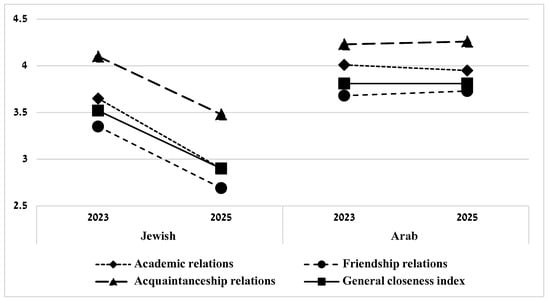
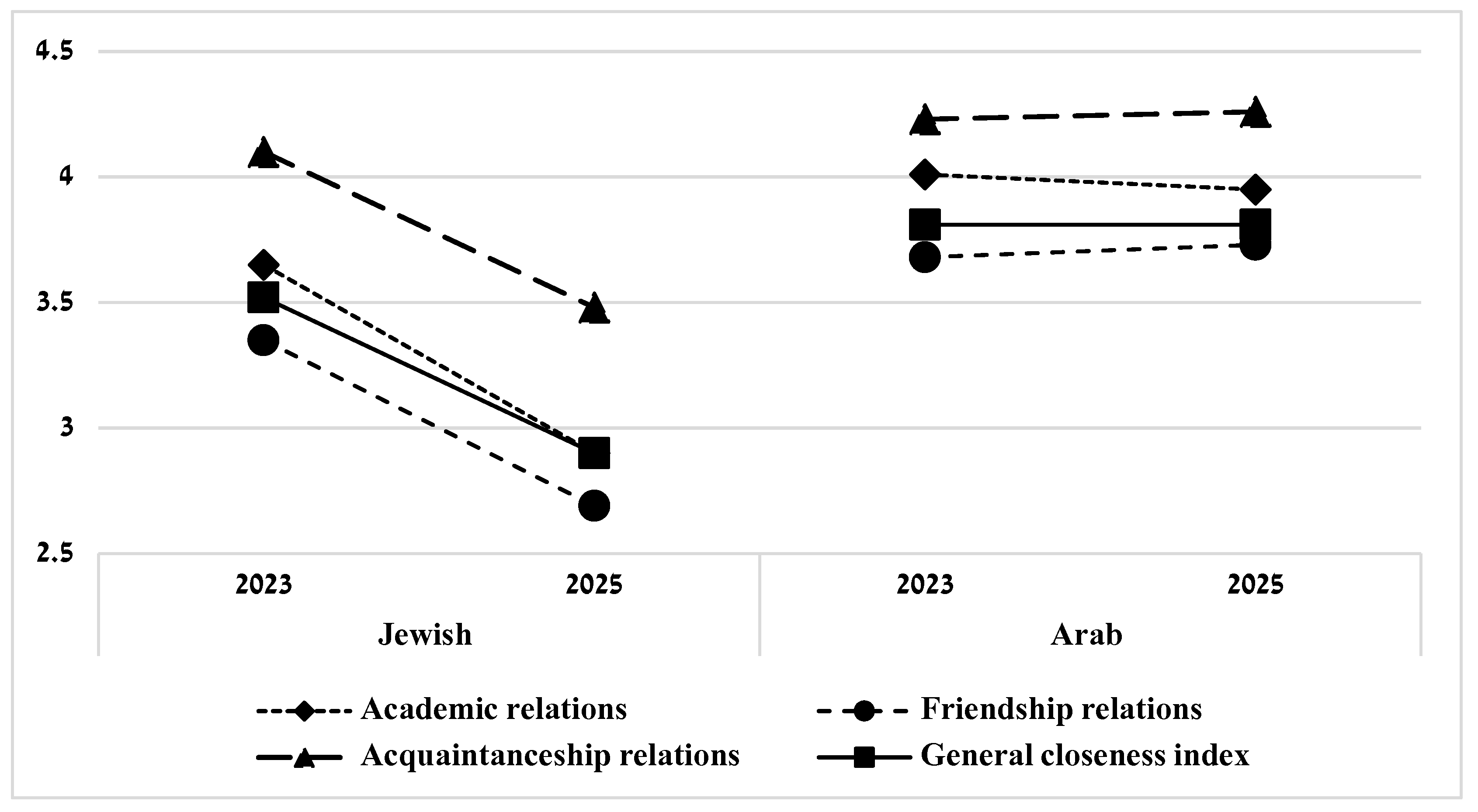
The analysis of students’ willingness for intergroup closeness, based on the 2025 dataset, revealed a consistent and statistically significant pattern in which Arab students reported higher levels of willingness than their Jewish peers across all dimensions. As shown in Table 2 and illustrated in Figure 1, Arab students expressed greater willingness to engage in academic relations (M = 3.93, SD = 0.91) compared to Jewish students (M = 2.95, SD = 1.35), [t(300) = 6.58, p < 0.001, d = 0.80]. A similar pattern was observed in friendship relations, where Arab students (M = 3.73, SD = 0.94) scored significantly higher than Jewish students (M = 2.69, SD = 1.25), [t(300) = 7.38, p < 0.001, d = 0.90]. In the domain of acquaintanceship relations, Arab students again reported higher willingness (M = 4.26, SD = 1.09) than Jewish students (M = 3.48, SD = 1.19), [t(300) = 5.23, p < 0.001, d = 0.67]. The general closeness index followed the same trend, with Arab students (M = 3.81, SD = 0.75) scoring significantly higher than Jewish students (M = 2.90, SD = 1.12), [t(300) = 7.37, p < 0.001, d = 0.90].
Table 2.
Willingness for intergroup closeness: differences by year and group.
Figure 1.
Willingness for intergroup closeness by year and group.
A repeated measures ANOVA revealed a significant main effect for the kind of intergroup closeness in which students were willing to engage, p < 0.001, indicating that across both groups, willingness for acquaintanceship relations was highest, followed by academic relations, and finally friendship relations. This pattern was consistent with findings from previous years. However, a significant interaction effect between group and closeness subscales was also observed, p < 0.01, suggesting that the relative ranking of closeness subscale differed slightly between Arab and Jewish students.
A two-way ANOVA revealed a significant main effect of gender on the general closeness index, p < 0.05, with male students reporting higher willingness for closeness than female students. This effect was consistent across both national groups.
4.2. Differences by Year and Group
A two-way ANOVA was conducted on data collected between 2023 and 2025, with group and year as independent variables and willingness to engage indices as dependent variables. The analysis revealed a significant main effect of group across all indices (p < 0.001), a significant main effect of year (p < 0.01), and a significant interaction between group and year (p < 0.01). To further examine temporal trends in willingness for intergroup closeness, independent samples t-tests were conducted for each group separately, comparing responses from 2023 and 2025. As shown in Table 2 and illustrated in Figure 1, Jewish students demonstrated a significant decline across all dimensions of willingness for closeness between 2023 and 2025. Specifically, their willingness for academic relations decreased from M = 3.65 (SD = 1.29) to M = 2.95 (SD = 1.35), p < 0.001; friendship relations declined from M = 3.35 (SD = 1.23) to M = 2.69 (SD = 1.25), p < 0.001; acquaintanceship relations dropped from M = 4.10 (SD = 0.98) to M = 3.48 (SD = 1.19), p < 0.001; and the general index fell from M = 3.52 (SD = 1.00) to M = 2.90 (SD = 1.12), p < 0.001. In contrast, Arab students showed no statistically significant changes between 2023 and 2025 across any of the indices. These findings suggest a growing divergence in intergroup attitudes over time, particularly among Jewish students.
4.3. Emotional Attitudes and Frequency of Joint Activities
Both Jewish and Arab students reported relatively low levels of personal hostility. Notably, 66.5% of Jewish students and 71.1% of Arab students indicated that they do not exhibit hostile behavior toward the other group. Similarly, 68.0% of Jewish students and 82.1% of Arab students reported no feelings of hatred toward the other group. These differences were statistically significant (p < 0.001 for hostile behavior; p < 0.01 for hatred), indicating a perceptual asymmetry in emotional attitudes. Furthermore, the proportion of Arab students reporting no hostile feelings was consistently higher than that of Jewish students across all items.
Arab students reported significantly higher frequencies of interaction across all items. For example, 68.0% of Arab students frequently sat with Jewish students in class (M = 3.93, SD = 1.06), compared to 30.9% of Jewish students (M = 2.72, SD = 1.40), t(300) = 7.65, p < 0.001, d = 0.93. Similar patterns were observed for studying together, working in teams, preparing assignments, and engaging in social activities such as leisure time, home visits, and personal communication.
4.4. Actual Intergroup Interactions
To categorize the types of activities, a Varimax-rotated factor analysis was conducted, initially yielding one factor explaining 66.8% of the variance. A subsequent content analysis by expert judges identified two distinct categories: academic activities (sitting together in class, studying for exams, working in teams, and preparing assignments) (α = 0.920) and social activities (preparing meals, spending leisure time together, visiting each other’s homes, sharing personal information, communicating via mobile phone, helping each other, and being connected on social media) (α = 0.925).
Based on these categories, two indices were constructed, along with a general index encompassing all items (α = 0.950). Higher scores on these indices indicate greater frequency of intergroup engagement. Across all indices, Arab students scored significantly higher than Jewish students, with p-values < 0.001.
Friendship with members of the other group was associated with significantly higher willingness for closeness among Jewish students (M = 3.1 with friends vs. M = 2.2 without), p < 0.001. Among Arab students, no significant difference was found based on friendship status (Table 3; Figure 2).
Table 3.
Actual intergroup interactions by year and group.
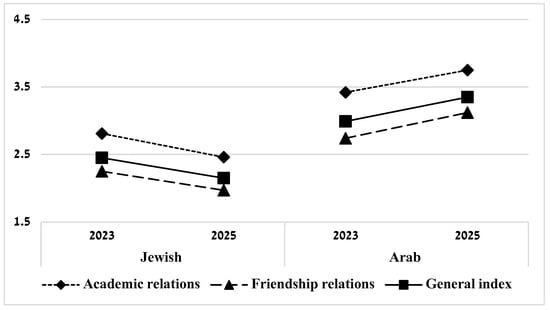
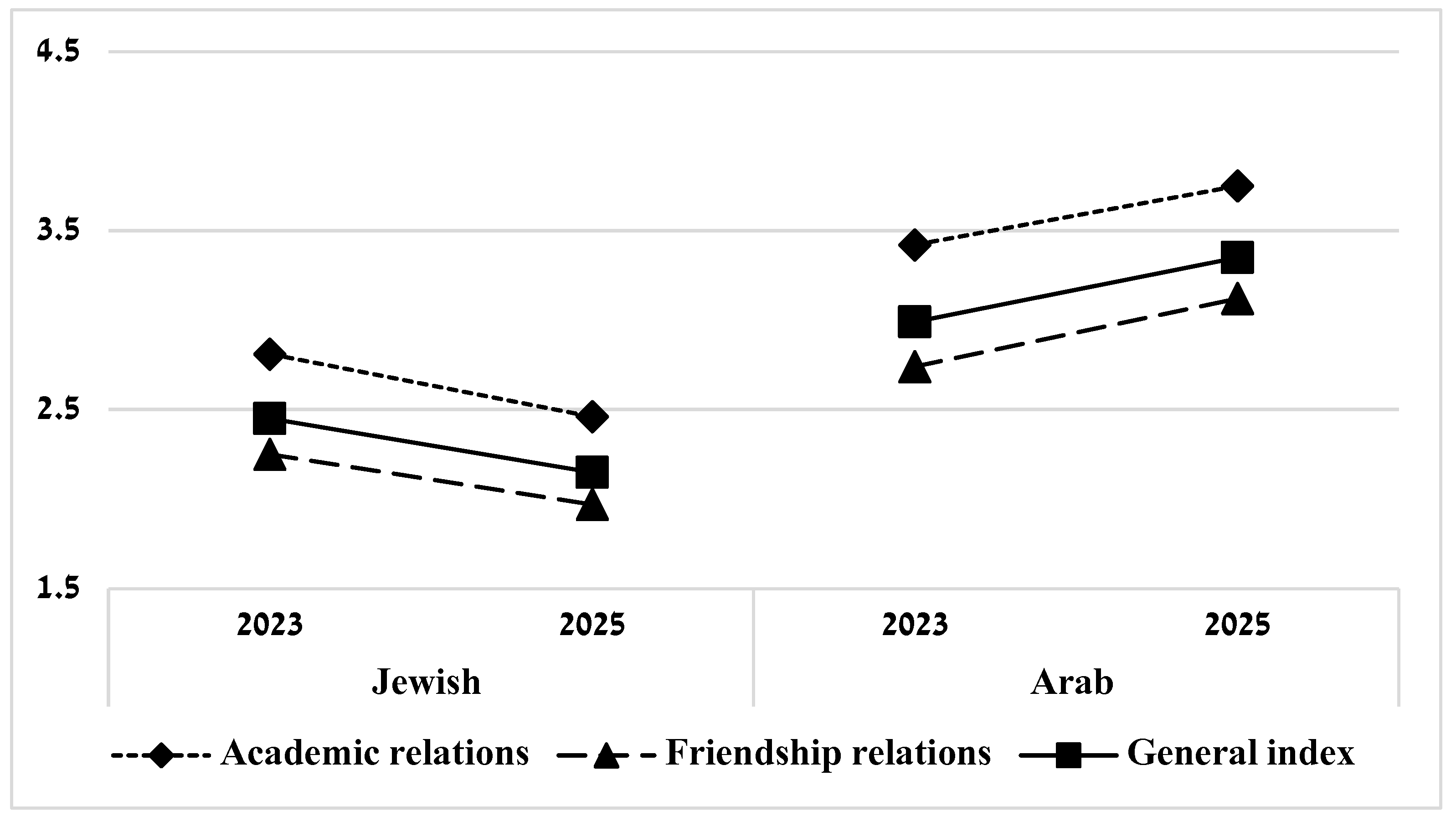
Figure 2.
Actual intergroup interactions by year and group.
Arab students reported significantly higher frequencies of both academic and social interactions with Jewish students. For academic relations, Arab students scored M = 3.75 (SD = 0.93) compared to M = 2.46 (SD = 1.23) among Jewish students, t(300) = 9.29, p < 0.001, d = 1.13. In friendship relations, Arab students scored M = 3.12 (SD = 1.14) versus M = 1.97 (SD = 0.93) among Jewish students, t(300) = 9.38, p < 0.001, 1.14. As such, the general interaction index showed a significant difference (Arabs: M = 3.35, SD = 1.00; Jewish: M = 2.15, SD = 0.98), t(300) = 10.31, p < 0.001, d = 1.26.
Repeated measures analysis confirmed that, for both groups, academic activity frequency was significantly higher than social activity frequency (p < 0.001). No significant differences were found between male and female students in the frequency of intergroup interactions. Jewish students, those who reported having friends from the other group engaged in intergroup interactions significantly more frequently than those who did not (p < 0.001). Among Arab students, no significant difference was found based on friendship status. Analysis of variance revealed significant differences in the general activity index by year of study. Among Jewish students, first-year students reported the highest frequency of intergroup activities, with a decline in subsequent years (p < 0.001). Among Arab students, the highest frequency was reported in the fourth year (p < 0.05).
Among Jewish students, the frequency of intergroup interactions declined from 2023 to 2025 across all indices. Academic relations decreased from M = 2.81 to M = 2.46, p < 0.01; friendship relations from M = 2.25 to M = 1.97, p < 0.01; and the general index from M = 2.45 to M = 2.15, p < 0.01. In contrast, Arab students showed a significant increase in all indices: academic relations rose from M = 3.42 to M = 3.75, p < 0.05; friendship relations from M = 2.74 to M = 3.12, p < 0.05; and the general index from M = 2.99 to M = 3.35, p < 0.05.
A two-way ANOVA, with group and year as independent variables and interaction frequency indices as dependent variables, revealed a significant main effect of group across all indices (p < 0.001), a non-significant main effect of year, and a significant interaction between group and year (p < 0.01). Detailed descriptive statistics and interaction patterns are presented in Table 3 and illustrated in Figure 2.
4.5. Attitudes Toward the Other Group
Finally, the study assessed students’ attitudes toward the other group both prior to and during their academic studies. In 2023, only 12% of Jewish students reported a positive attitude toward Arabs before beginning their studies, compared to 44% of Arab students who reported a positive attitude toward Jews. By 2025, these figures had increased to 16% and 56%, respectively, indicating a general trend toward more positive initial attitudes, particularly among Arab students. During their studies, 32% of Jewish students in 2023 reported an improvement in their attitude toward Arabs, while 47% of Arab students reported a similar improvement toward Jews. However, by 2025, the proportion of Jewish students reporting improved attitudes had declined to 26.8%, while the proportion among Arab students had risen to 61%. A chi-square test confirmed that the difference in positive attitude change in 2025 was statistically significant, p < 0.001.
The emotional impact of the 7 October 2023 events was also assessed. Among Jewish students, 60.9% reported that their attitude toward Arabs had become more negative, while only 2.6% reported a positive shift. Among Arab students, 14.2% reported a more positive attitude toward Jews, while 17.2% reported a more negative one. These differences were highly significant, p < 0.001, and reflect the asymmetric emotional consequences of sociopolitical events on intergroup perceptions within the academic environment.
5. Discussion
The present study extends a longitudinal investigation into intergroup relations between Arab and Jewish undergraduate students in Israel, which previously compared attitudes and interactions between 2016 and 2023 (Sindiani et al., 2024). By incorporating a third measurement point in 2025, the current study examines how willingness for intergroup closeness and actual intergroup interactions have evolved in the aftermath of the 7 October war. The 2025 data provide a perspective on the evolving dynamics of willingness for intergroup closeness and actual intergroup interactions, particularly in light of recent sociopolitical developments. The findings reaffirm several patterns observed in the first two time periods of the study, while also revealing new trends that warrant both theoretical reflection and practical consideration.
Consistent with the findings from 2023, Arab students reported significantly higher levels of willingness for intergroup closeness across all dimensions–academic, acquaintanceship, and friendship–as well as higher frequencies of actual intergroup interactions. However, unlike the pre-war trend, the 2025 data indicate a pattern of stability in Arab students’ willingness for intergroup closeness, with no statistically significant change between 2023 and 2025. This stability stands in contrast to the sharp decline observed among Jewish students. This upward trend suggests that the 7 October war did not diminish Arab students’ motivation for engagement; rather, it appears to have strengthened their desire for partnership. This interpretation is compatible with reports of Arab citizens’ heightened civic engagement and solidarity-oriented initiatives observed after 7 October, highlighting efforts to preserve social cohesion under a national crisis (Taub Center, 2023).
In contrast, Jewish students showed a reversed trajectory: an increase in willingness for closeness from 2016 to 2023, followed by a clear decline across all willingness indices in 2025. Their actual intergroup interactions also decreased in 2025, although the magnitude and pattern of change differed from those observed in willingness. This decline aligns with research documenting heightened fear, mistrust, and identity defensiveness among Israelis following the 7 October attacks, including evidence of increased psychological distress and trauma-related symptoms at the population level (Siegel-Itzkovich, 2025).
Taken together, these evolving patterns show that the gap between the two groups widened between 2023 and 2025. Whereas Arab students demonstrated increasing willingness for intergroup closeness and higher actual contact, Jewish students displayed a decline in both domains. This divergence reflects asymmetrical emotional and social responses to collective trauma. Arab students moved toward partnership and inclusion, while many Jewish students retreated socially.
Importantly, despite the overall decline observed among Jewish students in 2025, the data also reveal a noteworthy and encouraging counter-trend: more than one-quarter of Jewish students actually improved their attitudes during their studies toward their Arab peers following the war. This finding is particularly striking given the profound trauma, fear, and uncertainty that characterized the period. Moreover, the improvement was specifically directed toward the Arab students with whom they study, indicating that the shared academic environment continued to function as a protective contact setting even under extreme sociopolitical strain. At the same time, this positive shift did not generalize to attitudes toward Arabs as a broader social group, suggesting a widening gap between localized, relationship-based experiences of contact and more abstract perceptions of the outgroup. This pattern reinforces the well-documented distinction between personalized, high-quality contact, which can foster warmth and openness even during conflict, and generalized outgroup attitudes, which tend to remain more susceptible to threat, fear, and macro-level narratives.
Similar patterns were documented in earlier periods of Jewish–Arab tensions. Gindi et al. (2022) showed that intergroup violence that erupted in the May 2021 uprisings generated a “ripple effect,” whereby threat salience led to increased ingroup retreat and broader rejection of cross-group interactions, even in settings unrelated to the original conflict. The parallels to the post-7 October dynamic observed among Jewish students in the current study reinforce the role of perceived threat and collective trauma in shaping intergroup withdrawal.
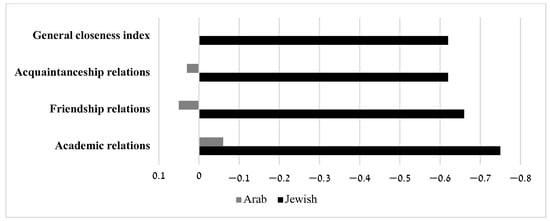
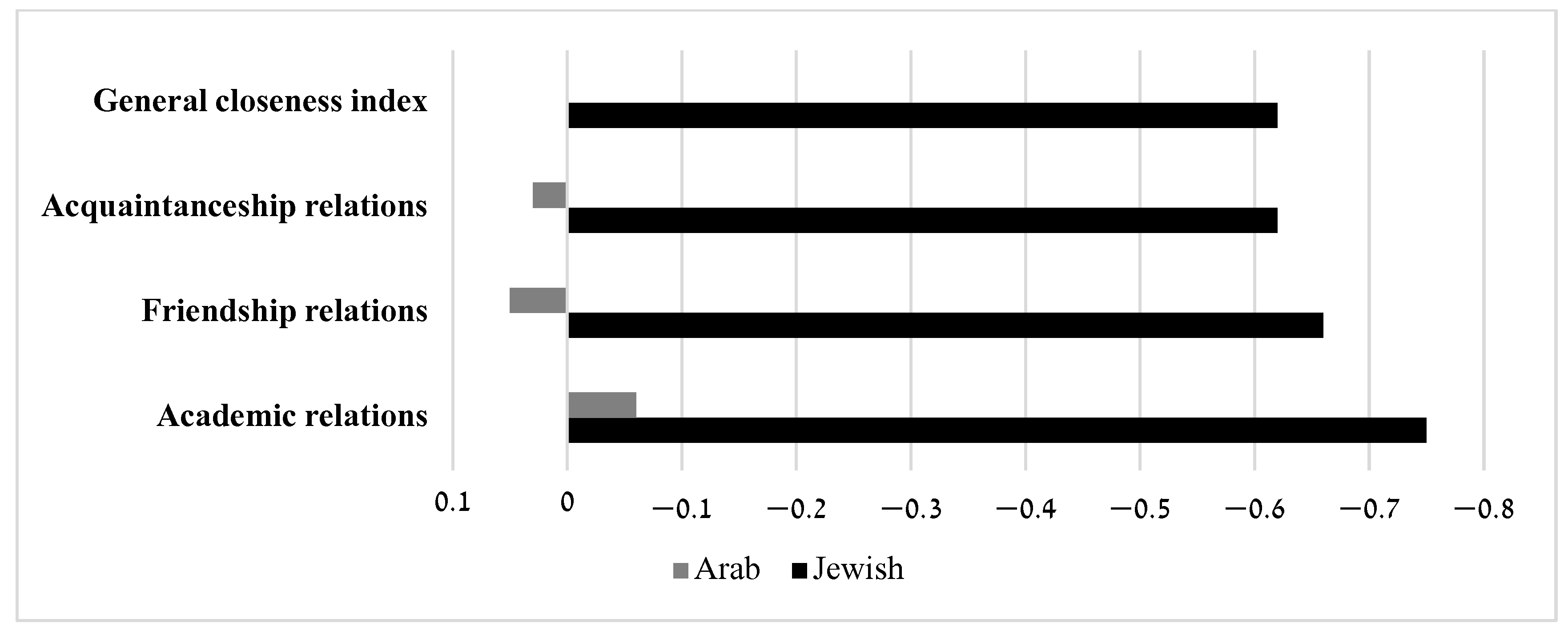
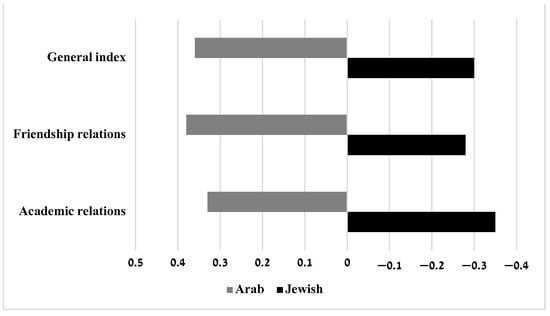
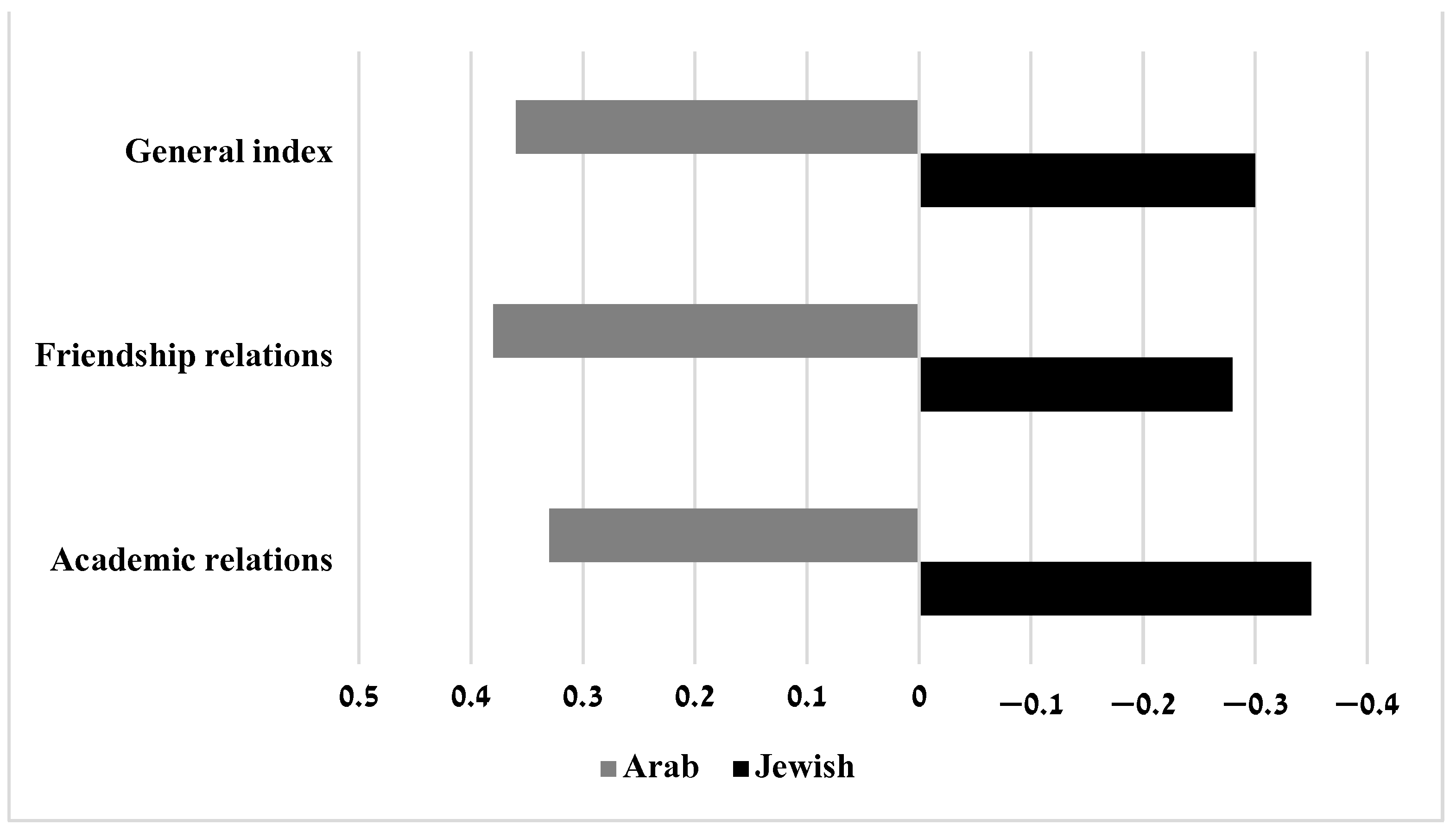
Figure 3 illustrates within-group change over time (Δ 2023→2025) in willingness indices separately for Arab and Jewish students, showing each group’s increased or decreased attitudes across academic, friendship, and acquaintanceship domains, as well as in the general willingness for closeness index. Figure 4 presents between-group differences in 2025, comparing Arab and Jewish students’ mean levels across academic, friendship, and general closeness indices. Thus, Figure 3 addresses how each group changed over time, while Figure 4 shows the extent of the Arab-Jewish gap at the latest timepoint. These figures complement each other by separating temporal change from group comparison.
Figure 3.
Within-group change over time.
Figure 4.
Between-group differences.
The patterns shown by Jewish students following the events of 7 October are consistent with intergroup threat theory, whereby perceived existential threat activates boundary reinforcement, reduces openness to contact, and encourages outgroup homogenization (Al Ramiah & Hewstone, 2013; Riek et al., 2006; Stephan & Stephan, 2013).
5.1. The War’s Impact on Students
The present cohort was studied during a period marked by overwhelming exposure to trauma, loss, and acute instability. The 7 October attacks and the subsequent war have reshaped the lived reality of young adults in profound ways. Many students belonged to the age group heavily represented at the Nova Music Festival, where 344–378 civilians were killed, over 250 raped, and dozens kidnapped (United Nations Human Rights Council, 2024; United Nations Security Council, 2024; Human Rights Watch, 2024). Students lost friends at the Nova festival and in the kibbutzim near Gaza; some are survivors themselves (Danan, 2024).
Moreover, an extraordinary portion of Israeli students were mobilized to reserve duty. According to official data, approximately 55,000 reservist students, about 18% of all students, served during the 2023/24 academic year (Central Bureau of Statistics, 2024; Frenkel & Wasserman, 2023). This level of mobilization placed significant strain on students’ academic continuity and on the universities responsible for supporting them. In the institution where this study was conducted, 12% of students served in reserve duty between October 2023 and the end of the academic year.
A nationwide 2025 survey conducted by the National Union of Israeli Students (NUIS) found that 66% of reservist students experienced emotional or social difficulties upon returning to campus, and 61% reported significant academic decline. For many Jewish students who served in Gaza or lost friends in combat, re-entering a mixed classroom requires navigating a complex emotional terrain. National data show substantial increases in anxiety, hypervigilance, depression, and trauma-related symptoms among Israelis following the 7 October attacks, underscoring the psychological burden many reservists and bereaved students carry upon returning to campus (Siegel-Itzkovich, 2025). Intergroup threat theory further suggests that trauma heightens vigilance, reduces cognitive differentiation, and can temporarily impede the ability to distinguish between Arab citizens and perpetrators of violence (Stephan & Stephan, 2013).
Conversely, Arab students reported fear, stigmatization, scrutiny, and pressure to publicly “prove” loyalty. Evidence from a mixed-methods study of 453 Palestinian Arab undergraduates in Israel shows that students perceive campuses as exclusionary spaces requiring continuous negotiation of their identity and legitimacy (Mansour, 2024, 2025). Additional campus climate data reveal that half to one third of Arab and MENA students reported experiencing insults and intimidation, and up to 72–78% described feeling unwelcome on campus, with many concealing aspects of their identity to avoid scrutiny (Taylor et al., 2024). These patterns are consistent with findings from recent research on Arab–Israeli academic leaders during the 7 October war, who reported intense fear, anxiety, helplessness, isolation, and experiences of silencing within academic institutions, reflecting secondary traumatic stress and highlighting how the conflict amplifies vulnerability among Arab members of the academic community (Hellerstein & Sindiani, 2025).
These parallel vulnerabilities create a classroom environment in which both groups carry heavy emotional burdens, though the nature of the burdens differ. This emotional context helps explain why Arab students’ willingness for closeness increased (seeking connection, acceptance and stability), whereas Jewish students’ willingness declined (seeking psychological safety and ingroup security). The structural asymmetry of the institution should also be acknowledged: Arab students constitute approximately 20% of the overall student body, positioning them as a numerical minority within a Hebrew-medium environment. This context likely constrains opportunities for avoidance and may help explain their higher reported levels of interaction. Conversely, Jewish students—even those interested in engaging with their Arab peers—may have fewer such opportunities.
5.2. Interpreting the Asymmetric Trends Through Contact Theory
The asymmetric post-war patterns align with the contact hypothesis, which posits that positive intergroup relations depend on four conditions: equal status, common goals, cooperation, and institutional support. While these conditions were more fully met prior to 7 October as reflected in earlier data from 2016 and 2023 (Sindiani et al., 2024), the war partially disrupted them in several significant ways. The sense of equal status was undermined as Jewish and Arab students entered the post-war campus with sharply divergent emotional realities; Jewish students returning from reserve duty carried trauma, loss, and hypervigilance, whereas Arab students increasingly faced fear, stigmatization, and heightened scrutiny. Collective psychological conditions weakened the perception of parity that had previously supported constructive intergroup contact.
In addition, the shared sense of common goals eroded. Before the war, daily academic routines fostered a sense of joint purpose. After 7 October, however, students’ goals and emotional priorities diverged: many Jewish students sought psychological safety and stability, while Arab students were focused on affirming belonging and mitigating identity-based pressures. This fracture in collective orientation made it harder to maintain a unified sense of “we”, a critical component of cooperative intergroup dynamics.
The war also disrupted opportunities for cooperation. The delayed academic calendar and the shift to online instruction limited spontaneous encounters, reduced face-to-face collaboration, and made avoidance between groups easier. Even after the return to campus, students coping with trauma or fear often withdrew socially, reducing the frequency and quality of intergroup interactions that previously fostered trust.
Finally, institutional support for meaningful intergroup contact was strained. HEIs were preoccupied with crisis response, logistics, and security management, leaving less capacity for campus-wide dialogue initiatives or proactive climate-building efforts. Moreover, both groups perceived the institutional environment as tense—Arab students due to increased monitoring and Jewish students due to heightened safety concerns—signaling a campus atmosphere less conducive to open, supported intergroup engagement.
Together, these shifts may help explain why willingness for intergroup closeness diverged after the war. The above-described asymmetric pattern reflects not only differing emotional burdens but also a disruption in the structural conditions that had previously enabled positive Jewish–Arab contact in higher education. For Arab students, the experience of studying in a mixed higher education institution may have contributed to a greater sense of academic belonging and institutional integration, particularly when contact with Jewish peers was positive and high-quality (Kahalon et al., 2023). By high-quality contact, we refer to interactions that are respectful, cooperative, and voluntary, marked by equal status, mutual recognition, and emotional safety. Such interactions often include meaningful collaboration in academic or social settings, opportunities for personal self-disclosure, and repeated encounters that build familiarity and trust. These forms of contact are known to reduce intergroup anxiety, increase empathy, and foster a sense of shared membership within the academic environment, conditions that are especially important in mixed ethnonational settings (Pettigrew & Tropp, 2006; Davies et al., 2011).
At the same time, research also shows that many Arab students perceive Israeli campuses as ethnonationally charged and at times exclusionary, requiring them to negotiate their presence within these spaces (Mansour, 2024, 2025). Similar patterns have been found in intergroup workplace relations in educational settings. In a recent qualitative study, Silverman et al. (2024) found that in the months following 7 October, Arab teachers in Jewish schools reported increased scrutiny, perceived hostility, and reduced trust from Jewish colleagues, while Jewish principals and teachers described heightened sensitivity, fear, and intergroup tension. These dynamics of fear-based withdrawal and asymmetrical vulnerability parallel the divergent trends observed among Jewish and Arab students in the present study.
Thus, the campus environment can function either as a site of opportunity for belonging or as a context marked by tension and marginalization. For Arab students, our data suggests the former, as they increased willingness for closeness and actual intergroup interactions, indicative of their perception of the academic setting as an opportunity for integration and belonging. However, for many Jewish students, the sense of mistrust and threat heightened, which undermined previous sentiments of shared goals and cooperation.
Willingness for intergroup closeness and actual intergroup interactions reflect two aspects of the contact process. Willingness indicates a motivational, attitudinal component and actual interaction reflects an enacted behavioral component. In 2025, the gap between these two components widened for Jewish students but narrowed for Arab students, illustrating how conflict can differentially influence affective responses (such as willingness for intergroup closeness) compared to behavioral outcomes (such as actual intergroup interactions), with each pathway reflecting distinct psychological and social mechanisms through which collective trauma and threat shape intergroup relations.
Importantly, conflict contexts often magnify the divergence between attitudinal and behavioral pathways. Research on intergroup relations in HEIs situated in conflict zones demonstrates that external violence can suppress intergroup behavior even when underlying attitudes remain ambivalent or moderately positive (Halabi & Sonnenschein, 2004; Bar-Tal, 2007). Studies of HEIs during periods of political unrest similarly show that threat salience, collective trauma, and heightened identity boundaries reduce the likelihood that students will translate attitudes of openness into action (Ben-Porath, 2009; Kelman & Fisher, 2017). These findings reinforce the need to understand Jewish and Arab students’ trajectories not merely as individual psychological responses, but as embedded within broader sociopolitical dynamics that shape how, when, and under what conditions contact is enacted.
5.3. Practical Implications for Higher Education Institutions
Given the scale of trauma and reserve mobilization, higher education institutions (HEIs) can play a key role in mitigating negative effects on intergroup contact, rebuilding trust, and enhancing intergroup relations. Several empirically grounded implications emerge.
First, HEIs should provide dedicated safe spaces for processing war-related trauma. Facilitated environments, either within culturally homogeneous groups or mixed Jewish–Arab settings, are essential in contexts of collective trauma. Without such spaces, fear, stigmatization, and identity threat increase, reducing willingness for intergroup engagement (Mansour, 2024, 2025). In contrast, guided processing allows students to express anxieties, grieve losses, validate identity complexity, and rebuild trust—necessary precursors to renewed contact.
In Israel, organizations have developed research-based frameworks and campus tools to manage intergroup tension and support emotionally safe dialogue during periods of escalation (aChord Center, n.d.-a; Living Together, n.d.). For example, the aChord Center provides psychosocial tools and intervention guides to help institutions navigate crisis-related emotional responses and restore constructive communication (aChord Center, n.d.-b). It also offers specialized resources addressing Jewish–Arab relations, threat perceptions, and the psychological dynamics shaping intergroup behavior under conflict (aChord Center, n.d.-c). Together, such guided environments help repair relational ruptures and support renewed openness to intergroup engagement.
International research on trauma-informed higher education similarly emphasizes the importance of structured, emotionally safe, and moderated environments for restoring belonging, reducing polarization, and supporting post-crisis recovery (M. R. Holmes et al., 2025a, 2025b).
HEIs should also expand mental health services for students affected by the war. National assessments indicate sharp increases in PTSD, anxiety, and depression following the 7 October attacks, with 25–50% of trauma-exposed individuals at risk of significant psychological distress (Sztokman & Brook, 2024; Israel Science Info, 2024). Beyond individual well-being, post-trauma distress directly shapes intergroup relations (Hager et al., 2025). Strengthening trauma-informed, culturally responsive mental health services can reduce emotional reactivity and restore the psychological safety needed for constructive intergroup contact.
Emerging evidence from Israeli campuses shows that departments perceived as emotionally safe and student-centered maintain more effective intergroup dialogue under crisis conditions. Arab Bedouin students report greater manageability, meaningfulness, and capacity for intergroup communication when institutions provide accessible support systems, including mentoring and structured processing spaces (Al-Said & Jaber, 2025). Similarly, creating secure spaces for vulnerable groups and training faculty to moderate sensitive discussions can reduce polarization and support inclusive campus functioning (Hager et al., 2025).
These findings suggest that mental health services function not only as therapeutic resources but also as mechanisms for sustaining intergroup relations. By strengthening counseling, embedding trained moderators, and establishing structured processing spaces, HEIs can counteract war-related psychological strain that otherwise fuels segregation and social distancing.
Beyond immediate support, conflict-aware and curriculum-embedded mechanisms are needed to sustain intergroup contact. Intergroup dialogue courses and co-curricular programs, when designed around equal status, shared goals, cooperation, and institutional support, enhance empathy, critical reflection, and collaboration across difference (Gurin et al., 2013; Zúñiga, 2007). Embedding such practices within departmental routines (e.g., facilitated reflection sessions, clear discourse norms, and visible administrative backing) aligns with evidence-based frameworks and complements trauma-informed approaches (aChord Center, n.d.-a, n.d.-b).
5.4. Embodied Cooperation as a Foundation for Post-War Intergroup Dialogue
Alongside clinical and organizational support, structured intergroup activities are essential for restoring students’ capacity for engagement after collective trauma. PETE programs, while distinct from dialogue-based interventions, offer a complementary pathway through embodied cooperation. Activities such as paired motor tasks, team-based exercises, and shared problem-solving create low-verbal, high-coordination contexts that foster trust, attunement, and shared intentionality meeting conditions aligned with Allport’s (1954) framework.
Research in Sport for Development and Peace (SDP) shows that shared physical activity reduces intergroup anxiety, promotes prosocial orientation, and fosters psychological safety, often more effectively than verbal interaction alone (Sport for Development and Peace International Working Group, 2008; Tang et al., 2025). These embodied experiences do not replace dialogue but help create the conditions that make it possible. By lowering vigilance and enabling coordinated action, students begin to perceive one another as partners rather than abstract outgroup members. Evidence from Israeli HEIs indicates that structured contact—cognitive, emotional, or physical—enhances belonging, academic functioning, and intergroup attitudes (Kahalon et al., 2023; Hellerstein & Sindiani, 2025).
Accordingly, structured intergroup contact within PETE should be deliberately integrated into curricula. PETE programs offer a unique pedagogical channel for embedding contact-based interventions into core coursework. Examples include cooperative Jewish–Arab pair work (Hellerstein et al., 2023), SDP modules under joint leadership (Hellerstein & Sindiani, 2025), mixed-community field experiences, and reflective courses linking physical cooperation with intercultural theory (Hellerstein & Sindiani, 2025).
Extensive research on sport-based cooperation shows that shared physical activity, synchronized movement, and team-based goals reduce prejudice and threat while promoting empathy, trust, and prosocial behavior (Sugden & Tomlinson, 2017). PETE programs should therefore be understood not as incidental contact settings but as intentional platforms for high-quality intergroup engagement. When combined with guided reflection, these experiences create a psychologically safe climate that supports deeper dialogue, or “deep contact,” integrating physical coordination, emotional attunement, and reflective exchange.
Despite these opportunities, intergroup engagement remains shaped by post-7 October asymmetries. Arab students often bear disproportionate pressure to demonstrate belonging, while Jewish students may struggle to maintain openness under heightened threat. To avoid reproducing inequalities, conflict-aware design should: (a) prevent burden-shifting that imposes performative expectations on Arab students; (b) ensure equal-status conditions and visible institutional support (Gurin et al., 2013; Zúñiga, 2007); and (c) provide parallel identity-safe spaces alongside mixed settings, moderated using trauma-informed protocols (aChord Center; Living Together). In practice, this requires pairing embodied cooperation with joint facilitation, ensuring that renewed contact does not come at the expense of those facing greater psychosocial risk.
6. Limitations and Future Directions
The reliance on self-report data may introduce social desirability bias, especially in politically charged periods. This concern is particularly salient when studying minority populations who may experience additional pressures when reporting attitudes and perceptions in institutional settings. For Arab students, in particular, self-report measures may be shaped by feelings of vulnerability, concerns about surveillance, or fears of negative repercussions, which could lead to underreporting of negative experiences or attitudes. In addition, the repeated cross-sectional design limits causal inference.
Another important limitation is that the study was conducted within a single higher education institution. While the institution represents a meaningful site of Jewish–Arab interaction, it cannot capture the full heterogeneity of campus climates, administrative cultures, or regional sociopolitical dynamics across Israel. Findings should therefore be interpreted with caution when generalizing to other HEIs, especially those with different demographic compositions or institutional missions.
Given the centrality of intergroup dynamics to this study, the limitations section plays an essential role in contextualizing the findings. Accordingly, it is important to acknowledge more explicitly that relying on one institution, self-report measures, and minority participants’ potentially constrained willingness to disclose may affect both internal and external validity. Expanding this discussion strengthens the interpretive robustness of the study and provides a clearer foundation for future work.
Future research would benefit from longitudinal panel data capturing individual trajectories before and after reserve duty. Qualitative interviews could further illuminate the lived experiences of both Jewish and Arab students navigating the emotional, political, and interpersonal complexities of post-war campus life.
7. Conclusions
The 2025 findings reveal the fragility, albeit promise, of Jewish–Arab intergroup relations in higher education. While Arab students expressed increased willingness for closeness and sustained levels of interaction, Jewish students exhibited reduced openness and trust, consistent with trauma-induced threat responses. These divergent pathways underscore the need for HEIs to adopt intentional, structured, and trauma-informed strategies for fostering intergroup engagement, especially in times of national crisis.
As one of the few shared societal spaces in an otherwise segregated landscape, HEIs hold a critical responsibility to cultivate the conditions necessary for reconciliation, understanding, and long-term living in partnership.
Author Contributions
Conceptualization, M.S.; methodology, M.S., D.H., B.S., and S.B.-Z.; software, M.S.; validation, M.S., D.H., B.S., and S.B.-Z.; formal analysis, M.S. and S.B.-Z.; investigation, M.S.; resources, M.S.; data curation, M.S., D.H. and B.S.; writing—original draft preparation, M.S.; writing—review and editing, M.S., D.H., and S.B.-Z.; visualization, M.S.; supervision, M.S.; project administration, M.S.; funding acquisition, M.S. All authors have read and agreed to the published version of the manuscript.
Funding
The authors declare that financial support was received for the research, authorship, and/or publication of this article. The authors disclose receipt of the following financial support for the research, authorship, and/or publication of this article: This work was supported by the President’s Fund of the Levinsky-Wingate Academic College.
Institutional Review Board Statement
The study was conducted in accordance with the Declaration of Helsinki, and approved by the Institutional Review Board of Levinsky-Wingate Academic College Review Board (protocol code 398/23, approved date: 28 March 2023).
Informed Consent Statement
Informed consent was obtained from all participants involved in the study.
Data Availability Statement
The original contributions presented in this study are included in the article. Further inquiries can be directed to the corresponding author.
Conflicts of Interest
The authors declare no conflict of interest.
References
- Abu Raiya, H., Pargament, K. I., Mahoney, A., & Stein, C. (2008). A psychological measure of Islamic religiousness: Development and evidence for reliability and validity. The International Journal for the Psychology of Religion, 18(4), 291–315. [Google Scholar] [CrossRef] [Scilit]
- aChord Center. (n.d.-a). Academia. Available online: https://www.achord.org.il/en/academia (accessed on 15 April 2026).
- aChord Center. (n.d.-b). Content library. Available online: https://www.achord.org.il/accord-products (accessed on 15 April 2026).
- aChord Center. (n.d.-c). Escalation assistance. Available online: https://www.achord.org.il/en/escalation (accessed on 15 April 2026).
- aChord Center. (2023–2024). Public opinion surveys on Jewish-Arab relations following the October 7 events. aChord Center for Social Psychology. Available online: https://www.achord.org.il (accessed on 15 April 2026).
- Allport, G. W. (1954). The nature of prejudice. Perseus Books. [Google Scholar]
- Al Ramiah, A., & Hewstone, M. (2013). Intergroup contact as a tool for reducing, resolving, and preventing intergroup conflict: Evidence, limitations, and potential. American Psychologist, 68(7), 527. [Google Scholar] [CrossRef] [Scilit] [PubMed]
- Al-Said, H., & Jaber, S. A. (2025). Bridges and walls: Coping and emotional experiences of Arab-Bedouin female students in Israeli academia post-October 7th. Journal of International Students, 15(3), 131–150. [Google Scholar] [CrossRef] [Scilit]
- Bagci, S. C., Baysu, G., Tercan, M., & Turnuklu, A. (2023). Dealing with increasing negativity toward refugees: A latent growth curve study of positive and negative intergroup contact and approach-avoidance tendencies. Personality and Social Psychology Bulletin, 49(10), 1466–1478. [Google Scholar] [CrossRef] [Scilit] [PubMed]
- Banas, J. A., Bessarabova, E., & Massey, Z. B. (2020). Meta-analysis on mediated contact and prejudice. Human Communication Research, 46(2–3), 120–160. [Google Scholar] [CrossRef] [Scilit]
- Bar-Tal, D. (2007). Sociopsychological foundations of intractable conflicts. American Behavioral Scientist, 50(11), 1430–1453. [Google Scholar] [CrossRef] [Scilit]
- Bar-Tal, D. (2014). Collective memory as social representations. Papers on Social Representations, 23, 5.1–5.26. [Google Scholar]
- Bäuml, Y., Ze’evi, I., & Totri, M. (2009). What do Jewish and Arab students learn from each other. Research Report.
- Ben-Porath, S. R. (2009). Citizenship under fire: Democratic education in times of conflict. Princeton University Press. [Google Scholar]
- Brewer, M. B. (1999). The psychology of prejudice: Ingroup love and outgroup hate? Journal of Social Issues, 55(3), 429–444. [Google Scholar] [CrossRef] [Scilit]
- Central Bureau of Statistics. (2024, November 7). Higher education in Israel: Selected data for the 2023/24 academic year (Publication No. 349). State of Israel. Available online: https://www.cbs.gov.il/he/mediarelease/DocLib/2024/349/06_24_349b.pdf (accessed on 15 April 2026).
- Dallasheh, W. (2025). Barriers and discrimination in higher education: The case of Arab society in Israel. In Minorities—New challenges and horizons. IntechOpen. [Google Scholar] [CrossRef] [Scilit]
- Danan, D. (2024, October 7). At Tel Aviv memorial ceremony interrupted by rocket sirens, Nova survivor reveals she witnessed rape on Oct. 7. Jewish Telegraphic Agency. Available online: https://www.jta.org/2024/10/07/israel/nova-survivor-reveals-she-witnessed-rape-on-oct-7-at-tel-aviv-memorial-ceremony-interrupted-by-rocket-sirens (accessed on 15 April 2026).
- Davies, K., Tropp, L. R., Aron, A., Pettigrew, T. F., & Wright, S. C. (2011). Cross-group friendships and intergroup attitudes: A meta-analytic review. Personality and Social Psychology Review, 15(4), 332–351. [Google Scholar] [CrossRef] [Scilit]
- Deardorff, D. K. (2006). Identification and assessment of intercultural competence as a student outcome of internationalization. Journal of Studies in International Education, 10(3), 241–266. [Google Scholar] [CrossRef] [Scilit]
- Dunne, C. (2009). Host students’ perspectives of intercultural contact in an Irish university. Journal of Studies in International Education, 13(2), 222–239. [Google Scholar] [CrossRef] [Scilit]
- Fiedler, C. (2023). What do we know about how armed conflict affects social cohesion? A review of the empirical literature. International Studies Review, 25(3), viad030. [Google Scholar] [CrossRef] [Scilit]
- Figueiredo, A., Baysu, G., Uluğ, Ö. M., & Psaltis, C. (2025). Social cohesion in (post-) conflict and divided societies: Recent advances and future directions. European Journal of Social Psychology, 55(6), 967–978. [Google Scholar] [CrossRef] [Scilit]
- Frenkel, M., & Wasserman, V. (2023). Bodies in-between: Religious women’s-only spaces and the construction of liminal identities. Gender, Work & Organization, 30(4), 1161–1177. [Google Scholar]
- Gindi, S., Gilat, I., & Sagee, R. (2022). Short communication–Students’ attitudes toward boundary-crossing teachers before and after the May 2021 violence between Israelis and Palestinians: A ripple effect? International Journal of Intercultural Relations, 91, 38–43. [Google Scholar] [CrossRef] [Scilit]
- Guo, S., & Jamal, Z. (2007). Nurturing cultural diversity in higher education: A critical review of selected models. Canadian Journal of Higher Education, 37(3), 27–49. [Google Scholar] [CrossRef] [Scilit]
- Gurin, P., Nagda, B. R. A., & Zúñiga, X. (2013). Dialogue across difference: Practice, theory, and research on intergroup dialogue. Russell Sage Foundation. [Google Scholar]
- Hager, T., Khalaile, M., & Jabareen, Y. T. (2025). The role of academic institutions in a state of war: The Gaza-Israel conflict. Higher Education, 1–18. [Google Scholar] [CrossRef] [Scilit]
- Halabi, R., & Sonnenschein, N. (2004). The Jewish-Palestinian encounter in a time of crisis. Journal of Social Issues, 60(2), 373–387. [Google Scholar] [CrossRef] [Scilit]
- Harrison, N., & Peacock, N. (2009). Cultural distance, mindfulness and passive xenophobia: Using integrated threat theory to explore home higher education students’ perspectives on ‘internationalisation at home’. British Educational Research Journal, 36(6), 877–902. [Google Scholar] [CrossRef] [Scilit]
- Hasan-Aslih, S., Shuman, E., Pliskin, R., van Zomeren, M., Saguy, T., & Halperin, E. (2020). With or without you: The paradoxical role of identification in predicting joint and ingroup collective action in intergroup conflict. European Journal of Social Psychology, 50(6), 1334–1343. [Google Scholar] [CrossRef] [Scilit]
- Hellerstein, D., Leitner, J., & Sindiani, M. (2023). Recreational activities as a tool for enhancing relations between Arab and Jewish students in an Israeli college. Sport in Society, 26(1), 27–44. [Google Scholar] [CrossRef] [Scilit]
- Hellerstein, D., & Sindiani, M. (2025). The roaming course: Fostering intergroup relationships among Arab and Jewish students in physical education teacher education. Frontiers in Political Science, 7, 1626285. [Google Scholar] [CrossRef] [Scilit]
- Hermann, T., Yohanani, L., & Kaplan, Y. (2024). Public opinion survey marking a year of the “Iron Swords” War (Israeli Voice Index—September 2024). Israel Democracy Institute. [Google Scholar]
- Hertz-Lazarowitz, R. (1999). Cooperative learning in Israels Jewish and Arab schools: A community approach. Theory into Practice, 38(2), 105–113. [Google Scholar] [CrossRef] [Scilit]
- Hertz-Lazarowitz, R. (2008). Beyond the classroom and into the community: The role of the teacher in expanding the pedagogy of cooperation. In The teacher’s role in implementing cooperative learning in the classroom (pp. 38–55). Springer US. [Google Scholar]
- Holmes, M. R., Korsch-Williams, A., & King-White, D. (2025a). Bridging research to the practice: Implementing trauma-informed care to support students in higher education. Metropolitan Universities, 36(1), 155–175. [Google Scholar]
- Holmes, M. R., Korsch-Williams, A., & King-White, D. (2025b). Implementing trauma-informed care in higher education: Bridging research to the classroom. Metropolitan Universities, 36(2), 155–157. [Google Scholar] [CrossRef] [Scilit] [PubMed]
- Human Rights Watch. (2024, July 17). October 7: Crimes against humanity and war crimes by Hamas-led groups. Available online: https://www.hrw.org/news/2024/07/17/october-7-crimes-against-humanity-war-crimes-hamas-led-groups (accessed on 15 April 2026).
- Israel Science Info. (2024). Report on projected mental-health impacts following the October 7 attacks and the Israel–Hamas war. Israel Science Info. [Google Scholar]
- Jayusi, V. (2009). Restoring the attitudes of peace education participants through the guidance of peers [Unpublished doctoral dissertation, University of Haifa]. [Google Scholar]
- Kahalon, R., Shnabel, N., Sharvit, K., Halabi, S., & Wright, S. C. (2023). High-quality contact with fellow majority group students is associated with better academic performance of minority group students. Personality and Social Psychology Bulletin, 49(12), 1723–1736. [Google Scholar] [CrossRef] [Scilit]
- Kelman, H. C., & Fisher, R. J. (2017). The role of national identity in conflict resolution: Experiences from Israeli-Palestinian problem-solving workshops (2001). In Herbert C. Kelman: A pioneer in the social psychology of conflict analysis and resolution (pp. 101–125). Springer International Publishing. [Google Scholar]
- Kilpatrick, R., & Leitch, R. (2004). Teachers’ and Ppils’ educational experiences and school-based responses to the conflict in Northern Ireland. Journal of Social Issues, 60(3), 563–586. [Google Scholar] [CrossRef] [Scilit]
- Landau, R., & Scheffler, G. (2007). Ethics in research. Magnes Press. [Google Scholar]
- Lavie, E., Elran, M., Shahbari, I., Sawaed, K., & Essa, J. (2021). INSS insight no. 14, May 3, 2021 Jewish-Arab relations in Israel, April–May 2021 (INSS Insight No. 1474). Institute for National Security Studies (INSS). Available online: https://www.inss.org.il/publication/arabs-and-jews-in-israel/ (accessed on 15 April 2026).
- Lee, Y., Kheirkhah, H., Stohry, H., & Aronson, B. (2025). Global racialization, class, and the politics of nation: Education as a site of racial formation and resistance in the United States, South Korea, and Iran. Genealogy, 9(4), 150. [Google Scholar] [CrossRef] [Scilit]
- Leitner, J. B., Hehman, E., Deegan, M. P., & Jones, J. M. (2014). Adaptive disengagement buffers self-esteem from negative social feedback. Personality and Social Psychology Bulletin, 40(11), 1435–1450. [Google Scholar] [CrossRef] [Scilit]
- Living Together. (n.d.). Living together: Promoting shared society and dialogue in Israel. Available online: https://dialogtogether.com (accessed on 15 April 2026).
- Mansour, L. (2024). Palestinian Arab undergraduate students’ transition to Israeli higher education: A mixed methods study. Studies in Higher Education, 49(2), 269–285. [Google Scholar] [CrossRef] [Scilit]
- Mansour, L. (2025). ‘Not ours’: Palestinian Arab students’ perceptions of the campus ethnonational climate in Israeli higher education. Race Ethnicity and Education, 28(2), 193–210. [Google Scholar] [CrossRef] [Scilit]
- Maoz, I. (2011). Does contact work in protracted asymmetrical conflict? Appraising 20 years of reconciliation-aimed encounters between Israeli Jews and Palestinians. Journal of Peace Research, 48(1), 115–125. [Google Scholar] [CrossRef] [Scilit]
- Mayer, S. J., Dollmann, J., Jacobsen, J., & Walter, L. (2024). Armed conflict as a threat to social cohesion: Large-scale displacement and its short-and long-term effects on in-group perceptions. Research & Politics, 11(2), 20531680241258309. [Google Scholar]
- McKeown, S., Schaefer, C. D., Ali, S., Dupont, P. L., Manley, D., Rao, S., Taylor, L. K., & Meleady, R. (2025). The longitudinal relationship between youth intergroup contact and social cohesion outcomes in two divided societies. European Journal of Social Psychology, 55(6), 1016–1031. [Google Scholar] [CrossRef] [Scilit]
- Özkan, Z., Dhont, K., & Abrams, D. (2024). Intergroup contact and intended actions in support of disadvantaged groups: The role of affective processes and feelings of solidarity. Group Processes & Intergroup Relations, 27(3), 471–496. [Google Scholar]
- Paluck, E. L., Green, S. A., & Green, D. P. (2019). The contact hypothesis re-evaluated. Behavioural Public Policy, 3(2), 129–158. [Google Scholar] [CrossRef] [Scilit]
- Pettigrew, T. F., & Tropp, L. R. (2006). A meta-analytic test of intergroup contact theory. Journal of Personality and Social Psychology, 90(5), 751. [Google Scholar] [CrossRef] [Scilit]
- Riek, B. M., Mania, E. W., & Gaertner, S. L. (2006). Intergroup threat and outgroup attitudes: A meta-analytic review. Personality and Social Psychology Review, 10(4), 336–353. [Google Scholar] [CrossRef] [Scilit]
- Saguy, T., Dovidio, J. F., & Pratto, F. (2008). Beyond contact: Intergroup contact in the context of power relations. Personality and Social Psychology Bulletin, 34(3), 432–445. [Google Scholar] [CrossRef] [Scilit]
- Siegel-Itzkovich, J. (2025, August 10). Oct. 7 aftermath: Nat’l study shows rise in substance abuse, addictions, mental health disorders. The Jerusalem Post. Available online: https://www.jpost.com/health-and-wellness/article-863711 (accessed on 15 April 2026).
- Silverman, G., Gindi, S., Hisherik, M., Yehya, N. A. H., Yaniv, I., & Yehuda, T. B. (2024). Interethnic workplace relations in times of heightened social tension: Israeli-Arab teachers in Jewish schools post-10/7. International Journal of Intercultural Relations, 103, 102093. [Google Scholar] [CrossRef] [Scilit]
- Sindiani, M., Hellerstein, D., Sky, B., Ben Zaken, S., & Arnon, M. (2024, September). Subtle yet encouraging developments: Exploring intergroup relations between Arab and Jewish college students over seven years. In Frontiers in education (Vol. 9, p. 1403926). Frontiers Media SA. [Google Scholar]
- Smooha, S. (2010). Arab-Jewish relations in Israel. US Institute of Peace. [Google Scholar]
- Sport for Development and Peace International Working Group. (2008). Harnessing the power of sport for development and peace: Recommendations to governments. Right to Play/United Nations Inter-Agency Task Force on Sport for Development and Peace. Available online: https://www.sport-for-development.com/imglib/downloads/sdpiwg2008-harnessing-the-power-of-sport-for-development-and-peace-summary.pdf (accessed on 15 April 2026).
- Stephan, W. G., & Stephan, C. W. (2013). An integrated threat theory of prejudice. In Reducing prejudice and discrimination (pp. 23–45). Psychology Press. [Google Scholar]
- Sugden, J., & Tomlinson, A. (2017). Sport and peace-building in divided societies: Playing with enemies. Routledge. [Google Scholar]
- Swart, H., Hewstone, M., Christ, O., & Voci, A. (2010). The impact of crossgroup friendships in South Africa: Affective mediators and multigroup comparisons. Journal of Social Issues, 66(2), 309–333. [Google Scholar] [CrossRef] [Scilit]
- Sztokman, E., & Brook, L. (2024). Israeli university launching unique mental health trauma center spurred by distinctive nature of Oct. 7 attack. Studies on Art & Architecture/Kunstiteaduslikke Uurimusi, 34(5). [Google Scholar]
- Tang, S., Lu, T., Chen, H., Tao, B., & Yan, J. (2025). The effect of exercise intervention on prosocial behavior in junior high school students: The chain mediation effect of empathy and interpersonal relationships. Frontiers in Psychology, 16, 1723840. [Google Scholar] [CrossRef] [Scilit]
- Taub Center for Social Policy Studies in Israel. (2023). State of the nation report 2023: The October War and its impact on Israel’s society and economy. Singer Series: State of the Nation Report 2023. Taub Center for Social Policy Studies in Israel. Available online: https://www.taubcenter.org.il/en/states/2023-en/ (accessed on 15 April 2026).
- Taylor, M., Perez, L., Ahmed, S., & Johnson, R. (2024). 2024 campus climate report: Experiences of Arab and MENA students in U.S. higher education. Council on American-Islamic Relations (CAIR). Available online: https://ca.cair.com/wp-content/uploads/2025/01/WEB_2024-Campus-Climate-Report-.pdf (accessed on 15 April 2026).
- United Nations Human Rights Council. (2024, May 27). Report of the independent international commission of inquiry on the occupied palestinian territory, including East Jerusalem, and Israel (A/HRC/56/26). United Nations. Available online: https://www.un.org/unispal/document/coi-report-a-hrc-56-26-27may24/ (accessed on 15 April 2026).
- United Nations Security Council. (2024, February 23). Security council briefing on the situation in the Middle East, including the Palestinian question (SC/15621). United Nations. Available online: https://press.un.org/en/2024/sc15621.doc.htm (accessed on 15 April 2026).
- Volet, S. E., & Ang, G. (2012). Culturally mixed groups on international campuses: An opportunity for inter-cultural learning. Higher Education Research & Development, 31(1), 21–37. [Google Scholar] [CrossRef] [Scilit]
- Vonhm, M. E. (2025). Key elements of social cohesion in conflict-affected societies: A critical literature review. Cogent Social Sciences, 11(1), 2586176. [Google Scholar] [CrossRef] [Scilit]
- Zúñiga, X. (2007). Intergroup dialogue in higher education: Meaningful learning about social justice: Ashe higher education report (Vol. 32). John Wiley & Sons. [Google Scholar]

Disclaimer/Publisher’s Note: The statements, opinions and data contained in all publications are solely those of the individual author(s) and contributor(s) and not of MDPI and/or the editor(s). MDPI and/or the editor(s) disclaim responsibility for any injury to people or property resulting from any ideas, methods, instructions or products referred to in the content. |
© 2026 by the authors. Licensee MDPI, Basel, Switzerland. This article is an open access article distributed under the terms and conditions of the Creative Commons Attribution (CC BY) license.