


Abstract
This study examined the effect of a psycho-education program on the awareness levels of teachers regarding child abuse and neglect. The study was conducted with teachers working in regions characterized by the presence of at-risk groups. Within the scope of the study, 18 teachers were assigned to the experimental group and 18 teachers to the control group. The experimental group participated in a structured psycho-education program on child abuse and neglect, while no intervention was implemented for the control group. Prior to the intervention, pre-test measurements were conducted using the Child Abuse Awareness Scale for both groups. The psycho-education program consisted of 10 weekly online sessions, each lasting approximately 100–120 min. The findings revealed a significant difference between the pre-test and post-test scores of the experimental group compared with the control group, indicating the effectiveness of the psycho-education program in increasing teachers’ awareness levels. The results suggest that such training programs may play an important role in enhancing teachers’ knowledge and awareness of child abuse and neglect, particularly in recognizing signs of abuse and understanding reporting procedures.
1. Introduction
Due to their young age and developing abilities, children are more open and vulnerable to negative effects and risky behavior. Despite this, violence against children knows no boundaries, and many children are exposed to violence, abuse, neglect, exploitation, exclusion, and discrimination on a daily basis. These violations restrict children’s opportunities for survival, growth, and development. Research has consistently shown that child maltreatment is associated with negative mental health outcomes in children and families, and these adverse effects may persist throughout the lifespan of the affected individual (Goemans et al., 2021; Kisely et al., 2018). In addition to its impact on individuals, child abuse and neglect also impose substantial social and economic burdens. Therefore, preventing maltreatment and ensuring the healthy development and safety of children constitutes a fundamental responsibility for families, professionals, and policymakers.
Child maltreatment is widely recognized as a traumatic experience with short- and long-term psychological consequences (Thoma et al., 2021). The severity of physical, psychological, and social outcomes are closely related to the timing, duration, and intensity of exposure, as well as the developmental stage of the child (Cicchetti & Toth, 1995). For instance, a history of child abuse is considered one of the strongest predictors of severe behavioral problems in adolescence (Yoon et al., 2021). Moreover, extensive research has demonstrated significant associations between child maltreatment and later psychiatric disorders, including psychotic symptoms (Degli Esposti et al., 2020; Wang et al., 2024). Child abuse also contributes substantially to the global burden of disease (Gilbert et al., 2009) and may be transmitted across generations, increasing the risk of victimization in future generations (Armfield et al., 2021).
Epidemiological evidence further highlights the widespread and persistent nature of child maltreatment across societies. According to reports by the World Health Organization (WHO, 2020), approximately 300 million children worldwide are subjected to regular physical punishment and/or psychological abuse, and approximately 120 million girls and young women under the age of 20 have experienced forced sexual acts. Similarly, findings from Turkey indicate that nearly half of the population reports exposure to at least one form of childhood maltreatment (WHO, 2013). These findings clearly demonstrate that child abuse is a global and pervasive public health problem.
Given the extensive and long-lasting impact of child maltreatment, early detection and intervention are critical. Schools represent one of the most important contexts for identifying children at risk, as most children regularly attend school and interact with teachers daily. Teachers are therefore in a unique position to observe behavioral, emotional, and social changes in children and to identify potential indicators of abuse (Kenny, 2004). Indeed, teachers are among the primary professionals involved in detecting and reporting suspected abuse (Weegar & Romano, 2019). In addition to detection, teachers have a range of responsibilities, including recognizing signs of abuse, responding appropriately to victims, and reporting suspected cases (Koçtürk, 2018). Furthermore, through trust-based relationships, teachers can facilitate communication with children, support the development of self-protection skills, and contribute to preventive efforts. School-based prevention programs have also been shown to be effective in increasing awareness and protective behaviors (Lu et al., 2022; Russell et al., 2020). Within multidisciplinary frameworks, teachers play a key role in the ongoing monitoring and support of children exposed to abuse.
Despite these critical responsibilities, a substantial body of research highlights that teachers often lack sufficient knowledge and skills related to child abuse (Savi Çakar & Yazıcı Okuyan, 2017). Similarly, research conducted in Turkey indicates that school professionals frequently have limited theoretical knowledge and practical competence regarding child abuse, and that existing prevention programs are insufficient to meet their needs (Cug, 2022). In line with national and international evidence, previous studies indicate that teachers and school professionals experience significant barriers in detecting and reporting child abuse, including insufficient knowledge, limited training, and inadequate communication skills (Gubbels et al., 2021). Moreover, teachers’ knowledge and attitudes toward child abuse are strongly influenced by prior training experiences, and many educators report feeling inadequately prepared to respond effectively to suspected cases (Zhang et al., 2015). These findings suggest that increasing awareness alone is not sufficient, as inadequate training, limited information, and insufficient skills may hinder teachers’ ability to respond effectively to child maltreatment.
In recent years, psycho-educational, trauma-informed, school-based interventions have been increasingly emphasized as effective approaches to improving teachers’ knowledge, attitudes, and professional preparedness in responding to child maltreatment. However, the existing evidence base remains limited, particularly regarding controlled and longitudinal evaluations of such interventions (Hamad et al., 2023). This highlights the need for methodologically robust studies examining the effectiveness and sustainability of psycho-educational programs targeting teachers.
Addressing the abovementioned concerns, the benefit of monitoring reporting procedures (a critical step in preventing and ending abuse), and the need for enhancing teacher’s abilities to protect children from abuse, create safe classroom and school environments, and support children who are victims of abuse, all strongly suggest the need for enhanced teacher education. Based on this need, the primary aim of the present study was to develop a psycho-education program designed to increase teachers’ awareness of child abuse and examine the effectiveness of the developed program. This study is expected to contribute to ensuring that the knowledge level of teachers, who are in a key position in recognizing and identifying child abuse, reaches an adequate level by equipping this professional group with appropriate interviewing methods for children exposed to abuse, a knowledge of their legal responsibilities, and psychosocial intervention skills applicable to affected children. Determining the role of teachers in child abuse, the difficulties they experience when encountering such cases, and their needs is of great importance for victimized children and teachers. Additionally, receiving education in this field is expected to contribute to the protection and promotion of children’s rights.
2. Methods
2.1. Procedure and Settings
To conduct the experimental phase of the study, official permission was obtained from the Provincial Directorate of National Education. The psycho-education program was implemented during the 2020–2021 spring semester. The study was conducted in schools identified through a district-level risk map, which reflects students’ likelihood of being exposed to various psychosocial risk factors. The risk map was developed based on systematic observations, interviews, and individual assessment techniques, taking into account objectively evaluated indicators, such as antisocial behavior, negative attitudes toward school, peer exclusion, exposure to bullying, tendencies toward violence, limited social opportunities due to family conditions, exposure to abuse and neglect, negative behavioral patterns related to parenting styles, and substance or technology addiction.
Within the scope of the study, schools classified as high-risk were identified through collaboration with the local Guidance and Research Center affiliated with the Provincial Directorate of National Education. Face-to-face meetings were conducted with teachers working in these schools, and those who volunteered to participate were included in the study. Participants were assessed using the Child Abuse Awareness Scale, and those scoring below the group mean were selected to ensure a relatively comparable baseline level of awareness. Due to ethical and administrative constraints, full random assignment was not feasible. Therefore, a quasi-experimental group assignment procedure was followed. Participants were assigned to the experimental and control groups in a balanced manner, considering demographic characteristics such as gender, age, and professional experience.
The experimental group participated in a 10-week psycho-education program, with sessions conducted once a week (100–120 min) outside school hours. Pre-test assessments were administered prior to the intervention, followed by post-test and three-month follow-up assessments. The control group did not receive any intervention during the study.
2.2. Content of the Psycho-Education Program
The program consisted of ten weekly sessions structured as follows: Session 1 introduced child development and influencing factors. Sessions 2 through 6 explored various abuse types—physical, emotional and sexual abuse and neglect—highlighting definitions, signs, and impacts. Session 7 focused on risk factors at individual, familial, and societal levels. Session 8 addressed school staff responsibilities and child-friendly disciplinary strategies. Session 9 covered intervention and reporting procedures. Session 10 explained the legal framework surrounding child protection in Turkey. Each session incorporated scenario-based learning, group discussion, and reflective activities to ensure applied understanding.
The 10-session program was finalized following expert review to ensure relevance and clarity (Table 1).
Table 1.
Structure of the psycho-education program.
2.3. Participants
The study sample consisted of 36 teachers working in secondary-level schools in a province located in the Black Sea region of Turkey. Participants were volunteers and were equally assigned to the experimental (n = 18) and control (n = 18) groups.
The experimental group included 12 female and 6 male teachers, while the control group consisted of 13 female and 5 male teachers. The mean age was 35.27 years (SD = 5.77) in the experimental group and 34.77 years (SD = 7.70) in the control group. The average professional experience was 10.00 years (SD = 7.01) for the experimental group and 10.83 years (SD = 7.66) for the control group.
3. Measures
3.1. Demographic Information Form
A demographic information form was prepared to collect sociodemographic data from participants within the scope of the research aim.
3.2. Child Abuse Awareness Scale (CAA-S)
The Child Abuse Awareness Scale (CAA-S) is a 15-item instrument developed by Türkkan (2022) to assess awareness of child abuse and neglect. The scale includes four subscales related to physical, emotional, and sexual abuse and neglect, and is rated on a 5-point Likert scale. Total scores range from 15 to 75, with higher scores indicating greater awareness. The original study reported a Cronbach’s alpha coefficient of 0.77. In the present study, Cronbach’s alpha coefficients for the subscales ranged between 0.60 and 0.85, while the overall reliability coefficient for the total scale was 0.90. Although the overall reliability of the scale was high (α = 0.90), one of the subscales demonstrated relatively low internal consistency. In the present study, the total scale score was used as the primary outcome measure, which is consistent with the overall aim of assessing general awareness of child abuse and neglect. Subscale reliability values are reported for descriptive purposes only.
4. Research Design
This study employed a quasi-experimental design with pre-test, post-test, and follow-up measurements, including experimental and control groups. This design allowed for the examination of changes in awareness over time and comparison between groups (Creswell, 2012).
Quasi-experimental designs are particularly suitable in educational settings where full randomization is not feasible (Karasar, 2000). In the present study, random assignment was not possible due to ethical and administrative constraints; therefore, a quasi-experimental design was employed. The inclusion of a follow-up measurement enabled the evaluation of the sustainability of the intervention effects. Accordingly, the findings should be interpreted within the framework of a quasi-experimental design rather than a fully randomized controlled trial. All statistical analyses were performed using IBM SPSS Statistics 25 (IBM Corp., Armonk, NY, USA). A significance level of p < 0.05 was adopted.
Internal and External Validity Considered When Creating the Research Pattern
With the aim of accessing valid and reliable findings with the planned research pattern, some threats must be checked (Creswell, 2012). To enhance validity, participants were selected from the same socio-cultural environment, minimizing demographic differences. None of the participants had prior education on child abuse, nor were they receiving psychological support or involved in similar interventions.
To reduce external influences, a control group with matching characteristics was used, and participants were instructed not to share program details. The risk of bias due to test familiarity was minimized by not disclosing scale content in advance and encouraging sincere responses. A follow-up assessment was included to evaluate the durability of the training’s impact, thus addressing time and intervention interaction threats (Creswell, 2012; Fraenkel et al., 2012).
5. Results
5.1. Preliminary Analyses
Descriptive statistics for child abuse awareness scores across pre-test, post-test, and follow-up measurements in the experimental and control groups are presented in Table 2.
Table 2.
Descriptive statistical values at different timepoints for the experiment and control groups.
Table 2 presents the descriptive statistics (mean, standard deviation, skewness, and kurtosis) for child abuse awareness scores across pre-test, post-test, and follow-up measurements in the experimental and control groups. The skewness and kurtosis values fell within acceptable ranges, indicating that the assumption of normality was met.
The mean CAA-S scores were similar between the experimental and control groups at pre-test. However, the post-test and follow-up mean scores were higher in the experimental group compared with the control group.
5.2. Findings Related to the Efficacy of the Child Abuse and Neglect Psycho-Education Program
With the aim of testing the research hypothesis, identified as “there is a significant difference in child abuse and neglect awareness levels of teachers working in regions in the risk group after a ten-week child abuse and neglect education program compared with before the education program”, repeated-measures ANOVA was used.
Before beginning repeated-measures ANOVA, the associated assumptions were validated. First, Box’s covariance matrix equivalent test was used with the aim of investigating the homogeneous distribution of covariance matrices. According to the findings obtained, the covariance matrices for mean values for teacher awareness of child abuse and neglect were identified not to have homogeneous distribution (Box’s M = 52.51, F(6,8375.54) = 7.91, p < 0.05). In situations where the homogeneity assumption for covariance matrices is not met, the equivalence of the sample groups should be considered. In situations with equal numbers of participants in the experiment and control groups (N = 18), the homogeneity assumption not being met for covariance matrices has a limited effect on research findings. In situations where this assumption is not met, Pillai’s trace criterion from the multivariate tests table offering results for repeated-measures ANOVA should be used (Field, 2005). According to the sphericity test results (Mauchly’s test of sphericity; W = 0.86, x2(2) = 4.65, p > 0.05), the sphericity assumption is met. According to the Levene test results, group variances were equal (p > 0.05).
In assessing the efficacy of the child abuse and neglect intervention program on awareness levels of teachers, the repeated-measures ANOVA yielded timepoint and timepoint*group common effect outcomes (Table 3).
Table 3.
Multivariate test results for mean pre-test, post-test, and follow-up values on the CAA-S for the experiment and control groups.
According to Table 3, the main effect of timepoint on mean values for child abuse and neglect awareness in the pre-test, post-test, and follow-up timepoints in the experiment and control groups appeared to be significant (V = 0.75, F(2,33) = 51.50, p < 0.01, ηp2 = 0.75). The repeated-measures ANOVA results regarding whether there were differences based on variations between timepoints in the groups are presented in Table 4.
Table 4.
Inter-group effect test results for mean pre-test, post-test, and follow-up test values for child abuse and neglect awareness levels in the experiment and control groups.
Table 4 shows that the group effect was identified to be significant according to the repeated-measures ANOVA (F(1,34) = 15.51, p < 0.01, ηp2 = 0.31). In other words, there was a significant difference between the mean values for child abuse and neglect awareness levels in the experiment and control groups without regard to measurement times.
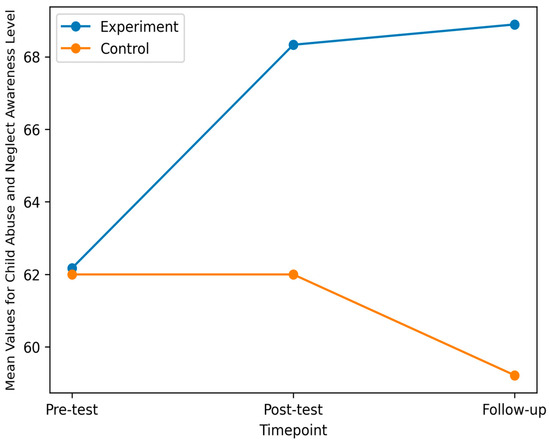
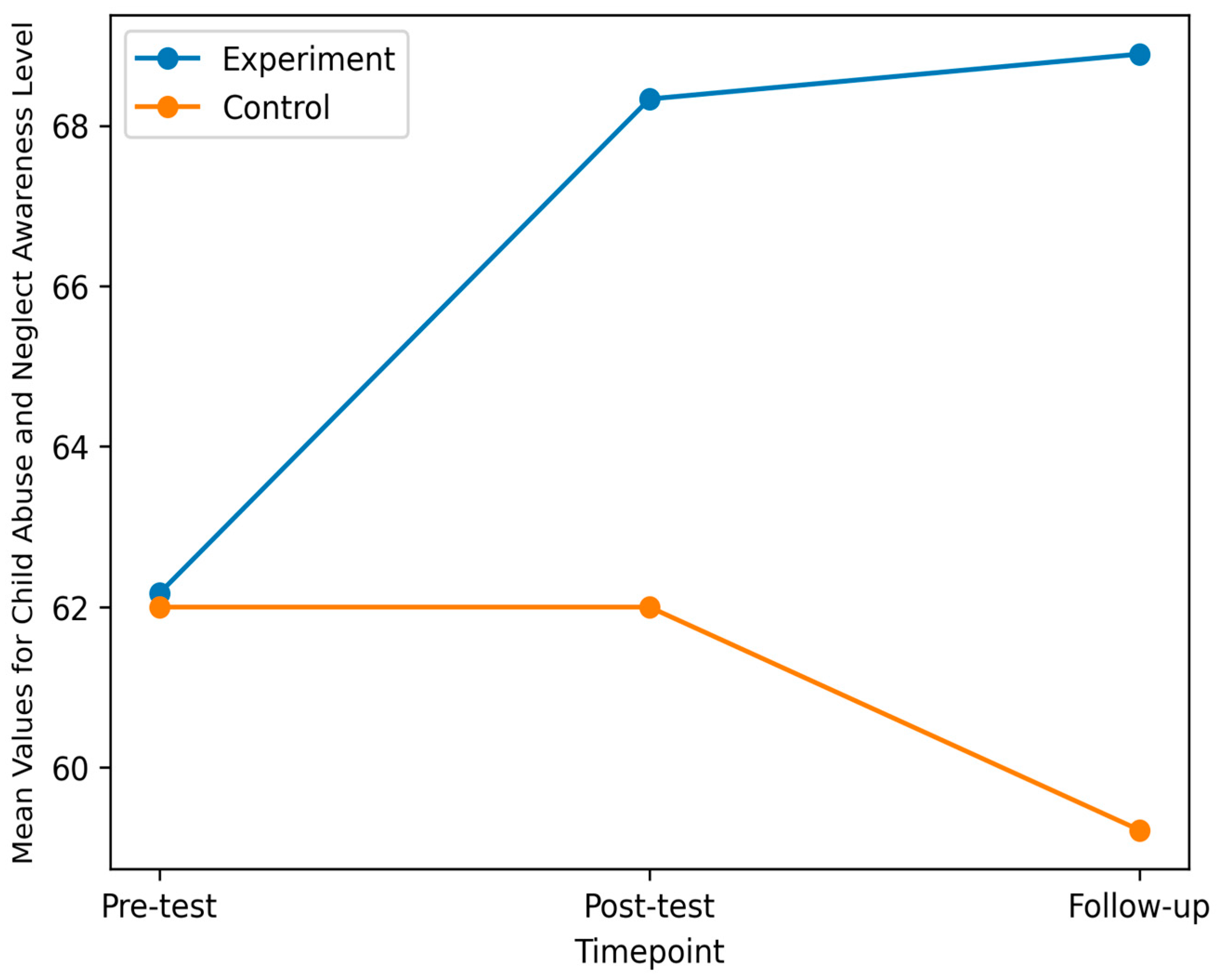
Statistically significant differences were identified between the mean values for pre-test, post-test, and follow-up timepoints in the experiment and control groups (F(2,68) = 106.95, p < 0.01, ηp2 = 0.76). In other words, whether the participant was in the experiment or control group significantly changed the child abuse and neglect awareness levels (Figure 1).
Figure 1.
Variation in mean CAA-S pre-test, post-test and follow-up test values for the experiment and control groups.
According to Figure 1, the experimental group demonstrated a statistically significant improvement in awareness of child abuse and neglect compared with the control group. The partial eta square (ηp2) related to the effect size was identified as 0.76. Effect size has a value between 0.00 and 1.00. In line with this, it is possible to say the psycho-education intervention had a large effect size (Cohen, 1988).
In addition, the Bonferroni test, a post hoc test for multiple comparison methods, was performed to determine the source of the difference in child abuse and neglect awareness levels. According to the Bonferroni test results, there were statistically significant differences between the mean pre-test values ( = 62.17) and mean post-test values ( = 68.33) (mean difference = −6.17, p < 0.05) and between the mean pre-test values and mean follow-up test values ( = 68.89) (mean difference = −6.72, p < 0.05) in the experiment group. The difference between mean post-test values and mean follow-up test values was identified to be statistically insignificant (mean difference = −0.56, p > 0.05). Based on this finding, the child abuse and neglect awareness education program achieved its aims in the experiment group and the effect lasted for a three-month duration.
6. Discussion
The aim of the present study was to examine the effectiveness of a psycho-education program developed to increase teachers’ knowledge and awareness regarding child abuse and neglect. In line with this aim, the findings demonstrated that the psycho-education program significantly improved teachers’ awareness levels, and that these improvements were maintained over time. It should be noted that the present study focused on self-reported awareness rather than actual behavioral competence. Therefore, the findings should not be interpreted as evidence of improved professional competence, but rather as an increase in perceived awareness and understanding. The increase observed in the experimental group suggests that structured psycho-educational interventions can play a critical role in enhancing teachers’ ability to recognize signs of child abuse and neglect. In particular, the persistence of the effect at the follow-up measurement indicates that awareness-based interventions may produce relatively stable cognitive and attitudinal changes over time. This finding is especially important considering that awareness is often the first step in the process of the identification and reporting of abuse cases. Without sufficient awareness, even existing legal and institutional frameworks may fail to function effectively in practice.
These findings are consistent with previous international research demonstrating that training programs can improve teachers’ knowledge, awareness, and preparedness regarding child abuse and neglect (Kenny, 2004; Walsh et al., 2008). More recent evidence from a quasi-experimental study conducted in Cambodia similarly showed that a four-week child sexual abuse prevention training significantly improved teachers’ knowledge and attitudes, with gains sustained at follow-up (Kantipudi & Chuemchit, 2024). The present study’s findings align with these results, demonstrating that structured training can produce meaningful improvements, even across different cultural contexts. In the Turkish context, Gün et al. (2022) reported that a child neglect and abuse training program increased teachers’ knowledge levels and their willingness to report suspected cases, which is consistent with the improvements observed in the experimental group of the current study. Studies conducted in other countries have similarly shown that teachers frequently report insufficient training and low confidence in identifying and reporting abuse cases, and that targeted educational interventions can significantly improve these outcomes (Weegar & Romano, 2019; Honsinger & Brown, 2019). This finding is also supported by qualitative research indicating that education professionals often underreport suspected child abuse due to lack of knowledge, limited communication skills, and concerns about potential negative consequences (Gubbels et al., 2021). Additionally, teachers’ attitudes toward reporting play a crucial role in child protection processes and can be positively influenced through targeted training programs (Fabris et al., 2026).
When the literature from Türkiye is examined, most studies have focused on personal safety education programs targeting primary school students (Cecen-Erogul & Kaf Hasirci, 2013; Çıtak Tunç et al., 2018; Kızıltepe et al., 2021), while relatively fewer studies have focused directly on teachers (Peker et al., 2020; Yıldız et al., 2017). Consistent with this perspective, previous studies have shown that higher levels of knowledge about child abuse are associated with better intervention responses among teachers (Sainz et al., 2020). Therefore, the present study contributes to the limited body of research focusing on teacher-based interventions and highlights the importance of equipping teachers with the necessary awareness and knowledge to identify and respond to abuse cases. This contribution is particularly important in the Turkish context, where structured training opportunities on child abuse and neglect are still limited.
Another important finding of the present study is the decrease observed in the control group’s awareness scores at the follow-up measurement. This decline suggests that in the absence of structured training, awareness levels may diminish over time or fail to be sustained. This finding is particularly noteworthy when considered alongside recent research demonstrating that while theoretical knowledge is associated with higher self-reported ability to recognize child maltreatment cases, it does not necessarily translate into actual detection capacity (Vozmediano-Collado et al., 2025). In the context of the present study, the decline in control group scores may reflect not only the absence of structured training but also the lack of contextual reinforcement and opportunities to apply knowledge in practice. These findings collectively underscore the importance of continuous and structured training programs, rather than one-time interventions, in maintaining professional awareness in educational settings.
Child abuse is widely recognized as a major public health problem with long-term psychological, social, and developmental consequences (Moffitt, 2013). Teachers play a critical role in identifying, reporting, and preventing abuse due to their close and continuous interaction with children (Koçtürk, 2018). Through daily contact, teachers are in a unique position to observe behavioral, emotional, and physical changes in children that may indicate abuse or neglect. However, previous studies have consistently shown that teachers often feel unprepared and lack sufficient knowledge and confidence to respond effectively to such cases (Savi Çakar & Yazıcı Okuyan, 2017; Weegar & Romano, 2019). In this context, psycho-educational programs, such as the one implemented in this study, may serve as an important tool to bridge this gap by improving awareness and preparedness among teachers.
The large effect sizes observed in the present study suggest that the psycho-education program had a substantial impact on participants’ awareness levels. This effect size is comparable with those reported in similar intervention studies. For instance, Kim et al. (2019) evaluated the Second Step Child Protection Unit training for elementary school teachers and reported significant improvements in knowledge and reporting attitudes, with post-training effect sizes demonstrating meaningful gains. Similarly, a pan-European digital training evaluation (ERICA) conducted across seven countries found that professionals’ self-assessed skills and knowledge significantly improved after training, with the effects observed consistently across different cultural and legislative contexts (Zlatkute et al., 2025). Although direct comparisons across studies should be made cautiously due to differences in measures and intervention formats, the present findings are consistent with this growing body of evidence demonstrating that structured training programs can effectively enhance teachers’ awareness and reporting-related attitudes. However, given the relatively small sample size (n = 18 per group), these effect size estimates should be interpreted with caution. Small samples may lead to unstable or inflated estimates, a limitation that has been noted in prior intervention research (Gün et al., 2022). Future studies with larger samples and fully randomized designs are needed to confirm the robustness and generalizability of these findings.
A critical distinction emerging from recent research is the difference between self-reported awareness and actual behavioral competence. Vozmediano-Collado et al. (2025) found that while teachers’ theoretical knowledge of child maltreatment was associated with higher self-reported ability to recognize cases, this did not translate into actual detection capacity. Instead, the quality of the teacher–student relationship, conceptualized as a “teacher–student alliance”, was more strongly associated with real detection capacity. This finding has important implications for interpreting the results of the present study. Although the psycho-education program successfully increased participants’ self-reported awareness, whether this improvement translates into actual detection and reporting behavior in real-world settings remains an open question. Future research should incorporate objective measures of detection capacity, such as case vignettes, simulated reporting scenarios, or administrative data on reporting rates, to complement self-report measures. Moreover, intervention programs may benefit from incorporating components that strengthen teacher–student relational skills alongside knowledge-based content, as suggested by Vozmediano-Collado et al. (2025).
This study has several limitations that should be considered when interpreting the findings. One important limitation is the lack of full random assignment. Since group allocation was partially based on pre-test scores, there is a potential risk of selection bias, which may affect internal validity and limit causal interpretations. Another limitation is the relatively small sample size, which may limit statistical power and increase the likelihood of unstable effect size estimates. In addition, the control group did not receive an alternative training or placebo-like intervention; therefore, the observed differences may partly reflect the effects of receiving structured attention and participating in a program rather than the specific content of the psycho-education itself. Furthermore, although the overall reliability of the scale was high, one subscale demonstrated relatively low internal consistency, which should be considered when interpreting the psychometric precision of the instrument at the subscale level. Awareness was also assessed using self-report measures, which may be subject to response bias. Although large effect sizes were observed, these findings should be interpreted with caution. Future studies with larger and more diverse samples, as well as fully randomized controlled designs, are recommended to confirm and extend these results.
7. Future Directions and Clinical Implications
Learning to identify signs of child abuse and neglect should be a central focus of educational experiences. Educators should also learn how to support students in the classroom, understand the processes that follow disclosure of abuse, and recognize the potential negative effects on students. Education about this topic for teachers and other professionals in the field will assist in identifying the many children who are abused and neglected and providing the best possible assistance in the shortest duration. The significant increase in awareness levels observed in the experimental group in the present study suggests that structured psycho-educational programs can be an effective component of teacher training curricula. These findings indicate that even short-term, well-designed interventions may produce meaningful improvements in professional awareness. Additionally, professional development seminars and workshops attended by teachers may produce more effective results if managed in a multidisciplinary way, with representatives from social services departments and the medical and legal fields who work regularly with children who are abused and neglected. Due to the sensitive structure of child abuse, protocols should be created for cooperation between institutions to allow teachers and trained professionals to develop preventative curricula that meet the needs of young children, and every member of society should be encouraged to contribute to child abuse prevention efforts.
8. Conclusions
Teachers play an important role in identifying and reporting children who are victims of abuse. However, existing research indicates that teachers often lack adequate knowledge to identify these children. Teachers need additional knowledge/skills to protect the rights of children and require a foundation for early screening and timely reporting for children who need assistance and support. This research provides insight into the efficacy of education programs to cope with the current problem of teachers having received inadequate education.
Author Contributions
Conceptualization, T.T. and H.O.; methodology, T.T.; software, T.T.; validation, T.T. and H.O.; formal analysis, T.T.; investigation, T.T.; resources, T.T.; data curation, T.T.; writing—original draft preparation, T.T.; writing—review and editing, T.T. and H.O.; visualization, T.T.; supervision, H.O.; project administration, T.T.; funding acquisition, none. All authors have read and agreed to the published version of the manuscript.
Funding
This research received no external funding.
Institutional Review Board Statement
The study was conducted in accordance with the Declaration of Helsinki and approved by the Trabzon University Ethics Committee for Social and Human Sciences (approval date: 12 June 2020; reference number: 81614018-000-E186).
Informed Consent Statement
Informed consent was obtained from all participants involved in the study.
Data Availability Statement
The data supporting the findings of this study are available from the corresponding author upon reasonable request.
Conflicts of Interest
The authors declare no conflicts of interest.
References
- Armfield, J. M., Gnanamanickam, E. S., Johnston, D. W., Preen, D. B., Brown, D. S., Nguyen, H., & Segal, L. (2021). Intergenerational transmission of child maltreatment in South Australia, 1986–2017: A retrospective cohort study. The Lancet Public Health, 6(7), e450–e461. [Google Scholar] [CrossRef] [Scilit]
- Cecen-Erogul, A. R., & Kaf Hasirci, O. (2013). The effectiveness of psycho-educational school-based child sexual abuse prevention training program on Turkish elementary students. Educational Sciences: Theory and Practice, 13(2), 725–729. [Google Scholar]
- Cicchetti, D., & Toth, S. L. (1995). A developmental perspective on child abuse and neglect. Journal of the American Academy of Child & Adolescent Psychiatry, 34, 541–565. [Google Scholar] [CrossRef] [Scilit]
- Cohen, J. (1988). Statistical power analysis for the behavioral sciences (2nd ed.). Lawrence Erlbaum Associates, Publishers. [Google Scholar]
- Creswell, J. W. (2012). Educational research: Planning, conducting, and evaluating quantitative and qualitative research (4th ed.). Pearson Education, Inc. [Google Scholar]
- Cug, F. D. (2022). What school counselors say: Training needs for preventing child sexual abuse. Higher Education Studies, 12(1), 155–165. [Google Scholar] [CrossRef] [Scilit]
- Çıtak Tunç, G., Gorak, G., Ozyazicioglu, N., Ak, B., Isil, O., & Vural, P. (2018). Preventing child sexual abuse: Body safety training for young children in Turkey. Journal of Child Sexual Abuse, 27(4), 347–364. [Google Scholar] [CrossRef] [Scilit]
- Degli Esposti, M., Pereira, S. M. P., Humphreys, D. K., Sale, R. D., & Bowes, L. (2020). Child maltreatment and the risk of antisocial behaviour: A population-based cohort study spanning 50 years. Child Abuse & Neglect, 99, 104281. [Google Scholar] [CrossRef] [Scilit]
- Fabris, M. A., Longobardi, C., Mastrokoukou, S., Cardoso, B. L. A., & Costa Lima, D. (2026). Teachers’ reporting attitude scale for child sexual abuse: An Italian adaptation. Behavioral Sciences, 16(2), 168. [Google Scholar] [CrossRef] [Scilit]
- Field, A. (2005). Discovering statistics using SPSS (2nd ed.). Sage Publications. [Google Scholar]
- Fraenkel, J. R., Wallen, N. E., & Hyun, H. H. (2012). How to design and evaluate research in education (8th ed.). McGraw-Hill. [Google Scholar]
- Gilbert, R., Widom, C. S., Browne, K., Fergusson, D., Webb, E., & Janson, S. (2009). Burden and consequences of child maltreatment in high-income countries. The Lancet, 373(9657), 68–81. [Google Scholar] [CrossRef] [Scilit]
- Goemans, A., Viding, E., & McCrory, E. (2021). Child maltreatment, peer victimization, and mental health: Neurocognitive perspectives on the cycle of victimization. Trauma, Violence & Abuse, 24(2), 530–548. [Google Scholar]
- Gubbels, J., Assink, M., Prinzie, P., & van der Put, C. E. (2021). Why healthcare and education professionals underreport suspicions of child abuse: A qualitative study. Social Sciences, 10(3), 98. [Google Scholar] [CrossRef] [Scilit]
- Gün, İ., Çopur, A., & Balcı, E. (2022). Effect of training about child neglect and abuse to teachers and its effect to awareness. BMC Public Health, 22(1), 543. [Google Scholar] [CrossRef] [Scilit] [PubMed]
- Hamad, H., Angelöw, A., & Psouni, E. (2023). Protocol for evaluation of effects of a psychoeducational trauma-informed intervention directed at schools. European Journal of Psychotraumatology, 14(2), 2263322. [Google Scholar] [CrossRef] [Scilit] [PubMed]
- Honsinger, C., & Brown, M. H. (2019). Preparing trauma-sensitive teachers: Strategies for teacher educators. Teacher Educators’ Journal, 12, 129–152. [Google Scholar]
- Kantipudi, S., & Chuemchit, M. (2024). Teach to say “NO”: A mixed methods evaluation of a child sexual abuse prevention training for primary school teachers in Phnom Penh, Cambodia. Child Abuse & Neglect, 158, 107097. [Google Scholar] [CrossRef] [Scilit]
- Karasar, N. (2000). Scientific research methods (10th ed.). Nobel Publishing. [Google Scholar]
- Kenny, M. C. (2004). Teachers’ attitudes toward and knowledge of child maltreatment. Child Abuse & Neglect, 28(12), 1311–1319. [Google Scholar] [CrossRef] [Scilit]
- Kim, S., Nickerson, A., Livingston, J. A., Dudley, M., Manges, M., Tulledge, J., & Allen, K. (2019). Teacher outcomes from the second step child protection unit: Moderating roles of prior preparedness, and treatment acceptability. Journal of Child Sexual Abuse, 28(6), 726–744. [Google Scholar] [CrossRef] [Scilit]
- Kisely, S., Abajobir, A. A., Mills, R., Strathearn, L., Clavarino, A., & Najman, J. M. (2018). Child maltreatment and mental health problems in adulthood: Birth cohort study. The British Journal of Psychiatry: The Journal of Mental Science, 213(6), 698–703. [Google Scholar] [CrossRef] [Scilit]
- Kızıltepe, R., Eslek, D., Irmak, T. Y., & Güngör, D. (2021). “I am learning to protect myself with Mika”: A teacher-based child sexual abuse prevention program in Turkey. Journal of Interpersonal Violence, 37(11–12), NP10220–NP10244. [Google Scholar] [CrossRef] [Scilit]
- Koçtürk, N. (2018). The responsibilities of school employees in preventing child abuse and neglect. MSKU Journal of Education, 5(1), 38–47. [Google Scholar]
- Lu, M., Barlow, J., Meinck, F., & Wu, Y. (2022). “Prevention alone is not enough:” Stakeholders’ perspectives about school-based child sexual abuse (CSA) prevention programs and CSA research in China. Journal of Interpersonal Violence, 37(7–8), NP5116–NP5142. [Google Scholar] [CrossRef] [Scilit]
- Moffitt, T. E. (2013). Childhood exposure to violence and lifelong health: Clinical intervention science and stress-biology research join forces. Development & Psychopathology, 25, 1619–1634. [Google Scholar]
- Peker, A., Cengiz, S., & Karabacak Çelik, A. (2020). The effect of psycho-education program developed for sexual abuse on counseling teachers’ reporting sexual abuse and ınformation and risk recognition attitudes. International Journal of Education & Literacy Studies, 8(4), 2–13. [Google Scholar]
- Russell, D., Higgins, D., & Posso, A. (2020). Preventing child sexual abuse: A systematic review of interventions and their efficacy in developing countries. Child Abuse & Neglect, 102, 104395. [Google Scholar] [CrossRef] [Scilit]
- Sainz, V., González-Sánchez, M., & Ruiz-Alberdi, C. (2020). Knowledge of child abuse among trainee teachers and teachers in service in Spain. Sustainability, 12(19), 8040. [Google Scholar] [CrossRef] [Scilit]
- Savi Çakar, F., & Yazıcı Okuyan, H. (2017). Trainee teachers’ opinions about child abuse and neglect. Mehmet Akif Ersoy University Faculty of Education Journal, 44, 250–275. [Google Scholar]
- Thoma, M. V., Bernays, F., Eising, C. M., Maercker, A., & Rohner, S. L. (2021). Child maltreatment, lifetime trauma, and mental health in Swiss older survivors of enforced child welfare practices: Investigating the mediating role of self-esteem and self-compassion. Child Abuse & Neglect, 113, 104925. [Google Scholar] [CrossRef] [Scilit]
- Türkkan, T. (2022). The effect of a psycho-education program on child abuse and neglect on the awareness levels of teachers [Doctoral thesis, Trabzon University, Institute of Educational Sciences]. [Google Scholar]
- Vozmediano-Collado, M. T., Pareja, D. G., García-Aparicio, V., Monroy García, F. A., & Pérez-Rodríguez, A. (2025). Teachers’ Perspective of their alliance with students and detection of child maltreatment. Social Sciences, 14(5), 299. [Google Scholar] [CrossRef] [Scilit]
- Walsh, K., Bridgstock, R., Farrell, A., Rassafiani, M., & Schweitzer, R. (2008). Case, teacher and school characteristics influencing teachers’ detection and reporting of child physical abuse and neglect: Results from an Australian survey. Child Abuse & Neglect, 32(10), 983–993. [Google Scholar] [CrossRef] [Scilit] [PubMed]
- Wang, W., Cui, Y., Hu, Q., Wei, Y., Xu, L., Tang, X., Hu, Y., Liu, H., Wang, Z., Chen, T., Wang, R., An, C., Wang, J., & Zhang, T. (2024). Childhood maltreatment and personality disorders in adolescents and adults with psychotic or non-psychotic disorders. Frontiers in Psychiatry, 15, 1336118. [Google Scholar] [CrossRef] [Scilit]
- Weegar, K., & Romano, E. (2019). Child maltreatment knowledge and responses among teachers: A training needs assessment. School Mental Health, 11(4), 741–753. [Google Scholar] [CrossRef] [Scilit]
- World Health Organization (WHO). (2013). Adverse childhood experiences survey among university students in Turkey study report. Available online: https://iris.who.int/server/api/core/bitstreams/44246b22-2b31-4441-b03b-95e0537f4504/content (accessed on 30 January 2022).
- World Health Organization (WHO). (2020). Child maltreatment. Available online: https://www.who.int/news-room/fact-sheets/detail/child-maltreatment (accessed on 17 December 2021).
- Yıldız, Y., Kaçar, M., Albayrak, E., Çalaboğlu, T., Çakmak, T., & Bayraktar, T. (2017). Evaluation of knowledge levels of primary education about child neglect and abuse. Van Medical Journal, 24(4), 303–309. [Google Scholar] [CrossRef] [Scilit]
- Yoon, D., Yoon, S., Pei, F., & Ploss, A. (2021). The roles of child maltreatment types and peer relationships on behavior problems in early adolescence. Child Abuse & Neglect, 112, 104921. [Google Scholar] [CrossRef] [Scilit]
- Zhang, W., Chen, J., & Liu, F. (2015). Preventing child sexual abuse early: Preschool teachers’ knowledge, attitudes, and their training education in China: Preschool teachers’ knowledge, attitudes, and their training education in China. Sage Open, 5(1), 1–8. [Google Scholar] [CrossRef] [Scilit]
- Zlatkute, G., Crocamo, C., Specka, M., Keenan, K., Cioni, R. M., Roe, L., Zabłocka-Żytka, L., Woźniak-Prus, M., Appleton, J., Bekaert, S., Paavilainen, E., Rantanen, H., Jouet, E., Viganò, G., & Baldacchino, A. (2025). Quantitative evaluation of a Pan-European multi-professional digital training programme for stopping child maltreatment (ERICA). International Journal on Child Maltreatment: Research, Policy and Practice, 8(4), 477–498. [Google Scholar] [CrossRef] [Scilit]

Disclaimer/Publisher’s Note: The statements, opinions and data contained in all publications are solely those of the individual author(s) and contributor(s) and not of MDPI and/or the editor(s). MDPI and/or the editor(s) disclaim responsibility for any injury to people or property resulting from any ideas, methods, instructions or products referred to in the content. |
© 2026 by the authors. Licensee MDPI, Basel, Switzerland. This article is an open access article distributed under the terms and conditions of the Creative Commons Attribution (CC BY) license.