


Abstract
The growing prevalence of home education necessitates exploration of parental involvement outside traditional schooling environments. This paper conceptualises parental involvement within home education decision-making. Core elements of decision making, including Choices, Contexts, Challenges and Changes, are integrated with Bronfenbrenner’s bioecological systems theory to create the 4Cs model of parental decision-making in home education. The 4Cs model is developed from integrating findings from the literature with previous empirical work on how parents make and explain decisions in home education. The present paper uses this model to organise and explain parental decision-making in a structured way. Building on critiques of school-centric parental involvement models, the 4Cs model steps away from assumptions that position parents as passive participants in schools’ agendas to instead illustrate parents’ active collaboration and involvement in their children’s education. The paper goes on to use the 4Cs model to help reframe Epstein’s typology of parental involvement to bridge home education research and broader scholarship on parental involvement. It provides a structured lens to analyse the decision-making processes that underpin why families choose home education and how it is enacted in practice. Central to this framework is the concept of parental agency, which is decoupled from school-based imperatives and positioned as the driving force in constructing tailored learning environments. This theorisation offers a critical lens for examining how parents navigate educational trade-offs, socioecological constraints, and adaptive strategies. We reframe parental involvement as deliberative, context-responsive praxis, creating potential for the 4Cs framework to act as a transferable model for analysing agency-driven parental engagement across diverse educational settings.
1. Introduction
The growing prevalence of home education necessitates exploration of parental involvement outside traditional schooling environments. This paper responds directly to critiques of dominant, school-centric models of parental involvement (e.g., Bond et al., 2025; Goodall, 2017, 2022), which often position parents as passive agents of institutional agendas. This paper foregrounds Choices, Contexts, Challenges and Changes as core elements of parental decision-making in and for home education. These elements are organised together with Bronfenbrenner’s bioecological systems theory (Bronfenbrenner & Morris, 2006) to create the 4Cs model of parental decision-making in home education. The 4Cs model presented here builds on Cheung’s (2024) empirical work, a qualitative doctoral study based on in-depth interviews with home-educating families in Hong Kong during the early years of children. While this paper does not have the space to revisit the empirical study in detail, it uses Author’s findings, along with relevant literature on parental involvement, to organize and develop the 4Cs model of decision-making and highlight its applicability to a broader population and different contexts. The model has two primary aims: firstly, to conceptualise the dynamic decision-making processes that lead families to choose home education over schooling; and secondly, to analyse the practices of parental support for learning within the home education environment. The paper goes on to use the 4Cs model to help reframe Epstein’s (1995) typology of parental involvement to bridge home education research and broader scholarship on parental involvement. Consequently, this paper invests in and broadens the conceptual understanding of parental involvement, reframing it not solely as a school-prescribed activity, but as a deliberative and context-responsive praxis that is central to the enterprise of home education.
Home education, also termed home schooling, is fundamentally defined as “the practice of educating children at home rather than sending them to school, usually by parents” (Cambridge Dictionary, n.d.). However, a more nuanced understanding positions it as “an alternative education option actively chosen by parents, wherein they take on the responsibility of educating their children instead of sending them to school at any age” (Ahi & Sengil-Akar, 2021). Crucially, it is defined as an educational choice by parents, rather than merely the physical location where learning occurs (Forlin & Chambers, 2024) or a consequence of school closures, such as during COVID-19. Home education is characterised by its individualised and child-focused nature, encompassing a diverse spectrum of pedagogical approaches, from highly structured, school-like instruction to informal, child-directed learning (Forlin & Chambers, 2024).
The development of home education is intrinsically linked to the history of formal schooling. Historically, education was primarily a domestic activity (Ray, 2021). The Industrial Revolution and the subsequent rise of state-funded, compulsory education systems shifted this responsibility from the family to institutional settings, effectively marginalising home-based education for over a century (Ray, 2025). Its modern re-emergence, particularly in countries like the US and UK from the late 20th century onwards, represents a significant societal movement where parents are reclaiming educational authority. Home education is a legal choice under educational regulations in the US and the UK, where the majority of the home-educating population and research on the topic are located. This movement has gained global momentum since 2000, and research on home education has since developed in many countries across Europe, South Africa, and Asia (Kunzman & Gaither, 2020). However, opportunities for home education remain restricted, or even illegal, in some nations (Germany and China, for example) due to state priorities concerning social cohesion and children’s rights (Forlin & Chambers, 2024).
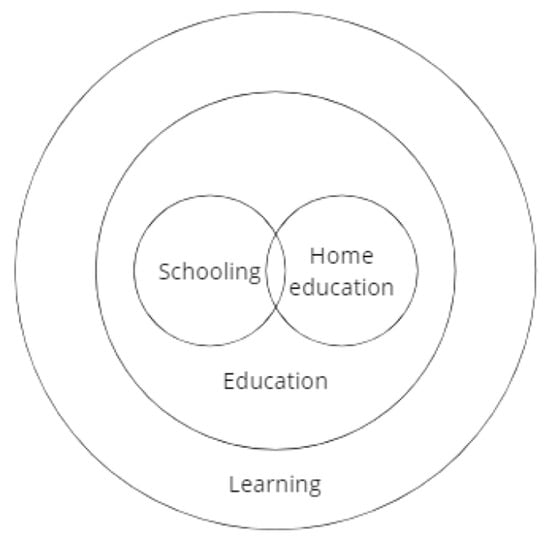
To fully understand home education, it must be situated within the broader conceptual triad of learning, education, and schooling. Learning is the lifelong process of acquiring knowledge and skills. Education is the deliberate, transformative pursuit of human development, encompassing a vast range of formal and informal experiences (Goodall, 2017, 2022). Schooling is a specific institutionalised subset of education, characterised by structured curricula, certified teachers, and standardised assessments (Sidorkin, 2012). Figure 1 conceptualises home education as a distinct subset within the domain of education. It shares the deliberate purpose of education but operates outside the structures of schooling, although often intersecting with formal schooling as families may move between the two modalities throughout a child’s development; further, some families structure home education in a manner akin to formal schooling.
Figure 1.
Conceptual layers among learning, education, schooling, and home education.
The choice of the term “home education” in this paper over “home schooling” is thus philosophically significant, as it embraces this full spectrum of intentional learning, not just the replication of school-at-home.
Research into home education has traditionally focused on two central questions: why parents choose it and how they implement it. The motivations (the why) are often categorised using Van Galen’s (1986, 1991) typology of “ideologues” (driven by religious, philosophical, or political beliefs) and “pedagogues” (driven by dissatisfaction with school pedagogy and content). These can be further understood as proactive choices (based on strong beliefs) or reactive ones (a response to a child’s negative school experience) (Forlin & Chambers, 2024; Green-Hennessy & Mariotti, 2023). The how encompasses the practices parents adopt, which range from highly structured to unstructured approaches (Kunzman & Gaither, 2020; Thomas, 2016). Parents act as primary educators, designing tailored curricula, but they also extensively leverage networks—through formal co-ops, informal support groups, and community resources like libraries and museums—demonstrating that home education is not an isolated practice confined to the home (Cheung, 2024).
Home education research reveals a focus on the role of parents, positioning the practice as a significant form of parental involvement in children’s education. However, home education itself is seldom examined within the broader landscape of parental involvement research, a field historically situated within the school context. As Bartolome and Mamat (2020) explains, conceptions of parental involvement are diverse and nuanced, shaped by the specific context of the research. Parental involvement refers to parents’ participation in their children’s education, which can include interactions with educators and institutions (e.g., in schools) as well as direct involvement in learning activities at home (e.g., in home education) (Hill, 2022; Kim, 2020). Early work by Green and Hoover-Dempsey (2007) began to bridge this gap—framing the motivation for home education as a form of parental involvement. Their research concludes that the choice to home-educate is not merely a viable alternative but a complex, deeply personal decision that reflects broader social and educational values.
2. Framing Choices for Home Education Within Bronfenbrenner’s Ecological Systems Theory
Research into home education is fundamentally concerned with the concept of choice, encompassing both the initial decision underlying motivations (why) and the subsequent implementation of pedagogical practices (how) (Kunzman & Gaither, 2020). Understanding these choices necessitates an investigation into who is responsible for them. Research indicates that both mothers and fathers contribute to this decision-making process (Ahi & Sengil-Akar, 2021; Kunzman & Gaither, 2020). Although mothers have traditionally taken a more prominent role, the dynamic within each family is unique. Contemporary studies reveal more equitable partnerships in some families, while in others, the father can be the most influential figure (Cheung, 2024). This highlights that the “who” behind home education is diverse and dynamic, as is the landscape of parental involvement itself.
To conceptualise the decision-making process for home education, this paper adopts Bronfenbrenner’s Bioecological Systems Theory (Bronfenbrenner, 1994, 1995; Bronfenbrenner & Morris, 2006). This theory posits that human development is shaped by the interaction between an individual and their layered environmental systems, which range from immediate settings to broader societal contexts (microsystem to macrosystem). While Bronfenbrenner’s earliest work emphasised the interconnectedness of these systems (Bronfenbrenner, 1977, 1979), his later revisions placed greater emphasis on the “individual” or “person” factors (Bronfenbrenner, 1995; Bronfenbrenner & Morris, 1998). This bioecological perspective acknowledges that personal characteristics—such as beliefs, values, and goals—actively shape human development through their interaction with the environmental systems (Tudge et al., 2022; Xia et al., 2020). A later model (Bronfenbrenner & Morris, 1998, 2006) incorporated the chronosystem to capture the influence of time and life transitions, advocating for a more dynamic understanding of human development. Bronfenbrenner’s theory offers a detailed and wide-ranging framework for understanding how individuals develop within complex, interacting systems. Work across a wide range of disciplines has demonstrated the utility of Bronfenbrenner’s work in inspiring research designs that capture the complexity of real-life environments (Tong & An, 2024; Paat, 2013; Eriksson et al., 2018).
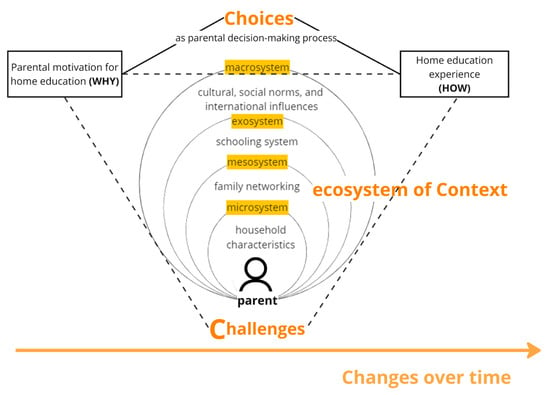
In this paper, we adopt Bronfenbrenner’s theory to position parental decision-making for home education (why) and in home education (how) as a bioecological process. Here, parents—with their unique beliefs, attributes, and backgrounds—interact with multiple systemic influences. These range from immediate family, child, and parent characteristics (microsystem) and extended family networks (mesosystem) to the quality and availability of local schooling (exosystem) and broader cultural-societal values and international influences (macrosystem). Consequently, the choice for home education is not a simple decision led solely by parental belief, but a dynamic decision-making process, characterised by unique challenges and changes within authentic ecological systems over time.
Central to this decision-making process is parental agency. This involves not only participation, but also the extent of active involvement in decision-making processes for their own children’s education. In the context of home education, this can include advocating for children’s needs and implementing educational practices aligned with family values and goals. The level of agency, and how it is enacted, can reflect deeply held educational beliefs, which are frequently categorised in home education research (Dennison et al., 2020; Green & Hoover-Dempsey, 2007; Pratiwi et al., 2023). A seminal typology first established by Van Galen (1986, 1991) distinguishes between ideological motivations (driven by conservative Christian religious beliefs) and pedagogical motivations (driven by concerns about teaching methods) for home education. This idea has been further developed by other scholars, who broaden the understanding of ideological motivations to include those driven by a wider range of religious backgrounds, as well as philosophical or political beliefs (Brewer & Lubienski, 2017; Fields-Smith, 2021; Sheng, 2019). Pedagogical motivations encompass not only teaching methods but also concerns about the school environment and the social aspects of school life (Kunzman & Gaither, 2020; Murphy et al., 2021). However, beliefs alone are seldom sufficient to explain decisions for and in home education. Adopting Bronfenbrenner’s lens, the decision-making process in home education can be understood as an interaction between parental agency and multiple systemic influences within parents’ contexts, as outlined below, drawing on empirical findings from home-education studies as examples.
The microsystem can be thought of as immediate household characteristics that directly influence the choice for home education. Factors that attract parents towards home education may include the desire to support children with special educational needs through tailored instruction, for example, or considerations related to race, minority identity, and experiences of disparity within traditional schooling (Murphy et al., 2021). Race and ethnicity can also shape parental choices, as home education is sometimes described as protecting children from racial discrimination and anti-Black curricula and as a proactive strategy to build cultural pride in Black families (Mazama & Lundy, 2012, 2015). In addition, children’s disabilities and special educational needs influence families’ moves toward home education, as a response to negative school experiences and unmet needs in school (Kunzman & Gaither, 2020; Murphy et al., 2021; Parsons & Lewis, 2010).
Conversely, significant forces—or challenges—that steer parents away from home education involve a cost–benefit consideration. The financial constraints are considerable, as parents—often mothers—may forfeit employment, resulting in a single-income household (Aubin, 2018; Minikel-Lacocque, 2013). Additional challenges include the readiness to reconcile the dual roles of parent and teacher, the intensive time commitment without traditional breaks, and the complexities of curriculum design (Lois, 2006). Low-income families may face significant challenges when choosing home education, including lack of understanding of homeschool laws, concerns about social services intervention, and doubts about their own ability to teach effectively (Ray et al., 2021).
The mesosystem—encompassing extended family and community networks—can reinforce or restrict the decision to home-educate. Support from home-educating friends, religious communities, or local networks often serves as a positive force, providing practical encouragement (Anthony, 2015; Anthony & Burroughs, 2012; Kunzman & Gaither, 2020). For example, such networks facilitate collaborative practices like co-learning, where families share teaching plans and resources (Anthony & Burroughs, 2012). Conversely, a lack of support or discouragement, particularly from extended family members such as grandparents, can present a significant challenge, as documented in studies from contexts such as Hong Kong (Cheung, 2024).
The exosystem, particularly the quality and availability of local schooling, constitutes a critical sphere for the exercise of parental agency. The decision to home-educate is frequently a direct response to parental perceptions of this exosystem. For instance, research in East Asia demonstrates that families in Hong Kong, South Korea, and Japan often choose home education as a reaction to an intensely competitive, academically driven educational ethos (Kemble, 2004; Riley, 2016; Seo, 2009). Their motivation is shaped not only by an intrinsic desire to provide a more balanced, whole-person education but also by a desire to escape the perceived pressures of the mainstream system (Kemble, 2004; Riley, 2016; Seo, 2009). Similarly, a parent’s ideological beliefs may lead them to select a faith-based curriculum due to a perceived misalignment with the secular ethos of local schools (Murphy et al., 2021). Home education represents a fundamental choice under the broader umbrella of children’s learning and education and can intersect with schooling—as illustrated in Figure 1. Understanding the interplay between parental agency, their beliefs about their children’s learning, and their perceptions of local schooling is therefore crucial if we are to understand the decisions for and in home education. While the bio-ecological interaction is most immediately salient between parental beliefs and the exosystem (the school system), these dynamics also extend to and are influenced by broader macrosystemic factors.
The macrosystem—such as internationalisation and cultural–societal values and policies—exerts a powerful effect. In China, intense academic pressure may push families towards home education to achieve ‘whole-person’ development (Sheng, 2020; Zheng, 2014). It is more than just about the school system or a parent’s personal educational belief: taking Hong Kong as an example, there is a saying, “win at the starting line,” where parents, schools, and society push children from an early age for academic achievement (HKIAPS, 2016; Wong & Rao, 2023). Cheung (2024) found that home-educating parents with young children not only wanted to escape from the school system but also to stand against what they claim is an “unhealthy” education culture, choosing home education instead of kindergarten in early childhood. Furthermore, globalisation acts as a macrosystemic factor; the international home education movement, facilitated by online conferences and transnational information sharing, provides frameworks and practices that transcend national borders. Ultimately, Bronfenbrenner’s model helps to conceptualise the multitude of influences on the decision-making process, both within and between systems.
The decision-making behind home education practices is relevant to its underlying motivation (Pannone, 2014). This connection is captured by the “content, context, pedagogues” (CCP) framework, posited by Jolly and Matthews (2020), which articulates home-educating parents’ reported practices: Content—what to teach; Context—where to learn; Pedagogues—how to teach. Within the microsystem, research shows that parents’ motives as ideologues and pedagogues are central considerations, influencing how parents deliver education to their children in numerous different ways relating to their motives. For example, the selection of religious content or child-centred approaches directly reflects the link between the why and the how in home education (Pannone, 2014). These practices are also shaped by multiple systemic influences. Home education networks, for instance, significantly impact the choice of practices and the availability of resources. When considering the macrosystem and microsystem together, home education can be seen as transcending the traditional border of ‘where to learn’—be that learning outside the home, gaining resources through local interactions, or online learning across national borders.
The figure below (Figure 2) illustrates how bio-ecological influences affect home education decision-making, particularly how parent agency interacts with different ecological systems to make choices. Research further documents the challenges and changes inherent in home education (Yalcin et al., 2020; Zhang & Gibson, 2024). Changes in motivations and practices are situated within a unique combination of ecological contexts, as outlined by Bronfenbrenner’s bioecological theory. In the 4Cs model, the timing of decisions matters because families do not face changes in a single moment; instead, shifts in the surrounding environment over time can shape what parents choose to do and how those choices develop across life transitions. For example, changes in the ecosystem of context—from household arrangements to wider influences such as community norms and international connections—can alter parents’ choices for home education and for continuing home education over time, while also interacting with challenges that emerge at the same time (Cheung, 2024; Kunzman & Gaither, 2020; Murphy et al., 2021).
Figure 2.
4C model in home education decision-making process.
Changes corresponding with children’s growth, transitions between educational levels, and responses to opportunities or challenges, such as family crises (e.g., health issues) or socio-historical events like the COVID-19 pandemic, have been reported in home education studies: As children get older, home education practices often shift. Families may start with more informal, play-rich learning and later move toward more structured academic activities, greater use of technology, and more external learning opportunities that support independence and social interaction (Hanna, 2012; Cheng & Hamlin, 2022; Abuzandah, 2020). These temporal shifts are also linked to changing motivation: initial reasons for home education—such as dissatisfaction with schooling or the desire to protect children—can evolve into longer-term goals such as personalisation, autonomy, and values, as children’s needs change with age (Kunzman & Gaither, 2020). Family crises can further redirect trajectories. For instance, when the main home educator can no longer continue, some families may decide to return to formal schooling, showing how time-dependent pressures can change the direction of home education (Cheung, 2024). External conditions can also affect timing and feasibility. During COVID-19, for example, prolonged social distancing policies in schooling in Hong Kong influenced normal schooling routines, which became a key motivation for some families to shift toward home education (Cheung, 2024).
At the policy level, temporal changes also matter. Over time, home education policy in different places can become clearer and easier to follow, which may increase both interest and feasibility (Bhatt, 2014). In Hong Kong, some families may also consider home education as a way to replace parts of early childhood schooling, such as home educating to cover the period of kindergarten (around three years) and then transferring to primary school when compulsory education begins (Cheung, 2024). In essence, home education is a dynamic process, ever-evolving as motivations and circumstances Change, as families navigate both Choices and Challenges in their unique ecosystem of Context.
This 4Cs model (Choice, Context, Challenges, and Changes), integrated with Bronfenbrenner’s ecosystemic theory, can be used as a framework for understanding decision-making in home education, exploring both the ‘why’ (the choice to home-educate) and the ‘how’ (the approaches to it). The model elucidates the complexity of how parents overcome challenges by reconciling their or their family’s preferences with reality, highlighting that parental motives are situated not only in societal contexts, as advocated by Spiegler (2010), but also in their dynamic interactions with them. Integrating Bronfenbrenner’s ecological systems theory, the 4Cs model provides a new lens by highlighting the bioecological landscapes that shape this journey—a journey that continually evolves with children’s growth and shifting family priorities across time. From the perspective of parental involvement, the 4Cs model thus acts not only to conceptualise the phenomenon of home education and identify its unique aspects, but also to reconceptualise parental involvement itself as a deliberative, context-responsive praxis, reflecting the power of parent agency.
This paper, then, positions parental involvement not as a set of activities to support a fixed system, but as the core process of constructing and continuously adapting an educational ecosystem that is centred around the family.
3. The Transformation of Parental Involvement: Applying Epstein’s Typology to the Home Education Context
Having presented the 4Cs model as a framework for understanding the agency-driven process of parental involvement in home education, it is necessary to examine the forms this involvement takes. We now turn to Epstein’s (1995, 2008) influential typology of parental involvement. As the most widely used framework for conceptualising parental involvement, Epstein’s model has had a lasting impact on education policy and practice, primarily within formal school contexts (Baquedano-López et al., 2013; Lemmer, 2023). Its enduring appeal lies in its structured categorisation of involvement types.
Epstein’s typology (Epstein, 1995, 2008; Epstein & Van Voorhis, 2010) identifies six primary types of involvement: parenting, communicating, volunteering, learning at home, decision-making, and collaborating with the community. This model situates the child at the centre of overlapping family–school–community “spheres of influence” (Goodall, 2017; Lemmer, 2023). When applied within a school context, the typology emphasises home–school cooperation (Goodall, 2017; Lemmer, 2023). It acknowledges that while children learn formally at school, parental roles like “communicating,” “volunteering,” and “decision-making” are enacted within that school learning context. Simultaneously, Epstein recognises out-of-school learning influences through “learning at home,” “parenting,” and “collaborating with the community”—types not limited to a single location (Epstein, 1995, 2008; Epstein & Van Voorhis, 2010). This aligns with the “context” dimension of the 4C model, where learning occurs across different bio-ecological layers.
Considering Epstein’s typology within the context of home education reveals that while all six forms of involvement remain applicable, their manifestation shifts fundamentally. Unlike the parent–school cooperation dynamic in schooling, in home education, parental agency becomes the core involvement mechanism. Notably, the “decision-making” category in Epstein’s typology takes on profound significance, with parents who lead choices toward home education and what and how to learn across various ecological layers—a process coherent with the dynamic 4Cs model. Epstein’s typology of parental involvement, when transposed from a school-based to a home education context, undergoes a profound reconfiguration. The model’s six types of involvement—parenting, communicating, volunteering, learning at home, and collaborating with the community—remain structurally relevant, but their manifestation shifts from complementary supports or cooperation with school to integrated functions of a parental pedagogical practice. This transition is characterised by the fusion of all forms of engagement through the role of the parent-as-educator, fundamentally altering their scope and purpose.
In home education, “parenting” and “educating” can become synonymous and co-constructed (Chinazzi, 2021). The holistic development of the child—intellectual, moral, social, and emotional—can be consciously integrated into daily life, with the home environment becoming the primary pedagogical space (Mathews, 2022). This differs from the school context, where parenting includes establishing supportive home routines for school or a type of involvement that is “out-of-school” (Muller & Kerbow, 2018; West et al., 1998). Communication in home education shifts from a formal, bidirectional flow of information between school and home (e.g., reports, parent-teacher meetings) to proactively advocating for a parent-directed educational journey. The category of volunteering is subsumed into the core work of educational facilitation (Kunzman & Gaither, 2020). Rather than assisting with a teacher’s pre-existing program, the home-educating parent performs the labour of designing their child’s educational journey—sourcing materials, creating teaching plans and projects, and facilitating cooperative learning groups with other families (Kunzman & Gaither, 2020). Concurrently, “learning at home” ceases to be a supplemental “out-of-school” activity and becomes the substantive, integrated education pathway. Academic skills and knowledge can be deliberately embedded in domestic life, with the parent identifying and exploiting the pedagogical potential of everyday moments with the potential to dissolve the boundary between formal instruction and lived experience (Jay & Rose, 2023; Mathews, 2022). Finally, collaboration with the community is reframed as an act of personalised resource curation. The parent-educator can selectively and directly integrate community assets—such as museums, specialist tutors, or nature reserves—into a learning plan for their child (Hanna, 2012; Laiya, 2021; Thomas, 2016). This moves beyond school-orchestrated, whole-class field trips to create a bespoke network of experiences that directly extend the child’s individualised educational environment without institutional mediation. Home education practices vary, and these types or examples of parental involvement do not apply to every home-educating family. However, research into home education practice helps to understand the landscape and the possibilities of parental involvement within it.
The application of Epstein’s framework to home education reveals a paradigm shift from a model of cooperative support for an external institution to one of integrated orchestration within the family unit. Each type of involvement is enacted not in partnership with a separate educational body, but as a distinct yet integrated expression of the parent agency. This underscores how home education can consolidate the overlapping spheres of influence into a single, deliberately managed ecology centered on the child and facilitated by the parent-educator.
Epstein’s typology serves as a valuable reminder that home education is one educational choice within the broader sphere of children’s learning—a relationship conceptualized in the earlier section (Figure 1) among learning, education, schooling, and home education. It cautions against framing home education as the sole way children learn, just as schooling is not the sole way. Regarding parental involvement in home education, “decision-making” is deliberative, ecological, and processual. When analysed through the 4Cs model, it demonstrates a strong, enacted sense of parental agency. This prompts a re-examination of parental agency within Epstein’s other categories: parents continuously “parent” and “communicate” with their children from birth, and home education happens both at “learning at home” and through “collaborating with the community.”
The 4Cs model provides a structured lens for analysing this agency-driven decision-making in home education. Integrated with Bronfenbrenner’s bioecological theory, it underscores the centrality of “parental agency”—the capacity for deliberative, strategic choice within a socio-ecologically responsive praxis. This paper posits that in home education, parental involvement is fundamentally redefined: it transcends auxiliary participation and constitutes the authority to shape educational pathways. This agency-driven conceptualisation invites a critical re-examination of the broader parental involvement literature, exploring how the 4Cs model extends frameworks like Epstein’s typology.
Decades of research affirm the link between parental involvement and positive child outcomes, including academic attainment, motivation, and self-esteem (Bond et al., 2025; Durand & Secakusuma, 2019; Fan & Williams, 2010; Jeynes, 2018). Historically, this literature has focused predominantly on parental involvement with schools, a paradigm that often conflates education with schooling and positions schools as the primary agents who set the agenda for support (Bond et al., 2025; Goodall & Montgomery, 2014). Goodall and Montgomery’s (2014) continuum directly critiques this school-centric framing, charting a progression from school-directed parental involvement to parent-led engagement with children’s learning. To further illustrate this concept, there is coherence with how parental agency is defined, where “parents are engaged with the learning of their children not due to dictates from the school but because of their own perceptions of their role as parents” (p. 12).
The choice to home-educate represents a fundamental reconfiguration of this dynamic. It operationalises the high-agency, engaged state advocated by Goodall and Montgomery (2014) as its foundational condition. Home education is an enactment of education deliberately beyond the institution of schooling, where parents assume primary relational agency over the learning process (Anthony & Wildmon, 2023; Hill, 2022). Thus, home education challenges the traditional locus of agency held by schooling institutions and can exemplify the ultimate expression of learning-centred engagement.
This paper argues that the 4Cs model of Choice, Context, Challenges, and Changes provides the critical framework to analyse how this engagement is enacted. While Goodall and Montgomery’s continuum charts the shift of agency within a school–parent partnership, the 4Cs model elucidates the bioecological decision-making process when parents exercise agency to step outside that partnership and construct a family-centred educational ecosystem. It details the why (Choice), the where and with what influences (Context), the navigation of barriers (Challenges), and the evolutionary adaptation (Changes) that characterise this journey.
In this paper, the term “parental involvement” is inherently aligned with the concept of parental engagement with children’s learning when applied to home-educating families. Goodall and Montgomery’s (2014) work provides the essential lens that reorients focus from schooling compliance to learning empowerment. The 4Cs model operationalises this agency, providing a structured framework to analyse the deliberative, context-responsive praxis that defines parental involvement in constructing and sustaining a family-centred educational ecosystem. However, understanding parental involvement in home education requires more than an analysis of decision-making; it involves examining the complex set of relationships, actions, and adaptive processes that unfold within the unique ecologies of families over time. The contribution of applying Epstein’s typology to home education is threefold. Firstly, it demonstrates the framework’s adaptability, showing that the six types of engagement remain a relevant taxonomy for describing parental actions even when the school institution is removed. Secondly, this application reveals a fundamental reconfiguration within the typology: decision-making shifts from a collaborative, school-partnered activity to the autonomous, core function of parental agency. This shift illuminates the qualitative difference in parental involvement between supporting an existing system and being the architect of a learning ecosystem. Thirdly, using Epstein’s established categories provides a common conceptual language, allowing research on home education to engage directly with the vast body of literature on parental involvement. This bridges a critical discursive gap, positioning home education not as an outlier but as a distinct point on the spectrum of engagement that challenges the school-centric assumptions of traditional models.
Ultimately, this synthesis of Epstein’s typology with the 4Cs model provides a more comprehensive picture of parental involvement in home education. Epstein’s framework catalogues the what of parental engagement, while the 4Cs model explains the how and why of the agency-driven process behind it. Together, they capture the wider scope of this involvement—its deliberative, ecological, and processual nature—as parents navigate the choice, context, challenges, and changes of constructing a family-centred educational journey.
4. Conclusions
This paper has used the context of home education to critically examine and reconceptualise the concept of parental involvement. The prevailing literature predominantly analyses parental involvement through a schooling lens; even scholarship advocating for a focus on children’s learning, such as that of Goodall and Montgomery (2014), typically uses school-based involvement as its point of departure. This paper demonstrates that parental involvement can, and indeed must, be conceptualised independently of the school context. Analysing it through the lens of home education develops a more universal and powerful framing applicable across educational settings.
Within home education, we have framed parental involvement through the dynamic 4Cs model—encompassing choices, contexts, challenges, and changes. Grounded in Bronfenbrenner’s Bioecological systems theory (Bronfenbrenner, 1994, 1995; Bronfenbrenner & Morris, 2006), this model elucidates how deliberative, context-responsive, and processual decisions are shaped by the layered ecological systems in which parental agency is exercised. Crucially, this model transcends its immediate application. The decision-making praxis it describes is not exclusive to home education but is fundamental to parental involvement in all children’s learning, whether that learning is directed by schools, initiated by parents, or driven by the child. The 4Cs model therefore repositions parental involvement as a core, agentic process through which parents construct and navigate their children’s educational journeys across diverse settings.
Our reframing of Epstein’s (1995, 2008) typology—originally conceived in school-centric terms—to the home education context builds on this move to a more universal approach. It highlights how the categories of parental engagement remain structurally relevant but are reconfigured by the locus of agency, shifting from institutional partnership to autonomous orchestration. This exercise bridges home education research and the broader parental involvement literature and underscores a central thesis: that parental involvement is most meaningfully understood as the exercise of parental agency within a specific ecological and temporal context.
To conclude, this reconceptualisation invites a paradigm shift. Parental involvement is not solely an adjunct to schooling but is the deliberative, context-responsive, and evolving process through which parents engage with the entirety of their children’s learning. By centring agency and ecology, the 4Cs model provides a robust framework for understanding this process, irrespective of the institutional setting.
Author Contributions
Conceptualization, R.C. and J.R.; Methodology, R.C. and J.R.; Formal analysis, R.C.; Writing—original draft, R.C.; Writing—review and editing, R.C. and J.R.; Supervision, J.R. All authors have read and agreed to the published version of the manuscript.
Funding
This research received no external funding.
Institutional Review Board Statement
Not applicable.
Informed Consent Statement
Not applicable.
Data Availability Statement
The original contributions presented in this study are included in the article. Further inquiries can be directed to the corresponding author.
Conflicts of Interest
The authors declare no conflicts of interest.
References
- Abuzandah, S. (2020). Social skills for homeschooling students. Creative Education, 11, 1064–1072. [Google Scholar] [CrossRef]
- Ahi, B., & Sengil-Akar, S. (2021). Understanding the initial stories of families preferring homeschooling: A narrative study. Education and Urban Society, 53(5), 515–535. [Google Scholar] [CrossRef] [Scilit]
- Anthony, K. V. (2015). Educational cooperatives and the changing nature of home education: Finding balance between autonomy, support, and accountability. Journal of Unschooling & Alternative Learning, 9(18), 36–62. [Google Scholar]
- Anthony, K. V., & Burroughs, S. (2012). Day to day operations of home school families: Selecting from a menu of educational choices to meet students’ individual instructional needs. International Education Studies, 5(1), 3–17. [Google Scholar] [CrossRef] [Scilit]
- Anthony, K. V., & Wildmon, M. (2023). Broadening the concept of parent involvement: Homeschool families as a pattern for traditional school parent involvement. Journal of Unschooling and Alternative Learning, 17(33), 26–57. [Google Scholar]
- Aubin, G. J. (2018). Multilingual families homeschooling: Reasons, goals, and challenges [Master’s thesis, University of San Francisco]. [Google Scholar]
- Baquedano-López, P., Alexander, R. A., & Hernandez, S. J. (2013). Equity issues in parental and community involvement in schools. Review of Research in Education, 37(1), 149–182. [Google Scholar] [CrossRef] [Scilit]
- Bartolome, M. T., & Mamat, N. (2020). Exploring parental involvement in early childhood education in Philippines: A case study. The Normal Lights, 14(2), 170–194. [Google Scholar] [CrossRef] [Scilit]
- Bhatt, R. (2014). Home is where the school is: The impact of homeschool legislation on school choice. Journal of School Choice, 8, 192–212. [Google Scholar] [CrossRef] [Scilit]
- Bond, A., Moore, G., & Hawkins, J. (2025). Understanding parental involvement with schools and parental engagement with learning across schools in areas of socioeconomic deprivation in Wales. Educational Review, 77(7), 2025–2045. [Google Scholar] [CrossRef] [Scilit]
- Brewer, T. J., & Lubienski, C. (2017). Homeschooling in the United States: Examining the rationales for individualizing education. Pro-Posições, 28(2), 21–38. [Google Scholar] [CrossRef] [Scilit]
- Bronfenbrenner, U. (1977). Toward an experimental ecology of human development. American Psychologist, 32(7), 513–531. [Google Scholar] [CrossRef]
- Bronfenbrenner, U. (1979). Beyond the deficit model in child and family policy. Teachers’ College Record, 81(1), 95–104. [Google Scholar] [CrossRef] [Scilit]
- Bronfenbrenner, U. (1994). Ecological models of human development. International Encyclopedia of Education, 3(2), 37–43. [Google Scholar]
- Bronfenbrenner, U. (1995). The bioecological model from a life course perspective: Reflections of a participant observer. In P. Moen, G. H. Elder Jr., & K. Lüscher (Eds.), Examining lives in context: Perspectives on the ecology of human development (pp. 599–618). American Psychological Association. [Google Scholar] [CrossRef] [Scilit]
- Bronfenbrenner, U., & Morris, P. A. (1998). The ecology of developmental processes. In R. M. Lerner (Ed.), Handbook of child psychology: Vol. 1. Theoretical models of human development (5th ed., pp. 993–1028). John Wiley. [Google Scholar]
- Bronfenbrenner, U., & Morris, P. A. (2006). The bioecological model of human development. In R. M. Lerner (Ed.), Handbook of child psychology: Vol. 1. Theoretical models of human development (6th ed., pp. 793–828). Wiley. [Google Scholar]
- Cambridge Dictionary. (n.d.). Homeschooling. In dictionary.cambridge.org. Available online: https://dictionary.cambridge.org/zht/%E8%A9%9E%E5%85%B8/%E8%8B%B1%E8%AA%9E/homeschooling (accessed on 1 February 2026).
- Cheng, A., & Hamlin, D. (2022). Contemporary homeschooling arrangements: An analysis of three waves of nationally representative data. Educational Policy, 37, 1444–1466. [Google Scholar] [CrossRef] [Scilit]
- Cheung, R. (2024). Exploring the motivations and experiences of parents engaged in early childhood home education in Hong Kong: A qualitative inquiry [Doctoral dissertation for the award of Doctor of Education, University of Bristol]. [Google Scholar]
- Chinazzi, A. (2021). Home education: Reshaping teachers and parents’ responsibilities in the era of intensive parenting. In European conference on education official conference proceedings. The International Academic Forum (IAFOR). [Google Scholar]
- Dennison, A., Lasser, J., Awtry Madres, D., & Lerma, Y. (2020). Understanding families who choose to homeschool: Agency in context. School Psychology, 35(1), 20. [Google Scholar] [CrossRef] [Scilit]
- Durand, T. M., & Secakusuma, M. (2019). Negotiating the boundaries of parental school engagement: The role of social space and symbolic capital in urban teachers’ perspectives. Teachers College Record, 121(2), 1–40. [Google Scholar] [CrossRef] [Scilit]
- Epstein, J. L. (1995). School/family/community partnerships. Phi Delta Kappan, 76(9), 701. [Google Scholar]
- Epstein, J. L. (2008). Improving family and community involvement in secondary schools. Education Digest, 73(6), 9–12. [Google Scholar]
- Epstein, J. L., & Van Voorhis, F. L. (2010). School counselors’ roles in developing partnerships with families and communities for student success. Professional School Counseling, 14(1), 2156759X1001400102. [Google Scholar] [CrossRef] [Scilit]
- Eriksson, M., Ghazinour, M., & Hammarström, A. (2018). Different uses of Bronfenbrenner’s ecological theory in public mental health research: What is their value for guiding public mental health policy and practice? Social Theory & Health, 16, 414–433. [Google Scholar] [CrossRef] [Scilit]
- Fan, W., & Williams, C. M. (2010). The effects of parental involvement on students’ academic self-efficacy, engagement and intrinsic motivation. Educational Psychology, 30(1), 53–74. [Google Scholar] [CrossRef] [Scilit]
- Fields-Smith, C. (2021). Homeschooling among ethnic-minority populations. In The Wiley handbook of home education (pp. 207–221). Wiley. [Google Scholar] [CrossRef] [Scilit]
- Forlin, C., & Chambers, D. (2024). Implementation of home-schooling: Parents’ practices and processes. Education Sciences, 14(5), 450. [Google Scholar] [CrossRef] [Scilit]
- Goodall, J. (2017). Narrowing the achievement gap: Parental engagement with children’s learning. Routledge. [Google Scholar] [CrossRef] [Scilit]
- Goodall, J. (2022). A framework for family engagement: Going beyond the Epstein framework. Wales Journal of Education, 24(2), 74–96. [Google Scholar] [CrossRef] [Scilit]
- Goodall, J., & Montgomery, C. (2014). Parental involvement to parental engagement: A continuum. Educational Review, 66(4), 399–410. [Google Scholar] [CrossRef] [Scilit]
- Green, C. L., & Hoover-Dempsey, K. V. (2007). Why do parents homeschool? A systematic examination of parental involvement. Education and Urban Society, 39(2), 264–285. [Google Scholar] [CrossRef] [Scilit]
- Green-Hennessy, S., & Mariotti, E. C. (2023). The decision to homeschool: Potential factors influencing reactive homeschooling practice. Educational Review, 75(4), 617–636. [Google Scholar] [CrossRef] [Scilit]
- Hanna, L. G. (2012). Homeschooling education: Longitudinal study of methods, materials, and curricula. Education and Urban Society, 44(5), 609–631. [Google Scholar] [CrossRef] [Scilit]
- Hill, N. E. (2022). Parental involvement in education: Toward a more inclusive understanding of parents’ role construction. Educational Psychologist, 57(4), 309–314. [Google Scholar] [CrossRef] [Scilit]
- Hong Kong Institute of Asia-Pacific Studies (HKIAPS). (2016). Survey findings on views on “winning at the starting line” in Hong Kong. Available online: https://www.cpr.cuhk.edu.hk/en/press/survey-findings-on-views-on-winning-at-the-starting-line-in-hong-kongreleased-by-hong-kong-institute-of-asia-pacific-studies-at-cuhk/ (accessed on 26 January 2026).
- Jay, T., & Rose, J. (2023). Parental engagement and out-of-school mathematics learning: Breaking out of the boundaries. Emerald Publishing Limited. [Google Scholar]
- Jeynes, W. H. (2018). A practical model for school leaders to encourage parental involvement and parental engagement. School Leadership & Management, 38(2), 147–163. [Google Scholar] [CrossRef] [Scilit]
- Jolly, J. L., & Matthews, M. S. (2020). The shifting landscape of the homeschooling continuum. Educational Review, 72(3), 269–280. [Google Scholar] [CrossRef] [Scilit]
- Kemble, B. G. (2004). My parents, my sensei: Compulsory education and a homeschooling alternative in Japan. Texas International Law Journal, 40(1), 335–352. [Google Scholar]
- Kim, S. W. (2020). Meta-analysis of parental involvement and achievement in East Asian countries. Education and Urban Society, 52(2), 312–337. [Google Scholar] [CrossRef] [Scilit]
- Kunzman, R., & Gaither, M. (2020). Homeschooling: An updated comprehensive survey of the research. Other Education-the Journal of Educational Alternatives, 9(1), 253–336. [Google Scholar]
- Laiya, R. E. (2021). Nature study as a learning method of character education for homeschooling learners. In 1st Paris Van Java international seminar on health, economics, social science and humanities. Atlantis Press. [Google Scholar] [CrossRef] [Scilit]
- Lemmer, E. (2023). Parent involvement in teacher education in South Africa. International Journal about Parents in Education, 1(1), 218–229. [Google Scholar] [CrossRef] [Scilit]
- Lois, J. (2006). Role strain, emotion management, and burnout: Homeschooling mothers’ adjustment to the teacher role. Symbolic Interaction, 29(4), 507–529. [Google Scholar] [CrossRef] [Scilit]
- Mathews, K. R. (Ed.). (2022). This is homeschooling: Stories of unconventional learning practices on the road and in nature. Taylor & Francis. [Google Scholar]
- Mazama, A., & Lundy, G. (2012). African American homeschooling as racial protectionism. Journal of Black Studies, 43, 723–748. [Google Scholar] [CrossRef] [Scilit]
- Mazama, A., & Lundy, G. (2015). African American homeschooling and the quest for a quality education. Education and Urban Society, 47, 160–181. [Google Scholar] [CrossRef] [Scilit]
- Minikel-Lacocque, J. (2013). Confessions of a wannabe home-schooler. Contemporary Issues in Early Childhood, 14(3), 279–281. [Google Scholar] [CrossRef] [Scilit]
- Muller, C., & Kerbow, D. (2018). Parent involvement in the home, school, and community. In Parents, their children, and schools (pp. 13–42). Routledge. [Google Scholar]
- Murphy, J., Gaither, M., & Gleim, C. E. (2021). The calculus of departure: Parent motivations for homeschooling. In The Wiley handbook of home education (pp. 86–120). John Wiley & Sons, Inc. [Google Scholar] [CrossRef] [Scilit]
- Paat, Y. (2013). Working with immigrant children and their families: An application of Bronfenbrenner’s ecological systems theory. Journal of Human Behavior in the Social Environment, 23, 954–966. [Google Scholar] [CrossRef] [Scilit]
- Pannone, S. J. (2014). Homeschool curriculum choices: A phenomenological study [Doctoral dissertation, Liberty University]. [Google Scholar]
- Parsons, S., & Lewis, A. (2010). The home-education of children with special needs or disabilities in the UK: Views of parents from an online survey. International Journal of Inclusive Education, 14, 67–86. [Google Scholar] [CrossRef] [Scilit]
- Pratiwi, I., Izani, M., Wijayanti, O., & Trianung, T. (2023). Why homeschooling? “The role of parental leadership in choosing homeschooling: Maximizing children’s potential”. Edunesia: Jurnal Ilmiah Pendidikan, 4(2), 938–951. [Google Scholar] [CrossRef] [Scilit]
- Ray, B. D. (2021). An overview of the worldwide rise and expansion of home education homeschooling. In R. English (Ed.), Global perspectives on home education in the 21st century (pp. 1–18). IGI Global. [Google Scholar] [CrossRef] [Scilit]
- Ray, B. D. (2025, January 17–20). Defining homeschooling and why it matters [Paper presentation]. Annual Meeting of the International School Choice and Reform Conference, Fort Lauderdale, FL, USA. [Google Scholar]
- Ray, B. D., Shakeel, M. D., Worth, F., Bryant, V., Lee, M., & Maranto, R. (2021). Four key barriers affecting the choice to homeschool: Evidence from a fragile community. Journal of School Choice, 15, 194–214. [Google Scholar] [CrossRef] [Scilit]
- Riley, G. (2016). Unschooling in Hong Kong: A case study. Journal of Unschooling and Alternative Learning, 10(20), 1–15. [Google Scholar]
- Seo, D.-H. (2009). The profitable adventure of threatened middle-class families: An ethnographic study on homeschooling in South Korea. Asia Pacific Education Review, 10(3), 409–422. [Google Scholar] [CrossRef] [Scilit]
- Sheng, X. (2019). Confucian home education in China. Educational Review, 71(6), 712–729. [Google Scholar] [CrossRef] [Scilit]
- Sheng, X. (2020). Home schooling in China: Culture, religion, politics, and gender (1st ed.). Routledge. [Google Scholar]
- Sidorkin, A. M. (2012). On the essence of education. In Making sense of education (pp. 93–99). Springer. [Google Scholar] [CrossRef] [Scilit]
- Spiegler, T. (2010). Parents’ motives for home education: The influence of methodological design and social context. International Electronic Journal of Elementary Education, 3(1), 57–70. [Google Scholar]
- Thomas, J. (2016). Learning from homeschooling routines. Journal of Research on Christian Education, 25(3), 233–250. [Google Scholar] [CrossRef] [Scilit]
- Tong, P., & An, I. (2024). Review of studies applying Bronfenbrenner’s bioecological theory in international and intercultural education research. Frontiers in Psychology, 14, 1233925. [Google Scholar] [CrossRef] [Scilit]
- Tudge, J. R. H., Merçon-Vargas, E. A., & Payir, A. (2022). Urie Bronfenbrenner’s bioecological theory: Its development, core concepts, and critical issues. In K. Adamons, A. L. Few-Demo, C. Proulx, & K. Roy (Eds.), Sourcebook of family theories and methodologies (pp. 487–513). Springer. [Google Scholar] [CrossRef] [Scilit]
- Van Galen, J. A. (1986). Schooling in private: A study of home education [Doctoral thesis, University of North Carolina]. [Google Scholar]
- Van Galen, J. A. (1991). Ideologues and pedagogues: Parents who teach their children at home. In J. Van Galen, & M. A. Pitman (Eds.), Home schooling: Political, historical, and pedagogical perspectives (pp. 63–76). Ablex. [Google Scholar]
- West, A., Noden, P., Edge, A., & David, M. (1998). Parental involvement in education in and out of school. British Educational Research Journal, 24(4), 461–484. [Google Scholar] [CrossRef] [Scilit]
- Wong, J. M. S., & Rao, N. (2023). Pursuing quality in early childhood education with a government-regulated voucher: Views of parents and service providers in Hong Kong. Journal of Education Policy, 37(1), 39–68. [Google Scholar] [CrossRef] [Scilit]
- Xia, M., Li, X., & Tudge, J. R. H. (2020). Operationalizing Urie Bronfenbrenner’s process-person-context-time model. Human Development, 64(1), 10–20. [Google Scholar] [CrossRef] [Scilit]
- Yalcin, H., Erkoc, E., & Yılmaz, Y. (2020). Evaluations of home-educated students and their families on the education process. Journal of Academic Perspective on Social Studies, (1), 1–18. [Google Scholar] [CrossRef] [Scilit]
- Zhang, K. C., & Gibson, L. (2024). Exploring the lived experiences of home-educating families with young children in the UK: The untold stories. European Journal of Investigation in Health, Psychology and Education, 14(9), 2491–2505. [Google Scholar] [CrossRef] [Scilit]
- Zheng, G.-P. (2014). A qualitative study of educational needs of homeschooling families in China. US-China Education Review, 4(6), 391–400. [Google Scholar]
Disclaimer/Publisher’s Note: The statements, opinions and data contained in all publications are solely those of the individual author(s) and contributor(s) and not of MDPI and/or the editor(s). MDPI and/or the editor(s) disclaim responsibility for any injury to people or property resulting from any ideas, methods, instructions or products referred to in the content. |
© 2026 by the authors. Licensee MDPI, Basel, Switzerland. This article is an open access article distributed under the terms and conditions of the Creative Commons Attribution (CC BY) license.