


Abstract
Learning Analytics (LA) can support student success through dashboards and early-support interventions, but adoption depends on students’ willingness to allow educational data use under privacy and data-protection requirements. This study examines predictors of students’ willingness to allow educational data use for LA in higher education, focusing on perceived benefits, perceived risks, control and transparency expectations, and institutional trust. A cross-sectional survey was administered to engineering students (N = 109); after an instructed-response attention check, N = 102 valid responses were retained. Composite Likert constructs (BENEFIT, RISK, CONTROL, TRANSPARENCY, TRUST) and two willingness outcomes were analyzed: academic-support LA (WILL_ACAD) and broader aggregated institutional reporting under safeguards (WILL_BROAD). Willingness was high in both scenarios, and the paired difference did not reach statistical significance. Regression models showed that institutional trust was the strongest predictor of willingness across both use cases; perceived benefits additionally predicted willingness for academic-support LA, while perceived risk was a positive predictor in the broader-use model. Descriptive results indicated that students prioritize human review before any action affecting a student and strong security measures as key safeguards. These provide initial evidence to inform privacy-aware learning analytics governance in similar technical-university contexts; broader generalization across higher education requires replication across disciplines and institutions.
1. Introduction
The rapid digitalization of higher education has expanded the use of learning management systems, online assessment platforms, and institutional information systems, generating extensive trace data about students’ learning processes and academic pathways (Ifenthaler & Yau, 2020; Hwang et al., 2020). Within this landscape, learning analytics (LA) and AI-supported approaches are increasingly positioned as mechanisms for evidence-informed educational decision making—ranging from monitoring engagement and supporting self-regulated learning to enabling early identification of students who may benefit from timely academic support (Holmes & Tuomi, 2022; Masiello et al., 2024). Contemporary LA applications frequently rely on predictive and inferential models, which makes the quality, coverage, and governance of student data central to the reliability and legitimacy of analytics-driven interventions (Nguyen & Karunaratne, 2024; Chang et al., 2025).
A major strand of LA research has focused on operationalization through dashboards and feedback systems, including learner-facing dashboards designed to foster reflection and action, and teacher-facing dashboards intended to support instructional decision making (Paulsen & Lindsay, 2024; Masiello et al., 2024; Hershkovitz et al., 2024). Systematic reviews indicate that LA can support personalization and targeted assistance when analytics are aligned with pedagogy and translated into actionable guidance rather than merely reporting activity metrics (Khor & K, 2024; Paulsen & Lindsay, 2024). Empirical work also suggests that structured LA guidance can improve learner outcomes and satisfaction when it explicitly scaffolds students’ self-regulated learning strategies and helps them interpret analytics meaningfully (Tzimas & Demetriadis, 2024). At the same time, LA implementations differ widely by course scale, institutional capacity, and dataset size, meaning that higher education contexts frequently operate under “small data” constraints that complicate both model validation and responsible deployment (Nguyen & Karunaratne, 2024).
However, LA is not merely a technical innovation; it is a socio-technical practice that depends on how educational institutions collect, process, and communicate the use of student data (Alfredo et al., 2024; Chang et al., 2025). Recent scholarship highlights a shift toward human-centered LA and AI in education, emphasizing stakeholder involvement, transparency, and trustworthiness as conditions for sustainable adoption (Alfredo et al., 2024). This shift is partly driven by persistent concerns that analytics can normalize extractive data practices, intensify power asymmetries, and create “black-box” decision processes that are misaligned with students’ expectations and rights (Kohnke & Foung, 2024; Heiser et al., 2026). These concerns become particularly salient when analytics move from descriptive reporting toward predictive risk profiling or automated recommendations, where errors, bias, and unintended consequences may have high educational and psychosocial costs (Prinsloo et al., 2023; Jin et al., 2024).
In European higher education, these socio-technical tensions are amplified by the legal and ethical requirements surrounding personal data processing. In privacy-aware contexts, institutions must justify data processing purposes, implement safeguards, and communicate data practices in ways that are meaningful to students as data subjects (Karunaratne, 2021). Prior work argues that explicit acceptance and clearly articulated processing purposes are central to sustaining LA initiatives in such settings, but that this may reduce personalization if data minimization and anonymization are treated as the only feasible compliance strategies (Karunaratne, 2021). Beyond formal compliance, broader discussions in educational data analytics emphasize that data privacy must be approached as an ethical imperative and a governance challenge, not merely as a procedural requirement (Ncube & Ngulube, 2024; Heiser et al., 2026). As a result, LA implementations increasingly face the practical question of how to obtain and maintain students’ willingness to allow the university to use their educational data under transparent, controllable, and trustworthy conditions (Soffer & Cohen, 2024; Sepp, 2025).
Empirical research indicates that students’ acceptance of LA is strongly shaped by perceptions of benefits, risks, control, and trust, consistent with privacy-calculus perspectives in digital learning environments (Jiang et al., 2022; Mutimukwe et al., 2022). For example, validated models of students’ privacy concerns in LA emphasize perceived privacy risk and perceived privacy control as key antecedents, with downstream implications for trust and self-disclosure behaviors (Mutimukwe et al., 2022).
Privacy calculus theory conceptualizes individuals’ willingness to allow data use as a trade-off in which perceived benefits are weighed against perceived risks (Jiang et al., 2022). In learning analytics, this trade-off is shaped by governance cues: perceived control (e.g., opt-in/opt-out and data minimization) and transparency can reduce perceived risk perceptions and strengthen trust in the institution’s data stewardship (Mutimukwe et al., 2022; Liu & Khalil, 2023). Trust then functions as a proximal determinant of acceptance and can mediate how governance expectations translate into behavioral intention (Mutimukwe et al., 2022; Soffer & Cohen, 2024). Based on this classic privacy-calculus logic, we examine how BENEFIT and RISK relate to willingness, and whether CONTROL and TRANSPARENCY expectations contribute directly and/or indirectly via TRUST.
Cross-national evidence further suggests that privacy concerns are not uniform: demographic factors and cultural context can shape trust beliefs and reactions to educational data practices (Kizilcec et al., 2023; Viberg et al., 2024). In addition, large-scale European work on expectations around LA shows that students care not only about “whether” analytics are used, but how they are communicated, what types of data are involved, and what agency students retain (Wollny et al., 2023).
At the same time, systematic reviews on privacy and data protection in LA suggest that the field still lacks sufficient empirically grounded guidance on translating high-level principles (e.g., transparency, accountability, and fairness) into student-facing governance, transparency and control mechanisms that are understandable and credible (Liu & Khalil, 2023; Prinsloo et al., 2023). Recent studies emphasize the importance of proactively sharing information with students to increase informed understanding and legitimacy of LA practices, yet evidence remains fragmented regarding which safeguards matter most to students and which benefit–risk trade-offs they consider acceptable (Sepp, 2025). Qualitative research also points to the need for culturally sensitive and ethically grounded visualization and messaging when institutions present analytics outputs to learners, particularly when analytics relate to affective or cognitive state inferences (Corza-Vargas et al., 2024; Heiser et al., 2026).
The present study investigates students’ intention to allow the university to use their educational data for LA purposes, focusing on four conceptually grounded determinants: perceived benefits, perceived risks, perceived control and transparency, and institutional trust (Jiang et al., 2022; Mutimukwe et al., 2022; Soffer & Cohen, 2024). The study adopts a willingness-to-allow (acceptance) framing that aligns with privacy-aware governance while emphasizing students’ agency and understanding of institutional safeguards (Karunaratne, 2021; Sepp, 2025). In this paper, ‘willingness to allow’ refers to students’ self-reported acceptance and perceived legitimacy of institutional LA practices, rather than prescribing the legal interpretation of data-protection regulation. By operationalizing these constructs through a structured student questionnaire and analyzing their relationships with behavioral intention, the study contributes empirical evidence to ongoing debates on how higher education institutions, particularly in technical-university settings, may implement LA in ways that are both pedagogically valuable and perceived as legitimate by learners (Alfredo et al., 2024; Liu & Khalil, 2023).
Accordingly, the implications are intended to inform similar technical-university contexts and should not be interpreted as generalizable claims about higher education as a whole.
Research Objectives and Questions
Accordingly, this paper addresses the following research questions:
RQ1: To what extent do perceived benefits of LA predict students’ intention to allow the university to use their educational data for LA purposes?
RQ2: To what extent are perceived risks (e.g., surveillance, bias, stigma) associated with students’ intention to allow data use for LA?
RQ3: To what extent are perceived control and transparency (e.g., clarity of purposes, ability to opt in/out, understandable communication) associated with intention to allow data use?
RQ4: What is the role of institutional trust in shaping students’ willingness to allow the university to use their data for LA?
RQ5: Which determinant(s)—benefits, risks, control and transparency, or trust—have the strongest explanatory value for intention in this context?
To address these questions, we operationalize BENEFIT, RISK, CONTROL and TRANSPARENCY expectations, and TRUST as multi-item constructs and examine their associations with students’ willingness to allow the use of educational data for two distinct purposes: academic-support LA and aggregated institutional use under safeguards. This design enables a direct comparison between willingness in pedagogically oriented scenarios and willingness in broader aggregated reporting scenarios, while maintaining an explicit privacy-aware framing focused on student agency and governance conditions.
The remainder of the paper is structured as follows: the next sections describe the conceptual background and instrument design, outline the methodology and analysis approach, present results, and discuss implications for privacy-aware LA governance and student-centered implementation (Karunaratne, 2021; Alfredo et al., 2024).
2. Materials and Methods
2.1. Participants and Context
This cross-sectional study employed an anonymous online questionnaire disseminated to students enrolled in engineering programs at a prominent technical university. The target population consisted of adult university students enrolled in Bachelor’s and Master’s programs, possessing sufficient experience with digital learning environments (e.g., LMS-supported coursework) to competently evaluate scenarios related to LA and the application of institutional educational data.
Convenience sampling through institutional communication channels, such as student groups and course-related announcements, was used to find participants. There were 109 responses in all. After verifying the data for quality (Section 2.3.2), N = 102 cases were retained for statistical analysis. The sample size of 102 shows that the cohort was accessible and that the study used an exploratory, survey-based method.
Descriptive distributions for the background variables captured in Items 1–8 (e.g., study cycle, prior LA awareness, and LMS-use frequency) are reported in Supplementary Table S6.
Participation was optional and anonymous, and no personally identifiable information was gathered (e.g., names, student IDs, emails). The survey was designed with a strict data-minimization principle in mind. The only responses collected were for academic research on how students feel about institutional educational data governance. Because the study used an anonymous survey of adult students and did not collect sensitive personal information, participation required electronic agreement on the first page of the form; proceeding to the questionnaire indicated voluntary consent.
The study examines students’ willingness to allow potential institutional applications of learning-related data, adhering to governance principles aligned with privacy and data protection standards, such as transparency, purpose limitation, control, and safeguards.
2.2. Survey Design and Procedure
We utilized Google Forms to construct an online survey that anyone could fill out. We did not gather any personal information, including names, student IDs, or email addresses. Following a data-minimization strategy, only the study team may examine the answers for scholarly analysis. The instrument was written in academic English and was meant to get (i) baseline perceptions and prior knowledge about how institutional educational data is used, (ii) willingness to allow the use of educational data for different LA situations, and (iii) preferred safeguards and acceptable data categories.
The questionnaire contained 40 items:
- Items 1–8 captured participant descriptors and background (study cycle, academic standing, frequency of platform use and progress checking, prior awareness of LA, self-reported familiarity with data-protection regulation, perceived clarity of institutional guidance, and prior experience/hearsay of privacy incidents).
- Item 9 presented a standardized LA scenario (dashboards and early-support interventions under data-protection principles) and measured scenario clarity.
- Items 10–29 measured the core attitudinal constructs (BENEFIT, RISK, CONTROL and TRANSPARENCY expectations, and TRUST).
- Item 30 was an instructed-response attention check.
- Items 31–36 measured willingness to allow the use of educational data across distinct use purposes.
- Item 37 asked respondents to select the single safeguard that would most increase willingness.
- Item 38 captured acceptable data types for LA (multiple selection).
- Item 39 asked for the single preferred purpose if only one could be chosen.
- Item 40 was an optional open-ended prompt for additional conditions or concerns.
Instrument development followed a construct-driven approach grounded in recent work on LA governance, privacy, transparency, and institutional trust. Before deployment, the questionnaire was piloted with a small student group (n = 8–10) to assess clarity and completion time, and minor edits were made to improve readability and reduce double-barreled phrasing.
The first page had an information sheet that explained the study’s purpose, how data would be used, and how participation was voluntary. The survey was available online, with an estimated completion time of approximately 8–10 min. Response formats included single-choice items for descriptors, 5-point Likert-scale items for attitudinal measures (1 = Strongly disagree to 5 = Strongly agree), multiple-selection items for safeguards and data categories, and one optional open-ended item.
2.3. Measures, Data Quality Screening, and Analytical Strategy
2.3.1. Core Constructs and Operationalization
All core constructs were measured using 5-point Likert items and computed as composite mean scores of their corresponding items (higher scores indicating higher endorsement of the construct).
Perceived Benefits (BENEFIT; Items 10–13). This construct captures students’ expectations that LA could support learning (e.g., improved understanding of progress, earlier academic support, personalization, and reduced stress through earlier identification of difficulties).
Perceived Risks (RISK; Items 14–18). This construct captures concerns regarding potential negative outcomes (e.g., excessive monitoring, unfair profiling from misinterpretation, unauthorized access or data breaches, bias or unfair treatment, and stigmatization through risk labels).
Perceived Control (CONTROL; Items 19–20 and 24). This construct captures perceived control over institutional use of learning-related data (e.g., granular opt-in, ability to withdraw acceptance easily, and data minimization as a condition for acceptance/for allowing data use).
Transparency and awareness expectations (TRANSPARENCY; Items 21–23). This construct captures the extent to which students expect institutional practices to be understandable and appropriately communicated (e.g., clear information about purposes/retention/processing, clarity about who can access data and why, and access logs/audit trails).
Institutional Trust (TRUST; Items 25–29). This construct captures trust in the institution’s competence and integrity in handling learning-related data responsibly (e.g., responsible handling, purpose limitation, security capacity, responsible incident response, and effective internal controls/oversight).
Primary outcome: Willingness to Allow the use of Educational Data (WILLINGNESS; Items 31–36). The dependent variable was students’ willingness to allow the use of educational data for LA under different purposes and boundaries. Two willingness indices were computed to reflect scenario clusters: WILL_ACAD (Items 31–33; personal dashboard, early-support interventions, and opt-in willingness given safeguards) and WILL_BROAD (Items 34–36; aggregated institutional improvement/reporting and conditions for any broader/non-academic use, including human review).
Checkbox items captured preferred safeguards (Item 37) and acceptable data categories (Item 38). These were analyzed descriptively using frequencies.
2.3.2. Data Quality Screening and Missing Data Handling
To strengthen internal validity, the dataset was screened for low-quality responses using a multi-step procedure. First, an instructed-response attention-check item (Item 30) was used to detect inattentive responding; responses failing this item were excluded, resulting in the removal of 7 cases and retention of N = 102 valid responses for analysis.
The verbatim wording of the instructed-response attention-check item (Item 30), the correct response, and the exclusion rule are provided in at the end of the Supplementary file.
Second, responses with excessive missingness across the attitudinal battery were excluded using a >20% threshold across key Likert items; no cases exceeded this threshold. In addition, responses were screened for obvious straight-lining across the full attitudinal battery; no additional exclusions beyond the attention-check and missingness threshold were required.
Because no missing values were present in the final dataset for the composite constructs, no imputation was required.
2.3.3. Statistical Analyses
All quantitative analyses were conducted in JASP (v.0.19.3). Statistical significance was set at p < 0.05, and effect sizes were reported to support interpretability.
Descriptive statistics were used to summarize overall patterns of student perceptions: frequencies for categorical and checkbox items and means/standard deviations for Likert items and composite scores. Internal consistency of multi-item constructs was evaluated using both Cronbach’s α and McDonald’s ω; ω was reported alongside α to improve reliability reporting under common measurement conditions.
To examine construct distinctiveness among the five attitudinal constructs (Items Q10–Q29), we conducted an exploratory factor analysis (promax rotation; five-factor solution); results are reported in Supplementary Table S3A,B.
Bivariate relationships among BENEFIT, RISK, CONTROL, TRANSPARENCY, TRUST, and willingness indices (WILL_ACAD and WILL_BROAD) were examined using Pearson correlations. The primary inferential analysis used multiple linear regression models to estimate predictors of willingness: Model A specified WILL_ACAD as the dependent variable and Model B specified WILL_BROAD as the dependent variable. Predictors included BENEFIT, RISK, CONTROL, TRANSPARENCY, and TRUST. Collinearity diagnostics (e.g., VIF) and residual checks were used to verify model assumptions; given the small sample size, models were kept parsimonious and interpretation prioritized effect sizes and confidence intervals, not only p-values.
Background descriptors collected in Items 1–8 were used to characterize the sample descriptively and were not entered into the primary regression models to keep the exploratory analyses parsimonious given N = 102 and the categorical/single-item nature of several background variables; future work with larger samples should incorporate such covariates to test potential confounding of TRUST.
To examine whether the positive RISK coefficient in the WILL_BROAD model could reflect suppression/shared variance with TRUST, we conducted hierarchical regression and a bootstrap sensitivity analysis (BCa; 2000 resamples); results are reported in Supplementary Table S2A–C.
Standard regression diagnostics (residual distribution, Q–Q plots, residuals vs. predicted) and influence checks (Cook’s distance; sensitivity re-estimation excluding flagged cases) are reported in Supplementary Figure S1 and Supplementary Table S4A–D.
A sensitivity power analysis for the overall five-predictor regression model (N = 102, α = 0.05) indicates a minimum detectable effect size of f2 ≈ 0.133 (≈R2 = 0.118) at 80% power, which is relevant when interpreting null findings for CONTROL and TRANSPARENCY.
Although individual Likert items are ordinal, the dependent variables were composite mean scores derived from multiple items, which are commonly treated as approximately continuous in educational and behavioral research. We therefore used linear regression with diagnostic checks (e.g., residual inspection and VIF), and we interpret results cautiously. As a robustness consideration, future work could also estimate ordinal or robust regression models, but this was beyond the scope of the present exploratory study.
Descriptive statistics were used for safeguards, acceptable data categories, and the preferred willingness purpose (Items 37–39). Open-ended responses (Item 40) were summarized descriptively to complement the quantitative findings.
3. Results
3.1. Descriptive Statistics of Constructs
Based on the final dataset (N = 102), the construct means indicated generally positive attitudes toward privacy-preserving governance conditions and LA use for academic support. Perceived benefits were high (BENEFIT: M = 4.176, SD = 0.702), while perceived risks were moderate (RISK: M = 3.245, SD = 1.031). Students also reported strong expectations for control (CONTROL: M = 3.931, SD = 0.895) and transparency (TRANSPARENCY: M = 4.212, SD = 0.865), alongside relatively high institutional trust (TRUST: M = 4.010, SD = 0.918). Willingness to allow the use of educational data was higher for academic-support LA (WILL_ACAD: M = 4.026, SD = 0.870) than for broader aggregated institutional uses (WILL_BROAD: M = 3.882, SD = 0.878). Table 1 summarizes descriptive statistics for all composite variables used in the subsequent correlational and regression analyses.
Table 1.
Descriptive statistics.
3.2. Reliability and Internal Consistency
Internal consistency of the multi-item constructs was assessed using Cronbach’s α and McDonald’s ω. As shown in Table 2, reliability was generally acceptable to excellent across constructs. BENEFIT, RISK, TRANSPARENCY, TRUST, and WILL_ACAD showed good internal consistency (α/ω ≈ 0.80–0.89), while CONTROL was acceptable (α = 0.725; ω = 0.725). WILL_BROAD showed comparatively lower consistency (α = 0.681; ω = 0.698), which is not uncommon for short three-item scales; therefore, results involving WILL_BROAD were interpreted with appropriate caution.
Table 2.
Cronbach’s α and McDonald’s ω.
Item-level reliability diagnostics for WILL_BROAD, including 95% confidence intervals and α-if-item-dropped statistics, are reported in Supplementary Table S1A,B.
Future work should expand the WILL_BROAD item pool to better cover broader-use facets and evaluate factorial validity (e.g., CFA) to optimize reliability.
3.3. Comparison of Willingness Across Use Cases
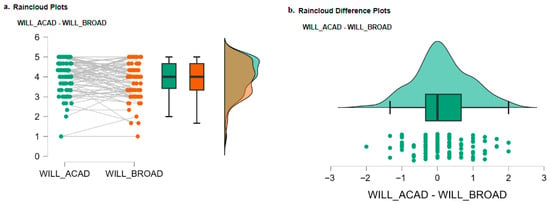
A paired-samples t-test compared willingness to allow the use of educational data for academic-support learning analytics (WILL_ACAD) with willingness to allow the use of educational data for broader aggregated institutional uses (WILL_BROAD). As reported in Table 1, willingness was slightly higher for academic-support scenarios than for broader aggregated uses. However, this difference did not reach statistical significance, t(101) = 1.872, p = 0.064, with a small effect size (Cohen’s d = 0.185; 95% CI [−0.011, 0.381]) (Table 3). Figure 1 visualizes the paired distributions and the distribution of within-participant differences; consistent with the t-test, no statistically significant difference was found between the two use cases.
Table 3.
Paired-samples t-test comparing willingness for academic-support LA (WILL_ACAD) versus broader aggregated institutional uses (WILL_BROAD) (N = 102).
Figure 1.
Raincloud visualization of willingness indices. (a) Paired distributions of willingness to allow the use of educational data for academic-support LA (WILL_ACAD) and broader aggregated institutional uses (WILL_BROAD). (b) Distribution of within-participant differences (WILL_ACAD − WILL_BROAD).
3.4. Correlation Analysis
Pearson correlation analysis was conducted to examine bivariate associations among the composite variables BENEFIT, RISK, CONTROL, TRANSPARENCY, TRUST, and the two willingness indices (WILL_ACAD and WILL_BROAD). Table 4 presents the correlation matrix. Willingness to allow the use of educational data for academic-support LA (WILL_ACAD) was strongly and positively associated with institutional trust (TRUST; r = 0.708, p < 0.001) and moderately associated with perceived benefits (BENEFIT; r = 0.507, p < 0.001). Willingness for broader aggregated institutional uses (WILL_BROAD) also correlated positively with TRUST (r = 0.472, p < 0.001) and BENEFIT (r = 0.350, p < 0.001). The two willingness indices were substantially related (r = 0.606, p < 0.001), indicating that respondents who reported higher willingness/acceptance in academic-support scenarios also tended to be willing under broader aggregated-use conditions.
Table 4.
Pearson correlation matrix for the composite variables (N = 102).
As a robustness check, Spearman’s rho correlations were also computed (Supplementary Table S5). The direction of associations was consistent with Pearson’s r; however, Spearman’s rho suggested a slightly stronger negative association between RISK and WILL_ACAD (ρ = −0.221, p = 0.026 vs. r = −0.185, p = 0.062), and a slightly stronger positive association between BENEFIT and TRANSPARENCY (ρ = 0.211, p = 0.033 vs. r = 0.167, p = 0.093).
Perceived risks (RISK) were not significantly correlated with either WILL_ACAD (r = −0.185, p = 0.062) or WILL_BROAD (r = 0.127, p = 0.204), and the correlation with WILL_ACAD did not reach statistical significance. Governance-related expectations showed strong co-occurrence: CONTROL and TRANSPARENCY were strongly correlated (r = 0.596, p < 0.001). RISK correlated positively with CONTROL (r = 0.395, p < 0.001) and TRANSPARENCY (r = 0.251, p = 0.011), suggesting that students expressing higher risk concerns also reported stronger expectations for control and transparency safeguards. Finally, TRUST correlated positively with BENEFIT (r = 0.434, p < 0.001) and negatively with RISK (r = −0.299, p = 0.002), indicating that trust aligns with benefit perceptions and is inversely related to risk concerns.
An exploratory factor analysis reported in Supplementary Table S3A,B supports a five-factor structure consistent with the intended constructs, including distinct factors for CONTROL and TRANSPARENCY.
3.5. Regression Models Predicting Willingness to Allow the Use of Educational Data
Two multiple linear regression models were estimated to examine the predictive contribution of perceived benefits (BENEFIT), perceived risks (RISK), perceived control (CONTROL), transparency expectations (TRANSPARENCY), and institutional trust (TRUST) to willingness to allow the use of educational data for LA under two use conditions. The first model used willingness for academic-support LA (WILL_ACAD) as the dependent variable (Table 5), and the second model used willingness for broader aggregated institutional uses (WILL_BROAD) as the dependent variable (Table 6). For both models, unstandardized coefficients (B), standardized coefficients (β), 95% confidence intervals, and variance inflation factors (VIF) are reported.
Table 5.
Multiple linear regression predicting willingness for academic-support LA (WILL_ACAD) (N = 102).
Table 6.
Multiple linear regression predicting willingness for broader aggregated institutional uses (WILL_BROAD) (N = 102).
The regression model predicting WILL_ACAD showed strong fit (R = 0.755, R2 = 0.569, adjusted R2 = 0.547, RMSE = 0.585), F(5, 96) = 25.386, p < 0.001, and the estimated coefficients are reported in Table 5.
For WILL_BROAD, the regression model was also statistically significant (R = 0.579, R2 = 0.336, adjusted R2 = 0.301, RMSE = 0.734), F(5, 96) = 9.704, p < 0.001, and the estimated coefficients are reported in Table 6.
Both models were statistically significant. The academic-support model (Table 5) explained substantially more variance (R2 = 0.569) than the broader-use model (Table 6; R2 = 0.336). Across both conditions, institutional trust (TRUST) was the most consistent and strongest predictor of willingness (WILL_ACAD: β = 0.593, p < 0.001; WILL_BROAD: β = 0.481, p < 0.001). Perceived benefits (BENEFIT) additionally predicted willingness for academic-support LA (β = 0.253, p = 0.001), while perceived risks (RISK) became a significant positive predictor only in the broader aggregated-use model (β = 0.225, p = 0.020). CONTROL and TRANSPARENCY were not significant in the multivariable models, and VIF values (1.312–1.760) indicated no problematic multicollinearity.
However, the bootstrap sensitivity analysis yielded a borderline bootstrap p-value (p* = 0.055) with a BCa 95% CI [0.009, 0.339], so this effect should be interpreted cautiously as exploratory.
Because WILL_BROAD showed comparatively lower internal consistency, inferences involving this outcome (including the regression results for broader-use willingness) should be interpreted cautiously and verified in future studies using refined measures. Analyses involving WILL_BROAD are treated as exploratory.
Bootstrap sensitivity analysis and hierarchical model comparisons for the positive RISK coefficient in the WILL_BROAD model are reported in Supplementary Table S2A–C.
Sensitivity re-estimation excluding flagged cases is reported in Supplementary Table S4A–D and did not materially change the substantive interpretation of either model.
3.6. Safeguards, Acceptable Data Types, and Preferred Purpose
Frequencies were computed to summarize (i) the safeguards most likely to increase students’ willingness to allow the use of educational data (Q37), (ii) the educational data types respondents would allow for LA (Q38; multiple-response item recoded into binary indicators in JASP), and (iii) the single preferred acceptance purpose if only one option could be selected (Q39). For Q37, responses were recorded as a single-response item, and percentages therefore sum to 100%. For Q38, respondents could select multiple data categories; consequently, percentages do not sum to 100%.
For Q37, the most frequently endorsed safeguards were human review before any action affecting a student (n = 19, 18.6%) and strong security measures (e.g., encryption, secure storage) (n = 19, 18.6%). These were followed by strict role-based access (only authorized personnel) (n = 15, 14.7%) and the use of aggregated/anonymized data whenever possible (n = 13, 12.8%) (Table 7). Overall, students prioritized safeguards that reduce the likelihood of harmful individual-level consequences (human review) and strengthen institutional security and access controls.
Table 7.
Most important safeguard increasing willingness to allow the use of educational data (Q37) (N = 102).
Regarding acceptable educational data types for LA (Q38), respondents most frequently selected quiz/test scores (n = 68, 66.7%) and final grades (n = 66, 64.7%). A substantial proportion also accepted learning platform activity (e.g., logins, resource views) (n = 54, 52.9%) and assignment content (e.g., written text/code) (n = 50, 49.0%), followed by attendance data (n = 47, 46.1%) and assignment submission metadata (e.g., timestamps) (n = 46, 45.1%). Forum participation was less frequently accepted (n = 32, 31.4%), while only a small minority selected none of the above (n = 3, 2.9%) (Table 8).
Table 8.
Acceptable educational data types for LA (Q38; multiple response) (N = 102).
Finally, when forced to choose a single willingness purpose (Q39), nearly half of respondents preferred allowing educational data use for both a personal dashboard and early-support interventions (n = 49, 48.039%). Others preferred personal dashboard only (n = 35, 34.314%) or early-support interventions only (n = 14, 13.725%); only a small minority selected neither (n = 4, 3.922%) (Table 9). This pattern suggests that students in this sample tend to favor willingness configurations that combine self-monitoring benefits with structured academic support, rather than restricting willingness to a single use case.
Table 9.
Single preferred willingness purpose if only one option can be selected (Q39) (N = 102).
Open-Ended Responses on Additional Conditions (Q40)
Some of the respondents provided optional open-ended comments (Q40) and chose to leave comments. These comments were written in both Romanian and English, but they all stressed the importance of openness (what data is used, for what purpose, and by whom), strong access and security controls, and human oversight for decisions that could affect students. Several comments also stressed limiting the purpose (preferring academic support uses) and keeping control, which includes the ability to take back acceptance. Overall, the answers to Q40 back up the quantitative results by showing that governance and trust-building measures are important steps to getting acceptance.
4. Discussion
This exploratory study provides empirical evidence on what drives students’ willingness to allow the use of educational data for LA in a privacy-aware higher education context, focusing on a privacy-calculus set of determinants: perceived benefits, perceived risks, perceived control and transparency expectations, and institutional trust (Jiang et al., 2022; Mutimukwe et al., 2022; Soffer & Cohen, 2024). Overall, the findings indicate a generally favorable orientation toward LA under governance conditions that protect autonomy and privacy, while also revealing that willingness is not determined by “privacy” constructs alone, but is strongly anchored in institutional trust and the perceived legitimacy of the university’s data-handling practices (Karunaratne, 2021; Liu & Khalil, 2023; Alfredo et al., 2024).
A first important result is that students reported high perceived benefits and high expectations for transparency, control, and institutional trust, alongside moderate perceived risks. This pattern aligns with the broader LA literature suggesting that students may value LA when it is framed as pedagogically meaningful (e.g., dashboards and early-support) and when governance is communicated clearly and credibly (Ifenthaler & Yau, 2020; Masiello et al., 2024; Paulsen & Lindsay, 2024). It also fits the shift toward human-centered LA and AI in education, where stakeholder involvement, transparency, and trustworthiness are treated as prerequisites for sustainable adoption rather than “add-ons” (Alfredo et al., 2024; Heiser et al., 2026).
Regarding the two willingness outcomes, willingness was slightly higher for academic-support LA (WILL_ACAD) than for broader aggregated institutional uses (WILL_BROAD), although the paired difference did not reach conventional statistical significance and showed only a small effect size. This nuance is consistent with European studies suggesting that students’ acceptance depends strongly on purpose framing—students often support LA that is clearly tied to direct learning support and self-regulation, while becoming more cautious as institutional or secondary-use purposes broaden (Wollny et al., 2023; Soffer & Cohen, 2024; Sepp, 2025). Interpreted in governance terms, the near-parity between the two use cases in this sample suggests that “broader” uses may remain acceptable when they are explicitly constrained to aggregated reporting and are paired with credible safeguards and clear purpose limitation (Karunaratne, 2021; Prinsloo et al., 2023).
The correlational results reinforce the centrality of trust in privacy-aware contexts: institutional trust was strongly associated with willingness for academic-support LA and moderately associated with willingness for broader uses. This finding aligns with established models where trust acts as a downstream consequence of privacy beliefs (risk/control) and as a direct antecedent of acceptance and self-disclosure behavior (Mutimukwe et al., 2022; Kizilcec et al., 2023; Viberg et al., 2024). At the same time, trust was positively related to perceived benefits and negatively related to perceived risks, consistent with a legitimacy mechanism: when students believe an institution will act competently and responsibly, they are more likely to see LA as beneficial and less likely to interpret analytics as surveillance or profiling (Liu & Khalil, 2023; Soffer & Cohen, 2024).
The regression models suggest a clearer hierarchy of associations among the predictors. Institutional trust was found to be the strongest and most consistent predictor of willingness in both use conditions. This suggests that students’ perceptions of the institution as a trustworthy steward of their educational data are more important than their abstract attitudes towards data (Karunaratne, 2021; Alfredo et al., 2024). For academic-support learning analytics (LA), perceived benefits also predicted willingness, corroborating privacy-calculus theories that perceived utility can mitigate concerns when LA is presented as actionable and aligned with student success (Jiang et al., 2022; Tzimas & Demetriadis, 2024). Conversely, perceived benefits ceased to be a significant predictor in the comprehensive aggregated-use model upon the inclusion of trust, indicating that broader acceptance may be predominantly limited by governance legitimacy rather than personal utility alone (Wollny et al., 2023; Sepp, 2025).
Although privacy-calculus frameworks often imply that higher perceived risk reduces willingness and higher control/transparency increases it, our multivariable models do not support a simple direct-effects pattern in this institutional setting. One interpretation is that control and transparency expectations operate as baseline governance requirements (i.e., prerequisites), and their influence is largely absorbed into students’ institutional trust and perceived legitimacy of data handling. In other words, privacy-related beliefs (risk, control, transparency) may shape willingness indirectly via trust and legitimacy perceptions rather than exerting independent direct effects once trust is held constant. This contextualized interpretation is consistent with the LA governance literature emphasizing trust as a proximal driver of acceptance and data sharing, while transparency/control function as necessary conditions that sustain legitimacy.
An intriguing result is that perceived risks (RISK) showed a positive association with willingness for broader aggregated institutional uses (WILL_BROAD) in the multivariable model, despite the absence of a strong bivariate correlation. This pattern should be interpreted cautiously and may reflect model suppression or shared variance with institutional trust (given their negative correlation), rather than a straightforward behavioral mechanism (Mutimukwe et al., 2022; Sepp, 2025). Substantively, it may indicate conditional acceptance among risk-aware students when broader uses are framed as institution-level improvement under explicit constraints and safeguards (e.g., aggregation, safeguards, and role-based access), rather than individualized intervention or profiling (Prinsloo et al., 2023; Liu & Khalil, 2023). Future work should test these alternative explanations explicitly using mediation/suppression models and scenario-based experimental designs, and by triangulating self-reported willingness with behavioral opt-in data.
Despite being high descriptively and strongly correlated with each other, control and transparency expectations did not uniquely predict willingness in the multivariable models. This does not imply that control and transparency are unimportant; rather, it suggests that in this sample they may function as broadly endorsed baseline expectations, offering limited incremental explanatory power once institutional trust is accounted for (Karunaratne, 2021; Wollny et al., 2023). This interpretation is consistent with systematic reviews showing that transparency principles are widely supported at a general level, while implementation remains challenging—particularly in translating principles into student-facing mechanisms that are both understandable and credible (Liu & Khalil, 2023; Prinsloo et al., 2023). In practice, transparency and control may indirectly enhance willingness by fostering trust—particularly when communication eschews “black-box” governance and delineates data access, purpose, and oversight (Corza-Vargas et al., 2024; Heiser et al., 2026). This aligns with learning-analytics privacy-concerns models in which perceived privacy control has downstream implications for trust and related disclosure/acceptance intentions (Mutimukwe et al., 2022).
The descriptive results regarding safeguards and permissible data categories offer actionable guidance for privacy-preserving learning analytics governance and design. Students put human review first before any action that would affect a student, then strong security measures, then role-based access, and finally a preference for aggregated/anonymized use. This is in line with worries that predictive analytics and automated recommendations can have bad effects if mistakes, bias, or stigma are used without proper supervision (Prinsloo et al., 2023; Jin et al., 2024). The pattern also backs up institutional suggestions that LA interventions should stay focused on people and be open to debate, with clear accountability and decision-making processes that can be checked, instead of hidden automation (Alfredo et al., 2024; Heiser et al., 2026). Simultaneously, students were more inclined to accept conventional academic data (such as quiz/test scores and grades) and exhibited greater caution regarding socially expressive traces (for instance, forum participation). This indicates that data minimization strategies emphasizing distinctly educationally relevant data types may enhance legitimacy, particularly when institutions function under “small data” limitations that hinder thorough validation and responsible implementation (Nguyen & Karunaratne, 2024).
In summary, these results suggest a governance-focused approach to enhancing LA acceptance in privacy-conscious environments, particularly within technical-university contexts similar to the one studied here. Institutions in comparable settings may consider prioritizing (i) demonstrable proficiency in data security and incident response, (ii) explicit purpose limitation and role-based access, (iii) human oversight and substantive contestability for decisions affecting students, and (iv) transparent, accessible communication that fosters informed understanding rather than mere compliance (Karunaratne, 2021; Liu & Khalil, 2023; Sepp, 2025). This is in line with human-centered LA approaches that say legitimacy and a shared understanding are important for adoption (Alfredo et al., 2024).
Limitations
There are some things to keep in mind when looking at the results of this study. First, the sample was collected through convenience sampling from engineering programs at a single technical university, which restricts its generalizability to other disciplines and institutional settings.
Second, the design was cross-sectional and based on self-reported perceptions and intentions; therefore, it cannot establish causal relations or predict actual willingness behavior when LA is deployed institutionally.
Third, willingness was measured through scenario-based items rather than observed opt-in/acceptance actions in a live governance environment; future studies should validate these findings using longitudinal designs and behavioral data.
Finally, one willingness scale (WILL_BROAD) showed comparatively lower internal consistency, which is common in short measures but suggests caution and motivates refinement in subsequent instrument development.
Open-ended responses were optional and summarized descriptively; therefore, qualitative insights should be interpreted cautiously.
5. Conclusions
This study examined students’ willingness to allow the use of educational data for LA in a privacy-aware higher education context, focusing on perceived benefits, perceived risks, control and transparency expectations, and institutional trust across two use cases: academic-support analytics and broader aggregated institutional use under safeguards. Overall willingness was high in both scenarios, and no statistically significant difference was found between the two use cases.
Institutional trust was the most reliable and strongest predictor of willingness in both models. This means that students are more likely to accept something if they think the institution is competent, honest, and well-governed. Perceived benefits also predicted willingness for academic-support LA, indicating that student-facing value (e.g., dashboards and timely support) enhances acceptance when governance is trusted. In a multivariable model for broader aggregated uses, perceived risk was positively correlated with willingness. This may indicate conditional acceptance among risk-aware students under clearly specified safeguards, accountability, and purpose limitation; however, this association should be interpreted cautiously and warrants replication and mechanism testing.
From a practical point of view, the descriptive findings show clear governance priorities that can help gain acceptance. These include having a human review any action that affects a student, strong security measures, strict role-based access, and a preference for aggregated or anonymized processing whenever possible. Institutions in similar technical-university contexts seeking sustainable privacy-preserving LA governance may therefore invest not only in technical capability, but also in transparent communication and demonstrable governance practices that build trust, protect autonomy, and maintain meaningful oversight.
These conclusions should be interpreted considering the cross-sectional, self-reported design and the single-institution convenience sample.
We did not model background covariates from Items 1–8; therefore, the observed TRUST–willingness association may partially reflect unmeasured differences in prior familiarity or institutional experiences, which should be tested in future studies with larger and more diverse samples.
Supplementary Materials
The following supporting information can be downloaded at: https://www.mdpi.com/article/10.3390/educsci16040637/s1, The anonymized dataset of student responses and the blank version of the questionnaire used in this study are available as Supplementary Materials. The Supplementary PDF file with Tables S1–S5 can be found in the same directory.
Author Contributions
Conceptualization, M.-V.D.; methodology, M.-V.D.; software, M.-V.D.; validation, M.-V.D., R.-A.P. and G.P.; formal analysis, R.-A.P., G.P. and C.A.C.; investigation, R.-A.P., G.P. and C.A.C.; resources, R.-A.P. and G.P.; data curation, R.-A.P., G.P. and C.A.C.; writing—original draft preparation, M.-V.D.; writing—review and editing, M.-V.D.; visualization, R.-A.P., G.P., C.A.C. and C.-I.D.; supervision, G.P. and C.-I.D.; project administration, M.-V.D.; funding acquisition, R.-A.P. All authors have read and agreed to the published version of the manuscript.
Funding
This research received no external funding.
Institutional Review Board Statement
Ethical review and approval were waived for this study because it involved an anonymous survey of adult students, without the collection of personal or sensitive data, and posed no potential risk to participants.
Informed Consent Statement
Participation in this study was voluntary and anonymous. Completing the questionnaire was considered as providing informed consent.
Data Availability Statement
The original contributions presented in this study are included in the article. Further inquiries can be directed to the corresponding author.
Conflicts of Interest
The authors declare no conflicts of interest.
References
- Alfredo, R., Echeverria, V., Jin, Y., Yan, L., Swiecki, Z., Gašević, D., & Martinez-Maldonado, R. (2024). Human-centred learning analytics and AI in education: A systematic literature review. Computers and Education: Artificial Intelligence, 6, 100215. [Google Scholar] [CrossRef] [Scilit]
- Chang, Y. H., Chen, F. C., & Lee, C. I. (2025). Developing an early warning system with personalized interventions to enhance academic outcomes for at-risk students in Taiwanese higher education. Education Sciences, 15(10), 1321. [Google Scholar] [CrossRef] [Scilit]
- Corza-Vargas, V. M., Martinez-Maldonado, R., Escalante-Ramirez, B., & Olveres, J. (2024). Students’ ethical, privacy, design, and cultural perspectives on visualizing cognitive-affective states in online learning. Journal of Learning Analytics, 11(3), 24–40. [Google Scholar] [CrossRef] [Scilit]
- Heiser, R., Underhill, G., & Stritto, M. E. D. (2026). Power, privacy, and transparency in communicating learning analytics in higher education: A critical discourse analysis. American Journal of Qualitative Research, 10(1), 246–265. [Google Scholar] [CrossRef] [Scilit]
- Hershkovitz, A., Ambrose, G. A., & Soffer, T. (2024). Instructors’ perceptions of the use of learning analytics for data-driven decision making. Education Sciences, 14(11), 1180. [Google Scholar] [CrossRef] [Scilit]
- Holmes, W., & Tuomi, I. (2022). State of the art and practice in AI in education. European Journal of Education, 57(4), 542–570. [Google Scholar] [CrossRef] [Scilit]
- Hwang, G. J., Xie, H., Wah, B. W., & Gašević, D. (2020). Vision, challenges, roles and research issues of artificial intelligence in education. Computers and Education: Artificial Intelligence, 1, 100001. [Google Scholar] [CrossRef] [Scilit]
- Ifenthaler, D., & Yau, J. Y. K. (2020). Utilising learning analytics to support study success in higher education: A systematic review. Educational Technology Research and Development, 68(4), 1961–1990. [Google Scholar] [CrossRef] [Scilit]
- Jiang, X., Goh, T. T., & Liu, M. (2022). On students’ willingness to use online learning: A privacy calculus theory approach. Frontiers in Psychology, 13, 880261. [Google Scholar] [CrossRef] [Scilit] [PubMed]
- Jin, Y., Echeverria, V., Yan, L., Zhao, L., Alfredo, R., Tsai, Y. S., Gašević, D., & Martinez-Maldonado, R. (2024). FATE in MMLA: A student-centred exploration of fairness, accountability, transparency, and ethics in multimodal learning analytics. Journal of Learning Analytics, 11(3), 6–23. [Google Scholar] [CrossRef] [Scilit]
- Karunaratne, T. (2021). For learning analytics to be sustainable under GDPR—Consequences and way forward. Sustainability, 13(20), 11524. [Google Scholar] [CrossRef] [Scilit]
- Khor, E. T., & K, M. (2024). A systematic review of the role of learning analytics in supporting personalized learning. Education Sciences, 14(1), 51. [Google Scholar] [CrossRef] [Scilit]
- Kizilcec, R. F., Viberg, O., Jivet, I., Martinez Mones, A., Oh, A., Hrastinski, S., Mutimukwe, C., & Scheffel, M. (2023, March 13). The role of gender in students’ privacy concerns about learning analytics: Evidence from five countries. LAK23. 13th International Learning Analytics and Knowledge Conference (pp. 545–551), Arlington, TX, USA. [Google Scholar]
- Kohnke, L., & Foung, D. (2024). Deconstructing the normalization of data colonialism in educational technology. Education Sciences, 14(1), 57. [Google Scholar] [CrossRef] [Scilit]
- Liu, Q., & Khalil, M. (2023). Understanding privacy and data protection issues in learning analytics using a systematic review. British Journal of Educational Technology, 54(6), 1715–1747. [Google Scholar] [CrossRef] [Scilit]
- Masiello, I., Mohseni, Z., Palma, F., Nordmark, S., Augustsson, H., & Rundquist, R. (2024). A current overview of the use of learning analytics dashboards. Education Sciences, 14(1), 82. [Google Scholar] [CrossRef] [Scilit]
- Mutimukwe, C., Viberg, O., Oberg, L. M., & Cerratto-Pargman, T. (2022). Students’ privacy concerns in learning analytics: Model development. British Journal of Educational Technology, 53(4), 932–951. [Google Scholar] [CrossRef] [Scilit]
- Ncube, M. M., & Ngulube, P. (2024). A systematic review of postgraduate programmes concerning ethical imperatives of data privacy in sustainable educational data analytics. Sustainability, 16(15), 6377. [Google Scholar] [CrossRef] [Scilit]
- Nguyen, N. B. C., & Karunaratne, T. (2024). Learning analytics with small datasets—State of the art and beyond. Education Sciences, 14(6), 608. [Google Scholar] [CrossRef] [Scilit]
- Paulsen, L., & Lindsay, E. (2024). Learning analytics dashboards are increasingly becoming about learning and not just analytics—A systematic review. Education and Information Technologies, 29(11), 14279–14308. [Google Scholar] [CrossRef] [Scilit]
- Prinsloo, P., Slade, S., & Khalil, M. (2023). Multimodal learning analytics—In-between student privacy and encroachment: A systematic review. British Journal of Educational Technology, 54(6), 1566–1586. [Google Scholar] [CrossRef] [Scilit]
- Sepp, S. (2025). Towards more transparency in learning analytics: Sharing information with university students increases their awareness of data collection practices. Journal of Learning Analytics, 12(3), 34–46. [Google Scholar] [CrossRef] [Scilit]
- Soffer, T., & Cohen, A. (2024). Privacy versus pedagogy–students’ perceptions of using learning analytics in higher education. Australasian Journal of Educational Technology, 40(5), 14–30. [Google Scholar] [CrossRef] [Scilit]
- Tzimas, D. E., & Demetriadis, S. N. (2024). Impact of learning analytics guidance on student self-regulated learning skills, performance, and satisfaction: A mixed methods study. Education Sciences, 14(1), 92. [Google Scholar] [CrossRef] [Scilit]
- Viberg, O., Kizilcec, R. F., Jivet, I., Monés, A. M., Oh, A., Mutimukwe, C., Hrastinsky, S., & Scheffel, M. (2024). Cultural differences in students’ privacy concerns in learning analytics across Germany, South Korea, Spain, Sweden, and the United States. Computers in Human Behavior Reports, 14, 100416. [Google Scholar] [CrossRef] [Scilit]
- Wollny, S., Di Mitri, D., Jivet, I., Muñoz-Merino, P., Scheffel, M., Schneider, J., Tsai, Y.-S., Whitelock-Wainwright, A., Gašević, D., & Drachsler, H. (2023). Students’ expectations of learning analytics across Europe. Journal of Computer Assisted Learning, 39(4), 1325–1338. [Google Scholar] [CrossRef] [Scilit]

Disclaimer/Publisher’s Note: The statements, opinions and data contained in all publications are solely those of the individual author(s) and contributor(s) and not of MDPI and/or the editor(s). MDPI and/or the editor(s) disclaim responsibility for any injury to people or property resulting from any ideas, methods, instructions or products referred to in the content. |
© 2026 by the authors. Licensee MDPI, Basel, Switzerland. This article is an open access article distributed under the terms and conditions of the Creative Commons Attribution (CC BY) license.