


Abstract
While artificial intelligence (AI) integration in education has attracted considerable attention, research examining its impact on student motivation remains limited. This study investigates the relationship between AI use for learning purposes and learning motivation among 207 Israeli middle and high school students. Data were collected using two self-report instruments: a questionnaire measuring AI use frequency and perceived educational value, and a learning motivation questionnaire based on self-determination theory. Pearson correlations, descriptive statistics, and group comparisons examined associations between variables and differences across school levels and gender. Findings revealed a statistically significant positive correlation between AI use for learning and students’ learning motivation, with students reporting higher AI use demonstrating greater learning motivation. This association was significantly stronger among middle school students compared to high school students, while no gender differences emerged. Despite limitations including moderate internal reliability of the motivation scale, convenience sampling, and the correlational design preventing causal inferences, results suggest AI-supported learning environments may be particularly effective for fostering motivation during early adolescence. The directionality of the relationship remains unclear—whether AI use enhances motivation or motivated students are more inclined to adopt AI tools. These findings contribute to emerging literature on AI in education by highlighting motivational implications and emphasizing the need for developmentally sensitive AI integration. Future research should employ longitudinal and experimental designs to clarify causal mechanisms.
1. Introduction
In recent decades, education systems around the world have grappled with profound transformations precipitated by rapid technological advancement, unprecedented access to information, and shifting demands from both the labor market and society at large. Digital technologies no longer serve merely as supplementary tools for learning; they have become integral to the design of learning environments, pedagogical approaches, and the evolving roles of teachers and students alike (Alhamuddin et al., 2022; Dias & Victor, 2017). Within this landscape, artificial intelligence (AI) has risen to prominence as a technology bearing significant pedagogical and psychological potential.
Artificial intelligence facilitates a transition from uniform instructional models toward adaptive learning environments capable of responding to the individual needs, pace, and cognitive profiles of learners. Tools such as intelligent tutoring systems, educational chatbots, and algorithm-driven gamification platforms provide immediate feedback, dynamically calibrate task difficulty, and help bridge learning gaps (Fryer et al., 2019; Chiu et al., 2024). An expanding body of research indicates that such environments may mitigate academic anxiety and bolster learners’ sense of self-efficacy (Huang et al., 2023; Wang & Zheng, 2024).
Among the most critical variables mediating the relationship between learning environments and educational outcomes is learning motivation. Motivation shapes task selection, the degree of persistence, the quality of cognitive engagement, and the capacity to navigate challenges and setbacks (Ryan & Deci, 2020). Self-Determination Theory holds that intrinsic motivation flourishes when learners experience autonomy, competence, and relatedness, and that environments nurturing these fundamental psychological needs give rise to deep and meaningful learning.
From the perspective of Self-Determination Theory, AI-based learning environments may support the satisfaction of the three basic psychological needs in several ways. First, AI tools may foster autonomy by allowing learners to control the pace, sequence, and depth of their learning, thereby enabling self-directed exploration. Second, features such as immediate feedback, adaptive difficulty, and personalized explanations may support competence by helping students overcome obstacles and experience mastery. Third, when students feel more confident and capable as a result of AI-assisted learning, they may be more willing to participate in classroom discussions and collaborative activities, indirectly supporting relatedness. Prior empirical evidence lends support to these mechanisms: Huang et al. (2023) found that AI-supported personalized learning was positively associated with perceived competence and autonomous motivation, while Wang and Zheng (2024) reported that adaptive feedback in AI environments enhanced students’ self-efficacy and interest in learning. Thus, there is a theoretical and empirical basis for expecting that AI use may positively influence intrinsic motivation through the satisfaction of basic psychological needs.
This raises a pivotal question: does the integration of artificial intelligence into learning environments genuinely fulfill these psychological needs, and in so doing, enhance student motivation? Despite the burgeoning volume of research on AI in education, the majority of studies have concentrated on academic achievement or usage metrics, paying comparatively little attention to learning motivation as a distinct variable. Furthermore, there has been limited inquiry into the differential effects of AI on students at varying developmental stages, such as those in middle school as opposed to high school.
In light of these gaps, the present study aims to examine the relationship between AI use and learning motivation among middle school and high school students in Israel, while also investigating gender- and age-related differences and the magnitude of the associations between these variables.
2. Literature Review
Learning in the 21st Century
Learning in the 21st century is characterized by a fundamental shift from traditional pedagogical approaches centered on knowledge transmission toward models that emphasize active, self-directed, and collaborative learning. These contemporary approaches prioritize the cultivation of higher-order competencies, including critical thinking, problem-solving, creativity, and lifelong learning—skills widely recognized as indispensable in an era defined by information abundance and accelerating technological change (Scott, 2015). Digital learning environments afford students the opportunity to assume the role of active inquirers, critically analyze information, and construct knowledge through reflective engagement (Alhamuddin et al., 2022).
Such transformations necessitate comprehensive adaptations in curricula, instructional methodologies, and teacher professional development, with the integration of advanced technologies increasingly recognized as a pivotal element in addressing the multifaceted challenges of the 21st century.
3. Artificial Intelligence in Education
Artificial intelligence (AI) refers to technological systems capable of learning from data, recognizing patterns, and adapting their operations to environmental demands in a semi-autonomous fashion (Sheikh et al., 2023). Within the educational domain, AI encompasses a broad range of applications, including adaptive learning systems, educational chatbots, and learning analytics tools.
A growing body of research suggests that AI facilitates the personalization of learning content, supports flexible pacing of instruction, and provides immediate feedback—factors that collectively enhance the overall learning experience (Ng et al., 2022; Mahmoud et al., 2025). In parallel, there is increasing scholarly recognition of AI literacy as a critical educational competency, one that entails a nuanced understanding of the technology’s capabilities, its inherent limitations, and its broader social and ethical ramifications (Choi et al., 2025).
4. Motivation for Learning
Learning motivation is conceptualized as the internal drive that impels learners to initiate academic activity, sustain engagement, and channel their efforts toward the attainment of educational objectives (Ministry of Education, 2016). A well-established distinction in the literature differentiates between intrinsic motivation, which arises from inherent interest and enjoyment, and extrinsic motivation, which is contingent upon external incentives and rewards (Greenberg & Cohen, 2012).
Self-Determination Theory (SDT) posits that learning environments fostering autonomy, competence, and relatedness promote intrinsic motivation and facilitate deeper, more meaningful learning (Ryan & Deci, 2020). Empirical evidence consistently demonstrates that motivation exerts a direct influence on students’ academic achievement, persistence, and psychological well-being (Oladunni et al., 2025).
5. Artificial Intelligence and Learning Motivation
The extant literature indicates that AI has the potential to enhance learning motivation through personalized instruction, immediate feedback, and the integration of interactive and gamified elements (Surendeleg et al., 2014; Ravindran, 2025). Educational chatbots, for instance, have been shown to mitigate anxiety stemming from external evaluation and to foster autonomous exploration and experimentation (Fryer et al., 2019).
Nevertheless, the influence of AI on motivation is neither uniform nor deterministic; rather, it is moderated by factors such as learner age, instructional context, and the pedagogical approach through which the technology is implemented. Younger students tend to demonstrate greater receptivity toward innovative technological tools, whereas older students are more frequently oriented toward formal academic outcomes (Alé et al., 2025). This disparity highlights the pressing need for rigorous empirical investigation into the relationship between AI use and learning motivation across distinct developmental stages.
6. Research Rationale and Hypotheses
Notwithstanding the proliferation of research on AI in education, the understanding of its effects on motivational processes among students remains incomplete, particularly within the context of secondary education. The present study endeavors to address this lacuna by examining the association between AI use and learning motivation among middle school and high school students in Israel, grounded in Self-Determination Theory and informed by the contemporary scholarly discourse in the field (Ryan & Deci, 2020; Dou & Sun, 2025).
7. Research Hypotheses
Drawing upon the theoretical framework and the empirical literature reviewed above, the following hypotheses were formulated:
Hypothesis 1 (H1).
A statistically significant positive correlation will be observed between the level of AI use and the level of learning motivation among middle school and high school students.
Hypothesis 2 (H2).
No statistically significant gender differences will emerge in either the level of AI use or the level of learning motivation.
Research on developmental differences in technology adoption suggests that younger adolescents tend to approach new technologies with greater openness and less evaluative skepticism than older students (Alé et al., 2025). Furthermore, middle school students, who are at a transitional stage from concrete to abstract thinking, may find AI tools particularly appealing because these tools provide concrete, immediate, and multimodal explanations that align with their cognitive developmental needs. In contrast, high school students, who face increasing academic pressures associated with matriculation examinations, may adopt a more utilitarian and selective approach to technology use (Ryan & Deci, 2020). With respect to the motivational impact of AI, Self-Determination Theory predicts that the novelty and interactivity of AI tools may be especially effective in satisfying the need for competence among younger learners who are still forming their academic identities, whereas older students’ more established learning routines may attenuate this effect. These developmental considerations lead to the following hypotheses:
Hypothesis 3 (H3).
Middle school students will report significantly higher levels of AI use compared to their high school counterparts.
Hypothesis 4 (H4).
The magnitude of the association between AI use and learning motivation will be significantly stronger among middle school students than among high school students.
8. Method
8.1. Research Objectives and Methodological Framework
The aim of the present study was to investigate the association between the extent of artificial intelligence (AI) use for learning purposes and the level of learning motivation among middle school and high school students in Israel. This objective is informed by growing evidence that AI-based technologies serve as active pedagogical agents shaping students’ learning experiences and motivation (Fryer et al., 2019; Ng et al., 2022; Chiu et al., 2024).
Grounded in Self-Determination Theory (as elaborated in the Introduction), the study focuses specifically on the actual use of AI tools for learning, rather than on general attitudes toward technology.
In light of the nascent and evolving nature of AI use among students, a quantitative research approach combining exploratory and hypothesis-testing elements was adopted, centered on identifying preliminary associations and patterns among variables. Such an approach is particularly appropriate for investigations of relatively novel educational phenomena for which well-established experimental paradigms and broadly validated measurement instruments have yet to be developed (Dou & Sun, 2025).
8.2. Research Design
The study adopted a quantitative, correlational design. This design permits the examination of statistical relationships among variables as they naturally occur within authentic educational settings, without deliberate manipulation of research variables. The choice of a correlational framework is consistent with prior work in digital learning and AI in education that has sought to investigate students’ perceptions, attitudes, and motivation in naturalistic, uncontrolled learning environments (Fryer et al., 2019; Dias & Victor, 2017).
The correlational design was deemed most appropriate given that the integration of AI into learning typically occurs at the learners’ own initiative and in diverse modalities that are not readily amenable to full experimental control. An experimental or quasi-experimental design would likely have constrained the capacity to capture the complexity inherent in students’ actual use of AI tools. The study therefore does not seek to establish causal relationships; rather, it aims to identify statistically significant associations that may serve as a basis for subsequent research.
8.3. Research Population and Educational Context
The target population comprised students enrolled in middle schools and high schools across Israel. This population was selected given its growing exposure to digital tools and AI applications, both within formal instructional settings and in informal learning contexts such as assignment preparation, information retrieval, and self-directed study (Ng et al., 2022).
Adolescence represents a critical developmental period for learning motivation. Research has documented a gradual decline in intrinsic motivation throughout the middle school and high school years, coinciding with mounting achievement pressures, escalating academic demands, and increased social comparison (Ryan & Deci, 2020). Examining the role of AI tools within this developmental context may therefore yield deeper insight into the ways in which advanced technologies shape the learning experiences of students during this formative stage.
8.4. Sampling Method and Sample
The sample comprised 207 students recruited through convenience and snowball sampling. The questionnaire was administered online via educational networks and social media platforms, and respondents were encouraged to forward it to additional students within their social circles.
8.5. Sample Characteristics
The final sample consisted of 207 participants, of whom 98 were male (47.3%) and 109 were female (52.7%). The distribution by educational level was as follows: 112 students attended middle school (Grades 7–9; 54.1%) and 95 attended high school (Grades 10–12; 45.9%). Participants ranged in age from 12 to 18 years (M = 14.8, SD = 1.9). They were drawn from diverse educational institutions throughout Israel, including state-secular, state-religious, and private schools. Notably, systematic data on school-level characteristics (e.g., enrollment size, technology use policies, geographic location), family socioeconomic status, or educational track were not collected. Given the sampling strategy employed-convenience and snowball sampling disseminated via social media—the sample is likely biased toward students with greater technological access, relatively high digital literacy, and potentially more favorable dispositions toward the integration of technology into learning. Accordingly, this sample is best characterized as representing a population of “early adopters” of AI technologies rather than a nationally representative cross-section of Israeli middle school and high school students.
These sampling methods are prevalent in exploratory educational research, particularly in studies concerned with emerging technologies and online instrument dissemination, as they enable relatively rapid access to heterogeneous student populations (Dou & Sun, 2025). Nonetheless, convenience and snowball sampling preclude full statistical representativeness of the broader middle school and high school student population in Israel. Students with greater technological access or more positive attitudes toward AI may have been disproportionately inclined to participate. The findings should therefore be interpreted as reflecting trends and associations within the sampled population, rather than as permitting broad generalization to the student population at large (Alé et al., 2025).
8.6. Research Instruments—General Development Principles
The research instruments were developed specifically for the purposes of the present study, drawing on a current literature review and established theoretical frameworks in the fields of motivation and digital learning. The instruments were designed to capture students’ everyday experiences with artificial intelligence for learning purposes, rather than advanced technical uses that are not characteristic of the majority of the target population.
The instruments were worded in accessible language appropriate for the age of the participants and were constructed to reflect both formal academic and informal uses of artificial intelligence in learning. This approach is consistent with recommendations in the literature for developing measurement tools in emerging educational contexts (Ng et al., 2022).
8.7. Artificial Intelligence Use in Learning Questionnaire
The Artificial Intelligence Use in Learning Questionnaire was designed to assess the extent and nature of students’ use of AI tools for learning purposes, as well as their perceptions of the contribution of these tools to the learning process. The questionnaire was developed based on studies addressing personalized learning, artificial intelligence literacy, and the integration of AI in instruction (Ng et al., 2022; Chiu et al., 2024).
The questionnaire comprised 12 items measured on a five-point Likert scale (1 = strongly disagree, 5 = strongly agree), organized around four core dimensions: frequency of AI use, perceived pedagogical utility of AI tools, sense of autonomy and control in learning, and integration of artificial intelligence with traditional instruction. Internal consistency analysis yielded a Cronbach’s α = 0.78, indicating good internal reliability.
Within the questionnaire, students were asked about the frequency with which they used AI tools for a variety of purposes, including:
- Obtaining explanations and clarifications for instructional material not understood during class;
- Summarizing lengthy materials (texts, articles, textbook chapters);
- Receiving assistance in solving mathematical or scientific exercises and problems;
- Preparing for examinations and assessments (review, practice questions);
- Formulating and organizing responses for writing assignments;
- Receiving suggestions for research topics or presentations.
To clarify how the variable of AI use was defined and measured in the present study, it is important to emphasize that the term “use of artificial intelligence for learning purposes” refers to the use of general-purpose generative AI tools that are publicly available. These tools primarily include chatbots based on large language models (LLMs) such as ChatGPT, Gemini, Claude, and Copilot, as well as additional automated systems for generating explanations, summaries, problem solutions, and educational content.
The use examined in this study does not focus on closed adaptive school-based systems or institutional AI-based learning platforms, but rather on students’ proactive and informal use of generative AI tools as part of their daily learning routines. This distinction is critical for understanding the nature of the relationship found between AI use and learning motivation, as the use in question is largely controlled by the learners themselves, rather than by the educational system.
8.8. Learning Motivation Questionnaire
The Learning Motivation Questionnaire was developed based on Self-Determination Theory (Ryan & Deci, 2020) and was designed to assess students’ overall level of motivation for learning in school. The questionnaire comprised 10 items measured on a five-point Likert scale (1 = strongly disagree, 5 = strongly agree), including both positively and negatively worded items to ensure measurement balance.
The dimensions examined included interest and enjoyment in learning, effort and persistence, and perceived value of learning. Internal consistency analysis yielded a Cronbach’s α = 0.64, indicating moderate internal reliability.
In light of the moderate reliability of the overall questionnaire, an Exploratory Factor Analysis (EFA) was conducted to examine the internal structure of the questionnaire and identify potential dimensions. Prerequisite conditions for factor analysis were first assessed: the Kaiser–Meyer–Olkin measure (KMO = 0.58) and Bartlett’s test of sphericity (χ2 = 142.3, p < 0.001) indicated a reasonable, though moderate, fit of the data for factor analysis (Kaiser, 1974).
The factor analysis, conducted using principal axis factoring with Varimax rotation, identified two primary dimensions within the questionnaire based on the Eigenvalue > 1.0 criterion:
- Intrinsic motivation (Items 1, 3, 5, 7, 9): This dimension encompasses items focusing on genuine interest in learning, curiosity, enjoyment of the learning process, and the pursuit of deep understanding. The internal consistency of this subscale was α = 0.71, indicating good internal consistency.
- Extrinsic motivation and self-efficacy (Items 2, 4, 6, 8, 10): This dimension encompasses items focusing on future-oriented goals, effort investment, academic self-efficacy, and recognition of the value of learning for achieving objectives. The internal consistency of this subscale was α = 0.68, indicating acceptable internal consistency.
This division aligns with Ryan and Deci’s (2020) theoretical framework. The first subscale captures intrinsic motivation, reflecting interest and enjoyment in the activity itself. The second subscale primarily reflects identified regulation—a form of internalized extrinsic motivation in which learners recognize the personal value and importance of learning—alongside elements of academic self-efficacy. While self-efficacy originates from social cognitive theory (Bandura, 1997), it has been recognized as closely related to perceived competence within SDT (Ryan & Deci, 2020). The inclusion of self-efficacy items in this subscale is therefore theoretically defensible, though readers should note that this dimension is not a pure SDT construct. The Pearson correlation between the two subscales was r = 0.31 (p < 0.001), indicating a moderate positive association that supports their treatment as related but distinct dimensions of learning motivation. This finding explains the moderate reliability of the overall questionnaire: the instrument effectively measures two distinct dimensions of motivation rather than a single homogeneous construct. When reliability is computed for a measure comprising two different dimensions, the overall value tends to be lower than the reliability of each dimension separately (Cortina, 1993).
8.9. Methodological Implications
The primary analysis of the study’s results was conducted on the total motivation score, reflecting overall learning motivation across the full motivational spectrum. However, supplementary analyses were also performed to examine the relationship between AI use and each of the two dimensions separately, in order to deepen the understanding of the nature of this relationship.
It should be noted that although the overall reliability falls below the commonly recommended threshold of 0.70, it falls within the acceptable range for exploratory studies and short questionnaires (10 items or fewer), particularly when the measurement instrument was purpose-developed for the study and adapted to the target population (Cortina, 1993; Tavakol & Dennick, 2011). The subscales demonstrate substantially improved reliability (α = 0.71 and α = 0.68), affording reasonable confidence in the research findings. In any case, the findings are interpreted with caution, acknowledging this limitation, and with emphasis on their primary utility for identifying preliminary trends and relationships in the association between AI use and learning motivation.
8.10. Data Collection Procedure
Data were collected using an online questionnaire, and participation in the study was voluntary and anonymous. Participants received a brief explanation of the study’s purpose and were assured that the data would be used solely for research purposes. No pilot study was conducted prior to data collection, which constitutes a methodological limitation; however, this is consistent with the exploratory nature of the study and its focus on an evolving educational phenomenon (Dou & Sun, 2025).
The research process was carried out as follows:
Phase 1—Instrument Development (Month 1): Development of the two questionnaires based on a literature review, adaptation to Hebrew and the Israeli context, and content validation by two experts in the fields of education and motivation.
Phase 2—Initial Distribution (Month 2): The questionnaire was uploaded to the Google Forms platform and distributed via social networks to a target audience of educators, teachers, and parents. Each participant was asked to forward the questionnaire to additional students (snowball sampling).
Phase 3—Data Collection (Months 2–3): A collection period of approximately six weeks, during which 207 valid responses were gathered. Invalid data (missing or inconsistent responses) were excluded from the analysis.
Phase 4—Data Analysis (Month 4): Data coding, reliability testing, factor analyses, descriptive statistics, correlations, regression, and t-tests.
Phase 5—Interpretation and Writing (Month 5): Interpretation of findings in light of theory and existing literature, formulation of conclusions and recommendations.
8.11. Data Analysis Methods
Data were analyzed using IBM SPSS Statistics (Version 28). Descriptive analyses (means, standard deviations, and frequency distributions) were computed for all research variables. Pearson correlation analyses were performed to examine the relationship between AI use and learning motivation, and independent-samples t-tests were employed to compare groups by age and gender. Additionally, effect sizes (Cohen’s d, r) were computed to evaluate the practical significance of the findings, in accordance with established conventions for effect size interpretation (Cohen, 1988).
8.12. Ethical Considerations
The study was conducted in accordance with the ethical standards accepted in educational research. Participation was voluntary, and participants received clear and accessible information regarding the study’s purpose and the intended use of the data. Informed consent was obtained prior to questionnaire completion. Data were collected and stored anonymously, without identifying information, and were used exclusively for research purposes. Given the observational nature of the study and the low level of risk to participants, all necessary measures were taken to ensure participant privacy and data confidentiality. Specifically, no identifying information (such as names, identification numbers, or school names) was collected. All data were stored on a password-protected computer accessible only to the research team, and responses were assigned numerical codes to prevent identification of individual participants.
9. Findings
9.1. Descriptive Analysis of Research Variables
In the first stage, descriptive statistics were computed to examine the distribution of the central research variables: use of artificial intelligence for learning purposes and learning motivation.
As shown in Table 1, the level of AI use among participants was above the midpoint of the measurement scale, indicating relatively active use of AI tools in the learning context. The standard deviation points to moderate variability among students, suggesting individual differences in usage patterns without extreme dispersion.
Table 1.
Descriptive Statistics for the Research Variables.
Learning motivation was also found to be at a moderate-to-high level. This finding is methodologically important, as it indicates the absence of ceiling or floor effects in measurement, thereby enabling a reliable examination of relationships between the variables (Ryan & Deci, 2020).
9.2. The Relationship Between AI Use and Learning Motivation
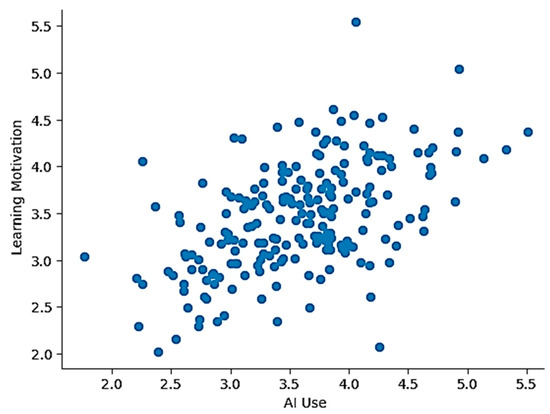
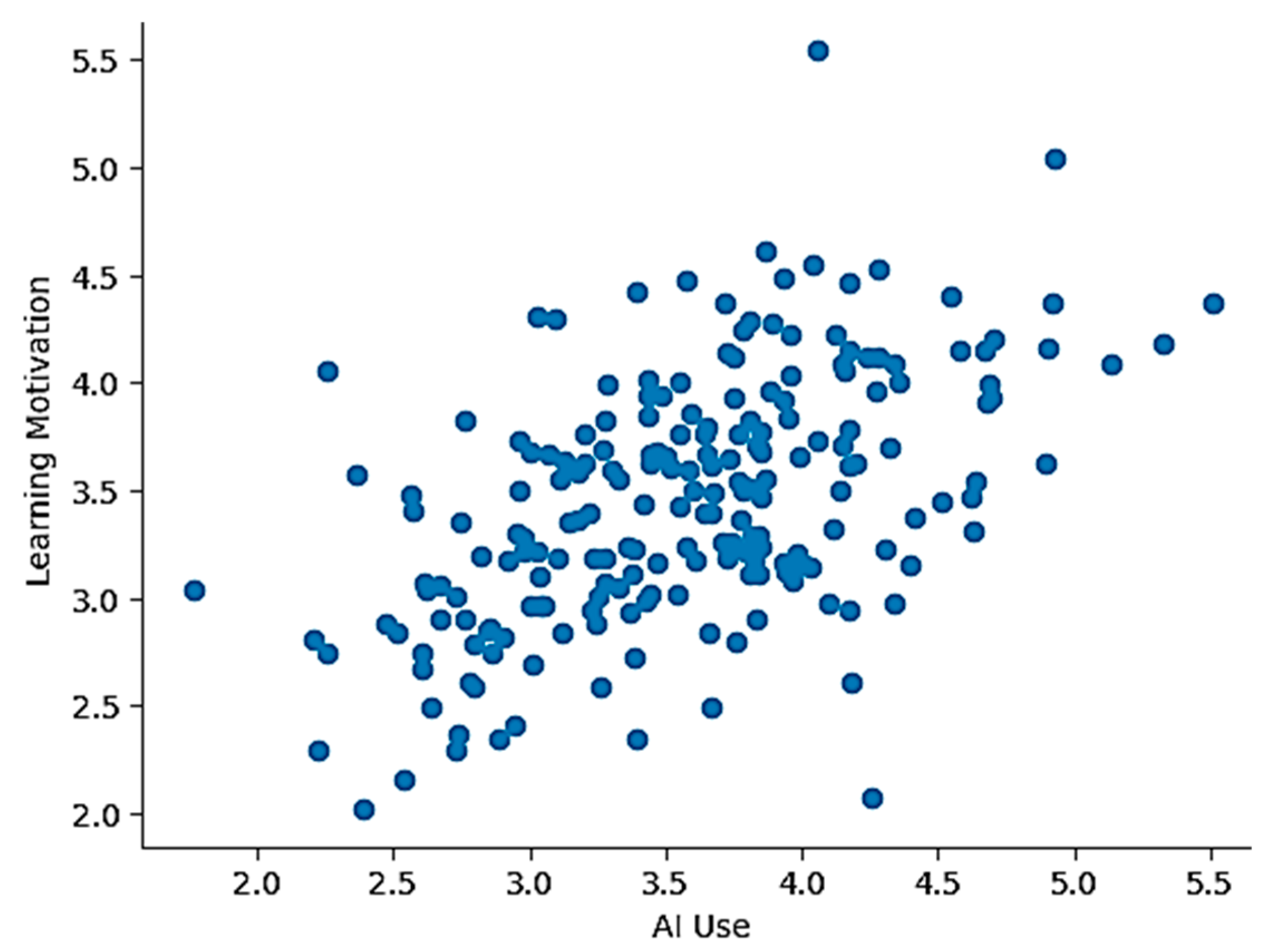
To test Hypothesis 1, a Pearson correlation was conducted between the level of AI use and the level of learning motivation. A significant positive correlation was found between the variables, r = 0.41, p < 0.001.
This correlation indicates that the more extensively students use AI tools for learning purposes, the higher their reported levels of motivation. The strength of the association was moderate, falling within the medium effect size range according to Cohen’s (1988) benchmarks (small: r = 0.10; medium: r = 0.30; large: r = 0.50), and suggests a meaningful but not deterministic relationship. The scatter plot of the overall relationship is presented in Figure 1.
Figure 1.
Scatter plot illustrating the relationship between AI use and learning motivation among all participants (N = 207), with a regression line indicating a positive association (r = 0.41, p < 0.001).
9.3. Examining the Relationship by Motivation Dimensions
In light of the two-dimensional structure identified in the factor analysis (Section 8.8), a further examination was conducted of the relationship between AI use and each of the two motivation dimensions separately.
Intrinsic motivation. A significant positive correlation was found between AI use and intrinsic motivation (interest, curiosity, enjoyment of learning), r = 0.38, p < 0.001. This finding indicates that students who use AI more extensively tend to report higher levels of genuine interest in learning and enjoyment of the learning process itself. This result is consistent with the assumption that AI tools may contribute to intellectual curiosity and a sense of discovery during learning.
Extrinsic motivation and self-efficacy. A significant positive correlation was also found between AI use and extrinsic motivation and self-efficacy (future goals, effort investment, sense of capability), r = 0.39, p < 0.001. This finding indicates that AI use is also associated with the goal-oriented motivational component and with the sense of ability to succeed. This result aligns with research suggesting that immediate feedback and personalization contribute to self-efficacy.
As expected, given the negligible difference between the two coefficients (0.38 vs. 0.39), Fisher’s Z-transformation confirmed no statistically significant difference (Z = 0.14, p = 0.89), indicating that AI use is similarly associated with both motivation dimensions (see Table 2). This near-identical pattern suggests that the distinction between the two correlations is not substantively meaningful. This finding reinforces the decision to use the overall motivation score in the central analyses and suggests that AI may support a broad spectrum of motivational processes—both intrinsic interest and self-efficacy and achievement orientation. Accordingly, AI tools serve as scaffolding that facilitates both curiosity-driven and goal-directed learning, in accordance with learner needs.
Table 2.
Pearson Correlations Between AI Use and Motivation Dimensions.
This finding is consistent with prior studies that demonstrated the contribution of AI-based tools to increased engagement, self-efficacy, and autonomy in learning—key antecedents and correlates of intrinsic motivation within the SDT framework (Fryer et al., 2019; Chiu et al., 2024; Dou & Sun, 2025).
9.4. Gender Differences in AI Use and Learning Motivation
To test Hypothesis 2, independent-samples t-tests were conducted to compare levels of AI use and learning motivation between boys and girls (see Table 3).
Table 3.
Comparison of Means by Gender.
The results indicate that no significant differences were found between boys and girls on either variable. This finding suggests that gender does not constitute a differentiating factor in AI usage patterns or in its motivational impact.
9.5. Hierarchical Regression Analysis
While the bivariate correlation (Section 9.2) established the overall association between AI use and learning motivation, a hierarchical regression analysis was subsequently conducted to determine whether this relationship persists after controlling for demographic and academic background variables. This two-step approach allows assessment of the unique predictive contribution of AI use beyond potential confounds. This analysis enables an assessment of whether the relationship between AI use and motivation stems from the use itself or rather from differences in demographic and academic background variables.
Model 1 included only background variables: gender, school level (middle school/high school), age, estimated prior grades, and estimated socioeconomic status. This model explained only 2.6% of the variance in learning motivation (R2 = 0.026, F(5, 201) = 1.08, p = 0.374), with no independently significant predictor. This finding indicates that demographic background variables alone do not significantly predict levels of learning motivation.
Model 2 added the AI use variable to the model. The addition of this variable led to a significant improvement in predictive power: the full model explained 22.4% of the variance in motivation (R2 = 0.224, F(6, 200) = 9.63, p < 0.001). The unique contribution of AI use accounted for 19.8% of the variance (ΔR2 = 0.198, ΔF(1, 200) = 50.91, p < 0.001), which is a statistically and practically significant contribution (Cohen, 1988).
Table 4 presents the regression coefficients in the full model. As can be seen, AI use was the only significant predictor in the model (β = 0.45, t = 9.05, p < 0.001), while none of the background variables reached statistical significance. This finding clearly indicates that the relationship between AI use and learning motivation does not stem from differences in demographic or academic background variables, but rather reflects a unique and independent effect of this technology on learning motivation.
Table 4.
Hierarchical Regression Coefficients Predicting Learning Motivation. (N = 207).
The regression findings substantially reinforce the first hypothesis of the study. They indicate that AI use for learning purposes is positively and significantly associated with learning motivation, and that this relationship is not an artifact of background variable differences but rather stems from the use of the technology itself. The unique contribution of 19.8% is considered particularly large in the context of educational research (Cohen, 1988) and underscores the significant potential of artificial intelligence as a factor supporting learning motivation.
9.6. Differences Between Middle School and High School Students
Testing Hypothesis 3 revealed significant differences between middle school and high school students in their level of artificial intelligence use (see Table 5).
Table 5.
Comparison of Means by Age Group.
The data indicate that middle school students use artificial intelligence more extensively than their high school counterparts. This gap suggests a greater openness among younger learners toward the adoption of innovative technological tools.
Learning motivation was also found to be higher among middle school students, although the gap was smaller.
These findings are consistent with studies emphasizing that younger students tend to respond more positively to interactive learning and personalized digital environments (Alé et al., 2025; Ravindran, 2025).
9.7. Comparison of Correlation Strength Between Groups
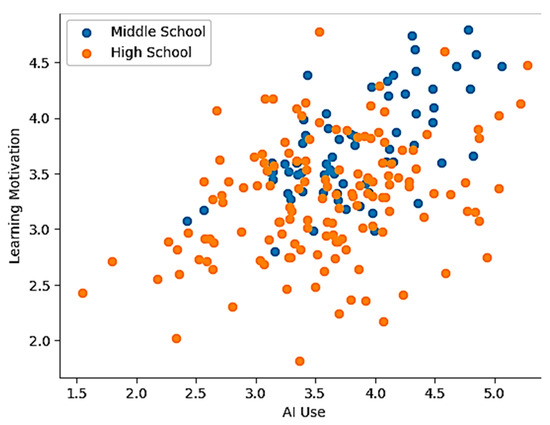
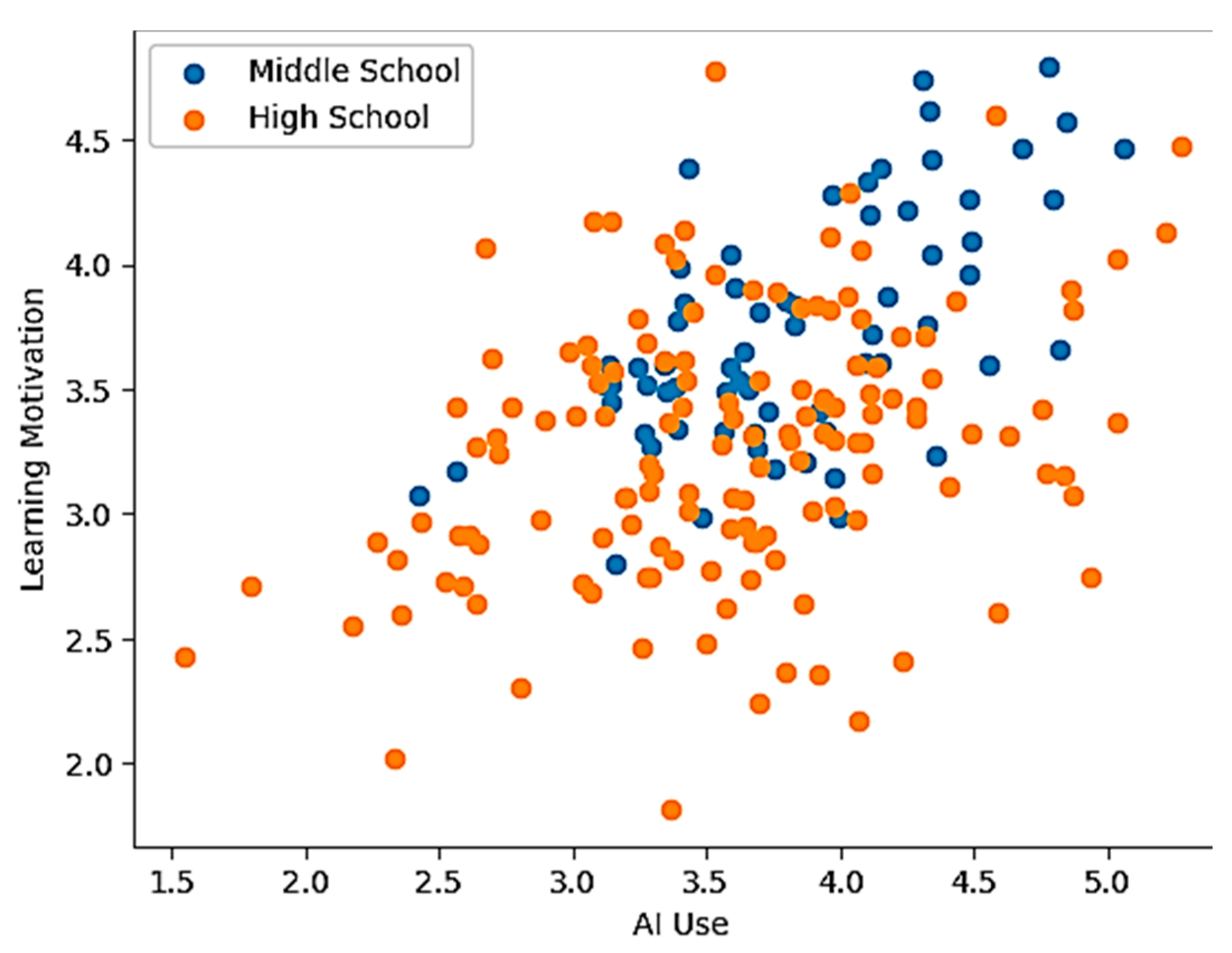
To test Hypothesis 4, separate Pearson correlations were computed for middle school and high school students. Among middle school students, a relatively strong positive correlation was found between AI use and learning motivation, r = 0.52, p < 0.001, whereas among high school students, a significant but weaker positive correlation was observed, r = 0.34, p < 0.001.
Figure 2 presents two separate scatter plots by age group. In the middle school plot, a clear linear trend and relatively narrow dispersion of data points are evident, indicating a more consistent and stronger relationship. In contrast, the high school plot displays a wider dispersion, suggesting greater variability in the contribution of artificial intelligence to motivation.
Figure 2.
Scatter plots illustrating the relationship between AI use and learning motivation by school level (middle school vs. high school).
This finding supports the theoretical claim that the motivational impact of advanced technologies is contingent upon the learner’s developmental stage and the manner in which these technologies are integrated into academic demands (Scott, 2015).
9.8. Summary of Findings
The findings point to a consistent positive relationship between artificial intelligence use and learning motivation among middle school and high school students. This relationship is not influenced by gender but varies according to age group, with middle school students deriving greater motivational benefit from AI use compared to high school students.
10. Discussion
The purpose of the present study was to examine the relationship between the use of artificial intelligence for learning purposes and learning motivation among middle school and high school students in Israel. The findings indicate a significant positive association between the level of AI use and the level of learning motivation, as well as differences between age groups in the manner in which this relationship is manifested.
In general, students who reported more frequent use of AI tools for learning purposes also tended to report higher levels of learning motivation. Importantly, the hierarchical regression analysis demonstrated that the association between AI use and motivation is not an artifact of potential confounding variables. Even after statistically controlling for gender, grade level, prior academic achievement, and socioeconomic status, AI use contributed a unique 19.8% of explained variance in motivation (ΔR2 = 0.198, p < 0.001). This finding strengthens the hypothesis that AI use exerts an independent and substantial influence on learning motivation, beyond the effects of demographic and academic background variables. This unique contribution is considered particularly large in the context of educational research (Cohen, 1988) and underscores the significant potential of artificial intelligence as a factor supporting learning motivation. This finding is consistent with a growing body of research pointing to the potential of AI tools to support learner engagement, comprehension of instructional material, and a sense of control over the learning process (Fryer et al., 2019; Chiu et al., 2024; Dou & Sun, 2025).
However, it must be emphasized that these findings do not indicate a causal relationship, but rather a statistical association between variables, consistent with the correlational design of the study. Accordingly, the discussion of findings focuses on theoretical interpretation and possible educational implications, while maintaining methodological caution.
10.1. AI Use and Learning Motivation: A Theoretical Interpretation
The positive association found between AI use and learning motivation can be interpreted in light of Self-Determination Theory (SDT), which conceptualizes motivation as a product of the satisfaction of basic psychological needs for autonomy, competence, and relatedness. AI tools may contribute to a sense of autonomy by enabling students to choose their learning pace, preferred mode of explanation, and level of detail suited to their needs.
A closer examination of the findings through the lens of the three basic psychological needs reveals the following: Autonomy: AI tools enable students to choose their preferred mode of learning—the pace of progress, the level of detail in explanations, the style of explanation (examples, visualizations, analogies)—and the ability to revisit topics without feeling judged. This sense of control may explain the strong association found in the study, particularly among middle school students who are at a developmental stage characterized by a search for autonomy. Competence: The immediate feedback and infinite patience of AI systems allow students to experiment, make mistakes, and learn from errors without fear of criticism. When a student successfully solves a problem with the assistance of AI—even in stages—they experience success that reinforces their sense of competence. The finding that the association was similarly strong for both intrinsic and extrinsic motivation (r = 0.38 and r = 0.39, respectively) supports the notion that AI contributes both to enjoyment of learning and to confidence in one’s ability to succeed. Relatedness: Although AI is a technological tool, it may indirectly contribute to a sense of relatedness. When students feel more confident in the instructional material, they may participate more actively in class, contribute to discussions, and collaborate with peers. Additionally, the use of AI itself becomes a social experience when students share tips, ask each other questions about effective use, and compare responses.
10.2. The Question of Directionality and Causality
Despite the significant association found, it is important to emphasize that the correlational design of the study does not permit us to definitively determine the direction of causality. There are at least four possible explanations for this finding:
Explanation 1: AI use enhances motivation (the hypothesized direction). According to this explanation, the use of AI tools directly contributes to increased motivation through the satisfaction of basic psychological needs: personalization strengthens autonomy, immediate feedback and accessible explanations strengthen competence, and the ability to learn independently reinforces a sense of self-reliance. This explanation is consistent with Self-Determination Theory and is supported by the research literature (Fryer et al., 2019; Chiu et al., 2024).
Explanation 2: High motivation leads to AI use (reverse direction). According to this explanation, students who are already highly motivated are those who actively seek additional tools to enhance their learning, including advanced technologies. Such students are characterized by intellectual curiosity, initiative, and a willingness to try new approaches to learning. In this case, AI is not a cause of motivation, but rather a product of it.
Explanation 3: A bidirectional (reciprocal) relationship. It is possible that the relationship is cyclical: initial motivation leads to AI use, and use in turn strengthens motivation, creating a positive reinforcement loop. In such a case, both processes operate simultaneously and mutually reinforce one another over time.
Explanation 4: A third variable explains both (spurious correlation). It is possible that a third variable, not measured in the study, influences both AI use and motivation. Potential variables include high digital literacy, high socioeconomic status, parental support for learning, or a general orientation toward academic achievement.
The hierarchical regression analysis conducted in this study partially contributes to understanding the directionality. The finding that AI use contributed a unique 19.8% of explained variance in motivation even after statistically controlling for gender, grade level, prior achievement, and estimated socioeconomic status somewhat weakens Explanation 4. However, it does not entirely rule it out, as additional variables such as digital literacy or parental support were not examined. To resolve the question of directionality, follow-up studies employing longitudinal or experimental designs are required, as elaborated below.
Beyond this, it is important to emphasize that AI does not merely serve as a technical “assistive tool”; it fundamentally strengthens the student’s sense of mastery over the learning material. The ability to receive immediate feedback and personalized explanations enables students to overcome cognitive obstacles in real time, thereby significantly enhancing their sense of competence. This reinforcement of competence is a key factor in the transition from extrinsic motivation (driven by grades) to deeper intrinsic motivation grounded in a sense of personal accomplishment. However, this effect is contingent upon the level of digital literacy and the manner in which the technology is integrated into the instructional process.
A separate examination of the two motivational dimensions (Section 9.3) revealed that AI use was similarly associated with both intrinsic motivation (r = 0.38) and extrinsic motivation and self-efficacy (r = 0.39). This finding suggests that AI tools may contribute to a broad spectrum of motivational processes. On the one hand, the ability to explore topics at one’s own pace and receive diverse explanations may nurture curiosity and genuine interest (intrinsic motivation). On the other hand, immediate feedback and support in problem-solving may strengthen a sense of self-efficacy and confidence in one’s ability to achieve learning goals (extrinsic motivation and self-efficacy).
10.3. Differences Between Age Groups
The findings indicate that the association between AI use and learning motivation is more pronounced and consistent among middle school students compared to high school students. This difference may be attributed to a “novelty effect,” whereby younger students experience the technology as a playful and intriguing element that stimulates intrinsic motivation. At the middle school age, students are at a critical stage of forming their academic identity, and the use of AI tools supports the process of becoming more autonomous learners.
In contrast, among high school students—who are subject to increasing pressure from matriculation examinations and formal academic achievement—the use of AI may be perceived merely as a functional and instrumental tool for reducing workload (extrinsic motivation), and less as a factor that stimulates curiosity or enjoyment of learning itself.
Additional developmental differences may account for this finding: Cognitive development: Middle school students are at a transitional stage from concrete to abstract thinking. AI tools, which provide diverse explanations and concrete examples, may be particularly well-suited to this stage. In contrast, high school students, who possess more developed abstract thinking abilities, may prefer deeper sources or human interaction. Academic identity: The middle school years represent a critical period in the formation of academic identity. Innovative technology such as AI may be perceived as part of the “tech-savvy” and modern identity that students at this age seek to construct. In high school, academic identity is already more established, and AI use is perceived as a means rather than an integral component of identity. Academic pressures: The difference in the strength of the association (r = 0.52 in middle school vs. r = 0.34 in high school) may also reflect differences in academic pressures. In middle school, learning is still perceived as relatively exploratory, and AI use supports curiosity. In high school, the pressure of grades and matriculation exams may render AI use more functional and less motivationally significant. Practical recommendation: Based on these findings, it is recommended that AI tools be integrated differently across grade levels. In middle school, with an emphasis on discovery, exploration, and creativity. In high school, with an emphasis on critical thinking, source evaluation, and the integration of AI as part of a broader toolkit.
10.4. Pedagogical and Practical Implications
In light of the findings, given the finding that the AI–motivation association was stronger among middle school students (r = 0.52) than high school students (r = 0.34), it is recommended that the educational system invest in developmentally differentiated teacher training for the pedagogical integration of AI tools. While in middle school, the tool operates as a natural motivational catalyst, in high school, AI use should be guided as a tool that develops critical thinking and problem-solving skills, rather than merely serving as a technical aid for reducing workload. In this manner, it will be possible to strengthen the sense of competence and autonomy of older students and ensure that the technology promotes meaningful learning rather than mere “shortcuts.”
Specific recommendations for implementation: 1. At the teacher level: It is recommended to train teachers in the informed use of AI, including guidance on how to integrate these tools into instruction without undermining independent thinking. Teachers can guide students to ask better questions, compare responses from different sources, and critically evaluate AI output. 2. At the school level: Clear policies for AI use should be developed, including guidelines for legitimate use, examples of inappropriate uses, and the implementation of principles of academic integrity. It is important to create a safe environment in which students can experiment, make mistakes, and learn. 3. At the curricular level: Consideration should be given to the introduction of an instructional unit on AI literacy, encompassing understanding of the capabilities and limitations of the tools, identification of biases, ethical and responsible use, and evaluation of the quality of AI-generated information. 4. At the assessment level: Assessment methods should be adapted to focus on critical thinking, creativity, and problem-solving—domains in which AI cannot replace the student. Examples include oral presentations, applied projects, and classroom discussions.
10.5. Absence of Gender Differences
The absence of significant differences between boys and girls in learning motivation in the context of AI use may indicate that AI tools are perceived as relatively gender-neutral, at least at the level of self-reported use. This finding is consistent with recent research indicating a narrowing of gender gaps in the use of digital technologies for learning among young students (Ng et al., 2022).
Nonetheless, it is possible that more subtle gender differences are not captured by the general measures employed in this study, and that future research incorporating qualitative measures may reveal differential patterns of use.
10.6. Methodological Limitations and Their Impact on the Interpretation of Findings
The present study has several limitations that must be taken into account. First, the internal reliability of the motivation questionnaire was found to be moderate (α = 0.64). This may be attributable to the translation of the questionnaire or its unique adaptation to the Israeli sample, and it is recommended that future studies employ instruments with higher internal consistency. Second, the use of convenience and snowball sampling may lead to selection bias, as respondents may be predisposed to more positive attitudes toward technology. Finally, the correlational nature of the study precludes causal inference; it cannot be determined with certainty whether AI use increases motivation or whether students with higher motivation are more inclined to adopt innovative technological tools.
10.7. Critical Discussion: Risks and Potential Negative Implications
Despite the positive findings, it is important to emphasize that the use of AI in learning may also entail educational risks. Research points to concerns regarding a reduction in cognitive effort, over-dependence on AI tools, and impairment of critical thinking development when use is not accompanied by appropriate pedagogical guidance (Gerlich, 2025).
In this context, the moderate positive correlation (r = 0.41) found in the present study does not necessarily indicate learning quality or conceptual depth, and the explained variance (R2 = 0.224) leaves a substantial portion of motivation unexplained by AI use alone. It is possible that part of the increase in motivation reflects operational ease or time savings, rather than deep cognitive engagement. Accordingly, artificial intelligence should be viewed as a learning support tool, not a substitute for informed pedagogical instruction.
Additional ethical and social considerations: Beyond pedagogical risks, there are broader ethical and social issues to consider.
First, the question of equity and access: Do all students benefit equally from the technology? Students from low-SES families may have limited access to devices, quality internet, or parental support for effective use. This gap may exacerbate existing inequalities.
Second, the question of privacy and data: AI tools collect vast amounts of data on students—what they learn, where they encounter difficulties, and how much time they invest. Who owns this data? How is it stored? Could it be used against the student in the future?
Third, the question of algorithmic bias: AI systems may reflect biases present in their training data. Are the explanations they provide equally suited to all students? Are there cultural, gender-based, or other biases that could affect the quality of learning?
Finally, the question of accountability: When a student uses AI and errs, who bears responsibility? The teacher, the student, the AI system, or the school? It is essential to develop clear ethical and legal frameworks for AI use in education.
10.8. Educational and Research Implications
The findings of this study point to the potential of artificial intelligence to serve as a tool supporting learning motivation, particularly among middle school students. However, the realization of this potential requires the informed integration of these tools into instruction, with an emphasis on the development of autonomy, critical thinking, and pedagogical guidance on the part of teachers (Chiu et al., 2024).
From a research perspective, there is a need for follow-up experimental and longitudinal studies that examine the causal effects of AI use on motivation, academic achievement, and the development of learning skills. Additionally, the incorporation of qualitative research methods may deepen understanding of students’ subjective learning experiences when using AI tools.
In summary, the discussion of the research findings highlights the potential of artificial intelligence to contribute to learning motivation among students, alongside methodological limitations and educational risks that must be taken into account. The findings constitute an additional contribution to the evolving body of knowledge on the integration of AI in education, and underscore the need for a cautious, theory-based, and context-sensitive approach.
11. Summary and Conclusions
The present study examined the relationship between AI use for learning purposes and learning motivation among middle and high school students in Israel.
The findings revealed a significant positive association between the level of AI use and the level of learning motivation. Students who reported more frequent and informed use of AI tools also tended to report higher levels of interest, effort, and persistence in learning. Additionally, differences were found between age groups, such that the association between AI use and learning motivation was more pronounced among middle school students compared to high school students. Conversely, no significant gender differences were found in learning motivation in this context.
11.1. Contribution of the Study to Understanding AI Use in Education
The central contribution of this study is its focus on the relationship between actual AI tool use and learning motivation—a key variable with broad implications for academic success and learner development.
In this context, the findings are consistent with the possibility that artificial intelligence may serve as a factor supporting motivation. While the present study did not directly measure perceived autonomy, the observed association between AI use and motivation is consistent with SDT’s prediction that technologies enabling greater learner control may foster motivational engagement. Future research should directly assess the mediating role of basic psychological need satisfaction. These findings align with Self-Determination Theory and reinforce the understanding that educational technologies are not neutral, but rather influence the learning experience and learner motivation according to the manner in which they are used.
Beyond its empirical contribution, the present study offers a theoretical contribution to understanding the role of AI in education by positioning the use of AI tools not merely as a technological resource supporting learning but as a psycho-pedagogical mediator operating through the satisfaction of basic psychological needs for autonomy, competence, and relatedness, in accordance with the principles of Self-Determination Theory.
11.2. Applied Educational Conclusions
The findings suggest that the informed integration of AI tools in learning may contribute to enhancing learning motivation, particularly among middle school students. However, this conclusion does not support the unregulated integration of AI technologies in the educational system. On the contrary, it underscores the need for clear pedagogical guidance, for training students in the informed use of tools, and for establishing clear boundaries for their use.
The educational system is called upon to view artificial intelligence as a means of supporting learning rather than a substitute for instruction, for independent thinking, or for educational interaction with teachers and peers. The proper integration of AI requires the development of AI literacy among both students and teachers, and the implementation of principles of critical thinking, reflection, and responsibility in technology-supported learning.
11.3. Study Limitations and Their Implications for the Conclusions
1. Limitations related to measurement instruments: The overall internal reliability of the motivation questionnaire was moderate (α = 0.64), below the recommended threshold of 0.70. Although the subscales demonstrated improved reliability (intrinsic motivation: α = 0.71; extrinsic motivation: α = 0.68), the use of a composite score may reduce measurement precision. This limitation may account for a portion of the unexplained variance in the regression model. Furthermore, the questionnaires were developed specifically for this study and did not undergo a prior validation process (pilot testing, full construct validation). This constitutes a notable limitation, particularly for the AI use questionnaire, which measures a relatively new educational phenomenon. Additionally, the study relied on students’ self-reports, which may be subject to bias due to social desirability, limited self-awareness, or difficulties in self-assessing the frequency and quality of AI tool use.
2. Limitations related to sampling and generalizability: The use of convenience and snowball sampling via social networks significantly limits the generalizability of the findings. It is reasonable to assume that the sample is biased toward students with high access to technology, high digital literacy, positive attitudes toward technology, and average-to-high socioeconomic status. The sample does not fully represent the diversity of educational streams, sectors, geographic regions, and SES levels present in the Israeli educational system. Students who do not use AI at all are likely underrepresented in this sample.
3. Limitations related to research design: The correlational design constitutes a fundamental limitation, as it does not permit the establishment of cause-and-effect relationships. As detailed in Section 10.2, it cannot be determined with certainty whether AI use causes an increase in motivation, whether high motivation leads to AI use, or whether a third variable accounts for both. Moreover, the study measured both variables at a single point in time, precluding the examination of changes over time and dynamic relationships.
4. Limitations related to definitions and context: The questionnaire did not distinguish between different types of use (deep understanding vs. “shortcuts”), between different AI tools, or between varying levels of quality of use. This broad definition limits the ability to draw conclusions regarding the contribution of specific uses. Furthermore, the study did not systematically collect information on school policy regarding AI, teacher attitudes, or the level of pedagogical integration.
5. Implications for the interpretation of findings: These limitations necessitate a cautious interpretation: the findings reflect associations, not causality; they represent active AI users, not the general population; and they describe a specific point in time in the process of technology adoption. Despite these limitations, the study provides valuable insights and contributes to the evolving body of knowledge in this domain.
Additionally, the study relied on students’ self-reports, which may be influenced by perceptual or social biases. Likewise, the correlational design of the study does not permit the establishment of cause-and-effect relationships between AI use and learning motivation. These limitations do not diminish the value of the study but define the boundaries of its applicability and sharpen the need for follow-up research.
11.4. Directions for Future Research
Based on the study’s findings and the identified limitations, several key directions for future research can be identified:
- Longitudinal studies to examine causality: There is a need for longitudinal studies that track students over time and examine whether changes in AI use are associated with changes in motivation, which precedes the other, and whether the relationship is sustained over time.
- Controlled experimental studies: Experimental studies (RCTs) would enable the examination of causal effects by comparing groups of students who integrate AI in learning with control groups, and by manipulating different types of use.
- Differentiation between types of use: Follow-up studies should distinguish between use by purpose (deep understanding vs. shortcuts), by quality (critical vs. passive), by subject area, and by frequency and depth.
- Qualitative studies: The incorporation of qualitative methods such as student interviews, digital learning journals, and observations of actual use would deepen understanding of learning experiences.
- Examination of mediating and moderating variables: Future research should examine what explains the relationship (sense of competence, autonomy) and when the relationship is stronger (digital literacy, teacher support).
- Expansion of contexts: There is a need for broader representation of educational streams, sectors, SES levels, age groups, and students with special needs.
- Examination of the role of teachers and the school context: The influence of school policy, the role of the teacher in guidance, and a comparison between planned pedagogical integration and independent use.
- Measurement of additional learning outcomes: Beyond motivation, future research should examine academic achievement, skill development (critical thinking), tool dependence, and academic integrity.
- Development of improved measurement instruments: Development and validation of motivation questionnaires with high reliability, objective AI use measurement tools, and AI literacy instruments.
- International comparative studies: Comparison of findings across different cultural contexts and learning from the experience of leading countries in AI integration in education.
The incorporation of qualitative research methods, such as interviews or learning journals, may deepen the understanding of students’ subjective learning experiences when using AI tools. Furthermore, examination of the role of teachers and the school context may illuminate the conditions under which artificial intelligence contributes to learning optimally.
In conclusion, the present study identifies a positive association between the use of artificial intelligence for learning purposes and learning motivation among middle school and high school students, with an emphasis on differences between age groups. The findings underscore the potential of artificial intelligence as a motivation-supporting tool, alongside the need for a cautious, critical, and theory-based approach to its integration in the educational system.
The study constitutes an additional contribution to the evolving body of knowledge in the domain of artificial intelligence in education and offers a theoretical and empirical foundation for continued discussion, research, and the development of educational policy suited to the contemporary technological era.
11.5. Unique Contribution of the Study
The present study is among the first in the Israeli context to examine the relationship between the actual use of generative AI tools and learning motivation among middle school and high school students. Unlike previous studies that focused on general attitudes toward technology or on closed learning platforms, the present study examines students’ everyday and independent use of tools available to the general public. The findings indicate that artificial intelligence is not merely a passing “technological trend,” but a tool with genuine potential to support learning motivation, particularly when used in an informed and guided manner.
11.6. Implications for Educational Policy
The educational system faces both an opportunity and a challenge. The opportunity lies in harnessing an accessible and available technology to improve motivation and learning. The challenge lies in preventing irresponsible use that could impair the development of independent thinking and values of academic integrity. The answer is not to prohibit or ignore, but to implement in an informed, guided, and critical manner. The present study represents an important first step in understanding this phenomenon and in building a knowledge base for informed decision-making.
Author Contributions
Conceptualization, R.Y. and N.D.; methodology, R.Y. and N.D.; software, R.Y.; validation, R.Y. and N.D.; formal analysis, R.Y.; investigation, R.Y. and N.D.; resources, R.Y. and N.D.; data curation, R.Y.; writing—original draft preparation, R.Y.; writing—review and editing, N.D.; visualization, R.Y.; supervision, N.D.; project administration, R.Y. and N.D.; funding acquisition, N/A. All authors have read and agreed to the published version of the manuscript.
Funding
This research received no external funding.
Institutional Review Board Statement
The study was conducted in accordance with the Declaration of Helsinki and approved by the Ethics Committee of Ariel University (protocol code AU-SOC-ND-202414229 with approval grant on 12 January 2025).
Informed Consent Statement
Informed consent was obtained from all subjects involved in the study.
Data Availability Statement
The original contributions presented in this study are included in the article. Further inquiries can be directed to the corresponding author.
Acknowledgments
The authors wish to thank Shelly Dunkin, Ekaterina Lomov and Yamit Gvili, undergraduate students of social sciences at Ariel University, for their assistance in the data collection for this study.
Conflicts of Interest
The authors declare no conflicts of interest.
References
- Alé, J., Ávalos, B., & Araya, R. (2025). Scientific practices for understanding, applying and creating with artificial intelligence in K–12 education: A scoping review. Review of Education, 13(2), e70098. [Google Scholar] [CrossRef] [Scilit]
- Alhamuddin, A., Inten, D. N., Mulyani, D., & Erlangga, R. D. (2022). 21st century learning. In Proceedings of the 4th social and humanities research symposium (SoRes 2021) (pp. 332–337). Atlantis Press. [Google Scholar] [CrossRef] [Scilit]
- Bandura, A. (1997). Self-efficacy: The exercise of control. W. H. Freeman. [Google Scholar]
- Chiu, T. K., Moorhouse, B. L., Chai, C. S., & Ismailov, M. (2024). Teacher support and student motivation to learn with artificial intelligence-based chatbots. Interactive Learning Environments, 32(7), 3240–3256. [Google Scholar] [CrossRef] [Scilit]
- Choi, J., Lee, S., & Park, K. (2025). AI literacy in secondary education: Frameworks, competencies, and pedagogical implications. Computers & Education, 195, 104732. [Google Scholar]
- Cohen, J. (1988). Statistical power analysis for the behavioral sciences (2nd ed.). Lawrence Erlbaum Associates. [Google Scholar]
- Cortina, J. M. (1993). What is coefficient alpha? An examination of theory and applications. Journal of Applied Psychology, 78(1), 98–104. [Google Scholar] [CrossRef]
- Dias, L., & Victor, A. (2017). Teaching and learning with mobile devices in the 21st century digital world: Benefits and challenges. European Journal of Multidisciplinary Studies, 2(5), 339–344. [Google Scholar] [CrossRef] [Scilit]
- Dou, W., & Sun, X. (2025). Artificial intelligence tools: Improvement of motivation, psychological well-being, and psychological capital of EFL learners: A self-determination theory perspective. Learning and Motivation, 92, 102169. [Google Scholar] [CrossRef] [Scilit]
- Fryer, L. K., Nakao, K., & Thompson, A. (2019). Chatbot learning partners: Connecting learning experiences, interest and competence. Computers in Human Behavior, 93, 279–289. [Google Scholar] [CrossRef] [Scilit]
- Gerlich, M. (2025). AI tools in society: Impacts on cognitive offloading and the future of critical thinking. Societies, 15(1), 6. [Google Scholar] [CrossRef] [Scilit]
- Greenberg, Z., & Cohen, A. (2012). The impact of the “learning from success” model on the sense of achievement among MABAR students. Studies in Education, 6, 116–137. [Google Scholar]
- Huang, A. Y. Q., Lu, O. H. T., & Yang, S. J. H. (2023). Effects of artificial intelligence-enabled personalized recommendations on learners’ learning engagement, motivation, and outcomes in a flipped classroom. Computers & Education, 194, 104684. [Google Scholar] [CrossRef] [Scilit]
- Kaiser, H. F. (1974). An index of factorial simplicity. Psychometrika, 39(1), 31–36. [Google Scholar] [CrossRef] [Scilit]
- Mahmoud, A., Elbanna, M., & Hassan, R. (2025). AI-driven personalized feedback systems in K–12 education: Enhancing learning outcomes and student engagement. Journal of Educational Computing Research, 63(2), 112–134. [Google Scholar]
- Ministry of Education. (2016). Motivation for learning. Inclusion in Practice Bulletin, 8. Available online: https://meyda.education.gov.il/files/yesodi/hachala/alon8.pdf (accessed on 10 March 2024).
- Ng, D. T. K., Luo, W., Chan, H. M. Y., & Chu, S. K. W. (2022). Using digital story writing as a pedagogy to develop AI literacy among primary students. Computers and Education: Artificial Intelligence, 3, 100054. [Google Scholar] [CrossRef] [Scilit]
- Oladunni, J. O., Okeowo, R. F., & Adejuwon, A. M. (2025). An exploration of the interplay among social factors, self-efficacy, and secondary school students’ academic motivation. African Journal of Educational Management, Teaching and Entrepreneurship Studies, 15(2), 1–8. [Google Scholar]
- Ravindran, D. (2025). AI-based gamification for interactive learning: Changing methodologies in teaching. Current Issues in the Education System, 1(5), 29–38. [Google Scholar]
- Ryan, R. M., & Deci, E. L. (2020). Intrinsic and extrinsic motivation from a self-determination theory perspective. Contemporary Educational Psychology, 61, 101860. [Google Scholar] [CrossRef] [Scilit]
- Scott, C. L. (2015). The futures of learning 2: What kind of learning for the 21st century? UNESCO education research and foresight working papers, No. 14. UNESCO. [Google Scholar]
- Sheikh, H., Prins, C., & Schrijvers, E. (2023). Artificial intelligence: Definition and background. In Mission AI: The new system technology (pp. 15–41). Springer. [Google Scholar] [CrossRef] [Scilit]
- Surendeleg, G., Murwa, V., Yun, H. K., & Kim, Y. S. (2014). The role of gamification in education: A literature review. Contemporary Engineering Sciences, 7(29), 1609–1616. [Google Scholar] [CrossRef] [Scilit]
- Tavakol, M., & Dennick, R. (2011). Making sense of Cronbach’s alpha. International Journal of Medical Education, 2, 53–55. [Google Scholar] [CrossRef] [Scilit] [PubMed]
- Wang, X., & Zheng, H. (2024). AI-enhanced personalized learning and student self-efficacy: Evidence from secondary school classrooms. Educational Technology & Society, 27(1), 45–61. [Google Scholar]

Disclaimer/Publisher’s Note: The statements, opinions and data contained in all publications are solely those of the individual author(s) and contributor(s) and not of MDPI and/or the editor(s). MDPI and/or the editor(s) disclaim responsibility for any injury to people or property resulting from any ideas, methods, instructions or products referred to in the content. |
© 2026 by the authors. Licensee MDPI, Basel, Switzerland. This article is an open access article distributed under the terms and conditions of the Creative Commons Attribution (CC BY) license.