


Abstract
Educational escape rooms have been widely used in education in recent years. On the other hand, capture the flag (CTF) competitions have been spreading from the cybersecurity area into other domains. In this paper, a fusion of both concepts is proposed in the form of a CTF-like escape room in order to carry out the assessment of a STEM course. Each puzzle within the escape room consisted of designing a short code snippet as part of a protocol engineering course, with up to three hidden hints available. Each hint incurred a 25% penalty, deducted from the score awarded for solving the puzzle, as is common in CTF environments. This approach can be applied to small problem-solving tasks across many disciplines and educational contexts. Data collection consisted of gathering the marks of all students enrolled in the courses on an anonymized basis, after they had provided informed consent, and data analysis was then performed using descriptive and inferential statistics. The results suggest a statistically significant increase in average academic performance compared to the previous academic year, during which assessment was conducted through written exams. In addition, engagement was measured using the ISA Engagement Scale, showing a high level of student involvement. Nevertheless, further research with a larger sample of students is needed in order to confirm these findings. In summary, a novel approach to STEM assessment is presented, as the solution of each puzzle requires not only recall but also critical thinking, technical proficiency, and application.
1. Introduction
Active learning is an educational approach in which students take an active and participatory role in the learning process rather than remaining passive recipients of information (Michaelsen et al., 2004). Instead of relying solely on traditional lectures, active learning emphasizes engagement through activities such as problem-solving, discussion, collaboration, and hands-on tasks that encourage learners to apply concepts in meaningful ways (Lim & Gepp, 2026). This methodology shifts the focus from teacher-centered instruction to student-centered learning, where instructors act as facilitators who guide, motivate, and support students as they construct their own understanding (Peláez-Sánchez et al., 2024). By promoting critical thinking, self-directed learning, and deeper involvement, active learning has been widely recognized as an effective strategy for improving both academic performance and learner engagement across a variety of educational contexts (Blanco et al., 2023).
According to the literature, one of the most widely used active learning methodologies is the implementation of educational escape rooms, in which a format originally developed for recreational purposes is adapted to the academic context (Veldkamp et al., 2020). Through this approach, students can be assessed within a gamified environment, either individually or collaboratively as part of a group. In this sense, escape rooms in educational settings incorporate a self-directed learning dimension together with gamification elements, thereby enhancing student motivation and engagement throughout the learning process (Stieha et al., 2024). It should be noted that, in education, gamification refers to the use of game elements, such as points, badges, and leaderboards, in non-game contexts (Deterding et al., 2011), whereas game-based learning involves the use of full games specifically designed to achieve learning outcomes (Plass et al., 2015).
In this sense, an educational escape room (EER) has been proposed in order to assess a college course dedicated to protocol engineering. The layout of this escape room is a linear path, where one puzzle must be solved before proceeding to the next one. However, the whole path has been divided into three stages, each of which has been dedicated to a specific teaching unit. This way, the whole path is segmented into sequential sections, where each one is composed of puzzles devoted to a particular teaching unit, which will eventually lead to a final metapuzzle with greater difficulty before the completion of the escape room. This layout has been deployed in a digital environment; thus, it may also be referred to as a digital educational escape room (DEER).
The three teaching units progressively introduce students to fundamental Process Meta-Language (Promela) constructs within a protocol engineering context. The first unit focuses on the basic use of variables, where students learn to declare and initialize different data types (e.g., bool, byte, int), understand their scope (global vs. local), and use them to represent system states and transitions. The second unit addresses conditional statements, enabling students to model decision-making processes through Promela’s guarded commands (if :: ... fi), distinguish between deterministic and nondeterministic behaviors, and represent protocol logic based on dynamic conditions. The third unit is dedicated to loop constructs, where students learn to model repetitive and cyclic behaviors typical of communication protocols using do :: ... od, to control execution with guards and break statements, and to analyze the implications of loops on system behavior and state-space exploration. Together, these units provide a foundational understanding of how to model and reason about concurrent systems in Promela.
On the other hand, capture the flag (CTF) is a competitive, gamified training exercise in which participants solve security puzzles to uncover hidden “flags”, which are actually specialized strings of text. These challenges simulate real-world vulnerabilities, such as hacking websites, cryptography, or forensics, allowing individuals or teams to test and build hacking skills in a safe, legal, and educational environment (Kaplan et al., 2022). CTF competitions originated in the cybersecurity domain but have since been adopted in other educational fields, where students are presented with hands-on challenges to be solved either individually or in groups (Kartasasmita & Timur, 2025).
Furthermore, integrating a CTF structure into educational escape rooms reconfigures the activity from a linear, puzzle-based progression into a competitive and strategy-driven collaborative learning experience (Löffler et al., 2021). By embedding physical or digital flags, such as clues, keys, codes, or tokens that teams must secure or defend, educators can increase student engagement, promote cooperative problem-solving, and strengthen knowledge retention across disciplines such as computer science, history, and mathematics. This hybrid model combines elements of gamification, experiential learning, and team-based competition to enhance both cognitive and social outcomes (Costa et al., 2020).
Additionally, the integration of CTF frameworks and educational escape rooms into Science, Technology, Engineering, and Mathematics (STEM) assessment practices reconfigures conventional evaluation models into interactive, team-based, and problem-centered learning environments (Korkiakoski et al., 2023). These approaches employ gamified structures characterized by staged and time-constrained challenges, frequently incorporating immediate feedback mechanisms. Within this format, students’ technical competencies, such as programming, data analysis, and engineering problem-solving, are assessed in authentic and applied contexts. Simultaneously, these methodologies promote the development of higher-order cognitive skills, including critical thinking, strategic reasoning, and collaborative problem-solving (Pirta-Dreimane et al., 2023).
While educational escape rooms emphasize immersion, collaboration, and integrative learning, capture the flag frameworks prioritize measurable technical achievement and structured competition. When combined, educational escape rooms provide contextual depth and narrative coherence, whereas CTF mechanics provide precise assessment metrics and scalable validation systems (Arduin & Costé, 2026). Together, they offer a complementary model capable of enhancing engagement while maintaining rigorous performance evaluation (Spatafora et al., 2024).
Table 1 displays an academically structured comparative description outlining the pedagogical benefits of educational escape rooms and CTF frameworks, highlighting their distinctive and complementary strengths. This table displays seven dimensions, such as pedagogical orientation, engagement mechanism, assessment structure, feedback system, collaboration dynamics, suitability for STEM education, and measurement precision, each of which has been particularized for both educational escape rooms (Kam et al., 2026; López-Pernas et al., 2021; Roig et al., 2024) and for capture the flag frameworks (Damenu et al., 2025; Saglam et al., 2023; Taherdoost, 2024). Additionally, a systematic review on educational escape rooms provides evidence of their engagement, teamwork, and problem-solving value in educational contexts (Taraldsen et al, 2020). On the other hand, research on CTF as a pedagogical tool underlines its gamified, competitive, and skills-focused learning outcomes in cybersecurity education, although it can be extrapolated to other education areas (Tay et al., 2024).
Table 1.
Comparative benefits of educational escape rooms and CTF frameworks.
According to the features displayed in Table 1, along with the underlying literature, the use of educational escape rooms and CTF frameworks has been shown to foster self-directed learning, enhance academic performance, and increase student engagement. These approaches place learners in active problem-solving scenarios where they must independently explore concepts, make decisions, and apply knowledge, thereby promoting autonomy and responsibility for their own learning process. At the same time, the challenge-based and interactive nature of these activities encourages deeper cognitive processing, which can lead to improved understanding and retention of course content, ultimately reflected in better academic outcomes. Moreover, their gamified structure, incorporating elements such as goals, feedback, and progression, creates a motivating and immersive environment that sustains attention and participation, significantly boosting students’ engagement levels compared to more traditional instructional methods.
Therefore, bringing all these considerations together, the research question guiding this study is as follows: To what extent can the implementation of an escape room–based assessment in a protocol engineering course improve students’ academic performance and engagement compared to a previous course delivered through a traditional unidirectional teaching approach?
More specifically, this study seeks to examine whether the deployment of an escape room as an evaluative instrument can (1) lead to measurable improvements in academic outcomes relative to prior cohorts taught through conventional instructional methodologies, and (2) maintain or increase overall levels of student engagement throughout the course. Additionally, it is expected that the implementation of this evaluative instrument may foster greater student involvement in autonomous learning processes, thus enhancing their preparation for the activity.
2. Related Work
The use of educational escape rooms as an evaluation tool has become increasingly common across various educational areas and levels. In this sense, Ghiamikeshtgar et al. (2024) proposed the use of escape rooms as educational tools for nursing students in order to assess the clinical reasoning and team-oriented performance regarding clinical evaluation scenarios, where the experience was rated by 80% of the participants as satisfactory or highly satisfactory. Likewise, Rushdan et al. (2024) presented a similar study in the same field, where students were divided into two groups. In this case, half of the learners were exposed to educational escape rooms for evaluation purposes, whilst the other half was not, and results exhibited higher levels of critical thinking and collaborative abilities when escape rooms were put in place.
Gutiérrez-Puertas et al. (2020) proposed the use of escape rooms in educational contexts for the evaluation of clinical students’ skills in order to achieve better individual skills in technology and collective skills in team interactions, which usually led to greater marks, although this was not the case in all situations. Analogously, Martínez de la Cal et al. (2024) stated that the use of escape rooms for evaluation purposes could help avoid the negative emotional alterations often suffered by students when they face classical assessment methods. In fact, they stated that the deployment of escape rooms as evaluation tools could turn those negative emotions into positive ones, which leads to better learning outcomes on many occasions.
Ugo et al. (2025) analyzed the effect of using escape rooms as a didactic tool in primary and secondary education, where they concluded that their use not only benefits students from the point of view of learning the skills proposed in the curriculum, but also those related to 21st-century abilities regarding the generalization of ever-growing new technologies. Similarly, Moore and Campbell (2021) presented a study in an undergraduate course, where the use of escape rooms for learning activities, as well as for evaluation purposes, improved not only technical skills but also team skills, such as collaboration, communication, and leadership. Also, Licchelli and Barnett (2023) presented a study in a postgraduate course, where they referred to the benefits of using escape rooms with respect to better mastering the learning outcomes, as well as working transversal skills at the same time.
Rawlinson and Whitton (2024) pointed out the use of escape rooms for students to better deal with anxiety around assessments, in a way to undertake learning through failure. This way, the gameful environment established by escape rooms facilitated students to better support productive failure when it comes to educational contexts. Makri et al. (2021) recommended some valuable guidelines to be applied to escape rooms, such as adopting a game-design framework with clear criteria and key pillars, creating hybrid learning experiences, where analog and digital elements are combined in order to improve the gaming experience, and using sustainable materials, especially reusable and multipurpose ones.
Navarro-Mateos and Pérez-López (2022) pointed out the key role of motivation when dealing with escape rooms, which may help the learning process to be more effective. Actually, they associated the motivation of the students when taking the escape rooms with the level of engagement, which eventually leads to better results. Likewise, Farreras et al. (2022) supported the idea of using escape rooms for formative assessments, such that play acts as a source of motivation, which leads to engaging students while enhancing learning. Similarly, Gordillo et al. (2020) also analyzed the learning effectiveness of applying escape rooms as evaluation tools, where the results showed unquestionable evidence of highly effective outcomes and high engagement.
Padilla-Piernas et al. (2024) proposed the use of escape rooms to fight demotivation in distance education, whose results were applied to the AIDA model, namely Attention, Interest, Desire, Action. The outcome obtained demonstrated an enhancement in student motivation and its effectiveness in distance education. Ramírez-Quesada and de Jesús Villa (2024) presented a review of works related to the use of escape rooms in higher education, concluding that such use has significant effects on learning outcomes, while the reviewed studies report positive implications related to motivation.
Maroto-Sánchez (2023) studied the balance of engagement and learning outcomes with the use of escape rooms, finding a correlation between both factors, as escape rooms stimulate motivation and facilitate content review at the same time. Likewise, País and Sousa (2023) presented a study where students were faced with escape rooms as an evaluation tool, which resulted in increasing the interest of students in the course while improving the learning outcomes.
On the other hand, recent research on educational escape rooms in cybersecurity and related STEM domains positions these environments as immersive, scenario-driven assessments that can be extended with CTF-like flag mechanics, that is, incremental wins via codes/tokens earned through technical tasks. For example, the Cybersecurity Active Pedagogical Escape (CAPE) approach explicitly frames cybersecurity learning as a hybrid escape room spanning physical and virtual infrastructure, and reports positive effects on student performance and interest, an architecture that readily supports CTF-style flag capture as evidence of task completion (Pirta-Dreimane et al., 2025). Specifically, a CAPE pilot CyberEscape was held with undergraduate IT students in university classrooms, where teams of four participants were formed, with an average completion of 60% of the activities reported.
Complementarily, empirical work on digital educational escape rooms (DEERs) shows strong learner acceptance linked to perceived usefulness and ease of use, supporting their feasibility as structured training/assessment environments in which flags can function as immediate, verifiable performance indicators (Keller et al., 2025). Specifically, this study included 217 participants aged between 16 and 55 with STEM and non-STEM backgrounds, where they were randomly assigned to various DEERs addressing a specific cybersecurity topic in order to promote cybersecurity competencies. Data analysis revealed no significant differences with respect to age, gender, or professional background in all of the DEER setups.
The innovative education studies that more directly bridge CTF paradigms and escape-room-like learning tend to situate the relationship as a continuum of challenge-based assessment, such that escape rooms provide narrative/physical immersion and teamwork constraints, while CTF provides a scoring/validation layer through flags (Harish et al., 2025). Evidence for CTF as an effective educational intervention is reported in studies measuring outcomes of gamified CTF scenarios in cyber ranges, such as pre/post comparisons and learner-group analyses, which supports the use of flags as assessment artifacts (Schafeitel-Tähtinen & Lazarov, 2025). Specifically, this study involves undergraduate IT students from two European universities, where 58 participants took part, whose ages ranged from under 20 to 49. The results obtained showed an increase in different cybersecurity skills after the competition.
Meanwhile, design-focused research on virtual cybersecurity escape rooms provides a blueprint for structuring collaborative, multi-step challenges—design patterns that can be operationalized as CTF-style objectives, such that each puzzle yields a unique flag (Williams & El-Gayar, 2021). Also, serious games are another option when it comes to implementing virtual escape rooms tailored for the cybersecurity field. This way, scenario-based problems can be set up to target specific learning objectives, where participants may develop practical competencies along with critical thinking and decision making (Hasan et al., 2025).
Taken together, this bibliography suggests a well-supported design strategy: implement escape-room scaffolding (narrative, pacing, collaboration) and overlay CTF validation (flags, scoring, progressive difficulty) to obtain both engagement and measurable assessment evidence.
However, it should be noted that different studies have shown that competitive environments in STEM education, such as CTF scenarios, can negatively influence students’ sense of belonging, particularly for women and students from minoritized backgrounds (Widdicks et al., 2021). Research suggests that when STEM classrooms are perceived as highly competitive, students often interpret this competition as reflecting inequities in preparation, resources, or opportunities, which can undermine their confidence and sense of inclusion within the field (Tatapudy et al., 2025). Such environments may exacerbate existing structural and cultural barriers, including gender stereotypes and biases that signal to women that they are less compatible with STEM identities or careers (Verdugo-Castro et al., 2023). Consequently, these dynamics can reduce persistence and engagement among women and other marginalized groups, highlighting the importance of fostering collaborative and inclusive learning climates that support belonging and equitable participation in STEM disciplines (Clark et al., 2021).
3. Materials and Methods
The educational escape room was deployed in a college course devoted to protocol engineering. There were 30 students registered in both the current academic year and the previous academic year. The goal of this course was to facilitate the acquisition of the knowledge and skills required to plan, design, develop, and validate communication protocols. This way, flawless protocols were expected to be achieved by means of using both mathematical models and validation tools.
It should be noted that all 30 students in each course agreed to participate in this study by completing an informed consent form; no student declined to take part in the study. Consequently, data were collected anonymously from capable, consenting adult participants solely for statistical analysis; such data cannot be traced to any individual participant (Voigt & von dem Bussche, 2024). Each group had a similar composition: in the current academic year, the course included 9 women and 21 men, whereas in the previous academic year, there were 8 women and 22 men. In addition, both courses included three students from racial or other minoritized groups.
A core part of this course was dedicated to studying the syntax and semantics of a verification modeling language called Promela (Dilley & Lange, 2020). It is mainly used to describe serial and concurrent processes taking place in distributed systems, where communication via message channels may be either synchronous or asynchronous (Shatrov & Vyatkin, 2021). Promela models can be verified with a specific software tool called Simple Promela Interpreter, whose acronym is Spin (Vidal-Silva et al., 2019). Hence, along this course, students were expected to have some mastery of Promela and Spin in order to build up models of simple distributed systems, as well as to do the corresponding model-checking.
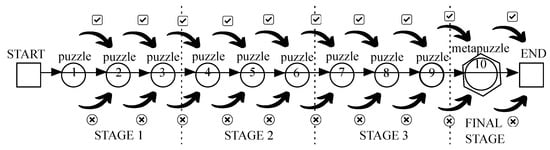
In this context, the evaluation in the last academic year was undertaken by means of a traditional written exam. However, the evaluation in the current academic year was carried out through an educational escape room on an individual basis. The escape room proposed was composed of nine sequential puzzles, evenly distributed into three stages, such that each stage contained just three puzzles. Additionally, a metapuzzle was included after clearing all previous stages, as a final stage before completing the escape room (Nicholson, 2015).
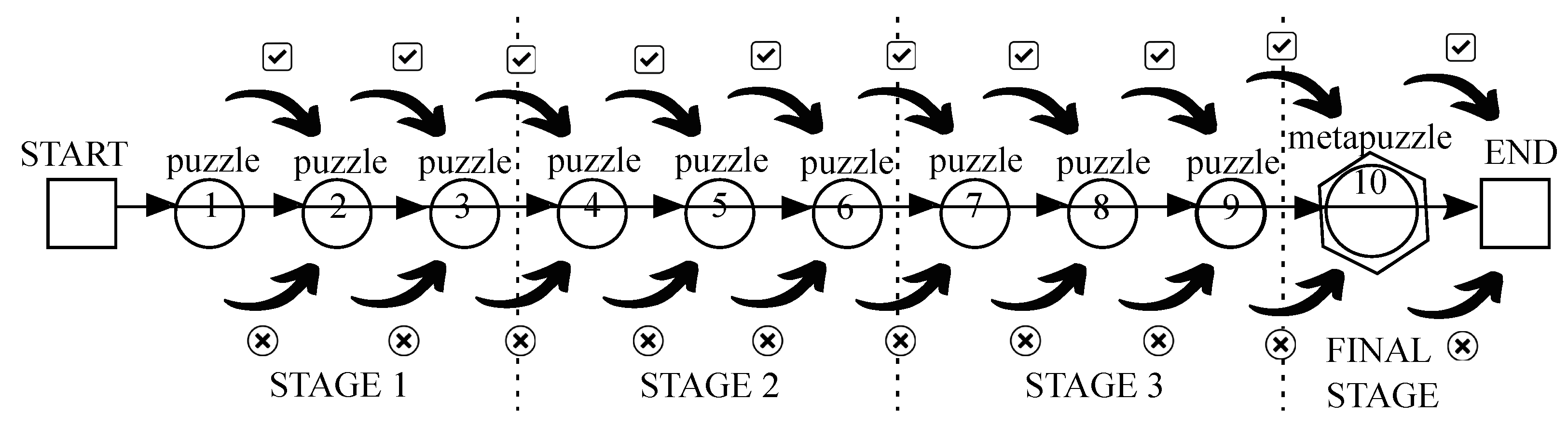
Figure 1 depicts the layout of the escape room proposed. It shows a string of puzzles arranged along a sequential path leading to the final goal, even though there are two ways to progress from one puzzle to the next one. The preferred option is to solve it, indicated by an upper arrow with a  symbol between the current puzzle and the next one, which contributes to the overall score. Alternatively, a puzzle may be skipped, indicated by a lower arrow with a ⊗ symbol between the current puzzle and the next one, which does not contribute to the score.
Figure 1.
Layout of the linear escape room proposed.
Therefore, the escape room was composed of 9 puzzles and 1 metapuzzle, thus making 10 challenges to be solved in a sequential order. Considering that the course was conducted in a Spanish college, the Spanish grading system was applied (Polytechnic University of Valencia, 2026). Hence, as the top mark in the Spanish grading system is 10 points, each of the 10 challenges was assigned 1 point, so that a student solving all puzzles would receive the top score. It should be noted that the metapuzzle had the same value as any other ordinary puzzle, as achieving top marks was considered to reflect outstanding performance. This way, students who solved all puzzles were required to make an additional effort to complete the metapuzzle if they wished to obtain the highest score. On the other hand, students who did not solve all puzzles also had the opportunity to attempt the metapuzzle in order to gain an additional point.
However, two restrictions were imposed: the first related to time and the second to hints. Regarding the former, the time constraint for solving the escape room was the duration of the class session during which the escape room was carried out. Therefore, the final score of a student was calculated according to how many puzzles were solved before the class session was over. With respect to hints, each hint used incurred a penalty of 0.25 points per puzzle. This way, if a puzzle was solved without any hint, then 1 point was awarded. However, if one hint was unveiled, 0.75 points were awarded for solving the puzzle. If two hints were unveiled, 0.50 points were awarded. If three hints were unveiled, 0.25 points were awarded. Additionally, if a puzzle could not be solved even after using all three hints, the student had to inform the teacher to skip it and proceed to the next one. In that case, the student received 0 points for that particular puzzle.
This scheme of hints and penalties was taken from the capture the flag competitions, which are commonly known by the acronym CTF. Hence, this scheme is also labeled as CTF-based or CTF-like (Mansurov, 2016). CTF challenges were originally designed for the cybersecurity domain, as they allowed organizers to set up controlled environments where participants had to use offensive-security techniques in order to get into some computing assets and escalate privileges without having to worry about legal consequences for breaching into third-party computer systems and networks (Beauchamp & Matusovich, 2024). However, this scheme of hints and penalties has also been applied to other domains in order to modulate the rewards obtained for completing certain actions according to the number of hints needed to do so (Zafar et al., 2024).
The layout of this CTF-like escape room can be quite useful in conducting assessments in STEM environments, as each puzzle can involve the evaluation of knowledge and skills related to critical thinking, technical proficiency, and application, rather than just recall (Roig et al., 2023). This way, the structure described herein may well be adapted to any STEM-related discipline in order to craft an assessment composed of a collection of small problems to be solved in a timely manner. Hence, each puzzle is cleared when a small problem is solved, whereas a more complex problem may be proposed as the final metapuzzle.
Sticking to the escape room presented in this paper, the three puzzles found in stage one were related to basic use of variables in Promela, those in stage two were based on conditional statements, whilst those in stage three were devoted to loop constructs. The answers in each case required writing a snippet of code, where three hints were available related to definitions and syntax. Finally, the metapuzzle required the design of a slightly more complex code in which all previous elements had to be combined. Overall, this type of practical evaluation provided students with an opportunity to consolidate the knowledge and skills acquired throughout the course.
This CTF-like approach carries some disadvantages, as the mechanism differs from a traditional written exam. In this sense, students need to go through the questions in a sequential manner, which does not allow them to return to a previous question (Vykopal et al., 2020). Also, each failure may impact motivation and performance in the remaining puzzles (Cole, 2022). In addition, some scaffolding is needed in order for students to clearly understand the dynamics of the activity (Faber et al., 2024).
On the other hand, in order to compare the academic performance obtained in the current academic year and in the previous one, the grades of all students in each course were taken into account. Regarding the previous year, the average score in the final written exam was considered. With respect to the current year, the average score in the CTF-like escape room proposed was considered. As stated above, both courses were taught according to the same curriculum, which was based on modeling with Promela and verifying with Spin, whereas the number of attendants was also the same, namely 30 learners. It should be noted that data collection was conducted by gathering the marks of all students enrolled in both courses on an anonymized basis, after they had provided informed consent.
Apart from the average score in both courses, the most common descriptive statistics were calculated for the distribution of scores from both years, such as the mode, the quartiles, the variance, the standard deviation, and the coefficient of variation. Furthermore, a t-test was conducted on both distributions of scores in order to check whether the results obtained in the current year were statistically significant compared to those attained in the previous year. Moreover, Cohen’s d was calculated to assess the magnitude of the effect size obtained in the current year relative to the previous year. The sample size needed was calculated and compared with the actual sample size (Serdar et al., 2020).
Finally, the level of engagement during the proposed CTF-like escape room was assessed by means of the ISA engagement scale (Soane et al., 2012). This is a standardized construct composed of 9 elements, which are evenly distributed across 3 dimensions. Those dimensions are intellectual, social, and affective, and the aim is to measure the engagement related to each of those dimensions. Each student had to rate each element on a 7-point Likert-type scale, where 1 point stands for fully disagree, 2 points stand for disagree, 3 points represent partially disagree, 4 points represent neither agree nor disagree, 5 points represent partially agree, 6 points stand for agree, and 7 points stand for fully agree (Mañas-Rodríguez et al., 2016).
The goal in the ISA engagement scale is to achieve an overall score of at least 6 points, as this corresponds to “agree” on the 7-point Likert scale. A reliable way to ensure this is to obtain an average of 6 points per dimension, based on the ratings of all students across the three items included in each dimension. If this condition is met, it indicates a high level of engagement, which is the desired outcome (Sidharta, 2019). It should be mentioned that the ISA engagement scale was initially created for working environments, even though it has been widely used in academic environments as well (Nwachukwu & Osa-Izeko, 2022).
Additionally, providing prior scaffolding before engaging students in the escape room is essential to ensure an effective learning experience (Zaim et al., 2026). By introducing key concepts, tools, and problem-solving strategies in advance, students can approach the challenges with greater confidence and preparedness. This preparatory phase may include guided practice, examples, or mini-tasks that familiarize learners with the types of puzzles they will encounter. As a result, scaffolding helps reduce cognitive overload, supports self-directed learning, and enables students to focus on applying knowledge rather than struggling with basic understanding during the activity (Zhang & Zhang, 2026).
As a general recommendation, the complexity of the puzzles should be kept moderate, as students generally have no prior knowledge of Promela, although this may vary across different cohorts. The following examples are three possible instances of puzzles for stage 1.
Puzzle 1: Declare a channel called q that can store up to eight messages, each consisting of type short. The first hint may indicate that the keyword to define a channel is chan. The second hint may state that the channel capacity must be specified within square brackets. The third hint may indicate that the data type to be transmitted must be enclosed in curly brackets.
Puzzle 2: Define a synchronous port p that can only pass messages consisting of 8-bit values. The first hint may indicate that the type byte corresponds to 8 bits. The second hint may state that message interactions performed via rendezvous ports are synchronous. The third hint may indicate that a rendezvous channel cannot store messages.
Puzzle 3: Define a channel ch that can store one message at a time, each consisting of one 32-bit value, one 16-bit value, and a channel name. The first hint may indicate that the type int corresponds to 32 bits. The second hint may indicate that the type short corresponds to 16 bits. The third hint may state that if a channel can store messages, then it is buffered rather than synchronous, so it is asynchronous.
4. Results
Table 2 displays the centralization and dispersion statistics calculated from the distribution of scores obtained in both academic years, namely the previous one with a traditional written exam and the current one with a CTF-like linear escape room.
Table 2.
Descriptive statistics for the scores obtained in each academic year.
The results displayed show an increase in the centralization statistics for the distribution of scores obtained in the current academic year, as well as a reduction in the dispersion statistics in the same score distribution. Specifically, there is an increase in the average score from 5.60 in the last year to 6.50 in the current year. Moreover, there is a rise in the mode, as well as in the first, second, and third quartiles. On the other hand, there is a drop in the variance, as well as in the standard deviation and in the coefficient of variation.
Table 3 shows the skewness and kurtosis of the score distributions in both years. The values of skewness and kurtosis shown are all within the range from −2 to +2, which indicates that the assumption of normality can be established on the distribution of scores corresponding to both academic years.
Table 3.
Skewness and kurtosis found in the distribution of scores in both academic years.
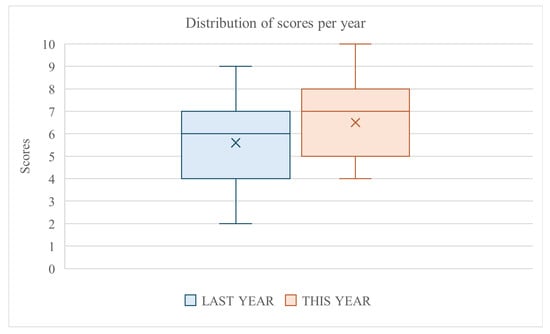
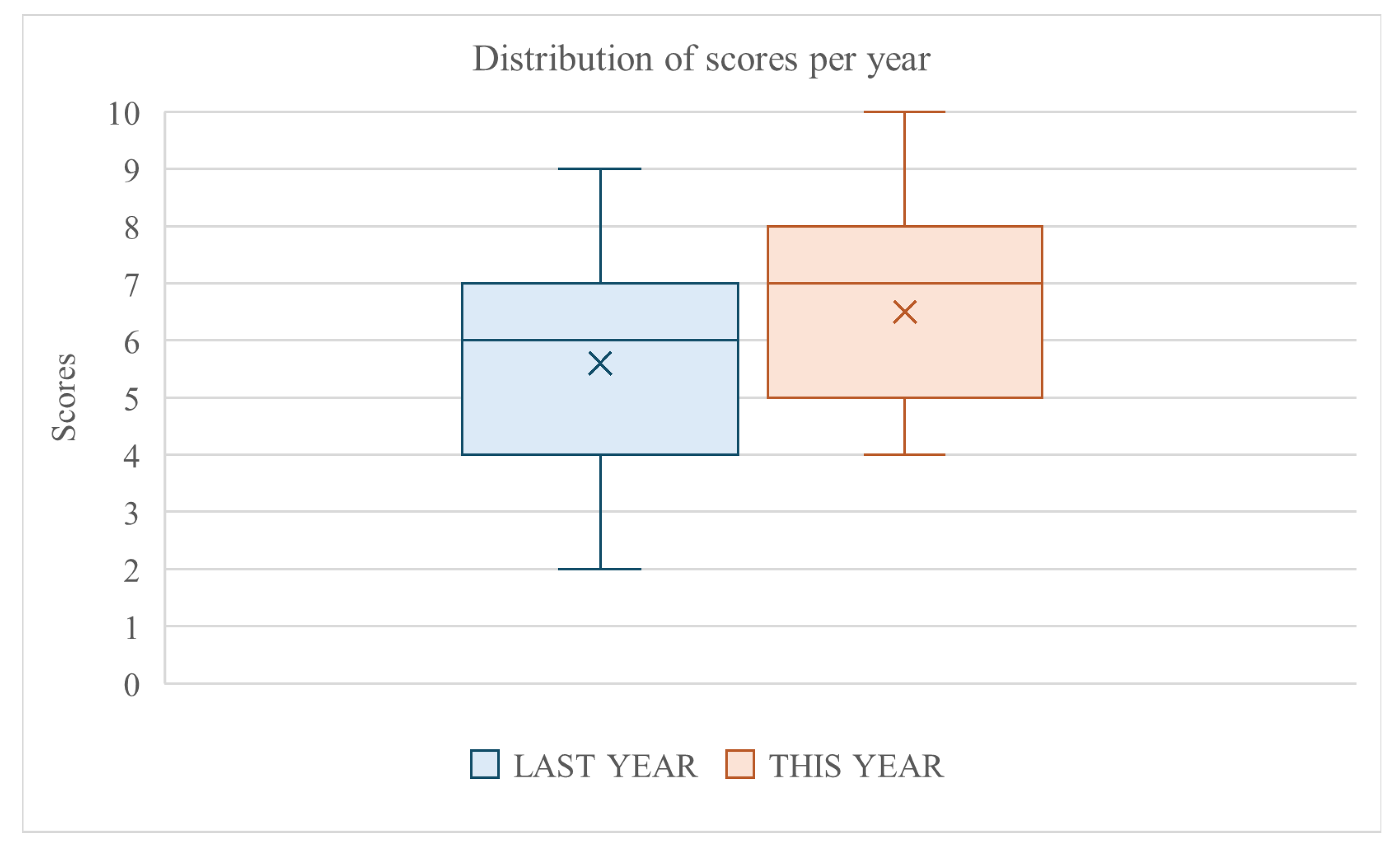
Furthermore, Figure 2 represents the boxplot of the distribution of scores in both years. Particularly, the left plot corresponds to the score distribution from the previous academic year, whereas the right plot corresponds to the score distribution from the current academic year.
Figure 2.
Boxplot with the distribution of scores in both academic years.
The difference between the samples is statistically significant (p = 0.04, Cohen’s d = 0.54), given a significance level of 0.05. However, the sample size required to detect this effect size is 54, which exceeds the actual sample size of 30 (the average size of both courses). Further research is needed with a larger sample.
At the end of the escape room, the level of engagement was measured through the ISA engagement scale. Table 4 displays the items involved and their classification into the corresponding dimensions. There are nine questions included in the ISA engagement scale, which was the construct used to measure the level of engagement of the students in the current academic year. The ISA engagement scale was structured according to three dimensions, namely intellectual, social, and affective, each of which contains three elements to be rated on a 7-point Likert-type scale.
Table 4.
Questions within the ISA engagement scale.
Table 5 exhibits the average scores obtained, classified by dimension and overall. Specifically, the questions related to the intellectual dimension got an average score of 6.47, while the elements related to the social dimension received an average score of 6.60, and the items related to the affective dimension received an average score of 6.63. Additionally, the overall average obtained was 6.57, which can be associated with a high level of engagement, as 6 represents the lower boundary for this level.
Table 5.
Descriptive statistics for the level of engagement obtained.
5. Discussion
Regarding descriptive statistics, the results displayed in Table 2 show that the increase in the current year with respect to the previous year is clear, thus accounting for higher marks overall, which indicates better academic performance. This is also supported by Figure 2, which shows a boxplot with the distributions of scores in both years, where higher marks are clearly observed in the current year compared to the previous year. Hence, the implementation of the escape room for assessment purposes appears to have been a key factor in improving academic performance.
On the other hand, the distribution of scores obtained in the present year is closer to the mean with respect to the previous year, as indicated by lower dispersion statistics. Furthermore, the values for the coefficient of variation ranging between 0.15 and 0.30 are considered as data with moderate variability. In this case, the coefficients of variation for both academic years fit into that interval, although it was just over the higher boundary of the interval in the last year, whereas it is around the middle of the interval in the current year. Hence, the distribution of scores in the current year presents less variability, such that the scores obtained are closer to the mean. From an educational perspective, the decrease in score variability, together with the increase in academic performance, may be interpreted as indicating that the escape room motivated students to be better prepared, resulting in higher average scores that are more closely clustered around the mean.
It should be noted that t-tests require normal distribution for validity with small samples (N < 30), while for large samples, they are robust to non-normality due to the central limit theorem (Fagerland, 2012). Using a t-test on non-normal data with small samples yields inaccurate p-values and high Type I error risk. In this case, the sample size is on the boundary, as N = 30, even though this does not apply herein, as the assumption of normality has been established for both distributions based on the outcome of Table 3. Once the t-value is calculated, it is used to determine the p-value, which in turn is used to estimate the effect size and the required sample size.
It should be noted that the p-value obtained suggests that the distributions of scores in both years come from different populations, which indicates that the increase observed in the current year is statistically significant.
From an educational perspective, it seems to indicate that the observed improvement in students’ performance is unlikely to be due to chance. This suggests that the intervention implemented, namely the use of the escape room and CTF framework, had a real and measurable impact on learning outcomes. In practical terms, it provides evidence that the teaching approach contributes meaningfully to enhancing student performance, supporting its effectiveness in the educational context.
On the other hand, the effect size represents the difference in the means between two groups, measured in standard deviations. In this case, this value is located within the interval going from 0.50 to 0.80, where the former represents a medium effect size, and the latter stands for a large effect size. It should be considered that a larger effect size is easier to detect, which in fact requires a lower sample size to get it. Otherwise, a smaller effect size is more difficult to spot, which actually requires a larger sample size to get it. Hence, as the value obtained is quite close to 0.50, it could be associated with a medium effect size, which is commonly labeled as a big enough effect to be discerned with the naked eye.
From an educational point of view, this effect size means that the intervention (e.g., the escape room and CTF framework) had a meaningful and practically relevant impact on students’ outcomes. In concrete terms, students exposed to the intervention performed noticeably better than those in the comparison group, with a difference that is not only statistically significant but also educationally meaningful, suggesting a moderate improvement in learning or performance.
With respect to the required sample size, the estimated value is 54, whereas the actual sample size is 30. It should be noted that the actual sample size corresponds to the average of the two samples considered, namely the number of students in the previous and current academic years, both of which are 30. In contrast, the required sample size refers to the number of participants needed per group. Therefore, the actual sample size is lower than the required sample size, indicating that it may be insufficient to reliably detect the observed effect size. Consequently, further research with larger sample sizes is needed.
With regard to the results obtained on the ISA engagement scale, all dimensions showed quite high values, as all scores were above 6.50. However, the intellectual dimension received a slightly lower score, whereas the social and affective dimensions yielded similar results. This outcome may be attributed to the fact that students could be somewhat less intellectually engaged compared to their social and affective engagement, which relates to forming close bonds with peers/competitors and experiencing positive emotions, respectively, even though the activity was carried out individually. This suggests that the gamified nature of the escape room fostered a bit more engagement at both the social and affective levels than at the intellectual level.
Finally, the use of active learning methodologies within the STEM education field is widely considered to bring an increase in students’ performance (Freeman et al., 2014). However, there is actually a certain degree of discrepancy in the results obtained in different levels, courses, and scenarios, which leads to mixed findings on academic performance and success rates. In this sense, the literature presents some studies reporting substantial increases and others indicating marked decreases. In order to enable a meaningful comparison with the results obtained in this study, we selected studies conducted in STEM-related courses at the college level. Accordingly, our results on academic performance are compared with those reported by Hacisalihoglu et al. (2018), while our findings on success rates are compared with those presented by Nurbavliyev et al. (2022).
Table 6 displays the academic performance obtained in this study, and Table 7 exhibits the corresponding success rate.
Table 6.
Comparing the academic performance in both academic years.
Table 7.
Comparing the success rate in both academic years.
According to the outcome of both tables, the academic performance obtained herein was 16%, as shown in Table 6, which is quite close to the 15% quoted in the literature. Likewise, the success rate achieved herein was 18%, as seen in Table 7, which is also quite close to the 20% quoted in the literature. Therefore, it seems that the results obtained in this study are quite similar to those quoted in the literature. However, further research should be undertaken considering a large population in order to check whether those results can be extrapolated.
Finally, this work presents several limitations that should be acknowledged. First, the comparison with the written examination raises methodological concerns. In the escape-room condition, students had access to hints, providing a level of support during the assessment, whereas no equivalent support mechanism was available in the written exam condition. Consequently, the comparison between the two formats is not fully balanced, which may partially account for the observed differences in performance. Second, the test and control groups were not concurrent but belonged to different course iterations. This may have introduced a temporal bias, potentially distorting the results due to differences in timing with respect to when the data were collected, measured, or compared across non-equivalent time periods.
Furthermore, the study may be constrained by a relatively small and context-specific sample, limiting the generalizability of the findings to other disciplines, educational levels, or institutional settings. Moreover, the evaluation of learning outcomes may rely partly on self-reported measures of engagement and perceived improvement, which can introduce bias and may not fully capture long-term knowledge retention. Moreover, the implementation of a CTF-based escape room requires considerable preparation time, resources, and instructor expertise, which may hinder scalability and adoption in resource-constrained environments. Additionally, the novelty and gamified nature of the approach could influence student motivation independently of its pedagogical effectiveness, making it difficult to isolate causal effects. Consequently, future work should include larger-scale studies, longitudinal analyses, and comparative experimental designs to validate and extend the findings.
6. Conclusions
In this paper, a CTF-like escape room for STEM assessment has been described. Specifically, the escape room was designed as a linear path, distributed into three sequential sections, where each of those sections was composed of three puzzles. This layout allowed the assignment of an individual teaching unit, or a group of units, to each section, which in turn allows the design of puzzles within each section according to a specific part of a course curriculum.
This layout was built up in order to evaluate a college course on protocol engineering in the current academic year, where students had to take the escape room on an individual basis. On the other hand, the results obtained were compared to those attained in the last academic year, where students in the same course were evaluated by means of a traditional written exam.
The centralization statistics worked out with the results obtained in the current year exhibited a rise with respect to the last year, where the average increased from 5.60 to 6.50 out of 10, while the mode, median, and the three quartiles increased 1 point in each case. On the contrary, the dispersion statistics obtained show a drop in the current year compared to the previous year, which indicates that the distribution of scores in the current year became closer to the mean. Moreover, the skewness and kurtosis values for the score distributions in both years indicate that the assumption of normality can be applied to both distributions.
Regarding the inferential statistics, the t-test was applied, resulting in a value of 2.11. This value, along with the degrees of freedom, namely 58, led to a p-value of 0.04. Hence, as the significance value (s-value) was set at 0.05, which is the most common case in the literature, it suggests that the increase in the results obtained in the current year seems to be statistically significant. Therefore, the results obtained in both years may appear to belong to two different populations, which suggests that the difference in the outcomes may be relevant.
Furthermore, the effect size achieved was calculated using Cohen’s d, and it was found to be 0.54. This value is around the boundary of 0.50, which represents a big enough effect to be discerned with the naked eye. This effect size was used to calculate the sample size required to detect it, taking into account the alpha and beta values, set at 0.05 and 0.20, respectively. In those circumstances, the sample size needed was 54, whereas the actual sample size was 30; the latter was not sufficient to detect the effect size achieved. Therefore, further research should be carried out with a larger population in order to check if those results can be extrapolated.
From an educational perspective, the observed improvement in students’ performance is unlikely to be due to chance, suggesting that the intervention, namely the use of the escape room and CTF framework, had a real and measurable impact on learning outcomes. In practical terms, this provides evidence that the teaching approach seems to contribute meaningfully to enhancing student performance, supporting its effectiveness in the educational context. Moreover, the observed effect size suggests that this impact may not only be statistically significant but also practically relevant, as students exposed to the intervention performed noticeably better than those in the comparison group, reflecting a moderate yet educationally meaningful improvement in learning and performance. Nevertheless, these results should be interpreted with caution, as the required sample size suggests that further research with a larger group of participants is needed.
Additionally, the level of engagement was measured through the ISA engagement scale. The outcome obtained with this standard construct was an intellectual engagement of 6.47, along with a social engagement of 6.60, and an affective engagement of 6.63. Those results led to an overall average of 6.57. All those engagement levels were clearly higher than 6, which is the lower boundary for a high level of engagement. Hence, it seems that students experienced a high level of engagement during this CTF-like escape room.
Finally, this kind of layout for assessment purposes in the current academic year yielded a 16% increase in academic performance with respect to the previous academic year, in which assessment was conducted through a written exam. Likewise, the success rate attained in the current academic year achieved a rise of 18% with respect to the last academic year. These figures seem to suggest that the implementation of the CTF-like escape room for assessment purposes was a success, although further research needs to be undertaken with a larger number of students.
According to the results obtained, the research question posed above can be answered affirmatively, as measurable improvements in academic outcomes were observed relative to prior cohorts taught through conventional instructional methodologies, and a high overall level of student engagement was achieved. On the other hand, the component related to self-directed learning was intended to represent the self-study carried out to achieve good performance in the escape room, even though it was not directly measured.
However, it should be noted that a series of confounders may have had some influence on the results obtained. In this sense, there is no control group in the current year, although the last edition of the course is taken as a control group. Nonetheless, it may have induced some time bias due to the distortion in the results caused by differences in timing, such as when data are collected, measured, or compared across unequal time periods. Moreover, it may have induced some instructional context due to different class environments along the course, even though the same teachers taught both courses. Moreover, the novelty effect may have boosted the outcome in the current year, even though it might not happen in future editions. Furthermore, early failures may have disappointed some students, leading them to underperform in the remaining puzzles. Finally, the limited sample size necessitates further research before the results obtained can be generalized to larger populations. Also, it should be noted that in the escape-room condition, students had access to hints, which provided a certain level of support during the assessment, whereas no equivalent support mechanism was available in the written exam condition. As a result, the comparison between the two formats is not entirely balanced, which may partially account for the observed differences in performance.
In addition, the theoretical implications of this study suggest that the combination of escape rooms and CTF frameworks offers an opportunity to enhance student engagement in self-directed learning due to the gamified and competitive nature of this setting. In contrast, the practical implications suggest that this approach may improve both students’ academic performance and their level of engagement compared to a traditional evaluation approach. In this sense, the contribution of this study to the research community lies in providing a use case where an educational escape room and a Capture the Flag framework are integrated into a STEM-related course at the college level for assessment purposes. The results have been compared with those obtained under a traditional evaluation scheme in a previous course, achieving an increase in both academic performance and success rate. Further research will focus on deploying this type of layout in other STEM-related courses, not only at the college level but also at lower educational levels, in order to assess outcomes across different contexts and larger populations.
Finally, the contribution of this work extends beyond the mere design of an escape room incorporating CTF elements and is situated within the broader field of educational science through its focus on pedagogical innovation, assessment design, and learning effectiveness. Specifically, this study investigates how gamified, challenge-based environments can be systematically used as assessment tools to enhance student engagement, foster self-directed learning, and improve knowledge retention. From an educational science perspective, its value lies in examining the validity and effectiveness of gamification-based assessment approaches, as well as in evaluating their impact on learning outcomes compared to traditional instructional methods. Furthermore, this work contributes to theory by exploring the relationships between motivation, collaboration, and performance in immersive learning settings, and to practice by providing a replicable and adaptable instructional model for STEM education. As such, the study aligns with this journal’s scope by advancing both the theoretical understanding and practical implementation of innovative teaching and assessment strategies.
Author Contributions
Conceptualization, P.J.R.; formal analysis, P.J.R.; supervision, P.J.R., S.A., K.G., C.B. and C.J.; validation, P.J.R. All authors have read and agreed to the published version of the manuscript.
Funding
This research received no external funding.
Institutional Review Board Statement
This study was conducted in accordance with the Declaration of Helsinki. Approval by the Institutional Ethics Committee was not necessary, as all data were collected anonymously from capable, consenting adults. The data are not traceable to participating individuals. The procedure complies with the General Data Protection Regulation (GDPR).
Informed Consent Statement
Informed consent was obtained from all subjects involved in the study.
Data Availability Statement
The datasets used and analyzed in this study are available from the corresponding author upon reasonable request.
Conflicts of Interest
The authors declare no conflicts of interest.
Abbreviations
The following abbreviations are used in this manuscript:
| CAPE | Cybersecurity Active Pedagogical Escape |
| CTF | Capture the Flag |
| DEER | Digital Educational Escape Room |
| EER | Educational Escape Room |
| ICT | Information and Communication Technologies |
| IP | Internet Protocol |
| IT | Information Technology |
| LMS | Learning Management System |
| STEM | Science, Technology, Engineering, Mathematics |
References
- Arduin, P. E., & Costé, B. (2026). Learning to hack, playing to learn: Gamification in cybersecurity courses. Journal of Cybersecurity and Privacy, 6(1), 16. [Google Scholar] [CrossRef] [Scilit]
- Beauchamp, C., & Matusovich, H. (2024). A mixed-method study exploring student motivation for participating in cybersecurity CTF competitions. Cybersecurity Pedagogy & Practice Journal, 3(1), 4–26. [Google Scholar]
- Blanco, C., Almarza, M., Massana, J., & Alonso-Peralta, F. (2023, November 13–15). Digital escape rooms as a way to increase academic performance and student’s motivation. The 16th Annual International Conference of Education, Research and Innovation (ICERI 2023), Seville, Spain. [Google Scholar]
- Clark, S. L., Dyar, C., Inman, E. M., Maung, N., & London, B. (2021). Women’s career confidence in a fixed, sexist STEM environment. International Journal of STEM Education, 8, 56. [Google Scholar] [CrossRef] [Scilit]
- Cole, S. V. (2022, July 8–13). Impact of Capture The Flag (CTF)-style vs. traditional exercises in an introductory computer security class. The 27th ACM Conference on on Innovation and Technology in Computer Science Education (ITiCSE 2022) (Vol. 1, pp. 470–476), Dublin, Ireland. [Google Scholar]
- Costa, G., Lualdi, M., Ribaudo, M., & Valenza, A. (2020, October 7–9). A NERD DOGMA: Introducing CTF to non-expert audience. The 21st Annual Conference on Information Technology Education (SIGITE 2020) (pp. 413–418), Virtual Event, USA. [Google Scholar]
- Damenu, T. K., Gökbay, I. Z., Covaci, A., & Li, S. (2025). Cyber security educational games for children: A systematic literature review. arXiv, arXiv:2508.17414. [Google Scholar] [CrossRef] [Scilit]
- Deterding, S., Dixon, D., Khaled, R., & Nacke, L. (2011, September 28–30). From game design elements to gamefulness: Defining “gamification”. The 15th International Academic MindTrek Conference: Envisioning Future Media Environments (MindTrek 2011), Tampere, Finland. [Google Scholar]
- Dilley, N., & Lange, J. (2020, April 26). Bounded verification of message-passing concurrency in Go using Promela and Spin. The Programming Language Approaches to Concurrency & Communication-cEntric Software (PLACES 2020), Dublin, Ireland. [Google Scholar]
- Faber, T. J. E., Dankbaar, M. E. W., van den Broek, W. W., Bruinink, L. J., Hogeveen, M., & van Merriënboer, J. J. G. (2024). Effects of adaptive scaffolding on performance, cognitive load and engagement in game-based learning: A randomized controlled trial. BMC Medical Education, 24, 943. [Google Scholar] [CrossRef] [Scilit]
- Fagerland, M. W. (2012). t-tests, non-parametric tests, and large studies—A paradox of statistical practice? BMC Medical Research Methodology, 12, 78. [Google Scholar] [CrossRef] [Scilit]
- Farreras, M., Bofill, P., Armengol, J., & Asensio, A. (2022, July 6–8). An escape room for an alternative evaluation system. The International Conference on Active Learning in Engineering Education (PAEE/ALE’2022), Alicante, Spain. [Google Scholar]
- Freeman, S., Eddy, S. L., McDonough, M., Smith, M. K., Okoroafor, N., Jordt, H., & Wenderoth, M. P. (2014). Active learning increases student performance in science, engineering, and mathematics. Psychological and Cognitive Sciences, 111(23), 8410–8415. [Google Scholar] [CrossRef] [Scilit]
- Ghiamikeshtgar, N., Ghaljaei, F., Ghaljeh, M., Taherizade, B., Mahmoodi, N., & Sharifi, S. (2024). The effect of escape room clinical evaluation method on satisfaction, learning, and preparedness to practice as interns of nursing students: A quasi-experimental quantitative study. Journal of Education and Health Promotion, 13, 0225. [Google Scholar] [CrossRef] [Scilit]
- Gordillo, A., López-Fernández, D., López-Pernas, S., & Quemada, J. (2020). Evaluating an educational escape room conducted remotely for teaching software engineering. IEEE Access, 8, 225032–225051. [Google Scholar] [CrossRef] [Scilit]
- Gutiérrez-Puertas, L., Márquez-Hernández, V. V., Román-López, P., Rodríguez-Arrastia, M. J., Ropero-Padilla, C., & Molina-Torres, G. (2020). Escape rooms as a clinical evaluation method for nursing students. Clinical Simulation in Nursing, 49(C), 73–80. [Google Scholar] [CrossRef] [Scilit]
- Hacisalihoglu, G., Stephens, D., Johnson, L., & Edington, M. (2018). The use of an active learning approach in a SCALE-UP learning space improves academic performance in undergraduate General Biology. PLoS ONE, 13(5), e0197916. [Google Scholar] [CrossRef] [Scilit]
- Harish, A. V., Tam, K., & Jones, K. (2025). Generating training events for building cyber-physical security skills. The Computer Journal, 68(5), 445–459. [Google Scholar] [CrossRef] [Scilit]
- Hasan, K. F., Hughes, W., & Rahman, A. (2025, November 3–6). Gamifying cyber governance: A virtual escape room to transform cybersecurity policy education. The International Society for the Scholarship of Teaching and Learning (ISSOTL 2025), Otautahi Cristchurch, New Zealand. [Google Scholar]
- Kam, M., Clune, M., Jowsey, T., & Singleton, R. (2026). Embracing ‘gameful learning’ with escape room games in higher education. Higher Education Research & Development, 1–20. [Google Scholar] [CrossRef] [Scilit]
- Kaplan, Z., Zhang, N., & Cole, S. V. (2022, July 8–13). A Capture The Flag (CTF) platform and exercises for an intro to computer security class. The 27th ACM Conference on Innovation and Technology in Computer Science Education (ITiCSE 2022) (Vol. 2, pp. 597–598), Dublin, Ireland. [Google Scholar]
- Kartasasmita, D. G., & Timur, F. G. C. (2025). Capture the Flag (CTF) implementation in the informatics engineering study program indonesia defense university. Journal of Engineering Education Transformations, 38(4), 36–44. [Google Scholar] [CrossRef] [Scilit]
- Keller, T., Guggemos, J., & Warwas, J. (2025). Digital educational escape rooms as a novel approach to cybersecurity education: An empirical study on learner perceptions of usefulness and usability. Computers in Human Behavior Reports, 20, 100785. [Google Scholar] [CrossRef] [Scilit]
- Korkiakoski, M., Antila, A., Annamaa, J., Sheikhi, S., Alavesa, P., & Kostakos, P. (2023, March 12–14). Hack the Room: Exploring the potential of an augmented reality game for teaching cyber security. The Augmented Humans International Conference 2023 (AHs 2023) (pp. 349–353), Glasgow, UK. [Google Scholar]
- Licchelli, S., & Barnett, L. (2023). Using an online escape room as a formative assessment tool during a lecture on HIV: A case study. Journal of Learning Development in Higher Education, 27, 1–14. [Google Scholar] [CrossRef] [Scilit]
- Lim, I., & Gepp, A. (2026). Design, implementation, and student feedback on a numerical-themed escape room for a data analytics subject. Interactive Technology and Smart Education, 23(1), 80–96. [Google Scholar] [CrossRef] [Scilit]
- Löffler, E., Schneider, B., Zanwar, T., & Asprion, P. M. (2021). CySecEscape 2.0—A virtual escape room to raise cybersecurity awareness. International Journal of Serious Games, 8, 59–70. [Google Scholar] [CrossRef] [Scilit]
- López-Pernas, S., Gordillo-Méndez, A., Barra-Arias, E., & Quemada-Vives, J. (2021). Escapp: A web platform for conducting educational escape rooms. IEEE Access, 9, 38062–38077. [Google Scholar] [CrossRef] [Scilit]
- Makri, A., Vlachopoulos, D., & Martina, R. A. (2021). Digital escape rooms as innovative pedagogical tools in education: A systematic literature review. Sustainability, 13(8), 4587. [Google Scholar] [CrossRef] [Scilit]
- Mansurov, A. (2016). A CTF-based approach in information security education: An extracurricular activity in teaching students at Altai State University, Russia. Modern Applied Sciences, 10(11), 0159. [Google Scholar] [CrossRef] [Scilit]
- Mañas-Rodríguez, M. A., Alcaraz-Pardo, L., Pecino-Medina, V., & Limbert, C. (2016). Validation of the Spanish version of Soane’s ISA engagement scale. Journal of Work and Organizational Psychology, 32(2), 87–93. [Google Scholar] [CrossRef] [Scilit]
- Maroto-Sánchez, A. (2023). Using digital educational escape rooms as a motivational review tool for Economics. The International Journal of Management Education, 21(3), 100852. [Google Scholar] [CrossRef] [Scilit]
- Martínez-de la Cal, J., Sandoval-Hernández, I., Ropero-Padilla, C., Rodríguez-Arrastia, M., & González-Sánchez, M. (2024). An escape room game-based innovation for the assessment of physiotherapy students: A qualitative study. Studies in Educational Evaluation, 81, 101331. [Google Scholar] [CrossRef] [Scilit]
- Michaelsen, L., Knight, A. B., & Fink, L. D. (2004). Team-based Learning: A transformative use of small groups in college teaching (1st ed., pp. 1–298). Routledge. [Google Scholar]
- Moore, L., & Campbell, N. (2021). Effectiveness of an escape room for undergraduate interprofessional learning: A mixed methods single group pre-post evaluation. BMC Medical Education, 21, 0220. [Google Scholar] [CrossRef] [Scilit]
- Navarro-Mateos, C., & Pérez-López, I. J. (2022). Escape room as a didactical strategy in the Master’s degree in teacher learning. Retos, 44, 221–231. [Google Scholar] [CrossRef] [Scilit]
- Nicholson, S. (2015). Peeking behind the locked door: A survey of escape room facilities. Available online: http://scottnicholson.com/pubs/erfacwhite.pdf (accessed on 25 February 2026).
- Nurbavliyev, O., Kaymak, S., & Sydykov, B. (2022). The effect of active learning method on students’ academic success, motivation and attitude towards Mathematics. Journal of Language and Linguistic Studies, 18(2), 701–713. Available online: https://www.jlls.org/index.php/jlls/article/view/4409/1310 (accessed on 25 February 2026).
- Nwachukwu, C., & Osa-Izeko, E. (2022). Assessment of Intellectual, Social and Affective (ISA) engagement of academics in Nigerian universities. Nigerian Journal of Management Sciences, 23(2), 20–28. Available online: https://nigerianjournalofmanagementsciences.com/wp-content/uploads/2022/09/3.-ASSESSMENT-OF-INTELLECTUAL-SOCIAL-AND-AFFECTIVE-ISA-ENGAGEMENT-OF-ACADEMICS-IN-NIGERIAN-UNIVERSITIES.pdf (accessed on 25 February 2026).
- Padilla-Piernas, J. M., Parra-Meroño, M. C., & Flores-Asenjo, M. P. (2024). Virtual escape rooms: A gamification tool to enhance motivation in distance education. RIED-Revista Iberoamericana de Educación a Distancia, 27(1), 61–85. [Google Scholar] [CrossRef] [Scilit]
- Pais, S., & Sousa, A. E. (2023, October 5–6). Using an escape room activity to enhance the motivation of undergraduate life science students in Mathematics classes—A case study. The 17th European Conference on Games Based Learning (ECGBL 2023), Twente, The Netherlands. [Google Scholar]
- Peláez-Sánchez, I. C., Velarde-Camaqui, D., & Glasserman-Morales, L. C. (2024). The impact of large language models on higher education: Exploring the connection between AI and Education 4.0. Frontiers in Education, 9, 1392091. [Google Scholar] [CrossRef] [Scilit]
- Pirta-Draimane, R., Brinlingaité, A., Parish, K., Grabis, J., Lugo, R. G., & Bonders, M. (2023). CyberEscape approach to advancing hard and soft skills in cybersecurity education. Lecture Notes in Computer Science, 14019, 441–459. [Google Scholar]
- Pirta-Dreimane, R., Brilingaité, A., Roponena, E., Parish, K., Grabis, J., Lugo, R. G., & Bonders, M. (2025). Try to esCAPE from cybersecurity incidents! A technology-enhanced educational approach. Technology, Knowledge and Learning, 30, 1577–1606. [Google Scholar] [CrossRef] [Scilit]
- Plass, J. L., Homer, B. D., & Kinzer, C. K. (2015). Foundations of game-based learning. Educational Psychologist, 50(4), 258–283. [Google Scholar] [CrossRef] [Scilit]
- Polytechnic University of Valencia. (2026). Spanish grading system. Available online: https://www.upv.es/entidades/OPII/infoweb/pi/info/1147768normali.html (accessed on 25 February 2026).
- Ramírez-Quesada, C. B., & de Jesús Villa, P. (2024). Revisión sistemática de la eficacia del escape room educativo como metodología universitaria para incrementar la motivación y el aprendizaje. EDUCA—International Journal, 1(4), 160–189. [Google Scholar] [CrossRef] [Scilit]
- Rawlinson, R. E., & Whitton, N. (2024). Escape rooms as tools for learning through failure. The Electronic Journal of e-Learning, 22(4), 19–29. [Google Scholar] [CrossRef] [Scilit]
- Roig, P. J., Alcaraz, S., Gilly, K., Bernad, C., & Juiz, C. (2023). Using escape rooms as evaluation tool in active learning contexts. Education Sciences, 13(6), 535. [Google Scholar] [CrossRef] [Scilit]
- Roig, P. J., Alcaraz, S., Gilly, K., Bernad, C., & Juiz, C. (2024). A generic multilevel structure for educational escape rooms. Education Sciences, 14(5), 488. [Google Scholar] [CrossRef] [Scilit]
- Rushman, E. E., Mohamed, M. A. E., Abdelhalim, G. E., El-Ashry, A. M., & Ali, H. F. M. (2024). Effect of an escape room as a gamification evaluation tool on clinical reasoning and teamwork skills among nursing students: A quasi-experimental study. Nurse Education in Practice, 82, 104188. [Google Scholar] [CrossRef] [Scilit]
- Saglam, R. B., Miller, V., & Franqueira, V. N. L. (2023). A systematic literature review on cyber security education for children. IEEE Transactions on Education, 66(3), 274–286. [Google Scholar] [CrossRef] [Scilit]
- Schafeitel-Tähtinen, T., & Lazarov, W. (2025). Teaching and learning cybersecurity using capture the flag: Effectiveness comparison between university students in Finland and Czechia. Computer Application in Engineering Education, 3(5), e70082. [Google Scholar] [CrossRef] [Scilit]
- Serdar, C. C., Cihan, M., Yücel, D., & Serdar, M. A. (2020). Sample size, power and effect size revisited: Simplified and practical approaches in pre-clinical, clinical and laboratory studies. Biochemia Medica, 31(1), 010502. [Google Scholar] [CrossRef] [Scilit] [PubMed]
- Shatrov, V., & Vyatkin, V. (2021, July 21–23). Promela formal modelling and verification of IEC 61499 systems with comparison to SMV. The IEEE 19th International Conference on Industrial Informatics (INDIN 2021), Palma de Mallorca, Spain. [Google Scholar]
- Sidharta, I. (2019). The Intellectual, Social, Affective engagement scale (ISA engagement scale): A validation study. Jurnal Computech & Bisnis, 13(1), 50–57. [Google Scholar]
- Soane, E., Truss, C., Alfes, K., Shantz, A., Rees, C., & Gatenby, M. (2012). Development and application of a new measure of employee engagement: The ISA engagement scale. Human Resource Development International, 15(5), 529–547. [Google Scholar] [CrossRef] [Scilit]
- Spatafora, A., Wagemann, M., Sandoval, C., Leisenberg, M., & Vaz de Carvalho, C. (2024). An educational escape room game to develop cybersecurity skills. Computers, 13, 205. [Google Scholar] [CrossRef] [Scilit]
- Stieha, V., Earl, B., Hagens, H., Haynes, M., Ulappa, A., Bond, L., & Oxford, J. T. (2024). An exploration of the relationship between active learning and student motivation in STEM: A mixed methods study. Advances in Physiology Education, 48(3), 621–638. [Google Scholar] [CrossRef] [Scilit]
- Taherdoost, H. (2024). Towards an innovative model for cybersecurity awareness training. Information, 15(9), 512. [Google Scholar] [CrossRef] [Scilit]
- Taraldsen, L. H., Haara, F. O., Lysne, M. S., Jensen, P. R., & Jenses, E. S. (2020). A review on use of escape rooms in education—Touching the void. Education Inquiry, 13(2), 169–184. [Google Scholar] [CrossRef] [Scilit]
- Tatapudy, S., Boukouzis, K., Kayal, I. S., Socko, R., Rajesh, M., & Theobald, E. J. (2025). Perceived inequities in STEM classes make them feel competitive. CBE—Life Sciences Education, 24(4), 45. [Google Scholar] [CrossRef] [Scilit]
- Tay, A., Hayes, S. M., Wilson, D., Hall, E., & Kaufman, R. (2024). Gamified cybersecurity education through the lens of the information search process: An exploratory study of Capture-the-Flag competitions. Issues in Informing Science and Information Technology, 21, 1. [Google Scholar] [CrossRef] [Scilit]
- Ugo, C. C., López-Pernas, S., Gordillo, A., & Tukiainen, M. (2025). Escape rooms for learning programming: A systematic literature review. Review of Education, 13(3), e70123. [Google Scholar] [CrossRef] [Scilit]
- Veldkamp, A., van de Grint, L., Kinppels, M. C., & van Joolingen, W. R. (2020). Escape education: A systematic review on escape rooms in education. Educational Research Review, 31, 100364. [Google Scholar] [CrossRef] [Scilit]
- Verdugo-Castro, S., Sánchez-Gómez, M. C., & García-Holgado, A. (2023). Factors associated with the gender gap in the STEM sector: Comparison of theoretical and empirical concept maps and qualitative SWOT analysis. Heliyon, 9(6), e17499. [Google Scholar] [CrossRef] [Scilit] [PubMed]
- Vidal-Silva, C. L., Villarroel, R. H., López-Cortés, X. A., & Rubio, J. M. (2019). Una propuesta de algoritmo Spin/Promela para el análisis y diagnóstico de errores en diagramas de secuencia UML. Información Tecnológica, 30(1), 263–272. [Google Scholar] [CrossRef] [Scilit]
- Voigt, P., & von dem Bussche, A. (2024). The EU general data protection regulation (GDPR). A practical guide. Springer Nature Switzerland. ISBN 978-3-031-62327-1. [Google Scholar]
- Vykopal, J., Svabensky, V., & Chang, E. C. (2020, March 11–14). Benefits and pitfalls of using capture the flag games in university courses. The 51st ACM Technical Symposium on Computer Science Education (SIGCSE 2020), Portland, OR, USA. [Google Scholar]
- Widdicks, K., Ashcroft, A., Winter, E., & Blair, L. (2021, September 2–3). Women’s sense of belonging in computer science education: The need for a collective response. The 2021 Conference on United Kingdom & Ireland Computing Education Research (UKICER’21), Glasgow, UK. [Google Scholar]
- Williams, T., & El-Gayar, O. (2021). Design of a virtual cybersecurity escape room. Lecture Notes in Networks and Systems, 310, 60–73. [Google Scholar]
- Zafar, A., Yamin, M. M., Katt, B., & Torseth, E. (2024). All flags are not created equal: A deep look into CTF scoring algorithms. Expert Systems and Applications, 254, 124436. [Google Scholar] [CrossRef] [Scilit]
- Zaim, M., Arsyad, S., Waluyo, B., Syafei, A. F. R., Ratmadina, & Zaim, R. A. (2026). Aligning generative AI with higher education workflows: Indonesian lecturers’ anxiety–Satisfaction profiles and adoption patterns. Education Sciences, 16(2), 271. [Google Scholar] [CrossRef] [Scilit]
- Zhang, X., & Zhang, W. (2026). Fostering creative instructional design: Unpacking the role of metacognitive scaffolding in an AI pedagogical agent for pre-service preschool teachers—A moderated mediation model. Education Sciences, 16(1), 172. [Google Scholar] [CrossRef] [Scilit]

Disclaimer/Publisher’s Note: The statements, opinions and data contained in all publications are solely those of the individual author(s) and contributor(s) and not of MDPI and/or the editor(s). MDPI and/or the editor(s) disclaim responsibility for any injury to people or property resulting from any ideas, methods, instructions or products referred to in the content. |
© 2026 by the authors. Licensee MDPI, Basel, Switzerland. This article is an open access article distributed under the terms and conditions of the Creative Commons Attribution (CC BY) license.