


Abstract
Early identification of language and literacy disorders (LLDs) in multilingual children remains a challenge in linguistically diverse educational systems shaped by ongoing migration. In many contexts, including Greece and Cyprus, where LLDs have been poorly investigated, teachers lack screening tools that can reliably distinguish typical multilingual development from possible indicators of LLDs. This study presents the development and preliminary piloting of two teacher-report screening questionnaires for multilingual children aged 4–6 and 6–9 years, designed for use in everyday classroom settings to support early identification and referral. A structured multi-stage procedure guided development. First, items were derived from internationally established clinical markers of multilingual LLDs, covering oral language, phonological awareness, communication, literacy, and related cognitive domains. Second, a scoring framework was created to support consistent, referral-oriented interpretation across languages. Third, the questionnaires were reviewed by specialists in linguistics, education, and speech-language therapy. Fourth, pilot testing with teachers evaluated clarity, feasibility, and classroom relevance. Expert and teacher feedback indicated that the questionnaires are practical and support differentiation between multilinual language differences and potential underlying difficulties. Overall, this study introduces two promising cross-linguistic screening tools for educators in multilingual educational settings, currently undergoing psychometric validation.
1. Introduction
Multilingualism refers to the ability to understand or use more than one language in a meaningful way in daily life, regardless of proficiency level (Raitskaya & Tikhonova, 2023; Franceschini, 2011), and represents complex linguistic, cognitive, and social phenomena shaped by developmental, environmental, and motivational factors. Simultaneous multilingualism involves early acquisition of multiple languages, whereas sequential multilingualism occurs after the establishment of the first language, with success depending on means, opportunity, and motivation. Multilingual individuals usually rely on their knowledge in one language to support the other(s). Cross-language transfer describes how one language influences another through shared linguistic features, with evidence showing that gains in one language can generalize to another, especially in related languages (Dewaele, 2015).
In increasingly multilingual societies, many children acquire more than one language simultaneously or sequentially. Multilingual development follows trajectories that are different but not deficient compared to monolingual development. Factors such as age of acquisition, quantity and quality of input, language dominance, and sociolinguistic context influence proficiency across languages (Paradis, 2023; Place & Hoff, 2016; Scheele et al., 2010; X. Wang, 2013). Without proper assessment tools, these normal variations can be misinterpreted as indicators of language impairment (e.g., Cortés Velásquez et al., 2025).
Across Europe, the rapid expansion of multilingual education, driven by a rapid increase in immigrant populations, has not been matched by the development of assessment tools adapted for multilingual learners with language or learning difficulties, which has led to inconsistent screening and frequent misidentification (Bloder et al., 2021; Pérez-Izaguirre et al., 2022). This is particularly applicable in countries such as Greece and Cyprus, where rapid increases in migration, combined with limited research on language and/or literacy disorders, make the development of appropriate screening tools for multilingual children particularly urgent.
Effective assessment requires consideration of children’s linguistic background, language exposure, and educational history (Bedore & Peña, 2008), as well as information from teachers, parents, and students, to distinguish language differences from language disorders (Caesar & Kohler, 2007). Misidentification may result in multilingual children being either over-referred due to typical second-language acquisition patterns or under-referred because their difficulties are incorrectly attributed to multilingualism (Castilla-Earls et al., 2020).
1.1. Multilingualism and Language Development
Multilingual children develop language at a normal overall pace, reaching early milestones such as babbling, first words, and first sentences at the same ages as monolingual children (De Houwer, 2024). Although growth in each language may appear slower due to divided input, multilingual development is not necessarily delayed; rather, it shows variability depending on exposure and use (Paradis, 2023). This variability also affects phonological development, including speech sound production and phoneme perception. When both languages are considered together, total vocabulary is typically comparable to—or even larger than—that of monolingual peers. Between the ages of two and four, multilingual children might exhibit smaller vocabularies and less advanced grammar in their primary or school language, with delays of approximately six to 12 months (Côté et al., 2019; Gatt & O’Toole, 2017; Hoff & Ribot, 2017). However, these delays largely depend on the amount and quality of exposure to each language, as well as the assessment methods employed. Evaluations that focus solely on one language—usually the majority language in migrant contexts—may overstate the delay. When considering all of a child’s languages together, the perceived delay often decreases (De Houwer et al., 2014; Mangold et al., 2024), illustrating the concept of language complementarity (Grosjean, 2015). This principle holds that a multilingual person’s full linguistic ability is distributed across their languages rather than confined to any single one. By school age, many multilingual children catch up to monolingual norms in the majority language. However, gaps may persist for some children who receive limited or lower-quality input in that language (e.g., D’haeseleer et al., 2021).
However, the linguistic development of multilingual children varies. Multilingual children with language or learning difficulties may struggle to keep up in school because they face challenges in developing vocabulary, grammar, and literacy skills across multiple languages (Kormos, 2017). These difficulties are not limited to language itself. Still, they are closely linked to broader cognitive processes, particularly executive functions, which play a crucial role in language development and learning in children with DLD (Marini et al., 2020, 2025). Their difficulties are sometimes misunderstood as normal aspects of multilingual development, making it harder to identify underlying language or learning deficits, such as Developmental Language Disorder (DLD) or Specific Learning Disorder (SLD). This is due to educators and clinicians having reduced knowledge of typical versus atypical error patterns and to limited training in assessing and identifying these children (Lally et al., 2025; Stanford et al., 2025). DLD and SLD frequently co-occur, with research suggesting that a substantial proportion of children with DLD—around half—also experience reading and other learning difficulties, highlighting the need for early and comprehensive assessment (Snowling et al., 2020). Consequently, it is very important to understand how language difficulties may emerge and be identified in multilingual children.
1.2. Language and Learning Difficulties in Multilingual Children
Multilingual children may face learning challenges due to the demands of using multiple languages. These difficulties can be hard to interpret, as they may result from limited language exposure, language-based learning issues, or broader learning disorders. In schools, such challenges are sometimes misunderstood or overlooked, especially when teachers lack training in multilingual development (Kormos, 2020; J. Zhang & Wang, 2023).
Developmental Language Disorder (DLD) is a neurodevelopmental condition characterized by persistent difficulties in understanding, producing, or using language that cannot be explained by other neurodevelopmental, sensory, or neurological conditions (Bishop et al., 2017). DLD differs from language difficulties linked to biomedical conditions such as autism spectrum disorder, intellectual disability, or hearing loss. Research shows that DLD affects about 7–10% of preschool and school-age children (Tomblin et al., 1997). When appropriate assessment tools are used, the prevalence of DLD is similar in monolingual and multilingual children.
Specific Learning Disorder (SLD) is marked by persistent and significant difficulties in acquiring academic skills such as reading, writing, or mathematics, which are not explained by intellectual disability, sensory impairments, neurological conditions, inadequate educational opportunities, or psychosocial trauma (DSM-5, APA, 2013). SLD usually becomes apparent in the early school years, when academic skills are formally taught. Epidemiological data indicate that 5% to 15% of school-age children are diagnosed with SLD, and about 4% of adults worldwide are affected (World Health Organization, 2019). Reading difficulties are most common, followed by writing and, less often, mathematics. SLD varies in severity and the specific skills affected, with common features including slow or effortful reading and writing, frequent spelling errors, and inconsistent academic performance (Chieffo et al., 2023).
In both DLD and SLD, symptoms in multilingual children, as in monolinguals, usually become more noticeable in primary school as academic demands increase. However, early signs of literacy acquisition difficulties can appear as early as preschool (Giguere et al., 2024).
1.3. Challenges in the Identification of Multilingual Children with DLD or SLD
Identifying DLD and SLD in multilingual children is particularly challenging. Typical patterns of multilingual development, such as slower oral and written L2 acquisition, are often misinterpreted as DLD or SLD, when these issues may instead reflect language differences or insufficient L2 exposure, resulting in over-identification of these disorders. Conversely, educators may attribute language or learning delays to typical L2 acquisition, resulting in under-identification of DLD and SLD (Biza & Giannakou, 2024). Educators and clinicians often use tools standardized for monolingual populations with multilingual children, which can yield misleading outcomes and complicate diagnostic clarity (Armon-Lotem et al., 2015; Chondrogianni & Marinis, 2012). Moreover, in the absence of standardized assessment tools in a child’s first language, educators and clinicians may rely on translations or informal judgments, sometimes despite reservations about their validity, in order to access services (Freeman & Schroeder, 2022).
1.4. Indicators for the Identification of Bi-/Multilingual Children with DLD
International initiatives, such as COST Action IS0804, have developed improved methodologies to differentiate typical multilingual development from language disorders (Paradis et al., 2017). Within this initiative, several multilingual assessment tools—collectively known as LITMUS tools—have been created to identify developmental language disorder (DLD) in multilingual children. These include the Multilingual Assessment Instrument for Narratives (MAIN; https://main.leibniz-zas.de/; accessed on 15 November 2025), the Sentence Repetition Task (Marinis & Armon-Lotem, 2015), Cross-Linguistic and Quasi-universal Nonword Repetition tests (Chiat, 2015), and the LITMUS Parental Bilingual Questionnaire [PABIQ] (Tuller, 2015). These tools incorporate core clinical markers of DLD and are designed to distinguish DLD from typical multilingual development.
Research shows that no single marker reliably identifies DLD in multilingual children. However, the manifestation of these markers may vary across languages. In morphologically rich languages, such as Slavic languages, difficulties may be more evident in the use of grammatical morphology, including pronouns, case marking, and flexible word order (e.g., object–verb–subject constructions) (Leonard & Schroeder, 2024). The highest diagnostic accuracy is achieved by combining several robust markers, including sentence repetition (SR) (Tuller et al., 2018; Peña et al., 2020; Van den Eynde et al., 2025), nonword repetition (NWR) (Boerma & Blom, 2017; Tuller et al., 2018; Van den Eynde et al., 2025), narrative abilities—particularly story structure and grammar (Boerma & Blom, 2017; Daelman et al., 2025; Gutiérrez-Clellen et al., 2008; Orellana et al., 2019), morphosyntactic accuracy in each language or the child’s “best language” (Castilla-Earls et al., 2023; Peña et al., 2020), and parental report of early language milestones, persistent difficulties, and family history of language problems (Abutbul-Oz & Armon-Lotem, 2022; Bedore & Peña, 2008; Boerma & Blom, 2017; Tuller et al., 2018; Van den Eynde et al., 2025). When used in combination, these markers have been found to achieve 80–90% sensitivity and specificity in identifying DLD in multilingual children (Boerma & Blom, 2017; Orellana et al., 2019; Peña et al., 2020; Tuller et al., 2018; Van den Eynde et al., 2025; D. Wang et al., 2024).
1.5. Indicators for the Identification of Multilingual Children with SLD
Accurately distinguishing typical multilingual development from SLD requires combined assessment of early literacy skills—such as phonological awareness, print knowledge, and letter-sound correspondence—alongside oral language abilities, rather than relying on a single measure. However, the relationship between sounds and letters varies across languages, as some orthographies show consistent one-to-one mappings, while others involve multiple correspondences between phonemes and graphemes (Ziegler & Goswami, 2005), which can influence reading and spelling development in multilingual learners. Evidence from longitudinal studies, cross-linguistic comparisons, and systematic reviews indicates that combinations of markers outperform individual predictors in identifying literacy risk in multilingual children (Bellocchi et al., 2017; Bhalloo & Molnar, 2021, 2023; Giguere et al., 2024; Lai et al., 2025; Vataja et al., 2021).
Phonological awareness and vocabulary are key early predictors of literacy in multilingual children (Bhalloo & Molnar, 2023). Phonological awareness often transfers across languages, supporting decoding in both linguistic systems (Bedore et al., 2023; Gottardo, 2002; Wagley et al., 2022), whereas vocabulary and morphosyntactic knowledge are more language-specific and strongly influence reading comprehension (Papastefanou et al., 2021). Uneven vocabulary across languages can therefore lead to differences in comprehension within each language (Bedore et al., 2023; Goodrich et al., 2022).
For word reading, fluency, and spelling, the most reliable markers are phonological awareness (Bedore et al., 2023; Bellocchi et al., 2017; Bhalloo & Molnar, 2023; Giguere et al., 2024; Kremin et al., 2019; Saiegh-Haddad & Geva, 2008; Swanson et al., 2008; K. Zhang et al., 2023, 2024), rapid automatized naming (Bellocchi et al., 2017; Vataja et al., 2021), and print knowledge (Bellocchi et al., 2017; Bhalloo & Molnar, 2021; Giguere et al., 2024; Vataja et al., 2021). Vocabulary (Al-Janaideh et al., 2021; Giguere & Hoff, 2023), morphological awareness (Bhalloo & Molnar, 2021; Desrochers et al., 2018; Haase et al., 2025; Marks et al., 2023; Saiegh-Haddad & Geva, 2008), and morphosyntactic or narrative comprehension (Al-Janaideh et al., 2021; Bedore et al., 2023; Bellocchi et al., 2017; Coloma et al., 2020; Visapää et al., 2025) are critical for identifying risk for reading comprehension difficulties. Assessing these skills across both languages provides the most accurate identification of literacy risk in multilingual children.
1.6. Teacher-Report Screening Tools for Multilingual Children
In recent years, only a few teacher-friendly screening tools have been developed internationally to support the early identification of multilingual children at risk for language or literacy difficulties. Importantly, these tools are designed primarily for risk flagging and referral, rather than for diagnostic decision-making. Their role is to support teachers in identifying children who may require further specialist assessment. One of them is the Inventory to Assess Language Knowledge (ITALK), which is developed in the context of English-Spanish bilingual children aged 5–8 years living in the USA and combines parent and teacher ratings. When parent and teacher reports across both languages were combined, ITALK demonstrated high sensitivity (0.90) but more moderate specificity (0.63), indicating strong utility as a screening and referral instrument rather than a diagnostic tool (Pratt et al., 2020). Similarly, the BLAB Preschool Teacher Report, developed for linguistically diverse preschoolers in Singapore, showed good concurrent validity with standardized vocabulary measures and generally high sensitivity and specificity, supporting its use as a classroom-based screener to trigger referral (Pua et al., 2017).
More recently, a digital observation-based tool for preschool teachers, appropriate for the early detection of DLD and SLD in very young children 6–36 months old, has been developed. The Gades platform in Spain allows preschool teachers to conduct guided observational screening independently. Validation against specialist judgment showed high overall accuracy (97%) and strong usability ratings, highlighting the potential of structured digital tools for early risk identification in educational settings (Dolón-Poza et al., 2025). However, it is not known if it can be applied to multilingual children. Other tools, such as the Language Screen app, provide automated oral-language screening for young children and have been standardized at scale, although they are not specifically designed for multilingual assessment (Hulme et al., 2024). In contrast, platforms such as MuLiMi offer bilingual screening with direct tasks and parent questionnaires, but require administration by trained professionals rather than teachers (Eikerling et al., 2022, 2023).
Overall, this body of work underscores that teacher-report questionnaires and guided observation tools are valuable first-step screeners, but that accurate identification of language or literacy disorders in bilingual children ultimately requires specialist assessment in both languages (Nayeb et al., 2020; Freeman & Schroeder, 2022).
1.7. Gaps in Europe and Rationale for a Marker-Based, Cross-Linguistic Design
Despite growing recognition of the need for early screening in multilingual classrooms, there remains a notable gap in Europe in the availability of teacher-administered screening questionnaires specifically designed for bilingual and multilingual children. While two tools have been developed internationally to support early risk identification (one in USA and one in Singapore), most European educational systems still rely on screening instruments standardized for monolingual populations or on informal teacher judgment, both of which increase the risk of misidentification (Bloder et al., 2021; Pérez-Izaguirre et al., 2022; Freeman & Schroeder, 2022). Existing teacher-report tools for multilingual children are often limited to specific language pairs or national contexts and are not widely adaptable across diverse multilingual classrooms.
In response to this gap, the present study adopts a marker-based, cross-linguistic approach to questionnaire development, grounded in evidence-based practice to promote the quality of services provided to children. Rather than constructing language-specific instruments, the questionnaires were designed around clinical markers of language and literacy difficulties that have been consistently identified across languages and multilingual populations worldwide. Item selection was informed by robust evidence on multilingual clinical markers for language and literacy disorders (e.g., Tuller et al., 2018; Peña et al., 2020; Bedore et al., 2023; Bhalloo & Molnar, 2023; Lai et al., 2025). By grounding the tools in universally supported clinical markers while allowing flexible application across linguistic contexts, the questionnaires aim to provide a scalable and ecologically valid screening solution for multilingual classrooms in Greece and Cyprus, where the study was initially conducted, and more broadly across Europe.
1.8. The Present Study
Building on this rationale, the present study focuses on the development and preliminary piloting of screening tools—psychometric validation is the subject of ongoing follow-up work. Despite advances in understanding multilingual development, teachers in many European contexts lack screening instruments specifically designed to distinguish language differences from language and literacy disorders in multilingual children, particularly instruments suitable for everyday educational settings. This challenge is especially evident in countries of South Europe, for instance, Cyprus and Greece, where the multilingual population has increased significantly in recent years (e.g., Fotiadou et al., 2022). Existing instruments are either tailored to monolingual children or do not include cross-linguistic item-level comparisons—an essential feature for accurately identifying DLD and SLD in multilingual contexts. The present study addresses this gap through the development and preliminary piloting of two teacher-administered screening questionnaires for multilingual children aged 4–6 years (preschool) and 6–9 years (early primary school). Importantly, the questionnaires were not constructed as language-specific tools tied to Greek or Cypriot linguistic norms. Instead, item selection and domain coverage were guided by internationally established clinical markers of developmental language disorder and early literacy difficulties in multilingual children, as identified in cross-linguistic research. The tools are designed to be developmentally appropriate, cross-linguistically structured, and practically feasible for classroom use, supporting teachers in differentiating typical multilingual development from potential disorder and providing a first step toward referral for specialist assessment. The study thus aims to develop and preliminarily evaluate screening tools that are theoretically grounded, developmentally appropriate, and practically feasible for use in multilingual educational contexts. Critically, these instruments are intended to support informed professional judgment and referral, not to serve as diagnostic tools.
This study was approved by the Research Ethics and Deontology Committee of Aristotle University, Thessaloniki (Approval No: 87169/2024).
2. Methodology
2.1. Questionnaires Development
We followed a structured, multi-stage process for the development of the two screening questionnaires (see Appendix A and Appendix B) for the Detection of Language and/or Literacy Disorders (LLDs) in Multilingual Settings, (1) preschool (4–6 years) and (2) school version (6–9 years), designed to ensure content validity, age appropriateness, and suitability for multilingual assessment contexts. Our aim was to create tools capable of distinguishing between: (a) multilingual language differences arising from varied exposure and use of languages, and (b) indications of underlying language and/or literacy disorders.
2.2. Conceptual Framework and Construct Identification
The initial stage involved identifying the key domains most relevant for distinguishing multilingual developmental trajectories from clinically significant difficulties. Domains were selected based on established markers of DLD (e.g., Boerma & Blom, 2017; Orellana et al., 2019; Peña et al., 2020; Tuller et al., 2018; Van den Eynde et al., 2025), early literacy development, and cross-linguistic indicators of atypical acquisition (e.g., Bhalloo & Molnar, 2023; Lai et al., 2025). Because multilingual children may display uneven proficiency across languages, the questionnaires were designed to target behaviors observable across linguistic contexts. The following constructs were adopted for both age groups: oral language comprehension, oral language production, phonological awareness, communication skills, emergent or conventional literacy skills (age-dependent), and cognitive correlates such as memory and attention. Literacy-related skills were included in an age-appropriate manner: emergent writing skills for the preschool version and reading and writing skills for the school-age version.
The present questionnaires focus on observable language, literacy, and related cognitive behaviors within classroom settings. Measures such as speech intelligibility (e.g., Intelligibility in Context Scale) and biomedical or developmental risk factors (e.g., recurrent otitis media) were not included, as they typically require parent report, clinical assessment, or medical history, which fall beyond the scope of teacher screening tools. The aim of the instruments was to prioritize behaviors that can be reliably observed and rated by teachers in everyday educational contexts.
2.3. Item Construction and Cross-Linguistic Structure
The items included in the two questionnaires were derived from the current literature on the identification of language and literacy difficulties in bilingual and multilingual children. Table 1 summarizes the empirical evidence supporting each item, specifying the studies and findings that informed their inclusion. While all items are grounded in the reviewed literature, some markers are considered more robust predictors of developmental language disorder based on converging evidence across studies. These include sentence repetition, nonword repetition, narrative abilities, morphosyntactic accuracy, and parental report of early language difficulties. Other items were included to capture a broader range of observable classroom behaviors, even when direct empirical evidence for each behavior is more limited. In such cases, item inclusion was guided by theoretical relevance, clinical expertise, and their frequent use in practice, rather than by a single specific study. The selection of constructs was further guided by practical constraints in school settings and the observational nature of teacher-report instruments. Accordingly, items were constructed to reflect classroom behaviors that are readily observable by teachers in everyday school contexts within each domain. While further validation and content validity are ongoing, teachers in the pilot phase reported that most items could be rated based on routine classroom observation, without requiring additional testing or specialist knowledge. We also formulated them so they assess the frequency of difficulty rather than binary presence/absence. Teachers were asked to rate each behavior separately for every language the child uses (Language 1, Language 2, and, when relevant, Language 3 or 4). When teachers are not familiar with one or more of the child’s languages, they are instructed to base their ratings on available information from parents, caregivers, or other professionals (e.g., home language teachers). In such cases, the “I don’t know” option can be used when reliable information is not available. This approach ensures ratings are based on informed observations rather than speculative judgments. This structure allows identification of patterns across languages, which is important for distinguishing pervasive difficulties from language-specific challenges related to exposure or proficiency. It is worth noting that although some domains may appear conceptually adjacent, they are intended to capture distinct constructs: the oral language production domain targets formal linguistic output (phonological accuracy, morphosyntax, vocabulary, and narrative), while communication skills specifically addresses the pragmatic and social dimensions of language use, such as spontaneous initiation and interactional communication. Similarly, item 1 in the oral language comprehension domain (speech-sound discrimination) taps a perceptual and receptive skill distinct from the metalinguistic awareness of sound structure assessed in the phonological awareness domain (items 18–20)—a distinction well-supported in the clinical and developmental literature. Both questionnaires include a preliminary section that describes the child’s multilingual background (language dominance, age of exposure, daily use, comfort levels) and forms the contextual foundation for interpreting later items.
Table 1.
Empirical evidence supporting each questionnaire item in each of the domains included (oral language comprehension, oral language production, communication skills, phonological awareness, reading, written language comprehension, written language production, and other cognitive skills) with a specification of the studies and findings that informed their inclusion.
We designed every item using a five-point Likert scale (0 = Never, 4 = Always) with an additional ‘I don’t know’ option, which acknowledges natural limits in teacher knowledge while also preventing forced or inaccurate responses (see Table 2). This approach also encourages teachers to gather supplementary information from parents or other colleagues when appropriate.
Table 2.
Item scoring system.
2.4. Age-Specific Adaptation
The content of the two instruments was developed to align with two different developmental milestones: (1) The Preschool version, designed for children aged 4 to 6, emphasizes early oral language, emerging narrative skills, basic phonological awareness including syllable identification and blending, as well as foundational writing skills such as name writing, pencil grip, and shape copying. (2) The School-age version, intended for children aged 6 to 9, addresses more advanced language and literacy skills, including comprehension of complex sentences, phoneme-level awareness, decoding, reading fluency, reading comprehension, spelling, and written expression. These modifications ensure that each version is developmentally appropriate while maintaining consistency in the core constructs assessed across both instruments.
2.5. Content Organization and Internal Structure
Each questionnaire was organized into the following sections:
- Child’s Linguistic Background and Exposure
Detailed mapping of language use across interactional contexts (family, school, peers), age of exposure, and daily input hours (5 items in both versions).
- Oral Language Comprehension
Items addressing speech-sound discrimination, vocabulary comprehension, processing of sentence complexity, and understanding of instructions; the older group additionally includes non-literal language (6 items in preschool and 7 in school-age version).
- Oral Language Production
Items targeting phonological accuracy, word-finding, grammaticality, syntactic complexity, narrative production, and responses to open-ended questions; the preschool tool also includes code-switching (10 items in preschool and 8 in the school-age version).
- Phonological Awareness
Developmentally appropriate items assessing syllable-level (4–6 years) or phoneme-level (6–9 years) skills (3 items in both versions).
- Communication Skills
Social-communicative behaviors such as spontaneous expression and peer/teacher communication (2 items in both versions).
- Literacy Skills
Emergent writing for the preschool version (3 items); decoding, reading fluency, reading comprehension, spelling, and written expression for the school-age version (12 items).
- Other Cognitive Skills
Working memory, sequential memory, and sustained attention were adapted in difficulty level across age groups (4 items in both versions).
- Open-Ended Qualitative Observations
Two sections for teachers to note family history of language difficulties and observations related to behavior, socio-emotional functioning, or attention.
This structure ensures that the tools capture a broad yet coherent behavioral profile relevant to multilingual learners. Domain composition is summarized in Table 3.
Table 3.
Domain composition by age group in each of the two questionnaires.
2.6. Scoring and Interpretation
2.6.1. Item and Domain Scoring
Each item response is converted to a numerical value (Never = 0, Rarely = 1, Sometimes = 2, Often = 3, and Always = 4). Responses marked as I don’t know are treated as missing data and excluded from calculations. For each language, domain scores are calculated as the mean of all completed items within that domain for each language:
Domain Score = Sum of item scores ÷ Number of completed items
Items marked as I don’t know are excluded from the denominator, resulting in a mean score ranging from 0 to 4. Higher scores indicate greater frequency of observed difficulty.
2.6.2. Language-Specific Risk Interpretation
To support interpretation, mean domain scores are examined using indicative risk bands:
- 0.0–1.0: Low risk (within expected developmental limits)
- 1.1–2.0: Moderate risk (monitoring recommended)
- 2.1–4.0: High risk (further assessment recommended)
The width of the risk bands was determined based on the structure of the Likert scale (0–4) and the intended use of the instrument as a screening tool rather than a diagnostic measure. The bands were designed to provide interpretable groupings corresponding to low frequency (0–1), moderate frequency (1–2), and high frequency (2–4) of observed difficulties, thereby supporting practical decision-making in educational settings. These thresholds are therefore provisional and heuristically derived rather than empirically calibrated; they have not been validated against diagnostic outcomes and are subject to revision pending psychometric analyses such as ROC curve or sensitivity/specificity testing. They are intended to guide teacher judgment rather than to function as empirically derived diagnostic cut-offs. Risk interpretation bands are summarized in Table 4.
Table 4.
Risk bands for domain and language-level interpretation.
2.6.3. Cross-Linguistic Pattern Analysis
Interpretation prioritizes cross-linguistic patterns rather than isolated scores. Difficulties observed consistently across two or more languages—particularly in core domains such as oral language comprehension, oral language production, and phonological awareness—are considered stronger indicators of underlying language or learning difficulties. In contrast, difficulties confined primarily to the school language are more likely to reflect typical second-language acquisition processes. They are interpreted in relation to exposure history and age of onset.
2.7. Referral Guidelines
Referral for a specialist multilingual assessment is recommended when domain scores exceed 2.0 across multiple domains in multiple languages, when elevated memory and attention difficulties co-occur with language difficulties, or when qualitative information (e.g., early difficulties in a home language or family history of language or learning disorders) supports concern. Teacher comments and background information are considered essential components of the final decision-making process.
2.8. Purpose of the Scoring Framework
The scoring and interpretation framework was designed as a screening and referral-support mechanism rather than a diagnostic system. Its primary aim is to assist educators in identifying children who may benefit from comprehensive multilingual assessment while reducing the risk of misidentifying typical multilingual development as a disorder.
2.9. Intended Use and Interpretive Principles
Both questionnaires were designed for feasible implementation within school settings, requiring approximately 10 min to complete for the preschool version and 15–20 min for the school-age version. As noted above, they are conceptualized as screening and referral tools, rather than diagnostic instruments. Their cross-linguistic response format enables identification of patterns indicative of: 1. true underlying difficulty (difficulties observed consistently across all languages), or 2. multilingual differences (difficulties limited to one language, typically the second/school language). Open-ended teacher comments serve to contextualize quantitative scores, particularly in cases involving attention, socio-emotional concerns, or environmental factors.
2.10. Expert Review and Pilot Testing
Given that the present study focuses on the development and preliminary piloting of the two questionnaires, the outcomes of the expert review and initial teacher feedback are reported as part of the methodological process rather than as quantitative validation. This phase aimed to ensure clarity, content relevance, developmental appropriateness, and feasibility of administration within Greek and Cypriot educational settings. The number of experts and teachers involved in this phase was consistent with qualitative pilot-testing practices in instrument development, in which small, purposefully selected samples are used to evaluate clarity, relevance, and feasibility prior to large-scale validation (Boateng et al., 2018). The gathered feedback informed iterative refinements to both instruments, resulting in versions deemed ready for large-scale application. Subsequent research will involve administering the questionnaires to a broader sample and conducting statistical analyses to establish their validity, reliability, and effectiveness in identifying language and learning difficulties in bi- and multilingual children. The present study thus represents a foundational step toward the development of a practical, culturally situated, and empirically grounded assessment tool for use in multilingual educational contexts.
2.11. Expert Review
Six experts in linguistics, speech-language therapy, and early childhood and primary education reviewed the initial items for content accuracy, clarity, and developmental relevance. Their feedback prompted a series of targeted revisions to the first version of the questionnaires. Definitions of Language 1 and Language 2 were explicitly provided, and instructions were refined to better reflect the linguistic profiles of multilingual learners. Several items were adjusted to better align with developmental expectations, particularly in phonological awareness and emergent writing for preschool-aged children, with illustrative examples added. Additionally, sections were reorganized to enhance logical flow and internal coherence. These revisions resulted in more comprehensive coverage of domains associated with Developmental Language Disorder (DLD) and Specific Learning Disorder (SLD), including oral language, phonological awareness, literacy, memory, and attention across both age groups. The experts concluded that the questionnaires are suitable for independent completion by educators without requiring additional explanation or training in administration.
2.12. Pilot Teacher Feedback
For the pilot administration, printed versions of each questionnaire were distributed to five teachers—two preschool and three elementary school teachers, all working in state schools in Greece and Cyprus. None had received formal training in multilingual language assessment, which reflects the typical profile of the target end-user population. Teachers were instructed to consider a specific child from their classroom while completing the questionnaire, without referencing or recording the child’s identity. This procedure aimed to simulate authentic classroom use while safeguarding the anonymity of the children involved. Upon completion, teachers provided structured qualitative feedback. They reported that the time required to complete the questionnaire was reasonable and that the instructions were clear and easy to follow. The Likert scale format and the inclusion of an “I don’t know” response option were considered particularly useful for accurately capturing observed behaviors in classroom contexts. Most items were judged to be directly observable within typical educational settings. Teachers recommended minor modifications, including simplifying the wording of two comprehension items, incorporating illustrative examples into certain phonological awareness items, and clarifying the conceptual distinction between difficulties attributable to limited language exposure and those consistently observed across a child’s languages. All recommendations were carefully reviewed and analyzed qualitatively by grouping recurring themes across participants, and they were incorporated into the revised versions of both instruments.
The full scoring and interpretation procedure—including item scoring, domain aggregation, risk classification, cross-linguistic comparison, and decision support—is illustrated in Figure 1.
Figure 1.
Flowchart illustrating the scoring and interpretation procedure for the multilingual language and literacy screening questionnaires. Item-level scores are aggregated into domain scores for each language, followed by risk classification and cross-linguistic comparison to identify patterns of difficulty and support decisions regarding monitoring, classroom support, or referral for further assessment.
3. Discussion
The present study describes the development of two teacher-report questionnaires designed to support the early identification of language and literacy difficulties in multilingual children aged 4–6 and 6–9 years. A central contribution of this work is the explicit cross-linguistic structure of the instruments, which enables teachers to evaluate children’s abilities separately in each language they use. This design responds directly to a longstanding challenge in multilingual assessment: distinguishing genuine developmental language disorder (DLD) from typical multilingual variation arising from differences in exposure, dominance, and language-use contexts.
There is a notable gap in assessment tools specifically designed for multilingual children with potential language and learning difficulties. Most existing tools are developed for monolingual populations and fail to account for the linguistic and cognitive complexities of multilingualism, which may lead to both under- or over-identification. The inclusion of age-appropriate screening tools for preschool and primary school children helps ensure that developmental expectations are considered, which may enhance the accuracy of identification processes. The questionnaires refer to typical developmental milestones and multilingual language patterns, enabling a culturally responsive approach to early identification of possible delays or deviations.
Research indicates that DLD and SLD affect all languages a child speaks, while language differences due to limited language exposure typically manifest in only one language, most often the school language. Our questionnaires are designed to support teachers in evaluating each item for Language 1, Language 2, and any additional relevant languages. Moreover, teachers are encouraged to identify patterns across multiple domains and multiple languages. The questionnaires also assign risk levels—low, moderate, or high—to each language, enabling teachers to interpret the results cross-linguistically across domains. High scores across languages and across domains are a strong indicator of a potential language or learning disorder. In contrast, difficulties primarily observed in the school language are more characteristic of children acquiring an L2. This cross-linguistic and multi-domain approach is designed to improve the accuracy of screening for DLD and/or SLD, pending formal validation.
In addition, the questionnaires are structured according to age-appropriate developmental milestones and target key clinical markers associated with DLD and SLD, particularly within domains of language, literacy, and cognitive skills. This design enables teachers to develop a more comprehensive profile of each child and supports more informed referral decisions.
Moreover, the involvement of teachers in the development and pilot testing of the questionnaires enhances their practical relevance, clarity, and applicability within educational settings. Feedback from preschool and primary school teachers enabled us to identify ambiguous items, missing content, and unclear wording, which we subsequently revised to improve usability. The use of a five-point Likert scale (0–4) allows teachers to rate both the frequency and severity of observed behaviors, facilitating the evaluation of difficulties over time rather than as isolated observations. This approach also supports more consistent and systematic documentation within everyday classroom practice.
Feasibility is a key consideration for real-world adoption of screening tools. The brief completion times mean the questionnaires can realistically be integrated into everyday teaching practice without placing undue burden on educators. The “I don’t know” response option further supports more accurate and reflective responding, encouraging teachers to consult parents or colleagues when needed rather than guessing. These design choices are intended to support the ecological validity of the resulting data, though whether they achieve this in practice will need to be evaluated during large-scale field testing.
The structured scoring framework represents a further strength. By generating comparable domain scores for each language and foregrounding cross-linguistic patterns, it directly addresses the core challenge of multilingual assessment: determining whether observed difficulties are pervasive across languages—suggesting an underlying disorder—or confined to the school language, suggesting typical L2 acquisition. The use of indicative risk bands, while provisional pending empirical calibration, gives teachers a practical interpretive anchor and supports more systematic referral decisions. This kind of structured yet accessible framework is largely absent from existing European multilingual screening practice, where informal judgment remains the norm (Bloder et al., 2021).
Taken together, the questionnaires provide a structured yet adaptable framework for enhancing early identification practices in multilingual educational settings. They address a persistent challenge in such settings: the tendency toward over-identification of multilingual learners, alongside the risk that children with DLD may be overlooked when difficulties are attributed solely to second-language learning. By integrating information on linguistic background, cross-linguistic patterns, developmental expectations, and behavioral observations, the questionnaires are designed to promote a more balanced and equitable screening process. The present study therefore lays the groundwork for future psychometric validation and large-scale implementation, with the longer-term aim of contributing to timely referral and improved educational outcomes for multilingual children.
Limitations and Suggestions for Future Research
This article presents the theoretical foundation, development process, content structure, scoring principles and preliminary piloting of two screening questionnaires. Large-scale field testing and psychometric validation, including analyses of reliability, sensitivity, and specificity for identifying language and literacy difficulties in multilingual children, are currently underway and will be reported in future work. Specifically, in the field-testing phase (which is a work-in-progress in the Greek and Cypriot contexts), teachers fill in questionnaires for a large sample of multilingual children (with and without suspected LLDs), and at the same time, those same children undergo direct assessment with non-verbal IQ, expressive and receptive morphosyntactic tasks, phonological short-term memory task (non-word repetition), phonological awareness and rapid naming tasks designed to detect language and literacy disorders in multilingual children. Future validation of the questionnaires is planned to be conducted first in the Greek and Cypriot context and later in the French and Italian contexts. This will provide evidence concerning the predictive validity of the questionnaires and their effectiveness as early screening tools within real educational decision-making processes.
A further limitation concerns the inherent constraints of teacher-report and observational measures. Teachers rate behaviors based on classroom observation, which means scores reflect the frequency of observed difficulty rather than directly measuring the underlying linguistic construct. Some behaviors may be difficult to observe consistently across all classroom contexts, and ratings may be influenced by the amount of time a teacher has spent with a child or the richness of opportunities for observation. Additionally, teacher-report data are subject to well-documented sources of bias, including implicit biases related to a child’s language background, ethnicity, or socioeconomic status, as well as variability in teachers’ familiarity with the norms of multilingual development. Since teachers may not be proficient in a child’s home language, ratings of L1 behaviors may rely on secondhand information from parents or colleagues, introducing further uncertainty. These limitations do not undermine the value of teacher-report screening as a first step, but they do underscore the need for corroborating evidence from specialist assessment before any diagnostic conclusions are drawn.
Notwithstanding these limitations, the initial pilot feedback indicates that the questionnaires are perceived as practical and meaningful by teachers, and that the underlying evidence-based framework is sound. Continued collaboration among educators, speech-language therapists, and researchers will be essential as the tools move into large-scale validation, to ensure that identification processes are equitable and responsive to the needs of multilingual children from diverse linguistic backgrounds.
4. Conclusions
The present study introduces two teacher-report questionnaires tailored to different age groups (4–6 and 6–9 years), designed to support early identification of language and/or literacy difficulties in multilingual children. By combining detailed information on children’s linguistic backgrounds with parallel ratings across all languages they use, the questionnaires address a key challenge in multilingual assessment: distinguishing language impairment from patterns reflecting typical multilingual development.
The questionnaires target key domains of language and literacy development and employ a cross-linguistic framework that enables teachers to determine whether difficulties are consistent across languages or language-specific. Specifically, these tools support more informed screening decisions and help reduce the risk of both over- and under-identification in multilingual educational settings.
Designed for implementation in authentic classroom contexts, the questionnaires are brief, practical, and feasible for teachers to use every day. Future research will focus on psychometric validation, evaluation of screening accuracy, and longitudinal examination of outcomes, with the aim of establishing their reliability and effectiveness as early screening tools.
In addition, the proposed questionnaires have broader implications for educational practice, research and policy. In educational settings, they provide teachers with structured and accessible tools to support early identification and referral decisions, particularly in contexts where multilingual assessment resources are limited. At the research level, the study provides a theoretically grounded and scalable framework for future validation, cross-linguistic adaptation, and longitudinal investigation of early identification pathways. At the policy level, the development of teacher-administered screening tools tailored to multilingual populations addresses a critical gap in current assessment systems, which often rely on monolingual norms. By promoting more systematic, evidence-informed, and equitable identification processes, these tools can strengthen early detection, support timely intervention, and improve educational outcomes for multilingual children.
Author Contributions
Conceptualization, I.T. and E.T.; methodology, I.T., E.T. and V.T.; questionnaire development, V.T., I.T., E.T., A.M., E.C., T.P. and S.S.; resources, V.T., I.T., E.T. and T.P.; writing—original draft preparation, I.T. and E.T.; writing—review and editing, all authors; supervision, S.S.; project administration, I.T.; funding acquisition, I.T., E.T., A.M., S.S. and E.C. All authors have read and agreed to the published version of the manuscript.
Funding
This research was funded by the authors’ institutional resources. Co-funded by the European Union. Views and opinions expressed are, however, those of the authors only and do not necessarily reflect those of the European Union or the State Scholarships Foundation (IKY). Neither the European Union nor the granting authority can be held responsible for them.
Institutional Review Board Statement
This study was approved by the Research Ethics and Deontology Committee of Aristotle University, Thessaloniki (Approval No: 87169/2024).
Informed Consent Statement
Informed consent was obtained from all individual participants included in the study.
Data Availability Statement
No new data are presented in this study. The pilot application was conducted solely for the development and refinement of the questionnaire; therefore, data sharing is not applicable.
Acknowledgments
The authors would like to thank all participants for their time and contribution to the study.
Conflicts of Interest
The authors declare no conflicts of interest. The funders had no role in the design of the study; in the development of the questionnaire; in the collection, analyses, or interpretation of data; in the writing of the manuscript; or in the decision to publish the results.
Appendix A. Questionnaire for the Detection of Language and/or Literacy Difficulties in Bi-/Multilingual Settings (4–6 Years Old)
| Child’s Full Name | Examiner’s Full Name | ||
| Date of Completion | Examination Framework | ||
| Child’s Date of Birth | Mother’s Academic Background | ||
| Child’s Age | Father’s Academic Background | ||
| Child’s Grade Level |
- Purpose: This questionnaire is designed to detect learning and/or language difficulties in bilingual/multilingual children aged 4–6 years. It assesses Oral Language Comprehension, Oral and Written Language Production, Phonological Awareness, Communication and other Cognitive Skills (memory and attention).
- Instructions for Completion: The completion of this questionnaire is addressed to preschool educators and takes approximately 10 min. Each question should be answered using a Likert scale from 0 to 4, where 0 = Never, 1 = Rarely, 2 = Sometimes, 3 = Often, 4 = Always. Educators should respond based on their observations of the child in the school setting or from information provided by parents and/or colleagues. They should select the number that best reflects the frequency or intensity of the observed behavior. In cases where they do not have sufficient information to answer accurately, they can collect information from parents or choose the answer “I don’t know”.
- Below, please list all the languages spoken by the child, in order of dominance/frequency of use. Depending on what you indicate for each language, you will answer the corresponding questions in the questionnaire.
- Language 1:_______________ Language 3:_______________
- Language 2:_______________ Language 4:_______________
- Comments/Clarifications: By “Language 1,” we refer to the language the child was exposed to, usually from birth, and is primarily used in the family environment (similar terms: First Language, Mother Tongue, Heritage Language, Family Language). “Language 2” is considered the language the child was exposed to either simultaneously or after Language 1 and is typically used in specific settings, such as at school or with friends (similar terms: Second Language, Environment Language, School Language). Finally, “Language 3” and/or “Language 4” refer to other languages the child is exposed to, usually not used in daily communication (e.g., through tutoring or additional lessons).
| Child’s History | ||||||
| Which language does the child speak with the people around them? | Mother | Father | Rest of the family (grandparents, cousins) | Friends | School | Afternoon activities |
| Language 1 | ||||||
| Language 2 | ||||||
| Language 3 | ||||||
| Language 4 | ||||||
| From what age was the child exposed to each language? | 0–1 years old | 1–2 years old | 2–3 years old | 3–4 years old | 4–5 years old | 5+ years old |
| Language 1 | ||||||
| Language 2 | ||||||
| Language 3 | ||||||
| Language 4 | ||||||
| If there are difficulties, when were they identified in each language? | 0–1 years old | 1–2 years old | 2–3 years old | 3–4 years old | 4–5 years old | 5+ years old |
| Language 1 | ||||||
| Language 2 | ||||||
| Language 3 | ||||||
| Language 4 | ||||||
| Which language does the child use most comfortably with each person in their environment? | Mother | Father | Rest of the family (grandparents, cousins) | Friends | School | Afternoon activities |
| Language 1 | ||||||
| Language 2 | ||||||
| Language 3 | ||||||
| Language 4 | ||||||
| How many hours per day on average does the child get exposed to and interact with others in each language? | 1–3 h | 3–5 h | 5–7 h | 7–9 h | 9–12 h | 12+ h |
| Language 1 | ||||||
| Language 2 | ||||||
| Language 3 | ||||||
| Language 4 | ||||||
| Oral Language Comprehension | ||||||
| 1. The child has difficulty distinguishing between speech sounds. | Never | Rarely | Sometimes | Often | Always | I don’t know |
| Language 1 | ||||||
| Language 2 | ||||||
| Language 3 | ||||||
| Language 4 | ||||||
| 2. The child has difficulty understanding the meaning of complex and/or multi-syllable words. | Never | Rarely | Sometimes | Often | Always | I don’t know |
| Language 1 | ||||||
| Language 2 | ||||||
| Language 3 | ||||||
| Language 4 | ||||||
| 3. The child struggles to comprehend oral sentences at a fast speaking rate. | Never | Rarely | Sometimes | Often | Always | I don’t know |
| Language 1 | ||||||
| Language 2 | ||||||
| Language 3 | ||||||
| Language 4 | ||||||
| 4. The child has difficulty understanding instructions that involve two or more steps. | Never | Rarely | Sometimes | Often | Always | I don’t know |
| Language 1 | ||||||
| Language 2 | ||||||
| Language 3 | ||||||
| Language 4 | ||||||
| 5. The child has difficulty answering comprehension questions related to a short story they have listened to. | Never | Rarely | Sometimes | Often | Always | I don’t know |
| Language 1 | ||||||
| Language 2 | ||||||
| Language 3 | ||||||
| Language 4 | ||||||
| 6. The child understands a limited number of words compared to their classmates. | Never | Rarely | Sometimes | Often | Always | I don’t know |
| Language 1 | ||||||
| Language 2 | ||||||
| Language 3 | ||||||
| Language 4 | ||||||
| Oral Language Production | ||||||
| 7. The child engages in code-switching when speaking (alternating between two languages within a sentence or more generally when communicating with one person). If yes, are the sentences they use grammatically correct? | Never | Rarely | Sometimes | Often | Always | I don’t know |
| Language 1 | ||||||
| Language 2 | ||||||
| Language 3 | ||||||
| Language 4 | ||||||
| 8. The child has difficulty producing speech sounds. | Never | Rarely | Sometimes | Often | Always | I don’t know |
| Language 1 | ||||||
| Language 2 | ||||||
| Language 3 | ||||||
| Language 4 | ||||||
| 9. The child has difficulty producing complex and/or multi-syllable words. | Never | Rarely | Sometimes | Often | Always | I don’t know |
| Language 1 | ||||||
| Language 2 | ||||||
| Language 3 | ||||||
| Language 4 | ||||||
| 10. The child has difficulty producing grammatically correct sentences. | Never | Rarely | Sometimes | Often | Always | I don’t know |
| Language 1 | ||||||
| Language 2 | ||||||
| Language 3 | ||||||
| Language 4 | ||||||
| 11. The child struggles to recall the right words in everyday communication or in other contexts (e.g., picture, book description) when expressing themselves. | Never | Rarely | Sometimes | Often | Always | I don’t know |
| Language 1 | ||||||
| Language 2 | ||||||
| Language 3 | ||||||
| Language 4 | ||||||
| 12. The child uses a limited number of words to express themselves compared to their classmates. | Never | Rarely | Sometimes | Often | Always | I don’t know |
| Language 1 | ||||||
| Language 2 | ||||||
| Language 3 | ||||||
| Language 4 | ||||||
| 13. The child has difficulty repeating simple sentences. | Never | Rarely | Sometimes | Often | Always | I don’t know |
| Language 1 | ||||||
| Language 2 | ||||||
| Language 3 | ||||||
| Language 4 | ||||||
| 14. The child has difficulty answering open-ended questions and prefers to respond with one-word answers. | Never | Rarely | Sometimes | Often | Always | I don’t know |
| Language 1 | ||||||
| Language 2 | ||||||
| Language 3 | ||||||
| Language 4 | ||||||
| 15. The child has difficulty telling his own story (e.g., how he spent the weekend). | Never | Rarely | Sometimes | Often | Always | I don’t know |
| Language 1 | ||||||
| Language 2 | ||||||
| Language 3 | ||||||
| Language 4 | ||||||
| 16. The child has difficulty retelling a short story they have listened to in their own words. | Never | Rarely | Sometimes | Often | Always | I don’t know |
| Language 1 | ||||||
| Language 2 | ||||||
| Language 3 | ||||||
| Language 4 | ||||||
| Phonological Awareness | ||||||
| 17. The child has difficulty identifying the initial syllable of a word. | Never | Rarely | Sometimes | Often | Always | I don’t know |
| Language 1 | ||||||
| Language 2 | ||||||
| Language 3 | ||||||
| Language 4 | ||||||
| 18. The child has difficulty dividing words into syllables. | Never | Rarely | Sometimes | Often | Always | I don’t know |
| Language 1 | ||||||
| Language 2 | ||||||
| Language 3 | ||||||
| Language 4 | ||||||
| 19. The child has difficulty combining syllables to form words. | Never | Rarely | Sometimes | Often | Always | I don’t know |
| Language 1 | ||||||
| Language 2 | ||||||
| Language 3 | ||||||
| Language 4 | ||||||
| Communication Skills | ||||||
| 20. The child has difficulty taking the initiative to express themselves spontaneously (e.g., in class, with classmates, etc.). | Never | Rarely | Sometimes | Often | Always | I don’t know |
| Language 1 | ||||||
| Language 2 | ||||||
| Language 3 | ||||||
| Language 4 | ||||||
| 21. The child has difficulty communicating with others (e.g., classmates, teachers, etc.). | Never | Rarely | Sometimes | Often | Always | I don’t know |
| Language 1 | ||||||
| Language 2 | ||||||
| Language 3 | ||||||
| Language 4 | ||||||
| Written Language Production | ||||||
| 22. The child has difficulty writing their name correctly. | Never | Rarely | Sometimes | Often | Always | I don’t know |
| Language 1 | ||||||
| Language 2 | ||||||
| Language 3 | ||||||
| Language 4 | ||||||
| 23. The child has difficulty holding the pencil correctly. | Never | Rarely | Sometimes | Often | Always | I don’t know |
| Language 1 | ||||||
| Language 2 | ||||||
| Language 3 | ||||||
| Language 4 | ||||||
| 24. The child has difficulty copying shapes. | Never | Rarely | Sometimes | Often | Always | I don’t know |
| Language 1 | ||||||
| Language 2 | ||||||
| Language 3 | ||||||
| Language 4 | ||||||
| Other Cognitive Skills | ||||||
| 25. The child has difficulty repeating a sequence of words/numbers (4–5 words/numbers). | Never | Rarely | Sometimes | Often | Always | I don’t know |
| Language 1 | ||||||
| Language 2 | ||||||
| Language 3 | ||||||
| Language 4 | ||||||
| 26. The child has difficulty memorizing songs and poems. | Never | Rarely | Sometimes | Often | Always | I don’t know |
| Language 1 | ||||||
| Language 2 | ||||||
| Language 3 | ||||||
| Language 4 | ||||||
| 27. The child has difficulty memorizing and following a sequence of instructions (2 or more). | Never | Rarely | Sometimes | Often | Always | I don’t know |
| Language 1 | ||||||
| Language 2 | ||||||
| Language 3 | ||||||
| Language 4 | ||||||
| 28. The child has difficulty maintaining attention in school activities and/or during play. | Never | Rarely | Sometimes | Often | Always | I don’t know |
| Language 1 | ||||||
| Language 2 | ||||||
| Language 3 | ||||||
| Language 4 | ||||||
- Are you aware of any language difficulties in the child’s family?
- ____________________________________________________________________________________________________________________________________________________________________________________________________________________________________________________________________________________________________________
- Additional comments on the child’s behavior that you wish to mention (e.g., attention difficulties, impulsivity, hyperactivity, social/emotional difficulties, interest for communication, problem-solving difficulties, etc.):
- _______________________________________________________________________________________________________________________________________________________________________________________________________________________________________________________________________________________________________________________________________________________________________________________
- Conclusions
- ____________________________________________________________________________________________________________________________________________________________________________________________________________________________________________________________________________________________________________
Appendix B. Questionnaire for the Detection of Language and/or Literacy Difficulties in Bi-/Multilingual Settings (6–9 Years Old)
| Child’s Full Name | Examiner’s Full Name | ||
| Date of Completion | Examination Framework | ||
| Child’s Date of Birth | Mother’s Academic Background | ||
| Child’s Age | Father’s Academic Background | ||
| Child’s Grade Level |
- Purpose: This questionnaire is designed to detect learning and/or language difficulties in bilingual/multilingual children aged 6–9 years. It assesses Oral Language Comprehension and Production, Reading, Phonological Awareness, Communication and other Cognitive Skills (memory and attention).
- Instructions for Completion: The completion of this questionnaire is addressed to school educators and takes approximately 15–20 min. Each question should be answered using a Likert scale from 0 to 4, where 0 = Never, 1 = Rarely, 2 = Sometimes, 3 = Often, 4 = Always. Educators should respond based on their observations of the child in the school setting or from information provided by parents and/or colleagues. They should select the number that best reflects the frequency or intensity of the observed behavior. In cases where they do not have sufficient information to answer accurately, they can collect information from parents or choose the answer “I don’t know”.
- Below, please list all the languages spoken by the child, in order of dominance/frequency of use. Depending on what you indicate for each language, you will answer the corresponding questions in the questionnaire.
- Language 1:_______________ Language 3:_______________
- Language 2:_______________ Language 4:_______________
- Comments/Clarifications: By “Language 1,” we refer to the language the child was exposed to, usually from birth, and is primarily used in the family environment (similar terms: First Language, Mother Tongue, Heritage Language, Family Language). “Language 2” is considered the language the child was exposed to either simultaneously or after Language 1 and is typically used in specific settings, such as at school or with friends (similar terms: Second Language, Environment Language, School Language). Finally, “Language 3” and/or “Language 4” refer to other languages the child is exposed to, usually not used in daily communication (e.g., through tutoring or additional lessons).
| Child’s History | ||||||
| Which language does the child speak with the people around them? | Mother | Father | Rest of the family (grandparents, cousins) | Friends | School | Afternoon activities |
| Language 1 | ||||||
| Language 2 | ||||||
| Language 3 | ||||||
| Language 4 | ||||||
| From what age was the child exposed to each language? | 0–1 years old | 1–2 years old | 2–3 years old | 3–4 years old | 4–5 years old | 5+ years old |
| Language 1 | ||||||
| Language 2 | ||||||
| Language 3 | ||||||
| Language 4 | ||||||
| If there are difficulties, when were they identified in each language? | 0–1 years old | 1–2 years old | 2–3 years old | 3–4 years old | 4–5 years old | 5+ years old |
| Language 1 | ||||||
| Language 2 | ||||||
| Language 3 | ||||||
| Language 4 | ||||||
| Which language does the child use most comfortably with each person in their environment? | Mother | Father | Rest of the family (grandparents, cousins) | Friends | School | Afternoon activities |
| Language 1 | ||||||
| Language 2 | ||||||
| Language 3 | ||||||
| Language 4 | ||||||
| How many hours per day on average does the child get exposed to and interact with others in each language? | 1–3 h | 3–5 h | 5–7 h | 7–9 h | 9–12 h | 12+ h |
| Language 1 | ||||||
| Language 2 | ||||||
| Language 3 | ||||||
| Language 4 | ||||||
| Oral Language Comprehension | ||||||
| 1. The child has difficulty distinguishing between speech sounds. | Never | Rarely | Sometimes | Often | Always | I don’t know |
| Language 1 | h | |||||
| Language 2 | ||||||
| Language 3 | ||||||
| Language 4 | ||||||
| 2. The child has difficulty understanding the meaning of complex and/or multi-syllable words. | Never | Rarely | Sometimes | Often | Always | I don’t know |
| Language 1 | ||||||
| Language 2 | ||||||
| Language 3 | ||||||
| Language 4 | ||||||
| 3. The child struggles to understand complex sentences (e.g., relative and adverbial clauses, passives, wh- questions, etc.). | Never | Rarely | Sometimes | Often | Always | I don’t know |
| Language 1 | ||||||
| Language 2 | ||||||
| Language 3 | ||||||
| Language 4 | ||||||
| 4. The child struggles to comprehend oral sentences at a fast speaking rate. | Never | Rarely | Sometimes | Often | Always | I don’t know |
| Language 1 | ||||||
| Language 2 | ||||||
| Language 3 | ||||||
| Language 4 | ||||||
| 5. The child has difficulty understanding instructions that involve three or more steps. | Never | Rarely | Sometimes | Often | Always | I don’t know |
| Language 1 | ||||||
| Language 2 | ||||||
| Language 3 | ||||||
| Language 4 | ||||||
| 6. The child has difficulty answering comprehension questions related to a short text they have listened to. | Never | Rarely | Sometimes | Often | Always | I don’t know |
| Language 1 | ||||||
| Language 2 | ||||||
| Language 3 | ||||||
| Language 4 | ||||||
| 7. The child has difficulty understanding the non-literal use of language (e.g., idioms, metaphors, irony, humor, etc.). | Never | Rarely | Sometimes | Often | Always | I don’t know |
| Language 1 | ||||||
| Language 2 | ||||||
| Language 3 | ||||||
| Language 4 | ||||||
| Oral Language Production | ||||||
| 8. The child has difficulty producing speech sounds within words and makes frequent phonological errors while speaking (e.g., omission, addition of sounds or syllables, etc.). | Never | Rarely | Sometimes | Often | Always | I don’t know |
| Language 1 | ||||||
| Language 2 | ||||||
| Language 3 | ||||||
| Language 4 | ||||||
| 9. The child has difficulty producing grammatically correct sentences. | Never | Rarely | Sometimes | Often | Always | I don’t know |
| Language 1 | ||||||
| Language 2 | ||||||
| Language 3 | ||||||
| Language 4 | ||||||
| 10. The child struggles to recall the right words in everyday communication or in other contexts (e.g., picture, book description) when expressing themselves. | Never | Rarely | Sometimes | Often | Always | I don’t know |
| Language 1 | ||||||
| Language 2 | ||||||
| Language 3 | ||||||
| Language 4 | ||||||
| 11. The child uses a limited number of words to express themselves compared to their classmates. | Never | Rarely | Sometimes | Often | Always | I don’t know |
| Language 1 | ||||||
| Language 2 | ||||||
| Language 3 | ||||||
| Language 4 | ||||||
| 12. The child has difficulty repeating simple sentences. | Never | Rarely | Sometimes | Often | Always | I don’t know |
| Language 1 | ||||||
| Language 2 | ||||||
| Language 3 | ||||||
| Language 4 | ||||||
| 13. The child has difficulty using phrases/sentences of age-appropriate length and complex sentences (e.g., relative and adverbial clauses, passives, wh- questions, etc.). | Never | Rarely | Sometimes | Often | Always | I don’t know |
| Language 1 | ||||||
| Language 2 | ||||||
| Language 3 | ||||||
| Language 4 | ||||||
| 14. The child has difficulty answering open-ended questions and prefers to respond with one-word answers. | Never | Rarely | Sometimes | Often | Always | I don’t know |
| Language 1 | ||||||
| Language 2 | ||||||
| Language 3 | ||||||
| Language 4 | ||||||
| 15. The child has difficulty retelling a short text they have listened to in their own words. | Never | Rarely | Sometimes | Often | Always | I don’t know |
| Language 1 | ||||||
| Language 2 | ||||||
| Language 3 | ||||||
| Language 4 | ||||||
| Communication Skills | ||||||
| 16. The child has difficulty taking the initiative to express themselves spontaneously (e.g., in class, with classmates, etc.). | Never | Rarely | Sometimes | Often | Always | I don’t know |
| Language 1 | ||||||
| Language 2 | ||||||
| Language 3 | ||||||
| Language 4 | ||||||
| 17. The child has difficulty communicating with others (e.g., classmates, teachers, etc.). | Never | Rarely | Sometimes | Often | Always | I don’t know |
| Language 1 | ||||||
| Language 2 | ||||||
| Language 3 | ||||||
| Language 4 | ||||||
| Phonological Awareness | ||||||
| 18. The child has difficulty identifying the initial sound of a word. | Never | Rarely | Sometimes | Often | Always | I don’t know |
| Language 1 | ||||||
| Language 2 | ||||||
| Language 3 | ||||||
| Language 4 | ||||||
| 19. The child has difficulty segmenting words into sounds. | Never | Rarely | Sometimes | Often | Always | I don’t know |
| Language 1 | ||||||
| Language 2 | ||||||
| Language 3 | ||||||
| Language 4 | ||||||
| 20. The child has difficulty finding words that rhyme. | Never | Rarely | Sometimes | Often | Always | I don’t know |
| Language 1 | ||||||
| Language 2 | ||||||
| Language 3 | ||||||
| Language 4 | ||||||
| Reading | ||||||
| 21. The child has difficulty matching phonemes to graphemes when reading (e.g., the sound t corresponds to the letter /t/). | Never | Rarely | Sometimes | Often | Always | I don’t know |
| Language 1 | ||||||
| Language 2 | ||||||
| Language 3 | ||||||
| Language 4 | ||||||
| 22. The child has difficulty reading new words and/or words that are not commonly used (low-frequency words). | Never | Rarely | Sometimes | Often | Always | I don’t know |
| Language 1 | ||||||
| Language 2 | ||||||
| Language 3 | ||||||
| Language 4 | ||||||
| 23. The child experiences difficulties while reading, by adding, omitting, or substituting vowels or consonants. | Never | Rarely | Sometimes | Often | Always | I don’t know |
| Language 1 | ||||||
| Language 2 | ||||||
| Language 3 | ||||||
| Language 4 | ||||||
| 24. The child’s reading is slow and effortful. | Never | Rarely | Sometimes | Often | Always | I don’t know |
| Language 1 | ||||||
| Language 2 | ||||||
| Language 3 | ||||||
| Language 4 | ||||||
| Written Language Comprehension | ||||||
| 25. The child has difficulty understanding the meaning of the words they read. | Never | Rarely | Sometimes | Often | Always | I don’t know |
| Language 1 | ||||||
| Language 2 | ||||||
| Language 3 | ||||||
| Language 4 | ||||||
| 26. The child has difficulty answering comprehension questions related to a short text they have read. | Never | Rarely | Sometimes | Often | Always | I don’t know |
| Language 1 | ||||||
| Language 2 | ||||||
| Language 3 | ||||||
| Language 4 | ||||||
| 27. The child has difficulty making inferences from a short text they have read. | Never | Rarely | Sometimes | Often | Always | I don’t know |
| Language 1 | ||||||
| Language 2 | ||||||
| Language 3 | ||||||
| Language 4 | ||||||
| Written Language Production | ||||||
| 28. The child has difficulty matching phonemes to graphemes when writing (e.g., the sound t corresponds to the letter /t/). | Never | Rarely | Sometimes | Often | Always | I don’t know |
| Language 1 | ||||||
| Language 2 | ||||||
| Language 3 | ||||||
| Language 4 | ||||||
| 29. The child has difficulty producing grammatically correct sentences. | Never | Rarely | Sometimes | Often | Always | I don’t know |
| Language 1 | ||||||
| Language 2 | ||||||
| Language 3 | ||||||
| Language 4 | ||||||
| 30. The child has difficulty using a variety of vocabulary in written expression. | Never | Rarely | Sometimes | Often | Always | I don’t know |
| Language 1 | ||||||
| Language 2 | ||||||
| Language 3 | ||||||
| Language 4 | ||||||
| 31. The child has difficulty while writing by adding, omitting, or substituting vowels or consonants. | Never | Rarely | Sometimes | Often | Always | I don’t know |
| Language 1 | ||||||
| Language 2 | ||||||
| Language 3 | ||||||
| Language 4 | ||||||
| 32. The child makes spelling errors that are not expected for their age. | Never | Rarely | Sometimes | Often | Always | I don’t know |
| Language 1 | ||||||
| Language 2 | ||||||
| Language 3 | ||||||
| Language 4 | ||||||
| Other Cognitive Skills | ||||||
| 33. The child has difficulty repeating a sequence of words/numbers (more than 5 words/numbers). | Never | Rarely | Sometimes | Often | Always | I don’t know |
| Language 1 | ||||||
| Language 2 | ||||||
| Language 3 | ||||||
| Language 4 | ||||||
| 34. The child has difficulty memorizing songs and poems. | Never | Rarely | Sometimes | Often | Always | I don’t know |
| Language 1 | ||||||
| Language 2 | ||||||
| Language 3 | ||||||
| Language 4 | ||||||
| 35. The child has difficulty memorizing and following a sequence of instructions (3 or more). | Never | Rarely | Sometimes | Often | Always | I don’t know |
| Language 1 | ||||||
| Language 2 | ||||||
| Language 3 | ||||||
| Language 4 | ||||||
| 36. The child has difficulty maintaining their attention on school activities and/or play. | Never | Rarely | Sometimes | Often | Always | I don’t know |
| Language 1 | ||||||
| Language 2 | ||||||
| Language 3 | ||||||
| Language 4 | ||||||
- Are you aware of any language difficulties in the child’s family?
- ____________________________________________________________________________________________________________________________________________________________________________________________________________________________________________________________________________________________________________
- Additional comments on the child’s behavior that you wish to mention (e.g., impulsivity, hyperactivity, social/emotional difficulties, interest for communication, problem-solving difficulties, etc.):
- _______________________________________________________________________________________________________________________________________________________________________________________________________________________________________________________________________________________________________________________________________________________________________________________
- Conclusions
- ____________________________________________________________________________________________________________________________________________________________________________________________________________________________________________________________________________________________________________
References
- Abutbul-Oz, H., & Armon-Lotem, S. (2022). Parent questionnaires in screening for developmental language disorder among bilingual children in speech and language clinics. Frontiers in Education, 7, 846111. [Google Scholar] [CrossRef] [Scilit]
- Al-Janaideh, R., Hipfner-Boucher, K., Cleave, P., & Chen, X. (2021). Contributions of code-based and oral language skills to Arabic and English reading comprehension in Arabic-English bilinguals in the elementary school years. International Journal of Bilingual Education and Bilingualism, 25, 2495–2510. [Google Scholar] [CrossRef] [Scilit]
- American Psychiatric Association. (2013). Diagnostic and statistical manual of mental disorders (5th ed.). American Psychiatric Publishing, Inc. [Google Scholar] [CrossRef] [Scilit]
- Andreou, G., & Lemoni, G. (2025). Narrative skills of children with developmental language disorder: Retelling in macrostructure. Frontiers in Education, 10, 1626433. [Google Scholar] [CrossRef] [Scilit]
- Armon-Lotem, S., de Jong, J., & Meir, N. (Eds.). (2015). Assessing multilingual children: Disentangling bilingualism from language impairment (Vol. 13). Multilingual Matters. [Google Scholar] [CrossRef] [Scilit]
- Armon-Lotem, S., & Meir, N. (2016). Diagnostic accuracy of repetition tasks for the identification of specific language impairment (SLI) in bilingual children: Evidence from Russian and Hebrew. International Journal of Language & Communication Disorders, 51(6), 715–731. [Google Scholar] [CrossRef] [Scilit]
- Bedore, L., Peña, E., Collins, P., Fiestas, C., Lugo-Neris, M., & Barquin, E. (2023). Predicting literacy development and risk in Spanish-English bilingual first graders. Child Language Teaching and Therapy, 39, 135–149. [Google Scholar] [CrossRef] [Scilit]
- Bedore, L., & Peña, E. D. (2008). Assessment of bilingual children for identification of language impairment: Current findings and implications for practice. International Journal of Bilingual Education and Bilingualism, 11(1), 1–29. [Google Scholar] [CrossRef] [Scilit]
- Bellocchi, S., & Bonifacci, P. (2024). Disentangling the impact of bilingualism and SES in literacy skills of language-minority bilingual children and monolingual peers exposed to French. Reading Psychology, 45(3), 219–241. [Google Scholar] [CrossRef] [Scilit]
- Bellocchi, S., Tobia, V., & Bonifacci, P. (2017). Predictors of reading and comprehension abilities in bilingual and monolingual children: A longitudinal study on a transparent language. Reading and Writing, 30(6), 1311–1334. [Google Scholar] [CrossRef] [Scilit]
- Bhalloo, I., & Molnar, M. (2021). Early precursors of literacy development in simultaneous bilinguals: A systematic review and meta-analysis. medRxiv. [Google Scholar] [CrossRef] [Scilit]
- Bhalloo, I., & Molnar, M. (2023). Early precursors of reading development in simultaneous bilinguals: A systematic review and meta-analysis. Perspectives of the ASHA Special Interest Groups, 8(5), 1103–1120. [Google Scholar] [CrossRef] [Scilit]
- Bishop, D. V., Snowling, M. J., Thompson, P. A., Greenhalgh, T., & the Catalise-2 Consortium. (2017). Phase 2 of CATALISE: A multinational and multidisciplinary Delphi consensus study of problems with language development: Terminology. Journal of Child Psychology and Psychiatry, 58(10), 1068–1080. [Google Scholar] [CrossRef] [Scilit] [PubMed]
- Biza, C., & Giannakou, A. (2024). Students with dyslexia and bilingual students: Teachers’ beliefs and attitudes on meeting their needs. Intercultural Education, 35, 610–634. [Google Scholar] [CrossRef] [Scilit]
- Bloder, T., Eikerling, M., Rinker, T., & Lorusso, M. L. (2021). Speech and language therapy service for multilingual children: Attitudes and approaches across four European countries. Sustainability, 13(21), 12143. [Google Scholar] [CrossRef] [Scilit]
- Boateng, G. O., Neilands, T. B., Frongillo, E. A., Melgar-Quiñonez, H. R., & Young, S. L. (2018). Best practices for developing and validating scales for health, social, and behavioral research: A primer. Frontiers in Public Health, 6, 149. [Google Scholar] [CrossRef] [Scilit]
- Boerma, T., & Blom, E. (2017). Assessment of bilingual children: What if testing both languages is not possible? Journal of Communication Disorders, 66, 65–76. [Google Scholar] [CrossRef] [Scilit]
- Bonifacci, P., Atti, E., Casamenti, M., Piani, B., Porrelli, M., & Mari, R. (2020). Which measures better discriminate language minority bilingual children with and without developmental language disorder? A study testing a combined protocol of first and second language assessment. Journal of Speech, Language, and Hearing Research, 63(6), 1898–1915. [Google Scholar] [CrossRef] [Scilit]
- Caesar, L. G., & Kohler, P. D. (2007). The state of school-based bilingual assessment: Actual practice versus recommended guidelines. Language, Speech, and Hearing Services in Schools, 38, 190–200. [Google Scholar] [CrossRef] [Scilit]
- Castilla-Earls, A., Bedore, L., Rojas, R., Fabiano-Smith, L., Pruitt-Lord, S., Restrepo, M. A., & Peña, E. (2020). Beyond scores: Using converging evidence to determine speech and language services eligibility for dual language learners. American Journal of Speech-Language Pathology, 29(3), 1116–1132. [Google Scholar] [CrossRef] [Scilit]
- Castilla-Earls, A., Ronderos, J., & Francis, D. J. (2023). Longitudinal examination of morphosyntactic skills in bilingual children: Spanish and English standardized scores. Journal of Speech, Language, and Hearing Research, 66(8), 2671–2687. [Google Scholar] [CrossRef] [Scilit]
- Chiat, S. (2015). Nonword repetition. In S. Armon-Lotem, J. de Jong, & N. Meir (Eds.), Methods for assessing multilingual children: Disentangling bilingualism from language impairment. Multilingual Matters. [Google Scholar] [CrossRef] [Scilit]
- Chieffo, D. P. R., Arcangeli, V., Moriconi, F., Marfoli, A., Lino, F., Vannuccini, S., Marconi, E., Turrini, I., Brogna, C., Veredice, C., Antonietti, A., Sani, G., & Mercuri, E. M. (2023). Specific learning disorders (SLD) and behavior impairment: Comorbidity or specific profile? Children, 10(8), 1356. [Google Scholar] [CrossRef] [Scilit] [PubMed]
- Chondrogianni, V., & Marinis, T. (2012). Production and processing asymmetries in the acquisition of tense morphology by sequential bilingual children. Bilingualism: Language and Cognition, 15(1), 5–21. [Google Scholar] [CrossRef] [Scilit]
- Chua, S. M., Rickard Liow, S. J., & Yeong, S. H. (2016). Using spelling to screen bilingual kindergarteners at risk for reading difficulties. Journal of Learning Disabilities, 49(3), 227–239. [Google Scholar] [CrossRef] [Scilit]
- Coloma, C., De Barbieri, Z., Quezada, C., Bravo, C., Chaf, G., & Araya, C. (2020). The impact of vocabulary, grammar and decoding on reading comprehension among children with SLI: A longitudinal study. Journal of Communication Disorders, 86, 106002. [Google Scholar] [CrossRef] [Scilit]
- Cortés Velásquez, D., Strasser, M., Bogensperger, T., Hülsmann, C., Zini, D., Bonvino, E., Brinkmann, L. M., Capucho, F., Damaskou, E., Gaillat, T., Gerwers, F., Gkaintartzi, A., Kitsiou, R., Kratochwil, L., Lamonaca, M., Melo-Pfeifer, S., Ollivier, C., Vetter, E., & Wagner, P. (2025). Language use in secondary and higher education: Teachers’ beliefs and practices. Survey Report. PEP—Promoting Plurilingual Education. [Google Scholar] [CrossRef]
- Côté, S., Gonzalez-Barrero, A., & Byers-Heinlein, K. (2019). Multilingual toddlers’ vocabulary development in two languages: Comparing bilinguals and trilinguals. Journal of Child Language, 49, 114–130. [Google Scholar] [CrossRef] [Scilit]
- Daelman, J., Van Lierde, K., Willems, L., Evrard, M., Simon, E., & D’haeseleer, E. (2025). Dynamic assessment of narratives in bilingual dutch-speaking children: Identification of developmental language disorders. International Journal of Language & Communication Disorders, 60(4), e70085. [Google Scholar] [CrossRef] [Scilit]
- de Bree, E. H., Bliekendaal, W., & van den Boer, M. (2025). Word spelling in monolingual and bilingual children with developmental language disorder. Journal of Research in Reading, 48(2), 119–130. [Google Scholar] [CrossRef] [Scilit]
- Degani, T., Kreiser, V., & Novogrodsky, R. (2019). The joint effects of bilingualism, DLD and item frequency on children’s lexical-retrieval performance. International Journal of Language & Communication Disorders, 54(3), 485–498. [Google Scholar] [CrossRef] [Scilit]
- De Houwer, A. (2024). Language development milestones for bilingual and monolingual children. Babylonia Journal of Language Education, 3, 14–17. [Google Scholar] [CrossRef] [Scilit]
- De Houwer, A., Bornstein, M., & Putnick, D. (2014). A bilingual-monolingual comparison of young children’s vocabulary size: Evidence from comprehension and production. Applied Psycholinguistics, 35(6), 1189–1211. [Google Scholar] [CrossRef] [Scilit]
- Desrochers, A., Manolitsis, G., Gaudreau, P., & Georgiou, G. (2018). Early contribution of morphological awareness to literacy skills across languages varying in orthographic consistency. Reading and Writing, 31, 1695–1719. [Google Scholar] [CrossRef] [Scilit]
- Dewaele, J. M. (2015). Bilingualism and multilingualism. The international encyclopedia of language and social interaction. John Wiley & Sons, Inc. [Google Scholar] [CrossRef] [Scilit]
- D’haeseleer, E., Daelman, J., Altinkamis, F., Smet, A. S., Ryckaert, E., & Van Lierde, K. (2021). Language development in Turkish-Dutch bilingual children. Folia Phoniatrica et Logopaedica, 73(6), 491–501. [Google Scholar] [CrossRef] [Scilit]
- Dolón-Poza, M., Gabaldón-Pérez, A., Berrezueta-Guzman, S., Gracia, D., Martín-Ruiz, M., & De La Cruz, I. (2025). Enhancing early language disorder detection in preschools: Evaluation and future directions for the gades platform. JMIR Human Factors, 12, e60424. [Google Scholar] [CrossRef] [Scilit]
- Eikerling, M., Andreoletti, M., Secco, M., Luculli, B., Cha, G., Castro, S., Gazzola, S., Sarti, D., Garzotto, F., Guasti, M., & Lorusso, M. (2023). Remote screening for developmental language disorder in bilingual children: Preliminary validation in Spanish–Italian speaking preschool children. Applied Sciences, 13(3), 1442. [Google Scholar] [CrossRef] [Scilit]
- Eikerling, M., Secco, M., Marchesi, G., Guasti, M., Vona, F., Garzotto, F., & Lorusso, M. (2022). Remote dyslexia screening for bilingual children. Multimodal Technologies and Interaction, 6, 7. [Google Scholar] [CrossRef] [Scilit]
- Fleckstein, A., Prévost, P., Tuller, L., Sizaret, E., & Zebib, R. (2018). How to identify SLI in bilingual children: A study on sentence repetition in French. Language Acquisition, 25, 101–185. [Google Scholar] [CrossRef] [Scilit]
- Fotiadou, G., Prentza, A., Maligkoudi, C., Michalopoulou, S., & Mattheoudakis, M. (2022). Investigating teacher beliefs, attitudes and practices regarding the inclusion of refugee and immigrant students in Greek state schools. Journal of Applied Linguistics, (35), 36–58. [Google Scholar] [CrossRef]
- Franceschini, R. (2011). Multilingualism and multicompetence: A conceptual view. The Modern Language Journal, 95(3), 344–355. [Google Scholar] [CrossRef] [Scilit]
- Freeman, M., & Schroeder, S. (2022). Assessing language skills in bilingual children: Current trends in research and practice. Journal of Child Science, 12(01), e33–e46. [Google Scholar] [CrossRef] [Scilit]
- Gatt, D., & O’Toole, C. (2017). Risk and protective environmental factors for early bilingual language acquisition. International Journal of Bilingual Education and Bilingualism, 20, 117–123. [Google Scholar] [CrossRef] [Scilit]
- Giguere, D., & Hoff, E. (2023). Bilingual children’s vocabulary skills at 5 years predict reading comprehension development within, not across, languages. International Journal of Bilingual Education and Bilingualism, 27, 240–252. [Google Scholar] [CrossRef] [Scilit]
- Giguere, D., Tulloch, M., Core, C., & Hoff, E. (2024). Early skills that predict English reading ability: A longitudinal study of bilingual children from 5 to 10 years. Journal of Experimental Child Psychology, 246, 105993. [Google Scholar] [CrossRef] [Scilit]
- Goodrich, J. M., Fitton, L., Chan, J., & Davis, C. J. (2023). Assessing oral language when screening multilingual children for learning disabilities in reading. Intervention in School and Clinic, 58(3), 164–172. [Google Scholar] [CrossRef] [Scilit]
- Goodrich, J. M., Fitton, L., & Thayer, L. (2022). Relations between oral language skills and English reading achievement among Spanish–English bilingual children: A quantile regression analysis. Annals of Dyslexia, 73, 6–28. [Google Scholar] [CrossRef] [Scilit]
- Gottardo, A. (2002). The relationship between language and reading skills in bilingual Spanish-English speakers. Topics in Language Disorders, 22(5), 46–70. [Google Scholar] [CrossRef] [Scilit]
- Grosjean, F. (2015). Bicultural bilinguals. International Journal of Bilingualism, 19(5), 572–586. [Google Scholar] [CrossRef] [Scilit]
- Gunnerud, H. L., & Bratlie, S. S. (2023). Assessing developmental language disorder in bilingual immigrant children: The case of morphological knowledge and executive functions. In Inclusion and special needs education for immigrant students in the Nordic countries (pp. 51–68). Routledge. [Google Scholar] [CrossRef] [Scilit]
- Gutiérrez-Clellen, V. F., Simon-Cereijido, G., & Wagner, C. (2008). Bilingual children with language impairment: A comparison with monolinguals and second language learners. Applied Psycholinguistics, 29(1), 3–19. [Google Scholar] [CrossRef] [Scilit] [PubMed]
- Haase, A., Fares, F., & Schroeder, S. (2025). How language background influences the relationship between morphological awareness and literacy skills in monolingual and bilingual schoolchildren. Collabra: Psychology, 11, 142641. [Google Scholar] [CrossRef] [Scilit]
- Hamann, C., & Ibrahim, L. (2017). Methods for identifying specific language impairment in bilingual populations in Germany. Frontiers in Communication, 2, 16. [Google Scholar] [CrossRef] [Scilit]
- Hoff, E., & Ribot, K. M. (2017). Language growth in English monolingual and Spanish-English bilingual children from 2.5 to 5 years. The Journal of Pediatrics, 190, 241–245. [Google Scholar] [CrossRef] [Scilit]
- Hulme, C., McGrane, J., Duță, M., West, G., Cripps, D., Dasgupta, A., Hearne, S., Gardner, R., & Snowling, M. (2024). LanguageScreen: The development, validation, and standardization of an automated language assessment app. Language, Speech, and Hearing Services in Schools, 55, 904–917. [Google Scholar] [CrossRef] [Scilit]
- Jensen de López, K. M., Kraljević, J. K., & Struntze, E. L. B. (2022). Efficacy, model of delivery, intensity and targets of pragmatic interventions for children with developmental language disorder: A systematic review. International Journal of Language & Communication Disorders, 57(4), 764–781. [Google Scholar] [CrossRef] [Scilit] [PubMed]
- Kormos, J. (2017). The effects of specific learning difficulties on processes of multilingual language development. Annual Review of Applied Linguistics, 37, 30–44. [Google Scholar] [CrossRef] [Scilit]
- Kormos, J. (2020). Specific learning difficulties in second language learning and teaching. Language Teaching, 53(2), 129–143. [Google Scholar] [CrossRef] [Scilit]
- Kremin, L., Arredondo, M., Hsu, L., Satterfield, T., & Kovelman, I. (2019). The effects of Spanish heritage language literacy on English reading for Spanish–English bilingual children in the US. International Journal of Bilingual Education and Bilingualism, 22, 192–206. [Google Scholar] [CrossRef] [Scilit] [PubMed]
- Lai, J., Rice, M., Quinonez-Beltran, J., Pittman, R., & Joshi, R. (2025). Identifying emergent bilinguals at risk for reading difficulties: A systematic review of criterion-validity of existing assessments. Journal of Learning Disabilities, 59, 222194251331533. [Google Scholar] [CrossRef] [Scilit] [PubMed]
- Lally, S., Lyons, R., & Antonijevic-Elliott, S. (2025). Practices and perspectives of speech-language pathologists in the assessment of multilingual children: A survey of clinicians working in the Republic of Ireland. International Journal of Speech-Language Pathology, 1–19. [Google Scholar] [CrossRef] [Scilit]
- Leonard, L. B., & Schroeder, M. L. (2024). The study of children with developmental language disorder beyond English: A tutorial. Language Acquisition, 31(3–4), 180–198. [Google Scholar] [CrossRef] [Scilit]
- Li’el, N., Williams, C., & Kane, R. (2018). Identifying developmental language disorder in bilingual children from diverse linguistic backgrounds. International Journal of Speech-Language Pathology, 21, 613–622. [Google Scholar] [CrossRef] [Scilit]
- Mangold, M., Lenhard, W., Schulz, D., Schindler, J., & Weiner-Bühler, J. (2024). Bilingual advantage in vocabulary development: A longitudinal look at Turkish-German preschoolers. Language Learning and Development, 21, 193–213. [Google Scholar] [CrossRef] [Scilit]
- Marini, A., Andreetta, S., Mita, A., Piccolo, B., Berginc, M., & Ozbič, M. (2025). How bilingualism affects cognitive and linguistic skills in children with developmental language disorders. Bilingualism: Language and Cognition, 28(5), 1378–1392. [Google Scholar] [CrossRef] [Scilit]
- Marini, A., Piccolo, B., Taverna, L., Berginc, M., & Ozbič, M. (2020). The complex relation between executive functions and language in preschoolers with developmental language disorders. International Journal of Environmental Research and Public Health, 17(5), 1772. [Google Scholar] [CrossRef] [Scilit]
- Marinis, T., & Armon-Lotem, S. (2015). Sentence repetition. In S. Armon-Lotem, J. de Jong, & N. Meir (Eds.), Methods for assessing multilingual children: Disentangling bilingualism from language impairment. Multilingual Matters. [Google Scholar] [CrossRef] [Scilit]
- Marks, R. A., Labotka, D., Sun, X., Nickerson, N., Zhang, K., Eggleston, R. L., Yu, C.-L., Uchikoshi, Y., Hoeft, F., & Kovelman, I. (2023). Morphological awareness and its role in early word reading in English monolinguals, Spanish–English, and Chinese–English simultaneous bilinguals. Bilingualism: Language and Cognition, 26(2), 268–283. [Google Scholar] [CrossRef] [Scilit]
- Nair, V., Clark, G. T., Siyambalapitiya, S., & Reuterskiöld, C. (2023). Language intervention in bilingual children with developmental language disorder: A systematic review. International Journal of Language & Communication Disorders, 58(2), 576–600. [Google Scholar] [CrossRef] [Scilit]
- Nayeb, L., Lagerberg, D., Sarkadi, A., Salameh, E., & Eriksson, M. (2020). Identifying language disorder in bilingual children aged 2.5 years requires screening in both languages. Acta Paediatrica, 110, 265–272. [Google Scholar] [CrossRef] [Scilit] [PubMed]
- Orellana, C. I., Wada, R., & Gillam, R. B. (2019). The use of dynamic assessment for the diagnosis of language disorders in bilingual children: A meta-analysis. American Journal of Speech-Language Pathology, 28(3), 1298–1317. [Google Scholar] [CrossRef] [Scilit] [PubMed]
- Ortiz, J. (2021). Using nonword repetition to identify language impairment in bilingual children: A meta-analysis of diagnostic accuracy. American Journal of Speech-Language Pathology, 30, 2275–2295. [Google Scholar] [CrossRef] [Scilit]
- Papastefanou, T., Marinis, T., & Powell, D. (2021). Development of reading comprehension in bilingual and monolingual children—Effects of language exposure. Languages, 6(4), 166. [Google Scholar] [CrossRef] [Scilit]
- Paradis, J. (2023). Sources of individual differences in the dual language development of heritage bilinguals. Journal of Child Language, 50(4), 793–817. [Google Scholar] [CrossRef] [Scilit]
- Paradis, J., Rusk, B., Duncan, T. S., & Govindarajan, K. (2017). Children’s second language acquisition of English complex syntax: The role of age, input, and cognitive factors. Annual Review of Applied Linguistics, 37, 148–167. [Google Scholar] [CrossRef] [Scilit]
- Peña, E. D., Bedore, L. M., Shivabasappa, P., & Niu, L. (2020). Effects of divided input on bilingual children with language impairment. International Journal of Bilingualism, 24(1), 62–78. [Google Scholar] [CrossRef] [Scilit]
- Pérez-Izaguirre, E., Roman, G., & Orcasitas-Vicandi, M. (2022). Immigrant minority languages and multilingual education in Europe: A literature review. International Journal of Multilingualism, 21(2), 932–952. [Google Scholar] [CrossRef] [Scilit]
- Place, S., & Hoff, E. (2016). Effects and noneffects of input in bilingual environments on dual language skills in 2 ½-year-olds. Bilingualism: Language and Cognition, 19(5), 1023–1041. [Google Scholar] [CrossRef] [Scilit]
- Pratt, A. S., Adams, A. M., Peña, E. D., & Bedore, L. M. (2020). Exploring the use of parent and teacher questionnaires to screen for language disorders in bilingual children. Topics in Early Childhood Special Education, 42(1), 77–90. [Google Scholar] [CrossRef] [Scilit]
- Pua, E., Lee, M., & Liow, S. (2017). Screening bilingual preschoolers for language difficulties: Utility of teacher and parent reports. Journal of Speech, Language, and Hearing Research, 60(4), 950–968. [Google Scholar] [CrossRef] [Scilit]
- Raitskaya, L., & Tikhonova, E. (2023). Multilingualism and beyond: Implications for education. Journal of Language and Education, 9(2), 5–11. [Google Scholar] [CrossRef] [Scilit]
- Saiegh-Haddad, E., & Geva, E. (2008). Morphological awareness, phonological awareness, and reading in English–Arabic bilingual children. Reading and Writing, 21, 481–504. [Google Scholar] [CrossRef] [Scilit]
- Scheele, A. F., Leseman, P. P. M., & Mayo, A. Y. (2010). The home language environment of monolingual and bilingual children and their language proficiency. Applied Psycholinguistics, 31(01), 117. [Google Scholar] [CrossRef] [Scilit]
- Schwob, S., Eddé, L., Jacquin, L., Leboulanger, M., Picard, M., Oliveira, P., & Skoruppa, K. (2021). Using nonword repetition to identify developmental language disorder in monolingual and bilingual children: A systematic review and meta-analysis. Journal of Speech, Language, and Hearing Research, 64, 3578–3593. [Google Scholar] [CrossRef] [Scilit]
- Snowling, M. J., Hayiou-Thomas, M. E., Nash, H. M., & Hulme, C. (2020). Dyslexia and developmental language disorder: Comorbid disorders with distinct effects on reading comprehension. Journal of Child Psychology and Psychiatry, 61(6), 672–680. [Google Scholar] [CrossRef] [Scilit] [PubMed]
- Stanford, E., Eikerling, M., Hadjadj, O., & Delage, H. (2025). Supporting multilingual children with language impairment in a multilingual environment: Experience and perspectives from speech and language therapists in Switzerland. International Journal of Multilingualism, 22(2), 630–649. [Google Scholar] [CrossRef] [Scilit]
- Swanson, H., Rosston, K., Gerber, M., & Solari, E. (2008). Influence of oral language and phonological awareness on children’s bilingual reading. Journal of School Psychology, 46(4), 413–429. [Google Scholar] [CrossRef] [Scilit]
- Tomblin, J. B., Records, N. L., Buckwalter, P., Zhang, X., Smith, E., & O’Brien, M. (1997). Prevalence of specific language impairment in kindergarten children. Journal of Speech, Language, and Hearing Research, 40(6), 1245–1260. [Google Scholar] [CrossRef] [Scilit]
- Tsimpli, I. M., Peristeri, E., & Andreou, M. (2016). Narrative production in monolingual and bilingual children with specific language impairment. Applied Psycholinguistics, 37(1), 195–216. [Google Scholar] [CrossRef] [Scilit]
- Tuller, L. (2015). Clinical use of parental questionnaires in multilingual contexts. In Assessing multilingual children: Disentangling bilingualism from language impairment (Vol. 11, pp. 301–330). De Gruyter Brill. [Google Scholar] [CrossRef] [Scilit]
- Tuller, L., Hamann, C., Chilla, S., Ferré, S., Morin, E., Prévost, P., Santos, C., Ibrahim, L., & Zebib, R. (2018). Identifying language impairment in bilingual children in France and in Germany. International Journal of Language & Communication Disorders, 53(4), 888–904. [Google Scholar] [CrossRef] [Scilit]
- Van den Eynde, L., De Clercq, P., Rombouts, E., Vandermosten, M., & Zink, I. (2025). Identification of developmental language disorder in bilingual children: An accurate and time-efficient combination of language measurements. Journal of Speech, Language, and Hearing Research, 68, 3956–3975. [Google Scholar] [CrossRef] [Scilit]
- Vataja, P., Lerkkanen, M., Aro, M., Westerholm, J., Risberg, A., & Salmi, P. (2021). The predictors of literacy skills among monolingual and bilingual Finnish–Swedish children during first grade. Scandinavian Journal of Educational Research, 66, 960–976. [Google Scholar] [CrossRef] [Scilit]
- Visapää, M., Munck, P., & Stolt, S. (2025). Predictive value of pre-reading skills and general language ability at 3;6 for pre-reading skills at 5;0—A longitudinal comparison study. Clinical Linguistics & Phonetics, 40, 288–305. [Google Scholar] [CrossRef] [Scilit]
- Wagley, N., Marks, R., Bedore, L., & Kovelman, I. (2022). Contributions of bilingual home environment and language proficiency on children’s Spanish-English reading outcomes. Child Development, 93(4), 881–899. [Google Scholar] [CrossRef] [Scilit] [PubMed]
- Wang, D., Choi-Tucci, A., Mendez-Perez, A., Gillam, R. B., Bedore, L. M., & Peña, E. D. (2024). Where to start: Use of the bilingual multidimensional ability scale (B-MAS) to identify developmental language disorder (DLD) in bilingual children. International Journal of Speech-Language Pathology, 27, 172–188. [Google Scholar] [CrossRef] [Scilit] [PubMed]
- Wang, X. (2013). Francois Grosjean and Ping Li (eds.) (2013). The psycholinguistics of bilingualism. Oxford: Wiley-Blackwell+ 248pages. Pbk: ISBN 978-1-4443-3279-7. International Journal of Applied Linguistics, 23, 391–395. [Google Scholar] [CrossRef] [Scilit]
- World Health Organization. (2019). International classification of diseases 11th revision (ICD-11). Available online: https://www.who.int/classifications/icd/en/ (accessed on 20 December 2025).
- Zhang, J., & Wang, Q. (2023). Reading and writing difficulties in bilingual learners. Annals of Dyslexia, 73(1), 1–5. [Google Scholar] [CrossRef] [Scilit] [PubMed]
- Zhang, K., Sun, X., Flores-Gaona, Z., Yu, C., Eggleston, R., Nickerson, N., Caruso, V., Tardif, T., & Kovelman, I. (2024). Cross-linguistic transfer in bilingual children’s phonological and morphological awareness skills: A longitudinal perspective. Bilingualism, 28(2), 327–342. [Google Scholar] [CrossRef] [Scilit] [PubMed]
- Zhang, K., Sun, X., Yu, C., Eggleston, R., Marks, R., Nickerson, N., Caruso, V., Hu, X., Tardif, T., Chou, T., Booth, J., & Kovelman, I. (2023). Phonological and morphological literacy skills in English and Chinese: A cross-linguistic neuroimaging comparison of Chinese–English bilingual and monolingual English children. Human Brain Mapping, 44, 4812–4829. [Google Scholar] [CrossRef] [Scilit] [PubMed]
- Ziegler, J. C., & Goswami, U. (2005). Reading acquisition, developmental dyslexia, and skilled reading across languages: A psycholinguistic grain size theory. Psychological Bulletin, 131(1), 3–29. [Google Scholar] [CrossRef] [Scilit]
- Ziethe, A., Eysholdt, U., & Doellinger, M. (2013). Sentence repetition and digit span: Potential markers of bilingual children with suspected SLI? Logopedics Phoniatrics Vocology, 38(1), 1–10. [Google Scholar] [CrossRef] [Scilit] [PubMed]
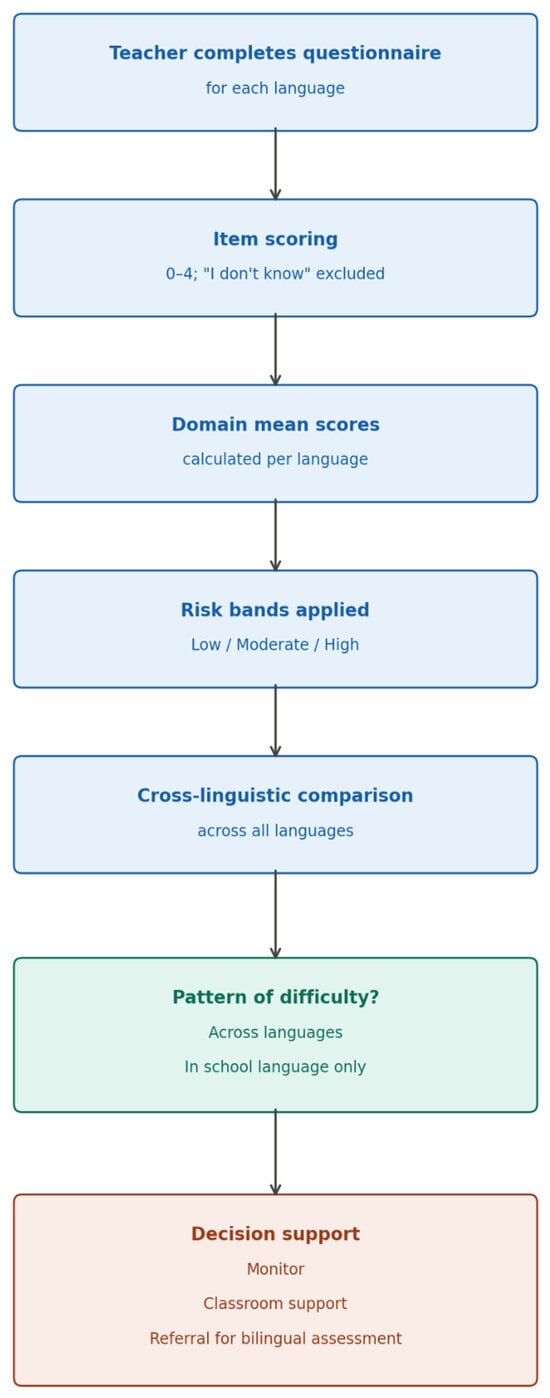
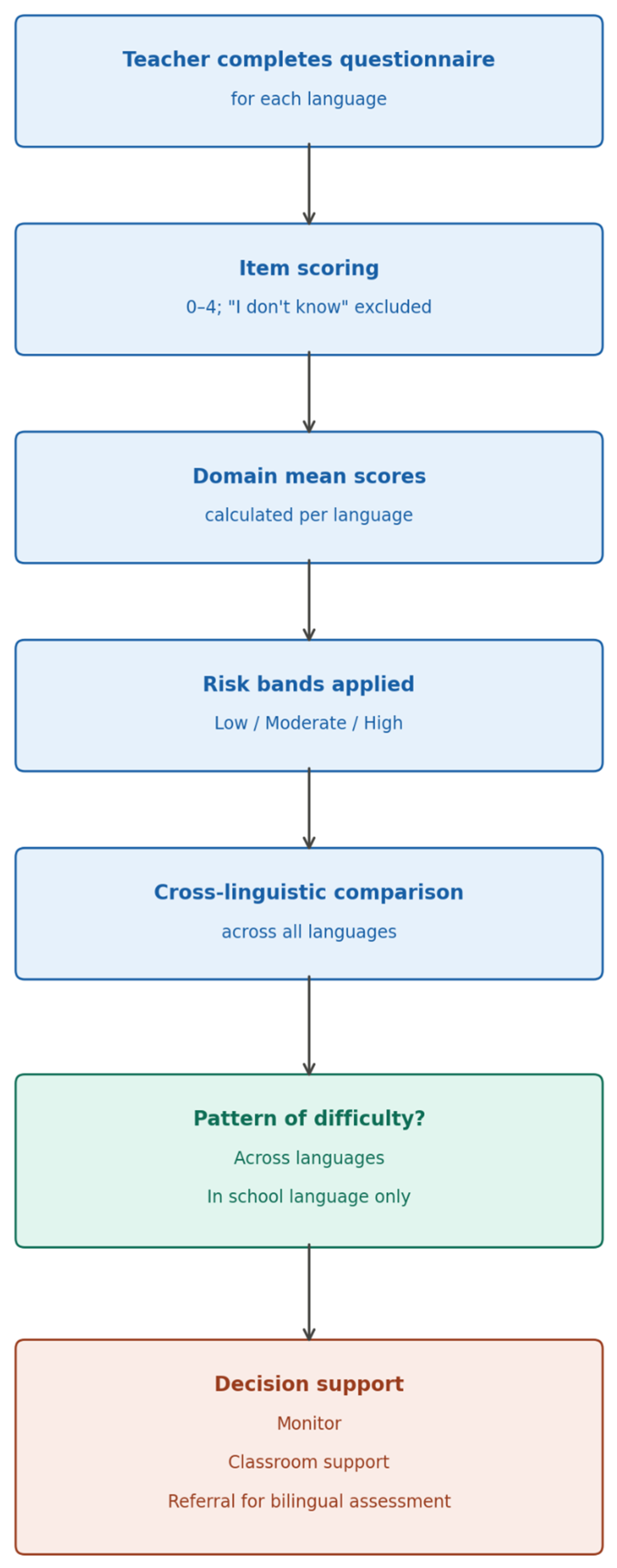

Disclaimer/Publisher’s Note: The statements, opinions and data contained in all publications are solely those of the individual author(s) and contributor(s) and not of MDPI and/or the editor(s). MDPI and/or the editor(s) disclaim responsibility for any injury to people or property resulting from any ideas, methods, instructions or products referred to in the content. |
© 2026 by the authors. Licensee MDPI, Basel, Switzerland. This article is an open access article distributed under the terms and conditions of the Creative Commons Attribution (CC BY) license.