Race, Class and Coloniality in Jamaican Education Policy & Practice


Abstract
1. Introduction
2. Literature Review
2.1. Racio-Classist Discrimination in Jamaican Society
2.2. Jamaican Student Dress and Grooming Policies
“…although race inequity may not be a planned and deliberate goal of education policy neither is it accidental. The patterning of racial advantage and inequity is structured in domination, and its continuation represents a form of tacit intentionality on the part of white powerholders and policy-makers”.(Gillborn, 2005, p. 485)
3. Methodology & Methods
3.1. Researcher Positionalities
3.1.1. Stephen
3.1.2. Robin
3.2. Data Collection
3.3. Data Analysis
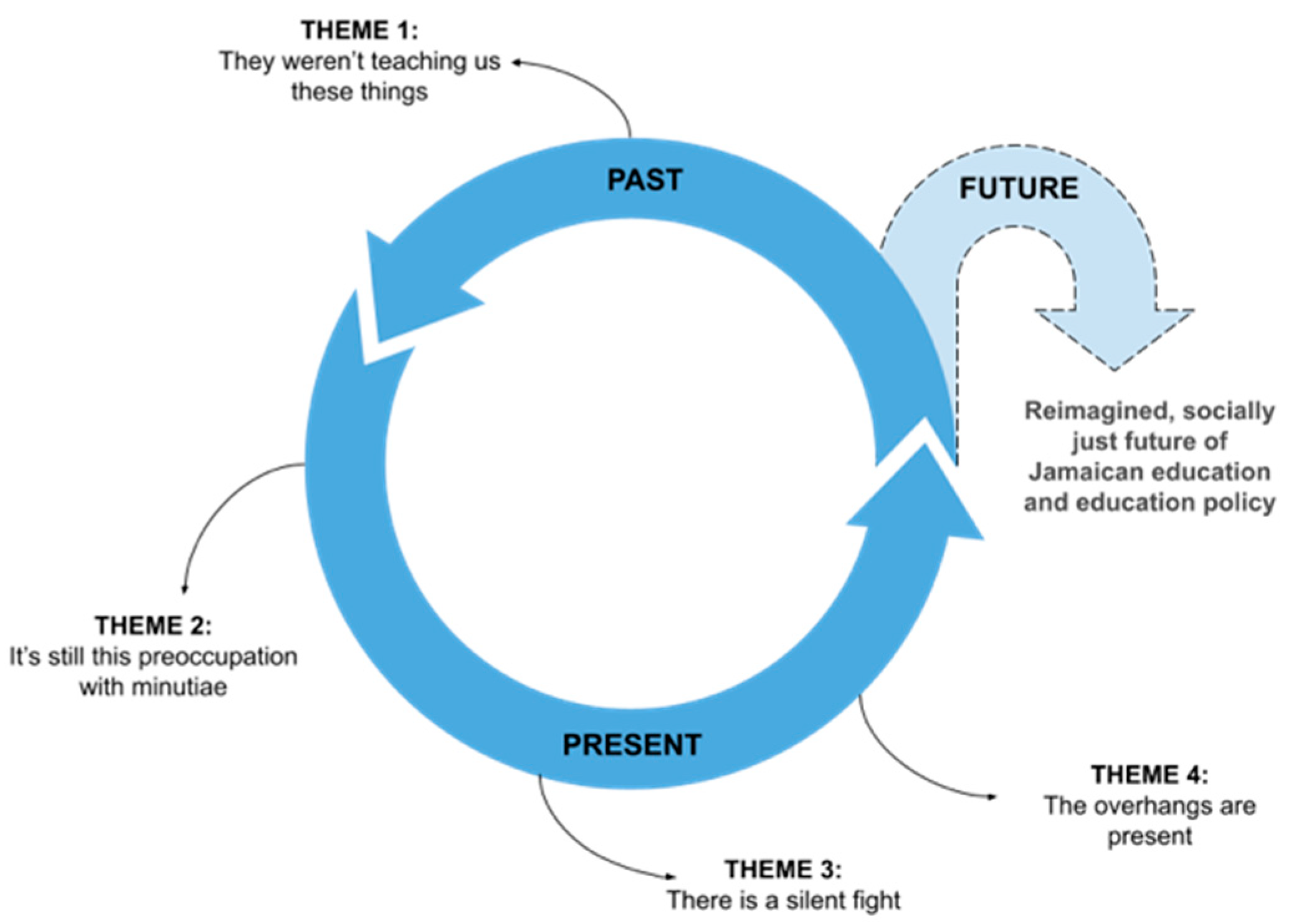
3.4. Temporality and Qualitative Analysis
4. Findings
4.1. Theme 1: “They Weren’t Teaching Us These Things”
4.1.1. Blindspots
4.1.2. Gazes
Traditionally, we are known to be persons of standards, persons that are governed by certain rules, mainly governed by the British and so the matter of uniform and attire is entrenched in our culture and school system. When you talk about identity [and] school identity, cultural identity is something that we are [bound] to uphold.(Morgan)
The premise is that we come into these Western spaces, and we get additional academic training…and then all of a sudden when we are now doing our research typically in spaces that we are familiar with, we have the dual identity of the insider–outsider, but then as outsider we have this colonial gaze…People might think ‘oh yes! Yu go farin so yu fiil se yu nais now an yu beta dan piipl an yu kyan se dis an yu kyan se dat’3 No! It’s not that! It’s because you’ve had this opportunity to step back from something…and read the things they weren’t giving you to read [locally].(August)
4.1.3. “Rules of Practice”
Sometimes [consultations] do not take place over the extended period that I think they should happen…Perhaps we start a little bit too late, and you know policy has to be implemented by a particular time to address particular needs and so because of the time constraint enough time is not allowed…for proper consultation to be done.(Dawson)
I want representation. Not necessarily me to go in to be consulted with but we have our associations [who should] not just be called in after the decision is made to be told about it. I want them to be there from the get-go…because it’s not just Head Office or Permanent Secretary and CEO4 and Education Officers.(Ariel)
[Policymakers] like to talk about ‘yes, we have these stakeholder engagements. That’s a load of BS. Those stakeholder engagements typically include very specific groups in the society. I’ve [spoken] with principals who would [say] ‘yuh hear di Ministry talking bout X? Dem did know dem was goin do dat from long time. Dem just sen’ us something…den dem put it out in di public domain that they had consultation. Dem neva have no consultation wid nobody!’5(August)
4.2. Theme 2: “It’s Still This Preoccupation with Minutiae”
If I look at my grade eleven alone, my top 5% students in terms of academic performance, their hair is groomed in a non-traditional way…the students who have demonstrated the most difficult behaviour have the ‘schoolboy cut’. There is nothing to say that delinquency is associated with grooming.
4.3. Theme 3: “There’s a Silent Fight”
4.3.1. Student Agency
Wai wi tink wi no av critical tinking in our schools?6 Who is sitting down to have these real conversations with our students and really listening to the things they say? It is about putting egos aside [because] we want our children to be educated. It is stupid to be denying children access to school because dem ier stay dis way and dem ier stay dat way an dem uniform no long enof.7
At what age can a child decide their religion?…I will have grades eight and nine students say ‘Miss, mi no riili waahn notn fi du wid dem an dem church ting8’ and the child is thinking that they want to be Rasta because they see Rasta as a way of embracing their Blackness, who they are, pushing back against the colonial restrictions and definitions of what is beautiful, and what is right, and what is wrong, and what is educated. Does the child really know enough about being Rastafari that they can say ‘I am Rastafarian’?
4.3.2. Administrative Agency
There is a place for a grooming policy to give [an] overarching dictate with flexibility on the ground in terms of local schools to craft what their school identity will look like and to connect that with the development of the student.
I am not one of those principals who is going to go in the papers for locking students out for their hair or any other such thing. Do you realise the feedback from the Ministry when these things happen? Nobody is going to draw me out for refusing to have students come to school.
“I lead a school whose thoughts are not as liberal as mine. I inherited rules and guidelines that I abide by and am responsible for their implementation… Coming into a new environment…you just have to adapt to certain things.”(Ariel)
“We are redefining some things now [but] the greatest pushback comes from the traditional teachers—a lot of whom have been in the system for a long time. They have a lot of influence.”(Sydney)
“There’s a silent fight going on and the Education Act allows certain rights to [grant-aided] institutions such as ours. So, we can set policy here that may not directly and specifically align to the government’s policy in every single way…The school has a little more control especially when it isn’t something defined by the law.”(Kim)
4.4. Theme 4: “The Overhangs Are Present”
“The significance of personal appearance grows with the age and maturity of the child and is of particular importance to adolescents seeking to assert self-identity…The seriousness to [adolescents] in dress and grooming as a means of self-expression should not be trivialised.”
“Is da girl de we dem did put out a skool fi ar ier an iivn wen shi come back wid anoda ierstail is still da girl de dem did put out a skool and she’s gonna have to live with that for the rest of her life9. ‘I was the one that they singled out.’”(Jamie)
5. Discussion
“[Jamaican schools] were designed to cultivate and conscript a British-oriented, subordinate ‘native’ elite [who] would become ‘subjectified’ from the inside by having their heads stuffed with a curriculum devoted to an idea of civilisation to which, it was hoped, they would be motivated to aspire…[The curriculum and how it was taught] valorised the British imagination, ways of life and habits of authority which the colonial authorities believed to be embedded in the…social conventions, manners, values and ideals of the ‘mother country’”.(p. 117)
5.1. Limitations
5.2. Implications for Praxis
6. Conclusions
Author Contributions
Funding
Institutional Review Board Statement
Informed Consent Statement
Data Availability Statement
Acknowledgments
Conflicts of Interest
| 1 | Interviewed as an academic researcher, but has indicated having prior training for PEI administration. |
| 2 | Interviewed as a PEI administrator, but has indicated having prior operational policymaking experience with the MOEY. |
| 3 | Contextual Translation: “Because you have studied overseas, you think you are better than those of us who haven’t, and you opinion is superior.” |
| 4 | CEO here means Chief Education Officer, a member within the highest ranks of the Ministry of Education, who directs policy. |
| 5 | Contextual Translation: “Have you heard the Ministry’s comment on X? They knew what they intended to do all along. They’ve just sent us something so they can publicly say that they’ve had consultations when they really didn’t.” |
| 6 | Direct translation: Why do we think we don’t have critical thinking in our schools? |
| 7 | Direct translation: their hair looks this way or that way or their uniform isn’t long enough. |
| 8 | Contextual translation: ‘Miss, I don’t want to be associated with them (my parents) and their Christian beliefs’. |
| 9 | Direct translation: ‘That’s the girl who was put out of school because of her hairstyle and even if she comes back with another hairstyle, she will still be the same girl, and she will have to live with that for the rest of her life.’ In this excerpt, the participant is code-mixing Jamaican and English. |
References
- Altink, H. (2019). Public secrets: Race and colour in colonial and independent Jamaica (Vol. 22). Liverpool University Press. [Google Scholar]
- Bailey, T. (2021, October 20). Attire should not be a hinderance to education—Morgan. Jamaica Gleaner. Available online: https://jamaica-gleaner.com/article/news/20211020/attire-should-not-be-hindrance-education-morgan (accessed on 20 August 2022).
- Ball, S. (1994). Education reform. McGraw-Hill Education. [Google Scholar]
- Barnett, L. (2020, August 4). No free-for-all—Judges rule there must be limits on freedom of expression in dreadlocks case. Jamaica Gleaner. Available online: https://jamaica-gleaner.com/article/lead-stories/20200804/no-free-all-judges-rule-there-must-be-limits-freedom-expression (accessed on 20 August 2022).
- Bastian, M. (2017). Liberating clocks: Developing a critical horology to rethink the potential of clock time. New Formations, 92(92), 41–55. [Google Scholar] [CrossRef]
- Bowleg, L. (2021). “The master’s tools will never dismantle the master’s house”: Ten critical lessons for black and other health equity researchers of color. Health Education & Behavior, 48(3), 237–249. [Google Scholar] [CrossRef]
- Braun, V., & Clarke, V. (2006). Using thematic analysis in psychology. Qualitative Research in Psychology, 3(2), 77–101. [Google Scholar] [CrossRef]
- Braun, V., & Clarke, V. (2019). Reflecting on reflexive thematic analysis. Qualitative Research in Sport, Exercise and Health, 11(4), 589–597. [Google Scholar] [CrossRef]
- Braun, V., & Clarke, V. (2022). Conceptual and design thinking for thematic analysis. Qualitative Psychology, 9(1), 3. [Google Scholar] [CrossRef]
- Briassoulis, H. (2004). Policy integration for complex policy problems: What, why and how (Greening of policies: Interlinkages and policy integration, pp. 3–4). Routledge. [Google Scholar] [CrossRef]
- Brissett, N. O. M. (2019). Evolution of education inclusion policy discourse in Jamaica. In Achieving inclusive education in the Caribbean and beyond: From philosophy to praxis (pp. 17–33). Springer. [Google Scholar]
- Cabinet Office. (2017). Guidelines for developing national policies. Government of Jamaica. Available online: https://cabinet.gov.jm/wp-content/uploads/2018/06/GUIDELINES-FOR-THE-DEVELOPMENT-OF-NATIONAL-POLICIES-August-2017-E-book-2.pdf (accessed on 25 June 2022).
- Cabinet Office. (2020). Government of Jamaica policy register. Government of Jamaica. Available online: https://cabinet.gov.jm/document-centre/government-of-jamaica-policy-register/ (accessed on 25 June 2022).
- Cann, C., & DeMeulenaere, E. (2020). The activist academic: Engaged scholarship for resistance, hope and social change. Myers Education Press. [Google Scholar]
- Deason, M. L., Salas, A., Newman, S. P., Macaulay, V. A., Morrison, E. Y., & Pitsiladis, Y. P. (2012). Interdisciplinary Approach to the Demography of Jamaica. BMC Evolutionary Biology, 12(1), 1–11. [Google Scholar] [CrossRef] [PubMed]
- Delgado, R. (1989). Storytelling for oppositionists and others: A plea for narrative. Michigan Law Review, 87(8), 2411–2441. [Google Scholar] [CrossRef]
- Devonish, H., & Carpenter, K. (2007). Towards full bilingualism in education: The Jamaican bilingual primary education project. Social and Economic Studies, 56(1/2), 277–303. [Google Scholar]
- Dey, I. (1999). Grounding grounded theory: Guidelines for qualitative inquiry. Academic Press. [Google Scholar]
- Du Bois, W. E. B., & Lewis, D. L. (2003). The Souls of Black Folk (Modern Library edition.). Modern Library. [Google Scholar]
- Facer, K., Siebers, J. I., & Smith, B. (2022). Working with time in qualitative research: Case studies, theory and practice (1 online resource: Illustrations). Routledge. [Google Scholar] [CrossRef]
- Finlay, L. (2021). Thematic analysis: The ‘good’, the ‘bad’, and the ‘ugly’. European Journal for Qualitative Research in Psychotherapy, 11, 103–116. [Google Scholar]
- Francis, S. L. (2023, March 15). Addressing the education ministry’s selective use of authority. The Western Mirror. 13. Available online: https://www.linkedin.com/posts/stephenlfrancis_education-educationpolicy-activity-7041700173164466176-m1Co/ (accessed on 27 February 2026).
- Gillborn, D. (2005). Education policy as an act of white supremacy: Whiteness, critical race theory and education reform. Journal of Education Policy, 20(4), 485–505. [Google Scholar] [CrossRef]
- Gillborn, D. (2006). Rethinking white supremacy: Who counts in ‘WhiteWorld’. Ethnicities, 6(3), 318–340. [Google Scholar] [CrossRef]
- Hall, S. (2017). Familiar stranger: A life between two islands (B. Schwarz, Ed.). Duke University Press. [Google Scholar]
- hooks, b. (1994). Teaching to transgress: Education as the practice of freedom. Routledge. [Google Scholar] [CrossRef]
- Hylton, K., & Hylton-Fraser, K. (2022). An evaluation of the “every child can learn, every child must learn” mantra’s alignment with educational policies in Jamaica. Equity in Education & Society, 1, 163–181. [Google Scholar] [CrossRef]
- Innes, J. E., & Booher, D. E. (2003). Collaborative policymaking: Governance through dialogue. In Deliberative policy analysis: Understanding governance in the network society (pp. 33–59). Cambridge University Press. [Google Scholar] [CrossRef]
- Jackson, M., Von Dohlen, H., & Black-Chen, M. (2024). Preparing school leaders for social justice: An analysis of educational leadership preparation programs in Jamaica. Equity in Education & Society, 4(3). [Google Scholar] [CrossRef]
- Jamaica Gleaner. (1968, October 16). Guyanese lecturer refused re-entry to Jamaica. Jamaica Gleaner.
- Jamaica Gleaner. (1971a, January). SFA protests. Jamaica Gleaner.
- Jamaica Gleaner. (1971b). Sixth formers protest use of police action. Jamaica Gleaner.
- Jamaica Gleaner. (2020, July 31). Court rules constitutional rights of 5-y-o dreadlocked girl were not breached. Jamaica Gleaner. Available online: https://jamaica-gleaner.com/article/news/20200731/court-rules-constitutional-rights-5-y-o-dreadlocked-girl-were-not-breached (accessed on 20 August 2022).
- Jamaica Observer. (2021, June 20). Frome students allegedly turned away because of hairstyles, despite ministry’s directive. The Jamaica Observer. Available online: https://www.jamaicaobserver.com/latest-news/frome-students-allegedly-turned-away-because-of-hairstyles-despite-ministrys-directive/ (accessed on 20 August 2022).
- James, C. L. R. (2013). Beyond a boundary. Duke University Press. [Google Scholar]
- Joseph-Salisbury, R., & Connelly, L. (2018). ‘If your hair is relaxed, white people are relaxed. If your hair is nappy, they’re not happy’: Black hair as a site of ‘post-racial’ social control in English schools. Social Sciences, 7(11), 219. [Google Scholar] [CrossRef]
- Kua, H. W. (2007). Information flow and its significance in coherently integrated policymaking for promoting energy efficiency. Environmental Science & Technology, 41(9), 3047–3054. [Google Scholar] [CrossRef]
- Lamming, G. (1991). In the castle of my skin. University of Michigan Press. [Google Scholar]
- Matthews, B., & Ross, L. (2010). Research methods: A practical guide for the social sciences. Pearson Education. [Google Scholar]
- McPherson, E. S. P., & Semaj, L. T. (1980). Rasta chronology. Caribbean Quarterly, 26(4), vii–viii. [Google Scholar] [CrossRef]
- Miller, K. (2021). Mr. Brown, Mrs White & Ms Black. In Things I have withheld (pp. 18–42). Canongate Books Ltd. [Google Scholar]
- National Student Dress and Grooming Guidelines. (2018). Available online: https://moey.gov.jm/wp-content/uploads/2018/09/Dress-and-Grooming-Policy-Guidelines-September-2018.pdf (accessed on 1 June 2021).
- Omi, M., & Winant, H. (2015). Racial formation in the United States (3rd ed.). Routledge/Taylor & Francis Group. [Google Scholar]
- Philip, N. (1995). Discourse on the logic of language. Review: Literature and Arts of the Americas, 28(50), 12–13. [Google Scholar] [CrossRef]
- Radio Jamaica News. (2022, April 13). Education minister defends handling of student dress code issues. Available online: http://radiojamaicanewsonline.com/local/education-minister-defends-handling-of-student-dress-code-issues (accessed on 25 August 2022).
- Rizvi, F., & Lingard, B. (2009). Conceptions of education policy. In Globalizing education policy. Routledge. [Google Scholar]
- Saldaña, J. (2013). The coding manual for qualitative researchers. In The coding manual for qualitative researchers (2nd ed., pp. 1–440). SAGE. [Google Scholar]
- Senior, O. (1985). Colonial girls’ school. In Talking of trees (pp. 26–27). Carcanet Press, Limited. [Google Scholar]
- Simmonds, S. (2022a, April 26). Education ministry contemplating sanctioning administrators who bar students from classes. Available online: https://nationwideradiojm.com/education-ministry-contemplating-sanctioning-administrators-who-bar-students-from-classes/ (accessed on 5 July 2022).
- Simmonds, S. (2022b, April 28). Kingston college refutes reports students were barred from school. Available online: https://nationwideradiojm.com/kingston-college-refutes-reports-students-were-barred-from-school/ (accessed on 5 July 2022).
- Solórzano, D. (2013, April 27). Critical race theory’s intellectual roots in ethnic studies and Freirean education [Paper presentation]. Annual Meeting of the American Educational Research Association, San Francisco, CA, USA. [Google Scholar]
- Sriprakash, A., Rudolph, S., & Gerrard, J. (2022). Learning whiteness: Education and the settler colonial state. Pluto Press. [Google Scholar]
- Thomas, C. (2021, July 20). Williams: Don’t bar school kids for hairstyles. Jamaica Gleaner. Available online: https://jamaica-gleaner.com/article/news/20210720/williams-dont-bar-schoolkids-hairstyles (accessed on 20 August 2022).
- Tuhiwai Smith, L. (2021). Decolonizing methodologies: Research and indigenous peoples. Bloomsbury Publishing. [Google Scholar]
- Williams, A. (2022, April 27). Rage at KC as students barred over hairstyles. Jamaica Gleaner. Available online: https://jamaica-gleaner.com/article/lead-stories/20220427/rage-kc-students-barred-over-hairstyles (accessed on 8 August 2022).
- Yancy, G. (2008). Colonial gazing: The production of the body as “other”. Western Journal of Black Studies, 32(1), 1–15. [Google Scholar]


| Category | Participant Pseudonym |
|---|---|
| Academic Researcher | Alex |
| August1 | |
| Jamie | |
| Robin | |
| Taylor | |
| PEI Administrator | Ariel |
| Kim | |
| Shannon | |
| Sydney2 | |
| Policymaker | Dawson |
| Morgan |
| Theme | Codes |
|---|---|
| “They weren’t teaching us these things” | Blindspots Gazes Rules of Practice |
| “It’s still this preoccupation with minutiae” | Distractions from teaching and learning Policy or Guideline? |
| “There is a silent fight” | Student Agency Administrative Agency |
| “The overhangs are present” | Persistence of Colonialism Attire and Identity Formation |
Disclaimer/Publisher’s Note: The statements, opinions and data contained in all publications are solely those of the individual author(s) and contributor(s) and not of MDPI and/or the editor(s). MDPI and/or the editor(s) disclaim responsibility for any injury to people or property resulting from any ideas, methods, instructions or products referred to in the content. |
© 2026 by the authors. Licensee MDPI, Basel, Switzerland. This article is an open access article distributed under the terms and conditions of the Creative Commons Attribution (CC BY) license.
Share and Cite
Francis, S.L.; Shields, R. Race, Class and Coloniality in Jamaican Education Policy & Practice. Educ. Sci. 2026, 16, 615. https://doi.org/10.3390/educsci16040615
Francis SL, Shields R. Race, Class and Coloniality in Jamaican Education Policy & Practice. Education Sciences. 2026; 16(4):615. https://doi.org/10.3390/educsci16040615
Chicago/Turabian StyleFrancis, Stephen L., and Robin Shields. 2026. "Race, Class and Coloniality in Jamaican Education Policy & Practice" Education Sciences 16, no. 4: 615. https://doi.org/10.3390/educsci16040615
APA StyleFrancis, S. L., & Shields, R. (2026). Race, Class and Coloniality in Jamaican Education Policy & Practice. Education Sciences, 16(4), 615. https://doi.org/10.3390/educsci16040615