Article

Integrating Generative AI and Cultural Storytelling to Enhance Geometry Learning in Vietnamese Primary Classrooms: A Quasi-Experimental Study


by
Nguyen Huu Hau
1,
Pham Sy Nam
2,*,
Trinh Cong Son
3,
Dao Chung Lan Anh
4,
Nguyen Thuy Van
5,
Pham Thi Thanh Tu
6,
Tran Thuy Nga
7 and
Vo Xuan Mai
8
1
Faculty of Natural Sciences, Hong Duc University, Thanh Hoa 440 000, Vietnam
2
Faculty of Mathematics and Application, Sai Gon University, Ho Chi Minh 700 000, Vietnam
3
Faculty of Primary Education, Nghe An University, Thanh Vinh 43 132, Vietnam
4
Cohort 26—Primary Education, Faculty of Education, Hong Duc University, Thanh Hoa 440 000, Vietnam
5
Faculty of Education, Phu Yen University, Tuy Hoa 56 000, Vietnam
6
Faculty of Primary Education, Sai Gon University, Ho Chi Minh 700 000, Vietnam
7
The Vietnam National Institute of Education Sciences, Ha Noi 100 000, Vietnam
8
Faculty of Mathematics and Information Teacher Education, School of Education, Dong Thap University, Cao Lanh 81121, Vietnam
*
Author to whom correspondence should be addressed.
Educ. Sci. 2026, 16(4), 588; https://doi.org/10.3390/educsci16040588
Submission received: 10 March 2026 / Revised: 29 March 2026 / Accepted: 1 April 2026 / Published: 7 April 2026

Abstract

In Vietnamese primary mathematics education, geometry instruction often emphasizes rote calculation and formula memorization rather than meaningful contextualization, leaving students disconnected from abstract concepts and lacking opportunities to connect learning with cultural identity. This quasi-experimental study investigates how integrating generative AI tools (ChatGPT, DALL·E, Canva) with the culturally grounded Vietnamese folktale Bánh Chưng—Bánh Giầy can support Grade 5 students’ understanding of circle geometry. Employing a mixed-methods design with 30 students divided into experimental (AI + storytelling) and control (traditional instruction) groups, the study measured cognitive and affective learning outcomes through pre/post-tests, a validated 25-item questionnaire, interviews, and classroom observations. Quantitative results revealed significant improvements in the experimental group across all measured dimensions, learning interest, attentional focus, conceptual understanding, mathematics passion, and cultural preservation awareness, with large effect sizes. Qualitative findings confirmed enhanced engagement, multimodal conceptual clarity, and cultural affective resonance. The study demonstrates that low-cost, teacher-mediated generative AI can effectively support learning in resource-constrained primary settings when anchored in local narratives. Implications for ethical AI integration and teacher professional development in Vietnamese contexts are discussed.

1. Introduction

Mathematics is often perceived as a subject of abstract facts and skills, requiring mechanical memorization and potentially causing anxiety or math phobia among students, particularly at the primary school level (Arneja & Tyagi, 2020). Teaching mathematical concepts, such as geometry, to young students using traditional methods often faces numerous challenges, as the abstract nature of the subject makes it difficult for them to grasp and connect with real-life applications (Garderen, 2004; Unodiaku, 2012). In Vietnam, teaching geometric quantities at the primary level sometimes still emphasizes formal calculations and rule application, without truly focusing on connecting and applying them to practical problems (Tran, 2019b). Therefore, seeking innovative pedagogical strategies to make mathematics more accessible, engaging and meaningful is an urgent necessity.
Using storytelling methods in mathematics teaching has been proven to be a powerful pedagogical tool to address these challenges (Goral & Gnadinger, 2006; Lambert, 2013). Storytelling helps to “humanize” mathematics, allowing students to connect with the subject at a personal and emotional level, while providing a realistic context that helps them form visual images in their minds (Toor & Mgombelo, 2015; Zazkis & Liljedahl, 2009). Furthermore, incorporating stories rich in local cultural identity creates a culturally responsive pedagogical environment, helping students see the close connection between scientific knowledge and traditional values, thereby enhancing learning interest and cultural preservation awareness (Gay, 2018; Sofowora & Agbedokun, 2010).
Along with technological development, traditional storytelling has evolved into Digital storytelling (DST), combining the art of storytelling with multimedia tools such as images, audio and video (Robin, 2008). Digital storytelling not only promotes motivation, engagement and learning achievement but also develops essential 21st-century skills such as digital literacy and critical thinking abilities (Hung et al., 2012; Yang & Wu, 2012). Recently, the explosion of Generative AI (GenAI) such as ChatGPT and DALL·E has brought unprecedented opportunities to education (Chiu et al., 2024; Qu et al., 2024). GenAI tools are capable of supporting the creation of multimedia content, personalizing learning experiences and helping teachers synthesize information in storytelling methods quickly and efficiently (Chiu, 2023).
While existing research has established the potential of cultural storytelling and digital storytelling in mathematics education, several critical gaps remain unaddressed. First, prior studies have largely focused on higher education contexts, leaving primary education, particularly in developing countries, underexplored (Chiu, 2023; Dwivedi et al., 2023). Second, although digital storytelling has been shown to enhance engagement, researchers have not systematically examined how generative AI can be intentionally integrated into storytelling to address teachers’ practical constraints, such as the time and technological proficiency required to create high-quality multimedia narratives (Robin, 2008). Third, and perhaps most notably, no existing study has investigated the integration of culturally grounded storytelling with generative AI tools to teach geometry in Vietnamese primary classrooms, nor has research examined how such integration might foster both mathematical understanding and cultural preservation awareness simultaneously.
To fill this gap, this quasi-experimental study investigates the impact of an AI-enhanced storytelling intervention on primary students’ geometry learning in Vietnam. Built on the foundation of culturally responsive pedagogy, this research integrates Generative AI tools (ChatGPT, DALL·E, Canva) with the traditional folk tale “Bánh Chưng—Bánh Giầy” to teach circle concepts (circumference and area) to 30 fifth-grade students. Through comparison between experimental and control groups, the study expects to provide concrete assessments of this model’s effectiveness in enhancing student concentration, learning interest, conceptual understanding, mathematics enthusiasm and cultural preservation awareness, while discussing implications for ethical AI integration and teacher professional development in developing regions.
The research is guided by three questions:
Question 1: How can GenAI and culturally grounded storytelling be co-designed for primary geometry instruction in Vietnam?
Question 2: What is the impact of this integration on students’ cognitive and affective learning outcomes?
Question 3: What are the practical enablers and ethical considerations from teacher and student perspectives?
By answering these questions, this study contributes a scalable, low-cost framework for AI integration in Global South classrooms, one that positions AI not as a replacement for teachers, but as a creative amplifier of human-centered, culturally resonant pedagogy. In doing so, it responds to JOTSE’s mission of advancing technology-enhanced science and mathematics education that is contextually grounded, ethically sound and pedagogically meaningful.
The remainder of this paper is organized as follows. Section 2 reviews the relevant literature on AI in education, storytelling-based learning, geometry instruction in primary education, and the Vietnamese educational context, concluding with a synthesis of the research gap. Section 3 describes the mixed-methods methodology, including the quasi-experimental design, intervention development, participants, data collection instruments, and analysis procedures. Section 4 presents the quantitative and qualitative findings, organized according to the three research questions. Section 5 discusses the theoretical contributions, empirical alignment with existing literature, practical implications, and limitations of the study. Section 6 concludes with a summary of key contributions and final reflections.

2. Literature Review

2.1. Artificial Intelligence in Education: Opportunities and Limitations

While Generative Artificial Intelligence (GenAI) offers transformative potential for personalizing learning and reducing administrative burdens (Chiu, 2023), its integration into classroom practice remains contested. Proponents highlight efficiency gains in material creation and feedback loops; however, critical scholars warn of risks ranging from algorithmic hallucinations to the erosion of student critical thinking (Dwivedi et al., 2023; Kasneci et al., 2023). Crucially, this debate often overlooks the mediating role of the teacher. Rather than viewing AI as an autonomous tutor, recent frameworks suggest its value lies in augmenting teacher capacity, provided educators possess the literacy to critique and adapt AI outputs ethically (Chiu et al., 2024). This study positions AI not as a replacement, but as a scaffolded tool requiring deliberate pedagogical oversight.

2.2. Storytelling-Based Learning in Mathematics Education

Mathematics is often perceived as a subject of abstract facts requiring mechanical memorization, which can easily lead to “math anxiety” among students (Goral & Gnadinger, 2006). The storytelling method has been proven to be a powerful pedagogical tool to overcome this barrier. Storytelling helps to “humanize” mathematics, engaging learners’ imagination and emotions while providing realistic contexts that make concepts more meaningful (Toor & Mgombelo, 2015; Zazkis & Liljedahl, 2009). As technology advances, this method has evolved into Digital storytelling (DST), combining images, audio and multimedia. Research confirms that DST not only enhances motivation and active engagement but also promotes students’ critical thinking and problem-solving competencies (Hung et al., 2012; Yang & Wu, 2012).
While studies like Hung et al. (2012) demonstrated the benefits of DST, they often relied on pre-made multimedia, overlooking the challenges teachers face in content creation. This study addresses this gap by exploring how GenAI can streamline the production process.

2.3. Geometry Learning in Primary Education: Challenges and Innovations

Teaching mathematics, particularly geometric concepts to young students using traditional “chalk-and-board” methods, faces significant difficulties due to the abstract nature of the subject (Garderen, 2004; Unodiaku, 2012). Students often encounter obstacles in reading comprehension of word problems and spatial visualization. Visual representations and the process of visualisation have an important role in geometry learning (Žakelj & Klančar, 2022). Visual aids and geometry software can help concretize abstract concepts, which impacts students’ learning: Students can also make connections with experiments then discover mathematics (Phung et al., 2024). Notably, integrating geometry into stories enables students to connect learning content with personally meaningful contexts, thereby forming vivid mental images to facilitate problem-solving (Casey et al., 2008; Goral & Gnadinger, 2006). Stories provide a practical lens through which students can develop a deeper understanding of geometric quantities such as circumference and area. However, beyond these general challenges, research has identified several specific cognitive difficulties that primary students commonly experience when learning geometry.
First, distinguishing between shapes and their properties is a foundational challenge. Young learners may recognize a circle or a square holistically but struggle to identify its constituent elements, such as the radius, diameter, center, or the relationship between them. This transition from holistic perception to analytic understanding requires explicit instructional scaffolding (Clements & Sarama, 2009). Second, confusion between perimeter and area is well documented across educational contexts. Students frequently conflate these two measures, not understanding why one is expressed in linear units and the other in square units. This confusion often persists when instruction emphasizes formula memorization without grounding concepts in concrete, contextualized experiences (Tran, 2019a; Žakelj & Klančar, 2022). Third, spatial visualization difficulties hinder students’ ability to mentally manipulate shapes, predict transformations, or understand the relationship between two-dimensional representations and real-world objects. For example, when learning about circles, students may have trouble conceptualizing how the circumference can be “unwrapped” into a straight line or how the radius relates to the diameter.
In this context, visual representations and the process of visualization play an important role in geometry learning (Žakelj & Klančar, 2022). Visual aids and geometry software can help concretize abstract concepts. For instance, GeoGebra has been shown to support students’ learning in three key ways: visualizing abstract concepts, making connections between representations and enabling discovery through experimentation (Phung et al., 2024). In the Vietnamese context, Phung et al. (2024) demonstrated that GeoGebra facilitated sixth-grade students’ understanding of symmetry by allowing them to manipulate shapes and observe invariant properties, shifting the focus from rote memorization to conceptual exploration. However, the authors noted that effective integration requires careful teacher mediation and alignment with curriculum goals.
Beyond digital tools, integrating geometry into stories enables students to connect learning content with personally meaningful contexts, thereby forming vivid mental images to facilitate problem-solving (Casey et al., 2008; Goral & Gnadinger, 2006). Stories provide a practical lens through which students can develop deeper understanding of geometric quantities such as circumference and area. When narratives draw from local cultural heritage, they also serve as vehicles for culturally responsive pedagogy, helping students see mathematics as embedded within their own traditions and daily lives (Gay, 2018).
Research in the Vietnamese context further underscores the need for innovation. Tran (2019a, 2019b) critically examined the teaching of perimeter and area in Vietnamese primary textbooks, revealing an overemphasis on formulaic calculation and algorithmic application. Geometry instruction, Tran argued, often prioritizes number-based strategies over spatial reasoning, leaving students with procedural fluency but limited conceptual understanding. Moreover, the scarcity of learning materials that connect geometric concepts to real-world or culturally meaningful contexts constrains students’ ability to see mathematics as relevant. This critique aligns with broader observations in Southeast Asian mathematics education, where traditional instruction tends to emphasize rote learning and teacher-centered approaches, often at the expense of exploration, visualization and contextualization (Sofowora & Agbedokun, 2010).
Innovations and research gap: Digital storytelling (DST) extends the narrative approach by incorporating multimedia elements such as images, audio and interactive features. Research has shown that DST enhances student motivation, critical thinking and learning achievement (Hung et al., 2012; Robin, 2008; Yang & Wu, 2012). However, a persistent barrier to DST adoption in resource-constrained settings is the time and technological proficiency required for teachers to create high-quality digital narratives (Robin, 2008). This barrier is particularly salient in Vietnam, where teachers often have limited access to professional development in technology integration and heavy workloads that constrain lesson preparation time. The emergence of generative AI (GenAI) tools offers a potential pathway to overcome these barriers by enabling teachers to efficiently create culturally grounded, visually rich and pedagogically sequenced learning materials. Yet empirical evidence on the integration of GenAI into primary geometry instruction, particularly in Global South contexts, remains scarce. This study addresses this gap by examining how AI-enhanced storytelling can support Vietnamese Grade 5 students in learning circle geometry, while attending to the specific cognitive difficulties and contextual constraints identified in the literature.

2.4. The Vietnamese Context: Curriculum Reform and Pedagogical Gaps

In Vietnam, the 2018 General Education Curriculum is driving substantial innovation, emphasizing experiential learning activities, mathematical modeling competencies and the application of knowledge to real-world contexts (Ministry of Education and Training, 2018b). Despite these clear orientations, significant pedagogical gaps persist in primary mathematics education practice in Vietnam. The teaching of geometric quantities sometimes remains heavily focused on formal arithmetic calculations, rote memorization of formulas and prioritization of number-based strategies rather than exploration through the visual aspects of geometry (Tran, 2019a). The scarcity of teaching materials and learning scenarios that connect mathematics with local cultural identity (Culturally Responsive Pedagogy) limits primary students’ ability to make real-world connections and sustain learning interest.

2.5. Synthesis and Research Gap

Overall, storytelling methods and DST hold tremendous potential for enhancing student engagement and mathematics learning outcomes. However, independently designing high-quality digital stories often presents challenges for teachers due to resource constraints and the demands of time and technological proficiency (Robin, 2008). The emergence of GenAI could address this barrier, yet most current discussions and research on GenAI have primarily focused on higher education levels (Chiu et al., 2024). The application of low-cost, teacher-mediated GenAI tools to support Culturally Responsive Pedagogy, specifically, integrating folk tales into geometry instruction at the primary level in developing countries, remains a significant research gap. This quasi-experimental study was conducted to fill this gap, providing empirical evidence on the impact of an AI-enhanced cultural storytelling model on student learning outcomes and perceptions in Vietnam.

3. Methodology

Guided by Creswell and Plano Clark’s (2017) convergent mixed-methods framework, this study intentionally combined quantitative measures of learning gains with qualitative insights into classroom dynamics. This dual approach was selected to address a core tension in educational innovation research in Vietnam: while test scores can signal immediate cognitive impact (RQ2), understanding “how” and “why” teachers and students engage with AI-mediated storytelling (RQ1, RQ3) requires rich, contextual data that numbers alone cannot capture.

3.1. Research Design

We adopted a quasi-experimental pretest–posttest control group design, recognizing that random assignment of individual students is rarely feasible in Vietnamese public schools, where class structures are fixed by administrative decree (Shadish et al., 2002). Two intact Grade 5 classes (N = 30) from a public primary school in Thanh Hóa Province were purposively selected with school leadership approval.
The 35 min duration was not arbitrary but intentionally selected to mirror the standard length of a single mathematics period in Vietnamese primary schools under the 2018 General Education Curriculum (Ministry of Education and Training, 2018a). By respecting this authentic constraint, the intervention was designed for ecological validity and replicability, testing what is achievable within existing temporal structures rather than idealized laboratory conditions.

3.2. Intervention Development and Implementation

The AI-SBL intervention emerged from iterative co-design sessions between the researcher and the classroom teacher, guided by Wiggins and McTighe’s (2005) backward design principle: we first clarified the geometric competencies required by Vietnam’s Grade 5 curriculum, then asked, ‘What story, what visuals and what AI support would help students own these concepts?’ Rather than a linear sequence, the design process was recursive, narrative choices prompted curriculum refinements, which in turn reshaped prompt engineering for AI tools.
First, curricular alignment ensured that all learning objectives were explicitly mapped to Vietnam’s 2018 General Education Curriculum for Grade 5 Geometry (Ministry of Education and Training, 2018a). This foundational step guaranteed that the intervention addressed required competencies while allowing pedagogical innovation.
Second, narrative selection involved choosing the Vietnamese folktale “The Legend of Bánh Chưng and Bánh Giầy” as the cultural anchor for the lesson. This particular story was selected for its embedded geometric symbolism, the square representing Earth and the circle representing Sky, as well as its deep cultural familiarity among Vietnamese students. The narrative provided a natural context for introducing circle concepts while honoring traditional heritage. The topic of circumference and area of a circle was selected for three interconnected reasons. First, curricular relevance: according to Vietnam’s 2018 General Education Curriculum for Grade 5 Mathematics, students are required to calculate the circumference and area of a circle, making this topic a mandatory learning outcome (Ministry of Education and Training, 2018b). Second, known learning difficulties: prior research has documented that primary students frequently confuse perimeter and area, treating them as interchangeable concepts (Tran, 2019a; Žakelj & Klančar, 2022). This confusion often stems from instruction that emphasizes formula memorization without concrete, contextualized experiences. Third, narrative alignment: the chosen folktale naturally features a round cake (Bánh giầy) symbolizing the Sky, providing an authentic cultural context for exploring the properties of a circle, its diameter, circumference, and area. The story’s problem—Lang Liêu needing to measure the cake—offers a meaningful narrative hook that transforms abstract formulas into a practical, emotionally engaging task.
Before the intervention, students in both groups had been introduced to basic circle concepts in earlier grades (Grades 3 and 4). According to the curriculum, they could identify a circle, distinguish it from other shapes, and understand basic vocabulary such as “center,” “radius,” and “diameter” at an introductory level. However, they had not yet learned the formulas for circumference and area, nor had they applied these concepts to real-world or culturally contextualized problems. Thus, the AI-SBL lesson functioned as a first formal introduction to the formulas and their application, rather than merely consolidation. The hands-on measuring activities and narrative context were designed to build conceptual understanding from the ground up, not simply to reinforce previously memorized procedures.
Third, AI integration employed three complementary generative AI tools, each serving a distinct pedagogical purpose:
ChatGPT (v4.0) generated draft narrative scripts and formative questions; however, the teacher revised all outputs to ensure mathematical precision (e.g., avoiding ambiguous phrasing of ‘radius’ vs. ‘diameter’) and age-appropriate vocabulary.
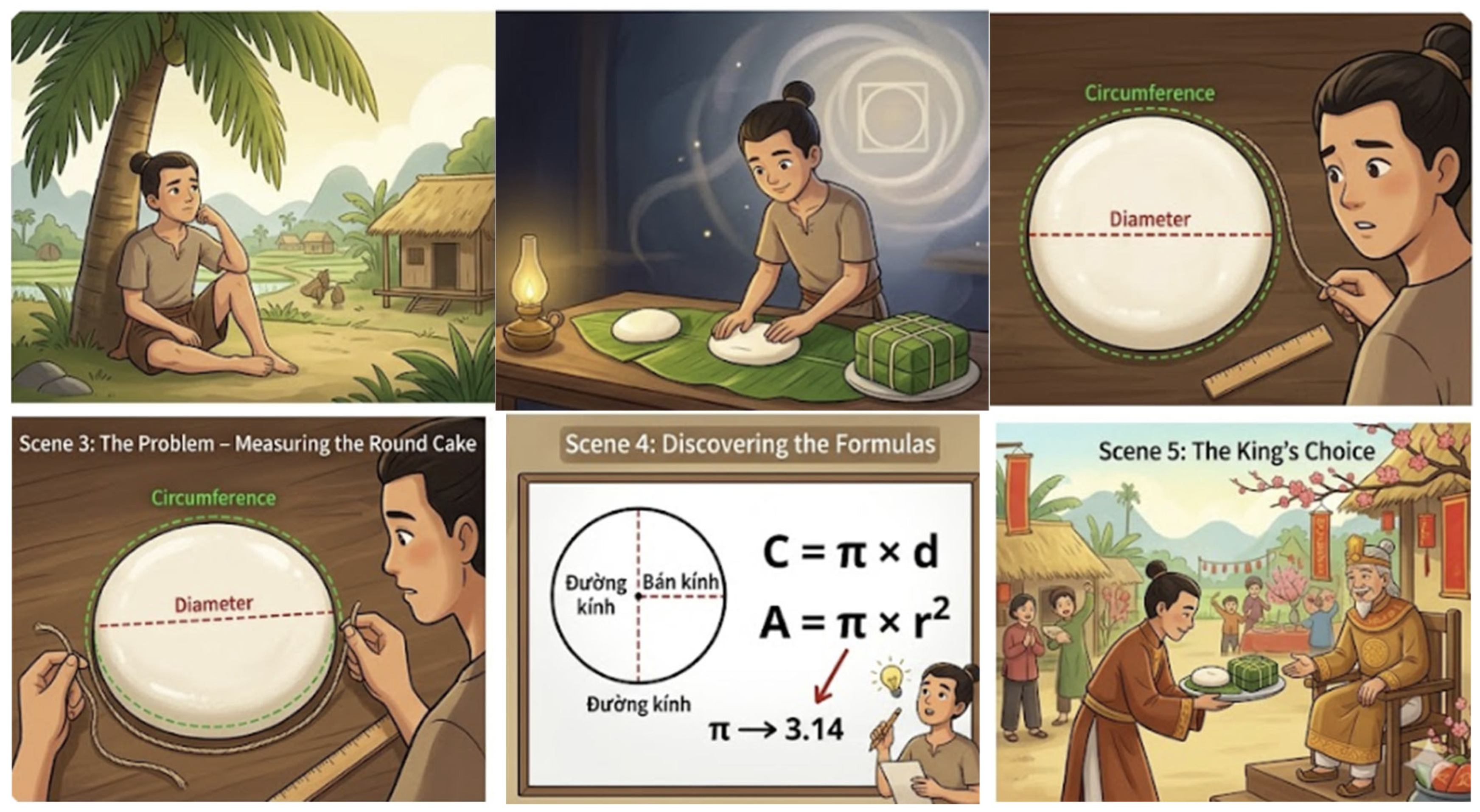
DALL·E 3 produced visual anchors for the circular Bánh giầy (Figure 1); crucially, the teacher rejected ~40% of initial generations for cultural inaccuracies (e.g., Korean-style rice cakes) or mathematical distortions (e.g., non-circular shapes), iterating prompts until visuals met both aesthetic and conceptual criteria.
Canva served as the assembly platform, but its interactive features (e.g., clickable prompts) were only retained after pilot testing confirmed they enhanced, rather than distracted from, student focus.
Fourth, pedagogical sequencing organized these materials into a five-stage lesson structure (learner analysis → narrative adaptation → material design → implementation → assessment) that guided students from initial engagement through conceptual application and cultural reflection.
Throughout this process, the teacher maintained pedagogical agency, with AI serving as a creative amplifier rather than a replacement for professional judgment. All AI-generated content was reviewed, refined and in some cases rejected when it failed to meet cultural or mathematical standards.
The resulting AI-enhanced storytelling materials were then implemented in the experimental group classroom, as detailed in the following section. The complete narrative script and a sample of AI-generated visuals are provided in Appendix B to enhance transparency and replicability
Two Grade 5 teachers participated in the study. Teacher A (with 12 years of experience) was responsible for implementing the intervention in the experimental group, while Teacher B (with 10 years of experience) taught the control group using traditional methods. Both teachers attended the co-design sessions but did not observe each other’s lessons to minimize contamination effects. The first author, as the lead researcher, conducted the co-design sessions, classroom observations and interviews but did not directly deliver instruction during the intervention.

3.3. Student Learning Tasks

The lesson was designed as a first formal introduction to the formulas for circumference and area of a circle. Although students had previously encountered basic circle vocabulary (center, radius, diameter) in earlier grades, they had not yet learned how to calculate circumference or area, nor applied these concepts in meaningful contexts. The experimental group engaged with the AI-SBL intervention through a structured sequence of five learning phases, as summarized in Table 1 below. Each phase was designed to progressively build conceptual understanding while maintaining narrative engagement.
Throughout all phases, students worked collaboratively, shared reasoning and received formative feedback from the teacher. The control group covered identical geometric content through traditional textbook exercises and teacher-led instruction without narrative context or AI-generated materials.

3.4. Data Collection Instruments

Data were collected through three complementary sources (see Table 2 and Table 3):
The 25-item Likert-scale questionnaire was developed through three rounds of expert review: two mathematics educators evaluated alignment with Grade 5 geometry competencies; two AI-in-education researchers assessed item clarity regarding technology-mediated learning; and a primary school teacher piloted wording with five non-participant students to ensure age-appropriate phrasing. The Vietnamese version underwent back-translation by an independent bilingual scholar to verify semantic equivalence with the English source. The instrument measured five latent constructs: (1) Learning Interest (α = 0.88), (2) Attention/Cognitive Focus (α = 0.86), (3) Content Understanding (α = 0.75), (4) Mathematics Learning Passion (α = 0.79) and (5) Cultural Preservation Awareness (α = 0.72).
A 10-item multiple-choice test was developed to assess students’ conceptual understanding of circle geometry, covering identification of radius, diameter, circumference, and area, as well as application of formulas in simple contexts. The same test was administered to both groups as a pretest (immediately before the intervention) and as a posttest (immediately after the intervention) to enable direct comparison of learning gains. The test items are provided in Appendix C.
The primary focus of this study is on the affective and engagement constructs measured by the 25-item questionnaire; the cognitive test results serve two purposes: (1) to establish baseline equivalence between groups, and (2) to provide supplementary evidence of cognitive learning gains. These results are presented in Section 4.2.

3.5. Data Analysis Procedures

Quantitative data were analyzed using SPSS v28 and AMOS v26. Descriptive statistics (means and standard deviations) summarized outcome scores, while independent samples t-tests compared posttest and questionnaire scores between groups. Reliability was assessed through Cronbach’s α and Composite Reliability (CR).
Validity was established via a two-stage approach. First, Exploratory Factor Analysis (EFA) with oblimin rotation and parallel analysis was conducted to examine the underlying factor structure. Second, Confirmatory Factor Analysis (CFA) using Maximum Likelihood estimation tested the measurement model, with fit assessed against established thresholds: χ2/df < 3, CFI > 0.95, TLI > 0.95, RMSEA < 0.06 and SRMR < 0.08 (Hu & Bentler, 1999). Following confirmation of the measurement model, Structural Equation Modeling (SEM) was employed to test hypothesized pathways among the five latent constructs.
For qualitative data, thematic analysis was conducted following Braun and Clarke’s (2006) six-phase framework. Interviews and field notes were transcribed verbatim and coded inductively. To ensure reliability, two researchers independently coded 20% of transcripts, achieving strong intercoder agreement (κ = 0.85). Emergent themes were triangulated with observational data and student artifacts to enhance credibility and transferability of findings.

3.6. Ethical Considerations

The study was exempt from ethical review in accordance with local for this type of research, as confirmed on 20 December 2025.

4. Results

This section presents findings from the quasi-experimental study evaluating the impact of the AI-enhanced storytelling-Based Learning (AI-SBL) model. The results are organized to address each research question sequentially, drawing on quantitative data from pre/post-tests and questionnaires and qualitative data from interviews and classroom observations.

4.1. Psychometric Properties of the Measurement Model

A 25-item Likert-scale questionnaire was developed to measure five latent constructs: Learning Interest, Attention/Cognitive Engagement, Content Understanding, Mathematics Learning Passion and Cultural Preservation Awareness. Prior to testing the main hypotheses, the instrument’s validity and reliability were systematically examined.
Given the exploratory nature of this pilot study and the limited sample size (N = 30), the use of Confirmatory Factor Analysis (CFA) and Structural Equation Modeling (SEM) should be interpreted as exploratory rather than confirmatory. These analyses aim to explore the underlying structural relationships among constructs and provide preliminary insights, acknowledging that larger-scale validation is required for generalizable conclusions
Descriptive statistics indicated acceptable item distributions, with skewness (range = −0.82 to 0.31) and kurtosis (range = −0.76 to 1.04) falling within recommended thresholds (±2). The Kaiser–Meyer–Olkin measure (KMO = 0.92) and Bartlett’s test of sphericity (χ2 = 2345.12, df = 300, p < 0.001) supported factorability.
Exploratory Factor Analysis (EFA) with oblimin rotation and parallel analysis yielded a clean five-factor structure consistent with the theoretical framework. All items loaded primarily on their intended factor (loadings > 0.50), with minimal cross-loadings (<0.30). Confirmatory Factor Analysis (CFA) suggested the measurement model’s fit to the data: χ2(165) = 312.45, p < 0.001; χ2/df = 1.89; CFI = 0.973; TLI = 0.967; RMSEA = 0.035 [90% CI: 0.028–0.042]; SRMR = 0.028. All standardized factor loadings were statistically significant (λ = 0.62–0.93, p < 0.001).

4.2. Cognitive Gains from Pretest to Posttest

To assess the intervention’s impact on conceptual understanding, both groups completed a 10-item multiple-choice test (see Appendix C) as a pretest (before the intervention) and as a posttest (immediately after the intervention). The same test was used for both administrations to enable direct comparison of learning gains.
An independent samples t-test revealed no significant difference between groups on pretest scores (Mexp = 5.20, SD = 1.42; Mctrl = 5.33, SD = 1.45; t(28) = 0.36, p = 0.72), confirming baseline equivalence. Posttest scores showed a statistically significant improvement for the experimental group (Mexp = 8.13, SD = 1.19) compared to the control group (Mctrl = 6.47, SD = 1.60; t(28) = 4.56, p < 0.001, d = 1.18). Effect sizes (Cohen’s d) are interpreted following Cohen (1988), where d = 0.2 indicates a small effect, d = 0.5 a medium effect, and d = 0.8 a large effect. These results provide convergent evidence that the AI-SBL intervention supported cognitive learning gains alongside affective outcomes.

4.3. Research Question 1: Co-Designing GenAI with Cultural Storytelling

4.3.1. The Co-Design Process

Analysis of design journals and semi-structured interviews with the classroom teacher revealed a systematic three-phase co-design process:
  • Phase 1: Narrative Selection and Prompt Engineering
The teacher collaborated with ChatGPT (v4.0) to adapt the Vietnamese folktale “The Legend of Bánh Chưng and Bánh Giầy” for geometry instruction. This phase involved iterative prompt refinement to generate age-appropriate mathematical dialogues that embedded circle concepts within the narrative. The teacher described this process:
“I started with simple prompts like ‘explain circle circumference in a story about Bánh giầy.’ The first outputs were too complex for Grade 5 students, so I refined the prompts to specify ‘use simple language, connect to the cake-making scene, include questions for students.’ After about four iterations, the narrative felt right, it maintained the cultural story while naturally introducing the formulas.”
  • Phase 2: Visual Iteration with DALL·E
The teacher generated multiple illustrations using DALL·E 3, selecting images based on two criteria: (1) mathematical clarity (visible diameter, radius and circular shape) and (2) cultural authenticity (Vietnamese aesthetics, appropriate depictions of the folktale characters). Three rounds of refinement were conducted, with the teacher rejecting initial images that showed distorted proportions or culturally inaccurate elements. The teacher noted:
“The first DALL·E images looked like Korean rice cakes, not Vietnamese bánh giầy. I had to add prompts like ‘traditional Vietnamese style, simple village setting’ to get culturally appropriate visuals. This review step was essential, AI doesn’t automatically understand cultural nuances.”
  • Phase 3: Pedagogical Sequencing and Material Assembly
The teacher organized AI-generated content into a five-stage lesson structure using Canva: (1) story introduction with AI images, (2) problem presentation (Lang Liêu needs help measuring the cake), (3) guided discovery of circumference formula, (4) collaborative problem-solving and (5) cultural reflection. The teacher reported that this phase required the most time but was “creative and rewarding” rather than burdensome.

4.3.2. Teacher–AI Collaboration Patterns

The co-design process revealed a clear division of labor between the teacher and the AI tools, reflecting a human-centered approach where AI served as an assistant rather than an autonomous designer. As summarized in Table 4, ChatGPT and DALL·E were responsible for generating initial narrative scripts, producing multiple visual options, embedding mathematical formulas into the story context, and suggesting activity ideas. In contrast, the teacher retained all pedagogical decision-making authority: refining prompts to ensure age-appropriate language, selecting culturally authentic images and rejecting inaccuracies, verifying mathematical accuracy against the national curriculum, designing the overall lesson flow, creating assessment points, and most criticallyconducting cultural review to align all content with Vietnamese values. Notably, AI lacked the cultural knowledge to perform this final task, underscoring the irreplaceable role of the teacher in culturally grounded pedagogy.

4.3.3. Time and Resource Efficiency

The teacher reported that the entire design process took approximately 4 h, significantly less than estimated time for creating original digital stories from scratch (typically 8–10 h based on teacher’s prior experience). This efficiency was attributed to AI’s rapid generation capabilities, with the teacher focusing on curation and refinement rather than content creation.
“Without AI, I wouldn’t have attempted this. Finding or drawing culturally appropriate images alone would have taken days. With AI, I could focus on making sure the math and culture were right.”
Classroom Teacher

4.4. Research Question 2: Impact on Cognitive and Affective Learning Outcomes

4.4.1. Group Comparison on Learning Outcomes

Independent samples t-tests compared post-intervention scores between the experimental group (n = 15) and control group (n = 15). As pretest scores showed no significant difference (p = 0.72), posttest comparisons reflect the intervention’s effect.
Effect sizes (Cohen’s d) are interpreted following Cohen (1988), where d = 0.2 indicates a small effect, d = 0.5 a medium effect, and d = 0.8 a large effect.
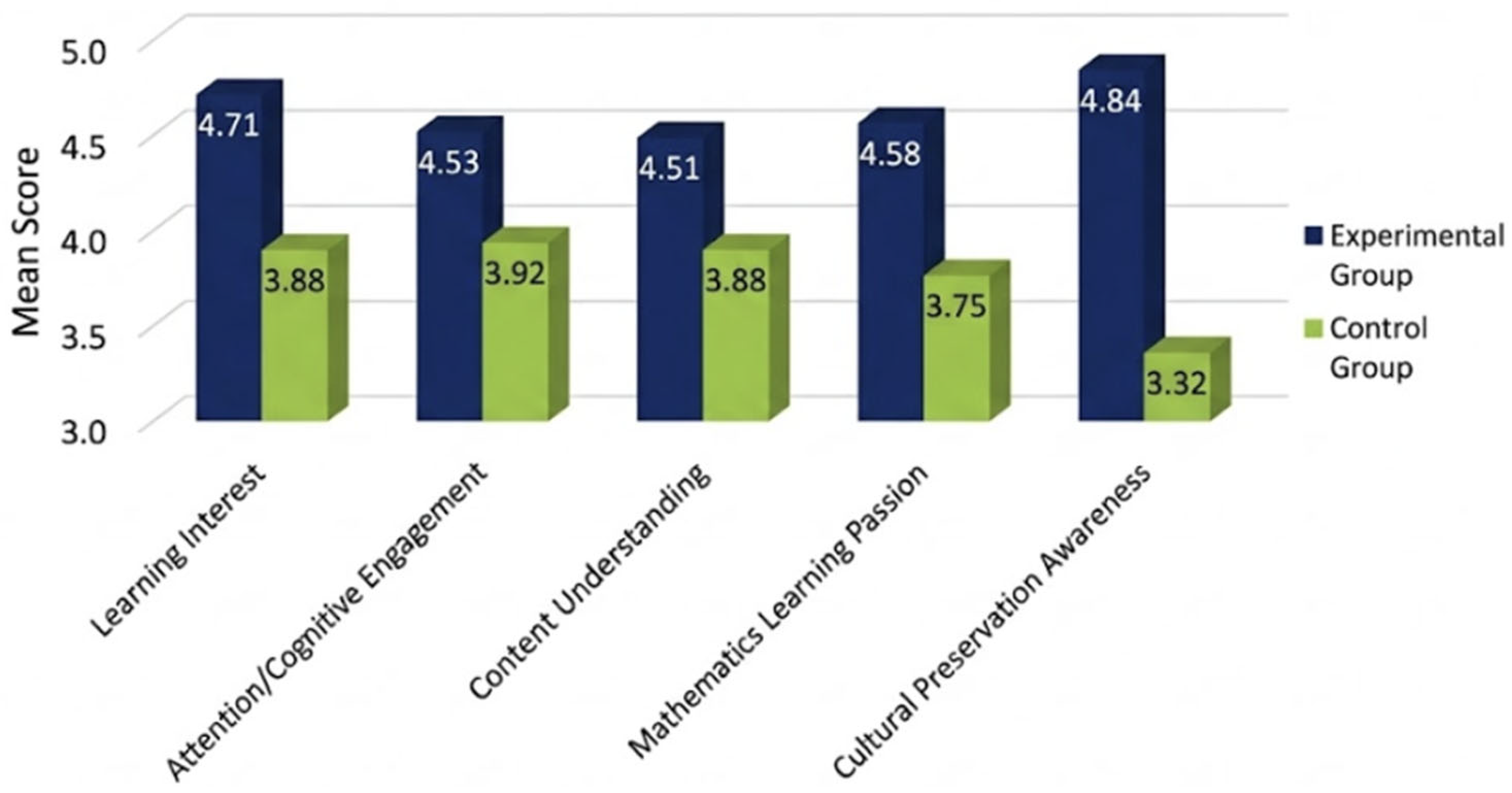
The experimental group explored significantly higher mean scores across all five constructs (p < 0.001), with large effect sizes (d > 0.80). The largest effect was observed for Cultural Preservation Awareness (d = 3.17), underscoring the strong cultural resonance of the intervention (Table 5 and Figure 2).

4.4.2. Item-Level Analysis

Examination of individual questionnaire items revealed the specific dimensions along which the experimental group most substantially outperformed the control group. The largest between-group differences were observed on three items: A3: “The lesson stimulates my curiosity” (Mexp = 4.90 vs. Mctrl = 3.90), B2: “I can minimize distractions during learning” (Mexp = 4.10 vs. Mctrl = 3.20) and E5: “I wish to participate in more cultural learning activities” (Mexp = 5.00 vs. Mctrl = 4.10). These findings suggest that AI-SBL particularly enhanced students’ curiosity, sustained attention and motivation for cultural learning, dimensions that align closely with the intervention’s narrative-based and culturally grounded design.

4.4.3. Performance-Based Artifact Analysis

Beyond self-reported measures, analysis of student products provided behavioral evidence of learning gains. Using a rubric aligned with lesson objectives, we assessed two dimensions of student work.
First, in geometric model construction, 14 of 15 experimental students (93.3%) successfully constructed models of the circular cake with accurate labels for radius and diameter, compared to only 5 of 15 control students (33.3%; χ2 = 8.76, p = 0.003, φ = 0.54). This substantial difference indicates that experimental students developed not only conceptual understanding but also the ability to apply geometric knowledge to concrete representations.
Second, in creative problem-solving, 12 experimental students (80.0%) met criteria for proposing alternative approaches to measuring circumference (e.g., using string, iterative folding), compared to 9 control students (60.0%; χ2 = 2.14, p = 0.143). Although this difference did not reach statistical significance, the trend suggests that narrative contextualization may encourage more flexible, creative thinking about mathematical problems, an area warranting further investigation with larger samples.

4.4.4. Structural Relationships Among Constructs

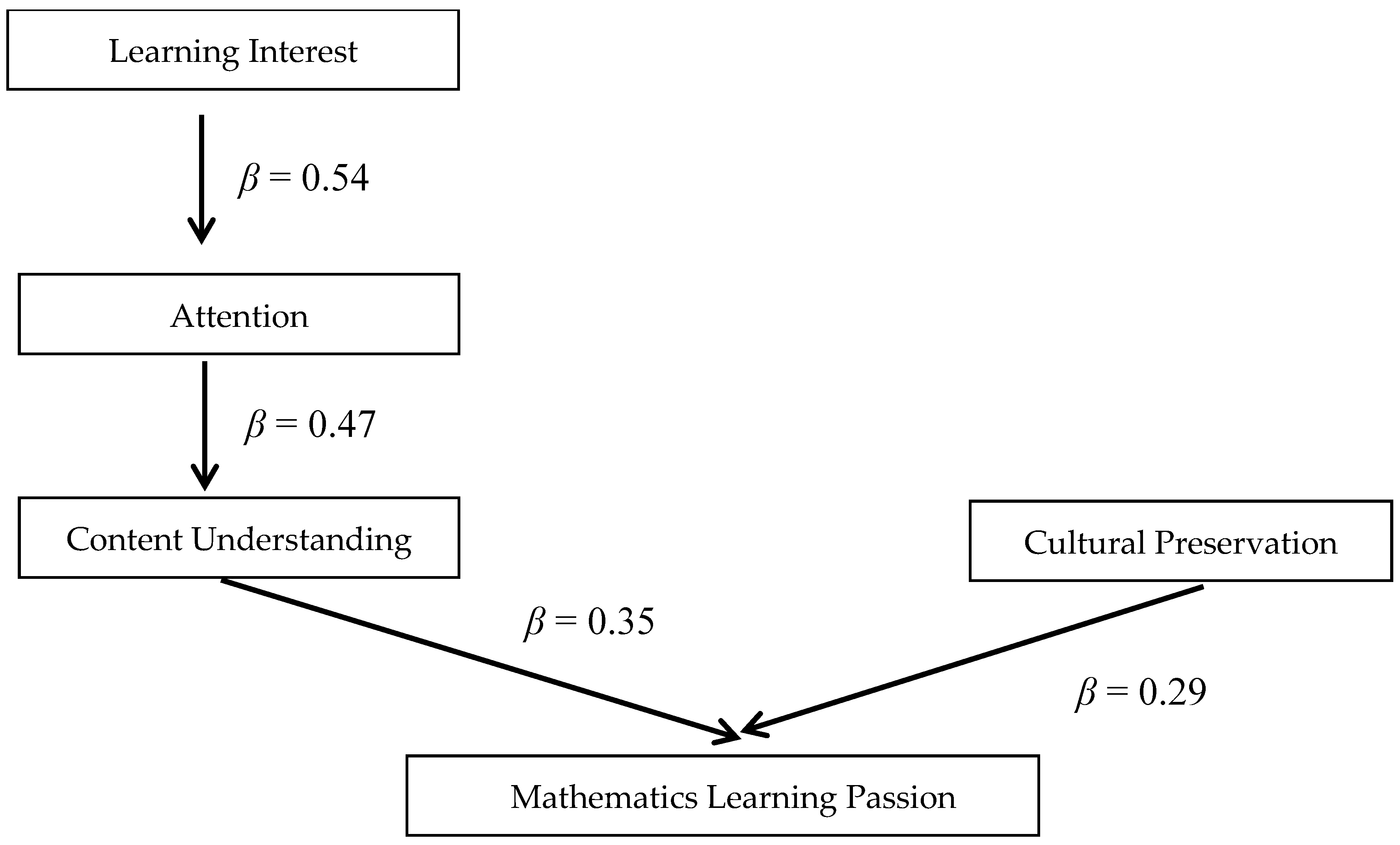
To examine the relationships among the five latent constructs, a Structural Equation Model (SEM) was tested. The model proposed that Learning Interest predicts Attention, which in turn predicts Content Understanding, and Content Understanding predicts Mathematics Learning Passion. An additional direct path from Cultural Preservation Awareness to Passion was also included.
The model demonstrated acceptable fit to the data: χ2(165) = 312.45, p < 0.001; χ2/df = 1.89; CFI = 0.966; TLI = 0.967; RMSEA = 0.038 (90% CI: 0.028–0.042); SRMR = 0.028.
All hypothesized paths were statistically significant (see Figure 3):
Interest → Attention (β = 0.54, p < 0.001)
Attention → Understanding (β = 0.47, p < 0.001)
Understanding → Passion (β = 0.35, p = 0.003)
Cultural Awareness → Passion (β = 0.29, p = 0.010)
The model explained 33% of the variance in Mathematics Learning Passion.

4.5. Research Question 3: Practical Enablers and Ethical Considerations from Stakeholder Perspectives

Analysis of semi-structured interviews with two teachers and six students, triangulated with classroom observations, revealed a constellation of practical enablers that facilitated successful implementation of the AI-SBL model, alongside important ethical considerations that emerged from stakeholder experiences.

4.5.1. Practical Enablers for Successful Implementation

Teacher-Identified Enablers
Both teachers consistently highlighted four interrelated factors that enabled effective integration of AI tools into their pedagogical practice. First, low technical barriers proved critical; despite initial apprehension, teachers found the AI tools remarkably accessible. As Teacher 1 explained: “I was worried AI would be complicated, but ChatGPT works like a conversation. Canva I already knew. The learning curve was minimal.” This accessibility lowered the threshold for technology adoption, allowing teachers to focus on pedagogical design rather than technical troubleshooting.
Second, time efficiency emerged as a powerful motivator. Teachers contrasted the AI-SBL approach with traditional methods of creating culturally appropriate materials. Teacher 2 noted: “Finding culturally appropriate images for Vietnamese folktales usually means searching hours online or drawing myself. DALL·E generated options in minutes. I spent my time on selection and refinement, not creation.” This efficiency directly addresses Robin’s (2008) concern about time constraints as a barrier to digital storytelling adoption.
Third, teachers valued the flexibility for iteration that AI tools afforded. The ability to rapidly generate alternative explanations enabled responsive teaching: “When students didn’t understand a concept in the pilot, I could ask ChatGPT to rephrase the explanation differently. That flexibility made a big difference” (Teacher 1). This adaptability proved particularly valuable in a pilot context where pedagogical refinement was ongoing.
Fourth, student enthusiasm served as a reinforcing motivator. Teachers reported that observing heightened engagement encouraged further investment in the approach: “Seeing how excited students were raising hands, discussing the story, made me want to invest more time in designing similar lessons for other topics” (Teacher 2). This reciprocal relationship between student response and teacher motivation suggests a sustainable pathway for innovation adoption.
Student-Identified Enablers
From the learner’s perspective, three interconnected enablers enhanced their engagement and learning. The visual appeal of AI-generated images captured students’ attention and supported conceptual understanding: “The pictures were beautiful. The cake looked real and I could see the circle shape clearly. It helped me remember” (Student 3). This finding aligns with Mayer’s cognitive theory of multimedia learning, wherein well-designed visuals reduce cognitive load and enhance comprehension.
Second, the connection to familiar stories appeared to reduce mathematics anxiety, a documented barrier to learning (Arneja & Tyagi, 2020). As Student 5 reflected: “Usually math is just numbers on the board. But this was like hearing a story from my grandmother. I wasn’t scared to try.” This affective dimension of storytelling, what Goral and Gnadinger (2006) term “humanizing” mathematics, emerged strongly in student accounts.
Third, students valued the collaborative problem-solving opportunities embedded in the narrative structure. The story’s framing of geometric problems as missions to help the protagonist Lang Liêu fostered peer collaboration: “We had to help Lang Liêu together. My friend explained the formula to me in a way I understood” (Student 2). This spontaneous peer teaching, observed throughout the lesson, suggests that narrative contextualization can scaffold collaborative learning naturally.

4.5.2. Ethical Considerations and Mitigation Strategies

Alongside enablers, the study surfaced important ethical considerations that inform responsible AI integration in primary education.
Cultural Accuracy and the Necessity of Human Review
Both teachers emphasized that AI-generated content cannot be trusted without critical human review. Teacher 1 articulated this forcefully: “AI doesn’t understand Vietnamese culture. The first images looked foreign. Teachers must check everything, AI is a tool, not an authority on our heritage.” This observation underscores Gay’s (2018) contention that culturally responsive pedagogy requires deep local knowledge that AI, trained on global datasets, cannot replicate. The research team addressed this concern through systematic teacher review of all AI outputs before classroom use, rejecting approximately 40% of initial DALL·E generations for cultural inaccuracies.
Data Privacy Concerns
Teachers raised important questions about student data privacy, particularly regarding potential future scaling of AI integration. Teacher 2 noted: “We didn’t collect any student information for this lesson, but if we use AI tools that require student accounts, what happens to their data? We need clear school policies.” This concern aligns with Dwivedi et al. (2023) and Kasneci et al. (2023), who identify data privacy as a critical ethical consideration in educational AI adoption. In response, the research team collected no student personal data and conducted all AI interactions through teacher-controlled accounts.
Student AI Literacy as an Emerging Need
Perhaps most significantly, the study revealed a striking gap in students’ understanding of AI’s role in their learning. When asked about the source of the lesson illustrations, Student 4 responded: “The teacher?” When informed that AI had helped create them, the student asked simply: “What’s AI?” This exchange, representative of all six student interviews, suggests that while AI can enhance learning, students themselves may benefit from age-appropriate AI literacy education. Understanding the tools shaping their learning experiences could empower students as critical consumers of AI-generated content.

4.5.3. Teacher Recommendations for Future Implementation

Drawing on their experience, teachers offered practical recommendations that synthesize the enablers and ethical considerations identified above. These recommendations provide actionable guidance for scaling the AI-SBL model:
“First, give teachers time to experiment with AI tools before using them in class. Second, create a shared bank of effective prompts for Vietnamese stories. Third, have clear guidelines on what student data can be shared with AI platforms.”
Teacher 1
“Start small. One story, one lesson. Learn what works for your students before scaling up.”
Teacher 2
These recommendations emphasize the importance of teacher agency, collaborative resource-sharing and incremental implementation, principles that align with sustainable technology integration in resource-constrained contexts (Chiu et al., 2024).

4.6. Synthesis: Cross-Cutting Qualitative Themes

Beyond the RQ-specific findings, thematic analysis revealed three overarching themes that illuminate the mechanisms through which AI-SBL enhanced learning, integrating perspectives from teachers and students across all research questions.
Theme 1: Immersive Engagement through Narrative Contextualization
Both teachers and students described the AI-SBL lesson as qualitatively different from typical mathematics instruction in its capacity to foster deep immersion. Students articulated this as a sense of purpose and agency: “It was like a mission. We had to solve the math to help Lang Liêu finish the story. I really wanted to get the answer right” (Student 4). Teachers observed corresponding behavioral indicators: “The room was completely focused. Even students who are usually distracted were following every step, raising hands to contribute” (Teacher 1). This immersive quality, rare in traditional geometry instruction (Tran, 2019a), appears to stem from the narrative framing that transformed abstract problems into meaningful quests.
Theme 2: Conceptual Clarity via Multimodal Representation
The combination of AI-generated visuals with narrative context appeared to enhance conceptual understanding by making abstract geometric relationships visible and tangible. Teacher 2 explained: “Students could see the diameter in the cake picture. They didn’t just memorize C = πd; they understood what it represented because they could point to it in the image.” This observation was corroborated by student artifacts: experimental students’ drawings consistently and accurately labeled radius and diameter on their cake illustrations, demonstrating applied understanding that transcended rote memorization.
Theme 3: Cultural and Affective Resonance as Motivational Driver
Perhaps most distinctively, the integration of Vietnamese cultural heritage evoked strong affective responses that appeared to fuel learning motivation. Student 6 reflected: “Now I understand why our ancestors made the cakes round and square. It’s not just a story; it’s math and our culture together. I told my grandma about it.” This connection between mathematical understanding and cultural identity, a core tenet of culturally responsive pedagogy (Gay, 2018), generated what Teacher 1 described as “pride and ownership” that translated into persistence during challenging problems. This finding suggests that cultural resonance functions not merely as contextual decoration but as a substantive motivational resource.

5. Discussion

This study provides empirical evidence that integrating Artificial Intelligence with storytelling-Based Learning offers a pedagogically effective and culturally resonant approach to teaching geometry in Vietnamese primary education. The findings confirm the anticipated benefits of AI-enhanced storytelling, heightened engagement, deeper conceptual understanding and affective investment, while revealing its unique capacity to bridge cultural heritage and mathematical abstraction, an underexplored synergy in mathematics education research.

5.1. Theoretical Contributions

Our findings align with and extend the theoretical convergence of culturally responsive pedagogy (Gay, 2018) and storytelling-based learning (Goral & Gnadinger, 2006). Specifically, the data suggest that when generative AI is positioned as a co-design tool, rather than an autonomous content generator, it can amplify the ‘humanizing’ potential of narrative approaches in mathematics education (Toor & Mgombelo, 2015). Specifically, the AI-SBL model successfully operationalizes the “humanizing” function of mathematics education that Toor and Mgombelo (2015) advocate, allowing students to connect with abstract geometric concepts at personal and emotional levels through culturally familiar narratives. This aligns with Zazkis and Liljedahl’s (2009) contention that storytelling provides realistic contexts helping students form visual mental images, while extending their work to demonstrate how generative AI can amplify this visual meaning-making process.
A distinctive contribution of this study lies in its measurement of Cultural Preservation Awareness, a construct rarely examined in AI-in-education research. The substantial effect observed in this dimension validates Gay’s (2018) culturally responsive pedagogy framework, demonstrating that when students perceive connections between scientific knowledge and traditional values, both learning interest and cultural awareness are mutually reinforced. The Bánh Chưng–Bánh Giầy folktale served not as decorative context but as a vehicle that transformed circumference and area formulas into culturally meaningful acts of knowledge construction. This finding echoes Sofowora and Agbedokun’s (2010) assertion that folklore in teaching strengthens students’ connection to heritage while facilitating conceptual understanding and it extends their work by showing how AI can scale such culturally grounded pedagogy.
The structural equation modeling results—revealing a pathway from Interest → Attention → Understanding → Passion—provide empirical support for the proposed motivational cascade, wherein interest drives engagement, engagement facilitates understanding, and understanding cultivates enduring passion for learning. The significant direct path from Cultural Preservation Awareness to Passion (β = 0.29) highlights the additive role of cultural connection beyond the cognitive pathway, suggesting that culturally grounded pedagogy contributes uniquely to affective learning outcomes.
The study further contributes to understanding how digital storytelling (Robin, 2008) can be enhanced through generative AI. Robin (2008) emphasized that while digital storytelling combines traditional narrative with multimedia tools to promote engagement, teachers often face resource and time constraints in creating high-quality digital stories. Our findings demonstrate that generative AI tools (ChatGPT, DALL·E, Canva) can address this barrier, enabling teachers to efficiently produce culturally authentic, pedagogically sound multimedia narratives, a critical advancement for resource-constrained classrooms.

5.2. Empirical Alignment with Existing Literature

The quantitative patterns observed align with international studies on storytelling-based learning and digital storytelling. Goral and Gnadinger (2006) found that storytelling helps students connect with mathematics at personal levels; our study extends this by quantifying the magnitude of such effects and demonstrating that AI-enhanced narratives can achieve substantial gains even within a single lesson. Similarly, Hung et al. (2012) and Yang and Wu (2012) documented that digital storytelling enhances motivation, engagement and critical thinking; our findings corroborate these conclusions while showing that AI-generated visuals can further strengthen the multimodal learning experience Robin (2008) described.
The structural equation modeling results are consistent with the theoretical mechanisms proposed by Toor and Mgombelo (2015), who argued that storytelling engages learners’ imagination and emotions to make concepts meaningful. The finding that Cultural Awareness directly predicted Passion (β = 0.29) also aligns with Gay’s (2018) culturally responsive pedagogy framework, supporting the notion that cultural resonance can independently contribute to learning motivation in collectivist educational contexts.
However, this study diverges from existing literature in two important ways. First, most AI-in-education research has focused on higher education levels (Chiu et al., 2024; Dwivedi et al., 2023; Kasneci et al., 2023). This study demonstrates that even 11-year-old learners in a resource-constrained Vietnamese setting can benefit meaningfully from AI-SBL, provided the design is age-appropriate, culturally grounded and teacher-mediated, addressing the research gap identified in the literature review. Second, unlike concerns about AI fostering over-dependence or undermining critical thinking (Dwivedi et al., 2023; Kasneci et al., 2023), our teacher-mediated approach positioned educators as co-designers who reviewed and refined AI outputs for mathematical accuracy and cultural authenticity, preserving pedagogical agency while leveraging AI’s efficiency.
The qualitative finding that students felt “part of the story” and motivated to help the folktale protagonist solve geometric problems directly illustrates Casey et al. (2008) assertion that integrating geometry into stories enables students to connect learning content with personally meaningful contexts. Moreover, teachers’ observations that AI-generated visuals helped students see diameter in the cake rather than merely memorizing C = πd addresses Garderen’s (2004) and Unodiaku’s (2012) concerns about abstract geometry instruction, while supporting the emphasis of Phung et al. (2024) on visual aids, such as GeoGebra, for concretizing mathematical concepts.

5.3. Practical Implications

For Vietnamese educators, this study offers a scalable micro-model for enacting the 2018 General Education Curriculum’s vision of competency-based, culturally integrated teaching (Ministry of Education and Training, 2018a). The five-stage framework (Learner Analysis → Narrative Adaptation → Material Design → Implementation → Assessment) provides a concrete blueprint addressing Tran’s (2019a) critique that Vietnamese geometry instruction often emphasizes formal calculations without connecting to practical problems. By embedding geometric concepts in culturally familiar narratives, teachers can shift from rote memorization toward meaningful application.
For teacher education, the findings underscore the need to develop AI literacy not as technical skill alone, but as pedagogical design competence, the ability to critically adapt AI outputs to local knowledge systems. This responds to Chiu et al.’s (2024) observation that successful AI integration requires teacher facilitation, while addressing Robin’s (2008) concern about teachers’ time and technological proficiency constraints in creating digital stories.
For policymakers in Global South contexts, the success of this low-cost intervention (requiring only basic digital tools: ChatGPT, Canva, projector) suggests that national AI-in-education strategies should prioritize curriculum-aligned, story-based content libraries co-created by teachers, cultural experts and AI, especially for rural schools. This aligns with UNESCO’s emphasis on culturally appropriate technology integration while addressing the resource constraints Chiu et al. (2024) identified as barriers to AI adoption in developing regions.

5.4. Limitations and Future Research

This study has three acknowledged limitations consistent with its pilot nature. First, the small sample size (N = 30) and single-lesson duration limit generalizability. Second, the quasi-experimental design lacks randomization, though baseline equivalence was confirmed. Third, long-term retention effects were not measured, an important consideration given Zazkis and Liljedahl’s (2009) emphasis on sustained conceptual understanding.
Future research should address three directions: (1) longitudinal studies tracking students’ geometric reasoning over a full academic year, responding to Yang and Wu’s (2012) call for extended investigations of digital storytelling impacts; (2) cross-cultural comparisons testing the model in other ASEAN contexts, extending Gay’s (2018) culturally responsive pedagogy framework; and (3) development of AI ethics modules for teachers, addressing Dwivedi et al.’s (2023) and Kasneci et al.’s (2023) concerns about bias detection, cultural review and student data privacy in generative AI applications.
The teacher-mediated approach employed in this study, where educators reviewed AI outputs for cultural appropriateness and pedagogical accuracy, mitigates risks of irrelevant or inappropriate content, addressing the ethical concerns Chiu (2023) raised about AI in education. This human-in-the-loop model ensures that AI serves as what Robin (2008) might describe as a creative amplifier of teacher capacity rather than a replacement for pedagogical judgment.
In sum, this study demonstrates that AI in primary education need not be high-tech or decontextualized. When integrated thoughtfully with storytelling and local culture following the principles Gay (2018) and Goral and Gnadinger (2006) established, even generative AI tools can become catalysts for engagement, understanding and cultural continuity. It offers a counter-narrative to techno-solutionist discourses, one where AI serves humanistic pedagogy in the Global South, not the reverse.

6. Conclusions

This study demonstrates that integrating generative AI with storytelling-based learning offers a pedagogically viable and culturally resonant model for enhancing geometry instruction in Vietnamese primary education. By embedding circle geometry within the culturally familiar narrative of The Legend of Bánh Chưng and Bánh Giầy and leveraging AI tools (ChatGPT, DALL·E, Canva) to generate multimodal learning materials, the intervention significantly improved students’ conceptual understanding, engagement, motivation and cultural awareness compared to conventional instruction.
Theoretically, this research bridges three previously siloed domains: AI in education, narrative pedagogy and culturally responsive teaching. It validates a motivational cascade, Interest → Attention → Understanding → Passion, while introducing Cultural Awareness as a distinct driver of learning motivation in collectivist educational contexts. Empirically, it provides one of the first classroom-based evaluations of generative AI in primary mathematics within a Global South setting, challenging assumptions that AI integration requires high-tech infrastructure or advanced learner maturity.
Practically, the five-stage AI-SBL model offers a scalable, low-cost framework aligned with Vietnam’s 2018 General Education Curriculum. It repositions the teacher not as a passive consumer of technology, but as a critical co-designer who curates AI outputs for pedagogical accuracy, emotional resonance and cultural authenticity.
While technological change continues to reshape educational landscapes, this study offers preliminary evidence that teacher-mediated AI integration, when anchored in local cultural narratives, can support more engaging and meaningful geometry learning for primary students. The circle, once an abstract symbol, becomes through story and AI a vessel of cultural memory, mathematical reasoning and student agency.

Author Contributions

Conceptualization, N.H.H., P.S.N., D.C.L.A. and N.T.V.; Methodology, N.H.H., P.S.N., T.C.S., N.T.V., P.T.T.T. and T.T.N.; Investigation, T.C.S., D.C.L.A., P.T.T.T., T.T.N. and V.X.M.; Resources, P.T.T.T. and T.T.N.; Data curation, D.C.L.A. and P.T.T.T.; Writing—original draft, N.H.H., P.S.N. and N.T.V.; Writing—review & editing, N.T.V. and V.X.M.; Visualization, N.T.V., P.S.N. All authors have read and agreed to the published version of the manuscript.

Funding

This research was funded by the National Foundation for Science and Technology Development, Grant Number 503.01-2025.16.

Institutional Review Board Statement

The study was conducted in accordance with the Declaration of Helsinki and approved by the Board of Principal of Hop Thang Primary School on 20 December 2025 (approval code 12/Tr THHT).

Informed Consent Statement

Informed consent was obtained from all subjects involved in the study.

Data Availability Statement

The original contributions presented in this study are included in the article. Further inquiries can be directed to the corresponding author.

Conflicts of Interest

The authors declare no conflicts of interest.

Appendix A. Questionnaire

Study: The Application of AI Tools and Story-Based Learning in Primary Geometry Instruction

A. 
Learning Interest/Engagement
  • I feel excited when participating in learning activities during the lesson.
  • I find learning more interesting compared to before.
  • The lesson stimulates my curiosity.
  • I want to explore the content learned in greater depth.
  • I feel that time passes quickly when I engage in the lesson.
B. 
Attention Focus/Cognitive Engagement
6.
I can easily maintain my attention throughout the lesson.
7.
I am able to minimize distractions while completing learning tasks.
8.
I focus on discussion and interactive activities in class.
9.
I can remember the information presented during the lesson.
10.
I follow and complete learning tasks purposefully.
C. 
Content Understanding/Cognitive Gains
11.
I can clearly explain the key concepts of the lesson.
12.
I understand the connection between the lesson content and real-life contexts.
13.
I feel confident presenting or discussing the lesson content with others.
14.
I can apply the knowledge learned to solve exercises or new situations.
15.
I recognize the long-term significance of the lesson content.
D. 
Cultural Preservation Awareness & Learning Passion
16.
I have a better understanding of traditional cultural values after the lesson.
17.
I recognize the importance of preserving and passing on cultural values.
18.
The lesson helps me develop a more appreciative attitude toward cultural heritage.
19.
I feel a greater sense of responsibility in promoting cultural values within the community.
20.
I wish to participate in more learning activities related to traditional culture.
E. 
Mathematics Learning Passion
21.
I feel that my motivation for learning has increased after the lesson.
22.
I take greater initiative in seeking additional materials and learning beyond class.
23.
I perceive learning as a meaningful process for personal development.
24.
I notice improvements in my study habits after completing the lesson.
25.
I feel that my love and passion for learning have been strengthened and sustained.

Appendix B. Narrative Script and AI-Generated Visuals

This appendix provides the adapted narrative script used in the experimental group lesson, along with descriptions of the AI-generated visuals created with DALL·E 3. The story is based on the Vietnamese folktale “The Legend of Bánh Chưng and Bánh Giầy”. All images were reviewed by the teacher for cultural authenticity and mathematical accuracy before being embedded in the Canva slides.
  • A. Narrative Script (Teacher’s Version)
    Scene 1: The King’s Command
    Long ago, in the time of the Hùng Kings, there was an old king who wanted to choose a successor. He called his sons together and said:
    King: “The one who finds the most meaningful food to offer our ancestors on the New Year will become the next king.”
    The princes travelled far and wide, searching for rare and precious foods. But the youngest prince, Lang Liêu, was poor and could not afford expensive ingredients. He stayed at home, sad and worried.
             Education 16 00588 i001
  • Scene 2: A Dream and a Shape
    One night, Lang Liêu had a dream. A spirit appeared and whispered:
    Spirit: “The Earth is square, the Sky is round. Use these shapes to make your offering. The round cake represents the Sky; the square cake represents the Earth.”
    When Lang Liêu woke up, he knew what to do. He gathered sticky rice, green beans and pork. He wrapped them in banana leaves.
             Education 16 00588 i002
  • Scene 3: The Problem—Measuring the Round Cake
    To make the round cake (Bánh giầy), Lang Liêu had to measure it carefully so that it would be perfectly round. He looked at the cake and wondered:
    Lang Liêu: “How can I find the distance around the cake? And how much space does it cover? I need to know so I can make the cakes exactly the same for the offering.”
    He remembered that the village elder had once taught: The diameter is the straight line from one side of the circle to the other, passing through the center. The circumference is the distance around the circle. The area is the space inside the circle.
    But Lang Liêu did not have a formula. He only had a piece of string and a ruler.
             Education 16 00588 i003
  • Scene 4: Discovering the Formulas
    The teacher then guided the students to help Lang Liêu by measuring the paper cake models. Together they discovered:
    Teacher (prompting): “When we measure the circumference and divide it by the diameter, we always get a number close to 3.14. That number is called pi (π). So the formula is: Circumference = π × diameter.”
    And for the area:
    Teacher: “The space inside the circle is Area = π × radius × radius.”
    Lang Liêu learned the formulas and successfully made many round cakes for the offering.
             Education 16 00588 i004
  • Scene 5: The King’s Choice
    At the New Year celebration, Lang Liêu presented his round Bánh giầy (symbolizing the Sky) and square Bánh chưng (symbolizing the Earth). The king was deeply moved because the cakes honoured both the ancestors and the natural world. He declared Lang Liêu the new king.
    King: “You have used simple things with great meaning. You understand our traditions and the wisdom of our ancestors. You shall be the next king.”
    The students reflected on how mathematics and culture are connected and how helping Lang Liêu made learning geometry meaningful.
             Education 16 00588 i005

Appendix C. Pretest and Posttest—10 Multiple-Choice Questions

  • What is the distance around a circle called?
    • Diameter
    • Radius
    • Circumference
    • Area
  • A line segment that passes through the center of a circle and connects two points on the circle is called the:
    • Radius
    • Diameter
    • Chord
    • Arc
  • If the diameter of a circle is 10 cm, what is its radius?
    • 20 cm
    • 10 cm
    • 5 cm
    • 15 cm
  • The formula for the circumference of a circle is:
    • C = π × r
    • C = 2π × d
    • C = π × d
    • C = π × r2
  • A circle has a radius of 7 cm. What is its circumference? (Use π ≈ 3.14)
    • 21.98 cm
    • 43.96 cm
    • 153.86 cm
    • 14 cm
  • The area of a circle is calculated using the formula:
    • A = π × d
    • A = 2π × r
    • A = π × r2
    • A = π × d2
  • A circle has a diameter of 14 cm. What is its area? (Use π ≈ 3.14)
    • 43.96 cm2
    • 153.86 cm2
    • 615.44 cm2
    • 21.98 cm2
  • If the circumference of a circle is 31.4 cm, what is its diameter? (Use π ≈ 3.14)
    • 5 cm
    • 10 cm
    • 15 cm
    • 20 cm
  • Which of the following statements is TRUE?
    • The radius is twice the diameter.
    • The diameter is half the radius.
    • The diameter is twice the radius.
    • The radius and diameter are equal.
  • A round Bánh giầy cake has a diameter of 20 cm. How much string is needed to go around it once? (Use π ≈ 3.14)
    • 31.4 cm
    • 62.8 cm
    • 125.6 cm
    • 314 cm
  • Answer Key: 1-C, 2-B, 3-C, 4-C, 5-B, 6-C, 7-B, 8-B, 9-C, 10-B

References

  1. Arneja, C., & Tyagi, S. (2020). The importance of using stories for teaching-learning of mathematical concepts. International Journal of Advanced Academic Studies, 2(4), 499–503. [Google Scholar] [CrossRef]
  2. Braun, V., & Clarke, V. (2006). Using thematic analysis in psychology. Qualitative Research in Psychology, 3(2), 77–101. [Google Scholar] [CrossRef]
  3. Casey, B. M., Erkut, S., Ceder, I., & Young, J. M. (2008). Use of a storytelling context to improve girls’ and boys’ geometry skills in kindergarten. Journal of Applied Developmental Psychology, 29(1), 29–48. [Google Scholar] [CrossRef]
  4. Chiu, T. K. F. (2023). The impact of Generative AI (GenAI) on practices, policies and research direction in education: A case of ChatGPT and Midjourney. Interactive Learning Environments, 32, 6187–6203. [Google Scholar] [CrossRef]
  5. Chiu, T. K. F., Falloon, G., Song, Y. J., Wong, V. W. L., Zhao, L., & Ismailov, M. A. (2024). A self-determination theory approach to teacher digital competence development. Computers & Education, 214, 105017. [Google Scholar] [CrossRef]
  6. Clements, D. H., & Sarama, J. (2009). Learning and teaching early math: The learning trajectories approach. Routledge. [Google Scholar]
  7. Cohen, J. (1988). Statistical power analysis for the behavioral sciences (2nd ed.). Lawrence Erlbaum Associates. [Google Scholar]
  8. Creswell, J. W., & Plano Clark, V. L. (2017). Designing and conducting mixed methods research (3rd ed.). SAGE Publications. [Google Scholar]
  9. Dwivedi, Y. K., Kshetri, N., Hughes, L., Slade, E. L., Jeyaraj, A., Kar, A. K., Baabdullah, A. M., Koohang, A., Raghavan, V., Ahuja, M., Albanna, H., Albashrawi, M. A., Al-Busaidi, A. S., Balakrishnan, J., Barlette, Y., Basu, S., Bose, I., Brooks, L., Buhalis, D., … Wright, R. (2023). Opinion Paper: “So what if ChatGPT wrote it?” Multidisciplinary perspectives on opportunities, challenges and implications of generative conversational AI for research, practice and policy. International Journal of Information Management, 71, 102642. [Google Scholar] [CrossRef]
  10. Garderen, D. V. (2004). Focus on inclusion: Reciprocal teaching as a comprehension strategy for understanding mathematical word problems. Reading & Writing Quarterly, 20(2), 225–229. [Google Scholar] [CrossRef]
  11. Gay, G. (2018). Culturally responsive teaching: Theory, research and practice (3rd ed.). Teachers College Press. [Google Scholar]
  12. Goral, M. B., & Gnadinger, C. M. (2006). Using storytelling to teach mathematics concepts. AMC Math Problems Monthly, 11(1), 4–8. [Google Scholar]
  13. Hu, L. T., & Bentler, P. M. (1999). Cutoff criteria for fit indexes in covariance structure analysis: Conventional criteria versus new alternatives. Structural Equation Modeling: A Multidisciplinary Journal, 6(1), 1–55. [Google Scholar] [CrossRef]
  14. Hung, C.-M., Hwang, G.-J., & Huang, I. (2012). A project-based digital storytelling approach for improving students’ learning motivation, problem-solving competence and learning achievement. Educational Technology & Society, 15(4), 368–379. [Google Scholar]
  15. Kasneci, E., Sessler, K., Küchemann, S., Bannert, M., Dementieva, D., Fischer, F., Gasser, U., Groh, G., Günnemann, S., Hüllermeier, E., Krusche, S., Kutyniok, G., Michaeli, T., Nerdel, C., Pfeffer, J., Poquet, O., Sailer, M., Schmidt, A., Seidel, T., … Kasneci, G. (2023). ChatGPT for good? On opportunities and challenges of large language models for education. Learning and Individual Differences, 103, 102274. [Google Scholar] [CrossRef]
  16. Lambert, J. (2013). Digital storytelling: Capturing lives, creating community (4th ed.). Routledge. [Google Scholar]
  17. Ministry of Education and Training. (2018a). General education curriculum: Overall program. Available online: https://thphanvantribinhthanh.hcm.edu.vn/ctgdpt-2018/chuong-trinh-giao-duc-pho-thong-2018-chuong-trinh-tong-the/ctmb/91775/590510 (accessed on 26 December 2025).
  18. Ministry of Education and Training. (2018b). Mathematics education curriculum (circular No. 32/2018/TT-BGDDT). Available online: https://thphanvantribinhthanh.hcm.edu.vn/ctgdpt-2018/chuong-trinh-giao-duc-pho-thong-mon-toan/ct/91775/590512 (accessed on 26 December 2025).
  19. Phung, M. D., Pham, S. N., Le, H. T., & Tran, V. T. (2024). The GeoGebra software as a tool to facilitate the construction of knowledge about the center of symmetry of a shape at the 6th grade. HNUE Journal of Science, Educational Sciences, 69(1), 3–10. [Google Scholar] [CrossRef]
  20. Qu, Y., Tan, M. X. Y., & Wang, J. (2024). Disciplinary differences in undergraduate students’ engagement with generative artificial intelligence. Smart Learning Environments, 11(1), 51. [Google Scholar] [CrossRef]
  21. Robin, B. R. (2008). Digital storytelling: A powerful technology tool for the 21st century classroom. Theory Into Practice, 47(3), 220–228. [Google Scholar] [CrossRef]
  22. Shadish, W. R., Cook, T. D., & Campbell, D. T. (2002). Experimental and quasi-experimental designs for generalized causal inference. Houghton Mifflin. [Google Scholar]
  23. Sofowora, O. A., & Agbedokun, O. (2010). An empirical survey of technology application in teaching Geography in Nigerian secondary schools. European Journal of Educational Studies, 2(1), 45–58. [Google Scholar] [CrossRef]
  24. Toor, A., & Mgombelo, J. (2015). Teaching mathematics through storytelling: Engaging the ‘being’ of a student in mathematics. In K. Krainer, & N. Vondrová (Eds.), Proceedings of the ninth congress of the European society for research in mathematics education (pp. 3276–3282). Charles University in Prague, Faculty of Education and ERME. [Google Scholar]
  25. Tran, Đ. T. (2019a). Đặc trưng hình học của diện tích và bài toán cắt giấy ở tiểu học. Tạp chí Khoa học Đại học Sư phạm Hà Nội, 64(7), 140–149. [Google Scholar]
  26. Tran, Đ. T. (2019b). Những bài toán khai thác ba phương diện hình học, số học, đại lượng của chu vi và diện tích trong sách Toán tiểu học của Pháp và Việt Nam. Tạp chí Khoa học Giáo dục Việt Nam, 15(20), 109–114. [Google Scholar]
  27. Unodiaku, S. S. (2012). Development and validation of mathematics readiness test for senior secondary school students. African Journal of Science, Technology and Mathematics Education, 2(1), 57–71. [Google Scholar]
  28. Wiggins, G., & McTighe, J. (2005). Understanding by design (2nd ed.). Association for Supervision and Curriculum Development (ASCD). [Google Scholar]
  29. Yang, Y. T. C., & Wu, W. C. I. (2012). Digital storytelling for enhancing student academic achievement, critical thinking and learning motivation: A year-long experimental study. Computers & Education, 59(2), 339–352. [Google Scholar] [CrossRef]
  30. Zazkis, R., & Liljedahl, P. (2009). Teaching mathematics as storytelling. Sense Publishers. [Google Scholar]
  31. Žakelj, A., & Klančar, A. (2022). The role of visual representations in geometry learning. European Journal of Educational Research, 11(3), 1393–1411. [Google Scholar] [CrossRef]
Figure 1. AI-generated illustration (using DALL·E) from the storytelling video based on the Vietnamese folktale “The Legend of Bánh Chưng and Bánh Giầy”.
Education 16 00588 g001
Figure 2. Comparison of Mean Scores (±1 Standard Deviation) Between Experimental and Control Groups Across Five Learning Outcome Dimensions.
Education 16 00588 g002
Figure 3. Structural Equation Model with Standardized Path Coefficients (CFI = 0.966, RMSEA = 0.038).
Education 16 00588 g003
Table 1. Sequence of Student Learning Tasks in the AI-SBL Intervention.
PhaseDurationLearning TaskPedagogical PurposeAI Integration
1. Narrative Immersion5 minWatch AI-generated storytelling video presenting the folktale and geometric problem (helping Lang Liêu measure Bánh giầy)Establish narrative context; create emotional investment in mathematical problemChatGPT-generated script; DALL·E illustrations
2. Guided Discovery8 minIdentify circular shapes in story illustrations; discuss relationships between diameter and circumference; learn key vocabularyBridge narrative context with geometric concepts; introduce terminology through visual anchorsAI-generated discussion prompts embedded in slides
3. Collaborative Problem-Solving12 minIn pairs: measure diameter of paper cake template with rulers; estimate circumference using string; compare measurements; record findings on worksheetDevelop hands-on understanding of circumference-diameter relationship; foster peer learningVisual templates designed with AI-generated reference images
4. Formula Application5 minConnect hands-on measurements to formal formulas (C = πd; A = πr2); apply formulas to calculate circumference of cakeFormalize intuitive understanding; connect concrete experience to abstract representationAI-generated visuals demonstrating formula application
5. Cultural Reflection & Extension5 minDiscuss cultural symbolism (round = Sky, square = Earth); draw and label own Bánh giầy cake; write one-sentence reflectionReinforce learning through creative expression; deepen cultural connectionStudent-created drawings (inspired by AI visuals)
Table 2. Data Collection Instruments and Research Questions.
Data TypeInstrumentPurposeRQ Addressed
QuantitativePretest/Posttest (10 MCQs)Measure cognitive gains in circle conceptsRQ2
25-item Likert-scale questionnaire (5-point)Assess affective and motivational outcomes across 5 constructsRQ2
QualitativeSemi-structured interviews (n = 6 students, n = 2 teachers)Explore perceptions, challenges and learning experiencesRQ1, RQ3
Classroom observations & student artifacts (drawings, models)Document engagement, collaboration and creativityRQ2, RQ3
25-item Likert-scale questionnaire (5-point)Assess affective and motivational outcomes across 5 constructsRQ2
Table 3. Reliability and Validity of the Measurement Model (N = 30).
ConstructCronbach’s αComposite Reliability (CR)Average Variance Extracted (AVE)
Learning Interest0.880.910.66
Attention/Cognitive Engagement0.860.890.62
Content Understanding0.750.820.55
Mathematics Learning Passion0.790.850.59
Cultural Preservation Awareness0.720.810.58
Note: All constructs explored acceptable reliability (α > 0.70, CR > 0.80) and convergent validity (AVE > 0.50). Discriminant validity was suggested using the Fornell–Larcker criterion.
Table 4. Division of Labor in the Co-Design Process.
TaskAI Role (ChatGPT/DALL·E)Teacher Role
Narrative generationProduce initial story scriptsRefine prompts; ensure age-appropriateness
Visual creationGenerate multiple image optionsSelect culturally authentic images; reject inaccuracies
Mathematical contentEmbed formulas in story contextVerify accuracy; align with curriculum
Pedagogical sequencingSuggest activity ideasDesign lesson flow; create assessment points
Cultural reviewNone (AI lacks cultural knowledge)Ensure alignment with Vietnamese values
Table 5. Comparison of Learning Outcomes Between Experimental and Control Groups.
ConstructExperimental Group M (SD)Control Group M (SD)tpCohen’s d
Learning Interest4.71 (0.28)3.88 (0.35)6.34<0.0012.17
Attention/Cognitive Engagement4.53 (0.31)3.92 (0.39)4.87<0.0011.68
Content Understanding4.51 (0.29)3.88 (0.41)5.12<0.0011.77
Mathematics Learning Passion4.58 (0.26)3.75 (0.43)6.09<0.0012.09
Cultural Preservation Awareness4.84 (0.18)3.32 (0.48)10.21<0.0013.17
Disclaimer/Publisher’s Note: The statements, opinions and data contained in all publications are solely those of the individual author(s) and contributor(s) and not of MDPI and/or the editor(s). MDPI and/or the editor(s) disclaim responsibility for any injury to people or property resulting from any ideas, methods, instructions or products referred to in the content.