


Abstract
Public policies and the sustainability of digital education are vital due to technology’s role in teaching, learning, and interaction. This study examines the relationship between Brazil’s National Education Plan (NEP 2014–2024) and sustainable digital education. Using a critical descriptive methodology, it conducts a systematic integrative literature review. Content analysis (Bardin) of CAPES Journal Portal data explores how the NEP supports or hinders sustainable digital education in Brazil. Findings show alignment with the 2030 Agenda (SDG 4), emphasizing socio-environmental sustainability and goals like universal connectivity (Strategy 7.15). However, a gap between theory and practice emerges, with sustainability often overlooked in higher education assessments. Additionally, the digital sphere’s algorithmic individualization may hinder the rational debate needed for sustainability. The study concludes that sustainable digital education demands stable funding, resilient infrastructure, ethical regulation, and policies prioritizing inclusion and innovation to enable technology’s role in social transformation.
1. Introduction
Today, digital education is critical since technology is integral to our methods of learning, teaching, and interaction, whether asynchronous or synchronous. Public policies targeted at the sustainability of digital education in Brazil are critical to ensure that schools, particularly public schools, have access to and use technology in a pedagogically sound and safe manner, supporting digital inclusion and improving educational quality. This is particularly evident in the rise in distance education (DE), the application of new technologies in education, the development of digital information and communication technologies (ICTs), and their broad use, all of which are transforming the ways of teaching and learning (Baxto & Machado, 2025).
In this scenario, it is critical to discuss how public policies developed by the Ministry of Education (MEC) can support the sustainability of digital education. Ensuring that all students, regardless of location or socioeconomic status, have access to high-quality learning experiences is crucial for promoting equity and improving educational outcomes, and MEC’s policies can play a key role in achieving this goal. Empirical evidence indicates that high-quality digital access is a fundamental prerequisite for effective educational services, provided it is integrated with professional training and resilient infrastructure. Furthermore, it is critical to consider how public policies might encourage teacher training and the integration of technology into education to maximize the benefits of digital education.
This issue is especially essential because technology is increasingly transforming the way we live, work, learn, and teach. Sustainable digital education is vital for both preparing students for the challenges of the twenty-first century and promoting the country’s inclusive and socioeconomic progress.
In this context, the purpose of this work is to give a critical descriptive study based on materials taken from the CAPES Periodicals Portal, triangulated with evidence of public policies and the sustainability of digital education. Furthermore, Law No. 14,934 of 25 July 2024 (Brazil, 2024) was passed to prolong the legality of the still-in-force Law No. 13,005 of 2014, which approved the National Education Plan—NEP 2014–2024 (Brazil, 2014), until 31 December 2025. It is worth noting that Law No. 14,934 of 2024, which addressed the ten-year plan, ended on 25 June 2024. Consequently, it left a regulatory void and certain unmet goals. As a result, it is vital to maintain continuity of planning while a new plan for 2024–2034 is being studied and then adopted by the National Congress.
The concept of sustainability, first introduced in the 1987 Brundtland Report (Brundtland, 1987) and expanded by the United Nations’ 2030 Agenda (United Nations, 2015) with the seventeen Sustainable Development Goals (SDGs), has become a global imperative and a public policy of extreme urgency for governments. Education for sustainable development (ESD) is acknowledged as an intrinsic aspect of quality education (SDG 4), as well as the fundamental vehicle for the social transformation required to accomplish all other SDGs.
Higher education seeks to meet this requirement by establishing learning objectives, introducing empowering pedagogies, and incorporating sustainability into its management systems. Simultaneously, the emergence of the fourth industrial revolution and Education 4.0 has made digitalization a key driver, necessitating new pedagogical techniques and technologies such as generative artificial intelligence (GAI).
As a result, this study examines whether the National Education Plan 2014–2024 is relevant to the long-term viability of digital education, as well as its difficulties, possibilities, and strategies for promoting digital inclusion and improving educational quality. This is especially important considering the role of digital learning and educational change in reaching Sustainable Development Goal 4 (SDG 4).
2. Public Policies and the Sustainability of Digital Education, with a Focus on Brazil
In Brazil, evidence-based planning expressly links digital education to the broader Sustainable Development Goals (SDGs) and national legislation controlling education and environmental education, emphasizing integration over technology insertion (Nogueira, 2024). Distance learning and transnational reflections place an emphasis on planetary sustainability abilities as part of digital education agendas (Okada et al., 2023).
This extract looks at the national and regional programs that have influenced digital access and school connectivity in Brazil, emphasizing their institutional foundations and timescales. National inclusion strategies and early programs sought to combine equipment, connectivity, and training through multifaceted approaches. Such as home access, school supplies, and community centers, with flagship initiatives including the Computers for Inclusion program and a National Digital Inclusion Observatory, described in program reviews (Pilatti & Carvalho, 2023).
Broadband and connectivity programs implemented as part of various federal initiatives include the National Broadband Program (PNBL), GESAC, Smart Brazil, Connected Amazon and Connected North with regional actions aimed at remote areas such as the North and Amazon regions (Okada et al., 2023).
Recent political and legal assessments place digital education inside Brazil’s National Education Plan and environmental/educational legislation, proposing policy coherence between ODS reduction goals and curricular objectives (Nogueira, 2024).
National digital education planning includes digital curation and content initiatives, with plans like the National Digital Education Plan (NDEP) and the National Strategy for Connected Schools (Enec) explicitly discussed in audiovisual and curricular resource studies (Lima et al., 2022). These policies combine federal aspirations with regionally specific initiatives. However, program longevity and maintenance have varied among governments. On the other hand, sustainability challenges are directly tied to infrastructure, equity, professional development of teachers, and resource allocation, which limit sustainable digital education in Brazil.
Brazilian public education systems show significant discrepancies in terms of equipment, bandwidth, and connectivity quality, with municipal systems typically having the lowest technological conditions. Comparative assessments of pre- and post-pandemic censuses show gains through 2021, although many schools remain significantly below ideal ICT levels (Campos et al., 2025).
Regional policies and broadband growth have been inconsistent, with documented disruptions in expansion (particularly between 2016 and 2021) that disproportionately affected the Amazonian and northern areas, exacerbating spatial connectivity disparities (Okada et al., 2023).
Teachers’ competence and digital pedagogical use are nevertheless hampered by a lack of ongoing professional development, with policy assessments highlighting gaps between legal/strategic frameworks and practical demands for teacher training and assistance (Nogueira, 2024; Lima et al., 2022).
Social vulnerability and the right to education connect with digital exclusion; scholars believe that inclusion strategies should specifically address socioeconomically vulnerable kids to ensure educational rights and long-term inclusion (Vianna et al., 2024). Social vulnerability and the right to education intersect with digital exclusion; scholars argue that inclusion policies should explicitly address socioeconomically vulnerable students to guarantee educational rights and the goals of sustainable inclusion (Vianna et al., 2024).
According to research, the key obstacles are as follows: (a) infrastructure gap, evidence of insufficient equipment and bandwidth, especially in municipal schools (Campos et al., 2025); (b) regional inequality, documented disruptions in broadband expansion affecting the North and Amazon regions (Okada et al., 2023); (c) policy analyses identify deficiencies in teacher development and curricular integration (Nogueira, 2024; Lima et al., 2022); (d) resource sustainability, studies indicate the lack of an ICT legacy.
Brazil has adopted some programmatic models inspired by international initiatives (for example, programs like Computers for Schools) and has participated in open dialogues on education between Europe and Brazil, but the dataset analysed does not include comprehensive comparative assessments across multiple countries.
According to the research reviewed, Brazil has developed numerous policy lines aiming at digital inclusion and education for sustainability, resulting in measurable but unequal advances; nonetheless, significant challenges remain in regional connectivity, long-term maintenance, teacher training, and equitable access. Specific advances, including device recycling and tailored connection programs, provide scalable models. While empirical studies indicate the necessity for continuing funding, stronger intergovernmental coordination, and research focused on long-term benefits to create truly sustainable digital education in Brazil, rigorous comparison cannot be based exclusively on these sources.
3. Materials and Methods
This study was designed as an integrative literature review (ILR), grounded in the methodological framework proposed by Whittemore & Knafl. This approach enables the inclusion and synthesis of empirical and theoretical studies with diverse methodological designs, allowing for a comprehensive and systematic understanding of complex phenomena in health and social sciences, including educational policy research.
Following the five-stage process defined by Whittemore and Knafl—problem identification, literature search, data evaluation, data analysis, and presentation—the review was structured to ensure methodological rigor, transparency, and reproducibility.
The guiding research question was defined as: How do the goals established in the National Education Plan (NEP 2014–2024) align with international sustainability standards? The search strategy was operationalized through the CAPES Periodicals Portal, which provides federated access to major international indexing databases, including Scopus, Web of Science, and ScienceDirect. Controlled descriptors and Boolean operators were combined to optimize sensitivity and specificity in retrieval.
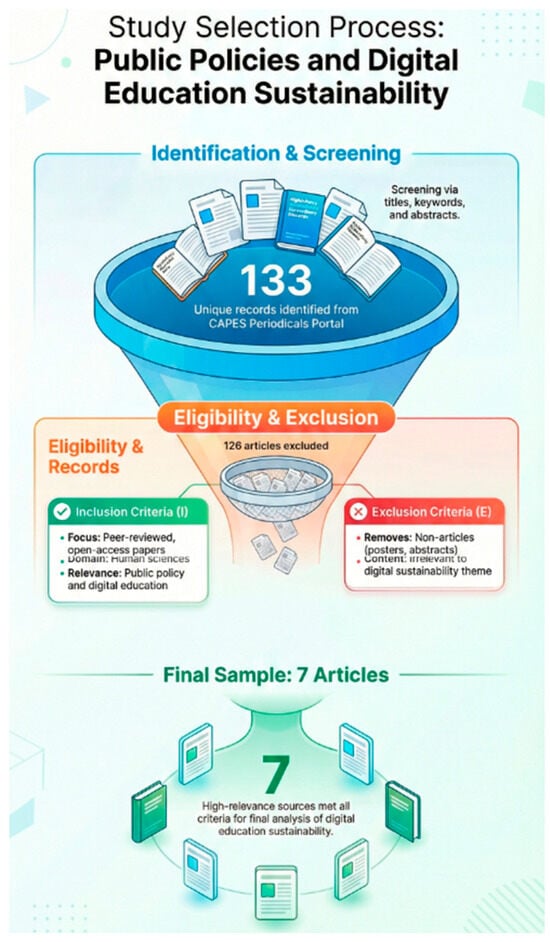
The identification phase yielded 133 unique records after duplicate removal. Screening was conducted in two sequential stages: (i) title and abstract assessment based on predefined inclusion and exclusion criteria and (ii) full-text eligibility evaluation. Inclusion criteria comprised peer-reviewed journal articles, thematic alignment with educational public policies and sustainability, publication within the temporal scope corresponding to the NEP cycle (2014–2024), and explicit reference to international sustainability frameworks. Exclusion criteria included conceptual dispersion, lack of methodological clarity, and insufficient analytical depth regarding policy alignment.
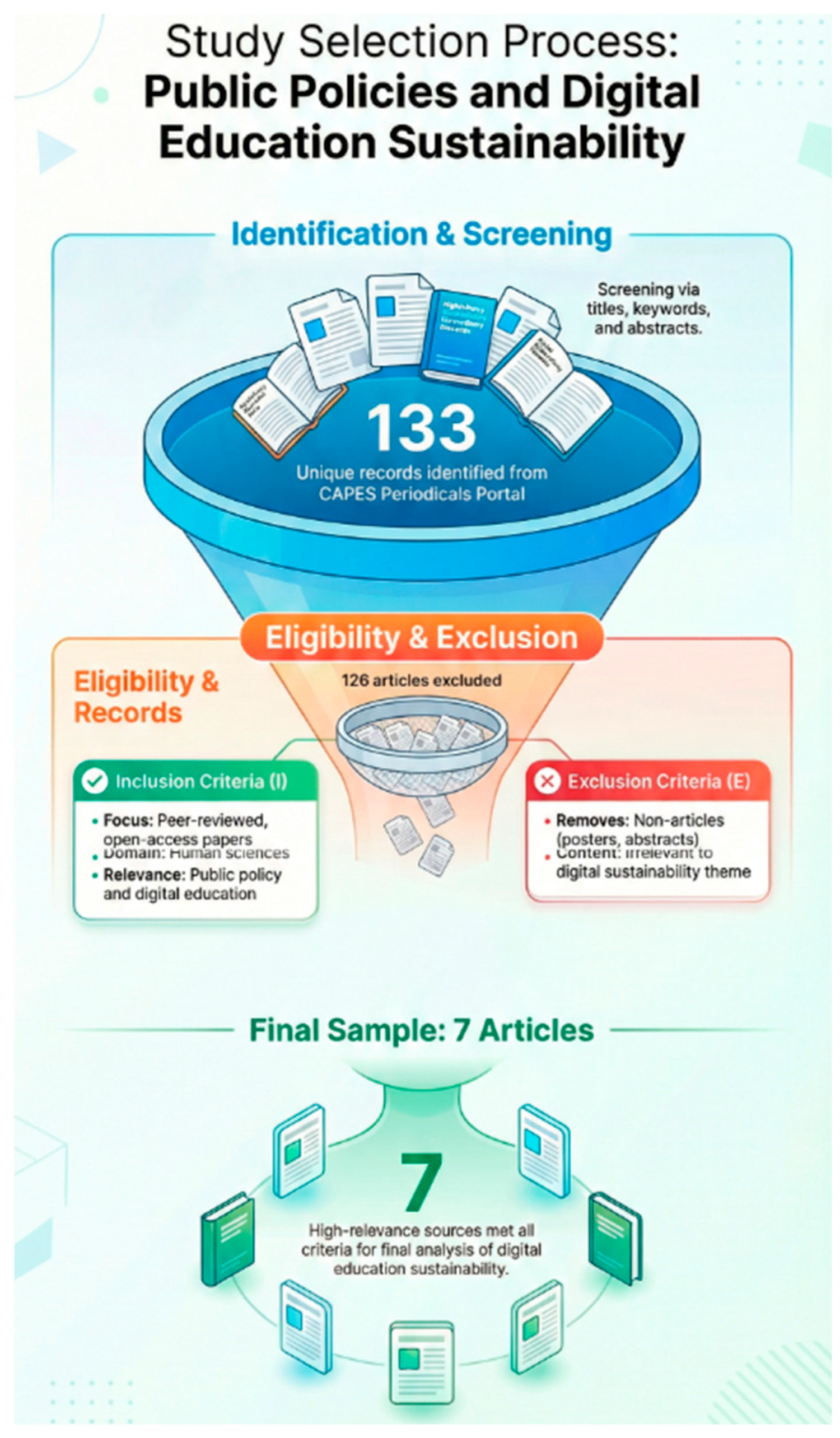
To enhance reporting transparency, the study selection process was documented using a PRISMA-based flow structure. After application of eligibility criteria, seven studies constituted the final analytical corpus, according to Figure 1.
Figure 1.
Process for selecting research sources.
Data extraction was performed using a structured matrix encompassing: (i) bibliographic identification; (ii) methodological design; (iii) conceptualization of sustainability dimensions (environmental, social, economic, and governance); (iv) treatment of public policy alignment; and (v) principal findings. Data analysis followed a thematic-analytical synthesis, consistent with the integrative method, allowing for the identification of conceptual convergences, theoretical divergences, methodological patterns, and research gaps.
By adopting the epistemological and procedural standards articulated by Whittemore and Knafl (2005), the review maintains analytical coherence while preserving the interpretative flexibility inherent to integrative designs, distinguishing it from strictly systematic reviews and meta-analytical approaches.
However, one might use CAPES Journals, the Portal of the Coordination for the Improvement of Higher Education Personnel (CAPES), to follow planning procedures and document conducted research. So, after accessing the data to extract the references, the configuration was done using descriptors and types of content (articles, theses, dissertations, audio material, etc.) in any language in the last 5 (five) years, between 2021 and 2025.
During this stage, the abstracts, keywords, and titles of the sources were read to determine whether the study should be included or excluded. This technique makes it possible to read each abstract, and in the set of them, other assertions, and perceive the presence of certain significant components of the debate on a specific area of knowledge at each time. The ability to read a text through summaries, which we know is not the only, nor the truest or most correct method, but rather the one proposed by the researcher of the state of the art. It can also be the result of understanding the marks left by the authors/editors in each summary and establishing relationships between them, as well as with a bibliography that extends beyond the production of dissertations and theses.
For inclusion criterion (I), the following were considered: (a) paper, (b) peer-reviewed, (c) comprehensive, (d) open access, (e) human sciences, and (f) public policy and the sustainability of digital education. Exclusion criteria (E): (a) not being an abstract; (b) not being a poster; (c) not being relevant to public policy and/or digital education; (d) not being an article.
The reference framework was identified and treated using inclusion and exclusion criteria to identify research dealing with “Public Policies and the Sustainability of Digital Education”.
As a result, the survey approach entailed searching for scientific papers, theses, dissertations, and systematic reviews relating to the researched theme using controlled descriptors and particular keywords derived from the research objectives. Filters based on time, field of knowledge, and document type were used to limit the theoretical corpus and the applicability of the findings to the study challenge.
Methodologically, the selected texts were analyzed using the principles of content analysis suggested by Bardin (2011), which were divided into three stages: pre-analysis, topic categorization, and results interpretation. This technique enabled the discovery of conceptual recurring themes, discursive trends, and research gaps in the literature. Furthermore, bibliometric indicators were examined, such as the frequency of publications, most cited authors, and journals with the greatest effect, with the goal of mapping the growth of scientific discourses on public policies and the sustainability of digital education.
4. Results
A comprehensive search was conducted across multiple databases extracted from the CAPES Periodicals Portal, focusing on public policies and the sustainability of digital education, with a focus on Brazil. Using filters for the above descriptors, 133 (one hundred and thirty-three) unique articles were found (after removing duplicates and sorting by relevance).
Considering the “Brazil” section, the evidence indicates that Brazil has developed various digital education policies with measurable, but unequal, gains. Persistent challenges remain regarding regional connectivity, sustainable maintenance, teacher training, and equitable access. However, of the 133 (one hundred and thirty-three) articles, 126 (thirty-six) did not meet the inclusion criteria and were therefore excluded. However, 7 (seven) sources were included in accordance with the inclusion criteria: (a) article; (b) peer-reviewed; (c) complete; (d) open access; (e) area of human sciences; (f) “Public Policies and the Sustainability of Digital Education” as per Table 1.
Table 1.
Reference framework for meeting the criteria for inclusion in Public Policies and the Sustainability of Digital Education.
Bibliographic research was carried out using the Periodicals Portal of the Coordination for the Improvement of Higher Education Personnel (CAPES), one of the most comprehensive scientific databases available, which brings together national and international collections with both restricted and open access. The portal was chosen as the primary source of consultation because of its thematic breadth, the trustworthiness of the indexed articles, and the timeliness of the available resources, which ensured methodological rigor and dependability of the results produced.
4.1. Thematic Synthesis of the Analytical Corpus
4.1.1. Sustainability as a Transversal Competence: Conceptual and Assessment Gaps
The literature converges in defining sustainability not merely as a policy principle but as a transversal competence requiring systemic, anticipatory, normative, strategic, and interpersonal dimensions. The competence-based model articulated by Membrillo-Hernández et al. (2021) conceptualizes sustainability as an integrative construct that demands inter- and transdisciplinary pedagogical approaches.
However, empirical evidence indicates a structural misalignment between this conceptual advancement and its practical operationalization in higher education. Data reported by Cano García and Lluch Molins (2022) demonstrate that sustainability competence remains marginal in assessment systems: only 9.7% of students and 15.2% of teachers reported explicit evaluation practices. Even when teachers recognize assignments and projects as suitable strategies, these tools are not systematically implemented.
This discrepancy suggests that sustainability has achieved rhetorical centrality at the policy and curricular discourse level but lacks institutional consolidation in evaluation frameworks. The gap reflects not only pedagogical inertia but also insufficient assessment literacy and limited curricular integration mechanisms.
4.1.2. Quality Assurance, Accessibility and Infrastructure as Conditions for Sustainability
Across the selected studies, sustainability in digital education is consistently linked to structural conditions of accessibility, infrastructure, and quality assurance. The multidimensional model proposed by Timbi-Sisalima et al. (2022) integrates organization, student body, teaching, and infrastructure into a continuous improvement framework, positioning accessibility as a cross-cutting dimension of sustainability.
Brazilian empirical analyses reinforce this structural dependency. Evidence indicates measurable expansion of connectivity and ICT access; however, significant regional disparities persist, particularly in municipal and northern systems (Campos et al., 2025; Okada et al., 2023). These findings highlight that infrastructure expansion alone does not guarantee sustainability. Long-term maintenance, interoperability, and teacher preparedness emerge as decisive variables.
Thus, sustainability in digital education must be understood as a systemic equilibrium between technological provision, inclusive design, and pedagogical capacity-building, rather than as mere hardware distribution.
4.1.3. Financial Sustainability and Institutionalization of Innovation
The durability of digital and pedagogical innovation depends fundamentally on financing structures and governance arrangements. Evidence from Portuguese higher education institutions (Guerra & Costa, 2021) demonstrates that short-term funding cycles undermine the institutionalization of pedagogical innovation. Sustainability requires alignment across macro (policy and funding), meso (institutional leadership and support structures), and micro (project coordination and team composition) levels.
Comparatively, Kim (2023) shows that countries with higher GDP for each person, stronger bureaucratic capacity, and greater global openness are more likely to adopt and intensify Educational Accountability Policies (EAPs). These findings indicate that economic capacity and administrative robustness are structural determinants of policy sustainability.
Together, these studies suggest that digital education sustainability cannot rely exclusively on normative alignment with SDG 4 or national legislation. It depends on stable fiscal commitments, bureaucratic continuity, and institutional embedding mechanisms that extend beyond temporary governmental programs.
4.1.4. Digitalization, Public Sphere Transformation and Algorithmic Risks
Digitalization introduces not only pedagogical opportunities but also structural tensions in the public sphere. Verovšek (2023), drawing on Habermasian theory, argues that algorithmic individualization fragments shared informational environments, weakening the intersubjective foundations necessary for democratic deliberation.
This diagnosis intersects with concerns regarding generative artificial intelligence (Tan & Maravilla, 2024). While AI tools can enhance personalized learning and support autonomy, their unregulated integration risks academic dishonesty and superficial engagement. The literature therefore converges on the necessity of authentic assessment models and digital literacy policies capable of aligning technological innovation with ethical and civic sustainability.
Consequently, digital education sustainability must incorporate governance mechanisms that regulate platform architectures, promote critical literacy, and preserve rational public discourse.
4.2. Synthesis of the Sources and Their Findings
The National Education Plan (NEP 2014–2024) establishes the guidelines and goals for Brazilian education for a decade, functioning as a public policy at a higher level. Sustainability and digital education, although not addressed in a single, specific goal under the name of sustainability of higher digital education, are addressed transversally in both the general guidelines. They include detailed strategies for improving the quality of teaching and infrastructure (Law No. 13,005, 2014).
Public Policy and Sustainability
Sustainability emerges as one of the guiding principles of educational policy in the National Education Plan 2014–2024, as defined in the guidelines (Article 2, item X). These guidelines include the promotion of values of respect for human rights, diversity, and socio-environmental sustainability. The concept of socio-environmental sustainability is implemented through specific strategies that serve vulnerable populations. An example of this is strategy 7.26, belonging to objective 7, which foresees the consolidation of school education in rural areas and traditional communities, such as indigenous and quilombola communities. This strategy respects the integration between school and community spaces while ensuring sustainable development and preserving the cultural identities of these communities (Law No. 13,005, 2014):
- Universalization of Connectivity: Strategy 7.15 mandates the universalization, by the fifth year of the National Education Plan’s (NEP) implementation, of access to the World Wide Web via high-speed broadband.
- Computer/Student Ratio: The same strategy requires tripling the computer/student ratio in public basic education schools by the end of the decade.
- Pedagogical Use: The explicit objective of these actions is to promote the pedagogical use of information and communication technologies.
- Resources and Management: Schools must be provided with digital technological equipment and resources for pedagogical use, and the management of public schools and education departments must be fully computerized.
Digital education is also a tool to improve the training of professionals and expand access (Law No. 13,005, 2014):
- Teacher Training: Strategy 15.6 requires curricular reform of undergraduate courses, incorporating modern information and communication technologies. In addition, continuing teacher training for literacy should include knowledge of new educational technologies.
- Digital Collections and Support: The plan foresees the expansion and consolidation of an electronic portal to support the work of basic education teachers, providing didactic and pedagogical materials. For higher education, the institutionalization of a program for the creation of a digital collection of bibliographic and audiovisual references is planned.
- Expansion of Supply: The National Education Plan (NEP) supports the expansion of enrollments in distance education (DE) in vocational technical education at the secondary level and in postgraduate studies in the strict sense to democratize access and expand supply.
4.3. Mathematical Components
Having completed the results section, the discussions follow, considering the research findings and triangulating the sources with the National Education Plan 2014–2024. These results allow us to understand the complexity of the sustainability of digital education from the perspective of public policies, indicating the need for integrated approaches that articulate pedagogical, technological, economic, and social dimensions. Thus, the findings systematized in this stage underpin the theoretical and critical discussion presented in the subsequent section of this study.
5. Discussion
5.1. From Normative Alignment to Implementation Gaps
The triangulation between the analytical corpus and the National Education Plan (NEP 2014–2024) reveals strong normative alignment with the 2030 Agenda, particularly with Sustainable Development Goal 4 (United Nations, 2015). Sustainability is formally embedded as a guiding principle (Law No. 13,005, 2014), and digitalization is positioned as a strategic vector for expanding educational access and quality.
However, empirical evidence indicates a persistent implementation gap. Although sustainability is recognized at the level of policy discourse and curricular intention, it remains weakly institutionalized in assessment systems (Cano García & Lluch Molins, 2022). This disjunction suggests that regulatory inclusion does not automatically translate into pedagogical consolidation. The problem, therefore, lies less in normative absence and more in operational fragility.
Bridging this gap requires strengthening teachers’ assessment literacy, aligning evaluation frameworks with sustainability competencies, and integrating formative assessment models into institutional accountability systems.
5.2. Infrastructure Expansion and Structural Inequality
The NEP’s Strategy 7.15 emphasizes universal broadband access and improved computer-to-student ratios (Law No. 13,005, 2014). Empirical evidence confirms progress in connectivity expansion. Nonetheless, structural inequalities persist, particularly in municipal and northern regions (Campos et al., 2025; Okada et al., 2023).
These findings reinforce that digital sustainability cannot be reduced to technological provision. Infrastructure must be accompanied by long-term maintenance planning, interoperability standards, and teacher professional development. Without such integration, digital inclusion risks becoming episodic rather than systemic.
Financial sustainability also emerges as a decisive variable. Short-term funding cycles undermine the institutionalization of innovation (Guerra & Costa, 2021). Moreover, comparative evidence indicates that durable accountability systems depend on bureaucratic capacity and economic robustness (Kim, 2023). Thus, sustainability requires fiscal continuity and governance coherence beyond electoral cycles.
5.3. Artificial Intelligence, Educational Research, and Policy Innovation
The expansion of generative artificial intelligence (GAI) introduces both pedagogical and epistemological transformations. Tan and Maravilla (2024) argue that AI can enhance personalized learning and autonomy when integrated within authentic assessment models. However, the educational implications extend beyond classroom practice.
Recent research on digital transformation and artificial intelligence in education highlights AI’s capacity to support large-scale data analysis, adaptive learning systems, predictive modeling, and evidence-based decision-making (Červeňová & Demkanin, 2025). These developments expand the methodological repertoire of educational research, enabling more granular monitoring of learning trajectories and policy impact.
From a public policy perspective, AI-driven analytics can contribute to real-time evaluation of infrastructure use, regional disparities, and pedagogical outcomes. Nevertheless, such applications require robust regulatory frameworks addressing transparency, data protection, algorithmic bias, and ethical governance.
Thus, the sustainability of digital education must incorporate AI not only as a pedagogical tool but also as an instrument for policy intelligence—while ensuring alignment with democratic and socio-environmental principles.
5.4. Digital Public Sphere and Civic Sustainability
Digital education unfolds within a broader digital public sphere shaped by algorithmic individualization. Verovšek (2023) argues that platform architectures fragment shared informational environments, weakening the intersubjective foundations necessary for rational-critical debate.
This dynamic poses a structural tension for sustainability. Education for Sustainable Development presupposes collective deliberation and shared responsibility. However, algorithmic filtering may generate epistemic fragmentation, undermining the civic dimension of sustainability.
Consequently, public policies must extend beyond connectivity and technological deployment. They must promote critical digital literacy, ethical AI engagement, and platform accountability mechanisms. Sustainability in digital education, therefore, encompasses not only environmental and economic dimensions but also civic rationality and democratic resilience.
6. Conclusions
This study proposes an analysis of Brazilian public policies addressing the sustainability of digital education, focusing on aspects such as regulatory frameworks, governance, infrastructure, and emerging technological dynamics. The findings indicate that, while Brazil has implemented significant normative and strategic instruments, particularly the National Education Plan (NEP 2014–2024) and various initiatives associated with digitalization, the establishment of a sustainable digital education system continues to face inequalities and structural constraints.
The investigation underscores that sustainability in digital education extends beyond mere technological deployment. It requires systemic articulation of diverse factors, including investments in infrastructure, sustained financing, robust institutional governance, professional teacher training, the enhancement of digital competence, and ethical regulation of emerging technologies. Although policy frameworks recognize digital inclusion and innovation as key objectives, challenges persist in practical implementation, particularly concerning geographical equity, financial stability, and effective coordination across federal, state, and municipal levels.
Furthermore, the growing integration of artificial intelligence (AI) into educational settings presents substantial transformative opportunities alongside complex governance challenges. Technologies such as adaptive systems, data monitoring tools, and predictive analytics can facilitate evidence-based policy formulation. However, these advancements necessitate adequate regulatory mechanisms, operational transparency and ethical oversight to mitigate risks associated with algorithmic bias, social exclusion, or the improper use of educational data. Within this context, sustainability should be conceptualized not merely as the robustness of technological infrastructure but as a principle interwoven with institutional accountability and ethical integrity.
This study’s scope is subject to certain limitations. While the integrative review model employed is suitable for thematic synthesis, it relies significantly on indexed publications, potentially overlooking unpublished public policy documents or grey literature. Additionally, the exclusive focus on Brazil as a case study constrains the direct generalizability of the findings. Nevertheless, the analysis provides valuable insights for emerging educational contexts facing similar structural challenges.
For future research, longitudinal assessments of public policy impacts, the development of applicable metrics for educational sustainability, and comparative studies across different countries are recommended. In particular, further investigation into the intersection of artificial intelligence, institutional governance capacity, and equitable educational promotion is critical for informing strategic decision-making in both political and educational domains.
In synthesis, consolidating sustainable digital education in Brazil demands articulated public policies based on evidence and adapted to the long term. These actions need to incorporate technological innovation combined with the promotion of social equity, the stability of institutions, and the development of ethical governance mechanisms. Without a systemic alignment of these fundamental dimensions, the advancement of digitalization risks perpetuating structural inequalities, instead of contributing to overcoming them.
Funding
This research received no external funding.
Institutional Review Board Statement
This research is an integrative literature review, based on secondary data from previously published studies, not directly involving human subjects or primary data collection. Therefore, it was not submitted for approval to a Research Ethics Committee, according to ethical guidelines for research with human subjects.
Informed Consent Statement
Not applicable.
Data Availability Statement
The data used in this research are available in a publicly accessible repository. The original data presented in the study are publicly available at https://www.periodicos.capes.gov.br/ (accessed on 16 February 2026). However, all data are referenced in the References section of this article.
Conflicts of Interest
The author declares no conflict of interest.
Abbreviations
The following abbreviations are used in this manuscript:
| CAPES | Coordination for the Improvement of Higher Education Personnel |
| CBL | Challenge-Based Learning |
| DE | Distance Education |
| EAPs | Educational Accountability Policies |
| ESD | Education for Sustainable Development |
| GAI | Generative Artificial Intelligence |
| IA | Artificial Intelligence |
| MEC | Ministry of Education |
| SDGs | Sustainable Development Goals |
| UN | United Nations |
| NDEP | National Digital Education Plan |
| NEP | National Education Plan |
| PPAs | Multi-Year Plans |
| SDT | Self-Determination Theory |
| ICT | Information and Communication Technology |
References
- Bardin, L. (2011). Content analysis (70th ed.). Edicoes. [Google Scholar]
- Baxto, W., & Machado, A. D. (2025). Educational policy of quality indicators in higher education in distance modality: Bibliometric review. In M. Lytras, & A. Șerban (Eds.), Academic accreditation and evaluation in higher education: Practices, experiences, and quality assurance (pp. 163–182). IGI Global Scientific Publishing. [Google Scholar] [CrossRef] [Scilit]
- Brazil. (2014). Law n° 13,005, of 25 June 2014 (86p). Approves the national education plan (PNE 2014–2024) and provides other measures. (Legislation series; No. 125). Chamber of Deputies, Editions Chamber. [Google Scholar]
- Brazil. (2024). Law nº. 14,934 of 25 July 2024 (p. 1). Official Gazette of the Union—Section 1—26 July 2024. (Original publication). Chamber of Deputies, Edições Câmara. Available online: https://www2.camara.leg.br/legin/fed/lei/2024/lei-14934-25-julho-2024-795997-publicacaooriginal-172483-pl.html (accessed on 16 February 2026).
- Brundtland, G. (1987). Report of the world commission on environment and development: Our common future. United Nations General Assembly Document A/42/427. Digital Library. Available online: https://digitallibrary.un.org/record/139811?v=pdf (accessed on 16 February 2026).
- Campos, R. A., Martini, F., Suzuki, J. T. F., David, S., Araujo, C. G., Nishikawa, T. F. C., Todan, I. C., Santos, J. V., Fernandes, D. B., Alves, A., Rocha, G. Q. O., Cardoso, R., & Barros, L. (2025). Projeto Recriar: Sustentabilidade, Inclusão Digital e Inovação Pedagógica a Partir da Reutilização de Dispositivos Tecnológicos Ilegais. Available online: https://periodicos.newsciencepubl.com/arace/article/view/6417 (accessed on 16 February 2026).
- Cano García, E., & Lluch Molins, L. (2022). Competence-based assessment in higher education during COVID-19 lockdown: The demise of sustainability competence. Sustainability, 14(15), 9560. [Google Scholar] [CrossRef] [Scilit]
- Červeňová, D., & Demkanin, P. (2025). Using LLM to identify pillars of the mind within physics learning materials. Digital, 5(4), 47. [Google Scholar] [CrossRef] [Scilit]
- Guerra, C., & Costa, N. (2021). Can pedagogical innovations be sustainable? An evaluation perspective for research developed in Portuguese higher education. Education Sciences, 11(11), 725. [Google Scholar] [CrossRef] [Scilit]
- Kim, Y. (2023). Educational accountability policy for sustainable development: A comparative analysis in 30 countries. Sustainability, 15(18), 13883. [Google Scholar] [CrossRef] [Scilit]
- Lima, K. O., Garcia, F. M., & Machado, A. S. R. C. (2022). Políticas públicas de acesso às tecnologias digitais no contexto educacional Brasileiro. Research, Society and Development, 11(16), e492111638662. [Google Scholar] [CrossRef] [Scilit]
- Membrillo-Hernández, J., Lara-Prieto, V., & Caratozzolo, P. (2021). Sustainability: A public policy, a concept or a competence? Efforts in implementing sustainability as a cross-cutting competence in higher education programs. Sustainability, 13(24), 13989. [Google Scholar] [CrossRef] [Scilit]
- Nogueira, D. C. A. (2024). Políticas públicas de inclusão digital e o direito à educação de alunos em vulnerabilidade social. Editora Realize. [Google Scholar] [CrossRef] [Scilit]
- Okada, A., Steimber de Pereira Okada, A. E., & de Oliveira Campolina, L. (2023). Open schooling for digital education with science and technology—Reflections on European and Brazilian public policy plans. Revista Científica, 65, e24689. [Google Scholar] [CrossRef] [Scilit]
- Pilatti, L. A., & Carvalho, H. A. D. (2023). Information and communication technology in Brazilian public schools: A sustainable legacy of the pandemic? Sustainability, 15(8), 6462. [Google Scholar] [CrossRef] [Scilit]
- Tan, M. J., & Maravilla, N. (2024). Shaping integrity: Why generative artificial intelligence does not have to undermine education. Frontiers in Artificial Intelligence, 7, 1471224. [Google Scholar] [CrossRef] [Scilit] [PubMed]
- Timbi-Sisalima, C., Sánchez-Gordón, M., Hilera-Gonzalez, J. R., & Otón-Tortosa, S. (2022). Quality assurance in E-learning: A proposal from accessibility to sustainability. Sustainability, 14(5), 3052. [Google Scholar] [CrossRef] [Scilit]
- United Nations. (2015). AGENDA 2030. SDGs—Sustainable development goals. UN. Available online: https://www.un.org/en/climatechange (accessed on 16 February 2026).
- Verovšek, P. J. (2023). Authorship and individualization in the digital public sphere. Constellations, 30, 34–41. [Google Scholar] [CrossRef] [Scilit]
- Vianna, P. H. F., Góis, D. V., Duarte, F., Conceição, C. D. J., Portela, I. M. C., Oliveira, L. P. R. D., Amorim, W. M. D., Pereira, S., Rodrigues, T. D. A., Prazeres, A. P. R. D., Morais, M., Pinheiro, C. C. D. S., Silva, H. D., Parente, M. S. P., & Araújo, M. P. P. (2024). Políticas públicas para a integração da educação, tecnologia e sustentabilidade no ensino básico e superior. Revista Campo Da História, 9(2), e317. [Google Scholar] [CrossRef] [Scilit]
- Whittemore, R., & Knafl, K. (2005). The integrative review: Updated methodology. Journal of Advanced Nursing, 52(5), 546–553. [Google Scholar] [CrossRef] [Scilit] [PubMed]

Disclaimer/Publisher’s Note: The statements, opinions and data contained in all publications are solely those of the individual author(s) and contributor(s) and not of MDPI and/or the editor(s). MDPI and/or the editor(s) disclaim responsibility for any injury to people or property resulting from any ideas, methods, instructions or products referred to in the content. |
© 2026 by the author. Licensee MDPI, Basel, Switzerland. This article is an open access article distributed under the terms and conditions of the Creative Commons Attribution (CC BY) license.