Leveraging Generative AI Through Vibe Coding: A Case of Simulation-Based Curriculum Redesign in Management Education

Abstract
1. Introduction
2. Background and Literature: GenAI as an Enabler of Educational Practice Transformation
3. Curriculum Redesign Rationale
3.1. Emphasizing Skills in Operations Management Education
3.2. Simulation-Based Learning
4. Educator Blueprint for Simulation Design
4.1. Vibe Coding and Simulation Development
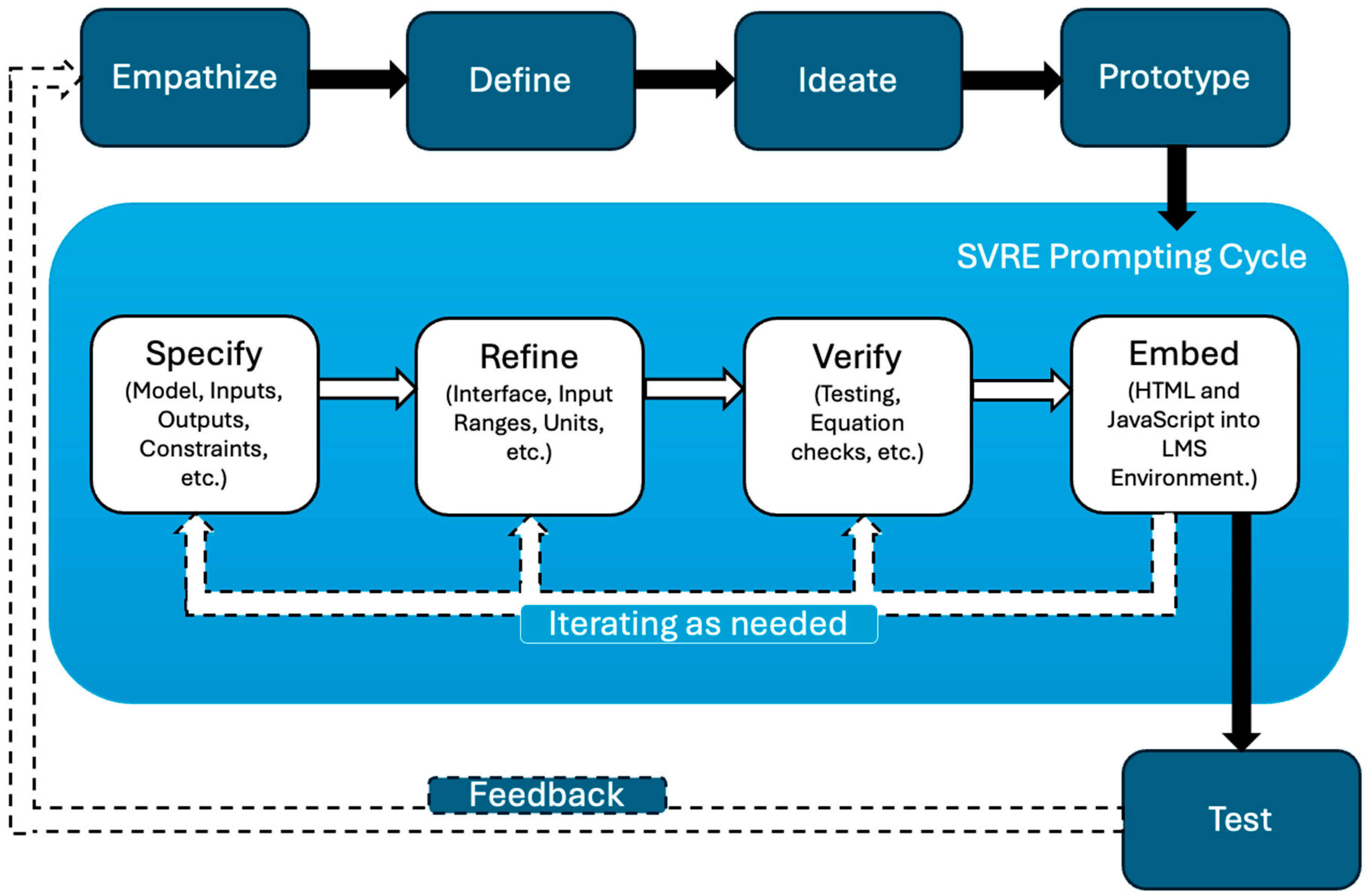
- Specify—prompts that declared the operations management model, inputs/outputs, constraints, and performance metrics. For example: create a turn-based simulation model for use in a university education setting that models inventory management, use the economic order quantity model as a basis, expect order quantity inputs from students and output financial performance metrics.
- Refine—prompts related to refining the user interface and usability, as well as input ranges and units. For example: A user interface should include a space to input order quantities (with specified maximum and minimum values), operational parameters such as holding and ordering costs (in dollars), performance graphs showing profit (in dollars) and service level (in percentage demand met) per turn, and a historical table of relevant inputs and outputs per turn.
- Verify—prompts containing boundary tests (including edge cases), seed randomization, and equation checks using manual calculation procedures to ensure rigor in calculations. If verification revealed errors, feedback was provided to the LLM and iteration continued until errors were resolved. For example: Test 10 different input values (including maximum and minimum values) and output the performance outcomes based on the stated equations and calculation algorithm, I will check these against manual calculations and tell you if any errors arise.
- Embed—producing the HTML and JavaScript code that is suitable for embedding into learning management system (LMS) content blocks. For example, if an element did not display properly, we provided a screenshot and used prompts such as the graphs are not displaying properly, see the following screenshot, diagnose the problem, and refactor the code accordingly.
4.2. GenAI-Enabled Simulation-Based Learning for Critical and Analytical Thinking
5. Reflections on Implementation
5.1. Educator Insights
5.2. Technical and Pedagogical Challenges
6. Discussion, Limitations, and Theoretical Contribution
Supplementary Materials
Author Contributions
Funding
Institutional Review Board Statement
Informed Consent Statement
Data Availability Statement
Conflicts of Interest
References
- Adam, M., Bauer, K., Jussupow, E., Stein, M.-K., & Benlian, A. (2025). Generating tomorrow’s me: How collaborating with generative AI changes humans. Business & Information Systems Engineering, 67(5), 583–594. [Google Scholar] [CrossRef]
- Bada, S., & Olusegun, S. (2015). Constructivism learning theory: A paradigm for teaching and learning. Journal of Research & Method in Education, 5(6), 66–70. [Google Scholar]
- Barab, S., & Squire, K. (2004). Design-based research: Putting a stake in the ground. Journal of the Learning Sciences, 13(1), 1–14. [Google Scholar] [CrossRef]
- Barrett, A., & Pack, A. (2023). Not quite eye to A.I.: Student and teacher perspectives on the use of generative artificial intelligence in the writing process. International Journal of Educational Technology in Higher Education, 20(1), 59. [Google Scholar] [CrossRef]
- Barzanji, C., & Loitsch, C. (2025). Exploring conversational agents for novice programmers: A scoping review. Discover Artificial Intelligence, 5(1), 271. [Google Scholar] [CrossRef]
- Bathla, A., Chawla, G., & Gupta, A. (2025). Benchmarking design-thinking as a tool for education: A systematic review and future research agenda. Benchmarking: An International Journal, 32(3), 965–991. [Google Scholar] [CrossRef]
- Beatty, J. E., Chen, Y.-S., & Klein, B. D. (2021). Games and gamification in business school courses: Experiential education that creates engagement and flow. Decision Sciences Journal of Innovative Education, 19(3), 170–172. [Google Scholar] [CrossRef]
- Belkina, M., Daniel, S., Nikolic, S., Haque, R., Lyden, S., Neal, P., Grundy, S., & Hassan, G. M. (2025). Implementing generative AI (GenAI) in higher education: A systematic review of case studies. Computers and Education: Artificial Intelligence, 8, 100407. [Google Scholar] [CrossRef]
- Bigelow, J. D. (2004). Using problem-based learning to develop skills in solving unstructured problems. Journal of Management Education, 28(5), 591–609. [Google Scholar] [CrossRef]
- Biggs, J. (1996). Enhancing teaching through constructive alignment. Higher Education, 32(3), 347–364. [Google Scholar] [CrossRef]
- Bonwell, C. C., & Eison, J. A. (1991). Active learning: Creating excitement in the classroom (ASHE-ERIC higher education reports). ERIC Clearinghouse on Higher Education, The George Washington University. [Google Scholar]
- Brown, T. (2008). Design thinking. Harvard Business Review, 86(6), 84. [Google Scholar]
- Carvalho, L., Martinez-Maldonado, R., Tsai, Y.-S., Markauskaite, L., & De Laat, M. (2022). How can we design for learning in an AI world? Computers and Education: Artificial Intelligence, 3, 100053. [Google Scholar] [CrossRef]
- Chan, C. K. Y. (2023). A comprehensive AI policy education framework for university teaching and learning. International Journal of Educational Technology in Higher Education, 20(1), 38. [Google Scholar] [CrossRef]
- Chernikova, O., Heitzmann, N., Stadler, M., Holzberger, D., Seidel, T., & Fischer, F. (2020). Simulation-based learning in higher education: A meta-analysis. Review of Educational Research, 90(4), 499–541. [Google Scholar] [CrossRef]
- Chow, M., & Ng, O. (2025). From technology adopters to creators: Leveraging AI-assisted vibe coding to transform clinical teaching and learning. Medical Teacher, 47, 1927–1929. [Google Scholar] [CrossRef] [PubMed]
- Clegg, S., & Sarkar, S. (2024). Artificial intelligence and management education: A conceptualization of human-machine interaction. The International Journal of Management Education, 22(3), 101007. [Google Scholar] [CrossRef]
- Cotton, D. R., Cotton, P. A., & Shipway, J. R. (2024). Chatting and cheating: Ensuring academic integrity in the era of ChatGPT. Innovations in Education and Teaching International, 61(2), 228–239. [Google Scholar] [CrossRef]
- Crawford, J., Vallis, C., Yang, J., Fitzgerald, R., & O’Dea, C. (2023). Editorial: Artificial intelligence is awesome, but good teaching should always come first. Journal of University Teaching and Learning Practice, 20(7), 1–12. [Google Scholar] [CrossRef]
- Davies, C. H. J. (2002). Student engagement with simulations: A case study. Computers & Education, 39(3), 271–282. [Google Scholar] [CrossRef]
- Dissanayake, H., Manta, O., Iddagoda, A., & Palazzo, M. (2024). AI applications in business: Trends and insights using bibliometric analysis. The International Journal of Management Education, 22(3), 101075. [Google Scholar] [CrossRef]
- Dittrich, L., Aagaard, T., & Hjukse, H. (2022). The perceived affordances of simulation-based learning: Online student teachers’ perspectives. International Journal of Educational Technology in Higher Education, 19(1), 60. [Google Scholar] [CrossRef] [PubMed]
- Ehsani, R., Pathak, S., Parra, E., Haiduc, S., & Chatterjee, P. (2025). What characteristics make ChatGPT effective for software issue resolution? An empirical study of task, project, and conversational signals in GitHub issues. Empirical Software Engineering, 31(1), 22. [Google Scholar] [CrossRef]
- Fischer, I., & Dobbins, K. (2024). Is it worth it? How paradoxical tensions of identity shape the readiness of management educators to embrace transformative technologies in their teaching. Journal of Management Education, 48(4), 829–848. [Google Scholar] [CrossRef]
- Fulmore, J. A., Olson, J., & Maellaro, R. (2023). Aligning leadership education: Linking interpersonal skills development to business needs. Journal of Management Education, 47(3), 263–291. [Google Scholar] [CrossRef]
- Grossman, P., Compton, C., Igra, D., Ronfeldt, M., Shahan, E., & Williamson, P. W. (2009). Teaching practice: A cross-professional perspective. Teachers College Record, 111(9), 2055–2100. [Google Scholar] [CrossRef]
- Hallinger, P., & Wang, R. (2020). The evolution of simulation-based learning across the disciplines, 1965–2018: A science map of the literature. Simulation & Gaming, 51(1), 9–32. [Google Scholar] [CrossRef]
- Hasso Plattner Institute of Design at Stanford. (2010). An introduction to design thinking: Process guide. Available online: https://s3-eu-west-1.amazonaws.com/ih-materials/uploads/Introduction-to-design-thinking.pdf (accessed on 27 February 2026).
- Heitzmann, N., Fischer, F., Hofmann, R., & Seidel, T. (2023). Editorial for the special issue “Advances in simulation-based learning in higher education”. Learning and Instruction, 86, 101774. [Google Scholar] [CrossRef]
- Hilton, M. L., & Pellegrino, J. W. (2012). Education for life and work: Developing transferable knowledge and skills in the 21st century. National Academies Press. [Google Scholar]
- Hoadley, C., & Campos, F. C. (2022). Design-based research: What it is and why it matters to studying online learning. Educational Psychologist, 57(3), 207–220. [Google Scholar] [CrossRef]
- Ionescu-Feleagă, L., Dragomir, V. D., Rîndașu, S.-M., Stoica, O.-C., Curea, Ș.-C., Bunea, M., & Barna, L.-E.-L. (2025). Business simulation games from the perspective of accounting and management professors: Implications for sustainability education in universities. The International Journal of Management Education, 23(2), 101147. [Google Scholar] [CrossRef]
- Itani, A., Gronseth, S. L., Musaad, S., Nguyen, T., Mirabile, Y., & Beech, B. M. (2025). Ethical considerations for teaching with artificial intelligence: A scoping review in medical education settings. International Journal of Educational Technology in Higher Education, 22(1), 68. [Google Scholar] [CrossRef]
- Jossberger, H., Breckwoldt, J., & Gruber, H. (2022). Promoting Expertise Through Simulation (PETS): A conceptual framework. Learning and Instruction, 82, 101686. [Google Scholar] [CrossRef]
- Kageyama, Y., Zamudio, S. Z., & Barton, M. (2022). Incorporation of simulation features to improve higher order thinking skills. The International Journal of Management Education, 20(2), 100628. [Google Scholar] [CrossRef]
- Karpathy, A. (2025). There’s a new kind of coding I call “vibe coding”, where you fully give in to the vibes, embrace exponentials, and forget that the code even exists. X. Available online: https://x.com/karpathy/status/1886192184808149383 (accessed on 27 February 2026).
- Kasneci, E., Sessler, K., Küchemann, S., Bannert, M., Dementieva, D., Fischer, F., Gasser, U., Groh, G., Günnemann, S., Hüllermeier, E., Krusche, S., Kutyniok, G., Michaeli, T., Nerdel, C., Pfeffer, J., Poquet, O., Sailer, M., Schmidt, A., Seidel, T., … Kasneci, G. (2023). ChatGPT for good? On opportunities and challenges of large language models for education. Learning and Individual Differences, 103, 102274. [Google Scholar] [CrossRef]
- Keys, B., & Wolfe, J. (1990). The role of management games and simulations in education and research. Journal of Management, 16(2), 307–336. [Google Scholar] [CrossRef]
- King, A. (1993). From sage on the stage to guide on the side. College Teaching, 41(1), 30–35. [Google Scholar] [CrossRef]
- Klein, E. J. (2008). Learning, unlearning, and relearning: Lessons from one school’s approach to creating and sustaining learning communities. Teacher Education Quarterly, 35(1), 79–97. [Google Scholar]
- Kluge, A. (2007). Experiential learning methods, simulation complexity and their effects on different target groups. Journal of Educational Computing Research, 36(3), 323–349. [Google Scholar] [CrossRef]
- Knight, S., Dickson-Deane, C., Heggart, K., Kitto, K., Kozanoğlu, D. C., Maher, D., Naraya, B., & Zarrabi, F. (2023). Generative AI in the Australian education system: An open data set of stakeholder recommendations and emerging analysis from a public inquiry. Australasian Journal of Educational Technology, 39(5), 101–124. [Google Scholar] [CrossRef]
- Knowles, M. S., Holton, E. F., III, & Swanson, R. A. (2005). The adult learner: The definitive classic in adult education and human resource development. Taylor & Francis Group. Available online: https://www.scirp.org/reference/referencespapers?referenceid=2806833 (accessed on 27 February 2026).
- Kolb, A. Y., & Kolb, D. A. (2012). Experiential learning theory. In Encyclopedia of the sciences of learning (pp. 1215–1219). Springer. [Google Scholar]
- Kumar, S., Rao, P., Singhania, S., Verma, S., & Kheterpal, M. (2024). Will artificial intelligence drive the advancements in higher education? A tri-phased exploration. Technological Forecasting and Social Change, 201, 123258. [Google Scholar] [CrossRef]
- Lehtinen, E. (2023). Can simulations help higher education in training professional skills? Learning and Instruction, 86, 101772. [Google Scholar] [CrossRef]
- Lim, W. M., Gunasekara, A., Pallant, J. L., Pallant, J. I., & Pechenkina, E. (2023). Generative AI and the future of education: Ragnarök or reformation? A paradoxical perspective from management educators. The International Journal of Management Education, 21(2), 100790. [Google Scholar] [CrossRef]
- Loaiza, I., & Rigobon, R. (2024). The EPOCH of AI: Human-machine complementarities at work. Available online: https://papers.ssrn.com/sol3/papers.cfm?abstract_id=5028371 (accessed on 27 February 2026).
- Macvaugh, J., & Norton, M. (2011). Introducing sustainability into business education contexts using active learning. Higher Education Policy, 24(4), 439–457. [Google Scholar] [CrossRef]
- Marks, A., & Al-Ali, M. (2022). Digital transformation in higher education: A framework for maturity assessment. In M. Alaali (Ed.), COVID-19 challenges to university information technology governance (pp. 61–81). Springer International Publishing. [Google Scholar] [CrossRef]
- Michel-Villarreal, R., Vilalta-Perdomo, E., Salinas-Navarro, D. E., Thierry-Aguilera, R., & Gerardou, F. S. (2023). Challenges and opportunities of generative AI for higher education as explained by ChatGPT. Education Sciences, 13(9), 856. [Google Scholar] [CrossRef]
- Mollick, E. R., & Mollick, L. (2024). Instructors as innovators: A future-focused approach to new AI learning opportunities, with prompts (The Wharton School Research Paper). Available online: https://papers.ssrn.com/sol3/papers.cfm?abstract_id=4802463 (accessed on 27 February 2026).
- Moundridou, M., Matzakos, N., & Doukakis, S. (2024). Generative AI tools as educators’ assistants: Designing and implementing inquiry-based lesson plans. Computers and Education: Artificial Intelligence, 7, 100277. [Google Scholar] [CrossRef]
- Pang, W., & Wei, Z. (2025). Shaping the future of higher education: A technology usage study on generative AI innovations. Information, 16(2), 95. [Google Scholar] [CrossRef]
- Pasin, F., & Giroux, H. (2011). The impact of a simulation game on operations management education. Computers & Education, 57(1), 1240–1254. [Google Scholar] [CrossRef]
- Pereira, E., Nsair, S., Pereira, L. R., & Grant, K. (2024). Constructive alignment in a graduate-level project management course: An innovative framework using large language models. International Journal of Educational Technology in Higher Education, 21(1), 25. [Google Scholar] [CrossRef]
- Polizzi, G., & Harrison, T. (2022). Wisdom in the digital age: A conceptual and practical framework for understanding and cultivating cyber-wisdom. Ethics and Information Technology, 24(1), 16. [Google Scholar] [CrossRef]
- Ratten, V., & Jones, P. (2023). Generative artificial intelligence (ChatGPT): Implications for management educators. The International Journal of Management Education, 21(3), 100857. [Google Scholar] [CrossRef]
- Ravi, M., Kaur, K., Wright, C., Bawn, M., & Cutillo, L. (2025). University staff and student perspectives on competent and ethical use of AI: Uncovering similarities and divergences. International Journal of Educational Technology in Higher Education, 22(1), 55. [Google Scholar] [CrossRef]
- Ritter, B. A., Gopalkrishnan, S. S., & Sockbeson, C. E. S. (2024). The next generation of pedagogy: Reflections from EdTech leaders. Journal of Management Education, 48(4), 610–633. [Google Scholar] [CrossRef]
- Rose, R. (2016). Defining analytics: A conceptual framework: Analytics’ rapid emergence a decade ago created a great deal of corporate interest, as well as confusion regarding its meaning. Or/MS Today, 43(3), 34–39. [Google Scholar]
- Rudolph, J., Tan, S., & Tan, S. (2023). ChatGPT: Bullshit spewer or the end of traditional assessments in higher education? Journal of Applied Learning and Teaching, 6(1), 342–363. [Google Scholar] [CrossRef]
- Sandoval, W. A., & Bell, P. (2004). Design-based research methods for studying learning in context: Introduction. Educational Psychologist, 39(4), 199–201. [Google Scholar] [CrossRef]
- Sharma, S. (2025). Adoption of generative artificial intelligence in management education using unlearning mechanism. The International Journal of Management Education, 23(3), 101249. [Google Scholar] [CrossRef]
- Skritsovali, K. (2023). Learning through playing: Appreciating the role of gamification in business management education during and after the COVID-19 pandemic. Journal of Management Development, 42(5), 388–398. [Google Scholar] [CrossRef]
- Sollosy, M., & McInerney, M. (2022). Artificial intelligence and business education: What should be taught. The International Journal of Management Education, 20(3), 100720. [Google Scholar] [CrossRef]
- Verboom, A. D. P. R., Pais, L., Zijlstra, F. R. H., Oswald, F. L., & Santos, N. R. d. (2025). Perceptions of artificial intelligence in academic teaching and research: A qualitative study from AI experts and professors’ perspectives. International Journal of Educational Technology in Higher Education, 22(1), 46. [Google Scholar] [CrossRef]
- Vermunt, J. D. (2023). Understanding, measuring and improving simulation-based learning in higher education: Student and teacher learning perspectives. Learning and Instruction, 86, 101773. [Google Scholar] [CrossRef]
- Vieira, C., De la Hoz, J. L., Magana, A. J., & Restrepo, D. (2025). Engineering students’ experiences with ChatGPT to generate code for disciplinary programming. Computer Applications in Engineering Education, 33(6), e70090. [Google Scholar] [CrossRef]
- Walter, Y. (2024). Embracing the future of Artificial Intelligence in the classroom: The relevance of AI literacy, prompt engineering, and critical thinking in modern education. International Journal of Educational Technology in Higher Education, 21(1), 15. [Google Scholar] [CrossRef]
- Wang, H., Dang, A., Wu, Z., & Mac, S. (2024). Generative AI in higher education: Seeing ChatGPT through universities’ policies, resources, and guidelines. Computers and Education: Artificial Intelligence, 7, 100326. [Google Scholar] [CrossRef]
- Yang, Y., Luo, J., Yang, M., Yang, R., & Chen, J. (2024). From surface to deep learning approaches with Generative AI in higher education: An analytical framework of student agency. Studies in Higher Education, 49(5), 817–830. [Google Scholar] [CrossRef]
- Zawacki-Richter, O., Marín, V. I., Bond, M., & Gouverneur, F. (2019). Systematic review of research on artificial intelligence applications in higher education—Where are the educators? International Journal of Educational Technology in Higher Education, 16(1), 39. [Google Scholar] [CrossRef]
- Zhang, S., Zhao, X., Zhou, T., & Kim, J. H. (2024). Do you have AI dependency? The roles of academic self-efficacy, academic stress, and performance expectations on problematic AI usage behavior. International Journal of Educational Technology in Higher Education, 21(1), 34. [Google Scholar] [CrossRef]
- Zhu, Y., Jiang, H., & Zhong, L. (2026). Generative artificial intelligence-assisted STEM education: A systematic review and future research agenda. European Journal of Education, 61(1), e70462. [Google Scholar] [CrossRef]


| Design Thinking Stage | Actions in This Case | SRVE Stage |
|---|---|---|
| Empathize | Recognised that students’ time was the primary resource at stake, and that traditional knowledge-transmission teaching was an inefficient use of it. Reframed the educational problem as one of skills development: what students could do mattered more than what they knew. | Pre-SRVE |
| Define | Identified simulation-based learning as the target pedagogy—sufficiently close to existing pedagogical knowledge to be implementable, and well-supported in the operations management education literature. Third-party simulations were ruled out due to cost and licensing constraints; traditional coding ruled out due to technical barriers and absence of dedicated resources. | Pre-SRVE |
| Ideate | The emergence of vibe coding was recognised as an enabling opportunity—a newly accessible capability that made simulation development feasible without specialist technical knowledge or funding. This recognition, informed by pre-existing domain expertise, collapsed the ideation process into a single, well-grounded insight rather than a formal divergent options exercise. | Pre-SRVE |
| Prototype | LLM-assisted code generation using iterative natural language prompts, structured through the four SRVE prompting patterns. | Specify → Refine |
| Test | Simulations trialled with academic colleagues prior to implementation; refined iteratively across three non-sequential trimesters based on LMS rendering issues and tutor feedback. | Verify → Embed |
| Category | Description | Example Question | Bloom’s Taxonomy Level |
|---|---|---|---|
| Content recall | Requires recalling and stating content previously covered. | What is the definition of concept X? | Remember |
| Calculation | Performing step-by-step mathematical procedures to arrive at a precise solution. | Calculate the value of X using the given formula. | Apply |
| Descriptive analytics | Involve identification of trends, describing characteristics, or articulating current state. | Describe any trends in the performance data. | Understand |
| Diagnostic analytics | Analyze and identify/diagnose root causes, behind observed outcomes or data patterns. | Why did product X sales spike during the holiday season? | Analyze |
| Predictive analytics | Making predictions, forecasting future trends, or evaluating outcomes based on evidence. | If the operation is managed in X manner, what is the most likely outcome? | Apply |
| Prescriptive analytics | Problem questions that elicit prescriptive courses of action, strategies, or solutions based on analysis of data and settings. | Given the data provided, what level of inventory would be appropriate to maximize profits? | Evaluate/Synthesize |
| Week | Simulation | Content | Aligned SLO | Objective(s) |
|---|---|---|---|---|
| 1 | Number Guessing Game | None | 4 | Introduce students to the importance of decision-making in operations. Acquaint students with the analytical and critical thinking required to manage operations. |
| 2 | Productivity and Performance (Food truck simulation) | Introduction to operations management Operations performance | 1, 3, 4 | Evaluate performance (single and multi-factor productivity) and performance metrics. Understand the role of decisions in driving operations performance. |
| 3 | Little’s Law (Coffee shop) | Process Design | 1, 3 | Link capacity, productivity, and Little’s Law in operations. |
| 4 | Staffing (Supermarket check-out) | Capacity Management | 1, 3 | Utilize forecasting to make capacity decisions. |
| 5 | Inventory Management (Vending Machines) | Inventory Management | 1, 2 | Understand how multiple decisions affect inventory and service levels. |
| 6 | Inventory and Lean Operations | Lean Operations | 1, 2 | Demonstrate use of Economic Order Quantity and how it contrasts with lean principles. |
| 7 | Supply Chains (Centralized beer supply chain) | Supply Chain Management | 1, 3, 4 | Manage inventory across multiple locations in a supply chain to ensure synchronized movement of stock and information. |
| 8 | Quality Management (Staff and Stock management) | Quality Management | 2, 3, 4 | Understand and balance inventory and staffing decisions to ensure customers are served to expectations. |
| 9 | Project Management (Community Garden project) | Project Management | 3, 4 | Understand how dynamic allocation of resources affects budget, schedule, and work completion rates. |
Disclaimer/Publisher’s Note: The statements, opinions and data contained in all publications are solely those of the individual author(s) and contributor(s) and not of MDPI and/or the editor(s). MDPI and/or the editor(s) disclaim responsibility for any injury to people or property resulting from any ideas, methods, instructions or products referred to in the content. |
© 2026 by the authors. Licensee MDPI, Basel, Switzerland. This article is an open access article distributed under the terms and conditions of the Creative Commons Attribution (CC BY) license.
Share and Cite
Munoz, A.; Rook, L. Leveraging Generative AI Through Vibe Coding: A Case of Simulation-Based Curriculum Redesign in Management Education. Educ. Sci. 2026, 16, 558. https://doi.org/10.3390/educsci16040558
Munoz A, Rook L. Leveraging Generative AI Through Vibe Coding: A Case of Simulation-Based Curriculum Redesign in Management Education. Education Sciences. 2026; 16(4):558. https://doi.org/10.3390/educsci16040558
Chicago/Turabian StyleMunoz, Albert, and Laura Rook. 2026. "Leveraging Generative AI Through Vibe Coding: A Case of Simulation-Based Curriculum Redesign in Management Education" Education Sciences 16, no. 4: 558. https://doi.org/10.3390/educsci16040558
APA StyleMunoz, A., & Rook, L. (2026). Leveraging Generative AI Through Vibe Coding: A Case of Simulation-Based Curriculum Redesign in Management Education. Education Sciences, 16(4), 558. https://doi.org/10.3390/educsci16040558