Rethinking Student Engagement Datasets for AI in Virtual Learning: A Narrative Review

Abstract
1. Introduction
2. Related Reviews and Contribution
3. Methods
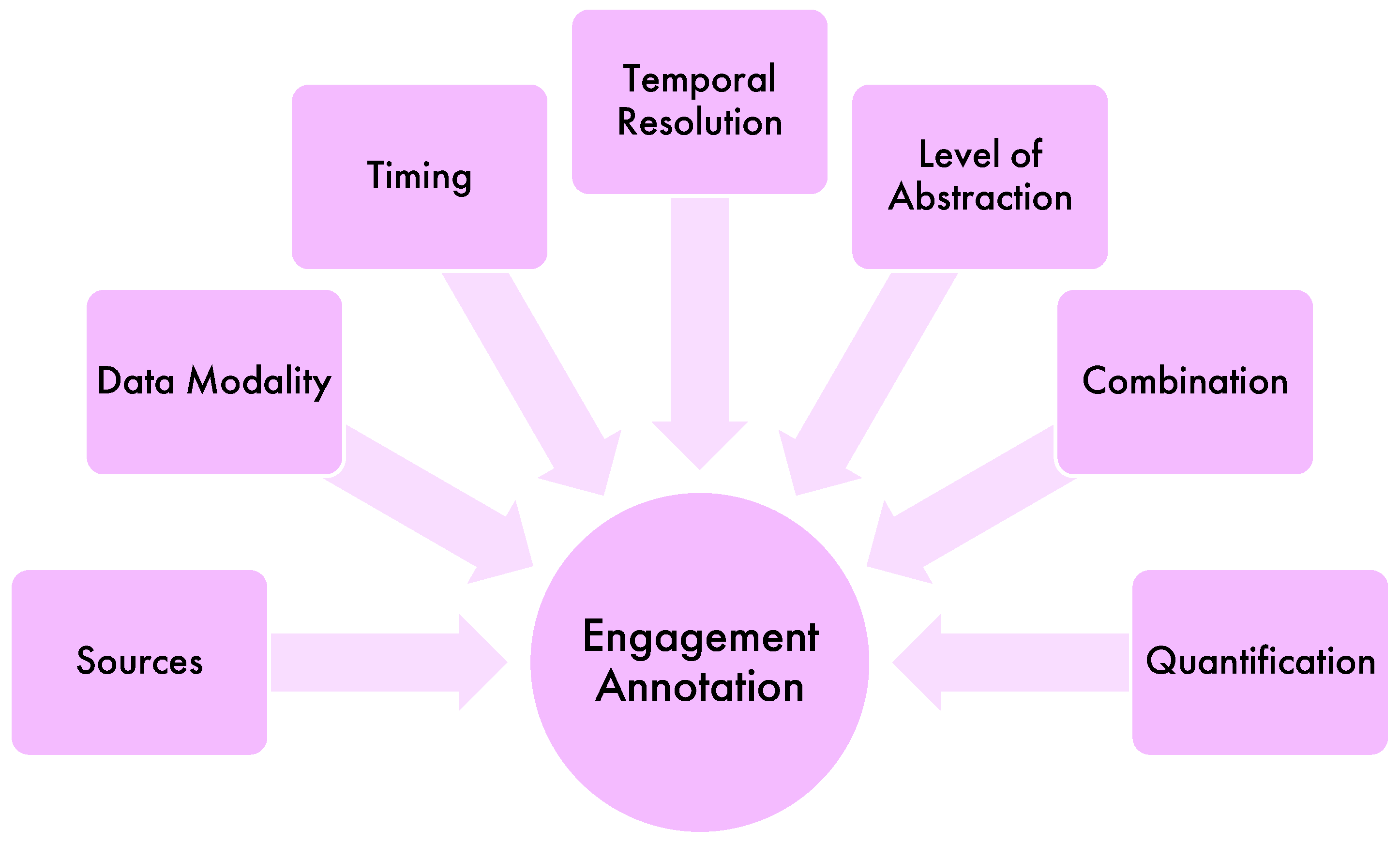
3.1. Dimensions of Engagement Annotation
3.1.1. Sources
3.1.2. Data Modality
3.1.3. Timing
3.1.4. Temporal Resolution
3.1.5. Level of Abstraction
3.1.6. Combination
3.1.7. Quantification
4. Results
4.1. Inconsistencies in Sources
4.2. Inconsistencies in Data Modality
4.3. Inconsistencies in Timing
4.4. Inconsistencies in Temporal Resolution
4.5. Inconsistencies in the Level of Abstraction
4.6. Inconsistencies in Combination
4.7. Inconsistencies in Quantification
4.8. Baseline Characteristics
5. Discussion
Author Contributions
Funding
Institutional Review Board Statement
Informed Consent Statement
Data Availability Statement
Conflicts of Interest
Appendix A. Student Engagement Annotation Protocols in Other Settings
References
- Abedi, A., & Khan, S. S. (2021). Improving state-of-the-art in detecting student engagement with resnet and TCN hybrid network. In 2021 18th conference on robots and vision (CRV) (pp. 151–157). IEEE. [Google Scholar]
- Abedi, A., & Khan, S. S. (2022). Detecting disengagement in virtual learning as an anomaly. arXiv, arXiv:2211.06870. [Google Scholar]
- Abedi, A., & Khan, S. S. (2023). Affect-driven ordinal engagement measurement from video. Multimedia Tools and Applications, 83, 24899–24918. [Google Scholar] [CrossRef] [Scilit]
- Abedi, A., & Khan, S. S. (2024). Engagement measurement based on facial landmarks and spatial-temporal graph convolutional networks. In International conference on pattern recognition (pp. 321–338). IEEE. [Google Scholar]
- Alkabbany, I., Ali, A., Farag, A., Bennett, I., Ghanoum, M., & Farag, A. (2019). Measuring student engagement level using facial information. In 2019 IEEE international conference on image processing (ICIP) (pp. 3337–3341). IEEE. [Google Scholar]
- Altuwairqi, K., Jarraya, S. K., Allinjawi, A., & Hammami, M. (2021). A new emotion–based affective model to detect student’s engagement. Journal of King Saud University-Computer and Information Sciences, 33(1), 99–109. [Google Scholar] [CrossRef] [Scilit]
- Alyuz, N., Aslan, S., D’Mello, S. K., Nachman, L., & Esme, A. A. (2021). Annotating student engagement across grades 1–12: Associations with demographics and expressivity. In International conference on artificial intelligence in education (pp. 42–51). Springer. [Google Scholar]
- Alyuz, N., Okur, E., Genc, U., Aslan, S., Tanriover, C., & Esme, A. A. (2017). An unobtrusive and multimodal approach for behavioral engagement detection of students. In Proceedings of the 1st ACM sigchi international workshop on multimodal interaction for education (pp. 26–32). Association for Computing Machinery. [Google Scholar]
- Aslan, S., Cataltepe, Z., Diner, I., Dundar, O., Esme, A. A., Ferens, R., Kamhi, G., Oktay, E., Soysal, C., & Yener, M. (2014). Learner engagement measurement and classification in 1:1 learning. In 2014 13th international conference on machine learning and applications (pp. 545–552). IEEE. [Google Scholar]
- Aslan, S., Mete, S. E., Okur, E., Oktay, E., Alyuz, N., Genc, U. E., Stanhill, D., & Esme, A. A. (2017). Human expert labeling process (HELP): Towards a reliable higher-order user state labeling process and tool to assess student engagement. Educational Technology, 57(1), 53–59. [Google Scholar]
- Baker, R. S. d., Rodrigo, M. M. T., & Xolocotzin, U. E. (2007). The dynamics of affective transitions in simulation problem-solving environments. In International conference on affective computing and intelligent interaction (pp. 666–677). Spinger. [Google Scholar]
- Bhardwaj, P., Gupta, P., Panwar, H., Siddiqui, M. K., Morales-Menendez, R., & Bhaik, A. (2021). Application of deep learning on student engagement in e-learning environments. Computers & Electrical Engineering, 93, 107277. [Google Scholar]
- Booth, B. M., Ali, A. M., Narayanan, S. S., Bennett, I., & Farag, A. A. (2017). Toward active and unobtrusive engagement assessment of distance learners. In 2017 seventh international conference on affective computing and intelligent interaction (ACII) (pp. 470–476). IEEE. [Google Scholar]
- Booth, B. M., Bosch, N., & D’Mello, S. K. (2023). Engagement detection and its applications in learning: A tutorial and selective review. Proceedings of the IEEE, 111(10), 1398–1422. [Google Scholar] [CrossRef] [Scilit]
- Bosch, N. (2016). Detecting student engagement: Human versus machine. In Proceedings of the 2016 conference on user modeling adaptation and personalization (pp. 317–320). Association for Computing Machinery. [Google Scholar]
- Bosch, N., D’mello, S. K., Ocumpaugh, J., Baker, R. S., & Shute, V. (2016). Using video to automatically detect learner affect in computer-enabled classrooms. ACM Transactions on Interactive Intelligent Systems (TiiS), 6(2), 1–26. [Google Scholar] [CrossRef] [Scilit]
- Brabham, D. C. (2013). Crowdsourcing. MIT Press. [Google Scholar]
- Buono, P., De Carolis, B., D’Errico, F., Macchiarulo, N., & Palestra, G. (2023). Assessing student engagement from facial behavior in on-line learning. Multimedia Tools and Applications, 82(9), 12859–12877. [Google Scholar] [CrossRef] [Scilit]
- Chen, J., Luo, N., Liu, Y., Liu, L., Zhang, K., & Kolodziej, J. (2016). A hybrid intelligence-aided approach to affect-sensitive e-learning. Computing, 98(1), 215–233. [Google Scholar] [CrossRef] [Scilit]
- Chen, X., Niu, L., Veeraraghavan, A., & Sabharwal, A. (2019). FaceEngage: Robust estimation of gameplay engagement from user-contributed (YouTube) videos. IEEE Transactions on Affective Computing, 13(2), 651–665. [Google Scholar] [CrossRef] [Scilit]
- Chen, Y., Bosch, N., & D’Mello, S. (2015, June 26–29). Video-based affect detection in noninteractive learning environments. Proceedings of the 8th International Conference on Educational Data Mining, Madrid, Spain. [Google Scholar]
- da Rocha Seixas, L., Gomes, A. S., & de Melo Filho, I. J. (2016). Effectiveness of gamification in the engagement of students. Computers in Human Behavior, 58, 48–63. [Google Scholar] [CrossRef] [Scilit]
- De Carolis, B., D’Errico, F., Macchiarulo, N., & Palestra, G. (2019). “Engaged faces”: Measuring and monitoring student engagement from face and gaze behavior. In IEEE/WIC/ACM international conference on web intelligence-companion volume (pp. 80–85). Association for Computing Machinery. [Google Scholar]
- Delgado, K., Origgi, J. M., Hasanpoor, T., Yu, H., Allessio, D., Arroyo, I., Lee, W., Betke, M., Woolf, B., & Bargal, S. A. (2021). Student engagement dataset. In Proceedings of the IEEE/CVF international conference on computer vision (pp. 3628–3636). IEEE. [Google Scholar]
- Dewan, M., Murshed, M., & Lin, F. (2019). Engagement detection in online learning: A review. Smart Learning Environments, 6(1), 1. [Google Scholar] [CrossRef] [Scilit]
- D’Mello, S. K. (2015). On the influence of an iterative affect annotation approach on inter-observer and self-observer reliability. IEEE Transactions on Affective Computing, 7(2), 136–149. [Google Scholar] [CrossRef] [Scilit]
- D’Mello, S. K., & Graesser, A. (2012). Dynamics of affective states during complex learning. Learning and Instruction, 22(2), 145–157. [Google Scholar] [CrossRef] [Scilit]
- D’Mello, S. K., Taylor, R., & Graesser, A. (2007). Monitoring affective trajectories during complex learning. In Proceedings of the annual meeting of the cognitive science society (Vol. 29). Springer. [Google Scholar]
- Dung, D. T. H. (2020). The advantages and disadvantages of virtual learning. IOSR Journal of Research & Method in Education, 10(3), 45–48. [Google Scholar]
- Fredricks, J. A., Blumenfeld, P. C., & Paris, A. H. (2004). School engagement: Potential of the concept, state of the evidence. Review of educational research, 74(1), 59–109. [Google Scholar] [CrossRef] [Scilit]
- Gray, J. A., & DiLoreto, M. (2016). The effects of student engagement, student satisfaction, and perceived learning in online learning environments. International Journal of Educational Leadership Preparation, 11(1), n1. [Google Scholar]
- Guhan, P., Awasthi, N., Bussell, K., Manocha, D., Reeves, G., & Bera, A. (2020). Developing an effective and automated patient engagement estimator for telehealth: A machine learning approach. arXiv, arXiv:2011.08690. [Google Scholar]
- Gupta, A., D’Cunha, A., Awasthi, K., & Balasubramanian, V. (2016). Daisee: Towards user engagement recognition in the wild. arXiv, arXiv:1609.01885. [Google Scholar]
- Gupta, S., Kumar, P., & Tekchandani, R. K. (2023a). A multimodal facial cues based engagement detection system in e-learning context using deep learning approach. Multimedia Tools and Applications, 82, 28589–28615. [Google Scholar]
- Gupta, S., Kumar, P., & Tekchandani, R. K. (2023b). Facial emotion recognition based real-time learner engagement detection system in online learning context using deep learning models. Multimedia Tools and Applications, 82(8), 11365–11394. [Google Scholar]
- Gupta, S. K., Ashwin, T., & Guddeti, R. M. R. (2019). Students’ affective content analysis in smart classroom environment using deep learning techniques. Multimedia Tools and Applications, 78, 25321–25348. [Google Scholar] [CrossRef] [Scilit]
- Hallgren, K. A. (2012). Computing inter-rater reliability for observational data: An overview and tutorial. Tutorials in Quantitative Methods for Psychology, 8(1), 23. [Google Scholar] [CrossRef] [Scilit]
- Henrie, C. R., Halverson, L. R., & Graham, C. R. (2015). Measuring student engagement in technology-mediated learning: A review. Computers & Education, 90, 36–53. [Google Scholar] [CrossRef] [Scilit]
- Hu, M., & Li, H. (2017). Student engagement in online learning: A review. In 2017 international symposium on educational technology (ISET) (pp. 39–43). IEEE. [Google Scholar]
- Huang, W., Roscoe, R. D., Johnson-Glenberg, M. C., & Craig, S. D. (2021). Motivation, engagement, and performance across multiple virtual reality sessions and levels of immersion. Journal of Computer Assisted Learning, 37(3), 745–758. [Google Scholar]
- Hutt, S., Grafsgaard, J. F., & D’Mello, S. K. (2019). Time to scale: Generalizable affect detection for tens of thousands of students across an entire school year. In Proceedings of the 2019 CHI conference on human factors in computing systems (pp. 1–14). Association for Computing Machinery. [Google Scholar]
- Jeong, Y.-S., & Cho, N.-W. (2023). Evaluation of e-learners’ concentration using recurrent neural networks. The Journal of Supercomputing, 79, 4146–4163. [Google Scholar]
- Jimerson, S. R., & Chen, C. (2022). Multicultural and cross-cultural considerations in understanding student engagement in schools: Promoting the development of diverse students around the world. In Handbook of research on student engagement (pp. 629–646). Springer. [Google Scholar]
- Kamath, A., Biswas, A., & Balasubramanian, V. (2016). A crowdsourced approach to student engagement recognition in e-learning environments. In 2016 IEEE winter conference on applications of computer vision (WACV) (pp. 1–9). IEEE. [Google Scholar]
- Karimah, S. N., & Hasegawa, S. (2021). Automatic engagement recognition for distance learning systems: A literature study of engagement datasets and methods. In International conference on human-computer interaction (pp. 264–276). Springer. [Google Scholar]
- Karimah, S. N., & Hasegawa, S. (2022). Automatic engagement estimation in smart education/learning settings: A systematic review of engagement definitions, datasets, and methods. Smart Learning Environments, 9(1), 31. [Google Scholar] [CrossRef] [Scilit]
- Kaur, A., Mustafa, A., Mehta, L., & Dhall, A. (2018). Prediction and localization of student engagement in the wild. In 2018 digital image computing: Techniques and applications (DICTA) (pp. 1–8). IEEE. [Google Scholar]
- Liao, J., Hao, Y., Zhou, Z., Pan, J., & Liang, Y. (2024). Sequence-level affective level estimation based on pyramidal facial expression features. Pattern Recognition, 145, 109958. [Google Scholar]
- Liao, J., Liang, Y., & Pan, J. (2021). Deep facial spatiotemporal network for engagement prediction in online learning. Applied Intelligence, 51(10), 6609–6621. [Google Scholar] [CrossRef] [Scilit]
- Liu, Y., Chen, J., Zhang, M., & Rao, C. (2018). Student engagement study based on multi-cue detection and recognition in an intelligent learning environment. Multimedia Tools and Applications, 77, 28749–28775. [Google Scholar] [CrossRef] [Scilit]
- Ma, X., Xu, M., Dong, Y., & Sun, Z. (2021). Automatic student engagement in online learning environment based on neural turing machine. International Journal of Information and Education Technology, 11(3), 107–111. [Google Scholar] [CrossRef] [Scilit]
- Mandia, S., Mitharwal, R., & Singh, K. (2023). Automatic student engagement measurement using machine learning techniques: A literature study of data and methods. Multimedia Tools and Applications, 83, 49641–49672. [Google Scholar] [CrossRef] [Scilit]
- McMahan, A. (2013). Immersion, engagement, and presence: A method for analyzing 3-D video games. In The video game theory reader (pp. 67–86). Routledge. [Google Scholar]
- McNeish, D. (2022). Limitations of the sum-and-alpha approach to measurement in behavioral research. Policy Insights from the Behavioral and Brain Sciences, 9(2), 196–203. [Google Scholar] [CrossRef] [Scilit]
- Mehta, N. K., Prasad, S. S., Saurav, S., Saini, R., & Singh, S. (2022). Three-dimensional DenseNet self-attention neural network for automatic detection of student’s engagement. Applied Intelligence, 52, 13803–13823. [Google Scholar]
- Minner, D. D., Levy, A. J., & Century, J. (2010). Inquiry-based science instruction—what is it and does it matter? Results from a research synthesis years 1984 to 2002. Journal of Research in Science Teaching: The Official Journal of the National Association for Research in Science Teaching, 47(4), 474–496. [Google Scholar]
- Mohamad Nezami, O., Dras, M., Hamey, L., Richards, D., Wan, S., & Paris, C. (2020). Automatic recognition of student engagement using deep learning and facial expression. In Joint european conference on machine learning and knowledge discovery in databases (pp. 273–289). Springer. [Google Scholar]
- Monkaresi, H., Bosch, N., Calvo, R. A., & D’Mello, S. K. (2016). Automated detection of engagement using video-based estimation of facial expressions and heart rate. IEEE Transactions on Affective Computing, 8(1), 15–28. [Google Scholar] [CrossRef] [Scilit]
- Mukhtar, K., Javed, K., Arooj, M., & Sethi, A. (2020). Advantages, limitations and recommendations for online learning during COVID-19 pandemic era. Pakistan Journal of Medical Sciences, 36(COVID19-S4), S27. [Google Scholar] [CrossRef] [Scilit] [PubMed]
- Naibert, N., & Barbera, J. (2022). Development and evaluation of a survey to measure student engagement at the activity level in general chemistry. Journal of Chemical Education, 99(3), 1410–1419. [Google Scholar] [CrossRef] [Scilit]
- O’Brien, H., & Cairns, P. (2016). Why engagement matters: Cross-disciplinary perspectives of user engagement in digital media. Springer. [Google Scholar]
- Ocumpaugh, J. (2015). Baker rodrigo ocumpaugh monitoring protocol (BROMP) 2.0 technical and training manual (p. 60). Teachers College, Columbia University and Ateneo Laboratory for the Learning Sciences. [Google Scholar]
- Okur, E., Alyuz, N., Aslan, S., Genc, U., Tanriover, C., & Arslan Esme, A. (2017). Behavioral engagement detection of students in the wild. In International conference on artificial intelligence in education (pp. 250–261). Springer. [Google Scholar]
- Porayska-Pomsta, K., Mavrikis, M., D’Mello, S., Conati, C., & Baker, R. S. (2013). Knowledge elicitation methods for affect modelling in education. International Journal of Artificial Intelligence in Education, 22(3), 107–140. [Google Scholar] [CrossRef] [Scilit]
- Salam, H., Celiktutan, O., Gunes, H., & Chetouani, M. (2022). Automatic context-driven inference of engagement in HMI: A survey. arXiv, arXiv:2209.15370. [Google Scholar] [CrossRef] [Scilit]
- Schindler, L. A., Burkholder, G. J., Morad, O. A., & Marsh, C. (2017). Computer-based technology and student engagement: A critical review of the literature. International Journal of Educational Technology in Higher Education, 14(1), 25. [Google Scholar] [CrossRef] [Scilit]
- Sinatra, G. M., Heddy, B. C., & Lombardi, D. (2015). The challenges of defining and measuring student engagement in science (Vol. 50, No. 1). Taylor & Francis. [Google Scholar]
- Singh, M., Hoque, X., Zeng, D., Wang, Y., Ikeda, K., & Dhall, A. (2023). Do I have your attention: A large scale engagement prediction dataset and baselines. In Proceedings of the 25th international conference on multimodal interaction (pp. 174–182). Association for Computing Machinery. [Google Scholar]
- Sümer, Ö., Goldberg, P., D’Mello, S., Gerjets, P., Trautwein, U., & Kasneci, E. (2021). Multimodal engagement analysis from facial videos in the classroom. IEEE Transactions on Affective Computing, 14(2), 1012–1027. [Google Scholar] [CrossRef] [Scilit]
- Tafreshi, D., Slaney, K. L., & Neufeld, S. D. (2016). Quantification in psychology: Critical analysis of an unreflective practice. Journal of Theoretical and Philosophical Psychology, 36(4), 233. [Google Scholar] [CrossRef] [Scilit]
- Thomas, C., Sarma, K. P., Gajula, S. S., & Jayagopi, D. B. (2022). Automatic prediction of presentation style and student engagement from videos. Computers and Education: Artificial Intelligence, 3, 100079. [Google Scholar] [CrossRef] [Scilit]
- Trowler, V. (2010). Student engagement literature review (Vol. 11, No. 1, pp. 1–15). The Higher Education Academy. [Google Scholar]
- Van Engelen, J. E., & Hoos, H. H. (2020). A survey on semi-supervised learning. Machine Learning, 109(2), 373–440. [Google Scholar] [CrossRef] [Scilit]
- Vanneste, P., Oramas, J., Verelst, T., Tuytelaars, T., Raes, A., Depaepe, F., & Van den Noortgate, W. (2021). Computer vision and human behaviour, emotion and cognition detection: A use case on student engagement. Mathematics, 9(3), 287. [Google Scholar] [CrossRef] [Scilit]
- Verkuyten, M., Thijs, J., & Gharaei, N. (2019). Discrimination and academic (dis) engagement of ethnic-racial minority students: A social identity threat perspective. Social Psychology of Education, 22, 267–290. [Google Scholar] [CrossRef] [Scilit]
- Verma, M., Nakashima, Y., Takemura, N., & Nagahara, H. (2022). Multi-label disengagement and behavior prediction in online learning. In International conference on artificial intelligence in education (pp. 633–639). Springer. [Google Scholar]
- Whitehill, J., Serpell, Z., Lin, Y.-C., Foster, A., & Movellan, J. R. (2014). The faces of engagement: Automatic recognition of student engagementfrom facial expressions. IEEE Transactions on Affective Computing, 5(1), 86–98. [Google Scholar] [CrossRef] [Scilit]
- Wong, Z. Y., & Liem, G. A. D. (2021). Student engagement: Current state of the construct, conceptual refinement, and future research directions. Educational Psychology Review, 34(1), 1–32. [Google Scholar] [CrossRef] [Scilit]
- Woolf, B., Burleson, W., Arroyo, I., Dragon, T., Cooper, D., & Picard, R. (2009). Affect-aware tutors: Recognising and responding to student affect. International Journal of Learning Technology, 4(3/4), 129–164. [Google Scholar] [CrossRef] [Scilit]
- Xu, T., White, J., Kalkan, S., & Gunes, H. (2020). Investigating bias and fairness in facial expression recognition. In Computer vision—ECCV 2020 workshops: Glasgow, UK, August 23–28, Proceedings, Part VI 16 (pp. 506–523). Springer. [Google Scholar]
- Zaletelj, J., & Košir, A. (2017). Predicting students’ attention in the classroom from Kinect facial and body features. EURASIP Journal on Image and Video Processing, 2017(1), 80. [Google Scholar] [CrossRef] [Scilit]
- Zheng, X., Hasegawa, S., Tran, M.-T., Ota, K., & Unoki, T. (2021). Estimation of learners’ engagement using face and body features by transfer learning. In International conference on human-computer interaction (pp. 541–552). Springer. [Google Scholar]


| Reference | Sources | Data Modality | Timing | Temporal Resolution | Level of Abstraction | Combination | Quantification |
|---|---|---|---|---|---|---|---|
| Whitehill et al. (2014) | Observers: 9 trained students | Video | Retrospective | 10 and 60 s | Affective, behavioral, and cognitive components | Rule-based | Ordinal 1–4: not at all engaged–very engaged |
| Aslan et al. (2014) | Observers: 3 experts | Video and Computer screen | Retrospective | 20 min | Engagement | NA | Categorical: engaged, not engaged, and unknown |
| Y. Chen et al. (2015) | self-reports | NA | Retrospective | 2 min | Affective component | NA | Ordinal 1–6: very little engagement–very much engagement |
| Bosch (2016) | Observers: trained experts | Video | Concurrent | Adaptive or 20 s | Affective and behavioral components | No combination | Categorical: boredom, confusion, delight, frustration, engaged concentration and off-task, on-task conversation, and on-task |
| J. Chen et al. (2016) | - | Video and skin conductance | Retrospective | - | Engagement | NA | Dichotomous: attention ON and attention OFF |
| Monkaresi et al. (2016) | self-reports | NA | Concurrent and retrospective | 2 min | Engagement | NA | Dichotomous: engaged and not-engaged |
| A. Gupta et al. (2016) | Observers: 10 untrained crowdsourcers | Video | Retrospective | 10 s | Affective component | NA | Ordinal 1–4: very low–very high |
| Kamath et al. (2016) | Observers: 25 untrained crowdsourcers | Video | Retrospective | single-frame | Engagement | NA | Ordinal 1–3: not-engaged–very engaged |
| Bosch et al. (2016) | self-reports + observers (untrained annotators) | Video | Concurrent + retrospective | 12 s | Cognitive component | NA | Dichotomous: mind-wandering (not-engaged) and no mind-wandering (engaged) |
| Booth et al. (2017) | Observers: 9 untrained students | Video | Retrospective | 20 min | Engagement | NA | Interval 0–1 |
| Okur et al. (2017) | Observers: 3 experts | Video, audio, computer screen, mouse cursor, and URL logs | Retrospective | Adaptive | Behavioral component | NA | Categorical: on-task, off-task, not applicable, cannot decide |
| Alyuz et al. (2017) | Observers: 3 experts | Video, audio, computer screen, and mouse cursor | Retrospective | Adaptive | Behavioral component | NA | Categorical: on-task, off-task, not applicable, cannot decide |
| Zaletelj and Košir (2017) | Observers: 5 experts | Video | Retrospective | 1 s | Engagement | NA | Ordinal 1–5: 5 levels of engagement |
| Kaur et al. (2018) | Observers: 5 experts | Video | Retrospective | 5 min | Behavioral component | NA | Ordinal 0–3: completely disengaged–highly engaged |
| De Carolis et al. (2019) | self-reports | NA | Retrospective | 9 min | Cognitive Engagement | - | - |
| Hutt et al. (2019) | self-reports | NA | Retrospective | Random | Affective component | NA | Ordinal 1–5: not at all engaged to very engaged |
| Alkabbany et al. (2019) | Observers: 4 annotators | Video | Retrospective | Single-frame | Affective and behavioral components | No combination | Ordinal 0–3: no detected face to emotionally engaged |
| Mohamad Nezami et al. (2020) | Observers: 6 trained students | Video | Retrospective | Single-frame | Affective and behavioral components | Rule-based | Dichotomous: engaged and not-engaged |
| Vanneste et al. (2021) | self-reports | NA | Concurrent | 5–12 min | Engagement | NA | Interval 0–2: totally disengaged to totally engaged |
| Alyuz et al. (2021) | Observers: 3 experts | Audio, video, and screen capture | Retrospective | Adaptive | Affective and behavioral components | No combination | Categorical: satisfied, bored, confused, on-task, off-task, not available, and cannot decide |
| Bhardwaj et al. (2021) | Observers: 10 annotators | Video | Retrospective | – | Engagement | NA | Ordinal 0–5: six levels of engagement |
| Delgado et al. (2021) | Observers: 3 untrained crowdsourcers | Video | Retrospective | Single-frame | Behavioral component | No combination | Categorical: looking at their screen, looking at their paper, and wandering |
| Zheng et al. (2021) | self-reports + observers | Video | Retrospective | 12 min | Engagement | NA | Ordinal 1–3: three levels of engagement |
| Altuwairqi et al. (2021) | self-reports + observers (untrained students) | Video | Retrospective | Single-frame | Affective component | NA | Ordinal 1–5: low to strong engagement |
| Ma et al. (2021) | Observers: 3 untrained annotators | Video | Retrospective | 30 min | Engagement | NA | Interval 0–1 |
| S. Gupta et al. (2023b) | – | Image | Retrospective | Single-frame | Affective engagement | NA | Interval 0–1: basic facial expressions converted to an interval variable |
| Buono et al. (2023) | self-reports | NA | Retrospective | 9 min | Engagement | NA | Interval 0–1 |
| Jeong and Cho (2023) | Observers: 3 experts | Video | Retrospective | 5 s | Engagement | NA | Dichotomous: engaged and not-engaged |
| Thomas et al. (2022) | self-reports | NA | Retrospective | 100 s | Engagement | NA | Ordinal 1–5 |
| Verma et al. (2022) | Observers: 3 trained annotators | Video | Retrospective | Adaptive | Behavioral engagement | NA | Categorical: disengagement, strange eye movements, presence of some kind of facial expression, yawning, face occlusion, body movements, and pressing keyboard |
| Singh et al. (2023) | Observers: 3 untrained annotators | Video | Retrospective | 10 s | Engagement | NA | Ordinal 1–4: very low to very high |
| Reference | Activity | Interactive | In-the-Wild | # of Students | # of Females | Age (Years) | Country | Class Distribution of Samples |
|---|---|---|---|---|---|---|---|---|
| Whitehill et al. (2014) | Software | Yes | No | 34 | 25 | NA | United States | 6% not engaged at all, 10% nominally engaged, 46% engaged in task, and 38% very engaged |
| Aslan et al. (2014) | Lecture | No | No | 9 | NA | NA | Turkey | NA |
| Y. Chen et al. (2015) | Reading | No | Yes | 88 | NA | NA | United States | NA |
| Bosch (2016) | Software | Yes | Yes | 137 | 57 | 13–15 | United States | 4% boredom, 2% confusion, 2% delight, 14% frustration, and 78% engaged concentration; 5% off-task, 21% on-task conversation, and 74% on-task |
| J. Chen et al. (2016) | Software | Yes | No | 30 | 17 | NA | China | NA |
| Monkaresi et al. (2016) | Writing | No | No | 23 | 9 | 20–60 | Australia | 80% engaged and 20% not-engaged |
| A. Gupta et al. (2016) | Lecture | No | Yes | 112 | 32 | NA | India | 1% very low, 5% low, 41% high, and 45% very high level of engagement |
| Kamath et al. (2016) | Lecture | No | Yes | 23 | NA | 18–24 | India | 9% not-engaged, 51% nominally engaged, and 40% very engaged |
| Bosch et al. (2016) | Reading | No | Yes | 98 | NA | NA | United States | NA |
| Booth et al. (2017) | Lecture | No | No | 12 | NA | 25 | United States | NA |
| Okur et al. (2017) | Lecture | Yes | Yes | 28 | NA | 14–15 | Turkey | 71% on-task and 29% off-task |
| Alyuz et al. (2017) | Lecture | Yes | Yes | 17 | NA | 14–15 | Turkey | 68% on-task and 32% off-task |
| Zaletelj and Košir (2017) | Lecture | No | No | 22 | 2 | NA | Slovenia | NA |
| Kaur et al. (2018) | Lecture | No | Yes | 78 | 25 | 19–27 | India | 5% completely disengaged, 27% barely engaged, 42% engaged, and 26% highly engaged |
| De Carolis et al. (2019) | Lecture | Yes | No | 19 | 7 | 21 | Italy | NA |
| Hutt et al. (2019) | Lecture | Yes | Yes | 69,174 | NA | NA | United States | NA |
| Alkabbany et al. (2019) | Lecture | Yes | Yes | 14 | NA | NA | United States | 0% no face detected, 12% behaviorally not engaged, 56% behaviorally engaged, emotionally not engaged, and 32% emotionally engaged |
| Mohamad Nezami et al. (2020) | Software | Yes | No | 20 | 11 | 14–16 | Australia | 50% engaged and 50% not-engaged |
| Vanneste et al. (2021) | Lecture | No | Yes | 14 | 4 | 18 | Belgium | NA |
| Alyuz et al. (2021) | Lecture | Yes | No | 60 | 30 | NA | Canada | NA |
| Bhardwaj et al. (2021) | Lecture | No | Yes | 1000 | NA | NA | India | NA |
| Delgado et al. (2021) | Software | Yes | No | 19 | NA | NA | United States | 25% looking at their screen, 72% looking at their paper, and 3% wandering |
| Zheng et al. (2021) | Software | Yes | No | 19 | NA | NA | Japan | 33% (1), 40% (2), and 27% (3) |
| Altuwairqi et al. (2021) | Lecture | No | Yes | 110 | NA | NA | Saudi Arabia | NA |
| Ma et al. (2021) | Lecture | No | Yes | 59 | NA | 20–32 | China | NA |
| S. Gupta et al. (2023b) | NA | NA | NA | NA | NA | NA | India | NA |
| Buono et al. (2023) | Lecture | No | Yes | 31 | 14 | 19 | Italy | NA |
| Jeong and Cho (2023) | Lecture | No | Yes | 92 | NA | 20–31 | South Korea | NA |
| Thomas et al. (2022) | Lecture | No | Yes | 6 | NA | NA | India | NA |
| Verma et al. (2022) | Reading | Yes | No | 26 | NA | NA | Japan | NA |
| Singh et al. (2023) | Lecture | No | Yes | 127 | 44 | 18–37 | India | NA |
Disclaimer/Publisher’s Note: The statements, opinions and data contained in all publications are solely those of the individual author(s) and contributor(s) and not of MDPI and/or the editor(s). MDPI and/or the editor(s) disclaim responsibility for any injury to people or property resulting from any ideas, methods, instructions or products referred to in the content. |
© 2026 by the authors. Licensee MDPI, Basel, Switzerland. This article is an open access article distributed under the terms and conditions of the Creative Commons Attribution (CC BY) license.
Share and Cite
Khan, S.S.; Abedi, A.; Colella, T.J.F. Rethinking Student Engagement Datasets for AI in Virtual Learning: A Narrative Review. Educ. Sci. 2026, 16, 548. https://doi.org/10.3390/educsci16040548
Khan SS, Abedi A, Colella TJF. Rethinking Student Engagement Datasets for AI in Virtual Learning: A Narrative Review. Education Sciences. 2026; 16(4):548. https://doi.org/10.3390/educsci16040548
Chicago/Turabian StyleKhan, Shehroz S., Ali Abedi, and Tracey J. F. Colella. 2026. "Rethinking Student Engagement Datasets for AI in Virtual Learning: A Narrative Review" Education Sciences 16, no. 4: 548. https://doi.org/10.3390/educsci16040548
APA StyleKhan, S. S., Abedi, A., & Colella, T. J. F. (2026). Rethinking Student Engagement Datasets for AI in Virtual Learning: A Narrative Review. Education Sciences, 16(4), 548. https://doi.org/10.3390/educsci16040548