


Abstract
In recent decades, there has been considerable evidence suggesting that music training can improve word reading. However, the mechanisms through which music training enhances word reading remain an open question. Although various claims and hypotheses have been proposed, they are scattered across the literature. By reviewing existing research, this narrative review article identifies three possible theoretical accounts: the perceptual account, the cognitive account, and the music reading account. The central argument is that these accounts are not mutually exclusive and can be integrated into a comprehensive framework. Specifically, this article proposes an integrated model suggesting that music training improves word reading by enhancing phonological awareness, cognitive skills, and music reading abilities. Rather than dismissing any single account in favour of others, this article advocates for their integration and calls for an evaluation of their relative contributions to music-to-language transfer. Additionally, future research directions for investigating this transfer process are discussed.
1. Overview
In recent decades, there has been increasing interest in the beneficial effects of music training on language-related abilities, referred to as music-to-language transfer (Choi, 2020; Patel, 2011; Tierney & Kraus, 2014). In particular, randomised controlled trials (RCTs) have often found that music training improves word reading (Bhide et al., 2013; Rautenberg, 2015; Slater et al., 2014). While meta-analyses have re-evaluated whether music training enhances word reading, the mechanisms by which music training does so remain scattered across the literature (Gordon et al., 2015; Neves et al., 2022; see also Bigand & Tillmann, 2022; Sala & Gobet, 2020). This review article aims to provide a well-organised and comprehensive summary of how music training may enhance word reading, followed by future research directions.
Rather than adopting a protocol-driven systematic review approach, this article employed a flexible narrative review method, which allows for the inclusion of a broader range of studies and theoretical perspectives on music-to-language transfer. This approach facilitates a comprehensive synthesis and critical discussion (Sukhera, 2022). Although narrative reviews typically do not require strict inclusion and exclusion criteria, this review article adhered to some general principles for literature selection (see Ferrari, 2015).
First, a literature search was conducted using the databases Google Scholar and PubMed, with search terms including “music training,” “word reading,” “phonological awareness,” “music-to-language transfer,” “music reading,” “music cognition,” “executive functions,” “rhythm,” and “pitch.” To ensure inclusivity, the review considered empirical studies, meta-analyses, systematic reviews, narrative reviews, commentaries, and theoretical papers published in peer-reviewed journals or books. Unpublished manuscripts, preprints, and doctoral dissertations were excluded. For practical reasons, works written in non-English languages were excluded as well. The time span for included publications ranged from 1952 to 2025, corresponding to the period up to the completion of this review.
Second, relevant references cited within the selected publications were retrieved manually to identify additional studies related to music-to-language transfer. This iterative process continued until the additional sources no longer contributed novel information (i.e., the saturation point). To be clear from the outset, in the strictest sense, narrative reviews and their literature selection are inherently subjective (Ferrari, 2015; Sukhera, 2022). Readers interested in relatively objective research syntheses are referred to prior systematic reviews (e.g., Neves et al., 2022).
Through a review of the literature, three potential theoretical accounts were identified (Degé, 2021; Tierney & Kraus, 2014; Zinar, 1976). The central argument of this review is that these theoretical accounts are not mutually exclusive and can be integrated to provide a comprehensive explanation of how music training may enhance word reading. Additionally, future research directions for exploring music-to-language transfer will be proposed.
2. Defining Music Training and Word Reading
Prior to reviewing the music-to-language transfer literature, it is crucial to establish clear definitions of music training and word reading. For the purpose of this review, music training is defined as the process of learning music through the guidance of a music education practitioner or music expert (Choi et al., 2024; Cogo-Moreira et al., 2012; Eccles et al., 2021). This definition is broad enough to encompass diverse music training experiences reported in the existing RCTs, which can vary in their form (instrumental and vocal), content (pitch, rhythm, and timbre), class size (individual and group), and teaching approach (Orff, Kodaly, Suzuki, and Dalcroze) (e.g., Nan et al., 2018; Rautenberg, 2015; Slater et al., 2014). Since this review article adopts a macroscopic perspective on music-to-language transfer, distinctions between specific training forms or content types (e.g., instrumental versus vocal, rhythm versus pitch) are not necessary. Existing literature reviews have already addressed these finer distinctions (see Eccles et al., 2021). To reflect the preponderance of RCTs, this review article focuses on music training; informal music experiences (e.g., listening to songs at home and singing along at a concert) are considered out of scope (see Gordon et al., 2015; Neves et al., 2022).
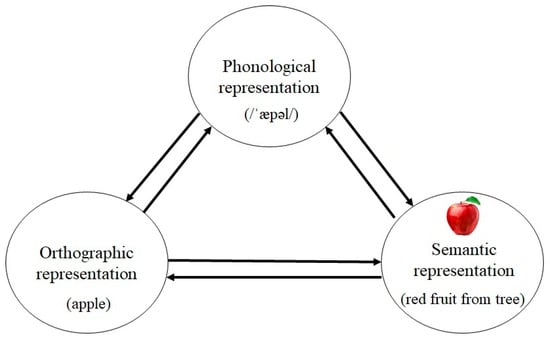
Regarding word reading, the lexical quality hypothesis posits that a word is mentally stored with three constituents: phonological, orthographic, and semantic representations (C. A. Perfetti & Hart, 2001; C. Perfetti, 2007). In proficient readers, these representations are well-specified and robustly interconnected (see Figure 1). According to various reading models, reading a word can engage different cognitive processes depending on the task (Coltheart et al., 2001; Seidenberg & McClelland, 1989; Snowling et al., 2010). Comprehending a written word entails retrieving semantic information from orthographic information, which can occur directly or via phonological information (Coltheart & Rastle, 1994). Conversely, reading aloud a word involves retrieving phonological information from orthographic information, either directly or mediated by semantic information.
Figure 1.
A conceptual illustration of the lexical quality hypothesis. The arrows represent the interconnections.
In reading research, word reading typically refers to reading aloud written words in isolation (Choi et al., 2016; Ehri, 2017; Nation & Cocksey, 2009). To complicate the picture, reading researchers sometimes differentiate between word decoding and word recognition. According to the Dual Route Cascaded Model, there are two pathways through which orthographic input can lead to phonological output (Coltheart et al., 2001). In the lexical pathway, readers retrieve the phonological information of the word that was stored in the mental lexicon. In the non-lexical pathway, readers rely on grapheme–phoneme correspondence rules to convert orthographic symbols to phonological units. Reading aloud a written word through the lexical and non-lexical pathways is known as word recognition and word decoding, respectively (Nation & Snowling, 1998; Nunes et al., 2012; Stanovich, 2024). While this distinction may be crucial in psycholinguistic and computational studies of reading, music-to-language transfer studies generally adopt a macroscopic approach (Habib et al., 2016; Rautenberg, 2015; C. Sun et al., 2022). In this discipline, the current concern is whether music training can improve children’s ability to read aloud words, without an ongoing need to differentiate word decoding and recognition. Thus, this review article focuses on the broader construct of word reading, which is defined as the ability to accurately read aloud written words in isolation.
This review article focuses on word reading for two main reasons. First, focusing on word reading can accurately represent the current state of the music-to-language transfer literature. In particular, existing theories and research are pertinent to word reading (e.g., Goswami, 2011; Rautenberg, 2015; Tierney & Kraus, 2014), with very few studies examining higher-level reading abilities (e.g., vocabulary knowledge, reading prosody, and reading comprehension). Second, word reading is a foundational skill supporting many higher-level reading abilities. For example, the Simple View of Reading views word reading as a critical starting point for reading comprehension (Hoover & Gough, 1990). Thus, a focused discussion on the effect of music training on word reading can lay the groundwork for future research into its broader implications for literacy.
3. The Beneficial Effect of Music Training on Word Reading
There is considerable causal evidence that music training improves word reading in typically developing children (Moreno et al., 2009; Rautenberg, 2015; Slater et al., 2014). Rautenberg (2015) randomly assigned German children to a music training group, a visual arts training group, or a business-as-usual control group for nine months. At pre-test, the three groups showed similar word reading accuracy. At post-test, the music training group showed a higher word reading accuracy than the two other groups, suggesting that music training improves word reading in German children. In another study, low-income Spanish–English bilingual children either received music training or no training (Slater et al., 2014). Compared with the norm, the music training group continued to show age-equivalent word reading accuracy, whereas the control group showed a significant decline after a year. This suggested that music training could mitigate the negative impact of low socioeconomic status on word reading development. However, the findings have not always been consistent (Moreno et al., 2009; Gordon et al., 2015). For example, Moreno et al. (2009) further differentiated between phonologically consistent and inconsistent words in their outcome analysis. Music training was found to improve Portuguese children’s accuracy in reading aloud phonologically inconsistent words but not phonologically consistent words.
In addition to typically developing children, music training has also been found to improve word reading in dyslexic children (Bhide et al., 2013; Flaugnacco et al., 2015; Rolka & Silverman, 2015). An RCT randomly assigned English dyslexic children to receive either musical rhythmic training or phonological training (Bhide et al., 2013). Relative to their own performance at pre-test, the two groups improved on word reading with similar effect sizes. Thus, it was concluded that musical rhythmic training and phonological training were equally effective. In another RCT, Italian dyslexic children received music or painting training alongside a phonological training program (Flaugnacco et al., 2015). While the two groups performed similarly at pre-test, the music group outperformed the painting group on word reading at post-test. This suggests that incorporating music training into an existing phonological training program can result in additional improvements in word reading. In a systematic review of 23 studies, 21 studies reported the efficacy of music training in improving dyslexic children’s word reading, whereas the two other studies reported mixed results (Rolka & Silverman, 2015).
Nevertheless, some researchers have questioned the effect of music training on word reading (Gordon et al., 2015; Sala & Gobet, 2017, 2020). A meta-analysis reported the lack of a significant aggregate effect of music training on word reading (Gordon et al., 2015). However, it had a small sample size (n = 5), and one of the studies included had not assessed word reading (Herrera et al., 2011). More recently, Sala and Gobet (2020) conducted a multilevel meta-analysis of 254 effect sizes from 54 music training studies. The outcome measures were broadly categorised as verbal ability (e.g., vocabulary, reading skills, and phonological processing), non-verbal ability, memory, and speed. While there was a significant overall effect of music training on the outcome measures, the effect became null when considering only active control or randomised non-active control group studies (see also Sala & Gobet, 2017). However, Bigand and Tillmann (2022) re-analysed the above data and found a significant overall effect of music training, even with an effect size comparable to that of linguistic training. Another recent meta-analysis, which included 20 effect sizes specific to word reading, also identified a significant effect of music training, providing additional evidence (Neves et al., 2022).
Although the debate over whether music training improves word reading remains inconclusive, the amount of supporting evidence is at least non-negligible in typically developing children (e.g., Moreno et al., 2009; Rautenberg, 2015; Slater et al., 2014) and dyslexic children (e.g., Bhide et al., 2013; Flaugnacco et al., 2015; Rolka & Silverman, 2015). This naturally raises the question of how music training may improve word reading. To date, there is no universal consensus on the answer. Moreover, different claims and hypotheses remain scattered across the literature. Through reviewing the literature, three possible theoretical accounts are identified: the perceptual account (Goswami, 2011; Loui et al., 2011; Tierney & Kraus, 2014), the cognitive account (Degé, 2021; Swaminathan et al., 2018), and the music reading account (Groff, 1977; Pantaleo et al., 2024; Wheeler & Wheeler, 1952).
4. The Perceptual Account of Music-to-Language Transfer in Word Reading
The perceptual account refers to the collection of hypotheses and notions pertaining to the perceptual aspect of music (Goswami, 2011; Loui et al., 2011; Tierney & Kraus, 2014). According to the lexical quality hypothesis, forming a well-specified phonological representation is crucial for word reading (C. Perfetti, 2007; C. A. Perfetti & Hart, 2001). Phonological awareness, defined as the ability to analyse and manipulate phonological units of words (e.g., syllable, onset-rime, and phoneme), is thought to aid in this process (Gillon, 2004). Indeed, there is mounting evidence that phonological awareness predicts word reading across different language populations (e.g., Chow et al., 2005; Hogan et al., 2005; Melby-Lervåg et al., 2012). Crucially, researchers have suggested that music training improves word reading by enhancing phonological awareness (Loui et al., 2011; Tierney & Kraus, 2014).
Proposed to explain the phonological deficit in developmental dyslexia, the Temporal Sampling Framework is one of the first theories to link music to word reading (Goswami, 2011). Across different language populations, children with developmental dyslexia were found to have impaired auditory rise time perception (Goswami et al., 2002, 2011; Muneaux et al., 2004; Suranyi et al., 2009). For example, English and Hungarian children with developmental dyslexia were significantly less sensitive to rise time than their age-matched counterparts (Suranyi et al., 2009). According to the framework, auditory rise time reflects amplitude modulation that facilitates the temporal segmentation of continuous speech into syllables, so it is crucial for phonological awareness and word reading development (Goswami, 2011). Of interest to this review article, the Temporal Sampling Framework proposes that musical and phonological processing share the same temporal processing system. As such, musical rhythmic training, by enhancing the temporal processing system, could enhance phonological awareness and improve word reading. Indeed, this was supported by an RCT involving English dyslexic children (Bhide et al., 2013).
Building on the Temporal Sampling Framework, the Precise Auditory Timing Hypothesis (PATH) also attributes music-to-language transfer to the auditory timing aspect of music training (Tierney & Kraus, 2014). During music training, children are often tasked with synchronising motor movements with the timing of sound onsets, a process known as auditory–motor entrainment (Crasta et al., 2018). According to PATH, musical activities involving auditory–motor entrainment would lead to enhanced auditory timing perception. Acoustically, auditory timing is an important cue for speech perception. For example, the time difference between stop release and voicing onset (i.e., voice onset time) is a prominent acoustic cue for differentiating voiced and voiceless consonants (e.g., /p/ and /b/) (Lisker & Abramson, 1964). In addition, temporal patterns play a role in detecting word and phrase boundaries (Klatt & Cooper, 1975; Cutler & Butterfield, 1992). Thus, PATH posits that music training, by enhancing auditory timing perception, would facilitate consonant perception and speech segmentation (Elmer et al., 2013; Zuk et al., 2013). This would, in turn, facilitate phonological awareness and ultimately word reading.
Besides the auditory timing aspect of music training, Loui et al. (2011) underscored the pitch aspect of music training in driving music-to-language transfer in word reading. Acoustically, vowels and consonants are characterised by different formant frequencies (Hillenbrand, 2013; Kent & Vorperian, 2018; Nearey & Assmann, 1986). As pitch is the perceptual correlate of (fundamental) frequency, Loui et al. believed that musical pitch and phoneme perception might involve the same process of frequency discrimination. Accordingly, enhancing musical pitch perception would facilitate vowel and consonant perception, in turn enhancing phonological awareness and then word reading.
In line with the perceptual account, music training was found to improve phonological awareness (Gordon et al., 2015; Patscheke et al., 2016; Vidal et al., 2020). In 2015, a meta-analysis of 13 studies found a significant aggregated effect of music training on phonological awareness (Gordon et al., 2015; see also Neves et al., 2022). In a later year, Patscheke et al. (2016) randomly assigned German immigrant children to music training, phonological training, or sports training. Across pre- and post-tests, only the music training and phonological training groups improved in phonological awareness, with the former group having an even larger effect size than the latter. More recently, an RCT assigned Portuguese children to either music training or art training (Vidal et al., 2020). While the two groups had matched on phonological awareness at pre-test, the music training group outperformed the art group at the post-test. Nevertheless, although these collective findings are consistent with the perceptual account, they could not prove that it was the perceptual component of music training that led to improvement in phonological awareness (Gordon et al., 2015; Patscheke et al., 2016; Vidal et al., 2020).
Supplementing the causal evidence, correlational studies have identified relations between music perception and phonological awareness. Musical rhythmic perception is closely linked to auditory timing perception. A correlational study found that musical rhythm perception concurrently and longitudinally predicted phonological awareness in English children (Moritz et al., 2013). Moreover, similar findings were reported for Cantonese, German, Mandarin, and Portuguese children (Sousa et al., 2022; Steinbrink et al., 2019; C. Sun et al., 2022; Zhang et al., 2017). These collective correlational findings supported PATH’s putative link between auditory timing perception and phonological awareness. Besides rhythm, previous studies identified relations between pitch perception and phonological awareness in Cantonese, Mandarin, and English children (W.-L. Chung & Bidelman, 2021; Goswami, 2011; Y. Sun et al., 2017; Zhang & McBride-Chang, 2014), supporting the notion of Loui et al. (2011). Taken together, the above correlational evidence supplements the causal evidence in supporting the perceptual account.
However, Schellenberg’s group frequently challenges the perceptual account (or even music-to-language transfer itself) (Schellenberg & Lima, 2024). In their correlational study with English children, music training did not significantly correlate with speech perception, while music perception did (Swaminathan & Schellenberg, 2019; see also Choi, 2022). Thus, they cast doubt on the effect of music training on speech perception. Instead, they argued that it was musicians’ pre-existing music perception, rather than music training itself, that resulted in better speech perception. Critically, failing to reject the null hypothesis, as in their study, does not warrant accepting the null hypothesis. In particular, their Bayesian analysis only produced very weak evidence for the absence of a relation between music training and speech perception, so the null hypothesis could not be convincingly accepted (M. D. Lee & Wagenmakers, 2013). Of course, the burden of proof lies on the researchers who advocate the presence of music-to-language transfer. In this regard, a number of RCTs have found an effect of music training on speech perception in English (MacCutcheon et al., 2020), Mandarin (Nan et al., 2018; Yao et al., 2022), and Portuguese children (Moreno et al., 2009), in addition to RCTs on phonological awareness (Gordon et al., 2015; Patscheke et al., 2016; Vidal et al., 2020). These RCTs have offered robust causal evidence that, at odds with Schellenberg’s claim, supports music-to-language transfer.
5. The Cognitive Account
The cognitive account refers to the theoretical view that attributes music-to-language transfer to enhanced cognitive abilities (Degé, 2021). A previous study found that the amount of prior music training was correlated with reading comprehension in English adults (Swaminathan et al., 2018). While the above correlation persisted with music perception controlled, it became non-significant when cognitive abilities were controlled. Thus, the authors argued that music training did not improve reading comprehension. Instead, individuals with higher cognitive abilities had a higher likelihood of receiving long-term music training, and at the same time, they had better reading comprehension (see also Schellenberg, 2011). However, they also raised the possibility that music training facilitates cognitive abilities, in turn improving reading comprehension, but they rejected the idea as their mediation analysis yielded no supporting evidence. Crucially, their rejection of the idea should be taken with caution because their sample size was not estimated for mediation analysis and thus not sufficiently powered for detecting a mediation effect.
Nevertheless, Swaminathan et al. (2018) proposed a gene–environment interaction model, in which individuals with better cognitive abilities were more likely to receive long-term music training and receiving training would, in turn, boost their cognitive abilities, facilitating reading comprehension. Instead of objecting to music-to-language transfer, this view somewhat acknowledges cognitive abilities as a mediator of music-to-language transfer. In a later year, Degé (2021) further developed this view, postulating that music training enhances language-related abilities by improving executive functions.
Supporting part of the cognitive account, music training was found to improve cognitive abilities (Bigand & Tillmann, 2022; Jamey et al., 2024; cf. Schellenberg, 2011). In an RCT, English children were randomly assigned to a music training group or an art training group (Moreno et al., 2011). Following music training, but not art training, children improved in executive functions and verbal intelligence. In another RCT, Dutch children received music training, arts training, or no training (Jaschke et al., 2018). Similar to the previous study, music training significantly improved executive functions and verbal intelligence relative to arts training and no training. In addition, musical rhythm training was found to improve executive functions in German children, though musical pitch training did not (Frischen et al., 2019). A meta-analysis of 41 RCTs found a significant aggregated effect of music training on cognitive abilities (Bigand & Tillmann, 2022). More recently, another meta-analysis of eight RCTs and 14 other studies found that music training significantly improved executive functions, especially inhibitory control (Jamey et al., 2024).
Correlational studies have provided support for the other part of the cognitive account. Executive functions include inhibitory control, working memory, and other cognitive skills that are essential for phonological awareness and word reading (McClelland et al., 2014; van de Sande et al., 2013). For example, working memory serves to temporarily store and analyse phonological information before it is encoded as phonological representations in the long-term memory (van de Sande et al., 2013). Moreover, word reading involves the activation of target and non-target lexical candidates, and inhibitory control is needed to inhibit the non-target ones (Gregg et al., 2023). In a correlational study with Dutch children, executive functions were found to predict Dutch and L2 English phonological awareness (Kwakkel et al., 2021). Moreover, mediation analysis revealed that executive functions predicted Chinese, English, and Spanish word reading through the mediation of phonological awareness (K. K. H. Chung et al., 2017; Pérez-Pereira et al., 2020), though the finding was not always consistent across age (K. K. H. Chung & McBride-Chang, 2011; Fung et al., 2020). Taken together, there is some causal and correlational evidence suggesting that music training enhances executive functions and that executive functions predict phonological awareness, in turn predicting word reading (e.g., Bigand & Tillmann, 2022; K. K. H. Chung et al., 2017; Pérez-Pereira et al., 2020).
6. The Music Reading Account
The music reading account refers to a lesser-known theoretical view that suggests music training enhances word reading by improving music reading. Various musical cultures have devised systems of visual symbols, known as musical notations, to represent musical sounds (Bent et al., 2001; Lehmann & Kopiez, 2009). Music reading refers to the retrieval of musical sounds from musical notations (Mishra, 2014). It is important for group music performance and is often taught in music theory classes (Arthurs & Petrini, 2023).
Music reading and word reading share cognitive parallels. Learning to read musical notation and written words both involve the mapping of visual symbols to sound (Forgeard et al., 2008; C. Perfetti, 2007). Cognitively, both music and word reading involve the mental process of retrieving sound information (e.g., phonemes, lexical tones, musical pitch classes, and musical rhythm) from visual information (i.e., orthographs and musical notations) (Lehmann & Kopiez, 2009; McKague et al., 2001). Functional magnetic resonance imaging has shown that while music reading and word reading recruit specialised regions in the ventral occipitotemporal cortex, there are some forms of communication between these regions, with music reading and word reading eliciting more similar functional activations in musicians than in non-musicians (Bouhali et al., 2020).
Although no studies in the past century have investigated the relation between music reading and word reading, there are a handful of studies on music reading and reading comprehension (Groff, 1977; Wheeler & Wheeler, 1952; Zinar, 1976). In a pioneering study, 243 English children completed a music reading test that measured their ability to recognise musical rhythm and melody from their notation (Wheeler & Wheeler, 1952). A low positive correlation was found (without reporting statistical significance) between music reading and their documented reading comprehension scores. This topic resurfaced two decades later through two opinion papers presenting conflicting viewpoints (Groff, 1977; Zinar, 1976). During the twenty-year gap, the opinion papers identified only two unpublished doctoral dissertations, which will not be discussed here (Movsesian, 1967; Blanton, 1962).
In recent years, this topic has drawn some empirical attention again, although few studies have directly explored the relation between music reading and word reading (Janurik et al., 2022; Li & Hsiao, 2018; Pantaleo et al., 2024). An event-related potential (ERP) study involving Cantonese–English bilingual adults examined how music reading expertise influenced hemispheric lateralisation in processing English and Chinese words (Li & Hsiao, 2018). Notably, they discovered a negative correlation between music reading expertise and response time for word reading, specifically in English but not Chinese. In a more relevant study, music reading accounted for 27% of the variance in the word reading test when phonological awareness, music perception, and music reproduction were controlled (Janurik et al., 2022). However, their word reading test assessed vocabulary knowledge rather than reading aloud, which is the primary focus of this review (Magyar & Molnár, 2015). In a more recent ERP study, musicians and non-musicians were compared on their N170 and P300 responses during musical note and letter detection tasks (Pantaleo et al., 2024). The study suggested that music reading could induce neuroplastic changes in the occipital–temporal cortex and potentially enhance word reading, although direct evidence linking music reading and word reading was not provided.
7. State of Evidence of the Three Theoretical Accounts
Prior to integrating the three theoretical accounts, it would be worthwhile to summarise their current state of evidence. Each theoretical account has three empirically testable predictions: (1) music training enhances word reading; (2) music training enhances the mediator; and (3) the mediator mediates the effect of music training on word reading. As reviewed previously, the first prediction is well supported by causal evidence from RCTs and meta-analyses (e.g., Neves et al., 2022; Rautenberg, 2015; Slater et al., 2014; cf. Sala & Gobet, 2020). For the second prediction, there is also a substantial body of causal evidence supporting the effects of music training on phonological awareness (e.g., Gordon et al., 2015; Patscheke et al., 2016; Vidal et al., 2020) and cognitive abilities (e.g., Bigand & Tillmann, 2022; Jamey et al., 2024; Jaschke et al., 2018), corresponding to the perceptual account and the cognitive account, respectively. Regarding the third prediction, to the author’s knowledge, no studies have yet tested mediation. Instead, the third predictions of the perceptual and cognitive accounts are only supported by correlations between phonological awareness/cognitive abilities and word reading (e.g., Chow et al., 2005; K. K. H. Chung et al., 2017; Hogan et al., 2005).
Compared with the perceptual and cognitive accounts, the music reading account has not received as much empirical support. Although there were some studies on music reading (Janurik et al., 2022; Wheeler & Wheeler, 1952), they only assessed vocabulary knowledge, which differs from the conventional definition of word reading in reading research (Ehri, 2017; Nation & Cocksey, 2009). Thus, the current body of evidence is too limited to conclude that learning music reading enhances word reading. However, given the paucity of studies testing the music reading account, it may be premature to entirely discount it as a possible theoretical account of music-to-language transfer, particularly considering the similar cognitive operations between music reading and word reading (Lehmann & Kopiez, 2009; McKague et al., 2001).
8. Future Direction: Integrating Different Theoretical Accounts
The central argument of this paper is that the three possible theoretical accounts are not necessarily mutually exclusive (Degé, 2021; Tierney & Kraus, 2014; Zinar, 1976). Originally, the cognitive account was proposed either to challenge music-to-language transfer or, at the very least, contest the role of music perception as an explanatory factor of music-to-language transfer (Swaminathan et al., 2018). While the cognitive account was proposed to challenge the perceptual account, this review article argues that the rejection of one account in favour of the other is a false dichotomy. Specifically, the perceptual and cognitive accounts can be integrated to explain music-to-language transfer. This applies to the music reading account, too.
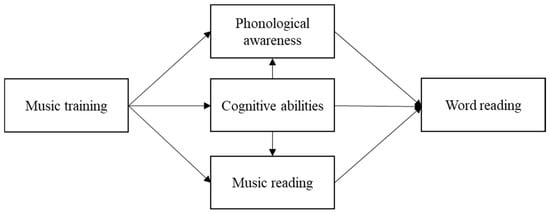
The conceptual integration of the three theoretical accounts gives rise to a testable model (see Figure 2). In this integrated model, music training can improve word reading via three mediators, each representing one theoretical account. Specifically, the perceptual account posits that music training would improve phonological awareness, in turn improving word reading (Loui et al., 2011; Tierney & Kraus, 2014). The cognitive account assumes that music training would improve cognitive abilities, resulting in word reading improvement (Degé, 2021; Swaminathan et al., 2018). The music reading account hypothesises that music training, by improving music reading, enhances word reading. In addition to three basic pathways, the integrated model also allows for the interplay of cognitive abilities in the perceptual and music reading accounts, as represented by two distal indirect pathways (music training→cognitive abilities→phonological awareness/music reading→word reading). These distal pathways can be classified under the cognitive account or a combination of multiple accounts or assigned a new account name. Arguably, the distinction is merely nominal. What is essential is the identification of the specific pathways through which music training improves word reading.
Figure 2.
The integrated model of music-to-language transfer. The arrows represent positive effects.
While falsification is a sine qua non in science, a better way to advance music-to-language transfer research is to embrace and reconcile multiple perspectives (Degé, 2021; Tierney & Kraus, 2014; Zinar, 1976). While researchers can definitely test each theoretical account on its own, it seems more meaningful to integrate different theoretical accounts and evaluate each of their relative importance in music-to-language transfer (see Choi et al., 2025). Hypothetically, multiple theoretical accounts could hold, but one may play a larger role than the others. Furthermore, this may vary across age groups. For example, phonological awareness plays the largest role in English word reading compared with other reading-related skills (Dixon, 2010; Ehri et al., 2001), but its role may diminish with age (cf. Pfost, 2015).
With the integrated model now preliminarily proposed, it would be essential to test the model with empirical rigour. In this model, the effects of music training on phonological awareness, cognitive abilities, and word reading are well supported by causal evidence from RCTs (see Gordon et al., 2015; Neves et al., 2022; Bigand & Tillmann, 2022). However, the basic and distal pathways of the perceptual and cognitive accounts mainly rely on correlational evidence, and those of the music reading account are largely speculative and require empirical testing (K. K. H. Chung et al., 2017; Janurik et al., 2022; Loui et al., 2011). Thus, even with previous RCTs, the evidence supporting the integrated model remains elusive.
Researchers seeking to test the integrated model (or any model) are recommended to adopt an RCT design supplemented with causal mediation analysis. Compared with a correlational design, an RCT design has a stronger causal inference, providing robust evidence for intervention efficacy (Ohlsson & Kendler, 2020). However, as described above, typical RCTs fall short in revealing the intervention mechanism (Moreno et al., 2009; Rautenberg, 2015; Slater et al., 2014). Gaining popularity in the medical and educational fields, causal mediation analysis enables researchers to test specific pathways through which an intervention leads to outcome improvement (H. Lee et al., 2017; Roberts et al., 2018). Readers who are interested in the statistical principles and practical steps of causal mediation analysis are referred to a comprehensive tutorial (Chi et al., 2022). Although causal mediation analysis is an ideal way to test the integrated model, it requires more than two time points of assessments, so researchers cannot adopt a simple pre–post-test design. Moreover, an RCT using causal mediation analysis requires a larger sample size than a conventional RCT (Qin, 2024). These may have some implications for research cost and manpower. Nevertheless, whenever feasible, researchers should adopt the most empirically rigorous approach for scientific research.
9. Future Direction: Individual Differences in Music-to-Language Transfer
In addition to integrating different theoretical accounts, it is also important to consider individual differences in music-to-language transfer. In the medical field, different patients may respond differently to the same intervention (Gewandter et al., 2019). For example, Gewandter et al. (2019) analysed four RCTs of fentanyl for breakthrough cancer pain and identified differences among patients in their response to fentanyl treatment. Identifying patients who are likely to respond well to an intervention is an important element of precision medicine. However, music-to-language transfer research has largely treated music training as a one-size-fits-all intervention for improving word reading and other language-related skills (Patel, 2011; Tierney & Kraus, 2014). Intervention studies have focused on evaluating the efficacy of music training relative to phonological training, arts/sports training, and no training (Bhide et al., 2013; Rautenberg, 2015; Slater et al., 2014). Arguably, viewing musically trained children as a unitary group may have masked individual differences in responsiveness to music training. From a practical perspective, addressing individual differences in responsiveness can help identify children who have a higher likelihood (or greater extent) of music-to-language transfer, thereby increasing the cost-effectiveness of music training.
Based on the integrated model, children with lower levels of phonological awareness, cognitive abilities, and music reading should benefit most from music training. Firstly, the effect of music training on word reading is expected only when improvements occur in phonological awareness (Goswami, 2011; Tierney & Kraus, 2014), cognitive abilities (Degé, 2021; Swaminathan et al., 2018), and/or music reading (Zinar, 1976). Children who already have high baseline levels of phonological awareness, cognitive abilities, and music reading may experience limited gains in these skills from music training because the neural substrates involved are already saturated (Choi, 2021; Kempert et al., 2016). Since there is little room for enhancement, music training may not be effective in further improving word reading for these children.
Secondly, for children with high baseline levels of phonological awareness, cognitive abilities, and music reading, these skills are less likely to serve as the bottleneck for word reading. Once phonological awareness has reached a sufficient level, word reading is more likely limited by other skills such as orthographical and morphological awareness (Choi et al., 2018; Liao et al., 2020). For these children, further improvements in phonological awareness may not benefit word reading. A similar logic applies to cognitive abilities and music reading.
Besides individual differences in intervention responsiveness, future studies should investigate individual differences in the mechanisms by which music training improves word reading. In the context of the integrated model, the relative weights of each pathway can vary across individuals (see Figure 2). For example, a child with poor phonological awareness but good cognitive abilities may benefit more from the perceptual pathway (i.e., music training → phonological awareness → word reading) than from the cognitive pathway. Conversely, a child with poor cognitive abilities but good phonological awareness may benefit more from the cognitive pathway (i.e., music training → cognitive abilities → word reading) than from the perceptual pathway. To address this research gap, future studies could employ a stratified RCT design, where children with varying levels of phonological awareness, cognitive abilities, and music reading are randomly assigned to music training or a control group. Crucially, future studies adopting this design should clearly justify the operational definitions of “good” and “poor” baseline levels, preferably referencing normative data.
10. Future Direction: Cross-Linguistic Differences in Music-to-Language Transfer
Besides individual differences, researchers should begin to address cross-linguistic differences in music-to-language transfer. To our knowledge, existing studies have only examined the effect of music training on word reading within alphabetical writing systems (Bigand & Tillmann, 2022; Gordon et al., 2015; Neves et al., 2022). This limitation confines the applicability of music-to-language transfer theories to alphabetical languages alone (Degé, 2021; Tierney & Kraus, 2014; Zinar, 1976). To date, no RCT has investigated whether music training can improve word reading in non-alphabetical languages such as Chinese.
Despite the lack of causal evidence, there is both a theoretical basis and correlational support for the effect of music training on Chinese word reading. According to the universal phonological principle, even though Chinese is a non-alphabetical script, phonological information still plays a crucial role (C. A. Perfetti et al., 1992). For example, to accurately read aloud the Chinese character 三 (three), children need to have established a well-specified phonological representation of the word (/sam1/). Phonological awareness facilitates this process, suggesting that the perceptual account of music-to-language transfer may also apply to Chinese (McBride-Chang et al., 2008). Supporting this, a recent cross-sectional study found that musically trained children exhibited better Chinese phonological awareness than untrained children (Choi et al., 2025).
Moreover, particularly in Hong Kong, Chinese reading instruction relies heavily on rote memorisation of words, without the use of alphabetic systems such as Pinyin or Zhuyin Fuhao (Chan & Siegel, 2001). This approach places a high demand on working memory, especially since many Chinese words are visually complex (K. K. H. Chung & McBride-Chang, 2011). Additionally, Chinese contains many visually similar words (e.g., 貌—貓, 兒—臼, 悶—聞, 髮—鬆) and numerous homophones (e.g., 而, 兒, 移, 儀, 怡, 夷, and 宜) that share the same pronunciation but have different meanings. When reading aloud, inhibitory control is required to suppress lexical competitors. Indeed, working memory and inhibitory control have been found to predict Chinese word reading ability (K. K. H. Chung et al., 2017). Furthermore, musically trained children have been shown to possess better working memory and inhibitory control compared to untrained children (Choi et al., 2025).
Beyond examining the cross-linguistic efficacy of music training, future research could investigate whether the relative weight of each pathway in the integrated model varies across different languages (see Figure 2). For instance, in Chinese, morphological awareness has been found to be a stronger predictor of word reading than phonological awareness (McBride-Chang et al., 2005; see also Choi et al., 2018). Does this imply that the perceptual account, which emphasises phonological awareness, might play a lesser role in Chinese children compared to other accounts? Additionally, research has shown that music reading correlates negatively with word reading response times in English but not in Chinese (Li & Hsiao, 2018). Could this indicate that the music reading pathway is less relevant or operates differently in Chinese children? Exploring these questions can help tailor models of music-to-language transfer to specific linguistic contexts.
11. Future Direction: Multifaceted Nature of Reading
In a broader context, music-to-language transfer research should also begin to address the multifaceted nature of reading a word. In educational settings, students are often tasked with reading written words aloud (Batini et al., 2018; Warner et al., 2016). Functionally, understanding the meaning of written words is also fundamental to reading comprehension (Hogan et al., 2011; Hoover & Gough, 1990). However, studies on music-to-language transfer have primarily focused on either reading aloud (e.g., Moreno et al., 2009; Rautenberg, 2015; Slater et al., 2014) or vocabulary knowledge (e.g., Janurik et al., 2022; Wheeler & Wheeler, 1952). To gain a comprehensive understanding of how music training enhances children’s ability to read words, researchers should combine both word reading and vocabulary knowledge into a latent variable. It would be of practical significance to examine whether music training can improve this multifaceted latent variable. Of course, individual effects could also be studied within the same research. For example, it would be interesting to explore whether the relative importance of different theoretical accounts varies depending on the reading task, such as reading aloud versus vocabulary knowledge. Beyond the word level, there are many other reading-related skills, such as reading passages aloud with appropriate prosody and reading comprehension, etc. While these are beyond the scope of this literature review, future studies are encouraged to address these skills as well.
12. Conclusions
By reviewing the literature, this article has identified three possible theoretical accounts of music-to-language transfer in word reading, namely, the perceptual account (Loui et al., 2011; Tierney & Kraus, 2014), the cognitive account (Degé, 2021; Swaminathan et al., 2018), and the music reading account (Zinar, 1976). The central argument is that these theoretical accounts are not mutually exclusive and can be integrated into a comprehensive, holistic model (see Figure 2). Future research should avoid creating false dichotomies or trichotomies and instead embrace the diversity of theoretical accounts on music-to-language transfer. Rather than contesting one theoretical account in favour of another, it would be more meaningful to assess their relative importance in music-to-language transfer. One promising research direction is to evaluate the integrated model using an RCT design supplemented with causal mediation analysis (H. Lee et al., 2017; Roberts et al., 2018). Moreover, researchers can advance the field by addressing individual differences and cross-linguistic variations in music-to-language transfer and its underlying mechanisms. Finally, the mechanisms underlying music-to-language transfer are unlikely to be fully explained by a trichotomy. Researchers are encouraged to continue identifying other potential accounts of music-to-language transfer and exploring how they can be integrated with existing accounts.
Funding
This research was funded by the Research Grants Council (General Research Fund 17600124).
Institutional Review Board Statement
Not applicable.
Informed Consent Statement
Not applicable.
Data Availability Statement
No new data were created.
Acknowledgments
During the preparation of this manuscript, the author used ChatGPT-4.1-nano for grammatical proofreading and editing. The author has reviewed and edited the output and takes full responsibility for the content of this publication.
Conflicts of Interest
The author declares no conflicts of interest. The funder had no role in the conceptualisation of the study, in the writing of the manuscript, or in the decision to publish the study.
Abbreviations
The following abbreviations are used in this manuscript:
| RCT | Randomised controlled trial |
| PATH | Precise Auditory Timing Hypothesis |
| ERP | Event-related potential |
References
- Arthurs, Y., & Petrini, K. (2023). Musicians’ views on the role of reading music in learning, performance, and understanding. Musicae Scientiae, 28(1), 3–17. [Google Scholar] [CrossRef] [Scilit]
- Batini, F., Bartolucci, M., & Timpone, A. (2018). The effects of reading aloud in the primary school. Psychology and Education, 55(1–2), 111–122. [Google Scholar]
- Bent, I., Hughes, D., Provine, R., Rastall, R., Kilmer, A., Hiley, D., Szendrei, J., Payne, T., Bent, M., & Chew, G. (2001). Notation. Grove Music Online. [Google Scholar]
- Bhide, A., Power, A., & Goswami, U. (2013). A rhythmic musical intervention for poor readers: A comparison of efficacy with a letter-based intervention. Mind, Brain, and Education, 7(2), 113–123. [Google Scholar] [CrossRef] [Scilit]
- Bigand, E., & Tillmann, B. (2022). Near and far transfer: Is music special? Memory & Cognition, 50(2), 339–347. [Google Scholar] [CrossRef] [Scilit]
- Blanton, W. L. (1962). An experimental application of language theory and personality theory to evaluate the influence of music in language learning [Unpublished doctoral dissertation, University of Texas]. [Google Scholar]
- Bouhali, F., Mongelli, V., Thiebaut de Schotten, M., & Cohen, L. (2020). Reading music and words: The anatomical connectivity of musicians’ visual cortex. NeuroImage, 212, 116666. [Google Scholar] [CrossRef] [Scilit]
- Chan, C. K. K., & Siegel, L. S. (2001). Phonological processing in reading Chinese among normally achieving and poor readers. Journal of Experimental Child Psychology, 80, 23–43. [Google Scholar] [CrossRef] [Scilit]
- Chi, W. E., Huang, S., Jeon, M., Park, E. S., Melguizo, T., & Kezar, A. (2022). A practical guide to causal mediation analysis: Illustration with a comprehensive college transition program and nonprogram peer and faculty interactions. Frontiers in Education, 7, 886722. [Google Scholar] [CrossRef] [Scilit]
- Choi, W. (2020). The selectivity of musical advantage: Musicians exhibit perceptual advantage for some but not all Cantonese tones. Music Perception, 37(5), 423–434. [Google Scholar] [CrossRef] [Scilit]
- Choi, W. (2021). Musicianship influences language effect on musical pitch perception. Frontiers in Psychology, 12, 712753. [Google Scholar] [CrossRef] [Scilit]
- Choi, W. (2022). What is ‘music’ in music-to-language transfer? Musical ability but not musicianship supports Cantonese listeners’ English stress perception. Journal of Speech, Language, and Hearing Research, 65, 4047–4059. [Google Scholar] [CrossRef] [Scilit]
- Choi, W., Lai, V. K. W., Kong, S., & Bautista, A. (2025). Examining the cognitive and perceptual perspectives of music-to-language transfer: A study of Cantonese-English bilingual children. Journal of Experimental Child Psychology, 249, 106069. [Google Scholar] [CrossRef] [Scilit] [PubMed]
- Choi, W., Ling, C. L. K., & Wu, C. H. J. (2024). Musical advantage in lexical tone perception hinges on musical instrument: A comparison between pitched musicians, unpitched musicians, and non-musicians. Music Perception, 41(5), 360–377. [Google Scholar] [CrossRef] [Scilit]
- Choi, W., Tong, X., & Cain, K. (2016). Lexical prosody beyond first-language boundary: Chinese lexical tone sensitivity predicts English reading comprehension. Journal of Experimental Child Psychology, 148, 70–86. [Google Scholar] [CrossRef] [Scilit]
- Choi, W., Tong, X., Law, K. K. S., & Cain, K. (2018). Within- and cross-language contributions of morphological awareness to word reading development in Chinese-English bilingual children. Reading and Writing, 31(8), 1787–1820. [Google Scholar] [CrossRef] [Scilit]
- Chow, B. W.-Y., McBride-Chang, C., & Burgess, S. (2005). Phonological processing skills and early reading abilities in Hong Kong Chinese kindergarteners learning to read English as a second language. Journal of Educational Psychology, 97(1), 81–87. [Google Scholar] [CrossRef] [Scilit]
- Chung, K. K. H., Liu, H., McBride, C., Wong, A. M.-Y., & Lo, J. C. M. (2017). How socioeconomic status, executive functioning and verbal interactions contribute to early academic achievement in Chinese children. Educational Psychology, 37(4), 402–420. [Google Scholar] [CrossRef] [Scilit]
- Chung, K. K. H., & McBride-Chang, C. (2011). Executive functioning skills uniquely predict Chinese word reading. Journal of Educational Psychology, 103(4), 909–921. [Google Scholar] [CrossRef] [Scilit]
- Chung, W.-L., & Bidelman, G. M. (2021). Mandarin-speaking preschoolers’ pitch discrimination, prosodic and phonological awareness, and their relation to receptive vocabulary and reading abilities. Reading and Writing, 34(2), 337–353. [Google Scholar] [CrossRef] [Scilit]
- Cogo-Moreira, H., Andriolo, R. B., Yazigi, L., Ploubidis, G. B., Brandão de Ávila, C. R., & Mari, J. J. (2012). Music education for improving reading skills in children and adolescents with dyslexia. The Cochrane Database of Systematic Reviews, 2012(8), CD009133. [Google Scholar] [CrossRef] [Scilit] [PubMed]
- Coltheart, M., & Rastle, K. (1994). Serial processing in reading aloud: Evidence for dual-route models of reading. Journal of Experimental Psychology: Human Perception and Performance, 20(6), 1197–1211. [Google Scholar] [CrossRef]
- Coltheart, M., Rastle, K., Perry, C., Langdon, R., & Ziegler, J. (2001). DRC: A dual route cascaded model of visual word recognition and reading aloud. Psychological Review, 108(1), 204–256. [Google Scholar] [CrossRef] [Scilit] [PubMed]
- Crasta, J. E., Thaut, M. H., Anderson, C. W., Davies, P. L., & Gavin, W. J. (2018). Auditory priming improves neural synchronization in auditory-motor entrainment. Neuropsychologia, 117, 102–112. [Google Scholar] [CrossRef] [Scilit]
- Cutler, A., & Butterfield, S. (1992). Rhythmic cues to speech segmentation: Evidence from juncture misperception. Journal of Memory and Language, 31(2), 218–236. [Google Scholar] [CrossRef] [Scilit]
- Degé, F. (2021). Music lessons and cognitive abilities in children: How far transfer could be possible. Frontiers in Psychology, 11, 557807. [Google Scholar] [CrossRef] [Scilit]
- Dixon, L. Q. (2010). The importance of phonological awareness for the development of early English reading skills among bilingual Singaporean kindergartners. International Journal of Bilingual Education and Bilingualism, 13(6), 723–738. [Google Scholar] [CrossRef] [Scilit]
- Eccles, R., van der Linde, J., le Roux, M., Swanepoel, D. W., MacCutcheon, D., & Ljung, R. (2021). The effect of music education approaches on phonological awareness and early literacy: A systematic review. Australian Journal of Language and Literacy, 44(1), 46–60. [Google Scholar] [CrossRef] [Scilit]
- Ehri, L. C. (2017). Orthographic mapping and literacy development revisited (pp. 127–146). Studies in Written Language and Literacy. [Google Scholar] [CrossRef] [Scilit]
- Ehri, L. C., Nunes, S. R., Willows, D. M., Schuster, B. V., Yaghoub-Zadeh, Z., & Shanahan, T. (2001). Phonemic awareness instruction helps children learn to read: Evidence from the National Reading Panel’s meta-analysis. Reading Research Quarterly, 36, 250–287. [Google Scholar] [CrossRef] [Scilit]
- Elmer, S., Hänggi, J., Meyer, M., & Jäncke, L. (2013). Increased cortical surface area of the left planum temporale in musicians facilitates the categorization of phonetic and temporal speech sounds. Cortex, 49(10), 2812–2821. [Google Scholar] [CrossRef] [Scilit]
- Ferrari, R. (2015). Writing narrative style literature reviews. Medical Writing, 24(4), 230–235. [Google Scholar] [CrossRef] [Scilit]
- Flaugnacco, E., Lopez, L., Terribili, C., Montico, M., Zoia, S., & Schön, D. (2015). Music training increases phonological awareness and reading skills in developmental dyslexia: A randomized control trial. PLoS ONE, 10(9), e0138715. [Google Scholar] [CrossRef] [Scilit] [PubMed]
- Forgeard, M., Winner, E., Norton, A., & Schlaug, G. (2008). Practicing a musical instrument in childhood is associated with enhanced verbal ability and nonverbal reasoning. PLoS ONE, 3(10), e3566. [Google Scholar] [CrossRef] [Scilit]
- Frischen, U., Schwarzer, G., & Degé, F. (2019). Comparing the effects of rhythm-based music training and pitch-based music training on executive functions in preschoolers. Frontiers in Integrative Neuroscience, 13, 41. [Google Scholar] [CrossRef] [Scilit]
- Fung, W. K., Chung, K. K. H., & Lam, C. B. (2020). Executive functioning and word reading in Hong Kong Chinese children: A 1-year longitudinal perspective. Journal of Research in Reading, 43(3), 382–393. [Google Scholar] [CrossRef] [Scilit]
- Gewandter, J. S., McDermott, M. P., He, H., Gao, S., Cai, X., Farrar, J. T., Katz, N. P., Markman, J. D., Senn, S., Turk, D. C., & Dworkin, R. H. (2019). Demonstrating heterogeneity of treatment effects among patients: An overlooked but important step toward precision medicine. Clinical Pharmacology and Therapeutics, 106(1), 204–210. [Google Scholar] [CrossRef] [Scilit]
- Gillon, G. T. (2004). Phonological awareness: From research to practice. The Guilford Press. [Google Scholar]
- Gordon, R. L., Fehd, H. M., & McCandliss, B. D. (2015). Does music training enhance literacy skills? A meta-analysis. Frontiers in Psychology, 6, 1777. [Google Scholar] [CrossRef] [Scilit] [PubMed]
- Goswami, U. (2011). A temporal sampling framework for developmental dyslexia. Trends in Cognitive Sciences, 15(1), 3–10. [Google Scholar] [CrossRef] [Scilit]
- Goswami, U., Fosker, T., Huss, M., Mead, N., & Szűcs, D. (2011). Rise time and formant transition duration in the discrimination of speech sounds: The BA–WA distinction in developmental dyslexia. Developmental Science, 14(1), 34–43. [Google Scholar] [CrossRef] [Scilit]
- Goswami, U., Thomson, J., Richardson, U., Stainthorp, R., Hughes, D., Rosen, S., & Scott, S. K. (2002). Amplitude envelope onsets and developmental dyslexia: A new hypothesis. Proceedings of the National Academy of Sciences of the United States of America, 99(16), 10911–10916. [Google Scholar] [CrossRef] [Scilit] [PubMed]
- Gregg, J., Inhoff, A. W., & Li, X. (2023). Lexical competition influences correct and incorrect visual word recognition. Quarterly Journal of Experimental Psychology, 76(5), 1011–1025. [Google Scholar] [CrossRef] [Scilit]
- Groff, P. (1977). Reading music affects reading language: Says who? Music Educators Journal, 63(5), 37–41. [Google Scholar] [CrossRef] [Scilit]
- Habib, M., Lardy, C., Desiles, T., Commeiras, C., Chobert, J., & Besson, M. (2016). Music and dyslexia: A new musical training method to improve reading and related disorders. Frontiers in Psychology, 7, 26. [Google Scholar] [CrossRef] [Scilit] [PubMed]
- Herrera, L., Lorenzo, O., Defior, S., Fernandez-Smith, G., & Costa-Giomi, E. (2011). Effects of phonological and musical training on the reading readiness of native- and foreign-Spanish-speaking children. Psychology of Music, 39(1), 68–81. [Google Scholar] [CrossRef] [Scilit]
- Hillenbrand, J. M. (2013). Static and dynamic approaches to vowel perception. In G. Morrison, & P. Assmann (Eds.), Vowel inherent spectral change (pp. 9–30). Modern acoustics and signal processing. Springer. [Google Scholar] [CrossRef] [Scilit]
- Hogan, T. P., Bridges, M. S., Justice, L. M., & Cain, K. (2011). Increasing higher level language skills to improve reading comprehension. Focus on Exceptional Children, 44(3), 1–20. [Google Scholar] [CrossRef] [Scilit]
- Hogan, T. P., Catts, H. W., & Little, T. D. (2005). The relationship between phonological awareness and reading: Implications for the assessment of phonological awareness. Language, Speech, and Hearing Services in Schools, 36(4), 285–293. [Google Scholar] [CrossRef] [Scilit] [PubMed]
- Hoover, W. A., & Gough, P. B. (1990). The simple view of reading. Reading and Writing, 2, 127–160. [Google Scholar] [CrossRef] [Scilit]
- Jamey, K., Foster, N. E. V., Hyde, K. L., & Bella, S. D. (2024). Does music training improve inhibition control in children? A systematic review and meta-analysis. Cognition, 252, 105913. [Google Scholar] [CrossRef] [Scilit]
- Janurik, M., Surján, N., & Józsa, K. (2022). The relationship between early word reading, phonological awareness, early music reading and musical aptitude. Journal of Intelligence, 10(3), 50. [Google Scholar] [CrossRef] [Scilit]
- Jaschke, A. C., Honing, H., & Scherder, E. J. A. (2018). Longitudinal analysis of music education on executive functions in primary school children. Frontiers in Neuroscience, 12, 103. [Google Scholar] [CrossRef] [Scilit] [PubMed]
- Kempert, S., Götz, R., Blatter, K., Tibken, C., Artelt, C., Schneider, W., & Stanat, P. (2016). Training early literacy related skills: To which degree does a musical training contribute to phonological awareness development? Frontiers in Psychology, 7, 1803. [Google Scholar] [CrossRef] [Scilit]
- Kent, R. D., & Vorperian, H. K. (2018). Static measurements of vowel formant frequencies and bandwidths: A review. Journal of Communication Disorders, 74, 74–97. [Google Scholar] [CrossRef] [Scilit] [PubMed]
- Klatt, D. H., & Cooper, W. E. (1975). Perception of segment duration in sentence contexts. In A. Cohen, & S. G. Nooteboom (Eds.), Structure and process in speech perception (Vol. 11, pp. 69–89). Communication and cybernetics. Springer. [Google Scholar] [CrossRef] [Scilit]
- Kwakkel, H., Droop, M., Verhoeven, L., & Segers, E. (2021). The impact of lexical skills and executive functioning on L1 and L2 phonological awareness in bilingual kindergarten. Learning and Individual Differences, 88, 102009. [Google Scholar] [CrossRef] [Scilit]
- Lee, H., Wiggers, J., Kamper, S. J., Williams, A., O’Brien, K. M., Hodder, R. K., Wolfenden, L., Yoong, S. L., Campbell, E., Haskins, R., Robson, E. K., McAuley, J. H., & Williams, C. M. (2017). Mechanism evaluation of a lifestyle intervention for patients with musculoskeletal pain who are overweight or obese: Protocol for a causal mediation analysis. BMJ Open, 7(6), e014652. [Google Scholar] [CrossRef] [Scilit]
- Lee, M. D., & Wagenmakers, E.-J. (2013). Bayesian cognitive modeling: A practical course. Cambridge University Press. [Google Scholar] [CrossRef] [Scilit]
- Lehmann, A. C., & Kopiez, R. (2009). Sight-reading. In S. Hallam, I. Cross, & M. Thaut (Eds.), The Oxford handbook of music psychology (pp. 344–351). Oxford University Press. [Google Scholar]
- Li, S. T. K., & Hsiao, J. H. (2018). Music reading expertise modulates hemispheric lateralization in English word processing but not in Chinese character processing. Cognition, 176, 159–173. [Google Scholar] [CrossRef] [Scilit]
- Liao, C., Kuo, B., Tsao, C., & Mok, M. M. C. (2020). Predictors of Chinese reading and literacy skills among Chinese school children: A 3-year longitudinal study. Educational Psychology, 40(7), 838–855. [Google Scholar] [CrossRef] [Scilit]
- Lisker, L., & Abramson, A. S. (1964). A Cross-language study of voicing in initial stops: Acoustical measurements. Word, 20, 384–422. [Google Scholar] [CrossRef] [Scilit]
- Loui, P., Kroog, K., Zuk, J., Winner, E., & Schlaug, G. (2011). Relating pitch awareness to phonemic awareness in children: Implications for tone-deafness and dyslexia. Frontiers in Psychology, 2, 10054. [Google Scholar] [CrossRef] [Scilit]
- MacCutcheon, D., Füllgrabe, C., Eccles, R., van der Linde, J., Panebianco, C., & Ljung, R. (2020). Investigating the effect of one year of learning to play a musical instrument on speech-in-noise perception and phonological short-term memory in 5-to-7-year-old children. Frontiers in Psychology, 10, 2865. [Google Scholar] [CrossRef] [Scilit] [PubMed]
- Magyar, A., & Molnár, G. (2015). A szóolvasási készség online mérésére kidolgozott adaptív és lineáris tesztrendszer összehasonlító hatékonyságvizsgálata. Magyar Pedagógia, 115(4), 403–428. [Google Scholar] [CrossRef] [Scilit]
- McBride-Chang, C., Cho, J. R., Liu, H., Wagner, R. K., Shu, H., Zhou, A., Cheuk, C. S., & Muse, A. (2005). Changing models across cultures: Associations of phonological awareness and morphological structure awareness with vocabulary and word recognition in second graders from Beijing, Hong Kong, Korea, and the United States. Journal of Experimental Child Psychology, 92(2), 140–160. [Google Scholar] [CrossRef] [Scilit] [PubMed]
- McBride-Chang, C., Tong, X., Shu, H., Wong, A. M. Y., Leung, K., & Tardif, T. (2008). Syllable, phoneme, and tone: Psycholingusitic units in early Chinese and English word recognition. Scientific Studies of Reading, 12, 171–194. [Google Scholar] [CrossRef] [Scilit]
- McClelland, J. L., Mirman, D., Bolger, D. J., & Khaitan, P. (2014). Interactive activation and mutual constraint satisfaction in perception and cognition. Cognitive Science, 38(6), 1139–1189. [Google Scholar] [CrossRef] [Scilit]
- McKague, M., Pratt, C., & Johnston, M. B. (2001). The effect of oral vocabulary on reading visually novel words: A comparison of the dual-route-cascaded and triangle frameworks. Cognition, 80(3), 231–262. [Google Scholar] [CrossRef] [Scilit]
- Melby-Lervåg, M., Lyster, S.-A. H., & Hulme, C. (2012). Phonological skills and their role in learning to read: A meta-analytic review. Psychological Bulletin, 138(2), 322–352. [Google Scholar] [CrossRef] [Scilit] [PubMed]
- Mishra, J. (2014). Factors related to sight-reading accuracy: A meta-analysis. Journal of Research in Music Education, 61(4), 452–465. [Google Scholar] [CrossRef] [Scilit]
- Moreno, S., Bialystok, E., Barac, R., Schellenberg, E. G., Cepeda, N. J., & Chau, T. (2011). Short-term music training enhances verbal intelligence and executive function. Psychological Science, 22(11), 1425–1433. [Google Scholar] [CrossRef] [Scilit]
- Moreno, S., Marques, C., Santos, A., Santos, M., Castro, S. L., & Besson, M. (2009). Musical training influences linguistic abilities in 8-year-old children: More evidence for brain plasticity. Cerebral, 19(3), 712–723. [Google Scholar] [CrossRef] [Scilit]
- Moritz, C., Yampolsky, S., Papadelis, G., Thomson, J., & Wolf, M. (2013). Links between early rhythm skills, musical training, and phonological awareness. Reading and Writing, 26(5), 739–769. [Google Scholar] [CrossRef] [Scilit]
- Movsesian, E. A. (1967). The influence of primary teaching music reading skills on the development of basic reading skills in the primary grades [Unpublished doctoral dissertation, University of Southern California]. [Google Scholar]
- Muneaux, M., Ziegler, J. C., Truc, C., Thomson, J., & Goswami, U. (2004). Deficits in beat perception and dyslexia: Evidence from French. Neuroreport, 15(8), 1255–1259. [Google Scholar] [CrossRef] [Scilit]
- Nan, Y., Liu, L., Geiser, E., Shu, H., Gong, C. C., Dong, Q., Gabrieli, J. D. E., & Desimone, R. (2018). Piano training enhances the neural processing of pitch and improves speech perception in Mandarin-speaking children. Proceedings of the National Academy of Sciences of the United States of America, 115(28), E6630–E6639. [Google Scholar] [CrossRef] [Scilit] [PubMed]
- Nation, K., & Cocksey, J. (2009). The relationship between knowing a word and reading it aloud in children’s word reading development. Journal of Experimental Child Psychology, 103(3), 296–308. [Google Scholar] [CrossRef] [Scilit] [PubMed]
- Nation, K., & Snowling, M. J. (1998). Semantic processing and the development of word-recognition skills: Evidence from children with reading comprehension difficulties. Journal of Memory and Language, 39(1), 85–101. [Google Scholar] [CrossRef] [Scilit]
- Nearey, T. M., & Assmann, P. F. (1986). Modeling the role of inherent spectral change in vowel identification. Journal of the Acoustical Society of America, 80, 1297–1308. [Google Scholar] [CrossRef] [Scilit]
- Neves, L., Correia, A. I., Castro, S. L., Martins, D., & Lima, C. F. (2022). Does music training enhance auditory and linguistic processing? A systematic review and meta-analysis of behavioral and brain evidence. Neuroscience and Biobehavioral Reviews, 140, 104777. [Google Scholar] [CrossRef] [Scilit]
- Nunes, T., Bryant, P., & Barros, R. (2012). The development of word recognition and its significance for comprehension and fluency. Journal of Educational Psychology, 104(4), 959–973. [Google Scholar] [CrossRef] [Scilit]
- Ohlsson, H., & Kendler, K. S. (2020). Applying causal inference methods in psychiatric epidemiology: A review. JAMA Psychiatry, 77(6), 637–644. [Google Scholar] [CrossRef] [Scilit]
- Pantaleo, M. M., Arcuri, G., Manfredi, M., & Proverbio, A. M. (2024). Music literacy improves reading skills via bilateral orthographic development. Scientific Reports, 14(1), 3506. [Google Scholar] [CrossRef] [Scilit]
- Patel, A. D. (2011). Why would musical training benefit the neural encoding of speech? The OPERA hypothesis. Frontiers in Psychology, 2, 142. [Google Scholar] [CrossRef] [Scilit]
- Patscheke, H., Degé, F., & Schwarzer, G. (2016). The effects of training in music and phonological skills on phonological awareness in 4- to 6-year-old children of immigrant families. Frontiers in Psychology, 7, 1647. [Google Scholar] [CrossRef] [Scilit] [PubMed]
- Perfetti, C. (2007). Reading ability: Lexical quality to comprehension. Scientific Studies of Reading, 11(4), 357–383. [Google Scholar] [CrossRef] [Scilit]
- Perfetti, C. A., & Hart, L. (2001). The lexical basis of comprehension skill. In D. S. Gorfein (Ed.), On the consequences of meaning selection: Perspectives on resolving lexical ambiguity (pp. 67–86). American Psychological Association. [Google Scholar] [CrossRef] [Scilit]
- Perfetti, C. A., Zhang, S., & Berent, I. (1992). Reading in English and Chinese: Evidence for a “universal” phonological principle. In R. Frost, & L. Katz (Eds.), Orthography, phonology, morphology, and meaning (pp. 227–248). North-Holland. [Google Scholar] [CrossRef] [Scilit]
- Pérez-Pereira, M., Martínez-López, Z., & Maneiro, L. (2020). Longitudinal relationships between reading abilities, phonological awareness, language abilities and executive functions: Comparison of low risk preterm and full-term children. Frontiers in Psychology, 11, 468. [Google Scholar] [CrossRef] [Scilit] [PubMed]
- Pfost, M. (2015). Children’s phonological awareness as a predictor of reading and spelling: A systematic review of longitudinal research in German-speaking countries. Zeitschrift für Entwicklungspsychologie und Pädagogische Psychologie, 47(3), 123–138. [Google Scholar] [CrossRef] [Scilit]
- Qin, X. (2024). Sample size and power calculations for causal mediation analysis: A tutorial and shiny app. Behavior Research Methods, 56(3), 1738–1769. [Google Scholar] [CrossRef] [Scilit]
- Rautenberg, I. (2015). The effects of musical training on the decoding skills of German-speaking primary school children. Journal of Research in Reading, 38(1), 1–17. [Google Scholar] [CrossRef] [Scilit]
- Roberts, G., Scammacca, N., & Roberts, G. J. (2018). Causal mediation in educational intervention studies. Behavioral Disorders, 43(4), 457–465. [Google Scholar] [CrossRef] [Scilit] [PubMed]
- Rolka, E. J., & Silverman, M. J. (2015). A systematic review of music and dyslexia. The Arts in Psychotherapy, 46, 24–32. [Google Scholar] [CrossRef] [Scilit]
- Sala, G., & Gobet, F. (2017). When the music’s over. Does music skill transfer to children’s and young adolescents’ cognitive and academic skills? A meta-analysis. Educational Research Review, 20, 55–67. [Google Scholar] [CrossRef] [Scilit]
- Sala, G., & Gobet, F. (2020). Cognitive and academic benefits of music training with children: A multilevel meta-analysis. Memory & Cognition, 48, 1429–1441. [Google Scholar] [CrossRef] [Scilit] [PubMed]
- Schellenberg, E. G. (2011). Examining the association between music lessons and intelligence. British Journal of Psychology, 102(3), 283–302. [Google Scholar] [CrossRef] [Scilit] [PubMed]
- Schellenberg, E. G., & Lima, C. F. (2024). Music training and nonmusical abilities. Annual Review of Psychology, 75, 87–128. [Google Scholar] [CrossRef] [Scilit] [PubMed]
- Seidenberg, M. S., & McClelland, J. L. (1989). A distributed, developmental model of word recognition and naming. Psychological Review, 96(4), 523–568. [Google Scholar] [CrossRef] [Scilit]
- Slater, J., Strait, D. L., Skoe, E., O’Connell, S., Thompson, E., & Kraus, N. (2014). Longitudinal effects of group music instruction on literacy skills in low-income children. PLoS ONE, 9(11), e113383. [Google Scholar] [CrossRef] [Scilit] [PubMed]
- Snowling, M., Gooch, D., & Henderson, L. (2010). Dyslexia. In Encyclopedia of human behaviour (2nd ed.). Academic Press. [Google Scholar]
- Sousa, J., Martins, M., Torres, N., Castro, S. L., & Silva, S. (2022). Rhythm but not melody processing helps reading via phonological awareness and phonological memory. Scientific Reports, 12(1), 13224. [Google Scholar] [CrossRef] [Scilit]
- Stanovich, K. E. (2024). Word recognition skill and reading ability. In Competent reader, disabled reader (pp. 81–102). Routledge. [Google Scholar] [CrossRef] [Scilit]
- Steinbrink, C., Knigge, J., Mannhaupt, G., Sallat, S., & Werkle, A. (2019). Are temporal and tonal musical skills related to phonological awareness and literacy skills? Evidence from two cross-sectional studies with children from different age groups. Frontiers in Psychology, 10, 805. [Google Scholar] [CrossRef] [Scilit] [PubMed]
- Sukhera, J. (2022). Narrative reviews: Flexible, rigorous, and practical. Journal of Graduate Medical Education, 14(4), 414–417. [Google Scholar] [CrossRef] [Scilit] [PubMed]
- Sun, C., Meng, X., Du, B., Zhang, Y., Liu, L., Dong, Q., Georgiou, G. K., & Nan, Y. (2022). Behavioral and neural rhythm sensitivities predict phonological awareness and word reading development in Chinese. Brain and Language, 230, 105126. [Google Scholar] [CrossRef] [Scilit]
- Sun, Y., Lu, X., Ho, H. T., & Thompson, W. F. (2017). Pitch discrimination associated with phonological awareness: Evidence from congenital amusia. Scientific Reports, 7, 44285. [Google Scholar] [CrossRef] [Scilit] [PubMed]
- Suranyi, Z., Csepe, V., Richarson, U., Thomson, J. M., Honbolygo, F., & Goswami, U. (2009). Sensitivity to rhythmic parameters in dyslexic children: A comparison of Hungarian and English. Reading and Writing, 22, 41–56. [Google Scholar] [CrossRef] [Scilit]
- Swaminathan, S., & Schellenberg, E. G. (2019). Musical ability, music training, and language ability in childhood. Journal of Experimental Psychology, 46(12), 2340–2348. [Google Scholar] [CrossRef] [Scilit] [PubMed]
- Swaminathan, S., Schellenberg, E. G., & Venkatesan, K. (2018). Explaining the association between music training and reading in adults. Journal of Experimental Psychology: Learning, Memory, and Cognition, 44(6), 992–999. [Google Scholar] [CrossRef] [Scilit]
- Tierney, A., & Kraus, N. (2014). Auditory-motor entrainment and phonological skills: Precise auditory timing hypothesis (path). Frontiers in Human Neuroscience, 8, 949. [Google Scholar] [CrossRef] [Scilit] [PubMed]
- van de Sande, E., Segers, E., & Verhoeven, L. (2013). How phonological awareness mediates the relation between children’s self-control and word decoding. Learning and Individual Differences, 26, 112–118. [Google Scholar] [CrossRef] [Scilit]
- Vidal, M. M., Lousada, M., & Vigário, M. (2020). Music effects on phonological awareness development in 3-year-old children. Applied Psycholinguistics, 41(2), 299–318. [Google Scholar] [CrossRef] [Scilit]
- Warner, L., Crolla, C., Goodwyn, A., Hyder, E., & Richards, B. (2016). Reading aloud in high schools: Students and teachers across the curriculum. Educational Review, 68(2), 222–238. [Google Scholar] [CrossRef] [Scilit]
- Wheeler, L. R., & Wheeler, V. D. (1952). The relationship between music reading and language reading abilities. Journal of Educational Research, 45(6), 439–450. [Google Scholar] [CrossRef] [Scilit]
- Yao, Y., Chen, X., Chen, F., & Zhu, J. (2022). Musical training enhances categorical perception of speech in preschoolers: Training duration and musical program matter. Journal of Speech, Language, and Hearing Research, 65(11), 4469–4484. [Google Scholar] [CrossRef] [Scilit] [PubMed]
- Zhang, J., & McBride-Chang, C. (2014). Auditory sensitivity, speech perception, L1 Chinese, and L2 English reading abilities in Hong Kong Chinese children. Developmental Psychology, 50(4), 1001–1013. [Google Scholar] [CrossRef] [Scilit] [PubMed]
- Zhang, J., Meng, Y., Wu, C., & Zhou, D. Q. (2017). Writing system modulates the association between sensitivity to acoustic cues in music and reading ability: Evidence from Chinese–English bilingual children. Frontiers in Psychology, 8, 1965. [Google Scholar] [CrossRef] [Scilit]
- Zinar, R. (1976). Reading language and reading music: Is there a connection? Music Educators Journal, 62(7), 70–74. [Google Scholar] [CrossRef] [Scilit]
- Zuk, J., Ozernov-Palchik, O., Kim, H., Lakshminarayanan, K., Gabrieli, J. D., Tallal, P., & Gaab, N. (2013). Enhanced syllable discrimination thresholds in musicians. PLoS ONE, 8(12), e80546. [Google Scholar] [CrossRef] [Scilit]
Disclaimer/Publisher’s Note: The statements, opinions and data contained in all publications are solely those of the individual author(s) and contributor(s) and not of MDPI and/or the editor(s). MDPI and/or the editor(s) disclaim responsibility for any injury to people or property resulting from any ideas, methods, instructions or products referred to in the content. |
© 2026 by the author. Licensee MDPI, Basel, Switzerland. This article is an open access article distributed under the terms and conditions of the Creative Commons Attribution (CC BY) license.