


Abstract
The failure of top-down approaches to education policy in England draws attention to the importance of context and foregrounds the need to help teachers to see themselves as practitioner–researchers, scholars and researchers capable of conducting systematic and trustworthy research into the improvement of their educational practice from the ground up and on the inside. This empirical, small-scale, qualitative study presents accounts of the lived experiences of 12 practitioner–researchers as they engage in the national practitioner research programme (PRP). The PRP offers intensive MPhil/PhD research training in which the evocative powers of aesthetic experience, culture and the arts are purposefully introduced to support practitioner–researcher–scholar identity formation and to encourage teachers to heighten the vitality of pedagogy and curriculum content by putting the cultural resources of society to work to make key ideas and concepts in education and educational research more accessible to all learners. Methods include 12 semi-structured interviews of 45–60 min, observation, field notes, case studies and extracts from MPhil/PhD theses. An objective of PRP research is to contribute to understanding how educational change and improvement might be done differently, including how persistent divisions, and barriers to teachers’ successful engagement in educational research and improvement, might be dismantled and dissolved through the strategic development of system-wide, HE-supported practitioner research. This article examines and calls into question the commonly held view that the arts are basically only instrumentally useful for their impact upon something else, such as the development of critical thinking and creativity. Main findings suggest that the use of aesthetic experience and the arts create epistemic-shortcuts which can not only help practitioners to overcome “imposter syndrome” but also enable them to access key ideas theories and concepts, theories and ideas in education and educational research more easily from the ground up, in context-attuned ways.
1. Introduction
For over 30 years, public investment in research into vocational education in England has been dominated by models of change and improvement, imposed from the top down and from the outside in where the intention is to identify, share and transfer “good”, “best” or “excellent” practice. This policy strategy of transferring “best” practice frequently fails because it underestimates the importance of the contexts in which vocational education takes place and the importance of teachers’ capacities to make good educational judgments in the interests of their learners in contexts in which they work. The depth and extent of the problems are captured in the following comment made by a teacher regarding their experiences of their in-house continuing professional development (CPD): “I hope I die during an in-service session because the transition between life and death would be so subtle” (Teacher quoted by Timperley, 2011, p. 1, cited in Coffield, 2025, p. 147). This comment regarding teachers’ experiences of their CPD is not unusual. For many teachers, far from offering an opportunity to engage in professional learning, teachers’ experiences of in-house CPD programmes have become a top-down, compulsory, instrumental and tedious requirement of their work, where the spirit and the intention is to make education “teacher-proof” or demonstrate their “compliance”. This usually involves education leaders imposing the findings of educational research conducted by others (often university researchers) upon teachers of vocational education. It is not surprising, therefore, that most vocational teachers generally regard the pursuit of “teacher-proof” education as (rather obviously) something of a waste of time.
The PRP builds upon previous research conducted by Stenhouse (1975) and Kemmis (1998) in Carr (1998). The ethos and research stance adopted in the PRP resonates closely with the work of Stenhouse, where he makes the case that “It is not enough that teachers’ work should be studied: they need to study it themselves.” (Stenhouse, 1975, p. 143). Kemmis goes further, where he points to the importance of teachers being able to conduct research into their own practice:
Despite the apparent recognition among avant-garde theorists that practitioners are not mindless functionaries performing in accordance with the theories of others, or the apparent recognition that practice and theory develop reflexively and together, many researchers still proceed to study practice ‘from the outside’, believing that the insights won in the intellectual struggle of the postgraduate seminar, or the invitational international conference, will produce changes in the educational practice of teachers who attend neither.Kemmis (1998) in (Carr, 1998, pp. 2–3)
This article describes the experiences of a group of 12 FE teachers participating in the PRP who are undertaking postgraduate research training at the MPhil/PhD Level. The aim of the PRP is to enable and support teachers to conduct systematic and trustworthy research into the creative improvement of their own practice. The PRP is funded by the Education and Training Foundation (ETF). It has been designed, taught and supervised for over 10 years by a research-active team of teacher–educators from the University of Sunderland. As a member of the University of Sunderland Team, I knew that we already had considerable evidence that the model of research training offered in the PRP is impactful. Supported by the PRP teachers across the vocational education sector, we successfully completed systematic research into how their educational practice might be improved in the contexts of their own classrooms, studios and workshops.
This evidence includes an MPhil research degree student retention rate of over 96%. In addition, over 92% of PRP MPhil students have progressed to study at PhD level, where to date a 90% retention/success rate has been achieved. What the team at Sunderland did not know was how or why the PRP was having such a positive impact on PRP participants’ thinking and their levels of critical engagement with the literature, as well as the high quality of their research outcomes, including their high standards of Pinker (2014) and scholarship in peer-reviewed publications.
Two aspects of the PRP delivered by the University of Sunderland make it different from other postgraduate research degree programmes:
- (1)
- It fuses a traditional research degree pathway with a series of intensive residential research training workshops. These clearly supported students in terms of conducting academic research and writing. They also resulted in bringing together a “community of research”, where PRP alumni would support each other both during research workshops and beyond. Indeed, many of these communities of PRP alumni survive long after graduation, forming active geographical and Special Interest Group research hubs across the FE sector.
- (2)
- The PRP makes extensive use of the arts, media and aesthetic experience to heighten the vitality of curriculum content and pedagogy in programmes of postgraduate research training; stimulate thinking; encourage debate; and convey complex ideas, theories and contexts in education and educational research in accessible and meaningful ways.
The focus of the existing literature research in the field of initial and continuing teacher education, practitioner research and action research tends to be largely upon empirical research in programmes of teacher education at the undergraduate level. A few examine traditional programmes of postgraduate educational research degree training at the Master of Arts/Science level. Fewer (if any) include empirical studies of a cooperative, collaborative arts-based postgraduate research training, such as the PRP. This study addresses this gap in the research. It aims to explore and understand the conditions in which collaborative, cooperative, arts-based and HE-supported practitioner research at the postgraduate research degree level can flourish and thrive. This study aims to contribute both theoretical insights regarding the nature of educational practice (Kemmis, 1998 in Carr, 1998; Dunne, 1993) and models of education, innovation and improvement through postgraduate research degree HE-supported practitioner research (Ruddock, 1991). It also offers practical insights into how increasing and strengthening the capacity of the FE sector for self-improvement through strategic, system-wide improvement through HE-supported practitioner research might be achieved.
This research aims to address the following research questions:
- How can aesthetic experience, as well as visual and other forms of art, mediate the acquisition and development of theories, concepts, language, literacy, and scholarship in educational research?
- What key pedagogic principles, processes, stages and critical moments support the development of language, academic writing and scholarship in educational research?
- How can teachers’ experiences of acquiring and developing the language of academic writing, scholarship and research inform pedagogic practice in the teaching of research methodology, methods and scholarship in education?
2. Literature Review and Theoretical Framework
The Arts-Based Educational Research (ABER) approach to the educational research underpinning the PRP and reported in this article consists of a broad genre of research, capable of embracing a variety of approaches to educational research. This approach acknowledges and admits the importance of accounts of experience; the construction of narratives and storytelling; the art of aesthetic appreciation; and educational criticism. In these genres, qualities of meaning are made visible through the activities of the educational critic and in non-linguistic forms of educational research which embrace painting, photography, collage, music, video, sculpture film and even dance. These are accepted as expressions of human experience and representations of ideas, theories and concepts in and across disciplines and subjects in education and research (Barone & Eisner, 2012, p. 101). These potential aspects of ABER can be judged by their power to illuminate an idea, theory or concept; their ability to move us; their capacity to evoke a response in us; their capability to generate questions; their incisiveness in bringing to the fore salient issues we might not have noticed before; and their relevance in representing phenomena beyond written texts.
In defining Arts-Based Educational Research, I take Barone and Eisner (2012) as a starting point, where they draw attention to how the term “arts-based research” is not self-explanatory. The same authors point out how arts-based research represents an effort to employ the expressive qualities of form, which enable a “reader” of that research to participate in the experience of the author. In short, “arts-based research” is a process that uses the expressive qualities of form to convey meaning. Here, I am trying to draw attention to the mediating role of the arts in expressing complex ideas, concepts and theories in education and in other subjects and disciplines, too ineffable to be expressed in words and in making these more accessible to all students by putting the cultural resources of society to work in bringing epistemic architectures into view in ways which resonate in experiences of a life lived (Stenhouse, 1975, 1987; Elliott, 1998; Leavy, 2020; Thomson et al., 2023; Curtis & Husband, 2025).
The role of the arts in education is widely accepted. However, it is often poorly understood. For example, many teachers already employ the arts in their teaching in the form of music, song, films, photographs, images, fiction, etc. Yet, aesthetic experience and the arts are often used in ad hoc and sometimes superficial ways with the intention of bringing some kind of “variety” or “creativity” to teaching methods. Leavy (2020) urges us to be mindful that there is a considerable gulf between this ad hoc use of the arts and the purposeful pedagogic use of the arts in letting the arts teach (Biesta, 2020). Leavy reminds us that arts-based researchers are not “discovering” new research tools; they are carving them with the tools they sculpt. In this way, she argues that a space opens where passion and rigour boldly intersect out in the open. She goes on to point out that some researchers have come to use these arts-based methods as a way of better addressing research questions while others aim to merge their scholar-self with their artist-self. In both cases, she notes, the aim is to follow a holistic, integrated perspective.
Barone and Eisner (2012) trace how the term arts-based research originates in the works of Elliott Eisner and coalesces around the first of what would become eight events he organised from 1993 to 2005. In bringing scholars and educational practitioners together, Elliott extends an invitation to scholars to explore what research, guided by aesthetic features, might look like. The purpose of these events was to develop and apply a rationale for an approach to qualitative research and evaluation that employed dimensions of the arts and aesthetic experience for researching, reporting, expressing and representing social phenomena. This includes putting the premises, principles and procedures employed by artists to serve a certain reason, for example, engaging in social research that, in important ways, can complement positivist–empiricist approaches to research in education. For many in the educational research community even today, the very idea of an approach to educational research based upon a conception of art is a contradiction. For them, the dominant research paradigm is the experiment, the gold standard for research supported by the ubiquitous use of numbers and statistics. Here, the dominant ontological, epistemological and methodological assumptions at work in this model are realist–positivist–deductive and causal, where science is seen to operate in a quasi-mechanical universe in which there is much more interest in numbers than in the human beings being studied, who are simply regarded as “the researched” (Johnston, 2003 in Swann & Pratt, 2003). In the 20th Century and now in the 21st Century, regard for this dualistic science-over-art hierarchical perspective persists. However, it is increasingly being eroded. The idea that aesthetic experience and the arts are somehow inferior, subjective and not to be trusted is progressively being met with stronger and more creative resistance (Sennett, 2009, 2013, 2025). The “literary turn” in the social sciences finds its origins in the works of some qualitative researchers, methodologists and practitioners who acknowledged and explored forms of inquiry, expression and representation that had previously been associated with imaginative literature and other art forms. Barone and Eisner (2012, p. xi) describe how the dissolution of the art–science dichotomy became increasingly obvious as genres and contours of social research began to blur. With reference to examples from social criticism journalism and elsewhere in the form of literary-style ethnographic essays, New Journalistic reportage, social portraits and so on, they draw attention to how arts-based research is becoming more widely accepted as a credible aspect of educational research.
Rather than presenting this as a hierarchical dichotomy, they go on to frame this shift in terms of an art–science research continuum. They point out that propositional language is not the only way in which we can represent complex social phenomena, including human experience. The same authors then expand their argument to make the point that Arts-Based Educational Research (ABER) was then, and is still, an effort to utilise the forms of thinking and forms of representation that the arts provide—a means through which the world, and the experiences of human beings who are currently existing, who have existed or are imagined to exist in the world, can be better understood. And through such understanding, they argue, can come an enhancement, enlargement and development of our minds. Barone and Eisner (2012) note the irony, and even the wrong-headedness of a focus upon what is often regarded as empirical research, is educational research studies in which numbers are used to convey meaning while studies that deal with individuals as such are often regarded as non-empirical. They draw attention to how the word empirical derives from the Greek word empirikos, which means experience. They also point out that “What is hard to experience is a set of numbers. What is relatively easy to experience is a set of qualities”. The relatively recent discovery of the literary/artistic side of educational research takes researchers and methodologists who may perhaps have first trained primarily as social scientists on a journey towards the artistic end of the art–science continuum of educational research. A key point here is that the arts speak to us and what they have to say is important (Biesta, 2020, 2025). In ABER, the expressive qualities of the arts are used methodologically to make it possible to reveal aspects of human experience and the human condition. For example, (as in the words of the participants in this research reported later) what does it feel like to struggle with failure at school?; what does it feel like to be told that you are not “academic”?; what does it feel like to have it made clear to you that you do or do not “belong” in a place or a space? Proponents of ABER argue that the neglect of the epistemological potential of the arts in education has left too many learners “out in the cold” for too long (Dewey, 1934/2005; Greene, 1995; Eisner, 2002; Barone & Eisner, 2012; Biesta, 2020, 2025). ABER employs the expressive qualities of the arts to enable readers/viewers/listeners of that research to participate in the experience of the author in ways which convey meaning and significance. In ABER, speech, music, visual imagery, stories and storytelling interact to express ideas and qualities that would otherwise be difficult or impossible to access in formal written language and texts alone. ABER shapes individual or collective experiences into a story which not only conveys meaning but also raises important and significant questions about past or present social issues (Gregory, 2009). While film stands near the artistic side of the arts–science continuum, different blends of ABER can be located on different points on the scale. ABER rejects the formulation of the art–science dichotomy; science, when done well, is conducted with imagination, is sensitive to qualitative variations and incisiveness of judgement, and has a care for clarity in thought and speech. Anything well-made employs skill and sensitivity to form and is prized not only for its practical utility but for the quality of experience that it generates. That is why, as Barone and Eisner contend, good science can be regarded as an example of an art form.
The design elements of ABER are based on artistic and aesthetic foundations. Barone and Eisner (2012, p. 6) point out that “truth” in ABER is not owned only in propositional discourse and is not found so much in its validity as in its credibility. Aesthetic experience, a core concept in ABER, is defined by Dewey (1934/2005) as “heightened vitality”, while Greene (1995) describes aesthetic experience as “wide awakeness”—an awareness of what we might not have noticed before. ABER entices us to take another look to dimensions of the social world that we may have come to take for granted. ABER extends an invitation to us to engage in a researching of social phenomena—to re-experience the world from a previously unavailable vantage point. In offering criteria for the assessment and appraisal of ABER, Barone and Eisner are careful to point out that they are not interested in identifying the necessary and sufficient conditions for ABER. Their aim is to try to describe features or qualities of inquiry that are examples of research that enable us to pursue that style of work without the encumbrances of a research tradition that often disallows their use. They regard ABER as an approach to research which they describe as a method, designed to enlarge human understanding. From this perspective, ABER involves the utilisation of aesthetic judgement and the application of aesthetic criteria in making judgements about what the expressive character of the intended outcome is to be. An aim of ABER is to create an expressive form that enables individuals and groups of people to secure an empathic participation in the lives of others in the situations studied. The common feature is the creation of an expressive form which reflects the following core concepts or qualities. The first quality of ABER is its incisiveness; it gets to the heart of the social issue and does not get swamped with insignificant details.
“Fortunately, a theory of the place of the esthetic [sic] an experience does not have to lose itself in minute details when it starts with experience in its elemental form. Broad outlines suffice”.(Dewey, 1934/2005, p. 12)
The second quality of ABER is its concision, the presence of a controlling insight or theme that serves as a guide for the artist or researcher and making judgements about which material to include and which to exclude. The third quality of ABER is its coherence, the way the components of the expressive form hang together, the extent to which we can look at the whole of the work to see the kinds of interactions that exist between and among the qualities of the artefact that the individual has created. A fourth quality of ABER is its generativity, the way in which the work enables another person to see or act upon phenomena. Even though it represents a kind of case study of a research population of only one single case, the generative capacity of an expressive form is found in the extent to which it reminds us of experiences of people and places that seem familiar to us because we have experienced something like this directly for ourselves in some way or another. However, generativity is not to be confused with the traditional research notion of generalizability, although the two notions share some common ground. A fifth quality of ABER is its social significance, its focus upon issues that make a sizable difference in the lives of people within a society, something that matters, ideas that count, important questions that need to be raised. A sixth quality of ABER is its evocative and illuminative capacities. Where ABER evokes a response from us, it moves us, it sheds light upon something so that it can be seen in a way that is entirely different from the way in which customary ways of seeing and perceiving operate. It draws attention to itself, to the processes or events that the creator of the work is attempting to reveal. It is not an accident that we talk about a work and its “shedding light” on something. Given the limiting influence of customary forms of perception, the ability to discover new angles from which to see is no trivial accomplishment. Sight can be promoted, and evocation moves that process forward. However, when illumination is combined with the quality of evocation within a vivid experience, the expressive form of the work will serve both to illuminate cognitively and to prompt the person perceiving it to respond emotionally to it as well.
Context: Vampires, Dark Lords and Demon Slayers
An almost 40-year, top-down legacy of positive–empiricist, technical–rational approaches to educational change and improvement has taken its toll in draining the lifeblood, diluting the energies, dulling the creativity, and stifling the imagination of teachers in England, leaving them emotionally exhausted. Ball (2008, 2018) describes how teachers in England now find themselves caught up in a web of “performative” terrors in the form of imperatives and diktats to demonstrate compliance and produce fabrications of “quality” in education which meet the requirements of positivist–empiricist, technical–rational, measures of quality in the teaching, learning and assessment of students
Dewey (1934/2005) offers us some insights into how an alternative approach to curriculum design, educational improvement and educational research might be realised through the purposeful use of aesthetic experience. In defining aesthetic experience, I take Dewey (1934/2005) as a starting point here. Dewey describes aesthetic experience as a particular kind of experience which evokes a sense of “heightened vitality” which essentially brings a way of life, idea or an aspect of human experience to mind. Dewey contends that, when artistic objects are separated from the conditions of their origin, their making and the people who made them in experience, their general significance becomes obscured and disjointed from that association; with the materials and aims of every other form of human effort, undergoing and achievement, art becomes limited to a separate realm, which he notes becomes a “pallid and bloodless” imitation of its original Dewey (1934/2005, p. 32). “By common consent, the Parthenon is a great work of art. Yet it has esthetic [sic] standing only as the work becomes an experience for the human being”.(Dewey, 1934/2005, pp. 3–4)
Dewey points out that, if we are to go beyond personal enjoyment, into the formation of a theory about that large Republic of Art of which the Parthenon is an example, he contends that, at some point, we need to reflect upon the bustling, arguing, acutely sensitive Athenian citizens for whom the architecture and function of the building was an expression of their human existence, their wants, priorities, hopes, fears and needs. In short, the Parthenon is therefore an expression of their existence. From this perspective, Dewey notes that a primary task imposed upon those who write about the philosophy of the fine arts is to restore continuity between the refined and intensified forms of experience that are works of art, and everyday events, doings and sufferings that are universally recognised to constitute the experiences and expressions of the existence of the people who made them. In the use of aesthetic experience in the PRP, the intention is to enable and encourage postgraduate research degree students to experience ideas, theories and concepts in moments of heightened vitality. I am trying to draw attention to how concepts are formed from our experiences of “felt life” (Langer, 1976) and are imaginative distillations of the essential features of the world as we experience it, and to use these concepts for pedagogic purposes. From this perspective, concepts are
“… distilled images in any sensory form or combination of forms that are used to represent the particulars of experience” (Eisner, 2002, p. 3). In my use of aesthetic experience in the PRP I am trying to draw attention to how the arts help us to notice the world to “see” art as a mode of human experience, a projection of “felt life” (Langer, 1976)—an epistemic short cut.
3. Materials and Methods
As this is a study of lived experience, the logic of methodology framing this research is inductive. It begins with the particular cases of the experiences of PRP participants and gradually moves toward what may plausibly be inferred to be more general. A deductive methodology is not appropriate here, as the intention of the study is not to prove a hypothesis but to capture as authentically and with as much fidelity as possible my own experiences of engaging in educational research and the experiences of those who participated in this research study with me. The research methods employed in this study are qualitative, because the intention of the research is to present and represent lived experience, not to quantify it. Qualitative methods employed include observation, analysis of evaluative commentaries in participants’ research degree Annual Monitoring Reviews (AMRs), accounts of experience, case studies, research posters, draft chapters and extracts from MPhil/PhD theses. These methods are put to work for the purposes of capturing the subtleties and complexities of human experience as it is lived. I also offer my interpretations of my own experiences of conducting this research, as well as my interpretations of the experiences of those who participated in this research with me. Data from the study are collected and presented in a variety of forms in order to bring these experiences to life in what I hope are vital and authentic ways. My aim is to speak to the reader, in ways which offer “thick description”—ways of describing social phenomena, which invite and evoke vicarious experience (Bassey, 2003)As explained above, the logic framing the research is inductive, as it begins with and focuses upon particular cases and moves tentatively towards what may be reasonably inferred to be more general. Datasets are drawn from PRP participants’ experiences, as well as my own account of my experience of conducting this research. The study moves from a consideration of particular cases inductively and incrementally towards what plausibly may be inferred to be more general aspects of the human experience of becoming and learning how to do educational research (savoir faire)—in other words, learning and knowing how to be (think, write, read, speak and act like) an educational researcher and a scholar (savoir être). Coe et al. (2021) point out that the variable and personal nature of social constructions suggest that individual constructions can be elicited and refined only through interaction between and among investigator(s) and research participant(s). The participants in this research and I in the role of researcher are interactively linked, so that the “findings” of this research are literally created as the investigation and discussion proceeds. Conventional hermeneutical (meaning-finding and meaning-making) techniques are used in arriving at interpretations and in making comparison and contrasts in the data in dialectical interchange. It is not therefore a matter of eliminating or refuting previous interpretations (as is the case with deductive logic based upon the proof or refutation of hypotheses). Instead, an aim of this study is to distil a more sophisticated and informed consensus construction in the process of conducting this research; as I and those involved in this study formulate more informed and deeper understandings of constructions, we become more aware of the content and meaning of competing constructions. For the above reasons, in following the arc of the narrative of this research, I am trying to tell an authentic and trustworthy story of experience and inquiry, which I hope illuminates individual and collective lived experiences of engaging in this study.
3.1. Research Population and Research Sample
As explained above, this article presents accounts of the lived experiences of 12 teachers of vocational education as they learn how to do educational research (savoir faire) and know how to be (savoir être) systematic and trustworthy educational researchers. All participants in this research are those who, following an invitation sent out by me via email to current and previous PRP practitioner–researchers, volunteered to participate in the study. Therefore, all of the teachers in the study are, or previously were, participants in the PRP. The research population reported here consists of a group of 12 participants in the research who are either currently engaged in the MPhil pathway of the PRP or have progressed from the PRP to study/complete PhDs. As they engage in the acquisition and development of language and practices of educational research mediated by ABER, participants offer their accounts of their experiences of engaging in the PRP at different times in their lives and at different points in their research training. All have (and in some cases are still) engaged in an individual practice-focused research study which involves investigating an aspect of their practice which they have identified as being in need of improvement. All PRP participants in this research teach a specialist vocational subject. These include English Language, Mathematics, English for Speakers of Other Languages (ESOL), Arts, Plumbing and Construction Trades, Media and Film Studies, Photography, ICT, Drama and Engineering. The ages of the PRP participants involved in the study range from those in their late twenties to those in their early sixties. Research participants work in a variety of vocational educational institutions across England, including colleges of further education (FE); Industry Training Centres (ITCs); Adult and Community Education organisations; Offender Education; Armed Forces Training and the National Health Service (NHS) training settings.
| Name | Participant Information, Institutional Context, and Demographic | Professional Background, Subject Specialism and Years of Teaching Experience |
| Laezel | Female, GGSE English Lecturer in a large urban FE College, North of England | Subject Specialism: English Language and Adult Literacy Years of Teaching Experience: Over 10 Years |
| Minthara | Female, Art Lecturer in a Large FE College, North of England | Subject Specialism: Art Years of Teaching Experience: Over 10 Years |
| Karlach | Female, GCSE English Lecturer in a large, semi-rural FE College, South of England | Subject Specialism: English Language Years of Teaching Experience: 8 Years |
| Enver | Male, Plumbing and GCSE English Lecturer in a large, inner-city FE College, Southeast England | Subject Specialism: Construction (Plumbing) Years of Teaching Experience: 5 Years |
| Ketheric | Male, Photography Lecturer in a semi-rural FE College, South of England | Subject Specialism: Photography Years of Teaching Experience: 3 Years |
| Halsin | Male, Film and Media Lecturer in a large, rural FE College, South of England | Subject Specialism: Film and Media Studies Years of Teaching Experience: 6 Years |
| Gale | Male, Vice Principal in a large FE College, South of England | Subject Specialism: English Language Years of Teaching Experience: Over 10 Years |
| Wyll | Male, English Lecture in a large, inner-city FE College, Southeast of England | Subject Specialism: English Language Years of Teaching Experience: 3 Years |
| Jaheira | Female, Art Lecturer in a large FE College, North of England, | Subject Specialism: Art Years of Teaching Experience: Over 10 Years |
| Elminster | Male, Vice Principal in a Large FE College, South of England | Subject Specialism: ICT Years of Teaching Experience: Over 10 Years |
| Astarian | Male, Art Lecturer in a large, FE College, South of England | Subject Specialism: Art and Graphic Design Years of Teaching Experience: 8 Years |
| Minsc | Male, ESOL Lecturer, Urban Charity, South of England | Subject Specialism: English for Speakers of Other Languages (ESOL) Years of Teaching Experience: Over 10 Years |
The sample chosen is warranted to both reflect and be representative of the demography of the wider research population of the sector workforce, in that all of the members who volunteered to participate in the study in the first instance were selected and recruited to Year 1 of the MPhil programme via a systematic, transparent and criterion-referenced process which had been agreed with the national sponsor ETF. This initial recruitment process to the PRP has now been in place for over 7 years and has been audited and commended as being a representative, fair and inclusive recruitment process by several external evaluators of the PRP. All students in the sample attended three Residential Research Development Workshops relevant to their MPhil pathway and stage, in each year of their studies. These workshops are timed to take place once per term in each year of their PRP-funded studies. Each workshop is of a residential nature and lasts between three and four days. A key aim of each Research Development Workshop is to support each individual and their respective cohorts of participants in writing the chapter of their thesis at a point in their research where they are expected to be writing that chapter. All PRP Residential Workshops aim to establish, nurture and maintain a sense of belonging to, and of being included in, a vibrant, national and supportive community of educational researchers. This spirit of inquiry and the sense of belonging to a community of researchers is deliberately designed into the PRP to act as an “antidote” or a corrective to the solitary and isolated experiences encountered by many sector practitioners who work within and who attempt to conduct research in the sector as part of their work.
3.2. Research Questions
- How can aesthetic experience, and visual and other forms of art, mediate the acquisition and development of theories, concepts, language, literacy, and scholarship in educational research?
- What key pedagogic principles, processes, stages and critical moments support the development of language, academic writing and scholarship in educational research?
- How can teachers’ experiences of acquiring and developing the language of academic writing, scholarship and research inform pedagogic practice in the teaching of research methodology, methods and scholarship in education?
3.3. Methods
In view of the above, the methods and techniques of data collection used in the study are aligned to the research questions and methodology as follows:
- Ideographic and inductive (moving from the case tentatively towards what may be plausibly inferred to be more general);
- Dialectic (involving logical discussion, interaction and evolution of experiences, ideas and opinions);
- Hermeneutic (employing research methods which involve interpretation of phenomena and individual and collective meaning-making).
From the field of hermeneutic phenomenology, the work of Van Manen (2016) informs and influences the ontological and epistemological basis of this research. I judge these positions to be appropriate in this study, bearing in mind the research problems and the research questions which underpin it. My reasons are that, because I am researching and attempting to represent lived experience, a hermeneutic–phenomenological methodology is appropriate to this study on the grounds that it is therefore helpful in capturing, presenting and representing the complexity of lived experience in many forms, including narrative accounts of experience, visual and oral stories, case studies, evaluative commentaries, critical incidents, anecdotes, research posters, draft chapters and extracts from full theses (Van Manen, 2016, pp. 117–118). My intention is to animate and bring experiences of this research to life by representing lived experience in a variety of ways.
3.4. Overview of Methods Employed in the Study
Each participant was provided with a Participant Information Form (Appendix A) which explained the aims and objectives of the research, including that they would be asked to contribute their accounts of their experiences in participating in the PRP and how it had influenced their thinking and their practice. In addition, participants were provided with and asked to sign an Informed Consent Form (Appendix A) which explained that they had a right to withdraw from the study at any time without any adverse consequences. The same document also provided participants with assurances that their anonymity would be protected in accordance with the British Education Research Association Guidelines (British Educational Research Association, 2018) and that data would be collected, stored and curated in line with the UK Data Protection Act (Legislation.gov.uk, 2018).
All participants in the study responded positively to a request to contribute to this research. All participation in the research was therefore voluntary. In this study, 12 semi-structured interviews were conducted. Each interview lasted between 45 min and 1 h. These interviews were conducted on Teams. Each interview was recorded and transcribed. All recordings and transcriptions were analysed using Systematic Thematic Analysis (Braun & Clarke, 2014). Multiple coders (MCs) were employed in the process of thematic analysis to ensure that subthemes and themes were identified in a systematic, trustworthy and transparent way. In the context of this study, multiple coders are included to not to strengthen inter-rater reliability but to strengthen the interpretive process of analysis to ensure that others who analysed the data found and interpreted the same or similar significant categories. This reassured me that I did not simply find what I was looking for in the first place, having completed the Literature Review, but that others had identified these items of significance in the data, thereby strengthening the epistemological coherence of the study.
As discussed above, the epistemic nature of the study is also pragmatic, in that it begins with a problem in practice and is grounded in the study of particular cases, including problems encountered in lived experience (in this case, educational practice). The epistemic assumption underpinning this study is that it is only by beginning with particulars of the lived experiences of particular human beings that we can we move tentatively and incrementally towards what may plausibly be inferred to be insights into, and a deeper understanding of, what may be more general or shared aspects of human experience and the human condition. Tangible evidence of the lived experiences of PRP participants are uncovered in this thesis through the thematic analysis of:
- The artefacts that research participants produce in the form of data derived from written texts, including evaluative commentaries, chapters from theses, extracts from full theses, research posters, critical incidents, field notes and case studies, email correspondence and accounts of experience;
- Accounts of experience and semi-structured interviews with MPhil PRP participants and PRP participants who have progressed to PhD;
- Retention and achievement statistics.
This research is conducted in accordance with the British Educational Research Association (British Educational Research Association, 2018) Guidelines. In addition, this research has been approved by the University of Sunderland Ethics Committee. All participants are volunteers, are made aware of their right to anonymity, have provided written informed consent, and have been given assurances of respect for their confidentiality and of their right to withdraw from the research at any time (as set out in the Participant Information Sheet explaining and framing the purposes and protocols of this study).
3.5. Reflexive Thematic Analysis
The results of the study identify several recurring themes and the subthemes that orbit them in the data. These were distilled during the data analysis process through six stages of systematic Reflexive Thematic Analysis (RTA) recommended by Braun and Clarke (2014) and Nowell et al. (2017).
- Phase 1: Familiarisation with the Data and Initial Coding Process
Braun and Clarke (2014) and Nowell et al. (2017) point out that, in adopting a systematic analytic process guided by RTA, the researcher seeks to arrive at a degree of consensus among multiple coders (MCs). In the conduct of this thesis, MCs were involved in the initial stage of the coding data and in the data analysis process. MCs included me, another (more) experienced educational researcher and a retired public sector professional accountant with no background in or experience of conducting educational research. As recommended by Braun and Clarke (2014) and Nowell et al. (2017), I began the data analysis process by familiarising myself with the data. All the semi-structured interviews that I conducted were held and recorded on Zoom. I began by watching and listening to recordings of each of the semi-structured interviews. My intention here was to identify information that was relevant and meaningful to the research questions and to the research participants. The first playback of each interview required careful observation and active listening. Here, I was able to make some brief notes in my Data Analysis Notebook/Codebook on aspects of the data that appeared to be meaningful to participants and were also linked to the research questions. This helped me to begin to develop a preliminary understanding of the main points expressed by the participants in each interview before I read the transcriptions. This also provided me with opportunities to recall gestures and intonations that I may not have been able to document in interview notes alone. I then read each transcription several times. At this point, I made notes on early initial trends in the data, including potentially interesting words, phrases, metaphors and passages in the transcripts. In the interests of transparency, I also documented my thoughts and feelings regarding both aspects of the data interpretation and the analytical process that I thought might be important later in my Data Analysis Notebook/Codebook. Next, I read through transcriptions of each interview which I recorded through the Zoom meeting transcription facility. This phase of the data analysis process was both time-consuming and challenging, as some aspects of the data were surprising, sometimes puzzling and, in some places, a little difficult to interpret.
To familiarise myself with the entire dataset, I read through the transcripts from each semi-structured interview as soon as possible after each interview. I read through them again several times before passing them on to each of the MCs that I had asked to support me in the process of data analysis, in the interests of rigour, balance, triangulation and transparency. Each MC then read through each of the 12 transcripts independently, identifying and noting interesting/meaningful categories of data by circling key words and phrases and making notes in the margins of each document. Notes that we made individually at this stage sequentially informed the interpretation and construal of the final thematic framework underpinning this study. Each transcript was then independently preliminarily coded by each of the three of MCs. Following this, the coders arranged a series of meetings to compare and discuss the categories each of us had identified in each transcript. This helped us to make sense of the categories of data we had identified and to discuss any ambiguities, problems in interpreting meaning, etc. It also helped the coding team notice early commonalities, recurring phrases, metaphors, discrepancies and broad/emerging patterns, etc., across the data in the 12 interview transcripts. While it was not surprising to find similarities in PRP participants’ accounts of their experience, it was also interesting to note how the accounts of one participant often helped us to make sense of the accounts of the experiences of another. It was also intriguing to note areas of difference in focus, and variations in emphasis and levels of importance attributed to different aspects of the PRP by different participants.
On a personal note, I also began to hear in the recordings of the semi-structured interviews in the voices recorded on Zoom, and to see in the transcriptions of the semi-structured interviews, recurring phrases and echoes of some of the key ideas and concepts which seemed to echo aspects of concepts, ideas and theories introduced and discussed in the Literature Review, as well as aspects of PRP participants’ accounts which did not. Progressive reading, noting and reflecting on the data helped me to start to bring some order and structure to this dataset, bringing emerging themes more clearly into focus.
- Phase 2: Generating Initial Codes
Braun and Clarke (2014) and Nowell et al. (2017) remind us that codes are the fundamental building blocks of what will later become themes and that the process of coding is undertaken to produce “succinct, shorthand descriptive or interpretive labels that may be of relevance to research questions.” Following their advice, I began by working systematically through the entire dataset, giving each item in the data equal consideration to identify categories/codes or aspects of items of data that appeared to be interesting, meaningful or of potential use in informing the development of themes. Each of the MCs coded any item of data that they thought might be meaningful and useful in addressing the research question(s). Through repeated interactions of coding and further familiarisation, we began to identify categories of data that seemed helpful in identifying and interpreting subthemes and items of data. Braun and Clarke (2014) and Nowell et al. (2017) also advise researchers to document the evolution of codes and the iteration of prospective themes in a Data Notebook/Codebook This proved to be an untidy and recursive process, and we found ourselves repeatedly revisiting the dataset to help us to refine and make more sense of categories and codes. We often found ourselves following a particular train of thought in the coding process only to abandon it where several different interpretations of the data came to light. The same authors caution that the process of generating codes is non-prescriptive regarding how data are segmented and itemised for coding. They also point out how many codes and what type of codes are interpreted from an item of data and that the same data item can be coded both semantically and latently. As recommended by Nowell et al., we tracked the evolution of the process of coding data in the Data Notebook/Codebook. We then developed a Data Coding and Frequency Table.
It is important to note that, in the process of coding interview data where a respondent mentioned the same aspect of the PRP more than once at different points in the same interview, that was counted as another incident of a referral to this category of the data. That is why in some cases the frequency of the category is greater than the number of respondents who refer to it.
- MC1 THEMES
- Anxiety
- Building Confidence
- Professional Growth
- Arts Based Resources
- Impact of PRP
- Support from Practitioners on Programme
- Support from University Staff
- Freedom
- MC2 THEMES:
- Accessible (Overcoming Anxiety, Quality of Material and Teaching)
- Developing Self-Worth
- Acquiring the skills to become a researcher
- Impact (Personal impact and organisational impact)
- Community learning
- Legacy
- Misc
- MC3 THEME:
- Confidence (Previous negative affective experience of research, academic snobbery, impenetrable academic writing, awe, imposter syndrome and anxiety)
- Community (Belonging, positive affective experience of research, cooperation/collaboration, all on the same journey, all in the same boat, building relationships)
- Aesthetic Experience ABER (Heightened Vitality, Guided Seminars, Gallery, Video Clips, Role Play, Paintings of Socrates, Plato, Aristotle, Music, Mr Blue Sky, Epistemic, Shortcuts, Remembering/Memorizing Concepts
- Time, Headspace and Location (time to think, freedom to follow research interest)
- Learning to write, read, think and talk like a researcher (Learning to write about experience, seeing what success looks like in research and that success in research can look different)
- Enhanced sense of self-worth and new possibilities
- Misc
- Combined Themes from all MCs:
- Confidence (Overcoming anxiety; awe; quality of materials and teaching; accessible; previous affective experience of research (positive); previous affective experience of research (negative); imposter syndrome)
- Community (DoS Support for practitioners on the PRP; a sense of belonging; cooperation/collaboration; all on the same journey; all in the same boat; building relationships)
- Aesthetic Experience; ABER (Heightened Vitality; Arts Based Resources referred to in interviews; guided seminars; gallery; video clips; roleplay; paintings of Socrates, plate and Aristotle and supporting seminar music; (Mr Blue Sky); Epistemic Shortcuts to knowledge; remembering/memorising concepts)
- Time, headspace and location (time to think; freedom to follow research interest; personal growth; professional growth; impact on organisation; enhanced sense of self-worth and new possibilities; impact of PRP on participant and colleagues (ripple effect)
- Learning to write, read, think and talk like a researcher (acquiring the knowledge and skills to become a researcher; learning to write about experience; seeing practical examples and stories regarding what success looks like in research and that success in research can look different; support from university staff as role models; university staff sharing stories of their own research experiences)
- Misc
We used column one in the Data Coding and Frequency Table (Figure 1) to allocate a reference number for each item/category of data that was coded. Column two was used to indicate the words and phrases that PRP participants actually used in the semi-structured interviews. This was done to capture as faithfully as possible what the PRP participants actually said (semantic coding). Our intention here was to strengthen the credibility and authenticity of the data analysis process by making the process of data analysis as transparent as possible. Column three of the Data Coding and Frequency Table was used to represent the frequency with which a particular category of data appeared across the overall sample of transcripts. Column four denotes the pseudonyms of participant(s) who provided data contributing to this category. The Data Coding and Frequency Table helped us to progressively identify and distil the names of categories, codes, subthemes and themes from aggregations of PRP participants’ actual words in the transcripts. As recommended by Nowell et al. (2017), all three MCs tried to keep the codes identified as brief as possible while also trying to ensure that each coded category had enough detail to be able to stand alone. Our intention here was to try to bring a sense of the commonality of constituent data items, categories, subthemes and themes to the fore, in relation to the focus of the research and the research questions. The first version and then subsequent iterations of the Data Coding and Frequency Table were saved and labelled separately to help us to chronicle iterations of coding and to document the overall analytical process while also highlighting which codes, subthemes and themes were changed in each successive iteration and why. Subsequent iterations of coding were also tracked and documented in the Data Notebook/Codebook. At this point, we were still referring back to the original transcripts to assess existing codes and examine the interpretation of new codes as our familiarity with the data increased. In line with the reflexive thematic framework underpinning this study, frequency counts are used descriptively to support the transparency of the analytical and interpretive process rather than as indicators of statistical weight or thematic significance.
Figure 1.
Extract from frequency table, codes 1–10.
- Phase 3: Searching for/Generating Themes
Phase 3 of the data analysis process began when all relevant data items had been coded. The focus then shifted from the interpretation of individual data items within the dataset to the interpretation of aggregated meaning and meaningfulness across the datasets. As we moved through and towards the end of Phase 3, we progressively, individually and collectively began to develop a sense of potential themes and how they might fit together. Coded data were reviewed, analysed and discussed at this point, to identify how different codes might be combined according to shared meanings so that they might contribute to, or form, subthemes or themes. Each MC independently drew up their own list of potential themes and subthemes. These were then shared and refined into a combined list of potential themes and subthemes.
Sometimes the process of identifying and distilling subthemes and themes involved collapsing multiple categories of data that shared a similar underlying concept or folding a feature of the data into one single code. Equally, one particular code sometimes turned out to be representative of an overarching narrative within the data which was then identified as a subtheme, or even a new theme. For example, following discussion, the subtheme of, “enhanced sense of self-worth” was elevated to a theme. At this point, we also concluded that the theme of “confidence” did not constitute an appropriate representation of the data. Following MC’s discussions, we decided that the theme of “confidence” should be reduced to a subtheme of “enhanced sense of self-worth” and the previous theme of “confidence” should be renamed “previous experiences of research.” As discussed above, it is important to reiterate that, in RTA, themes are not regarded as already residing in the data waiting around to be found. Instead, in RTA, it is accepted that the researcher(s) actively construes the relationship among different codes and examines how this relationship may inform the narrative of a given theme. What is also important to note is that the pattern of codes and data items communicate something meaningful that helps answer the research questions. Nowell et al. (2017) also point out that themes also need to be distinctive and that they may even be contradictory to other themes. However, they also advocate that themes should tie together to produce a coherent and lucid picture of the dataset. Sometimes, in the process of data analysis, we had to be able and willing to let go of codes or prospective themes that did not contribute to the overall analysis. We also constructed a miscellaneous theme to contain some categories of data that did not appear to fit into any prospective theme. At the end of the process, the miscellaneous theme was not used as, on closer examination, and as our naming of themes became more refined, we were able to see links between what at first looked like miscellaneous subthemes and an original theme. Sometimes a miscellaneous theme ended up becoming a theme/subtheme in its own right or was simply removed from the analysis during a later phase.
- Phase 4: Reviewing Potential Themes
At this point, we conducted a recursive review of the candidate themes in relation to the coded data and the entire dataset. It also came to light that some of the constituent codes and/or data items that informed the themes required minor revision. Following the advice of Nowell et al. (2017), we used the following key questions to further interrogate the data:
- Is this a theme or could it just be a code or a subtheme?
- If it is a theme, what is the quality of this theme? (Does it tell me something useful about the dataset and my research question?)
- What are the boundaries of this theme? (What does it include and exclude?)
- Are there enough meaningful data to support this theme? (Is the theme thin or thick?)
- Are the data too diverse and wide-ranging? (Does the theme lack coherence?)
The analysis conducted at this phase continued to include the MCs and involved two levels of review in relation to the above questions. The first level of analysis was to review relationships among data and codes that informed each theme and subtheme. If the items or codes formed a coherent pattern, it was assumed that the candidate theme or subtheme cohered and made a logical argument that might contribute to the overall narrative of the data and the findings of the thesis.
- Phase 5: Defining and Naming Themes
This phase presented us with the task of constructing a detailed analysis of the thematic framework, informed by categories, subthemes and themes identified in the data. In the process, we had to ensure that each theme and each subtheme and theme was expressed in relation to the dataset and the research questions in the form of a coherent and internally consistent account of the data that could not be told by other themes. This meant that we had to provide a lucid narrative that was consistent with the dataset and informative in relation to the research questions. We were also conscious that, at this point, the names of some subthemes and themes might still need to be renamed, refined or revised. It became necessary at this juncture for us to undertake a deep analysis of data items underpinning each theme to identify which data items to use as extracts when writing up the results of the analysis. A challenge at this point was to present with trustworthiness and fidelity a vivid and compelling account of the arguments being made by each respective theme. Nowell et al. (2017) suggest that extracts from the data should be drawn from the entire pool of data items that inform a theme to convey the diversity of expressions across data items to illustrate the cohesion of data items that constitute a theme.
- Phase 6: Producing the Report of the Thesis
Separating Phases Five and Six was not always easy or clear-cut. Nor were they restricted to the final stage of the analysis. Instead, these stages were woven into the process of the analysis itself. Phases Five and Six also coincided with me individually writing up the first full drafts of Section 5 and Section 6 independently of the MCs, so this also required me to adopt a recursive approach to report writing. As codes and themes emerged and crystalised over the course of the analysis, so too did the arc of write-up. In writing Section 5 and Section 6 of this thesis, as well as in previous chapters, I have tried to chronicle, document and reflect these transparently in the form of informal notes and memos, as well as in field notes in my research journal and Data Analysis Notebook/Codebook.
I began by establishing the order in which I would discuss the themes and findings in Section 5. This required me to present and connect themes in a logical and meaningful way to build a cogent narrative of the data with relevant themes building upon previously reported themes while remaining internally consistent and communicating their own individual narrative distinct from other themes. This process helped to bring the findings of the theses more clearly into view, as well as potential recommendations and conclusions that can be drawn from the thesis.
4. Results
Six findings were distilled from this process. These are summarised below.
- Experiences of Research: Imposter Syndrome, Invisible Researchers and Language Barriers;
- Aesthetic Experience, Heightened Vitality, Epistemic Shortcuts and Research Galleries;
- Place, Space and Timely, Scaffolded Support;
- Learning to Be an Educational Researcher (Savoir Faire and Savoir Être);
- Enhanced Sense of Self-worth and New Possibilities;
- Intensive Collaborative and Cooperative Model of Research Training.
For the purposes and within the confines of this article, only the first two findings are discussed in detail as I regard these as being the most pertinent to the focus of this Special Issue.
- Theme 1. Experiences of Research: Imposter Syndrome, Invisible Researchers and Language Barriers.
- Finding 1:
- Experiences of Research: Imposter Syndrome, Invisible Researchers and Language Barriers
The first finding of this study (Figure 2) is that PRP participants come to the programme with strong feelings of anxiety and a deep sense of “imposter syndrome”. These feelings proved to run much deeper than they first appeared. Many participants also hold the perception that educational research must be empiricist–positivist, largely numerical, statistical and, most notably, seldom for “people like them”. Taken together, both aspects of this finding draw attention to the high levels of apprehension and anxiety coupled with deep feelings of being “imposters” in the field of educational research that the vocational teachers who participated in this study brought with them from the outset of their PRP research training. For many, their conceptions of knowledge and what counts as “real” research was based upon several rather troubling positivist–empiricist assumptions and misguided beliefs. Firstly, the assumption that “real” research requires quantification and the application of statistical techniques in the pursuit of valid, reliable, objective knowledge and a search for “the truth”.
Figure 2.
Theme 1 Experiences of research, invisible researchers and imposter syndrome.
For example, participant Ketheric recalls
“I think I was under the impression that we would have to take a more numerical approach to the data…I was coming in kind of new to the whole thing, so I’d had a little look at some research papers or in terms of theory side of stuff from what a colleague had kind of given me … saying, you know, you should have a look at this... I’d got the impression that what, what would generally get through into a research project or an action research project was something that had a statistical element to it… So very much a quantitative sort of approach… numbers-driven.”
- Excerpt from participant interview, Ketheric (male, photography lecturer, semi-rural FE College, South of England)
Participant Karlach notes,
“I think I was a little bit in awe to be honest, because it was only my second encounter with people that were so involved in educational research and I guess I kind of felt a little bit of an imposter because it hadn’t been something that I’d been particularly engaged with.”
- Excerpt from participant interview, Karlach (female, GCSE English Lecturer, large, semi-rural FE College South of England)
Enver tells us that
“...I was really worried about the academic writing side of things, in terms of, as I said, I was confident in my ability to write, but what does it mean to write as an academic? I was trying to write in a style that didn’t really fit with who I am. It didn’t really suit me very well because I think I was trying to tick certain academic boxes and [Name of tutor] … sort of stripped it back and said, “Listen, think about what you’re doing and think about the language you’re using … Think about the language you want to use. And that led to a conversation about Punk music and [Name of tutor] said, “Well write about that”.
I was thinking, well I can’t write … you know… I can’t write about Punk music in my thesis and then [Name of tutor] said... “Why not … you know, tell the stories… researching is about telling stories… so tell your story. And that was a real light bulb moment and everything changed really, because I went away and wrote about Punk music and I made the connection of how that fits in with the theme of my research … looked at Punk music in a certain way… [and that] could be thought of as similar to the traditional way of writing … not a lesser form of knowledge or [an inferior] language … how [informal and formal] language overlap. That was a real key moment for me. And I’ve not looked back from that. I’m writing this thesis now as me … not me trying to be an academic.”
- Excerpt from participant interview, Enver (male, large, inner-city FE College, Southeast England, Plumbing and English Lecturer)
Minsc draws attention to how his engagement in the PRP
“... has made another important contribution, namely, to our understanding of what it means to apply narrative inquiry in community learning contexts—both for the researcher and the participants. Narrative inquiry, despite being around for some time, is not well-known within education research. And yet, as I found, it has a lot of potential for this area of research. As a researcher taking this approach, I was able to get to know my participants well which made it possible for me to really “look under the lid” and co-construct the narrative of their experience with them. Doing so allowed me not only to systematically gather and analyse information but also to represent their story through their experiences as told by them. … The idea of “voice” has been discussed earlier in the chapter [of Minsc’s thesis] but it is worth reiterating here. Migrants are an underrepresented community whose voice is seldom heard. Narrative inquiry gave their voice the prominence it deserved, so it could be heard, and in doing so we gained a better understanding not only of what it means to be an ESOL learner (using goals to learn English) but also of what it means to be a member of an underrepresented group in the UK. The empowerment resulting from narrative inquiry also impacts on the researcher. As discussed earlier, carrying out a research study within narrative inquiry deepened my understanding of the processes involved in carrying out research within educational and community settings. I was also able to challenge my assumptions and to look critically at my own beliefs about what constitutes “proper” research. And just as I was able to co-construct the narrative with my students to tell their stories, I was also able to tell my own story of “doing” research and describe the change I had undergone in my thinking in a way that captured the human and personal dimension of this experience over time. As such, it was both liberating and revealing and made an important and valuable contribution to my development as a researcher. Narrative inquiry presents an opportunity for fellow researchers to explore alternative research methods and not get stuck in one way of thinking.”
- Chapter Excerpt from Chapter of PhD Thesis: Minsc (Male, ESOL Lecturer, Urban Charity, South of England)
- Finding 2
- Aesthetic Experience, Heightened Vitality, Epistemic Shortcuts and Research Galleries
The second finding of this study (Figure 3) is that PRP participants’ experiences of engaging with the arts and their encounters with aesthetic experience in their intensive postgraduate research training workshops and in Research Gallery Exhibitions heightened the vitality of the PRP and enabled its participants to grasp key and complex ideas, theories and concepts in education and educational research more easily and more securely by creating lived experiences of “epistemic shortcuts”. In addition, in engaging with the storied narrative accounts of experiences of conducting educational research, PRP participants were able to “see” what it feels like to be an educational researcher—savoir être.
Figure 3.
Aesthetic experience, heightened vitality, epistemic shortcuts and research galleries.
For example, Elminster tells us,
“But whereas you … when you move into … you know, you’ve got a funny clip or, or a video or some kind of visual cue or something else comes up, all of a sudden you feel like you’re in a lesson again. You feel like you’re being taught rather than you are being on your own … which kind of contrasts a little bit with the feeling of autonomy, but I always felt like I was able to make my own choices.
I didn’t for any minute think I’d be engaging with Aristotle at any point on the programme … and actually that seems to be the mainstay of my reading and my go-to … like the origins of philosophy and education is, is where I go to now as a sort of a grounding. So, it’s been, it’s been really dramatic in terms of my, my whole thought process. Whenever I engage a problem now or, or an idea … I go to, well, what is the philosophy? What is the theory behind this? As opposed to thinking, well, the stats or the data tell me this, and that must be true… So, I do question a lot of things now. I think what I do in my job is far more …the academic rigour is part of my job now, and not just, not just as a bit fun, but I thought I was going onto a Short Course … Yeah, it’s been quite significant.”
- Elminster (Male, Vice Principal, Large, FE College, South of England)
Elminster goes on to share his experiences of the Research Gallery Exhibitions
He recalls,
“I really valued the Galleries … we’d write our abstracts … and we’d have a Gallery [of our Abstracts] … I think what was really fascinating about that is that everyone else in that room was in the same boat. So, I’m not judging myself as an academic at that point… I’m judging … I’m almost measuring … how I have interpreted something compared to how someone else under the same conditions has interpreted something … The reason that this was so beneficial is that it wasn’t an intimidating process… We were really supporting each other and giving feedback … and I also felt that the feedback was quite honest … You could give some honest feedback without feeling that you had to fluff it up because you liked someone or knew someone.”
- Extract from Semi-Structured Interview with Elminster (Male, Vice Principal Large, FE College, South of England)
Elminster describes above how aesthetic experience and Research Galleries not only provided participants with opportunities to “see” what success looked like in Research Galleries but also that success in educational research could look different and still be regarded as a success. He notes how this also proved to be a crucial influencing factor in his development as an educational researcher. In addition, this finding suggests that supporting teachers in securing their grasp of educational concepts and theories as “distilled images’’ in multisensory ways strengthened their capacities to develop “epistemic shortcuts” by igniting interest, releasing imagination and accelerating their grasp of ideas, theories and concepts in educational research.
“What I liked about the visual stuff … is it, it sort of brought you back down to earth a bit more. It took us away from the … you know … if all I was ever presented with was academic journals and, and books and papers … as I said early on, it’s intimidating … and … [makes you] feel like an imposter”
- Elminster (Male, Vice Principal, Large, FE College, South of England)
- Laezel (female, English Lecturer, large urban FE College) remembers
“So kind of reflecting that … kind of doing the Postcards… remembering what you had done and what had made an impact …That kind of [visual representations] really sort of gels the sessions for me… The visual stuff I think some of the more … like the references that go back to … sort of [discussion of] Socratic education when we talked about the hip of education and being able to make those types of links [classical paintings and brief biographies of Socrates, Plato and Aristotle]... and some of the recommended reading as well [Guided Seminars] l…and the opportunity to discuss them. The things that stand out to me more … definitely … the Socratic background … and where we look at the philosophy of education … I enjoyed that, which would have been something that I would never have been able to get my teeth into”.
- Excerpt from Wyll’s interview (male English Lecturer, Large inner-city FE College, Southeast England) Participant Wyll underscores the importance of aesthetic experience in enabling him (and his own learners) to grasp ideas and concepts where he comments,
“I love a good gif … I love a meme … they always make me chuckle. But things like the use of those … the use of the music, the games, the role-playing things, it’s almost like... it’s still … the kind of thing that we would look for in good teaching practice as well.
5. Discussion
Finding 1 illustrates the strength of the grip of the positivist–empiricist inheritance of British Educational research into view. Theme 1 also illustrates how this grip has not loosened and how beginning researchers in education continue to feel that they do not have the right or the legitimacy to conduct research into their own practice. This signals how late nineteenth century arbitrary divisions of labour (Kemmis, 1998 in Carr, 1998, p. 5) set up between teachers and researchers persist (at least in the minds of the teachers who participated in this research) to the extent that they feel obliged to write about their research in the third person as if they were not there at the time.
A consequence of accepting this assumption is that it carries with it a secondary assumption that all research phenomena can and should be reduced to what is measurable. The deeper problem here, as Eisner (2002) reminds us, is that much of what needs to be understood in educational research needs a narrative more than it needs a number. Eisner draws attention to how “Not everything that matters can be measured. And not everything that is measured matters.” (Eisner, 2002, p. 178). For other PRP participants in the study, this problem is compounded by a sense that, as lecturers and education leaders in the vocational education sector, they did not have “the right” to be educational researchers. PRP participants tended to regard educational research as being “beyond them”—the legitimate property and territory of specialists in universities and “not for them”, located largely in the landscape and rightly in the legitimate possession of an (often privileged middle-class) elite.
Comments from PRP participants address aspects of Research Questions 2 and 3, where they reveal how encouraging and enabling PRP practitioners to be “present” in their own research and to see how experience could be put into linguistic forms in different ways “gave them permission” to see their own experience of educational practice as a starting point for important, useful and credible educational research. In turn, and over time, this also enabled PRP participants to be more confident and be visibly and clearly present and more “authentic” in their own research, progressively helping them to overcome “imposter syndrome”. A further undertow of assumptions and beliefs about educational research based upon empiricist–positivist approaches to measurement and quantification is the high status such assumptions afford to laboratory experiment and the control of variables. However, effects that might be secured under controlled conditions often cannot be controlled in a typical classroom, studio or workshop in further education and in other vocational education contexts. An additional consequence of this empiricist–positivist worldview of educational research is evidenced in the comments of the PRP participants above. These can also be found in the persistent levels of disappointment and dissatisfaction with the modest usefulness and the (at best) moderate impact of conventional, positivist research in the field of education to date (Coffield, 2025). Eisner contends that the form in which ideas appear affects the kinds of experiences that people will have and the meanings they will make from those experiences. Changing PRP participants’ concepts of “knowledge”, what we mean when we speak of “truth”, and challenging their assumptions about what they regarded as being the essentially quantitative and statistical nature of educational research involved creating aesthetic experiences in their research training which enabled PRP participants to directly encounter the shortcomings of these beliefs and assumptions in educational research and in educational practice, in lived experience and first-hand. The move toward more pluralistic conceptions of ways of knowing, knowledge and truth in educational research, as Greene (1995) and Eisner (2002, p. 215) point out, involves not just a methodological expansion but also an epistemological one.
“It represents a change in the way knowledge is conceptualised. It is a much more fluid concept of method. What counts as knowledge depends on perspective, time, interest, method, and form of representation. What has been recognised—a lesson the arts teach—is that the choice of an approach to the study of the world is a choice of not only what one is able to say about the world, but also what one looks for and is able to see. Methods define the frames through which we construe the world.”Eisner (2002, p. 215)
Shifting perceptions and the task of loosening the grip of the empiricist–positivist, quantitative, statistical assumptions and beliefs surrounding the nature of educational research was not an easy or a comfortable experience for PRP participants (or indeed for their PRP tutors). Bearing in mind the points made by Eisner above regarding the epistemological demands involved, this is unsurprising. However, a key aspect of this finding is that the demands of dispelling such assumptions are certainly not to be underestimated. Data from this study suggest pedagogic use of aesthetic experiences and stories in the early stages of the PRP served as something of a corrective to the dominance of positivist–empiricist ontological and epistemological views of educational research in that they supported the development of more pluralistic conceptions of knowledge, ways of coming to know and knowing, as well as helping PRP participants to begin to question what counts as “reality” and “truth” in social science and educational research—in other words, the savoir faire of educational research. Data from this study therefore lend support to the works of Dewey (1933, 1934/2005); Hunt (1987); Eisner (1993, 2002); Greene (1995); Barone and Eisner (2012); and Bernstein (1996), among others, where they argue that practice, experience and aesthetic experience are legitimate and powerful starting points both for education and for educational research. These data relate to Research Questions 2 and 3, where they bring to the fore pedagogic principles, practices and critical moments in the PRP that supported the participants’ development of the language of educational research, academic writing and scholarship (Pinker, 2014), as well as strengthening participants’ grasp of more pluralistic ontological and epistemological perspectives regarding the legitimacy of adopting a range of approaches to knowledge, ways of knowing and the conduct of educational research. A second and important aspect of this finding is that most participants report how they had been disheartened by previous negative experiences of engaging in educational research prior to the PRP. Many believed that accounts of research had to be written in the third person, using complex and complicated language and that they could not be “present” in their own research (Research Question 2). This finding is informed by data from this study (see for example the extracts from Enver’s comments during his semi-structured interview above). These suggest that the use of the stories of experience and narrative inquiry (discussed above) in PRP Research Development Workshops enabled participants to engage with stories (of educational research, their own and those of others) and the relationships between theory and practice differently and in vicarious ways grounded in their own lives and lived experience.
Finding 2 brings to the fore how aesthetic experience and the arts can teach (Biesta, 2020). It draws attention to how the arts and the cultural resources of society can be used for pedagogic purposes. It also illustrates how concepts can be formed from our experiences of “felt life” (Langer, 1976). From this point of view, the arts are imaginative distillations of the essential features of the world as we experience it. Viewed from this perspective, as Eisner argues, concepts are “… distilled images of in any sensory form or combination of forms that are used to represent the particulars of experience” (Eisner, 2002, p. 3). As noted above, this theme also illustrates how the arts help us to notice the world to “see” art as a mode of human experience, a projection of “felt life” (Langer, 1976).
Firstly, by encouraging and giving PRP participants opportunities to begin with their own experiences of practice, participants were able, in turn, to put their own direct and first-hand experiences into linguistic and non-linguistic forms in the pursuit of the development of their own thinking, academic writing and scholarship. This operated to strengthen the individual confidence of PRP participants in themselves as educational researchers. It also helped them to see that they were “all in the same boat”, as Elminster describes it in his interview above. In the process, PRP participants became more willing and able to take experience seriously and to see how the experiences and the thinking of other researchers can be translated into linguistic and non-linguistic forms.
In their research training workshops, PRP participants were also able to see storied versions of how, as beginning researchers, they may share common ground with more experienced researchers than they might expect. For example, the PRP seminar on the work of Coffield and Borrill (1983) in Entrée and Exit describe a situation where both of these (now prominent) researchers tell the story of how, at the early stages of their own research careers, their early access to a research population went wrong. In a narrative account of their experiences of a critical incident in their research presented in Coffield and Borrill (1983), PRP participants were able to see how even research that goes badly wrong or research that develops in disappointing or unexpected ways can be written up in accessible, useful and meaningful narrative accounts of experience that resonate with others. The narrative account evocatively presented by Coffield and Borrill (1983) had parallels in many PRP participants’ own situations and contexts. In these and other ways, PRP participants were able to gain insights into the lived experiences of becoming and being an educational researcher—savoir être.
Comments from PRP practitioners also offer some practical insights into how aesthetic experience lightened the mood and heightened the vitality of PRP workshops, opening up spaces in which epistemic shortcuts, complex ideas, theories and concepts underpinning education and educational research could come into experience and into view. This includes how Research Galleries enabled PRP participants to “see” what success in educational research could look like and that success in educational research could look different and still be regarded as good educational research.
6. Conclusions
This article examines and calls into question the commonly held view that the arts are basically only instrumentally useful for their impact upon something else—useful, for example, for the acquisition and development of some other subject, mental capacity or qualities of mind and character, such as problem solving; language development; mathematical thinking; critical thinking; scientific thinking, etc. The key contributions of this empirical research are threefold. Firstly, it offers practical insights into how, instead of relegating the arts to the status of mere sources of relief, ornamental activities intended only to play second-fiddle to core, more “serious” and important “academic” subjects, the arts and aesthetic experience can and should serve as a central and powerful pedagogic device (Bernstein, 1996; Stenhouse, 1975, 1981, 1987; Elliott, 1998; Eisner, 2002) by putting the cultural resources of society to work to make key theories, concepts and ideas in the disciplines and subjects that they teach (“epistemic architectures”, Kemmis, 2009) more accessible to all learners. This includes disciplines and subjects that we usually think of as “academic”, including research methodology and methods in education and the principles and protocols of academic reading, writing and scholarship.
The second contribution of this work is to illuminate how engagement with the arts and encounters with aesthetic experience ignite experiential learning in existential moments that can take an individual to a standpoint where they can begin to “see” and “grasp” things differently. Whilst accepting the small-scale nature of this study, a further key contribution of this research is that giving teachers the latitude and licence to use their professional judgement to introduce aspects of creativity and the arts into their classrooms could potentially help bring about improvements in educational practice and outcomes.
Whilst again accepting the small scale of the research, the article reports that many PRP participants, who for the most part are teachers within FE, come to the programme with deep feelings of anxiety and a strong sense of “imposter syndrome”.
These fears often emanate from being told they were not “academic” while at school. The same fears and feelings of inadequacy are heightened and reinforced by what participants perceive to be the invisible but rigid barriers and false divisions of labour between practitioners in FE and those in HE in terms of who is allowed and expected to conduct systematic and credible research in education. The elite, highly exclusive (and not so subtle) mantra that “research is not for the likes of you” still sounds loud and clear in the minds of practitioner–researchers. These feelings proved to run much deeper than it first appeared.
In addition, PRP participants often held the perception that educational research must be empiricist–positivist, largely numerical, and statistical. They report starting their research journey feeling like “imposters” in their endeavours to conduct systematic educational research. Given the high rate of attrition and “drop-outs” experienced on many HE postgraduate research degree programmes, understanding the depths of feeling and anxiety of such students could help MPhil/PhD providers to develop more targeted support strategies and hopefully improve retention rates and equalities of outcomes.
Finally, this article offers insights into and practical examples of what a new arts-based, practitioner research model of educational change and improvement might look like. This alternative model of educational improvement could be based upon intensive, practice-focused research training as part of a general programme of CPD for teachers and be based upon a “grass roots” or “insider” approach to research and the improvement of educational practice via HE-supported practitioner research. The same model also offers practical examples of how we might bring about approaches to educational evaluation and improvement which take the aesthetic experience and the experiences of teachers and learners as starting points for educational improvement and educational research. The stance adopted in the PRP builds upon a coherent concept of practice grounded in the works of Aristotle (2014), Dewey (1934/2005), Stenhouse (1975, 1981, 1987), Eisner (2002) and Biesta (2020, 2022, 2025). It foregrounds the importance of the recognition and acceptance of the existence of different forms of knowledge, knowing and coming to know. This small-scale empirical study suggests that arts-based practitioner research, when supported as described above, could be an important first step in moving towards a sustainable and self-improving vocational education sector in England and possibly elsewhere. In conclusion, on the question of what education can learn from the arts, education can learn how to let the arts teach (Biesta, 2020).
Funding
This research received no external funding.
Institutional Review Board Statement
The study was conducted in accordance with the Declaration of Helsinki, and approved by the Institutional Review Board (or Ethics Committee) University of Sunderland (protocol code 008816 and date of approval: 5 April 2021).
Informed Consent Statement
Informed consent was obtained from all subjects involved in the study.
Data Availability Statement
Data generated in the research and reported in this manuscript conform to the British Educational Research Association (BERA) Guidelines (2018) regarding protected participant anonymity, informed consent and right to withdraw and in line with UK GDPR (2018) data protection legislation and MDPI’s policies, following the Committee on Publication Ethics (COPE) principles of publication ethics.
Acknowledgments
I would like to thank my Director of Studies, Mike Collier and my Second Supervisor, Gary Husband at the University of Sunderland for their unstinting support throughout my PhD studies. I would also like to offer my thanks to the 12 PRP participants who kindly agreed to participate in this research and to share their research journey with me.
Conflicts of Interest
The author declares no conflict of interests.
Appendix A. Participant Consent Form and Participant Information Form

- Participation Consent Form
- Study title: What Can Education Learn from the Arts?
Participant code: _______________
- I am over the age of 18 (insert box for participant to initial)
- I have read and understood the attached study information and, by signing below, I consent to participate in this study
- I understand that I have the right to withdraw from the study without giving a reason at any time during the study itself.
- I understand that I also have the right to change my mind about participating in the study for a short period after the study has concluded, i.e., 2 weeks after the end of your participation in your interview.
- Signed: ______________________________________________________________
- Print name: __________________________________________________________
- (Your name, along with your participant code is important to help match your data from two questionnaires. It will not be used for any purpose other than this.)
- Date: __________________________
- Witnessed by: ________________________________________________________
- Print name: __________________________________________________________
- Date: __________________________

- PROJECT INFORMATION SHEET
- Study Title: What Can Education Learn from the Arts?
- What is the purpose of the study?
- The purpose of the study is to explore the mediating role of the arts and aesthetic experience in programmes of postgraduate research degree training in Education and Educational Research
- Who can take part in the study?
- Current and previous participants of the Practitioner Research Programme (PRP)
- Do I have to take part?
- Participation is entirely voluntary. If you change your mind about taking part in the study, you can withdraw at any point during the study without giving a reason and without penalty. After you have completed your participation in the study, you can also withdraw your consent for your data to be included by contacting me via email within 2 weeks from the end of your participation and providing me with your participant code. Your participant code will be given to you after you have consented to take part in the study. If you decide to withdraw during the study or in the subsequent 2-week period, your data will be destroyed and will not be used in the study.
- What will happen to me if I take part?
- You will be invited to a recorded Teams meeting online lasting no more than 45 min. During this meeting you will be interviewed about your time on the Practitioner Research Program and asked about your experiences, while on the program and since. Transcripts of your interview will be analysed as part of the study. Extracts from your thesis will also be analysed to contribute to this research. From time to time, I may contact you by email to ask if we could meet so that I can check with you informally that I have interpreted your contributions to the study in a trustworthy way with fidelity, authenticity, accurately and with due care.
- What are the possible disadvantages and risks of taking part?
- There are no foreseen disadvantages or risks to you by your participation in this study.
- What are the possible benefits of taking part?
- You will be able to share your experiences of taking part in the PRP. Your contributions to the research will inform the content, design and pedagogy of postgraduate research-based degrees at the University of Sunderland in the future
- What if something goes wrong?
- If you change your mind about participation, please contact me by email to cancel your participation. If you feel unhappy after the study, please contact me immediately or via the Chairperson of the University of Sunderland Research Ethics Committee, whose contact details are given below.
- Dr John Fulton: Chair, University of Sunderland Research Ethics Committee
- Will my taking part in this study be kept confidential?
- Yes. All participant data will be made anonymous in accordance with the BERA Ethical Guidelines (2018) and GDPR (2018)
- What will happen to the results of the research study?
- The results of the study will be published in the researcher’s (Daniel Gregson) thesis. Where appropriate, the results may also be presented at academic conferences and/or written up for publication in peer reviewed academic journals.
- Who is organising and funding the research?
- University of Sunderland
- Who has reviewed the study?
- The University of Sunderland Research Ethics Committee has reviewed and approved the study.
- Contact for further information
- Daniel Gregson
References
- Aristotle. (2014). Nicomachean ethics (R. Crisp, Trans.). Cambridge University Press. [Google Scholar]
- Ball, S. J. (2008). The education debate. The Policy Press. [Google Scholar]
- Ball, S. J. (2018). The tragedy of state education in England: Reluctance, compromise and muddle—System of disarray. Sir John Cass’s Foundation Lecture: Journal of the British Academy, 6, 207–238. [Google Scholar] [CrossRef] [Scilit]
- Barone, T., & Eisner, E. W. (2012). Arts based research. Sage. [Google Scholar]
- Bassey, M. (2003). Case study research in educational research in practice (J. Swann, & J. Pratt, Eds.). Continuum. [Google Scholar]
- Bernstein, B. (1996). Pedagogy, symbolic control and identity. Taylor and Francis Limited. [Google Scholar]
- Biesta, G. (2020). Letting the arts teach. ArtEZ Press. [Google Scholar]
- Biesta, G. (2022). World-centred education. Routledge. [Google Scholar]
- Biesta, G. (2025). Teaching and teacher education on the age of evidence: The case for artistry, an interview with Gert Biesta by Philip Winter. Eduçacão, Sociedad Culturas, 67, 1–18. [Google Scholar] [CrossRef] [Scilit]
- Braun, V., & Clarke, V. (2014). Thematic analysis. In T. Teo (Ed.), Encyclopedia of critical psychology (pp. 1947–1952). Springer. [Google Scholar]
- British Educational Research Association. (2018). BERA ethical guidelines. BERA. [Google Scholar]
- Carr, W. (1998). For education. Open University Press. [Google Scholar]
- Coe, R., Waring, M., Hedges, L. V., & Arthur, J. (2021). Research methods and methodologies in education. Sage. [Google Scholar]
- Coffield, F. (2025). The creative art of troublemaking. Routledge. [Google Scholar]
- Coffield, F., & Borrill, C. (1983). Entrée and exit. The Sociological Review, 31(3), 520–545. [Google Scholar] [CrossRef] [Scilit]
- Curtis, B., & Husband, G. (2025). The play’s the thing: Reflections on the use of playwriting as creative practice within an education studies PhD. Studies in Graduate and Postdoctoral Education, 16(2), 178–192. [Google Scholar] [CrossRef] [Scilit]
- Dewey, J. (1933). How we think. Heath. [Google Scholar]
- Dewey, J. (2005). Art as experience. Penguin Books. (Original work published 1934). [Google Scholar]
- Dunne, J. (1993). Back to the rough ground: Practical judgment and the lure of technique. University of Notre Dame Press. [Google Scholar]
- Eisner, E. W. (1993). Forms of understanding and the future of educational research. Educational Researcher, 22, 5–11. [Google Scholar] [CrossRef]
- Eisner, E. W. (2002). The arts and the creation of mind. Yale University Press. [Google Scholar]
- Elliott, J. (1998). The curriculum experiment: Meeting the challenge of social change. Open University Press. [Google Scholar]
- Greene, M. (1995). Releasing the imagination. Jossey Bass. [Google Scholar]
- Gregory, M. (2009). Shaped by stories. University of Notre Dame Press. [Google Scholar]
- Hunt, D. E. (1987). Beginning with our selves. Brookline Books. [Google Scholar]
- Johnston, P. M. G. (2003). Research in a bicultural context: The case of Aotearoa. In J. Swann, & J. Pratt (Eds.), Educational research in practice: Making sense of methodology (pp. 98–110). Continuum. [Google Scholar]
- Kemmis, S. (1998). Theorizing educational practice. In W. Carr (Ed.), For education. Open University Press. [Google Scholar]
- Kemmis, S. (2009). Action research as a practice-based practice. In Educational action research (Vol. 17, No. 3, pp. 463–474). Taylor & Francis. [Google Scholar]
- Langer, S. (1976). Problems of art. Scribner (Re-Print). [Google Scholar]
- Leavy, P. (2020). Method meets art: Arts—Based research practice (3rd ed.). Gilford Press. [Google Scholar]
- Legislation.gov.uk. (2018). UK Data Protection Act. Available online: https://www.legislation.gov.uk/ukpga/2018/12/contents (accessed on 26 February 2026).
- Nowell, L. S., Norris, J. M., White, D. E., & Mules, N. J. (2017). Thematic analysis: Striving to meet the trustworthyness criteria. International Journal of Qualititative Methods, 16, 1–13. [Google Scholar] [CrossRef] [Scilit]
- Pinker, S. (2014). The sense of style: The thinking person’s guide to writing in the 21st century. Penguin. [Google Scholar]
- Ruddock, J. (1991). Innovation and change. Open University Press. [Google Scholar]
- Sennett, R. (2009). The craftsman. Penguin Books. [Google Scholar]
- Sennett, R. (2013). Together. Penguin Books. [Google Scholar]
- Sennett, R. (2025). The performer: Art life politics. Allen Lane. [Google Scholar]
- Stenhouse, L. (1975). An introduction to curriculum research and development. Heinemann. [Google Scholar]
- Stenhouse, L. (1981). What counts as research? British Journal of Education Studies, 29(2), 103–114. [Google Scholar] [CrossRef]
- Stenhouse, L. (1987). Artistry and teaching (O. Boyd-Barrett, & P. Braham, Eds.). Routledge. [Google Scholar]
- Swann, J., & Pratt, J. (Eds.). (2003). Educational research in practice: Making sense of methodology. Continuum. [Google Scholar]
- Thomson, P., Gilliam, M., Leach, S., Noble, K., & Broadhead, S. (2023). Art now: An inquiry into the state of art and design teaching in early years foundation stage, primary and secondary education. [Report]. Available online: https://lau.repository.guildhe.ac.uk/id/eprint/17832/1/PATRIC~1.PDF (accessed on 17 January 2026).
- Timperley, H. (2011). Realising the power of professional learning. Open University Press & McGraw-Hill Education. [Google Scholar]
- Van Manen, M. (2016). Researching lived experience. Routledge. [Google Scholar]
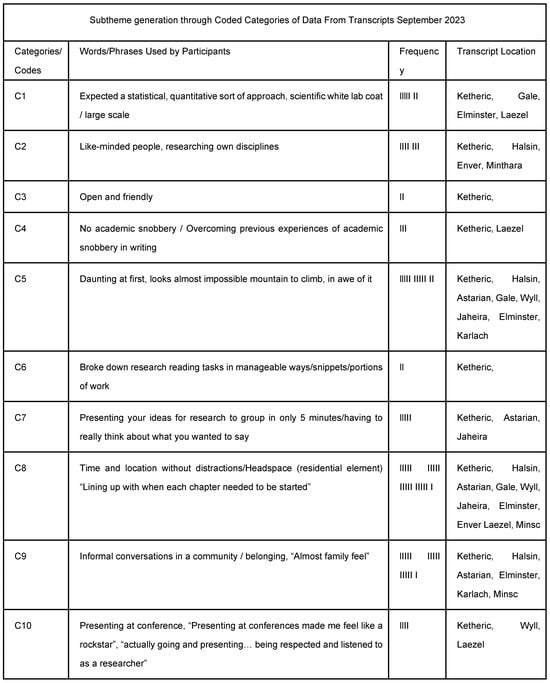
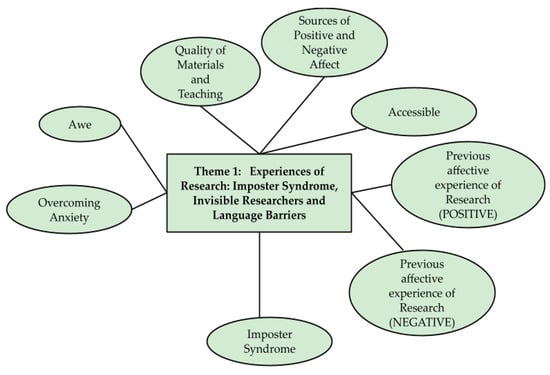
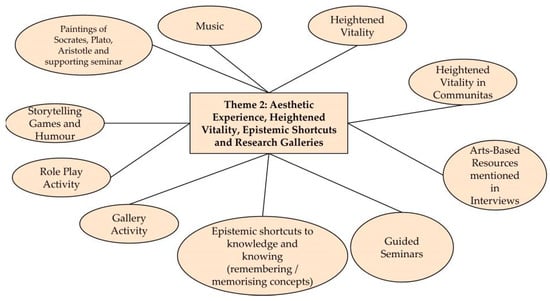
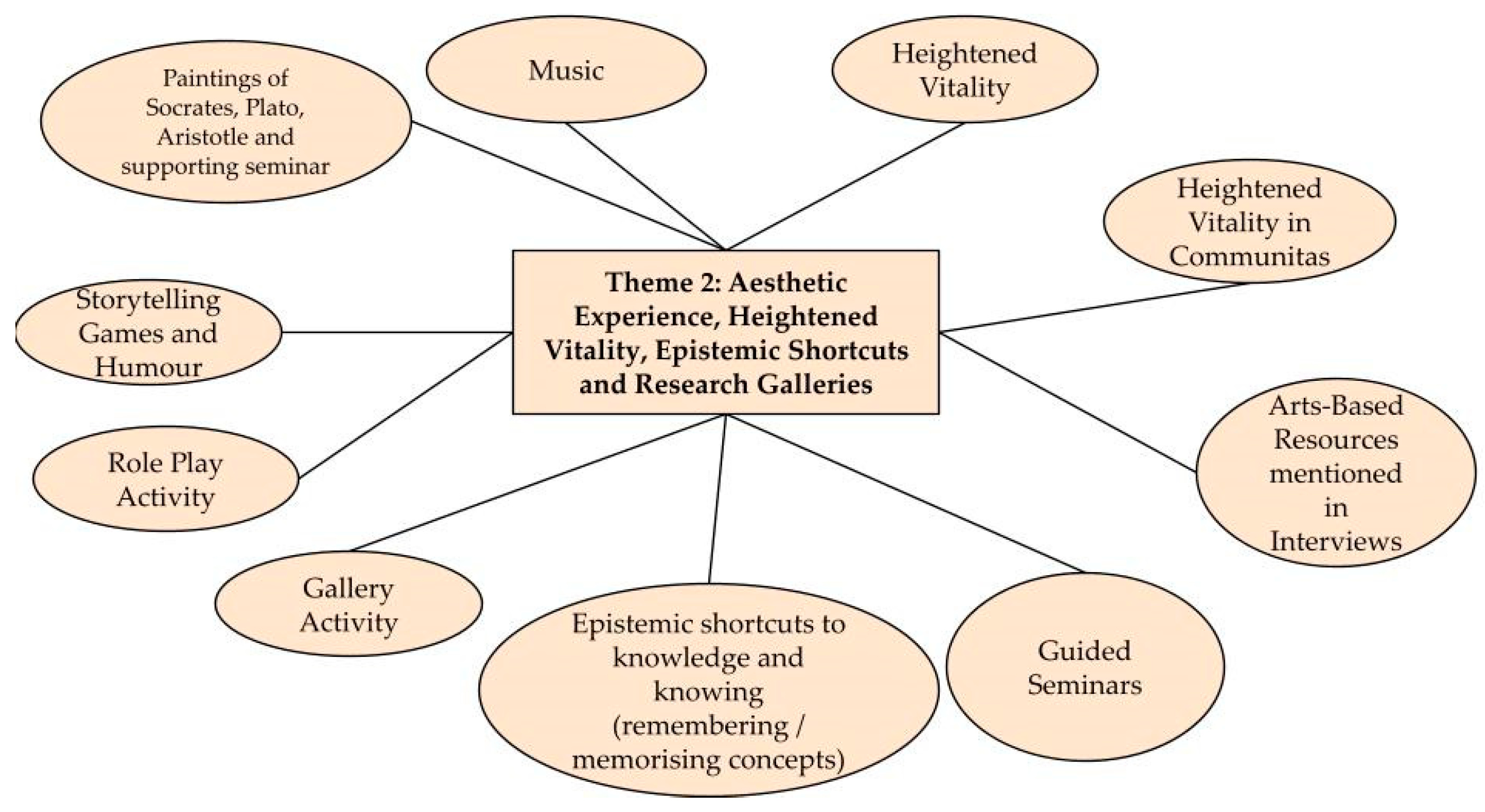
Disclaimer/Publisher’s Note: The statements, opinions and data contained in all publications are solely those of the individual author(s) and contributor(s) and not of MDPI and/or the editor(s). MDPI and/or the editor(s) disclaim responsibility for any injury to people or property resulting from any ideas, methods, instructions or products referred to in the content. |
© 2026 by the author. Licensee MDPI, Basel, Switzerland. This article is an open access article distributed under the terms and conditions of the Creative Commons Attribution (CC BY) license.