


Abstract
Behaviour management represents a complex dimension of the teaching profession, especially in contexts of high social vulnerability. This instrumental case study qualitatively analysed the experiences of four teachers from a technical–professional high school in Santiago, Chile, focusing on how they construct and sustain behaviour management in everyday classroom work. Data were generated through semi-structured interviews and analysed using qualitative content analysis. Findings foreground a central tension in which reactive management predominates over preventive strategies, shaping how teachers sustain pedagogical continuity under recurrent disruption. Teachers describe this work as a reflective construction negotiated between routines and adaptation to contingencies, supported by bonds of trust with students and informal peer collaboration within an institutional structure perceived as fragmented. These insights can inform teacher education by strengthening practice-oriented preparation for behaviour management and can support the refinement of educational coexistence policies in context-sensitive ways.
1. Introduction
Behaviour management is one of the most complex and recurring tasks in teaching practice. It is not merely a technical or procedural matter, but a component that directly impacts the development of the educational process. This dimension affects the conditions of teaching and learning, teacher well-being, and professional continuity (Barmby, 2006; Bertieaux et al., 2024; Korpershoek et al., 2016; Orrego-Tapia, 2023).
From this perspective, in classroom contexts, problematic behaviours can be understood as social constructs, with definitions of acceptability anchored in specific cultural and social frameworks (Chow et al., 2024; Lopes et al., 2017; Marder et al., 2023). Accordingly, what may be interpreted as disruptive or uncivil behaviour in one school environment (Spadafora et al., 2022) may not have the same connotation in another context. In general terms, disruptive behaviour can be understood as any action that interferes with the development of the pedagogical process and violates the norms (implicit or explicit) that regulate classroom dynamics (Aymelo, 2022; Musa & Martha, 2020). These manifestations must not be addressed as isolated events, but as part of a complex network of relationships among teachers, students, the institutional context, and the broader social structure (Tanase, 2021).
Various studies have documented strategies that foster a consistent learning environment in the classroom, such as establishing clear norms, providing continuous feedback, and encouraging active student participation (Mitchell et al., 2017; Morris, 2024; Wang & Kiefer, 2020). However, in educational contexts marked by high levels of social vulnerability, these practices are often implemented in a fragmented manner, limiting their effectiveness (Blanco-Varela et al., 2024; Paramita et al., 2020). In such contexts, even teachers with consolidated experience face situations that demand responses exceeding their usual resources (Adams et al., 2024; Borgmeier et al., 2017; Özdaş & Akpinar, 2016).
This condition directly reduces the time available for pedagogical work. In the case of Chile, the Teaching and Learning International Survey (TALIS) indicates that a significant portion of the school day is dedicated to conflict resolution, at the expense of effective teaching time (OECD, 2020). Additionally, the results from the Programme for International Student Assessment (PISA) 2022 indicate that, while the disciplinary climate has improved across Organisation for Economic Co-operation and Development (OECD) countries, 20% of students still report being unable to work effectively in class (OECD, 2023). Both studies highlight the quality of time in the classroom as a central factor, directly conditioned by behaviour management and associated with better academic outcomes (Tomaszewski et al., 2022).
This assertion, however, contrasts with the existing literature on teacher education, which suggests that the frequency with which teachers rely on their personal experience as the primary resource for conflict resolution indicates insufficient preparation in this area (Barnes et al., 2014; Thornton, 2020; Valente et al., 2023). Although professional development is recognised as a space to strengthen these abilities (Asterhan & Lefstein, 2024; Ávalos, 2007; Kirkpatrick et al., 2019; Moutiaga & Papavassiliou, 2021), this lack of adequate preparation is associated with increased professional distress and higher teacher turnover (Samudre et al., 2024), as well as disruptions in pedagogical continuity (Bijsmans & Schakel, 2018; Childs & Lofton, 2021). In Chile, studies on initial teacher education align with this perspective, as they indicate that there remains an emphasis on curricular components, to the detriment of a more holistic preparation for classroom behaviour management (López et al., 2020; Monzalve & Horner, 2020; Monzalve et al., 2023; Varela et al., 2024).
In terms of educational policy, Chile has promoted a set of initiatives to improve school coexistence. Among these, the National Policy on Educational Coexistence 2024–2030 stands out, as it sets guidelines to strengthen pedagogical authority and consolidate institutional protocols (MINEDUC, 2024). These orientations, however, operate as general frameworks that require interpretation and adaptation by each educational community in its specific context. In this article, educational coexistence is used exclusively to refer to the Chilean policy field and its associated institutional instruments (MINEDUC, 2024, 2025).
In this context, a central problem emerges where teacher experience in behaviour management is in tension with the formal guidelines that prescribe actions in behavioural situations. While educational policies and training programmes have established general frameworks for educational coexistence, there remains a gap between these normative dispositions and the realities of professional practice, particularly in educational contexts of high vulnerability. This tension has not been sufficiently understood from the teachers’ perspective, whose strategies, decisions, and meaning-making processes regarding classroom behaviour management tend to be rendered invisible in institutional diagnoses and the design of training programmes.
This study aims to understand teacher experience in classroom behaviour management, focusing on the tension between institutional prescriptions and actual practice, the role of pedagogical relationships, and the forms of collaboration within a vocational–technical educational institution. Specifically, the study examines (a) the predominance of reactive over preventive responses; (b) the role of bonds of trust in sustaining the class; and (c) collaboration dynamics between peers and their articulation with institutional coordination.
From this perspective, teaching experience is configured at the intersection between the prescribed task and actual practice, and it is mediated by professional self-assessment processes and framed by social conditions that shape pedagogical relationships. To understand teacher experience in behaviour management, this study draws on an interpretative framework that articulates three interrelated theoretical dimensions.
First, drawing on Donati’s relational sociology (Donati, 2016), the social bond is understood not as an accessory component of reality, but as an ontological constituent of it. From this perspective, pedagogical interactions, particularly in contexts of high vulnerability, are conditioned by relational precariousness, which shapes the relationships between teachers and students (Galdames-Paredes & Rioseco-Sánchez, 2023; Garro Gil, 2017).
Second, the study draws on Bandura’s social cognitive theory (1978), which situates human action within processes of thought, self-assessment, and self-regulation. The concept of self-efficacy, understood as the perception of one’s own capacity to face a particular situation, provides a basis for understanding how teachers act in complex behavioural situations. In turn, collective efficacy introduces a group dimension that sustains practice in demanding scenarios (Eun, 2019; Legg, 2023; Schmidt, 2010).
Third, the activity clinic, developed by Clot (2007), focuses on the distance between the prescribed task and actual practice, that is, on what is effectively carried out to sustain teaching work under specific conditions. The distinction between professional genre, understood as the collective knowledge of the profession, and style, conceived as a singular mode of enactment, supports a situated understanding of teaching practice in which technical, ethical, and relational dimensions are intertwined (Clayton et al., 2014; Clot, 2014; Pinheiro et al., 2016).
Taken together, these perspectives provide an integrated analytic orientation. Relational sociology situates behaviour management within institutional arrangements and relational conditions. The social cognitive theory sensitises the analysis to teachers’ appraisals of their own capability and to collective support. The activity clinic foregrounds how constraints become tangible in the organisation of everyday work. Analytically, the three perspectives are treated as mutually informing: relational conditions shape the room for manoeuvres available in practice; within that room, teachers’ self- and collective efficacy appraisals orient decisions under pressure, and the activity clinic allows this articulation to be examined in situ by tracing how the prescribed–actual gap is negotiated in everyday work. In combination, these perspectives inform the analytic focus, the construction of categories, and the interpretation of teachers’ accounts in the sections that follow.
2. Materials and Methods
This study is framed within a qualitative, inductive, and exploratory approach, aimed at understanding the meanings individuals attribute to a social problem by constructing ideas from the particular to more general abstractions. To understand teacher experience in its context, we opted for an instrumental case study (Creswell, 2013). From this perspective, the analysis of classroom behaviour management requires considering the concrete conditions in which teaching occurs, as well as how subjects build meaning in their daily practice. Accordingly, the study focuses on a technical professional high school in the Metropolitan Region of Santiago, Chile, characterised by an enrolment of 1083 students from 31 peripheral and working-class areas, and a school vulnerability index of 85% (JUNAEB, 2024).
During manuscript preparation, we used ChatGPT 5.2 (OpenAI, https://chat.openai.com/ accessed on 10 January 2026) and Grammarly Pro (https://app.grammarly.com/ accessed on 10 January 2026) to prepare the initial draft of this manuscript. ChatGPT was used for stylistic revision, and Grammarly Pro for grammatical review. Although the research team is composed of bilingual academics, feedback from a native academic was sought for selected paragraphs with more complex constructions. The final version of the article was completed following these revisions.
2.1. Participant Selection
Participants were selected through intentional sampling (Galloway, 2005), guided by relevance and equity considerations. In collaboration with the school’s management team, recruitment was facilitated through the school leadership team, who acted as institutional gatekeepers by initiating contact with potential participants. This mediation may have shaped which teachers were approached, particularly in a context where organisational tensions are part of the analytic focus. Accordingly, final inclusion followed pre-defined criteria, including subject-area diversity and direct involvement in behaviour management situations, rather than convenience or managerial preference. These criteria included a minimum of three years of service at the institution and at least five years of professional experience. Furthermore, a gender-parity criterion was incorporated, guiding the search toward two women and two men whose trajectories were deemed relevant to the study’s objectives. In total, four teachers participated (see Table 1).
Table 1.
Participant characteristics.
Participation remained voluntary, and teachers could decline without consequences. The entire procedure complied with the ethical guidelines for social research (Alderson, 2014; Miles et al., 2014), ensuring informed consent and data confidentiality. Participants’ identities were protected using pseudonyms based on colours (Patton, 2015).
2.2. Production of the Qualitative Data
The primary strategy used to produce the qualitative data was the individual semi-structured interview. Four interviews were conducted, each lasting approximately 40 min, once per week. The process design was iterative; thus, the questions and foci of inquiry were adjusted based on the emergent findings (Creswell, 2013). The interview guide was developed drawing on the contributions of Hopf (2004) and Gaskell (2000). It was subsequently reviewed by experts to ensure coherence with the study’s objectives. Access to the field was supported by trust-based relationships with the school’s coexistence team and mediated by a key informant who enabled initial contact with participants (Linstroth, 2008; Wolff, 2004). Recruitment was facilitated through the school leadership team, who mediated initial contact with potential participants. This mediation may have shaped which teachers were approached and, indirectly, who was included or excluded, particularly given the study’s focus on organisational fragmentation and tensions with formal structures. To mitigate this risk, final inclusion followed pre-defined criteria (minimum years of experience, subject-area diversity, and direct involvement in behaviour management situations), rather than convenience or managerial preference. Participation remained voluntary, and teachers could decline without consequences.
2.3. Qualitative Data Analysis
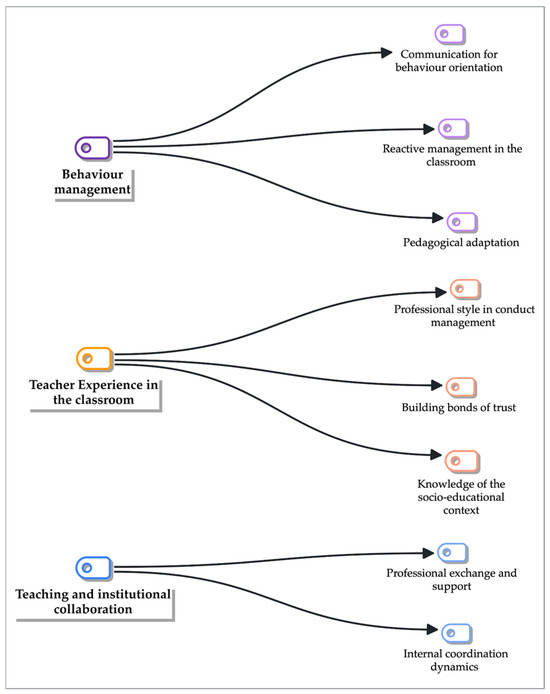
The textual corpus was analysed using qualitative content analysis (Schreier, 2014) to systematically describe the meanings present in teachers’ narratives. The analytical process was divided into three stages: (i) constructing the initial coding framework, (ii) segmenting and coding the empirical material, and (iii) progressively refining the categories until a stable structure was reached. Coding was iterative rather than linear (Saldaña, 2013). After an initial coding cycle, earlier segments were revisited and category definitions were refined through memoing and repeated comparison across excerpts. This second-pass review focused on stabilising category boundaries and ensuring consistent application of inclusion/exclusion rules. Decisions about refinements were documented in analytic memos to maintain traceability and interpretative consistency. For coding purposes, preventive management was operationally defined as practices that occurred before disruption (e.g., anticipatory planning, explicit routine-setting, and classroom-environment design aimed at reducing behavioural escalation). Reactive management was coded when practices were described as responses occurring after disruption (e.g., immediate containment, sanctions, removal, or escalation procedures). Throughout this process, the principle of mutual exclusivity between categories was applied, and the framework was iteratively adjusted to incorporate relevant emergent dimensions (see Appendix A for the definitions of categories and subcategories). To support data analysis, the MAXQDA24 software (version is 24.6) (VERBI, 2024) was used, which facilitated the organisation of the material and the systematic coding of the data (see Figure 1).
Figure 1.
Main categories and subcategories of the study. Source: Prepared by the authors using MAXQDA24.
To safeguard the interpretative quality of the analysis, we followed Tracy’s (2021) criteria for qualitative research, emphasising procedural rigour and transparency through analytic memos and decision logs, as well as credibility through detailed description and the multivocality of the selected excerpts. Given the scope of the study and the type of data available, data-source triangulation was not conducted. Instead, we adopted theoretical triangulation by interpreting the results in dialogue with relational sociology (Donati, 1993, 2014, 2016), Bandura’s social cognitive theory (Bandura, 1978), and the activity clinic (Clot, 2007), in order to interrogate and refine the interpretations from alternative theoretical perspectives (Denzin, 2012).
3. Results
The current analysis is organised around three main categories developed inductively from the corpus. These categories are not pre-established divisions but nuclei of meaning that emerged from the interpretative process and reflect teachers’ experience. The first category, behaviour management, addresses the practices teachers use to maintain pedagogical order. The second, teacher experience in the classroom, focuses on the formation of professional subjectivity. The third, teacher and institutional collaboration, examines interaction dynamics within the organisational environment.
3.1. Behaviour Management
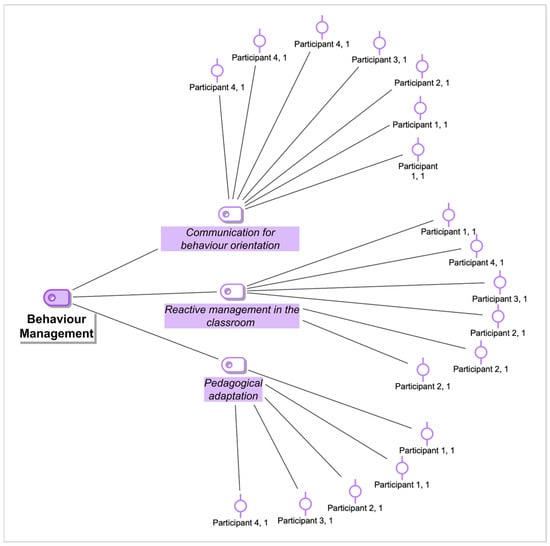
In this study, behaviour management refers to the specific skills, ranging from communication to pedagogical adaptation, that teachers mobilise to maintain pedagogical continuity in response to classroom situations. In analytical terms, this category encompasses the discursive and material practices teachers use to structure the social and pedagogical order in the classroom. Within this category, communication strategies and the establishment of explicit routines are articulated alongside flexible adaptation practices in response to contextual contingencies. For analytical clarity, the material is organised into three sequential and mutually supportive subcategories (see Figure 2). These are communication for behaviour guidance, reactive management in the classroom, and pedagogical adaptations in the classroom.
Figure 2.
Category map: behaviour management. Source: Prepared by the authors using MAXQDA24. The central nodes represent categories and subcategories, and the peripheral nodes correspond to emerging segments in the analysis.
3.1.1. Communication for Behaviour Orientation
Communication for behaviour orientation refers to the intentional use of verbal and non-verbal resources to guide students’ behaviour, establish a relational bond, and ensure understanding of expectations and limits. Under this delimitation, communication plays a pre-emptive framing role, enabling the coherent application of routines and protocols.
Teachers position communication as a central practice in shaping school coexistence. Participant 2′s account illustrates the search for a balance between relational proximity and normative clarity: “It means having a sense of closeness with them, while also letting them know that there are boundaries that cannot be overstepped during class”. This stance is complemented by explicitly communicating the consequences associated with certain behaviours, so that “they are aware of them, that they know the consequences of stepping outside classroom behavioural expectations.”
This initial bond becomes a condition for using dialogue as a tool for containment. When a disruption occurs, Participant 2 indicates that the first action is relational: “I walk out of the classroom with the student to approach him personally and ask him what is going on with him [in his life].” This practice aims to understand the personal situations underlying observable behaviour. Along similar lines, Participant 1 describes how the emergence of unexpected behaviours activates a state of attentive observation: “It is important to me to always be alert while teaching, this way, I can be more sensitive and receptive to what is going on [between the students]”.
From a complementary perspective, Participant 3 proposes a collective approach to addressing conflict, where the objective is “to understand what happened in a situation. We want to talk about it, solve it, and recognise that we are all involved.” This view situates conflict resolution within the realm of shared responsibility. Participant 4, in turn, emphasises the importance of establishing a clear normative framework of rules and expectations from the beginning of the school year and reinforcing it when necessary: “At the beginning of the year, and whenever it is necessary to reinforce it, we reinforce it.” This framework is materialised in concrete protocols that regulate interaction, ensuring that “they know they cannot interrupt their classmates; their classmates’ opinions are respected regardless of what they may be.”
Taken together, these accounts show that communication operates as a condition-of-possibility mechanism for classroom direction. It makes expectations and consequences legible, legitimises boundaries without undermining closeness, enables early containment, and shifts the framing of conflict resolution from the individual to the group’s shared responsibility.
3.1.2. Reactive Management in the Classroom
Reactive management in the classroom refers to the explicit communication of norms and to environmental management practices (from adjustments to the setting to direct intervention in conflicts) aimed at stabilising class dynamics. This form of management is supported by the communicative framework and enables an orderly response to recurring events.
Teachers describe the more structured dimension of their classroom management, which is organised through routines, explicit guidelines, and protocols. Participant 1 indicates that management transcends mere behaviour, as “it involves many aspects, such as students’ and teachers’ dispositions, and the activities and dynamics we carry out [or not] in the classroom and includes the classroom,” atmosphere, and the type of activities proposed. Thus, Participant 1 highlights how the structure of a task can shape group dynamics, noting that “if you give them dictations, they all stay quiet and copy them.”
Alongside these structuring strategies, Participant 3 emphasises the importance of immediate action in critical moments, such as “a direct conflict between students. That is when one has to intervene immediately.” This stance is not automatic. Rather, it is informed by an attentive reading of group dynamics and situational cues. From this perspective, Participant 4 highlights the use of affective support as a pedagogical intervention, where a phrase such as “come on, you can do it” can trigger something much larger, thereby introducing an emotional dimension into classroom management.
In the face of repeated misconduct, protocols are activated not only to sanction but also to understand the context. Participant 1 explains that
We talk to the students to see if they are okay or what is happening to them, because they may be dealing with something that happened at home. We call the school’s coexistence coordinator so they can talk to the student, because sometimes they react badly towards us.
This practice combines emotional support with institutional action. However, Participant 2 reflects critically on the reactive nature of these practices: “one does something when things happen but perhaps does not do anything to prevent them,” thereby revealing a tension between reactive management and an aspiration toward proactive management.
Thus, teachers describe the organisation as being based on a logic of ex post containment: routines and protocols help stabilise the situation, but they do not eliminate urgency as the primary concern. Teachers describe preventive measures as still only partially implemented (with no dedicated time, no follow-up, and no common criteria). Importantly, the scarcity of preventive examples in the accounts is treated here as an empirical pattern rather than a reporting omission: participants narrate day-to-day work largely in terms of responding once events emerge. As a result, the continuity of teaching ultimately depends on the decisions teachers make in specific situations.
3.1.3. Pedagogical Adaptation
Pedagogical adaptation refers to the teacher’s ability to respond flexibly to unexpected dynamics, taking into account the situational application of rules and the particularities of each group. This level includes real-time adjustments that support the continuity of pedagogical work.
Adaptation emerges in the discussions as the ability to adjust strategies to the classroom’s heterogeneity. Participant 1 describes how certain students “do not develop their independent work,” which requires differentiated support. In contrast, Participant 4 uses anticipation as a strategy to organise the class and the group’s disposition. From the outset, the content to be covered is announced, and the planned activities are outlined, so students know what to expect and can follow the session clearly. This is expressed in practice, for example: “we give them a spoiler, so they are ready.”
The implementation of rules, however, is presented as a complex process. Participant 2 admits difficulties in regulating the use of mobile devices: “I still find that difficult to enforce.” This account shows that a rule’s effectiveness depends on its acceptance within the group. In Participant 4’s practice, rule implementation follows a predictable, structured sequence: “the greeting, creating the right atmosphere of respect, then energising the group, and a general reflection.”
Participant 3 identifies that an obstacle to coordinated adaptation is poor communication between teachers about classroom events. It is noted that “things happen that teachers are not aware of, and others are resolved behind closed doors.” This lack of exchange weakens the possibility of building common criteria.
In this sense, pedagogical adaptation is a teaching practice that relies on early and fluid communication to set expectations and legitimise rules. Within this framework, routines provide predictability and allow for real-time adjustments without interrupting class work. This ability to adjust depends on three collective conditions: students’ acceptance of the rules, a recognisable class structure that organises time and tasks, and the timely circulation of information and criteria among teachers and support teams. When these conditions are present, teaching flexibility operates preventively. When they are absent, management tends to become reactive and fragmented, making it difficult to build shared criteria and maintain pedagogical continuity.
3.2. Teacher Experience in the Classroom
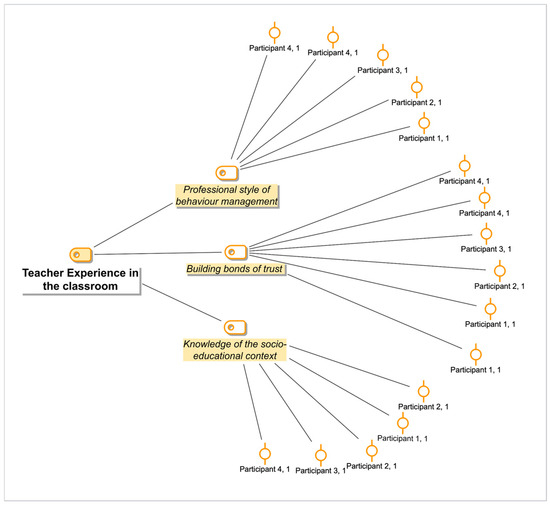
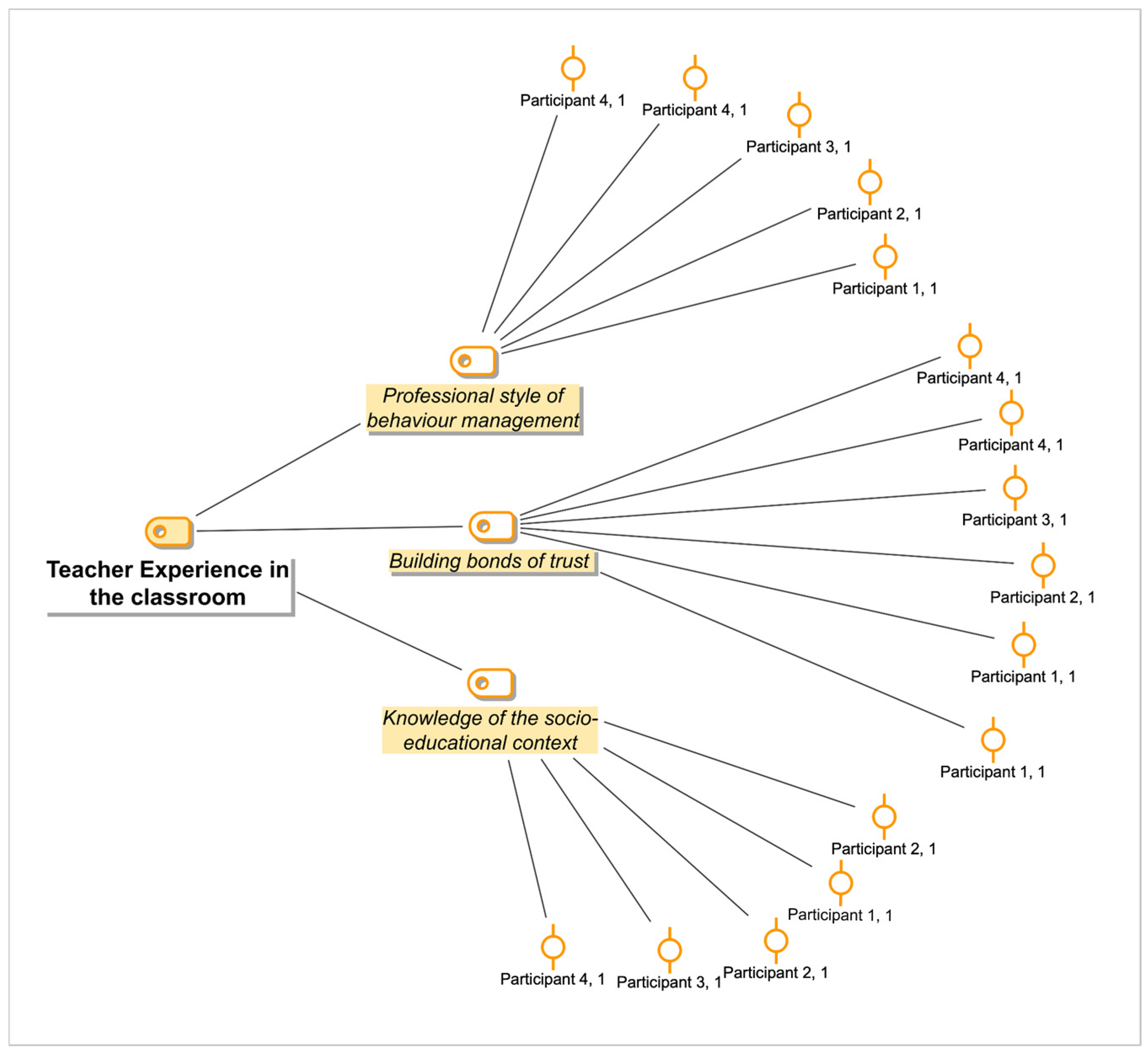
This category refers to the processes of constructing professional subjectivity in the context of classroom teaching experience. It brings together three successive and mutually supportive levels (see Figure 3): (i) professional style in behaviour management, understood as the hallmark that each teacher develops based on their career, learning, and ethical decisions; (ii) building bonds of trust, understood as relationships of respect and support that permeate pedagogical work and behaviour regulation; and (iii) knowledge of the socio-educational context, conceived as an active understanding of the realities of the groups and the environment that inform decisions in the classroom.
Figure 3.
Category map: teacher experience in the classroom. Source: Prepared by the authors using MAXQDA24. The central nodes represent categories and subcategories, and the peripheral nodes correspond to emerging segments in the analysis.
3.2.1. Professional Style in Behaviour Management
Professional style is a synthesis of theoretical training and practical experience. Participant 3 argues that, although continuous training provides a repertoire of strategies, their application is not automatic but rather serves to keep these tools available: “They are tools you sometimes have there. You know them, but you may not apply them. With constant training, I can use them when something happens”. However, Participant 1 points to a disconnect between these spaces and real needs, indicating that behaviour management is not usually a priority issue in council meetings: “In the academic area, we do not include behaviour management in the classroom itself.”
To this construction of style is added the observation of previous models. Participant 2 recounts that this method is attributed to the imitation of role models: “I remember a teacher whose way of teaching was very similar to mine.” Based on self-assessment, Participant 2 describes being more rigorous than colleagues, suggesting that flexibility may emerge over time: “I think I am stricter than the other two teachers in my department, who are older; maybe I will become less strict when I am a bit older myself.”
Beyond its configuration, style manifests itself most clearly in the ethical dimension, which becomes visible when teachers face dilemmas that require them to prioritise some values over others. Participant 4, for example, illustrates one of these tensions when recounting a decision in which coexistence criteria clashed with the institutional logic organised around sport participation: “I had a student who had many negative behaviour reports, and because the school administration would not remove him from football practice, I ended up making that decision myself.” This account shows how personal positioning resolves a normative conflict.
Taken together, professional style clarifies techniques and asserts itself as a situated position in the educational context: one that brings together training, experience, and value judgements to determine the modalities and timing of intervention. It is within this context that the relationship with students takes shape, where the teaching style influences the regulation of student behaviour across settings within the educational establishment.
3.2.2. Building Bonds of Trust
Bonds of trust are understood as the process of creating and maintaining relationships of mutual respect and support with students, considered the foundation that permeates pedagogical work and behaviour regulation. Participant 3 introduces a variable that conditions this construction: the impact of gendered cultural frameworks on students’ perceptions.
When students have classes with male teachers, their behaviour tends to be more moderate. When female teachers are in charge of the class, students adopt a different attitude. I do not know whether it is because they are afraid of male teachers or because male teachers are stricter with them.
The strengthening of these bonds is also supported by specific institutional initiatives. Participant 1 highlights their work with the school coexistence team to “create motivating activities” that strengthen community and improve the classroom experience.
In practice, Participant 4 attaches unequivocal importance to the pedagogical connection, considering it the basis of the educational process: “In the end, whether I am a good or bad teacher matters less than having a good relationship with my students.” This bond is nurtured by everyday gestures of recognition, such as positively reinforcing effort: “I usually tell them ‘good job,’ and the students respond, ‘Did I do a good job?’ Over time, that initial surprise becomes routine, and they come to expect positive feedback.” This pedagogical vision is deepened and sustained by incorporating an analysis of the local context, which materialises social inequalities and, as a result, directly conditions the school experience.
Participant 2 sees listening as a prerequisite for teaching: “If you do not listen to them and understand their problems, you cannot teach them anything else.” This role also incorporates an ethical and emotional dimension, as a future horizon is projected for students: “I hope that all my students manage to move themselves and their families forward.”
Bonds of trust are fundamental to teaching. They legitimise rules, allow students to speak up, and support teacher intervention in difficult situations. When this relational work has clear and consistent institutional support, behaviour regulation becomes more stable and less dependent on the individual. Conversely, if this support is lacking, management becomes vulnerable and highly personalised.
3.2.3. Knowledge of the Socio-Educational Context
Knowledge of the socio-educational context is conceived as an active understanding of the realities of groups and the environment, which informs decisions and the teacher’s capacity to respond. For Participant 3, understanding institutional norms and student characteristics facilitates decision-making, especially when the teacher is “trying to help them learn to resolve conflicts” through dialogue.
Participant 1 describes a process of constant adaptation, using tools that generate interest in the group, such as digital questionnaires, because “they like to compete too.” This knowledge is enriched through dialogue with colleagues, a practice described as follows: “I always ask what you do in this situation.”
However, Participant 4 observes a gap between institutional initiatives and their consistent implementation, which hinders their effectiveness: “The big question is, do we all do it?” Participant 4 also criticises the fact that many training activities lack a clear purpose, affecting their appropriateness for teachers.
In contrast, Participant 2 values dialogue with the coexistence team as a source of concrete strategies, noting that “they have given me some advice.” This perspective suggests that strengthened interdisciplinary work would enable a more integrated approach to the challenges of coexistence.
In this sense, knowledge of the context serves as a decision-making resource, making the classroom legible and guiding specific adjustments to rules, rhythms, and support. When it circulates among peers and translates into shared criteria, it ceases to be individual knowledge and becomes institutional capacity: it enables coherent responses, reduces discretion, and sustains the continuity of pedagogical work beyond each course or teacher.
3.3. Teaching and Institutional Collaboration
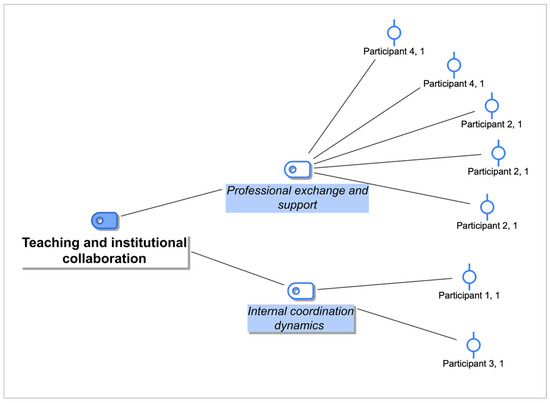
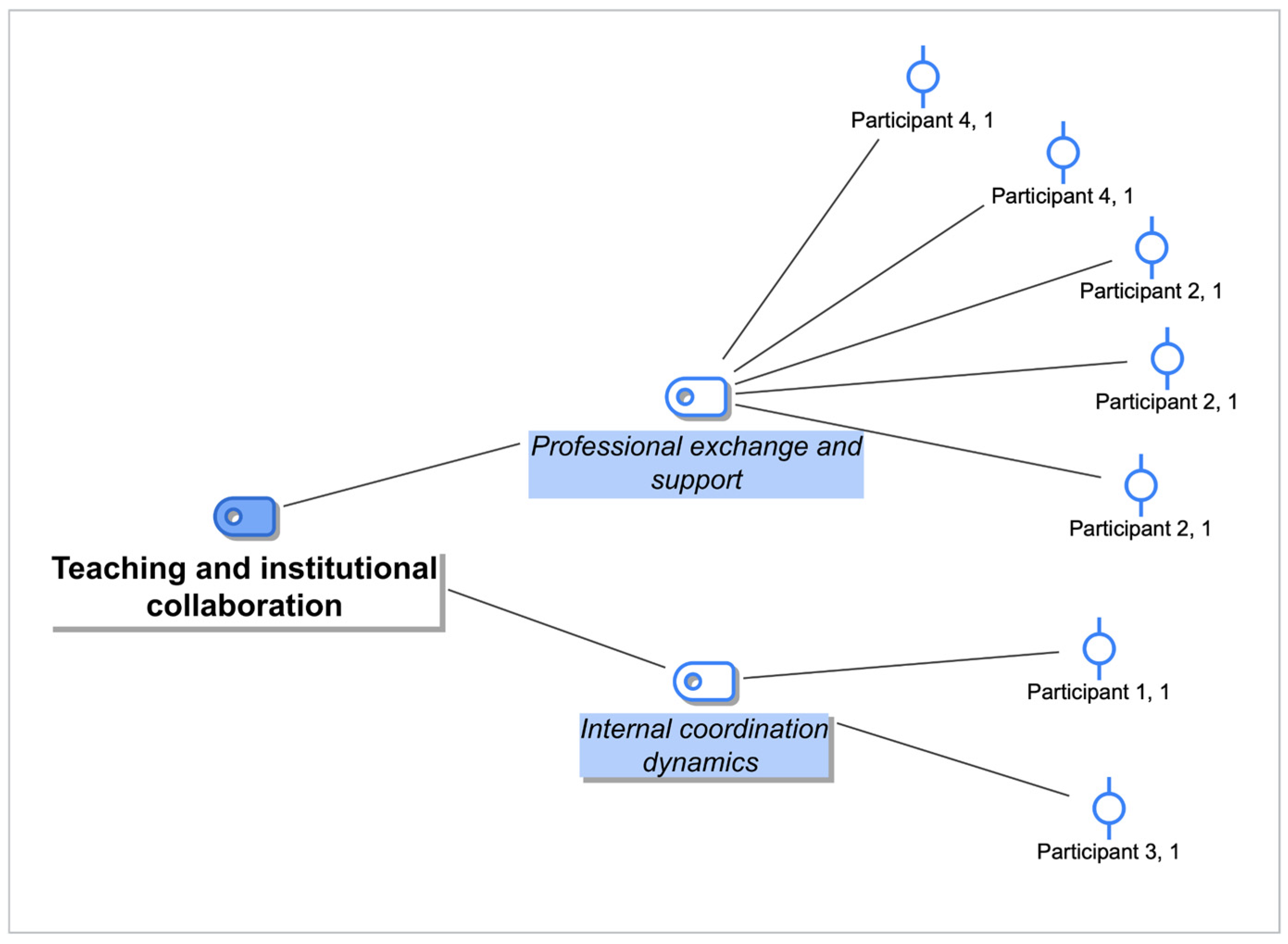
This category examines the dynamics of interaction that place teaching practice in a collective and organisational context. For analytical clarity, the material is organised into two mutually supportive subcategories (see Figure 4): (i) professional exchange and support, referring to horizontal relationships between peers for sharing resources, validating practices, and sustaining the task; and (ii) internal coordination dynamics, relating to the formal mechanisms and flows that articulate individual work with the institutional structure and culture.
Figure 4.
Category map: teaching and institutional collaboration. Source: Prepared by the authors using MAXQDA24. The central nodes represent the category and its subcategories, and the peripheral nodes correspond to segments emerging from the analysis.
3.3.1. Professional Exchange and Support
Exchange between professionals supports the addressing of classroom issues, functioning as a contextual resource for practice. Participant 1 describes how the school coexistence team’s initiatives are discussed and adapted in staff meetings. It is noted that “the school coexistence team sends us material to work with the students” and that “some of their recommendations are also worked on in staff meetings.” This process links institutional proposals with the specific needs of each group.
However, Participant 1 points to an important limitation. These exchanges often take place in informal settings, rather than through regular, structured instances. As Participant 1 explains, as follows:
Suddenly, if there is a more serious conflict in a class, a teachers’ council is held with the teachers who teach that class, and there they discuss and reach agreements. But we do not talk on a weekly or monthly basis; suddenly, our conversations are like those in the hallway during recess.
These interactions, although useful, do not replace structured reflection, limiting the development of systematic strategies. In this context, Participant 2 expresses the need for more direct support from management teams: “There is also a lack of support, such as backing for teachers. Yes, at least in my case, I feel that there is a lack of support in this process of school coexistence.”
From this experience, institutional presence should be materialised in the classroom to foster a more situated understanding of the dynamics, suggesting that “it would be a good opportunity for part of the management team or the school coexistence team to accompany us in some classes and observe certain situations.”
Peer exchange serves as immediate support for practice and as a space for daily validation, but its scope is reduced when it occurs during informal times and without classroom support. The demand for the presence of management and school coexistence teams aims to turn these conversations into shared criteria and consistent actions. Therefore, the analysis moves towards internal coordination, an area that defines whether collaboration has structure, protected time, and shared agreements, or whether it continues to depend on individual initiatives.
3.3.2. Internal Coordination Dynamics
This subcategory explores the ways in which communication is organised and flows across the different units of the educational establishment, identifying areas of alignment and friction. The lack of internal coherence is perceived as a structural obstacle. Participant 3 describes it as a discursive fragmentation that weakens any joint action:
This school has inconsistent credibility because teachers say one thing and then another, and different units say something else; in many respects, especially in matters of coexistence, the question is: how are we going to achieve anything if we ourselves cannot agree?
This account explains how the lack of common criteria impedes the implementation of coherent strategies within the community. By contrast, Participant 4 shares an experience of interdisciplinary work that produced positive results in student learning and development:
At the beginning of the year, in History class, we worked with language and music, and we did a really nice interdisciplinary project on social issues. And you know, we think the students are very aware of what’s happening today.
From this perspective, this collaborative dynamic fostered empathy and understanding among students, strengthening their connection to complex realities. This indicates a tension between the desire for collaboration and organisational barriers: horizontal exchange sustains daily practice, while its scope is conditioned by the coherence of internal coordination and by the institutional presence in the times and spaces of joint work. Internal coordination appears as a condition for working with other teachers in the establishment. When messages and criteria between units are misaligned, horizontal exchange loses its scope. When there is articulation, interdisciplinary collaboration translates into learning.
It is in this context that the discussion on the gap between prescriptions and actual activity, the place of bonds in behaviour management, and the effects of organisational fragmentation on school coordination takes place.
In summary, the analysis suggests that teacher experience in behaviour management in this case is organised around three connected patterns: (i) accounts that foreground reactive containment over preventive planning; (ii) sustained work to build bonds of trust as a condition for maintaining pedagogical continuity; and (iii) reliance on informal peer collaboration in response to uneven internal coordination and fragmented criteria across units. Read in light of the integrated framework outlined in the Introduction, these patterns can be located at the intersection of relational conditions that shape pedagogical interaction (Donati, 2016), teachers’ appraisals of capability and collective backing under pressure (Bandura, 1978), and the everyday negotiation between prescribed expectations and actual activity in concrete situations (Clot, 2007). Together, the findings describe behaviour management as a situated professional construction shaped by what teachers perceive as feasible to enact in everyday classroom conditions, particularly under constraints related to time, follow-up, and shared institutional coherence.
4. Discussion
Building on the integrated theoretical lens outlined in Section 1, the discussion revisits the axes developed in the Section 3 as accounts of what teachers describe as feasible to sustain in everyday classroom work. These accounts reflect practice carried out under conditions of uneven coordination and recurrent disruption.
Beyond the Chilean policy context, the patterns described here can be situated within international research on behaviour management in schools serving socially disadvantaged communities. Studies across different contexts have shown how time pressure, recurrent disruption, and uneven support capacity can narrow the space for preventive work and increase reliance on in-the-moment containment. In this sense, the present case adds a context-sensitive account of how organisational coordination and teachers’ perceived room for manoeuvre shape the balance between preventive intentions and reactive practice (Borgmeier et al., 2017; Korpershoek et al., 2016; Hepburn et al., 2021).
This study identifies three axes that organise behaviour management in the classroom: the predominance of reactive over preventive responses, the centrality of bonds of trust for sustaining classroom work, and informal peer collaboration within an institutional framework perceived as fragmented.
The first axis can be understood, drawing on the activity clinic (Clot, 2007), as a tension between the task prescribed by the institutional regulatory framework and the actual activity that teachers mobilise to maintain order in demanding contexts. A central element of this tension is the predominance of reactive rather than preventive management. Preventive management focuses on creating conditions conducive to learning, whereas reactive management responds after a disruption has occurred. The teachers’ accounts in this case align with research describing a generalised tendency towards reactive strategies in schools (Bozkus, 2023; Hepburn et al., 2021), even though preventive practices are associated with greater student engagement and lower professional burnout (Weber et al., 2023).
In this context, reflective practice emerges as a core competency. It shifts attention from fidelity to standardised programmes (Alasmari & Althaqafi, 2024; Mac Cobb et al., 2014) towards contextual expertise that allows teachers to interpret the pedagogical scene and adjust norms to the singularities of the moment. It is through this mediation that professional style is configured (Clot & Faïta, 2000), understood as a construction that integrates experience, training, and ethical decisions.
The second axis of analysis focuses on the construction of bonds of trust as a dimension that legitimises pedagogical practice and constitutes a core component of professional style. Bandura’s social cognitive theory (Bandura, 1978) provides a useful lens for understanding this process. Intervention in complex situations can be read as an expression of self-efficacy, while hesitation in the face of a normative challenge suggests a perceived lack of capacity in that domain. The literature shows that self-efficacy is not only individual but also relational, as it is linked to interactions and the social capital available in the educational environment (Bjorklund et al., 2020; Neugebauer et al., 2019; Zhang & Yusof, 2024). This capital is also recognised as a resource that can be strengthened (Pedditzi & Marcello, 2018; Saputro et al., 2023).
From a relational sociology perspective, bonds are not incidental, but constitutive of practice (Donati, 2016). Teachers intentionally work on them in a context of relational precariousness, and their effectiveness increases when support is oriented towards concrete practice, such as feedback and resource discussions, rather than general emotional support (Neugebauer et al., 2019).
The third axis addresses teacher–institutional collaboration. A disconnection emerges between the relational support that teachers build informally among peers and institutional coordination, which is perceived as fragmented (Donati, 2014). Informal networks, sustained by affinities and corridor conversations, facilitate the exchange of strategies and constitute horizontal social capital that helps compensate for organisational deficiencies (Mahatmya et al., 2024; Ortega et al., 2023; Penuel et al., 2009; Visone et al., 2022; Woodland & Mazur, 2019).
At the same time, the prominence of these networks points to institutional disarticulation, characterised by insufficient administrative support, unstructured time for collaboration, and limited opportunities for professional development (Mastad et al., 2025; Mulholland & O’Connor, 2016). As an alternative explanation, though not discernible from the available data, this perceived fragmentation may also be influenced by staff turnover, internal calendars, administrative burdens, or organisational culture. In this dual perspective, a participant’s account of a lack of internal coherence illuminates the flip side of the phenomenon. Retreat into informal networks is also a symptom of disarticulation that limits the construction of collective responses and restricts professional development (Hökkä et al., 2008; Mastad et al., 2025).
5. Implications for Practice and Institutional Decision-Making
This analysis has implications for both teacher training and institutional management. In relation to teacher training, it is advisable to move beyond preparation focused solely on curricular components and to address the gap between prescribed tasks and actual classroom activity. This can be done through contextualised mechanisms that are sensitive to each school setting, such as professional self-confrontation processes conducted within schools (Clot, 2007). At the institutional level, school decision-making can support this work by protecting time for structured peer collaboration, clarifying shared criteria for behaviour management across units, and ensuring that coexistence-related protocols are accompanied by follow-up and coordination mechanisms rather than remaining as formal prescriptions.
Implications for Institutional Decision-Making
For educational management and institutional policy, classroom behaviour management cannot be understood as an exclusively individual responsibility. Rather, it depends on the practices and culture of the educational establishment and therefore requires a comprehensive, whole-school approach (Oliver et al., 2019). In this regard, it is pertinent to strengthen schools’ social capital (Saputro et al., 2023), ensure protected time for collaboration, establish common criteria across organisational units, and promote forms of pedagogical leadership that foster trust and openness (García-Martínez et al., 2021; Mthembu et al., 2025). Rather than initiating processes from scratch, the challenge lies in providing structure and continuity to the informal collaboration that already exists.
Finally, this study shows that teacher–institutional collaboration in highly vulnerable contexts often develops spontaneously in informal spaces and is shaped primarily by personal ties rather than formal institutional arrangements. These findings align with previous research indicating that cooperation frequently emerges as a response to immediate classroom needs, without explicit institutional planning (Vangrieken et al., 2017). However, for peer collaboration to become a stable component of pedagogical practice, it is necessary to establish institutional mechanisms that formalise and sustain it. Evidence suggests that protecting time for co-planning, together with the creation of learning groups organised around shared goals, enables pedagogical reflection to become systematic rather than sporadic (OECD, 2020; Stoll et al., 2006). Similarly, incorporating peer observation supports the development of shared foundations for teaching and promotes continuous improvement and collective learning (City et al., 2009; Darling-Hammond & Hyler, 2020). Through these mechanisms, practices of mutual support can move beyond individual goodwill and become institutionalised tools for pedagogical improvement, which is essential for strengthening the management of educational coexistence in schools.
6. Limitations and Future Research
The study has several limitations. First, inductive thematic saturation, understood as the point at which no new themes emerge, was not reached, although sufficient categorical stability was achieved for the purposes of this case (Saunders et al., 2018). Second, the study involved four participants from a single institution, and sampling was coordinated with the management team, which may have introduced selection bias. Third, classroom observation was not included, meaning that the analysis relies on self-reported discourse.
Because this study relies on interview accounts, professional style and institutional coordination are interpreted through participants’ narrative constructions of practice. These accounts may not fully align with enacted classroom behaviour or with the way routines and protocols unfold in situ. This limitation is particularly relevant when interpreting situational decision-making, such as escalation, sanctions, or de-escalation, where observed interactional dynamics may diverge from retrospective descriptions. Future research combining interviews with classroom observation and documentary sources, such as coexistence protocols or incident records, could examine potential gaps between reported strategies, enacted practices, and organisational procedures. Addressing these gaps would also help reduce constraints on analytical transferability associated with reliance on self-reported data (Faulkner & Trotter, 2017).
As a future line of inquiry, it would be pertinent to compare these dynamics across establishments with different institutional cultures, to follow the trajectories of novice teachers in highly complex contexts, and to incorporate classroom observation in order to triangulate the distance between prescriptions and practice.
7. Conclusions
In conclusion, this research provides a contextualised understanding of classroom behaviour management as a professional construct shaped by reflective work, the quality of pedagogical relationships, and forms of collaboration that emerge in the gaps of institutional structures. Recognising these dynamics in context is useful for informing continuing professional development and for strengthening educational coexistence at the institutional level, within the limits of a case study that did not reach thematic saturation. In this scenario, relational expertise and informal collaboration networks appear as relevant supports for sustaining educational practice in highly complex settings.
These implications should be read as context-sensitive insights. They are likely to be the most relevant for technical–vocational schools serving high-vulnerability communities and operating under comparable constraints in institutional coordination.
Author Contributions
Conceptualisation, T.A.-L.; methodology, T.A.-L. and S.M.-A.; validation, E.B.P.-V. and D.S.J.-R.; formal analysis, T.A.-L. and S.S.-A.; investigation, T.A.-L.; resources, T.A.-L.; data curation, T.A.-L.; writing—original draft preparation, T.A.-L.; writing—review and editing, S.M.-A., E.B.P.-V., D.S.J.-R. and S.S.-A.; visualisation, T.A.-L.; supervision, T.A.-L.; project administration, T.A.-L. All authors have read and agreed to the published version of the manuscript.
Funding
This research received no external funding.
Institutional Review Board Statement
Ethical review and approval were waived for this study because it involved non-interventional semi-structured interviews with adult professionals (teachers) who participated voluntarily. The study posed no risk to the participants’ physical or psychological integrity and was conducted in strict accordance with the ethical standards of the Declaration of Helsinki.
Informed Consent Statement
Informed consent was obtained from all subjects involved in the study.
Data Availability Statement
The data presented in this study are available on request from the corresponding author. The data are not publicly available due to ethical restrictions regarding the privacy and anonymity of the participants. For grammatical correction in English, Grammarly Pro was used; for stylistic editing suggestions, ChatGPT (OpenAI, 2025 version) was employed. All final writing decisions were made by the authors.
Acknowledgments
The authors would like to thank the teachers and the management team of the technical-vocational secondary school for their willingness to participate in this study. Funding from ANID CIAE CIA250005 is gratefully acknowledged. We would also like to thank Catalina Espinosa Tovar (The University of Queensland) for her invaluable help in reviewing the final draft and providing insightful comments.
Conflicts of Interest
The authors declare no conflicts of interest.
Appendix A
Appendix A provides definitions or descriptions of the categories and subcategories used when coding illustrative segments.
Table A1.
Definitions of categories and subcategories.
References
- Adams, T., Koster, B., & Den Brok, P. (2024). The effects of an intervention in student teachers’ classroom management learning processes. Pedagogische Studien, 101(1), 60–84. [Google Scholar] [CrossRef] [Scilit]
- Alasmari, N. J., & Althaqafi, A. S. A. (2024). Teachers’ practices of proactive and reactive classroom management strategies and the relationship to their self-efficacy. Language Teaching Research, 28(6), 2158–2189. [Google Scholar] [CrossRef] [Scilit]
- Alderson, P. (2014). Ethics. In A. Clark, R. Flewitt, M. Hammersley, & M. Robb (Eds.), Understanding research with children and young people. SAGE Publications. [Google Scholar]
- Asterhan, C., & Lefstein, A. (2024). The search for evidence-based features of effective teacher professional development: A critical analysis of the literature. Professional Development in Education, 50(1), 11–23. [Google Scholar] [CrossRef] [Scilit]
- Aymelo, K. (2022). Student’s indiscipline in secondary schools: The case of the Eastern part of Ethiopia. International Journal of Advances in Scientific Research and Engineering, 8(6), 78–88. [Google Scholar] [CrossRef] [Scilit]
- Ávalos, B. (2007). El Desarrollo Profesional Continuo de los Docentes: Lo que nos dice la Experiencia Internacional y la Región Latinoaméricana. Revista Pensamiento Educativo, 41(3), 77–99. Available online: https://ojs.uc.cl/index.php/pel/article/view/25677 (accessed on 15 October 2025).
- Bandura, A. (1978). Self-efficacy: Toward a unifying theory of behavioral change. Advances in Behaviour Research and Therapy, 1(4), 139–161. [Google Scholar] [CrossRef] [Scilit]
- Barmby, P. (2006). Improving teacher recruitment and retention: The importance of workload and pupil behaviour. Educational Research, 48(3), 247–265. [Google Scholar] [CrossRef] [Scilit]
- Barnes, T. N., Smith, S. W., & Miller, M. D. (2014). School-based cognitive-behavioral interventions in the treatment of aggression in the United States: A meta-analysis. Aggression and Violent Behavior, 19(4), 311–321. [Google Scholar] [CrossRef] [Scilit]
- Bertieaux, D., Hesbois, M., Goyette, N., & Duroisin, N. (2024). Psychological capital and well-being: An opportunity for teachers’ well-being? Scoping review of the scientific literature in psychology and educational sciences. Acta Psychologica, 248, 104370. [Google Scholar] [CrossRef] [Scilit] [PubMed]
- Bijsmans, P., & Schakel, A. H. (2018). The impact of attendance on first-year study success in problem-based learning. Higher Education, 76(5), 865–881. [Google Scholar] [CrossRef] [Scilit]
- Bjorklund, P., Daly, A. J., Ambrose, R., & van Es, E. A. (2020). Connections and capacity: An exploration of preservice teachers’ sense of belonging, social networks, and self-efficacy in three teacher education programs. AERA Open, 6(1), 2332858420901496. [Google Scholar] [CrossRef] [Scilit]
- Blanco-Varela, B., Amoedo, J. M., & Sánchez-Carreira, M. C. (2024). Analysing ability grouping in secondary school: A way to improve academic performance and mitigate educational inequalities in Spain? International Journal of Educational Development, 107, 103028. [Google Scholar] [CrossRef] [Scilit]
- Borgmeier, C., Loman, S. L., & Strickland-Cohen, M. K. (2017). ABC tracker: Increasing teacher capacity for assessing student behavior. Beyond Behavior, 26(3), 113–123. [Google Scholar] [CrossRef] [Scilit]
- Bozkus, K. (2023). Classroom management models. In Progress in education (Vol. 78, pp. 43–67). Nova Science Publishers. Available online: https://novapublishers.com/shop/progress-in-education-volume-78/ (accessed on 15 December 2025).
- Childs, J., & Lofton, R. (2021). Masking attendance: How education policy distracts from the wicked problem(s) of chronic absenteeism. Educational Policy, 35(2), 213–234. [Google Scholar] [CrossRef] [Scilit]
- Chow, J., Sayers, R., Fu, Y., Granger, K., Mccullough, S., Kingsbery, C., & Morse, A. (2024). A systematic meta-review of measures of classroom management in school settings. Assessment for Effective Intervention, 49(2), 60–74. [Google Scholar] [CrossRef] [Scilit]
- City, E. A., Elmore, R. F., Fiarman, S. E., & Teitel, L. (2009). Instructional rounds in education: A network approach to improving teaching and learning. Harvard Education Press. [Google Scholar]
- Clayton, K., Smith, H., & Dyment, J. (2014). Pedagogical approaches to exploring theory-practice relationships in an outdoor education teacher education programme. Asia-Pacific Journal of Teacher Education, 42(2), 167–185. [Google Scholar] [CrossRef] [Scilit]
- Clot, Y. (2007). A função psicológica do trabalho. Vozes. [Google Scholar]
- Clot, Y. (2014). Géneros y estilos profesionales. Laboreal, 10(1), 191–195. [Google Scholar] [CrossRef] [Scilit]
- Clot, Y., & Faïta, D. (2000). Genre et style en analyse du travail: Concepts et méthodes. Travailler, 4, 7–42. Available online: https://psychanalyse.cnam.fr/revue-travailler/presentation-et-sommaire/numero-4/theorie-genres-et-styles-en-analyse-du-travail-concepts-et-m-thodes--467242.kjsp?RH=1306144949966 (accessed on 20 July 2025).
- Creswell, J. W. (2013). Qualitative inquiry and research design: Choosing among five approaches. Sage Publications. [Google Scholar]
- Darling-Hammond, L., & Hyler, M. (2020). Preparing educators for the time of COVID … and beyond. European Journal of Teacher Education, 43, 1–9. [Google Scholar] [CrossRef] [Scilit]
- Denzin, N. (2012). Triangulation 2.0. Journal of Mixed Methods Research, 6(2), 80–88. [Google Scholar] [CrossRef] [Scilit]
- Donati, P. (1993). Pensamiento sociológico y cambio social: Hacia una teoría relacional. Reis: Revista Española de Investigaciones Sociológicas, 63, 29–51. [Google Scholar] [CrossRef] [Scilit]
- Donati, P. (2014). Relational goods and their subjects: The ferment of a new civil society and civil democracy. Recerca, Revista de Pensament I Anàlisi, 14, 19–46. [Google Scholar] [CrossRef] [Scilit]
- Donati, P. (2016). The ‘relational subject’ according to a critical realist relational sociology. Journal of Critical Realism, 15(4), 352–375. [Google Scholar] [CrossRef] [Scilit]
- Eun, B. (2019). Adopting a stance: Bandura and Vygotsky on professional development. Research in Education, 105(1), 74–88. [Google Scholar] [CrossRef] [Scilit]
- Faulkner, S. L., & Trotter, S. P. (2017). Data saturation. In J. Matthes, C. S. Davis, & R. F. Potter (Eds.), The international encyclopedia of communication research methods (pp. 1–2). Wiley. [Google Scholar] [CrossRef] [Scilit]
- Galdames-Paredes, A. M., & Rioseco-Sánchez, C. (2023). Violencia hacia profesores y profesoras en Chile: Aproximaciones a las trayectorias normativas, políticas e investigativas en dos décadas. Rumbos TS. Un espacio crítico para la reflexión en Ciencias Sociales, (30), 97–116. [Google Scholar] [CrossRef] [Scilit]
- Galloway, A. (2005). Non-probability sampling. In K. Kempf-Leonard (Ed.), Encyclopedia of social measurement (pp. 859–864). Elsevier. [Google Scholar] [CrossRef] [Scilit]
- García-Martínez, I., Montenegro-Rueda, M., Molina-Fernández, E., & Fernández-Batanero, J. M. (2021). Mapping teacher collaboration for school success. School Effectiveness and School Improvement, 32(4), 631–649. [Google Scholar] [CrossRef] [Scilit]
- Garro Gil, N. (2017). Relación, razón relacional y reflexividad: Tres conceptos fundamentales de la sociología relacional. Revista Mexicana de Sociología, 79(3), 633–660. Available online: https://www.jstor.org/stable/26631806 (accessed on 20 October 2025).
- Gaskell, G. (2000). Qualitative researching with text, image and sound (M. W. G. Bauer, Ed.; pp. 39–56). SAGE Publications. [Google Scholar] [CrossRef] [Scilit]
- Hepburn, L., Beamish, W., & Alston-Knox, C. L. (2021). Classroom management practices commonly used by secondary school teachers: Results from a Queensland survey. Australian Educational Researcher, 48(3), 485–505. [Google Scholar] [CrossRef] [Scilit]
- Hopf, C. (2004). Qualitative interviews: An overview. In U. Flick, I. Steinke, & E. vom Rath (Eds.), A companion to qualitative research (pp. 203–208). SAGE Publications. [Google Scholar]
- Hökkä, P., Rasku-Puttonen, H., & Eteläpelto, A. (2008). Teacher educators’ workplace learning: The interdependency between individual agency and social context. In Emerging perspectives of workplace learning (pp. 51–65). Brill. [Google Scholar] [CrossRef] [Scilit]
- JUNAEB. (2024). Índices de vulnerabilidad escolar/school vulnerability indices. Ministerio de Educación/JUNAEB. [Google Scholar]
- Kirkpatrick, M., Akers, J., & Rivera, G. (2019). Use of behavioral skills training with teachers: A systematic review. Journal of Behavioral Education, 28(3), 344–361. [Google Scholar] [CrossRef] [Scilit]
- Korpershoek, H., Harms, T., de Boer, H., van Kuijk, M., & Doolaard, S. (2016). A meta-analysis of the effects of classroom management strategies and classroom management programs on students’ academic, behavioral, emotional, and motivational outcomes. Review of Educational Research, 86(3), 643–680. [Google Scholar] [CrossRef] [Scilit]
- Legg, R. S. (2023). When enactive learning went missing, vicarious learning became a must. Theory Into Practice, 62(3), 245–254. [Google Scholar] [CrossRef] [Scilit]
- Linstroth, J. P. (2008). Field research. In L. M. Given (Ed.), The SAGE encyclopedia of qualitative research methods (pp. 343–347). SAGE Publications. [Google Scholar]
- Lopes, J., Silva, E., Oliveira, C., Sass, D., & Martin, N. (2017). Teacher’s classroom management behavior and students’ classroom misbehavior: A study with 5th through 9th-grade students. Electronic Journal of Research in Education Psychology, 15(43), 467–490. [Google Scholar] [CrossRef] [Scilit]
- López, V., Benbenishty, R., Astor, R., Ascorra, P., & Gonzalez, L. (2020). Teachers victimizing students: Contributions of student-to-teacher victimization, peer victimization, school safety, and school climate in Chile. American Journal of Orthopsychiatry, 90(4), 432–444. [Google Scholar] [CrossRef] [Scilit]
- Mac Cobb, S., Fitzgerald, B., & Lanigan-O’Keeffe, C. (2014). The Alert Program for self-management of behaviour in second level schools: Results of phase 1 of a pilot study. Emotional and Behavioural Difficulties, 19(4), 410–425. [Google Scholar] [CrossRef] [Scilit]
- Mahatmya, D., Brown, E. L., Valenti, M., Celedonia, K. L., Sweet, T., & Bethea, C. (2024). Developing social capital through school-based collaborations: A mixed methods social network analysis. Journal of Education Human Resources, 42(3), 354–381. [Google Scholar] [CrossRef] [Scilit]
- Marder, J., Thiel, F., & Göllner, R. (2023). Classroom management and students? mathematics achievement: The role of students? disruptive behavior and teacher classroom management. Learning and Instruction, 86, 101746. [Google Scholar] [CrossRef] [Scilit]
- Mastad, L., Jensen, A. R., Skjølberg, K. H. W., Bjelland, A., & Jensen, L. (2025). Lesson Study as a method for professional development in upper secondary school. Acta Didactica Norden, 19(1), 5. [Google Scholar] [CrossRef] [Scilit]
- Miles, M., Huberman, A. M., & Johnny, S. (2014). Ethical issues in analysis. Qualitative data analysis a methods sourcebook. In Qualitative data analysis a methods sourcebook (Chapter 3). Sage Publications. [Google Scholar]
- MINEDUC. (2024). Política nacional de convivencia educativa. Marco de actuación y visión institucional (2024–2030). Ministerio de Educación. Available online: https://convivenciaparaciudadania.mineduc.cl/pnce2024-2030/ (accessed on 20 October 2025).
- MINEDUC. (2025). Orientaciones para la jornada de revisión de reglamentos internos 2025. Ministerio de Educación. Available online: https://convivenciaparaciudadania.mineduc.cl/convivencia-escolar/ (accessed on 20 October 2025).
- Mitchell, B. S., Hirn, R. G., & Lewis, T. J. (2017). Enhancing effective classroom management in schools: Structures for changing teacher behavior. Teacher Education and Special Education, 40(2), 140–153. [Google Scholar] [CrossRef] [Scilit]
- Monzalve, M., & Horner, R. H. (2020). The impact of the contextual fit enhancement protocol on behavior support plan fidelity and student behavior. Behavioral Disorders, 46(4), 267–278. [Google Scholar] [CrossRef] [Scilit]
- Monzalve, M., Sánchez, S., & Díaz, D. (2023). Examinando la formación en manejo y apoyo conductual en el aula y sentido de eficacia de futuros profesores. Formación universitaria, 16, 1–10. [Google Scholar] [CrossRef] [Scilit]
- Morris, E. J. (2024). Integrating academic integrity: An educational approach. In Springer international handbooks of education (Vol. Part F2304, pp. 305–324). Springer. [Google Scholar] [CrossRef] [Scilit]
- Moutiaga, S., & Papavassiliou, I. (2021). Developing a teacher training model in managing student behavior. Journal of Education and Human Development, 10, 34–47. [Google Scholar] [CrossRef] [Scilit]
- Mthembu, P., Ngcobo, Z. A., Ngema, S., Mkhize, B. N., Zulu, F. Q., & Bansilal, S. (2025). Collaborative practices in professional learning communities: Perspectives from middle-grade mathematics teachers in a semi-rural district in South Africa. Teacher Development, 29(4), 829–848. [Google Scholar] [CrossRef] [Scilit]
- Mulholland, M., & O’Connor, U. (2016). Collaborative classroom practice for inclusion: Perspectives of classroom teachers and learning support/resource teachers. International Journal of Inclusive Education, 20(10), 1070–1083. [Google Scholar] [CrossRef] [Scilit]
- Musa, M., & Martha, A. A. (2020). School management mechanisms and control of discipline among pupils in primary schools: An analysis of discipline in upper primary level. Anatolian Journal of Education, 5(1), 1–16. [Google Scholar] [CrossRef] [Scilit]
- Neugebauer, S. R., Hopkins, M., & Spillane, J. P. (2019). Social sources of teacher self-efficacy: The Potency of teacher interactions and proximity to instruction. Teachers College Record, 121(4), 1–32. [Google Scholar] [CrossRef] [Scilit]
- OECD. (2020). TALIS 2018 results (volume II): Teachers and school leaders as valued professionals. OECD Publishing. [Google Scholar] [CrossRef] [Scilit]
- OECD. (2023). PISA 2022 results (volume II): Learning during—And from—Disruption, PISA. OECD Publishing. [Google Scholar] [CrossRef] [Scilit]
- Oliver, R. M., Lambert, M. C., & Mason, W. A. (2019). A pilot study for improving classroom systems within schoolwide positive behavior support. Journal of Emotional and Behavioral Disorders, 27(1), 25–36. [Google Scholar] [CrossRef] [Scilit]
- Orrego-Tapia, V. (2023). Rotación y deserción docente en Chile: ¿Por qué es importante y cómo prevenirla y/o mitigarla? Revista de Estudios y Experiencias en Educación, 22(48), 267–281. [Google Scholar] [CrossRef] [Scilit]
- Ortega, L., Manaut, C., Palacios, D., & Martínez, M. V. (2023). Patterns and predictors of teacher collaboration: A mixed study in chilean schools. REICE. Revista Iberoamericana sobre Calidad, Eficacia y Cambio en Educación, 21(1), 65–85. [Google Scholar] [CrossRef] [Scilit]
- Özdaş, F., & Akpinar, B. (2016). The frequency of unwanted student behaviours in secondary schools in terms of certain variables. International Journal of Learning and Teaching, 2(1), 43–47. [Google Scholar] [CrossRef] [Scilit]
- Paramita, P., Anderson, A., & Sharma, U. (2020). Effective teacher professional learning on classroom behaviour management: A review of literature. Australian Journal of Teacher Education, 45(1), 60–81. [Google Scholar] [CrossRef] [Scilit]
- Patton, M. Q. (2015). Qualitative research & evaluation methods (4th ed.). Sage Publications. [Google Scholar]
- Pedditzi, M. L., & Marcello, P. (2018). School social context, students’ self-efficacy and satisfaction in high school. Open Psychology Journal, 11(1), 249–260. [Google Scholar] [CrossRef] [Scilit]
- Penuel, W., Riel, M., Krause, A., & Frank, K. (2009). Analyzing teachers’ professional interactions in a school as social capital: A social network approach. Teachers College Record, 111(1), 124–163. [Google Scholar] [CrossRef] [Scilit]
- Pinheiro, F., Costa, M. F., Melo, P., & Aquino, C. (2016). Clínica da Atividade: Conceitos e fundamentos teóricos. Arquivos Brasileiros de Psicologia, 68(3), 110–124. Available online: http://pepsic.bvsalud.org/scielo.php?script=sci_arttext&pid=S1809-52672016000300009&lng=pt&tlng=pt (accessed on 20 July 2025).
- Saldaña, J. (2013). The coding manual for qualitative researchers (2nd ed.). Sage Publications. [Google Scholar]
- Samudre, M. D., LeJeune, L. M., Anderson, E. J., Viotto, J. A., Brock, M. E., & Nichols, H. (2024). A meta-analysis on behavioral support training and general education teacher implementation. Exceptional Children, 90(2), 164–185. [Google Scholar] [CrossRef] [Scilit]
- Saputro, I. N., Mahfud, T., & Sari, A. I. (2023). Promoting creative professional behavior of future educators: The role of social capital, motivation and self-efficacy. Integration of Education, 27(3), 390–402. [Google Scholar] [CrossRef] [Scilit]
- Saunders, B., Sim, J., Kingstone, T., Baker, S., Waterfield, J., Bartlam, B., Burroughs, H., & Jinks, C. (2018). Saturation in qualitative research: Exploring its conceptualization and operationalization. Quality & Quantity, 52(4), 1893–1907. [Google Scholar] [CrossRef] [Scilit]
- Schmidt, M. (2010). Learning from teaching experience: Dewey’s theory and preservice teachers’ learning. Journal of Research in Music Education, 58(2), 131–146. [Google Scholar] [CrossRef] [Scilit]
- Schreier, M. (2014). Qualitative content analysis. In U. Flick (Ed.), The SAGE handbook of qualitative data analysis (pp. 170–183). Sage Publications. [Google Scholar] [CrossRef] [Scilit]
- Spadafora, N., Al-Jbouri, E., McDowell, H., Andrews, N. C. Z., & Volk, A. A. (2022). Be a little rude, but not too much: Exploring classroom incivility and social network position in adolescents. Journal of Early Adolescence, 42(4), 565–585. [Google Scholar] [CrossRef] [Scilit]
- Stoll, L., Bolam, R., McMahon, A., Wallace, M., & Thomas, S. (2006). Professional learning communities: A review of the literature. Journal of Educational Change, 7(4), 221–258. [Google Scholar] [CrossRef] [Scilit]
- Tanase, M. (2021). Addressing challenging behaviours in urban high school classrooms through building relationships with students. Educational Studies, 47(3), 312–327. [Google Scholar] [CrossRef] [Scilit]
- Thornton, S. (2020). Agression: Managing aggressive behaviour in students. British Journal of Child Health, 1, 40–41. [Google Scholar] [CrossRef] [Scilit]
- Tomaszewski, W., Xiang, N., Huang, Y., Western, M., McCourt, B., & McCarthy, I. (2022). The impact of effective teaching practices on academic achievement when mediated by student engagement: Evidence from Australian high schools. Education Sciences, 12(5), 358. [Google Scholar] [CrossRef] [Scilit]
- Tracy, S. (2021). Calidad cualitativa: Ocho pilares para una investigación cualitativa de calidad. Márgenes, Revista de Educación de la Universidad de Málaga, 2(2), 173–201. [Google Scholar] [CrossRef] [Scilit]
- Valente, S. N., Lourenço, A. A., & Dominguez-Lara, S. (2023). Emotional skills and interpersonal conflict: Testing the role of teachers’ emotional intelligence. In Advances in psychology research (Vol. 150, pp. 171–187). Nova. Available online: https://www.scopus.com/inward/record.uri?eid=2-s2.0-85152537259&partnerID=40&md5=38ba0bdd415e6bcaedd99b9945171be2 (accessed on 20 July 2025).
- Vangrieken, K., Meredith, C., Packer, T., & Kyndt, E. (2017). Teacher communities as a context for professional development: A systematic review. Teaching and Teacher Education, 61, 47–59. [Google Scholar] [CrossRef] [Scilit]
- Varela, J. J., González, C., Bravo-Sanzana, M., Melipillán, R., Reyes-Reyes, F., & Pacheco-Olmedo, D. (2024). School violence, school bonding, and adherence to school norms, and their association with life satisfaction among Chilean and foreign students. Child Indicators Research, 17(1), 31–56. [Google Scholar] [CrossRef] [Scilit]
- VERBI. (2024). MAXQDA (Version analytics 24.6.0). VERBI Software. Available online: www.maxqda.com (accessed on 20 July 2025).
- Visone, J. D., Mongillo, M. B., & Liu, Y. (2022). Teachers’ perceptions of collaboration within an evolving teacher evaluation context. Journal of Educational Change, 23(4), 421–450. [Google Scholar] [CrossRef] [Scilit]
- Wang, J. H., & Kiefer, S. M. (2020). Joint implications of teachers and classroom peers for adolescents’ aggression and engagement. Journal of Applied Developmental Psychology, 71, 101199. [Google Scholar] [CrossRef] [Scilit]
- Weber, K. E., Neuber, K., & Prilop, C. N. (2023). What role do knowledge and willingness to reflect play for video-based reflection-related thought processes with the focus of classroom management? Zeitschrift fur Erziehungswissenschaft, 26(5), 1235–1257. [Google Scholar] [CrossRef] [Scilit]
- Wolff, S. (2004). Ways into the field and their variants. In U. Flick, E. von Kardorff, & I. Steinke (Eds.), A companion to qualitative research (pp. 195–202). Sage Publications. [Google Scholar]
- Woodland, R. H., & Mazur, R. (2019). Examining capacity for “cross-pollination” in a rural school district: A social network analysis case study. Educational Management Administration and Leadership, 47(5), 815–836. [Google Scholar] [CrossRef] [Scilit]
- Zhang, Y., & Yusof, F. M. (2024). Exploring emotional experiences of Chinese university novice EFL teachers: An ecological perspective. Acta Psychologica, 251, 104590. [Google Scholar] [CrossRef] [Scilit]

Disclaimer/Publisher’s Note: The statements, opinions and data contained in all publications are solely those of the individual author(s) and contributor(s) and not of MDPI and/or the editor(s). MDPI and/or the editor(s) disclaim responsibility for any injury to people or property resulting from any ideas, methods, instructions or products referred to in the content. |
© 2026 by the authors. Licensee MDPI, Basel, Switzerland. This article is an open access article distributed under the terms and conditions of the Creative Commons Attribution (CC BY) license.