1. Introduction
| can you read my soul? |
| and I will read yours? for no coin, |
| a smile of recognition. |
| (from unpublished poem, Dobson) |
For beginning professionals, the journey towards full recognition can privilege the formal boundaries of the classroom setting and the clearly defined roles of student and teacher. While acknowledging the importance of this process, this essay explores an alternative argument, how those seeking to become professionals must pass through an equally important
liminal rite of passage, a formative in-between experience, as they cross to the other side while undertaking periods of
internship in the workplace. The liminal is a site of antenarrative, ‘a refusal to be coherent,’ as suggested by
Boje (
2001, p. 2)—at least for a period of time. We shall not dwell on the often-raised point that students value time in the workplace in contrast with the experienced aridness of theory in the classroom. In the workplace during internship, we contend that students take part in a relatively under-thematised educational experience—what we would call, for want of a better word,
storytelling, or, more precisely,
the telling of professional stories. Actively listening, they ask questions and plough the storied experience of professionals who share the journey as their trusted guides on the way to becoming fellow experts of equal professional standing. At times, this can even be a felt and arguably imagined presence. As
Mcallister and Brien (
2019) noted, student nurses told stories of ‘ghosts’ who visited to offer wise guidance and support when experienced nurses were absent on long night shifts.
Of course, it could immediately be interjected that professional stories are, of course, shared by the university teacher in the classroom as they teach. Such stories might be part of pedagogically designed reflective student activities in the classroom. There is some truth in this assertion, but not everything takes place in the setting of the formal classroom. Learning takes place in other places during the night watch in a correctional facility or the confined space of a police car. In this contribution, our examples are taken from the life of those who literally work in the “still of the night,” where informal opportunities exist to discuss and reflect on what has happened or is yet to happen and anticipated as future moments of intense activity. In the “still of the night,” the stage is set for reflecting on and through stories. All is laid bare and can be explored, and there are fewer disturbances as the sensations of the day are in the process of drifting away.
In what follows, we build upon the seminal work of
Benner (
2000), who preferred the term “novice,” whereas we propose the “beginning professional,” who always possess some, however basic, level of skills as they move towards becoming an expert professional in their own right. We also draw upon the
Dreyfus and Dreyfus (
1986) brothers who talked of
Heidegger’s (
1927/1962) sense of one’s
Being being (the existential sense of how and who you are when you are being yourself), i.e., being embedded in a situation supported by often taken-for-granted attitudes, intuited perceptions, and knowledge of the world. We contend that a central goal for the beginning professional is to gain access to the valuable experiences that the expert often knows in a tacit sense and for which they are the custodian. But the expert is not always able to easily express these experiences other than through stories shared with students who listen and reflect upon them in conversation with the expert and when they are left to themselves. What might they mean to them as they seek to understand what it means to “be” (Being being) a professional?
The expert professional with long and deep experience wishes to guide the beginning professional across the liminal phase, a journey which they also took once. The meeting point between the eager-to-learn beginner and their professional guide is the opportunity for sharing stories and creating in this very activity an experience, one that is in itself a story worthy of further reflection. While still acknowledging the role of storytelling in formal classroom teaching settings, we are primarily interested in applied educational settings, where stories are recounted and shared, and there is no defined set curriculum or teaching plan. It is important to note that internship settings are characterised by their own rhythm, in our case the rhythms of the night and the accompanying cultures of professional storytelling that lead and to some extent dictate the meaning of liminal, charged experience. Much that has been written detailing narratives as the connective tissue of an organisation (e.g.,
Bormann, 1982;
Fisher, 1985;
White, 1984) and the variegated functions of storytelling (
Brown, 1985) is not only borne out but also set into stark relief by examining storytelling within police organisations. The police engage in storytelling for entertainment, safety, and status in ways that would seem to uniquely qualify them as an oral community in a modern-day setting. Two stories inspired by one of the co-author’s own experiences in a correctional facility are shared to set the stage. The first we shall call for shorthand “The Scream and the Grasshopper” and the second “The Sound That Was Not Heard but Anticipated.” In the final section of our argument, we will have cause to reference a story of almost mythical proportions that continues to circulate in police organisations, namely the encounter with a “250 lb maniac” in a confined space.
Example 1. Correctional facility A
Stationed in the guard room overlooking the prison section for new inmates and those with behavioural issues, the night has its own rhythm surrounded by an all-enveloping silence. When something extraordinary happens, the rhythm changes pace and those in charge of security make a risk assessment based on factors that may or may not be different to those identified in daytime. One night, a dreadful scream shook us out of our relaxed state. Seconds later running down two flights of stairs, we identified the right room number. A woman convicted for brutally murdering a customer from her trade as a sex worker was woken by the sensation of something crawling on her face. Turning on the light an enormous grasshopper appeared in her vision. This woman, one of the toughest on the wing, belonging to ‘neither angels nor demons’ to cite the title of Ferraro’s (2006) book, lost her mask totally when encountering an insect that was no danger to anything other than an agricultural crop in a country elsewhere in the world. Example 2. Correctional facility B
Some nights were different, there was a kind of disquiet in the prison, not the kind that might be connected with observations, more like the feeling of ‘a sound like someone trying not to make a sound’ (Irving, 1998). At six in the morning, we go to Room 311. It belongs to a familiar acquaintance, a drug addict for years. Staying with us for a week she is undertaking an abrupt withdrawal from her daily cocktail of heroin and pills. From earlier experience I put my foot towards the bottom of the door before opening it. A wasted effort against 80 kilos moving forwards at full speed—an unstoppable force. My keys remain in the door, the chain connecting me to them brakes and I fall to my knees. My colleagues are seeking to restrain a psychotic inmate. We calm her down and she recounts that she has been moving around all night, overwhelmed by the vision of a helicopter that has been following her for days. No wonder she was exhausted. The strange thing was that we didn’t hear her, we just sensed that something was about to happen or was in actually happening. In the first section of our argument, we ask why liminality is so important when trying to understand the journey of beginning professionals, as exemplified by those in correctional and police settings. In due course, we will focus on a particular kind of embroidered narrative weave that exists, where the retelling and sharing of liminal professional stories is at one and the same time part of a liminal experience for beginning professionals and for those who are their guides on this journey. The what is woven with the how and the where through the introduction of ba (場), a shared meeting place for emerging relationships and the development of enabling groups. Based on the three main concepts: navigating liminality, sharing professional stories, and building enabling groups characterised by ba 場, the final section of the essay proposes a programme of research.
2. Navigating Liminality
The concept of the liminal relates to a complex series of episodes often described as a “rite of passage.” In the process, ‘social relations may be discontinued, former rights and obligations suspended, and the social order might even seem to have been turned upside down’ (
Turner, 1974, p. 56). For the beginning professional, the rite of passage represents entering an existential state of Being being (a sense of how and who you are when you are being yourself) in a physical space that constitutes an in-betweenness on the way to full acceptance. The existential liminality endures and possesses the character of newness, strangeness, and otherness. It is full of risks and reminiscent of the electrical excitement of the city street late at night where the unexpected can suddenly take place at any moment (
Warner & Gabe, 2004). It is not unusual for beginners to complain that time in classrooms with theoretical and generalised instructions has failed to adequately equip and prepare them to master the challenges of entering the field of practice (
Petersen, 2017). The existential fear looms large of forever being the beginner in a state of perpetual liminality, working as a
liminar as some have termed it (
Reed & Thomas, 2021), where foundational knowledge and skills gained in the classroom need to be tried, tested and exposed to the risk of being pulled down.
The strange newness of the correctional and policing sites of internship can shock the existential certainty of the beginning professional. This has consequences. As
Beech (
2011, p. 286) has described it, liminality is a ‘temporary transition through which identity is reconstructed in a changeful context,’ and being in such a liminal state, the beginner is forced to balance the sense of how one sees oneself with how the self is expressed and perceived by others, i.e., between the inner self-identity and the outer social identity. Some (
Aagesen, 2024) have even used the term ‘desistance’ to understand how a person views themselves differently, at a distance so to speak. A seasoned expert professional might also feel this when sharing experiences with a beginning professional (
Amott, 2021).
Specifically, for us, the students as beginning professionals are challenged to adopt or adapt to the profession without losing the core elements of their inner self-identity, especially when the practice confronts them with the demands of an organisational culture. This culture offers and represents what are considered solutions to problems encountered by the profession or the organisation (
Schein, 1985). The effect of these solutions constitutes a lived story, which the beginner or
liminar are invited to embrace and accept. For the newcomer, often regarded as a visitor staying for no more than the short period of the internship, professional stories about the organisation might be used as part of a disciplinary exercise so that the individual surrenders parts of their inner self-identity or perceived deeper nature to benefit the ongoing existence of the common culture.
Morrison and Maycock (
2021), by way of illustration, describe how correctional officers under training in Scotland assimilate and adopt the often-negative core values of the working culture at an alarming speed.
Hoel and Dillern (
2022), while considering tutors (i.e., field-training officers for police students), add elements to this picture by differentiating between two modes. On the one hand, the students on internship are expected to be passive, adaptive, and obedient in-house and highly active while ‘on patrol’. The culture of shared beliefs and core values held by the expert professionals can in such cases be considered closed to the external world and any proposed internal changes (
Eriksson, 2021). On the other hand, it is noteworthy that the students are also appreciated for the new ideas and views they bring. This occurs despite the fact that, in the next moment, new perspectives may be considered a threat, and students are pressured to assimilate to the dominant norms and culture of the existing environment.
We are now in a position to understand a longer version of Beech’s definition of liminal experience:
“A temporary transition through which identity is reconstructed, and/or it can be thought of as a more longitudinal experience of ambiguity and in-between-ness within a changeful context”.
In our terms, it is a polyphonic array of conflicting experiences and voices that are being both acknowledged and refused by those involved. In the liminal phase, the beginning professional is actually the expert on their own identity, just as the guide during the internship is the expert regarding the profession. For the student on internship, it is an opportunity to explore the relationship between their own inner self-identity, how much it will change, and their to-be-constructed outer social identity as a professional. Simply put, it is about the beginner’s inner voice and identity and how it gains an outer, external verbalised expression on show to the other, who, in this case, is the expert professional with deep and long experience. The student’s identity is in flux within this liminal space.
Let us pause to make a historical comparison. Even though Rousseau wrote over 250 years ago, we contend that his work still offers important insights into how to navigate liminal experiences and their transformative effect upon identity. Rousseau teaches us how he continually (re)constructs his identity by reflecting upon his sensations and how he emotionally and aesthetically felt experiences. Sometimes the reader is unsure if what they say has actually happened, but in their view, this does not matter because they felt it, and it had therefore happened and was for this reason of value and part of his identity. In his Fifth Revelry as a solitary walker on Ile St. Pierre, he writes the following:
“I would let myself float and drift slowly wherever the water took me, sometimes for several hours at a time, plunged in a thousand vague but delightful reveries, which although they did not have any clear or constant object, I always found a hundred times preferable to all the sweetest things I had enjoyed in what are known as the pleasures of life”
Rousseau creates in reflections such as these an atomistic self, if only for a moment, that is protected from all the persecutions, misfortunes, and jealousies that he had experienced during his life. In our context, he is navigating a liminality characterised by the constant interplay between his inner self-identity and that of his outwardly faced social identity. The latter references identity as it is viewed and exposed to the vagaries of critical others. In our context, the other viewing the outer social identity is that of the expert professional. But it also includes the sensations and experiences that result from the norms and practices of the culture encountered by the beginning professional when on the internship.
To repeat and to summarise, the boat drifting outside Ille St. Pierre represents an element of what we identified in our essay on the
Connoisseur (
Skogvoll & Dobson, 2011) and describes an ideal state with qualities that support the opening of an
inner room through reflection. We contend that, in order to navigate liminality, the beginning professional must create such an
inner room where it becomes possible to work through the interplay between the inner self-identity—who we aspire to be as a professional—and the outer self-identity created and displayed to the expert professional, the other who exerts an influence.
Some students say, when given the often-daunting task of reflecting upon their encounter with the field of practice, that nothing of importance occurred. We can learn from Rousseau how the creation of an inner room suggests adding new levels of self-reflection based upon sensations and experiences that may or may not have occurred. It was quite simply felt, like the feeling of ‘a sound like someone trying not to make a sound’ (—the title of a book by
Irving, 2004), as in the opening story shared by one of the co-authors of this paper. Rousseau notes in Book VI of Confessions ‘how shall I describe what was neither said nor done, nor even thought, but enjoyed, felt.’ (
Rousseau, 1987, p. 9).
The liminal state offers the one experiencing it the opportunity to create such an inner room for deeper reflection, where they can draw upon sensations and add emotive qualities, complexity, and ambiguity. With this understanding of identity work in a liminal period of internship, let us move on to consider the professional storying of experience. The beginning professional on an internship listens to the stories told by the expert professionals about their own experiences of events (or events that might never have eventuated to re-quote Rousseau), which are also the sources of such stories. Both become intertwined, forming a weave that constitutes the stem of the beginning professional’s professional identity, along with the impulses from knowledge and reflection in the classroom. The existential weave that we have in mind is different to but nonetheless seems to echo, in a practical and professional sense, the existential point made by Ricoeur’s concerning stories, where ‘time becomes human time to the extent that it is organised after the manner of a narrative; narrative, in turn, is meaningful to the extent that it portrays the features of temporal existence’ (
Ricoeur, 1984, p. 3).
3. The Art of Storying Experience
We are interested in those professional stories originating from and belonging to the enclosed spaces of the correctional facility and the police car, as well as how they might be retold to support coming to terms with liminal experiences. Such stories function to promote learnable professional practice rather than an anecdotal insight and, therefore, not all stories are of interest. For example, to chat about liking to exercise after work is scarcely what we would call a professionally related story. This contrasts with stories of liminality, encompassing the topic of the beginning professional seeking advice on the newness of the internship, which takes on the appearance of being strange, owing undoubtedly to the fact that much is experienced for the first time. The expert professional for their part seeks to meet this need for advice, offering accounts that calm, provide a rationale, and normalise the strange. The question worth exploring is: what kinds of professional stories are told in the identity-building work being undertaken by the beginning professional? In addition, and of accompanying interest, are the questions of how and where such stories are told as the beginning professional acquires their professional voice. This is a professional voice with a repertoire of stories that support their personal and shared sense of belonging to a professional group, characterised by ba (and anti-ba), to be explored in subsequent sections.
A story in its simplest form is the attempt to chronicle the experience with the minimum of interpretation. Such an understanding of storytelling echoes the tradition of the chroniclers of the Middle Ages, as successive lists of events are presented, with the trace of the storyteller reduced to the absolute minimum (
Sharfman, 2015). It is the attempt to tell the story of experience in an as objective as possible manner where the hand of the storyteller is absent. Feelings and emotions are removed, as in a Brechtian drama. Let us consider a brief excerpt from
Brecht’s (
1956/2019, p. 13) little discussed play
Refugee Conversations. It exemplifies how the reader is called upon to mobilise only thought processes (not emotions connected with catharsis, which is a more traditional convention) to extract the meaning of a dialogue between two refugees stranded in Helsinki in WWII (
Schmidt, 2020). They meet on a regular basis and have conversations:
“You could say: disorder is when nothing is in the right place.
Whereas order is when the right place has nothing at all.”
“These days, you tend to find order where there isn’t anything. It’s a symptom of deprivation.”
For Brecht, the refugees in flight live in a world where all meaning has been emptied or, more correctly, all the meaning to which they had been accustomed to is variously discounted, lost, or abandoned. In this absence, the lived experience of liminality dominates and fills the space. Multiple conversations in this play create a safe place where the two refugees communicate their experiences to the reader, who in turn can look forward to the next scene when the refugees meet for further conversation. This safe place exists despite the fact that the world around has taken on the appearance of instability. In a strange turn of events, Brecht seems to rescue us from the abyss of meaninglessness. He offers us a sense of wellbeing, even if it is of fleeting character, resting in the form and content of these conversations. It is a place for self-reflection, a space in which to work through what we highlighted earlier as the interplay between the inner aspirational self-identity and the outer self-identity, created and observable to others, who can exert an influence as expert professionals.
Bager and McClellan (
2024) make the important point that stories are co-created by participants, at times but not always, in opposition to overcoming other dominant narratives embedded in organisational structures. These authors apply equal interest to story-making and storytelling and to the power imbalances that are evident when the corporation’s story is told and imposed on employees.
Let us revisit the stories from the correctional facility introduced earlier, ‘The Scream and the Grasshopper’ and ‘The Sound That Was Not Heard but Anticipated.’ When told and retold, they take on the cloak of professional stories capable of offering advice to beginning professionals. On one level, they provide a chronicle account of what has happened, marked by its liminal character of uncertainty. But the stories move beyond the chronicling of events and seek to normalise these events through a sense-making account of how and by what means they came into being. In the first story, the vision that is the cause of the woman’s pain is understood to be ‘an insect that was no danger to anything other than an agricultural crop in a country elsewhere in the world.’ In the second story, understanding the role played by a vision, this time of a helicopter, is seen to account for the behaviour. In both cases, rational sense-making elements are introduced into the stories and the beginning professional on hearing them is offered the opportunity to realise that just accounting for events in the manner of the chronicler is not enough. The accounting and making sense through the understanding of the presence of visions in each provides the necessary level of explanation.
In the storying of professional experience, another layer of learning experience is on offer to the beginning professional. It provides an additional way of navigating the liminal. Rather than looking for a rational explanation such as evidence of a vision, it concerns learning how to gain access to what at first appears to have no reason, i.e., what the expert professional referred to as that which was anticipated. As the reader will recall, the second story is entitled for shorthand, ‘The Sound That Was Not Heard but Anticipated.’ What the story shares in the telling is the need to use one’s senses as a feeling that anticipates and rightly so in this case that something is going to happen or that something is happening. Specifically, the expert professional can intimate in a tacit way that something was both anticipated and occurring (
Dobson et al., 2024;
Smith et al., 2024). With this, the listener as the beginning professional gains access to something that can with difficulty be put into words other than with the simple word: anticipation.
Inntrykk,
uttrykk, and
avtrykk offer insight into how to further unpack anticipation. In an earlier essay on the connoisseur published in Norwegian,
Skogvoll and Dobson (
2011) introduced a wordplay to Norwegian ears where the word stem
trykk in inntrykk, uttrykk, and avtrykk means to put pressure on and create a real or felt impression. Using this, they talked about how an impression that is intimated (termed an
inntrykk in Norwegian, our emphasis) can result in a verbalisation or expression (
uttrykk in Norwegian, our emphasis) and then can leave an imprint on our memories (
avtrykk in Norwegian, our emphasis). What is intimated and leaves an imprint (
avtrykk) in our case at hand is an earlier experience that the expert professional has had in dealing with this woman. This earlier experience is an impression (
inntrykk). It is revealed in the comment, ‘a familiar acquaintance, a drug addict for years.’ The expert professional might have expressed this lingering awareness verbally in a phrase ‘when it is too quiet, be ready, as something is going to happen.’ But the expert professional chose not to formulate it in such a way. Instead, he simply used the phrase, ‘The Sound That Was Not Heard but Anticipated.’ Simply put, the experience had been expressed (
uttrykk) as an anticipation or, more correctly, as a “feeling” of anticipation that something was about to or was in fact happening.
We are reminded of how Wittgenstein regarded the tacit as a psychological form of shifting perception or
noticing noticeable aspects or attributes. For example, one person who looks at an image sees rabbit ears, while another person, or even the same person in the next instance, might see a duck (
Wittgenstein, 1953/1968, p. 194). Wittgenstein also used other terms such as ‘seeing’ or ‘aspect perception’ and ‘thinking’ to describe this concept of
noticing an aspect (
Dinishak, 2013). But the point is consistent, nonetheless, in our connection: the role of the expert professional is to draw attention to and make the connection between the professional story explicit, intimating an impression (
inntrykk), leaving an imprint (
avtrykk) and finding its verbalisation (
uttrykk). By formulating it in this manner, noticing can be seen as involving both seeing and thinking, and it can appear that they take place simultaneously (seeing as thinking) or that one reverses into the other.
When the expert professional adopts the practice of telling professional stories, whereby the tacit is made explicit through examples communicated in stories, there is a risk. Namely, in the telling, the beginning professional is exposed and woven tightly into in the role of a listener. In this position, the beginning professional may potentially ask follow-up, probing questions, as they may not initially and without support notice what they are expected to notice (recalling Wittgenstein’s point). Thus understood, not all telling leads to learning because, the beginning professional may not share the understanding of the expert professional. Sometimes, there can be too much storytelling that has the character of simply telling, without engaging the beginning professional in a reciprocal process of improving their own skills in noticing and their grasp of the viewpoint of the expert professions.
To summarise this section on the storying of professional experience: Firstly, on a more general note, the storying of experience by the expert professional for the learning benefit of the beginning profession is founded upon sharing examples considered unique in their richness and the possession of multiple threads rather than by a precept (i.e., seeking generalised rules across examples and cases), to paraphrase
Polanyi (
1966). Secondly,
noticing by the expert professional can entail explicit sharing of a verbalised reason, such as in the visions identified in the aforementioned two stories. Noticing can also involve the expert professional sharing tacitly by intimating, such as in the case of the feeling of anticipation (
Dobson & Fudiyartanto, 2023). Thirdly, the impact of learning through the storying and sharing of experience is as follows: the expert professional is the one who is building up examples that constitute guild knowledge of value to the beginning professional seeking advice in navigating the liminal. As future members of the guild, these beginning professionals will learn how to access and use both tacit and explicit knowledge for the shared benefit of all guild members.
4. Ba as a Shared Space for Supporting Educational Storytelling and Story-Sharing
Thus far, we have elaborated on the identity-building work that takes place as beginning professionals enter and learn how to navigate the liminal experience of internships with the support and guidance of expert professionals sharing stories of their professional experiences. In what follows, we will consider the role played by the context in which the storying takes place, i.e., the need to create a space for navigating liminality through storytelling and the sharing of professional stories. What characterises the time of internship is that the beginning professionals experience periods of time in enclosed spaces, such as in correctional facilities or on patrol in police cars. These kinds of settings contrast with the learning that takes place in the classroom setting of their formal education, where the constraint is not an enclosed space per se. Of course, the classroom can be constraining in other respects, such as limited time to teach a specified curriculum.
The ‘other than’ classroom spaces are enabling contexts in the sense identified by
Von Krogh et al. (
2000). They are settings for knowledge sharing and transfer that they have called
ba, from the Japanese word 場, meaning a shared meeting place for emerging relationships.
1 Ba unifies the physical spaces, virtual spaces, and mental spaces involved in knowledge creation (
Von Krogh et al., 2000, p. 178;
Antonczak, 2020).
Ogilvy et al. (
2014) focus upon
ba to strengthen collective self-identity in organisations through storytelling. Importantly, these authors identify
ba as possessing an analytical status that explicitly acknowledges the contextual and cultural limits of their applicability.
By contrast, we emphasise the importance of
ba as a supportive harbour or oasis for meaning construction undertaken by the beginning professional seeking a personal and social role in the professional organisation.
Ba settings are characterised by a myriad of stories that are communicated through sharing and that circulate through more or less consciously verbalised points made by the storyteller (
Dailey & Browning, 2014).
An example that supports this understanding of
ba is offered by
Fletcher (
1996). He describes police organisations filled by storytellers, and he then introduces a story of almost mythical proportions: the confrontation with the 250 lb raving maniac in a constrained space. In some accounts, the maniac is of Finnish origin, not that this suggests any special meaning-in-itself. According to her research, this is a story used throughout the United States to resist a visible change in the police force—namely, the increasing number of female officers. According to
Fletcher (
1996), the story is supported by two premises: first, that the police work is defined predominantly as a professional practice founded upon confrontations; and second, that female officers’ placed in such a setting are best understood as spectators and members of the audience.
We note that Norwegian police and prison officers often have stories (including the ones that we have presented earlier) with some of the same qualities as the confrontation with the 250 lb maniac. The reasons motivating the sharing of this kind of story can span from entertainment (making fun of those who are not strong enough) and self-therapeutic aspects (being ready to manage the after-effects of such confrontations) to socialising the beginning professional into what to expect in these professions. The common thread in entertainment, therapeutic, and socialising is the opportunity to acquire a form of valuable ‘professional capital’ that can be cashed in to manage the encounter with the 250 lb maniac or the equivalent and the after-effects (
Fudiyartanto & Dobson, 2024).
The event originally constituting the core for the story of the 250 lb maniac gains fictional elements as it passes from storyteller to storyteller. The three stories in this article also share an underlying motivational element for the student. Finally getting out of the classroom echoes that of Faust (
von Goethe, n.d.) in his study chamber as he longs for the real world and its sensations.
The story of the maniac might also attract a sensation associated with a kind of sharp sting by an insect.
Hoel and Dillern (
2022) describe how Norwegian field training officers, the expert professionals who deliberately expose the beginning professional police trainee to a learning process characterised as “learning by burning.” The expert professionals in this way deliberately seek to make the beginning professionals learn by the sensation of being “burnt,” i.e., making and learning from mistakes that sear a bit. Hearing the 250 lb maniac story from the field training officer or actually experiencing the equivalent might burn or shock a bit too much. An educational perspective characterised by learning by burning might seem, at first sight, to be counterintuitive if the goal is to create an enabling setting characterised by
ba (場). By this is meant a shared meeting place for emerging relationships that are supportive of knowledge transferred without fear or distrusting colleagues.
However, as we shall contend in what follows, painful stories and experiences such as being burnt can be understood as lessons that promote resilience for the beginning professional who must learn to become more robust. From a meta-analytical perspective,
Neto and Choo (
2011) in their examination of
ba concluded that an “enabling context” is still very much an underdeveloped theoretical concept. To meet this need, the authors propose distinguishing between four groups of enabling conditions: social/behavioural (care, courage, tolerance, and attentive enquiry), cognitive/epistemic (variety of data, ideas, and a sound mix of people in formal and informal groups), informational (information systems, best practices, internet, and virtual communities of practice), and business/managerial (project teams, supply-chain, and reward systems linked to knowledge processes). The distinctions might be regarded as purely analytical, and it is the dynamic interplay between the dimensions that is of importance. The interplay also involves the processes of internal and external negotiations and confrontations at an individual and group-based level.
Ba and especially the importance of care with its core qualities of mutual trust, access to help, active empathy, leniency in judgement, and the courage ‘that organizational members need to exhibit towards another’ (
Von Krogh et al., 2000, p. 54) are deemed essential in our view for creating an enabling professional context (also) for storytelling and story-sharing.
As a thought-experiment, let us introduce the idea of something that neutralises the concept of
ba, and let us call it
anti-ba for lacking the element of care that
Von Krogh et al. (
2000) value so highly. This would be a workplace or a conversation in a micro-community where there is a lack of care for the other. A leader might be disrespectful, or a colleague might bully or discipline beginning and aspiring professionals towards conformity or advocating an exit pathway from the profession. Returning again to Being being and referencing
Heidegger’s (
1927/1962) understanding of care, with the (German) term
sorge in mind, we can understand the effect of such behaviour on the beginning professional. Namely,
sorge references a kind of sorrow and anxiety arising out of an apprehension for the future, whilst also reflecting upon the past and referring as much to an inner existential state as to an external cause. Heidegger also considers the concept
besorgen as providing a thing such as care for the other in the
present and
forsorge as actively caring for someone with a future-oriented sense of seeking to give back with the others’ wellbeing in mind. All are united around the root
sorge, understood as a phenomenological and existential experience, as an attitude towards the world. It is not about knowledge per se.
Returning to our argument,
ba signifies care for the other in a sense of
forsorgen, meaning their wellbeing, while
anti-ba is the expression of fear and creating uncertainty through the giving of a thing,
besorgen, such as the sharing of the story of the 250 lb maniac and it evoking anxiety, as
sorge in the beginning professional. There is a commonality at play here where navigating
ba and
anti-ba is ‘the sense of belonging to the group as a “kind of whole” and being vulnerable to others and “letting them in”’ (
Smith et al., 2024, p. 13).
An enabling context of
ba will always require that the beginning professional must meet and appreciate the value of the enabling context where care can embody
besorge (e.g., the story of the 250 lb maniac above shared in the
present) and
forsorge as care for another (considering the impact of the story in a
future directed sense on a person’s wellbeing). However, at the same time, it is important to be confronted with challenges, so the student is not simply met and left where they are at any one point in time (
Sæverot, 2011). The needs of the professional context will require that the student is confronted with stories of events and situations that clearly set the terms of the boundaries of expectations and demands. The 250 lb maniac can be seen in such terms as a confrontation offering learning opportunities. In the correctional services and police, stories such as this can, of course, be seen as “work” where the beginning professional’s view of the profession is tainted in an unfavourable light (
Eriksson, 2021;
Mikkelsen, 2022). The expert professional, as well as the beginning professional, have to be aware of the risk in the face of the 250 lb maniac. Given the challenge that the confrontation creates, there is a need for balance between courage as an ideal and recklessness and cowardice. The expert professional, as well as the beginning professional, have to be aware of risk all the time, and there is a need for balance as a kind of a golden mean between courage as an ideal and recklessness and cowardice in the face of the 250 lb maniac.
The balance is fragile and needs to address the anxiety of
anti-ba with its opposite of a caring
ba (
besorge and
forsorge). It is a shifting existential boundary established by the expert professional in the professional stories shared with the beginning professional. Simply put, the sharing of stories and particular kinds of professional stories allow the beginning professional to experience the importance of both
anti-ba and
ba. Most importantly, the range of stories offer the opportunity to learn how to navigate experiences such as ‘The Scream and the Grasshopper’ and ‘The Sound That Was Not Heard but Anticipated.’ Professional stories create a reflective inner space in which the beginning professional can live out and explore the liminality of their internships as both connectivity with and personal distance from other professionals (
Rantatalo & Karp, 2018). It is this that
Rousseau (
2011) suggests we cultivate as the inner self-identity (as in ‘revelries’ in our inner world) to which we might aspire, as well as the simultaneous connection with our outwardly facing professional self-identity (how people view us when working).
5. Proposing a Programme of Research
In our argument, we have sought to introduce and weave together three main concepts: navigating liminality, sharing professional stories, and building enabling groups characterised by ba, 場, rather than with anti-ba. The goal has been to deepen our understanding of experiences that are central to the professional development of beginning professionals in the correctional services and the police.
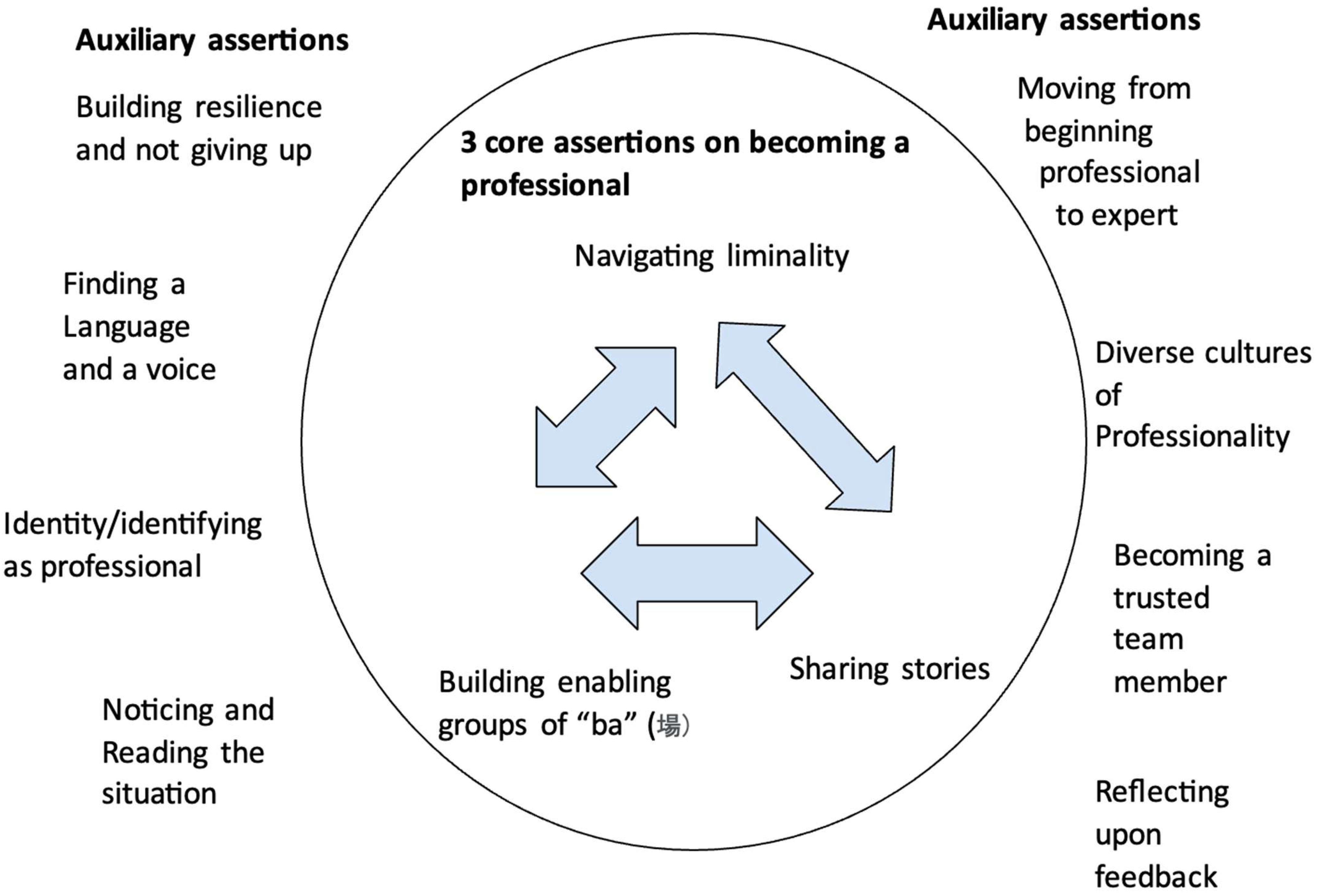
The argument provides the conceptual foundation for a research programme we have been developing over several years. While it might seek support as a form of ethnographic inquiry (e.g., in the mention of liminality), it is more usefully grasped as inspired by narrative inquiry. From a meta-theoretical perspective, how might such a research program be conceptualised? We take inspiration from the tradition of
Lakatos (
1970). He suggested a set of hard-core assertions surrounded by auxiliary, less strong assertions that might constitute a research program seeking to understand (in our context) education into a profession and the key role played by internships. Accordingly, we are not arguing for a paradigm shift (
Kuhn, 1962) in the way we see, talk about, and undertake research, but rather we seek to add new perspectives on the development of a professional voice, identity, and sense of belonging.
In
Figure 1 below, we are thus suggesting the need for further research, as a research programme, with well-designed and clearly delimited sub-projects, that explore several topics, all subsumed or collected around core assertions. These topics are based upon auxiliary assertions that are interchangeable and may be explored in pairs, groups, singularly or make way for new, yet unthought-of assertions. What is not changeable or to be omitted in the research we are proposing is the presence of the three core designated assertions of liminality, story-sharing and enabling
ba (場).
As an illustrative example of a present research project exploring the potential of the concept of the core assertions, the adoption of reflective teams in the training programme of beginning professionals has resulted in the opportunity to conduct focus group interviews with both students and their tutors when in the classroom. Findings so far suggests that the use of reflective teams, especially in the liminal phases in the beginning of the time on placement in correctional facilities, creates an enabling context for students to share their stories without being interrupted and additionally receiving feedback that further stimulates their professional development.
Accordingly, the feedback loops are widened from the stories shared between the beginning professional and expert while on internship to include the many opportunities for feedback loops from all student members of the classroom, including teachers. Simply put, the space for reflection and professional growth gains new and additional dimensions when the team of listeners and those offering feedback is increased. We are sure there are other yet to be considered potential research projects that remain aligned to the shared family of research projects encompassing the interplay between the three core assertions.
Lastly, we anticipate future collaboration with existing or new micro-communities of researchers who share our interests in different countries and cultures. This may include adjacent professions concerned with the care and well-being of those in other institutionalised settings, anything from hospitals, schools, or community settings where we might encounter the disadvantaged and those with time on their hands, such as disengaged youth. An example of such collaboration is with those who might call themselves social educators or social pedagogues, a term more common in northern Europe than elsewhere, embracing three professions working together, such as social worker, youth (community) workers, and teachers.