


Abstract
Digital literacy has become central to educational participation and social inclusion worldwide. Yet significant disparities persist in low-resource schooling contexts, where unequal access to digital infrastructure may shape learners’ confidence in engaging with technology. This study examines the relationship between socioeconomic access and digital self-efficacy among underserved high school students in South Africa through the lens of the UNESCO Digital Literacy Global Framework (DLGF). Data were collected from 286 learners in three Eastern Cape secondary schools in South Africa using a structured questionnaire measuring constructs derived from the DLGF. Focusing on two core constructs, socioeconomic access and digital self-efficacy, a partial PLS-SEM model was estimated with SmartPLS 4. The reflective measurement model showed acceptable reliability and convergent validity (CR = 0.83, AVE = 0.51 for socioeconomic access; CR = 0.79, AVE = 0.65 for digital self-efficacy). Socioeconomic access was positively associated with digital self-efficacy ( = 0.38, t = 7.04, p < 0.001), explaining 15% of its variance ( = 0.15). These findings suggest that policies aimed at improving device availability and reliable connectivity in underserved schools may strengthen learners’ confidence in performing foundational digital literacy tasks, particularly information search and source evaluation.
1. Introduction
Digital literacy has become a cornerstone of educational participation and social inclusion in the 21st century (Hatlevik & Christophersen, 2013; Imjai et al., 2024; Martínez-Bravo et al., 2022). As digital technologies increasingly mediate how individuals learn, communicate, and engage with knowledge, the ability to access, evaluate, and use digital information effectively has emerged as a fundamental skill for learners worldwide. According to Imjai et al. (Imjai et al., 2024), digital literacy goes beyond just getting technical ability; it includes getting critical skills such as information analysis, digital communication, and content creation, which are important for any digital society. Following on its efforts to promote gender equity, UNESCO (2024) states that as digital technologies continue to impact global economies, their use helps to ensure that all individuals, particularly women and girls living in remote communities, get the literacy required for daily digital communications. Even with this growing recognition and acceptance, some challenges still remain between urban and underserved learners (van Maarseveen, 2021; Yang et al., 2025), particularly in developing countries where limited infrastructure, socioeconomic barriers, and cultural factors continue to affect equal access to digital learning opportunities. Recent empirical studies continue to document significant disparities in digital access and literacy outcomes between urban and underserved learners across developing contexts (such as Mokoena & Seeletse, 2025; Mwansa et al., 2025).
In South Africa, the digital divide continues to be a critical educational challenge (Aruleba & Jere, 2022; Chisango & Marongwe, 2021; Mwansa et al., 2025). In a recent study by Mwansa et al. (Mwansa et al., 2025), they showed that digital exclusion increases existing educational inequality, limiting academic progress and socioeconomic mobility for most of the marginalised communities. While the national curriculum focuses on efforts to continue to integrate information and communication technologies (ICTs) (Department of Education, South Africa, 2003), many underserved schools still experience inadequate internet connectivity, outdated devices, and limited digital training for teachers and students. As a result, learners in low-resource areas often lag behind their urban counterparts in developing essential digital competencies that support academic achievement and lifelong learning (Aruleba & Jere, 2022; Kukulska-Hulme et al., 2023). This gap not only reinforces educational inequality but also perpetuates socioeconomic exclusion in a digital economy where employability depends heavily on technological proficiency. Recent years have seen renewed efforts to strengthen ICT integration through provincial device distribution initiatives, connectivity expansion programs, and teacher digital skills development workshops in parts of the Eastern Cape. However, implementation has been uneven across rural and peri-urban schools, with reports indicating variability in infrastructure maintenance, bandwidth reliability, and sustained pedagogical integration (Aruleba & Jere, 2022; Mwansa et al., 2025). While these initiatives reflect policy commitment to digital inclusion, empirical evidence examining how such structural investments translate into learners’ digital self-efficacy remains limited.
To address these challenges, the UNESCO Digital Literacy Global Framework (DLGF) (UNESCO-UNEVOC, 2018) offers a good structure for assessing and improving digital literacy. The framework defines five core competence areas for a complete view of digital literacy that extends beyond operational skills to include ethical, cognitive, and creative dimensions. The DLGF has been widely applied to evaluate digital capabilities in many different contexts (Li et al., 2024; Manca et al., 2021; Wong et al., 2023); however, limited empirical evidence exists on how these competencies are adopted and internalised by underserved learners in low-resource educational environments, and how basic access conditions translate into learners’ confidence in using digital tools.
Building on these perspectives, this study focuses on two foundational constructs: socioeconomic access (SEA) and digital self-efficacy (DSE). Within the DLGF, socioeconomic access corresponds to enabling conditions underpinning digital engagement, particularly those related to access to infrastructure and opportunities for digital participation. Digital self-efficacy aligns most closely with the DLGF’s “information and data literacy” domain, reflecting learners’ confidence in locating, evaluating, and responsibly engaging with digital information. The focus on these two constructs reflects their foundational role in contexts where access cannot be assumed and where more advanced competencies may be constrained by infrastructural limitations. It is framed narrowly, focusing on learners’ confidence in performing foundational digital literacy tasks rather than advanced or emerging digital practices. The emphasis is on information and data literacy activities that are central to schooling in low-resource contexts. Together, these constructs align with the DLGF’s emphasis on empowering learners to become confident, critical, and responsible users of digital technology, and represent necessary preconditions for more advanced forms of digital engagement (UNESCO-UNEVOC, 2018).
The main contributions of this study are:
- It provides empirical evidence for the Digital Literacy Global Framework (DLGF) by validating a model that links structural socioeconomic access to learners’ digital self-efficacy (DSE) within the African context of underserved.
- It quantifies the disparity between high and low-access groups and generates actionable insights for educators and policymakers on integrating self-efficacy interventions with infrastructural improvements in low-resource settings.
While prior research has demonstrated positive associations between digital access and digital competence, much of this evidence derives from high-income or technologically stable educational environments. Fewer studies have empirically examined how access disparities shape learners’ digital self-efficacy in settings characterised by infrastructural instability and socioeconomic constraint. By focusing on underserved South African high schools, this study addresses this contextual gap. It is guided by the research question “To what extent does socioeconomic access predict digital self-efficacy among underserved high school students, and how do disparities in this access translate into significant differences in learners’ digital self-efficacy levels?”.
By focusing on the case of the Eastern Cape, in South Africa, this study responds to the need for locally grounded, data-driven research that can inform digital inclusion policy and pedagogy. The results are expected to reveal not only the extent of access and competency gaps but also the mechanisms through which access conditions shape the confidence of underserved learners in engaging with digital tools. Ultimately, the study aims to advance understanding of how digital self-efficacy can be fostered as part of a broader effort to support equitable education in low-resource environments.
In this study, underserved schools are defined as public secondary schools operating in low-resource contexts characterised by limited and unstable digital infrastructure, including intermittent or low-bandwidth internet connectivity, shared or outdated devices, and constrained opportunities for regular technology-supported learning. This definition reflects conditions commonly observed in rural and peri-urban township schools in the Eastern Cape, where access to digital resources is irregular rather than continuous (Aruleba & Jere, 2022; Deng & El Hag, 2024).
2. Theoretical Framework
The Digital Literacy Global Framework (DLGF) (UNESCO-UNEVOC, 2018) developed by UNESCO provides a comprehensive foundation for understanding the competencies required for effective participation in digital environments. The framework conceptualises digital literacy as a multidimensional construct that extends beyond technical proficiency to include information management, communication, content creation, safety, and problem-solving competencies (Law et al., 2018; Martínez-Bravo et al., 2022). These dimensions together reflect the knowledge, skills, and attitudes necessary for learners to engage critically, creatively, and safely with digital technologies.
The DLGF has been applied internationally to benchmark digital literacy levels, evaluate policy outcomes, and guide curriculum design (Hammoda & Foli, 2024; Li et al., 2024; Manca et al., 2021; Mattar et al., 2022; Wong et al., 2023). However, much of this work has focused on describing the presence or absence of competencies, rather than examining the structural and psychological conditions under which such competencies emerge in everyday learning. In low-resource schooling contexts, where basic access to devices and connectivity cannot be assumed, digital literacy must be understood not only as a set of competencies but also as an outcome of enabling conditions (Aruleba & Jere, 2022). Two of the most fundamental of these conditions are the material circumstances of access and learners’ beliefs in their own capability to use digital tools.
Within this study, the DLGF is therefore used not simply as a descriptive taxonomy of skills but as a guiding framework for identifying core elements of digital engagement that are empirically tractable in a low-resource context. Specifically, attention is directed to (a) socioeconomic access to digital technologies (SEA) and (b) digital self-efficacy (DSE) in relation to key information and data literacy tasks as defined within the UNESCO Digital Literacy Global Framework (DLGF), particularly those involving information search, evaluation, and responsible online engagement. These constructs are treated as foundational, capturing the extent to which underserved learners are both able and feel able to participate meaningfully in digital learning activities.
2.1. Socioeconomic Access in Low-Resource Schooling Contexts
Access to technology remains a fundamental determinant of digital literacy development and use (Akakpo et al., 2025; Kukulska-Hulme et al., 2023; Mwansa et al., 2025). The DLGF implicitly assumes that digital engagement presupposes the availability of physical infrastructure, connectivity, and devices that enable learners to apply digital skills meaningfully (Law et al., 2018). In South Africa, socioeconomic constraints, such as household income, parental education, and infrastructural limitations, often impede consistent access to technology both at home and in underserved schools (Aruleba & Jere, 2022; Matli & Ngoepe, 2021; Mojapelo & Durodolu, 2022). Many underserved schools continue to operate with limited internet connectivity, a small pool of shared devices, and intermittent electricity supply, which restrict the opportunities that learners have to interact with digital tools in a sustained manner (Mhlanga, 2024; Mhlongo et al., 2023).
In this study, socioeconomic access (SEA) is conceptualised as a contextual construct that captures learners’ access to core digital resources, specifically their ability to use essential digital tools and connectivity required for routine learning activities. This includes access to a computer or laptop, ownership or regular use of a smartphone, availability of internet connectivity at home or via mobile data, and opportunities to participate in basic online collaborative activities linked to schooling. Access is not viewed merely as nominal ownership but as the extent to which learners can reliably use digital devices and networks for learning-related activities. In line with the DLGF, such access serves as a foundation for the development of more advanced digital competencies. Without minimally adequate access, learners are unlikely to progress beyond occasional, peripheral use of technology (Law et al., 2018).
Prior research in digital inclusion and educational technology has shown that students with limited access to digital resources tend to report lower confidence and competence in using technology for academic purposes, while those with regular access are more likely to experiment with digital tools, adopt diverse applications, and integrate them into their learning routines (Akakpo et al., 2025; Chisango & Marongwe, 2021; Lukose & Agbeyangi, 2025; Matli & Ngoepe, 2021; Mwansa et al., 2025; Siddiq et al., 2017). Socioeconomic access can therefore be understood as an upstream factor that shapes both opportunities for digital engagement and the experiences from which self-beliefs are formed.
While previous studies have demonstrated positive associations between digital access and digital competence or self-efficacy (such as Hatlevik & Christophersen, 2013; Siddiq et al., 2017; Yuan et al., 2025), much of this research has been conducted in educational systems where baseline access is relatively stable and widespread. In such contexts, access differences may be incremental rather than structural. By contrast, in underserved schooling environments where connectivity is intermittent and device ownership is uneven, access may function not merely as a facilitating condition but as a foundational determinant of digital engagement opportunities. Furthermore, much of the digital literacy literature has concentrated on assessing multidimensional competence domains and observable skills (Manca et al., 2021), while giving comparatively less attention to distinct psychological constructs such as digital self-efficacy grounded in self-efficacy theory.
From a self-efficacy perspective, access to digital resources plays a critical role in shaping learners’ confidence through repeated mastery experiences, reduced anxiety, and increased opportunities for successful task completion (Bandura, 1997). In digital contexts, regular interaction with devices and online resources allows learners to experiment, recover from errors, and progressively internalise beliefs about their own competence (Al Mamun & Lawrie, 2024; Chiou et al., 2015; Ng, 2012). Conversely, constrained or intermittent access limits exposure to such mastery experiences, reinforcing uncertainty and avoidance behaviours.
Empirical studies across diverse educational settings have reported positive associations between access to digital resources and students’ confidence or perceived competence in using technology (Lukose & Agbeyangi, 2025; Siddiq et al., 2017). However, much of this evidence derives from contexts where baseline access is relatively stable, leaving open questions about how strongly access predicts digital self-efficacy in low-resource schooling environments where access is uneven, shared, or unreliable.
Accordingly, the study formulates the following hypotheses:
Hypothesis 1 (H1).
Socioeconomic access is positively associated with digital self-efficacy among underserved high school students.
Hypothesis 2 (H2).
Students with higher levels of socioeconomic access report higher digital self-efficacy than students with lower levels of access.
2.2. Conceptual Model
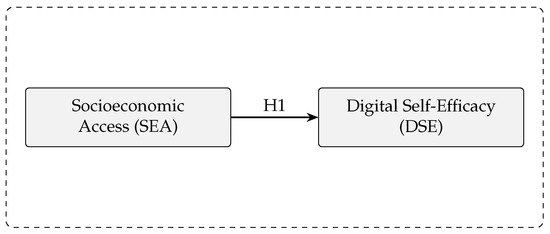
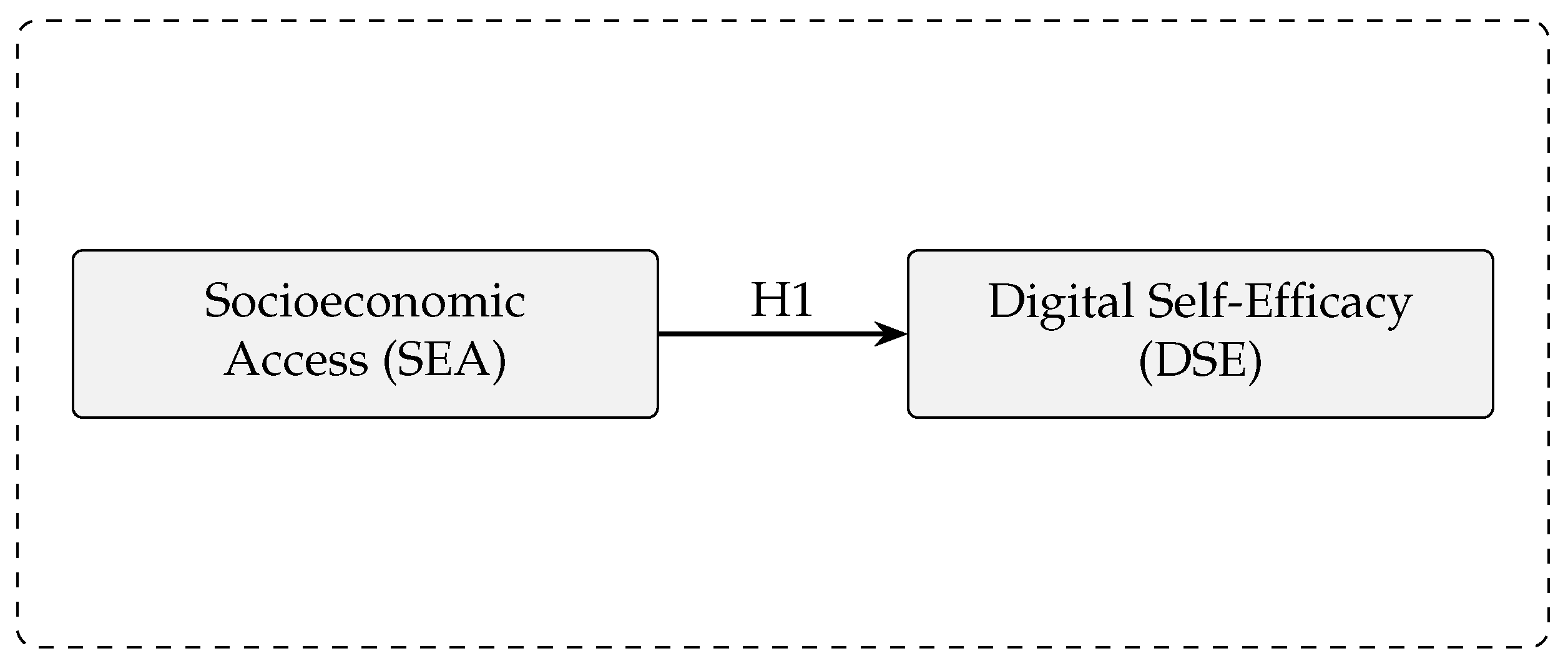
Grounded in the theoretical framework already discussed (Section 2), this study proposes a conceptual model linking socioeconomic access (SEA) and digital self-efficacy (DSE) among underserved high school students. The model is presented in Figure 1.
Figure 1.
Conceptual model linking socioeconomic access to digital self-efficacy.
Socioeconomic access, as operationalised in this study, reflects learners’ access to core digital resources, including computers, smartphones, internet connectivity, and opportunities for online collaboration. Digital self-efficacy captures learners’ confidence in performing foundational information and data literacy tasks, such as searching for information and evaluating the credibility of online sources.
The conceptual model focuses on the hypothesised association between socioeconomic access and digital self-efficacy (H1). In addition, a complementary group comparison analysis (H2) examines whether learners with relatively higher and lower levels of access differ in their reported digital self-efficacy.
3. Methods
3.1. Research Design
This study employed a quantitative, cross-sectional research design to investigate the relationship between socioeconomic access and digital self-efficacy among underserved high school students. The design was chosen to enable statistical testing of the hypothesised predictive relationship between socioeconomic access and digital self-efficacy, as specified in the conceptual model.
3.2. Participants and Sampling
The study was conducted in three underserved public high schools located in the Eastern Cape, South Africa. To protect institutional confidentiality, schools are anonymised and referred to as School A (rural), School B (peri-urban township), and School C (peri-urban township). These schools were purposively selected to reflect the infrastructural and socioeconomic challenges characteristic of resource-constrained educational environments in both rural and peri-urban settings.
A total of 300 learners were initially approached, of whom 286 provided complete and usable responses: 125 (43.7%) from School A, 53 (18.5%) from School B, and 108 (37.8%) from School C (see Table 1). Participants ranged in age from 14 to 21 years (, ), consistent with the typical age range for Grades 9 to 12 within the South African General Education and Training and Further Education and Training bands. The sample comprised 59.8% females, 38.1% males, and 2.1% of learners who preferred not to disclose their gender. Approximately 30.1% of learners were in Grade 9, 9.1% in Grade 10, 29.7% in Grade 11, and 31.1% in Grade 12.
Table 1.
Demographic characteristics of the sample (N = 286).
The linguistic profile of the sample was predominantly isiXhosa-speaking, with 96.5% reporting isiXhosa (alone or in combination with other languages) as a home language. Participation was voluntary, and informed consent was obtained from school principals and all respondents (and guardians, where applicable) in accordance with ethical clearance guidelines. The researcher administered the questionnaires in person and remained present during completion to provide clarification where necessary. Ethical approval was granted by the Walter Sisulu University Senate Research Ethics Committee (WSU SREC), Protocol Number: 16/23/07/2025/DRI.
3.3. Research Instrument
Data were collected using a structured Digital Literacy Questionnaire (DLQ) (see Appendix A) developed by the authors for the purposes of this study and informed by the UNESCO Digital Literacy Global Framework (DLGF). The instrument was designed to operationalise a selected subset of DLGF competencies that are empirically tractable and contextually relevant in low-resource secondary school settings, particularly those related to socioeconomic access and information and data literacy self-efficacy. The DLGF was selected because it provides a globally benchmarked yet flexible framework capable of accommodating context-specific analyses of digital literacy. The sample size (N = 286) exceeds commonly recommended minimum thresholds for PLS-SEM, including the “10-times rule” and power-based recommendations for models with a single predictor construct (Kock & Hadaya, 2018), supporting adequate statistical power for detecting medium-sized effects.
Most construct items were measured using five-point Likert-type scales, typically ranging from 1 (“Rarely” or “Strongly disagree”) to 5 (“Almost always” or “Strongly agree”). In addition, several socioeconomic access indicators were measured as binary variables (e.g., Yes = 1, No = 0) capturing device ownership and internet availability. Prior to the main data collection, the DLQ underwent a multi-step suitability and validation process. First, items were mapped explicitly to relevant DLGF competency descriptors to ensure content alignment. Second, the questionnaire was reviewed by two experts in educational technology and digital literacy to assess clarity, relevance, and contextual appropriateness for South African secondary schools. Third, a pilot study was conducted with 30 students from a non-participating school in the Eastern Cape. Feedback from the pilot informed minor wording refinements, and the resulting scales demonstrated acceptable internal consistency (Cronbach’s ), supporting the instrument’s reliability for the study context.
This instrument was selected in preference to more comprehensive digital competence questionnaires (such as, DigComp (Ferrari, 2013) or TPACK (Herring et al., 2016)) because the study focuses on foundational access conditions and early-stage digital engagement rather than advanced technical or creative competencies. In underserved schooling contexts where reliable access to devices and connectivity cannot be assumed, narrowly focused measures aligned with core information and data literacy tasks are more appropriate and less susceptible to construct contamination arising from unequal exposure to advanced technologies.
The two core constructs were operationalised as follows:
- Socioeconomic Access (SEA)—measured through items addressing device ownership (e.g., computer/laptop at home), internet availability (e.g., internet access at home and primary means of access), and participation in collaborative online activities linked to schooling. It was operationalised as a reflective latent construct composed of five indicators capturing learners’ access to essential digital resources and opportunities. Three indicators assessed device and connectivity access (computer/laptop at home, internet access at home, internet connection via smartphone), one indicator captured smartphone ownership, and one indicator reflected participation in collaborative online activities. Device and connectivity items were coded as binary variables (Yes = 1, No = 0), while the collaborative activity item was coded dichotomously to reflect whether learners had engaged in any form of online collaboration related to schoolwork. All indicators were specified to load reflectively onto the SEA construct, representing manifestations of an underlying access condition rather than independent components. Latent variable scores for SEA were estimated within the PLS-SEM framework using standardised outer loadings, allowing indicators with stronger empirical relationships to contribute proportionally more to the construct score.
- Digital Self-Efficacy (DSE)—measured by aggregating items related to students’ perceived ability and confidence in applying digital tools effectively, specifically focusing on core information and data literacy tasks, such as searching for information and evaluating the credibility of online sources. It does not encompass advanced technical skills (e.g., programming), specialised digital financial practices (e.g., cryptocurrency use), or emerging competencies such as artificial intelligence prompt engineering. Instead, it reflects learners’ perceived capability to carry out foundational digital literacy tasks that are prerequisites for broader digital engagement in low-resource educational settings.
While individual items reflect constructs commonly used in prior digital literacy and self-efficacy research, the DLQ as a composite instrument has not been previously published and was purpose-built to address the specific research questions and contextual constraints of this study.
3.4. Data Collection Procedure
Data collection took place over a three-week period in August 2024. The researcher, with assistance from class teachers, administered the printed questionnaires during scheduled class periods. The purpose of the study was explained to participants, and confidentiality and anonymity were assured. Each questionnaire took approximately 20 min to complete. Completed responses were collected immediately and stored securely for data entry and analysis.
3.5. Data Analysis
Data were analysed using SmartPLS 4 following established guidelines for partial least squares structural equation modelling (PLS-SEM), which is appropriate for predictive research, models with formative or mixed indicator types, and studies conducted in emerging or resource-constrained contexts (Hair et al., 2019, 2021). The use of PLS-SEM is particularly suitable where the primary objective is to estimate and explain variance in key outcome constructs rather than to achieve exact model fit. The analysis proceeded in three primary stages:
- Measurement Model Assessment evaluated the reliability and validity of the reflective constructs using composite reliability (CR), average variance extracted (AVE), and discriminant validity assessed via the heterotrait–monotrait ratio of correlations (HTMT).
- Structural Model Assessment tested the hypothesised causal relationship (H1) using path coefficients (), t-values, and significance levels (p-values) obtained through bootstrapping (5000 samples). Model fit was confirmed using the Standardized Root Mean Square Residual (SRMR), and predictive relevance was assessed using Stone–Geisser’s .
- Group Difference Analysis tested the secondary hypothesis (H2) using an independent-samples t-test to compare the mean digital self-efficacy scores between groups categorised by high and low socioeconomic access.
Measurement quality was evaluated using widely accepted cut-off criteria: composite reliability () to assess internal consistency, average variance extracted () to establish convergent validity, and heterotrait–monotrait ratios (HTMT < 0.85) to confirm discriminant validity (Hair et al., 2021; Henseler et al., 2015). Structural relationships were assessed using standardised path coefficients (), with statistical significance determined via non-parametric bootstrapping.
Because socioeconomic access was modelled as a latent construct, individual indicator values were not summed or averaged manually; instead, SEA scores were estimated internally by SmartPLS using the reflective measurement model and bootstrapped standard errors. In addition, descriptive statistics (means, standard deviations) were computed to summarise digital literacy competency levels, and Pearson correlation analysis was conducted to explore preliminary relationships among variables. Missing data were minimal (<2%) and handled through mean imputation to maximise sample utilisation.
4. Results and Discussion
4.1. Descriptive Statistics
Descriptive statistics for the primary constructs are presented in Table 2. Socioeconomic access (SEA) had a mean of (), with observed values ranging from 0.00 to 1.00. Digital self-efficacy (DSE) had a mean of (), with scores ranging from 1.00 to 5.00. The variability observed across both constructs indicates meaningful differences in access conditions and levels of digital self-confidence among learners. The distribution of SEA scores indicates that access levels were neither uniformly low nor uniformly high, while the moderate mean and relatively larger standard deviation for DSE suggest notable heterogeneity in learners’ perceived digital confidence.
Table 2.
Descriptive statistics for primary constructs.
4.2. Measurement Model Assessment
The measurement properties of the two reflective constructs, socioeconomic access (SEA) and digital self-efficacy (DSE), were assessed prior to estimating the structural model.
As shown in Table 3, all outer loadings exceeded the commonly accepted threshold of , with most indicators loading above on their intended constructs. This indicates that the indicators share a substantial proportion of variance with their respective latent variables (Hair et al., 2021). Socioeconomic access was operationalised using indicators related to resource ownership (e.g., smartphone and computer access), internet availability, and one item on collaborative online behaviour that reflects access-based opportunity. Digital self-efficacy was measured using two items capturing students’ confidence in core information literacy tasks.
Table 3.
Measurement model: outer loadings.
Composite reliability (CR) and average variance extracted (AVE) are reported in Table 4. Both constructs demonstrated acceptable internal consistency, with CR values of for SEA and for DSE, exceeding the recommended minimum of . AVE values were and respectively, surpassing the threshold and confirming convergent validity at the construct level.
Table 4.
Composite reliability and average variance extracted.
Discriminant validity was examined using the heterotrait–monotrait ratio of correlations (HTMT). As shown in Table 5, the constructs SEA and DSE demonstrated a strong empirical relationship, indicated by the heterotrait–monotrait ratio (HTMT) value of . Crucially, since this value is well below the conservative threshold of (Hair et al., 2021), the measurement model retains excellent discriminant validity, confirming that although the constructs are tightly linked theoretically and empirically, they are sufficiently distinct for the purposes of structural modelling.
Table 5.
Discriminant validity: HTMT.
Overall, the measurement model for socioeconomic access and digital self-efficacy exhibits satisfactory reliability and validity and is therefore suitable for testing the hypothesised structural relationships.
4.3. Structural Model Assessment (H1)
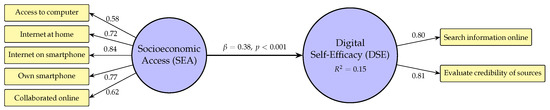
Following the establishment of measurement validity, the structural model was evaluated to examine the hypothesised association between socioeconomic access and digital self-efficacy (H1). Table 6 summarises the path coefficient, t-value, p-value, confidence interval, and explained variance, while Figure 3 provides a graphical representation of the model with standardised loadings and the structural path.
Table 6.
Structural path coefficient (H1).
The results indicate that socioeconomic access is positively and statistically significantly associated with digital self-efficacy (, , ). The magnitude of the observed effect () is consistent with relationships reported in recent empirical studies conducted in diverse educational settings. For example, a large international analysis using PISA 2022 data by Joshi et al. (2025) found higher levels of digital resource utilisation and self-efficacy among students in high-income countries compared with those in lower-income contexts, suggesting that access disparities continue to shape self-efficacy outcomes across economic gradients. Similarly, recent SEM research by Yuan et al. (2025) has documented positive paths from digital literacy to digital self-efficacy in university populations, with implications for engagement and learning outcomes. These findings suggest that in low-resource contexts, where access is neither universal nor taken for granted, incremental differences in access may exert a disproportionately strong influence on learners’ confidence with foundational digital tasks, reinforcing the centrality of access conditions in shaping digital self-efficacy.
The bias-corrected bootstrap confidence interval does not include zero , providing further support for the robustness of this effect. The model explains of the variance in digital self-efficacy (), achieving a meaningful level of predictive power that is acceptable within the study of complex behavioural and psychological constructs (Hair et al., 2021). The global model fit, as assessed by the standardised root mean square residual (SRMR), was . Although this value exceeds the conventional cut-off typically applied in covariance-based SEM (CB-SEM), SRMR plays a more limited role in PLS-SEM, which prioritises prediction rather than exact model fit (Hair et al., 2019). Predictive relevance, evaluated using Stone–Geisser’s for the digital self-efficacy indicators, was positive (average ), suggesting small but non-trivial out-of-sample predictive capability. Taken together, these results support Hypothesis 1 and suggest that improved access to devices, connectivity, and basic digital opportunities is associated with stronger confidence among underserved high school students in performing core digital tasks.
Bootstrapping with 5,000 resamples was employed to obtain robust standard errors and confidence intervals, as recommended for PLS-SEM when distributional assumptions cannot be guaranteed and when working with mixed-scale indicators (Hair et al., 2021; Preacher & Hayes, 2008).
4.4. Group Differences in Digital Self-Efficacy by Access Level (H2)
To provide a more fine-grained test of Hypothesis 2 (H2), learners were divided into two groups based on the median of the socioeconomic access latent scores: a high-access group and a low-access group. Table 7 presents the descriptive statistics for digital self-efficacy by access group.
Table 7.
Digital self-efficacy by socioeconomic access group (H2).
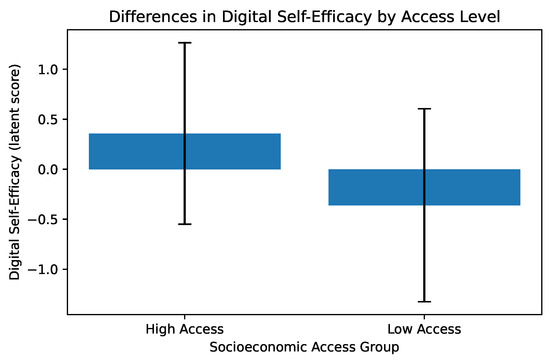
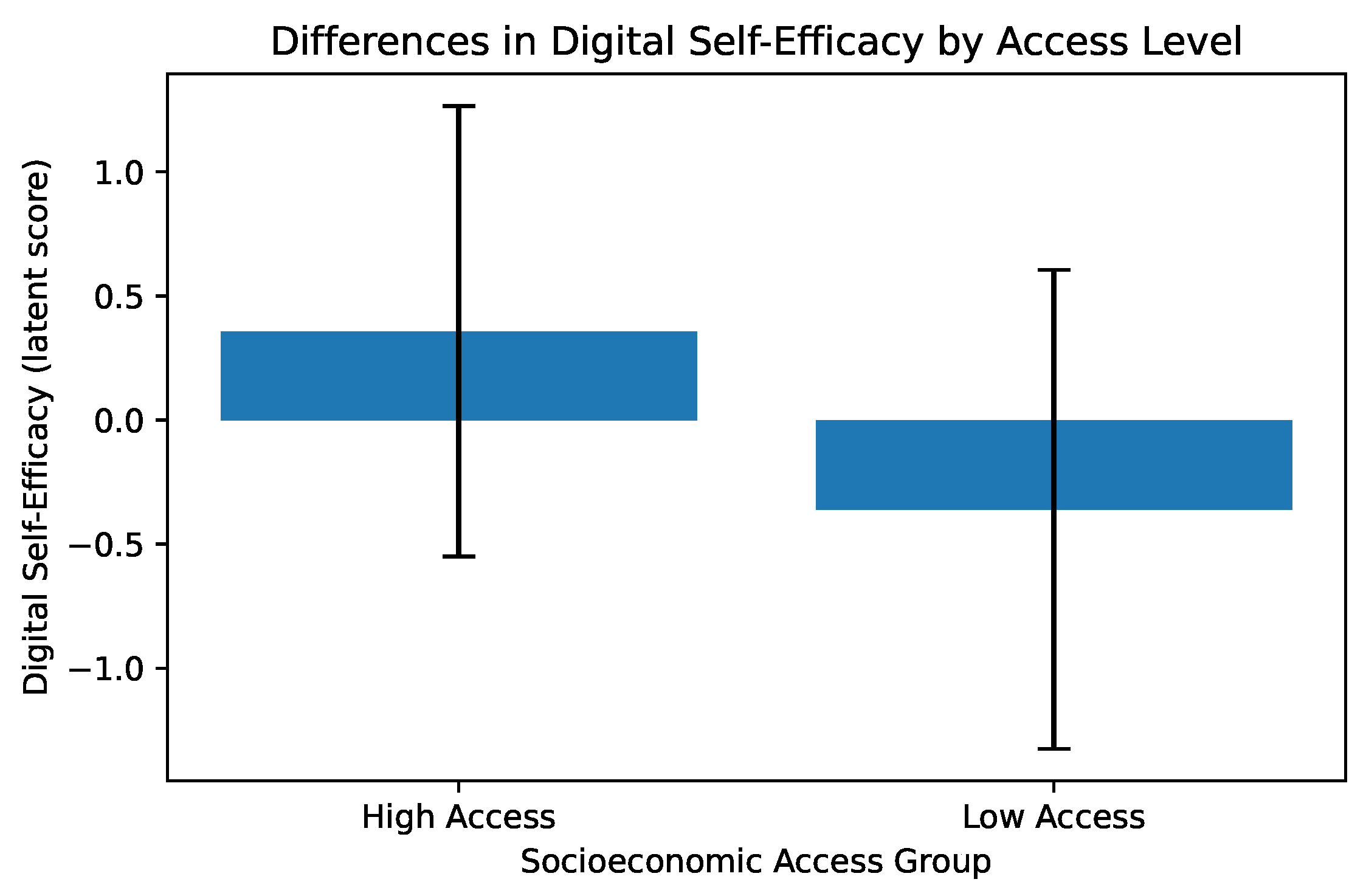
An independent-samples t-test was conducted to compare digital self-efficacy between the two groups. Students in the high-access group (, , ) reported significantly higher digital self-efficacy than those in the low-access group (, , ), , . The effect size, expressed as Cohen’s d, was , indicating a medium-to-large difference in self-efficacy between the two groups. These results, as illustrated in Figure 2, provide strong support for Hypothesis 2, underscoring that disparities in access translate into notable psychological differences in the confidence of underserved learners to use digital technologies.
Figure 2.
Differences in mean digital self-efficacy (DSE) scores between learners categorised by high and low socioeconomic access (SEA), based on a median split. The difference is statistically significant (, ), with a medium-to-large effect size ().
As illustrated in Figure 3, the partial least squares structural equation model depicts the structural relationship between socioeconomic access (SEA) and digital self-efficacy (DSE). Each construct is represented as a latent variable with its corresponding observed indicators and standardised outer loadings. The path coefficient from SEA to DSE is positive and statistically significant (, ), indicating that learners with greater access to digital resources report stronger confidence in using digital tools. The model explains of the variance in digital self-efficacy (). The corresponding effect size () indicates a medium effect according to established PLS-SEM benchmarks (Kock & Hadaya, 2018), suggesting that socioeconomic access makes a substantive contribution to explaining variation in digital self-efficacy. While the explained variance may appear modest, such values are typical in research examining behavioural and psychological constructs, where multiple contextual and individual factors interact to shape outcomes. The global model fit, as assessed by the standardised root mean square residual (SRMR), was . Although this value exceeds conventional covariance-based SEM cut-offs, SRMR plays a more limited role in PLS-SEM, which prioritises prediction over exact model fit (Hair et al., 2019). Predictive relevance, evaluated using Stone–Geisser’s for the digital self-efficacy indicators, was positive (average ), indicating small but non-trivial out-of-sample predictive capability. Overall, the structural diagram confirms that improved access conditions are associated with higher levels of digital self-efficacy, consistent with theoretical expectations derived from the UNESCO Digital Literacy Global Framework (DLGF).
Figure 3.
Structural model linking socioeconomic access to digital self-efficacy with standardised loadings and path coefficient.
5. Discussion
This study examined the relationship between socioeconomic access (SEA) and digital self-efficacy (DSE) among underserved high school learners, using a cross-sectional, correlational design grounded in the Digital Literacy Global Framework (DLGF). The findings revealed a positive and statistically significant association between access and self-efficacy (, , ), indicating that learners with greater access to digital resources tend to report higher confidence in performing foundational digital literacy tasks. The following discussion interprets these findings in relation to theory, prior empirical research, and contextual realities of low-resource educational environments.
5.1. Discussion in Relation to the DLGF and Literature
The findings contribute to the Digital Literacy Global Framework (DLGF) by illustrating how access-related conditions underpin the development of key digital literacy dispositions. While the DLGF specifies competency areas such as information and data literacy, the present study demonstrates that the successful transition to realising these competencies in low-resource educational environments is highly contingent upon both structural access and learners’ self-efficacy. The results are aligned with socio-technical perspectives on digital inclusion, which emphasise that infrastructure alone is insufficient to guarantee meaningful digital participation (Selwyn, 2020). Restating the primary finding, socioeconomic access was meaningfully associated with digital self-efficacy, with a medium effect size. This suggests that access conditions do not merely accompany digital competence development but play a substantive role in shaping learners’ psychological readiness to engage digitally. The effect size () indicates that access contributes materially to confidence formation, although it does not operate in isolation.
In line with previous studies, the positive relationship between access and self-efficacy resonates with evidence that regular, meaningful use of technology strengthens learners’ confidence and skills (Chiou et al., 2015; Lukose & Agbeyangi, 2025; Ng, 2012). The current study extends this work by situating the analysis explicitly within the complex context of South Africa’s underserved schools, which includes both deeply rural and peri-urban township settings, and by operationalising socioeconomic access as a latent construct composed of multiple access indicators. The medium-to-large difference in self-efficacy between high- and low-access learners underscores the risk that infrastructural disparities will be mirrored by disparities in confidence and, by implication, in learners’ willingness to engage with digital tools for learning.
While the positive association between socioeconomic access and digital self-efficacy may appear intuitive, this study’s findings extend existing scholarship by demonstrating that this relationship remains robust and substantively meaningful in contexts of pronounced resource scarcity. In environments where access to devices and connectivity is intermittent or shared, access functions not merely as a background condition but as a salient enabler of psychological readiness to engage digitally. Although the model explained a modest proportion of variance in digital self-efficacy (), such values are common in studies examining motivational and belief-based constructs in educational research (Hair et al., 2021), where multiple contextual, instructional, and psychological factors jointly influence outcomes. The remaining unexplained variance suggests that digital self-efficacy is shaped not only by material access but also by factors such as teacher support, quality of digital instruction, prior exposure to technology, and peer learning environments (Selwyn, 2020).
These findings also have implications for policy and practice. National initiatives that seek to expand connectivity and device access in underserved schools are clearly necessary, but they are not sufficient on their own. To fully leverage infrastructural investments, interventions should simultaneously target learners’ digital self-efficacy through structured opportunities for hands-on practice, teacher modelling, and peer support. Viewed through the lens of the DLGF, this means that efforts to improve the “hardware” of digital access must be complemented by efforts to develop the “software” of learner confidence and agency.
Generally, the study provides an empirically grounded baseline showing that socioeconomic access and digital self-efficacy are tightly linked in low-resource educational environments. By demonstrating that access inequalities are associated with meaningful differences in digital confidence, the results underscore the importance of addressing both structural and psychological enablers in strategies designed to foster equitable digital literacy in low-resource educational environments. By empirically quantifying the access–self-efficacy relationship within underserved South African schools, this study contributes new evidence on how foundational digital confidence is shaped under conditions of scarcity, extending digital literacy research beyond contexts where access is relatively stable and homogeneous.
5.2. Policy Implications
The results hold several important implications for theory, practice, and policy. Theoretically, the study extends the DLGF beyond its traditional competency-based orientation by showing the behavioural and psychological mechanisms through which digital literacy emerges in low-resource settings. Rather than treating digital literacy as a static skill set, the findings conceptualise it as a dynamic process shaped by the interaction between infrastructural conditions and self-belief. This bridges the gap between digital literacy frameworks and self-efficacy theory (Bandura, 1997), offering a whole explanation of how learners progress from access to confident use.
Practically, the evidence shows that providing devices and connectivity is important, but not sufficient, for having meaningful engagement with technology. Interventions must also strengthen learners’ confidence and capacity to use digital tools effectively. Schools and educators should therefore complement ICT provision with experiential learning, peer mentoring, and teacher modelling designed to enhance digital self-efficacy. Such strategies can help learners translate access into active and continuous digital participation.
From a policy perspective, the study highlights that the digital divide in underserved South African contexts extends beyond material infrastructure to include disparities in psychological readiness. National and provincial education departments should integrate digital self-efficacy development into existing ICT-in-education frameworks. Partnerships with local communities, NGOs, and private-sector stakeholders can further support underserved schools in building sustainable digital ecosystems that combine access, training, and motivational support. These actions align with the DLGF’s vision of inclusive digital education and the broader national commitment to equitable, technology-enabled learning.
Overall, fostering digital literacy in low-resource contexts requires simultaneous attention to both structural and psychological enablers. By demonstrating that socioeconomic access is meaningfully associated with digital self-efficacy, this study provides empirical support for integrated interventions that combine infrastructural provision with psychological empowerment strategies. Strengthening learners’ confidence and ensuring increased access to digital resources are essential steps toward realising equitable, future-ready education in South Africa and in other comparable settings across the low-resource environment.
5.3. Limitations and Future Research
The study employed a cross-sectional, correlational design, which precludes causal inference. Although socioeconomic access was statistically associated with digital self-efficacy, the directionality of this relationship cannot be definitively established and may be reciprocal or influenced by unmeasured third variables. Further limitations arise from the reliance on self-reported data, which introduces potential for common method bias and social desirability. Additionally, the purposive, non-random sampling from only three underserved Eastern Cape schools restricts the generalisability of the findings to other educational contexts.
Based on these limitations, the following avenues for future research are recommended:
- A longitudinal research design could be done to confirm the causal path and establish the optimal timing and duration of access interventions required to promote sustained growth in digital self-efficacy.
- The model could be expanded to include moderating or mediating variables such as quality of digital skills training, teacher digital competence, and parental support, which are likely to influence the translation of access into self-efficacy, potentially increasing the model’s explanatory power.
- The modest explanatory power of the model () further suggests that additional predictors should be incorporated in future research. Variables such as teacher digital competence, instructional quality, parental support, school ICT policy implementation fidelity, and learners’ prior exposure to structured digital training may enhance explanatory depth. Incorporating such variables would allow for more comprehensive modelling of the socio-technical ecosystem influencing digital self-efficacy.
- Digital self-efficacy in this study context was operationalised using a limited set of indicators focused on information and data literacy, reflecting the foundational nature of digital engagement. Future research could extend this construct to include communication, content creation, and emerging digital competencies as access conditions improve.
- Additionally, the absence of control variables such as gender, grade level, and school-level contextual effects limits the granularity of interpretation. Prior research suggests that demographic and developmental factors may moderate digital confidence and engagement (Chisango & Marongwe, 2021; Deng & El Hag, 2024). Future studies should integrate such controls to determine whether the access–self-efficacy relationship varies across subgroups.
6. Conclusions
This study advances understanding of digital literacy in low-resource educational contexts by demonstrating that socioeconomic access is not only a structural prerequisite for digital engagement but also a significant psychological enabler of learners’ confidence to use digital technologies. Anchored in the UNESCO Digital Literacy Global Framework, the results indicate that digital access inequalities are accompanied by systematic differences in perceived digital competence, suggesting that digital inclusion is not merely a question of infrastructure provision but also of psychological empowerment and individual agency.
Beyond confirming an expected relationship, the study highlights that in underserved schooling environments, where access is uneven and often precarious, incremental improvements in device availability and connectivity can yield substantial gains in learners’ confidence to perform foundational digital literacy tasks. This underscores the importance of viewing access not as a binary condition but as a continuum with real psychological consequences.
The findings also suggest that policies focused exclusively on hardware provision risk underestimating the role of learner self-efficacy in translating access into meaningful educational use. Interventions that combine infrastructural investment with pedagogical strategies designed to strengthen digital confidence are therefore more likely to produce sustainable gains in digital literacy.
Taken together, this study contributes to a growing body of evidence that equitable digital education requires simultaneous attention to material conditions and psychological readiness. By situating digital self-efficacy as a foundational outcome of access in low-resource contexts, the research provides a conceptual and empirical basis for designing more holistic and context-sensitive digital inclusion strategies in South Africa and comparable settings.
Author Contributions
J.M.L.: Conceptualisation, Supervision, Writing—review & editing. A.O.A.: Conceptualisation, Methodology, Formal analysis, Data curation, Writing—original draft, Writing—review & editing. All authors have read and agreed to the published version of the manuscript.
Funding
This research receives no specific funding.
Institutional Review Board Statement
The study was conducted in accordance with the Declaration of Helsinki and approved by Walter Sisulu University Senate Research Ethics Committee (WSU SREC) (protocol code 16/23/07/2025/DRI and date of approval: 23 July 2025).
Informed Consent Statement
Informed consent was obtained from all participants involved in the study.
Data Availability Statement
The dataset supporting the findings of this study is available from the corresponding author upon reasonable request.
Acknowledgments
The authors appreciate the participating schools in Eastern Cape and the learners who generously contributed their time and perspectives to this study. The authors also appreciate Walter Sisulu University for providing the environment in which this research was conducted.
Conflicts of Interest
The authors declare no conflicts of interest.
Appendix A. Digital Literacy Questionnaire (DLQ)
The Digital Literacy Questionnaire (DLQ) was developed by the authors and informed by the UNESCO Digital Literacy Global Framework (DLGF). The full instrument is reproduced below to enhance transparency and replicability. Items included in the PLS-SEM structural model (Socioeconomic Access and Digital Self-Efficacy constructs) are marked with an asterisk (*).
- Section A: Demographic Information
- 1.
- Age: _________________
- 2.
- Gender:
- □
- Male
- □
- Female
- □
- Prefer not to say
- 3.
- Grade Level:
- □
- Grade 8
- □
- Grade 9
- □
- Grade 10
- □
- Grade 11
- □
- Grade 12
- 4.
- Household income (annual range):
- □
- 0–54,344 ZAR
- □
- 54,345–151,727 ZAR
- □
- 151,728–363,930 ZAR
- □
- 363,931–631,120 ZAR
- □
- 631,212–863,906 ZAR
- 5.
- Parental education level:
- □
- No formal education
- □
- High school diploma
- □
- College degree
- 6.
- Home language:
- □
- isiXhosa
- □
- English
- □
- Other (specify): _________________
- Section B: Socioeconomic Access (SEA)
- *
- Do you have access to a computer or laptop at home?
- □
- Yes
- □
- No
- *
- Do you have internet access at home?
- □
- Yes
- □
- No
- *
- Do you have internet access on your smartphone?
- □
- Yes
- □
- No
- *
- Do you own a smartphone?
- □
- Yes
- □
- No
- *
- Have you ever collaborated on a school-related project using online tools?
- □
- Yes
- □
- No
- 1.
- How often do you use technology for academic purposes? (1 = Rarely, 5 = Almost Always)
- □
- Rarely
- □
- Occasionally
- □
- Somewhat often
- □
- Frequently
- □
- Almost always
- Section C: Digital Self-Efficacy (DSE—Information and Data Literacy)
- *
- How often do you search for information online? (1 = Rarely, 5 = Almost Always)
- □
- Rarely
- □
- Occasionally
- □
- Somewhat often
- □
- Frequently
- □
- Almost always
- *
- How confident are you in evaluating the credibility of online sources? (1 = Rarely, 5 = Almost Always)
- □
- Rarely
- □
- Occasionally
- □
- Somewhat often
- □
- Frequently
- □
- Almost always
- Section D: Additional Digital Literacy Domains (DLGF-Aligned)
Communication and Collaboration
- 1.
- How often do you use email or messaging applications for communication? (1 = Rarely, 5 = Almost Always)
- 2.
- Have you ever collaborated on a project using online tools?
Digital Content Creation
- 1.
- Have you ever created digital content (e.g., videos, images, blog posts)?
- 2.
- How often do you use digital tools for content creation? (1 = Rarely, 5 = Almost Always)
Safety
- 1.
- How often do you use strong passwords and keep them confidential? (1 = Rarely, 5 = Almost Always)
- 2.
- Have you ever experienced online harassment or cyberbullying?
Problem-Solving
- 1.
- How often do you use digital tools to solve problems or complete tasks? (1 = Rarely, 5 = Almost Always)
- 2.
- Have you ever troubleshooted technical issues online?
Digital Citizenship
- 1.
- How often do you consider the ethical implications of your online actions? (1 = Rarely, 5 = Almost Always)
- 2.
- Have you ever participated in online communities or forums?
Technology Use and Training
- 1.
- How often do you use technology for entertainment purposes? (1 = Rarely, 5 = Almost Always)
- 2.
- Have you ever received training on digital literacy skills?
- 3.
- If yes, where did you receive this training? (School, Community centre, Online courses, Other)
- 4.
- What challenges do you face in accessing and using digital technology? (Open-ended)
- 5.
- What resources or support would help you improve your digital literacy skills? (Open-ended)
References
- Akakpo, M., Ahardy, D. O., & Kumankumah, S. S. (2025). Towards digital information literacy guidelines for African libraries: A survey of the relationship between digital and information literacy of university students in Ghana. The Journal of Academic Librarianship, 51, 103067. [Google Scholar] [CrossRef] [Scilit]
- Al Mamun, M. A., & Lawrie, G. (2024). Cognitive presence in learner–content interaction process: The role of scaffolding in online self-regulated learning environments. Journal of Computers in Education, 11(3), 791–821. [Google Scholar] [CrossRef] [Scilit]
- Aruleba, K., & Jere, N. (2022). A systematic review of digital divide and ICT challenges in rural areas of South Africa. Scientific African, 16, e01190. [Google Scholar] [CrossRef] [Scilit]
- Bandura, A. (1997). Self-efficacy: The exercise of control. W. H. Freeman and Company. [Google Scholar]
- Chiou, C., Tien, L., & Lee, L. (2015). Effects on learning of multimedia animation combined with multidimensional concept maps. Computers & Education, 80, 211–223. [Google Scholar] [CrossRef] [Scilit]
- Chisango, T., & Marongwe, N. (2021). The digital divide at three disadvantaged secondary schools in Gauteng, South Africa. Journal of Education, (82), 151–167. [Google Scholar] [CrossRef] [Scilit]
- Deng, X., & El Hag, S. (2024). Digital inequality and two levels of the digital divide in online learning: A mixed methods study of underserved college students. Journal of Information Systems Education, 35(3), 377–389. [Google Scholar] [CrossRef] [Scilit]
- Department of Education, South Africa. (2003, August). Draft white paper on e-education: Transforming learning and teaching through ict [Technical report]. Department of Education. Available online: https://www.gov.za/sites/default/files/gcis_document/201409/e-education1.pdf (accessed on 14 November 2025).
- Ferrari, A. (2013). Digcomp: A framework for developing and understanding digital competence in europe (Technical Report EUR 26035 EN). European Commission, Joint Research Centre, Institute for Prospective Technological Studies. [Google Scholar] [CrossRef]
- Hair, J. F., Risher, J. J., Sarstedt, M., & Ringle, C. M. (2019). When to use and how to report the results of PLS-SEM. European Business Review, 31(1), 2–24. [Google Scholar] [CrossRef] [Scilit]
- Hair, J. F., Jr., Hult, G. T. M., Ringle, C. M., Sarstedt, M., Danks, N. P., & Ray, S. (2021). Partial least squares structural equation modeling (PLS-SEM) using R: A workbook. Springer. [Google Scholar] [CrossRef] [Scilit]
- Hammoda, B., & Foli, S. (2024). A conceptual digital competence framework for learners in the digital era. Knowledge Management & E-Learning: An International Journal, 16(3), 477–500. [Google Scholar] [CrossRef] [Scilit]
- Hatlevik, O. E., & Christophersen, K.-A. (2013). Digital competence at the beginning of upper secondary school: Identifying factors explaining digital inclusion. Computers & Education, 63, 240–247. [Google Scholar] [CrossRef] [Scilit]
- Henseler, J., Ringle, C. M., & Sarstedt, M. (2015). A new criterion for assessing discriminant validity in variance-based structural equation modeling. Journal of the Academy of Marketing Science, 43(1), 115–135. [Google Scholar] [CrossRef] [Scilit]
- Herring, M. C., Koehler, M. J., & Mishra, P. (2016). Handbook of technological pedagogical content knowledge (TPACK) for educators (Vol. 3). Routledge. [Google Scholar]
- Imjai, N., Aujirapongpan, S., & Yaacob, Z. (2024). Digital literacy as a cornerstone of educational participation and social inclusion in the 21st century. International Journal of Educational Research Open, 6, 100329. [Google Scholar] [CrossRef] [Scilit]
- Joshi, D. R., Khanal, J., Chapai, K. P. S., & Adhikari, K. P. (2025). The impact of digital resource utilization on student learning outcomes and self-efficacy across different economic contexts: A comparative analysis of PISA, 2022. International Journal of Educational Research Open, 8, 100443. [Google Scholar] [CrossRef] [Scilit]
- Kock, N., & Hadaya, P. (2018). Minimum sample size estimation in PLS-SEM: The inverse square root and gamma-exponential methods. Information Systems Journal, 28(1), 227–261. [Google Scholar] [CrossRef] [Scilit]
- Kukulska-Hulme, A., Giri, R. A., Dawadi, S., Devkota, K. R., & Gaved, M. (2023). Languages and technologies in education at school and outside of school: Perspectives from young people in low-resource countries in Africa and Asia. Frontiers in Communication, 8, 1081155. [Google Scholar] [CrossRef] [Scilit]
- Law, N., Woo, D. J., & Wong, G. (2018, June). A global framework of reference on digital literacy skills for indicator 4.4.2 (Technical Report TD/TNC 141.496). UNESCO Institute for Statistics. Available online: https://hub.hku.hk/bitstream/10722/262055/1/Content.pdf?accept=1 (accessed on 19 November 2025).
- Li, J., Dong, W., Yan, X., Shi, L., & Lv, C. (2024). A study on digital literacy and influencing factors among Chinese seafarers. Scientific Reports, 14, 29574. [Google Scholar] [CrossRef] [Scilit]
- Lukose, J. M., & Agbeyangi, A. O. (2025). Effectiveness of digital learning tools in upper secondary education: A data-driven sentiment analysis approach. International Journal of Innovative Research and Scientific Studies, 8(6), 100–112. [Google Scholar] [CrossRef] [Scilit]
- Manca, S., Bocconi, S., & Gleason, B. (2021). “Think globally, act locally”: A glocal approach to the development of social media literacy. Computers & Education, 160, 104025. [Google Scholar] [CrossRef] [Scilit]
- Martínez-Bravo, M. C., Sádaba Chalezquer, C., & Serrano-Puche, J. (2022). Dimensions of digital literacy in the 21st Century competency frameworks. Sustainability, 14(3), 1867. [Google Scholar] [CrossRef] [Scilit]
- Matli, W., & Ngoepe, M. (2021). Extending information poverty theory to better understand the digital access and inequalities among young people who are not in education, employment or training in South Africa. Higher Education, Skills and Work-Based Learning, 12(3), 419–436. [Google Scholar] [CrossRef] [Scilit]
- Mattar, J., Santos, C. C., & Cuque, L. M. (2022). Analysis and comparison of international digital competence frameworks for education. Education Sciences, 12(12), 932. [Google Scholar] [CrossRef] [Scilit]
- Mhlanga, D. (2024). Digital transformation of education, the limitations and prospects of introducing the fourth industrial revolution asynchronous online learning in emerging markets. Discover Education, 3, 32. [Google Scholar] [CrossRef] [Scilit]
- Mhlongo, S., Mbatha, K., Ramatsetse, B., & Nyathi, J. (2023). Challenges, opportunities, and prospects of adopting and using smart digital technologies in learning environments: An iterative review. Heliyon, 9(11), e16348. [Google Scholar] [CrossRef] [Scilit] [PubMed]
- Mojapelo, S. M., & Durodolu, O. O. (2022). Information and communications technologies in library facilities in disadvantaged rural schools in South Africa: Lessons from Limpopo province. Education for Information, 38(2), 113–131. [Google Scholar] [CrossRef] [Scilit]
- Mokoena, O. P., & Seeletse, S. M. (2025). AI in rural classrooms: Challenges and perspectives from South African educators. International Journal of Current Educational Studies, 4(2), 30–52. [Google Scholar] [CrossRef] [Scilit]
- Mwansa, G., Ngandu, M. R., & Mkwambi, Z. (2025). Bridging the digital divide: Exploring the challenges and solutions for digital exclusion in rural South Africa. Discover Global Society, 3, 54. [Google Scholar] [CrossRef] [Scilit]
- Ng, W. (2012). Can we teach digital natives digital literacy? Computers & Education, 59(3), 1065–1078. [Google Scholar] [CrossRef] [Scilit]
- Preacher, K. J., & Hayes, A. F. (2008). Asymptotic and resampling strategies for assessing and comparing indirect effects in multiple mediator models. Behavior Research Methods, 40(3), 879–891. [Google Scholar] [CrossRef] [Scilit]
- Selwyn, N. (2020). Education and technology: Key issues and debates (3rd ed.). Bloomsbury Academic. [Google Scholar]
- Siddiq, F., Gochyyev, P., & Wilson, M. (2017). Learning in digital networks—ICT literacy: A novel assessment of students’ 21st century skills. Computers & Education, 109, 11–37. [Google Scholar] [CrossRef] [Scilit]
- UNESCO. (2024). Empowering women through digital literacy: IFAP’s impact across marginalized communities. Available online: https://www.unesco.org/en/articles/empowering-women-through-digital-literacy-ifaps-impact-across-marginalized-communities (accessed on 16 November 2025).
- UNESCO-UNEVOC. (2018). Digital competence frameworks. UNESCO-UNEVOC International Centre for Technical and Vocational Education and Training. Available online: https://unevoc.unesco.org/home/Digital+Competence+Frameworks/lang=en/id=5 (accessed on 13 November 2025).
- van Maarseveen, R. (2021). The urban–rural education gap: Do cities indeed make us smarter? Journal of Economic Geography, 21(5), 683–714. [Google Scholar] [CrossRef] [Scilit]
- Wong, G. K.-W., Reichert, F., & Law, N. (2023). Reorienting the assessment of digital literacy in the twenty-first century: A product-lifecycle and experience dependence perspective. Educational Technology Research and Development, 71, 2389–2412. [Google Scholar] [CrossRef] [Scilit]
- Yang, J., Luo, Q., Li, Y., Huang, C., Xu, Y., Ou, K., & Lu, S. (2025). Urban-rural disparities in literacy development among Chinese elementary students: A large-scale assessment. Learning and Instruction, 98, 102145. [Google Scholar] [CrossRef] [Scilit]
- Yuan, N., Yu, Q., & Liu, W. (2025). The impact of digital literacy on learning outcomes among college students: The mediating effect of digital atmosphere, self-efficacy for digital technology and digital learning. Frontiers in Education, 10, 1641687. [Google Scholar] [CrossRef] [Scilit]


Disclaimer/Publisher’s Note: The statements, opinions and data contained in all publications are solely those of the individual author(s) and contributor(s) and not of MDPI and/or the editor(s). MDPI and/or the editor(s) disclaim responsibility for any injury to people or property resulting from any ideas, methods, instructions or products referred to in the content. |
© 2026 by the authors. Licensee MDPI, Basel, Switzerland. This article is an open access article distributed under the terms and conditions of the Creative Commons Attribution (CC BY) license.